All Global Research articles can be read in 51 languages by activating the “Translate Website” drop down menu on the top banner of our home page (Desktop version).

***

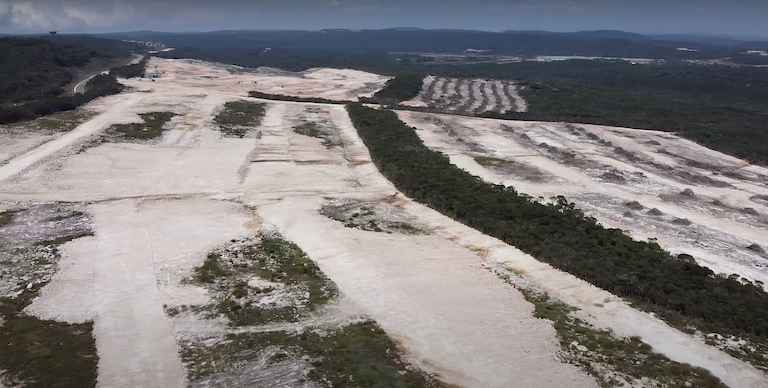
After halting forest-clearing operations in 2020, the Digoel Agri conglomerate has apparently restarted its activities in Indonesia’s Papua province, raising alarms among local Indigenous communities who say they never agreed to its presence on their ancestral lands.

Satellite imagery from the first two months of 2021 shows 64 hectares (158 acres) of deforestation in two Digoel Agri concessions, those held by its subsidiaries PT Boven Digoel Budidaya Sentosa and PT Perkebunan Boven Digoel Sejahtera, according to forest monitoring platform Nusantara Atlas.

Pusaka, an Indonesian nonprofit that analyzed the satellite imagery, says it has heard from local villagers that the conglomerate’s land-clearing contractor started bringing heavy equipment into the area in November 2020.

In 2019, Digoel Agri cleared 164 hectares (405 acres) of forest, before pausing operations in October that year, when it reportedly stopped paying staff salaries.

The concessions form part of the Tanah Merah project, a vast area on the island of New Guinea earmarked to become the world’s largest oil palm plantation. The project lies in the heart of the world’s third-largest rainforest, after the Amazon and Congo.

Development on the project has only just begun, but if it is carried through to completion, it will result in the clearance of 280,000 hectares (692,000 acres) of rainforest, releasing a huge amount of carbon dioxide into the atmosphere.

The project has been mired in controversy, such as allegations of falsified permits, conflicts with Indigenous peoples, and the use of shell companies in offshore secrecy jurisdictions to conceal the identifies of the investors behind the project, several of which remain a mystery.

Digoel Agri was founded by the family of the late Ventje Rumangkang, a founder of Indonesia’s Democratic Party who died last year. They have partnered with a New Zealand property developer named Neville Mahon, who in 2018 became the majority shareholder in the Digoel Agri subsidiaries. Neither party replied to a request for comment.

A report from Pusaka includes allegations that Digoel Agri has failed to obtain the free, prior and informed consent of local Indigenous tribes.

“The ancestral forests that have important value for their livelihoods and cultures will be gone” if the project continues, Pusaka director Franky Samperante told Mongabay, adding that the group had been unable to obtain copies of permits held by Digoel Agri.

*

Note to readers: please click the share buttons above or below. Forward this article to your email lists. Crosspost on your blog site, internet forums. etc.

Featured image: Rainforest in Boven Digoel district, Papua. (Source: Mongabay)

All Global Research articles can be read in 51 languages by activating the “Translate Website” drop down menu on the top banner of our home page (Desktop version).

***

The generally perceived attitude regarding inter-state water disputes in India has been that these should be resolved as soon as possible so that the many-sided potential of various river-valley projects can be realized as early as possible by taking up the construction of dams, canals and hydro power plants.

So when the Narmada Tribunal settlement led to resolving water sharing agreement about five decades back, this was widely seen as a great opportunity to go ahead with a number of large dam projects. However when these projects came to ground level implementation it became clear that the displacement of hundreds of thousands of people , the submergence of highly fertile farmland and invaluable forests and habitats as well as other massive ecological disruptions including intrusion of saltwater over wide stretches of coastal area were involved.

So what actually happened over the next five decades was a complete disruption of the entire  environment, livelihoods and in fact the basic geography of the Narmada region the like of which had perhaps not been seen in the past five thousand years. The tunnel vision which celebrates this change is incapable of seeing or understanding  what they  have done to peacefully living farming communities, forest and tribal communities, to various forms of life including animals and fish, to forests and habitats. If they are incapable of seeing and understanding all this, then  of course they  are also incapable of learning any lessons from this and so the possibility of such gigantic mistakes being repeated remains with us.

Recently there was celebration regarding the states of Uttar Pradesh and Madhya Pradesh reaching agreement on sharing of river waters, paving the way for the early implementation of the Ken-Betwa link project, a project that has been widely criticized, among others by several eminent experts, regarding its disruptive impacts including the felling of over two million trees, while its basic rationality in terms of its stated aims has also been  questioned seriously

But then this is only the first of many rivers inter-linking projects, conceived as components of a gigantic river-linking project at national level. Such a scenario of water sharing agreements paving the way  for hurried implementation of many dam projects may be repeated time and again, particularly as powerful construction lobbies are  often exerting pressure for this all the time.

But the real task is to first access very carefully and independently all the possible adverse impacts as well as examine the stated  benefits so that a decision which is truly beneficial for society can be taken. The fact that an inter-state agreement on sharing of waters has been reached cannot itself be taken as a signal for rushing through dam projects which have not been investigated properly regarding all their impacts and regarding which many serious questions have been raised in the past. However past experience tells us that actually agreements on water sharing are often followed by hurried execution of dam and related projects, as though water sharing agreement is by itself a green signal for this. This may prove very costly in terms of very adverse social and environmental costs. Such hurried and indiscriminate tinkering with rivers has always been costly, and it is likely to prove all the more costly in times of climate change which have brought their own uncertainties and difficulties.

The same can  be said also of projects involving sharing of water with neighboring countries. In such cases the need for caution is even more, as here any carelessness or uncalled for hurry can not only cause a lot of harm to environment and people  but also have adverse implications for relationships between two countries.

*

Note to readers: please click the share buttons above or below. Forward this article to your email lists. Crosspost on your blog site, internet forums. etc.

Bharat Dogra is a journalist and author. His recent books include Man Over Machine and Protecting Earth for Children.

Featured image is from Countercurrents

All Global Research articles can be read in 51 languages by activating the “Translate Website” drop down menu on the top banner of our home page (Desktop version).

***

There were Cold War preparations underway as early as August 1945 and the two regions selected, Korea and Vietnam, were pre-planned years in advance before the actual wars were to take place, Cynthia Chung writes.

In part one of this series, I discussed how a massive U.S. arms stockpile in Okinawa, Japan that was originally intended to be used for the planned American invasion of Japan was cancelled once the two atomic bombs were dropped on Hiroshima and Nagasaki.

L. Fletcher Prouty, who served as Chief of Special Operations for the Joint Chiefs of Staff under Kennedy and was a former Col. in the U.S. Air Force, remarks in his book “The CIA, Vietnam and the Plot to Assassinate John F. Kennedy,” that these massive arms shipments were not returned to the United States but rather, half were transported to Korea and the other half to Vietnam.

The implications of this are enormous.

It signifies that there were Cold War preparations already underway as early as August 1945 and likely much earlier, and that the two regions selected, Korea and Vietnam, were pre-planned five years in advance and the other ten years in advance respectively, before the actual wars were to take place.

What this means is that the official narrative for why the Korean War and the Vietnam War were fought are fabrications of the Cold War “reality.”

Therefore, it should be asked, what was the real reason that Americans entered these two brutal wars? Why did leading figures among the American elite, many who were so adamant on not joining in the combat against fascism in WWII, become so quickly convinced, that everything having to do with communism, was their personal responsibility to destroy?

These questions will be answered in this series titled “The Fascist Roots of the CIA.”

The CIA and the Pentagon: A Tale of Two Star Crossed Lovers

As discussed in part one of this series, with the Eisenhower-Nixon victory in 1952, the culmination of years of political strategizing by Wall Street Republican power brokers, the new heads of the State Department and the CIA were selected as none other than Foster and Allen Dulles respectively; and they would go on to direct the global operations of the most powerful nation in the world.

It is for this reason that the 1952 presidential election has gone down in history as the triumph of “the power elite.”

The entire period of April 12th 1945 to that fateful Election Day can be best understood as the first stage of America’s coup. This is especially clear between the period of 1945 and 1949, when a number of new pieces of legislation were passed which successfully reorganised the departments within the United States such that much of the government and military decisions would be beholden to the authority of a few men, men who were much more powerful than the president himself.

The National Security Act of 1947, a Trojan horse, was one of the first of this new breed of legislation and led to the creation of the Central Intelligence Agency, placing it under the direction of the National Security Council.

Although it did not explicitly authorize the CIA to conduct covert operations, Section 102 was sufficiently vague to permit abuse. By December 1947, (less than four months after the creation of the CIA), the perceived necessity to “stem the flow of communism” in Western Europe—particularly Italy—by overt and covert “psychological warfare” forced the issue and NSC 4-A was born.

NSC 4-A was a new directive to cover “clandestine paramilitary operations, as well as political and economic warfare,” this provided the authorization for the intervention of the CIA in the Italian elections of April 1948.

It was understood that the U.S. military could have no “direct” role in covert operations, since that would defeat the purpose of deniability.

The Communist Party of Italy, admired for leading the fight against Mussolini, was expected to win in Italy’s first post-war election. This, of course, was considered intolerable under the Iron Curtain diktat and American covert operations were deployed to block the anti-fascist victory. Investigative journalist Christopher Simpson writes in his book “Blowback,” how a substantial part of this funding came from captured Nazi assets. This intervention, according to Simpson, tipped the balance in favour of Italy’s Christian Democrats Party, which hid thousands of fascists in its ranks.

In just a few months from its creation, the CIA went from what was supposed to be a civilian intelligence gathering arm of the government to being responsible for covert operations including “psychological warfare.” This was a far cry from what had organised the United States prior to WWII, and which relied on a civilian army. Such a government mandate for cloak and dagger operations during a time of peace would have been considered unthinkable.

But that is why the Cold War narrative was so imperative, since under this paranoid schizophrenic nightmare, it was thought the world would never be at peace until a significant portion of it was wiped out. The Cold War defined a pixelated enemy that was under-defined and invisible to the eye. The enemy was what your superiors told you were the enemy, and like a shape-shifter could take the form of anybody, including your neighbour, your colleague, your partner…even the president.

There would always be an enemy, because there would always be people who would resist the Grand Strategy.

NSC 4-A was replaced by NSC 10/2, approved by President Truman on June 18th 1948, creating the Office of Policy Coordination (OPC). NSC 10/2 was the first presidential document which specified a mechanism to approve and manage covert operations, and also the first in which the term “covert operations” was defined.

From 1948-1950 the OPC was not under CIA’s control, but rather was a renegade operation run by Allen Dulles. OPC was brought under CIA control in October 1950, when Walter Bedell Smith became Director of Central Intelligence, and it was renamed the Directorate of Plans.

Although the CIA was strictly in charge of covert operations, it often needed the military for additional personnel, transport, overseas bases, weapons, aircraft, ships, and all the other things the Department of Defense had in abundance. In reality, the military, whether it liked it or not, found itself forever in the embrace of its toxic lover, the CIA.

Prouty writes in 1992:

OPC and other CIA personnel were concealed in military units and provided with military cover whenever possible, especially within the far-flung bases of the military around the world… The covert or invisible operational methods developed by the CIA and the military during the 1950s are still being used today despite the apparent demise of the Cold War, in such covert activities as those going on in Central America and Africa…the distinction between the CIA and the military is hard to discern, since they always work together.

A Daring Declaration

On Sept. 2nd, 1945, Ho Chi Minh signed the Declaration of Independence for a new nation, the Democratic Republic of Vietnam, which stated the following lines:

 “A people who have courageously opposed French domination for more than eighty years, a people who have fought side by side with the Allies against the Fascists during these last years—such a people must be free and independent.

Ho Chi Minh had been leading the nationalist Viet Minh independence movement since 1941 against the colonial rule of Japan. Like most of the world, Ho Chi Minh viewed the war against the fascists as aligned to a war against imperialism. He believed that if the world was to finally make a stand against such tyranny, than there would be no place for colonialism in the post-war world. The world would have to be organised according to the recognition and respect of independent nation states, along the lines of Roosevelt’s post-war vision.

After a long and horrific battle against the ruthless Japanese fascists, with support during the war from the United States and China, it was the hope of Ho Chi Minh that Vietnam could return to its former days of peace with its new-found independence from colonial rule.

The Japanese had surrendered and were leaving. The French had been defeated by the Japanese and would not return—or so it was thought.

Vo Nguyen Giap, Ho Chi Minh’s brilliant military commander, while serving as Minister of the Interior of the provisional government, delivered a speech describing the United States as a good friend of the Viet Minh. That, too, was in September 1945. Ho Chi Minh had been supplied with a tremendous stock of military equipment by the United States, and he expected to be able to administer his new government in Vietnam without further opposition.

But on September 23, 1945, shortly after the Democratic Republic of Vietnam had issued its Declaration of Independence, a group of former French troops, acting with the consent of the British forces (who had been given jurisdiction of the area from the Potsdam Conference) and armed with Japanese weapons stolen from surrender stockpiles, staged a local coup d’état and seized control of the administration of Saigon, in South Vietnam, known today as Ho Chi Minh City.

By January 1946, the French had assumed all military commitments in Vietnam and reinstalled the French government.

It should be understood that the removal of the French presence in Indochina was no small feat, since it was not only their military presence that had to be dealt with, but also its business interests including French banks, among the most powerful in Asia. The French had imposed its colonial presence in Indochina since 1787.

Negotiations between the French and the Democratic Republic of Vietnam began early in 1946. Ho Chi Minh traveled to Paris, but the conference failed due to French intransigence.

The French Indochina War broke out in 1946 and went on for eight years, with France’s war effort largely funded and supplied by the United States.

In 1949, Bao Dai, the former emperor who spent most of his time in the lap of luxury in Paris, France, was set up by foreign interest to be the puppet government of the State of Vietnam (South Vietnam).

On May 8, 1950, Secretary of State Dean Acheson announced that the United States would give both economic and military aid to France and to the State of Vietnam. The value of this military assistance surpassed $3 billion.

There was never any official reason for why the United States changed its allegiance from Ho Chi Minh to the French colonial interests and their puppet government. Although Ho Chi Minh’s belief in communism was used to justify this betrayal, the truth was that he was a threat because he considered himself first and foremost a nationalist, who believed that the Vietnamese people were one and that his nation deserved independence from colonial dominance.

It was this nationalism that could not be tolerated in areas of the world which were regarded as imperial territories and subject lands. It is for this very same reason that MI6 and the CIA staged a coup against the beloved nationalist Mosaddegh in Iran, a non-communist who held a Ph.D. in law and was well on his way to removing all British imperial claims on oil in the country after winning his case against the British at the Hague and at the UN Security Council in 1951.

This is why the interests of imperialism and fascism were often linked hand in hand, as seen with Edward VIII (though he was not alone in the British Royal family in his views), the Vichy government in France, King of Italy Victor Emmanuel III who appointed Benito Mussolini as Prime Minister in 1922 (who only deposed Mussolini in 1943 when it was clear they were going to lose the war) and Imperial Japan under Emperor Hirohito.

It is for this reason that we saw, before WWII was even over,the imperialists and the fascists in discussion with each other as to what would form the post-war world. It is for this reason that the countries chosen to oversee this Grand Strategy would be the U.S., Britain, France, Germany and Japan, rather than Roosevelt’s choice of the U.S., Russia, Britain and China.

It is for this reason that the Iron Curtain, that was originally announced, not by Churchill, but rather by German Foreign Minister Count Lutz Schwerin von Krosigk, reported in the London Times on May 3, 1945, was to announce the terms of an indefinite war against communism. In reality, it meant any country opposed to imperial rule, opposed to the idea that some were born to rule and others to be ruled, in other words, imperialism and sovereign nation states could not co-exist.

Ho Chi Minh was an ally to the Americans under the leadership of Roosevelt. However, with Roosevelt’s death and the soft coup that followed, Ho Chi Minh was now an enemy.

The Saigon Military Mission

On January 8, 1954, at a meeting of the National Security Council, President Eisenhower made his views clear that Americans did not belong in the Vietnam War. But that did not really matter.

Eisenhower, who was used to people diligently following his line of command as a General of WWII, was soon to learn that this did not apply as President of the United States.

Among those at the January 8, 1954 meeting of the National Security Council were Allen W. Dulles and his brother John Foster Dulles. There was no way that the Dulles brothers could have misunderstood the words of President Eisenhower.

Yet, on January 14, 1954, only six days after the President’s “vehement” statement against the entry of U.S. armed forces in Indochina, Secretary of State John Foster Dulles said:

Despite everything that we do, there remained a possibility that the French position in Indochina would collapse. If this happened and the French were thrown out, it would, of course, become the responsibility of the victorious Vietminh to set up a government and maintain order in Vietnam…[I do] not believe that in this contingency this country [the United States] would simply say, “Too bad; we’re licked and that’s the end of it.

Thus, the seed was planted. If the French were forced out, which was rather predictable, it was understood that the U.S. would not engage in open warfare with the Viet Minh. However, it could carry out clandestine operations against Ho Chi Minh’s forces so as to cause them trouble, or in the words of Foster Dulles “to raise hell.”

This is how American intervention and direct involvement in the Vietnam War began, a war in which the Americans had been arming both sides since 1945 and to which there was no official military objective except “to raise hell.”

According to a record of the January 14, 1954 National Security Council meeting, it was:

Agreed that the Director of Central Intelligence [Allen Dulles], in collaboration with other appropriate departments and agencies should develop plans, as suggested by the Secretary of State [John Foster Dulles], for certain contingencies in Indochina.

And, just like that, the entire overseeing of the Vietnam War was placed into the hands of the Dulles brothers.

Two weeks later, on January 29, Allen Dulles, selected Colonel Lansdale to head the team that was going to be deployed in Vietnam “to raise hell.”

Edward G. Lansdale, chief of the Saigon Military Mission, arrived in Saigon on June 1, 1954, less than one month after the defeat of the French garrison at Dien Bien Phu, for the purpose of a covert operation to conduct psychological warfare and paramilitary activities in South Vietnam.

Prouty writes:

It was not a military mission in the conventional sense, as the secretary of state had said. It was a CIA organization with a clandestine mission designed to “raise hell” with “guerrilla operations” everywhere in Indochina, a skilled terrorist organization capable of carrying out its sinister role in accordance with the Grand Strategy of those Cold War years.

…With this action, the CIA established the Saigon Military Mission (SMM) in Vietnam. It was not often in Saigon. It was not military. It was CIA. Its mission was to work with the anti-Vietminh Indochinese and not to work with the French. With this background and these stipulations, this new CIA unit was not going to win the war for the French. As we learned the hard way later, it was not going to win the war for South Vietnam, either, or for the United States. Was it supposed to?

It should be noted here that although NSC and Department of State records show that the Saigon Military Mission did not begin until January 1954, there were other CIA activities in Vietnam, Cambodia, and Laos (such as the White Cloud teams) long before 1954, and some members of the SMM had participated in these earlier activities as far back as 1945. (1)

Though Lansdale is listed as a U.S. Air Force Col. who was put in charge of the SMM, this was just a ploy. He would continue in Vietnam, as he had in the Philippines, to exploit the cover of an air force officer and to be assigned to the Military Assistance Advisory Group (MAAG) for “cover assignment’’ purposes. He was always an agent of the CIA, and his actual bosses were always with the CIA.

With Ho Chi Minh’s defeat of the French in 1954 at the Battle of Dien Bien Phu, ending the First Indochina War, it was understood that new oppositional leadership would be required if Ho Chi Minh were to be prevented from taking control of South Vietnam.

Ngo Dinh Diem would oust Bao Dai in a rigged referendum vote in 1955, becoming the first President of the Republic of Vietnam (South Vietnam). The South Vietnamese were not interested in either candidate.

The reader should take note here that South Vietnam (otherwise known as Cochinchina for centuries), had never had a real form of government because it had never been a nation in its entire existence but rather had been made up of ancient villages for several centuries with relatively little change. There was no congress, no police, and no tax-system – nothing essential to the function of a nation. Diem’s “government” was nothing but a façade of bureaucracy.

Despite this, Diem’s Republic of Vietnam was treated as an equal member of the family of nations, as if it could stand on its own two feet and respond accordingly to the crisis its people were being thrown into. The Vietnamese government that Eisenhower believed ought to be fighting the Viet Minh on its own behalf did not exist.

The choice of a predominant number of Indochinese was overwhelmingly for Ho Chi Minh. They felt no loyalty to Bao Dai, who lived in Paris, and they hated the French. Ngo Dinh Diem was a nobody, who never accomplished anything to win the hearts of his people.

The Vietnam War, as it understood today, was full of oversights. But perhaps the most serious oversight of all was that not one of the six U.S. administrations who oversaw the Vietnam War ever stated a positive American military objective for that war. The generals sent to Saigon were told not to let the “communists” take over Vietnam, period. As Prouty stated repeatedly in his book, this does not constitute a military objective.

The Saigon Military Mission was sent to Vietnam to preside over the dissolution of French colonial power. The Dulles brothers knew, by January 1954 if not long before that, that they would be creating a new Vietnamese government that would be neither French nor Vietminh and that this new government would then become the base for continuing the decade-old war in Indochina.

That was their primary objective.

The Geneva Conference, A Genocidal Exodus

The defeat of the French resulted in the Geneva Accords in July 1954 which established the 17th parallel as a temporary demarcation line separating the military forces of the French and the Viet Minh. Within 300 days of the signing of the accords, a demilitarized zone, or DMZ, was created, and the transfer of any civilians who wished to leave either side was to be completed.

Ho Chi Minh and all northern Vietnamese believed the nation to be “one.” They did not want a division of their country, as the Geneva Agreements had guaranteed.

The closing article of the Geneva Agreements, Number 14, a scarcely noticed few lines, read; “…any civilians residing in a district controlled by one party, who wish to go and live in the zone assigned to the other party, shall be permitted and helped to do so by the authorities in that district.

The ominous meaning of this was concealed under the guise of humanitarian words. The American-British note spoke of a “peaceful and humane transfer,” as if they were being kind and sensitive to the situation at hand, ready to uproot people who had lived all their lives in a settled village that had existed for tens of thousands of years.

The people of the world, most of whom had no knowledge of the Tonkinese, were led to believe that this offer was a most compassionate gesture. And, what is worse, the planners of this sinister plot were certain that the people of the world would never learn the truth, that this movement of one million North Vietnamese was really intended to be the kindling that would set the country on fire. It was a set-up and would lay the essential groundwork for America’s direct entry into the war.

The mass exodus of North Vietnamese to South Vietnam would be orchestrated by the Saigon Military Mission. This was a terrible upheaval for these people but it was sold to the West as if they were refugees fleeing Ho Chi Minh. In reality, they were fleeing the “psychological warfare” and “paramilitary tactics” today called “terrorism” that the SMM were unleashing in these small Northern villages.

In their own words, as found in documents released with the Pentagon Papers, leaders of the SMM wrote that the mission had been sent into North Vietnam to carry out “unconventional warfare,” “paramilitary operations, ” “political-psychological warfare,” and rumor campaigns and to set up a Combat Psy War course for the Vietnamese. The members of the SMM were classic “agents provocateurs.”

Prouty writes:

This movement of Catholics—or natives whom the SMM called “Catholics”—from the northern provinces of Vietnam to the south, under the provisions of the Geneva Agreement, became the most important activity of the Saigon Military Mission and one of the root causes of the Vietnam War. The terrible burden these 1,100,000 destitute strangers imposed upon the equally poor native residents of the south created a pressure on the country and the Diem administration that proved to be overwhelming.

These penniless natives…were herded into Haiphong by the Saigon Military Mission and put aboard U.S. Navy transport vessels. About 300,000 traveled on the CIA’s Civil Air Transport aircraft, and others walked out. They were transported, like cattle, to the southernmost part of Vietnam, where, despite promises of money and other basic support, they were turned loose upon the local population. These northerners are Tonkinese, more Chinese than the Cochinese of the south. They have never mixed under normal conditions. wherever these poor people were dumped on the south were given the name ‘‘Communist insurgencies,” and much of the worst and most pernicious part of the twenty years of warfare that followed was the direct result of this terrible activity that had been incited and carried out by CIA’s terroristic Saigon Military Mission.

…Nothing that occurred during these thirty years of warfare, 1945-75, was more pernicious than this movement of these 1,100,000 “Catholics” from the north to the south at a time when the government of the south scarcely existed.

It didn’t take long before the disturbance caused by the Diem-favored northern intruders onto the southern natives broke out into violence. Before long, the “friends,” according to the Diem government and its CIA backers were the one million northern Catholics, and the “enemy”—or at least the “problem”—was the native Cochinese of the south.

The time was right to fan the flames into war and to bring in the Americans.

*

Note to readers: please click the share buttons above or below. Forward this article to your email lists. Crosspost on your blog site, internet forums. etc.

Cynthia Chung is a lecturer, writer and co-founder and editor of the Rising Tide Foundation (Montreal, Canada).

Featured image is from Wikimedia Commons

India: A Year of Pandemic, Deadlock, Disaster and Dissent

March 25th, 2021 by Adv Dr Shalu Nigam

All Global Research articles can be read in 27 languages by activating the “Translate Website” drop down menu on the top banner of our home page (Desktop version).

***

The lockdown that has been imposed almost a year back in the wake of COVID-19 has introduced several changes in almost every part of the world. The virus has not only resulted in damages resulting in high mortality and morbidity, but it has also made adverse qualitative changes in the lives of billions while its socio-political repercussions have devastated economies in the Global South. The pandemic has resulted in not only widening the wealth inequalities but it has also exposed the socio-economic vulnerabilities and the way the social protection system has crumbled depriving billions of their right to dignified life. The neoliberal policies being pushed by the governments over the decades has resulted in deepening of crisis that expands during the pandemic. Also, the lockdown imposed by the state led to chain of events that resulted in the loss of hard-gained rights and further marginalized those on margins. Moreover, the records of sufferings of those vulnerable are being erased from the public memory and are being stifled by the compulsory distortion of reality.

However, those on the margins continued to resist against the authoritarian regimes. For instance, the ill-planned lockdown in India was imposed amidst the protests when the millions of citizens have been dissenting against the Citizenship Amendment Act. As soon as the lockdown is imposed with merely four hours of warning, millions of migrant workers in cities defied the plea of the Prime Minister and walked thousands of miles to reach their homes. A year later, the resistance took a different hue when thousands of farmers began protesting against the farm laws introduced by the government. Also, the unwarranted policies of intense privatization resulted in increasing unemployment pushed by the state compelled millions of workers and students to join the protest. Currently, the situation is that the state, instead of resolving the crisis caused due to the pandemic, seems to have initiated a war against its own citizens. Those in power are lamenting that `too much democracy’ is obstructing the tough reforms while ignoring the plight of the common citizens.

The year of the pandemic, therefore, is about the onslaught of repression by the state whereby the state enacted the anti-people laws and policies behind the garb of lockdown, that have deeply scarred the society, yet on the other side, it has also seen the outrage and the resistance from those who have been marginalized by the autocratic regime. Though the vaccination may heal the impact in terms of morbidity and mortality caused due to the virus, however, achieving justice, political, economic and social, or the democratic ideals as enshrined in the Constitution, may take longer in the society ridden with the inequalities and oppressions at various levels and in different forms. Presently, the situation is that more the state is muzzling the dissent abusing its repressive power, more resolutely are dissenting the protestors. It may therefore be said that the struggle against oppressive policies and laws may continue in the post-COVID world for an idea to forge a better more just world.

The Pre-Lockdown Stage

In December 2019, when the Chinese authorities identified the human case of coronavirus, its neighbor India was witnessing a huge protest against the citizenship laws where the protestors all over the country demanded to scrap the laws claiming that these are discriminatory. (Nigam, 2020 a) Started as a spontaneous gathering at Shaheen Bagh resisting against the police violence and against the citizenship laws, it emerged into a successful non-violent movement to protect the `idea of India’.  Gradually, many Shaheen Baghs emerged across the country where millions of men and women resisted against the repressive legal matrix. (The Indian Express, 2020) The goal of this movement was to protect the constitutional rights where the common people rebelled against the divisive ideology of hate. (Nigam, 2020 b) The government refused to initiate any dialogue with the protestors. Rather steps were taken by the ruling regime to malign the protestors and to question their integrity. The state portrayed the protestors as enemies of the imagined Hindu rashtra. The electricity at the protest site was cut off and the tents set up by the protestors were taken away in the freezing cold. The sites were cleared after 101 days when the lockdown was imposed whereby the protestors vowed to continue their fight for justice. (Lama, 2021) Later, during the lockdown, many students who participated have been arrested. The Supreme Court in October 2020 observed that the right to protest in public places should be balanced with the right of the general public to move without hindrance.

Accounting human losses during the strict lockdown

India imposed a strict brutal lockdown on 24 March 2020, without any preparation or consultation from various departments and ministries, when India had less than 600 cases and nine people died of the coronavirus (Purohit and Parmar, 2021).  1.3 billion population was given only four hours to prepare for the heavy disruption in their lives including restriction on their mobility and complete cessation of economic activities. In order to explain as to why the government imposed the nationwide lockdown on merely four hours notice, it is being explained that this step was taken on the `recommendation of experts’ and after `taking into account the global experience’ to prevent the danger of spread of coronavirus.  (Azam. 2020) The Oxford University tracker that calculated the governments’ response to COVID-19 has identified India’s response as one of the most stringent in the world. (India Today, 2020) Other scholars have termed it as a punitive and a draconian lockdown. (Ray and Subramanian, 2020)

However, as soon as the lockdown was announced, millions of poor men, women and children started walking from the cities to their hometowns defying the appeal made by the Prime Minister on the national television. These workers took to roads while fleeing cities and cowering police batons, in brutal heat while battling hunger and fatigue. (Nigam, 2020 c).  Some squeezed themselves in container trucks while others walked. These informal workers are backbone of economy as they construct buildings and flyovers, cook food, serve in eateries, salons, automobiles, and do other odd jobs to earn meagerly to sustain themselves in the city. However, the state did little to help these desperate citizens. The arrangements for food and the transport was done after much delay and not all those moving could be reached out.

The lockdown, hence, reminded of fear, violence and mass exodus that took place during the Partition of India in 1947 (Hajari, 2020) During the Partition, sectarian and the communal violence forced millions to cross the political boundary, however, this time, the catastrophic ill-planned lockdown endangered the livelihood of those who are survive on hand-to-mouth existence with no social security provision being made available. The fear of survival and homelessness were the major concerns that compel millions to face hardship. (Petersen and Chaurasia, 2020)   In one instance, disinfectant was sprayed on the migrant workers, others were beaten by the police, but that could not deter them to try all possible ways to return to their home.

The mass exodus also happened earlier in 1918 when the Spanish flu gripped the world. At that point of time, the British rulers were hardly concerned about the health or the economy of the colonial India, however, this time too, the state has hardly made any preparation to deal with the calamity. (Sreevatsan, 2020)  Rather the state acted to deny the sufferings of the migrant workers as it declared the pandemic as an `act of God’  (The Telegraph, 2020). Steps are taken to erase the pain and agony of those vulnerable from the public memory while distorting the reality. The human loss is being made invisible by those in power. In the Parliament it is claimed that no data is available on the death of migrant workers (The Indian Express 2020) though some organizations documented 971 non-COVID deaths of workers during the lockdown. (SWAN, 2020) Other database reported that 989 deaths occurred due to the financial distress, exhaustion, train and road accidents, suicides due to fear, absence of facilities, police brutality and so on. (Article-14.com, 2021) Many women and children were compelled to face adverse as the state failed to ensure basic minimum rights guaranteed under the Constitution. (Nigam, 2020 c)  The lived experience of Berjom Bamda Pahadiya, a 54-year-old migrant labourer from Jharkhand who arrived home from Delhi after seven months with no money in his pocket and after being looted and cheated by the contractor resonates with that of millions of other families who have been devastated during the lockdown.

The Supreme Court, too ignored the `crisis within crisis’ of the migrant workers during the pandemic because of the omission of the government to prepare for the lockdown. It is being observed that in the darkest hour, the fundamental rights of the vulnerable citizens, that constitute more than 70 percent of the population, are denied and abdicated by those sitting in the `ivory towers’ of justice though some of the high courts played a stellar role while acting with `rationality, courage and compassion’ to uphold the rule of law (Shah AP 2020; Mihir D, 2020)

How COVID-19 Pushed the Marginals beyond Margins

Economic disruptions due to lockdown also resulted not only in loss of livelihoods, wage loss, poverty, food insecurity, hunger and malnutrition, but also more children are orphaned, or are spending time in domestic work and a digital gender gap left many women and children unprepared for future. As per the UN Report, the health care disruptions caused due to the pandemic has killed 228,000 children in South Asia under 5 years of age and resulted in estimated 239,000 maternal and child deaths. The halt in crucial services such as nutrition, immunization, health care services and range of other services has affected children and increased child mortality by 15.4% in India, 13% in Bangladesh, 21.5% in Sri Lanka and 21.3% in Pakistan. The obstruction in health services with no access to contraception resulted in 3.5 million additional unwanted pregnancies including 400,000 among teenagers. The data indicates that 5,943 additional deaths occurred because of non-availability of treatment related to tuberculosis, malaria, typhoid and HIV/AIDs. The absence of basic public health and educational facilities has curtailed educational attainment of around 420 million school aged children. Only 2 out of every 3 are being reached by remote learning while denying access to children in rural areas in poor households. The report estimated that this disruption in education may cost India of US $ 52.8 billion, Bangladesh US $ 7.4 billion and Sri Lanka $ 1.9 billion in long run. The high dropout rate of adolescent girls and economic hardships of the families is resulting in early marriage and increasing adolescent pregnancies. UN Women termed the COVID-19 pandemic as a `most discriminatory crisis’ that resulted in women losing more jobs as compared to men, also women faced domestic violence or `shadow pandemic’ while pushing 47 million more women into living less than $1.90 per day. (UN 2021)

COVID-19 and the Widening Inequalities

The pandemic has resulted in weakening of economy affecting poorest of the poor while the wealth of the billionaires increased by 35 percent and by 90 percent since 2009 (Oxfam, 2021). The GDP fell down by 24 percent and the estimates suggest that it may take long to recover. The COVID-19 Economic Response Task Force was announced on 19 March 2020 to meet the economic challenges caused due to pandemic however the reports reveal that it never came into existence (ANI, 2020). The economic experts also criticized that the economic stimulus announced by the government during the lockdown remained inadequate to mitigate the effects of the pandemic. (Dutta PK 2020) The report CMIE, 2021depicts that the rate of unemployment increased by 8.7 percent in March 2020, 23.5 percent by April 2020 and by June 2020 it was 20 percent. It is in February 2021 that unemployment rate reached to 6.9 percent. However, the labour force participation rate and employment rate, both remained significantly low. Moreover, the jobs move away from high labor productive sectors such as manufacturing and services to low productivity sectors such as agriculture and construction (The Economic Times, 2021). Another research shows that the pandemic pushed 32 million Indians out of the middle class (those earning 10 to 20 $ a day) leading to sharper rise in poverty while undoing years of economic gains (NDTV, 2021). It is estimated that the number of poor people with income of less than 2$ or less each day has gone up by 75 million due to the recession induced by the pandemic. As a result, those on the brink, not only suffered due to government’s inaction but are being pushed further beyond margins. The state has done little to mitigate the social and economic impact of the pandemic rather it pushed for tough reforms and attempts are made to crush and muzzle any resistance from the citizens.

The Weak Social Protection System

During the pre-pandemic period too, the government has been pushing for tough economic reforms.  The measures such demonetization and GST has already crumpled and weakened the economy. The imposition of stringent lockdown further made adverse impacts. (Kumar A, 2020) During the lockdown, hunger and unemployment rise rapidly. The Food Corporation of India had four times the buffer stock yet the state discontinued the supply of food grains through Public Distribution System in November 2020. (Narayanan, 2021) The post pandemic recovery approach ignored the plight of the citizens as evident by the lesser allocations towards social safety programs such as reducing the expenditure on the Rural Employment Guarantee Act by 73,000 crores, leading to increasing stress for the bottom pyramid of population. Also, the government scrapped 3 crores ration cards for not linking it with Aadhaar card denying common people their basic right to food as ensured under the National Food Security Act of 2013  (NDTV, 2021) Instead of mitigating the impact of lockdown, the government initiated a series of reforms in the labour and the agriculture sector without consultation or debate from various stakeholders. These reforms aimed at increasing flexibility and supporting the employers and corporates rather than protecting the rights of the farmers or workers. Pushing such economic reforms is creating chaos. (Jha 2021)

The Farmer’s Protest

Farmers’ protest in India. Source: Green Left

It is during the lockdown that the farmers began their agitation against the three farm laws enacted by the state to liberalize the agricultural market by flouting all democratic norms. (Jain RK and V Suresh, 2021) Instead of addressing the agrarian crisis or resolving the issues relating to farmers’ debt or suicide, or providing safety nets to protect the rights of farmers, the state pushed the neoliberal agenda to empower the market. In September, 2020 while laying siege to the malls, the farmers cordoned the godowns belonging to the corporates, occupied the railway tracks and burned the effigies of the Prime Minister and the corporate bigwigs. (Ziya, 2021) On 26 November, 2020, thousands of farmers rode on tractors, bikes, cars and trucks to start an indefinite sit-in in the capital. When prevented from reaching Delhi, they camped themselves at the borders of the capital. The state though engaged with the farmers and held several discussions with them, it also acted vengefully while using water cannons in freezing cold, digging up trenches on the road and putting fenced blocked, nails, barbed concertina wires. Iron lances and maces were mixed with cement were put up blocking the roads and with these resentful actions the state also obstructed the process of negotiations. Water connection, toilet facilities and internet were blocked at the protest sites, social media was censored while draconian laws were used against the protestors while demonizing them. The protestors were dubbed as separatists, secessionists, paid protestors or Khalistanis. The international celebrities who tweeted in support of the protest were slammed whereas the international diplomats have been rebuked by the Indian government (BBC, 2021b). Multiple petitions have been filed in the courts to remove the protestors projecting the issue as right to protest versus the right to public convenience (Chaturvedi, 2020) rather than actually addressing the true causes for which the protestors raised their voice. As I write, the protest has completed almost four months, yet a breakthrough remained elusive. However, during this period, the protest that began with a group of farmers slowly is emerging as a mass struggleresonating across villages, chaupals and tea stalls (Khan, 2021). It is gaining momentum with many students and workers joining and extending their support. (Kumar, 2021)  Some are terming these developments as a satyagraha. (The Conversation, 2021)

Dissenting Citizens versus the State

The omissions and commissions by the government besides its dereliction of duties has caused much anguish among citizens – for some it entails loss of lives due to non-COVID reasons, others faced extreme starvation, debt, loss of livelihood, stress, atrocities of various kinds committed on them by police and administration in the garb of compliance of lockdown norms. The past year shows that government is at the war with its own citizens, be it women protestors at Shaheen Bagh protesting to scrap citizenship laws, the migrant workers who walked miles as soon as lockdown was imposed or the farmers who are continuing to protest against the farm laws. The state is adamant of not only dissecting the existing citizenship matrix denying the citizens their rights, but it is also pushing the neoliberal reforms guaranteeing the domination of the market. World over, the research shows that the economic liberalization has not guaranteed efficiency, rights or protection to the marginalized groups. Instead, economic approach that promotes massive deregulation has led to market volatility and has denied and deprived livelihood to many. However, the state is adamant and is muzzling dissent using various tactics. Several international organizations have intervened and called for the state authorities to protect the basic rights of the citizens to protest. (The Amnesty International, 2021)

Yet, at the local and the national level, the dissent is growing stronger. The creative non-violent resistance at the ground level is paving the way for the independent journalism (DW.com, 2021) reviving the brotherhood or `bhaicharabetween the Hindu and the Muslim communities in western Uttar Pradesh where for decades the electoral politics has utilized the divide and disharmony to its vested interest, garnering international attention (UN News, 2021, The Hindustan Times, 2021), initiating debates on issues relating to democracy and governance among the common citizens and more importantly giving voice to the women who are being excluded and made invisible for decades (Bhowmick and Sonthalia, 2021) In fact, hassled with the protests and different forms of resistance by the citizens, those in the ruling regime lamented that `too much democracy’ is making the tough reforms difficult.

Marching Ahead in Post-COVID world

A year of pandemic shows that more than a medical calamity, the crisis is humanitarian and arose because the fascist state is pushing the neoliberal agenda behind the garb of the lockdown. The lockdown has provided an opportunity to the authoritarian state to utilize its repressive apparatus to deny common people of their rights while consolidating power relationship with the rich corporates. The V-Dem Institute and the Freedom House both have downgraded the world’s largest democracy to a flawed and partially free democracy. Despite the abuse of power by the state, the masses are not blindly following the traps laid down by the corporate controlled media and are resisting to save the democratic ideals. The mass mobilization during the lockdown as evident by the farmers’ protest against the ruling regime has re-kindled a heated debate on several issues such as survival with dignity, culture, corruption, identity, federalism, dissent, democracy and more importantly the `idea of India’. The continuous resilience and resistance by the common citizens against the government’s failure to uphold the constitutional values are igniting change, depicting the power of the people and is indicating towards the strength of democracy as imagined by the makers of the constitution. The citizens driven dissent against the citizenship laws, the social movement by the farmers, or the defiance by the workers who walked thousands of miles, all are the part of articulation of disagreement with the arbitrary laws and the policies of the government by the common citizens. Whether the demands being made by the protestors crystalize into action or not, what is significant is that these protests are initiating a debate and are heightening the political consciousness that is critical to functioning of democracy. The ruling regime may arbitrarily enact the anti-people laws in haste, however the citizens are mobilizing and challenging those in power. These acts of resistance against neoliberalism as well as against nationalist communalism depict solidarity among subalterns that is essential to build a cohesive society in the post-COVID world. Looking beyond the binaries of triumph or failure of social movements is vital to bring in social transformations to shape human destinies and to reaffirm the commitments towards inclusion, justice, equality and above all the human dignity.

*

Note to readers: please click the share buttons above or below. Forward this article to your email lists. Crosspost on your blog site, internet forums. etc.

The author is an advocate, researcher, and activist working at the intersection of gender, law, governance, and human rights issues. Her publications include The Founding Mothers: 15 Women Architects of the Indian Constitution (coauthor, 2016) and Women and Domestic Violence Law in India: A Quest for Justice (2019). She has been a regular contributor to countercurrents.org and has published essays in journals such as the South Asia Journal, Social Action, International Journal of Gender and Women’s Studies, and Legal News and Views. Her forthcoming book is titled as Domestic Violence Law in India: Myths and Misogyny.

Sources

Amit Sahni v Commissioner of Police SC Civil Appeal No 3282 of 2020 https://www.livelaw.in/pdf_upload/pdf_upload-382531.pdf

ANI (2020) Shocking that the promised COVID-19 economic task force  hasn’t been set up: Chidambram, March 24, https://www.aninews.in/news/national/politics/shocking-that-promised-covid-19-economic-task-force-hasnt-been-set-up-chidambaram20200324103540/

Article-14.com (2021) India’s manufactured Amnesia over its Covid-19 lockdown deaths, March 23, https://www.article-14.com/post/india-s-manufactured-amnesia-over-its-covid-19-lockdown-deaths

Azam T (2020) Explained: Why did the Center imposed nationwide lockdown on four hours notice, Zee News, September 16, https://zeenews.india.com/india/explained-why-did-the-centre-impose-nationwide-lockdown-on-four-hours-notice-2309962.html

BBC (2021) COVID-19 disruptions killed 228,000 children in South Asia, says UN Report, March 17, https://www.bbc.com/news/world-asia-56425115

BBC (2021b) India rebukes UK MPs over farmers’ protest debate, March 9, https://www.bbc.com/news/world-asia-india-56330205

Bhowmick and Sonthalia (2021) `I cannot be intimidated. I cannot be bought’ The Women Leading the Indian Farmers’ Protest, Time, March 4, https://time.com/5942125/women-india-farmers-protests/

Bloombergquint.com (2020) Amitabh Kant says `Too much Democracy’ in India making Tough Reforms Difficult, December 8, https://www.bloombergquint.com/economy-finance/india-needs-more-reforms-states-must-take-lead-kant-2

Chaturvedi A (2020) Farmers’ Protest: The right to protest versus Public Convenience, Bloomberg, December, 21, https://www.bloombergquint.com/law-and-policy/farmers-protest-the-right-to-protest-vs-public-inconvenience

CMIE (2021) Unemployment Rate in India: Return to a declining gradient, March 1, https://unemploymentinindia.cmie.com/kommon/bin/sr.php?kall=wtabnav&tab=4080

Dutta PK (2020) Not enough: Why Covid-19 package is being criticized, India Today, May 20 https://www.indiatoday.in/news-analysis/story/covid-19-package-economic-slowdown-rs-20-lakh-crore-1680016-2020-05-20

DW.com (2021) India: Farmers’ protests give way to new independent journalism,  March 16, https://www.dw.com/en/india-farmers-protests-give-way-to-new-independent-journalism/a-56890017

Freedom House (2021) Freedom in the World 2021: Democracy under Siege, https://freedomhouse.org/report/freedom-world/2021/democracy-under-siege

Hajari N (2020) India’s COVID-19 exodus isn’t like Partition but 2020 has one thing in common with 1947, The Print, April, 1 https://theprint.in/opinion/indias-covid-19-exodus-isnt-like-partition-but-2020-has-one-thing-in-common-with-1947/393200/

India Today (2020) India scores high on COVID-19 response tracker made by the Oxford University, April, 10, https://www.indiatoday.in/india/story/india-scores-high-on-covid-19-response-tracker-made-by-oxford-university-1665573-2020-04-10

Jain RK and V Suresh (2021) Upholding the farmers’ protest: Letter, EPW, 55 (49) December 12, https://www.epw.in/journal/2020/49/letters/upholding-farmers%E2%80%99-protest.html

Jha S (2021) Privatization Files: Modi’s Flagship policy faces pushback from key ministries – BQ Exclusive, March 24, https://www.bloombergquint.com/business/privatisation-files-modis-flagship-policy-faces-pushback-from-key-ministries-bq-exclusive

Khan T (2021) Farmers’ protest acquires new dimensions, National Herald, February, 26 https://www.nationalheraldindia.com/india/farmers-protest-acquires-new-dimensions

Kumar A (2020) Indian Economy’s Greatest Crisis: Impact of Coronavirus and the road ahead, BRICs 2020 Seminar at INALCO, October 21 https://f-origin.hypotheses.org/wp-content/blogs.dir/2039/files/2020/10/Arun-Kumar-COVID-19-Indian-Economy-INALCO-2020-October.pdf

Kumar R (2021) 100 days later, the farmers’ protest is alive, well and gaining momentum, The Wire, March 7, https://thewire.in/rights/100-days-later-the-farmers-protest-is-alive-well-and-gaining-momentum

Lama P (2021) An uneasy calm in Shaheen Bagh one year after  the protest, The Hindustan Times, December 17, https://www.hindustantimes.com/india-news/an-uneasy-calm-in-shaheen-bagh-one-year-after-protest/story-ICbGQmdhTarXDLa8PbekiN.html

Mihir D (2020) COVID-19 and the Indian Supreme Court, Bloombergquint.com, May 28, https://www.bloombergquint.com/coronavirus-outbreak/covid-19-and-the-indian-supreme-court

Narayanan R (2021) What they lost in lockdown, The Indian Express, March 24, https://indianexpress.com/article/opinion/columns/coornavirus-national-lockdown-impact-migrant-workers-exodus-women-7241944/

NDTV (2021) Scrapping 3 crores ration cards for not linking Aadhaar “too Serious”: Supreme Court, March 18 https://www.ndtv.com/india-news/supreme-court-calls-scrapping-of-3-crore-ration-cards-for-not-linking-aadhaar-too-serious-2392626?

NDTV (2021) Pandemic pushed 32 million Indians out of Middle Class says Pew Research,  March 19, https://www.ndtv.com/india-news/coronavirus-pandemic-pushed-32-million-indians-out-of-middle-class-says-pew-research-2393901

Nigam S (2020) a `Rights to have Rights’ in the Context of Citizenship Matrix in India, April 27, https://papers.ssrn.com/sol3/papers.cfm?abstract_id=3566904

Nigam S (2020) b Many Dimensions of Shaheen Bagh Movement in India, March 19, https://papers.ssrn.com/sol3/papers.cfm?abstract_id=3543398

Nigam S (2020) c COVID-19: India’s Response to Domestic Violence Needs Rethinking, May 13, https://papers.ssrn.com/sol3/papers.cfm?abstract_id=3598999

Nigam S (2020) d At Beijing 25+ Battling the Backlash in the post-COVID world: A Perspective from the Third World, Paper Presented at the Conference on Beijing Platform for Action at 25: Progress, retreat and future of Women’s Rights, organized by UNSW, Australia, December 3, https://www.humanrights.unsw.edu.au/sites/default/files/2020-11/NIGAM%2C%20Shalu_Paper%20submission.pdf

Noronha G (2021) Govt has decided India’s past COVID crisis by reducing fiscal support in Budget: Yamini Aiyer, The Economic Times February 9, https://economictimes.indiatimes.com/news/economy/indicators/govt-has-decided-indias-past-covid-crisis-by-reducing-fiscal-support-in-budget-yamini-aiyer/articleshow/80755257.cms?from=mdr

Oxfam (2021) The Inequality Virus, January 22, https://www.oxfamindia.org/knowledgehub/workingpaper/inequality-virus-global-report-2021#:~:text=A%20new%20global%20survey%20of,a%20result%20of%20the%20pandemic.

Petersen and Chaurasia (2020) India racked by greater exodus since partition due to coronavirus, The Guardian, March 30. https://www.theguardian.com/world/2020/mar/30/india-wracked-by-greatest-exodus-since-partition-due-to-coronavirus

PIB (2020) PM addresses nation on combating COVID, March 19, https://pib.gov.in/PressReleseDetail.aspx?PRID=1607248

Purohit J and A Parmar (2021) After all on whose advice did the Modi government decided to impose the coronavirus lockdown? BBC Investigation March 21 https://www.bbc.com/hindi/india-56478320?xtor=AL-73-%5Bpartner%5D-%5Bbbc.news-%5Bheadline%5D-%5Bhindi%5D-%5Bbizdev%5D-%5Bisapi%5D&at_custom4=A3997576-8ACD-11EB-8EC9

Ray D and S Subramanian (2020) India’s Response to COVID-19 is a Humanitarian Disaster, Boston Review, July 16 https://bostonreview.net/global-justice/debraj-ray-s-subramanian-indias-response-covid-19-humanitarian-disaster

Salam ZU (2021) A tale of two protests: farmers’ protest and Shaheen Bagh, Frontline, February, 26 https://frontline.thehindu.com/the-nation/agriculture/shaheen-bagh-farmers-protests-modi-government-bjp-tactics-handling-crisis/article33763766.ece

Shah AP (2020) Failing to perform as a constitutional court, The Hindustan Times, May 25, https://www.thehindu.com/opinion/op-ed/failing-to-perform-as-a-constitutional-court/article31665557.ece

Sreevatsan A (2020) Why 1918 matters in India’s corona war, The Livemint, March 13 https://www.livemint.com/news/world/why-1918-matters-in-india-s-corona-war-11584033795146.html

SWAN (2020) No data, No Problem: Center in Denial about Migrant Workers Death and Distress, The Wire, September 16 https://thewire.in/rights/migrant-workers-no-data-centre-covid-19-lockdown-deaths-distress-swan

The Amnesty International (2021) India: Government must stop crushing farmers’ protest and demonizing dissenters, February 9 https://www.amnesty.org/en/latest/news/2021/02/india-government-must-stop-crushing-farmers-protests-and-demonizing-dissenters/

The Conversation, (2021) Why Indian farmers’ protests are being called a satyagraha – which means embracing the truth, February 18, https://theconversation.com/why-indian-farmers-protests-are-being-called-a-satyagraha-which-means-embracing-the-truth-155101

The Economic Times (2021) COVID-19 results in jobs moving away from the high labour productive sectors to agri construction: CMIE, January 22, https://economictimes.indiatimes.com/news/economy/indicators/covid-19-resulted-in-jobs-moving-away-from-high-labour-productive-sectors-to-agri-construction-cmie/articleshow/80402089.cms?from=mdr

The Hindustan Times (2021) On farmers’ protest, Trudeau commended India’s efforts, says MEA, February 12, https://www.hindustantimes.com/india-news/on-farmers-protest-canada-s-trudeau-commended-india-s-efforts-says-mea-101613137835167.html

The Hindustan Times (2021) COVID-19 is  a most discriminatory crisis for women: UN Women, March 16, https://www.hindustantimes.com/world-news/covid19-is-most-discriminatory-crisis-for-women-un-women-101615854090490-amp.html

The Indian Express (2020) Shaheen Bagh’s 101-days protest: Timeline of sit-in against CAA, March 24,  https://indianexpress.com/article/cities/delhi/shaheen-bagh-protests-cleared-timeline-caa-delhi-coronavirus-6328911/

The Indian Express (2020) Parliament Session:  No data available on migrant’s death during lockdown, says govt, September 14, https://indianexpress.com/article/india/india-coronavirus-job-loss-migrant-workers-death-no-data-centre-6595549/

The Telegraph (2020) `Divine Excuse’: Covid-19 as act of God, September 9, https://www.telegraphindia.com/opinion/divine-excuse-covid-19-as-act-of-god/cid/1791424

The Wire (2021) After walking for seven months, migrant labourer reaches home in Jharkhand,  March 14, https://thewire.in/labour/migrant-worker-jharkhand-seven-months-walk

UN News (2021) India: UN rights office urge `maximum restrain’ in ongoing protests, February 7,  https://news.un.org/en/story/2021/02/1084072

UNICEF (2021) Direct and indirect effects of COVID-19 pandemic and response in South Asia,  https://www.unicef.org/rosa/media/13066/file/Main%20Report.pdf

V-Dem Institute (2021) Autocratization Turns Viral: Democracy Report 2021, https://www.v-dem.net/media/filer_public/c9/3f/c93f8e74-a3fd-4bac-adfd-ee2cfbc0a375/dr_2021.pdf

Yadav JP (2021) Farmers’ Protest: Revival of brotherhood between Jats and Muslims in Western Uttar Pradesh, The Telegraph, February 23,  https://www.telegraphindia.com/india/farmer-protest-revival-of-brotherhood-between-jats-and-muslims-in-western-uttar-pradesh/cid/1807503

  • Posted in English @as @as
  • Comments Off on India: A Year of Pandemic, Deadlock, Disaster and Dissent
  • Tags:

In a Shift, Pakistan Suing for Peace with India

March 25th, 2021 by FM Shakil

All Global Research articles can be read in 27 languages by activating the “Translate Website” drop down menu on the top banner of our home page (Desktop version).

***

Pakistan has unveiled a new “geo-economic vision” that offers to “bury the past” with neighboring rival India if it reciprocates with a “relaxation” on the two sides’ long-running dispute over Kashmir.

Pakistan’s olive branch announcement, made on March 18, comes after last month’s bilateral resolution to revive an 18-year-old ceasefire agreement to end Kashmir’s Line of Control (LoC) skirmishes, which have claimed thousands of lives on both sides of the divide over the years.

By de facto offering peace with India, Pakistan appeared to turn the page on its trademark militarized rhetoric by calling for a new bilateral emphasis on “infrastructure development and regional integration” for the sub-continent.

General Qamar Javed Bajwa, Pakistan’s army chief, made the pledges while addressing the first-ever Islamabad Security Dialogue on March 18, vowing “non-intervention” in the internal affairs of neighboring and regional countries while acknowledging that unless “one’s own house is in order, nothing could be expected from the outside.”

Bajwa, moreover, called for peaceful coexistence, non-interference, boosted intra-regional trade and connectivity, and the creation of new intra-regional investment and economic hubs as the four pillars of his geo-economic vision.

“On top of it, we spend huge money on defense which creates a paucity of funds for human development programs. That is precisely the reason that despite rising security challenges, Pakistan has resisted the temptation of an arms race in the region and over time scaled down the country’s defense expenditure,” Bajwa claimed.

India and Pakistan have fought three wars over Kashmir since British colonialists left the subcontinent. Pakistan’s de-escalation of its conflict with India, of course, is still only rhetorical.

A report published this month by the Stockholm International Peace Research Institute (Sipri) placed Pakistan among the top 10 major arms importers of the world and the biggest in Asia for the period spanning 2016-2020, accounting for 2.7% of total arms sales.

Moreover, the report revealed that Pakistan had several overdue orders for arms scheduled for delivery through 2028, including 50 combat aircraft, eight submarines and four frigates from China, and four frigates from Turkey.

But the signals emanating out of Pakistan are increasingly peaceful. Prime Minister Imran Khan said that economic prosperity was possible only in a serene regional neighborhood.

“We would not take full advantage of our geostrategic location until we have regional peace and our trade relations with our neighbors restored,” he said on March 17.

The shift from a security to economics orientation will be contentious in Pakistan. A senior Pakistan Muslim League-Nawaz (PML-N) opposition leader who requested anonymity told Asia Times that General Bajwa had no constitutional right to say what he said about the nation’s future course of action vis-à-vis India.

“A soldier cannot dictate terms for a peace process, which is the job of political leadership to decide. Unfortunately, Prime Minister Khan has outsourced his responsibilities, which has disrupted the power equilibrium. That is why the army chief is overstepping his constitutional responsibilities,” he said.

The opposition politician said that Bajwa’s proposed de-escalation of border tensions and shift towards a “geo-economic” strategy ultimately aimed to push ahead stalled infrastructure development projects and regional connectivity schemes now being built under China’s global Belt and Road Initiative (BRI).

A map shows the route of the China-Pakistan Economic Corridor. Photo: Wikimedia Commons/Wanishahrukh

The two sides are currently engaged in a $60 billion China-Pakistan Economic Corridor infrastructure development program that has recently stalled on security concerns, including in Pakistan’s restive Balochistan province. Bajwa has been a major supporter of the CPEC and is a key point person for Beijing.

“Beijing’s huge investment cannot achieve its objective unless peace is returned to the region and in my view, China did play a role in bringing India and Pakistan back to the negotiation table under an 18-years old Line of Control (LoC) ceasefire agreement at a time when the situation on both sides was tense,” said the opposition politician.

The peace overtures between New Delhi and Islamabad began last month when both countries agreed on a ceasefire at the Line of Control (LoC) under an old agreement reached in 2003. A statement jointly released on February 25 revealed that the nuclear powers have agreed to follow all agreements and understandings reached since 2003 to maintain a ceasefire across the LoC.

The statement added that the Director Generals of Military Operations (DGMOs) on both sides decided to address all such mutual concerns that could create mistrust on both sides and ignite LoC violations so that the situation does not boil up on the border.

The announcement was highly unexpected, leaving analysts and observers to speculate how and why it was brokered. International media reports have suggested various behind-the-scenes motivations.

Some have speculated that the US helped to broker the deal to make Pakistan exclusively focused on the security situation in Afghanistan, which threatens to devolve into chaos and mayhem as a vowed US troop withdrawal, which may or may not happen, approaches in May.

Others have suggested China helped drive the deal. The China-India Himalayan standoff over contested territory in Ladakh, some speculate, pushed New Delhi to normalize with Pakistan, as Indian fears of a potential two-front armed conflict spiked in recent months.

The fact that India and Pakistan’s ceasefire announcement came just two weeks after China and India reached a similar arrangement reinforced the speculation. Beijing and New Delhi jointly announced a military disengagement in the north and south of Pangong Lake to end a nine-month stalemate at the Line of Actual Control (LAC).

“Does India think it has obtained nominal objectives so it is time to take an off-ramp?, Asfandyar Mir, a scholar at Stanford University who specializes in South Asian security affairs, asked.

“Alternatively, due to sustained Chinese pressure over the last year, Indian policymakers feel they need to pull back on the level of hostility with Pakistan? Both are plausible, but I speculate the Chinese pressure on India over the last year has been substantial and exerted more influence on India’s decision to de-escalate [with Pakistan.]

“India’s decision to re-engage is somewhat more surprising. For years, India has sought to keep the temperature on the LOC high not just for local, LOC-specific goals but also in the furtherance of India’s broader coercive strategy,” Mir said. “The strategy has been to change Pakistani policies of supporting various India-specific jihadists and separatism in Kashmir, as well as the country’s longstanding claim on Kashmir,” he added.

Pakistani officials, for their part, say there is no secret push behind the de-escalation of hostilities. The deal “will save innocent lives so no-one should question the intent nor should wrong inferences be drawn,” Moeed Yousaf, special assistant to Prime Minister Khan, wrote on Twitter.

“There is nothing more than (what) meets the eye here.”

*

Note to readers: please click the share buttons above or below. Forward this article to your email lists. Crosspost on your blog site, internet forums. etc.

All Global Research articles can be read in 27 languages by activating the “Translate Website” drop down menu on the top banner of our home page (Desktop version).

***

The ongoing injustices and dispossession of First Nations peoples can be seen in the devastating impact of stolen water rights.

A 2020 report from Griffith University researchers on the diminishing water rights of Traditional Owners of the rivers which make up the Murray Darling Basin confirms the extent of First Nation’s dispossession.

Trends in Aborginal water ownership in New South Wales, Australia: The continuities between colonial and neoliberal forms of dispossession details how reduced access to safe drinking water has led to difficulty in maintaining cultural practices which have helped devastate riverine environments and wetlands.

Across 10 catchments in the New South Wales portion of the Murray-Darling Basin, Aboriginal people make up almost 10% of the population. Collectively, however, they have access to just 12.1 gigalitres of water — 0.2% of all available surface water.

The population of First Nations peoples is predicted to rise to 15%, which the authors say will worsen water dispossession.

The Griffith study found that the value of water held by Aboriginal organisations was $16.5 million (over 2015–16), just 0.1% of the value of the Murray-Darling Basin’s water market.

From 2009–2018, water rights held by Aboriginal people in the Murray-Darling Basin in New South Wales shrunk by at least 17.2%, or 2 gigalitres of water per year. No new entitlements were acquired over the decade.

The federal government has set aside $40 million to buy water back for Aboriginal organisations but, so far, this has not happened. In a drastically over-allocated free market water allocation system, this is unlikely to be anything more than token.

However, last November the Victorian government announced a landmark reallocation of 2 gigalitres of water outside of the Murray Darling Basin on the Mitchell River to the Gunaikurnai Land and Waters Aboriginal Corporation.

Improvements in water management in the Gippsland region have led to unallocated water being returned to First Nations peoples for cultural, environmental and economic purposes. Aboriginal Water Rights advocate Will Mooney said the Gunaikurnai water grant showed the state government recognised First Nations’ “inherent rights” and that “water justice needs to involve that transfer of water back”.

But Troy McDonald, a spokesperson for the Gunaikurnai Land and Waters Aboriginal Corporation (GLaWAC), cautioned about the barriers that remain for Traditional Owners in their allocation of water. Writing for the November 20 The Conversation, McDonald said: “Victoria’s water entitlement framework is consumption-based — it is designed for water to be taken out of rivers, not left in.

“This can make it hard for Traditional Owners to leave water in the river for the benefit of the environment. So water entitlements and rules should be changed to reflect how traditional owners want to manage water.”

GLaWAC want water recovery reforms to cover fees and charges, which can run into tens of thousands of dollars each year.

Land rights and Native Title claims awarded to Traditional Owners in other states have excluded rights to water.

When the Barkandji of the Barwon Barka Darling Rivers won their title, after 18 years of legal battle in 2015, it came with no water, wetlands or riverine environments. These ecosystems have since all collapsed, with devastating impacts.

The Traditional Owners of Lake Victoria, near the South Australian border, have been pushing for compensation for the land and water that have been taken from them.

Murra Wurra Paakintji elder Dorothy Lawson is using laws that led to her people’s dispossession to make the claim under the Nullum Tempus Act and the principle of adverse possession for the lake where her people once lived.

Lawson said her great-grandfather, Dan McGregor, along with his Maraura contemporaries, obtained the possessory title of their homeland in western NSW in 1848, having lived there, uninterruptedly, for 60 years since the British colony was set up.

In 1922, NSW allowed SA to take charge of Lake Victoria, and use it for water storage. Three judges of the NSW Court of Appeal have now ruled that any rights Lawson held over that land were converted into a claim for compensation under the Public Works Act when SA assumed management of the lake.

It remains to be seen whether the SA Water Minister and NSW solicitors will appeal that decision in the High Court. The case is currently listed for the Land and Environment Court.

The Murray-Darling Basin Plan included detailed rules for how states must engage with the views of First Nations peoples.

But, until last year, no Aboriginal representative had been appointed to the Murray-Darling Basin Authority Board. Nari Nari man Rene Woods, former CEO of Murray Lower Darling Rivers Indigenous Nations, was finally appointed in November.

Following the litany of errors leading up to, and since, the fish kills on the Darling River, the NSW government is finally being dragged to the table.

Murray Lower Darling Rivers Indigenous Nations spokesperson Will Mooney told Green Left:

“They have had to recognise that there was a complete absence of recognition of First Nations’ water rights and that the public discussion has moved forward so much [showing] that their policy framework was seriously deficient.

“We need much stronger commitments and actions to recognise cultural flows, First Nations Rights to access water and their right to have a really strong role in water management.”

*

Note to readers: please click the share buttons above or below. Forward this article to your email lists. Crosspost on your blog site, internet forums. etc.

Featured image: Murrumbidgee River. Photo: Tracey Carpenter

All Global Research articles can be read in 27 languages by activating the “Translate Website” drop down menu on the top banner of our home page (Desktop version).

***

Abstract: This paper focuses on Meiji Japan’s annexation of the Ryukyus as seen through the eyes of key Western diplomats in the 1870s. Although it played out over seven years, the annexation process unfolded relatively smoothly on the international stage. One reason for this was the skill with which Japanese diplomats handled inquiries and potential protests by Western diplomats. In this article, I show that, as early as 1872, leading members of the Meiji government were gaining familiarity with the nuances of Western diplomatic maneuvering. Indeed, in some ways the annexation functioned as a rehearsal for future diplomatic challenges the regime would face. In retrospect, it offers an excellent lens through which to view Japanese diplomacy of the 1870s.1

*

Following the restoration of imperial power, Meiji Japan embraced modernization and, as part of this process, it sought to determine its national borders in order to create a modern nation-state. In the north, in 1869, the Meiji leaders incorporated the former foreign territory known as “Ezo,” renaming it Hokkaido; in 1875, they exchanged the island of Sakhalin with Russia in return for the acquisition of the Kuril Islands; in the south, in 1876, they annexed the Bonin Islands through a formal declaration; and in the same year, they imposed an “unequal treaty” on Korea, employing the same kind of gunboat diplomacy that Commodore Matthew Perry had used against Japan in 1853-54. Finally, in 1879, Japan formally annexed the former kingdom of the Ryukyus.

As previous scholarship has shown, by the early 1870s Japanese diplomats had recognized the interconnected nature of Japan’s unresolved border issues and the need to devise a comprehensive policy towards them.2Although I fully acknowledge the importance of understanding Meiji Japan’s national border issues as a single question, in this paper I confine myself to addressing the Ryukyuan annexation to Japan.

Dissatisfied with the Ryukyus’ ambivalent status – China and Japan both laid claims to the territory – in the new era of international relations, between 1872 and 1879 Tokyo’s leaders resorted to political and diplomatic maneuvers that aimed to formally incorporate the Ryukyu Kingdom into the newly established Meiji state. They ordered the Ryukyus to dispatch an embassy to Tokyo, where they appointed the ruling monarch as “King of the Ryūkyū Domain”; sent a punitive mission to Taiwan to avenge the deaths of a group of Ryukyuan fishermen considered to be “Japanese subjects”; concluded, through British mediation, an international agreement with the Qing court that (implicitly) stated that the Ryukyuan people were Japanese; ordered the kingdom to cease tributary relations with China; and, finally, in the face of strong resistance from the Ryukyuan authorities, annexed the kingdom by force.

Historians have conventionally referred to this process, which culminated in the establishment of Okinawa prefecture in 1879, as the Ryūkyū shobun (“the disposition of Ryukyu,” 1872-1879; hereafter “annexation”).Gregory Smits has pointed out that during the 1880s, “the shobun became an international event, involving diplomatic activity between and among China, Japan, Britain, the United States, France, and, of course, former officials of the Ryūkyūan court.”4

As Smits’ analysis suggests, the Ryukyu islands presented the new Meiji State with a diplomatic conundrum, one that involved not only relations with China, but also its relationship with several Western countries, especially those which had negotiated treaties with the Ryukyus (“Lew Chew”) in the 1850s. In other words, the Meiji leaders needed, at the very least, the powers’ tacit approval of their future plans for the islands.5

This paper focusses on the annexation as seen through the eyes of a number of key Western diplomats during the 1870s. Had these diplomats chosen to make a serious issue of Japan’s annexation of the Ryukyus, the matter could easily have become more complex and international tensions escalated. Although it played out over seven years, the annexation unfolded relatively smoothly on the international stage. One reason for this was the skill with which Japanese diplomats handled questions and potential protests by Western diplomats. As we will see, a number of their inquiries were directed specifically at the Ryukyuan treaties.6

As early as 1872, leading members of the Meiji government were becoming increasingly adept at interpreting the nuances of Western diplomatic maneuvering.7 Indeed, the annexation of the Ryukyus can be seen as an early example of the future diplomatic challenges the regime would face. In retrospect, the annexation provides an excellent lens through which to view Japanese diplomacy of the 1870s.

The Ryukyuan treaties

In 1609, the Ryukyu Kingdom was defeated by the Satsuma Domain and surrendered unconditionally; as a result, it was placed under the de facto rule of Satsuma (and by extension, of the Tokugawa bakufu).8 However, the Ryukyus continued to maintain the posture of an independent country, with Satsuma’s approval and financial support, in order to maintain tributary relations with China.9 In this way, while Satsuma gave the kingdom a high degree of autonomy in its internal affairs, it exercised considerable control over the kingdom’s foreign relations and created what Smits has called a “theatrical state” in its relations with China.10

After centuries under this arrangement, Westerners arrived in East Asia, visiting both the Ryukyus and Japan. Subsequently, the United States, France, and Holland concluded treaties of amity with the Ryukyu Kingdom in 1854, 1855, and 1859, respectively. In so doing, these Western nations recognized that the kingdom possessed at least some degree of diplomatic capacity, as the Ryukyuan authorities had signed these various agreements without the direct involvement of Satsuma officials. Ryukyuan officials drafted the treaties they exchanged with their Western counterparts in classical Chinese and dated them according to the Chinese calendar, omitting any reference to the kingdom’s subordination to Japan.

The Ryukyuan officials who negotiated with these Western powers were exercising the same kind of “theatrical diplomacy” that the Ryukyus had employed for centuries with China. While they repeatedly emphasized the kingdom’s status as a tributary of China, they never revealed their subordinate relationship with Satsuma and the bakufu.11 Although the powers’ arrival was perceived as a threat to the kingdom’s stability, and the Ryukyuan negotiators took great pains to prevent the signing of these agreements, in the end, they succumbed to the Westerners’ demands.

In the 1850s, Western observers were further prevented from fully understanding the Ryukyus’ status by the bakufu’s ambiguous replies when they asked about its relations with the kingdom. When, in early 1854, Commodore Perry demanded that bakufu officials open the port of Naha, the Japanese negotiators replied that “the Ryukyu islands are very distant and the opening of its ports cannot be discussed by us.” It was following this reply that Perry decided to sign a treaty with the Ryukyus without the bakufu’s involvement.12

On the other hand, the bakufu did not raise any objection to the compacts the Ryukyus signed with the US and France, and when in 1857 the Dutch asked the shogunate to mediate a treaty between Holland and the Ryukyus, the shogunate replied that even though the Ryukyu Kingdom shitagafu (obeys or submits) to Japan, moto yori gaikoku no koto nite (“it has been a foreign kingdom from the beginning”), and thus it would be problematic for Japan’s rulers to give instructions about such a treaty.13 From the bakufu’s perspective, the Ryukyus were subordinate to Japan, but not part of Japan; thus, they thought it prudent not to intervene in the Ryukyuan–Dutch Treaty. Although, at that time, the bakufu did not fully grasp that an international treaty was an agreement signed by two sovereign states and all the ramifications that flowed from that, it still tacitly approved the instruments signed by the Ryukyu Kingdom in the 1850s.

The Ryukyuan–American Treaty concluded on July 11, 1854, stipulated that American citizens in the Ryukyus should be treated with courtesy and friendship; Americans were granted the right of free trade and the ability to move freely on the islands without restriction, as well as the right of extraterritoriality (but not of consular residence); and that US ships in difficulty should be assisted and treated with courtesy by the Ryukyuan authorities. In the French treaty, in addition to these privileges, the Most Favored Nation clause was also included, along with rights to rent houses, land, and boats. The Dutch treaty was similar to the American treaty, but like the French instrument it also included the Most Favored Nation clause.

In the original documents, these agreements were referred to variously as “treaties,” “compacts” and “conventions.” As the treaties lacked ratification clauses, the rights and relations defined in them were valid and effective immediately following the exchange of the documents between the parties involved.14 However, while the US government ratified its treaty with the kingdom in 1855 (a purely domestic act to formally sanction the agreement), the French and Dutch government decided not to ratify their respective treaties with the Ryukyus in the late 1860s.

Last page of the 1854 Ryukyu-US Treaty
Courtesy of the Diplomatic Archives of the Ministry of Foreign Affairs of Japan (外務省・外交史料館蔵)

As early as 1862, the bakufu had revised its former policy and begun to characterize the Ryukyus as subordinate to both China and Japan, while also strongly affirming Satsuma control over the kingdom as a means of controlling the Western powers’ advances. In this way, the new policy provided the powers with more detailed – but still far from unambiguous – information about the Ryukyus and their relations with China, Satsuma, and the bakufu. Therefore, although in the 1860s the bakufu had no intention of incorporating the kingdom, it had in effect created a diplomatic environment that would prove advantageous to Meiji Japan when it eventually decided to annex the kingdom.15

Based on the foregoing analysis, it is reasonable to dismiss the Ryukyuan treaties as irrelevant and problematic in terms of Japan’s international relations. However, because they remained in place, any encroachment on the islands would potentially involve the Ryukyus’ treaty partners. In the sections that follow, I demonstrate that the discussions between the Japanese Foreign Minister, Soejima Taneomi, and the Western ministers based in Tokyo over Japan’s “alleged” annexation of the kingdom in late 1872 illustrate the intentions – and involvement – of all parties in ways that are not immediately apparent. By examining these negotiations and their outcomes in detail, I tease out Japan’s skillful responses to the powers’ demands in determining the status of the Ryukyus.16

The debate over the political status of the Ryukyus within the Meiji government

Japan’s encounter with the Western imperialist powers generated constant anxiety about the nation’s security. The Meiji leaders fully understood that the “unequal treaties,” which had been signed by the Tokugawa bakufu in the 1850s, had placed Japan in a subordinate position with respect to the Western powers and, because of this, their revision was to be given top priority.D While the main object of the Iwakura Mission of 1871-73 was the revision of the treaties, the Meiji officials who visited the US and Europe clearly understood from the inflexible attitudes of their Western counterparts that it would require a long process of radical reform to achieve their goal. The other pressing issue, as I noted at the outset, was the need for Meiji Japan to establish well-defined national borders.

Although the Meiji government had provisionally assigned control of the Ryukyus to the newly established Kagoshima prefecture (1871), in the spring of 1872, when the Iwakura Mission was abroad, Meiji leaders began to discuss the Ryukyu Kingdom’s political status in earnest. From their discussions, three main proposals emerged.

First, the deputy minister of the Ministry of Finance, Inoue Kaoru, proposed that Japan abolish the dual subordination system and, in order to enhance the prestige of the Meiji Emperor, bring the Ryukyu Kingdom under exclusive Japanese rule.18

Japan’s Foreign Minister, Soejima Taneomi, who also sought to bring the Ryukyus under Japan’s exclusive rule, proposed that, as a first step, the Ryukyuan king, Shō Tai, should receive his investiture from the Meiji emperor. Soejima also suggested appointing Shō Tai as king of a newly established Ryūkyū Domain and terminating all “private intercourse” (shikō) between the Ryukyu Kingdom and foreign countries.19

The third proposal came from the members of the sain, or Ministry of the Left, who submitted a detailed, nine-point plan that argued that Japan should maintain the status quo by declaring publicly that the Ryukyu Kingdom was subordinate to both China and Japan.20

In the event, the Meiji leaders adopted Soejima’s proposal and the Ryukyu Kingdom was required to dispatch an embassy to Tokyo.

At around the same time (early summer 1872), news of what became known as the Taiwan Incident reached the Meiji government. In 1871, a group of fishermen from the Ryukyus’ Miyako Island were shipwrecked on an isolated part of the Taiwanese coast; 54 of the 69 survivors were killed by indigenous people known as the Botan. For Japan’s leaders, the incident underlined the need to resolve the Ryukyus’ ambiguous political status and incorporate the kingdom into the new Meiji state.21

On October 16, 1872, when the Ryukyuan embassy arrived in Tokyo, the Meiji emperor formally appointed the king of the Ryukyus, Shō Tai, as king of the Ryūkyū Domain – a move that seemed intended to replicate the Chinese emperor’s investiture of the Ryukyuan royal line. Despite this installation having no precedent in relations between Japan and the Ryukyus, the Meiji leaders used it to establish a clear hierarchical relationship between the Japanese emperor and the Ryukyuan king.22 This was the first political measure taken by the Meiji leaders to bring the Ryukyu Kingdom into a closer relationship with their central government administration. It is important to keep in mind, however, that at the time these events were taking place, king Shō Tai was in Okinawa and was unaware that the Meiji government had conferred this new title on him through his ambassadors (the significance of this is made clear below).

For some Japanese officials, the emperor’s investiture of the Ryukyuan king meant that the kingdom’s international treaties were now null and void. For example, on the same day that Shō Tai was appointed king of the Ryūkyū Domain, Kabayama Sukenori, a major general in the Imperial Japanese Army hailing from the former domain of Satsuma, recorded in his diary that Shō Tai’s new role meant that the Ryukyus’ treaties with the Western powers had been effectively rescinded.23 Thus, just as the Tokugawa bakufu had not regarded the Ryukyus’ foreign treaties as an impediment to its control of the kingdom, Kabayama did not foresee further involvement of the Western powers in Ryukyuan matters now that, as he thought, the treaties had been abolished.

Shortly after the investiture, on October 30, 1872, the Meiji government replaced the resident magistrate appointed by Satsuma with a branch office of the Foreign Ministry to oversee the Ryukyus’ diplomatic relations with the powers.

Aware of the diplomatic sensitivities involved, the Meiji leaders decided against informing the Qing of Shō Tai’s new appointment, allowing the Ryukyus to continue tributary relations with China. However, during the Ryukyuan embassy’s stay in Tokyo, the Meiji government informed the American and French representatives, albeit informally, that Japan would henceforth assume responsibility for the Ryukyus – a clear indication of Japan’s new stance toward the kingdom. 

De Long’s request to the Meiji government

In the pre-telegraph age – as was the case in East Asia in the 1870s – the actions and decisions of diplomats stationed abroad often had an immense influence on the diplomacy of their governments. As we will see, it was a time when the exchange of notes between diplomats could change the status of territory regardless of the reality on the ground.

When Foreign Minister Soejima Taneomi revealed his plans for the Ryukyus to the American minister in Tokyo, Charles E. De Long, the status of the treaty that the kingdom had signed with the US in 1854 emerged as a question of major importance.24 After Soejima privately informed De Long of Japan’s annexation of the Ryukyus (as a result of Shō Tai’s appointment as king of the Ryūkyū Domain), on October 20, 1872, the American minister wrote to Soejima seeking clarification of the status of the 1854 agreement:

Understanding you advised me a few days since that the King of the Lew Chew Islands had been called upon by the Japanese Government to resign his titles and estates to it, which had been done, letters patent of nobility issued to him constituting him a member of the nobility of your Empire ranking [him] as to the former daimios, thus incorporating Lew Chew as an integral portion of the Japanese Empire; I feel called upon to call your attention to a Compact entered into between the former Kingdom of Lew Chew and the United States of America, on the 11th of July 1854 … and to ask if the same will be observed in all its provisions by Your Government within the territorial limits of the former Kingdom.25

It is clear from this letter that De Long understood (from Soejima’s words) that Shō Tai had resigned his “titles and estates” to the Meiji government and that the Ryukyus had been incorporated into Japan.26 This is an important point because, according to Japanese sources, at that time (1872) Meiji leaders had not yet made clear their intention “to annex” the Ryukyus.27 As soon as he learned of the kingdom’s new status, De Long sought assurances that the change of status would not negatively affect the US and its treaty.

De Long’s exchange with Soejima in 1872 has long been known to scholarship; previous studies have used it to demonstrate the close relationship between the two men.28 However, earlier studies have failed to consider why, of all the questions he might have put, De Long asked the Japanese government if it would take responsibility for the 1854 treaty.

De Long’s reasoning is clarified in a letter he sent to the US Secretary of State, Hamilton Fish, in which he explained Shō Tai’s new appointment and the consequent formal incorporation of the Ryukyus into Japan. De Long wrote that the king “had accepted” his new title and the kingdom’s incorporation. As we have seen, however, Shō Tai did not know what was happening in Tokyo at that time. Most likely De Long’s understanding was based on what Soejima had told him. Next, De Long noted that the Ryukyus–US Compact, which had been “proclaimed” by American President Franklin Pierce in 1855, “gave to our people certain privileges not embodied in our treaty with Japan” and that because of this he had requested, and obtained, an undertaking from the Japanese Foreign Minister to respect and observe its contents.29

Thus, De Long was unconcerned by the Ryukyus’ new status so long as Americans could continue to enjoy freedom of trade and movement in the islands – a right they did not have in Japan at that time.30

In his letter to Fish, De Long also noted that the Taiwan Incident gave the US an “opportunity” (with the assistance of the former American Consul in Amoi, General C. Le Gendre) to “put our legation at Peking and yourself [Fish] in such rapport with the views and intentions of this government [Japan] as to be of substantial benefit to us and at the same time advance my standing and intimacy with this government [Japan].”31 Because De Long was seeking to ingratiate himself with the Japanese government and be seen to cooperate with them, it seems he had no interest in verifying the accuracy of Soejima’s claims about the new status of the Ryukyus.

In response, Fish approved De Long’s request to take measures to ensure that the Japanese government would observe the Ryukyus–US Compact.32 Fish wrote that “it is supposed that the absorption or incorporation of one state by another does not discharge or release, within the limits of the absorbed or incorporated state, the obligation which it may be under to a third power at the time of such absorption or incorporation.”33 It is thus clear that in the Americans’ interpretation, Japan’s annexation of the Ryukyus was that it was a fait accompli – a precondition for future discussion with Japan as to whether it would respect the 1854 treaty.

Fish’s phrase, “it is supposed,” is of particular interest. In his view, following the incorporation of one state into another, the annexed state’s former obligations included in international treaties would not be rescinded. A thorough investigation of the position of international law on this question at that time would require a separate article. Here, however, it is sufficient to consider the point that precisely because De Long informed Fish that Japan had already assured him that it would uphold American privileges in the Ryukyus, Fish promptly approved this arrangement, which he “supposed” was in accordance with international law.34

The French government is informed of the Ryukyus’ annexation to Japan

The French Minister in Tokyo, Paul Louis de Turenne, also played an important role in events as they unfolded in late 1872.35 On October 16, 1872 (the same day Shō Tai was appointed king of the Ryūkyū Domain), Turenne wrote to his government informing it that some days previously, Soejima had told him of Japan’s intention to claim the Ryukyus, and that this decision was closely connected to the Taiwan Incident. Turenne informed Paris that he understood the reasoning behind Soejima’s plan, since the US and Prussia, which lacked bases in East Asia, might have an interest in the islands. Turenne had responded by telling Soejima that he hoped he would succeed in his intentions. Turenne also reported that he had asked Soejima whether he expected Chinese opposition to Japan’s plans for the Ryukyus, as Beijing had exercised its own rights over the archipelago for three centuries. According to Turenne, Soejima replied that he was planning to propose “a compromise” to the Ryukyuan ambassador: Japanese assistance and abolition of the traditional annual tribute to Satsuma in exchange for the ambassador’s commitment to reject Chinese “interference” in the kingdom’s affairs. Once this deal was accepted, and if the Ryukyuan “prince” (Soejima was likely referring to the king) was willing to renounce his “essential attributes of sovereignty” (aux attributs essentiels de la souveraineté), Soejima planned to have the kingdom redesignated as a han (domain) and to appoint the Ryukyuan king as a member of the Japanese court. Turenne argued that Soejima’s plan deserved serious consideration by the French government because, although he thought it unlikely that the two countries would go to war over the issue, it was likely to destabilize Japan–China relations once China learned of it.36

Turenne’s report to his government reveals that, before Shō Tai was appointed king of the Ryūkyū Domain on October 16, 1872, Soejima had already obtained Turenne’s tacit approval for Japan’s intention to annex the kingdom and transform it into a Japanese domain. Although Soejima told Turenne that he was planning to offer a compromise to the Ryukyuan ambassador, there is no evidence that any such offer was ever extended from the Meiji leaders to the Ryukyuan envoys.

A few days later, on October 29, Turenne again wrote to Paris with the news that Soejima had informed him that the Ryukyuan ambassador had accepted his offer of compromise and, as a result, “apart from the possibility of Chinese interference in this matter,” the territory’s incorporation into Japan “can be considered as accomplished.”37

Although France had earlier signed a treaty with the Ryukyus which was never ratified, Turenne did not refer to this in the letter. For him, the Ryukyu Kingdom was dependent on both China and Japan; he also saw it as the possible target of American and German imperialism, as well as a complicating factor in China–Japan relations. Like De Long, Turenne also accepted Soejima’s statements without verifying them (as we have seen, since there was no offer of compromise on the table, the ambassador could not have accepted what did not exist). Turenne did not seek clarification or verification when Soejima told him that the ambassador had accepted the offer without specifying whether the king had indeed renounced his “essential attributes of sovereignty.”

Thus, French diplomatic sources reveal that in late 1872 Soejima was already talking about the Ryukyus’ annexation to Japan to a senior French official.

At this point, some clarification is in order. Since France had decided not to ratify the treaty it had made with the Ryukyus, it is understandable that Turenne did not raise the treaty as an issue during his meetings with Soejima. As we have seen, rather than seeing the Ryukyus as an independent kingdom, Turenne maintained the view that the islands were subordinate to both China and Japan. However, it is important to appreciate that, based on the surviving sources, neither the Ryukyuan, Meiji, nor Qing governments ever made an issue of this lack of ratification. In 1862, a French mission had gone to the Ryukyus and ascertained that the treaty France had signed with the kingdom in 1855 was still being observed by the Ryukyuan authorities. Thus, from the Ryukyus’ perspective, the treaty with France remained in force. However, when in 1867 the French government (after consulting Holland about the status of its treaty with the Ryukyus) decided not to ratify the treaty, it did not notify the Ryukyu Kingdom of its decision to drop the Ryukyuan-French Treaty from its list of formal treaties.38

Thus, in the eyes of the Ryukyuan, Japanese, and Chinese governments, the Ryukyuan–French Treaty was a formal and binding agreement and, as a result, their respective heads of state considered France’s involvement in Ryukyuan affairs to be significant. In other words, far from being a mere bystander, the French government was another actor involved, at least indirectly, in the developing Ryukyuan story. 

Soejima’s response to the Western diplomats’ inquiries

At this point, let us reconsider what we have examined so far from the Meiji government’s perspective. As we have seen, neither De Long nor Turenne sought further clarification about Soejima’s assertions and informed their governments that the Ryukyuan king and his ambassador had accepted the Japanese government’s offers, including the kingdom’s incorporation into Japan.

Returning to the negotiations between De Long and Soejima – as De Long’s inquiry showed, the Americans had privileges in the Ryukyus and were unwilling to renounce their treaty rights. De Long asked that the treaty be honored in all its provisions and sine die (indefinitely). But, at the same time, by using the words “thus incorporating Lew Chew as an integral portion of the Japanese Empire,” he was effectively admitting that the Ryukyus had been annexed. Thus, De Long’s decision not to question the kingdom’s incorporation and to consult Japan alone on the future of the US–Ryukyu Compact was key to determining Soejima’s stance on the Ryukyuan-American Treaty. This had a doubly favorable outcome for Japan: It both offered Meiji leaders a prudent solution to the problem of the pre-existing treaty (by implicitly suggesting that Japan assume responsibility for it) and, more importantly, it assured the Japanese government that, so long as it upheld the treaty in all its provisions, the US would not obstruct Japanese encroachment on the Ryukyus.

Mindful of De Long’s interests, Soejima did not argue that the Ryukyus’ treaties were invalid (or had been rescinded, as some Japanese officials believed), as this would have certainly triggered American objections. As we have seen, in the 1870s Japan was politically subordinate to the Western powers and would not risk antagonizing the Americans on the Ryukyuan issue. The best option for Japan was to accede to the concessions demanded by De Long. On November 5, 1872, Soejima wrote to De Long: “The Lew Chew Islands have been dependencies of this empire for hundreds of years, and to them the title of Han [domain] was recently given.” Giving the Ryukyus the status of a domain was, according to Soejima, all that the Meiji government had done until that point. Then, using De Long’s own words, he went on: “As you [De Long] say, the Lew Chew being an integral portion of the Japanese Empire, it is natural that the provisions of a compact … will be observed by this government.”39

Soejima showed his diplomatic skills by using De Long’s own words to demonstrate that his American colleague had already acknowledged the kingdom’s annexation; this being the case, Soejima felt able to grant major concessions to the US government in return for its tacit approval of Japan’s annexation of the Ryukyus.

In assessing these bilateral discussions, it is important to appreciate that, initially, De Long had asked whether Japan would honor the Ryukyuan–American Treaty, an option that Meiji Japan might have rejected at this stage (Kabayama, for example, was talking about “abrogation” of the treaties, not “upholding” them). Consequently, Soejima accepted De Long’s suggestion that Japan take full responsibility for the treaty signed by the Ryukyu Kingdom with the US. In this way, the Meiji leaders deftly sidelined one of the strongest potential supporters of the kingdom’s autonomy, given that the American government alone had ratified its treaty with the Ryukyus.

Following De Long’s inquiry and Soejima’s response, the US and Japanese governments reached an important, albeit informal, consensus. On December 21, 1872, Mori Arinori, the representative of the Meiji government in Washington, D.C., wrote to Soejima informing the Japanese government that during a “private conversation” with Fish, the secretary of state had assured him that “so long as Japan upholds the [Ryukyuan–American] Treaty in all its provisions and does not make any changes to it, [the US government] will not raise any objections at all.”40

Thus, through an informal understanding between the two governments, the Meiji government obtained tacit approval from the US for the continuation of the Ryukyuan-American Treaty and, more importantly, of Japan’s annexation of the Ryukyus.

From that time, the Meiji government – which, as we have seen, gave little weight to France and Holland’s decision not to ratify their respective Ryukyuan treaties – handled the kingdom’s treaties with kid gloves, even to the extent of making no mention of these agreements during negotiations with France and Holland.41 In other words, Japan left both countries to make the first move in any discussion of the treaties, although the issue was never raised by either party. Japan only discussed the Ryukyuan treaties when other nations raised the matter first, as happened with the US.

In March 1873, with the clear intention of proving that Japan was in charge of Ryukyuan diplomacy, the Meiji government ordered the Ryukyus to hand over the original documents on which the three treaties were based. Although Ryukyuan officials firmly opposed the directive, the documents were seized in May 1874 and the Meiji leaders then returned to the Ryūkyū Domain a copy of the original documents. At that point, the Ryukyuan officials implored the Meiji leaders not to change the content of their treaties during negotiations with the powers.42

A number of other powers were also focusing their attention on the Ryukyuan treaties. On August 27, 1873, at the very time when the foreign ministers in Tokyo were pressing Japan to open up the interior of the country to foreigners, the Italian Acting Minister, Conte Balzarino Litta, and the German Minister, Maximilian A. S. Von Brandt, each sent very similar requests to Soejima. Having acknowledged that the Ryukyus were now an integral part of Japan (even though the islands would not be formally incorporated for six years), they asked the Meiji government to submit notes granting Italian and German vessels and citizens the same rights and privileges included in the former Ryukyuan treaties and extended to the US, France, and Holland. It is interesting to observe that both diplomats considered that, temporarily at least, the simple exchange of notes was sufficient for the granting of these concessions. The alternative, they noted, was for the Meiji government to sign a new treaty that would meet their requests, if that was its preferred option.43

Thus, while the Italian and German representatives sought major concessions (the upholding of the Ryukyuan treaties in all their provisions and indefinitely, even though neither Italy nor Germany had had formal relations with the Ryukyus), by offering to settle the issue through the exchange of notes they also made it clear that they had no intention to undermine the Japanese government; in fact, a simple exchange of letters would avoid invoking the MFN clause enjoyed by all of Japan’s treaty partners.

On September 19, 1873, Soejima replied that he would handle the matter as outlined in their proposal and would inform the Ryūkyū Domain of the new arrangements.44 In this way, in return for Italy and Germany’s tacit approval, the Meiji government granted them the same privileges enjoyed by the US, France, and Holland in the Ryukyus.

Once the Western powers (the US and France and, after 1873, Italy and Germany) had accepted that Japan had formal responsibility for the Ryukyus, Japan had only to convince the Chinese government and, to a lesser extent, the Ryukyuan authorities, who now found themselves stripped of their former (albeit “theatrical”) diplomatic status.

The Western diplomats in Japan were the representatives of imperialist states that were naturally focused on their own interests and privileges. Certainly, they did not feel any moral or other kind of obligation to advocate for Ryukyuan sovereignty or autonomy. Rather, they perceived the kingdom as a minor actor in the East Asian arena, having nothing of great value to offer their ambitions. However, the fact that a number of Western diplomats had accepted the Japanese annexation so swiftly was advantageous for the still politically weak Japan, whose attitude toward the imperialist powers veered between suspicion and admiration. At the same time, the diplomats’ acceptance of Japan’s actions put the Ryukyuan authorities into a difficult spot. They were unaware that the treaties had been superseded by Japan with Western blessing, and they wanted to maintain their former arrangements with China and Japan. In addition, the Chinese government knew nothing about the informal understanding reached by Soejima with a handful of Western diplomats. It was in this context that when in 1873 a group of Ryukyuan officials in Tokyo sought guarantees of their kingdom’s future from Soejima (who had just returned from China for the ratification of the 1871 Sino-Japanese Treaty), the Japanese foreign minister told them that the Ryukyuan polity and government would remain “unchanged through eternity” (kokutai seitai eikyū ai kawarazu).45

Significantly, Western documents reveal information about the annexation that is not found in Japanese sources. In private meetings, Soejima sought to justify the Japanese incorporation of the Ryukyus by assuring De Long and Turenne that the Ryukyuans – the Ryukyuan king and his ambassador – had accepted annexation, despite the fact that this was not the case. In other words, during the build-up to formal annexation, Soejima was careful to ensure that both the US and France (powers that had signed treaties with the Ryukyus) would not raise any objections to Japan’s plans.

Britain had its own intelligence sources on the matter. On October 22, 1872, the British Acting Minster in Tokyo, R. G. Watson, informed his government of the arrival of the Ryukyuan embassy in the Japanese capital, noting that the Meiji government “it seems has taken advantage of the visit of this mission to take Loochoo entirely under its protection, and to incorporate it with the Japanese Empire” as a “Han.”46 It seems that Watson did not receive this information directly from Soejima, as De Long and Turenne had done. Apparently, Soejima selected the diplomats to whom he disclosed Japan’s plans for the Ryukyus.47

The legacy of De Long’s inquiry and Soejima’s response

In May 1874 Meiji Japan invaded Taiwan to revenge the 1871 massacre of a group of shipwrecked Ryukyuan fishermen.48 Although, following protracted negotiations between China and Japan, the two countries signed an agreement on October 31, 1874, they failed to agree on the status of the Ryukyus.

A year later, in early 1875, what was to be the last Ryukyuan tributary embassy arrived in Beijing. The Taiwan Expedition and the arrival of this mission in China showed that the Ryukyus had not in fact been incorporated to Japan, as previously declared in the American and French dispatches.

At this point, the Japanese Acting Minister in Beijing, Tei Einei, informed his American colleague, Minister B. P. Avery, that the Meiji government had decided to assert “the complete jurisdiction of Japan over the islands.” On May 30, 1875, Avery informed the US Secretary of State, H. Fish, of these developments.49

On July 29, 1875, Fish wrote to John Bingham, who had replaced De Long in Tokyo two years earlier, reminding him that “A compact was concluded between the United states and the Royal Government of the Lewchew … granting certain privileges to American citizens and vessels going to the Lew Chew islands.” Fish was citing the very words used by De Long in 1872; now, he instructed Bingham to “examine the question, and in the event of any consolidation of those islands by Japan, see to it that our compact be preserved, unless it should be found more advantageous … to apply the treaty with Japan.”50

These exchanges show that, mindful of the 1872 developments, Fish focused on American privileges that must be “preserved” or even increased in the event that the treaty with Japan proved more advantageous to the Americans in the Ryukyus.

Following Fish’s instructions, on April 4, 1876 Bingham wrote to the Japanese Foreign Minister, Terashima Munenori: “I make these inquiries because it is the wish of my Government to know whether anything has been done in the premises which in anywise contravenes, limits, or changes the subsisting compact between my Government and that of the Lew Chew Islands.”51 Again we see a persistent concern that Japan preserve US treaty rights in the territory of the Ryukyu Kingdom.52

On May 31, 1876, Terashima (who had asked about, and consequently been informed by the Meiji government about Soejima’s 1872 response to De Long53) replied to Bingham, writing that “this government [Japan] has not at any time interfered with the rights of the United States as secured by its subsisting compact with the Lew Chew and before taking such action this Government will confer with the Government of the United States.”54

We can observe a nuanced shift in the Japanese strategy around the Ryukyuan–American Treaty. Whereas in 1872 Soejima had promised De Long to uphold the treaty in its entirety and indefinitely, in 1876, Terashima informed Bingham that Japan had been maintaining American privileges in the Ryukyus. Although, in the near future, Japan was planning to make some changes to the arrangement, he assured his American colleague that “before taking such action,” the Meiji government would inform the US government.

After receiving Terashima’s reply, the US government did not make further inquiries on the matter and, for a second time, the Ryukyuan issue was settled through an exchange of notes between the Japanese Foreign Minister and the American Minister in Tokyo. 

The Ryukyus’ request for help from the US and France in 1878

As part of their attempt to preserve the kingdom, the Ryukyuan authorities called on the US, France, and Britain (whose diplomats also represented the Dutch government in Tokyo) for help. While the events of 1878-79 require a detailed and thorough analysis, in what follows I set out only the major points for reasons of space.55

In August 1878, the American minister John Bingham met a group of senior Ryukyuan officials in Tokyo, who urged the US government to prevent the annexation of their kingdom to Japan. In drafting their petitions, these officials received a good deal of support and guidance from the Chinese legation.

The petitioners set out in detail the five-century history of tributary relations between China and the Ryukyus; they explained that the US, France, and Holland had concluded treaties with the Ryukyus, specifying that the agreements were to be written in Chinese and dated according to the Chinese calendar. “As to our intercourse with Japan” before 1868, the petitioners merely stated that “it was formerly with the dependency of Satsuma.” Next, they detailed the “compulsory orders” issued by the Meiji government from 1872 onward, which, among other things, specified that “all business” in the islands “should be transacted with the Department of Foreign Affairs.” They pointed out that “in your petitioners’ humble opinion though our kingdom be but a small nationality, nevertheless, it is a nationality.” On the treaties, they argued that if the Ryukyus had been prohibited from enjoying the same tributary relations with China, since “the treaties into which we have entered” were written in Chinese and dated according to the Chinese calendar, they “will be like so much wastepaper.” Finally, they pointed out that as “the United States recognized and treated Lew chew as a distinct nationality and permitted us to enter into treaty relations, … we turn to the United States, in the hope that they may advise and induce Japan to leave Lew Chew to remain as it has been hitherto.”56

In sum, the approach taken by the petitioners was to seek Western support based on the Ryukyus’ existing treaty relations and to paper over their former relations with Satsuma and the bakufu.57 (The petitions handed to the French and British legations were very similar in content.)

In response, Bingham informed his government that Japan’s demands on the Ryukyus infringed the Ryukyus–US Treaty and, more importantly, that “It seems to me that this Government [Japan] is too late in asserting supreme authority over those islands after allowing them perfect freedom for five centuries, and manifestly assenting to the action [the signing of the Ryukyu-US Treaty] taken by Lew Chew with our own Government in 1854.”58

Bingham’s response is significant because of the chain of logic that it demonstrated: based on his own interpretation of international law, a senior Western diplomat had concluded that – because Japan had allowed the Ryukyus to continue their relations with China and sign a treaty with the US – there was a good case for the Ryukyus to be seen as independent of Japan. Bingham saw the infringement of the Ryukyuan-American Treaty as a possible reason for American involvement in the issue. Bingham’s criticism of Japan is especially significant when we consider that, in contrast to most Western diplomats, he had displayed an empathy and sensitivity toward Japan during his long tenure in Tokyo (1873-1885) and made serious efforts to revise the many “unequal treaties” that Japan had concluded with the West.59

We cannot dismiss the fact, however, that Bingham based his opinions on the Ryukyuan petition, which failed to mention Satsuma’s de facto control of the Ryukyus.

In late 1878, the American assistant secretary of state, F. W. Seward, replied to Bingham: “According to the information in the possession of the Department the independence of the Lew Chew Islands is a matter of dispute solely between the government of China and the Lew Chew Islands on one side and the government of Japan on the other, and is a question in which this government cannot interfere unless its rights under Treaty stipulations with any of the powers concerned in the controversy appear to be endangered.” Seward also reminded Bingham that “This declaration (the previously mentioned Terashima’s reply to Bingham of May 31, 1876) of the Minister of Foreign Affairs does not appear to be inconsistent either with the stipulation of the instrument above referred to or with any information hitherto communicated to this Department.”60 In other words, the US government saw no reasons to intervene in the matter because Japan had been continuing to honor the Ryukyus–US Treaty.

The Ryukyuan officials fared no better with France. In late 1878, while the Chinese legation in Japan was pressing the Tokyo-based French minister Louis de Geoffrey (who had arrived in Japan a year earlier) to meet the Ryukyuan envoys, Geoffrey wrote to his government that he was trying to avoid meeting the Ryukyuan officials and, more importantly, that France had “no direct interest” in supporting Chinese (and Ryukyuan) claims, even if they were supported by the “law” (or even if they were simply “just”). He also argued that if France had to choose between China and Japan on the issue, it would do better to support Japan, through which “we have more to gain in moral and material [terms].”61

In the end, the Chinese legation succeeded in arranging an appointment between the Ryukyuan envoys and Geoffrey; however, the minister did not change his mind after meeting with the Ryukyuan officials and reading their petition.

At the time, French sympathies were warmer towards Japan than China, as France’s relations with China were becoming increasingly complicated and strained over the Tonkin question concerning the status of northern Vietnam on China’s border. However, it is also important to note that Geoffrey refused to support the Ryukyus, not because France had not yet ratified its treaty with the tiny kingdom, but because he did not foresee any direct interest in championing its cause.62

In early 1879, after a summary of the Ryukyuan officials’ petitions had been published in the Nichi Nichinewspaper, the British minister in Japan, Harry Parkes, questioned Foreign Minister Terashima Munenori about Japan’s plans in the Ryukyus. When Parkes insisted that it was commonly understood that the Ryukyus had been paying tribute to China (in addition to Japan), Terashima argued that the distinction between “tribute” and “taxes” proved that the Ryukyus had not been subordinate to the Qing, but only to Satsuma, which had been collecting taxes from the kingdom.63 This distinction became a crucial argument in Japan’s claims on the Ryukyus as East Asia subscribed increasingly to Western-based international law.

Towards bilateral negotiations

As we have seen, the Meiji government did not rescind the Ryukyuan treaties; instead, Soejima and Terashima promised the powers that their privileges in the Ryukyus would continue. Their promises to the US government bore fruit at the precise moment when the Ryukyuan authorities were seeking American help.

On the other hand, from late 1878, Qing officials were at pains to point out to Japan and Western diplomats alike that the Ryukyu Kingdom had concluded international treaties on its own behalf. The Chinese claims were mainly based on the fact that the kingdom had been a tributary of China for centuries, that the Ryukyus had signed these foreign treaties as an independent state, and that annexation would be in violation of the 1871 Sino-Japanese Treaty.64

After the Qing court began issuing strongly worded protests through its Tokyo-based diplomats opposing Japan’s action in the islands and Ryukyuan officials petitioned foreign diplomats, the Meiji government decided to proceed with formal annexation to avoid the Ryukyuan issue escalating into an international dispute.

Shortly after the establishment of Okinawa prefecture in April 1879, Meiji constitutional expert Inoue Kowashi handed the Japanese government an important memorandum discussing potential friction between Japan and China over the new prefecture.65 Inoue, who drafted most of Japan’s diplomatic documents in the 1870s and 80s, told his government that the three treaties which the Ryukyu Kingdom had signed in the 1850s would likely become a major sticking point for Japan.66

In the memorandum (dated July 3, 1879), Inoue pointed out that if the Qing were to claim that the Ryukyus were a semi-independent state, the Meiji government would find it very difficult to counter this argument. Inoue pointed to numerous examples in the West where, when a powerful state tried to annex a small country which was unable to defend itself, other powers joined together to oppose the incorporation. Inoue feared that the Qing might join with the powers and apply this strategy to the Ryukyus; in such a case, Japan would need to work very hard to counter this kind of argument.

Next, Inoue pointed out that the fact that the Ryukyus had signed treaties with the US, France, and Holland in the 1850s was “a matter of the greatest difficulty” (ichi no kon’nan naru jijō). Because this was tantamount to the bakufu leaders tacitly approving these agreements, the Meiji government would be at great pains to defend its position; moreover, these treaties were valid instruments. Dated according to the Chinese calendar, they were written in Western and Chinese languages, and were formally treaties of amity. Although the Ryukyus had been a Japanese dependency of Satsuma, in their external relations they had seemed to function as an independent state, thus giving the Chinese plenty of ammunition for their claims.

Next, after retracing the exchange of notes between Soejima and Terashima with their American counterparts, and noting that Japan had never made arrangements with France and Holland about the treaties, Inoue pointed out that when the Japanese foreign ministers had advised the American diplomats that Japan would continue to uphold the Ryukyuan-American treaty, this implied that the Meiji government had admitted that the Ryukyuan treaties were valid instruments. It also proved that the Meiji leaders had recognized that, in the past, the Ryukyus had the “right” (kenri) to sign treaties. Given these realities, Inoue foresaw major obstacles for the Meiji government as it sought to support its claims through the lens of international law.67

Inoue warned that what Smits has called the Ryukyus’ “theatrical state and diplomacy,” as well as the Meiji government’s decision to uphold the Ryukyuan-American Treaty, might turn out to be detrimental to Japan’s claims when placed under the spotlight of international law. It is important to note, however, that while Inoue urged his government to prepare counter-arguments to the Chinese claims, he also appreciated that the treaties would become a problem for Japan if the Ryukyuan question became an international issue – that is, if the Western powers became involved (a possibility that, for various reasons, failed to eventuate).68

At the very time Inoue was presenting his memorandum, a number of key diplomats informed their goverments about the Ryukyuan issue. On August 1, 1879, the day that Parkes sent the Ryukyuan petition to the British government, he wrote that “a difference of a grave character has arisen between the Governments of China and Japan” over Japan’s actions in the islands. He stated that, while the Ryukyuan people had been paying tribute to both countries, “they have at the same time formed a separate nationality and have enjoyed their own autonomy.”69 Then, when on August 29 Bingham sent the American government translations of the original documents that the Meiji leaders had presented to the Chinese government on July 16 concerning relations between the Ryukyus and Japan up to 1868 (including the surrender documents signed by the Ryukyuan king and his officials in 1611), he observed that “The paper does not in my opinion make a very strong case if indeed it makes any case whatever for the action taken by Japan in 1872 and since.”70 When Parkes sent the same translations to his government, he wrote “It seems to me that in claiming that they have exercised sovereign control over Loochoo for a long period…the Japanese Government omit to explain why they permitted Loochoo to keep up direct official relations with China…and to send every other year, with marked regularity and considerable ceremony, Public Envoys with tribute to the Court of Peking.”71 It seems that, in the months following their reception, a number of influential Western diplomats had been influenced by the arguments of the Ryukyuan petitioners.

As Inoue’s memorandum shows, the Meiji leaders had already grasped the diplomatic significance of the Ryukyus’ treaties and their potential legal significance. However, since the Ryukyu Kingdom had concluded several international treaties, it lay with the Western powers to choose to minimize their importance; and it was only because of their tacit approval that Meiji Japan was able to take a stronger stance toward China over the treaties.

In late 1879, after the Chinese reasserted their claim that the Ryukyu Kingdom was both a tributary of China and an independent kingdom (citing its international treaties as evidence), the Meiji government strongly rebutted their claims.

The Meiji leaders continued to frame the annexation of the Ryukyus as simply a matter of domestic reorganization by the Japanese government; among other arguments, they asserted that the tribute China had received from the kingdom was merely nominal, and that China’s investiture of the Ryukyuan kings was an empty title. On the other hand, by employing legal notions of effective possession and rule, the Japanese leaders claimed that the Satsuma domain had exercised “substantial effects” upon Ryukyuan “laws, taxes, and internal administration.”72

With regard to the treaties, the Meiji leaders asserted that the Qing had “absolutely no relation” with the Ryukyuan treaties and that the Western powers were the only “parties concerned” (tōjisha). They added that the powers had not grasped the true relations obtaining between Satsuma and the Ryukyus, and that during the pre-modern era, many arrangements had been agreed (according to feudal principles) that would be inconceivable in the present era of centralized government. And they had already assured the Western nations involved that Japan would uphold the treaties. Based on these arguments, the Meiji leaders concluded that the treaties in no way proved that the Ryukyus had not been an “internal dependency” (naizoku) of Japan.73

Even after the kingdom’s formal annexation, the Ryukyuan treaties were never formally abolished74; in late summer 1879, the Meiji government considered assuring the French government that it would uphold the latter’s treaty rights in the Ryukyus (an option that was later abandoned after the Meiji leaders realized that the Ryukyuan-French Compact was not listed among France’s formal treaties).75

In 1880, following the advice proffered by former US president Ulysses Grant, Japan and China agreed to enter bilateral negotiations aimed at settling the Ryukyuan issue. Japan sought to exploit its established position in the Ryukyus to put pressure on the Qing to grant it equal status with the Western powers in China. In the end, however, the two states were not able to find a compromise, and it was Japan’s victory in the First Sino-Japanese War of 1894-95 that, among other factors, effectively resolved the Ryukyuan question in Japan’s favor.

Conclusions

This study has set out to show that, as early as the 1870s, Japanese diplomats were increasingly mastering the nuances of Western-style diplomatic maneuvering. The skill with which Soejima and Terashima handled inquiries and potential protests by Western diplomats bears witness to this point. Soejima persuaded his Western counterparts that the Ryukyuan king and his ambassador had freely accepted Japanese annexation, while, on the other hand, he promised the Ryukyuan envoys that Japan would not change the kingdom’s traditional polity and government.76 In his memorandum, Inoue Kowashi showed a deep understanding of the theory of the balance of power and clearly appreciated that the bakufu’s tacit approval of the Ryukyuan treaties, as well as the Meiji government’s promise to honour the Ryukyuan-American Treaty, could very well undermine Japan’s claims. On the other hand, Chinese and Ryukyuan officials showed their skill in leveraging Western concepts of soveregnty and nationality, which clearly had an impact in 1878-79 on the Western diplomats’ understanding of the Ryukyuan issue. This study has also demonstrated that Meiji Japan benefitted massively from the responses of the Western powers over the issue, which helped pave the way for Japan to annex the Ryukyus from early in the process, and take a stronger stance toward China in the aftermath of annexation.

This latter point is a crucial one, as the annexation of the archipelago was, along with the incorporation of Hokkaido, one of the first expansionist expressions of the newly Japanese nation-state of the Meiji era. Placed in a politically subordinate position and constantly fearing Western intrusion, Japan understood the importance of granting concessions to the Western powers in return for their tacit approval of its encroachment on the Ryukyus. This cooperation was possible because, in the 1870s, Japan and the powers had mutual interests in the Ryukyus, namely Japan’s need of the powers’ tacit approval and the latters’ willingness to preserve their privileges, and they were able to satisfy their different interests through an informal exchange. On the other hand, the Meiji leaders felt emboldened to strike an uncompromising stance toward their Asian neighbors which, from that point on, would rapidly intensify. In fact, it was at the very moment that Japan annexed the Ryukyus that the Qing began to question its traditional policy of non-interference toward Korea. Indeed, the annexation of the Ryukyus can be seen as the first expression of the diplomatic challenges that Meiji Japan would face in the future. Looking back, the annexation provides an excellent lens through which to view the Meiji government’s early diplomacy toward East Asia and the West.

*

Note to readers: please click the share buttons above or below. Forward this article to your email lists. Crosspost on your blog site, internet forums. etc.

Marco Tinello is an assistant professor of East Asian and Japanese history in the Faculty of Cross-Cultural and Japanese Studies at Kanagawa University.

Primary sources

France. Ministère des Affaires Étrangères, Paris. Correspondance politique (CP), Japon, 1854-1896.

British Foreign Office, Japan Correspondence (FO 46/156, FO 46/247).

Foreign Relations of the United States (FRUS), United States Department of State, Executive documents printed by order of the House of Representatives. 1873-’74, Vol. I, Washington, D.C.: U.S. Government Printing Office, 1873-1874 (University of Wisconsin Digital Collections, last access on February 18, 2021).

France. Ministère des Affaires Étrangères, Paris. Correspondance politique (CP), Japon, 1854-1896.printed by order of the House of Representatives. 1873-’74, Vol. I, Washington, D.C.: U.S. Government Printing Office, 1873-1874,University of Wisconsin Digital Collections, last access on February 18, 2021).

Foreign Relations of the United States (FRUS), United States Department of State, Executive documents printed by order of the House of Representatives. 1875-’76, Vol. I Washington, D.C.: U.S. Government Printing Office, 1875/1876, University of Wisconsin Digital Collections, last access on February 16, 2021).

Gaimushō chōsabu (ed.), Dai Nihon gaikō bunsho DNGB, Nihon Kokusai Kyōkai, 1939.

Inoue kowashi denki hensan iinkai (ed.), Inoue Kowashi den, shiryō hen dai ichi, 1966.

Meiji bunka shiryō sōsho kankōkai (ed.), Meiji bunka shiryō sōsho, vol. 4, gaikō hen, Kazama shobō,1959-1963.

Tokyo daigaku shiryō hensanjo (ed.), Dai Nihon komonjo bakumatsu gaikoku kankei monjo (BGKM), Tokyo, Tokyo daigaku shuppankai, 1972.

United States. Department of State. Diplomatic Instructions of the Department of State, 1801-1906, Japan, N. A., RG59, M 77, Roll 105, Vol. 2.

United States. Department of State. Despatches from the United States Ministers to Japan, 1855-1906, (N.A., RG59, .M 133), Roll 21 and 38.

Yokoyama Manabu (ed.), Ryūkyū shozoku mondai kankei shiryō, Honkoku shoseki, dai 2 shū, dai 6, jō-chū, 1980.

Secondary sources

Beillevaire, Patrick, “Furansu seifu no tai-Ryūkyū koku seisaku,” in Furansu ni okeru Ryūkyū kankei shiryō no hakkutsu to sono kisoteki kenkyū, Heisei 9 nendo~Heisei 11 nendo, Kagakukenkyūhi hojokinn kiban kenkyū (A) (2) Kenkyū hōkokusho, 2000.

Caroli, Rosa, Il Mito dell’Omogeneità Giapponese: Storia di Okinawa, Milano, Franco Angeli, 1999.

Duus, Peter, The Abacus and the Sword: The Japanese Penetration of Korea, 1895-1910, University of California Press, 1998.

Eskildsen, Robert, Transforming Empire in Japan and East Asia: the Taiwan Expedition and the birth of Japanese Imperialism, Palgrave Macmillan, 2019.

Gabe Masao, Meiji kokka to Okinawa, Tokyo, San’ichi shobō, 1979.

Hammersmith, Jack L., Spoilsmen in a “flowery fairyland”: the development of the US Legation in Japan, 1859-1906, Kent, Ohio, Kent State University Press, 1998.

Kabayama Aisuke, Chichi, Kabayama Sukenori, Tokyo, Denki sōsho 44, Ōzorasha, 1988, 186.

Kamiya Nobuyuki, Bakuhansei kokka no Ryūkyū shihai, Azekura shobō, 1990.

Mayo, Marlene J., “A Catechism of Western diplomacy: the Japanese and Hamilton Fish, 1872,” The Journal of Asian Studies, Vol. 26 No 3 May 1967.

McWilliams, Wayne C., “East Meets East: the Soejima Mission to China, 1873,” Monumenta Nipponica, 30, 1975, 237-275.

Miller, Hunter (Ed.), Treaties and Other International Acts of the United States of America, Vol. 6, Publications of the Department of State no. 1719, United States Government Printing Office Washington, 1942, 755

Mizuno Norihito, “Early Meiji Policies Towards the Ryukyus and the Taiwanese Aboriginal Territories,” Modern Asian Studies 43, 2009, 683–739.

Mori Toshihiko, “Soejima Taneomi no tai-Shin gaikō, Hōgaku zasshi, 41-4, 1995, 485-519.

Namihira Tsuneo, Kindai Higashi Ajia no naka no Ryūkyū heigō: Chūka sekai chitsujo kara shokuminchi Teikoku Nihon he, Tokyo, Iwanami shoten, 2014.

Nishizato Kikō, Shin-matsu Chū-Ryū-Nichi kankei-shi no kenkyū, Kyoto, Kyoto daigaku shuppankai, 2005.

Okabe Toshikazu, “Bei-Futsu-Ran sankakoku jōyaku to ‘Ryūkyū shobun,’” Higashi Ajia Kindaishi, 23, 2019.

Okamoto Takashi, Chūgoku no tanjō: Higashi Ajia no kindai gaikō to kokka keisei, Nagoya daigaku shuppankai, 2017.

Ozawa Yōsuke, “Gaimushō kankatsu-ki ni okeru tai Ryūkyūhan seisaku,” Hōsei shigaku, vol. 87, Hōsei daigaku shi gakkai (ed.), 2017.

Smits, Gregory, “The Ryūkyū shobun in East Asian and world history,” Josef Kreiner, ed., Ryukyu in World History. Bonn, Bier’sche Verlagsanstalt, 2001.

Smits, Gregory, “New Cultures, New Identities: Becoming Okinawan and Japanese in Nineteenth-Century Ryukyu,” in James Ketelaar, Yasunori Kojima, Peter Nosco (eds.) Values, Identity, and Equality in Eighteenth- and Nineteenth-Century Japan, Brill, 2015, 159-178.

Smits, Gregory, “Rethinking Earlier Ryukyuan History”, The Asia-pacific Journal: Japan Focus, Vol. 17, Issue 7, April 2019.

Smits, Gregory, Maritime Ryukyu, 1050-1650, University of Hawaii Press, Honolulu, 2018, 251-252.

Tinello, Marco, “A New Interpretation of the Bakufu’s Refusal to Open the Ryukyus to Commodore Perry,” The Asia-Pacific Journal, Japan Focus, Vol. 16, Issue 17, No. 3, 2018.

Tinello, Marco, Sekai-shi kara mita ‘Ryukyu shobun’, Ginowan, Yōju shorin, 2017.

Tinello, Marco, “Senhappyakurokuju nendai ni okeru Tokugawa bakufu ni yoru Ryūkyū no ichiduke: bakufu ga Igirisu seifu ni teishutsu shita ‘hensho’ to hokokusho wo chūshin ni,” Tōyō-shi kenkyū 78, no.3 (2019), 72-103.

Uehara Kenzen, Kurobune raikō to Ryūkyū ōkoku, Nagoya daigaku shuppankai, 2020.

Umeki Tetsuto, Shin Ryūkyū koku no rekishi, Tokyo, Hosei daigaku shuppankyoku, 2013.

Yamamoto Takahiro, Balance of favour: the emergence of territorial boundaries around Japan, 1861-1875, PhD Thesis, The London School of Economics and Political Science (LSE), 2015.

Yamashita Shigekazu, Ryūkyū-Okinawa shi kenkyū josetsu, Ochanomizu shobō, 1999.

Yokoyama Yoshinori, “Nihon no kaikoku to Ryūkyū,” Kokka to taigai kankei: atarashii kinsei-shi 2, Shin jinbutsu ōraisha, 1996.

Watanabe Miki, “Inpei seisaku no tenkai to Ryū-Shin-Nichi kankei,” Ryūdai shigaku, vol. 20, 2018.

Notes

This paper is a fully updated version of Marco Tinello, Sekai-shi kara mita “Ryūkyū shobun”, Yōju shorin, 2017. I deeply thank Professor Gregory Smits for his invaluable comments and suggestions that allowed me to greatly improve the quality of the manuscript.

Robert Eskildsen, Transforming Empire in Japan and East Asia: the Taiwan Expedition and the birth of Japanese Imperialism, Palgrave Macmillan, 2019. Yamamoto Takahiro, Balance of favour: the emergence of territorial boundaries around Japan, 1861-1875, PhD Thesis, The London School of Economics and Political Science (LSE), 2015.

Considering that, when annexing the Ryukyus, the Meiji government’s chief priority was eliminating the archipelago’s traditional subordination to both China (from the 14th century) and Japan (from the 17th century), earlier studies have understandably viewed the annexation as an event in which the Ryukyus, Japan, and China were the main actors. See, for example, Kinjō Seitoku, Ryūkyū shobun ron, Okinawa taimususha, 1978; Araki Moriaki, Shin Okinawa shiron, Okinawa taimususha, 1980; Gabe Masao, Meiji kokka to Okinawa, San’ichi shobō, 1979; Rosa Caroli, Il Mito dell’Omogeneità Giapponese: Storia di Okinawa, Milano, Franco Angeli, 1999; Nishizato Kikō, Shin-matsu Chū-Ryū-Nichi kankei-shi no kenkyū, Kyoto, Kyoto daigaku shuppankai, 2005; Umeki Tetsuto, Shin Ryūkyū koku no rekishi, Tokyo, Hōsei daigaku shuppankyoku, 2013; Namihira Tsuneo, Kindai Higashi Ajia no naka no Ryūkyū heigō: Chūka sekai chitsujo kara shokuminchi Teikoku Nihon he, Tokyo, Iwanami shoten, 2014; Mizuno Norihito, “Early Meiji Policies Towards the Ryukyus and the Taiwanese Aboriginal Territories,” Modern Asian Studies 43, 2009, 683–739.

Gregory Smits, “The Ryūkyū Shobun in East Asian and World History,” Josef Kreiner, ed., Ryukyu in WorldHistory, Bonn, Bier’sche Verlagsanstalt, 2001.

On this point see, Ozawa Yōsuke, “Gaimushō kankatsu-ki ni okeru tai Ryūkyūhan seisaku,” Hōsei shigaku, vol. 87, Hōsei daigaku shi gakkai (ed.), 2017.

Recently, Okabe Toshikazu has argued that, by promising to take responsibility for the Ryukyuan treaties, the Meiji government was able to obtain the Western powers’ support; in so doing, the treaties became a useful political tool that the Meiji leaders used to strengthen their claims during their negotiations with China (Okabe Toshikazu, “Bei-Futsu-Ran sankakoku jōyaku to ‘Ryūkyū shobun,’” Higashi Ajia Kindaishi, 23, 2019). Okabe, however, bases his analysis entirely on Japanese sources and does not discuss the relationship between the powers and Japan during the 1870s, which is the focus of the present article.

For a detailed study of the diplomatic capability of the Japanese leadership during the early Meiji era, see Marlene J. Mayo, “A Catechism of Western diplomacy: the Japanese and Hamilton Fish, 1872,” The Journal of Asian Studies, Vol. 26 No 3 May 1967, 389-410.

The status of the Ryukyus during the early modern era has been the subject of academic discussion for decades. A commonly – but not universally – accepted definition of the archipelago among Japanese historians is a “foreign country within the Tokugawa baku-han system” (see, for example, Kamiya Nobuyuki, 1990). Smits has recently argued that, as a result of the unconditional surrender of the territory to Japan in 1609, all the Ryukyu islands became Shimazu territory (Gregory Smits, “Rethinking Earlier Ryukyuan History”, The Asia-Pacific Journal: Japan Focus, Vol. 17, Issue 7, April 2019). To add another element to the debate, in the bakumatsu era, even when it began to assert its control over the islands, the bakufu always referred to the Ryukyus, in both internal and foreign communications, as a subordinate but foreign territory (Marco Tinello, “A New Interpretation of the Bakufu’s Refusal to Open the Ryukyus to Commodore Perry,” The Asia-Pacific Journal, Japan Focus, Vol. 16, Issue 17, No. 3, 2018).

“Tributary” in the context of premodern Chinese foreign relations did not ordinarily mean political subordination. Although the topic is complex, “tributary” relations were mainly economic in nature, albeit with ritual recognition of Chinese cultural superiority required as a prerequisite for de facto trade.

10 Gregory Smits, Maritime Ryukyu, 1050-1650, University of Hawaii Press, Honolulu, 2018, 251-252.

11 On the relationship between the Ryukyus’ posture as an independent country and Ryukyuan diplomacy, see Watanabe Miki, “Inpei seisaku no tenkai to Ryū-Shin-Nichi kankei,” Ryūdai shigaku, vol. 20, 2018, 63-64.

12 Before signing the Ryukyus-US Compact, on July 18, 1854, Commodore M. C. Perry wrote to the Secretary of the Navy that “Lew-Chew, it appears, is in a measure an independent sovereignty, holding only slight allegiance either to Japan or China” (Message of the President of the United States, transmitting a report of the Secretary of the Navy, in compliance with a resolution of the Senate of December 6, 1854, calling for correspondence, &c., relative to the naval expedition to Japan, by the United States Navy Department, The Library of Congress, 1855, 168). I deeply thank Takeishi Kazumi, proprietor of Yōju shorin, for sending me this document.

13 BGKM, vol. 15, Tokyo Daigaku Shiryō Henshanjo (ed.), Tokyo daigaku shuppankai, 1972, 599-600.

14 See, for example, Hunter Miller (Ed.), Treaties and Other International Acts of the United States of America, Vol. 6, Publications of the Department of State no. 1719, United States Government Printing Office Washington, 1942, 755.

15 Marco Tinello, “Senhappyakurokuju nendai ni okeru Tokugawa bakufu ni yoru Ryūkyū no ichiduke: bakufu ga Igirisu seifu ni teishutsu shita ‘hensho’ to hokokusho wo chūshin ni,” Tōyō-shi kenkyū, 78, no.3 (2019), 96.

16 Given a lack of documentary evidence, I have not covered the Dutch government’s attitude toward Japan’s annexation of the Ryukyus. The Dutch minister in Edo, Jhr. F. P. van der Hoeven, left Tokyo on October 1, 1872, immediately prior to the period (late 1872) examined in this article. When in 1878 the Ryukyuan envoys asked their Western treaty partners (the US, France, and Holland) for support, the Dutch government was then represented by the British minister in Tokyo, Harry Parkes. Since the Dutch perspective on the Ryukyuan question is very significant, I look forward to forthcoming publications that clarify this aspect of the annexation.

17 Peter Duus, The Abacus and the Sword: The Japanese Penetration of Korea, 1895-1910, University of California Press, 1998, 1-28.

18 Meiji bunka shiryō sōsho, vol. 4, gaikō hen, Meiji Bunka Shiryō Sōsho Kankōkai, Kazama shobō, 1959-1963, 8

19 Ibid., 9.

20 Ryūkyū shozoku mondai kankei shiryō, Yokoyama Manabu seinin henshū, Honkoku shoseki, 1980, dai 2 shū, dai 6, jō-chū, 7-9.

21 Gregory Smits, 2001, 281 (cited in note 4).

22 This point is investigated in detail in Namihira, 2014, 142 (cited in note 3). 

23 Kabayama Aisuke, Chichi, Kabayama Sukenori, Denki sōsho 44, Ōzorasha, 1988, 186.

24 Soejima Taneomi’s foreign diplomacy is often described as “national rights diplomacy” as, during his short tenure (1871–73), he sought to protect and expand Meiji Japan’s national rights wherever he saw the opportunity. He also established close relations with a handful of American diplomats who were sympathetic toward his foreign policy stance. See, Eskildsen, 2019, 75-76 (cited in note 2); Mori Toshihiko, “Soejima Taneomi no tai-Shin gaikō,” Hōgaku zasshi, 41-4, 1995, 485-519.

25 FRUS, 1872, No. 244 (De Long to Fish, November 6, 1872), 553-555.

26 Charles E. De Long is often characterized both as someone who lacked experience in diplomatic affairs and was vastly ambitious. For a detailed study on De Long in Japan see, Jack L. Hammersmith, Spoilsmen in a “flowery fairyland”: the development of the US Legation in Japan, 1859-1906, Kent, Ohio: Kent State University Press, 1998, 80-105

27 In their 1872 proposals, Inoue Kaoru and Soejima Taneomi suggested bringing the Ryukyus under Japan’s exclusive subordination but did not explicitly mention the “annexation” of the Ryukyus to Japan.

28 Gabe Masao, 1979, 40. Also, it is important to observe that General C. Le Gendre would begin his collaboration with Soejima immediately after De Long’s acknowledgement of the Ryukyus’ incorporation. For a thorough investigation of the cooperation between Soejima and Le Gendre, see Eskildsen, 2019.

29 FRUS, 1872, No. 244 (De Long to Fish, November 6, 1872), 553-555.

30 For a detailed comparison of the Treaty of Kanagawa between the US and Japan (1854) and the Ryukyuan-American Treaty (1854), see Uehara Kenzen, Kurobune raikō to Ryūkyū ōkoku, Nagoya daigaku shuppankai, 2020.

31 FRUS, 1872, No. 244 (De Long to Fish, November 6, 1872), 553-555.

32 For a detailed study of US relations with East Asia and Japan under Hamilton Fish, see Marlene J. Mayo (cited in note 7).

33 FRUS, 1872, No. 247 (Fish to De Long, December 18, 1872), 564.

34 On this question, earlier studies argued that “Perhaps the correspondence of 1872 was overlooked.” (See, Treaties and Other International Acts of the United States of America, Vol. 6, 1942, 784, cited in note 14). Although my research in this subject is still at an early stage, it is worth noting that according to Henry Wheaton (in his, Elements of international law, Boston: Little, Brown, and company, 1866, Part III, Chap. II, section 275), treaties have an expiration clause “in case either of the contracting parties loses its existence as an independent State.” Thus, following international law, a different arrangement might have developed from the one proposed by De Long. At the same time, however, we cannot dismiss Gregory Smits’ view (cited in note 8) that the Ryukyus had lost their independence as early as 1609.

35 For a thorough study of the French government’s relations with the Ryukyus from the early-modern period to the modern era, see Patrick Beillevaire, “Furansu seifu no tai-Ryūkyū koku seisaku,” in Furansu ni okeru Ryūkyū kankei shiryō no hakkutsu tosono kisoteki kenkyū, Heisei 9 nendo ~ Heisei 11 nendo, Kagakukenkyūhi hojokinn kiban kenkyū (A) (2) Kenkyū hōkokusho, 2000.

36 Correspondance Politique (hereafter CP), Japon, vol. 21 (Turenne to Remusat, October 16,1872), 466-469

37 Ibid., (Turenne to Remusat, October 29, 1872), 479-480.

38 For an accurate account of the decision by France and Holland not to ratify their treaties signed with the Ryukyus see, Yokoyama Yoshinori, “Nihon no kaikoku to Ryūkyū,” Kokka to taigai kankei: atarashii kinsei-shi 2, Shin jinbutsu ōraisha, 1996.

39 FRUS, 1872, No. 244 (De Long to Fish, November 6, 1872), 553-554.

40 Ryūkyū shozoku mondai kankei shiryō, dai 2 shū, dai 1 dai 2, 1258.

41 On this observation, see Namihira, 2014, 309-310 (cited in note 3).

42 Okabe, 2019,19-20 (cited in note 6).

43 Ryūkyū shozoku mondai kankei shiryō, dai 2 shū, dai 6, jō-chū, 1259-60.

44 Ibid., dai 2 shū, dai 6, jō-chū, 1261.

45 Namihira, 2014, 227-228. (cited in note 3). On Soejima’s 1873 mission to China, see Wayne C. McWilliams, “East Meets East: the Soejima Mission to China, 1873,” Monumenta Nipponica, 30, 1975, 237-275.

46 FO 46/156, Japan Correspondence (Watson to Hammond, October 22, 1872), 50-57.

47 On November 16, 1872, the Japan Weekly Mail published an English translation of the Imperial Decree addressed to Shō Tai (published in Daijōkan Nisshi on October 16), which stated that “Ryukyu is now our southern border … We will confer on you a signal honor by raising you to be the king of the Ryukyu domain and appointing you a noble.” On 26 November, sending his government a copy of this article, Turenne commented that the annexation of the Ryukyus could be considered “with good reason” by the Japanese to be “a fait accompli.” CP, Japon, vol. 21 (Turenne to Remusat, November 26, 1872), 492-493. From American, French, and British sources, it seems that as early as October 1872 the Meiji government was already planning to annex the Ryukyus; however, this plan had been made in private and was known only to the Western diplomats in Tokyo. We can surmise that the reason for the lack of an official announcement was concern over managing objections by the Ryukyuan and Qing officials.

48 For a detailed study of the Taiwan Expedition, including the powers’ stance on the matter, see Eskildsen, 2019 (cited in note 2).

49 FRUS, 1875, No. 158 (Avery to Fish, May 30, 1875), 331-332.

50 Treaties and Other International Acts of the United States of America, Vol. 6, 1942, 784-785 (cited in note 14).

51 Ryūkyū shozoku mondai kankei shiryō, dai 2 shū, dai 1 dai 2, 1262-64.

52 With regard to Japan’s annexation of the Bonin Islands in 1875-76, Yamamoto Takahiro has pointed out that “The United States and Britain, in turn, condoned Japanese rule while trying to preserve their privileges of extraterritoriality,” Yamamoto, 2015, 190 (cited in note 2).

53 On this point see, Okabe Toshikazu, 2019, 20 (cited in note 6).

54 Ryūkyū shozoku mondai kankei shiryō, dai 2 shū, dai 1 dai 2, 1265-66.

55 The British stance on the Ryukyuan question requires a thorough study, which I hope to undertake in a separate work.

56 Diplomatic Despatches (N.A.M. 133), Japan, Vol. 38, No. 844 (Bingham to Evarts, September 2, 1878), 28-33.

57 By contrast, between 1875 and 1876, the Ryukyuan authorities repeatedly appealed to the Meiji government by invoking Confucian notions of dual obligation to justify the maintenance of their relations with China. The annexation turned out to be a long process, mainly as a result of the Ryukyuan authorities’ resistance and, from late 1878, the strong protests made by the Qing. It is important to observe, however, that resistance to annexation was restricted almost exclusively to the Ryukyuan authorities and never involved the Ryukyuan people as a whole. See Gregory Smits, “New Cultures, New Identities: Becoming Okinawan and Japanese in Nineteenth-Century Ryukyu,” in James Ketelaar, Yasunori Kojima, Peter Nosco (eds.) Values, Identity, and Equality in Eighteenth- and Nineteenth-Century Japan, Brill, 2015, 159-178.

58 Diplomatic Despatches (N.A.M. 133), Japan, Vol. 38, No. 844, (Bingham to Evarts, September 2, 1878), 24-28.

59 Jack L. Hammersmith, 1998, 108 (cited in note 26).

60 Diplomatic Instructions, 1801-1906, Japan, N. A. M 77, Roll 105 vol. 2 (2), 133 (131), 1878, No. 380, (F. W. Seward to Bingham, October 9, 1878), 455-458.

61 CP, Japon, Vol. 26 (Geoffrey to Waddington, November 18, 1878), 362-384; 392-402. In his long report, Geoffrey also mentioned that although the Ryukyus had been under the dual subordination of China and Japan, they had maintained a level of independence, signed treaties with foreign states and governed their people freely. He also referred to the 1872 Japanese Imperial Decree that declared the annexation of the islands as a “Han.” Geoffrey added that, around that time, the Japanese government had promised the US, Holland, and France that it would take over and uphold all the obligations defined in the Ryukyuan treaties. In this way, it seems that De Long’s and Soejima’s arrangement would also be extended to the other Ryukyu treaty partners. As we will see below, however, in 1879 Inoue Kowashi and the Meiji government observed that Japan had never mentioned the treaties in their negotiations with France and Holland.

62 Ibid., Geoffrey was fully aware that France had not ratified the treaty; in his report, he surmised that if France intervened in favor of the Qing, Japan might respond by saying that the Ryukyuan–French Treaty had never been ratified. However, at that time, the Meiji government did not realize that the agreement had not received the French government’s formal sanction.

63 Ryūkyū shobun, ka (last volume), Matsuda Michiyuki (ed.), 132-138.

64 The 1871 Sino-Japanese Treaty stipulated, among other things, that “in all that regards the territorial possession of either country the two Governments shall treat each other with proper courtesy, without the slightest infringement or encroachment on either side.” For an excellent discussion of the Chinese perspective on the Ryukyuan issue, see Okamoto Takashi, Chūgoku no tanjō: Higashi Ajia no kindai gaikō to kokka keisei, Nagoya daigaku shuppankai, 2017. Despite the Chinese protests, at first the Meiji leaders refused to formally negotiate over the Ryukyus and they did not submit the first memorandum supporting their claims to the Qing until July 16, 1879.

65 On Inoue Kowashi’s constitutional documents, see Yamashita Shigekazu, Ryūkyū-Okinawa shi kenkyū josetsu, Ochanomizu shobō, 1999.AW

66 For a detailed analysis of Inoue’s memorandum, see Namihira, 2014, 307-312 (cited in note 3). Here, I focus on Inoue’s discussion of the Ryukyuan treaties.

67 Inoue Kowashi den, shiryō hen dai ichi, 174-177.

68 On this matter, I have argued elsewhere that former US president Ulysses Grant played an important role in the Ryukyuan affair in the summer of 1879. At precisely the time when a number of Qing officials thought it was absolutely necessary to include the Western powers in the Ryukyuan question and Inoue Kowashi was concerned that the Ryukyuan affair might involve the powers, Grant arrived in Japan and, after accepting a Chinese request to mediate in the Ryukyuan controversy between China and Japan, he suggested among other things that the two East Asian nations not allow any of the Western powers to enter the negotiations. China and Japan followed his advice, and the question did not blow up into an international issue as Inoue had feared. Marco Tinello, 2017, cited in note 1.

69 FO 46/247, Japan Correspondence, N. 140 (Parkes to Salisbury, August 1, 1879), 75-134.

70 United States, Department of State, General Records of the Department of State (R.G. 59), Diplomatic Despatches, Japan (N.A.M. 133), No. 943, (Bingham to Evarts, August 29, 1879), 3-24.

71 FO 46/247, Japan Correspondence, N.163 (Parkes to Salisbury, September 18, 1879), 342-343.

72 For a detailed analysis of the Meiji government’s 1879 claims as they related to China, see Namihira, 2014, 292-298, 304-312 (cited in note 3).

73 DNGB, vol. 12, 191-200.

74 On the termination of the Ryukyuan-American Treaty, see Treaties and Other International Acts of the United States of America, Vol. 6, 1942, 786 (cited in note 14).

75 It is unknown whether the Meiji leaders referred to international law when they decided to uphold the Ryukyuan-American Treaty in 1872. We might surmise that since De Long’s inquiry (1872) had a favorable outcome for both the US and Japan, the leaders of both countries had not investigated the requirements of international law on the issue in detail. However, the fact that despite formal annexation in 1879 Japan continued to maintain Western privileges in the Ryukyus is indicative of Japan’s weak position in relation to the powers in the second half of the 19th century. For example, in reply to the Japanese government’s claim that “the annexation of Hawaii would tend to endanger certain rights of Japanese subjects,” on June 25, 1897, US Secretary of State, John Sherman, pointed out that “The principle of public law whereby the existing treaties of a State cease upon its incorporation into another State is well defined by Halleck…also Wheaton…To this end the termination of the existing treaties of Hawaii is recited as a condition precedent. The treaty of annexation does not abrogate those instruments, it is the fact that Hawaii’s ceasing to exist as an independent contractant that extinguishes those contracts.” DNGB, vol. 30, 997-999. (also, see John Basset Moore (ed.), A Digest of International Law as Embodied in Diplomatic Discussions, Treaties and Other International Agreements, Washington: Govt. Print. Off, 1906, 348-350).

76 As one example of how Western diplomats were being manipulated, on December 2, 1878, Geoffrey wrote to his colleague and friend, the French minister in Beijing, stating that the Ryukyuan people were “good and interesting” people, and that their claims were “just.” He added that the Japanese had boldly annexed Ryukyuan territory and persuaded the whole world that the Chinese had acknowledged it. See, Beillevaire, 2000 (cited in note 35).

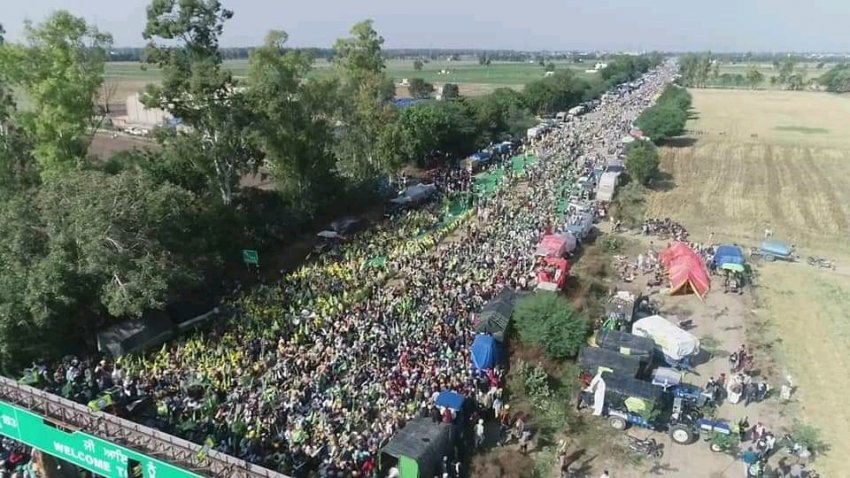
All Global Research articles can be read in 27 languages by activating the “Translate Website” drop down menu on the top banner of our home page (Desktop version).

***

“A nation at peace and a region in harmony are thus essential prerequisites for attainment of national security in the true spirit. No national leaders of today can ignore these factors,” said Army chief Gen Bajwa, marking a significant iteration of Pakistan’s latest security policy.

“…, it is an almost universally acknowledged fact that the contemporary concept of national security is not only about protecting a country from internal and external threats but also providing conducive environment in which aspirations of human security, national progress and development could be realised.

“Surely, it is not solely a function of armed forces anymore…”

Pakistan’s Chief of Army Staff Gen Qamar Javed Bajwa said this in the keynote address he delivered, at the first-ever Islamabad Security Dialogue (ISD) on March 17-18. The Dialogue was inaugurated by Prime Minister Imran Khan. The ISD was organised by the National Security Division, together with five leading think-tanks of the country, the Centre for Aerospace and Security Studies, Islamabad Policy Research Institute, Institute of Strategic Studies, Institute of Regional Studies and National Defence University’s Institute of Strategic Studies, Research and Analysis. The broad composition indicates the united political will of the Pakistani state.

Reuters from Islamabad thus reported the event, March 18, 2021:

“Pakistan’s army chief called on arch rivals India and Pakistan to “bury the past” and move towards cooperation, an overture towards New Delhi that follows an unexpected joint ceasefire announcement last month between the two countries’ militaries…. The militaries of both countries released a rare joint statement on February 25 announcing a ceasefire along the disputed border in Kashmir, having exchanged fire hundreds of times in recent months….

“The United States immediately welcomed the move, and encouraged the two to “keep building on this progress”.

PTI reported: White House Press Secretary Jen Psaki had said on Feb 25 that the Biden administration remains “closely engaged with a range of leaders and officials in the region, including those in Pakistan.”

“This is a positive step towards greater peace and stability in South Asia which is in our shared interest and we encourage both countries to keep building upon this progress,” she said.

At a separate news conference, State Department spokesperson Ned Price said the administration had called on the parties to reduce tensions along the LoC by returning to the 2003 ceasefire agreement. “We have been very clear that we condemn the terrorists who seek to infiltrate across the Line of Control,” he said.

The USA sells peace as well as war as it suits from time to time. In the eyes of the merchants of death, peace is the time between two wars. And it indulges in trade war too, which calls for shifts in policy. For India and Pakistan, both dependent on USA, unfortunately this nudge from the super power was needed, fortunately this time for peace.

Notably those engaged in backchannel talks with India were also associated in the ISD. Further, on Kashmir, the General simply said : “It is time to bury the past and move forward. But for the resumption of the peace process or meaningful dialogue, our neighbour will have to create a conducive environment, particularly in Indian-Occupied Kashmir.”

Who has to take the initiative? “The burden was on India” said Bajwa. Nay, the onus is on Pakistan, said India. Notwithstanding this refrain, it shows the thaw on both sides.

*

Further, it was really not so “unexpected joint ceasefire,” and it is based on political economy, as this report by indiatoday.in, March 19, 2021, indicates the chain of recent events:

“Bajwa said that “stable” Indo-Pak relations is a “key” to unlock the untapped potential of South and Central Asia by ensuring connectivity between East and West Asia…he also said that the potential of the region has “forever remained hostage to disputes and issues between two nuclear neighbours”.

“Calling the Kashmir dispute the “heart of this problem”, General Bajwa said, “It is important to understand that without the resolution of Kashmir dispute through peaceful means, the process of sub-continental rapprochement will always remain susceptible to derailment due to politically motivated bellicosity“…

“Our position is well known. India desires normal neighbourly relations with Pakistan in an environment free of terror, hostility and violence. The onus is on Pakistan for creating such an environment,” Anurag Srivastava, spokesperson at the Ministry of External Affairs (MEA), said during his weekly briefing on February 4.

“This came in the wake of General Bajwa’s earlier offer of peace, February 2, while speaking at the graduation ceremony at the Pakistan Air Force (PAF).  He had said, “Pakistan and India must resolve the longstanding issue of Jammu and Kashmir in a dignified and peaceful manner as per the aspirations of people of Jammu and Kashmir.”

“India and Pakistan had announced on February 25 that they have agreed to strictly observe all agreements on ceasefire along the Line of Control (LoC) in Jammu and Kashmir and other sectors. The ceasefire continues to hold, which is a positive sign.

“India had last month said that it desires normal neighbourly relations with Pakistan in an environment free of terror, hostility and violence. India had said the onus is on Pakistan to create an environment free of terror and hostility.

“General Qamar Javed Bajwa stressed however that the burden was on India to create a “conducive environment”, and said Washington had a role to play in ending regional conflicts.

“Pakistan and India, both nuclear-armed countries, have fought three wars, and in 2019, tensions rose dramatically post the Pulwama terror attack and the Balakot aristrikes…”

*

Dr. Tara Kartha, Former Director, India’s National Security Council Secretariat, explained and underlined the significance of the events.  See this extract from tribuneindia.com, Mar 20, 2021:

“These are stirring times in Islamabad, where the rich and the powerful gathered for the ISD….In Pakistan, the rich and the powerful are either politicians, businessmen or those in khaki, or even all three. And since it is they who run the country, what they say usually matters.

“The ISD was organised by the National Security Division, a body originally set up under Nawaz Sharif to serve as the secretariat of the Cabinet Committee on National Security which replaced the Defence Committee of the Cabinet. Later called the National Security Committee, it was notified as the ‘principal decision-making body on national security’ in a move quite unlike the advisory role such bodies have in most countries. That it included the service chiefs hardly needs to be said….”

“The idea is aimed at bringing think-tanks and policy-makers together, in a praiseworthy effort to benefit both. Bureaucracies the world over are not very different from each other, particularly in South Asia, where there is usually a solid brick wall between the two. The first move to break that wall is the first ever advisory portal, an integrated platform to exchange ideas with universities, think-tanks and the bureaucracies. The second was obviously to get the army chief to lay down the proposals…

“This (singular obsession with India) now seems to be changing, just a little. It started at the beginning of this year. In February, there was talk of Pakistan prioritising geo-economics over other issues. That was echoed by Foreign Minister Qureshi soon after Khan’s visit to Colombo where he rather surprisingly talked about Sri Lanka being part of CPEC. Now at the ISD, PM Khan is talking of comprehensive security astonishingly, saying that security is not just about defence. Unsurprisingly, he praised China’s model, as he does at every forum available…

Then he places national security within ‘South Asia’, as the least integrated of regions…

If that’s not astonishing enough, there is the offer of regional connectivity. That’s not just about China Pakistan Economic Corridor (CPEC), though that is offered up as an ‘inclusive, transparent’ project for global and regional participation, particularly Afghanistan. What follows is best quoted in full.

The General says, “Let me also emphasise that while CPEC remains central to our vision, only seeing Pakistan through the CPEC prism is also misleading. Our immensely vital geostrategic location and a transformed vision make us a country of immense and diverse potential which can very positively contribute to regional development and prosperity.”

In simple words, he’s offering up Pakistan as a node for regional connectivity… This means that Pakistan is ready for roads, railways and shipping to cross its territory into the rest of the world, including India. That’s turning South Asian politics on its head…

Delhi had better consider this connectivity push and its pros and cons rather than dither about Bajwa’s hostile antecedents. Here is an opportunity. Take it up. It might mean money, and a lot of it.

*

It goes against the simplistic and inobjective notions spread in India that the Pakistan army decides everything.

Bajwa spoke of “politically motivated bellicosity“…And it reminds former Pakistan Gen Musharaff’s statement that the armed forces know better about, and suffer the vagaries of war.

In this context, it is instructive to recall words of wisdom:

“24. WAR IS A MERE CONTINUATION OF POLICY BY OTHER MEANS.

We see, therefore, that War is not merely a political act, but also a real political instrument, a continuation of political commerce, a carrying out of the same by other means…the political view is the object, War is the means, and the means must always include the object in our conception.”  (Carl von Clausewitz, (1780-1831), On War)

The text of Gen Bajwa’s speech, given below, gives a fuller picture and deeper insights of what is going on.

*

Full text of Gen Qamar Javed Bajwa’s speech at the Islamabad Security Dialogue, March 17, 2021.

Worthy Guests, Diplomats, Panelists, Participants, Ladies & Gentlemen!

Assalam-o-Alaikum & Good Afternoon!

It is my profound privilege and pleasure to address this august gathering of some of the best Pakistani and global minds. “Together for ideas” is a very appropriate theme chosen by the organisers for this dialogue. I am certain that the policy practitioners and scholars present here or participating virtually, will not only discuss Pakistan’s security vision but also formulate ideas to guide us on how best to tackle Pakistan’s future security challenges.

I would like to appreciate the National Security Division for identifying the need for Pakistan to have its own security dialogue. I commend the NSD and its Advisory Board for putting together the first iteration of this Dialogue. I hope this trend of integrating intellectual input into policy-making continues to grow.

Ladies and gentlemen, it is an almost universally acknowledged fact that the contemporary concept of national security is not only about protecting a country from internal and external threats but also providing conducive environment in which aspirations of human security, national progress and development could be realised.

Surely, it is not solely a function of armed forces anymore.

National security in the age of globalisation, information and connectivity has now become an all-encompassing notion; wherein, besides various elements of national power, global and regional environment also play a profound role.

National security is thus multi-layered: outer layers being the exogenous factors of global and regional environment and inner layers being the endogenous factors of internal peace, stability and developmental orientation.

A nation at peace and a region in harmony are thus essential prerequisites for attainment of national security in the true spirit. No national leaders of today can ignore these factors. I also firmly believe that no single nation in isolation, can perceive and further its quest for security, as every single issue and security dilemma faced by today’s world is intimately linked with global and regional dynamics. Whether it be human security, extremism, human rights, environmental hazards, economic security or pandemics, responding in silos is no longer an option.

Ladies and gentlemen!

The world has seen ravages of World Wars and Cold War, wherein polarisation and neglect of virtues blighted human future and brought catastrophic consequences for humanity.

On the contrary, we have witnessed how multilateral rule-based platforms contributed towards good of mankind.

Today we face similar choices; whether to stay etched in the acrimony and toxicity of the past, continue promoting conflict and get into another vicious cycle of war, disease and destruction; or to move ahead, bring the dividends of our technological and scientific advancements to our people and usher in a new era of peace and prosperity.

We must not forget that the desire to achieve autarky was historically divisive and a stimulus for grabbing more, leading to “haves” and “have nots”. History has taught us that the way ahead has always been through an interconnected, interdependent and collective sense of security…

Today the leading drivers of change in the world are demography, economy and technology. However, one issue which remains central to this concept is economic security and cooperation.

Frayed relations between various power centres of the globe and boomeranging of competing alliances can bring nothing but another stint of cold war. It is naive to apply the failed solutions of yesteryears to the challenges of today and tomorrow.

It is important for the world that the leading global players must reach a stable equilibrium in their relations through convergences instead of divergence.

In this environment, developing countries like Pakistan, today face multi-dimensional challenges, which cannot be navigated single-handedly. A similar situation is confronted by other countries in our region as well, therefore, we all require a multilateral global and regional approach and cooperation to overcome these challenges.

Dear Participants!

You are well aware that South Asia is home to one quarter of world’s population. However, despite tremendous human and resource potential, the unsettled disputes are dragging this region back to the swamp of poverty and underdevelopment.

It is saddening to know that even today it is among the least integrated regions of the world in terms of trade, infrastructure, water and energy cooperation.

On top of it, despite being one of the most impoverished regions of the world, we end up spending a lot of money on our defence, which naturally comes at the expense of human development.

Pakistan has been one of the few countries, which despite the rising security challenges has resisted the temptation of involving itself in an arms race. Our defence expenditures have rather reduced instead of increasing. This is not an easy undertaking especially when you live in a hostile and unstable neighbourhood.

But, having said that, let me say profoundly that we are ready to improve our environment by resolving all our outstanding issues with our neighbours through dialogue in a dignified and peaceful manner.

However, it is important to state that, this choice is deliberate and based on rationality and not as a result of any pressure. It is our sincere desire to re-cast Pakistan’s image as a peace-loving nation and a useful member of international community.

Our leadership’s vision is Alhamdullilah transformational in this regard. We have learned from the past to evolve and are willing to move ahead towards a new future, however, all this is contingent upon reciprocity.

Ladies and gentlemen!

The world knows that we are geo-strategically placed, to be a bridge between civilisations and connecting conduit between the regional economies.

We are a nation of significance due to our large and enterprising demography, fertile soil and adequate logistical infrastructure. We intend to leverage our vital geostrategic location for ours own, regional and global benefit.

Our robust role in current quest for peace in Afghanistan is proof of our goodwill and understanding of our global and moral obligations.

Our close collaboration and crucial support for the peace process has led to the historic agreement between Taliban and US and paved the way for intra-Afghan dialogue.

We will continue to emphasise on a sustained and inclusive peace process for the betterment of people of Afghanistan and regional peace. Moreover, besides offering our all-out support to Afghanistan peace process, we have also undertaken unprecedented steps to enhance Afghanistan’s trade and connectivity by:

  • Re-energising Afghan-Pakistan Transit Trade Agreement and also providing access to Afghanistan to export her goods to India
  • Improving economic and trade environment along Pak-Afghan border by establishing border markets and development of infrastructure
  • Being part of energy and trade corridors binding Central. South and West Asia through land routes and inviting Afghanistan to be part of CPEC.

Dear Participants!

Stable Indo-Pak relation is a key to unlock the untapped potential of South and Central Asia by ensuring connectivity between East and West Asia. This potential however, has forever remained hostage to disputes and issues between two nuclear neighbours.

Kashmir dispute is obviously at the head of this problem. It is important to understand that without the resolution of Kashmir dispute through peaceful means, process of sub-continental rapprochement will always remain susceptible to derailment due to politically motivated bellicosity.

However, we feel that it is time to bury the past and move forward. But for resumption of peace process or meaningful dialogue, our neighbour will have to create conducive environment, particularly in Indian Occupied Kashmir.

Ladies and gentlemen,

today we are a nation with tremendous geo-economic potential. In order to carve a promising future for our people, it is important for us to embark upon a solid economic roadmap, backed up by infrastructural developments and regional integration. Our choices with respect to the same have been clear and explicit.

This geo-economic vision is centered around four core pillars:

  • One: Moving towards a lasting and enduring peace within and outside
  • Two: Non-interference of any kind in the internal affairs of our neighbouring and regional countries
  • Three: Boosting intra-regional trade and connectivity
  • Four: Bringing sustainable development and prosperity through establishment of investment and economic hubs within the region

Pakistan has been working towards all four aspects with unity of purpose and synchronisation within the various components of national security.

We had realised that unless our own house is in order, nothing good could be expected from outside. Now, after having overpowered the menace of terrorism and tide of extremism, we have begun to work towards sustainable development and improving economic conditions of under-developed areas.

Pakistan Army has contributed tremendously towards this national cause by rebuilding and mainstreaming some of the most neglected areas through massive development drives besides ensuring peace and security.

Our long campaign against the tide of terrorism and extremism manifests our resolve and national will. We have come a long way and yet we are a bit short of our final objective but we are determined to stay the course.

Dear participants!

CPEC has been at the heart of our economic transformation plan and we have left no quarter to declare its necessity for addressing our economic woes.

Our sincere efforts to make it inclusive, transparent and attractive, for all global and regional players, with the aim of bringing its benefits to everyone.

Let me also emphasise that while CPEC remains central to our vision, only seeing Pakistan through CPEC prism is also misleading.

Our immensely vital geostrategic location and a transformed vision make us a country of immense and diverse potential which can very positively contribute to regional development and prosperity.

This vision however remains incomplete without a stable and peaceful South Asia. Our efforts for reviving Saarc, therefore, are with the same purpose. Our efforts for peace in Afghanistan, responsible and mature behavior in crisis situation with India manifest our desire to change the narrative of geo-political contestation into geo-economic integration.

While we are doing our bid, a major contribution is to be made by the global players through their cooperation.

I am sure that an economically interconnected South Asia is much more suited to them instead of a war-torn, crisis-ridden and destabilised region.

We also see hope in the form of incoming US administration which can transform the traditional contestation into a gainful economic win-win for the world in general and the region, in particular, South Asia can be the starting point for regional cooperation.

I have firm belief that economic and sustainable human development can guide us into a future, full of peace and prosperity.

And finally, it is time that we in South Asia create synergy through connectivity, peaceful co-existence and resource sharing to fight hunger, illiteracy and disease instead of fighting each other.

I thank you.

Courtesy : Dawn.com, March 18, 2021.

*

In conclusion, Dr. Tara Kartha’s words are worth repeating:

“Delhi had better consider this connectivity push and its pros and cons rather than dither about Bajwa’s hostile antecedents. Here is an opportunity. Take it up. It might mean money, and a lot of it.”

Hope jingoists in India are listening and will heed.

*

Note to readers: please click the share buttons above or below. Forward this article to your email lists. Crosspost on your blog site, internet forums. etc.

Featured image is from Countercurrents

All Global Research articles can be read in 27 languages by activating the “Translate Website” drop down menu on the top banner of our home page (Desktop version).

***

Racism is not fundamentally about individual behaviour – although often that’s how people experience it. It has been built into the institutions of Australian capitalism from its origins in the invasion, dispossession and genocide against the First Nation’s peoples.

Even if, miraculously, every individual racist changed their views, the major forms of racist disadvantage that Aboriginal people experience – from appallingly low life expectancy to the worst housing, education, ill health, joblessness and access to government services – would continue.

Nor would the extra attention they receive from government – the murderous police, jails, courts and child removal departments – disappear.

Racism is central to capitalism because the system benefits from it.

It is a process of divide and rule. Establishing divisions within the working class is fundamental to ruling class attempts to keep control over a society in which they constitute only a tiny minority, making their profits from the labour of the majority.

Constructing an enemy is also important for prosecuting imperialist wars.

This also explains why the targets of Australian racism have shifted over the decades depending on the needs of the ruling class at the time.

When the White Australia policy was introduced in 1901, most Chinese workers suffered. Italians were targeted in late 19th century. Today, First Nations peoples, Muslims, Africans and refugees are the prime targets of anti-migrant racism.

Vilifying these groups to justify Australia’s involvement in occupation and war has resulted in anti-terror laws that have strengthened the state’s power to spy and intimidate.

If refugees can be imprisoned and brutalised, so too can poor people and workers.

Racism has a specific economic use for the ruling class.

In general, societies where racism is more pronounced experience lower wages and poorer working conditions.

Historical divisions between Black and white workers in the southern states of the United States have created a downward pressure on wages for all workers; it has contributed to the confidence of bosses to ruthlessly exploit both Black and white workers.

To this day, workers in the US south are the most poorly unionised and lowest paid in the country. Of the five US states that have no minimum wage laws, all are located in the south (Mississippi, Alabama, Louisiana, Tennessee and South Carolina).

This is not the product of the retrograde views of your average racist; it’s a legacy of slavery, segregation and the prevalence of racism that has weakened the workers’ movement and held back good working conditions.

Those on precarious visas toil in some of the most exploitative industries in the country.

I have witnessed many refugees, asylum seekers, backpackers and international students being paid below the minimum wage, subject to intimidation, sacked if they speak up or join a union and living under the constant threat of deportation.

Racism and national borders make this situation possible. It’s a windfall for the bosses and a disaster for all working class people, both the migrant workers and those struggling to defend hard-won gains.

It’s the structural elements that link racism and capitalism, and over which most people have absolutely no control. But that does not necessarily mean people will swallow anything that is spoon-fed to them.

In recent years, we have seen tens of thousands of people march in Invasion Day rallies and oppose Australia Day.

Educating white people to be nicer to brown people won’t address the very real material underpinnings of inequality: it does not build more houses, or give poor people jobs.

Organising workers to overcome racial divisions and stand together against their bosses and the government is what helps sideline racist ideas.

It is not an accident that the high points of anti-racist struggle in Australia have coincided with the upsurges in class struggle in which workers most clearly see that the bosses are their real enemies and, conversely, that racism only undermines that struggle.

After all, the working class is multi-racial and multi-ethnic – our strength is in our unity. This is how we overcome racism and the system that perpetuates it — a system in which money and power matter more than human lives.

*

Note to readers: please click the share buttons above or below. Forward this article to your email lists. Crosspost on your blog site, internet forums. etc.

Lavanya Thavaraja is an organiser with the Migrant Workers’ Centre. This article is based on a talk she gave to a Socialist Alliance forum on February 6.

Featured image: Black Lives Matter rally, June 2020, Brisbane. Photo: Alex Bainbridge

All Global Research articles can be read in 27 languages by activating the “Translate Website” drop down menu on the top banner of our home page (Desktop version).

***

Within the space of five years India has meticulously manipulated the Kashmir dispute in ways which few, if any, people foresaw.

Begrudgingly, I doff my cap to India’s Prime Minister Narendra Modi and his left-hand man, national security adviser Ajit Doval.

Within the space of five years, they have meticulously manipulated the Kashmir dispute in ways which few if any people foresaw. Now they have managed to negotiate a de-escalation along both fronts in Kashmir set alight by their brinkmanship.

India’s military standoff with China in the Ladakh region of Kashmir was never expected to last long, or even escalate into a shooting war. But nobody foresaw the sudden restoration last Thursday of a ceasefire agreement between Indian and Pakistani forces in Kashmir.

Starting with the so-called surgical strikes mounted against some of Pakistan’s forward bunkers along the Line of Control in 2016, Modi & Co Ltd has snatched the geopolitical initiative on Kashmir from Islamabad. I am convinced that their strategy was built upon the element of surprise.

Quite simply, Pakistan did not believe that India would cross its red lines because of the risk that it could spark an unwinnable war between the nuclear-armed nemeses.

Islamabad’s conclusion was justifiable: India’s military, while significantly bigger, is in no better a position to seize territory from Pakistan than it was when they first went to war in 1965.

And, of course, India has a far superior Chinese military to contend with.

This lulled Pakistan’s decision-makers into a false sense of security and they made one big mistake: they dismissed Modi’s pre-2014 election rhetoric as mere words.

So did most people outside of India.

Meanwhile, Modi and his Hindutva coterie were forging ahead with their plans to put India on the geopolitical map of the world like never before.

Correctly, they surmised that Pakistan’s response to surprise escalations would be defensive, not retaliatory.

Their calculations also took into account that Pakistan was beset with internal problems. It had only just defeated the Tehreek-e-Taliban Pakistan (TTP) in the northwestern tribal areas bordering Afghanistan. A decisive counterinsurgency operation in the restive Balochistan province was ongoing. And the civilian government and the military were engaged in a hugely divisive power struggle.

Plus the 2019 general elections in India were fast approaching and the Modi government’s approval ratings suggested that his Bharatiya Janata Party would struggle to gain a majority.

As soon as the opportunity presented itself, in the form of a suicide bombing that killed 40 Indian troops in Kashmir, Modi sent Indian warplanes to bomb a deactivated militant training camp located inside Pakistan.

In doing so, Modi achieved three objectives at the bargain basement price of the rickety MiG-21 Pakistan subsequently shot down, and cringe worthy videos of the captured India pilot praising his captors’ hospitality and the quality of tea they served him.

This little propaganda victory and the impression of air superiority lulled Pakistan into believing that the status quo in Kashmir would hold.

So the memes flowed and Pakistan soon switched focus back to the domestic political theatre.

Behind closed doors, however, Modi & Co had conveyed what India would do if Pakistan were to retaliate in kind: ballistic missiles were in play.

Within three years, India’s military posture had gone from reactionary to retaliatory to punitive to a warhead choice short of nuclear war.

Islamabad was still coming to terms with this when Modi sprung the gigantic shock by stripping Indian-administered Kashmir of its special constitutional status.

It is difficult to overstate the sheer audacity of this geopolitical gamble. Somehow, Modi and his closest aides managed to keep the plan a secret, and that, along with the overhanging threat of a ballistic missile response to any Pakistani military retaliation is what shaped Islamabad’s non-reaction.

Of course, Modi does not hold all the cards and, like all big-stack bullies, his tactics were only effective until a bigger shark, China, bared its teeth in Ladakh last summer.

Nonetheless, by simultaneously negotiating de-escalations along India’s disputed borders with China and Pakistan, Modi has built himself a nice offramp. For the time being, the arrangement suits all parties – except Kashmiris, who still have to contend with life in one of the world’s biggest open-air prisons.

China and the US have bigger fish to fry: each other.

Neither India nor Pakistan wants to become a frontline proxy for either great power.

India needs to focus on reviving its Covid-hit economy, as does Pakistan. Meanwhile, Islamabad awaits President Joe Biden’s decision on whether or not to pull out remaining US forces from Afghanistan by May, as agreed with the Taliban a year ago. Either way, the situation is complex and besieged by spoilers, including the TTP militants and Baloch rebels based in Afghanistan and their financiers, who notably, but not exclusively, include India.

The other elephant in the room is Iran. A political settlement in Afghanistan is practically unachievable without its support. It won’t be forthcoming unless Iran and the US agree on the terms of their re-engagement under the 2015 Joint Comprehensive Plan of Action.

Until those unknowns become known, India and Pakistan will remain in a holding pattern, limited to the tentative normalisation of their bilateral relationship.

We may see some bilateral meetings on the sidelines of multilateral confabs such as the Shanghai Cooperation Organisation, which has previously proven a useful forum for de-escalating tensions amongst members.

The Istanbul-based Heart of Asia track of the Afghan peace process is another platform where they will have to work together, despite being at cross purposes.

What comes after that?

It all depends on whether everybody in the neighbourhood can agree to shift the focus of their foreign policy from geopolitics to geo-economics, as recently declared by Pakistan.

I wouldn’t bet on it. It would require several minor miracles, not to mention an unprecedented geopolitical focus on connectivity in the midst of the pandemic.

The historical form book, meanwhile, suggests that India and Pakistan will clash again after a brief respite because Modi won’t budge on Kashmir – followed by another bout of detente.

However, stranger things have happened recently, among them the Abraham Accords and the invention of the Indo-Pacific strategic theatre.

And there are people like Modi at the table who are prepared to roll the dice.

*

Note to readers: please click the share buttons above or below. Forward this article to your email lists. Crosspost on your blog site, internet forums. etc.

Tom Hussain is a journalist and analyst on Pakistan affairs and geopolitics in South Asia.

Featured image is from TRT World

Myanmar: Hidden Opposition Violence

March 18th, 2021 by Brian Berletic

All Global Research articles can be read in 27 languages by activating the “Translate Website” drop down menu on the top banner of our home page (Desktop version).

***

As is common with US-backed color revolutions around the globe, the Western media will attempt to cover up opposition violence for as long as possible until shifting the narrative toward a “reluctant civil war” in which opposition groups were “given no choice” but to take up arms.

Of course, in every example – from Libya and Syria to Yemen and Ukraine – violence was part of US-backed political subversion from the beginning.

This is no different in the Southeast Asian state of Myanmar where US-backed protesters are in the streets fighting with Myanmar’s police and military.

The “Activists Say” School of Journalism

The Western media is once again relying on the “activists say” method of reporting – absolving themselves from actual, objective and factual journalism and instead reporting on the conflict from the point of view of Western-backed opposition groups who have every motivation to depict themselves as victims and Myanmar’s new government as being brutal and repressive.

Reports are based almost entirely on information from local media funded by the US government through the National Endowment for Democracy (NED) – outlets like The Irrawaddy, Mizzama, DVB (Democratic Voice of Burma), as well as “monitoring groups” like the Assistance Association for Political Prisoners (AAPP).

A glance at any Western media report will include at least one of these sources.

Far from journalists or actual monitoring groups – these are components of the opposition who have every motivation to relay a narrative that serves to advance their own political agenda rather than  reporting the truth.

Similar “activists say” reporting was used by the West for years during the Syrian conflict with the Western media attempting to cover up opposition violence up to and including junctures where militants began operating tanks, artillery, and anti-tank missiles.

Crumbling Facade

As in Syria and Ukraine – where Western attempts to cover up violence and brutality among the opposition eventually gave way to the fact that both opposition groups were violent extremists – the truth about violence used by protesters in Myanmar is also beginning to emerge.

An article from the Bangkok Post titled, “KNU vows protection for Karen protesting Myanmar coup,” would admit that the Karen National Union – an armed group who has waged a bloody insurrection against Myanmar’s central government for decades – has vowed to “protect” anti-government protesters.

Images of heavily armed militants travelling in convoys allegedly on their way to protest sites were circulating in media across Asia – but these reports are still being deliberately omitted from Western media coverage.

Similar scenes had played out in Libya and Syria in 2011 – with the public’s confusion and genuine belief that the Libyan and Syrian governments were brutalizing “peaceful protesters” owed wholly to the Western media’s deliberately misleading coverage.

US-funded fronts providing misinformation to the Western media, and the Western media’s reports themselves are being used to pressure the United Nations and the governments of countries around the globe to  in turn put pressure on Myanmar and restore the US client regime of Aung San Suu Kyi to power.

Efforts by Myanmar’s new government to tell its side of the story have been hampered by US-based social media companies that have shut down official accounts of Myanmar’s military and government, as well as Myanmar state media services – leaving literally only opposition media’s accounts for the global public to read.

AFP in its article, “Facebook shuts down Myanmar army ‘True News’ page,” would claim:

A Facebook page run by the Myanmar junta’s “True News” information service was kicked off the platform Sunday after the tech giant accused it of inciting violence.

Revealing is Facebook’s inaction toward opposition groups, including the KNU, who are clearly armed and engaging in violence, and using the US-based social media giant to coordinate their activities within the country and to spread misinformation abroad.

Carefully Manipulated Misinformation 

Carefully edited videos show only the moment security forces respond, with no context provided as to why Myanmar’s police and military are using force. A similar tactic is being used by US-backed protesters in neighboring Thailand – however the government and alternative media in Thailand have done a slightly better job showing the other side of the story – mainly to the Thai public and is likely one of several factors behind the protests finally fading there.

In the days, weeks, and months to come – if Myanmar’s government cannot manage this crisis and it continues to grow – the Western media will find it increasingly difficult to ignore the armed, violent nature of the opposition – an opposition – supporters of Aung San Suu Kyi – the Western media itself had noted were violently storming Rohingya communities in past years, killing locals and burning homes and businesses to the ground.

It is very unlikely that these same excessively violent opposition groups suddenly adopted peaceful protesting tactics since then – and even pictures in the media show them wearing body armor, holding shields, and in some cases advancing on the position of police and soldiers with clubs and metal rods – an act that would provoke violence from security forces anywhere in the world.

Evidence has already emerged that the opposition depicted as “peaceful protesters” by the West are using violence and further evidence will eventually emerge of deadly violence that is prompting an escalation across the country.

With reports of militant groups already mobilizing amid the protests – armed clashes are inevitable – and likely are already taking place. But – just as in Libya and Syria – the Western media will only report one side of the conflict for as long as possible – and alternative media, including state media from non-Western nations appear to have no presence in Myanmar and are instead – unfortunately – merely repeating Western reports – reports these alternative news sources should know better than to trust.

US-backed regime change succeeding anywhere, emboldens it everywhere.

If more voices are not raised in regards to Myanmar, demanding both sides of the story be told – the nation risks falling victim to the same chaos that consumed nations targeted by the US elsewhere – with the possibility of the violence and instability crossing over the border into Thailand and beyond.

A destabilized Southeast Asia is the ultimate goal of Washington. A destabilized Southeast Asia denies China access to stable and prosperous political, economic, and military partners along its peripheries. If out of the chaos the US can create viable client regimes – the region can even be turned against China.

*

Note to readers: please click the share buttons above or below. Forward this article to your email lists. Crosspost on your blog site, internet forums. etc.

Brian Berletic is a Bangkok-based geopolitical researcher and writer, especially for the online magazine New Eastern Outlook”.  

Featured image is from New Eastern Outlook

All Global Research articles can be read in 27 languages by activating the “Translate Website” drop down menu on the top banner of our home page (Desktop version).

***

US government meddling around the globe isn’t aimed only at elections and regime change, but also at the legal processes within any given targeted nation – including referendums for things up to and including constitutional changes.

Thailand’s constitution will require 2 public referendums before being amended. This process is a matter of Thailand’s internal political affairs – but as in previous elections and regarding petitions to have the constitution rewritten in the first place – the US government and other Western special interests seek to influence and interfere in this strictly internal matter.

US government-funded fronts – through the National Endowment for Democracy (NED) – need to be watched carefully as Thailand prepares for these referendums while raising public awareness of this interference is essential in giving the Thai government the leverage it will need to effectively deal with it.

*

Note to readers: please click the share buttons above or below. Forward this article to your email lists. Crosspost on your blog site, internet forums. etc.

Brian Berletic, formally known under the pen name “Tony Cartalucci” is a geopolitical researcher, writer, and video producer (YouTube here and BitChute here) based in Bangkok, Thailand. He is a regular contributor to New Eastern Outlook and more recently, 21st Century Wire. You can support his work via Patreon here

All Global Research articles can be read in 27 languages by activating the “Translate Website” drop down menu on the top banner of our home page (Desktop version).

***

Pakistan may allow cotton import from India through land route as prospects of the gradual restoration of bilateral trade ties have brightened after the new ceasefire agreement along the Line of Control, according to a media report on Sunday.

Citing sources in the Ministry of Commerce, The Express Tribune reported that Adviser to the Prime Minister on Commerce Abdul Razak Dawood may take a decision on whether to import cotton and yarn from India next week.

They said that the issue of the cotton shortfall has already been brought to the notice of Prime Minister Imran Khan, who also holds the portfolio of the commerce minister. Once a principled decision is taken, a formal order will be presented before the Economic Coordination Committee of the Cabinet, the sources told the daily.

The sources said that in-house deliberations have already begun but the final decision would be taken only after seeking the approval of the prime minister.

“I cannot say yes or no at this stage and would be in a better position to respond on Monday,” Commerce minister told the daily, responding to a question on whether Pakistan was considering allowing cotton import from India.

The trade ties between both the countries can help minimise cost of production in Pakistan and ensure sustained food supplies, the daily said.

India and Pakistan issued a joint statement on Thursday to strictly observe all agreements on ceasefire along the LoC and other sectors after the hotline discussions by their Director Generals of Military Operations.

The two countries signed a ceasefire agreement in 2003, but it has hardly been followed in letter and spirit over the past several years.

Relations between the two neighbours have nose-dived after a series of terror attacks in India perpetrated by terror groups based in Pakistan.

Bilateral ties deteriorated further after India revoked the special status of Jammu and Kashmir in 2019. The move angered Pakistan, which downgraded diplomatic ties and expelled the Indian High Commissioner in Islamabad. Pakistan also snapped all air and land links with India and suspended trade and railway services.

The paper reported that against the annual estimated consumption of minimum 12 million bales, the Ministry of National Food Security and Research expects only 7.7 million bales production this year. However, cotton ginners have given the lowest production estimates of only 5.5 million bales for this year.

There is a minimum shortfall of six million bales and Pakistan has so far imported roughly 688,305 metric tonnes of cotton and yarn, costing USD 1.1 billion, according to the Pakistan Bureau of Statistics. There is still a gap of about 3.5 million bales that needs to be filled through imports.

Due to shortage of cotton and yarn, the users were compelled to import them from the United States, Brazil and Uzbekistan.

Imports from India would be far cheaper and would reach Pakistan within three to four days.

Importing yarn from other countries was not only expensive but would also take one to two months to reach Pakistan, the daily reported, quoting businessmen who deal in these commodities.

The delay in yarn import can pose risk to timely deliver the export orders, according to the paper.

However, the All Pakistan Textile Mills Association (Aptma) is exerting pressure on the Pakistan government not to allow cotton and yarn import from India.

An industry insider told the daily that few millers have already hoarded the cotton and were now charging higher rates and import would dampen their short-term earnings. In an appeal to Dawood, Aptma said that the import of yarn from India will directly impact cotton prices in Pakistan.

“The cotton sowing season is currently starting in Pakistan and the predicted drop in cotton price owing to import of yarn from India is approximately 10-15 per cent, discouraging farmers not to sow cotton,” according to the Aptma.

On Thursday, India said it desires normal neighbourly relations with Pakistan and is committed to resolving all issues bilaterally in a peaceful manner.

Prime Minister Khan on Saturday welcomed the ceasefire agreement with India and said Islamabad remains ready to move forward to resolve “all outstanding issues” through dialogue.

*

Note to readers: please click the share buttons above or below. Forward this article to your email lists. Crosspost on your blog site, internet forums. etc.

The Evolution of the East Asian Eco-Developmental State

March 17th, 2021 by Stevan Harrell

All Global Research articles can be read in 27 languages by activating the “Translate Website” drop down menu on the top banner of our home page (Desktop version).

***

Abstract: The four major countries of East Asia—China, Japan, South Korea, and Taiwan—form one of the most densely populated regions on earth, and through the course of the late 20th and early 21st centuries the region experienced some of its fastest economic growth, propelled by the policies of state-led developmentalism. As a result of this density and these policies, the four countries in turn became some of the most environmentally degraded. As each achieved middle-to-high income status, however, the populace and then the regime in each country realized that they could not sustain either rapid economic growth or popular legitimacy without addressing the environmental consequences of this fast growth. The four states thus changed their fundamental economic policies from pure developmentalism to what we call eco-developmentalism, an attempt to reconcile economic prosperity with environmental sustainability. Although success so far has been mixed, this turn to eco-developmentalism has allowed these states to claim world leadership in mitigating environmental degradation.1

*

East Asia’s four largest countries2—the People’s Republic of China, the Republic of China on Taiwan, Japan, and the Republic of Korea— contain some of the most densely populated regions in the world and support 21% of the world’s population. Their estimated GDP constituted about 25% of the world’s total in 2019 (Statistics Times 2020)3, up from just 7% in 1960 (World Bank n.d.). The dramatic growth of East Asia’s economy in the past half-century is widely attributed to the economic success of the East Asian developmental states, which have staked their popular legitimacy on economic development and the material benefits that such growth brings to their citizens. At the same time, the developmental states’ extreme focus on material growth, particularly in the early decades of their high growth period, led to intense pollution and environmental catastrophes. Betting on the populace’s propensity to value increases in material living standards above all, state planners and corporate enterprises often externalized the air, water, soil, forests, and biodiversity of their territories as something that they could take care of later, perhaps much later, after they had achieved material prosperity.

The Three Gorges Dam, China

Later has come. China, Japan, South Korea and Taiwan have all reached upper-middle or even high-income status, and the pollution and environmental degradation have become so intense that they threaten the health and livelihood of residents in urban as well as rural areas. Citizens across the region no longer automatically prioritize additional material wealth over cleaner air, water, and soil, more buildings over more greenspace. Beginning in Japan in the 1960s, and spreading to Taiwan and Korea in the 1980s and China in the 1990s, citizens and civil society groups began to demand that their governments shift priorities away from growth-at-any-cost. The governments were slow to take notice at first, but by the 1970s in Japan, the 1990s in Korea and Taiwan, and after 1998 in China, East Asia’s states began to modify their emphasis on growth to incorporate environmental restoration and preservation into their policies and practices.

This pro-environmental shift in policy orientation represents a fundamental change in the nature of these states—from purely developmental to what we call eco-developmental—which recognize that greater environmental sustainability is critical for them to continue to grow economically while maintaining their domestic political legitimacy and assert international leadership. East Asia’s eco-developmental states have thus committed themselves to some sort of balance between economic development and environmental sustainability. Commitment of course does not equal results, and the actual record of the four East Asian states has been mixed. China in particular continues to increase its greenhouse gas emissions, and it attempts to mitigate this growth partly by building massive, environmentally destructive hydroelectric dams. It also exports environmental degradation by building power plants and hydroelectric dams in many Belt and Road Initiative (BRI) countries. Japan, Korea, and Taiwan also export environmental degradation by continuing to import massive amounts of fossil fuels and wood. But all four states have made immense progress in curtailing air pollution and deforestation, and are actively addressing a multitude of other environmental problems. Part of the four states’ turn to eco-developmentalism is based on public pressure: under these regimes, civil society groups have continued and frequently expanded their environmental action, sometimes in active opposition to and sometimes in wary or even enthusiastic cooperation with state environmental agencies. In addition, the desire to be seen around the globe as environmentally responsible has also accelerated the turn toward eco-developmentalism.

The Importance of East Asia

Despite its prominence in the world economy and the relative wealth of the four countries included in our analysis, East Asia is resource poor. Japan and Taiwan both import 93% of their energy, and Korea 81%. Although China imports a much smaller percentage of its total primary energy—around 16%—the total volume of imports—270 million tons of coal (Reuters 2018) and 3.06 billion barrels of crude oil (MAREX 2018) in 2017—still makes China the world’s largest total net energy importer (IEA 2017: 60-69). East Asia’s fossil-fuel thirst thus contributes to environmental degradation and economic imbalance in oil- and gas-producing countries. All four countries also import a large percentage of the wood they use in construction and manufacturing, something that has allowed Japan, Korea, and Taiwan to restore the forest cover lost before and during the early days of the developmental state and allowed China to increase its forest cover from 8-11% in 1960 to over 21% today (Robbins and Harrell 2014). The result is that all the East Asian countries, along with other high-consuming countries like the United States, are causing deforestation abroadtheir construction and furniture industries have depleted the forests of Indonesia, Malaysia, the Solomon Islands, and particularly the Russian Far East, and have negatively impacted forests as far away as Gabon in west-central Africa (ibid.). Finally, food imports, especially China’s enormous appetite for soybeans from Brazil and Argentina (Rapoza 2015; Gu and Thukral 2018), have contributed to deforestation and land degradation in those areas as well. All four countries’ enthusiasm for seafood has put pressure on world marine fisheries resources, threatening biodiversity (Cao et al. 2017).

The East Asian region also accounted (in 2012) for 48% of the world’s manufacturing exports (TMI 2013), a major reason for its polluted cities and rivers and its high GHG emissions. In 2017-18 China, Japan, Korea, and Taiwan accounted for 51%, 6%, 4%, and 1.5% of the world’s steel production (World Steel Association 2018, 2019), and all four ranked among the top 10 net exporters of steel, meaning that the toxic effects of coal burning on the air and of steel manufacture on the soil and water resources are concentrated locally. Similar effects result from automobile manufacture in Japan and Korea, which respectively account for 10% and 4% of autos produced worldwide (OICA n.d.)4, and 12.6% and 5.2% of automobile exports ranked by monetary value, ranking second and sixth in the world (Workman 2019). Other manufactures such as leather goods, textiles, machine parts, and electronics, all of which are major East Asian exports, also contribute to the region’s high rate of pollution from producing goods that will be consumed abroad.

Because of the intensity of their local environmental problems and their rapid economic growth in the postwar era, all the East Asian countries except Taiwan have become important participants in international forums dealing with the environment. China, Japan and Korea have participated at least since the initial United Nations Conference on the Human Environment in 1972 (UN 1972) and although China participated only in very limited ways during the Maoist era of planned economy and self-reliance from 1949 to 79, it began to take an active role starting from the 1992 Rio Meeting on Environment and Development, and has been an active participant since.

East Asian countries’ international connections work in two ways. In some cases, the desire for international recognition and integration has led these countries to adopt more progressive policies on the environment. In other cases, as their economic and political influence grows, East Asian countries have been able to influence international dialogues on the environment in their desired directions.

On the specific issue of climate change, China’s position has shifted from its initial insistence in the 1990s that economic development should take priority over environmental sustainability, to its more recent proactive involvement with international efforts to decrease GHG emissions. China’s commitment to reduce its own GHG emissions has also been a big force in driving down the global cost of wind and solar power generation, thus contributing to rising use of renewable energy across the globe. China has also become a leader in endangered species conservation, having cooperated with international conservation NGOs such as The Nature Conservancy (Litzinger 2004; Moseley and Mullin 2014) and the World Wide Fund for Nature (formerly World Wildlife Federation). In particular, China has gained international respect for its efforts toward the restoration of the iconic megafaunal species Ailuropoda melanoleuca (Giant Panda) which has become a national symbol as well as an object of environmental concern (Songster 2018).

In addition to the renewable energy sector, Japan and Korea (and to a lesser extent Taiwan) have focused on helping manufacturing firms adjust their products and processes to be more eco-friendly. Just as Japan was the first East Asian developmental state, it was also the first to adjust its developmental policies to incorporate environmental priorities into its co-development plans with manufacturers. For example, its investments in high-efficiency and electric vehicles paid off in a big way with the explosive popularity of the Toyota Prius. That model sold 300 vehicles during its launch year in 1997, and twenty years later, in 2017, more than 1.5 million Priuses were sold globally, and the total electric vehicle market worldwide had risen to almost 12 million vehicles, representing a reduction of 90 million tons of CO2 (Toyota 2018). China now has almost half the world’s electric cars on its roads (IEA 2020). In the construction industry, Japan’s policies to encourage waste reduction and recycling also offer important models that other countries follow; Japan now has a 100% recycling rate for industrial concrete (Tam 2009), and China has recently reduced the energy used in producing a ton of cement by about a third of what it was just a few years ago (Li et al. 2017: 1841).

Although they followed Japan’s lead by a few years, South Korea and Taiwan have also developed extensive green growth initiatives. South Korea’s 2009 National Strategy for Green Growth, with its associated Five-Year Plan, was perhaps the most comprehensive in the region, articulating clear goals for resource conservation and emissions reduction, as well as significant public and private investment in green technology (UN n.d.). Similarly, Taiwan has found that nurturing “green” industrial products and related services promotes economic growth and helps mitigate the economic effect of the decline of more polluting traditional industries (Chao 2017; Hu et al. 2017).

In Japan, Korea, and Taiwan interactions between state and civil society show important interplays with global environmental organizations and agendas. The governments of Japan and Korea were initially reluctant to sign international protocols on labeling of genetically modified organisms, but pressures from civil society groups that were linked to international environmental organizations led both countries to ratify the Cartagena Protocol on Biosafety. While sometimes at odds with those advocating for CO2 reductions, anti-nuclear activists in Japan, Korea, and Taiwan have advocated for renewable policies across the region.

East Asia as a Region in Environment and Environmental Politics

A skeptic might question the value of discussing the environmental policies of China, Japan, South Korea and Taiwan together, since they have such different political systems and political cultures. We believe, however, that there are three strong reasons for writing about East Asia as a region. First, despite their obvious differences, East Asian countries have a number of historical, cultural, political, economic, and ecological similarities. Second, because of geographic proximity, the countries in the region are highly connected to one another and have been for centuries. Those interconnections tend to be obscured in country-specific analyses, underscoring the value of comparative scholarship covering the entire region. Finally, given the similarities among them and the close connections between them, the differences among the countries allow for valuable controlled comparison of their environments along with their environmental cultures and politics.

First and foremost, East Asia is a climatic and ecological region that shares air, water, and natural wildlife resources. The whole region is affected by the geologic fault lines that separate the Asian continent from North America, the Pacific Ocean, and the Philippines. The region shares a typhoon season, heightening its collective exposure to climate change-related risks. Dust from storms originating in the Loess Plateau of North China and the Inner Mongolian desert to the north is a major contributor to lowering air quality in Korea and Japan, and on certain days can even be detected in Seattle and San Francisco.

Similarly, East Asia’s economies are highly interconnected—China is the top trading partner for Japan, Korea, and Taiwan; and those three countries represent China’s #2, #3, and #4 trading partners after the United States. Just as European and American-owned manufacturing companies exported their air and water pollution to more permissive regulatory regimes in Japan, then to Korea and Taiwan, those countries are now exporting their pollution (and also many of their manufacturing jobs) to the low wage labor and looser regulatory regime of China. Much of Taiwanese-owned manufacturing, particularly in the electronics and apparel sectors, now takes place in China, along with substantial amounts of Japanese- and Korean-owned manufacturing. These activities of course not only boost incomes but affect China’s environment in negative ways, primarily through pollution (Hatch and Yamamura 1996; Reardon-Anderson 1997; Terao and Otsuka 2007; Wilkening 2004; Lora-Wainwright 2017). Air current flows mean that the pollution produced by these companies then drifts back to their home countries. Thus, unlike when the US and Europe outsourced their polluting industry to Japan, outsourcing manufacturing from Japan, Korea, and Taiwan to China does not entirely outsource the related pollution. Relatedly, when Japan, Korea and Taiwan invest in cleaner supply chains, greener technology, and transportation methods for their sub-contractors in China, it can contribute to the improvement in the quality of their own air, water, soil, and marine resources.

Historically, the eastern half of China, along with all of the Korean Peninsula, Taiwan, and Japan south of Hokkaido, has maintained an unusually high population density for multiple centuries, based on an agrarian order in which large numbers of peasant farmers grow grains intensively and pay rents and taxes to a landlord elite and to a centralized state staffed by members of this elite. Many of the specific problems of East Asia’s environment, including pollution, deforestation, and species loss—are related to the high population density recently compounded in its effects by rapid economic growth and urbanization.

East Asian countries also share both elite and popular cultural ideas about human-environment relations. The elite cultures of East Asia were dominated by a tradition that we can loosely call “Confucian,” which expresses diverse views that have been drawn on by political leaders to promote different agendas at different times. During China’s imperial era and Mao’s rule, the perspective that nature exists to serve humanity, and thus human action can prevail over or control nature, was promoted. This attitude was exemplified by the slogan “humans are destined to triumph over nature” (ren ding sheng tian), which can be found on a seaside monument to engineering on the east coast of Taiwan as well as in Maoist propaganda from 1960s and 1970s China (Shapiro 2001, Weller 2006).

More recently, pro-environmental leaders and activists in all four countries have touted another aspect of the Confucian tradition, one that promotes harmony or even unity between humans and nature. This idea is embodied in the slogan “unity of nature and people” (tian ren heyi), which has evolved in China into the modern cry to build an “ecological civilization” (shengtai wenming; Schmitt 2016). At the popular level, peasant proverbs and notions of village ecology and balance, such as the Japanese “village and mountain” (satoyama), stress the ecological integrity of the agrarian community (Takeuchi et al, 2002).

Interestingly, the interconnection between humans and nature, and the emperor’s historic responsibility for maintaining harmony in both, meant that in contrast to the Christian view of natural disasters as “acts of God” for which leaders were not responsible, natural disasters such as floods and earthquakes were seen as a sign that a leader had lost the Mandate of Heaven, and should perhaps be replaced. Thus, leaders across East Asia, even those not subject to democratic political pressures, have felt a responsibility to address environmental pollution and environmental disasters that threaten people’s “right to subsistence” (Tu 1989; Perry 2008).

Although they operate in a widely diverse set of political regimes, environmental advocates across the region rely on a remarkably similar set of strategies to influence policy and state action. Everywhere, more organizations use informal networking—either with or without state involvement—and public education as their primary advocacy strategies than use more direct forms of action such as public protest, lobbying, and litigation. Whom you know has always been more important than what you know in East Asian societies (and elsewhere), and this general cultural trend is reflected in the strategies utilized by environmental activists in the region.

Additionally, East Asian nations all lack a tradition of citizen participation in governance above the very local level. Thus, across the region mechanisms of citizen participation through electoral democracy or other formal means to influence national legislatures or bureaucracies are relatively new and tend to be underdeveloped, even among the democratic states. At the same time, all the countries have strong traditions of local governance. Also, perhaps significantly, the region has a long and diverse tradition of millenarian rebellions and other popular movements based on religious or other local solidarities (Perry and Harrell 1983). This paradox—high levels of civic engagement at the local level and low levels of activism at the national level—contributes to many of the specific forms of environmental action that we find throughout the region.

Finally, since World War II, the East Asian states have all shared the consensus of the developmental state, a governing body that derives its legitimacy from its ability to improve material consumption among its citizens. The developmental state’s initial bargain—asking citizens to accept environmental degradation in return for an increased standard of consumption—began to fray as economic prosperity increased and environmental conditions deteriorated, leading to the formation of the eco-developmental state as a new basis for policy and state legitimacy.

Variation within East Asia

Although they share many similarities, the differences among East Asian countries also make the region productive for academic inquiry. Precisely because a regional focus allows scholars to control for the many historical, ecological, economic, and cultural variables that the countries have in common, it becomes possible to engage in a detailed investigation into the ways that biophysical, sociocultural, administrative, legal, and geopolitical differences affect political behavior.

Perhaps most obviously, there are large biophysical differences among the countries. Because of China’s continental size and location, in contrast to peninsular Korea and insular Japan and Taiwan, there are large differences in resource self-sufficiency: Although China has the largest trade volume of any nation, because of its size it is much more self-sufficient and less dependent on trade than its smaller neighbors. It produces more of its own energy, forest resources, and even food than the other nations, and this difference affects the ability of each country to determine its environmental policies, particularly with respect to energy. We can see this especially with respect to nuclear power politics. Historically, Japan has relied heavily on nuclear power, getting as much as 30 percent of its electricity from that source before the 2011 Fukushima triple disaster (World Nuclear Association 2019), and since then has emphasized conservation. Korea generated 29% of its electricity from nuclear plants in 2017, but the Moon administration has announced plans to gradually eliminate nuclear generation as a power source (World Nuclear News 2017). Taiwan built three nuclear plants during the period of authoritarian rule, but popular protests have rendered a fourth plant infeasible since democratization, and the regime is now committed to a fast transition to heavy reliance on renewables, though the means for achieving that goal are only vaguely defined. Nuclear power remains a difficult political issue for all of the countries in the region, and its future has not yet been determined.

Socioculturally, the differences among the countries are quite complex. Many of them stem from the recent historical trajectories of governance models: Japan as a bureaucratic state with democratic elections throughout the postwar era, Korea and Taiwan with traditions of authoritarian governance and transition to democracy in the late 20th century, and China as an authoritarian state that nevertheless changed its economic model from state socialism to bureaucratic capitalism after 1980. These differences influence the nature of regulatory regimes, ministerial turf wars, and most importantly environmentalist opposition to and cooperation with state agencies in the four countries. The strength and character of democratic politics—its institutions, (e.g., elected legislature, free press, independent judiciary, and autonomous advocacy organizations), as well as its practices (e.g., electoral politics, public protests, community organizing, etc.)—are commonly thought to be critical for determining the environmental politics of a country. East Asia allows us to examine that assumption: although all four countries have very different experiences with democracy, they all initially followed a developmental state model and have made the transition to eco-developmental states.

Central-local government relations also differ. All four countries have strong central governments and a common practice of local policy experimentation prior to national policy implementation. However, the center-local political game is played very differently in the four places, and the capacity for local innovation varies as well. In China, localities can practice what we might call “guided autonomy” or a limited ability to experiment with policy implementation, so that policies such as the emissions trading markets or renewable energy subsides are often tried out locally before being implemented on a wider scale. In Japan local municipalities frequently experiment with waste, emissions, and building ordinances in an effort to increase the quality of their local environment. When those local models are effective, they can be adopted by multiple localities and eventually become national policy. Similarly, in Taiwan local governments are able to experiment with environmental policies, and their models of what to do as well as what not to do can be adopted nationally. In Japan and Taiwan, pioneering local governments often “guide” the national governments in the area of environmental policy. Although Korea has also seen a rise in the level of autonomy of its local governments in recent years, they remain highly constrained and have the least capacity to act as environmental policy innovators of the four countries in this study.

The role of law and lawyers also varies. In none of these countries has litigation traditionally played as great a role in society as in the Euro-American world, and its importance differs considerably from one country to another. Although environmental lawsuits have been permitted in China and Taiwan since the early aughts (Economy 2005; Li Jianliang 2010), they play a minor role in comparison to popular protest. In contrast, in both Japan and Korea lawyers and lawsuits have played vital roles in the environmental movement and in environmental policymaking. Victory in the early 1970s by pollution victims, in what came to be known as Japan’s Big lawsuits (Upham 2009), served as a critical turning point for the re-orientation of the developmental state away from growth-first towards a model that promoted more sustainable development. In Korea, lawyers’ associations were crucial players in the successful democratization movement (Lee et al. 1999; Ku 2002), and they continue to influence the evolution of Korea’s eco-developmental state (Cho 1999). These differences have implications as all four countries increase their participation in rights-based international forums and join various treaties and protocols.

Diachronic differences are also important to any comparative project, and especially here as we seek to highlight the transformation of developmental to eco-developmental states across the region. Countries that experienced this transition at later dates have done so in a different world context, particularly with regard to climate change and its effects. Japan, which was the first East Asian country to industrialize, and the first to face the negative environmental legacy of the developmental state, it was a pioneer in developing environmental policies, based primarily on regulation. But it was not until the end of the 20thcentury that the bureaucratic processes of regulation became transparent enough, and global environmental NGOs became powerful enough, to allow popular participation to influence policy significantly. Korea and Taiwan not only developed later, they democratized later. It is partly because of this timing that they have been much more closely connected to worldwide environmental movements. China has not democratized, but is eager to be seen as a player in international environmental politics. It has developed a system of top-down environmental regulation that also allows a small amount of popular environmental protest (Lora-Wainwright 2017), but activism has generally been restricted to the local level (Ho 2007, Teets 2014).

All of these differences mean that the basic dynamics and priorities in the environmental politics in the four countries vary widely. While there are remarkable similarities in the specific strategies utilized by citizens to advocate for pro-environmental policy change, the configuration of environmental politics in the four places is very different. In Japan, which experienced its environmental crisis first and has been ruled by the Liberal Democratic Party for nearly all of the post-war period, environmental organizations have been most effective when they have found allies among the ruling LDP members and inside the bureaucracy and local government. While advocacy organizations have connections to opposition parties, electoral politics has not been a defining element of the environmental movement. In contrast, in South Korea and Taiwan, the environmental movement became fully incorporated into those countries’ pro-democracy movements, creating much closer connections between environmental groups and progressive political parties (Ku 1996; Lee 2000; Lyons 2009; Grano 2015; Haddad 2015a). In further contrast, after a brief period of opening up in the 2000s, the CCP has spent much of the last decade tightening state control over environmental organizations and increasing party involvement in their activities. As a result, environmental groups in China tend to be small and local, and if they grow larger, they must find ways to work productively with the government or face shutdown.

In sum, East Asia is an excellent region in which to study the complex dynamics of environmental politics and particularly the way that developmental states can evolve into eco-developmental states. The four countries in the region whose experiences are highlighted here share many ecological, social, cultural, and political characteristics, but they vary in size, resource wealth, history, and especially political systems. This enables us to study in detail how these various factors can influence environmental politics and how national policy can become reshaped by environmental advocacy.

The Recent Trajectory of East Asia’s Environment

Because of their geographic proximity and cultural commonalities, and in spite of the differences in size and regime type, the East Asian countries have all experienced a similar trajectory in the politics and policies of the environment—and in the state of the environment itself—since World War II, but at different times and at different speeds, roughly corresponding to the timing of industrial growth. As a result, East Asian countries have followed a similar pattern where growth-first developmental states have evolved into eco-developmental states, modifying high-growth policies to include pro-environmental goals and promote more sustainable economic growth.

First in Japan, then in Korea and Taiwan, and most recently in China, all of the East Asian states supported rapid industrialization and high-speed economic growth that emphasized export-oriented manufacturing industries. As they became economically successful, they also caused environmental catastrophes such as mercury poisoning in Minamata, wintertime PM2.5 “air-pocalypses” in Chinese cities, toxic waste spills in South Korea, and the contamination of indigenous lands by nuclear waste facilities in Taiwan. Industrial pollution endangered the lives and livelihoods of their citizens, threatening the stability of their political regimes. All of the ruling political regimes struggled to incorporate these new environmental concerns into their governance strategies. Japan’s Liberal Democratic Party managed to hold onto power by passing sweeping environmental regulations in 1970 during what came to be known as “the pollution Diet.” The military/nationalist regimes in South Korea and Taiwan failed to get ahead of popular dissatisfaction—the environmental movements merged with pro-democracy movements that resulted in political democratization in the late 1980s in both places. So far, the Chinese Communist Party has managed to keep ahead of the mounting political pressure with increasingly ambitious pro-environmental policies designed to reduce the pollution that can lead to political unrest. This process of transformation from a developmental state to an eco-developmental state was a gradual one that proceeded in fits and starts over many decades.

Beginning with the influential work of political scientist Chalmers Johnson on Japan (1982), which he (Johnson 1986, 1999) and others later extended to Taiwan (Gold 1986) and Korea (Haggard and Moon 1997; Suh and Kwon 2014), the idea of the developmental state has been central to analysis of East Asian economic growth. Developmental states in Japan, Korea, and Taiwan have been characterized by private ownership of most of the means of production; policies set and enforced by a meritocratically selected bureaucracy; and active intervention, through both regulation (including import substitution followed by export promotion) and economic incentives, to guide economic growth in the directions it deems desirable. In service of their development goals, these states have promoted universal education, including both technical and nationalistic content; ensured relative income equality; and limited citizen political participation (Johnson 1986; Beeson 2004). China, having had a planned economy from the 1950s to the early 1980s, gradually “grew out of the plan” and came to resemble the other East Asian developmental states more closely, though state ownership still accounts for a larger share of its economy (Naughton 2015). Across all four countries, governments and businesses clung tenaciously to their pro-growth, anti-environment developmental models until their citizens, whose lives and livelihoods were threatened by industrial pollution, demanded change.

Japan’s postwar environmental movement was triggered both by general deterioration of urban air quality and by a series of industrial pollution incidents (Avenell 2012: 27), two of which have become iconic in the world history of environmentalism. In one incident, the Mitsui Company’s mines polluted the waters of the Jinzu River in Toyama Prefecture with cadmium, causing the outbreak of a local epidemic of itai-itai (Ouch!, Ouch!) disease, which led first to local citizen protests and eventually to litigation in which Mitsui was found culpable and forced both to clean up the river and to pay a large amount of compensation (Yoshida et al. 1999). In the other incident, the Chisso Corporation, a plastics manufacturer in Kyushu, released large amounts of methyl mercury into Minamata Bay, and local people ingesting fish became afflicted with what came to be known as Minamata disease, a potentially fatal degenerative disease of the nervous system. This led to local protests and eventually to the formation of a national environmental movement with important political allies (Almeida and Stearns 1998), one that began to include citizens’ groups agitating for nature preservation and food safety in addition to opposing industrial pollution and its negative health effects (Avenell 2012: 429).

In Korea, the rise of an environmental movement followed its own rapid industrialization, about two decades after Japan’s. There were local protests as early as the 1960s and 70s, in response to pollution around industrial sites and local demands for contamination. Just as pollution in Minamata galvanized the Japanese, Korean farmers demanding compensation for pollution caused by the Ulsan Industrial Complex galvanized others to demand redress, including residents of Seoul and Inch’on affected by poor air quality. Citizens began to establish organizations to pressure the government and demand change (Ku 2002; Lee 2000). But in the atmosphere of a repressive military dictatorship that lasted until 1987, only local action was possible, and the regime blocked attempts at coordination between local residents of polluted areas and any national or international environmental organizations, seeing them (correctly) as connected with the pro-democracy movement and hostile to the dictatorship (Ku 2004: 191). Once the Chun Doo-hwan dictatorship fell in 1987, the space for political organizing around the environment expanded, and during the 1990s Korea’s environmental movement grew rapidly, as part of the growth of civil society organizations generally in the newly democratic country. Now, the Korean Federation for Environmental Movement (KFEM), which was formed in 1993 by the merger of eight national environmental groups, is the largest environmental organization in East Asia by far, boasting more than 80,000 members (Deep Sea n.d.).

Taiwan’s environmental movement developed around the same time as Korea’s, but in different ways. Like its counterparts in Korea, the Nationalist-ruled state ignored environmental concerns in its headlong (and successful) push for development, setting the stage for environmental opposition. This opposition began, as did environmental movements in Japan and Korea, around local issues, primarily those of water pollution. For Taiwan, the pollution cases that served to spark the national movement were those formed against Sunko Ink in Taichung County (1982-1984) and DuPont in Lukang (1986-1987). Both cases saw local villagers organize and successfully force companies to scrap plans to locate factories in their towns (Ho 2010). Throughout the 1980s victims as well as opposition intellectuals began to raise issues of local water and air pollution along with nuclear power and nuclear waste, the latter prompted by the 1980 proposal to build Taiwan’s fourth nuclear power plant. This nascent environmental movement was a primary issue in the programs of the “Outside the Party (Dangwai)” political movement that developed into the Democratic Progressive Party, which was tolerated when it formed in defiance of a ban on the founding of opposition parties in 1986 and was allowed to organize and run candidates when martial law was lifted in 1987. After full democratization in the late 1990s, the environmental movement, among many other social movements, began to resort to mass demonstrations on the one hand, and to formal organizations on the other, becoming, as Ho (2011:120) puts it “a vital component of political life.”

Unlike Korea but like Hokkaido and Okinawa (in Japan), Taiwan has a significant indigenous population, which was deprived of much of its rights to land and resources by the Japanese colonial government and then by the Nationalist dictatorship after 1945. As civil society organizations of all kinds blossomed beginning in the late 1980s, the Aboriginal Rights Movement grew along with them. Because of both resource extraction and the storage of nuclear waste on aboriginal lands after 1979, indigenous rights and environmental rights became closely connected political issues in Taiwan, and have remained so to the present day.

China’s environmental movement, like its economic development, has taken place most recently. Propelled by the Marxist assurance that only capitalism could despoil the environment, along with the ideological valorization of sacrifice for the revolution, the Communist-ruled state paid little attention to environmental concerns even after the transition in the 1980s to a bureaucratic capitalist system in which state agencies, along with private capital, are important industrial and market actors. Informed by what happened in the other countries as pollution intensified —especially how the environmental movement provided significant support to what became successful pro-democracy movements in South Korea and Taiwan—the CCP sought to model its response on the LDP, which was able to stay in power by enacting ambitious, far-reaching legislation protecting the environment. In December 1989 (a mere six months after crushing pro-democracy protests in Tiananmen Square) China enacted a new Environmental Protection Law, which was quickly followed by additional laws focused on limiting air, water, and solid waste pollution (Xie 2020). The first officially-permitted environmental NGO in China, Friends of Nature (Ziran Zhi You), was established in 1994, working primarily on issues of biodiversity conservation and nature education rather than anti-pollution advocacy (Weller 2006: 128-29).

The Chinese state is notoriously fearful of any kind of independent national-scale organization or movement, environmental or otherwise. The primary focus of environmental organization and protest (as with other forms of protest), therefore, has always been local. Ad hoc, grass-roots organizations formed to address issues of industrial pollution and its effects on agriculture, food safety, water quality, and population health (Lora-Wainwright 2017; Mertha 2008; Yan 2014). Although China, like Taiwan, has large indigenous minority populations, indigenous peoples have not been allowed to organize for environmental causes, lest their organizations develop into movements for local autonomy. When national-scale environmentalism emerged after 1998, it was thus inevitably incorporated into the state’s developmentalist system, and belongs to the next section of our overall history—the evolution of the eco-developmental state.

The Evolution of the Eco-Developmental State

Nowhere in East Asia did the state respond quickly to the environmental concerns brought up by direct action, journalistic exposés, and increasing public awareness. Instead, all of the states, attempting to continue their policies of promoting economic development through collaboration with industrial corporations and enterprises, initially reacted by trying to ignore and minimize the problems. The states claimed that pollution was a temporary sacrifice that populations would have to endure if people wanted to continue to raise their standards of consumption, and by studying environmental problems without doing anything concrete about them (Avenell 2012: 434-35).

Eventually, however, spurred on by a combination of mounting public pressure from growing environmental movements and realization that things were getting bad enough to harm further development, governments began to act to address environmental problems, reaching environmental tipping points. Japan, having been first to pollute, was also first to begin cleaning up, but it did not really begin until the late 1960s and early 1970s, initially at the local level and then only later at the national level. At that time, the Japanese developmental state began to become eco-developmental—passing anti-pollution laws, creating an environmental protection agency, and ruling in favor of pollution victims who had brought lawsuits in the courts (Avenell 2012: 435, Chapter 5; Wakamatsu et al. 2013). Within only a few decades, Japan went from being a “toxic archipelago” (Walker 2011) to one that enjoyed some of the cleanest air, water, and soil among advanced capitalist countries as the government implemented regulations and corporate actors saw the commercial value of cleaner, more efficient production processes and products (Schreurs 2002).

In spite of this dramatic improvement, Japan has not fully replaced its developmental goals and policies with environmental ones. The Japanese state still prioritizes economic growth, although it now takes environmental concerns into account when it considers how to support that growth. As a result, international and national NGOs, local citizen groups, environmental lawyers, and other activists continue to put pressure on the state and large corporations to live up to their environmental promises (Edahiro 2009).

In Korea, the Chun Doo-hwan regime (1980-88) actively worked to suppress the environmental movement. For example, in the face of the “Onsan disease” caused by heavy metal pollution in Gyeongsamnan-do, the government’s environmental agency (falsely) announced that the disease was not caused by industrial pollution (Ku 2004: 196). After democratization, however, the state reaction to environmental concerns began to evolve. President Roh Tae-woo condemned the Doosan Electrical Materials company for spilling phenols into the Nakdong River in 1991. That same year local residents and national NGOs organized to block a proposed dam on the Donggang River, and won their fight on Environment Day when President Kim Dae-Jung announced that plans to build the dam had been scrapped. That same day he laid out “The New Millennium Vision for the Environment” in 2000 (ibid.: 199-201). Since that time Korea’s state regulation has been successful in combating air pollution and partially successful in combating water pollution.

As in Korea, Taiwan’s environmental movement played a key role in democratization itself (Weller 1999), and its political system rather quickly evolved into a “two-camp” structure with splinter parties forming coalitions with the two major parties—the reformed Nationalist Party leading the so-called “blue” camp and the Democratic Progressive Party leading the “green,” both named for the colors of the respective parties’ flags and not for any affiliation with environmental movements. While Korea’s environmentalists formed a powerful organization in the Korean Federation of Environmental Movements (KFEM) that usually supported the Democratic Party, in Taiwan environmentalists formed an independent Green Party. Taiwan’s Green Party has never gained representation in the national legislature, but they have elected representatives to city and county councils and work with the Democratic Progressive Party to run and support candidates for national office. Through their partnership with the Democratic Progressive Party they have promoted such programs as “trash doesn’t fall to the ground (lese bu luo di)” under then-Taipei mayor Chen Shui-bian (which was partly responsible for his successful bid for the presidency in the 2000 elections, ending fifty-plus years of Nationalist party rule). Significant air and water quality regulations were adopted during his mayoral and presidential tenures.

China has followed a similar trajectory to the others, but for very different reasons and with starkly contrasting outcomes. All through the transition from state socialism to bureaucratic capitalism in the 1980s and early 1990s, China’s environmental degradation accelerated. Throughout this period, it continued to be impossible for any but the most local and spontaneous groups to engage in protest, let alone organize effectively in opposition. Thus, unlike the other three places, China has not seen any coordinated environmental or anti-nuclear movements emerge to play a serious role in politics. However, a transformation in state policy orientation did happen, beginning in the mid-1990s and galvanized by disastrous floods in the middle-Yangzi provinces in 1998 that killed more than 3,000 people, left 15 million homeless, and negatively affected more than 200 million people (UN 1998). After researching the cause of the floods, state scientists (wrongly perhaps: see Henck et al. 2011) attributed much of the damage to upstream deforestation caused by the logging booms of the late 1950s, 1970s and 1980s. The state at this point did an about face, and began to take environmental regulation seriously. The State Environmental Protection Administration (later elevated to ministry status) began aggressive campaigns to stop deforestation, followed after a few years by policies emphasizing de-carbonization of the nation’s energy mix, as well as attempts to address excessive water use for irrigation (which had caused the Yellow River, for example, to run dry before it reached the ocean in the winter during the 1990s), and measures to clean up some of the world’s worst urban air pollution. But much of China’s recent push to green its coal-based energy sector though efficiency and renewables has been driven by green industrial policy, in line with overarching economic development and reform goals (Lewis 2013).

Unlike the eco-developmental states in Japan, Korea, and Taiwan, however, there has been little coordination between any central-level state agencies and national environmental groups, because there are no powerful national environmental groups. Formally organized local groups do exist from time to time, and local protests continue to be very common (Mertha 2009; Lora-Wainwright 2017). Local state agencies are often eager to compromise and to pay compensation to victims of pollution or occasionally to shut down the most egregious polluters, in fear of retribution from higher-level state agencies.

At the national level, a small number of the largest and most professional global NGOs such as The Nature Conservancy (n.d.) and the Natural Resources Defense Council (2016) have been able to work with the Chinese government to promote better environmental policies. But unlike the other countries, China has not seen an uneasy swaying between opposition and collaboration of state branches and environmental organizations, except in the area of species conservation. Instead, environmental mitigation in China has been largely state-led, using methods ranging from legislation to broad policy initiatives, including the state’s proclamation that China is an “ecological civilization” (shengtai wenming) (Schmitt 2016). Not all of these efforts have achieved immediate success—river and lake eutrophication, for example, are still huge problems (Fu 2020), but the campaign against air pollution triggered by the extreme events of the early 2010s has been a notable success—sulfur dioxide has been eliminated as a major pollutant (Li et al. 2020; MEE n.d.), and ultra-small particulate pollution has been reduced by more than half in almost all cities (MEE n.d.).5 Renewable energy expansion is well ahead of targets set only a few years ago (Sönnichsen 2020), and forest cover continues to expand (State Forestry 2019).

In general, the public and environmental groups have only been able to exercise influence when they work through the channels already provided by the state, which tends to reinforce the legitimacy and authority of the central government while directing the criticism to local authorities (Haddad 2015c; Teets 2018). Widespread unrest has largely taken a virtual form—videos like Chai Jing’s “Under the Dome” (Chai 2015), WeChat and Weibo discussions, and crowd-sourced reporting (Tyson and Logan 2016) of environmental pollution. Citizens critical of the government response to environmental problems have not been allowed to form organizations to express that unhappiness—Chinese citizens can sometimes express discontent as individuals, but if they want to organize, they must form groups that work with, not against, the government.

Since China’s transformation to an eco-developmental state is only about a decade old, we have not yet seen the kind of dramatic improvements in air, water, and soil quality that Japan, Korea, and Taiwan have enjoyed. In general, the environmental situation in China remains in “crisis” mode. That said, we note considerable progress in some areas (e.g., reduction in SO2 and PM2.5 emissions, increase in forest cover) even as the overall situation remains dire.

While the overall story of the environmental cleanup made possible by the transition from a developmental to an eco-developmental state may be significant, we must emphasize that in no case has the state become a fully environmental state committed to sustainability at the expense of growth. The eco-developmental state views green technology as an important industry for continued economic growth and is concerned about the costs and risks related to climate change and pollution clean-up. In other words, the developmental state’s shift in perspective is not from one that was pro-economic growth to one that is pro-environment. Rather, the eco-developmental state now recognizes that many pro-environmental policies are also beneficial for the economy, and that sustainable economic growth requires more sustainable environmental policies and practices. Because the eco-developmental state is still very strongly pro-growth, all of these states continue to face both environmental challenges and significant, even growing pressure from their citizens to respond to those challenges.

Overall, the observed pattern of evolution from developmental to eco-developmental state is based on three main factors: industry support, state capacity, and party incentive.

  1. Industry support. In many cases, pro-environmental policy has the potential to generate economic growth and job creation (e.g., renewable energy industries or increased energy efficiency), and in fact the success of these industries and initiatives has very much been driven by “green’ industrial policy. In other cases, there are real tradeoffs to be made between environmental protection and direct economic gain (e.g., land conservation or pollution control equipment), and in these areas state support has remained lukewarm.
  2. State capacity. In industries and issues where the industry is fairly consolidated and/or the state has a lot of influence, it has been a lot easier to shift policies (e.g., energy, forestry). In industries and issues where the sources of pollution are more diffuse (e.g., car emissions) or the industry is more fragmented (e.g., farming), it has been a lot harder for the state to convince industry to change behavior.
  3. Party incentive. If the issues are negatively affecting an important political constituency, then the ruling party will deal with the issue in order to maintain political legitimacy/support. If the issues are not very visible or affect politically marginalized communities, then the ruling party will be much less likely to deal with the issue.

When these three factors combine, we can observe a wholesale shift away from a growth-at-any-cost policy towards one that regularly includes environmental concerns. Indeed, in some policy areas where these three factors coalesce, we see East Asian countries become global leaders, such as low emission and hybrid vehicles in Japan and solar energy in China. In contrast, in areas where we only see a few of these factors coming together (e.g., biodiversity), we see much less inclusion of environmental concerns into state policy.

Thus, the governments of East Asia have remained developmental states even as they incorporate ecological concern within their priorities. They continue to base their legitimacy on their ability to bring material prosperity to their people. They continue to work closely with industry to coordinate efforts to bring about economic development. In the spheres where the state can work with industry to promote green growth policies, where efficiency and conservation can cut production costs, when short term environmental investments can reap long-term economic gains, we see tremendous progress towards a model of sustainable development. In other areas, where it is more difficult for industry and/or government to collaborate for a policy that is good for the bottom line as well as good for the planet, when people, plants, and animals can only win when industry loses, we continue to see activists across the region seeking to pressure corporations and governments to make more ecologically positive choices. They frequently lose those fights, but they keep fighting.

*

Note to readers: please click the share buttons above or below. Forward this article to your email lists. Crosspost on your blog site, internet forums. etc.

Stevan Harrell retired in 2017 after 43 years teaching anthropology, China Studies, and Environmental Studies at the University of Washington in Seattle.

Mary Alice Haddad is the John E. Andrus Professor of Government, Chair and Professor of East Asian Studies and Professor of Environmental Studies at Wesleyan University.

Sources

Almeida, Paul, and Linda Brewster Stearns. 1998. “Political Opportunities and Local Grassroots Environmental Movements: The Case of Minamata.” Social Problems 45 (1): 47-60.

Avenell, Simon. 2012. “Japan’s Long Environmental Sixties and the Birth of a Green Leviathan.” Japanese Studies 32 (3): 423-44.

Avenell, Simon. 2013. “The Borderless Archipelago: Toward a Transnational History of Japanese Environmentalism.” Environment and History 19: 397-425.

Bebbington, Anthony. 2000. “Reencountering Development: Livelihood Transactions and Place Transformations in the Andes.” Annals of the Association of American Geographers. 90, 3: 495-520.

Beeson, Mark. 2004. “The Rise and Fall (?) of the Developmental State: The Vicissitudes and Implications of East Asian Interventionism.” Western Australia University

Blaikie, Piers. 2000. “Development, Post-, Anti-, and Populist: A Critical Review.” Environment and Planning A, 32, 6: 1033-1050.

Boden, T.A., Marland, G., and Andres, R.J. 2017. National CO2 Emissions from Fossil-Fuel Burning, Cement Manufacture, and Gas Flaring: 1751-2014, Carbon Dioxide Information Analysis Center, Oak Ridge National Laboratory, U.S. Department of Energy, doi 10.3334/CDIAC/00001_V2017.

Cao, Ling, Yong Chen, Shuanglin Dong, Arthur Hanson, Bo Huang, Duncan Leadbitter, David C. Little, Ellen K. Pikitch, Yongsong Qiu, Yvonne Sadovy de Mitcheson, Ussif Rashid Sumaila, Meryl Williams, Guifang Xue, Yimin Ye, Wenbo Zhang, Yingqi Zhou, Ping Zhuang, and Rosamond L. Naylor. 2017. Opportunity for Marine Fisheries Reform in China. PNAS 114, 3: 435-42.

Chai Jing. 2015. 穹顶之下 (Under the Dome). Documentary film.

Chao, Lucy. 2017. Green Energy, Green Economy Avert Decline. CommonWealth (Taiwan)

Chiu, Dominic. 2017. “The East Is Green: China’s Global Leadership in Renewable Energy.” CSIS Report. https://csis-website-prod.s3.amazonaws.com/s3fs-public/171011_chiu_china_Solar.pdf?i70f0uep_pGOS3iWhvwUlBNigJMcYJvX

Cho, Hong Sik. 1999. An Overview of Korean Environmental Law. Environmental Law 29, 3: 501-514.

Choi, Yoo-sung, and Deil S. Wright. 2004. Intergovernmental Relation (IGR) In Korea and Japan: Phases, Patterns, and Progress Toward Decentralization (Local Autonomy) in A Trans-Pacific Context. International Review of Public Administration 9, 1: 1-22.

Dalton, Russell J., Steve Recchia, and Robert Rohrschneider. 2003. The Environmental Movement and the Modes of Political Action. Comparative Political Studies, 36: 743-71.

Deep Sea Conservation Coalition. n.d. Korean Federation for Environmental Movement (KFEM).

Delman, Jorgen. 2018. Ecological civilization Politics and Governance in Hangzhou: New pathways to green urban development? Asia Pacific Journal 16 (17,1)

Economy, Elizabeth. 2004. Environmental Enforcement in China. In Kristen A. Day, ed., China’s Environment and the Challenge of Sustainable Deveopment, pp. 102-120. Armonk, NY: M.E. Sharpe.

Edahiro, Junko. 2009. A Brief History of the Environmental Movement in Japan. Japan for Sustainability Newsletter 82, 83.

Enerdata.

EPA (United States Environmental Protection Administration). 2018.

Escobar, Arturo. 1999. The Invention of Development. Current History 98 (631): 381-86.

Executive Yuan, Republic of China (Taiwan). 2018. New Measures Aimed at Boosting International Tourism in Taiwan. 20 April.

Falcus, Max, and Maggie Hiufu Wong. 2019. Beijing is Building Hundreds of Airports as Millions of Chinese Take to the Skies. CNN travel, 25 May. https://www.cnn.com/travel/article/china-new-airports/index.html

Fedman, David. 2018. Wartime Forestry and the “Low Temperature Lifestyle” in Late Colonial Korea, 1937-1945. Journal of Asian Studies 77 (2): 333-350.

Fu, Jianru. 2020. China’s Sewage Treatment Industry Status Quo and Improvement Measures. IOP Conference Series: Earth and Environmental Sciences 514: 030264, 6 pp. Accessed December 2020.

Garcia, Cathy Rose A. 2017. Beyond Hallyu: How Korea Plans to Attract More Tourists. Business World. December 8.

Gold, Thomas B. 1986. State and Society in the Taiwan Miracle. Armonk, N.Y.: M.E. Sharpe.

Grano, Simona A. 2015. Environmental Governance in Taiwan: A New Generation of Activists and Stakeholders. New York: Routledge.

Greenpeace. 2018. Analysis of Air Quality Trends in 2017.

Gu, Hallie, and Naveen Thukral. 2018. Soy Source: Brazil’s Share of Soybean Exports to China Hits Record. Reuters, 25 January:

Haddad, Mary Alice. 2015a. From Backyard Environmental Advocacy to National Democratisation: The Cases of South Korea and Taiwan. in Carol Hager and Mary Alice Haddad, eds, NIMBY is Beautiful: Cases of Local Activism and Environmental Innovation around the World. New York: Berghahn Books).

_____. 2015b. ‘Paradoxes of Democratization: Environmental Politics in East Asia.’ in Paul G. Harris and Graeme Lang (eds.), Routledge Handbook of East Asia and the Environment (Routledge: New York).

_____. 2015c. Increasing Environmental Performance in a Context of Low Governmental Enforcement: Evidence from China, Journal of Environment and Development 24: 3-25.

Hager, Carol, and Mary Alice Haddad, eds. 2015. NIMBY is Beautiful: Cases of Local Activism and Environmental Innovation Around the World. New York: Berghahn Books.

Haggard, Stephan, and Chung In Moon. 1997. The State, Politics, and Economic Development in Post-War South Korea, in Hagen Koo, ed., State and Society in Contemporary Korea. Ithaca: Cornell University Press, pp. 51-94.

Hatch, Walter, and Kozo Yamamura. 1996. Asia in Japan’s Embrace: Building a Regional Production AllianceNew York: Cambridge University Press.

Henck, Amanda C., Katharine W. Huntington, John O. Stone, David R. Montgomery, and Bernard Hallet. 2011. Spatial Controls on Erosion in the Three Rivers Region, Southeastern Tibet and Southwestern China. Earth and Planetary Science Letters  303 (1): 71-83.

Ho, Ming-Sho. 2011. Environmental Movement in Democratizing Taiwan (1980-2004): A Political Opportunity Structure Perspective. In Jeffrey Broadbent and Vickie Brockman, eds, East Asian Social Movements. New York: Springer. pp. 283-314.

Ho, Samuel P.S. 1975. The Economic Development of Colonial Taiwan: Evidence and Interpretation. Journal of Asian Studies 34 (2): 417-39.

Hu, Wen-cheng, Shih-ming Chung, Jui-chu Lin, Chien-te Fan, and Chen-An Lien. 2017. An Accelerating Green Growth for Taiwan’s Climate Ambition. Renewable and Sustainable Energy Reviews 79: 286-292.

IEA (International Energy Agency). 2020. Global EV Outlook 2020.

Japan Times. 2016. Japan’s Government Aims to Help Local Airports Attract Foreign Visitors. 21 December.

Johnson, Chalmers. 1982. MITI and the Japanese Miracle. Stanford: Stanford University Press.

Johnson, Chalmers. 1986. The Nonsocialist NICs: East Asia. International Organization 40 (2): 557-65.

J.P. 2018. How China Cut its Air Pollution. The Economist, 25 January https://www.economist.com/the-economist-explains/2018/01/25/how-china-cut-its-air-pollution

Kim, Su Min. 2014. Shunning the Authority: Symbolic Purity and Autonomy in Consuming Non-Certified Organic Foods in Chengdu, China., Honors Thesis, University of Washington.

King, Betty L. 1975. Japanese Colonialism and Korean Economic Development, 1910-1945. Asian Studies: Journal of Critical Perspectives on Asia 13 (3): 1-15.

Ku, Do-Wan. 1996. The Structural Change of the Korean Environmental Movement. Korea Journal of Population and Development 25: 155-80.

Ku Do-Wan. 2004. The Korean Environmental Movement: Green Politics through Social Movement. Korea Journal, Autumn: 185-219.

Ku, Duwan. 2002. Environmental Movement and Policies During High Economic Growth in Korea. in Yuko Arayama, ed., Environment and Our Sustainability in the 21st Century: Understanding and Cooperation between Developed and Developing Countries Nagoya: Nagoya University.

Lee Chien-liang. 2010. 環境公民訴訟新典範─簡析台北高等行政法院九八年度訴字第五○四號判決. Huanjing gongmin susong xin dianfan: Jianxi taibei gaodeng xingzheng fayuan 98 niandu suzi di 504 hao panjue (The New Paradigm of Environmental Citizen Lawsuits: Analysis of Taipei High Administrative Court Decision 98-Su-504]. Taiwan Law Journal 152: 57-67.

Lee, See-Jae. 2000. The Environmental Movement and Its Political Empowerment. Korea Journal 40: 131-60.

Lee, Su-Hoon, Hsin-Huang Michael Hsiao, Hwa-Jen Liu, On-Kwok Lai, Francisco A. Magno, and Alvin Y. So. 1999. The Impact of Democratization on Environmental Movements. in Yok-shiu F. Lee and Alvin Y. So, eds., Asia’s Environmental Movements. Armonk, NY: M.E. Sharpe.

Lewis, Joanna I. 2013. Green Innovation in China: China’s Wind Power Industry and the Global Transition to a Low-Carbon Economy. New York: Columbia University Press.

Li, Nan, Ding Ma, and Wenying Chen. 2017. Quantifying the Impacts of Decarbonization in China’s Cement Sector: A Perspective from an Integrated Assessment Approach. Applied Energy  185: 1840-1848

Li, Pei, Yi Lu, and Jin Wang. 2020. The Effects of Fuel Standards on Air Pollution: Evidence from China. Journal of Development Economics 146, 19 pages.

Litzinger, Ralph A. 2004. The Mobilization of “Nature”: Perspectives from Northwest Yunnan. China Quarterly 178: 488-504.

Looney, Kristen Elizabeth. 2012. The Rural Developmental State: Modernization Campaigns and Peasant Politics in China, Taiwan, and South Korea. Ph.D. dissertation, Department of Government, Harvard University.

Lora-Wainwright, Anna. 2017. Resigned Activism: Living with Pollution in Rural China. Cambridge, MA: M.I.T. Press.

Lyons, David. 2009. The Two-headed Dragon: Environmental Policy and Progress Under Rising Democracy in Taiwan. East Asia 26: 57-76.

Manufacturing Institute 2013 The US is Losing Export Market Share.

MAREX (Maritime-Executive). 2018. China Surpasses U.S. as Largest Crude Oil Importer.

Mertha, Andrew C. 2008. China’s Water Warriors: Citizen Action and Policy Change. Ithaca, N.Y.: Cornell University Press.

Ministry of Ecology and Environment (People’s Republic of China). n.d. PM2.5 历史数据, (Historical Statistics of PM2.5). Accessed January 2021.

Moseley, Robert K, and Renée B. Mullin. 2014. The Nature Conservancy in Shangrila: Transnational Conservation and its Critiques. In Emily T. Yeh and Chris Coggins, eds., Mapping Shangrila (Seattle: University of Washington Press), pp. 129-152.

Natural Resources Defense Council. 2016. The China Coal Consumption Cap Plan and Research Project.

Naughton, Barry. 2015. The Transformation of the State Sector: SASAC, The Market Economy, and the New National Champions. In Barry Naughton and Kellee S. Tsai, eds., State Capitalism, Institutional Adaptation, and the Chinese Miracle, pp. 46-71. Cambridge, UK: Cambridge University Press.

OICA (International Organization of Motor Vehicle Manufacturers). n.d. World Motor Vehicle Production by Country and Type, 2017-2018.

Perry, Elizabeth J. 2008. Chinese Conceptions of “Rights”: From Mencius to Mao—and Now. Perspectives on Politics 6, 1: 37-50.

_____, and Stevan Harrell. 1983. Syncretic Sects in Chinese History: A Symposium. Modern China 8 (3-4).

Rapoza, Kenneth. 2015. Are Chinese Investments in Argentina Destroying the Environment? Forbes, 30 May.

Reardon-Anderson, James. 1997. Pollution, Politics, and Foreign Investment in Taiwan: The Lukang RebellionNew York: M.E. Sharpe.

Reuters. 2018. China Coal Imports Highest Since 2014—Customs.

Sachs, Jeffrey. 2017. “Japan’s Leadership and Inspiration in Sustainable Development.”

Schmitt, Edwin A. 2016. The Atmosphere of an Ecological Civilization: A Study of Ideology, Perception, and Action in Chengdu. China. Ph.D. dissertation, Chinese University of Hong Kong.

Shapiro, Judith. 2001. Mao’s War Against Nature: Politics and the Environment in Revolutionary China.  Cambridge, UK: Cambridge University Press.

Smil, Václav. 1993. China’s Environmental Crisis. An Inquiry into the Limits of National Development.  Armonk, N.Y.: M. E. Sharpe.

Songster, E. Elena. 2018. Panda Nation: The Construction and Conservation of China’s Modern Icon, New York: Oxford University Press.

Sönnichsen, N. 2020. Primary Energy Consumption in China in 2018 and 2019, by Fuel Type. Statista, Nov. 3. h Accessed January 2021.

State Forestry and Grassland Office (People’s Republic of China). 2019. Zhongguo senlin fugai lü 22.96% 中国森林覆盖率22.96%  (China’s forest cover 22.96%). www.forestry.gov.cn/main/65/20190620/103419043834596.html. Accessed January 2021.

Statistics Times. 2020. Projected GDP ranking.

Suh, Chung-Sok, and Seung-Ho Kwon. 2014. Withere the Developmental State in South Korea? Balancing Welfare and Neoliberalism. Asian Studies Review 38 (4): 676-692.

Takeuchi, K., R.D. Brown, I. Washitani, A. Tsunekawa, M. Yokohari eds. Satoyama: The Traditional Rural Landscapes of Japan (Springer, 2002).

Tam, Vivian W.Y. 2009. Comparing the Implementation of Concrete Recycling in the Australian and Japanese Construction Industries. Journal of Cleaner Production 17, 7: 688-702.

Terao, Tadayoshi, and Kenji Otsuka, eds. 2007. Development of Environmental Policy in Japan and Asian Countries New York: Palgrave Macmillan and IDE-JETRO.

Teets, Jessica. 2014. Civil Society Under Authoritarianism: The China Model. Cambridge,UK: Cambridge University Press.

_____. 2018. The Power of Policy Networks in Authoritarian Regimes: Changing Environmental Policy in China. Governance 31, 1: 125-131.

The Nature Conservancy. n.d. The Land Trust Reserve: A New Model of Nature Conservation in China.

Thomas, Asha E. 2013. Impact of Tourism on Environment: Responding to Global Challenges. Pauline Journal of Research and Studies. 1, 1: 169-182.

Toyota. 2018. Toyota sells 1.52 million electrified vehicles in 2017, three years ahead of 2020 target.

Tu, Wei-Ming. 1989. Centrality and Commonality: An Essay on Confucian Religiousness Albany, NY: State University of New York Press.

Tyers, Roger. 2017. It’s Time to Wake Up to the Devastating Impact Flying Has on the Environment. The Conversation.

Tyson, Elizabeth, and Kate Logan. 2016. Tracking China’s “Filthy Rivers” with Citizen Science. New Security Beat.

UN Environment Programme. 1972. Declaration of the United Nations Conference on the Human Environment.

UN Economic and Social Commission for Asia and the Pacific. n.d. A Paradigm Shift for Economic Growth: Republic of Korea’s National Strategy for Green Growth and Five-Year Plan

UN Office for the Coordination of Humanitarian Affairs. 1998. Final Report on 1998 Floods in the People’s Republic of China.

Upham, Frank K. 2009. Law and Social Change in Postwar Japan. Cambridge, MA: Harvard University Press.

Wakamatsu, Shinji, Tazuko Morikawa, and Akiyoshi Ito. Air Pollution Trends in Japan between 1970 and 2012 and Impact of Urban Air Pollution Countermeasures. Asian Journal of Atmospheric Environment 7 (4): 177-190.

Weller, Robert P. 1999. Alternate Civilities: Democracy and Culture in China and Taiwan. Boulder: Westview Press.

Weller, Robert P. 2006. Discovering Nature: Globalization and Environmental Culture in China and Taiwan., Cambridge, UK: Cambridge University Press.

Whitney, J. B. R. 1973. Ecology and Environmental Control. In Michel Oksenberg, ed., China’s Developmental Experience. New York: Praeger.

WHO (World Health Organization) 2018. Global Health Observatory (GHO) Data: Exposure to Ambient Air Pollution.

Wilkening, Kenneth E. 2004. Acid Rain Science and Politics in Japan. Cambridge, MA: MIT Press.

World Bank. n.d. GDP.

World Bank. 2019a. International Tourism, Number of Arrivals.

World Bank, 2019b. Air Transport, Passengers Carried.

World Nuclear Association. 2019. Nuclear Power in Japan (Updated February 2019).

World Nuclear News. 2017. Korea’s Nuclear Phase-out Policy Takes Shape.

World Steel Association. 2018. World Steel in Figures 2018.

World Steel Association. 2019. World Crude Steel Production – Summary, 25 January 2019.

Workman, Daniel. 2019. Car Exports by Country. WTEX (World’s Top Exports).

Xie, Zhenhua. 2020. China’s historical evolution of environmental protection along with the forty years‘ reform and opening-up. Environmental Science and Ecotechnology. January 2020.

Yan Dingfei. 2014. Shifang Deadlock is a “National Problem” for China. China Dialogue, November 10. Accessed January 2021. [Originally published in 南方周末Southern Weekend]

Yoshida, Fumikazu, Akio Hata, and Haruo Tonegawa. 1999. Itai-itai disease and the countermeasures against cadmium pollution by the Kamioka Mine. Environmental Economics and Policy Studies 1999 (2): 215-229.

Notes

This article is based on the introductory chapter to Ashley Esarey, Mary Alice Haddad, Joanna Lewis, and Stevan Harrell eds., Greening East Asia: The Rise of the Eco-Developmental State (University of Washington Press, 2020). We urge all readers who are interested in the subjects raised here to read the book, which contains 15 chapters related to policy and law, local action, and environmental NGOs and coalitions.

We take no position on the status of Taiwan in international law. We treat it as a separate country because: 1) it has its own government, political and judicial system, enforced borders, armed forces, and currency, and 2) its trajectory of development and environment has been unique, different from China, Japan, and South Korea.

GDP percentages vary depending on the method of calculation, from about 23.9% (PPP) to about 25.7% (nominal). Because of the disruptions of the COVID-19 pandemic, we use 2019 rather than 2020 figures.

China produces more motor vehicles than Japan and Korea put together, but almost all of these are used domestically

Based on a study by one of the authors using daily statistics from 2013 through 2020 provided by the Ministry of Ecology and Environment, which can be found at n.d. b. , PM2.5 历史数据, (Historical Statistics of PM2.5)

All Global Research articles can be read in 27 languages by activating the “Translate Website” drop down menu on the top banner of our home page (Desktop version).

***

Introduction

The COVID-19 pandemic has resulted in the unprecedented disruption of education globally threatening to reverse gains made in access to education and learning across countries. In the East Asia and Pacific region, the pandemic brought education provision in all of the 27 countries supported by UNICEF programmes to a standstill disrupting the lives and affecting the learning of over 325 million children at its peak in April 2020.

This unprecedented disruption to education systems has had particularly devastating impact on the situation of girls’ education, with many having limited access to distance learning during school closures, and with many at risk of not returning to classrooms once schools reopen. The pandemic also caused increases in gender-based violence, early marriage and teenage pregnancy, which in turn negatively affected girls’ ability to access education and learn.

This Brief summarizes the impact of COVID-19 on the education of girls in countries across the East Asia and Pacific region and proposes considerations for national stakeholders and policy makers in their school reopening efforts and beyond. The Brief also highlights and provides specific examples of UNICEF’s programmatic interventions to ensure that girls are not left behind in the efforts to reimagine more inclusive and equitable quality education systems after COVID-19.

COVID-19 may result in an unprecedented increase in girls out-of-school …

More than 15 million girls in the East Asia and Pacific (EAP) region were not enrolled and able to gain an education before COVID-19:1 Concerted efforts by governments across the region halved the overall number of girls out-of-school from 30 million to 15 million over the past two decades. These notable achievements towards girls’ access to education on a regional level hide significant variability at the country level. In Mongolia and the Philippines, for example, 73% and 63% respectively of primary school aged children out-of-school were girls before COVID-19.2

These trends are expected to be exacerbated by COVID-19. While recent research does not always agree on the exact extent of the negative impact of COVID-19 on school enrolment, all authors agree that the negative impact will be sizeable and lasting if not addressed.

Globally, 20 million additional secondary-aged girls could drop out of school due to COVID-19: Research by the Malala Fund based on dropout rates after the Ebola and financial crisis in 2014/15 and 2008 respectively estimates that 20 million additional girls globally could drop out of secondary schools alone.3 Following the Ebola crisis, girls in Sierra Leone were 16% less likely to be in school and girls in Guinea 25% less likely following school closures in these countries of between six to eight months – similar to the length of school closures in some countries in the East Asia and Pacific region. As the research focuses on secondary-aged girls only, the actual number of girls – primary to secondary aged – potentially not continuing their education on school reopening could be significantly higher.

In the East Asia and Pacific region, more than 1.2 million girls could drop out of school due to COVID-19:

Research conducted by UNESCO estimates that more than 1.2 million additional girls (from pre-primary to upper secondary)4 may drop out or not have access to school next year in countries of the East Asia and Pacific region due to the pandemic’s socio-economic impact including the need to generate income, increased household and child caring responsibilities, early and forced marriage and/or unintended pregnancy. Those who did not have access to distance education during government-imposed lockdowns are at particular risk of dropping out.

Click here to read the full report.

*

Note to readers: please click the share buttons above or below. Forward this article to your email lists. Crosspost on your blog site, internet forums. etc.

Featured image is from UNICEF Laos/2020/AKarki

India Should Hold the Line on Myanmar

March 16th, 2021 by M. K. Bhadrakumar

All Global Research articles can be read in 27 languages by activating the “Translate Website” drop down menu on the top banner of our home page (Desktop version).

***

The Indian government has done the right thing by sending an advisory to the four northeastern states — Mizoram, Nagaland, Manipur and Arunachal Pradesh — to be vigilant about preventing large scale influx of people from across the border with Myanmar where the internal situation is deteriorating. 

Authorities in Myanmar extended martial law in more areas of the main city of Yangon Monday amid reports of more killings of protesters at the hands of security forces. Authorities had earlier imposed martial law in a suburb of the city after several Chinese-owned factories were set on fire and about 2,000 people had stopped fire engines from reaching them. 

The Chinese Communist Party daily Global Times has alleged in an editorial that “The violent attacks were apparently well organised and planned”. The editorial hinted that the protests in Myanmar and the arson against Chinese establishments are being coordinated from abroad. Beijing traced the twitter account of Founder and Executive Director of Burma Human Rights Network, operating out of London since 2015, for inciting the unrest in Myanmar. 

The BHRN is known to be linked to the British intelligence. An established pattern of colour revolution stirred up through the social media is repeating — as had happened in Hong Kong, Thailand and Belarus recently. For the past several weeks, BBC, Radio Free Asia (US-funded), Voice of America, etc. have been on overdrive regarding Myanmar closely coordinating with the young revolutionaries in Yangon. 

The Global Times disclosed that the US asked China to condemn the Myanmar military and impose sanctions against it. But, “China will certainly not accept it. Actually, none of ASEAN members has the same attitude as the US and the West. Myanmar’s neighbouring countries have coincidently held the same stance with profound, realistic reasons. This is in line with the moral principles of independence and autonomy of each country. The West has no right to point an accusing finger at them.” 

The Russian assessment is also that the West’s motivation in stirring up the Myanmar situation is “cynical” — with a view to “make problems for China.” A commentary in the Sputnik said, 

“Western powers sense they have China over a barrel with Myanmar due to its strategic economic interests. If China doesn’t condemn, then the anger of Myanmar protesters can be directed at ripping up infrastructure. If China does condemn, then it is being put in to sour relations with Myanmar’s military rulers. The Western powers appear to be ratcheting up the vice-like position.” 

“The Biden administration has made it abundantly clear that it is ramping up the geopolitical rivalry with China even more than the previous Trump administration. Washington wants to clamp down on China’s rise as a global power. By targeting Myanmar, the United States and its Western allies calculate that they can damage a key node in China’s new Silk Routes for its lucrative global trade and economic expansion.”

Chaos in Myanmar, which has a strategic location on China’s periphery, suits the West. It will block China’s access to the Indian Ocean from Yunnan via Bay of Bengal. Creating instability in the peripheries of Russia and China is a template of the US’ containment strategy. The intention is to stir up colour revolution, instal pro-US regimes via local proxies and encircle Russia and China in an arc of hostility. The colour revolutions in Georgia and Ukraine met with success. The attempts by the western intelligence to create turbulent conditions to undermine the established order in Hong Kong and Belarus failed. Thailand and Myanmar are work in progress.

However, from the Indian perspective, what matters most is not the geopolitics of Myanmar but that this is all about a neighbouring country with which it has a 1600 km border. A chaotic situation in Myanmar ensuing from the geopolitical struggle would have serious consequences for the security of India’s northeastern region, which has historical, cultural and ethnic links with the tribes inhabiting the border regions of Myanmar.

A large scale influx of these tribes into India due to the chaos in Myanmar and the breakdown of state power, is becoming a high probability. It must be prevented at all costs. Global Times was spot on in forewarning that “Various ethnic groups live in Myanmar, resulting in complex contradictions within the country. An active interference in Myanmar’s domestic affairs will bring unbearable consequences.” 

The heart of the matter is that the current unrest is restricted mainly to the cities and towns of the central region of Myanmar inhabited by the Burmans — principally, the cities of Yangon and Mandalay. The other regions (borderlands) are inhabited by various ethnic groups comprising nearly 50% of the population who are not involved at all in the current unrest. 

Alas, outsiders are largely unaware of the complex inter-ethnic equations in Myanmar. Broadly, there are more than 20 different ethnic armed formations in Myanmar who are estimated to have around 70000 fighters operating mostly in remote jungle mountain areas where some of them control territory which is notionally under the central govt, while others are waging guerrilla war for decades. 

Any notion that these non-Burman ethnic groups could team up with the protestors (Burmans) in Yangon or Mandalay and form a unified force is pretty fanciful. In fact, the Burman politicians drawn from the central region (Aung Saan Suu Kyi’s NLD) have hardly any moorings in the peripheral regions. 

For good reasons, today, these non-Burman ethnic groups are not receptive to the appeal by the NLD for unity to confront the military. They harbour a strong sense of disillusionment / resentment that the “benefits” of democratic rule under the NLD headed by Suu Kyi through the past decade never really percolated to them. In fact, in a lot of those ethnic areas, the conflict actually increased and more human rights violations took place during the past 10 years than before. Suu Kyi and her government were also silent about these human rights violations. They didn’t condemn them or try to stop them. They even branded some of the ethnic groups as terrorist organisations. 

Herein lies the paradox. The heart of the matter is that the NLD is a staunchly (Burman) nationalist party. Now, Suu Kyi’s father had founded the Burmese military as a symbol of Burman nationalism — and the military became the bulwark for the newly created state after independence with the Burman as its ethnic base. Suu Kyi herself has been mindful that the military as an institution must remain as the “steel frame” without which Myanmar, a mosaic of over 135 ethnic groups, would disintegrate into countless fiefdoms locked in warlordism or civil war. 

Inevitably, India’s northeastern region will be sucked into the tribal wars and ethnic strife inside a chaotic Myanmar. The population in India’s northeastern region have a strong sense of kinship with the ethnic groups across the border. Christianity is the second largest religion in Myanmar, making up close to 10% of the population already. It was no coincidence that in 2017, the Pope undertook an evangelical mission to Myanmar.

*

Note to readers: please click the share buttons above or below. Forward this article to your email lists. Crosspost on your blog site, internet forums. etc.

Featured image: Fire from burning Chinese-owned factories in Myanmar’s industrial township of Hlaingthaya, Yangon, March 15, 2021 (Source: Indian Punchline)

All Global Research articles can be read in 27 languages by activating the “Translate Website” drop down menu on the top banner of our home page (Desktop version).

***

Located in the East China Sea, the five uninhabited islands with a total area of about 6 square kilometers, which in Japan are called Senkaku and in China Diaoyu, are among those few “particularly heated” zones, from which, under unfortunate circumstances, the flames of full-scale conflict could well erupt. Not only in the Indo-Pacific region, but also on a global scale.

That the latter claim is not an ill-founded assertion is evidenced in particular by the military activation of some of the leading European countries in the IPR in general and in the immediate vicinity of the zones mentioned. It is here, on the other side of the globe, that the former major colonialists are looking for a thrill.

In the latest development, on February 9, a French nuclear attack submarine surfaced in the South China Sea. Two weeks later, a French frigate called into the Japanese port of Nagasaki: North Korea needs someone to look after it, you know. Where, one wonders, are the various troubles of the IPR, and where does the growing lump of French (British, German) problems lie?

But the main external force in the IPR and in all the “hot zones” of the region remains, undoubtedly, the United States. The fluctuation of Washington’s political course in relation to the situation in each of them is influenced by the sum of a variety of factors. Both internal and external. In this regard, Washington’s response (if any) to occasional questions from Tokyo about extending Article V of the 1960 bilateral “Security Treaty” to the Senkaku/Diaoyu islands is quite revealing.

The very fact that for decades, time after time, this question has been raised not only before every new American administration, but often while some of them have been in power, is remarkable. As was the case, for example, during B. Obama’s second presidential term. Something unusual is hidden in the very subject of the said question, if it is periodically actualized. To determine this oddity we must once again turn to local geography and recent history.

The Senkaku/Diaoyu Islands are located approximately 150 km west of the southern Ryukyu Archipelago, which stretches 1,200 km from north to south from one of the four major Japanese islands, Kyushu, to Taiwan. From this last island, the Senkaku/Diaoyu Islands are 150 km away, from the PRC coast 300 km away. This geography serves as a reason for Beijing (as well as Taiwan, which is secondary) not to refer the disputed islands to the Ryukyu Archipelago.

And this is where the history part comes in. The fact is that the entire Ryukyu Archipelago is present in the Japan-China territorial dispute (in the author’s view). Just as part of India’s elite has buried deep in its “mental subcortex” the problem of suzerainty (not sovereignty as it is today) of Beijing over all of Tibet. Although on the political surface there are “only” disputes over the ownership of 100 thousand square kilometers of the Sino-Indian border zone.

Just as India would like (of course, not publicly and officially) to see all of Tibet fairly autonomous from Beijing, so the latter would prefer (again, not publicly) to have a quasi-state entity called Ryukyu, with extensive autonomy from Tokyo, next to it. For which there are some historical reasons.

The fact is that before the second half of the nineteenth century, such a quasi-state formation with its fairly autochthonous population already existed. The Ryukyu Archipelago became part of Japan as Japan began its foreign policy expansion after the so-called Meiji Restoration (in the late 1960s), and mainly as a result of the First Sino-Japanese War (1894-95). The status of the adjacent Senkaku/Diaoyu Islands was not specified in any way.

With the end of World War II, the Ryukyu Archipelago came under US control, which in 1951 was enshrined in the San Francisco Peace Treaty (Article 3) with the international legal status of trusteeship. However, this document, too, said nothing specifically about the status of the Senkaku/Diaoyu Islands.

In 1972, the Ryukyu Archipelago returned to Tokyo’s jurisdiction, an act of goodwill on the part of Washington toward a now key ally in Asia. On lease (but paid for by the Japanese budget) part of the territory of Okinawa, that is, the main island of the Ryukyu Archipelago, remained the main base of the American military contingent in Japan. But with the return of this archipelago to its jurisdiction, Japan also regained the unresolved status of the Senkaku/Diaoyu Islands.

In the author’s view, again, the connection of this very local problem with the potential issue of the status of the entire Ryukyu Archipelago underlies the acuteness of the situation in the Senkaku/Diaoyu Islands area. And not so much the (almost always mentioned) abundance of fish and the allegedly huge hydrocarbon reserves at the bottom of the surrounding sea. The latter was predicted by a certain UN commission back in the late 1960s.

In 2012, the Japanese government decided to end the terra nullius status of these islands. A certain Japanese “owner” of three of them was found who agreed to “sell” them. Since then they have all been the “property” of the Japanese government.

It is hardly necessary to explain Beijing’s reaction to the very procedure of this “sale-purchase”. With its accomplishment, the situation around the Senkaku/Diaoyu Islands began to deteriorate steadily. Japan considered as an open challenge the introduction in early February of this year of China’s Border Guard Law, which, among other things, allows Chinese border ships to fire on foreign “intruder ships” in national territorial waters.

On February 9, during a conversation with US charge d’affaires ad interim Joseph Young at the office of the Japanese Defense Ministry, its head Nobuo Kishi called the law “absolutely unacceptable”. Two weeks later, there was a “news leak” about a conversation between a “group” of members of the ruling Liberal Democratic Party and some Japanese government representatives concerning the rights of Japanese border ships in the Senkaku/Diaoyu islands area. The relevant question raised by the “group” was answered positively.

In other words, the situation around these islands is getting only worse. And the question of the US position is extremely important in predicting its further development. Which in relation to Japan is in terms of a binding military-political alliance, and to China as the main geopolitical opponent.

Meanwhile, during the aforementioned conversation between Joseph Youn gand Nobuo Kishi, the former only uttered a ritual mantra about his country’s commitment to the principle of “freedom and openness” in the maritime communications of the IPR and said nothing on the subject of the issue raised by Nobuo Kishi. Or at least there is no mention of it in the media comments.

Article V is mentioned in the official report about one of President Joe Biden’s phone conversations with Prime Minister Yo. Suga. But without any “territorial” reference, which contradicts the more definite interpretation of this conversation by almost all the respected news media. Meanwhile, in the course of the election campaign, the same Biden was already making such a connection. But, as is well known, opposition “blabbering” and the words of an official clothed with supreme power are completely different things. Even in form, not to mention in content.

There are noticeable nuances on this issue during the press conferences of Pentagon spokesman John Kirby, which was noticed in Japan.

In other words, as before, we are witnessing the usual behavior of every participant in the “Great World Game,” seeking to benefit himself, but to avoid (if possible) the prospect of getting into trouble for an entirely unnecessary reason. The same can be seen in the positioning of the US in relation to the “Taiwan Issue,” the territorial disputes in the South China Sea: “We have no formal obligations and behave according to the situation”.

Japan is “dragging its feet” on joining the anti-Russian sanctions adopted by its allies over “some Ukraine,” claiming that it is extremely important for Tokyo to develop good relations with Russia (for reasons that go far beyond the notorious “Northern Territories” issue). Articles about the dubiousness of extending Article V of the bilateral “Security Treaty” to the Senkaku/Diaoyu Islands appear in the landmark US press. Japan eventually joins the said sanctions – some time later President B. Obama publicly declares that, of course, the US obligations apply to these islands as well.

With the uncertainty of US foreign policy in general and towards China in particular, it is quite possible that the same contradictory “nuances” in the situation around the Senkaku/Diaoyu Islands will continue to emerge, which is escalating before our eyes.

*

Note to readers: please click the share buttons above or below. Forward this article to your email lists. Crosspost on your blog site, internet forums. etc.

Vladimir Terekhov is an expert on the issues of the Asia-Pacific region, exclusively for the online magazine “New Eastern Outlook”.

Featured image is from New Eastern Outlook

India: Women Reject State Surveillance

March 15th, 2021 by Kavita Krishnan

All Global Research articles can be read in 27 languages by activating the “Translate Website” drop down menu on the top banner of our home page (Desktop version).

***

Abridged from Liberation. Kavita Krishnan will speak at Green Left’s 30th birthday event on March 27.

*

Madhya Pradesh Chief Minister Shivraj Chouhan has proposed that every woman stepping out of her home be required to register herself with her local police station so that the police can track her for her safety.

Chief Justice Sharad Arvind Bobde asked last month why women had been “kept” at the farmers’ protests and praised Supreme Court advocate AP Singh (a man with a record of victim-blaming and support for honour crimes) for giving an assurance that women would be sent home and kept out of the protests.

As an Indian woman, these developments fill me with a sense of foreboding and panic. Chouhan and Bobde are men with immense power, who do not feel obligated to listen to the voices of women. Their whims carry the weight of authority.

We need to tell these powerful and influential men: Women are not a “problem” for which confinement and surveillance are the “solution”. Women are not “things” owned by men, which need to be “protected” from theft or damage.

Women are people with the inalienable right to live the fullest of lives. Everything that prevents their life from being lived to the fullest extent of freedom is a form of violence.

Violence against autonomy is, by far, the most widespread and the least acknowledged form of gender-based violence in India.

I wrote Fearless Freedom to document and discuss this fact. National Family Health Survey data shows that just 42% of women with no schooling, and 45% of women with schooling, have the right to go “alone to the market, to the health centre, and outside the community”.

An India Human Development Survey (IHDS) found that even those women who could go out alone — to workplaces, for instance — are expected to seek permission from some authority figure in the household to do so.

The NFHS and IHDS surveys found that even Dalit, educated and socially disadvantaged caste (OBC) and adivasi (indigenous) women experience restrictions on mobility, to more or less the same extent as women from more privileged castes.

In Fearless Freedom, I wrote:

“What do these facts and figures really mean? They translate to a life lived ‘crashing against walls’, like a bird caught in a closed room, battered by every attempt to escape and fly free. There’s really no way to dress up this life and romanticise it as ‘safe’. Such intense and obsessive confinement of women is not ‘safety’. It’s time we recognised it as violence in its own right.”

Rape or sexual assault is violence against women’s autonomy — that is, her control over her own body.

Confinement to the home and surveillance inside and outside the home is also violence against women’s autonomy.

Requiring women to take permission from authority figures in the family to step out of the home is violence against women’s autonomy.

Requiring women to inform state authorities (like the police) of their movements outside the home is violence against women’s autonomy.

Requiring women to seek permission from the state to convert to another faith or marry someone from a different caste or community is violence against women’s autonomy.

Withholding the right of a woman to take risks (by protesting in cold weather for instance) is violence against women’s autonomy.

A man is not asked to explain and answer for why he is “outside his house”. The “outside” is accepted as his natural sphere.

The very fact that a woman is expected to answer to others for her presence “outside her house” proves that the house is in fact a prison for a very large number of women. As Shilpa Phadke’s 2011 book Why Loiter eloquently asserts, women have a right to loiter without purpose, and it is only by asserting and defending this right that women can truly have a claim to their city.

Confinement is violence, not safety.

Surveillance is violence, not safety.

Those who prescribe restrictions on women’s freedoms in the name of “safety” are the most likely to voice rape culture that blames victims, not perpetrators, for sexual violence.

Singh is a handy example. He declared, in the context of the Delhi gang rape and murder in 2012, “if my daughter was having premarital sex and moving around at night with her boyfriend, I would have burnt her alive. All parents should adopt such an attitude.”

The man who justified rape of a woman on the grounds that she went out at night with her boyfriend, says today that women must stay home and keep out of protests — and the Chief Justice agrees with him. What a disturbing and dangerous meeting of minds.

The Bharatiya Janata Party (BJP) and the fascist Rashtriya Swayamsevak Sangh (RSS) act as though the Manusmriti (a religious script declaring that women are never free, and must always be in the custody of their father, husband or son) is India’s Constitution — and they boast that their views and policies are in line with those of the majority of Indians, while feminist ideas are confined to an isolated, “westernised” minority.

BJP leader Ram Madhav boasted in an Indian Express op-ed in 2017 that this liberal, feminist minority, which had enjoyed an influence out of proportion to its size, was finally out of the driver’s seat, and “The mob, humble people of the country, are behind [Prime Minister Narendra] Modi. They are finally at ease with a government that looks and sounds familiar. They are enjoying it.”

In another op-ed in the same paper in 2019, Madhav called for the “pseudo-secular/liberal cartels that held a disproportionate sway and stranglehold over the intellectual and policy establishment of the country” to be purged from “the country’s academic, cultural and intellectual landscape” under Modi’s second term as PM.

People’s movements in India (trade union, students’, feminist, anti-caste, civil liberties and environmental movements) aim, like Dalit rights campaigner B R Ambedkar, to democratise Indian society — and these movements have been led by masses of ordinary people, not by liberal intellectuals. From educators Savitribai Phule and Fatima Sheikh, to anti-dowry campaigners Shahjahan Apa and Satyarani Chaddha, feminist organisers are the products of Indian soil, fighting for a more democratic India.

As we have seen, NFHS data does show that regressive anti-feminist ideas and practices are still widespread in India. But until six years ago, women could still appeal to the courts, at least, and be fairly confident that the outcome would uphold constitutional morality above social majoritarian morality. Today, we have no basis for such complacence.

With the BJP and RSS controlling government and influencing every institution, women’s legally recognised liberties hang by a thread. All that stands between women and regressive laws legalising the shackles on their autonomy are the courts. And the sheer number of judges who seem to have no understanding or respect for the very concept of women’s autonomy and constitutional morality does not inspire confidence.

It is no coincidence, after all, that some of the inspiring Indian feminist figures of our times (to name a few — advocate Sudha Bharadwaj and teacher Shoma Sen, student activists Natasha Narwal and Devangana Kalita of Pinjra Tod, Ishrat Jahan and Gulfisha) are in prison today under draconian laws, and no judge seems able to see and end the appalling injustice of their incarceration.

Our rights rest on the chance that the judge who gets to weigh in on such regressive policies and laws will be guided by constitutional morality, and not by his own patriarchal common sense. That is a grim thought.

It is women’s movements, and the extraordinary courage of ordinary women in the face of fascist assaults, that supply the confidence that the Courts do not. We draw courage from the young women like Muskanwho tell violent mobs that she is an adult and has a right to marry whom she pleases.

We draw courage from the young women out to loiter and break the cages of hostels and homes even as leaders of these movements are thrown in prison.

We draw courage from the elderly, grey-haired women who lead movements asserting equal citizenship and farmers’ rights, and refuse to be treated like school kids and “sent home” by paternalistic judges.

The followers of the Manusmriti are afraid of the change that women’s movements can bring. And we can smell their fear. And their fear dispels ours.

So Messrs Chouhan, Adityanath and company, the honourable chief justice and other honourable judges — we are not going to be boxed up by you.

We refuse to show you papers to prove our citizenship.

We refuse to register ourselves with the police.

We refuse to allow courts to decide if obnoxious, regressive “laws” and policies are legitimate or not — we will defy them and refuse to obey them no matter what the judges think.

We are going to wash the dirty linen in public — and expose the violence inside our homes.

We need no one’s permission to break our cages.

We are here on the streets — and here we are going to stay.

Get used to it.

*

Note to readers: please click the share buttons above or below. Forward this article to your email lists. Crosspost on your blog site, internet forums. etc.

Featured image is from Maruf Rahman/Pixabay

Quad: Say It Like Modi

March 15th, 2021 by M. K. Bhadrakumar

All Global Research articles can be read in 27 languages by activating the “Translate Website” drop down menu on the top banner of our home page (Desktop version).

***

India hasn’t had a prime minister to match Narendra Modi in his grasp of the power of speaking with purpose to connect with his listeners. When he speaks on foreign policy issues, however, Modi uses communication skills of a certain kind where he doesn’t have to build to a crescendo and he’d much rather leave a record for lasting impression. 

Modi’s remarks at the landmark first-ever summit meeting of the  Quad on Friday is a case in point. What comes to mind is a book that I picked up at Mumbai airport many years ago titled SAY IT LIKE OBAMA by Shel Leanne who used to be a full faculty member at Harvard. It focuses on the communicative power of Barack Obama — a “mixture of Martin Luther King and John F. Kennedy”.

Modi’s communication skills are of a different kind. He lacks Obama’s deep baritone and his communication techniques of backward loops and symbolism and his inspiring, compelling eloquence. But Modi created a strong non-conformist first impression at the Quad summit.

Modi’s remarks added up to just 105 words — in comparison with his voluble American counterpart Joe Biden’s 560 words, his ebullient Australian counterpart Scott Morrison’s 295 words and the taciturn Japanese PM Yoshihide Suga’s 215 words. Conceivably, External Affairs Minister  S. Jaishankar advised the PM beforehand that discretion would be the better part of valour.  This is the first thing. 

Truly, India gains nothing out of irritating China at this point in time. Probably, it’d have much to lose. Besides, it’s surreal to get excited about a US enterprise that the Asia-Pacific refuses to identify with. This is aside the wisdom of aligning with Biden’s ambivalent, contrarian attitudes toward China. Unsurprisingly, America’s close European allies refuse to identify with the US approach. 

An incisive analysis by Reuters last week summed up:

“EU is looking for a strategic balance in relations with Beijing and Washington that ensures the bloc is not so closely allied with one of the world’s two big powers that it alienates the other… But the EU is hungry for new trade and sees the Indo-Pacific as offering huge potential.” 

The report quoted a EU diplomat as saying that the US has “a hawkish agenda against China, which is not our agenda”. This is the crux of the matter. One doesn’t have to be a rocket scientist to figure out why Biden slipped into his Quad wardrobe so early into his presidency. 

Last week, Biden’s aides were extending an invitation to high-level Chinese officials for strategic talks. Biden is in tearing hurry to engage with the Chinese leadership, although the US has far from coordinated with its allies a common strategy towards China, his passion for trans-atlanticism notwithstanding. 

The heart of the matter is that Biden has successfully signed into law his $1.9 Trillion American Rescue Package. This would be in addition to previous $900 billion stimulus packages he announced in January. Biden said on Thursday, “The crisis of deep human suffering is in plain sight.” In a call to immediate action to turn things around, he added, “There’s no time to waste. We have to act and we have to act now.” 

Biden’s American Rescue Plan is broadly popular with voters but at its core, it is about living on borrowed money in ways that will do little to improve the nation’s long-term economic outlook. The overall federal debt is expected to climb to 102% of GDP this year! The point is, deficit-financed spending now on a short-term relief package could make it harder for the Biden administration to find money later for long-term investments in things like infrastructure. 

Enter China. The economies of the US and China are intricately linked, due to the two nations sharing a large trading partnership of goods and services and  investment. The US deficit is financed partly by capital flows from China. China holds more US Treasury securities than any other foreign country except Japan. According to the US Treasury, China owned $1.06 trillion in US debt securities as of Sept. 2020. 

Clearly, the huge influence of the Chinese economy on Biden’s calculus cannot be understated. China is the only show in town for his ambitious project encapsulated in that very widely used expression “Build Back Better” where he has openly telegraphed his role model to be FDR’s New Deal, which is riveted on the famous “Three Rs” — relief (for the unemployed), recovery (through federal spending and job creation), and reform (of capitalism by means of regulatory legislation and creation of new social welfare programs). 

Biden desperately needs the “2+2” talks in Anchorage on March 18-19 with top Chinese diplomats to reset the US-China relationship. But the paradox is that he is also not ready to let go the containment strategy against China that the Beltway demands, although it has no takers abroad among America’s friends and allies. Simply put, the US has a tactical need to keep the Quad going while it resets the ties with China. 

This is where Modi’s remarks show smart thinking. He stated:

“Excellencies, we are united by our democratic values and our commitment to a free, open, and inclusive Indo-Pacific. Our agenda today — covering areas like vaccines, climate change, and emerging technologies — make the Quad a force for global good.”

“I see this positive vision as an extension of India’s ancient philosophy of Vasudhaiva Kutumbakam, which regards the world as one family.  We will work together, closer than ever before, for advancing our shared values and promoting a secure, stable, and prosperous Indo-Pacific.”

“Today’s summit meeting shows that Quad had come of age.  It will now remain an important pillar of stability in the region.” 

Modi stated the minimum that was necessary for the occasion. Evidently, Modi enjoys claiming affinity with Biden in “democratic values”. It has its uses too. Biden is a tough, wily, unsentimental partner. (The US just co-sponsored a scathing UNHRC resolution condemning authoritarianism and repression in Egypt under President Sisi — and is threatening to impose arms embargo against that close ally bordering Israel.) 

Second, Modi repeated “our commitment to a free, open, and inclusive Indo-Pacific”. It is Biden’s prerogative as the self-appointed Quad chairman to drop the word “inclusive” from the joint statement, but for Modi it is important not to attribute any exclusivity to Quad as if it is directed against China. 

Modi noted the “agenda” for the summit’s deliberations — vaccines, climate change, and emerging technologies — and expressed confidence that such a purposive development agenda would “make the Quad a force for global good.” In essence, he flagged India’s vision of the Quad. Does it look like “Asian NATO”? 

Equally, Modi struck a philosophical note: “I see this positive vision as an extension of India’s ancient philosophy of Vasudhaiva Kutumbakam, which regards the world as one family.” In Modi’s conception, the Quad family can accommodate Marxist-Leninists and capitalists alike.

Modi sounded pleased that the Quad has “come of age”, finally. The plan to finance a brand new ultra-modern vaccine factory in India testifies to maturity. Modi hoped that the Quad “will now remain an important pillar of stability in the region.” Interestingly, in his entire remarks, Modi never once mentioned regional security. 

Indeed, Modi’s expectation will be that the newly set-up Quad Working Groups on climate and critical and emerging technology will also make investments in “Make in India” projects. However, everything Biden does has a domestic resonance. The Quad isn’t a seductive enough topic for American domestic opinion.  NSA Jake Sullivan’s media briefing turned out to be a damp squib!

For Biden too, this summit has been quintessentially a useful catch-up on vaccine-diplomacy, as New York Times pointed out, to push back against intense pressure to donate excess coronavirus vaccines to needy nations “without risking domestic political blowback from exporting doses in the coming months, as Americans clamour for their shots.” China, India and Russia have hopelessly outmatched the US in vaccine diplomacy. Biden is facing accusations of vaccine hoarding from global health advocates.

In the final analysis, of course, Beijing has since outwitted Biden by simply scaling up its vaccine production capacity manifold to a mammoth scale that his Quad vaccine project cannot possibly compete with.

*

Note to readers: please click the share buttons above or below. Forward this article to your email lists. Crosspost on your blog site, internet forums. etc.

Featured image is from Indian Punchline

All Global Research articles can be read in 27 languages by activating the “Translate Website” drop down menu on the top banner of our home page (Desktop version).

***

Palawan is an outlier in the Philippine archipelago, its topography and habitat closer to that of Borneo than the rest of the country’s major islands. This so-called last ecological frontier is under siege on two fronts: internally, politicians want the island carved up into smaller administrative regions; externally, it stands as a buffer against threats from a superpower across the sea.

On March 13, half a million of Palawan’s population will vote in a plebiscite calling to split up the island into three provinces — north, south, and central Palawan — and leaving its capital, Puerto Princesa, as a separate chartered city, excluded from voting for the province’s future.

The idea, approved by Congress in 2018 and signed by President Rodrigo Duterte a year later, was met by an uproar from environmentalists and settler families who have eschewed the clan-run patronage politics practiced elsewhere in the Philippines. Critics also say the threat of breaking up the island could not have come at a worse time, with the COVID-19 pandemic compounding a maritime dispute with Beijing in the South China Sea.

The proposed divided Palawan will have Palawan del Norte, with Taytay as its capital; Palawan Oriental, with Roxas as its capital; and Palawan del Sur, with Brooke’s Point as the provincial capital. Puerto Princesa City, the existing provincial capital, will become its own chartered city.

The plan to break up the islands has, however, been applauded by political clans who have long pushed for the division; three new provinces create more political positions to farm out.

The group of congresspeople and some local government officials pushing for the division say there is higher revenue to be generated out of this undertaking. They say the split is estimated to yield a 10% increase in each new province’s internal revenue allotment (IRA), the yearly budget handed out by the national government to augment a province’s earnings. In their view, having three administrations instead of one governing the island will kill two birds with one stone: social services will be more accessible and officials will be “closer to the people.”

Opponents of the division warn of a drastic shift in the management of the natural resources Palawan is known for, raising concerns about a possible weakening of the enforcement laws that protect the province’s already threatened ecology.

Whims and wills

The island has come a long way from the penal colony that it once was, to an ecotourism haven; a shift from being a laid-back island province to an international destination for backpackers and jet-setters, famous even by Hollywood standards. For decades, Palawan banked on its natural resources and sustainable practices to provide livelihood for communities and boost its earnings, all heavily hinged on proper environmental management.

The measure being put up for a vote lays out the political structure of a new Palawan region, but remains vague on the implementation of various programs, particularly on environmental management.

Significantly, under the new law the appointment of a Provincial Environment and Natural Resources (PENRO) position is “optional,” and the Palawan Council for Sustainable Development (PCSD), the current overseer of environmental regulations, will have to have three officials as de facto heads of the council, a prospect that might stymie or create delays in decision-making.

With the environment a devolved sector in Philippine governance, groups say the unclear management structure will depend on political whims and wills, as it is municipalities, after all, that fund the hiring of forest and marine guards.

The possible rise in revenue also isn’t what it seems, says Ferdie Blanco, a strategic planning specialist and part of the ONE Palawan movement opposing the island’s partition. Palawan remains heavily dependent on the IRA from the national government, and the state of infrastructure and basic services remains inadequate, he said. So why break it up when development should be the focus, he asks.

The proposed conservation zone for the Victoria-Anepahan mountain range, home to the Philippine pangolin (Manis culionensis) sees heavy deforestation in recent years. Image created through Global Forest Watch

And while the island may obtain wealth in terms of extractive industry, proceeds from large-scale mining in the south and gas field exploration in the north will be distributed separately to the three provincial governments if the law is passed.

Under current laws, municipalities and barangays (villages) affected by large-scale extractive projects earn through a revenue-sharing scheme with the national government. In the revenue allotted for local governments, municipalities and barangays are entitled 35% and 45% each of the revenue generated by these industries, leaving 20% for provincial offices. But the new law will overturn this: provincial governments stand to gain 60%, cutting down the shares of municipalities to 24% and barangays, the smallest political units in the country, to 16%.

“A community that hosts a mining site should have the biggest share because they are directly affected by these projects,” Blanco says. “But the division law reverses this … This allocation is far from equitable.”

He compares the economic performances of other provinces that have been split into smaller units and cites two trends: Divided provinces reported higher poverty rates, and one province becomes a “laggard,” left behind in terms of progress. In Palawan, Blanco says this is likely to be the middle part of the island, which would be called Palawan Oriental and where a majority of residents depend on low-income fishing and agriculture.

Frozen Philippine Pangolins intended for the wild meat black market were seized in Palawan on 28th July 2018. Image by TRAFFIC.

While the province is on the front lines of conservation in the country, with its protected areas regarded as model initiatives, Palawan also suffers from a wide range of destructive activity, from poaching to wildlife trafficking, largely due to the fact that it does not have enough enforcers, and, often, political will to crack down on the illegal trades.

Palawan is considered the “hottest hotspot” in the Philippines’ wildlife trafficking routes, according to USAID’s Protect Wildlife project, also citing intelligence reports showing the involvement of “influential people that maintain a network of perpetrators.”

The island is home to more than 400 wildlife species, most of them found nowhere else on Earth. The island likewise boasts of having one-eighteenth of the world’s biodiversity, says Aldrin Mallari of the Center for Conservation Innovations.

“The current conservation policies do not match the needs of the threatened species,” says Mallari, adding that if the status quo remains and if the island winds up divided, it will be “the last nail on the coffin” for the future of Palawan.

A school of juvenile bigeye trevally (Caranx sexfasciatus ) swims in the shallows of Dimakya Island, Palawan, Philippines. Image by Steve De Neef/Greenpeace

Around 36% of the country’s marine species comes from the waters off the island’s 2,000-kilometer (1,240-mile) coastline, says Oceana Philippines, a conservation NGO. Fisheries statistics show Palawan is the top province in terms of fish volume production, valued at 14 million pesos ($288,000) in 2019 – a huge amount for fishers who are considered among the poorest in the country.

Palawan, too, has the largest forest cover of any province in the Philippines, but every year it loses an average of 13,323 hectares (32,922 acres) to mostly illegal logging that takes place on the range of Mount Mantalingahan — one the island province’s largest protected areas. If the new measure to split up the province succeeds, the protection of the mountain will fall under the sole jurisdiction of what will be called Palawan del Sur province in the south.

Central Palawan covers the Victoria-Anepahan mountain range, home of the critically endangered Philippine pangolin (Manis culionensis), a scaly anteater that’s become increasingly rare to spot in the wild due to poaching and wildlife trafficking. Municipal authorities are still in the long process of crafting a “harmonized management system” among the local government units — already a challenge under a single province, and expected to become more complicated under three.

As the plebiscite nears, the people are just as divided, with the northerners generally against breaking up the province, while those in the south, which has already seen profits from mining and the prospects of oil palm plantations on Indigenous lands, are said to favor it.

Mt. Mantalingahan Protected Landscape is Palawan’s largest terrestrial protected area that serves as home to 2,951 Indigenous families. Image courtesy of MMPL Protected Area Office

Dynastic politics

Governor Jose Alvarez, the prime mover behind the split, has painted a picture of northern Palawan sticking to the business of tourism, and southern Palawan being turned into a grand economic zone.

Alvarez, who hails from Mindanao in the southern Philippines, has risen to political power through the years since he first established his presence as one of the biggest logging concessionaires on the island. In the early 1990s, his business took a hit when a nationwide logging ban was imposed and Palawan was put under the scope of a strategic environmental plan.

He stayed, funding advocacy projects and programs across municipalities and eventually running for office in 2010. He failed on his first attempt, but won by a landslide in 2013, remaining in office for three consecutive terms, the maximum allowed. His support for splitting up the province is a common tactic for political clans seeking to expand their domain; the splitting of other Philippine provinces has allowed the ruling dynasties there to continue occupying congressional and local government seats.

Governor Jose Alvarez solicits local officials’ support on RA 11259 in a Palawan Oriental baranggay summit last March 2020. Photo courtesy of Provincial Government Office via 3n1 Palawan Facebook Page

Governor Alvarez’s plan, seen through this lens, will likely benefit his family links and loyal allies; his relatives hold pivotal posts in Palawan province. But in the current geopolitical climate, Palawan stands as a sentinel in what the government calls the West Philippine Sea, and its place on the map has become critical.

Environmentalists are wary of Alvarez’s designs, saying his plan of dividing Palawan is one driven by a political agenda and done without consultation with civil society and other special interest groups.

The governor has, for example, already pushed for the exemption of specific protected areas from the Expanded National Integrated Protected Areas System (E-NIPAS). He said it would restrict development projects in those areas; but just before the pandemic lockdown in early 2020, the province passed an ordinance creating a new council to oversee the management of all of Palawan’s protected areas.

Bordering disputed waters

The capital, Puerto Princesa, has seen drastic changes over the past few decades. Once a sleepy town, its commercial boom has shaken up environmental rules. A highway built in 2007 that runs from the city to the north, where tourism flourishes, has sped up the rate of business, but failed to regulate a mushrooming tourism industry that has largely broken the principles of conservation.

The capital itself has turned into a crowded urban center where a growing number of tour groups from mainland China have caused friction with the local population. There are fears the situation could get worse as foreign tour operators try to monopolize the business in what the locals call “an invasion.”

Local Philippine fishers’ boats in Palawan. Fisheries statistics show Palawan is the top province in terms of fish volume production. Image courtesy of John Griffiths via Flickr (CC 2.0).

In late 2019, a scandal erupted when a military raid on an apartment unearthed a huge cache of dried pangolin scales, seahorses and marine turtle carapace for smuggling. The foiled smuggling attempt allegedly involved a Chinese businessman previously involved in wildlife trafficking and suspected of smuggling in Chinese nationals working for online gambling operations.

The past six months saw an uptick in the poaching of giant clams with authorities seizing at least 150 tons of fossilized shells buried in the sand across various areas in the province. Seen as a replacement for ivory, Palawan’s giant clams have been the target of Chinese poachers.

More than anything, Palawan is now on the front line of geopolitical tension in the South China Sea, bracing itself for any possibility of a flashpoint. Its southern coastline is a jumping-off point to Thitu Island, otherwise known as the Kalayaan Island Group, occupied by the Philippines to mark its territory among the tiny islands, shoals and reefs that China says falls within its own “nine-dash line” — a controversial maritime border Beijing wields to lay claim over the vast expanse of the South China Sea.

For the past five years, the presence of foreign vessels within what the Philippines considers its maritime areas has increased. The country’s fisheries bureau has classified Palawan’s western coast as a fisheries management area, within it the country’s exclusive economic zone (EEZ) in portions of the Spratly Islands identified as part of the Philippines’ continental shelf by The Hague ruling — areas mostly occupied by the Chinese military and its newly built bases.

Map of the Spratly Islands in the South China Sea by the U.S. Department of State (2015), showing occupation by Vietnam, China, Taiwan, Malaysia, Philippines. Image via Wikimedia Commons, Public Domain

Heat maps based on a technology called visible infrared imaging radiometer suite (VIIRS) show that the majority of boats roaming in this area are foreign fleets: if a boat has lighting equipment powerful enough to be picked up by VIIRS, it is almost certainly a large vessel or part of a major fishing fleet rather than belonging to an artisanal fisher.

In the Kalayaan island group, VIIRS detected about 59,000 boats in 2016. But foreign intrusion in the country’s western coast in 2019 went up to almost 133,000 boat detections. These figures, monitored by sources who do not wish to be named, reveal how much of poaching, commercial fishing legal or otherwise, or military patrolling have taken over the island’s spawning ground.

There have been reports of boats identified as those coming from Malaysia, Indonesia, Vietnam, Taiwan, and China — countries that also stake a claim to portions of the South China Sea — as well as from Japan, which appears to be more interested in catching tuna. The heat signatures, which appear as dots on a map, also significantly picked up the lights that were monitored pointed to Chinese vessels.

Such incursions have cost the Philippines billions of pesos in losses of its natural resources, something the Constitution says should be protected. Palawan alone has been unable to stop these, and with issues of national security, it is even more helpless, especially since President Duterte made a U-turn in Philippine foreign policy and started an open-arms policy with China when he was elected in 2016.

“We don’t want to go to war,” Duterte said repeatedly in various public speeches, casting aside incidents of Chinese fleets sinking the boats of artisanal fishers as “accidents” and downplaying reports of community fishers going hungry for being deprived access to the high seas.

Heat maps based on VIIRS technology show boat detections in the South China Sea. Map accessed through Karagatan Patrol

With the pandemic forcing the economy into a recession, the Philippines, like its neighbors in Southeast Asia, has turned to Beijing to aid its recovery despite growing local sentiments against China. Last October, Duterte lifted a six-year moratorium on mineral exploration in the South China Sea, potentially reopening a shuttered natural gas drilling deal between the Philippines, China and Vietnam.

What this coming plebiscite in Palawan might boil down to is a choice between cohesion and division. Palawan has had much to deal with in the past two decades; through those years it tried to keep its reputation of being the last frontier.

With the division, the task of protecting Palawan’s and the country’s maritime borders, already beset by politicking and resource limitations, will add more layers of jurisdiction and could potentially complicate coordination processes, groups say. Those against the law prefer the island together — to keep it from falling apart.

*

Note to readers: please click the share buttons above or below. Forward this article to your email lists. Crosspost on your blog site, internet forums. etc.

Criselda Yabes is a prize-winning journalist and book author. Her latest book, The Battle of Marawi, explores the military strategies that brought an ISIS-inspired faction to its knees. 

Leilani Chavez is Mongabay’s staff writer in the Philippines.

Featured image: Islands of Coron in northern Palawan, Philippines, April 2008. Image by Patrick Kranzlmüller via Flickr (CC BY-NC-ND 2.0)

All Global Research articles can be read in 27 languages by activating the “Translate Website” drop down menu on the top banner of our home page (Desktop version).

***

After the nuclear disaster at Fukushima, evacuees were put in what was supposed to be temporary housing built in parking lots and fields on the outskirts of inland towns. These metal structures were measured by the size of Japan’s traditional tatami sleeping mats, typically about 36 by 71 inches.

Takenori and Tomoko Kobayashi lived in an eight-tatami-mat house for the next five years—nuclear refugees inhabiting 132 square feet of living space.

In 2016, Mr. and Mrs. Kobayashi were allowed to return to their former home in Odaka, a village on the edge of Fukushima’s 20-kilometer exclusion zone, where Tomoko is a third-generation innkeeper. Owner of a small ryokan—a traditional Japanese hotel with common baths and a dining room holding a long table for family and guests—she invited volunteers to help her scrub down the inn, plant flowers along the roadside, open a gift shop, and rescue some of the area’s famous “samurai horses,” which are now branded with the white mark that labels radioactive livestock.

Fukushima horse with irradiated brand

A hostler at Mrs. Kobayashi’s stable shows the brand put on radioactive livestock in Fukushima prefecture. Image courtesy of Thomas A. Bass

This past September, the inn was full again with visitors such as my research assistant, Ms. Yuki Abe. (Due to COVID, non-citizens, even long-term visa holders, are not allowed into Japan.) They had come for the yearly festival that marks the fall planting of rape seed, a member of the mustard family that has the dual benefit of leeching cesium from the soil while producing uncontaminated canola oil, because cesium is not soluble in oil. The idea of replacing the area’s traditional rice-growing with rape seed was borrowed from Chernobyl—a place which the Kobayashis and many of their friends have visited, in an effort to learn how to live in a nuclear exclusion zone.

The Kobayashi family brought another important lesson back from Chernobyl. While his wife Tomoko had been bustling around her inn, Takenori opened a radiation testing lab in the nearby town of Minamisoma. With money raised on a TV telethon and donated labor and equipment, his laboratory welcomes anyone who comes in with soil samples or foraged mushrooms or even potentially contaminated food from the grocery store. “What we learned from Chernobyl is that you have to measure everything and keep measuring,” Takenori says. Chernobyl got a 25-year head start on Fukushima, but living with nuclear disasters and their long-term effects is still a work in progress. Despite the official government spin that everything is back to normal—indeed, Japan is touting the upcoming Olympic games as the so-called “Recovery Olympics”—life in Fukushima is far from normal.

The torch for the 2020 Olympics—delayed for a year by the coronavirus pandemic but still called the “2020 Olympics”—is scheduled to be lit on March 25, 2021, at what is known as J-Village, the Japan Football Association Academy for training soccer players.

J-Village lies 12 miles south of Fukushima Daiichi, where this March also marks something else: the 10th anniversary of the meltdown of three of the six nuclear reactors at the generating complex known as Fukushima Number 1, or F1. The reactors started melting down and exploding on March 11, 2011, after the 9.0 magnitude Tohoku earthquake sent a 130-foot wave racing at 500 miles per hour—the speed of a jet plane—toward Japan’s eastern coast, killing more than 18,000 people, according to the International Journal of Disaster Risk Reduction.

Already damaged by the earthquake and emitting high levels of radiation before the tsunami arrived, F1 was finished off by flood waters that destroyed its backup generators and cooling systems. As the reactors began exploding, authorities made F1 the center of a nuclear exclusion zone that stretched up to 60 miles inland—depending on where the winds and rains deposited the damaged plant’s emissions of cesium, plutonium, strontium, iodine 131, and other radioactive elements. One hundred and sixty thousand people were evacuated from Fukushima’s nuclear exclusion zone; 10 years later, most of them—unlike the Koybayashi family—are still displaced, their former homes forming part of an eerie landscape of abandoned villages filled with palm civets, monkeys, and other animals nesting in the urban ruins.

wild boar on streets of Fukushima

A wild boar on the streets of Namie, five miles north of Fukushima Daiichi, in 2015. Image courtesy of Yuki Iwanami

The operator of the plant, the Tokyo Electric Power Company, or TEPCO, evacuated its workers from F1 and ordered the site abandoned. The Japanese prime minister, in a dawn visit to TEPCO headquarters in Tokyo, effectively seized the company and demanded that they keep working. As a result, a suicide squad of older workers struggled to contain the disaster. Known as the “Fukushima Fifty” (which actually numbered 69) they tried to cool the reactors with fire trucks brought from Tokyo, 140 miles to the south. The command center for managing the disaster was moved to J-Village.

No one can say with 100-percent certainty the amount of radiation that came from Fukushima, since most of this radiation has been carried eastward into the ocean. At the high end, Fukushima may be worse than Chernobyl in terms of global contamination. At the low end, the Nuclear Energy Institute estimates that Fukushima’s release is one-tenth that of the accident at Chernobyl—which is estimated to have scattered between 50 and 200 million curies of radiation over Russia and Central Europe says Kate Brown, the MIT historian who published a book on Chernobyl in 2019. (One curie equals 37 billion becquerels, the standard unit of measurement for radioactive decays per second.) To give a sense of scale, this amount of radiation is the equivalent of what would have been emitted by at least 400 Hiroshima bombs, according to the International Atomic Energy Agency. As Nobel laureate Kenzaburō Ōe says of the Fukushima disaster, unlike Hiroshima and Nagasaki, this time Japan bombed itself.

Compounding the problem, most of Fukushima’s dosimeters were swept away in the flood or knocked offline. Readings from US military planes flying overhead and ships sailing offshore differed dramatically from those reported by TEPCO. The same is true for spot readings of air and soil samples around the plant.

What we know about nuclear disasters at Chernobyl, Fukushima, and elsewhere comes primarily from modelling what is known as the “source term”—the types and amounts of radioactive material that were in a reactor’s core and then released to the environment by an accident. These models are revised as we learn more about the prevailing winds and other factors but are still only models; ideally, one wants to examine the reactors’ cores themselves. Unfortunately, even 10 years later, no one can get close to Fukushima’s reactor cores, and we do not even know precisely where they are located. As recently as December 2020, Japan’s Nuclear Regulatory Authority (NRA) announced “extremely serious” developments at Fukushima that were far worse than previously thought, the Asahi Shimbun newspaper reported. TEPCO had discovered that the massive shield plugs covering the reactors were emitting 10 Sieverts of radiation per hour—a lethal dose for humans (though it should be noted that reactor cores are normally examined by robots, unless these, too, are destroyed by radiation). Because Fukushima now has more contaminated material at higher doses than previously estimated, “this will have a huge impact on the whole process of decommissioning work,” said NRA chairman Toyoshi Fuketa.

The effective dose of radiation required to sicken or kill you is measured in Sieverts, a unit named after Rolf Sievert, the Swedish physicist who first calibrated the lethal effects of radioactive energy. A dose of 0.75 Sieverts will produce nausea and a weakened immune system. (Sieverts are used to measure the relative biological damage done to the human body, while becquerels and curies are units that describe the amount of radiation emitted by radioactive material.)

A dose of 10 Sieverts will kill you, if absorbed all at once.

A dose somewhere in-between 0.75 and 10 Sieverts gives you a fifty-fifty chance of dying within 30 days.

Guidelines for workers in the nuclear industry limit the maximum yearly dose to 0.05 Sieverts, or 50 milliSieverts—the equivalent of five CT scans, says Harvard Health Publishing. (This is a high figure compared to the 1 milliSievert per year that is considered acceptable for the general public; a physicist familiar with the industry explained that the thinking is that workers in the nuclear energy industry are implicitly being paid to take on the risk.)

So how many Sieverts are currently being produced by Fukushima’s melted reactors? The latest reading from reactor No. 2 is 530 Sieverts per hour. This means that every hour the heart of the reactor is emitting more than 10,000 times the yearly allowable dose for radiation workers.

F1’s reactors are still radioactively hot. They are lethal to humans who approach them and even the robots sent to explore the melting cores are quickly fried; in 2017, TEPCO lost two robots in two weeks. But some of the nuclear exclusion zone has been re-opened—at least officially—to resettlement, and the Japanese government is paying two million yen (about $20,000) to people who move into the area.

Ouside the core but still in the zone. An army of about 100,000 workers has spent a decade scraping up and bagging radioactively contaminated soil. Consequently, what were once the emerald green rice paddies of Fukushima’s coastal plain are now filled with black plastic garbage bags holding mountains of radioactive dirt.

Aerial view bags of radioactive soil Fukushima

Drone photo giving an aerial view of some of the black plastic garbage bags containing radioactive soil from the Fukushima nuclear disaster. Some of the piles of bags are about five or six layers high, and cover several acres—as can be seen by the relatively small size of the adjacent trucks and heavy equipment. Image courtesy of Andreasz Podniesinski

After a lighting ceremony at J-Village, the Olympic torch will be run for three days through Fukushima’s nuclear exclusion zone. The zone is now a checkerboard of remediated areas and other places that are closed off behind accordion fences. Japan hopes to focus our attention on the refurbished schools and town halls, re-opened train stations, and two new museums that have been built in Fukushima, while trying to keep the TV cameras away from the ruined houses and radioactive cars lying nearby. The torch will then be run to Fukushima City, 40 miles to the northwest, where the first six Olympic games in softball and baseball are scheduled to be played after the games officially open July 23.

But is it safe to promote Japan’s so-called “recovery” by sending athletes into a nuclear exclusion zone? The area has been tidied up and dotted with LED monitors showing the latest cesium releases from F1, comparable to the devices that measure airborne radiation levels found in other parts of the world. But these airborne releases are only part of the story—and not the most worrisome part. In 2013, scientists discovered that Fukushima’s exploding reactors had showered Japan with microparticles, or little glassy beads, of radioactive cesium and uranium. Hot spots from these microparticles can be found in vacuum cleaner bags and automobile air filters as far away as Tokyo. Fukushima prefecture is full of radioactive hot spots, and these hot spots keep moving as microparticles are washed down from the forested mountains that make up 70 percent of the prefecture, researchers said in Nature Scientific Reports.

In 2019, a survey conducted for Greenpeace found hot spots in the J-Village parking lot, where children participating in a youth soccer match were eating their lunch. Greenpeace measured radiation levels at over 71 microSieverts per hour (one microSievert is one-millionth of a Sievert, or one-thousandth of a milliSievert)—1,775 times higher than the normal reading in this area before the Fukushima disaster of about 0.04 microSieverts per hour. The elevated reading, which translates to roughly about 0.62 Sieverts over the course of a year, meant that anyone breathing dust from the J-Village playing fields could be ingesting radioactive particles—little death stars lighting the way to cancer and genetic mutation. Since then, researchers have found radioactive hot spots at the Azuma baseball stadium in Fukushima City and all along the route to be run by the Olympic torch bearers.

Ground view bags radioactive soil Fukushima

File photo of workers stacking bags of soil collected during Fukushima’s so-called decontamination and cleanup operations, a few months after the accident. Image courtesy of Ricardo Herrgott/Global 2000.

This casual attitude toward radiation is widespread. “We found a disregard for global trends and a disregard for public safety,” said the parliamentary report on the Fukushima disaster, known as The Official Report of The Fukushima Nuclear Accident Independent Investigation Commission. “Across the board, the commission found ignorance and arrogance unforgivable for anyone or any organization that deals with nuclear power,” the report’s authors concluded.

They went on to note: “What must be admitted—very painfully—is this was a disaster ‘Made in Japan.’ ”

If Japan covered up the risks involved in building 54 nuclear reactors on its geologically unstable shores, it is now covering up the consequences. A government-sponsored study of radiation exposure in Fukushima prefecture undercounted people’s exposure by two-thirds. Australian physician Tilman Ruff, co-founder of the International Campaign to Abolish Nuclear Weapons (which won the 2017 Nobel Peace Prize), wrote me to say that doctors have left the area because the government refuses to reimburse them when they list radiation sickness as the cause for nose bleeds, spontaneous abortions, and other ailments resulting from ionizing radiation. (The only acceptable diagnoses are so-called “radiophobia,” nervousness, and stress.) The spike in thyroid cancer among children in Fukushima is dismissed as a survey error, produced by examining too many children.

The government has mounted no epidemiological study in Fukushima. It has established no baseline for comparing public health before and after the disaster. Instead, it has greenlighted the use of radioactive ash and soil from Fukushima in construction projects throughout the country, the Japan Times reported.

The generally accepted safety standard for radiation exposure is one milliSievert, or one-thousandth of a Sievert, per year. Different countries have different standards, but in the United States, the Nuclear Regulatory Commission requires that the operators of nuclear power plants limit the amount of their incidental radiation exposure to individual members of the public to 1 milliSievert (1,000 microSieverts) per year above the average annual background radiation, and this figure has become a sort of rough international average benchmark. (For comparison’s sake, the natural level of background radiation usually averages in the range of up to as much as 3 milliSieverts annually.)

But in its haste to deal with the Fukushima emergency in the months after the accident, the Japanese government simply raised the limit of what was considered an acceptable amount of incidental radiation coming from the now-defunct nuclear power plant. The Japanese government now allows individuals in Fukushima prefecture to be exposed to 20 milliSieverts per year of incidental radiation, above and beyond what was emitted naturally, reported Scientific American. Figures like these are a far cry from that international average benchmark of 1 milliSievert annually.

To give a sense of scale, a figure in the 20 milliSieverts range means that a schoolchild in Fukushima can be exposed to the same amount of radiation as the average adult working full-time in a nuclear power plant.

The limit in the rest of Japan, outside of Fukushima’s environs, remains 1 milliSievert per year.

21st-century versions of hibakusha, or “bomb-affected people”? Anyone objecting to Fukushima’s 20-fold increase in allowable radiation exposure is criticized for promoting “harmful rumors.” After China and 50 other countries banned the importation of food from Fukushima on the grounds that it might be radioactive, the Japanese authorities reacted vehemently, and critics of the Japanese government’s response to the handling of anything related to Fukushima were treated like economic saboteurs. Similarly, refugees from Fukushima are scorned in other parts of Japan, and the Asahi Shimbunreported “widespread bullying and stigmatization of evacuees.” This finding was echoed by the UK newspaper The Independent, which said that “discrimination suffered by evacuee pupils [is] likened to that faced by those who lived through the atom bomb blasts of the Second World War.”

Women from Fukushima are shunned as marriage partners, and a new kind of Fukushima divorce has emerged, with men returning to the area in greater numbers than their wives, who want to keep their children as far away as possible.

“Japan has clamped down on scientific efforts to study the nuclear catastrophe,” said Alex Rosen, a pediatrician who co-chairs the German affiliate of International Physicians for the Prevention of Nuclear War. “There is hardly any literature, any publicized research, on the health effects on humans, and those that are published come from a small group of researchers at Fukushima Medical University, which are centered around the scientist Shunichi Yamashita, who in Japan is called ‘Mr. 100 milliSieverts.’ ” (Yamashita was the spokesman for the Japanese government in the early months of the catastrophe and led the Fukushima health survey for two years, before being forced to resign in 2013. Contradicting his earlier research and instructions to his own staff, Yamashita told the public that 100 milliSieverts of radiation was harmless. He recommended against administering iodine pills to prevent thyroid cancer, and told people that their best protection against radiation poisoning was literally to smile and be happy.)

Image courtesy of Pixabay

Four thousand people continue to labor daily to contain the ongoing disaster at F1. They pump cooling water into reactor cores and fuel pools, while struggling to keep the damaged buildings from collapsing. More than a billion liters of contaminated water—the equivalent of 480 Olympic-sized swimming pools—are stored on-site in rusting tanks. Claiming that it has run out of storage room, TEPCO is planning to release this water directly into the ocean. For years, TEPCO maintained that the water stored at F1 had been scrubbed of radioactivity, save for tritium, a water-soluble isotope that is said to be relatively safe. In 2014, TEPCO was forced to admit that its cleaning process had failed, and Fukushima’s cooling water is actually contaminated with high levels of strontium-90 and other radioactive elements.

From the day it opened, Fukushima Daiichi struggled to contain the groundwater that rushed down from the nearby mountains and flowed through the plant. Fukushima today is a swamp of groundwater and cooling water contaminated with strontium, tritium, cesium, and other radioactive particles. Engineers have laced the site with ditches, dams, sump pumps, and drains. In 2014, TEPCO was given $292 million in public funds to ring Fukushima with an underground ice wall—a supposedly impermeable barrier of frozen soil. This, too, has failed, having “limited, if any effect,” Japan’s Nuclear Regulation Authority said.

In 2019, the Japan Institute for Economic Research estimated that the cost of cleaning up the Fukushima disaster could reach $747 billion. But there is actually no such thing as saying that a nuclear disaster has been cleaned up. Lumps of radioactive fuel, concrete, and cladding remain lethal for tens of thousands of years. At Chernobyl, this lava-like mass, called the “Elephant’s Foot,” has been buried under a mountain of concrete and covered again by a second, $1.5 billion shield financed by the European Union, which some have dubbed the “sarcophagus.” Sensitive about looking like a failed nuclear power, Japan has vetoed the building of a similar concrete sarcophagus over Fukushima. Instead, relying upon technology yet to be invented, TEPCO plans to scoop up the fuel in its failed reactors and store the waste in some undisclosed location. In the meantime, Fukushima sits like an open wound on Japan’s eastern shore.

The takeaway? Among the new buildings meant to lure settlers back to Fukushima are two museums. In Tamioka, directly to the south of the power plant, a former energy museum has been converted into something called the Decommissioning Archive Center. Films depict actors replaying scenes from the disaster on one floor of the museum and demonstrate TEPCO’s “Progress of the Work” on another floor.

In the village of Futaba, directly to the north of the reactors, the government has erected a three-story building called The Great East Japan Earthquake and Nuclear Disaster Memorial Museum. A former boomtown filled with workers from the plant, Futaba used to have an archway over its main street, declaring, in bold letters, “Atomic Power: Energy for a bright future.” Yuji Onuma created this slogan for a ninth-grade homework assignment. He received a prize from the mayor.

Now living far from Fukushima and running a business installing solar panels, Onuma returned to Futaba one day a few years after the disaster. A photo from that visit shows him wearing a white Tyvek suit, booties, hat, and facemask. Behind him is Futaba’s main street, filled with crumbling buildings and overgrown with weeds. Above him is the archway that TEPCO financed. Over his head, Onuma holds a placard with red-letter writing on it, so the sign instead reads, “Atomic Power: Energy for a destructive future.”

The archway has since been removed and stored in Futaba’s new museum. Onuma wants it reinstalled, where the irony of having his slogan floating over the ruins of a dead city will remind everyone of their original mistake. At the least, he wants the sign put on display in the museum. “I made the wrong slogan,” he recently told an American interviewer. “But I’m glad that I realized my mistake before I died.”

cremated ashes Fukushima urn

Yuji Onuma and his wife, Serina, wearing traditional mourning suits and holding the ashes of his aunt, outside the entrance to the village of Futaba. Evacuated after the Fukushima disaster in 2011, she died alone in a refugee camp in October 2013; it was two weeks before her body was discovered. The Onumas are carrying her urn to the family grave in Futaba; because it lies in the nuclear exclusion zone, the cemetery can be visited only by special permission. Visitors must wear Tyvek suits and dosimeters, like the one that Mrs. Onuma is wearing around her neck. Photo courtesy of Yuji Onuma.

*

Note to readers: please click the share buttons above or below. Forward this article to your email lists. Crosspost on your blog site, internet forums. etc.

Thomas A. Bass is the author of seven books, including The Eudaemonic Pie and The Predictors, as well as several books on Asia. A contributor to The New Yorker, Atlantic, Wired, and other publications, he is Professor of English and Journalism at the State University of New York in Albany.

Featured image: Yuji Onuma had come up with the slogan for the gate that orginally hung above the entrance to his home village of Futaba, north of the reactors at Fukushima. It said, “Atomic Power: Energy for a bright future.” After the disaster, he went back, with a new, handwritten correction in red, “Atomic Power: Energy for a DESTRUCTIVE future.” Image courtesy of Yuji Onuma

BrahMos Missile Would Give Manila Instant Clout

March 14th, 2021 by Dave Makichuk

All Global Research articles can be read in 27 languages by activating the “Translate Website” drop down menu on the top banner of our home page (Desktop version).

***

Last year, Philippines President Rodrigo Duterte, threw in the towel on the battle over territory in the South China Sea. Or did he?

According to The Eurasian Times, he insinuated it was better for Manila to pursue “diplomatic endeavors” with China over the dispute, because China had the military might.

The Philippines, of course, did not.

So why exactly, did India and the Philippines — specifically, Philippine defense undersecretary Raymund Elefante and Indian ambassador Shambu Kumaran — lay the groundwork for a secret deal to procure the deadly BrahMos missile?

As we know, the medium-range ramjet supersonic BrahMos cruise missile is a highly adaptable, effective weapon. One that would certainly make any threatening nation, ie. China, sit up and take notice.

An Indo-Russian joint venture, BrahMos, can be fired in inclined or vertical configurations from ships, submarines, aircraft and ground launchers.

Capable of hitting sea based targets beyond radar horizons, it’s the perfect weapon for a small nation, that wants to do a little sabre-rattling, without having to do the R&D.

Just uncrate, and fire — a Mach 3.5 monster of destruction.

Initial versions of the BrahMos go up to the range of 290 km, but last year India tested an extended range of around 400 kilometers, with more versions of higher ranges above 1,000 kilometers currently under development.

And let’s face it, whoever heard of a Filipino backing down from a fight? Does Manny Pacquaio ring a bell?

So what, exactly, is Duterte’s ultimate goal? Is he crazy, like the fox? Bowing to Beijing, and then quietly boosting the PI’s coastal defenses?

Is he stealing a page from Xi Jinping’s “Wolf Warrior” playbook — eyeing an endgame that is well down the road.

Or is this just a big mistake?

Some experts are slamming the deal, suggesting the country doesn’t even have the required infrastructure to ensure that purchases are maintained and manpower is trained to maintain the systems, Eurasian Times reported.

And even with BrahMos, experts point out that the country doesn’t have a budget to configure its combat ships to launch them.

While details of the procurement have not yet been revealed, New Delhi has reportedly offered a soft loan of US$100 million to Manila, to acquire the missiles, Eurasian Times reported.

If a formal deal is signed, the defense credit line may as well be extended, which will help the Philippines in the procurement, sources said.

The Southeast Asian nation is set to become the first buyer of BrahMos, part of Prime Minister Narendra Modi’s vision to expand defense exports, Eurasian Times reported.

Cruise missiles like BrahMos are a type of systems known as the “standoff range weapons” which are fired from a range sufficient to allow the attacker to evade defensive fire from the adversary.

BrahMos can even be launched from a submarine.

In March, 2013, this version was successfully tested at a depth of 50 metres from a submerged platform off the coast of Visakhapatnam, sources said.

The canister stored missile is launched vertically from the pressure hull of the submarine and uses different settings for underwater and out of the water flights.

In 2016, The Hague tribunal backed the Philippines in its case over the disputed waters of the South China Sea.

Bejing claims the entire South China Sea, stretching across 3.6 million square kilometers, as its territory.

The tribunal ruled that rocky outcrops claimed by China – some of which are exposed only at low tide – cannot be used as the basis of territorial claims, Eurasian Times reported.

“Some of the waters were within the exclusive economic zone of the Philippines because those areas are not overlapped by any possible entitlement of China,” the ruling said.

It also found China in violation of the Philippines’ sovereign rights in those waters by interfering with its fishing and petroleum exploration and by constructing artificial islands.

However, China refused to accept the ruling and instead, has shown more aggressiveness in protecting its claims.

Meanwhile, Duterte’s “Build, Build, Build” infrastructure program is well on its way, as the country attempts to achieve a rapid recovery — ironically, with the help of Beijing.

Chinese companies have signed two major construction contracts for a bridge link to Davao City in Mindanao and a cargo railway in Luzon.

The Subic-Clark railway project, which will cost approximately US$940 million, will be bank-rolled by China. It will also be the highest-funded G-to-G cooperation project between China and the Philippines so far.

*

Note to readers: please click the share buttons above or below. Forward this article to your email lists. Crosspost on your blog site, internet forums. etc.

Featured image is from Asia Times

Eyes on China: The Quad Takes Scattered Aim

March 11th, 2021 by Dr. Binoy Kampmark

All Global Research articles can be read in 27 languages by activating the “Translate Website” drop down menu on the top banner of our home page (Desktop version).

***

The Quadrilateral Security Dialogue has had its fits and starts, but nothing encourages such chats than threats, actual or perceived.  In 2017, Japanese Foreign Minister Taro Kono felt that it was time that a strategic dialogue between Japan, the United States, Australia and India should be revived.  The Quad, as it was termed, was on the way to becoming a more serious forum, having had its tentative origins in the cooperative efforts of the four countries in the aftermath of the 2004 tsunami.  Formally launched in 2007, the initiative petered out. 

The evolution of such a forum typically begins at senior official level, followed by a ministerial upgrade. Levels of seniority get roped in until the leaders of the countries take the reins. But at its inception, brows creased in Beijing.  These were not, however, meant to reach the level of full blown frowns.   

The prospect of this somewhat misnamed “Asian NATO” was not to be taken too seriously, though officials in the Trump administration did contemplate a collective with teeth and persuasiveness.  In October 2020, then US Secretary of State Mike Pompeo was all about using the grouping to combat China.  “This is for the soul of the world.  This is about whether this will be a world that operates … on a rules-based international order system, or one that’s dominated by a coercive totalitarian regime like the one in China.”  At the time, Pompeo had to settle for a more mild-mannered proposal – that of the Free and Open Indo-Pacific – an idea advanced by former Japanese Prime Minister Shinzo Abe in 2016.

Nonetheless, the four powers have been painting a picture that will not find cheer in President Xi Jinping’s quarters.  At a press conference in September last year, Chinese Foreign Ministry spokesperson Wang Wenbin, when asked about the government’s views on the upcoming October Quad meeting, curtly spoke of being against the “forming of exclusive cliques”.  The “targeting of third parties or undermining third parties’ interests” was surely less preferable to conducive cooperation towards “mutual understanding and trust between regional countries.” 

Last month, the Quad’s four foreign ministers met.  Japan’s Foreign Minister Toshimitsu Motegi described “candid talks about cooperation toward the free and open Indo-Pacific and on regional and global issues.”  US State Department spokesperson Ned Price noted in a statement that discussion also included “the priority of strengthening democratic resilience in the broader region” and maintaining “support for freedom of navigation and territorial integrity.”

The Biden administration is also making an effort to elevate the status of the Quad.  The president intends holding a virtual meeting on March 12 with the prime ministers of Japan, Australia and India.  White House Press Secretary Jen Psaki rolled out the now frequent message that such meetings demonstrated Biden’s keenness to take allies and partnerships seriously.  According to the press secretary, topics to be discussed will include “the threat of COVID”, “economic cooperation” and the “climate crisis”.  Only the dimmest of dolts could avoid the prospect that China would not come up in the virtual chat feast.

A senior administration was more forthcoming in telling Reuters that, “This sends a very strong signal of common cause and purpose.  And the goal here is basically to introduce the Quad as a new feature of regular diplomacy in the Indo-Pacific.”  Similarly, Australian Prime Minister Scott Morrison spoke of the Quad becoming “a feature of Indo-Pacific engagement,” a gathering of “four leaders four countries” and not “a big bureaucracy with a big secretariats”.  And just to make the point of a counterweight to Chinese power clear, without naming Beijing, Morrison envisaged the arrangement as an “anchor of peace and stability in the region”.

Each of the nations, however, have their individual differences in how to deal with China.  Australia remains obsessed with foreign interference and Chinese moves into regional Pacific politics, piggy backing on US power in order to stem that influence.  Japan considers good relations with China important, while still happy to concede ground to the US as being the dominant Asian-Pacific power.

India remains the most cautious participant. Its foreign policy harks back to the days of non-alignment maintained during the Cold War.  Unlike Japan and Australia, there is no fondness for the idea of having one dominant bully in the playground, dressed up in the clothing of strategic primacy.  But its relationship with China remains fractious.  The border dispute in the Himalayan region, which also features a competition to build infrastructure, turned bloody in June 2020 in a Galwan Valley clash that left over 20 Indian soldiers dead.  Accusations about provocations by both sides have been traded with increasing frequency since last year, with a mutual disengagement between the Indian Army and the People’s Liberation Army from disputed points yet to take place.

In November 2020, New Delhi invited Australia to participate in the annually held Malabar naval exercises, frequented by US and Japan.  Prime Minister Narendra Modi seemed to be turning.  This week, India confirmed that he would be attending the virtual conference, with the Ministry of External Affairs revealing that discussions would cover the ground traversed by the foreign ministers in February.  “The leaders will discuss regional and global issues of shared interest, and exchange views on practical areas of cooperation towards maintaining a free, open and inclusive Indo-Pacific region.”

Despite much common ground, the prospects of the Quad flowering into a security arrangement that will ring-fence China seem unlikely.  Provocative as it may well be, the more measured sages in Beijing will consider the differences between the four powers and deal with each of them accordingly.  The cannier ones might even choose to manipulate them.       

*

Note to readers: please click the share buttons above or below. Forward this article to your email lists. Crosspost on your blog site, internet forums. etc.

Dr. Binoy Kampmark was a Commonwealth Scholar at Selwyn College, Cambridge.  He lectures at RMIT University, Melbourne. He is a frequent contributor to Global Research and Asia-Pacific Research. Email: [email protected]

Featured image is from Wikimedia Commons

All Global Research articles can be read in 27 languages by activating the “Translate Website” drop down menu on the top banner of our home page (Desktop version).

***

“Birds might fall as they’re not strong since there’s no more trees standing.”

This is how Jemris Nikolas characterizes the response of many in Sorong, a district in Indonesia’s easternmost region of Papua, to the deforestation unfolding in their area.

Jemris is an environmental activist based in Papua, home to the last great expanse of rainforest in Southeast Asia. Indonesia’s commodities boom of recent decades — from palm oil to coal to pulpwood —razed much of the forests on the western islands of Sumatra and Borneo. Now, those same industries are moving into Papua, where authorities have issued licenses that could result in the clearing of an area the size of Sydney.

That’s the finding from a new report by a coalition of 11 NGOs in Indonesia, which shows that most of the 1.1 million hectares (2.7 million acres) of natural forest that the government has authorized for clearing will be converted into oil palm plantations.

These licenses are known as forest conversion permits, which are required by law to allow plantations and infrastructure projects to be established in forest areas.

Dedy Sukmara, a researcher at the environmental NGO Auriga, a member of the coalition, said the issuance of these permits effectively legitimizes large-scale forest clearing.

“According to the law, this is legal deforestation,” he said.

And this could spell disaster for the region’s wildlife and plants. Papua’s forests are among the most biodiverse on Earth, home to at least 20,000 plant species, 602 birds, 125 mammals and 223 reptiles.

Historically, the issuance of forest conversion licenses has been followed to a small extent by deforestation, but new regulations could mean an even higher rate of clearing. From 1992 to 2019, the government issued such licenses for 1.57 million hectares (3.8 million acres) of forest areas, of which 1.3 million hectares (3.2 million acres) were for plantations. As of 2019, 11% of the 1.3 million hectares had been deforested, accounting for nearly a third of all deforestation in Papua, totaling 663,443 hectares (1.6 million acres), over the past two decades.

Under new regulations that set a tighter deadline for when license holders must start cultivating on their land, companies would be compelled to clear their concessions sooner or face punishment, Dedy said.

“The recipients of the forest conversion licenses [are perceived to] not perform when they don’t utilize [their permits],” he said. “This shows the potential of a spike in deforestation in Papua in the next few years considering that there are many natural forests in the region that have been released [for plantations] and these [forests] are very threatened.”

In response to the NGOs’ report, the Ministry of Environment and Forestry released its own data showing there are at least 1.26 million hectares (3.1 million acres) of natural forests remaining in the areas that have already been earmarked for plantations as of January 2021.

These forests have remained largely intact, with only 2,645 hectares (6,536 acres) of deforestation identified by the ministry by January 2021.

The ministry said it monitors this trend as part of wider efforts following up on a 2018 government moratorium on issuing new permits for oil palm plantations. The moratorium was imposed to improve the sustainability of the industry, and also calls for a review of existing permits.

The ministry said the monitoring by the central government is especially important because there have been no recommendations from local governments to revoke forest conversion permits in areas that are still forested.

“The ministry continues to monitor deforestation, whether through satellite-based monitoring or through field observation in certain levels, on the 1.26 million hectares of natural forests that are still spread in the areas zoned to be converted into oil palm plantations [in Papua],” it said in a press statement.

The island of New Guinea is split between Indonesia and Papua New Guinea.

Call for action

Mufthi Fathul Barri, a researcher with Forest Watch Indonesia (FWI), another member of the NGO coalition, said monitoring alone is not enough to make sure the natural forests in the areas already licensed remain intact.

“It seems like the [monitoring] efforts by the ministry are merely to prevent deforestation from happening in the current administration, not to protect the remaining natural forests,” he told Mongabay. “These [efforts] will go to waste if, in the end, areas that have been licensed will be converted” to oil palm plantations.

In addition to a freeze on new oil palm permits and review of existing permits, the government should enforcing the law on violating companies and recognize the rights of local communities and Indigenous peoples, Mufthi said. He cited the Tanah Merah mega plantation project in Papua’s Boven Digoel district, a deforestation hotspot, as a litmus test for the ministry and the oil palm plantation moratorium.

The Tanah Merah site, earmarked mostly for oil palm, could on its own lead to the clearing of up to 280,000 hectares (692,000 acres) of rainforest — an area nearly twice the size of New York City.

But the multibillion-dollar project has been mired in a litany of controversies, with a 2018 investigation by Mongabay and The Gecko Project showing how permits were issued by an official in jail on corruption charges; Indigenous peoples were coerced into relinquishing the rights to their ancestral lands; and the true identities of the individuals behind the project were concealed behind fake nominees and shell companies in tax havens.

In 2019, allegations emerged that fake licenses had been issued to some of the operators involved in the project.

Officials from the Papua provincial investment agency also alleged that permits for the seven concessions at the Tanah Merah site were falsified at a critical stage of the licensing process. While the permits bore the signature of the former head of the agency, he has reported in writing that it was forged. The allegations were uncovered in a follow-up investigation by Mongabay and The Gecko Project.

In 2016, Environment and Forestry Minister Siti Nurbaya Bakar referred to the project, though not by name, when discussing the progress of the ministry’s review of licenses in Papua.

“Several of our findings indicate that in areas where forest release permits have been granted since 2011 in Papua, nothing has been done there and they are simply land banks,” she said in a statement on the ministry’s website. “We even found that some of these permits have been traded. For example, seven forest release permits for palm oil development in that province, amounting to almost 300,000 hectares [741,000 acres], were sold to a number of business groups in Malaysia.”

Siti added that these trades involved 20% of the areas that should have been allocated for local communities.

Given the number of investigations already done into the project, and with the minister’s own acknowledgement of its maladministration, Mufthi said there’s no reason for the ministry to not take further action.

“The case has been ongoing since 2014, and if the ministry is being proactive, then the case shouldn’t lie dormant like this,” he said. “It’s clear that the permits issued in Papua were used as land banking, and there’s a regulation that bans people from selling permits that have been issued. And yet, trading of shares continue to happen, just like the Tanah Merah case.”

To follow up on the Tanah Merah case and address the loopholes that have allowed it to happen in the first place, the ministry doesn’t have to wait for recommendations from local governments, Mufthi said.

“Because not all officials in Papua understand these processes,” he said. “So not all [actions] have to be based on local governments’ recommendations.”

Rainforest in Boven Digoel district, Papua.

More moratorium

To protect forests for which conversion permits have already been issued after the moratorium expires at the end of this year, the government should impose a blanket ban on the clearance of all natural forests, regardless of whether permits have been issued or not, said Dedy from Auriga.

The government in 2011 did issue a moratorium on clearing primary forests and peatlands, which was made permanent in 2019. But it doesn’t cover secondary forests, defines as those where there has been some degree of human activity, but which also host a large proportion of Indonesia’s remaining natural forests, with high levels of biodiversity and tree cover.

An analysis by the environmental NGO Madani shows there are at least 9.5 million hectares (23.5 million acres) of natural forests that aren’t covered by the moratorium, of which only 1 million hectares (2.5 million acres) consist of primary forests that were licensed out before the moratorium came into force.

“[To] protect remaining natural forests in Papua, including the ones in concessions, the moratorium has to include all natural forests in Indonesia, not only in Papua,” Dedy said.

The forestry ministry said it had identified natural forests with high conservation value (HCV) and high carbon stock (HCS) in Papua in an effort to protect them. According to the ministry, these areas may be classified as conservation forests in the future, which would protect them from deforestation.

Belinda Arunarwati Margono, the ministry’s director of forest resource monitoring, acknowledged that there are secondary forests that are nearly as pristine as primary forests. But she said it’s not possible, due to “technical difficulties,” to include them in the moratorium.

“Our technology is not accurate enough to separate different types of secondary forests, whether they’re in good, medium or bad [conditions],” Belinda said last year. “We’re busy finding methodology and testing to separate secondary forests. We also want to include secondary forests that are still in good condition in the moratorium map, but we can’t do that yet.”

*

Note to readers: please click the share buttons above or below. Forward this article to your email lists. Crosspost on your blog site, internet forums. etc.

Featured image: Dumpy Tree Frog (Litoria caerulea) in West Papua province, Indonesia. Image by Rhett A. Butler/Mongabay.

India’s Farmers Resistance Movement. Repeal the Three Farm Laws

March 8th, 2021 by National Alliance of People’s Movements

All Global Research articles can be read in 27 languages by activating the “Translate Website” drop down menu on the top banner of our home page (Desktop version).

***

6th March, 2021: The historic and globally recognized farmers’ movement, which entered into an electrifying phase with the ‘Delhi Chalo’ Call on 26th Nov, completes 100 days today. The movement continues to challenge the notorious ‘Three Farm Acts’ that would herald unprecedented levels of corporate control over agriculture, nullifying the mandi system, diminishing the significance of the Minimum Support Prices (MSP) and opening up the possibility of alienation of farmlands to big corporations. Landowning farmers, marginal farmers and agricultural workers, in particular women across all categories, stand to lose by these laws. In addition, this will lead to a general increase of dominance of big corporates such as the Adanis and Ambanis over rural governance and agriculture, enhancing the already existing “Company Raj”.

For more than 7 months, the entire nation witnessed farmers across the country on the streets, raising their voice against these laws that would permanently jeopardize their already precarious situation and also eventually disband the public distribution system (PDS). Diverse sections of civil society and concerned citizens extended support at many places. The farmers and farm workers of Punjab, a state which not only thrives on agriculture but also one that has a long history of farmer unionism have been leading since Day 1.

Under the leadership of the Samyukta Kisan Morcha, consisting of over five hundred farmers’ organizations across the country, along with the All India Kisan Sangharsh Co-ordination Committee (AIKSCC), the farmers arrived at the borders of Delhi in late November, with thousands of tractors from Punjab. They staged historic sit-ins at Singhu, Tikri and Ghazipur throughout the cold winter months. The farmers have also staged roadblocks and rail blockades, peacefully and democratically to communicate their points to the largely unresponsive government and the middle-class power holders in India’s cities.

However, the Govt., continuing its anti-people and authoritarian approach, refused to listen to the farmers who complained that they were never consulted in the process of enactment of these laws, despite being the primary stakeholders. The Govt, its right-wing affiliates and lapdog media houses made multiple attempts to vilify the farmers’ movement, spread fake narratives, clamp down on the protest, inflict injury, undertake arrests etc. The Centre even imposed a de facto economic and transportation blockage of Punjab. However, none of these modes of repression worked in the face of the tremendous resistance of the farming-toiling class.

With their increased participation and leadership, the women farmers and elderly farmers also gave a befitting reply to the disparaging and misogynist comments by that CJI, asking why they were ‘kept’ in the protest. The central role played by women farmers in keeping the movement alive at the borders of Delhi, in the villages of Punjab and elsewhere is awe-inspiring.

Over the months, the movement snowballed across the length and breadth of the country, intensifying the demand for a complete repeal of the three Farm Acts and the Electricity Bill, calling for a legally guaranteed MSP for all crops, for slashing of diesel prices and the implementation of the Swaminathan Committee Report (in particular C2+50). The government’s refusal to accept the farmers’ demands, despite repeated meetings, eventually strengthened the struggle and over the last two months, the movement took wings throughout Western Uttar Pradesh, Uttarakhand, Haryana and Rajasthan. Multiple maha-panchayats and rallies have been convened, in which lakhs of people participated, with the inspiring presence of women in some of them. Today, the protestors have blocked major roads leading to Delhi and resolved to continue their struggle till the demands are met.

As we extend our solidarity, we deeply appreciate the historic achievements of the movement so far. Within Punjab, it has been able to galvanize the non-farming sections and create a region-wide political churning against centralized pro-corporate Hindutva rule. The movement has brought back the “farmer” at the heart of the political discourse, as a category of people pitted against corporate rule. This is an important achievement in times when we stand in real danger of Hindutva-corporate rule being normalized.

Unsurprisingly, and significantly, such a political process has promised to heal the religious polarization in Western Uttar Pradesh and Haryana which the Bharatiya Janata Party (BJP) had engineered through communal riots in 2013, from which it had reaped massive electoral benefits. The Govt was also forced to enter into multiple rounds of consultations with the farm unions, although it was never sincere in its commitment to understand and address the core issues. The pressure from the movement made the Govt announce shelving of the Electricity Amendment Bill and the Ordinance to ‘Check Air Quality Deterioration in NCR’, which sought to impose heavy fines on the farmers. Even the Supreme Court had to take cognizance of the protests and stayed away from interfering with the farmers’ right to agitate peacefully.

Recently, the movement has been able to enlist the support of several non-BJP political parties and the central trade unions – by extending solidarity to the latter’s stance against the Labour Codes – and joined the No Vote to BJP Campaign that has been going on in election-bound Bengal. In other words, the farmers’ movement has moved towards building a cross section social movement and weaved alliances with social movements, trade unions and political parties, in order to throw up a potent political opposition to the BJP’s anti-federal, Hindutva/corporate rule.

NAPM salutes all the farmers of the country and in particular those camping at Delhi for 100 days, braving the biting cold and the cold-hearted government. We respectfully remember each of the 248 farmers whose lives were lost in the past few months, only because of this callous regime. We firmly believe that it is high time the entire nation stood resolutely by the farmers who are fighting a crucial battle for the present and the future generations.

In solidarity,

National Alliance of People’s Movements (NAPM)

For further details, write to [email protected]

*

Note to readers: please click the share buttons above or below. Forward this article to your email lists. Crosspost on your blog site, internet forums. etc.

Featured image is from Countercurrents

All Global Research articles can be read in 27 languages by activating the “Translate Website” drop down menu on the top banner of our home page (Desktop version).

***

March 5, 2021 marks the 100th Day of the sit-in of more than half a million farmers and workers and it is indeed an unthinkable affair compared to farmers’ movements that happened in the recent past. It will not be irrelevant if we probe a little bit of history to understand its uniqueness.

In the past, we have seen bigger and longer peasants’ struggle. In the late 1940s like the glorious Telangana and Tebhaga movements which continued for years. But, in the 1980s, the revolutionary peasants’ movement subsided or was subsiding (except some flares, e.g., in some districts of undivided Bihar, Andhra and some pockets of Punjab too); whereas various ‘national’ movements were rising — like the Assam movement in Assam from late 1970s, the Jharkand movement, the Punjab movement or Khalistan movement, which based itself at first on the 1973 Ananpur Sahib Resolutions, the Gorkhaland movement, the Boroland movement, etc). From that decade we have been seeing a different kind of Farmers movement. Those movements were led by the capitalist landlords (a good term coined by prof. Utsa Patnaik) and rich peasants and served the interest of these classes and stratum. We saw different kinds of slogans (related to remunerative prices of crops / higher MSP, and lower inputs prices / input-subsidy). We also saw different forms of movement (rasta-roko, rail-roko, along with sit-in/seize/satyagraha etc, naturally which were not like transport workers strike or 1974 railway-strike). All those started in a big way in 1983 Nashik Movement led by Sharad Joshi and then, Mahendra Singh Tikait of BKU carried the baton. Btw, these ‘roko’ forms also entered toiling peoples’ movement as a ‘last resort’ to make the deaf govt. administration hear the voices of workers or for some urgent local demands, for example the Kanpur Cotton Textile workers conducted their famous 5-day rail roko 1989, and we also saw many such rail/road blockades in WB when factory workers suddenly found their factory was locked out. Anyway, under Mahendra Singh Tikait’s leadership we saw very long protests: 77-day Ghaziabad protest in 1992, 1-month seize of Lucknow in the same year, 110 days Rajabpur Satyagraha, to mention a few.  Demands were: more compensation for land, cheaper electricity, fertiliser subsidy, higher MSP, loan waiver etc.

This very scrappy and sketchy ‘history’ points to transition of peasant- movement to ‘farmers movement’ mainly in the interest of capitalist landlords and rich peasants, which got increasingly focused to two demands: (1) remunerative prices (Swaminathan Commission recommendation = 150% of cost of production) and (2) Farm Loan Waiver. The very decorative movements of recent years, like the CPIM of AIKS led Nashik to Mumbai Kisan Long March in 2018, the BKU (Tikait) led Kisan Kranti Yatra of 2018, the 2018 Dilli Chalo by Yogendra Yadav led umbrella body AIKSCC, the much-hyped 2017 Tamil Nadu Farmers protest in Delhi by an organisation which supports the crazy idea of River-Linkage, all fall in this category. Why these protests, even the CPIM led Maharashtra Long March also serves interest of capitalist landlords and rich peasants and are UNABLE TO SERVE the interests of poor and middle peasants is a different question and it was dealt with in several articles by this author like “There are ‘farmers’ and farmers” in Countercurrents, Apr 13, 2018. Everybody of those parties and organisations comfortably forgot the question of increasing wages of agricultural labourers, the question of land to the landless, anti-usury movement and all such ‘old-fashioned’ words that were still in vogue in the 1970s.

But what started mainly in Punjab villages in August-September 2020 and converged to Delhi border points (Singhu and Tikri) on Nov 26, 2020 and their continuing protest for 100 days at a stretch, including a Tractor Rally in Delhi on Jan-26, and which is continuing even after death of more than 260 fighters and arrest of hundreds… is really a unique one. Here, the demand that came in the forefront is repealing the three agriculture laws enacted by the govt, this got more highlight than the demand of MSP as was proved by several rounds of talks between farmer leaders and govt. negotiators. The farmers organisations want nothing short of total repeal of these three agricultural laws.

There are some important points:

(1) These three Agri-laws are not only totally anti-peasant (poor, middle, rich peasants) and anti-farmer (farmer in the sense that who owns and operates/manages a farm depending on labourers), but also against all toiling people, as the Law 3 implementation will increase prices of essential commodities (outside the new govt. definition of essential commodities).

(2) Moreover, the movement to repeal these laws is definitely a movement against corporatisation and also anti-imperialist (by defying the W.B.-I.M.F. dictum for agriculture). No political parties that enjoyed governmental power or vie to enjoy that (including the CPI, CPIM etc lefts parties) cannot and did not do any ‘movement’ in real sense that may hurt interests of foreign and/or desi corporate bodies or foreign and desi capitalists.

(3) ‘Luckily’ the present movement could not be controlled by such political parties; the farmers unions and labourers’ bodies independent of those conceived this movement and are the main driving force of this movement. They are in control of this movement.

(4) Farmers and labourers of many states like Punjab, Haryana, Rajasthan, Western-UP, Uttarakhand now control large farmer-labourer assembled forces at different borders. Of course, there are also some from Maharashtra, but anyway, leaders like Hanna Molla of CPIM or Yogendra Yadav of Swaraj party are not able to dominate or rein in the movement.

(5) BKU (Tikait) and likeminded unions also made this demand, repeal of farm laws, their central demand, and did not insist on focusing Swaminathan Recommendation and loan waiver like they did in their previous movements.

(6) Moreover, this movement could bring some changes in the BKU fractions mainly working in western Uttar Pradesh. For example – Tikait openly confessed that supporting BJP was a big mistake; many Mahapanchayats were organised each attended by thirty to fifty thousand villagers where the leaders promised to distance themselves from BJP; they confessed that making anti-Muslim riot was a very big mistake and they will never do it again; talks of unity cutting across castes and religions were there, the ‘identity’ of toiling people resurfaced, that ‘identity’ for which they can feed themselves, their family members and all non-farm people of the country.  It is indeed heartening to see Hindu-Muslim Unity resurfacing at such places in the Yogi-Raj where the soil was blood-stained by notorious anti-Muslim pogroms. Previously we have seen Punjab-Haryana Unity, Sikh-Hindu Unity were forged to smash the govt. plan to divide the movement in the January days. How a struggle can change minds, how a struggle can teach!

One particular farmers’ organisation, the BKU (Ekta Ugrahan) took some extra steps that must be appreciated. For example, in the first phase of the sit-in, they observed one day as ‘Human Rights Day’, and demanded release of all political social activists who are imprisoned with false allegations. Recently they conducted a weeks-long agitation-propaganda explaining to the Punjab toilers how imperialism is linked with these farm laws and why our struggle must be anti-imperialist. They staged a big workers-peasants united rally where more than two-hundred-thousand workers and peasants after weeks of preparation. The farm labourers’ union explained to the workers the need of workers-peasants unity in this and in the future struggles. They could show in some of their programmes that jawan-kisan unity is not just a slogan.

But sadly, and it is the most important point now, the states where the masses of peasants and workers are mainly under the domination of the parliamentary parties and not the so-called ‘independent’ farmers organisation, e.g., Bengal, Andhra, Tamil Nadu, Assam, etc there those parties did not yet take concrete steps for organising masses towards anti-Farm-Acts movement like Punjab and Haryana. They issued only statements in the media. CPIM chief even wrote in his article to make new farm laws after repealing these ones after discussing, even with concerned corporate capitalists! (For example, you may see this.) It is really a matter of shame for those once connected with revolutionary movement in Bengal that they could also not stir the masses by agitation-propaganda, Bengal did not see any move like boycotting Adani-Ambani shops/pumps including boycotting Ambani’s or Reliance’s JIO as farmers in Punjab did as token gestures against corporatisation of agriculture, the laws, and steps taken by Adani, Ambani etc capitalists. Even Tata is perhaps now eager to take on ‘Big Baskets’ that supply not only grocery products but also fish, meat and etc at doorsteps. The big ‘Brigade Meeting’ on Feb 28 by the alliance of CPIM etc Left parties with Indian National Congress and a new outfit named ISF led by a Pirzada did not raise or emphasise the slogan of repealing the three anti-people farm laws! They did/could not say that if voted to govt. power they would never implement those laws in WB (agriculture being a state subject)!

The onus is now on communist revolutionaries and there are toiling people who want to fight, who are disenchanted with the parliamentary parties. Election results will not and cannot show this. We must clarify to thousands of toiling masses what the three farm laws really mean and what would be the consequences – it is not impossible to do – we must try to do as much as we can. We are to clarify why this matters more than all the electoral speeches, promises and jibes of all parliamentary parties. Why this election campaign cannot evade the birding questions of farm laws and labour laws. We must try to explain that no-vote-to-BJP is NOT the ONLY important slogan now, but there should be agitations by the toiling masses against the farm laws, and these are also very important now – these farm laws and labour laws are concrete deeds of the BJP led govt. against the toilers and for the interest of desi and foreign capitalists We must tell the masses why toiling masses should try to design steps, however small, against these farm laws, why toiling people should not put any faith in parliamentary parties.

There is another encouraging sign: We are seeing many environmental activists are up in arms over the farm laws. It started not from the Greta tweet as the media reported. Much back, several environmental activists and organisations, who were against the severe damage caused by the imperialist-sponsored Green revolution, studied the farm laws and saw in those again an attempt to develop the Indian part of global-food-production chain led by the big imperialist multinational corporate bodies and their Indian counterparts. They understood how anti people and anti nature will be the effects of these laws. They have already started to take programs on their own to conduct agitation-propaganda among the toiling people and also among the intelligentsia. We need to cooperate as much as possible keeping in mind many constraints (like disenchantment of many environmentalists regarding practices of ‘communist countries’ etc). At this moment, joining forces against the farm laws may be given priority.

*

Note to readers: please click the share buttons above or below. Forward this article to your email lists. Crosspost on your blog site, internet forums. etc.

Sandeep Banerjee is an activist who writes on political and socioeconomic issues and also on environmental issues. Some of his articles are published in Frontier Weekly. He lives in West Bengal, India. Presently he is a research worker. He can be reached at [email protected]

Featured image: A View of Workers Farmers Rally on Feb 23 at Barnala (Countercurrents)

Ex-PMs Call on Japan to ‘Eradicate’ Nuclear Power

March 5th, 2021 by Bradley K. Martin

All Global Research articles can be read in 27 languages by activating the “Translate Website” drop down menu on the top banner of our home page (Desktop version).

***

A bipartisan duo of former prime ministers is beating the drums for Japan to totally “eradicate” nuclear energy in the country and rely instead on renewables.

During an appearance before foreign correspondents in Tokyo on Monday, when reminded in a question from Asia Times that US President Joe Biden has included new and prospectively safe nuclear power technology in his multi-trillion-dollar prescription to combat climate change and fix the American economy, the Liberal Democratic Party’s Junichiro Koizumi insisted that pushing any form of nuclear power in Japan is “incomprehensible.”

Following a triple earthquake-tsunami-meltdown disaster at Fukushima a decade ago this month, there was a considerable period when all 54 of Japan’s nuclear power reactors were shut down. During that period, Koizumi said, the country experienced “not a single blackout.”

Thus, “whether it’s fission or the other kind [fusion], I don’t see that there is any need to rely on that sort of technology.”

Naoto Kan of the Democratic Party of Japan, who was prime minister at the time of the Fukushima disaster, exhibited a bit more flexibility, to the extent he admitted to having spoken several years ago with Bill Gates, a leading prophet of new nuclear power technology.

Signs from an anti-nuclear protest against the Japanese government in Tokyo. Photo: iStock

Signs from an anti-nuclear protest against the Japanese government in Tokyo. Photo: iStock

“Even hearing his explanation,” Kan said, he was not convinced. “We have solar, water, wind – it’s not necessary to look at nuclear.”

Kan was only slightly less adamant than Koizumi. He acknowledged that “there is research on fusion that may lead to something that might be useful in the future.” He did not go further and suggest that Japan’s government emulate Biden in proposing to earmark additional funding for such research.

Renewable policies

Instead, an innovation he said he favored would be to turn Japan’s aging farmers into harvesters of solar energy on some of their farmland.

The views of the two jibe with public opinion – Koizumi, who held the job from 2001 to 2006, remains one of the most popular ex-prime ministers. They illustrate the difficulties ahead for the US and other countries when it comes to a fight over the issue against “green” purists who want to focus solely on renewable energy technologies.

Kan indicated that current Prime Minister Yoshihide Suga has not yet gone along with the zero-nuclear option. Suga’s LDP government “has spoken of moving to ‘carbon neutral’ without specifying the means of change. Some others use carbon neutral as an excuse to go back to nuclear power. At the moment I think they plan for 20-22% of the power supply to come from nuclear. I hope Mr Suga will realize soon why nuclear shouldn’t have a role.”

In response to a question from a Turkish journalist, Kan said he felt “ashamed” that during his term as prime minister – before the Fukushima disaster – he had visited Turkey and urged the country to make contracts with Japanese suppliers of nuclear technology.

Although Koizumi showed no interest in advanced nuclear research, he noted that he is a trendsetter regarding another energy source: “I am using a hydrogen car. There are only three places in Tokyo where I can fill it up. Gas stations should do it but putting in the equipment is costly. It’s a nice car. Developing new technology is good.”

The two speakers expressed the most concern about what to do with radioactive waste produced by today’s fission-based powerplants.

Kan said he had visited Finland and seen that country’s solution: storage spaces drilled 400 meters down in a type of rock that is viewed as capable of securely holding nuclear waste for tens of thousands of years. He found no answer there for his own country, which, he noted, occupies some of the planet’s least solid real estate, subject to frequent earthquakes and tsunamis.

“For Japan,” he said, “the first thing is not to produce more waste.”

In fact, as the science writer Jonathan Tennenbaum has reported on multiple occasions for Asia Times, radioactive waste is a problem that some designers of new-generation nuclear technology claim to have figured out how to avoid in whole or in large part – either by not producing such waste or by consuming it in the reactor process.

*

Note to readers: please click the share buttons above or below. Forward this article to your email lists. Crosspost on your blog site, internet forums. etc.

All Global Research articles can be read in 27 languages by activating the “Translate Website” drop down menu on the top banner of our home page (Desktop version).

***

“When I left Sudan in 2003, I was looking for a safe place,” said Babkir Omda, a Medevac refugee who is detained in the Park Hotel prison in Melbourne. “I was running from the genocide in Darfur, West Sudan. I lost many family members and relatives. That’s why I ran.

“I came to Australia with great difficulty. I escaped to Indonesia and, after spending nine days in the ocean, I arrived at Christmas Island and then went to Manus Island.

“After two years, I got my refugee status and my United Nations High Commission for Refugees identification number.

“I had to leave behind my wife, daughter, parents, brothers and sisters. My daughter, who is now eight years old, always asks me: “Why are you in detention?”

“I don’t have answers. Sometimes it’s hard to speak to her because how can I explain why I am imprisoned indefinitely, without crime? Even criminals have a limited [sentence].”

Omda said it had become stressful trying to explain his and other refugees’ situation to family members. This is because many struggle to believe that the Australian government would lock up their loved ones, sometimes also questioning their innocence.

“Because everyone is far away from me, they don’t understand: everyone thinks if you are in detention, it means you have committed a crime.

“Some of our friends ask, ‘Did you do any crime? Why are you remaining in detention?’

“I am very depressed and frustrated. I can’t have anyone ask me questions like that. No one believes you and they think you committed crimes.”

While anxious and tired from eight years of living his life in limbo, Omda still manages to express disbelief, even humour, at the way the Medevac refugees are transferred between detention centres.

Referring to the excessive numbers of police, including some on horseback, he said: “Even criminals are not moved like that. Every road is blocked like we are international criminals.

“When we were transferred from the Mantra Hotel to the Park Hotel, the police came towards us on horseback and I had flashbacks from Darfur!

“I told my friend, today we are being moved by the Janjaweed!”

Janjaweed, which translates to “devils on horseback”, is the paramilitary group that terrorised the people of Darfur who rose up against the dictatorship. The paramilitary group was responsible for massacring many Sudanese civilians.

Omda was transferred to Australia from Manus Island in August 2019 under the now defunct Medevac law because he suffered a bad injury in 2014.

Omda has been in the hotel prison for 18 months and has yet to receive specialist medical care. He, like many other Medevac refugees, was brought to the country for medical treatment but is only getting sicker.

“Before I came here [Park Hotel, Carlton] I applied to go to the United States. I failed a medical check.

“For the first three months at the Mantra, there were no open windows, no sun, no fresh air and we are not allowed to go outside the room. More than five times a day, officers would check the windows.

“Last June, I got this lung problem and I was coughing blood. I have never smoked, never drunk.

“I was sent for another medical check to go to America. They thought I had TB [tuberculosis], but the test came back negative.” Omda blames being locked up at the hotel prisons as the reason for his lung problem.

Because of this mistreatment in Australia, quite a few imprisoned Medevac refugees are now requesting to be transferred back to Papua New Guinea and Nauru.

The Department of Home Affairs is dealing with this request in its same cruel way.

Omda said his friend, another detained refugee, who put in a removal request with the department was told that he could leave but would have to give up any future right to settle in Australia. He was also told he would have to pay for his removal — including a plane ticket — which, of course, is not possible.

While Omda does not want to go back to Manus Island, he said at least there they felt like humans.

“In Manus, we were in detention but, after 2016, we could go outside in fresh air. Manus is not safe, we got attacked. But we feel like human beings, a little bit.

“But here, we are not like human beings.”

Speaking about the Park Hotel, he said:

“This is a bad hotel; no windows are open. Only level 4 has a balcony if you need to smoke, or get fresh air, but most rooms here don’t have any windows.

“The food is very bad. They bring raw meat and just put it in boiling water: it smells bad. No one will give a dog this food. But noone is complaining about the food. We need to get out from here.”

Many refugees are having trouble sleeping due to anxiety over their uncertain future.

“I’m sleeping around two to three hours per day because of stress and worry. When I go to sleep, I’m thinking, ‘Why am I here?’.”

Omda also spoke of the appalling mental health services provided by the department.

“The mental health [authorities] have only one solution — they just give you sleeping tablets.

“When I ask, ‘What am I still doing here? How much longer am I going to be here?’, they say, ‘Don’t ask anything’ and give me sleeping tablets.

“That is not treatment; those tablets are addictive and for two, three days, you can’t sleep.

“I once asked a mental health professional, ‘If you have someone inside a fire – do you let him burn first inside the fire and then treat him, or do you take him out of the fire first?’ Of course he said, ‘Take him out of the fire first’.”

Omda said the reason refugees are being given sleeping tablets is to gag them, and make life easier for the Serco guards.

“My friend slept around 18 hours continuously. It’s more comfortable for the staff, the Serco guards, because you are not asking any questions.

“I tell my case manager that I am a human being and ask what is happening, why am I remaining here? They always respond the same way – ‘I don’t know’.

“How is it that you don’t you know? Ask someone who knows. No one is saying anything, they keep silent, noone answers to me. Some of them don’t have human heart.”

*

Note to readers: please click the share buttons above or below. Forward this article to your email lists. Crosspost on your blog site, internet forums. etc.

Featured image is from Green Left

All Global Research articles can be read in 27 languages by activating the “Translate Website” drop down menu on the top banner of our home page (Desktop version).

***

Palm oil giants Indonesia and Malaysia are teaming up to fight what they call a smear campaign targeted at the commodity. The move sets the stage for what activists say will be a costly PR war that takes the focus away from efforts to clean up the industry.

“Indonesia will continue to fight against palm oil discrimination,” Indonesian President Joko Widodo said at a press conference in Jakarta on Feb. 6 with Malaysian Prime Minister Muhyiddin Yassin. “The efforts will be stronger if conducted together. Indonesia invites Malaysia to have the same commitment regarding the issue of palm oil.”

Yassin said Malaysia would “continue to cooperate with Indonesia in this issue and initiate council of palm oil producing countries to save palm oil industry and millions of palm farmers whose livelihood depends on palm oil industry in Malaysia and Indonesia.”

The two Southeast Asian countries produce 85% of the world’s palm oil, a ubiquitous ingredient in processed foods, cosmetics and biodiesel. But production of the commodity has long been associated with the wholesale clearing of tropical rainforests, burning of peatlands, destruction of endangered wildlife habitat, land conflicts with Indigenous and traditional communities, and labor rights abuses.

These concerns have fueled consumer campaigns calling for boycotts of products containing palm oil. But the current defense mounted by the Indonesian and Malaysian governments of one of their top commodities is spurred primarily by the European Union’s refusal to recognize palm-based biodiesel as a renewable fuel and plan to phase out its use as a biofuel by 2030.

The European Commission’s resolution on the issue, adopted in 2019, has prompted retaliatory trade measures by Indonesia and Malaysia, who accuse the EU of favoring its own vegetable oil producers. Both countries have lodged trade disputes on this basis with the World Trade Organization.

“Malaysia has filed a lawsuit against the EU on 15 January 2021 to follow similar step taken by Indonesia in December 2019,” Yassin said at the Jakarta press conference.

Black campaign

Following the call for cooperation, Malaysia’s minister of plantation industries, Mohd Khairuddin Aman Razali, said officials from both countries would meet to come up with a strategy.

“I will discuss with my Indonesian counterpart, the Coordinating Minister for Economic Affairs, Airlangga Hartarto, to formulate the best strategy to protect the oil palm industry of both countries in the near future,” he said as quoted by Malaysian media.

Reuters recently reported that the two countries are seeking to hire an advocacy firm to run a campaign in Europe to counter the criticisms and fight the introduction of tighter regulations.

In Indonesia, the BPDP-KS, a government fund that manages revenue from palm oil exports, has been enlisted to run a “black campaign” against European producers of olive, rapeseed, sunflower and other vegetable oils.

“So far, the strategy that we use in [fighting the] black campaign against palm oil is always defensive, so that if we do it over and over again, [we] won’t win,” Eddy Abdurrachman, the fund’s director, said as quoted by local media. “Therefore, looking ahead we have to change our strategy, to become offensive. We attack [the EU] as conveyed by the president.”

He said this means a change of tack from promoting the benefits brought by the palm oil industry, to actively campaigning against other vegetable oils produced in Europe.

“If it is said that palm oil here damages biodiversity, we will also take issue with rapeseed in Europe, [how] their use of fertilizers affect marine biodiversity,” he said.

An oil palm plantation in Sabah, Malaysia. Image by Rhett A. Butler/Mongabay.

‘PR stunt’

The prospect of a PR war breaking out has dismayed environmental activists in Indonesia, who say the focus should remain on reforming the palm oil industry.

Nur Hidayati, executive director of the Indonesian Forum for the Environment (Walhi), the country’s biggest green group, said the money and effort for such a campaign would be far better spent on improving the sustainability of the palm oil industry.

“Instead of taking corrective actions on the palm oil sector seriously, the government is doing a PR stunt that won’t have a positive impact on the people and the environment in Indonesia,” she told Mongabay. “The various facts about environmental degradation and conflicts that taint the palm oil sector can’t be hidden or denied by the government.”

Teguh Surya, executive director of the environmental NGO Madani, agreed that there was no such thing as a smear campaign against palm oil, “as long as it’s based on fact.”

“Honestly, we’re confused with what’s perceived as a palm oil black campaign,” he told Mongabay. “The definition is not clear. This narrative is dangerous because it will hamper the development of Indonesia’s palm oil itself.”

Nur called on the government to stop “spending the state budget to polish the image [of palm oil] … and immediately solve agrarian conflicts, stop the expansion of oil palm plantations especially on natural forests and rehabilitate degraded ecosystems.”

Oil palm fruit bunches in a truck for transport to market. Image by John C. Cannon/Mongabay.

Oil palm fruit bunches in a truck for transport to market. Image by John C. Cannon/Mongabay.

Silencing criticism

The palm oil industry has welcomed the government’s call for a counter-campaign, and is already targeting local NGOs that it accuses of siding with foreign groups to demonize palm oil.

“There are domestic NGOs that accuse [the industry] as they wish, for example [saying that] floods are caused by oil palm,” said Master Parulian Tumanggor, head of the Indonesian biodiesel producers’ association, APROBI.

He called on the government to “make it clear” how much freedom Indonesian NGOs had to “protest against the country’s top commodity” and to find a solution “so that oil palm businesspeople don’t fall victim.”

The plantation and coal industries came under increased scrutiny recently when heavy floods inundated large parts of southern Borneo. Environmentalists said extensive deforestation for plantations and mines compromised the ground’s ability to absorb the heavy rainfall, thus amplifying the impacts of the disaster.

The environment minister, Siti Nurbaya Bakar, denounced this as “misinformation,” while Master also said it was not fair for activists to blame the palm oil industry for the floods.

“Don’t [say] floods in Jakarta, Central Java, East Java and earthquakes in many places are caused by palm oil,” he said. “What is the cause of flooding in Germany? [Is it] palm oil? Rapeseed? Sunflower? Our NGOs never comment on flooding in Europe.”

Back in science, however, various studies have linked the spread of oil palm plantations to worsening floods in Indonesia. A 2020 study in the journal Ecology and Society shows that “the observed and measured increase in flood frequency and intensity within the Tembesi River catchment area [in Sumatra’s Jambi province] is most likely driven by land use change from forests to monoculture plantations.” The study found that groundwater levels in both oil palm and rubber plantations fluctuated widely, indicating a lower water storage capacity compared to forests.

And an analysis by the environment ministry itself of floods that struck the hilly district of North Konawe on the island of Sulawesi in 2019 cited “river silting” and “oil palm plantations” as among the causes of the disaster.

Walhi climate justice campaign manager Yuyun Harmono said NGOs don’t criticize the palm oil industry at the behest of other countries, but in the interests of the people of Indonesia.

“We are also critical against the EU,” he told Mongabay. “The problem is not about the interests of the EU or Indonesia, but about the interests of the people.”

He cited the disparities in the EU’s stances on palm oil and nickel, of which Indonesia is also a top producer. The global push for clean energy has made nickel a hot item, key in the manufacture of the batteries used for electric vehicles and power storage. A new report estimates that the EU’s demand for nickel will increase by a factor of 31 from 2020 to 2040, while analysts predict that Indonesia will account for almost all of the growth in global nickel supplies over the next decade.

Yuyun said the EU had failed to apply the same standard to nickel that it imposed on palm oil, by failing to be critical of the environmental and social problems associated with nickel mining, including waste disposal and land conflicts with local communities.

“If [the EU] wants to be stringent on one commodity [palm oil], then it should do the same for the other commodity [nickel],” he said. “Are nickel mines free from deforestation? There are many nickel mining permits that are illegal, and the practice of nickel mining and smelting don’t yet have strict regulations that can guarantee people’s safety.”

Walhi’s Nur said Master’s call could be interpreted as an attempt to gag critics of the palm oil industry.

“These businesses have already been given too many protection and facilities, not to mention impunity for the legal violations that they commit, from tax evasion to environmentally destructive practices like forest fires,” she said.

Madani’s Teguh said civil society shouldn’t be painted as the enemy for pushing for sustainability in the industry through monitoring and campaigning.

“NGOs should be seen as stakeholders who play a positive role because they can benefit businesses by monitoring [them] and pushing for the improvement of palm oil management,” he said.

Oil palm plantation in Indonesia. Photo by Rhett A. Butler.

Interior of an oil palm plantation in Indonesia. Photo by Rhett A. Butler.

Industry talking points

One of the industry’s key talking points is that, hectare for hectare, oil palm is far more productive than other vegetable oil crops, in some cases yielding 10 times the oil from the same area of cultivated land. Proponents cite this to make the case that replacing oil palms with rapeseed, soybean or other vegetable crops would require a much greater area of land to achieve the same yield — nearly six times as much in the case of soy, which is itself strongly associated with deforestation in Brazil.

Teguh said this argument doesn’t excuse the deforestation associated with the palm oil industry.

“High yields can’t be used to justify bad practices that damage the environment,” he said. “It’s better for the government and businesses to focus on their commitment to protect the environment.”

Eddy of the BPDP-KS dismissed these environmental concerns outright, saying the palm oil industry is not a driver of deforestation.

“In fact, oil palm plantations occupy lands that are abandoned due to forest encroachment,” he said. “Thus it can be said that palm oil actually reforests” abandoned land, he added.

Eddy also said the palm oil industry is actually good for biodiversity, providing a “home for both flora and fauna.”

Again, the science says otherwise: A 2017 study published in the journal PLOS ONE looked at the impacts on Amazonian mammals of converting primary and secondary forests into oil palm plantations, and concluded that “conventional oil palm plantations are extremely hostile to native tropical forest biodiversity.”

Another industry talking point is that the forest-clearing spree that marked the early years of the palm oil industry has largely ended, and that deforestation associated with the industry continues to decline every year. Palm oil-linked deforestation in Indonesia, Malaysia and Papua New Guinea hit a three-year low in 2020. But that’s likely due to the economic slump and travel restrictions prompted by the COVID-19 pandemic, Teguh said.

“Deforestation declines due to many factors, and don’t forget that our [overall] deforestation is still huge, which in 2019 was 466,000 hectares [1.15 million acres],” he said. “Even this still exceeds the [minimum deforestation] threshold that we have to stay under in order to achieve our carbon emissions reduction commitment, which is 325,000 hectares [803,000 acres].”

Fire burning through forest and oil palm on peatlands in Indonesia. Photo by Rhett A. Butler.

Tainted with conflict

Enabling the environmental and social problems associated with oil palm plantations is the global network of processors, traders, and consumer goods companies. Many of these players committed to zero deforestation in their palm oil supply chains by the end of 2020, but fell short, according to the Zoological Society of London’s (ZSL) annual assessment of 100 of the world’s most significant palm oil producers, processors and traders.

A more expansive version of the zero-deforestation commitment is NDPE, which stands for no deforestation, no planting on peatland, and no exploitation of workers and local communities. On this pledge, too, the industry has failed to deliver.

A report by the Consortium for Agrarian Reform (KPA), an Indonesian NGO that advocates for rural land rights, the plantation sector accounted for the largest number of land conflicts in 2020, at 122 cases, or a 28% increase over the previous year. In 101 of these cases, the companies were palm oil firms.

“It can’t be denied that even though palm oil is more competitive [in terms of yields per hectare], its chain supply is still tainted [with deforestation and conflicts],” Madani’s Teguh said.

The Indonesian government’s response to these problems is the ISPO, a mandatory sustainability certification scheme modeled on the Roundtable on Sustainable Palm Oil (RSPO) and introduced in 2011.

However, industry experts and observers regard the ISPO as a weaker version of the RSPO. A 2017 report by the Forest Peoples Programme (FPP) ranking various certification schemes for biofuels and edible oils put the ISPO at the very bottom of the list. It said the ISPO had the weakest set of requirements of the schemes evaluated.

And even though the government updated the ISPO’s standards last year, activists sayit still doesn’t do enough to protect Indigenous communities from land grabs or prevent the destruction of forests. Furthermore, many plantations in Indonesia, which sprawl across a combined 16.3 million hectares of lands, an area the size of Florida, are still not yet certified.

According to the government, only 30% of oil palm plantations in Indonesia had beencertified under the ISPO by 2020. The country’s palm oil business association, GAPKI, recorded 61% of its members being certified.

Those numbers, however, underscore the ISPO’s lack of bite as a sustainability benchmark. A 2019 government audit found that more than 80% of oil palm plantations are operating in violation of numerous regulations, such as operating in areas larger than permitted, not complying with the ISPO standard, and failing to allocate sufficient land for smallholder farmers in their operations.

*

Note to readers: please click the share buttons above or below. Forward this article to your email lists. Crosspost on your blog site, internet forums. etc.

Featured image: Excavator working in an oil palm plantation in Aceh, Sumatra, Indonesia. Image by Rhett A. Butler/Mongabay.

The Fallacy of North Korean Collapse

March 3rd, 2021 by Sang Ki Kim

All Global Research articles can be read in 27 languages by activating the “Translate Website” drop down menu on the top banner of our home page (Desktop version).

***

In an op-ed in the Washington Post on January 15, 2021, Dr. Victor Cha, a senior adviser at the Center for Strategic and International Studies, warned that the United States may confront a military crisis arising from North Korea’s regime instability or its collapse. He argued that the North Korean economy could not survive “for another year or longer” due to existing sanctions and border blockades for quarantine measures, and thus the North Korean government may be tempted to take military actions against external enemies, or it may lose control of its nuclear weapons.

Cha is one of the most influential North Korea analysts in Washington; unfortunately, in this case, his argument is closer to fiction than reality. The inaccuracies and distorted description of North Korea’s situation themselves create risks. Such a view not only makes it more difficult to solve the North Korean nuclear problem, but also might even lead to policy miscalculations, such as a military option. In this article, we rebut Cha’s claim in hopes of providing a more accurate basis for considering diplomatic and policy options.

Flawed Economic Analysis

First, there is almost no possibility that the North Korean economy will collapse. Cha argues that the recent North Korean economy is in a situation “comparable to the Great Famine in the 1990s.” However, the reality is entirely different from his assertion. North Korea experienced a terrible crisis in the years after the end of the Cold War, during which about two million people starved to death despite foreign aid. There were no strong sanctions and a border blockade at that time, but there was mass starvation. On the contrary, recently, starvation is not pervasive in North Korea even with tough economic sanctions and border blockades as far as we know.

Why does this difference exist? The reason is that North Korea has already developed internal conditions for survival with which it can manage to muddle through strong sanctions. Since the early 2010s, the government in Pyongyang has pursued an economic policy of reform and openness to strengthen its survival capacity and resilience. In 2018, its national strategy shifted from a military-first approach to an economy-first one. New economic changes in North Korea encompass a wide range of areas such as facilitating import substitution and domestic production, adopting competitive systems, expanding markets, reforming financial institutions, establishing commercial banks, and promoting science and technology. However, the opening-up policy has been postponed because of strong economic sanctions caused by North Korea’s nuclear program.

In particular, the adoption of both the “socialist corporate responsible management system” and “field responsibility system” has increased production and facilitated distribution in light industry and agriculture. The former grants firms substantive management rights to run business autonomously, and the latter permits individual farmers to be rewarded for their crop yields. As a result of an import substitution policy, the proportion of domestically manufactured products has rapidly increased in markets.

Also, exchange rates and market prices for items such as rice and gasoline have become relatively stable. North Korea has secured internal economic conditions that enable people to have at least three modest meals a day. Comparing the current North Korean economy to the Arduous March in the mid-to-late-1990s is a deeply flawed approach that considers only the magnitude of challenges facing North Korea, ignoring its enhanced ability to cope with them.

Of course, the decline in trade and investment due to sanctions and border blockades poses a major obstacle to North Korea’s economic development. However, North Korea has already secured an internal economic foundation, thanks to which citizens do not starve to death amid intensified sanctions. At the Eighth Congress of the Korean Workers’ Party last month, General Secretary Kim Jong Un admitted that the five-year economic development strategy had fallen short of meeting its goals in almost every category, but this should not be construed as a complete failure of North Korean economy. Besides, the economic recession caused by COVID-19 is a global phenomenon, not just for North Korea.

Under the sanctions regime, it will be difficult for North Korea to achieve economic prosperity through its self-reliance strategy, but it will have no problem in maintaining the status quo or achieving a low level of gradual economic development.[1]

Conquering COVID-19

Second, Cha argues that North Korea will not be able to obtain a vaccine for COVID-19 in the near future; thus, it will have no choice but to continuously block its borders and, as a result, the economy will not be able to survive for a year or longer. However, his claim is groundless speculation. We find it hard to agree with the argument that China will not provide its close ally with vaccines, especially since it has already supplied them to Southeast Asian and African countries. According to our research, the North Korean government has already secured hundreds of thousands of vaccine doses from China. Given that the North Korean government desperately wants the revitalization of foreign trade that is not subject to sanctions, it is highly likely to vaccinate trade workers first.

Depending on whether the COVID-19 situation improves, trade between North Korea and China is expected to resume as early as this spring or in the fall at the latest. Therefore, the North Korean economy is predicted to gradually turn to a recovery path after hitting a low point in 2020 and the first half of 2021, when it faced a triple whammy of sanctions, natural disasters and the coronavirus pandemic.

At the recent Party Congress, 7,000 people attended meetings without wearing masks for the main events.[2] This suggests that North Korea is in control of COVID-19, or there is at least no massive infection. Although a combination of COVID-19 and sanctions negatively impacts the North Korean economy, it is improbable to lead to economic collapse.

The Market Rules

Third, although Dr. Cha contends that via this Party Congress, North Korea hinted at pursuing anti-market policies to overcome economic difficulties, the government is unlikely to do so. If anything, Cha’s argument seems to be based on a lack of understanding of the changes in economic policies in the Kim Jong Un era.

In the past, North Korean markets existed outside the national economy and were spontaneously expanded by people seeking their own survival. But in the Kim Jong Un era, markets have become part of the structure of the national economy. In other words, the markets belong to the economic arena managed by the government. In fact, Kim’s economic policy enables factories, enterprises and citizens to utilize markets for facilitating the supply and distribution of products.

As economic reforms have expanded and been institutionalized since Kim’s ascension to power, the government has not pursued a policy of suppressing market activity. Therefore, it is highly unlikely that the government would transform its economic policy in the direction of cracking down on or trying to eliminate markets, unless serious abnormal symptoms spring up. The failed currency reform in 2009 makes the government in Pyongyang likely to refrain from undertaking an anti-market policy.

Denuclearization Is Still an Option

Fourth, Cha contends that at this Party Congress, Kim Jong Un made it clear that he does not intend to negotiate on denuclearization with the Biden administration. However, such an argument is based on a priori assumptions, not observation or analysis of what actually transpired at the Congress. At the eight-day-long Congress, Kim neither mentioned denuclearization nor stated that he has no intention to denuclearize.

Before this Congress, the DPRK government has repeatedly announced that it will persist in developing strategic weapons until the United States withdraws its hostile policy towards North Korea. The DPRK’s position on denuclearization has always been conditional. Therefore, the plan for developing strategic weapons announced at this Congress cannot be interpreted as a final statement that North Korea does not have a willingness to denuclearize.

Recent moves by North Korea show that although it will not approach the United States with flexibility first, it has a willingness to negotiate on denuclearization with the Biden administration. During this transition period of American leadership, North Korea has not made any provocations against the United States in rhetoric or action from the election to the present. This is contrary to the past when North Korea made provocations to test the United States whenever a new US administration was about to start its term, including the time before and after President Obama’s inauguration. Additionally, the military parade commemorating the Party Congress, held shortly before President Biden’s inauguration, did not display any ICBM (intercontinental ballistic missile) that always appeared to provoke the United States in previous military parades.

What do these signs point to? It is fair to interpret that if the United States does not provoke North Korea first, it will likewise not provoke the United States and that the government in Pyongyang is leaving room open for nuclear negotiations with the Biden administration. At the recent Party Congress, Kim Jong Un reaffirmed that the future relationship between North Korea and the United States would depend on changes in the United States’ position. Contrary to Cha’s argument that North Korea does not intend to denuclearize, the North is sending a message that it will wait for the United States to take a new approach.

The Dangers of Miscalculations

In conclusion, it can be said that Cha’s article presents inaccurate descriptions and distorted views of North Korea’s reality. The DPRK is highly unlikely to enter a systemic crisis or face regime collapse. Thus, there is almost no possibility that the government in Pyongyang would preemptively strike external enemies for internal control or lose control of its nuclear weapons. We need to face the fact that the North Korean regime survived an extreme crisis in the mid-to-late-1990s, during which about two million people died of starvation.

The idea of North Korean collapse is a persistent fallacy, almost a mythology in US foreign policy thinking. Policies built on such a fallacy are doomed to fail. There should be no more mistakes: The lack of understanding and distorted perspectives on North Korea’s reality mislead policies on the country, thereby making it harder to solve the North Korean nuclear issue.

*

Note to readers: please click the share buttons above or below. Forward this article to your email lists. Crosspost on your blog site, internet forums. etc.

Notes

1. For a more detailed explanation of how the North Korean economy has been able to secure internal viability in response to tough sanctions, see Jong-seok Lee and Eun-ju Choi, Demystifying The North Korean Economy (Seoul: The Sejong Institute, 2019), http://www.sejong.org/boad/1/egoread.php?bd=56&itm=&txt=&pg=1&seq=5270.

2. “Supreme Leader Kim Jong Un Makes Opening Speech at 8th WPK Congress,” KCNA, January 6, 2021.

All Global Research articles can be read in 27 languages by activating the “Translate Website” drop down menu on the top banner of our home page (Desktop version).

***

After a series of pandemic-defying trips across the world, Indonesian Defense Minister Prabowo Subianto appears to have settled on the French-made Rafale and an under-strength squadron of American F-15EX jet fighters to bolster Indonesia’s front-line air defenses, with deliveries expected over the next three years.

Along with the 36 Dassault Rafales and eight Boeing F-15s, the wish list also extends to three Lockheed Martin C-130J Super Hercules transport aircraft, three Airbus A330 tankers for aerial refuelling, six MQ-1 Predator drones and Italy’s Leonardo early-warning radar system.

It could be Jakarta’s biggest-ever defense purchase if it goes through in its current form, but serious questions remain over whether debt-burdened Indonesia can afford the estimated $11 billion it will cost for the aircraft alone and the early availability of the F-15 variant, only two of which have been built so far.

Indonesia’s defense budget for 2021 stands at US$9.2 billion, an increase over the 2020 allocation that started out at $9.3 billion and dropped to $8.7 billion because of fiscal pressure from the pandemic. The 2021 spending includes $3 billion for military modernization.

Widodo’s first-term government had hoped to increase the defense budget to $20 billion by 2019, or 1.5% of gross domestic product (GDP), but that was predicated on 7% growth, not the average 5% the country has achieved over the last five years as it struggled to attract foreign investment.

What the February 17 announcement does seem to have settled is that Indonesia has decided not to risk US sanctions with the $1.1 billion deal to buy a further 11 Sukhoi Su-35 air defense fighters to go with the 16 twin-engine Su-27 and Su-30 Russian jets it already has.

Then-US president Donald Trump signed off on the Countering America’s Adversaries Through Sanctions Act (CAATSA) in mid-2017, three years after the Barack Obama administration introduced the legislation to punish Russia for its invasion and annexation of Crimea from Ukraine.

If the deal is finalized, Indonesia will become the first East Asian country to operate the Rafale, a twin-engine, delta-winged multi-role aircraft introduced in 2001 and currently in service with the French air force and navy, Egypt, Qatar and, most recently, India.

India paid $9.4 billion for its 36 aircraft, which began arriving last July amid tensions between India and China over the contested Ladakh region in the western Himalayas. New Delhi also wants to purchase 21 MiG-29s and 12 Su-30MKI fighters.

Washington has yet to respond to India’s request for a waiver from CAATSA for the aircraft, but senior Pentagon officials have made it clear that sanctions would be applied if New Delhi goes ahead with a plan to buy Russia’s self-propelled S-400 missile system in a deal worth $5.5 billion.

The Rafales will add a third logistical tail to the Indonesian Air Force, which apart from its fleet of Sukhoi fighters also has three squadrons of refurbished Lockheed F-16s, recently deployed on patrols over the southern reaches of the South China Sea where Chinese Coast Guard vessels have conducted past intrusions.

Concerns have mounted since China passed legislation authorizing its Coast Guard to use weapons against foreign ships that are considered to be intruding into its waters, a move that could also be aimed at enforcing its unlawful maritime claims inside Indonesia’s economic exclusion zone (EEZ) north of the Natuna islands.

Prabowo had previously shown interest in buying 15 second-hand Eurofighter Typhoon fighters offered by the Austrian Air Force, but despite the favorable price he has always said privately that he wants new-generation aircraft that will stand the test of time.

Indonesian Defense Minister Prabowo Subianto takes aim in a file photo. Image: Facebook

The 4.5 generation Rafale always appeared to be on his radar, however, due in small part to his affinity for France. A French speaker, the retired special forces general spent his early years in Europe, where family members once came across him standing in front of the mirror pretending to be president Charles de Gaulle.

The history of the proposed sale appears to go back to 2017 when the two countries signed a letter of intent to increase defense cooperation, but it was Prabowo’s two meetings with French Defence Minister Florence Parly, last October and in January, that appeared to lay the groundwork for the deal.

Armed with a range of air-to-air and air-ground missiles and advanced French-developed avionics, the 4.5 generation Rafale has a maximum speed of 2,200 kilometers an hour and a combat range of 1,850 kilometers. It can be used in air superiority, interdiction, ground attack or anti-ship roles.

Prabowo had initially hoped to also acquire Lockheed’s stealthy F-35 Joint Strike Fighter, but was persuaded to accept the latest version of the F-15, which only now is entering service with the US Air Force to fill a gap left by cuts in the F-22 Raptor program.

Then US defence secretary Mark Esper reportedly told Prabowo on a visit to Washington last October that Indonesia would have to wait at least a decade for the delivery of the F-35s because of a long waiting list of buyers, including  Japan, South Korea and Singapore as the only Asian customers.

While it is the first time the US has sold the F-15 in 20 years, Saudi Arabia and Qatar have continued to fund upgrades worth $5 billion over the intervening years to a point where the EX variant is very different from its predecessors.

Military experts point to its more powerful twin engines, updated cockpit systems and sensors, data fusion capabilities and an ability to carry 29,500 pounds of ordnance over 2,200 kilometers as examples of the improvements to the purpose-built air superiority fighter.

The F-15EX in a file photo. Image: Facebook

They also note that the F-35 is far more expensive to operate and more problematic to repair compared with the F-15EX, which has a reputed 20,000-hour lifespan and, according to some sources, may cost half as much as the F-35 to operate.

That would present a major challenge to Indonesia. It already has difficulties maintaining the army’s eight sophisticated AH-64 Apache attack helicopters, which have been barely visible since they were delivered nearly three years ago.

Claims by Indonesian officials that six of the new F-15s will be ready for delivery in 2022 appear to be overly ambitious when the US Air Force and Air National Guard will get priority in replacing up to 144 aging F-15C/Ds that are reaching the end of their service years.

Each jet has a fly away price of $87.7 million, but the avionics and weapons systems are expected to add as much as $40 million to its overall cost. The experts also note that some of America’s cutting-edge technology is banned for export to countries like Indonesia.

The acquisition of the mobile Leonardo interdiction radar system will help to bolster Indonesia’s air defenses and, if positioned at a high elevation on frontier islands like Natuna Besar and Sebatik, could conceivably cover more than 500 kilometers of both air and sea, far beyond its EEZ.

Known as unmanned aerial combat vehicles (UACVs), the Predators are a surprise addition to the shopping list, but Indonesia has been operating unarmed Chinese, Israeli and French-made surveillance drones for three years.

Indonesia’s Agency for the Assessment and Application of Technology is also developing the country’s first armed Black Eagle drone, which will carry a home-built 2.75 folding fin aerial rocket already used by attack helicopters and jet fighters.

Deployed extensively across Afghanistan, Pakistan and the Middle East, the Predator’s precision-guided Hellfire missiles have killed thousands of Al Qaeda and Islamic State militants since they were introduced in the wake of the 9/11 attacks.

The US Air Force replaced it with the heavier, more capable MQ-9 Reaper in 2018, but it remains in service with the Italian, Turkish and Moroccan air forces and would probably be based at Pontianak, West Kalimantan, the main drone base on the edge of the South China Sea.

*

Note to readers: please click the share buttons above or below. Forward this article to your email lists. Crosspost on your blog site, internet forums. etc.

Featured image: Indonesia is set to take delivery of the France-made Rafale fighter. Credit: AINonline.

Nepal’s Mega-dam Is a Mirage

March 2nd, 2021 by Ramesh Bhushal

All Global Research articles can be read in 27 languages by activating the “Translate Website” drop down menu on the top banner of our home page (Desktop version).

***

Plans to build Nepal’s biggest hydropower project was been delayed by politics and compensation issues for 10 years, but is now held up because the Chinese contractor is incommunicado.

The 263-m high dam on the Budi Gandaki River will be the world’s tenth tallest, and impound a reservoir 45km long displacing 50,000 people, to generate 1.200MW of electricity. But the $2.5 billion project is in doubt because of delays and doubts about its viability.

The project, situated 60km northwest of Kathmandu, was supposed to be completed by 2022. It had been cancelled and revived several times by successive governments, but has been stuck for the past year because of the pandemic.

The China Gezhouba Group Corporation (CGGC) was awarded the main construction contract in 2018, but has not shown up for the past year.

“We have repeatedly tried to communicate with the company, but it has not responded clearly. We cannot say whether they are in or out, it is between somewhere and nowhere,” said Gokarna Raj Panta at the Ministry of Water Resources, Energy and Irrigation in Kathmandu.

‘Between somewhere and nowhere’ is also a fitting description of the lives of the people of the Budi Gandaki Valley whose homes, farms and livelihoods will be submerged by what will be Nepal’s largest reservoir.

However, at the project office in Siurenitar near the proposed dam site there is frantic activity. Phones are ringing constantly, and staff are busy taking calls from those asking about their compensation claims.

“The first priority is land acquisition and we have already paid out Rs33 billion as compensation,” said Krishna Bahadur Karki who heads the project’s compensation and resettlement unit. Another Rs20 billion is earmarked for reimbursement for homes, livestock, trees and other assets.

The government froze land dealings in 2013 along the valley, but in anticipation of jobs and economic activity new roads and towns have sprung up in a district tht has seen dramatic depopulation due to outmigration.

Ghare Gurung runs a roadside metal workshop outlet 40km north of the dam site. He bought this small patch in Arkhet using money saved from working in Malaysia. He got Rs120,000 compensation for it.

“Now they have been saying that a 10% depreciation cost would be applied for our infrastructure. If it happens, then I need to pay them instead of receiving money,” he said.

Besides submergence of the main valley, the reservoir will put another 22km of land along the Aankhu Khola tributary under water.

Gyanu Maya Shrestha sells snacks from a small stall by the Aankhu Khola in Hepne of Dhading district, and is worried about her future.

The April 2015 earthquake destroyed her home and her animal shed, killing her buffaloes, oxen, and goats. Before the quake, officials from the project had assessed both structures. “After the earthquake, they inspected it again, and now say they will reduce the compensation,” says Shrestha.

The response from project officials was that the pre-earthquake inspection was for the environmental impact assessment (EIA) report, not compensation. While many other quake-hit communities have built new houses, people along these two rivers have not.

Krishna Majhi lives in unregistered land at Gumti village, 10km from the proposed dam. In 2017, the government had agreed to compensate structures on unregistered land. Till now, no payments have been made.

Krishna uses part of his earthquake-damaged house as a kitchen but has spent five years living in a makeshift structure. “Even a small earthquake would now be enough to kill us, and we cannot dismantle it because we need to show it to the project for compensation,” he said.

Many promises were made to locals to persuade them to hand over their land, including of resettlement. They were asked to fill forms saying where they wanted to be resettled and what facilities they needed.

“We were told that new villages will be built in the slopes above the reservoir we would be provided all facilities. But we have heard nothing since, all these years they tricked us,” said Sushil Dharel, from Khahare on the Ankhu Khola.

Back at the compensation office, Karki says he can understand the frustration of the people, but adds, “The compensation amount is many times higher than the government rates, and there are rules. There are also people who have received millions in compensation and bought houses in Kathmandu.”

Indeed, while some have done well from compensation payouts, the majority are from poorer communities without political clout or access. They resent the way the authorities downplay their problems.

“Our field is irrigable, there is a market nearby and we can produce three crops a year. I can’t buy a piece of land in the city with our project compensation, how do I make a living there?” asks Pampha Khadka from Khahare, bursting into tears.

Government officials in Kathmandu do not have any clearer answers on resettlement, but say the details need to be ironed out.

“We have drafted a resettlement policy, but there isn’t clarity on the modality of project implementation. Unless it is finalised, resettlement is not possible,” said Gokarna Raj Panta at Nepal’s Ministry of Water Resources, Energyand Irrigation.

Botched resettlement policies are not new in projects in Nepal. And in Budi Gandaki, too, there are problems. Some families have spent the money they got on parties, which means they will be homeless and landless if not resettled. Many have used payouts to meet their daily needs or pay debt, buy motorbikes or educate and marry off their children.

“I received about Rs100,000 for a piece of land. I spent Rs10,000 on my grandchildren and sent Rs 80,000 to my daughter in Kathmandu for her studies,” said Purna Bahadur Ale Magar from Arkhet.

According to the environmental impact assessment, the reservoir will submerge 2,400 hectares of forests with 3.5 million trees of 38 species. The forests are home to 19 mammal species, 9 reptiles and 54 birds. They include 15 protected species, and there are five fish species on the IUCN red list, whose habitat will disrupted.

There has not been much interest from environmental activists and civil society groups in Nepal.

“There was interest in the 1990s about the social and environmental costs of large hydro projects, but Budi Gandaki shows that there is no concern anymore,” says  water resource expert Ajaya Dixit.

There is also cultural impact. Much of life in rural Nepal revolves around rivers, which are considered holy. The Budi Gandaki reservoir will submerge 44  cremation sites, 74 religious and 29 places of historic and cultural importance.

“Even if you raise genuine and serious concern, you are tagged as being anti-development. I think this has helped to instill fear at all levels and civil society has fallen prey to it,” he added.

The project will also undermine the region’s achievements in forest conservation. Some 1,500 hectares of community forests managed by 62 communities will be impacted bny the reservoir. The Pashupati Community Forest in Majhitar is one of them, where locals are cutting trees before the waters start rising.

About 200m above the riverbank, Suresh Shah pointed out freshly cut tree stumps. “When I try to stop them, they say why do you care about these trees, we have lost everything,” he said. “Feelings of ownership had helped conserve the forest, but that is gone now.”

Karki, the project office manager, was unable to answer any questions on environmental issues, and his engineer was equally at a loss. “This is an issue which will be dealt with when construction starts. We have not thought about it and have not been advised on how to deal with it,” Karki said.

After the deadly flood on the Alkananda River in India this month that destroyed two hydro power projects and killed at least 100 people, concerns about the impact of the climate crisis also loom large. The Budi Gandaki watershed drains the eastern flanks of Himalchuli and Manaslu and the Ganesh Mssif to the east, which has many glacial lakes in danger of bursting.

Experts say it is very risky to build such a large and expensive projects directly downstream from mountains that are melting rapidly due to the climate emergency.

In Kathmandu, three successive governments in the last three years have made as many decisions to award or scrap the contract with China Gezhouba Group Corporation.

After pre-feasibility study in 1984, the project was sidelined till 2006, when it was opened to international bidders. No expressions of interest were received.

It was next revived in 2011, when Nepal’s power outages exceeded 12 hours per day. Once again, international companies showed no interest, so the government opted to make Budi Gandaki into a ‘national pride project’ – a development priority with a bigger budget from domestic resources.

In 2016, the Belgian multinational Tractebel completed a detailed design. The project was set to move ahead with local funds and management when China entered the picture in 2017.

A few days before leaving office, the Maoist party Prime Minister Pushpa Kamal Dahal’s cabinet awarded the project to China Gezhouba Group Corporation, without any bidding.

In November 2017, the incoming Nepali Congress-led government promptly scrapped the contract stating irregularities and lack of transparency. A court action followed. Nepal got another new government four months later, and K P Oli became prime minister who returned the project to China Gezhouba in September 2018.

Now the problem is that China Gezhouba is showing little interest and failing to respond to Nepali government requests for information.

“It’s not that Chinese are less interested now. They are just waiting for a favourable time as there is political chaos in the country,” said Nepali hydro-economist Ratna Sansar Shrestha.

In his view, China’s interest in Nepali hydro projects is limited to making money from construction contracts. “India has more interest in Nepal’s water as it depends on water that flows from the mountains for irrigating vast swathes of land in the Gangetic plains,” Shrestha explained.

Geopolitical friction

The Budi Gandaki feeds into the Gandaki, one of Nepal’s four main rivers. It flows into India’s Bihar state and eventually empties into the Ganges.

Nepal and India signed the 1959 Gandak Treaty, which bars Nepal from upstream activities that would impact water flow in Bihar, where millions of hectares of farmland depend on waters from the Gandak (as Gandaki is known in India).

However, China’s growing influence in Nepal as the largest provider of foreign direct investment could lead to geopolitical friction, according to a 2018 report by the Asia Society.

Chinese firms recently built two other hydro projects in Nepal at Upper Marsyangdi A and Upper Madi, with a combined capacity of 75 MW. But both are run-of-the-river schemes, unlike Budi Gandaki which would be a gigantic reservoir.

Indian state owned and private firms have not built a power project in Nepal since the mid-1980s, although one is involved in large projects on the Arun River.

However, India is promoting cross-border trade in electricity as part of the nascent BBNI (Bangladesh, Bhutan, India, Nepal) regional sub-group in its sphere of influence. Both Nepal and Bhutan have objected to the Indian power ministry’s statement in December 2016 that electricity was a ‘strategic commodity’ so non-BBNI foreign powers could not be involved in the supply chain.

Shrestha says India is not concerned about China’s involvement in the Budi Gandaki project, whose power is solely for domestic use, and it views the reservoir positively.

“In general, India is not happy with Chinese companies being involved in Nepal’s hydropower, but in Budi Gandaki they are more than happy as India would get lean-season augmented flow for free,” he added.

India had said it was not interested in investing in or building the Budi Gandaki project, and withdrew from bilateral talks in the late 90s.

Another water expert, Dipak Gyawali says that the irrigation aspect has been completely ignored in designing Budi Gandaki.

Gyawali headed a review committee formed by the government to look at the design, and says: “About 100,000 hectares of land in Nawalparasi and Chitwan districts downstream could have benefitted in Nepal. The water that flows in dry months from the reservoir is not flowing water, it’s produced by submerging our land and through our investment. If India uses this water then we should get financial returns.”

Another problem Gyawali sees in this project is that it is located close to the epicenter of the 2015 earthquake and may not be able to withstand a future megaquake. “For a seismically active region like Nepal, rock filled dams are better than concrete double arch dams as proposed on the design,” he said.

But Laxmi Devkota, the former Chair of the Budi Gandaki Development Committee, claimed that it has been designed with a serious consideration for earthquake impacts and is within international seismic resistance parameters.

The many delays risk making the Budi Gandaki project financially unviable. Costs are plummeting for other renewables, such as solar and wind power, and emerging hydrogen energy technology.

According to the Asia Foundation  report, solar electricity tariffs in Rajasthan, India, fell from more than 19 cents per unit in 2010 to 3.6 cents, and wind energy was  around 3.7 cents. Nepal’s hydropower costs 7 cents per unit to produce.

India, which is Nepal’s expected energy export market, is ramping up renewable energy capacity fast with 37 gigawatts of solar and 38 gigawatts in wind by 2020.

However, Budi Gandaki’s output is planned for domestic use so need not compete directly in the regional market. Nonetheless, the technical costs are making its value questionable, even for domestic use.

“If we can develop this project within five years then we will definitely save some money, but if it is the next 20 years then it would be a hotpot of corruption for politicians and bureaucrats. It looks like this project is losing its technical strength in terms of cost already,” said Dipendra Bhattarai, an energy expert.

Who will buy Nepal’s hydropower?

Finally, the daily power cuts that drove Nepal’s policymakers to revive the project in 2011 have ceased.  Nepal doubled its electricity production from 700MW in 2010 to 1400 MW in 2014. Another 700MW is likely to be added in the next couple of years. However, Nepal has been importing about 600 megawatts from India in the dry, winter months (November to April) to meet peak demand as the smaller run-of-the-river projects struggle when water levels are low– one motivation to build a big reservoir.

The Budi Gandaki hydropower plant should have been completed by 2022. In 2015, the project cost was estimated at 2.5 billion— more than one fourth of Nepal’s total budget that year.

Says Laxmi Devkota of the project: “We have already lost about half a billion dollars in the last four years if we consider just 10% inflation rate. Another one and half billion dollars could have been gained by selling electricity in the four years that were delayed. We are already on loss at total project cost amount.”

*

Note to readers: please click the share buttons above or below. Forward this article to your email lists. Crosspost on your blog site, internet forums. etc.

All photos: NABIN BARAL / www.thethirdpole.net

All Global Research articles can be read in 27 languages by activating the “Translate Website” drop down menu on the top banner of our home page (Desktop version).

***

US-backed anti-government protesters in Thailand have once again “rebranded” to shake off the image of an unpopular, violent mob only to stage a poorly attended, extremely violent protest as their first “rally.” 

I explain how this is part of a wider US plan to create a  regional crisis to deny China Southeast Asia as a viable economic, military, and political partner and how US-funded Thai opposition groups are working with US-funded protesters in Myanmar.

*

Note to readers: please click the share buttons above or below. Forward this article to your email lists. Crosspost on your blog site, internet forums. etc.

Brian Berletic, formally known under the pen name “Tony Cartalucci” is a geopolitical researcher, writer, and video producer (YouTube here and BitChute here) based in Bangkok, Thailand. He is a regular contributor to New Eastern Outlook and more recently, 21st Century Wire. You can support his work via Patreon here

Featured image is from New Eastern Outlook

All Global Research articles can be read in 27 languages by activating the “Translate Website” drop down menu on the top banner of our home page (Desktop version).

***

On Nov. 12, 2020, Typhoon Vamco cut across the northern Philippines, flooding more than 60 cities and towns in the Cagayan Valley. Millions of dollars’ worth of property and crops were damaged.

Considered the worst flooding to hit the region in almost half a century, Vamco’s impact on communities was largely attributed to waters released from the Magat dam, one of the largest in the Philippines. The dam sits on the Magat River, a tributary of the Cagayan River, about 350 kilometers (220 miles) northeast of Manila.

In just 11 hours, the dam discharged more than 265 million cubic meters (70 billion gallons) of water — almost a third of the reservoir’s capacity, and enough to fill nearly 110,000 Olympic-sized swimming pools.

The disaster has rekindled criticism of dam-building in the region, including by longtime opponents of two proposed hydropower projects on another tributary of the Cagayan, the Chico River.

“The Cagayan flooding verified one of the many reasons why we maintain our opposition to damming any part of Chico River,” says Danny Bangibang, a leader of the Indigenous communities of Kalinga province, where the rivers are located. “We will not wait for the same disaster to happen in our own soil.” In his leadership role, Bangibang is entrusted with mediating talks among Indigenous communities and facilitating interaction with government agencies.

The two planned hydropower plants, the Upper Tabuk dam and the Karayan dam, are both set to be built on ancestral domain lands. Their developers have touted them as being pivotal to providing cheaper electricity and a consistent supply of water for irrigating upland farms. Some Indigenous groups and activists, however, have opposed the projects since 2008, questioning the exclusion of downstream Indigenous communities from the consultations, and alleging bribery and sweetheart deals surrounding the consent process.

River of life

The Chico River runs 175 km (280 mi) through Mountain Province and Kalinga provinces before merging into the Cagayan River. The Chico and its 12 main tributaries are the lifeblood of Indigenous communities in the Cordillera region of the northern Philippines, providing a bounty of fresh water for drinking and for irrigation. Its watershed is also home to a wealth of wild flora and fauna;28 species of wildlife found here are endemic.

“Similar to other civilizations around the world, communities and culture developed adjacent to the river,” Dominique Sugguiyao, Kalinga’s Environment and Natural Resources Officer (ENRO), tells Mongabay. “People refer to Chico as the ‘river of life’ because it is rightly so. Our ancestors drew living from it and we continue to do so.”

“Indigenous people have always been the stewards of land, including rivers from which they draw a valuable symbiotic relationship,” says Michael Sugguiyao, Dominique’s brother and the Indigenous Peoples Mandatory Representative (IPMR) to the provincial legislature of Kalinga.

Indigenous peoples have maintained their traditional knowledge systems, passed down from one generation to another, that prescribe the preservation and maintenance of the forests, he says. In those practices, forests are protected because they sustain the rivers with waters, which in turn, sustain the communities with food and livelihood — an unbroken cycle even in the 21st century, Michael Sugguiyao adds.

Any venture that disturbs or hampers the natural flow of the river will have an immense and profound negative effect on this ecology and the people who depend on it, Dominique Sugguiyao says.

Analyses of the environmental impacts of the Karayan dam submitted to the Department of Environment and Natural Resources (DENR) show that earthmoving activities during construction could increase water turbidity, which could decrease algae diversity. This would reduce the abundance of zooplankton, which feed primarily on algae, sending a ripple effect through the aquatic food chain. The natural migration and movement of freshwater species will also be impeded, and installing fish ladders is not a solution that will work for all aquatic species, Dominique Sugguiyao says.

The uplands of the Cordillera mountain range houses various Indigenous groups in the northern Philippines. Image by Erwin Mascariñas

Overall, the interconnectedness of biological communities will be disrupted and the productivity of the river system will be reduced, the analysis concluded.

The river is also a source of aggregate (sand and gravel) that today fuels a multi-million-peso industry in Tabuk, the Kalinga provincial capital, supplying construction projects across the province and in adjacent towns. Dams would also halt the flow of aggregate, destroying the livelihoods that depend on it. “The same [analysis] is applicable if the Upper Tabuk Dam will be constructed,” says Bangibang, the Indigenous leader. “Imagine the extent of the damage if both dams will [be] push[ed] though?”

The analysis of the effects of the Karayan dam applies to the Upper Tabuk dam, and could spell greater damage if both are constructed, he said.

Upper Tabuk dam: Dividing communities

The proposed Upper Tabuk dam would feed a 17-20-megawatt hydroelectric generator from a reservoir of about 5 million m3 (1.3 billion gallons) on the Tanudan River, one of the main tributaries of the Chico. It’s also expected to provide year-round irrigation for the rice terraces and fields in Kalinga, potentially doubling rice production in the “rice granary” of this mountainous part of the northern Philippines.

The dam would be built in the village of Dupag village, which lies within the officially recognized ancestral territory of the Naneng people. In 2009, members of the Minanga, then a sub-tribe of the Naneng, formed an Indigenous-owned corporation, Kalinga Hydropower Inc. (KHI), to back the construction of the Upper Tabuk dam at an estimated cost of 2 billion pesos (about $40 million at the exchange rate at that time).

Left map: The Cordillera region is composed of 6 provinces: Abra, Apayao, Benguet, Ifugao, Kalinga and Mountain Province. Right map: The locations of the Chico Dam, part of the Chico pump irrigation project, and the two planned hydropower dams for construction along the Chico River

KHI partnered with DPJ Engineers and Consultancy (DPJ), owned by Daniel Peckley Jr., a civil engineer who specializes in hydro projects and whose firm operates the 1 MW Bulanao hydropower plant, also in Kalinga.

Despite scattered protests, the project obtained the necessary permits from government agencies. By 2011, it was only lacking major investors to begin construction.

In April 2012, the opposition unified, with more than a hundred tribal leaders from 18 affected villages petitioning the National Commission on Indigenous Peoples (NCIP), the Department of Energy (DOE), and the Department of Environment and Natural Resources (DENR) to cancel the permits.

They accused KHI and DPJ of downplaying the scale of the proposed dam by painting it as “a small hydropower development,” and said that the size of its water reservoir puts it in the category of a large dam under the standards set by the International Commission on Large Dams and the World Commission on Dams.

Mongabay made multiple attempts to contact Peckley by email and by sending a representative to his office but did not receive a response by the time this article was published.

The Chico River is a major source of quarry aggregates in the Cordillera region. Image by Erwin Mascariñas

Two months after the petition, the NCIP cancelled the certificates it had issued for the project. Five years later, in 2017, DPJ revived its proposal and reapplied for free, prior and informed consent (FPIC), a legally mandated process for projects with the potential to affect Indigenous peoples and their territories.

The following year, the NCIP identified five tribes, including the Minanga and the Naneng, as the only Indigenous groups who would be impacted by the project and thus who should be consulted for the FPIC.

In response, more than a thousand people from different tribes along the Chico River submitted their own petition against the Upper Tabuk dam, denouncing the potential impact on downstream Indigenous communities. These downstream groups say all tribes whose ancestral domains are connected to the flow of the Chico and the Tanudan should be included in the consultations.

“What is done upstream will affect the river flow in the downstream communities,” Bangibang says. “It is common sense that they too … should be consulted.” He also called into question the validity of the company’s original 2008 feasibility study, saying it skipped an FPIC process that should have been carried out before the study was conducted.

The main canal of the Upper Chico River Irrigation System in Tabuk, Kalinga. Image by Karlston Lapniten for Mongabay

The hardships of agricultural life, however, have persuaded many in these farming communities to support the dam project and its promised benefits, undermining opposition to the dam, says Andres Wailan, an elder and bodong (peace treaty and alliance) holder of the Malbong tribe.

In 2019, three Indigenous communities, including the Minanga and Naneng, consented to the dam project, leaving two other communities opposed to it: the Talloctoc and Malbong. Leaders of the consenting tribes said in a November 2019 community hearing that they were won over by the promise of jobs, infrastructure and a share of tax revenue.

“We cannot blame the people [who consented] but we cannot also just let them make bad decisions,” Wailan tells Mongabay.

Within affected communities, the split has caused tensions, including among members of the same families, straining the strong kinship ties of the Indigenous peoples, says Naneng leader Jerry Bula-at, a member of the Timpuyog ti Mannalon ti Kalinga(Federation of Farmers in Kalinga), or TMK, a progressive group advocating for farmers’ and Indigenous people’s rights.

Within his own family, some members are in favor of the Upper Tabuk dam because of the promised access to better irrigation and farming development, he says. Similar rifts have appeared in downstream communities.

“If a project causes division among Indigenous communities, it should be enough grounds for the NCIP to stop the project,” Bula-at says.

The Cordillera region is considered the primary source of upland vegetables. Image by Karlston Lapniten

The NCIP did not respond to Mongabay’s request for comment. But in a memo to its Kalinga office, dated Jan. 11, 2021, a copy of which Mongabay has seen, the NCIP regional office said the issues and concerns regarding the Upper Tabuk dam need to be settled first and “a common and united stance” among affected Indigenous communities must be achieved before the developer’s FPIC application can proceed.

Bula-at says Peckley should back out of the project knowing it has brought, and continues to bring, tension and division to Indigenous groups. “He claims that he is one of us but he does not act like one,” Bula-at says. “Indigenous peoples know that values and preservation of healthy kinship stand above monetary gains.”

Karayan dam: Wine and dine and bribes

A few kilometers from the proposed site of the Upper Tabuk dam, a larger project, estimated to cost 5.18 billion pesos ($104 million), has stalled due to violent opposition. The 52-MW run-of-the-river hydropower project is a venture by the Karayan Hydropower Corporation (KHC), which is, in turn, a joint operation of San Lorenzo Ruiz Builders and Developers Group, Inc., and the Union Energy Corporation.

Known as the Karayan dam, it would be built on the Chico River itself, in the village of Lucog, according to DENR documents obtained by Mongabay. Its 14-million-m3 (3.7-billion-gallon) reservoir would displace five communities. DENR identifies the project as “environmental critical,” meaning it has “high potential significant negative impact.”

The Cordillera region is home to 1.2 million Indigenous peoples. Image by Karlston Lapniten

Like the Upper Tabuk dam, the Karayan dam faced immediate opposition from Indigenous groups for its perceived impact on ancestral domain lands and the environment. It has also caused rifts within the community by “distorting information,” Bula-at says.

“They used the same deceptive tactics they used in gaining support for the Upper Tabuk dam,” he says. “They wined and dined people to manipulate them and sow disunity as a means to divide and conquer.”

Instead of directly talking to affected households, Bula-at says, developer KHC talked to residents whose properties fall outside the proposed project site, promising financial benefits and creating disputes with family members whose own properties lie within the area that would be submerged. Residents speaking to Mongabay on condition of anonymity say KHC gave out cash and gadgets, promising even bigger rewards if they agreed to the dam’s construction.

KHC did not respond to Mongabay’s requests for comment.

Ultimately,  most of the tribe’s voting members gave their consent to the project. In response, Bula-at and 88 other elders and members of affected communities filed another formal objection with the NCIP.

Rice terraces in the Cordillera region. Image by Karlston Lapniten

Since then, tensions have risen in the communities, while engineering surveys and community engagement efforts by non-tribe members have been met with resistance and hostility. (During a visit, this reporter was apparently mistaken for a company representative; residents threw stones and even chased him with a machete.)

Large signs reading “No to Karayan dam” and “Our lands are not for sale” have been painted on the roadside retaining walls and large boulders in the affected areas. In 2017, more than 300 people attended a protest in Tabuk, led by community members, local clergy, and Indigenous organizations like the TMK.

Throughout that year, the Indigenous groups maintained their staunch opposition and disdain for KHC and its employees. Residents showed up at consultation meetings but refused to sign the attendance sheets and disrupted KHC’s efforts to present its materials on the Karayan project.

The tensions dragged on until July 2018, when the NCIP suspended the FPIC process. It justified its decision on findings of technical violations committed by KHC and allegations that the developer had paid some of the community members.

A roadside retaining wall vandalized with anti-dam messages. Image by Karlston Lapniten for Mongabay

Elders and officials from three villages said they met with a group of ostensibly new developers in January 2019 in an attempt to revive the consent process. But their efforts were rebuffed by residents.

On February 2020, a retaining wall along Naneng village was graffitied: “Don’t force me squeeze the trigger of my gun to speak the language of death. No to dam.” Another read, “No trespassing. No to survey. Chapter 45, Verse M16, M14, R4 to M79” — an allusion to the use of firearms. Residents won’t say who was responsible for the graffiti. A few days later, it was covered over in paint and mud.

‘The question is life’

Today’s opposition to the two proposed dams in Kalinga mirrors a similar resistance in the 1970s, when Indigenous communities joined forces to wage a decade-long struggle against the Chico River Basin Development Project (CRBDP).

A pet project of strongman Ferdinand Marcos while the country was under martial law, the CRDBP called for the construction of four massive hydroelectric dams that would have been the largest dam system in Asia at the time. Two of the dams would have been in Mountain Province, and two in Kalinga. The project’s sheer scale would have submerged Indigenous communities in eight towns, impacting around 300,000 people.

When their efforts to secure an audience with officials in Manila failed, the Indigenous groups resorted to civil disobedience, rolling boulders onto the roads to block construction workers and hurling their equipment into the Chico River.

Indigenous women played a particularly significant role in the campaign. In 1974, Bontoc women drove away survey teams in Mountain Province, while in Kalinga the women tore down the workers’ dormitory in Tabuk four times. They used nothing but their bare hands, says Kalinga elder Andres Ngao-i, who was in his teens back then. “It is taboo to hurt women, much more unarmed, in the Kalinga culture,” Ngao-I says. “It was a strategy. If it were men who dismantled the camps, there would have been bloodshed.”

Upriver in the town of Tinglayan, Indigenous women from other communities tore down construction camps twice. They also stripped down to the waist and displayed their tattooed torsos and arms in front of government personnel and armed guards, in an act known as lusay, which is believed to cast bad luck.

Other members of the affected communities took up arms as part of a community militia, while many joined the armed wing of the banned Communist Party of the Philippines, the New People’s Army (NPA).

The Marcos government responded to the opposition by sending in the military and declaring the area a “free-fire zone,” where security forces had carte blanche to shoot perceived “trespassers.” From 1977, cases of human rights abuses and killings racked up.

The assassination in April 1980 of Macli-ing Dulag, an outspoken pangat (village elder) of the Butbut people of Kalinga, by the Philippine Army’s 4th Infantry Division while inside his home tipped the scales in favor of Indigenous groups.

The Heroes’ Monument in Tinglayan, Kalinga, was erected in 2017 to honor local heroes of the anti-Chico Dam struggle and includes Macli-ing Dulag (middle). The monument has been dismantled in January 2021. Image by Erwin Mascariñas

“The question of the dam is more than political,” Dulag said in a prescient interview shortly before his death for a book authored by journalist Ma. Ceres Doyo. “The question is life — our Kalinga life. Apo Kabunian, the Lord of us all, gave us this land. It is sacred, nourished by our sweat. It shall become even more sacred when it is nourished by our blood.”

Just as he foresaw, Dulag’s death magnified the resistance and mobilized various sectors across the wider region. The violent struggle ended in 1986 with the CRDBP being abandoned. The whole experience forced the World Bank, which had financed the project, to revamp its operational guidelines for infrastructure projects that involve Indigenous peoples. It was also key to institutionalizing the FPIC process, which gave Indigenous groups legal control over their ancestral lands.

The World Bank released its revised global policy on Indigenous-affected projects in 1991 to include a wider definition of Indigenous peoples, encompassing those who have close attachments to their ancestral lands, and who are often susceptible to being disadvantaged in the development process.

But the war for control of the Chico River hadn’t ended. The specter of Marcos’s mega-dams resurfaced in 1987, when then-President Corazon Aquino issued an executive order opening up the electricity generation sector to private companies. The latter quickly moved in; today, there are three large hydropower dams operating inside the Cordillera region that includes Kalinga and Mountain Province, and at least five proposed dams.

The Chico river pump irrigation system, the first infrastructure project in the Philippines that is funded by a loan from China, is set to irrigate 8,700 hectares of farmlands. Image by Karlston Lapniten for Mongabay

For Andres Wailan, the Malbong elder and veteran of the campaign against the Marcos-era dams, the current efforts to build support for the new dams rely on tactics that are all too familiar.

He says the process reeks of manipulation and deception, and suggests that the NCIP, which is meant to protect the interests of Indigenous groups, is complicit in it. “There are prescribed processes and guidelines that these proponents need to conform to, but they do not,” he says. “And the government office who are supposed to check these seem to turn a blind eye.”

Danny Bangibang, the Taloctoc tribal elder, says social media is a new battlefront, used by proponents of the dams to sow disinformation and vilify critics. “Proponents pick science and expert opinions that favor them and present them as absolute truths,” he says. “When this fails, they simply resort to made-up information.”

“We [Indigenous peoples] live here before the concept of dams,” Wailan says. “We will decide what we want with our lands and this must be respected. We will keep on fighting to maintain the natural flow of the Chico, unimpeded by any means, just as our forebears had done. We are not afraid; if the river will bleed red like before, then so be it.”

*

Note to readers: please click the share buttons above or below. Forward this article to your email lists. Crosspost on your blog site, internet forums. etc.

Featured image: The Chico River is the longest tributary of the Rio Grande de Cagayan, or the Cagayan River, the longest river in the Philippines. Image by Erwin Mascariñas

All Global Research articles can be read in 27 languages by activating the “Translate Website” drop down menu on the top banner of our home page (Desktop version).

***

A panel exhibit featuring the experiences of Chinese “comfort women” (victims of Japanese wartime sexual slavery), their pursuit of justice and campaigns for redress, toured several Chinese provinces between 2009 and 2012.1 The panels contributed to spreading awareness of wartime sexual violence and the life-long suffering endured by its victims. The content of these exhibitions largely consisted of testimonies delivered by Chinese victims during a series of civil litigations instigated against the Japanese government between the 1990s and 2000s. This paper examines the long-term significance of those court cases in achieving greater recognition for the experience of victims of the comfort women system. I will argue that this significance extends well beyond the nature of the court verdicts, as exemplified by the touring exhibition of 2009-2012, and by subsequent commemorative initiatives.

The issue of reparations for wartime Japanese atrocities was first brought to the attention of a group of visiting Japanese lawyers by a Chinese journalist in 1994. Having been made aware of the issue, on their return to Japan these lawyers set about marshalling the resources needed to bring these cases to court in Japan. To eliminate any financial concerns on the part of former comfort women, the lawyers offered to represent victims pro bono and secured support from civil groups, who provided funding and helped publicize the victims’ travel to Japan to testify.2 With the assistance of Japanese lawyers, scholars, and feminists, surviving Chinese comfort women from Shanxi and Hainan provinces filed four collective lawsuits demanding a formal apology and state reparations. They included: 1) the First Case on Chinese Comfort Women’s Claims for Reparations (Chūgokujin ‘ianfu’ songai baishō seikyū jiken, daiichiji; hereafter, the First Case; submitted to the Tokyo District Court in 1995, requests dismissed by the same court in 2001 and by the Tokyo High Court in 2004, appeals rejected by the Supreme Court in 2007); 2) the Second Case on Chinese Comfort Women’s Claims for Reparations (Chūgokujin ‘ianfu’ songai baishō seikyū jiken, dainiji; hereafter, the Second Case; submitted to the Tokyo District Court in 1996, requests dismissed by the same court in 2002 and by the Tokyo High Court in 2005, appeals rejected by the Supreme Court in 2007); 3) the Case on Claims for Reparations by Victims of Sexual Violence from Shanxi Province (Sanseishō seibōryoku higaisha songai baishō seikyū jiken; hereafter, the Shanxi Case; submitted to the Tokyo District Court in 1998, requests and demands dismissed by the same court in 2003 and by the Tokyo High Court in 2005, appeals rejected by the Supreme Court in 2005); and 4) the Case on Claims for Reparations by Victims of Wartime Sexual Violence from Hainan Province (Hainantō senji seibōryoku higai baishō seikyū jiken; hereafter, the Hainan Case; submitted to the Tokyo District Court in 2001, requests and demands dismissed by the same court in 2006 and by the Tokyo High Court in 2009, appeals to the Supreme Court rejected in 2010).3 The call for justice by and for Chinese victims, as manifested in the lawsuits against the Japanese government, is the focus of the present research.

Eschewing the conventional verdict-centered approach to civil trials involving comfort women, this paper adopts a procedural approach. It examines court transcripts, legal briefs, and other evidentiary documents submitted to the court, materials which have so far remained under-researched, if not wholly unexamined by scholars. This paper first reviews the existing literature on reparation trials involving Chinese victims and points out the problems inherent in hitherto prevalent approaches. What follows is an examination into the testimonies delivered before the court, and an analysis of the narratives manifested in the legal briefs produced on behalf of the victims. This paper argues that the victims and their lawyers managed to turn the courtroom into a site for knowledge transmission and legal recognition. The court hearings thus set a kind of precedent for civil litigations elsewhere involving historical injustices against women. Moreover, the proceedings also carry implications for activists, scholars, and judicial personnel considering how to approach cases involving sexual violence in the courtroom while restoring respect and agency to victims.

Both lawyers and scholars have examined reparation cases involving Chinese former comfort women, but previous studies have tended to highlight either the jurisprudential debates or the historical facts established by the courts. Some of the legal barriers faced by comfort women plaintiffs included, inter alia, statutes of limitations, claims of state immunity, and prior settlement of reparation issues in the 1951 San Francisco Peace Treaty and subsequent bilateral treaties. Lawyers on behalf of the victims tried to clear these jurisprudential hurdles by invoking legal norms regarding war crimes and the gross violation of human rights established in international law, but the Japanese Appellate and Supreme Courts ultimately dismissed such demands and ruled in favor of the Japanese state. The court records offer a rich discussion of legal issues, and the verdicts present a well-organized summary of the arguments from the opposing sides. Going beyond legal matters, activist Tsubokawa Hiroko and lawyer Ōmori Noriko sought to counter the revisionist attempts to whitewash Japan’s record of wartime sexual violence by disseminating the historical facts established by courts in an easily accessible pamphlet targeting the Japanese public.4 Ikeda Eriko, too, in a more recent paper, briefly mentions the judicial recognition of sexual violence inflicted on women in Shanxi province, as well as the different forms of sex crimes perpetrated by the Japanese military during the war.5

Court rulings do matter, since in many cases they unequivocally pronounce right or wrong and vindicate claims to victimhood; however, an overemphasis on final judgments is problematic, since legal systems are rife with gender bias.6 As Deborah Rhode contends, many social institutions, including juridical mechanisms, are fundamentally geared towards male members of society.7 When courts adhere to the articles on reparations concluded in the San-Francisco Peace Treaty and the bilateral settlements without questioning these treaties’ exclusion of women’s voices, this in itself speaks volumes about the prevalence of unconscious (or conscious) legal bias against women. In the context of this male-oriented legal environment, we should therefore value women’s gains in securing legal acknowledgment of their initial victimization and long-term suffering, even while we also consider the significance of these judicial proceedings beyond their eventual verdicts.

This paper therefore challenges the conventional verdict-centered view of the civil litigations, instead highlighting how Chinese victims and their lawyers presented their cases in the courtroom. It primarily scrutinizes the following two constellations of documents: 1) court records, including court transcripts, legal briefs (junbi shomen), and other evidentiary materials submitted to the court by Japanese lawyers on behalf of Chinese plaintiffs; and 2) lawyers’ own memoirs, which shed light on the historical background of the trials.

Testimonies for Knowledge Transmission

Although all four cases put Chinese victims on the witness stand, this section primarily examines the Shanxi Case, due to the availability of court transcripts.8 One may question to what extent the trial practice of the Shanxi Case represents all four cases of reparation trials initiated by Chinese comfort women victims. While I cannot guarantee that the interaction between the victims and judicial personnel during the remaining three trials followed the same pattern, due to the absence of relevant court transcripts, it is highly likely that lawyers for these cases collaborated with one another for two reasons: 1) the legal briefs they prepared exhibited many similarities; and 2) some of the same expert witnesses such as Ishida Yoneko and former Japanese soldiers such as Kondo Hajime were called to testify before the court.9

Court transcripts show that the lawyers caused victims’ voices to be heard, either by calling them to testify before the court or by presenting their testimonies in the form of videotapes or signed statements. Feminist scholars have pointed to the importance of heeding not only the content of testimony but also the silence, reluctance, body language, and other forms of expression manifested in the process of bearing witness.10This section focuses on how the suffering endured by victims was represented and articulated before the court through an examination of court transcripts, which provide rich insights into the way in which testimonies were solicited and delivered.

Scholars have pointed out the difficulty of bearing witness to traumatic experiences such as sexual violence. Legal scholar Nicola Henry, in particular, examines the constraints victims often experience in “bearing witness to wartime rape” in the setting of international war crimes tribunals.11 She argues that trauma and other psychological torment resulting from rape are usually deployed by the defense counsel to attack the credibility of victim testimonies or by the prosecutors to tailor the stories told by victims for prosecutorial purposes. Henry further points out that traumatic syndromes resulting from rape are considered factors militating against their trustworthiness, whereas lack of psychological disorders in the immediate aftermath of the sexual assault itself is deployed to deny the authenticity of the victim status.12In this sense, it is often impossible for victims of sexual violence to effectively bear witness in war crimes trials: they are often reduced to the status either of persons “without […] agency” or of ill-intentioned liars.13

Civil settings create new possibilities, albeit not without challenges. As Nikki Godden-Rasul has pointed out in a different context, civil courts play a crucial role in measuring and comprehending the profound impact of sexual violence upon women.14 Rather than criminal courts that center upon substantiating crimes and determining an individual defendant’s liability, civil trials place weight on financial and mental harm imposed upon victims and account for the diversity of afflictions resulting from sexual violence.15Judith Herman, on the other hand, contends that victims of sexual and domestic violence are generally unsatisfied with either civil or criminal legal proceedings, the adversarial format of which tends to marginalize victims and overlook their pain.16 Therefore, even in civil settings, the way legal personnel interact with victims generally affects their satisfaction with the judicial process.

The reparation trials involving Chinese comfort women granted victims a chance to develop their own narratives in a public legal forum. As I discuss further below, trauma remains raw and deep-seated social mechanisms that perpetuated violence against women as well as individual women’s agony and hardship found expression in the court proceedings. Kang Jian, a Chinese lawyer who engaged in evidence collection and attended some of the court hearings, recalls that lawyers acting on behalf of the Japanese state usually summarized their jurisprudential opinion in the legal briefs, without really voicing their opinions regarding the reliability and credibility of testimonies delivered by victims before the court.17This observation is corroborated by the court transcripts of victim testimonies, where the process of cross-examination is almost entirely absent. Whatever the reason for the defending lawyers’ reluctance to cross-examine the former Chinese comfort women, their silence in court nevertheless meant that victims’ narratives were not truncated, nor was the truthfulness of their testimonies challenged over inconsistencies and lapses in memory. Nor were aspersions cast upon the victims’ credibility, in part because their lawyers substantiated their oral testimony with corroborating evidence.

Chinese and Malayan girls forcibly taken from Penang by the Japanese to work as ‘comfort girls’ for the troops (Public Domain)

In contrast to international war crimes proceedings that focus on defendants and sex crimes per se,18 the reparation trials gave agency to victims and stressed the far-reaching harm brought about by sexual violence. The testimony they offered invariably featured description of both sex crimes and the suffering that these women experienced. After delivering their testimony, the witnesses were requested by their lawyers to state their demands of the Japanese government, and their answers provide insight into their motivation in bearing witness.

My examination of these testimonies draws on performance scholar Elizabeth W. Son’s analysis of the Women’s International War Crimes Tribunal on Japan’s Military Sexual Slavery (Women’s Tribunal) and literary scholar Shoshana Felman’s analysis of the legal proceedings of the Eichmann Trial in 1961. Son examines the performance of testimonies and scars at the Women’s Tribunal, a people’s court organized by grassroots activists and convened in Tokyo in 2000, arguing that the Tribunal functioned as “a site of knowledge production and community formation.”19 Through a detailed account of witnesses’ gestures, Son points to the tension between: 1) legal protocols of oath-taking and victim-survivors’ desire to bear witness in their own ways; 2) the prosecution counsel’s focus on criminal behavior and victim-survivors’ need to circumvent details of violation against their bodies and to exert ownership over their stories; and 3) juridical emphasis on vocal testimony and the impossibility of articulating trauma—as well as victim-survivors’ body gestures as expressions of pain. Son contends that the proceedings of the Women’s Tribunal ushered in “[a] process-oriented conception of justice.”20 Borrowing Son’s proceedings-focused analytical framework, in this section I delve into the way judicial personnel interacted with victims as well as victims’ own representations of their suffering.

My analysis of the testimony is also inspired by Felman’s analysis of the Eichmann Trial which she describes as “historiographically conservative, but jurisprudentially revolutionary.”21 It was “historiographically conservative” in the sense that the trial situated itself within the historical context of discrimination against and persecution of Jews, stopping short of stressing the unprecedented scale of atrocities inflicted upon Jews during the Nazi genocide.22 On the other hand, Felman also points out that by centering on the victims and their voices, the Eichmann Trial was “jurisprudentially revolutionary,” since it produced a history of the Holocaust based on victims’ testimonies before the court.23 Although the Eichmann Trial was a criminal tribunal rather than a civil case, the significant common ground between the two proceedings makes the borrowing of Felman’s framework a rational choice here. Firstly, both cases “put history on trial”.24 The Eichmann Trial not only adjudicated the defendant’s individual liability but also deliberated on the historical oppression of Jews.25 In the different legal and social context of the Asia-Pacific region, victims and their lawyers in the reparation trials focused on the responsibility of the Japanese government for the systematic enslavement of women; as a result, the court proceedings also heard lawyers’ presentations of the pertinent historical background. Secondly, both proceedings gave victims a voice. Felman’s research highlights that unlike previous criminal proceedings that focused on convicting defendants, the Eichmann trial focused on victims, enabling them to articulate their agonizing experiences and to form a collective “political and moral identity.”26 In the same vein, the comfort women trials also foregrounded the testimonies delivered by victims and acknowledged their continued suffering. Owing to these similarities, the following analysis is indebted to Felman’s insights.

Felman points out that unlike the legal verdicts of the Eichmann Trial that “distance” history, the victims’ testimonies brought historical events into the courtroom.27 Similarly, by calling victims to testify before the court, the court hearings of the comfort women trials also functioned to “transmit”—to borrow Felman’s words again—historical events into the present through the medium of narratives and the presence of witnesses.28 The following examination of the testimonies is based on this idea of “transmission.”29 I separate this concept of transmission into two categories: 1) the communication of knowledge through clear, verbal articulation; and 2) the attempted expression of the incomprehensible through unconscious physical exhibition and presence, as well as the less articulate use of language. The first aspect concerns the lawyers’ representation and victims’ (as well as their daughters’) testimonies with regard to the complex pain and intergenerational trauma caused by the comfort women system. The testimony offered by victims on their pre-war plight and wartime victimization was generally quite clear. However, this testimonial clarity stands in contrast to some of the less readily comprehensible aspects of the physical and narrative representations of sex crimes and the demands aimed at the Japanese government, which will be examined from the second perspective.

In the Shanxi Case, the longest victim testimony was delivered by Wan Aihua, who was forced into sexual slavery three separate times between 1942 and 1943. She also endured torture under captivity due to her political affiliation. In her testimony, responding to Kawaguchi Kazuko, a lawyer for the plaintiffs, Wan narrated her involvement in the CCP-led resistance, her arrest and confinement by the Japanese military, her experience of sexual assault and torture, her escape and survival, and her subsequent ostracization by her family, among other aspects of her life. Wan’s narrative was especially detailed, possibly for two reasons. First, she was coerced into sexual enslavement three times. Second, she had prior experience of giving testimony in public. Due to the level of detail of the court record relating to Wan’s experience and the commonality manifested in the representation of testimony from other witnesses, the following analysis focuses primarily on Wan’s testimony. As the victims gave testimony to their suffering in the form of answers to lawyers’ questions, we should be aware that these questions to a certain extent determined which parts of the victims’ stories were heard in court and which were omitted.

Transmission of Conscious Knowledge: Intersectionality of Pain and intergenerational Trauma

The questions and answers exhibited in the court transcripts demonstrate the lawyers’ attempt to have the “intersectionality” of victims’ suffering recognized by the court. Coined by feminist scholar Kimberlé Crenshaw in her analysis of black women’s plight, the term intersectionality has been employed to mean that gender discrimination, racial injustice, and class exploitation, among other forms of contextual and structural inequalities, intertwine to cause women’s oppression.30 Although the lawyers did not reference the term directly in their legal briefs, the way they solicited testimonies illustrates their desire to add nuance to judicial understanding of the suffering of comfort women. In the case of Wan Aihua, for example, instead of directly asking about her victimization from sexual violence, Kawaguchi Kazuko solicited testimony concerning her life prior to the Sino-Japanese War. In her response to these questions, Wan revealed her experience of being sold as a child bride due to abject poverty and being forced into sexual intercourse with her future husband. Later in her testimony, after recalling her first escape from the cave where she was kept in captivity for interrogation and sexual abuse, Wan mentioned that she was no longer welcomed back by the family into which she was sold as a child bride.31 The narrative that unfolds in Wan’s story therefore points to the multivalence of her life-long hardship and sexual abuse. Prior to the War of Resistance, she was sold as an object by her parents. When she was seen as having lost her “chastity” to foreign abusers, she was devalued in terms of the patriarchal norms of Chinese society, and cast aside by her first husband.

Patriarchal culture and Japanese sex crimes, however, were not the only elements put forward as causes of comfort women’s victimization. Yin Yulin, another victim of the comfort women system, testified that she had also been abused—though not sexually—by a Chinese collaborator.32 Through these testimonies, Chinese complicity in the operation of the comfort women system also came to light. In fact, historians such as Ishida Yoneko have made clear in their research based on interviews with comfort women victims in Shanxi Province that the villages, as patriarchal entities, were complicit in sustaining the comfort women system. Ishida and others point out that heads of villages proffered women to Japanese occupiers in response to the latter’s demands and selected as comfort women those eking out a living on the margins of society.33

In this sense, various factors intersected in subjecting comfort women to military sexual violence and social prejudice. They include: 1) Japanese sex crimes inflicted directly upon their bodies; 2) patriarchy manifested in the decision of village heads to sacrifice some marginalized women for the preservation of the village as a whole; 3) poverty that shunted some women to the margins of local community; 4) expulsion or ostracism that resulted from the loss of so-called chastity; and 5) local collaboration that further exacerbated women’s pain. Albeit in a different context, anthropologist Sarah Soh argues in the same light that imperialism, colonialism, racism, sexism, patriarchy, economic hardship, and the issue of Korean complicity all interacted and overlapped, contributing to these women’s plight both prior to their sexual abuse and subsequently.34 By unveiling the manifold acts of violence and discrimination against Chinese victims, lawyers sought not only to add weight to the portrayal of the hostile environment engendered by Japan’s occupation and the harm incurred due to military sexual violence in patriarchal societies, but also to facilitate a comprehensive juridical understanding of victims’ physical and psychological pain.

This multivalent victimization was not frozen in the timeframe of the war, but continued to haunt victims and their family members, as much of the testimony emphasized. In addition to former comfort women themselves, the lawyers also called on daughters or foster-daughters of victims, expert witnesses, and male villagers who had experienced Japan’s occupation first-hand to testify to the sex crimes and their long-term impact. Daughters were typically called to give testimony on behalf of their deceased mothers; Zhang Fenxiang, a daughter of former comfort woman Hou Qiaolian, was called to bear witness to her mother’s post-traumatic stress disorder (PTSD) resulting from the latter’s sexual enslavement. She related the sudden flashbacks her mother experienced while watching movies featuring war and her other daily difficulties resulting from PTSD. It is noteworthy that Zhang also described scenes in which her mother beat her up for no reason and regretted her violent behavior after regaining her composure. Engulfed by this threat of violence during childhood, Zhang herself had developed various psychological conditions as a result and relied on sedative drugs and painkillers for headaches.35

Zhang’s story showcases the intergenerational suffering brought about by the comfort women system. The trauma became “contagious” as it was transmitted to immediate family members, exposing them to violence from the traumatized original victims.36 Zhang’s testimony highlighted the phenomenon of PTSD and its profound impact on former comfort women’s immediate family members. In this sense, for comfort women victims and their families, as Kathleen Daly has pointed out in a different context, “victimization is a process.”37 It does not wane with the passage of time; rather, it ruthlessly defies both victims’ humanity and their familial bonds over time. At the end of Zhang’s testimony, she also claimed that although her mother had died, she was determined to carry on the struggle for justice on her behalf. The children of some victims thus “inherit” the justice-seeking enterprise from their mothers.38 The episode suggested to the court that intergenerational suffering had transformed into intergenerational determination for the pursuit of justice.39

These testimonies on the intersectionality of pain and intergenerational suffering therefore broadened the meaning of the courtroom by turning it into a space where witnesses and lawyers collaborated to explain the extent of the suffering experienced and seek recognition for the victims. But in addition to such efforts to articulate and explain pain, the court also witnessed the presentation of somewhat muddled narratives, some of which at times contradicted the logic of the law.

Transmission of the Unconscious and Incomprehensible: Verbal Articulation, Physical Exhibition, and Presence

Aside from descriptions of multilayered violence, the representation of sex crimes also deserves attention. It demonstrated to the court not only the difficulties of narrating the details of sexual violence but also the importance of respecting victims’ own representation of the crimes. When asking questions related to sex crimes, instead of using explicit words such as rape or sexual slavery, Kawaguchi employed the phrase “victimization of women (josei toshite no higai).”40 Not shying away from direct articulation of rape, Wan responded that she was abused and raped by Japanese soldiers when under captivity. Regardless of Wan’s use of the term “rape,” she never explained in detail how exactly she was sexually abused, in stark contrast to her detailed answers describing other forms of torture inflicted upon her by the Japanese soldiers. Kawaguchi did not ask follow up questions on Wan’s sexual abuse, unlike prosecutors in criminal trials who tend to insist on soliciting a description of vaginal penetration.41

This episode clearly reflects the lawyer’s understanding of many women’s desire to circumvent detailed description of sex crimes and even the term rape itself. Other lawyers on behalf of plaintiffs did directly employ the word rape, but none of them pushed victims for detailed descriptions of the violation of their sexual and physical integrity. Wan also had reason to describe her torture in great detail, since she attributed her smaller stature to the bone fractures that resulted from torture. Whatever the exact reasons for the lawyers’ word choices or for the victims’ attempts to circumvent details of rape, the fact that the lawyers refrained from pressing for graphic descriptions of forcible penetration restored to comfort women victims a sense of control and authority over their own narratives.

Comfort women caught and interrogated by the US army in Myitkyina (August 14, 1944) (Public Domain)

Besides verbal expressions, Wan also used her body to communicate particular points. She sought to express pain and trauma through her physical gestures. The gestures she made to illustrate how she was abused were clarified by her lawyer’s questions, for example, “Does this posture mean that you were suspended from the tree, rather than tied to it?” This physical gesturing demonstrated Wan’s fervent desire to convey exactly how she was tortured. She tried to bring attention back to her body in her final remarks to the court when talking about Japanese atrocities in China, saying, “please take a look at my body. I do not have pubic hair [as a result of Japanese sexual torture and interrogation], and I am already dispossessed of a female body.”42 For Wan, it seemed, certain body features, such as pubic hair, were closely associated with the essence of feminine physical attributes, the loss and deformation of which deprived her of the very sense of being a woman.

Furthermore, the directing of attention to her body exemplified Wan’s wish to emphasize the life-long consequences of the physical violence she suffered. By reenacting the scene of torture and by calling attention to her own injured body, Wan used her altered physical frame as evidence of the violence inflicted upon her and enabled the audience to experience her physical pain vicariously. Although direction of audience attention to violated bodies is not evident in the court transcripts of other victims in the Shanxi Case, the physical presence of the victims speaks to the court of the pain inflicted and the long-term consequence of the sex crimes.43 This exhibition constitutes what Felman calls the “physical legal dimension” of the court, in which the injured bodies before the court carried “jurisprudential speaking power.”44 In this sense, the comfort women system “returned as a ghost or as an incarnated, living present” in the very bodies of the victims.45 In a different but relevant context, Elizabeth Son examines victims’ physical representation of their suffering before the Women’s Tribunal, arguing that oral testimony alone falls short of comprehensively representing the “physical imprint of the trauma on her body.”46Borrowing Son’s words and insights on the analysis of the victims and their physical presentation of wounds before the Women’s Tribunal, I contend that by displaying the way she was tortured together with her shortened body stature, Wan, as well as other comfort women victims, also “assigned her body new meanings and repositioned herself as a survivor” during the reparation lawsuits.47 In this sense, they transmitted their experience of pain to the court through their physical exhibition and presence.

Wan’s burning desire to represent herself was also manifested in a number of verbal outbursts. On several occasions, she disrupted court proceedings and demanded an apology and fair judgment. The first such interjection came in response to Kawaguchi who inquired how Wan fled the comfort station for the second time and whether either of her families came to her rescue. She answered that she somehow escaped by herself; unlike other victims, she had no one to rely on. Then, in the following sentences, she suddenly turned to address the judges directly:

I want to reveal the sufferings inflicted upon me. I also wish to obtain an [official] acknowledgment of the crimes committed by the Japanese military. I sincerely hope that the court helps us, not just me but also other grandmothers who endured these crimes. My whole family would sincerely appreciate a ruling in our favor.48

Wan’s words demonstrate her desire for the court to uphold justice both for herself and for other victims. Kawaguchi waited until Wan finished and then brought the conversation back to her inquiry into the circumstances surrounding Wan’s return to her village.

In answer to Kawaguchi’s question regarding the murder of the village head at the hands of the Japanese military, Wan commented that it was beyond her comprehension that Japanese soldiers perpetrated wanton killing and torture in China. Once again, she went beyond the line of questioning:

I no longer have a human shape; therefore, I am not filing this lawsuit for myself, but for many other victims: victims of rape, deceased victims… I wanted to settle these old scores (urami o harashitai). Although more than five decades have passed since the incidents, I have been living with anger and resentment since then. I feel lucky that I have this chance to meet with [you] good judges. I could not be happier if these scores were to be settled. I would be really grateful if these old debts could be paid.49

We see Wan reiterate her desire to gain justice for all victims of war crimes. Also notable in this short plea is Wan’s repeated use of the phrase “settling old scores (urami o harasu),” which demonstrates the extent to which she was burdened with the unresolved feelings of exasperation and injustice.

After Wan’s speech, Kawaguchi directed her back to the testimony of the sex crimes and asked Wan about her physical condition after the withdrawal of the Japanese military. Wan first responded to Kawaguchi about her poor heath and then for a third time, she made a direct request to the court. She restated her desire for justice and for a settling of old scores. In the ensuing exchange, in an attempt to present to the court the difficulty in bearing witness, Kawaguchi asked Wan about her previous experience of delivering testimony. Instead of answering this question, however, Wan, for a fourth time, disrupted the legal proceedings, remarking that although some of her memory might be fuzzy, she was telling the truth out of her sense of conscience. She continued, saying she trusted that the judges would uphold justice and called for a just court ruling. In her final remarks, once again, she expressed her wish to “settle old scores” and highlighted her need and that of other victims for recognition, apology, and justice. She also stressed that there would have been no place for her to speak about her suffering or to initiate litigations, if she had not been able to meet with Japanese judges.50

The verbal reiterations and disruptions cogently transmitted to the court the victim’s motivation to bear witness through linguistic repetitions. Wan’s repeated statement that she was testifying not only for herself but also on behalf of other victims displays her sense of moral obligation to others. As some scholars have pointed out in a different context, “fulfilling a moral duty”—to reveal atrocities, to curb their recurrence, and to pay homage to the wronged—is an important factor in motivating people to bear witness to mass atrocities.51 Wan’s motivation to perform this moral obligation can be corroborated by Kawaguchi’s statement tendered to the court. Kawaguchi mentioned that during a rehearsal session in preparation for the court hearing, Wan lost her temper, asking, “how many times do you have to ask the same question? Is it not true that I have already answered that question?”52 Kawaguchi speculates that Wan considered herself as a representative of comfort women victims and regarded bearing testimony as her “duty (Jpn. shimei; Chn. renwu);” otherwise, she might have avoided speaking about these experiences.53 On the other hand, Stepakoff et al. hold that people articulate traumatic experiences to obtain recognition of the crimes committed against them and the long-term pain they experience in order to ameliorate their psychological suffering.54

Indeed, regardless of individual differences in the details of victimization and family background, many victims expressed similar desires. They mentioned their wishes to convey their suffering to the Japanese government, settle old scores, obtain official acknowledgment, secure an apology and reparations, have their reputations restored, and resolve the comfort women issue before their deaths.55 In the case of Wan, apart from her strong sense of responsibility, her repeated use of the term “settling old scores” indicates her pent-up indignation towards individual perpetrators and the Japanese government. During the court proceedings, although Kawaguchi always directed the testimony back to her questions, neither the lawyers nor judges disrupted Wan’s narrative or dismissed it as irrelevant. In this sense, the lawyers turned the courtroom into a relatively safe space, where victims transmitted their knowledge and experience to the court while attempting to exert control over their stories.

Through the process of delivering testimony, lawyers and victims together transcended the meaning of the courtroom and carved out a space in which victims (and at times their close family members) could attempt to explain to the court the intersectionality of suffering and intergenerational pain brought about by the comfort women system. As a group of victims who are usually denied their voices in history and their agency in memory, what they demanded first and foremost was recognition. This was also demonstrated in the legal briefs the lawyers submitted to the court on behalf of victims.

Legal Briefs for Recognition

Since many legal briefs submitted during the court proceedings focus on jurisprudential issues such as statutes of limitations and state immunity, this section primarily examines the final legal briefs (saishū junbi shomen) tendered to the court at the last phase of each case, except for the First Case, the court records of which are unavailable. Albeit different from one another in the actual layout, these final legal briefs were usually composed of the following sections: 1) the historical background of Japan’s war with China as well as the comfort women system based on academic works; 2) victims’ wartime and postwar suffering collected from testimonies and supplemented by scholarly papers; and 3) jurisprudential debates. The bulk of most final legal briefs was devoted to legal claims, but much ink is also spilled on historical background and women’s physical and psychological suffering.

Efforts for Legal Recognition

From the Second Case onwards, all the comfort women reparation trials involving Chinese victims stressed the importance of courts’ recognition of both historical facts and victims’ suffering. This specific emphasis resonates with lawyer Ōmori Noriko’s comment in her memoir on the court ruling on the First Case. Although realizing how difficult it would be to win the case, the lawyers endeavored to at least have the court vindicate the testimony of the comfort women victims.56 To their disappointment, however, the Tokyo District Court not only adjudicated in favor of the Japanese government but also failed to acknowledge the sexual violence inflicted upon victims.57 Probably in an attempt to prevent a repetition of what they considered legal negligence, in their final legal brief for the Second Case, lawyers vehemently denounced the “abnormality (ijōsei)” of the judgment rendered by the Tokyo District Court in the First Case.58 They pointed out that the court’s failure to acknowledge the victims’ pain and its relationship with Japan’s war of aggression revealed its “stance of sheer collaboration (zenmen teki na kyōryoku shisei)” with the Japanese government, whose legal representatives always skirted historical points raised by the claimants, instead focusing entirely on jurisprudential issues.59 The lawyers for the victims therefore strongly urged the court to act in its own right, rather than out of political considerations.60 They also requested that the court contextualize the sex crimes perpetrated under the auspices of the comfort women system.61 Only by situating the sexual violence imposed upon victims in the larger social context of the war, they explained, would it be possible to comprehensively fathom the affected women’s pain.62

However, recognizing the historical facts surrounding the war and comfort women system itself was still insufficient, the lawyers argued, since the judges also needed to acknowledge victims’ suffering. In particular, the lawyers for the victims in the Hainan Case viewed acknowledgment of the facts surrounding their clients’ victimhood as the fundamental responsibility of the judges and called on them to “face up to the facts (jijitsu o chokushi-suru)” based on the evidence submitted in court.63 They further argued that one of the most important reasons why victims decided to initiate lawsuits was their desire for the court to validate their claims to victimhood.64

How did the lawyers strive to achieve this goal of legal recognition? To begin with, they attempted to arouse the empathy of the judges by appealing to their humanity and by connecting the wartime sexual slavery system to contemporary sex crimes. During the Hainan Case, the lawyers associated legal recognition of historical facts and suffering pertaining to the comfort women system with the judges’ “sensitivity as human beings (hito toshite no kansei).”65 Moreover, they sought to place the comfort women issue in the context of international and domestic violations of women’s human rights. For example, the lawyers for the Second Case pointed out that contemporary armed conflicts such as those in Rwanda and Yugoslavia also witnessed large-scale sexual violence against women. To eradicate sex crimes as such, they claimed, it was indispensable for the aggressors to offer official apologies and reparations, and to punish perpetrators.66 Turning attention closer to home, the lawyers in this same legal brief reminded the court of the rape incident that occurred in Okinawa in 1995 in which a twelve-year-old schoolgirl was raped by three U.S. soldiers, and the fury this sparked among the Japanese populace.67 To stimulate the judges’ empathy, the lawyers asked them to imagine how they might feel should such sexual violence be perpetrated against “our own daughters (wareware no musume).”68

The lawyers’ intention to induce empathy in the judges is evident from the account in lawyer Ōmori Noriko’s memoir. Ōmori reveals that the lawyers deemed it their duty to “soften the heart (kokoro o yawarakakushi)” of the judges and to stimulate their imaginations.69 In fact, this also explains why the lawyers went to such great lengths to bring Chinese comfort women victims to Japan to bear witness.70With written documents alone, they assumed, it might be difficult for judges to understand properly the agony that victims endured, since the plaintiffs were non-Japanese and the crimes took place decades ago.71 Both the testimonies and the legal briefs were thus designed to arouse empathetic feelings among the judicial personnel (as well as all those present at the court), to gain legal recognition of what the comfort women victims endured.

Importance of Recognition

Why did recognition matter, particularly for Chinese comfort women? Chinese victims had been excised from historical accounts and collective memory for too long, and it was thus necessary to carve out a space for recognition by producing an authentic record of both women’s direct suffering under the comfort women system and their hardship over the following decades. The “heroic narratives” formed in the aftermath of the war feature grandiose and mythic stories of suffering, sacrifice, and resistance, leaving no space for alternative wartime experiences.72 Meanwhile, given the limits on articulation imposed by the post-war social and cultural milieu—what historian Carol Gluck calls the “effability factor”—many victim-survivors of sexual violence chose to remain silent about the crimes inflicted upon them.73 In fact, as Ishida has pointed out, regardless of the dearth of records on the experiences of victims of sex crimes as a whole, those who were raped to death or rape-murdered fared slightly better in the official historical documents than victim-survivors.74 The former very occasionally figure in the local chronicle in name whereas the latter almost always appear in abstract, vague numbers, such as “countless.”75 Historian Louise Edwards argues that the discrimination against victim-survivors of sexual violence has some bearing on the lienü, or “chaste female martyrs” phenomenon, under which women were expected to prioritize chastity over everything else, including their lives.76 In her study of anti-Japanese propaganda cartoons produced during wartime China, Edwards points out that the fate that befell rape victims in wartime propaganda was almost always death, with the reproductive system portrayed as damaged and genitals depicted as penetrated by weapons after rape, so that the values of so-called chastity could be upheld and the apprehension of pregnancy resulting from rape could be erased.77

Victim-survivors of sexual violence, in this sense, were considered not only to be tarnished women due to their loss of chastity but also to bring shame to their families and villages, embodying men’s failure to guarantee the safety of “their” women.78 Therefore, the comfort women victims, who survived the ordeal in Japanese military comfort stations, became the target of censure, due to both their forced sexual intercourse with Japanese soldiers and their survival. This also in part explains the reason why the comfort women system was largely disregarded in the postwar Class B/C war crimes trials carried out by Nationalist and Communist Chinese, among other authorities.79 As a disgrace to their villages, their suffering was erased from local history, not to mention national historical narratives. Together with a place in history, they were denied agency in memory as well.

Although the history of Chinese comfort women has entered into the memory of the Chinese populace, it has been entangled with nationalistic rhetoric. Historian Song Shaopeng, for example, argues that the media has framed the comfort women issue within a nationalistic framework.80 She notes that in the early 1990s, when the comfort women issue first surfaced, it was represented as a diplomatic dispute between Japan and its neighboring countries, South Korea in particular; as a result, the lawsuits instigated by the Chinese victims during this period did not attract much media attention. Later, with the transformation of the political landscape in East Asia, the issue came to be portrayed as a symbol of national suffering, and the Hainan Case later in the 2000s received limited coverage in the media.81 She further maintains that rather than dissecting the multivalent violence inflicted upon the victims, the Chinese media has continued to appropriate their stories for the purpose of adding more weight to the collective suffering of the Chinese at the hands of the Japanese during the War of Resistance.82 Resonating with Song’s argument, Edward Vickers maintains that the representation of comfort women in official Chinese narratives dichotomizes Japanese perpetrators and Chinese victims, without attention to Chinese complicity in women’s suffering or the larger social context of sex trafficking.83

Although the comfort women lost their lawsuits, nevertheless, together with their lawyers, they carved out an official, legal discursive space for a comprehensive representation of their suffering.84 The court verdicts on all cases involving Chinese comfort women, except for the First Case at the Tokyo District Court, recognized as facts the sex crimes and torture inflicted upon victims, as well as their subsequent life-long physical and psychological suffering (including PTSD). Although the courts ultimately denied victims’ requests for an apology and reparations, this recognition itself held considerable significance. In a different context, Clare McGlynn and Nicole Westmarland point out that victim-survivors of sexual violence consider “recognition as justice.”85 In the case of comfort women, for those who fell victim to Japanese sexual violence and social ostracization, among other forms of multilayered violence, recognition of Japanese military sexual slavery and vindication of their claims to victimhood matter tremendously. Official acknowledgment sends out a message to victim-survivors and society as a whole that rather than shameful women to be disdained, comfort women are wronged victims who deserve respect and recognition at the very least. From a broader social perspective, as Judith Butler has argued, recognition is indispensable for all individual human beings.86 She further maintains that the act of granting and seeking recognition transforms who people are, since the interaction involved in this process places them in a living relationship with one another.87 The lawsuits instigated by comfort women with the help of Japanese lawyers, while failing to secure the desired verdicts due to legal technicalities (i.e. international treaties and statutes of limitations), nonetheless succeeded in so far as they secured legal recognition positioning the state as wrongdoer in relation to victims.

Beyond the courtroom, the knowledge of victims’ suffering also transmitted to a larger audience. The touring exhibitions mentioned at the outset of this paper reached approximately 180,000 visitors in total.88While it is impossible to gauge the overall impact of the exhibits on attendees, the research conducted by Chinese scholar Qu Yajun provides a glimpse into the public response in Shaanxi province.89 Focusing specifically on the messages left at the exhibition site of Shaanxi Normal University, Qu points out that the responses—mostly from students—featured three themes: 1) the importance of peace, as women almost always fall victim to wartime sexual violence; 2) a profound understanding of victims’ suffering, as a result of both wartime sexual enslavement and postwar social prejudice and ostracization; and 3) self-reflexivity on the rise of Chinese nationalism, upon realizing Japanese activists’ and scholars’ unflagging commitment to the resolution of the comfort women issue.90 Turning attention to Japan, Chinese victims’ testimonies and pursuit of justice in the reparation litigations also in part formed a special exhibition temporarily housed at the Women’s Active Museum on War and Peace (WAM) in Tokyo between 2008 and 2009. In this sense, the transmission of knowledge regarding victims’ suffering and their yearning for justice transcends the physical space of the courtroom, reaching a wider audience and exerting a long-lasting influence on the commemoration of comfort women.

Conclusion

Through a close reading of the court records, including the court transcripts and legal briefs, both of which have been understudied thus far, this paper shows how the comfort women victims and their lawyers broadened the meaning of the reparation trials by turning the courtroom into a space for transmitting knowledge and gaining recognition. Although their efforts were frustrated in the sense that the Japanese courts never ruled in favor of the Chinese plaintiffs, the trials nevertheless bore witness to the victims’ pursuit of justice. The court transcripts demonstrate that the victims obtained the opportunity to transmit their experience to the judicial personnel and all those in the courtroom, through their formal testimony as well as through physical display, without being interrupted or denied by defense lawyers or by other judicial personnel. Moreover, though aware of the difficulties involved in winning the cases, the lawyers spared no effort in seeking the courts’ recognition of the brutality of the comfort women system and the women’s victimhood.91 This paper therefore also demonstrates that for a better understanding of civil trials involving sexual violence and historical injustice, it is essential to go beyond an examination of final verdicts. The proceedings of the reparation trials also carry implications for other civil litigations elsewhere adjudicating sexual violence, in a world fraught with sexual and gender-based historical injustice and ongoing sexual violence in armed conflict.

These trials were nonetheless far from unproblematic. In her research on human responses to large-scale atrocities, Martha Minow surveys a range of trials, truth commissions, reparations, and apologies, and argues that none of these are sufficient to cure the wounds and to mend the wrongs suffered.92 This argument rings true for these reparation trials, which only witnessed the representation of a limited number of victims with similar experiences. In fact, victims featured in all four lawsuits came from just two major provinces—Shanxi and Hainan—and were selected by lawyers on the grounds that their narratives were independently verifiable.93 Those (far more numerous) who had endured in isolation or silence had no opportunity to enjoy their day in court. This selectivity has some relevance to the legal structure of the trials, since unverifiable claims do not constitute admissible evidence. As lawyer Barbara Freg has pointed out in an interview with James Dawes, trials are ultimately designed “for a certain type of justice for certain selected victims.”94 Therefore, to uphold justice for all comfort women victims, it is also vital to direct attention to those whose stories are excluded from the lawsuits. Regardless, the reparation trials still carry tremendous significance for the victims and their families, for future litigations, and as a form of public history—as demonstrated by the use made of the testimony in subsequent public exhibitions. They exemplify a defiance of persistent taboos surrounding the verbal articulation and physical representation of sexual violence that hold lessons for future responses to such atrocities.

*

Note to readers: please click the share buttons above or below. Forward this article to your email lists. Crosspost on your blog site, internet forums. etc.

Xiaoyang Hao was awarded her doctorate in 2020 by Kyushu University’s Faculty of Integrated Science for Global Society. Her thesis is entitled From Legal Derivatives to Legal Subjects: Adjudicating Sex Crimes from the Sino-Japanese War.

Notes

1 Edward Vickers, “Commemorating ‘Comfort Women’ beyond Korea: The Chinese Case,” in Remembering World War Two Across Asia, ed. Mark Frost, Daniel Schumacher, and Edward Vickers (London: Routledge, 2019), 174-207. As a euphemism, the phrase “comfort women” should be enclosed in quotation marks, but for the sake of convenience, they will be omitted hereafter.

2 Chūgokujin sensō higai baishō seikyū jiken bengodan, ed., Sajō no shōheki: Chūgokujin sengo baishō saiban 10-nen no kiseki (Tokyo: Nihon Hyōronsha, 2005), 280.

3 See WAM, Aruhi, Nihongun ga yattekita: Chūgoku senjō de no gōkan to ianjo (Tokyo: Women’s Active Museum on War and Peace, 2008 [2015]), 48.

4 Tsubokawa Hiroko and Ōmori Noriko, Shihō ga nintei shita Nihongun “ianfu”: Higai, kagai jijitsu ha kesenai! (Tokyo: Kamogawa Booklet, 2011).

5 Ikeda Eriko, “Coercion, Sexual Violence, and Rape Centers in Yu County, Shanxi Province,” in Denying the Comfort Women: The Japanese State’s Assault on Historical Truth, ed. Nishino Rumiko, Kim Puja, and Onozawa Akane (London & New York: Routledge, 2018), 64-69.

6 Ann J. Cahill, Rethinking Rape (Ithaca & London: Cornell University Press, 2001), 33-34.

7 Deborah L. Rhode, Justice and Gender: Sex Discrimination and the Law (Cambridge, Massachusetts & London, England: Harvard University Press, 1989), 252-53. For a detailed discussion on the gendered nature of legal institutions, see Cahill, Rethinking Rape.

8 I turned to the Women’s Active Museum on War and Peace (WAM) for archival research, which only holds the court transcripts of the Shanxi Case and legal briefs of the Second, Shanxi, and Hainan Cases, in part due to the lawyers’ reluctance to share certain records with the WAM and the larger public for the sake of their clients’ privacy.

9 Ōmori Noriko, Rekishi no jijitsu to mukiatte: Chūgokujin “ianfu” higaisha totomoni (Tokyo: Shinnihon Shuppansha, 2008), 38, 99-101, 115.

10 See, for example, Maki Kimura, Unfolding the “Comfort Women” Debates: Modernity, Voices, Women’s Voices(London & New York: Palgrave MacMillan, 2016), 156-61. Another significant factor is that the testimonies were given before the court through the medium of interpreters, who facilitated communication between victims who spoke in the Shanxi dialect of Chinese and the lawyers who spoke in Japanese. While I acknowledge the importance of delving into non-verbal aspects of testimonies and the possibility of certain linguistic elements being omitted in the process of translation, the unavailability of audiovisual records of court proceedings renders it impossible to conduct research on that front.

11 Nicola Henry, “The Impossibility of Bearing Witness: Wartime Rape and the Promise of Justice,” Violence Against Women 16, no. 10 (2010): 1098.

12 Ibid., 1098-1119.

13 Ibid., 1111. Indeed, testimonies can be extremely touching and empowering, as exhibited in literature and mass media. However, without an effective mechanism ensuring victims’ ownership over their own narratives, testimonies tend to be truncated for prosecutorial purposes in court. After all, both sides—defense lawyers and state prosecutors—try to win the cases and tend to employ testimonies as primary sources to bear out their arguments and build their cases.

14 Nikki Godden-Rasul, “Retribution, Redress and the Harms of Rape,” in Rape Justice: Beyond the Criminal Law, ed. Anastasia Powell, Nicola Henry, Asher Flynn (London and New York: Palgrave MacMillan, 2015), 112-26.

15 Ibid.

16 Judith Lewis Herman, “Justice from the Victim’s Perspective,” Violence Against Women 11, no. 5 (2005): 581-84.

17 Kang Jian, Suopei: Qinli Zhongguo “weianfu” ji bei qianglu furi laogong susong (Beijing: Beijing ribao chubanshe, 2015).

18 Henry, “The Impossibility of Bearing Witness.”; Martha Minow, Between Vengeance and Forgiveness: Facing History after Genocide and Mass Violence (Boston: Beacon Press, 1998).

19 Elizabeth W. Son, Embodied Reckonings: “Comfort Women,” Performance, and Transpacific Redress (Ann Arbor: University of Michigan Press, 2018), 101.

20 Ibid., 70.

21 Shoshana Felman, “Theaters of Justice: Arendt in Jerusalem, the Eichmann Trial, and the Redefinition of Legal Meaning in the Wake of the Holocaust,” Theoretical Inquires in Law 1, no. 2 (2000): 28.

22 Ibid., 1-43.

23 Ibid., 1-43.

24 Shoshana Felman, The Juridical Unconscious: Trials and Traumas in the Twentieth Century (Cambridge, Massachusetts & London, England: Harvard University Press, 2002).

25 Ibid.

26 Ibid., 38.

27 Ibid., 153.

28 Ibid., 133.

29 Ibid., 133.

30 See Kimberlé Crenshaw, “Mapping the Margins: Intersectionality, Identity Politics, and Violence against Women of Color,” Stanford Law Review 43, no. 6 (1991): 1241-1299.

31 Sokkiroku (Court Transcript, Wan Aihua; hereafter, Court Transcript of Wan), November 30, 2000, 1-13.

32 Court Transcript of Yin Yulin, February 21, 2001, 4-5.

33 Ishida Yoneko and Uchida Tomoyuki, ed., Kōdo no mura no seibōryoku: Dainyan tachi no sensō wa owaranai(Tokyo: Sōdosha, 2004), 163.

34 Sarah Soh, The Comfort Women: Sexual Violence and Postcolonial Memory in Korea and Japan (Chicago: University of Chicago Press, 2009).

35 Court Transcript of Zhang Fenxiang, June 2, 2004.

36 Psychiatrist Judith Herman points out that “[t]rauma is contagious.” Concepts such as “traumatic countertransference” and “vicarious traumatization” refer to the phenomenon of psychiatrists experiencing traumatic syndromes as a result of exposure to the traumatic narratives of their patients. The word “contagious” here is employed to explain the profound influence of trauma exerted on both comfort women victims and their close family members. For further explanation on traumatic countertransference, see Judith Herman, Trauma and Recovery: The Aftermath of Violence—From Domestic Abuse to Political Terror(New York: Basic Books, 1992), 140-47.

37 Kathleen Daly, “Reconceptualizing Sexual Victimization and Justice,” in Justice for Victims: Perspectives on Rights, Transition and Reconciliation, ed. Inge Vanfraechem, Antony Pemberton, and Felix Mukwiza Ndahinda (London & New York: Routledge, 2014), 378.

38 See Gerry Johnstone and Joel Quirk, “Repairing Historical Wrongs,” Social & Legal Studies 2, no. 2 (2012): 158.

39 The author is inspired by Elizabeth Son’s study of the Wednesday Demonstrations before the Japanese Embassy in Seoul. She argues that younger generations, children in particular, embody the “futurity” of the demonstrations, in defiance to the Japanese government’s indifference to the comfort women issue. She further points out that their participation to a certain degree guarantees the continuation of the demands for redress and awareness-raising in the future as well. Son, Embodied Reckonings, 27-64.

40 Court Transcript of Wan, 8, 9, 12, 15, 17, 21. Very occasionally, she also used “sexual violence (seibōryoku)” though, see Court Transcript of Wan, 10.

41 Henry, “The Impossibility of Bearing Witness,” 1106.

42 Court Transcript of Wan, 37.

43 The author is inspired by Son’s discussion of the Korean victim Park Yong-shim’s physical presence before the Women’s Tribunal, see Son, Embodied Reckonings, 93-94.

44 Felman, The Juridical Unconscious, 163, 166.

45 Ibid., 153.

46 Son, Embodied Reckonings, 92.

47 Ibid.

48 Court Transcript of Wan, 19. Wan later adopted a daughter; by “family,” she was probably referring to the bond she formed with her foster daughter.

49 Court Transcript of Wan, 23.

50 Ibid., 36.

51 Shanee G. Stepakoff et al., “Why Testify? Witnesses’ Motivations for Giving Evidence in a War Crimes Tribunal in Sierra Leone,” The International Journal of Transitional Justice 8 (2014): 431-32.

52 Kawaguchi Kazuko, Chinjutsusho, October 28, 2004, 6.

53 Ibid.

54 Stepakoff et al., “Why Testify?,” 433-34.

55 Court Transcript of Yin Yulin, February 21, 2001; Court Transcript of Zhang Xiantu, February 21, 2001; Court Transcrpit of Wang Gaihe, February 21, 2001; Court Transcript of Gao Yin’e, May 17, 2001; Court Transcript of Zhao Runmei, September 6, 2001.

56 Ōmori, Rekishi no jijitsu to mukiatte, 95-96.

57 Ibid., 96-97.

58 Genkoku saishū junbi shomen (the Second Case), November 2, 2001, 18-19.

59 Ibid.

60 Ibid.

61 Ibid., 24-27.

62 Ibid., 28.

63 Genkokura saishū junbi shomen (the Hainan Case), March 22, 2006, 4.

64 Ibid., 23.

65 Genkokura saishū junbi shomen (the Hainan Case), March 22, 2006, 4-7.

66 Genkoku saishū junbi shomen (the Second Case), November 2, 2001, 7.

67 Ibid., 69.

68 Ibid.

69 Ōmori, Rekishi no jijitsu to mukiatte, 142.

70 Ibid., 49.

71 Ōmori, Rekishi no jijitsu to mukiatte.

72 Carol Gluck, “Operations of Memory: ‘Comfort Women’ and the World,” in Ruptured Memories: War, Memory, and the Post-Cold War in Asia, ed. Sheila Miyoshi Jager and Rana Mitter (Cambridge, Massachusetts: Harvard University Press, 2007), 49-50.

73 Ibid., 51.

74 Ishida Yoneko, “Nihongun seibōryoku ni kansuru kioku, kiroku, kijutsu: Sanseishō ni okeru senjō seibōryoku no chōsa kara,” in Kōdo no mura no seibōryoku: Dainyan tachi no sensō wa owaranai, ed. Ishida Yoenko and Uchida Tomoyuki (Tokyo: Sōdosha, 2004), 228-31.

75 Ibid., 230-31; Song Shaopeng, “Meitizhong de ‘weianfu’ huayu: Fuhaohua de ‘weianfu’ he ‘weianfu’ xushizhong de jiyi/wangque jizhi,” Kaifang shidai (2016): 148.

76 Louise Edwards, “Women Sex-Spies: Chastity, National Dignity, Legitimate Government and Ding Ling’s ‘When I Was in Xia Village’,” The China Quarterly 212 (2012): 1059-78.

77 Louise Edwards, “Drawing Sexual Violence in Wartime China: Ant-Japanese Propaganda Cartoons,” The Journal of Asian Studies 72, no. 3 (2013): 562-586.

78 Ishida, “Nihongun seibōryoku ni kansuru kioku, kiroku, kijutsu,” 229; Song, “Meitizhong de ‘weianfu’ huayu,” 149.

79 For a discussion of the judicial treatment of wartime Japanese sex crimes, see Xiaoyang Hao, “What Is Criminal and What Is Not: Prosecuting Wartime Japanese Sex Crimes in the People’s Republic of China,” The China Quarterly 242 (February 2020): 529-49.

80 Song, “Meitizhong de ‘weianfu’ huayu.”

81 Ibid.

82 Ibid.

83 Vickers, “Commemorating ‘Comfort Women’ beyond Korea.”

84 No verdict ruled in favor of comfort women plaintiffs except for the one rendered by the Yamaguchi District Court. The case, which is known as the Kampu Trial (Kampu saiban), involves a group of former Korean comfort women, and the court held the Japanese government liable for its failure to provide redress to the satisfaction of comfort women victims in a timely manner. However, this ruling was later reversed by the Hiroshima High Court upon the appeal by the Japanese government.

85 Clare McGlynn and Nicole Westmarland, “Kaleidoscopic Justice: Sexual Violence and Victim-Survivors’ Perceptions of Justice,” Social & Legal Studies 28, no. 2 (2019): 188.

86 Judith Butler, Precarious Life: The Powers of Mourning and Violence (London & New York: Verso, 2006), 19-49.

87 Ibid.

88 WAM, Aruhi, Nihongun ga yattekita, 54.

89 The same set of exhibits actually toured Shanxi, Shaanxi, and Guangzhou provinces, and Beijing. I choose to focus on Shaanxi province here primarily because Qu’s detailed account on the Shaanxi experience enables me to analyze the impact of the panel exhibits, and by extension, testimonies and legal recognition.

90 Qu Yajun, “Josei, heiwa, minzoku jisei: Sansei Shihan Daigaku de Nihongun seibōryoku paneru-ten o kaisai shite,” in Gendai Chūgoku no jendā poritikusu: Kakusa, seibaibai, “ianfu,” ed. Kohama Masako and Akiyama Yōko (Tokyo: Bensei Shuppan, 2016), 180-90.

91 Although the Japanese government has implemented several reparation programs, including the Asian Women’s Fund (1994-2007) and the ROC-Japan bilateral pact (2015), it has yet to issue an official apology to comfort women victims.

92 Minow, Between Vengeance and Forgiveness.

93 Ōmori, Rekishi no jijitsu to mukiatte; Chūgokujin sensō higai baishō seikyū jiken bengodan, ed., Sajō no shōheki, 18.

94 James Dawes, Evil Men (Cambridge, Massachusetts & London, England: Harvard University Press, 2013), 30.

Featured image: Rangoon, Burma. August 8, 1945. A young ethnic Chinese woman from one of the Imperial Japanese Army’s “comfort battalions” is interviewed by an Allied officer. (Public Domain)

All Global Research articles can be read in 27 languages by activating the “Translate Website” drop down menu on the top banner of our home page (Desktop version).

***

Having made something of a splash last month with the fuss over Australia’s News Media Bargaining code, Facebook, and the digital giants, are facing another stormy front in India.  The move here has nothing to do with revenue so much as alleged bad behaviour.  “We appreciate the proliferation of social media in India,” stated Ravi Shankar Prasad, India’s minister of electronics and information technology. “We want them to be more responsible and more accountable.”

Such responsibility and accountability will purportedly be achieved through the Information Technology (Intermediary Guidelines and Digital Media Ethics Code) Rules, 2021.  They are part of a program that has been incubating for some years.  An IT industry consultant advising the government expressed the sentiment to Wired in 2018.  “The government’s message is: If you want to do business in India, do it on our terms and conditions or you are free to leave.”  Previously, the Indian approach has been more timorous.  It had “always been ‘Do it the Apple way, do it the Facebook way, do it the Amazon way.”

Behind such rules is a crude, self-vested interest at work.  The primary role of social media lies in the sharing of information.  Governments tend to be happy with material they can finesse, curate and control on such platforms.  When the platforms become home for material that challenges the official version, stirring the blood of the citizenry or encouraging misrule, problems emerge.

To make its case, the Indian government has resorted to the marketing of moral outrage.  Over the last years, fake news has become something of a favourite, the Zeitgeist driving the regulatory truck.  In 2017 and 2018, over 40 deaths due to mob violence were said to have arisen from generously circulated disinformation.  On July 1, 2018, in the hamlet of Rainpada, five men, all members of the Nath Panthi Davari Gosavi wanderers, were beaten to death.  They were victims of a rampaging mob incensed by rumours circulating on WhatsApp that the area was crawling with opportunistic child kidnappers. 

The Indian authorities duly asked WhatsApp to assist in stopping the “irresponsible and explosive messages” on its platform.  Some actions were taken.  The number of forwards was limited to five at a time.  Those messages also sported a “forwarded” tag.  This did little to pacify government officials.

The scope of the proposed changes is far from negligible.  The draft IT rules take aim at over-the-top (OTT) media services responsible for content on such outlets as Amazon, Netflix and Prime and news media platforms.  Applicable entities include “publishers of news and current affairs content”; “intermediaries which primarily enable the transmission of news and current affairs content” and “publishers of online curated content”.  Finally, “intermediaries which primarily enable the transmission of online curated content” are included.

The regulatory framework will entail three tiers: self-regulation by the entity itself; self-regulation through “self-regulating bodies of the applicable entities” and an “Oversight mechanism by the Central Government.”  The creation of “Chief Compliant Officers” by the companies is envisaged as are “nodal” persons responsible for 24 hour “coordination with law enforcement agencies and officers to ensure compliance to their orders or requisitions made in accordance with the provisions of law or rules made thereunder.”  Resident Grievance Officers will also have to be appointed. 

The introduction of this additional layer of regulation will constitute a form of bureaucratic strangulation, with the oversight mechanism open to censoring content in a manner that goes even beyond the current powers of the Ministry of Information and Broadcasting for TV regulation.  

The Internet Freedom Foundation considers the mechanism a calamity in waiting, breaching the digital rights of citizens, causing economic harm “and [will] also negatively impact India’s growing cultural influence through the production of modern and contemporary video formats entertainment.”  In anticipation of the government code, 17 OTT platforms have already developed “self-regulation toolkits” which risk embracing the genie of self-censorship.

The incorporation of news media in the Code goes beyond the ambit of current legislation and potentially exceeds the safe harbour protections for intermediary platforms outlined by section 79 of the Information Technology Act.  That section exempts intermediaries hosting material from liability provided they follow various stipulated guidelines.  The draft rules, as they stand, circumvent due process and parliamentary scrutiny through regulation.  Media would also be censored if the government were to take a broad reading of the definition “publisher of news and current affairs content”.

Prasad does not merely want social media channels to be more diligent monitors and, if necessary, censors.  He is clear that such digital platforms lend a hand in identifying culprits who might be behind the dissemination of information and be targets of government prosecution. “We don’t want to know the content, but firms need to be able to tell who was the first person who began spreading misinformation or other objectionable content.”

Sub-rule (2) of Rule 5 proposes to do this, stating that the significant social media intermediary primarily responsible for providing messaging services “shall enable the identification of the first originator of the information on its computer resource as may be required by a judicial order passed by a court of competent jurisdiction” or by “the Competent Authority” pursuant to legislation.

The unacceptable content officials have in mind is detailed in a government release.  The objectionable material would be the sort that relates to Indian sovereignty and integrity, state security, friendly relations with States, “public order or of incitement to an offence relating to the above or in relation with rape, sexually explicit material or child sexual abuse material punishable with imprisonment for a term of not less than five years”.  Prosecutors will have much to play with.

Breaking the resistance of companies such as WhatsApp to traceability requests has been a central aim of the Modi government, despite such proposals being dismissed as ineffectual in actually achieving their stated purpose.  They are not the only ones.  End-to-end encryption is seen by states as a technique for concealment, ripe for abuse, which is always a mean spirited way of clamping down on digital sovereignty.  Countries such as the United States, the United Kingdom and Australia fantasise about creating backdoors to content.  That very subject is being currently considered by the Indian Supreme Court in the case of Antony Clement v Union of India (TC Civil No. 189 of 2020)

The emerging trend here is that, while such policy may fail to achieve its stated goal, it will certainly be pernicious in other ways, as any backdoor weakening of encryption or vital escrow systems would breach privacy and security.  Given that encryption acts as a safeguard in the current digital environment of data aggregation, while also deterring identity theft and code injection attacks, the draft rules look menacing.

Manoj Prabhakaran, Professor of Computer Science and Engineering based at ITT Bombay, suggests that States should do the opposite.  In a furnished expert report in the Antony Clement case, he urges government authorities to “promote strong encryption and anonymity.  National laws should recognize that individuals are free to protect the privacy of their digital communications by using encryption technology and tools that allow anonymity online.”

While the conduct of digital platforms is monstrous in terms of their operating rationale, not least their tendency to monetize privacy and commodify predictive behaviour, government scapegoating is a shallow distraction.  The agenda of the Modi government is moral stringency, surveillance and the monitoring of unruly citizens.  Breaking down the doors of encryption while encouraging social media giants to regulate themselves into censorship, is all in keeping with this theme.

*

Note to readers: please click the share buttons above or below. Forward this article to your email lists. Crosspost on your blog site, internet forums. etc.

Dr. Binoy Kampmark was a Commonwealth Scholar at Selwyn College, Cambridge.  He lectures at RMIT University, Melbourne. He is a frequent contributor to Global Research and Asia-Pacific Research. Email: [email protected]

Featured image is from Aviv Digital

All Global Research articles can be read in 27 languages by activating the “Translate Website” drop down menu on the top banner of our home page (Desktop version).

***

The planned construction of three luxury residential estates in vital wildlife refuge and popular tourist site Bokor National Park marks the latest update in a wider tale of loss for Cambodia’s native forests.

Also known as Preah Monivong Bokor National Park, the protected area in south-west Cambodia’s Cardamom Mountains region offers a refreshingly cool climate, spectacular ocean views, boulder-strewn waterfalls and poignant decay in a haunting, 1920s French hill station. In pre-pandemic times, these attractions brought in thousands of tourists each year to an area known for its abundant forests and varied wildlife.

Environmental activist group Mother Nature Cambodia says Bokor’s forests are already being destroyed. In a video shared on their Facebook page, an activist – their identity hidden by a large black coat, sunglasses and mask to avoid detection and possible harassment – describes the project and its expected harm to the park’s primary forests before the video cuts away to clips of areas that have already been heavily deforested.

Drone image of alleged clearing for luxury residential estates in Bokor National Park. Image courtesy of Mother Nature Cambodia.

Drone image of alleged clearing for luxury residential estates in Bokor National Park. Image courtesy of Mother Nature Cambodia.

A master plan released by Cambodia’s Ministry of Land Management details how the development will cover just under 19,000 hectares – equivalent to around 35,000 football fields – of the entire 154,000-hectare park.

Once occupied by the Khmer Rouge, the park gained official protected status in 1993, yet was awarded to Cambodian tycoon Sok Kong in 2007 as a 99-year concession for $1 billion. In the intervening years, Kong’s company has developed an access road, luxury hotels and condominiums in Bokor.

According to the ASEAN Centre for Biodiversity, Preah Monivong National Park harbors virgin lowland forest including dry dipterocarp, mixed deciduous and moist tropical evergreen tree species, while mangrove forests line its southern stretches. And within the park’s entrancing mix of tumbling hills and sweeping plateaus, unique flora, such as Burretiodendron hsienmu, a valuable flowering plant threatened by habitat loss, finds a home.

An abundance of wildlife also relies on the forest to survive. Pileated gibbons (Hylobates pileatus), green peafowls (Pavo muticus), chestnut-headed partridges (Arborophila cambodiana), Asian elephants (Elephas maximus), gaurs (Bos gaurus), Asiatic black bear (Ursus thibetanus), dhole (Cuon alpinus), large Indian civets (Viverra zibetha), and banteng (Bos javanicus) have all been sighted within the park. Bokor is also a catchment area for Touk Chhou, a major river flowing to Kampot.

The wider Cardamom Mountains region encompasses several protected areas, including four national parks (Central Cardamom, Southern Cardamom, Botum Sakor and Preah Monivong Bokor) and four wildlife sanctuaries (Phnom Samkos, Phnom Aural, Peam Krasaep and Tatai). Yet these official designations apparently offer little protection. Satellite data from the University of Maryland (UMD) visualized on Global Forest Watch show the Cardamoms’ national parks and wildlife sanctuaries together lost some 148,000 hectares – more than 8.6% – of their tree cover between 2001 and 2019.

During that time, UMD data show Bokor National Park lost nearly 9% of its primary forest cover. Preliminary 2020 data from UMD show deforestation may have jumped further last year, with clearing expanding along the southern, northern, and western boundaries of the park as well as invading deeper inside. This trend appears to be continuing; so far in 2021, the dataset has registered three weeks of higher-than-average deforestation activity.

Satellite data from the University of Maryland show large areas of deforestation in Bokor National Park in 2020 and 2021. (Mongabay has not confirmed all areas of forest loss are attributable to the residential development.)

Satellite data from the University of Maryland show large areas of deforestation in Bokor National Park in 2020 and 2021. (Mongabay has not confirmed all areas of forest loss are attributable to residential development.)

Satellite imagery shows rapid, recent clearing in the northern portion of Bokor National Park.

Satellite imagery shows rapid, recent clearing in the northern portion of Bokor National Park.

An activist working with Mother Nature Cambodia, who asked to remain anonymous citing the sensitivity of the issue, told Mongabay that vast swathes of Bokor have been earmarked for construction and that developers have already begun clearing the forest, with a vision to complete the new residential areas by 2030.

“This plan provides almost 20,000 hectares of land concessions, where almost all of the land is forest, to Sokha Real Estate company, which belongs to Sok Kong, a tycoon close to Hun Sen,” the activist said.

The source added, however, that there’s another section of the plan that covers almost 9,000 hectares. Thus, the total amount of land that is earmarked for the plush residential estates encompasses just under 28,000 hectares.

“Though the plan was signed by the Prime Minister in 2019, Bokor Mountain’s forest has been cut down for years before that,” the activist said. “Therefore, it looks like the master plan is just something to legalize their acts.”

“The land concessions approved by this plan are mostly covered in forest, “the activist continued. “Although the trees are not that big compared to other forests, it is a significant shelter to wild animals, an oxygen tank to produce fresh air and a picturesque natural landscape for tourists.”

International and local NGOs ordinarily play a meaningful role in preventing widespread forest loss in Cambodia. However, it appears many have been muzzled through fear. A reporter in Cambodia, who asked to remain anonymous, said “deforestation” has become a dirty word. Speaking on record about the issue, he said, can lead to NGOs being shut down or at least harassed. Many activists working for Mother Nature Cambodia, he added, have been arrested in recent years.

On February 9, Cambodian human rights organization Licadho released a statementsigned by 74 community groups calling on the Ministry of Environment to stop arresting forestry activists after local officials arrested five individuals who “were wrapping trees in Buddhist cloth and collecting evidence of widespread illegal logging occurring inside Prey Lang Wildlife Sanctuary.”

Four major conservation organizations working in Cambodia contacted by Mongabay all said they were unable to comment on the developments in Bokor, while Sokha Real Estate Company did not respond to requests for comment.

Neth Pheaktra, a spokesperson for Cambodia’s Ministry of Environment, said in an email to Mongabay that the government pays “high attention” to environmental protections and biodiversity conservation, and that the Ministry of Environment is working to create zoned areas to conserve natural resources such as forests and wildlife.

“According to the master plan, officially known as the ‘Master Plan for Bokor City Development Project until 2035,’ around 8 percent of land (12.016 [thousand] hectares) of Preah Monivong Bokor National Park (154.458 [thousand] ha) has been earmarked by the Royal government of Cambodia for development into a smart city and a historical site,” Pheaktra said. “The master plan will look into the need for housing, relaxation, employment, study, and business, all within an eco-friendly environment …”

Pheaktra said that the project has been planned in response to shifting demographics, land use requirements, and takes current and future needs into account. He added that the plan will ensure the protection of natural resources above and below ground, including delicate ecosystems.

Drone image of alleged clearing for luxury residential estates in Bokor National Park. Image courtesy of Mother Nature Cambodia.

Drone image of alleged clearing for luxury residential estates in Bokor National Park. Image courtesy of Mother Nature Cambodia.

Beyond the threat to natural life that depends on Bokor’s forest, corruption concerns also remain. Sophal Ear, associate professor of Diplomacy & World Affairs at Occidental College, Los Angeles, said the developments in Bokor are “a disgrace.”

“Even if there were by some miracle transparency on the money that should have gone to the state for this allegedly secret 99-year concession, there’s no telling how that money would have been spent,” Ear said. “The Prime Minister [Hun Sen] regularly has total discretion over more than a billion dollars from the national budget.”

“Cambodia’s forests have been decimated for decades in this same way,” he added. “No surprise here, only the last vestiges of forestland, gone.”

The Mother Nature Cambodia activist echoed Ear’s concerns, saying what the government and Sokha Real Estate are doing in Bokor goes against the law.

“Based on land laws in Cambodia [Article 16], every mountain belongs to the state as public property and cannot be given to a private owner if it is still of benefit to the public. Moreover, Bokor is a national park, which should be protected by the law…”

“In this case, Bokor has not lost its public interest, so providing Bokor land as a concession to any private company is illegal,” the activist added. “However, Hun Sen can do all of this, because deciding land concessions and transferring public state land to private state land depends solely on sub-decrees, for which Hun Sen alone is enough to do it.”

Sokha Real Estate Company’s estates aren’t the first developments slated for Bokor National Park. Here, a man stands outside an entrance to the decaying Bokor Palace Hotel and Casino. Image by Chris Humphrey.

Bokor isn’t the only Cambodian national park threatened by development. Ream City, a huge $16 billion development comprising housing estates, hotels, family attractions, beachfront homes, shopping malls, hotels, resorts, and a yacht and marina club, was recently approved in Ream Bay, a prominent feature of Ream National Park in Preah Sihanouk province.

Meas Nhim, former park director in Beng Per and Ream National Park, and a current deputy director of the Environment Mini­stry’s protected area department, told Mongabay the Bokor development and the coastal city project in Ream will each have a “big impact” on the environment in the area and said the bay should be kept in a more natural state.

Deforestation and corruption issues have also crept up in the wider Cardamom mountains region, with critics saying government-linked land grabs and infrastructure projects are particularly to blame. And there remains a fear that national parks like Bokor could be wiped out entirely. Rampant trafficking of Siamese rosewood in certain border areas with Vietnam grew so severe in recent years that two protected areas, including Snoul Wildlife Sanctuary, were dissolved in 2018 by royal decree after being almost entirely stripped of forest.

“All of the land concessions on Bokor Mountain belong to Sok Kung,” the Mother Nature Cambodia activist said, before adding: “It looks like it is his private mountain now.”

*

Note to readers: please click the share buttons above or below. Forward this article to your email lists. Crosspost on your blog site, internet forums. etc.

Featured image: Dholes (Cuon alpinus) are wild canids that range throughout South, Central, East and Southeast Asia. They are listed as endangered, with fewer than 2,500 adults remaining in the wild. Image by Davidvraju via Wikimedia Commons (CC BY-SA 4.0).

All Global Research articles can be read in 27 languages by activating the “Translate Website” drop down menu on the top banner of our home page (Desktop version).

***

Let’s take a look at a US-backed opposition party in Thailand – Future Forward (now renamed as the Move Forward and Progressive Movement parties). 

These are parties that vow to create “equality” in Thailand – to take the “pyramid” of social order and turn it upside with “people power” at the top.

I explain how this is pure propaganda and how those selling these lies to the public in an effort to swell the ranks of US-backed anti-government mobs in the streets have organized their own parties and businesses into the very “pyramidal” structures they claim they seek to topple. They are pyramidal structures they will only make larger and more oppressive if ever they get into power.

In a wider context – these US-backed opposition groups seek to reduce or eliminate Thailand’s relationship with China in Washington’s bid to encircle and contain China.

*

Note to readers: please click the share buttons above or below. Forward this article to your email lists. Crosspost on your blog site, internet forums. etc.

Brian Berletic, formally known under the pen name “Tony Cartalucci” is a geopolitical researcher, writer, and video producer (YouTube here and BitChute here) based in Bangkok, Thailand. He is a regular contributor to New Eastern Outlook and more recently, 21st Century Wire. You can support his work via Patreon here.

Featured image is from Public Domain

All Global Research articles can be read in 27 languages by activating the “Translate Website” drop down menu on the top banner of our home page (Desktop version).

***

Just one of the 52 short-finned pilot whales that washed up on an Indonesian shore last week survived, an official said.

Volunteers and local authorities on the island of Madura initially managed to save three whales, pushing them back out to sea.

But the trio became stranded again at a different location, and two of them died, according to Permana Yudiarso, the head of the marine resources agency in neighboring Bali island.

Contact with the rocky ocean floor had injured them somewhat, said I Made Jaya Ratha, a veterinarian who was among those at the scene, though they were still in relatively good condition.

The governor of East Java province, Khofifah Indar Parawansa, said that according to volunteers, “some of the whales got back to the coast again as their mothers are still stranded at the beach.”

The pilot whales in Madura. Image courtesy of the Bali marine resources agency.

Researchers are now trying to figure out why the whales ended up on land, just the latest mass beaching incident in the country with the world’s longest coastline.

Results of the necropsies — autopsies performed on animals — now underway at Airlangga University in the provincial capital Surabaya will take about a month to come in, Permana said.

Observers cited water pollution, extreme weather and shipping activity as among the possible causes of the stranding — though they cautioned they could only speculate.

“The main cause can only be known from the necropsy of the alpha pilot whale apart from the social behavior and condition of the group members,” said Adriani Sunuddin, a researcher in the marine science department at the Bogor Agricultural Institute (IPB).

Pilot whales — which, despite their name, are actually a type of dolphin — are highly social, tending to travel in groups of 30 or more immediate family members.

“To my knowledge, nobody’s figured out yet why they strand the way they do,” marine biologist Amy Van Cise told Mongabay in 2018. “But when they do, you’re losing what seems to be basically an entire social group. If one animal in that group strands, they all strand together.”

Short-finned pilot whales have been recognized as a single species, but a recent study found that two unique subspecies actually exist: the round-headed “Shiho” type, left, and the square-headed “Naisa” type, right. Image by Natalie Renier, Woods Hole Oceanographic Institution.

Indonesia has sought to train its citizens to deal with sea mammal strandings, setting up groups of first responders around the country.

Sekar Mira, a researcher at the Indonesian Institute of Sciences (LIPI), said live whales must be separated from dead ones.

He also cautioned locals from pouring water into their blowholes, which could suffocate them.

*

Note to readers: please click the share buttons above or below. Forward this article to your email lists. Crosspost on your blog site, internet forums. etc.

Featured image: The East Java government provided excavators for a burial that began over the weekend. Image courtesy of the Bali marine resources agency.

All Global Research articles can be read in 27 languages by activating the “Translate Website” drop down menu on the top banner of our home page (Desktop version).

***

The Issue

On 1 December 2020, an article by Professor J. Mark Ramseyer was published online in the International Review of Law and Economics. The article, ‘Contracting for Sex in the Pacific War’, was scheduled for inclusion in the March 2021 edition of the journal but, following expressions of concern from scholars, the article was taken down from the journal’s website for further examination. These events caused a major controversy amongst scholars. A copy of the article as it appeared on the journal’s website is attached (Appendix 1).

The main contentions of this article are: (i) that wartime ‘comfort stations’ were run by private entrepreneurs, the Japanese military’s only direct role being the maintenance of hygiene in the establishments; (ii) that ‘comfort women’ freely negotiated contracts with the ‘comfort station’ owners, reflecting their personal interests and following the ‘basic game theoretic principles of credible commitments’ (p. 7).

The article was strongly criticised by a number of student and other groups linked to Harvard Law School and by other groups and individuals (see an example).

On the other hand, some groups have responded with criticisms of Ramseyer’s critics, arguing that they are threatening freedom of speech by denying Professor Ramseyer the right to controversial opinions. The attached letter from a group of conservative Korean public figures, for example, has been widely circulated to various university groups and individuals in the US. It praises Professor Ramseyer’s article, insisting that the article should be published in the journal, and argues that anyone who questions the journal’s decision to publish is trampling on free speech (Appendix 2).

Professor Ramseyer’s article provides a really important opportunity for a free and open debate. But that debate must begin by examining the ground-rules and understandings of academic knowledge and research integrity that underpin debates between contending opinions. Are the participants in a debate following the same fundamental principles of research integrity and ethics? If there are no ground rules, then academic journals would have no basis for rejecting any paper submitted to them, and any statement of opinion – however lacking in logic or factual evidence – would have to be treated as equal to any other. We could then very easily end up spending much of the rest of our lives debating conspiracy theories or fake news which have no intellectual foundation whatever. To put it at its simplest and crudest, if there are no research standards, then we may as well all pack up and go home, because anything goes and any truth claim is just as good as any other.

So, I welcome the opportunity for debate, and embrace the opportunity for academics, students and the broader community to have a thorough and frank discussion about crucial questions of free speech and academic integrity. This short document provides a few suggestions and questions as a starting point for such a debate, accompanied by illustrative materials from Professor Ramseyer’s article and other writings on the ‘comfort women’ issue. The fundamental principles, it should be emphasised, apply not just to this article or historical issue, but across the board of research and scholarship.

Free Speech and Research Integrity 

We live in an age when the online and other media are flooded with conspiracy theories, pseudo-science, fake research findings etc. But it is also an age when free speech faces as many challenges as ever, if not more. The issue, then, is how we defend and uphold free speech, while also learning (and teaching others) how to assess the quality of information. How do we distinguish well-founded research and knowledge from research that lacks integrity? How do we identify knowledge claims that lack proper foundations? How do we protect free debate while preventing the abuse of academic credentials to disseminate misleading information? These are vital problems of our age.

Sincerity and Integrity in Research

Universities have developed a range of rules and principles about proper research practices and ethics. These are always a work in progress, and are an important topic for debate and improvement. You can find some helpful thoughts on the subject in a range of documents such as the US government Office of Research Integrity’s guidelines on responsible publication or the European Code of Conduct for Research Integrity (ALLEA 2017).

Below, I suggest some key principles that, I think, have come to underpin the notion of research integrity. This is my list, which I offer to you also for debate and improvement. In each case, I illustrate the principle by referring to issues arising from research on the ‘comfort women’ issue and from the debate about the Ramseyer article.

The European Federation of Academies of Humanities and Sciences (ALLEA 2017, p. 4) defines the underlying principles of research integrity as being reliability, honesty, respect and accountability. This means that researchers should genuinely want to find the answers to research questions, be as honest as possible about their own research motives, and be prepared to report unexpected findings if they discover that the data they are looking at contains information which they had not anticipated. They should try their best (within the human limitations that we all have) to convey their findings truthfully to others, and should certainly not consciously invent or misrepresent information about the data they have collected (e.g. by falsifying the results of experiments or stating that source material contains facts which it does not contain).

Below I try to flesh this out in a bit more detail. The principles set out are the aims. No researcher is perfect and no one piece of research fulfils all the principles listed below perfectly. The issue is whether a piece of research falls so far below all (or nearly all) of these principles that it fails to meet fundamental standards of research integrity.

Former “Comfort Women” from various Asian countries and Holland in Tokyo in 1992.From left anonymous Taiwanese survivor, Kang Soon-ae, Wan Ai Hua, Kim Young-hil, Maria Rosa Henson, Jan Ruff O’Herne and Coordinator Indai Sajor.

Some Key Principles for Discussion 

  1. Defining the boundaries of the research topic. Research integrity begins by telling yourself and others what topic you are researching, and defining the scope of the topic. Many topics are very large, so researchers will only look at one small corner of them. This can be very valuable – a single human being’s life history can tell us a lot about a whole historical era, for example. But a historian who writes about a single life should try to say something to readers about the extent to which this one person’s experience can be generalised to the wider history of their day.In relation to the ‘comfort women’ history – What is the ‘comfort women’ issue? So-called ‘comfort stations’ were places where members of the Japanese military had sex with women during the ‘long’ Asia-Pacific War (defined here as the period from 1931 to 1945) under the jurisdiction of the Japanese military authorities. The Japanese government’s 1993 report ‘On the Issue of Wartime “Comfort Women”’ states that ‘comfort stations were established in various locations in response to the request of the military authorities at the time’, and adds: ‘the countries or areas where it has been possible as a result of the study to confirm that comfort stations existed are: Japan; China; the Philippines; Indonesia; the then Malaya; Thailand; the then Burma; the then New Guinea; Hong Kong; Macao; and the then French Indochina’. (In this context, ‘Japan’ means the pre-war Japanese empire, including Okinawa, Korea, Taiwan and Karafuto [Southern Sakhalin]). It defines the ‘comfort women’s’ known places of origin as ‘Japan; the Korean Peninsula; China; Taiwan; the Philippines; Indonesia; and the Netherlands. Apart from Japanese, many of the comfort women transferred to the war areas were from the Korean Peninsula.’The report notes that the earliest ‘comfort stations’ appear to date from 1932, and that ‘many comfort stations were run by private operators, although in some areas there were cases in which the then Japanese military directly operated comfort stations.’ (see full document)

    Substantial further research has since extended our knowledge of the problem, but this provides a starting point.

    During the war, the Japanese government and military used the term ‘comfort station’ (ianjo) or ‘comfort facility’ (ian shisetsu), but typically used terms such as ‘bar maids’ (shakufu) or ‘special women’ (tokushu fujo) to describe the women in these ‘facilities’. Allied service-people who encountered the women during the war sometimes referred to them as ‘comfort women’ or ‘comfort girls’, and after the war the euphemism ‘comfort women’ became widely used in debates. From the 1990s a number of researchers began to use the term ‘sex slaves’, drawing on the internationally understood definition of ‘slavery’ as ‘an umbrella term covering practices such as forced labour, debt bondage, forced marriage, and human trafficking’ and referring to ‘situations of exploitation that a person cannot refuse or leave because of threats, violence, coercion, deception, and/or abuse of power’. (See this for further details)

    Questions for discussion – How well do the boundaries of the problem presented in Ramseyer’s research match the Japanese government’s 1993 definition of the ‘comfort women’ problem, or the definitions used by other key reports and documents on the issue?

    Why does Ramseyer’s research make no mention of women from China, the Philippines, Indonesia or the Netherlands (nor of women from Malaya, East Timor and other places who are now also known to have been recruited into the system?

    Why does he largely cite pre-1932 sources to analyse a post-1932 problem, and what is the basis for his claim that information about the 1920s to early 1930s applies to the period of the Asia-Pacific War?

    Given that the 1993 Japanese government report, like many other sources, says that the Japanese military directly operated some comfort stations, why does Professor Ramseyer state that the Japanese army ‘encouraged private entrepreneurs to establish semi-official brothels next to its bases’ (Ramseyer 2020 p. 1) but remain entirely silent about bases run by the military themselves (including the navy)?

  2. Defining your own position in relation to your research. Most researchers approach their work with some pre-existing belief and ideology, and many have political objectives, such as the wish to influence policy, support the work of social movements etc. It is important that researchers are open about their own positions. It can be argued that, if a piece of research is being done specifically to advance a policy position or movement etc., the author should make this clear to readers.
    In relation to the ‘comfort women’ history – Immediately after publishing the article ‘Contracting for Sex in the Pacific War’, Professor Ramseyer went on to publish a media piece, ‘Recovering the Truth about the Comfort Women’ in the online journal Japan Forward. Here, repeating sentences from his International Review of Law and Economics article, he shifted from his academically-worded conclusion about the application of game theory to wartime ‘comfort stations’ to the much more aggressively political statement that ‘the comfort-women-sex-slave story’ is ‘pure fiction’, that testimonies from former ‘comfort women’ about forcible recruitment are lies, and the whole story has been driven by a left-wing South Korean lobby group bent on sabotaging Japan-South Korea relations in order to promote a ‘key North Korean political goal’. Japan Forward is a news/opinion site established by the neo-nationalist Japanese Sankei Media group to propagate its views and those of like-minded people to an English-speaking audience (see Nakai 2018, p. 3). The site is currently running a very energetic campaign on the ‘comfort women’ history, aimed at denying that any ‘comfort women’ at all were recruited by force or deception and denouncing women who testify to forcible recruitment as liars.Questions for Discussion – Should Professor Ramseyer’s have provided his readers and peer reviewers with more frank information about his personal position on the ‘comfort women’ issue and his aims in conducting this research?
  3. Demonstrating awareness of the existing research done by others in your field – Good research needs to be based on a knowledge of the work that has been done already in the field of study. Researchers have very rarely read everything in their field, but they should have read a fair share of existing research, and it is helpful to readers if they start by mentioning some of the existing works that have informed their own research. Where they strongly disagree with existing work in the field, particularly the most influential works, they should provide some explanation of the reasons why they are doing so.
    In relation to the ‘comfort women’ history Appendix 3 (from a reading list published by the Center for Korean Legal Studies at Columbia Law School), contains one list of many existing works on the ‘comfort women’ issue in English (representing various viewpoints); there are many other lists, including this one (please note that this list is from a former ‘comfort women’ support group, and lists works sympathetic to their cause); and this one (a somewhat older list from Japan’s Asian Women’s Fund, including key works in Japanese). You can doubtless find more lists online.Questions for Discussion –See if you can find further lists of resources on the ‘comfort women’ issue.

    Can you identify the position on comfort women issues of the creators of the lists, or their openness to presenting conflicting positions on a subject that is notable for controversy?

    How many of the key existing research works on the ‘comfort women’ issue does Professor Ramseyer refer to in his article?

    Does he explain his selection?

    Does he indicate why his work disregards the conclusions of most other researchers of the topic?

  4. Providing evidence for your research claims – The key findings of research need to be supported by verifiable evidence, which might include documents, oral testimony, material objects, combinations of all of these etc.
    In relation to the ‘comfort women’ history – ‘Contracting for Sex in the Pacific War’ offers an analysis of the contracts signed between ‘comfort women’ and the owners or managers of ‘comfort stations’ during the Asia-Pacific War. Surprisingly, though, Professor Ramseyer does not provide any references to or quotations from any contract actually signed by a ‘comfort woman’ and her ‘employer’. He provides no evidence that he has ever seen such a contract, and no oral or written testimony from anyone who had ever signed one of these contracts or witnessed one being signed.Source material which he has read and cited (though without acknowledging this part of its content) describes a situation where ‘contracts’ were signed by women who had been recruited by deception (see 5.iii below), with a loan payment going to their debt-burdened families. Ramseyer assumes that all women signed contracts on the basis of informed consent while providing no evidence to support this assumption, and remaining silent about evidence which contradicts this assumption.His article also ignores testimony of cases where women clearly did not sign ‘contracts’ of any sort (for example, O’Herne 1998; McGregor and Mackie 2018)

    Question for Discussion – Does Ramseyer provide convincing evidence for the existence of ‘comfort women’ contracts founded on ‘basic game theoretic principles of credible commitments’?

    What percentage of the wartime ‘comfort women’ do you think might have signed such contracts?

  5. Using sources with honesty and respect – Debates about historical, social and political issues rely on a range of resources, including official documents, private records, oral testimony etc. It is a basic principle of research that scholars should not deliberately misrepresent the content of the sources that they cite. It is also important that they think carefully about the nature of the sources and the context in which they were produced. In the case both of oral and written sources, we need to ask ourselves the questions: who produced the information in this document or interview etc. and why? Using multiple sources carefully and honestly is central to research integrity.
    In relation to the ‘comfort women’ history – Here are just a couple of illustrative examples of the sources used by Professor Ramseyer, and of the way in which he has cited them.(i) On p. 6 of the article, Professor Ramseyer quotes from the memoirs of former ‘comfort woman’ Mun Ok-Ju, as published in the ‘Korea Institute of History, 2016’. Despite the impressive-looking institutional title, the ‘Korea Institute of History’ is actually an anonymous neo-nationalist online blogger whose site is dedicated to denying the forced recruitment of ‘comfort women’. The blogprovides no information about the person who runs it or its source of funding. The site does not contain Mun’s memoirs. Rather, it contains one page of selected extracts from her memoirs, carefully chosen to try to persuade readers that her experiences were pleasurable and well-paid. Incidentally, it also mis-spells her name. University of Toronto scholar Joshua Pilzer, who has studied testimony given by Mun in detail, writes that she described being forcibly abducted by Japanese military personnel in 1940 at the age of 16 and forced to provide sexual services to twenty to thirty Japanese soldiers a day (Pilzer 2014, p. 2). He quotes Mun, a courageous and resourceful woman, as saying that ‘on the rare occasions when we had something to laugh about in our torturous life, and when we felt lonesome or miserable, we would sing in unison or hum together quietly’ (Pilzer 2014, p. 18)(ii) Professor Ramseyer writes that the Japanese military ‘encouraged private entrepreneurs to establish semi-official brothels next to its bases’ (Ramseyer 2020, p.1), but that ‘the Japanese military did not need additional prostitutes; it had plenty. Prostitutes have followed armies everywhere, and they followed the Japanese army in Asia’ (Ramseyer 2020, p. 5). Thus he tells his readers that women and private brothel owners flocked to the war zones, with the role of the military in the ‘comfort station’ system being limited to its regular checks of the hygiene of women in the ‘semi-official brothels’. This is at odds with the contents of the sources cited by Ramseyer himself, such as his reference ‘Naimusho 1938’, in Suzuki et al 2006, vol. 1, pp. 124-138 (incorrectly referenced by Ramseyer as Suzuki et al 2006, vol. 1, p. 124.) The information in that document shows that in late 1937-early 1938 private recruiters in various parts of Japan reported being urgently requested by the military command in Shanghai to help dispatch 2500-3000 Japanese women for work in ‘comfort stations (in fact brothels)’ being set up ‘within the Shanghai Expeditionary Army’ (Suzuki et al. vol. 1, pp. 130 and 134). Reports of this request – and of the fact that the women were to be transported from Japan in military vessels under the supervision of Japanese military police (kempei) – clearly caused concern and even disbelief amongst some officials in Japan, one of whom expressed his anxiety that it was hard to maintain that this ‘was not in contravention of the terms of international treaties on the trafficking of women’ (‘婦女売買に関する国際条約の趣旨にも悖ること無きを保し難き’- Suzuki et al. vol. 1 p. 125). But enquiries made by local authorities to the Japanese Consulate General in Shanghai confirmed the essence of the reports, including the central involvement of the Japanese military police and the Consulate’s own military bureau in the scheme, and the recruitment of the women continued (Suzuki et al 2006 vol. 1, p. 136). In short, these documents provide compelling official testimony of the role of the Japanese military and other government agencies in initiating and overseeing the recruitment of Japanese women to serve in ‘comfort stations’ in China, but Ramseyer makes no mention of this aspect of the document’s content.

    (iii) On p. 6 of his article, Ramseyer gives a detailed account of the contract terms in ‘comfort stations’ in Malaya, and provides two sources for this information. One of these is the document ‘US Office of War Interrogation (1944), Interrogation Report no. 49’. You can find a copy of this document here.

    As was common in Allied military reports on encounters with ‘comfort women’ on the battlefield, the tone of this report is derogatory towards the women, but the report still contains important information and is widely known to researchers. Interrogation Report No. 49 does contain figures for the pay received by the women, but the figures are different from the ones cited in Ramseyer’s text, which are for Malaya, while this document is about Burma.

    Significantly, this document does refer to contracts signed by the women, which might seem to support the core contention of Ramseyer’s article. But it states the following: ‘Early in May of 1942 Japanese agents arrived in Korea for the purpose of enlisting Korean girls for “comfort service” in newly conquered Japanese territories in Southeast Asia. The nature of this “service” was not specified but it was assumed to be work connected with visiting the wounded in hospitals, rolling bandages, and generally making the soldiers happy. The inducement used by these agents was plenty of money, an opportunity to pay off the family debts, easy work, and the prospect of a new life in a new land, Singapore. On the basis of these false representations many girls enlisted for overseas duty and were rewarded with an advance of a few hundred yen. The majority of the girls were ignorant and uneducated, although a few had been connected with “oldest profession on earth” before. The contract they signed bound them to Army regulations and to work for the “house master ” for a period of from six months to a year depending on the family debt for which they were advanced… Approximately 800 of these girls were recruited in this manner and they landed with their Japanese “house master ” at Rangoon around August 20th, 1942’. In other words, the report shows that the signing of wartime ‘contracts’ did not mean that these women had freely chosen to work in ‘comfort stations’. ‘Contracts’, in this case at least, were signed even though women were recruited by trickery and transported to places from where they had no possibility of returning until they had paid off their debt (and in many cases probably even after paying off their debt). Contrary to statements made by Ramseyer in his article (see particularly Ramseyer 2020, p. 5), only a few had previously worked as prostitutes, while most had not. Having read and cited this important document, Ramseyer fails to acknowledge or address this crucial part of its content directly at odds with his claims.

    Question for Discussion – See if you (with help from Japanese or Korean speaking friends if necessary) can check more of the sources used in the Ramseyer article.

    Consider possible reasons why Professor Ramseyer may have failed to mention the information about contracts contained in Interrogation Report no. 49.

    Do you think he uses his sources in an academically responsible, honest and balanced way which genuinely conveys the content of the sources to his readers?

  6. Treating readers with honesty and respect – The Office of Integrity’s Responsible Publication guidelines, like other statements on research standards, remind us that footnotes and bibliographies need to be fair and accurate, so that other researchers can verify a scholar’s conclusions and follow up sources for their own further research. It’s easy to make occasional mistakes with a page number or a date in a reference, but a systematic mismatch between the information in a book or article and the source material that it claims to be citing is cause for real concern.In relation to the ‘comfort women’ history – Here are a few more instances of the sources used by Professor Ramseyer, and of the way in which he has cited them.(i) One basic rule of academic referencing is that you should cite page number/s that point readers to the information you are citing. A large proportion of the wartime primary sources quoted by Professor Ramseyer come from a two-volume collection of archival documents edited by Suzuki Yūko and others; but in the case of these documents, Professor Ramseyer simply provides the number of the first page of the document concerned – and some of these documents run to a dozen or more pages. In most cases, therefore, the information on the page cited by Ramseyer bears no correspondence to the information he is supposed to be citing, and does not provide the necessary help to readers trying to follow up his sources.

    (ii) He gives figures of 12 Korean ‘comfort women’ and 527 Korean ‘unlicensed prostitutes’ in Shanghai in 1938, and attributes these to a document reproduced on ‘p. 118’ of vol. 1 of the Suzuki et al. collection (actually pp. 118-120) and to Table 6 of a 2012 article by Takei Yoshikazu (Ramseyer 2020, p. 5, footnote 5). In an earlier 2019 article, he gave the same figures and said that they were for 1940 (Ramseyer 2019, p. 10), oddly citing pre-1940 official data as a source for 1940 statistics. He seems subsequently to have spotted the problem, because his 2020 article now tells us that these are 1938 figures. The figures he cites appear nowhere in either of the sources referenced. The Takei document cited in Ramseyer’s article is a conference presentation outline which contains no Table 6 and no figures for ‘comfort women’ or unlicensed prostitutes. There is also a full version of this paper, which does contain a Table 6, but this table does not give numbers of individual ‘unlicensed prostitutes’ and ‘comfort women’. The figures are for households not individuals, and the terminology used makes it impossible to distinguish ‘unlicensed prostitutes’ from ‘comfort women’. The document from Suzuki et al. does not give a figure of 527 (nor any precise figure for the number of Korean unlicensed prostitutes in Shanghai), and gives a figure of 20 Korean ‘comfort women’ in the ‘comfort stations’ that it lists. (See Appendix 4).

    (iii) Ramseyer also writes that, in one month of 1938, 90 Korean women ‘petitioned’ the colonial government for permission to go to the Chinese city of Jinan ‘to work as unlicensed prostitutes’ (Ramseyer 2020, p. 5). The document he cites as his source (Suzuki et al. 2006 vol. 1, p. 143; Appendix 5) does not contain any mention of a petition or a request from any women, Korean or otherwise. What it contains is a letter from the colonial government of Korea reporting that 907 people (including 115 Korean women) had been issued with official documents for a journey to Jinan. There is no mention of ‘unlicensed prostitutes’ in the document. It speaks of ‘special women’ (tokushu fujin), a term used in documents of the time to refer to military ‘comfort women’ as well as women working in private brothels. The document also notes the issuing of documents to an unspecified number of others by the Japanese military police. In other words, Ramseyer converts a government document about the mass transportation of women to sexual service in Jinan into a ‘petition’ from women pleading to be ‘permitted’ to be unlicensed prostitutes.

    (iv) Professor Ramseyer states that ‘Some Korean comfort women in Burma worked on contracts as short as six months to a year’, and references this to a nineteen-page document in another five-volume archival collection (Josei no tame no Ajia Heiwa Kokumin Kikin ed. 1997), The document is confusingly referenced, but the reference appears to be to p. 19 of volume 1 of this collection. That page (Appendix 6) contains no reference to Korean comfort women, Burma or six-months contracts. It is about the setting up of ‘comfort stations’ in North China in the 1930s. Interrogation Report no. 49, cited in 5(iii) above, does refer to contracts of six months to a year, but, as we have seen, states that these contracts were fraudulent.

    (v) Professor Ramseyer’s statement that karayuki-san earned ‘generally higher wages [overseas] than they could earn within Japan’ (Ramseyer 2020) is referenced to ‘p. 451’ of Park Yuha’s 2014 book Teikoku no Ianfu. Since the book only has 324 pages, it is impossible to identify the source of the information.

Question for Discussion – As above, see if you (with help from Japanese or Korean speaking friends if necessary) can check more of the sources used in the Ramseyer article.

Does Professor Ramseyer provide full and correct references which confirm his conclusions and allow other researchers to verify them and follow up sources for their own further research?

General Questions for Discussion:

How would you rate the article ‘Contracting for Sex in the Pacific War’ in terms of your own standards of research integrity?

Do you think this article should be accepted for publication in an academic journal?

What systems exist in your university to protect research integrity?

Who implements them, and how?

What sanctions do they impose on researchers whose work fails fundamental tests of research integrity?

Could these systems and their implementation be improved?

What do you consider to be the best ways of maintaining research integrity and preventing research misconduct while also supporting the right to free speech?

*

Note to readers: please click the share buttons above or below. Forward this article to your email lists. Crosspost on your blog site, internet forums. etc.

Tessa Morris-Suzuki is Professor Emerita of Japanese History at the Australian National University. Her current research focuses on the history of the indigenous people of the Okhotsk Sea region, and her most recent publications include Japan’s Living Politics: Grassroots Action and the Crises of Democracy (2020), On the Frontiers of History: Rethinking East Asian Borders(2020) and The Korean War in Asia: A Hidden History (edited, 2018).

Sources

McGregor, Katherine E. and Mackie, V, ‘Transcultural Memory and the Troostmeisjes/Comfort Women Photographic Project’, History and Memory: Studies in Representation of the Past, vol. 30, no. 1, 2018, pp. 116-150.

Nakai, Daisuke, ‘Mass Media in Japan, Fake News in the World’, Reexamining Japan in Global Context, Suntory Foundation Research Project Forum Report 13, 2018. Pp. 1-5

O’Herne, Jan Ruff, 50 Years of Silence, Watson’s Bay NSW, Editions Tom Thompson, 1997.

Pilzer, Joshua D., ‘Music and Dance in the Japanese Military “Comfort Woman” System: A Case Study in Performing Arts, War, and Sexual Violence’, Women and Music: A Journal of Gender and Culture, vol. 18, 2014, pp. 1-23.

All Global Research articles can be read in 27 languages by activating the “Translate Website” drop down menu on the top banner of our home page (Desktop version).

***

A coal-slurry spill into a river in Indonesian Borneo has killed hundreds of fish and forced authorities to shut off water lines to households.

The waste-management facility at coal miner PT Kayan Putra Utama Coal’s site in North Kalimantan province was reportedly breached on the evening of Feb. 7. The slurry spilled into the Malinau River and other waterways, including the Sesayap River, home for the nearly extinct Irrawaddy dolphin (Orcaella brevirostris).

By the morning of Feb. 8, the water in the Malinau had turned brown and cloudy, and nearly a thousand dead fish were found floating on the surface, according to residents. The local water board, which pipes its water from the river, shut off its pipeline over concerns that the pollution would contaminate the area’s water supply. The water supply was cut off for two days, according to Rosiena Kila, a resident of the district of Malinau, who also shared photos on Facebook of the dead fish. She added that residents had to collect rainwater during this time.

A dead fish collected by residents from the polluted Malinau River. Image courtesy of Rosiena Kila.

On Feb. 10, the North Kalimantan provincial legislature issued a letter to local authorities to investigate the incident.

“If it’s proven that the environmental pollution was caused by a certain company, we hope the government will certainly take an assertive move by demanding responsibility from the company — administrative, civic and criminal,” the letter, signed by councilor Hasan Basri, said.

Residents say the spill wasn’t the first of its kind in Malinau, where coal mining is a major industry, but that it was the worst. “Coal slurry spills are a classic problem in Malinau,” Rosiena said.

Five companies manage mining concessions along the Malinau River, according to data from the Mining Advocacy Network (Jatam), an NGO. They are PT Artha Marth Naha Kramo, PT Amarta Teknik Indonesia (ATI), PT Kayan Putra Utama Coal (KPUC), PT Baradinamika Muda Sukses (BMS), and PT Mitrabara Adiperdana (MA).

Jatam has recorded coal slurry spills in the river dating back to 2010. One particular incident, in 2017, was so severe that authorities ordered the company responsible, BMS, to suspend its operations for 60 days. In 2018, Jatam published a report showing the deterioration of the Malinau River’s ecosystem over the years due to mining activities. It cited complaints from residents that the river was turning darker and muddier, and fish populations had declined. Residents have also stopped using the river for bathing in or washing their clothes.

The problems of weak enforcement of environmental regulations, a lax licensing process, and a general failure to rehabilitate the river ecosystem mean there’s no deterrent effect for the coal companies, said Andry Lalingka, coordinator of Jatam’s North Kalimantan chapter. He added that, for residents, losing access to the river meant economic losses, given how reliant they are on the Malinau as both a source of water and a transport conduit.

“It’s fair to suspect that mining companies intentionally do this [spill slurry] to reduce the load on their waste facilities,” Andry said.

One of the smaller channels branching off the Malinau River has also been polluted. Image courtesy of the Mining Advocacy Network.

KPUC, the miner accused in the latest spill, has apologized for its negligence and promised to help distribute clean water to affected residents. It holds two permits allowing it to mine a combined 4,476 hectares (11,061 acres) of forest.

Government records identify KPUC’s beneficial owners as Soesanto, Gunawan Santoso, Lauw Kardono Lesmono, and Hendry Lesmana. Other names listed in the corporate deeds are Soegwanto, Ery Santi, and Juanda Lesmana. Juanda Lesmana is a prominent businessman with interests in North Kalimantan’s logging, shipping, and hospitality industries. He has also publicly backed politicians running in local and national elections, including the current governor and deputy governor of North Kalimantan, Zainal Paliwang and Yansen Tipa Padan.

While those ties suggest any punishment for KPUC will likely be trivial, Rosien said she still hopes justice will be served.

“Pity the people of Malinau who depend on the water and natural resources,” she said. “I hope the government of Malinau and other responsible stakeholders will immediately bring sanctions that can give a deterrent effect to the company so that this won’t happen again.”

*

Note to readers: please click the share buttons above or below. Forward this article to your email lists. Crosspost on your blog site, internet forums. etc.

Featured image: Dead fish collected by residents from the polluted Malinau River. Image courtesy of Rosiena Kila.

  • Posted in English @as @as
  • Comments Off on Calls for Accountability after Coal-slurry Spill in Indonesian River

India’s Forever Wars and Forever Warriors

February 22nd, 2021 by M. K. Bhadrakumar

All Global Research articles can be read in 27 languages by activating the “Translate Website” drop down menu on the top banner of our home page (Desktop version).

***

The Washington-based Quincy Institute, arguably the most intellectually stimulating American think tank nowadays, in its compulsively readable publication Responsible Statecraft featured on Tuesday an investigative report titled Weapons biz bankrolls experts pushing to extend Afghan War, authored by Eli Clifton, noted expert and journalist on US foreign policy.

It was an expose of the interest groups that dominate the narratives on America’s ‘forever wars’. Clifton made a case study of the controversial report by a group of experts established by Congress, which recommended that the White House should extend the May 1 deadline for withdrawing troops from Afghanistan, as stipulated under the Doha pact with the Taliban.

But the fine print is: “Two of the group’s three co-chairs and nine of the group’s 12 plenary members… have current or recent financial ties to major defence contractors, an industry that soaks up more than half of the $740 billion defence budget, and stands to gain from protracted U.S. military involvement overseas.”

One of the co-chairs named is Gen. Joseph F. Dunford, formerly Chairman of the Joint Chiefs of Staff, commandant of the Marine Corps, and Commander of all US and NATO forces in Afghanistan (2013), and is now serving on the board of Lockheed Martin, and holds approximately $290,000 worth of stock in the arms manufacturing conglomerate under a devious scheme to award stock to directors in order to “further align their economic interests with the interests of stockholders generally.”

Clifton estimated that “the study group’s plenary is deeply intertwined with the military industrial base, with nearly $4 million the group’s co-chairs and plenary have received in compensation for their work on the boards of defence contractors.”

Clearly, Biden administration’s Afghan-policy making is skewed insofar as all of the advice it gets is heavily dominated by people with financial stakes in continuing the war. It was US president Dwight Eisenhower, the only general to be elected president in the 20th century, who first warned about the corrupting influence of the military-industrial complex, when he said famously in January, 1961 in his farewell address, “In the councils of government, we must guard against the acquisition of unwarranted influence, whether sought or unsought, by the military-industrial complex.”

The Indian narrative on the recent disengagement of troops on the disputed border with China in eastern Ladakh fits the above description in certain ways, although India doesn’t yet have an avaricious military-industrial complex. Logically, the disengagement of troops in Eastern Ladakh ought to be a cause for celebration that the war clouds have dispersed. Even Chinese experts acknowledge that the disengagement signifies a “a key breakthrough” that hopefully leads to peace and stability in short and medium term.

Looking ahead, pre-conditions now exist for a positive turn to the India-China bilateral relationship. Arguably, the recent India-China consultations over the upcoming agenda in the UN forum and an exclusive Reuters report on Tuesday that the government is getting ready to clear some new investment proposals from China in the coming weeks are discernible signs that the disengagement agreement is gaining traction.

A top Chinese expert, Qian Feng, director of the research department at the National Strategy Institute at Tsinghua University, a highly prestigious institution internationally, wrote yesterday that the disengagement agreement is “a wise and pragmatic decision” by the Modi Govt “after weighing the country’s interests at both home and abroad.”

No doubt, the decision is in India’s national interests. Frankly, the curtailment of economic ties with China was an unrealistic move. India’s imports from China actually increased in the second half of last year and China surged as India’s number one trading partner, surpassing the US.

Rolling back Chinese investments in the Indian economy was a self-defeating policy, as post-pandemic economic recovery and job creation ought to be national priorities. China becomes an irreplaceable partner, given the state of world economy.

Belatedly, the government realises it. But it remains to be seen whether the Chinese investors are about to get engaged with Indian economy. The systematic factors that inhibit western investors are also applicable to Chinese investors. Clearly, western companies relocating from China to cut production costs prefer Vietnam or Taiwan to India.

India stands outside the Asian supply chain, which the RCEP is expected to consolidate. Above all, there is the trust quotient. Despite the disengagement in Ladakh, the mutual trust in India-China relations has hit rock bottom.

This is where the creation of buffer zones in the disputed border areas assume significance. Such underpinnings enhance mutual confidence & ensure that peace and tranquility is sustainable. The stunning disclosure recently by minister VK Singh, a former army chief, that Indian ingressions must be five times the number of Chinese ingressions historically, underscores the criticality of buffer zones.

Yet, Indian analysts bemoan the creation of such buffer zones, saying it deprives the army from conducting “patrols” in disputed territories. Now, border transgressions can always be monitored through technical means, whereas, patrols risk face-offs. The government decided to prioritise peace and tranquility on a sustainable basis.

Why do Indian analysts look crestfallen? Fundamentally, the adversarial mindset inculcated through decades of indoctrination since 1962 explains it. As happens in opaque circumstances, interest groups proliferate, like mushrooms in damp soil.

VK Singh’s disclosure is a rare acknowledgement of ground realities which successive governments through past decades obfuscated as a mater of political expediency. Having said that, the government’s decision on disengagement cannot and should not be a ‘stand alone’ decision. Downstream developments in the political and diplomatic arena become highly relevant.

Any student of the Sino-Russian border settlement would agree that the October 2003 pact, which fully settled the intractable dispute, including the vexed question of control over the three islands in the Amur and Argun rivers, was only possible due to the mutual desire to strengthen the developing Russo-Chinese strategic partnership “in all areas, based on shared basic fundamental approaches to key issues of world politics” — to quote from the then Russian foreign policy concept (which, curiously, had also called for a “Russia-India-China triangular format”, although Delhi ignored it.)

Clearly, India and China have a lot of ground to cover to reach the ‘October 2003 moment’ in their relationship. The US will not probably countenance such a moment, either, as sans India, its Indo-Pacific strategy will remain a damp squib. Nor is India’s foreign-policy trajectory leaning toward a  quasi-alliance with the US going to be helpful. The untimely QUAD meeting yesterday that Washington convened bang in the middle of the disengagement in the Himalayas highlights the contradiction in the Indian policies.

Suffice to say, India also has a powerful pro-American lobby clamouring for “forever wars”. Sinophobia feeds into it seamlessly. This lobby will only gain ascendancy, as India develops a defence industry and the corporate interests and their eventual nexus with the defence establishment come into full play, inevitably, in the domain of foreign and security policies.

Eisenhower was prescient in laying down the red line universally applicable to all democracies upholding the civilian supremacy, but it is easier said than done. Thus, the ‘forever warriors’, being the best organised and best-endowed faction — and highly motivated too — almost always prevails, in the final analysis.

*

Note to readers: please click the share buttons above or below. Forward this article to your email lists. Crosspost on your blog site, internet forums. etc.

Featured image is from Indian Punchline

All Global Research articles can be read in 27 languages by activating the “Translate Website” drop down menu on the top banner of our home page (Desktop version).

***

The AMAN-21 naval exercise, the biennial event hosted by Pakistani Navy since 2007, in Karachi and the Arabian Sea from February 11-16 draws special attention. As many as 45 navies are reportedly participating, which makes AMAN probably the biggest event of its kind in the Indian Ocean or anywhere. Not only that, the participants include the US, UK, Turkey, Russia, China, Japan, Malaysia, Indonesia, Japan, Bangladesh, Sri Lanka and some unnamed countries from East Africa.

In a world torn apart like at no time since World War 2, the US and Russia, the US and China and China and Japan are rubbing shoulders under the Pakistani canopy. Russia’s participation in AMAN is another novelty. Russia is having a military exercise with the NATO member countries for the first time in a decade. Without doubt, Pakistan’s growing diplomatic clout as a regional power is on spectacular display.

Clearly, India’s campaign to isolate Pakistan is not taken seriously by the international community. India’s Pakistan policy seems to have landed in a cul-de-sac. It lacks credibility and has no future. A course correction is overdue.

AMAN-21 makes a mockery of India’s aspiration to be a “net security provider” for littoral states in the Indian Ocean. The participation of Bangladesh and Sri Lanka in AMAN-21 speaks for itself. Comparison will be drawn, inevitably, with the first-ever first ever Indian Ocean Region (IOR) defence ministers conference on February 4 at Bengaluru, which was poorly attended. Only Maldives, Iran and Seychelles were represented at ministerial level.

Evidently, there aren’t many takers in the IOR for India’s self-appointed leadership role. On the other hand, the militarisation of the Indian Ocean has resulted in a new reality: Maritime security challenges in IOR have acquired international dimensions.

The Trump administration’s expansion of the Area of Responsibility of the US Indo-Pacific Command to include the Indian Ocean waters within its fold has proved, in retrospect, a defining moment. The growing perception is that the US, which has limited presence in East Africa, would be depending on India to ensure freedom of navigation in the Indian Ocean and to counter the Chinese Navy’s growing presence in the region.

India, in turn, is having back-to-back dealings also with the navies of France and the UK, NATO members, as well as Japan, a new kid on the block in the IOR, and the UAE and Bahrain, the US’s surrogates in the Persian Gulf. Much is happening beneath the radar such as a reported US-Indian exercise in Diego Garcia on “submarine hunting”. But India’s diplomatic thrust toward Seychelles, Madagascar and Comoros is drawing international attention to the rapidly growing militarisation of the Indian Ocean.

The “Western Indian Ocean” comprising Somalia, Kenya, Madagascar, Comoros, Mauritius, Mozambique, Seychelles, South Africa and Tanzania is poised to become the focus of an increased US-Indian geo-strategic interest. The US’s National Defence Authorisation Act for Fiscal Year 2020 incorporated enhanced amendments to improvise existing Indo-US strategic ties in an enhanced framework in the Western IOR to take stock of the military coordination activities of the two countries.

Curiously, the US legislation defined “Western Indian Ocean” as the “area in the Indian Ocean extending from the west coast of India to the east coast of Africa,” which subsumes countries along the entire east Africa belt and Iran and Pakistan.

Indian strategists are delighted that the Pentagon is developing a Western Indian Ocean version of the Indo-Pacific concept incorporating the Arabian Sea, Persian Gulf and Africa that envisages India as the linchpin. It seems India has begun working on it diligently, as evident from the External Affairs Minister S. Jaishankar’s recent regional tour of Bahrain, the UAE and Seychelles. The Indian strategic concerns appear to be two fold: China’s growing naval presence in IOR and Pakistan’s expanding submarine fleet.

Of course, the militarisation of the Indian Ocean is in direct violation of the United Nations General Assembly Resolution 2832 dated 16th December 1971 which designated the Indian Ocean as a “zone of peace” and called upon the great powers to halt further escalation of military presence including bases, installations and logistic/supply facilities.

The Resolution 2832, which was sponsored by Sri Lanka, guaranteed that warships and military aircraft would not use the Indian Ocean for any threat or use of force; the right to free and unimpeded use of the zone by the vessels of all nations; and, an international agreement would be reached for the maintenance of the Indian Ocean as a zone of peace.

Without doubt, Washington’s definition of Western Indian Ocean is tantamount to imposition by an extra-regional power, which fundamentally violates various United Nations resolutions and encourages a conventional-cum-nuclear build-up in the high seas. India should have had nothing to do with it.

Looking ahead, India’s quasi-alliance with the US and other NATO powers will not have acceptability in the Indian Ocean region, especially Iran and Pakistan. It is easily predictable that Russia and China will also push back. In 2019, Russia and China held a joint naval exercise with South Africa and Iran respectively. Another Russia-China-Iran naval exercise is due on the Northern Indian Ocean later this month.

Tehran’s gravitation toward China and its support for the Belt and Road Initiative (BRI) also fall into perspective. It is a matter of time before Iran’s interests will converge with Pakistan and China’s via the BRI pivot. (Pakistan was invited originally to the Iran-Russia-China naval exercise in 2019.)

In the backdrop of AMAN-21, in an interview with the Chinese newspaper Global Times, Pakistani navy chief Admiral M Amjad Khan Niazi said, “Pakistan finds itself in the midst of a complex geopolitical and geo-economic competition prevailing in the region. Pakistan’s maritime security is intertwined with the maritime environment in the Indian Ocean region which is rapidly transforming… India, with an expansionist mindset, is destabilising the region by actions that could imperil regional security.”

Admiral Niazi added that the Pakistani and Chinese Navies “with their longstanding and expanding cooperation can play an important role in maintaining good order at sea. The PLA Navy’s presence in the Indian Ocean region is thus an important element in maintaining the regional balance of power and promoting maritime security.”

He hinted that Gwadar Port, which will serve as “the lynchpin of the CPEC” (China-Pakistan Economic Corridor) may receive Chinese warships. The admiral took note: “Pakistan maintains close and ever-growing ties with China which has been one of the most steadfast and reliable partners for peace in the region… PLA Navy now operates two aircraft carriers. The PN would like to conduct an exercise with these carriers whenever an opportunity arises… PN would continue to welcome further visits by PLA Navy ships, including aircraft carriers.”

Even India’s time-tested friend Russia must be nodding disapprovingly. Russia recently announced the setting up of a naval base in Sudan, presumably to service its nuclear-powered submarines deployed to the “Western Indian Ocean”. Russia has discussed with Myanmar a regime to facilitate regular visits of its warships to the Bay of Bengal (which is, by the way, likely to be a major transportation route for China) against the backdrop of India providing access for the US to its bases in the Andamans and Nicobar.

To be sure, the audacious Indian trajectory on the pretext of “maritime security” is going to isolate it in the region. How a tie-up with the western powers, which are keen to tap into the emergent Asian Century, would serve India’s long-term interests is beyond comprehension. Do not rule out the US’ “Suez moment” in a conceivable future.

India cannot choose its geography and devise regional strategies to dovetail into the Western Indian Ocean hypothesis conceived in the Pentagon. India lives in its region and the accent should be to sort out its differences with Pakistan and China rather than piggy riding the NATO powers to counter China in IOR or to blockade Pakistan’s Makran coast.

*

Note to readers: please click the share buttons above or below. Forward this article to your email lists. Crosspost on your blog site, internet forums. etc.

Featured image is from News Click

India: The Kisans Are Right. Their Land Is at Stake.

February 15th, 2021 by Research Unit for Political Economy

All Global Research articles can be read in 27 languages by activating the “Translate Website” drop down menu on the top banner of our home page (Desktop version).

***

The protesting kisans on the borders of Delhi repeat one thing over and over: When fighting against the three farm-related Acts, they are fighting to save their land.

“See, they want to capture our land.  Adani, Ambani, corporate houses…” says one young protester. Though wheelchair-bound, he has come from Punjab to take part in the Delhi protest. An older kisan, shelling peas for the protesters’ collective kitchen, declares: “The Britishers, they captured our land. We shooed them away. We have to do the same thing now. We will not rest till we shoo them away.”

Yet the authorities are unanimous in declaring: the kisans are misled. There is no threat to their land.

  • The Prime Minister asserted on December 15: “a massive conspiracy is underway to misguide farmers in Delhi and nearby areas. They are being intimidated that others will occupy the land of farmers after the new agricultural reforms. Brothers and sisters, I want to know from you whether any dairy owner who enters into a contract with you for milk takes away your cattle. Whether the land of those trading in fruits and vegetables is taken away?”


  • “No corporate can snatch away any farmer’s land as long as Narendra Modi is Prime Minister of the country”, proclaimed Home Minister Amit Shah on December 25.
  • The Chief Justice of India too assured the kisans on January 12, 2021: “We will pass an interim order saying no farmer’s land can be sold for contract farming”. Senior advocate Harish Salve, appearing for the Government, informed the Court: “The Attorney General and Solicitor General can assure that these concerns are unfounded….  no lands will be sold off.”
  • The Government’s top policy-making body, the Niti Aayog, produced a paper in November 2020, in which it declared that “apprehensions like corporates usurping the lands of the farmers, or forcibly taking their assets by manipulating the agreement are totally misplaced.”
  • Indeed the alleged land-snatchers themselves, Reliance Industries, issued a press release on January 4, 2021, asserting: “Neither Reliance nor any of our subsidiaries has purchased any agricultural land, directly or indirectly, in Punjab/Haryana or anywhere else in India, for the purpose of ‘corporate’ or ‘contract’ farming. We have absolutely no plans to do so.”


Earlier, more candid, statements by the rulers

However, probing a bit deeper, it becomes clear the kisans are right. What is at stake, ultimately, is their land. The three Acts are an integral part of a larger policy, the result of which will be to part peasants from their land.

Indeed, just a few months ago, the rulers themselves were keen to advertise this fact to corporate investors. In his speech of May 12, announcing the “Corona package”, Modi said: “In order to prove the resolve of a self-reliant India, Land, Labor, Liquidity and Laws all have been emphasized in this package.” What “Land” was he referring to?

Two days later, the Chief Economic Advisor, Krishnamurthy Subramanian, spelled out what the Prime Minister meant: “Land and labour are really factor market reforms [in textbook economics, Land, Labour and Capital are the three ‘factors of production’ — RUPE] because these are factor inputs that really affect the cost of doing business and you have seen a lot of changes on these recently at state level. Uttar Pradesh, Madhya Pradesh and Gujarat have announced fundamental labour reforms and other states are also in line to follow up…. Karnataka had just gone ahead and changed the regulation on acquisition of land for business. Land can now be directly bought from farmers in the state and other states will also imbibe the model.”

The old land reform law in Karnataka prevented direct acquisition of land by private business, in order to protect peasants from force and fraud. The removal of this protection[1] in December 2020 was immediately welcomed by big business.

In line with this, at the height of the Corona crisis, the Modi government initiated two measures: drone-based mapping of all residential areas in the rural areas; and a model legislation for states to implement ‘conclusive’ land titling. Before we discuss these steps, let us briefly state the argument of this article.

*

Summary

(1) Over the last two decades, international agencies and the Indian government have explicitly been preparing the ground for transfer of the lands of poor peasants. They term this the creation of “vibrant land sales markets” for farmers who “find their lands too small to be a viable source of livelihood.”

(2) In pursuit of this aim, the Indian government is trying to establish a system of ‘conclusive titling’ of all land in the country, whereby the State would permanently guarantee the title of the title-holder against any other claimants. The Niti Aayog is accordingly pushing state governments to adopt a draft ‘conclusive titling’ bill.

(3) In our country, land continues to be the single largest source of livelihood and sustenance, and there are often multiple, historically established, claims on it. These claims need to be determined and satisfied through a social process, not a mere administrative one. The present rapid forced-march of conclusive titling and digitizing land records threatens to oust large numbers of poor peasants from the most important rural means of production.

(4) This process is actually driven, not by the needs of the poor peasants, but the needs of international and domestic corporate investors, who want, from remote locations, to be able to take investment decisions related to Indian land.

(5) Ongoing changes and growing uncertainties in the world economy, as well as those anticipated in the world climate and environment, have fueled a drive on the part of international agribusinesses and financial investors to get control of land, including agricultural land, in the Third World. At the same time, in the neoliberal era, Third World economies have opened themselves to foreign investment further and further, and (in line with this) scrapped step by step their existent legal restrictions on corporate and foreign ownership of agricultural land.

One such global trend is the growth of organised retail, generally linked to foreign investment. This is leading to “the corporate takeover of the domestic food systems of the developing countries as a whole.”[2] This process reorients Third World countries’ agriculture away from staple crops for domestic consumption, toward fresh fruits, vegetables, and other produce demanded in the developed world and by the Third World countries’ domestic elites. Domestic food security systems are dismantled, and Third World countries become dependent on imports of foodgrains from developed countries (which have large surpluses of these grains). Foreign and domestic corporate investors’ penetration of the agricultural sector of a Third World country spurs the “concentration and foreignization”[3] of land.

(6) Three decades of neoliberal restructuring of India’s agriculture have led to an acute crisis, manifested most starkly by the suicides of over 3,00,000 peasants since the late 1990s. Official data reveal that the poor peasantry is squeezed, with their farm income not covering even their consumption needs.[4] At the same time, they are unwilling to part with their land. Their stubborn resistance is due to their knowledge that other secure livelihoods are not emerging (indeed, are disappearing), and that land and access to common property resources can still yield some subsistence for the peasant family.

However, the corporate takeover of India’s food system will press upon the various sections of the Indian peasantry in multiple ways. The winding up of official procurement will reduce farmgate prices for foodgrains, and force growers in procurement regions to shift to growing crops demanded by corporates, in a desperate attempt to meet their consumption expenditures. But the specifications and investments demanded by organised retail and by exporters are unaffordable for these small producers. Meanwhile, the winding down of the Public Distribution System will raise the consumption costs of peasants in other regions, including in tribal areas. All these trends will intensify the debt crisis of different sections of the peasantry, and lead to parting them from their land.

The kisans are not misled. Their resistance to this process is in their long-term interest. It is also in the national interest, by defending the food security and land of the country. It is thus a direct heir to the legacy of the struggles of India’s peasantry under British rule.

*

We now proceed to elaborate the above.

The aim: creating “vibrant land sales markets”

One of the key elements of the neoliberal ‘reform’ process has been the transferring of control over land. As is well known, the Modi government in its first term tried to dilute or virtually scrap various provisions of its predecessor’s Land Acquisition, Rehabilitation and Re-settlement Act, 2013[5], against the interests of peasants, and in favour of forcible land acquisition.

That attempt at amendment had to be dropped by the rulers in the face of opposition both by peasant organisations and parliamentary parties, but the rulers plan to bring it back: According to a former member of the Prime Minister’s Economic Advisory Council (PMEAC), “With the ruling party expected to be placed comfortably from November 2020 it is hoped to introduce the land bill again.”[6]

However, the process of separating peasants from their land is not limited to the acquiring of land for industrial, infrastructural, mining or real estate projects. It is also part of the re-structuring of India’s agriculture in the interests of monopoly capital. As part of this process, the neo-liberalizers wish to first fix ownership of the land on some person, whether or not that person has the exclusive right to it, so that ownership can thereafter be transferred to others. For this purpose, they reduce the question of land rights to a purely managerial question of improving the efficiency of land administration, which is the opposite of the truth. They have always been quite clear in stating the aim of this exercise: to facilitate the transfer of land. (Toward the same end, they have also been pushing for a new law for the leasing of land, aimed at promoting the leasing of small peasants’ land to large landholders.)

A 2001 report by the leading international consulting firm, McKinsey, claimed (without citing any reference) that “most, even 90 per cent by one estimate, of the land titles in India are ‘unclear’”.[7] One reason for this unclear status, it claimed, is the strength of tenancy rights in India: “both legal as well as illegal occupants gain de facto rights on the property they occupy, increasing the time and paperwork needed before the real owner can fully exercise his right to sell the property”.[8] In McKinsey’s view, by implication, all tenants are encroachers, without legitimate claims; only “real owners” have legitimate claims.

In fact, such tenancy rights as exist in India’s lawbooks are the legacy of fierce struggles by India’s peasantry over decades. These struggles, to one extent or another, established the social claim that those who actually work the land have a primary right on its fruits, not those who extract rent of one kind or another on the basis of paper titles. It is clear that what McKinsey terms a lack of ‘clarity’ is actually a social question, a struggle between classes for possession and fruits of the land.

In a 2007 document, the World Bank claimed that traditional land reform in India (abolition of intermediaries, tenancy legislation, and ceilings on land ownership), was no longer beneficial; indeed it was now turning harmful.[9] Land reform laws affected “the efficiency with which land is used by land reform beneficiaries as well as landowners targeted by land reform”. In other words, in order to boost ‘growth’, it was necessary to do away with land reform laws. In their place, the World Bank laid out a new charter: “Expand computerization, integration, and use of textual records to ensure full coverage [of land]. Provide a basis for statewide spatial coverage. Allow private sector participation in surveying, focusing government on a regulatory role.” Finally, it said, “Eliminate restrictions on land markets”, by legalising leasing of land; removing ceilings on rent; removing restrictions on the transfer of land, including to non-agriculturalists; and allowing direct acquisition of agricultural land by investors (i.e., without Government mediation).

Going further, the Columbia University economist Arvind Panagariya, in his best-selling book India: The Emerging Giant (2008), called for “state-guaranteed titles” to land as a prerequisite for a “highly efficient land market in India”:

Currently, an effort is under way to digitize the existing land records. While this is a useful exercise to ensure that the records that exist are properly documented and preserved, it will not solve the fundamental problem of the absence of state guaranteed titles. The latter requires legislative action. While politically complex, this reform has a very large payoff. Not only will it give millions of farmers peace of mind and avoid millions of law suits in future, it will also give rise to a highly efficient rural land market in India. (p. 322)

Indeed, it was the Congress-led UPA government that, in August 2008, launched the “National Land Records Modernisation Programme” (NLRMP), with the explicit aim of moving to a system of conclusive, State-guaranteed titles of land ownership.[10] It appears that the state governments gave their assent, and sent in their plans for implementation of this scheme. Progress, however, was slower than the rulers wished, and the Economic Survey 2012-13, prepared under Raghuram Rajan, called for accelerating the NLRMP “to map land carefully and assign conclusive title”, and bring about “greater liquidity for land”.

In 2014, the new Modi government made Panagariya the head of its central policy body, Niti Aayog, and he set about creating the land market of his dreams. A 2015 paper of the Niti Aayog states:

…[O]wnership rights in India are also poorly defined. All ownership is presumptive and subject to challenge in the courts. This feature has undermined the development of a vibrant land sales market with the owner unable to get the true value of his piece of land. In turn, this discourages land sales as well when the farmer finds his [sic] piece of land too small to be a viable source of livelihood.[11]

Thus neither international agencies nor successive governments, from the Congress-led UPA to the present Modi government, were ever coy to state their intent to part the “unviable” farmer from his or her plot of land through “vibrant land sales markets”.

Making use of the Covid-19 crisis

In April 2020, as India reeled under the world’s harshest lockdown – the country’s most terrible humanitarian crisis since Partition – commentators in the business press called for the Government to use the occasion to ram through politically difficult measures: “While the need to unleash the power of land was never in doubt, the coronavirus crisis has given us an opportunity to make it happen now.” Panagariya called on the Government not “to let the crisis go to waste”, pointing out “The crisis… gives the government the opportunity to introduce reforms in areas of land and labour markets that are harder in ‘peace’ time.”

In April 2020, at the height of the lockdown, the Prime Minister launched a new project, ‘SVAMITVA’ (Survey of Villages and Mapping with Improvised Technology in Village Areas), for drone surveys to map all residential houses in rural areas. Once this is done, state governments would issue property cards for these houses to village households. (Note that this merely formalises existing home ownership; those who do not have house sites will not benefit from this scheme.) Apart from demarcation of individual rural property, other gram panchayat and community assets like village roads, ponds, canals, open spaces, schools, anganwadis, health sub-centres, etc. would also be surveyed and maps would be created.

Why did the Government accord such urgency to this scheme? The Government claims this would “increase liquidity of land parcels in the market” (i.e., facilitate sales of property). Moreover, it is likely that, having set up a sizeable physical infrastructure and trained personnel for drone-based mapping in the rural areas, the Government may use the same later for mapping agricultural land as well.

Niti Aayog’s Draft Land Titling Act

In 2008, the UPA government undertook the National Land Records Modernisation Programme (NLRMP), with the aim of establishing ‘conclusive titling’ of land in India. This was revamped in 2014 by the Modi government as the “Digital India Land Records Modernisation Programme” (DILRMP).

Taking this further, in November 2020, the NITI Aayog released a model Land Titling Act, which it is pressing state governments to adopt (land being a state, not Central, subject). Given that all state governments signed on to the NLRMP, they may well agree to adopt such legislations in their respective states now.

A bit of background is required to understand the significance of the above step.

Land accounts for 73 per cent of the assets of rural households (buildings, located on that land, account for another 21 per cent).[12] Who owns, who possesses, who has a right to the fruits of, who has specific use rights in, and who can transfer a parcel of land are not simple questions in India; nor are they merely technical or administrative questions, but social ones, which must be determined through a social process. There are multiple layers of land rights, often belonging to different persons. And these can be questions of life and death for those affected.

At present, India has a system of ‘presumptive’ land titles, whereby the State does not guarantee land titles; evidence of ownership is provided by sale deeds, tax revenue receipts, etc. The onus of verifying ownership lies on the buyer of a property, for which the prospective buyer frequently carries out a ‘title search’ of existing documents.

Under a system of ‘conclusive’ titling, titles to property are registered with, and guaranteed by, the State. In order to institute such a system, it is necessary to conclusively determine ownership of all land, including the claims of creditors, and the rights of other parties such as tenants. Once such a determination is made, the State will guarantee the rights of the owner against all other persons. Such a system is known internationally as a “Torrens system.” Not all developed countries have it. Indeed it is not prevalent even in most states of the United States.

Legal scholar Jonathan Zasloff points out that, since land registration documents are to be accepted or rejected by bureaucrats, the present drive for a Torrens system provides enormous potential for bureaucratic corruption.[13] The official record will be determined by powerful vested interests.

India’s history provides ample evidence of this.

(1) Redistributive land reforms, to break the landlord monopoly on land, failed utterly in India. The historic report of the official Task Force on Agrarian Relations (1973) frankly admitted that such reforms never stood a chance: “Considering the character of the power structure obtaining in the country it was only natural that the required political will was not forthcoming.”[14] More recently too, the official Committee on State Agrarian Relations and Unfinished Task of Land Reforms (2009) pointed to “deep collusion between the large landholders [and] the political and bureaucratic structure”.

(2) An estimated 200 million people (Scheduled Tribes and other forest dwellers) were to be covered under the Forest Rights Act of 2006. To date, just 4.1 million individual titles have been distributed, representing about 20 million people, or 10 per cent of the projected coverage. The situation is even worse with regard to community forest rights (CFR): just 3 per cent of the potential CFR area has been established to date.

Even the much more modest aim of recording and securing tenants, and improving their share of the produce, was never attempted in most of the country. No doubt West Bengal carried out a major programme (‘Operation Barga’) in 1978-82, during which officials camped at 8,000 sites, and peasant organisations of the ruling Left Front mobilised sharecroppers to get registered. Yet even this covered only half the sharecroppers and half the sharecropped land, and more or less came to a halt by the mid-1980s.[15]

The final burial of land reform

Further, as Zasloff notes, if “land owners” are to be protected, “the question of who should own the land cannot be avoided”:

Among other things, Torrens protects absentee owners against loss of their land to squatters under adverse possession: squatters obviously will lack title registration certificates, and thus lack title. A just land distribution system in India, however, might favor squatters, millions of whom are poor victims of an often savagely oppressive history, and in any event are the ones making productive use of the land, frequently for several years.

Thus the Torrens system represents the final and formal burial of land reform; for once the State itself is the guarantor of the owner’s title, what question is there of the same State redistributing land to the landless? This despite the fact that there is much land to be redistributed, and (to quote the 2009 Committee on State Agrarian Relations) “The country will never be able to achieve a structural end to rural poverty without land reforms, including redistributive measures and security of tenure and ownership, prevention of usurious alienation from vulnerable segments of people and ownership of house sites.”

In current times, the word ‘reform’ is used not in its historical sense of progressive change, but to refer to all sorts of utterly regressive neoliberal policies and even outright plunder. So too the phrase ‘land reform’ has been appropriated: It now refers not to the historically progressive task of breaking up the monopoly of land and abolishing all types of feudal extractions, but policies to grab the means of production from poor peasants.

Indeed, as Zasloff points out, the very drive for titling can become a drive for dispossession:

Formalization can pose a problem for the poor for several reasons. It forces them to defend their claims, and they may lack the resources to do so. It might undermine customary or collective forms of tenure that work on the ground but are difficult to formalize. The very increase in property value that formalization can achieve might enable a government to levy property tax, and if the poor are unable to pay it, they will be driven from their homes. More darkly, greater land values might encourage those interests with little interest in the niceties of due process to make the poor offers that they cannot refuse.

But the implications of this process are not limited to dispossession of a section of peasants in the course of conclusive titling. The fixing of conclusive titles is meant to set the stage for a wider dispossession.

In Part 2 of this article (to follow), we discuss changes in the world economy which have fueled the desire of international investors to get control of land; and how the planned restructuring of India’s agriculture will force kisans to part with their land.


Annex

The theoretician of conclusive titling for Third World property

The justification for the move to conclusive titling derives from a fashionable theory propounded by the Peruvian economist Hernando de Soto in an international best-seller, The Mystery of Capital. Since its publication in 2000, the book has become a neoliberal bible, winning praise from neoliberal icons such as Margaret Thatcher, Bill Clinton, George W. Bush, two Nobel Memorial prize-winning economists, and a host of other celebrities and authorities. The institute set up and run by de Soto “has been ranked as the world’s second-most influential think tank, with assignments from the ILO, the UN, and some thirty governments in the Third World and former Soviet states.”[16]

De Soto’s book is specifically aimed at refuting Marx’s thesis of irreconcilable class interests between the working people and capitalists. He is worried that Marxism may still provide the only explanation for the way things are, and so Marxist movements will revive: “Today, there are serious statistics that provide the anticapitalists with just the ammunition they need to argue that capitalism is a transfer of property from poorer to richer countries and that Western private investment in developing nations is nothing short of a massive takeover of their resources by multinationals.”[17]

De Soto sets out to refute those who point to the misery of the Third World as an indictment of world capitalism. He claims that in the West (the advanced countries), strong formal property systems enable all persons to participate in the economy, hence capitalism is successful there; whereas this is not the case in the Third World. Using questionable methodology, he discovers that the global poor already have ample property: “By our calculations, the total value of the real estate held but not legally owned by the poor of the Third World and former communist nations is at least $9.3 trillion.” (italics in the original)[18] Of this, $6.7 trillion is the value of the property of “informal urban dwellings” (slums and shantytowns), and $2.6 trillion is the value of “informal rural area” (land holdings). But this is what he calls “dead capital”, because “What the poor are missing are the legally integrated property systems that can convert their work and savings into capital.”[19] If only they had the legal titles to that property, they could borrow against it and start or expand their business activities.

We need not here discuss the whole of de Soto’s bogus theory, but one point is relevant for our present discussion. Contrary to de Soto’s depiction, rural land in India is not entirely undocumented. Moreover, given that rural credit in India is extended by public sector banks, not private ones, decisions on how much credit to extend, and what type of collateral to accept, are determined by Government policy. Rural landholders do possess various types of documents evidencing their right to the plots they hold. On this basis, millions of them already avail of bank credit. According to official press releases, 97 million farmer families have been registered on the PM-KISAN web portal, of whom nearly 67 million have Kisan Credit Cards. (No doubt, tenant farmers are unable to obtain credit against their land, but under any drive to formalize legal titles, they would be excluded from title anyway.) The problem of poor landholders is not that lack of conclusive title hinders them from obtaining credit, but that they face various types of exploitation as well as risks, so much so that they are frequently unable to service their loans, and thus some even face loss of land. Without improving the terms on which they labour, what use are de Soto-inspired drives to enhance the quality of their title, and enable them to borrow more?

The real import of de Soto’s theory (although he avoids saying it directly) is that, as long as the property of the poor is not part of his “legally integrated property system” (with formal, tradable, legal titles), it cannot easily be taken over by the private corporate sector. When bank officials or private creditors turn up to seize a debt-ridden peasant’s land, they may face the wrath of a peasant community, indignant at the idea that land is to be bought and sold.  In de Soto’s words:

A good property system… allows assets to become fungible [i.e., mutually interchangeable, like currency notes] by representing them to our minds so that we can easily combine, divide, and mobilize them to produce higher-valued mixtures. This capacity of property to represent aspects of assets in forms that allow us to recombine them so as to make them even more useful is the mainspring of economic growth, since growth is all about obtaining high-valued outputs from low-valued inputs.[20]

As one commentator notes, “What de Soto actually argues is that these assets would produce significantly more wealth if they were drawn into the formal sector”[21]; but wealth for whom?

Thus de Soto’s theory, while making seemingly pro-poor noises, actually prepares the basis for separating the poor from their meagre assets.

*

Note to readers: please click the share buttons above or below. Forward this article to your email lists. Crosspost on your blog site, internet forums. etc.

Notes

[1] The Karnataka Land Reforms (Amendment) Bill, 2020 removes Section 79A of the Act, that allowed only those earning less than Rs 25 lakh per annum to buy agricultural land, and Section 79B, that said only people earning a living through agriculture could buy agricultural land. 

[2] John Wilkinson, “The Globalization of Agribusiness and Developing World Food Systems”, Monthly Review, September 2009.

[3] See The Land Market in Latin America and the Caribbean: Concentration and Foreignization, Food and Agricultural Organization of the United Nations (FAO), 2014.

[4] See RUPE, India’s Peasantry under Neoliberal Rule, May 2017, Chapter III, https://rupe-india.org/66/partthree.html

[5] The full form is “Right to Fair Compensation and Transparency in Land Acquisition, Rehabilitation and Resettlement Act, 2013.”

[6] Jagadish Shettigar and Pooja Misra, “Land reforms: The next big game changer”, Hindu Business Line, November 23, 2020.

[7] McKinsey, India: The Growth Imperative, October 1, 2001, p. 19. https://www.mckinsey.com/featured-insights/india/growth-imperative-for-india#. McKinsey named the land market as one of the “three main barriers to faster growth: the multiplicity of regulations governing product markets (i.e., regulations that affect either the price or output in a sector); distortions in the land markets; and widespread government ownership of businesses.” Do away with these, McKinsey said, and annual GDP growth would be 4 percentage points higher.

[8] Ibid., p. 27.

[9] India: Land Policies for Growth and Poverty Reduction (2007). The World Bank says: “econometric evidence also suggests that the positive impact of land reform legislation has been declining over time and actually risks becoming negative”. p. xxi.

[10] “Moving towards clear land titles in India: Potential benefits, a road-map and remaining challenges”, Rita Sinha, Secretary, Department of Land Resources, Ministry of Rural Development, Government of India, August 2008.

[11] Niti Aayog, “Raising Agricultural Productivity and Making Farming Remunerative for Farmers”, December 2015.

[12] National Sample Survey Organisation, NSS 70th Round (January-December 2013).

[13] Jonathan Zasloff, “India’s Land Title Crisis: The Unanswered Questions”, Jindal Global Law Review, 2011, Vol. XX Number X.

[14] Quoted in “Land Reform Is Dead, Long Live Land Reform”, Economic and Political Weekly (EPW), May 19, 1973. Further: “In a society in which the entire weight of civil and criminal laws, judicial pronouncements and precedents, administrative tradition and practice is thrown on the side of the existing social order based on the inviolability of private property, an isolated law aimed at the restructuring of property relations in the rural areas has hardly any chance of success….”

[15] Dipankar Basu, “Political Economy of ‘Middleness’: Behind Rural Violence in West Bengal”, EPW, April 21, 2001. Total land under sharecropping in West Bengal is estimated at 18-22 per cent of arable land; sharecroppers were recorded on 8.2 per cent of the arable land. West Bengal Human Development Report 2004, pp. 31-32.

[16] Steffan Graner, “Hernando de Soto and the mystification of capital”, Eurozine, January 2007, https://www.eurozine.com/hernando-de-soto-and-the-mystification-of-capital/

[17] Hernando de Soto, The Mystery of Capital: Why Capitalism Triumphs in the West and Fails Everywhere Else, p. 165.

[18] Ibid., p. 41. These calculations are based on questionable methodology, which we will not enter into here.

[19] Ibid., p. 173.

[20] de Soto, op. cit., p. 168.

[21] Steffan Graner, op. cit.

Featured image: Farmers’ protest in India. (Source: Green Left Weekly)

All Global Research articles can be read in 27 languages by activating the “Translate Website” drop down menu on the top banner of our home page (Desktop version).

***

A 7.1 magnitude earthquake was recorded off the coast of Fukushima Prefecture in northeastern Japan on Saturday night, injuring around 100 people, closing roads and trains, and leaving almost a million people without electricity overnight.

It came almost 10 years after the nearby Tohoku quake of March 2011, a magnitude 9.0 earthquake that caused a catastrophic tsunami and resulted in thousands of deaths and a nuclear reactor meltdown.

In the hours after Saturday’s quake, there were several aftershocks up to magnitude 5, and officials warned there could be more to come.

The Japan Meteorological Agency said the quake itself was an aftershock of the 2011 event. That might seem odd, but aftershocks of a major earthquake can persist for years and even decades.

How do you know if it’s an aftershock?

The earthquake occurred in what’s a called a “subduction zone”, where the Pacific tectonic plate slides under the plate on which northern Japan sits at a rate of 7 to 10 cm per year. It’s an area where there are a lot of earthquakes. It was a structurally simple earthquake: what’s called a “thrust” or “reverse slip” quake, in which rock above the fault moves up and over the rock below the fault.

In areas with low seismic activity, we can recognise aftershock patterns for years and decades after a major quake. The Christchurch earthquake of 2016, for example, was an aftershock of the 2010 quake. Some scientists think aftershock sequences in regions like the eastern USA and Australia may persist for centuries.

In these seismically quiet places, it’s relatively easier to spot aftershocks. The main hallmark is that the rate of quakes in an area is higher after a major quake than it was before. When the rate of quakes has dropped back to what it was originally, we say the aftershocks have stopped.

However, in places like Japan with high seismic activity, it can be hard to say whether one earthquake is an aftershock of another.

On one hand, the rates of aftershocks reduced to pre-2011 rates within about 3 years of the Tohoku earthquake and thus the sequence may have concluded.

On the other hand, rates of seismic activity were continuing to decrease in a fashion consistent with an ongoing aftershock sequence. And Saturday’s earthquake appears to have occurred in an area that generated fewer immediate aftershocks following the 2011 event, suggesting this earthquake could have occurred as rupture of a remaining “sticky part” of the 2011 fault that generated the Tohoku earthquake.

So was this an aftershock?

It’s certainly plausible that Saturday’s quake was an aftershock.

The 2011 quake was enormous — the largest ever recorded in Japan, and the fourth-largest worldwide since modern record-keeping began around 1900. It released around 1,000 times as much energy as Saturday’s earthquake, and created a rupture more than 500 km long with 10s of meters of slip. But the slip on the fault was not uniform and seismic activity continued in some areas that did not fail entirely in that earthquake.

Given all this, it’s almost certain there will be some relationship between the two quakes.

What’s more, there have been relatively few aftershocks of the 2011 quake close to where this one happened. This suggests it might have been a “balancing out” of stresses.

On the other hand, there have been several magnitude 7 quakes over the past century within 100 kilometres or so of this one, so it’s hardly out of the ordinary.

A definite answer on whether this was an aftershock or not will require detailed analysis of the quake and others in the region.

What we can learn from this

A quake like this one can be a valuable reminder of how important it is to learn the lessons of a disaster.

The earthquake generated very strong shaking in areas of Japan that were severely affected by the 2011 earthquake shaking and tsunami. Effects such as liquefaction are likely to have occurred again.

People sometimes think a big quake relieves stress built up in Earth’s crust and you can relax afterwards. In reality, it’s the opposite. When you have a big quake, there’s a higher probability you’ll have more to come. Subsequent earthquakes, whether they adhere to statistical definitions of aftershocks or not, can induce recurrent hazards that cause more damage to buildings and infrastructure and present risks to human life.

After a disaster, it is critical to act to reduce future exposure and vulnerability to future disasters through actions such as more considered land-use planning informed in part by better maps of seismic hazards, enhancing coastal protection through engineering of sea-walls and breakwaters and using vegetation, and making sure that warning and evacuation protocols are efficient and effective.

Japan is a world leader in many of these aspects, and the lessons learned from Tohoku are likely to have generated outcomes that minimised some of the loss and damage that could have otherwise occurred from Saturday’s earthquake.

*

Note to readers: please click the share buttons above or below. Forward this article to your email lists. Crosspost on your blog site, internet forums. etc.

 is an Associate Professor of Earthquake Science, University of Melbourne.

Featured image is from The Millennium Report

Military Coup: The Myanmar-China Nexus

February 15th, 2021 by Askiah Adam

Myanmar has reverted to military rule. Claiming allegations of election fraud as basis for a coup the military has detained top civilian leaders of the former government, including the State Counsellor Aung San Suu Kyi who was head of government and the President, Win Myint. And many others including the student protesters that had brought Suu Kyi’s National League of Democracy (NLD) to share power with the military in a transition to democracy. On 1st February 2021 this ended and the military regime has announced a one year long national emergency before holding another election.

Meanwhile, while in power, the Nobel Peace Laureate, Suu Kyi, walked a tightrope of appeasement. She appeared in defence of her government before the International Court of Justice (ICJ) against charges of genocide of the Rohingyas, an ethnic group robbed of its citizenship, denied its human rights and subject to ethnic cleansing by the Myanmar military. While some accuse her of racist prejudices towards the Rohingyas for her inactions, as head of government she was in no position to admit to the world that she had little control of the army, very much a part of her government.

Today that is a proven fact despite her best efforts. And to make matters worse the military government has charged her with crimes to legally silence her. The November elections demonstrated her continued popularity among the people, her waning international support notwithstanding. Suu Kyi held fast to her struggle for democracy in Myanmar but the compromises forced on her did much to damage her reputation but helped little in democratising the military.

There is an outcry against the coup in Myanmar, which some of them prefer to call Burma despite the now widely received name encompassing the country’s sovereignty. It is this hegemonic tendency by certain western nations that many find offensive.

In this regard, therefore, the principle of non-interference in domestic affairs of sovereign nations by Beijing is much appreciated, while yet bringing shared prosperity.  Myanmar especially has had relations with the People’s Republic of China (PRC) for 70 years, most of it years of military rule in Myanmar. China’s support had kept successive military regimes in power. Only very recently have there been any problems between Myanmar and China when the civil war in Myanmar spilled over into the Chinese province of Yunan, which shares a border with Myanmar.  But even this is under control.

So when China refused to interfere with the recent Myanmarese reversion to military rule in the UN Security Council, it was no surprise. Inasmuch as relations were good with the NLD government the indications are that nothing will change. China is heavily invested in Myanmar as part of its Belt and Road Initiative (BRI). Myanmar will provide it with a port that can overcome the risks of Strait of Melaka congestions, imposed and otherwise.

As such, Myanmar has strategic value to China. Supporting Myanmarese sovereignty is also important to its security. The shared border is of immeasurable importance to China given the presence of the surrounding US bases intended to encircle her as part of the US’s Asian pivot policy. Maybe its plausible to believe that an army on standby is more attractive to Beijing than a civilian government propped up by the West on its borders.

Losing Myanmar as part of the Indo-Chinese buffer zone, too, is surely not a palatable option. Vietnam is already an illogical development for China where the US is being welcomed back even before the pervasive damage of the Vietnam War has yet to be fully repaired. Granted a thousand years of Chinese colonialism is not easily forgiven by the Vietnamese but the US damage caused by intensive bombing and harrowing Agent Orange deformities still persisting many decades after the war is even more horrifying. Hence China’s wariness of its borders.

Myanmar is showing risks of prolonged instability. Just over a week since the military coup the protests are escalating in the country’s two main cities Yangon and Mandalay. The police are using water cannons and protesters are being detained. It is claimed by the international media there is more demonstration of concern about the loss of democracy in Myanmar worldwide. But one wonders why a general can rule in Egypt and not in Myanmar?

Meanwhile, reports from Bangladesh suggests that the Rohingya refugees are happy to see the end of Aung San Suu Kyi’s rule. While the Dhaka Tribune piece cautions the Rohingyas, thus far, however, history has shown that repatriation in the past happened during military rule. The military has, in fact, immediately after the coup, reached out to the Rohingyas in Rakhine state. China is the only power to have offered a substantive contribution to the resolution of the Rohingya problem. It has offered to play an overseeing role in a tripartite arrangement to repatriate the Rohingyas where China can hold to account both sides. Such a move indicates the special relationship between China and Myanmar irrespective of who governs.

Of course, now that China is heavily invested in Myanmar vis-a-vis its BRI policy, debilitating political instability in its neighbour is something China will give its all to prevent. Its refusal to act against Myanmar in the UN Security Council is a strong signal that China still has Myanmar’s back. That Russia has stood by China in this respect suggests an unwavering strategic alliance between these two super powers.

Myanmar as a member nation of ASEAN is unlikely to be under pressure from the other members. Like China the organisation holds dear the principle of non-interference in the domestic affairs of its members. Rather, this regional organisation exercises constructive engagement as the means to resolve any and all contradictions. This has been the position it has always held regarding Myanmar. There was no aversion to the military junta of old and, in all likelihood, the stance will remain unchanged.

Which time has shown that China is comfortable with.  While there maybe protests that are escalating at the moment its further escalation will most likely be too reminiscent of Hong Kong and Thailand.

*

Note to readers: please click the share buttons above or below. Forward this article to your email lists. Crosspost on your blog site, internet forums. etc.

Askiah Adam is the Executive Director of International Movement for a JUST World (JUST). 

Featured image is from Asia Times

Lobbying for Gain: Passing Through Australia’s Revolving Door

February 15th, 2021 by Dr. Binoy Kampmark

Governments have an almost crippling trouble appreciating conflicts of interest.  Since tentacle-heavy lobby groups decided to move into the world’s capitals to make the case for their clients, the revolving door has become the sickening feature of politics.  Former bureaucrats, public service officials and elected representatives find few problems with joining the very lobby groups that once pressured them to change policy.  This seamless movement of sewerage makes accountable governance a hag and transparency a bed-bound dream.

The indifference shown by political wonks and private sector lobbyists to this practice is reflected in an abundant literature that is enchanted by it.  Be it in organisational or management studies, you are bound to find work that even approves of the phenomenon, suggesting that people with abundant skills and contacts obtained while serving their country should be made use of on leaving their positions.  The significance here lies in the benefits that accrue to those in the market place (the lobbyists and companies) rather than the political needs of transparency and accountability.  A co-authored article in Managerial Finance from 2015 is almost prosaic in observing over the sample period of study that “firms which hire former politicians as directors or executives have significantly positive long-term abnormal returns”.  Hardly earth shattering.

In Australia, the greased revolving door is swift to giddying effect.  In critical industries, those formerly in government and public office make their slime strewn way into the corporate sector while still retaining compromising links.  In 2019, a study published in Public Health and Research Practice examined the background of 569 individuals whose names are on the federal lobbyist register.  The authors of the study were keen to examine the lobbying effect of companies in the alcohol, food and gambling industries.  As they rightly point out, “the development of public health policy often runs counter to the interests of” such companies.  To undermine the making of such policy is an essential feature of their revolving door strategy, an effort to capture the regulatory field. 

Of those surveyed, 197 had declared to have previously worked within government.  In this happy tribal collective were found 122 former representatives of government: 18% had been members of parliament or senators; 47% had held positions as chiefs of staff or senior advisors.  The authors conducted 15 key informant interviews which found the inevitable effect of such influence.  “Interviewees stated that they believed the revolving door created an imbalance between industry and public health advocates in terms of their access, advocacy and influence with government.”

Things are not much better in the defence and security industries, pockmarked as they are by appointments with a direct line to government officials.  In recent years, the examples have multiplied.  Dr Tony Lindsay, one of the country’s most notable defence scientists, farewelled his role as Chief of National Security Intelligence, Surveillance and Reconnaissance Division in Defence, Science and Technology on October 28, 2016 only to take up an appointment, a few days later, with Lockheed Martin. 

The multi-billion dollar contractor is more than knee-deep with the Defence Department, having signed partnership agreements and running a scheme of industry placements for DST staff.  Lindsay’s Lockheed move was to take up the position of Director of the then newly established STELaRLab, the company’s first R&D lab outside the United States.  

Michelle Fahy of Michael West Media remarked at the time that the decision was “a good example of how the revolving door between the public sector and military-related private industry in Australia is being facilitated by both sides.”  Justifications to keeping such a process opaque follow a predictable copybook: journalists and the public should be kept in blissful ignorance for reasons of “national security” and “commercial in confidence” restrictions. 

Another tactic of obfuscation lies in the world semantics.  Avoid using such terms as “lobbying”, which emits an unnecessary pungency.  Focus, instead, on such platitudinous terms as “strategic adviser” and the giving of “strategic advice”.  This was particularly evident in justifying the role of former defence minister Christopher Pyne, who even went so far as to commence discussions with Ernst and Young Defence while still in the ministerial portfolio.  Within nine days of leaving politics, he was hired as a consultant and careful with his words.  “I’m looking forward to providing strategic advice to EY,” he told The Australian, “as the firm looks to expand its footprint in the defence industry.”

The most recent and startling instance of this is the case of Nick Warner, who completed his term as the first Director-General of the Office of National Intelligence last December.  He has also served as Director-General of the Australian Secret Intelligence Service (ASIS) and secretary of the Department of Defence.  His resume also has the lacing of various overseas roles: ambassador to Iran, high commissioner to Papua New Guinea, and special coordinator of the Regional Assistance Mission to Solomon Islands.

Without so much as a murmur, Warner was retained by the Melbourne-based advisory firm Dragoman as a counsellor.  The company’s appetite is considerable and global, having previously included developing “a government strategy for an Australian provider of project and asset management services in the energy, chemicals and resources sectors.”  The company is not shy in emphasising the “alignment with Australia’s national interest.” 

Dragoman’s managing director and only publicly declared lobbyist is former Liberal Party vice-president Tom Harley; its chairman of counsellors is former defence minister Robert Hill.  Other counsellors, for good measure, include Ambassador Thomas Shannon, former Under Secretary of State for Political Affairs of the US State Department and Malcolm Rifkind, former British foreign minister and minister for defence.

Warner’s new role at Dragoman is not all that piques the interest.  The Canberra security and intelligence veteran, as revealed by the ABC, began being remunerated for consultancy services for the Department of Prime Minister and Cabinet (PM&C) in January this year.  Questions posed by the national broadcaster to Harley, Warner and Dragoman on potential conflicts of interests have been treated with icy silence.

Federal Labor MP Julian Hill, deputy chair of Parliament’s Joint Committee of Public Accounts and Audit, is also querying Warner’s engagement.  “The Prime Minister’s got some serious questions to answer about this whole arrangement.”  It was not clear what work Warner was engaged in “and how and if conflicts of interest are being managed”.  A man with “access to the most privileged secrets of Australia, more than most ministers would ever get” had concluded his tenure in the public sector, only to now work for “a lobbying firm whilst separately contracted by the Prime Minister.”  Perhaps Warner, in his wisdom, is merely providing well thought out, strategic advice. 

*

Note to readers: please click the share buttons above or below. Forward this article to your email lists. Crosspost on your blog site, internet forums. etc.

Dr. Binoy Kampmark was a Commonwealth Scholar at Selwyn College, Cambridge.  He lectures at RMIT University, Melbourne. He is a frequent contributor to Global Research and Asia-Pacific Research. Email: [email protected]

  • Posted in English @as @as
  • Comments Off on Lobbying for Gain: Passing Through Australia’s Revolving Door
  • Tags:

“Creating an environment in which women find it comfortable to work… is no longer a matter of choice for Japan. It is instead a matter of the greatest urgency.” — PM Abe Shinzō, speaking to the United Nations in September 2013. (Emphasis added.) 

“Since Japan’s population is shrinking, capital is finite, and productivity gains will take time, unless radical steps are taken quickly, we argued [in 1999] that the nation not only faced the risk of a further decline in its productivity and potential growth rate, but eventually, lower standards of living as well.” –Kathy Matsui, Vice-Chair and Chief Strategist of Goldman Sachs Japan. (Emphasis added.) 

Abe’s Womenomics Policy in Historical Context 

In 1999 a group of investment strategists at Goldman Sachs Japan led by Kathy Matsui applied the term ‘Womenomics’ to describe their recommended strategy for revitalizing the stagnant Japanese economy by “closing the gender employment gap” and promoting the better utilization of human capital through workplace equality.1 Two decades later, and six years after seeing Womenomics adopted as official government policy, Matsui claimed that “one of the biggest game changers in Japan’s attitude towards gender issues was the shift from diversity being a social or human rights issue to being an economic and business imperative.”2 This article critically examines whether the elevation of gender within economic discourse has been matched by results in the economy and in society. It finds that notwithstanding several important innovations in the past three years relating to labour standards, pay equity, tax policy, and the funding of both paternity leave and daycare, Japan seems fated to fall drastically short of nearly all its stated goals for gender equity in the 2020s.

“Abenomics”, a brochure and website by the Government of Japan updated in June 2020, touted the Abe government’s achievements since taking office in 2012 in promoting the status of women in the Japanese economy.3 It pointed out that, between 2012 and 2019, the number of women in private sector management positions “approached 10%”, while 3.3 million joined the workforce. An impressive graph showed Japan’s labour force participation rate for females vaulting past that of the United States during this period, to 74.0% compared with just 70.9% for the US. Unfortunately, these statistics were misleading insofar as they failed to mention the precarity of the female workforce. In 2017, 50% of the 28 million women in the Japanese labour market were in ‘non-regular’ jobs with few benefits, lower pay and shorter hours than ‘regular’ (i.e. ‘permanent’) employees, in comparison to just 16.7% of the 35 million male workers.4 By 2019, these ratios had risen to 56.0% of females and 22.8% of males respectively.5 Unsurprisingly, women disproportionately bore the brunt of unemployment in the COVID-19 recession. Of the record 970,000 people who had just been laid off in April 2020, 710,000 were women, making them the “shock absorbers” of the Japanese economy.

Image Source: Savvy Tokyo

The current situation of Japan’s female workers is deeply rooted in 75 years of history. Postwar Japan pioneered novel institutions that combined both foreign and domestic elements in the realms of education, the financial system, bureaucracy and employment practices. In the economic arena, this meant that the export of manufactured products, capital and people was stressed, while their import was not. This strategy was facilitated and reinforced by a high domestic savings rate and high export earnings. An employment structure was also developed based on lifetime employment and seniority wages for elite workers in large corporations, enterprise unions which agreed to non-confrontational labour relations and long hours in exchange for job security, and paternalistic company welfare functions in elite corporations. These institutions of high-speed growth worked well enough to make possible Japan’s rise to being the world’s second largest economy, consistent with an advanced welfare state and lower levels of income inequality than almost every other developed country.6

Underpinning this entire system, however, was a sexual division of labour in which women accepted virtually sole responsibility for household management, the raising of children, and the care of aging parents. Women’s management of household finances gave them an important role in helping to generate the savings that financed the economic miracle, but no say in shaping economic institutions or the salaryman culture that pervaded Japanese society despite only directly benefitting a small number of elite male middle-class workers.7 As millions of women gained ground in affluence, education, and juridical status, many began to see the role of housewife and mother as a trap. R. Taggart Murphy describes this perceived trap as being more pronounced, and more problematic, in Japan than in other industrial and industrializing countries, where men are both more able and more willing to share in housework and child-rearing. “For while Japanese blue-collar workers, salarymen, farmers, small business owners, shadowy Far Right fixers, ambitious politicians and the University of Tokyo-bred mandarin class…had all had their input during the 1950s when the institutions of high-speed growth assumed their final shape, women were not represented. The consequences of their exclusion—both for them and for the men they married and the children they raised—would prove incalculable.”8 Feminist critiques have shown that the first generation of laws dealing with employment equity, childcare, eldercare, and sexual violence were inadequate to address the deep structural and cultural impediments facing women struggling to balance family responsibilities with careers.9 10 As Helen Macnaughtan observed in 2015, “[t]he lingering ideal of the male salaryman and the female shufu (housewife) is now hugely disconnected from social realities, but remains as an ideal because the alternative – the renegotiation of men, women, work and childcare – is complex.”11

Moreover, the growing disillusionment of Japanese women with the shufu role model has occurred within an economic context of increased precarity of employment since the Great Recession of the 1990s. The increase in non-regular work for both males and females has meant that people are increasingly reluctant to commit to marriage and childrearing, which, in combination with a restrictive immigration policy, has meant that Japan is aging faster than any other large country.12 The Japanese population has been shrinking, from its historic high of 128.5 million in 2009 to 124.2 million in 2020. (If this trend were to continue, there could be as few as 88 million people by 2055, with 38% of that population aged 65 or older, supported by a workforce that will have been cut in half to just 45 million.) Even under less alarming scenarios, and despite the stimulus afforded by Abenomics, Japan may find it increasingly difficult to encourage investment, avoid declining consumption of goods and services and deflation, manage its public debt (already the world’s highest relative to GDP), or maintain its high standard of living. From a demographic perspective, the failure to restructure the gender order has produced the worst of both worlds: the rejection of the shufu model that once encouraged larger families, without the kinds of economic opportunities, cultural changes and institutional supports that could enable Japanese women to effectively combine child-rearing with careers (or contribute to raising productivity).

In 2020, Japanese men still did less housework than their counterparts in any other developed country, while women got less sleep than any of their counterparts, according to the OECD.13 The postwar employment model and several aspects of its associated social compact are still firmly in place, despite this growing dysfunction, which explains how a G-7 country that ranked 19th among all nations in the 2020 United Nations Human Development Index has also slid to 121st out of 153 countries in the World Economic Forum’s Global Gender Gap Report] , a drop of 40 places since 2006. The equality ranking is a composite of four sub-indices: a respectable 40th in health; a more worrying 91st in educational attainment; and a dismal 115th in economic opportunity and 144th in political empowerment—the latter being by far the worst of any advanced industrial country. This paradox (no other country in the top 20 of the UNHD index is also in the bottom 50 of the WEF index of gender equality) is largely attributable to Japan’s employment system, and to the inherent limitations of what Ayako Kano has called “state feminism” (state sponsorship and co-optation of gender issues), particularly under the aegis of the LDP and Abe Shinzo.14At issue is whether a few recent major initiatives in the areas of the provision of childcare, parental leave, work hours and tax policy, in addition to a number of ambitious but completely voluntary targets, promotional and educational activities, are adequate to address these demographic and economic challenges.

Continued Structural Inertia in the Employment System and the ‘Breadwinner’ Model

Most scholars seeking to explain the very slow advancement of women in the Japanese economy, despite various types of legal support, stress that Japan’s lifetime employment and seniority-based system for elite workers was generally ‘rational’ during the postwar period of high growth. Japanese firms anticipated an excess of labor demand over supply; lifetime security increased retention rates and prevented the loss of firm-specific human capital; and seniority-based wage and retirement schemes acted as a form of deferred payment that gave employees the incentive to work long term. Sociologist Kazuo Yamaguchi has argued that this appearance of rationality may have been deceptive: the system only had a limited (“strategic”) rationality because of specific historical conditions and cultural assumptions that were emphasized or constructed at a particular socio-economic juncture, the irrationality of which only became apparent once Japan’s postwar period of rapid economic growth had passed. Yamaguchi observes that the popular ‘cultural’ theory that traces the origins of Japanese firms’ attributes to the Edo samurai household “fails to explain why, barring a few exceptions, the Edo period samurai system was not widespread among Japanese companies during the Meiji, Taisho, and early Showa periods, and was only popularized during a period of rapid economic growth.”15 Nor does it explain why more elements of Japanese feudal agricultural households (uji), in which males and females worked together, were not chosen instead. He finds that “institutional inertia” was created in postwar Japan as mutually reinforcing practices, based upon strong job security and seniority-based wages, became established. These possessed high stability notwithstanding the existence of other, more rationally desirable institutions, which could have better served to attract, develop, and retain female employees. “From its inception, the Japanese employment system was created by overlooking the utilization of female personnel.” 16

Under this system, opportunities for regular employment are scarce for those who leave the workforce, regardless of their experience or educational attainment, and regardless of whether they do so for childcare reasons. Although this lack of second chances technically applies to men as well, women experience far higher turnover rates during child-rearing ages, typically retiring from regular jobs upon marriage or the birth of a first child, and then returning to the workforce as non-regular workers after their children are grown. As several leading Japanese labour scholars have stressed, regular employment in Japanese firms makes them “membership-type” organizations, and not just “job-type”; “kintract” (i.e. the combination of kinship and contract, applying the feudal loyalty to the household to the modern corporate context as the quid pro quo for lifetime employment) rather than simply “contract”. Even the Japanese bonus system, which pays almost all regular employees at the same rate depending on company sales or profits, is starkly different from most Western-style bonus systems, which reward individual performance. When pay is premised upon collective performance, both management and trade union peers can enforce corporate norms, including the expectation of long hours from regular employees—an expectation premised upon the so-called ‘traditional’ sexual division of household labour in which females play the supporting role to the male breadwinner. The lifetime employment system, the seniority-based wage system, and the Japanese-style bonus system all serve to reinforce employee acceptance of constraint in exchange for security, even though the actual beneficiaries of that social bargain represent a shrinking proportion of the population.

Yamaguchi’s game-theoretic analysis, which explains how the Japanese employment system displays strategic rationality at the expense of general economic rationality, is broadly consistent with feminist critiques of state feminism over the past three decades. Ayako Kano’s account of feminist debates concerning the Equal Employment Opportunity Law (EEOL) shows how the elimination of paternalistic “protections” in the name of equality enabled more women to join the workforce, but the law was still heavily criticized by both liberal and radical feminists for caving in to business interests. “The issue of workplace equality was left to the discretion of employers, who simply created a two-track system—one that subverted the intent of the law and ensured that most women would remain in secondary positions in the workplace.”17 This system assigned the majority of men to the managerial career track (sōgō shoku) even if they lacked college education, and the majority of women, including college graduates, to the clerical career track (ippan shoku).

Stephanie Assmann argues that “the EEOL has always been a guideline for private companies rather than a policy enforced by law. … Japanese companies have regularly evaded the EEOL by establishing a dual career track … system [which] continues to be practiced to maintain gender-specific employment conditions, without openly declaring a gender bias.”   She observes that the revised version of the EEOL in 2006/07, which forbids indirect discrimination, challenges the dual track system by further constraining the conditions for hiring and promotion. Nevertheless, those changes were implemented in the context of deregulation of the labour market, which limited progress against discrimination due to the rising tide of irregular and part-time employment.18 The growing prevalence of irregular employment may have also blunted the economic benefits of the 1999 Basic Law for a Gender Equal Society and the subsequent five-year Basic Plans for Gender Equality, which set out specific numerical targets and deadlines (including several for 2020) as well as the promotion of work/life balance, child-rearing support and the development of policies to implement international standards. Economic insecurity no doubt contributed to some of the backlash against state feminist initiatives from about 2000 to 2006, much of it led by none other than Abe Shinzō.19

Indeed, certain aspects of sexual discrimination in the workplace may have increased during and after Japan’s Great Recession of the 1990s, notwithstanding the legislative advances during that period. Yamaguchi points out that in the past three decades, Japanese firms responded to recession and slower growth by replacing regular employment with non-regular employment through retirement and “restructuring”, thereby attempting to secure economic rent by keeping the wages of non-regular workers lower than their productivity. Consequently, the labour share of national income declined and corporations experienced a temporary improvement in their operating profits. Because this defensive measure did not raise productivity, though, and in fact left most traditional regular employment practices untouched, it actually gave rise to a new form of discrimination against women: “giving priority to men in new-graduate regular employment, unlike during the period of rapid economic growth when new graduates could find regular employment regardless of gender.”20 But after the economic slowdown, more women could be slotted into the non-regular and ippan shoku (regular, clerical) positions exempt from long working hours. At least this development gave Prime Minister Abe something to brag about until the COVID-19 crisis hit: a temporary boost in female employment.

Beyond Tokenism? Recent Legislation and its Limited Effects

The effectiveness of the 2018 Workstyle Reform Laws in providing equal pay for equal work and a labour market more conducive to work/life balance is difficult to gauge amidst the massive layoffs and revocations of informal job offers caused by the pandemic. Abe boldly pronounced that “[t]hese are the first major reforms [to labour laws] in 70 years. We will rectify the problems of working long hours and eradicate the expression ‘non-regular employment’ from Japan.”21 Yet, as economist Naohiro Yashiro has pointed out, the formal prohibition against discrimination between regular and non-regular workers does not affect the large wage gap attributable to seniority-based pay, since employers are only obliged to pay equal wages to regular workers and non-regular workers with the same length of work experience at the same firm. “It de-facto rationalises the current wage gap mainly based on the seniority wage of regular workers.”22   Moreover, the amendments enacted to improve pay and employment conditions for non-regular workers still do not explicitly refer to equality between men and women, and do not carry stiff penalties, but merely require employers to explain the reasons for any differences upon an employee’s request. This is consistent with the soft law ‘comply or explain’ approach favoured by both the corporate sector and the governing Liberal Democratic Party (LDP).

Yamaguchi’s analysis of the ‘gender wage gap’ by a combination of employment types (four categories distinguishing regular versus non-regular employment and full-time versus part-time work) shows that gender differences in employment type explain only 36 percent of the gap.23 In fact, the primary factor is the wage differential within full-time regular employment. “The elimination of the gender wage gap among regular workers is therefore a more pressing issue than fixing the overrepresentation of women in non-regular employment.”24 A major cause of this disparity is the small percentage of female managers in Japan. According to the 2017 Annual Report of the Ministry of Health, Labour and Welfare,25 women hold just 6.6% of senior management positions (department director or higher); 9.3% of middle management (section heads); and 18.6% of lower management (e.g., task unit supervisor) positions.

Even more remarkable is how much Yamaguchi’s research findings contradict employers’ stated reasons for not promoting more women. The two major reasons given by personnel officers in surveys are (1) “at the moment, there are no women who have the necessary knowledge, experience, or judgment capability”, and (2) “women retire before attaining managerial positions due to their short years of service.”26 His analysis of firms with 100 or more employees shows that only 21 percent of the gender disparity among regular workers in middle management (section heads) and above could be explained by gender differences in education and employment experience. In fact, “the proportion of managers among female college graduates is far lower than that among male high school graduates, for any given number of years of employment for the current employer.”27 In all, about 60% of the wage gap remains even after educational attainment, age, employment duration and working hours have all been equalized.28 The rest of the disparity arises from gender differences in the rate of promotion to managerial positions among employees with the same levels of education and experience. (Hence the proportion of section head positions that women attain on average after 26–30 years of employment is attained by men within 5 years.) Yamaguchi surmises that the major underlying cause of gender inequality stems from the Japanese employment practice of promotion based upon seniority combined with indirect discrimination against women through firms’ internal tracking systems. This practice of statistical discrimination based upon the putative probability of temporary job-quitting becomes a self-fulfilling prophecy, since women often quit their jobs when raising children due to their smaller chance of developing their careers in their firms.29 Given the wider influence of corporate/salaryman culture in Japanese society, it is not surprising to find that this pattern extends beyond the corporation to the professions as well: for example, the now-discredited practice at Tokyo Medical University (and probably several other private universities) of making deductions from entrance exam scores for more than 10 years to curb the enrollment of women.

This issue is deeply structural and highly resistant to ordinary incremental inducements and exhortations. That is why Yamaguchi advocates broadening the definition of indirect discrimination in Japan’s Equal Employment Opportunity Law:

In order to break through this present situation, the definition of indirect discrimination in Japan must be changed to comply with international standards, including, as discriminatory practices, institutions that have a disparate impact on the minority, rather than only institutions that are discriminatory in intention. In particular, an essential requirement for gender equality of opportunity will be to prohibit by law internal tracking systems such as the distinction between the managerial career track and the clerical career track, which is very strongly associated with the employee’s gender, as an institution of indirect discrimination.30

Such proposals, though, run counter to the general policy ethos of deregulation. After not a single Japanese company took up the Ministry of Labour’s offer in April 2014 of between 150,000 and 300,000 yen apiece to train and promote women to supervisory roles, the government’s Gender Equality Bureau reduced the target for female section heads in businesses to just 15%. In June 2020, it was announced that the 30% target would be delayed for up to a decade. In June 2020, the Minister of State for Gender Equality announced that the 30% target would be delayed for up to a decade. More importantly, there was still no indication that the new target would be mandatory or carry stiff penalties if not achieved. At present, only 4% of Japanese corporate board members are female, even though the stated goal for 2020 was 10% (most American and European companies are already over 20%). The government simply delayed the goal, with an additional promise “to aim for a society where men and women alike are in leadership positions” by 2050.31

Osawa Machiko, a labour economist at Japan Women’s University, states that the problem will not be solved until Japan “develops a more liquid job market that would allow women to threaten to take their skills to other organisations.”32 Her analysis, like Yamaguchi’s, is consistent with a recent OECD study recommending the labour market reforms that are needed in order to enable Japan to better utilize its human capital.33 All of these experts agree that breaking down labour market dualism is crucial to expanding employment opportunities for women and older people, while reducing income inequality and relative poverty. This need not mean jettisoning the Japanese system in its entirety (Macnaughton, for example holds out hope that “core Japanese elements such as corporate loyalty and citizenship, commitment to investment in employee training and careers, and a priority for employee security before corporate profits can be extended to encompass female and non-regular employees”), but it does mean confronting the fundamental logic of seniority, tenure, collective bonuses, sōgō shoku/ippan shoku, and other aspects of the Japanese corporation that serve to reproduce gender inequality.

The rigidity and entrenchment of the system is why the gap between promise and performance is so pronounced in the area of parental leave. Japan’s generous Child Care and Family Leave Law has been in place since 2009 and childcare leave benefits have recently been increased from 50% to 67% of parents’ existing salary for the first six months of leave, and 50% thereafter for up to a year. Japan even has the longest paid-leave for fathers in the world, 30.4 weeks, according to a 2019 UNICEF Report.34 The difficulty is that very few fathers use it. According to data compiled in the Ministry of Health, Labour and Welfare Basic Survey of Gender Equality in Employment Management for fiscal 2019, only 7.48 percent of eligible men used childcare leave.35 (By comparison, 62% of eligible German fathers and 70% of Swedish fathers took at least two months of paternity leave in 2015, for a total uptake of the legally available leave of 30% and 45% respectively.36) Japan has experienced a steady incremental increase since 2011, but the figure remains far below the government target of 13% of fathers by 2020 and 30% by 2025. The latter objective is unlikely to be achieved, but not because they are not interested. A 2017 Japanese government-commissioned study found that 35% of new fathers wanted to take paternity leave but did not because they feared the repercussions for status and promotion.37

Although there continues to be incremental progress in the development of new legislation,38the persistent under-utilization of paternity leave in the face of both legislated incentives and popular support for the policy suggests that there exists not just a cultural lag, but a collective-action problem: i.e. a situation in which individual rationality makes a collectively rational outcome impossible to achieve.39 As such, mandatory paternity leave may be necessary in order to break the impasse. It would remove at a stroke the problem of intra-company competition deterring the use of parental leave, as well as the problem of inter-company competition pressuring managers to punish leave-takers. Such a proposal does not appear to be unacceptably radical for Japan, because in June 2019 50 Diet members, including 11 former Cabinet ministers, supported the idea.40

The expenditure of nearly 2 trillion yen in the 2017 budget to expand the scope of free education and childcare services, along with increasing childcare leave benefits and the reform of the dependent spouse tax deduction (which had discouraged women from entering the labour force by giving a tax benefit to married couples if a spouse — in most cases the wife — earned less than a certain amount) are more than just token measures. So are some of the revisions to Japan’s labor laws. As of April 1, 2019 large firms (defined as firms with 300 or more employees) were required by the aforementioned Workstyle Reform Law to comply with a new overtime Basic Limit of 45 hours per month and 360 hours per year, although under “special circumstances” this can be extended to 100 hours per month and 720 hours per year.41 It also carries a penalty for non-compliance with the new overtime rules that may include imprisonment for up to six months or fines of up to 300,000 Yen. Although it is not clear how much this directly affects women, given their small presence in the regular workforce, it does strike a blow against the prevalent ‘more is always better’ attitude toward male working hours.

Nevertheless, these measures reflect a narrow, compartmentalized strategy that is tailored to impose minimal restraint upon business. They may not be sufficient to engineer the kind of rapid structural, cultural, and societal transformation that many commentators feel is needed when the fertility rate in 2020 remains stuck at 1.369 births per woman (replacement rate is 2.1 per woman), and the cost of females not participating in the workforce on an equal basis with males is estimated by Goldman Sachs to be almost 13% of GDP.42

Supportive Social Policy and Increased Immigration as Policy Alternatives

The reluctance of Japan’s political elites to adopt a more comprehensive and aggressive approach is more baffling considering their resistance to mass immigration, which is the only feasible policy alternative to Womenomics for stemming the effects of demographic decline. The United Nations estimated in 2009 that Japan would need 650,000 immigrants per year to stabilize the nation’s population (the actual number of net immigrants in 2019 was 165,000). Although the majority of Japanese people surveyed are not opposed to gradually increasing immigration to meet labour shortages, there is official opposition to creating a large, permanent immigrant community.43 One reason for this is the difficulty that was experienced in integrating the 370,000 nikkeijin (ethnic Japanese born in Brazil and Latin America) between 1990 and 2010. That policy failure suggested that unfamiliarity with the Japanese language and culture presents a serious obstacle to reliance upon immigration as the primary policy instrument for solving Japan’s demographic dilemmas.44

Japan therefore needs to ask how seriously it takes, or ever took, the goal of raising its fertility rate from under 1.4 to 1.8 by 2025. France furnishes perhaps the most relevant international comparison because it successfully used public policy to raise its fertility rate from 1.7 to nearly 1.9 in just 10 years between 1993 and 2003. The French began precisely where conservative Japan has thus far feared to tread: by taking the broadest, most liberal definition of family possible, to include unwed couples, adoptions, same-sex couples, and single parents. French maternity leave (fully paid for sixteen weeks per child for the first two children and twenty-six weeks in the case of a third child, with an additional monthly stipend that rises with the number of children) can be split with partners, with an additional eleven days of paternity leave reserved exclusively for fathers. A mother can also take an additional two and a half years without pay, with a guaranteed right of return to her job (up to five years leave if there is more than one child). French law requires that at least 40 percent of directors be women (or not fewer than the number of men minus two for smaller corporations). Yet Japan purportedly seeks to raise its fertility rate twice as much as France by doing considerably less. Moreover, France’s current fertility rate of 1.85 births per woman is due to French-born mothers giving birth at a rate of about 1.75, plus the contribution made by immigrant mothers, who in 2017 averaged 0.8 more (all told, immigrant mothers contributed 18–19% of French births in 2017).45Japan’s reluctance to greatly increase its levels of immigration means that it is even more reliant than France is upon its domestic fertility rate, making its task that much more difficult.

Although the number of children waiting to enter authorized daycare facilities in Japan as of April 2019 was the lowest (16,772) it had been since records started in 1994, new demands arising from the advent of free daycare for children up to the age of two from low income households, coupled with a growing shortage of childcare workers eating into the profitability of private preschools and daycare centers, means that the goal of eliminating waiting lists remains elusive.46 To achieve its ambitious goals for both increasing female labour participation and raising birth rates, however, Japan should probably take a page from Scandinavia and the Netherlands and not just from France. That is: it should supplement these social policy supports with policies that take more direct aim at gender equality and labour market flexibility across different job categories.

There is also more that can be done in other areas of family law and social policy, such as providing more support for (or at least fewer impediments to) single parents, unmarried parents and gay couples who may wish to raise families. Opposition parties submitted a bill in 2019 that proposed legalizing same-sex marriage, but the Abe government declined to debate it, on the grounds that same-sex marriage is prohibited by Article 24 of the Constitution, which states that “marriage shall be based only on the mutual consent of both sexes.” That conservative interpretation of Article 24 is currently being challenged in the courts, and the Japanese Bar Association has recommended that Article 24 be interpreted so as to not deny the Article 14 guarantee of Equality.47 The first judgement in this case is expected in the Sapporo District Court on 17 March 2021.Some prefectures have issued partnership certificates to same-sex couples,48 and the trend in public opinion is unmistakeable: according to a poll carried out by Dentsu in October 2018, 78.4% of Japanese people under the age of 60 were in favour of same-sex marriage.49 It is telling however that the national government is more of a hindrance than a help to recognizing non-traditional family structures, notwithstanding its ostensible commitment to promoting adoptions and to facilitating the careers of all women and couples who decide to raise children.50

Tokenism in the Political Arena: Gender Inequality and the LDP

Abe Shinzō acknowledged the need to complement efforts to promote female managers in the private sector with those to encourage both elected and non-elected officials in the public sector. Nevertheless, his government managed to avoid several key opportunities to break the glass ceiling at the highest reaches of government. First, the issue of female succession to the Throne of Japan: the existing Imperial House Law of 1947 remains a clear affirmation of patriarchy and patriliny in a country that needs just the opposite.51Second, Abe allowed the number of women in his Cabinet to slide from seven in 2014, just after Womenomics was announced, to just two in 2020, a number maintained by his successor, PM Suga Yoshihide. Third, the lack of female representation in the Diet: Japan’s electoral system allows for 176 members of the House of Representatives and 96 members of the House of Councillors to be elected from party lists in accordance with proportional representation (PR). In most countries with a PR-element in their electoral system, political parties use PR-lists in multi-member constituencies in order to enhance and ensure female and minority representation. Emma Dalton’s work describes how the replacement of the multi-member Single Non-Transferrable Vote with the mixed-member plurality system in the electoral reform of 1994 raised hopes for a similar breakthrough in Japan, which did not materialize due to a series of moves by LDP politicians calculated to defuse its radical potential. One aspects of this was the steady reduction in the number of PR seats (from one-half or 250 in the original proposal of the Hosokawa government, to 226 in the compromise negotiated by Hosokawa with the LDP in November 1993; to the 200 PR elected in 11 regional blocs that was included in the 1994 law and used in the 1996 general election, to 176 out of 480 seats used in the 2000 general election and afterwards). Arguably even more important was a provision in the 1994 law allowing dual candidacies across the two electoral segments (the “zombie” clause), which protected the careers of incumbents and thus greatly reduced opportunities for women. Most parties, in particular the LDP, resisted calls for quotas. Some campaign finance reforms limited the power of private money and provided some modest government funding of parties, but these measures had only modest effect, with female representation in the Diet rising from 2.7% in 1993 to just 7.3% in 2000, and then levelling off.52

The political reforms of 1994 also gave the PM increased powers in order to curb the cost and frequency of elections and to reduce the scope for local pork-barrel politics, corruption and factionalism. These powers helped Abe to achieve a more cohesive cabinet, greater political stability and to eventually become, in 2019, Japan’s longest-serving prime minister. He was also able to overcome the veto power of the agricultural lobby and other domestic constraints in order to become a leader on free trade in the wake of President Trump’s withdrawal of the US from the Trans-Pacific Partnership. Nevertheless, he allowed the LDP to repeatedly water down a multi-party bill aimed at promoting the recruitment of female candidates. Why was the law eventually adopted in 2018 calling for parties to “aim for” balanced gender representation among candidates in elections not made binding, at least with respect to the PR-list seats? As it happens, in the first local elections held under the new law in April 2019, a record six out of 59 mayoral races were won by women. In prefectural assembly elections, women constituted 12.7 percent of candidates, winning 10.4 percent of those seats. This was a slight increase over the 9.1 percent of prefectural assembly seats that went to women in 2015. In the July 2019 Upper House election, the percentage of female candidates rose from 24.7 percent in the 2016 election to 28.1 percent, winning 28 out of the 124 seats (22.5 percent). These numbers were all modest improvements, but they could have been significantly better if the candidate lists in multi-member districts used for proportional elections had been gender-balanced to begin with. It was also telling that only 15 percent of LDP candidates were women, compared with 45 percent for their main opponents, the Constitutional Democratic Party (CDP).53 Qualitative research confirms the continuing prevalence of a patriarchal party culture in the LDP, including the norms internalized by LDP women themselves.54 

These missed opportunities reflect both the government’s narrow conception of Womenomics as simply part of an economic growth strategy, and the social conservatism of Abe and many leading members of the LDP. The short-term success of the first two arrows of Abenomics (monetary easing and fiscal stimulus) meant that between 2012 and 2019 the government had been able to postpone or avoid actions that were less politically popular among its core constituencies. As Jeff Kingston observes, “Abe’s ‘Three Arrows’ strategy suffers because the third arrow of structural reforms remains in the quiver. …[F]inancial markets rejoiced that the Bank of Japan was underwriting guaranteed stock gains…[while]increased government spending on public works projects…helps construction companies and generates jobs in rural areas where longstanding LDP activists reside.”55 No comparable constituency exists for Womenomics, which is basically a public good. The lack of a strong centre-left Opposition party after the implosion of the Democratic Party of Japan (DPJ) in 2012 has meant that there is no longer an alternative government-in-waiting to compete on the basis of a more progressive program. This power vacuum has undoubtedly boosted the relative influence of the Nippon Kaigi (the “Japan Conference”), the conservative right-wing organization that included Abe and most of his Cabinet. (Although Nippon Kaigi has also included some important female leaders, such as former defense minister Inada Tomomi, it is hardly known for promoting feminist policies.)56 During the campaign to secure the succession of Abe as President of the LDP, neither the eventual winner, now Prime Minister Suga, nor the other leading candidates (Ishiba Shigeru and Kishida Fumio) proposed to do more than “push for female hiring targets and more progress on child-care provision.”57

Womenomics and Business

Members of the business elite, upon whom the LDP rely heavily for advice and support, are also complicit in this policy drift. In 2017, Keidanren agreed to foot 300 billion yen (US $2.7 billion) of the 2 trillion yen daycare and education initiative of the government, to be paid in the form of employer contributions under the employee pension insurance system.58 Japan still, however, lacks an official evaluation system to check the daily operations of nursery facilities, and suffers from low pay for qualified daycare workers, resulting in an acute labour shortage. Lack of regulation and cheap labour may prove attractive to foreign companies looking to open private daycare centres,59 but they also arguably neglect the quality of educational and daycare services, which is what matters most to working parents.

Capital markets also stepped up to the plate, as when, in 2018, the Corporate Governance Code set out by the Tokyo Stock Exchange and the Financial Services Agency was revised to stipulate that at least one female board member was “expected” to be in position at every listed company. Nikkei Asia reported in December 2020 that “[c]ompanies in Japan will be encouraged to set voluntary targets for female and foreign managers and provide information on their progress under a revised corporate governance code due out in the spring of 2021.”60 Kathy Matsui, reflecting in 2019 upon the progress of Womenomics over the previous two decades, expressed a measured satisfaction that it had “helped shift corporate managers’ and societal attitudes to the critical role gender diversity can play in driving growth” and “while Japan is still far from reaching its targets on female leadership representation, headway has been made in other areas.” Matsui recommends that Japan consider temporary quotas for the Japanese Diet, but–despite reiterating the stakes, in terms of implications for productivity, economic growth, and standards of living, of gender inequality and depopulation—does not recommend stronger regulation of the private sector.61 

That is because ‘Womenomics’ keeps bumping into another glass ceiling: the need to cohere with the other “Arrows” of Abenomics and with business imperatives. Goldman Sachs, Keidranen and other business elite organisations are committed to a general strategy of deregulation, privatization, and other market-oriented policies to maximize growth. Lobbyists have successfully persuaded the government to follow a neoliberal prescription that preserves managerial autonomy,62 a shift to more regressive expenditure taxes, and deregulation. These lobbyists and advisers in the private sector have not, however, been inclined to advocate quotas for hiring and board representation, a broader definition and stronger regulation of indirect discrimination in the workplace, higher minimum wages, or mandatory paternity leave.

Conclusion: Womenomics and the Limits of Neoliberal Reform 

It is undeniable that the last three years of the Abe government in Japan saw a move beyond mere tokenism and symbolism in certain key policy areas relating to Womenomics. The investments in daycare, parental leave, and the cap on working hours are significant, if not exactly transformational. The long-criticized ceiling for the spousal tax deduction was finally raised from 1.03 million yen to 1.5 million yen, encouraging more women to work—although out of political sensitivity to many women who are still full-time homemakers, the tax deduction framework remains firmly in place.63 The new Prime Minister, Suga Yoshihide, states that he is committed to giving renewed momentum to the ‘third arrow’ of structural reform, including labour market reforms that would promote gender equity.64

Nevertheless, these recent innovations do not fundamentally alter the validity of Helen Macnaughtan’s conclusion that the system continues to serve the “ideal of core regular male employment,” and that until that model is dismantled, genuine progress for both men and women will be impossible to achieve. Nor have they disproven Jeff Kingston’s prediction in 2014 of “a muddling-through scenario of crisis-averting half-measures” by the Abe government in response to the growing needs of the precariat, women, youths, and immigrants. The case has not been convincingly made that continued incrementalism, with heavy reliance upon voluntary targets and disclosure requirements, is sufficient to achieve the dramatic change that Japan needs. It is still rational for too many employers to bet against women staying in the workforce to the same extent as men; for fathers to not take the full paternity leave to which they are entitled; and for women to not attempt to combine ambitious careers suited to their talents with the raising of families. The complaint from corporations that not enough female talent was in the pipeline to meet the 2020 hiring targets for managers was the self-fulfilled prophecy of a discriminatory dual track career system. In the face of such an entrenched system of gender inequality, to base one’s optimism on the idea that the “critical tailwinds” of social investment and generational culture change will serve to blow Japan across the finish line65 is to miss the historical lesson that it was determined political leadership that once fashioned “Japan Inc.” This may be needed again to forge a more inclusive and egalitarian political economy that fits 21stcentury realities.

The paradox of the Abe-era reforms is how extensive legislation and publicity efforts to change the system nonetheless tiptoed very carefully around the same political coalitions between conservative policymakers, politicians, large firms, and core regular workers that consolidated labor market dualism and inequality during Japan’s protracted recession of the 1990s and 2000s. By not offending these key constituencies, the LDP may have maintained its grip on power, but in so doing may have jeopardized Japan’s long-term growth and progress. In contrast, by reducing the distinctions between regular and non-regular employment; prohibiting internal tracking systems that have highly gendered effects; making targets for female managers and Board appointments mandatory; making paternity leave compulsory; reserving half of the Diet’s PR-list seats for female candidates; and strongly supporting parents regardless of their gender, sexual orientation or marital status, Suga could break some of the vicious circles that prevented Abe’s government from reaching its stated goals. To make Womenomics work, Japanese neoliberalism must bend to the requirements of gender equality, and not just the other way around.

*

Note to readers: please click the share buttons above or below. Forward this article to your email lists. Crosspost on your blog site, internet forums. etc.

Mark Crawford is an Associate Professor of Political Science at Athabasca University in Alberta, Canada. He specializes in Canadian and Comparative Politics and spent his most recent research sabbatical in 2020 in Okayama, Japan.

Notes

Kathy Matsui, Hiromi Suzuki and Yoko Ushio. “Womenomics: Buy the Female Economy”. Goldman Sachs Japan: Portfolio Strategy. August 13, 1999.

Kathy Matsui. “Is Womenomics Working?” Arancha Gonzalez and Marion Jansen, eds. Women Shaping Global Economic Governance. UK: Centre for Economic Policy Research, 2019. Pp. 151-60 at 151, 156-157.

Abenomics: For future growth, for future generations, and for a future Japan.”

Katharina Bucholz, “Half of Japanese Female Workers are Not Employed Full Time.” Statista, March 06, 2019.

Statistical Handbook of Japan 2020, Chapter 12 “Labour “. Pp. 130-132.

Koike Yuriko. “Why Economic Inequality is Different in Japan.” World Economic Forum, March 02 2015.

Romit Dasgupta. Re-reading the salaryman in Japan: crafting masculinities. Abingdon, UK: Routledge, 2013.

Taggart Murphy. Japan and the Shackles of the Past. Oxford, UK: Oxford UP, 2004. P.157.

Stephanie Assmann, “Gender Equality in Japan: The Equal Employment Opportunity Law Revisited,”The Asia-Pacific Journal, Vol. 12, Issue 45, No. 2, November 10, 2014.

10 Ayako Kano. Japanese Feminist Debates: A Century of Contention on Sex, Love, and Labor. Honolulu: University of Hawaii Press, 2016. See also Yoshie Kobayashi, A Path Toward Gender Equality: State Feminism in Japan. New York: Routledge, 2004. Pp.139-171.

11 Helen Macnaughtan, “Womenomics for Japan: is the Abe policy for gendered employment viable in an era of precarity?“, The Asia-Pacific Journal, Vol. 13, Issue 12, No. 1, March 30, 2015.

12 Noriko O. Tsuyo. “Low Fertility in Japan—No End in Sight”. AsiaPacific Issues, No. 131. June 2017. Pp.1-4.

13 Organisation for Economic Cooperation and Development. Japan Policy Brief, April 2015.

14 Kano. Japanese Feminist Debates. Op. cit., Ch.5.

15 Kazuo Yamaguchi. Gender Inequalities in the Japanese Workplace and Employment: Theories and Empirical Evidence. Singapore: Springer Press, 2019. Sect.1.2.1.

16 Ibid., Sect. 1.2.2.

17 Kano. Op.cit., p. 123.

18 Assmann, op. cit.

19 Kano. Op. cit. Pp. 3-4, 155-165. See also Tomomi Yamaguchi. “’Gender Free’ Feminism in Japan: A Story of Mainstreaming and Backlash,” Feminist Studies 40, no.3, 2014. Pp.541-572.

20 Yamaguchi. op.cit. Sect. 1.2.2

21 Work Style Reform Bill Enacted.” Japan Labor Issues, Volume 2 no. 10. November, 2018.

22 Naohiro Yashiro. “Serious Flaws in Japan’s new ‘Equal Pay for Equal Work’ Law”. East Asia Forum, November 8, 2019.

23 Kazuo Yamaguchi . “Japan’s Gender Gap”, Finance & Development, vol.56 no.1, March 2019, pp.26-29 at p.27.

24 Ibid.

25 https://www.mhlw.go.jp/english/wp/wp-hw11/index.html.

26 Kazuo Yamaguchi 2016. “Determinants of the Gender Gap in the Proportion of Managers among White-Collar Regular Workers in Japan.” Japan Labor Review 51:7-31 at p. 8.

27 Yamaguchi. Ibid., at p. 7(emphasis added).

28 Ibid., p.30.

29 Glenda S. Roberts. “Leaning out for the long span: what holds women back from promotion in Japan?” Japan Forum, 32:4, 555-576, 2020. DOI: 10.1080/09555803.2019.1664619

30 Yamaguchi. “Determinants of the Gender Gap in the Proportion of Managers among White-Collar Regular Workers in Japan.” Op. cit., p.30.

31 Japan gov’t to push back 30% target for women in leadership positions by up to 10 years.” Mainichi Shimbun June 26, 2020.

32 Leo Lewis. “Japan’s womenomics resists the skeptics.” Financial Times March 27, 2017.

33 Randall Jones, and Haruki Seitani. “Labour market reform in Japan to cope with a shrinking and ageing population,” OECD Economics Department Working Papers, No. 1568, OECD Publishing, Paris, 2019.

34 Japan Has the Best Paternity Leave System, But Who’s Using It?Nippon.com July 25, 2019.

35 Ministry of Health, Labour and Welfare.  Basic Survey of Gender Equality in Employment Management for fiscal 2019.. July 31, 2020.

36 Janna Van Belle. “Paternity and parental leave policies across the European Union.” RAND Research Reports.

37 Motoko Rich. “Men in Japan Claim They Paid Dearly for Taking Paternity Leave.” New York Times, Sept. 13, 2019, Section A, P. 4.

38 In September 2020, a subcommittee of the Labour Policy Council, which advises Japan’s Minister of Health, Labour and Welfare, announced that it was considering a new paternity leave program: . There is also encouraging news that most prospective fathers in Japan’s public service are planning to take at least 30 days of parental leave. 

39 Keith Dowding. “Collective Action Problem.” Encyclopedia Britannica. March 07, 2013. Accessed December 19, 2020.

40 Shirakawa Toko, “Why Paternity Leave Should Be Mandatory,” Japan Times, June 14, 2019.

41 Ministry of Health, Labour and Welfare’s leaflet on the Work Style Reform with slight changes to the explanatory text by the Japanese Institute for Labour Policy and Training (JILPT), 2018.

42 Kathy Matsui, Hiromi Suzuki, and Kazunori Tatebe. “Womenomics 5.0: 20 Years On”.

43 Jeff Kingston argues that “there is reason to be skeptical when Ministry of Justice officials invoke anti-immigration public opinion to justify their desired policy goal,” both because it is rare for the government to be deferential to public opinion, and because polling data indicates that public opinion is not as staunchly anti-immigrant as is often supposed. Kingston, “Demographic dilemmas, women and immigration.” Kingston, ed. Critical Issues in Contemporary Japan. Abingdon, UK: Routledge Press, 2014. P. 197.

44 Ibid. Pp. 195-197.

45 Sabrina Volant, Gilles Pison, François Héran. “French fertility is the highest in Europe. Because of its immigrants?Population & Societies, 2019/7 (No 568), p. 1-4. DOI: 10.3917/popsoc.568.0001. URL.

46 Record low of 16,772 children on day care waiting lists in Japan, welfare ministry says.” Japan Times, September 6, 2019.

47 Magdalena Osumi. “In a first, LGBT couples sue Japan over constitutionality of not recognizing same-sex marriage.” Japan Times February 14, 2019.

48 Naha starts system to certify same-sex marriages.” Japan Times, July 08, 201.

49 Dentsu Diversity Lab Conducts “LGBT Survey 2018”. Dentsu. 10 January 2019.

50 “Japan is not a signatory to the [1993 Hague Convention on adoption]…and has followed a policy that lies somewhere between the diverging paths of extensive state involvement in adoptions [i.e. the international norm] and leaving society free to create its own solutions.” Hayes and Habu, op. cit., p. xii. Habu argues that the more laissez faire approach to adoption in Japan reflects the state’s willingness and inclination to maintain “the structures of social, economic, and legal inequality”.

51 The Imperial House Law.”

52 Emma Dalton. Women and Politics in Contemporary Japan. New York: Routledge, 2015. Ch.2.

53 Linda Sieg and Miyazaki Ami. “Path to the Diet still strewn with high hurdles for Japan’s women.” Japan Times, July 18, 2019.

54 Dalton. Op. cit., Ch.4.

55 Jeff Kingston. Japan.  Cambridge, UK: Polity Press, 2019. P. 156.

56 For a discussion of Nippon Kaigi’s influence on political activities during the Abe era, including of a discussion of NK’s institutionalized ambivalence toward feminism, see Sachie Mizohata. “Nippon Kaigi: Empire, Contradiction and Japan’s FutureAsia-Pacific Journal: Japan Focus. Volume 14, Number 4 November 1, 2016.

57 Julian Ryall. “Female workforce in Japan despair as Abe’s womenomics dream fails to materialize before sudden handover.” The Telegraph, September 14 2020.

58 Japan business lobby agrees to contribute 300 billion Yen to expand child care services.Japan Times,December 1, 2017. .

59 Cheang Ming. “Japan’s childcare industry is creating an unlikely opportunity for some foreign firms.”

60 Mari Ishibashi and Ryosuke Eguchi, “Japan governance code to urge hiring targets for women and foreign bosses.” Nikkei Asia December 9, 2020.

61 Matsui. 2019. Op. cit. Pp.153-154.

62 Steven K. Vogel. “Japan’s Ambivalent Pursuit of Shareholder Capitalism,” Politics & Society. 2019, Vol. 47(1) 117–144.

63 Philip Brasor and Masako Tsubuku. “Japan’s tax laws get in way of more women working full time.” Japan Times March 5, 2019.

64 Ryushiro Kodaira . “Can Suga replicate success of maverick reformer Koizumi?Nikkei Asia September 22, 2020. One encouraging sign in this direction is that Suga also already promised to make infertility treatment eligible for coverage by national health insurance.

65 Matsui. 2019. Op.Cit,. P.160.

Featured image is from Answer Coalition

Since the 2018 emergence of African swine fever in China, the viral disease has torn through Asia, leaving behind a trail of economic devastation. It’s witheringly fatal to pigs but harmless to humans, and at least 100 million pigs have either been cut down by ASF or culled in a grisly campaign aimed at corralling the disease.

Over the past two years, the disease has hopped China’s land and sea borders and swept across pig-rich Southeast Asia. Previously unknown to the immune systems of the region’s domestic and wild pigs, the virus moves readily from pig to pig, ripping through a single farm in a matter of weeks and leaving listless, coughing, dying pigs in its wake.

Now, according to recent research, it could also jeopardize the foundations of food security and local economies, threaten endangered animals — including but not limited to Southeast Asia’s kaleidoscope of unique wild pig species — and imperil entire ecosystems. In a study published Dec. 21 in the journal Conservation Letters, a team of biologists is calling on countries across Southeast Asia to use every tool available to halt the spread of the disease.

Anchors of the ecosystem

Southeast Asia has a lot of islands — more than 25,000, at last count. As with Darwin’s finches in the Galápagos, evolution has hewn a remarkable cast of curious species living on the islands.

Few animal families in Southeast Asia exemplify this speciation over generations more aptly than pigs, or “suids,” if you’re a biologist. There are several varieties of both warty and bearded pigs, as well as a short-slung (and -legged) member of the Porculagenus called the pygmy hog. Several Babyrousa species stalk the islands of Indonesia, sporting tusk-like canines that burst from their skulls like an animal from the pages of Arthur Conan Doyle’s The Lost World. In all, scientists have found 11 suid species in Southeast Asia.

Confined in some cases to just a few islands, these species tend to have naturally small populations. That, combined with surging human settlement and the related loss of the pig habitat to deforestation for timber and agriculture, has winnowed those numbers even further. In 2016, for example, scientists estimated that only about 1,000 adult Togian babirusa (Babyrousa togeanensis) lived on its namesake island chain in Indonesia.

With such small populations, these pigs teeter on a precarious edge, where a single calamity — such as a deadly disease to which they have no developed immune response — could wipe them out, and it’s put scientists on alert across Southeast Asia.

Image on the right: A Sulawesi babirusa (Babyrousa celebensis). Image by Masteraah at German Wikipedia, via Wikimedia Commons(CC BY-SA 2.0 DE).

A Sulawesi babirusa (Babyrousa celebensis). Image by Masteraah at German Wikipedia, via Wikimedia Commons (CC BY-SA 2.0 DE).

Particularly worrisome have been reported mass wild pig deaths in places like India, home to the last few hundred pygmy hogs, as well as on the islands of Sumatra, Java and Borneo, said Matthew Luskin, a wildlife ecologist at Australia’s University of Queensland and the study’s lead author, in an email to Mongabay. Recently, scientists from Danau Girang Research Centre in northern Malaysian Borneo happened on dozens of dead bearded pigs (Sus barbatus barbatus).

Luskin said the arrival of ASF in Borneo’s wild pigs would have been the realization of scientists’ “worst nightmares.” But on Feb. 9, government officials said that no evidence of ASF had turned up in samples taken from the dead animals, according to The Star newspaper. They’re still unsure of what caused the deaths, though they suspect the animals may have been poisoned.

Addressing the threat of the disease more broadly turns out to be complicated. The ongoing COVID-19 pandemic could make it more difficult to marshal resources for a disease that hasn’t been shown to infect humans or jump from pigs to other animals, Luskin added. What’s more, farmers who see wild pigs as a nuisance might be less inclined to support measures to control a disease like ASF.

But even if it remains within the pig family, the effects of the disease could still reverberate through ecosystems and human communities across the region, the authors write.

Image below: Critically endangered Sumatran tigers, pictured here in Indonesia, rely on wild pig species as prey in parts of their range. Image by Rhett A. Butler/Mongabay.

A Sumatran tiger in Indonesia. Image by Rhett A. Butler/Mongabay.

On the surface, the disease imperils the survival of Southeast Asia’s wild pig species, several of which are listed as endangered or critically endangered on the IUCN Red List. But these animals also serve vital functions in their home ecosystems: Their hooves and fondness for rooting around for food help till the soil and encourage plant growth. And they’re a critical source of food for critically endangered predators, such as the Javan leopard (Panthera pardus melas) and the Sumatran tiger (Panthera tigris sumatrae).

For people living in many parts of Southeast Asia, farm-raised and wild pigs are a primary source of protein and income, even in Indonesia, where the predominantly Muslim majority avoids pork. Luskin said the disease first popped up in Indonesia in the port cities of Medan on the island of Sumatra and Denpasar on Bali, both home to large non-Muslim populations.

If the disease wipes out local pig populations, “the impact on those already threatened species and on the livelihoods of people would be catastrophic,” said Benoît Goossens, the director of Danau Girang. Goossens was not involved in the study.

“Southeast Asian governments need to recognize that this is a large social and environmental problem in the making with potentially massive impacts if not controlled early on,” Luskin told Mongabay.

‘A precautionary approach’

Image on the right: A Philippine warty hog (Sus philippensis). Image by Lsj via Wikimedia Commons (CC BY-SA 3.0).

A Philippine warty hog (Sus philippensis). Image by Lsj via Wikimedia Commons (CC BY-SA 3.0).

To date, information on the spread of the disease, the potential for spillovers from domesticated to wild pigs, and the efficacy of control measures in Southeast Asia is scant. So Luskin and his colleagues set out to figure out what’s known about the disease and where the gaps lie.

The team began by plotting out the known outbreaks of the disease, starting with its arrival in China in mid-2018. From their examination of shipping data, they concluded that the disease likely spread through trade. In Africa, where the disease originated, ticks harbor the virus and carry it between pig populations. But so far, scientists haven’t yet determined if Asian tick species are also a vector.

Once the virus surfaces, wild boars, which are the same species (Sus scrofa) as domestic pigs and the most ubiquitous wild pig in Southeast Asia, help circulate the disease.

The scientists also mapped out the known ranges of each of the region’s 11 wild pig species. They then assigned an overall risk of each pig species’ or subspecies’ susceptibility to ASF based on factors such as the density of nearby human populations, the local appetite for pork and pig farming in the area, each species’ conservation status, and whether it overlaps with wild boar territories.

An infographic tracking the timeline and geographic spread of African swine fever in Asia. Image by Luskin et al., 2020.

An infographic tracking the timeline and geographic spread of African swine fever in Asia. Image by Luskin et al., 2020.

The risk posed by ASF to the hairy babirusa (Babyrousa babyrussa) — literally “deer-pig” in Indonesian — is relatively low. Human communities in its range are sparsely populated, and neither pig farming nor pork consumption is very common. By contrast, the Visayan warty pig (Sus cebifrons), which lives in six of the Visayan Islands in the central Philippines, is at “very high” risk: There’s a lot of trade in pigs and pork within its range, and the species’ numbers are already low enough to warrant a designation of critically endangered by the IUCN.

Lowering these risks and minimizing the losses to both wildlife and people will require a host of solutions, the authors write, many relying on a precautionary approach advocated by other experts as well.

“It is important for the wildlife and veterinarian authorities to be extremely vigilant and treat suspicious deaths of wild pigs very seriously,” Goossens said in an email. He and the Danau Girang staff are currently working with Malaysian authorities to determine what killed as many as 60 Sunda bearded pigs (Sus barbatus barbatus) in early February 2021.

Fajar Sumping, Indonesia’s animal health director with the Ministry of Agriculture, told Mongabay that the ministry has been communicating with provincial veterinarians to prepare for possible ASF outbreaks since 2018. The government also has a health information system for animals called i-sikhnas, which allows veterinarians and farmers alike to report suspected cases of animal disease for follow-up.

“Through infographics that we distribute on social media, radio and ground campaign,” Fajar said, “the public are being informed and educated to actively participate in recognizing the symptoms of ASF, how to report them and how to carry out simple biosecurity actions.”

Image below: A Sunda bearded pig (Sus barbatus) in Malaysian Borneo. Image by Quinet via Wikimedia Commons (CC BY-SA 4.0).

A Sunda bearded pig (Sus barbatus) in Malaysian Borneo. Image by Quinet via Wikimedia Commons (CC BY-SA 4.0).

Luskin noted that certain biosecurity measures, such as testing, the proper disposal of carcasses, and controlling the movement of animals and trade, are more feasible for large pork producers. But they are “practically impossible” for small family farms, he said. That means authorities will need to exert more control over the pork trade, even halting it completely if an outbreak is suspected.

He and his colleagues also said that collecting saliva samples for testing from wild pigs using bait could help to verify whether and where the disease might be spreading, along with stepping up in-the-field monitoring.

“What may [be] useful is the enhanced surveillance with active patrolling to look for dead wild boar and immediate testing and imposing restrictions to infected areas,” Sheherazade, a conservation scientist with WCS and co-author of the study, said in an email.

Communities living near wild pig ranges will be crucial to curbing disease transmission, Luskin said.

“[L]ocal traditional, commercial or recreational hunters are the first line of defence of the disease spreading as they are likely the first to notice whether and where the disease is affecting wild populations,” he said.

Image on the right: Wild pigs also help sustain Javan leopards, another critically endangered carnivore in Southeast Asia. Image by Anaxibia via Wikimedia Commons (CC BY-SA 3.0).

Wild pigs also help sustain Javan leopards, another critically endangered carnivore. Image by Anaxibia via Wikimedia Commons (CC BY-SA 3.0).

The authors also write that the scientific community needs to invest in continued research to determine which vectors pose the greatest risk. Scientists also don’t currently have enough data about the ecology of these animals, such as the size of the groups they live in, the team writes. Nor do they have up-to-date numbers for many of the species, apart from a general consensus that the populations are generally pretty small.

It’s that last point that is particularly concerning. Elsewhere, pigs can and have adapted to live with ASF. In Africa, the disease lies in wait more or less harmlessly in warthogs (Phacochoerus africanus), and even domestic pigs seem to have evolved some ability to cope with the disease since it was first introduced from Europe 400 or 500 years ago.

“If the disease persists across Asia, and there is no doubt that it will,” Luskin said, “then at some point in time it will similarly become endemic.”

The question then becomes whether the small — tiny, in some instances — populations of Southeast Asia’s distinctive wild pig species will be able “to buffer the high mortalities of the initial outbreaks,” he said, with the region’s ecological health hanging in the balance.

*

Note to readers: please click the share buttons above or below. Forward this article to your email lists. Crosspost on your blog site, internet forums. etc.

Hans Nicholas Jong contributed reporting.

John Cannon is a staff features writer with Mongabay. Find him on Twitter: @johnccannon

Sources

Luskin, M. S., Meijaard, E., Surya, S., Sheherazade, Walzer, C., & Linkie, M. (2020). African swine fever threatens Southeast Asia’s 11 endemic wild pig species. Conservation Letters. doi:10.1111/conl.12784

Featured image: Visayan warty pigs (Sus cebifrons) at a wallow in the Philippines. Image by Shukran888 via Wikimedia Commons(CC BY-SA 4.0).

  • Posted in English @as @as
  • Comments Off on Southeast Asian Wild Pigs Confront Deadly African Swine Fever Epidemic

Former prime minister Tun Dr Mahathir Mohamad has reportedly blamed corruption for accelerating the downfall of the short-lived Pakatan Harapan government (PH) last year, after several MPs decided to defect and join forces with Umno and PAS then.

In an interview with Free Malaysia Today, the Parti Pejuang Tanah Air chairman said the opposition then was “led by people who were under suspicion and who have been tried in court for a lot of crimes”, and the same politicians are now backing the Perikatan Nasional government.

“So, the government [now] is backed up by people who have criminal records. And they seem to have powerful influence. So the corruption in Malaysia has reached a very high level that endangers the government of this country,” he was quoted saying.

However, he also pointed out that the previous Barisan Nasional administration had also fallen due to corruption, pointing at the how money politics had allegedly proliferated.

This, he said continued with the 1Malaysia Development Bhd (1MDB) scandal which he said had showed that an “entire government” can be subverted with wealth, and he claimed this practice has been picked up by the current administration to garner support.

“At that stage I had already warned them, but it is very difficult because the people were all wanting to become ministers and all that they were prepared to even borrow money to bribe people,” he reportedly added.

Claiming that both sides of the political divide are “bribing” voters, he then claimed that democracy has “enabled” corruption as winning support is contingent on who commands the most popularity.

“Now, people vote according to what they are paid. It’s no longer a question of choosing the best candidate, but choosing the candidate who will give you [the most] money,” he reportedly said.

Last month, watchdog Transparency International released its report on the Corruption Perception Index (CPI), which placed Malaysia at 57th out of 180 countries for last year.

Malaysia ranked 51st in the international watchdog’s CPI in 2019.

Its Malaysian chapter said the drop in ranking underscores the country’s deteriorating score, from 53 points in 2019 to 51 last year.

Countries are scored from zero to 100, with zero being perceived as the most corrupted, and 100 marks for those perceived as the cleanest and most transparent.

*

Note to readers: please click the share buttons above or below. Forward this article to your email lists. Crosspost on your blog site, internet forums. etc.

Raid on NewsClick: An Attempt to Muzzle the Voices of Dissent

February 11th, 2021 by Countercurrents.org

NewsClick, a progressive website based out of Delhi has been raided by the Enforcement Directorate. The raid comes at a time when NewsClick has been bravely covering the farmers’ agitation and other issues of the marginalised when most of the mainstream media are keeping silent or toeing the line of the government. The raid on NewsClick is a continuation of the attempt of the Modi regime to silence the voices of dissent across the country.

Recently an independent journalist Mandeep Punia was arrested for reporting from the farmers’ protest site. He was later given bail. However, another independent journalist Siddique Kappan is in jail for more than two months. He was arrested under a stringent anti-terrorism law, UAPA, when he was on his way to report the Hathras rape incident.

Sixteen intellectuals and activists are in jail for over two years, arrested under UAPA, allegedly trying to overthrow the government. This includes 83 year old Jesuit priest Stan Swamy and 81 year old poet Varavar Rao.  Washington Post today came out with a report that in fact, the evidence was planted on the laptop of Rona Wilson using a malware. The present raids on NewsClick is an attempt to muzzle the voices of dissent in India.

NewsClick wrote an editorial today on the raids. We are reproducing it in full:

Govt Raids on Newsclick: Our Voice Can’t be Muzzled

Since the morning of February 9, officials of Enforcement Directorate (ED) have been searching through Newsclick’s office and at homes of senior persons in order to find evidence for what are alleged to be financial irregularities, as reported by media. The raids are still ongoing at the time of writing, some 30 hours after they started.

Media reports have quoted from what appears to be the official narrative that alleges that Newsclick was involved in “money laundering” by channeling funds received from abroad. During the raid, Newsclick has cooperated with the officials and will continue to do so. If the ED and the government are truthful and follow the course of law, no wrong doing will be found and this unfortunate event will be closed. Newsclick has nothing to hide.

It has become a routine practice with the present government to deploy government-controlled agencies to deal with all those who disagree with and criticise the government. In the past, the income tax department, the ED, various Central investigative agencies like the Central Bureau of Investigation and National Investigation Agency, have been selectively used in this manner against a range of people – from journalists to political leaders, to even farmers’ leaders.

The whole panoply of the legal instruments available with the government have been deployed for such politically motivated coercive actions, including filing cases of sedition, defamation, harming harmony, breach of peace, etc. under the Indian Penal Code, and use of other laws like the Disaster Management Act, the draconian Unlawful Activities (Prevention) Act (UAPA), the Information Technology Act, and others.

The present raid at Newsclick appears to be on the same lines, and its purpose appears to be the same: to cow down an independent and progressive voice through a vindictive course of action.

In the meantime, Newsclick will continue to report and record voices of the unheard and unseen people of India, and the world, who are struggling to build a life of dignity and well-being. Efforts such as these raids, to suppress protests and indeed, any striving for progressive thought, will not deter those who stand for justice.

There has been an outpouring of support and solidarity for Newsclick from across the country and the world over, for which Newsclick is thankful.

*

Note to readers: please click the share buttons above or below. Forward this article to your email lists. Crosspost on your blog site, internet forums. etc.

December 8, 2020—now already “last” year—marked the 20th anniversary of an event wherein the International Military Tribunal for the Far East was declared reopened for the purpose of taking up a category of crimes against humanity unaddressed in 1946—crimes against women in the form, specifically, of military sexual slavery. Here, we are speaking of the Japanese military. Its victims, known as “comfort women” (慰安婦) in an especially egregious exercise of euphemism, hailed from all over Japan’s empire, including the homeland, and its theaters of war. 

The Women’s International War Crimes Tribunal (女性国際戦犯法廷) was the culmination of arduous and imaginative work by activists, legal specialists, and scholars from the region and beyond. There were men—many of them—who collaborated in every aspect of this process. During the Tribunal itself, they were present as expert witnesses, as prosecutors, and as authors of amicus curiae briefs arguing for due process on behalf of the deceased defendants as well as the Government of Japan, which declined to send representatives. (See richly documented program of the Tribunal for listing of participants, video clips, and texts.) The Tribunal represented the committed labor of international civil society, in response to a phenomenon that had been tacitly known for decades, but which, especially in the 1990s, could no longer be ignored, as survivors themselves came forward, but state actors, notably Japan, refused to respond. It is the testimony of these courageous women, many no longer with us, that formed the centerpiece of the proceedings. And that testimony has left us with a vast archive of research, historical and legal, that must be taken into account in subsequent attempts to address the “comfort woman” issue.

The Tribunal took place over three days, from December 8-10, 2000. The fourth day, while the four-person panel (three women, from the U.S., the U.K., and Argentina, and one man, from Kenya) of distinguished jurists serving as judges deliberated, we were able to hear from women subjected to crimes in ongoing military conflicts. On December 12, the judges delivered a summary of their judgment. The full judgment in the case of The Prosecutors and the Peoples of the Asia-Pacific Region v. Hirohito Emperor Showa, Ando Rikichi[and 8 other military leaders] and the Government of Japan, amounting to 312 pages in the pdf version, was delivered December 4, 2001 at The Hague.

I had the great good fortune to attend all the proceedings in Tokyo. The venue, Kudan Kaikan, crackled with excitement, with media from all over the world (though tellingly, only one-third were from Japan) and booths crammed with information and goods from struggles the world over. Pausing over the literature and handicrafts at the Zapatista table, I suddenly felt closer to Chiapas than I ever had at home in Chicago—and not just because I could buy a souvenir with the masked image of Subcommandante Marcos. Judges, prosecutors, witnesses, and survivors were all housed in Kudan Kaikan, which not only had a long association with the emperor and the prewar military but was located not far from Yasukuni Shrine. It was there where those who had died in the emperors’ wars since the Meiji Era were enshrined; and there where cabinet members of the Liberal Democratic Party betook themselves for performative visits, rousing affirmation and bitter controversy, depending on one’s view of Japan’s role in World War II. During a lunch break, one of the veritable army of volunteers walked about, carrying a sign attached to a pole warning us to be careful of what we said “because there are many right-wingers around.”

Inside the large hall, over 1000 of us gathered to share in the solemnity and drama that would be sustained for the duration of the proceedings. What our sight could grasp was augmented by earphones providing multilingual translations. Looking back, I reexperience the pride I felt in watching two distinguished African American women jurists: Patricia Viseur Sellers, serving as co-chief prosecutor, and Gabrielle Kirk McDonald, chief justice. That the Tribunal happened at all felt miraculous then and even more so, now. The large miracle contained multiple discreet miracles, such as the North and South Korean prosecutors working together to produce a single indictment. We were even granted perpetrator testimony, in the form of two veterans who shared in some detail their experiences of rape and gang rape in China—acts that the “comfort woman system” was meant to prevent. Surely, they had children and grandchildren? And yet they had brought themselves there, to testify. As they bowed to make their exit, the survivors applauded them.

We knew we were watching a living history, one that inadvertently and yet necessarily presented us with an invaluable secondary narrative, that of serial colonialism and occupation. It began with the courageously pioneering Dutch survivor testifying that Batavia [Indonesia] was “paradise” until the Japanese came. Later, the video shows her sitting close by, with intent interest, as we hear testimony from Indonesian survivors. And then, it is East Timor’s turn. The prosecutor for Indonesia expresses her regret to the court that she had not been able to prepare fully because of Indonesia’s military occupation of East Timor. The prosecutor for Indonesia covers her face in her hands. She will applaud the Timorese survivors as they depart after their spirited testimony. In fact, it was in the course of pursuing Indonesian violence against women that the survivors of Japanese military sexual slavery were discovered. Esmeralda Boe and Marta Abu Bere left an indelible impression with their surprised response to the ritual question of whether they promised to tell the truth: why would they not? They had not come to Japan for sightseeing.

The final day took place in a different, still larger venue. And there was delivered, in Gabrielle Kirk McDonald’s calm, warm tones, the pronouncement of Hirohito’s guilt. Who among us will forget that moment?

Many of these scenes can be found in the invaluable documentary, Breaking the History of Silence. The Tribunal it records was a historical event whose significance is both reinforced and newly revealed with the passage of time. The intensified denial and hatemongering by nationalist groups and the backtracking of the Government of Japan (read the pathbreaking “Statement by Chief Cabinet Secretary Yohei Kono” of 1993, not officially disavowed, but increasingly difficult to find) are dispiriting and worse, but they cannot negate the event and its record. Or the power generated by the collective effort to give respectful hearing to those who had been denied the right to report the destruction of their lives and the theft of their dignity.

Watch the documentary and explore the records archived, all accessible at the site of the Women’s Active Museum on War and Peace. There you will see the scrupulous efforts made to gather historical records, apply legal reasoning, and present concrete suggestions for a path ahead. Some of this is concisely presented in the follow-up video, Hague Final Judgment, which, incidentally, captures a moment when Japanese members of a small party attempting to deliver a copy of the Judgment to the Japanese Embassy are told by officials—yes, Japanese—that they must be addressed in English.

Inevitably, to watch the documentaries today is to register loss, beginning with many of the survivors, including the Timorese. They were already frail twenty years ago from their hard, hard lives. Also gone is Matsui Yayori, co-convenor and the spirit behind the entire undertaking. Still young attorney Kazuko Kawaguchi, one of the Japanese prosecutors. The two Japanese veterans. And with a start, followed by piercing grief, we identify the face of prosecutor Park Won-soon, social justice activist, campaigner for the rights of “comfort women,” and longest-serving mayor of Seoul until he took his own life in July 2020, apparently in response to allegations of sexual harassment.

Please read the succinct, updating essay below by Watanabe Mina, who was deeply involved in the Tribunal and is now Director of the Women’s Active Museum. And then turn to the videos.

-Prof. Norma Field

***

Revisiting the Women’s International War Crimes Tribunal: Saying “No!” to Impunity.1

by Mina Watanabe

The year 2020 marked the 20-year anniversary of the Women’s International War Crimes Tribunal on Japan’s Military Sexual Slavery (hereafter the Women’s Tribunal) held in Tokyo in December 2000. For this occasion, the Women’s Active Museum on War and Peace (WAM) has organized a special exhibition focusing on the Women’s Tribunal, entitled “The War Responsibility of the Emperor – Voices Against Oblivion.” It is intended as a challenge to the citizens of Japan, who concealed and then consented to forget the emperor’s responsibility, as head of state and chief commander, for the conduct of the Japanese military in World War II.2

The establishment of WAM embodies the last wishes of Matsui Yayori, a prominent journalist and women’s rights activist who proposed and then exerted herself to realize the Women’s Tribunal. She held this to be a responsibility that women in Japan needed to shoulder. Tragically, she died of cancer only two years after the Women’s Tribunal. Three years later, in August 2005, WAM was installed in a small corner of a building in Tokyo, thanks to donations mainly from people in Japan. Since then, WAM has held exhibitions, archived testimonies and documentary evidence, engaged in fact-finding projects and participated in actions in solidarity with the victims/survivors of Japan’s military sexual slavery, or the “comfort woman” system.

Punish the guilty! For the sake of peace by Kang Duk-kyung, 1995 (Courtesy of the House of Sharing)

Prior to and during preparations for the 20th anniversary exhibition, we assembled and researched the archives. It was on February 6 of 1994 that an epochal event took place: six Korean women, who had been subjected to sexual enslavement as “comfort women” to the Japanese military, arrived in Japan, statement of complaint in hand. The Tokyo District Public Prosecutors Office declined even to receive their statement. Footage from that day reveals frustration and anger pouring from the words and evident in the faces of Kang Duk-kyung, who painted “Punish the Guilty! For the sake of peace,” as well as Kim Soon-duk, Yi Young-suk, Mun P’il-gi, Pak Tu-ri, and Pak Ok-ryŏ. The force of their emotion is overwhelming. This action, which sought the punishment of responsible parties, met with a chilly reception from Japanese society as a whole. Even among supporters, there were responses tinged with negativity, such as “our kids might be bullied” or “some people’s parents could be targeted.” But there were others who said, “I wanted to quit being Japanese, but now I know what I need to do,” and expressed their resolve at the report-back assembly after the action. The halmoni had hurled their cries at the heart of postwar Japanese pacifism, which had failed, even in its dreams, to imagine the possibility of punishing those responsible for colonialism and the war of aggression.

What Kang Duk-kyung and the others sought was not punishment of the foot soldiers who had directly caused them to suffer, but of those who were in positions of responsibility. Who was it that came up with the system of Japanese military sexual slavery and ordered its implementation? Whose face should we see behind the maintenance of this inhumane system? They wanted the truth to be revealed. Mun P’il-gi, who, during her 1994 visit, had shouted out the demand that those in charge be punished, would often ask after the two former Japanese soldiers, Kaneko Yasuji and Suzuki Yoshio, witnesses at the Women’s Tribunal. She had come to care about their well-being. These halmoni had witnessed the anguish caused by the memory, seared into soldiers’ hands, of the killings they had been ordered to commit. We can readily imagine that the ones the halmoni could not bring themselves to forgive were those with power, the ones who had never had to sully their own hands, who never experienced pain, who spent their postwar years in comfort and died surrounded by their families.

Japanese society remains predisposed not to pursue the responsibility of those in charge. Public documents are destroyed or falsified so that “higher ups” are not held accountable, even as those actually compelled to commit criminal acts are robbed of their lives—all the more so if they are sincere. Surely, many have had these thoughts as they watched the allegations of deception and falsification of official documents unfold in the case of the Moritomo and Kake educational institutions.

To mark the twentieth anniversary of the Women’s International War Crimes Tribunal, WAM has launched a web-based archival project dedicated to the Tribunal. We will be conducting interviews and adding documents, updating the contents throughout 2021, hoping that people in Japan as well as the global community will revisit this people’s initiative for justice for the survivors of military sexual slavery. Courtesy of Video Juku, “Breaking the History of Silence,” the documentary video of the Tribunal, will be available for free until December 4, 2021, the day the final judgement was delivered at The Hague 20 years ago.

We hope that many of you will visit, with proper coronavirus precautions.

Please click here for the digest and full versions of the video, Breaking the History of Silence as well as the Hague Final Judgment.

*

Note to readers: please click the share buttons above or below. Forward this article to your email lists. Crosspost on your blog site, internet forums. etc.

Mina Watanabe is the director of the Women’s Active Museum on War and Peace (WAM) based in Tokyo. She has been campaigning internationally for the rights of survivors of Japan’s military sexual slavery system and has written alternative reports for, as well as lobbied at, a range of UN human rights institutions.

Norma Field is a professor emerita, University of Chicago. 

Notes

Adapted by Watanabe Mina from her opening essay to the wam newsletter [wam だより] no. 46 (November 2020) and translated by Norma Field. Please see here for the extensive range of articles pertaining to the “comfort women” published at The Asia-Pacific Journal.

WAM, as a museum in keeping with the spirit of the “Women’s International War Crimes Tribunal on Japan’s Military Sexual Slavery,” has decided to stay open on four specific public holidays. The majority of public holidays in Japan are closely linked to the Emperor system, and during the Asia-Pacific War, these holidays were deployed as occasions for deifying the Emperor. We open our doors on the Emperor’s birthday and comparable occasions as a refusal to participate in such celebration. We hold seminars to discuss the Emperor system and the kinds of discrimination rooted in it, such as patriarchy, colonialism and racism, which still prevail in Japanaese society.

Featured image is from Kyodo News

  • Posted in English @as @as
  • Comments Off on Reopening the Tokyo War Crimes Tribunal, Fifty-Four Years Later: As Recorded in the Documentary Video, Breaking the History of Silence

China Building Indonesia into an EV Powerhouse

February 9th, 2021 by John Mcbeth

Chief investment minister Luhut Panjaitan has few concerns about China’s iron grip on Indonesia’s nickel industry as other major investors flock to a country with the range of mineral elements needed to turn it into one of the world’s leading producers of lithium batteries and electric cars.

“We invited everybody and no-one came, except the Chinese,” the minister said in a wide-ranging interview that reflected the retired general’s consuming vision of Indonesia as a modern industrialized state. “So they’re welcome and they are easy to deal with.”

It is not the first time he has defended China’s growing role in the Indonesian economy. “Like it or not, happy or not happy, whatever is said, China is a world power that can’t be ignored,” he told a virtual public lecture last year. “You can’t dodge facts out in the field.”

While European interest often remains focused on just one level of the manufacturing process, the hard-charging Chinese are developing a fully-integrated supply chain, from stainless steel and lithium batteries to even copper wire and other finished products. As Panjaitan puts it: “All the way down.”

“Indonesia will move up from a producer and exporter of raw materials to becoming an important player in the world supply chain, where lithium batteries account for 40% of the total cost of an electric car,“ says Bahlil Lahadalia, head of the Indonesian Investment Coordinating Board (BKPM).

However narrowly focused it may be for now, it is a vindication of the once much-criticized value-added mining policy introduced during the Susilo Bambang Yudhoyono presidency and now being pursued with new energy by the Joko Widodo administration.

When he steps down in 2024, President Widodo will almost certainly leave a legacy as Indonesia’s “Infrastructure President.” But his uncertain handling of the Covid-19 notwithstanding, it could be so much more if his government can lay the groundwork for a great leap forward in industrial development.

“Nobody but China was prepared to risk putting money into Indonesia,” says a foreign mining expert who has visited Central Sulawesi’s Morawali Industrial Park, the site of one of privately-owned Tsingshan’s Steel’s two nickel-processing complexes in eastern Indonesia.

As an illustration, he recalled a Chinese engineer telling him during his tour of the plant:

“We looked at the numbers and worked out whether we would be in the lowest 25% in terms of cost of production. Once we had determined that, we knew we could never be out of business.”

Often dubbed the “Minister of Everything,” Panjaitan is well aware of talk that he sits in Beijing’s pocket. “They (Indonesians) don’t understand sometimes,” he says. “But they can’t blame me anymore. I also have a good relationship with the Americans and I have good relationship with Abu Dhabi.”

He might have added South Korea, with lithium battery-maker LG Chemical and car manufacturer Hyundai recently announcing new investments totaling $11.3 billion that will give them a leading role in the fledgling electric car industry.

Panjaitan and his team have also had four rounds of talks with American auto giant Tesla, a major producer of lithium battery packs whose interest in Indonesia lies in several diverse areas, including the location of a future SpaceX rocket launch pad on the northern Papuan island of Biak.

Industry aside, Panjaitan has also been a leading figure behind Indonesia’s planned sovereign wealth fund, which has attracted initial pledges from the US International Development Finance Corp (IDFC) and the Abu Dhabi Investment Authority (ADIA), the body that manages the emirate’s excess oil reserves.

Government planners say the introduction of electric vehicles on the domestic market and a concerted push into solar power, neglected up to now, will help reduce Indonesia’s $21.2 billion in energy imports by at least a third and also utilize 8,000 megawatts of oversupply on the Java-Bali electricity grid.

Panjaitan and other senior officials are confident incentives in the newly-passed Job Creation Omnibus Law have now given Indonesia a competitive edge with President Widodo ready to sign the last of the EV implementing regulations, some aimed at protecting smaller local producers.

The general-turned-businessman falls back on military terminology in explaining what he calls his “rules of engagement” for potential investors – first-class technology, added-value, majority Indonesian labor, technology transfer and business-to-business deals only.

Skilled labor is still an issue. Finding employees for technical positions has struck an obstacle in Morawali, for example, after it was found the education level of high school students was not up to the standard required for them to enter a newly-established polytechnic.

Progress on the electric car has already been impressive, despite the worrying economic impact of the pandemic which has infected more than one million Indonesians and left 30,000 dead.

In the space of a few months, LG Chemical confirmed the planned construction of a $9.8 billion lithium battery venture in Batang, Central Java and Hyundai announced it is moving its Malaysia-based regional hub and an entire China assembly line to Indonesia.

At the same time, Panjaitan expects a deal to be reached by next month on Tsingshan Steel’s offer to build Freeport McMoRan Copper & Gold’s long-delayed copper smelter at its Weda Bay nickel processing facility on Halmahera, the main island of the Maluku chain.

It now appears Tsingshan has been the driving force all along behind the sudden decision to move the long-delayed project from Gresik, near the East Java port city of Surabaya, to Halmahera, 3,400 kilometers to the northeast and closer to Freeport’s Grasberg mine operation in Papua.

That’s because the sulphuric acid derived from the copper smelting process is needed to produce nickel sulfide, the composition of the alloy used in  cathodes. The existing Gresik smelter, operated by Mitsubishi, supplies the by-product to a state-owned fertilizer company.

Panjaitan says Tsingshan has agreed to pay 85% of the cost of the $1.8 billion facility, with Freeport and the government, the majority partner in its Indonesian subsidiary, committed to sharing the balance. But sources familiar with the talks say the Chinese are still holding out for a smaller 75% stake.

Tied up in the negotiations is what Freeport will have to fork out for treatment and refinement charges (TCs/RCs) and how that will relate to the 5% export tax the Phoenix-based mining giant now pays for the half of the concentrate output it currently exports to mainly Japan and Spain.

Tsingshan is also in talks with Indonesian firm PT Merdeka Copper and Gold to supply pyrite rock from a mine on Wetar island, south of Weda Bay, to the $7.8 billion Morawali nickel-processing complex, which began construction in 2013.

Nickel mining in Indonesia. Image: Facebook

Together, the two facilities are expected to be producing lithium batteries by 2023 when high-speed acid-leach operations come online. A fourth $5.3 billion battery plant to be built by China’s Contemporary Amperez Technology (CATL) is planned for completion in 2024.

Morawali is expanding its coal-fired power plant from 2,000 to 2,900 megawatts, needed to drive a three million ton a year nickel pig iron smelter to produce stainless steel, a 500,000-ton carbon steel facility and a 600,000-ton high-carbon ferrochrome plant.

Further down the coast, in Southeast Sulawesi, China’s Virtue Dragon Nickel Industry has completed the $1.4 billion first stage of its three-phase Konawe complex, which will eventually boast production of three million tons of ferronickel a year.

It is still unclear how much of Tsingshan’s nickel sulfide will be allocated to other battery makers. The only element Indonesia does not have in abundance is the lithium used to produce anodes, which will likely be imported from either Australia or China.

Illustrating the synergy which is already developing in the electric car business, Tsingshan’s Weda Bay partner, Zhejiang Huayou Cobalt, already has a joint venture with LG Chemical in the production of precursors and cathodes in Wuxi, north of Shanghai.

Panjaitan says LG was initially reluctant to expand into Indonesia but finally came around after he convinced the company of the logic behind investing in a country with 25% of the world’s nickel reserves and adequate amounts of cobalt, magnesium and other key elements used in lithium batteries.

The South Korean project will become part of Batang’s 4,300 hectare Integrated Industrial Estate, with power supplied by a new Japanese-built 2,000MW coal-fired power station and a planned gas pipeline linking Cirebon and the central Java province capital of Semarang.

Hyundai will start producing combustion-engine cars at its new $1.5 billion plant at Cikarang, Jakarta, by the end of this year, and electric cars as early as 2022 with a planned capacity of 250,000 vehicles, more than initially anticipated for domestic demand.

With Toyota still dithering over a planned $2 billion investment in hybrid and electric cars, the South Koreans have a jump on the Japanese who have seemingly grown complacent after controlling 95% of Indonesia’s conventional car and motorcycle market for decades.

Launch of a soon to be ubiquitous Electric Vehicle charging station in Indonesia. Image: Facebook

State-owned Perusaahan Listrik Indonesia (PLN) says it already has enough charging stations between Jakarta and Bali, which will reduce the cost of traveling 350 kilometers, the maximum range for an average EV, from 350,000 rupiah ($25) to 37,000 rupiah ($2.6).

Tsingshan took only 18 months to bring its first Halmahera nickel smelter into production, a can-do attitude that has struck a chord with Panjaitan and the team of young assistants he consults on speed-dial when he doesn’t have an answer.

The reason for the Chinese-built copper smelter being $1 billion cheaper than the planned Finnish-designed facility at Gresik is partly explained by new Chinese advances in smelter technology, which have reportedly impressed even Freeport engineers.

But cost-effective equipment isn’t the only reason. Asked to explain the difference in prices, a Jakarta-based Tsingshan executive told Asia Times: “It is very important it is done at speed. You have to do it quickly otherwise the budget will only increase.”

He was referring to the prolonged delays, exacerbated by the pandemic, that have dogged the Gresik project from the start, mostly due to Freeport’s reluctance to take it on. “The problem is there has been too much talking and the capital cost has become too high,” he said.

Copper refineries, in particular, operate on paper-thin margins, only breaking even with the sale of anode slime, the sediment rich in gold, silver, selenium and tellurium that settles at the bottom of an electrorefining cell during the refining process.

Panjaitan says that at a recent conference in Yunnan, Chinese companies were encouraged to invest in value-added ancillary industries at Halmahera to offset any potential losses. Electric cars use three times more copper components than conventional vehicles.

In that sense, the new copper smelter will lose much of its stand-alone status and become part of the integrated supply chain dedicated to the electric car venture. After decades of being the Indonesian public’s Corporate Enemy No 1, Freeport’s Phoenix directors may welcome the distraction.

*

Note to readers: please click the share buttons above or below. Forward this article to your email lists. Crosspost on your blog site, internet forums. etc.

Featured image: Indonesia is poised to take the regional lead in electric vehicle production. Image: iStock

India Needs Course Correction on Myanmar

February 8th, 2021 by M. K. Bhadrakumar

The Modi government made a strident call on February 1 that the “rule of law and the democratic process must be upheld” in Myanmar. The statement, following a prodding from Washington, was unabashedly intrusive, and, ironically, completely overlooking that human rights, rule of law, democratic pluralism, etc. are universal values that India also can (and should) be held accountable for. Lapping up the neocon prescriptions from Washington may not serve India’s interests, in general, and they are very specific to Myanmar. 

The government failed to fathom the US’ motivations in riding the high horse of democracy so soon after the Capitol Riots in Washington, DC. Human rights issues come handy for Washington to rally allies at a juncture when its leadership of the transatlantic alliance is in drift and major European powers do not see eye to eye with its global strategies on Russia and China and mock at its nostalgia-laden slogan that “America is back.” 

Alas, the government failed to consult the ASEAN despite Delhi’s refrain that it attributes “centrality” to that grouping.

The ASEAN Chair’s statement of Feb, 1 recalled the “purposes and the principles enshrined in the ASEAN Charter” which include respecting the principles of sovereignty, equality, territorial integrity, non-interference, consensus and unity in diversity.” 

The ASEAN Chair’s statement of Feb, 1 recalled the “purposes and the principles enshrined in the ASEAN Charter.” Simply put, India chose to bandwagon with the US, Japan and Australia while the ASEAN and China took a differentiated stance. Geopolitics crept in. But the US has since realised the folly and National Security Advisor Jake Sullivan scrambled to contact the ASEAN ambassadors in Washington. 

How come Delhi goofed up? Primarily, it is due to a flawed understanding of the Myanmar situation. The Indian analysts increasingly view world developments through their China prism and began fancying that with the massive victory of Aung San Suu Kyi in the November election provided an opportunity for India to “gear up to implement a major strategy with Myanmar under its ‘Neighbourhood First’ policy… to bring Myanmar under the Indo-Pacific construct” so as to align that country “more with ‘like-minded’ countries… to stand firm against China… to make Myanmar a part of the Indo-Pacific policy… (and) steer Myanmar away from the Chinese grip.”  

Such views betray a zero sum mindset borne out of blind Sinophobia. Whereas, the ground realities are much more complex. The point is, Beijing brilliantly succeeded over the years in building a close relationship of mutual trust and mutual respect with Suu Kyi, parallel to the nurture of links between the Chinese Communist Party and her party National League for Democracy. 

Unlike the western narrative of Aung Suu Kyi as Myanmar’s democracy icon, Beijing regarded her as a pragmatic politician who never uttered remarks to the detriment of China-Myanmar ties, was manifestly eager to maintain good relations and consistently adopted a soft stance on the South China Sea issue. 

Beijing was greatly impressed that although Suu Kyi wanted Western support, she was adamant about national sovereignty. Arguably, it was in sync with what China would like its neighbours to practice. Chinese President Xi Jinping received Suu Kyi seven times since 2015.

State Counselor Wang Yi visited Myanmar recently on Jan. 12, met Suu Kyi and expressed strong support for her government and conveyed a strong commitment that China wants to work with her during the second term. And they agreed to push ahead with Belt and Road projects and lock in a five-year pact on trade and economic cooperation. Clearly, the prospect for the China-Myanmar Economic Corridor under Belt and Road Initiative has become uncertain now, as compared to a month ago. 

In fact, the Chinese media reports already sound a word of caution that “Chinese companies operating in Myanmar need to watch out for contractual and default risks amid the current political upheaval… Government default is a major risk, especially for major and strategic projects in sectors including transportation and energy… But Chinese companies can seek international arbitration if they face illegal confiscation of their property.”

It is no secret that the Myanmar army marks a certain distance from China. Suffice to say, Myanmar developments present an extraordinary case study where Beijing silently feels distressed over the sudden eclipse of western style democracy in a neighbouring country. (See the Reuters analysis Myanmar coup does China more harm than good.)

Surely, the coup creates political baggage for China insofar as it cannot (and will not) take a position against the military, but also comes under compulsion to cover or provide protection for the military internationally. On the whole, this situation poses a major political and diplomatic liability for Beijing and cannot bring good news. Therefore, China prioritises that the concerned parties to solve their differences mutually, according to the constitution and within the legal framework, while maintaining peace and stability. Chinese expert opinion is that Suu Kyi’s political career is in jeopardy. 

Of course, Suu Kyi made some serious errors, too. She heavily depended on people loyal to her personally, without bothering about their competence or integrity. It not only spawned corruption but also led to government failure to deliver, especially in job creation. Her leadership style was often dictatorial. She resorted to draconian laws to muzzle or jail critics. (See the Singapore-based Channel News Asia video titled Aung San Suu Kyi: A Fading Legacy dated October 22, 2020 on the eve of the November elections.)

Suu Kyi had no control over some major sectors of the national economy through two entities, Myanmar Economic Holdings Limited and Myanmar Economic Corporation as well as a network of domestic private business enterprises, known as “crony companies,” which generate revenue for the military and strengthen its autonomy.

Suu Kyi’s biggest mistake was in believing that she could, through her brand of nationalism, dismiss accusations of genocide directed against the Rohingya. In the process, Suu Kyi lost western support. From that point, she has been on borrowed time and the military barely hid its distaste for Suu Kyi.

To be sure, the military anticipated the impact and the reaction from the international community and took into consideration the Biden administration’s preoccupations with domestic issues. Myanmar doesn’t even figure in the top 10 priorities of Biden’s foreign policy. But the US Congress is not going to tolerate a coup in Myanmar and will mount pressure on the Biden administration to punish the military by imposing sanctions, cutting aid or targeting the generals and their companies.

However, a reversal of the military takeover is not to be expected and the probability is that Washington may lose whatever little leverage it would have had in Naypyidaw. Washington is mulling over policy options

But there may be a Plan B. Indeed, the former US Ambassador to the United Nations Bill Richardson, who is no stranger to Myanmar, voiced the opinion last week that the time has come for the West to look beyond Suu Kyi for new faces among the opposition. One way is to mould a leadership that will be friendly to the US. There are signs that the western agencies are inciting the youth in Myanmar to stage protests, as had happened in Hong Kong and Thailand. The military has clamped down on Facebook and internet. Shades of colour revolution? 

This is where Russia’s role merits attention. The struggle for influence in Myanmar has a geopolitical dimension, for obvious reasons. Since 2015, following the signing of a military cooperation agreement, Russian presence has increased, and, importantly, it coincides with the lengthening shadows of Russian presence in the Indian Ocean. 

Russia has emerged as a major military partner for Myanmar. Russia operates a servicing centre in Myanmar. The Russian Deputy Defense Minister Alexander Fomin told the media last month that Myanmar plays “a key role in maintaining peace and security in the region.” 

It is entirely conceivable that Russia, which has great expertise in countering colour revolutions, shares intelligence with the Myanmar military. Over six hundred military officers from Myanmar are studying in the Russian military academies presently. Myanmar’s military chief Min Aung Hlaing visited Russia six times in the recent years, more than to any other country. 

During the visit of Defence Minister Sergei Shoigu to Naypyidaw last month, the Russian media quoted Gen. Hlaing as saying, “Just like a loyal friend, Russia has always supported Myanmar in difficult moments, especially in the last four years.” An agreement was signed for supply of a batch of Russian missile and artillery air defense systems Pantsir-S1. 

Tass reported that the “command of Myanmar’s armed forces has shown interest in other advanced weapon systems of Russian manufacture.” Shoigu has reportedly expressed interest to establish visits of Russian warships to Myanmar’s ports. 

All things taken into consideration, we may expect China and Russia to provide a firewall for Myanmar to ward off western penetration, as is happening in Central Asia. (The UN Security Council statement avoids any reference to the military or a coup as such in Myanmar and lays emphasis on national reconciliation, with pointed reference to Suu Kyi’s release.)Russia shares China’s perception of Quad as a destabilising factor in regional security. 

Clearly, India needs to keep the “big picture” in view. It will not be to India’s advantage to create misperceptions that it is bandwagoning with some neocon Anglo-American project for regime change in Myanmar. In regard of Myanmar’s stability, India too is a stakeholder and would have a convergence of interests with Russia and China. 

*

Note to readers: please click the share buttons above or below. Forward this article to your email lists. Crosspost on your blog site, internet forums. etc.

Farmers Are Tillers, Not Killers

February 8th, 2021 by Kancha Ilaiah Shepherd

Kangana Ranaut again and again is attacking the Indian farmers as terrorists. She has done that in response to the world famous pop singer Rihanna and famous environmentalist girl Greta’s support to farmers movement. Sachin Tendulkar and other pro-BJP forces also joined the chorus. Most of these forces are pro-monopoly houses and hardly have any engagement with the agrarian production.

One’s own social location in terms of caste plays a key role in taking stands when the farmers of India and the business and industrial houses are on the course of conflict.  International expressions cannot be judged based on convenience. In a globalised world international opinions get expressed on many things. In fact the BJP/RSS mobilized international opinions in their favour on many occasions. Such international opinions were expressed during the anti-rape Nirbhaya agitation and the RSS/BJP combine was very happy and welcomed such global opinions coming in since those opinions were against the Congress Government at that time. The farmers issue is a massive survival issue of the whole nation itself.  I have never in my life time experienced such massive agitation by farmers. What do Sachin Tendulkar and Kangana kind of people know about agriculture? Particularly Kangana Ranaut’s language against farmers has shocked the whole world, not just the nation.

It is a well known fact that Kangana is a Ksatriya arrow left on the Indian Shudra farmers by Yogi Adithyanath. I say this with conviction  because the agitating farmers mostly are Shudras and the Ksatriyas as a community did not put its hand on the plough, in their historical existence, though they own estates of land. They treat tilling land below their community status. Quite interestingly the Jats of Uttar Pradesh are in the lead of the movement at present under the leadership of Rakesh Tikait, who is a son of the famous Mahendra Singh Tikait. Even then Kangana says the same thing that she was saying against Punjab farmers linking this agitation to Khalistan. The caste system makes many of the policy decisions biased. There is a clear divide between the agrarian production and the business networks that want to make business and make profits around agrarian produce. Farmers  have never evolved into a business community in India. Even the high end agriculturist communities like Kamma, Reddy, Velama, Kapu, Lingayat, Jat, Gujjar, Yadav, Maratha and so on did not get into high end monopoly businesses. The high end business is mainly in the hands of national Banias, Brahmins, Kayathas, Khatris. Of late Ksatriyas are also entering into business. The farmers’ fears get compounded because of this caste divide also.

Kanagana, who characterises the food producers  comes from a family that never tilled an acre of land and never sowed a seed and produced a ton of grain. She comes from a horse riding and knife wielding family heritage. Perhaps she has not seen how a farmer’s furrow germinates the plant that becomes the source of life blood of all others in the country while living in a mansion in Himachal Pradesh.

There is a fine Telugu folk song that has become a trend setter on youtube written by a Telugu writer Asta Gangadhar ‘Raithu (farmer) the Legend’ and sung by Relare Ganga, which broadly goes as follows:

O farmer you are our hero

O farmer you are our legend

O farmer you produce food from the mud

Unless you produce food computers cannot work

Unless you produce food the robots do walk

Unless you produce food the soldier cannot fire a gun

Kangana calls this farmer who is the real hero of the nation and real legend of the nation, a terrorist repeatedly. She does not seem to read or hear what is said and written about her daily attack on farmers.

Why did the international response come even after so many days of farmer agitation against the new farm laws? A tribal environmentalist young girl from North East India called Kangujam, who is just nine, gave a call to the world to respond to the suffering farmers in the cold, in corona pandemic in the open on Delhi borders. They are facing police lathis, barricades along with insufficient food and water.

Kangujam tweeted, “Dear friends, our millions of poor farmers sleeping in the streets in this cold weather don’t expect anything from you. Just your one tweet of love and support /solidarity to their cause means a lot to them. Our Indian celebrities are lost!”

This appeal of our own environmentalist young Adivasi girl invoked responses from many global celebrities including

Rihanna who said in her hashtag tweet “Why aren’t we talking about this farmers’ protest” with a picture of Indian farmers living in the cold on the Delhi border. This led to a series of tweets.

Greta Thunberg said “We stand in solidarity with the farmers protest in India”

Actress and Instagram influencer Amanda Cerny too showed her support:

She said:

“The world is watching. You don’t have to be Indian or Punjabi or South Asian to understand the issue. All you have to do is care about humanity. Always demand freedom of speech, freedom of press, basic human and civil rights-equity and dignity for workers. ❤️ #FarmersProtest #internetshutdown

Kanagana said in her tweet in response to these international tweets, they “are not farmers but terrorists who are trying to divide India”. She not only repeatedly slut shamed Rihanna in a aseries of tweets, Ranaut also called Thunberg a “dumb and spoilt brat”. Kangana’s response must be seen in the background of the BJP Government trying to project the farmers movement as Khalistani terrorist movement. For the first time in six years Modi rule a political blunder has been committed. He went after farmers who voted the BJP to power twice. His Government and party also do not stop such a miscalculated attack on the farmers.   Why should the Government of India become very sensitive to individual criticism from abroad? As I said such a criticism came more than this when Nirbhaya rape agitation took place in Delhi.

The narrative of farmers getting attacked as terrorists is certainly making the organic intellectuals coming from the agrarian family background who write in every regional language their own songs, stories and novels. The farmers agitation has inspired a new genre of writing, singing and dancing in the villages. The farmer terrorist language is infuriating them. That will have its fall out sooner or later.

Social media cuts both ways. In one particular stage it worked in the RSS/BJP favour. But now the narrative is changing. Farmer is too much of a nationalist to be brandished as terrorist or anti-national.

*

Note to readers: please click the share buttons above or below. Forward this article to your email lists. Crosspost on your blog site, internet forums. etc.

The author is a political theorist, with an upcoming new book The Shudras — Vision for a New Path co-edited with Karthik Raja Karuppusamy (Penguin).

Featured image is from Countercurrents

Illegal loggers in Indonesia’s remote Papua region have largely evaded any meaningful kind of punishment and continue to operate unimpeded, in what a new report calls a failure by the country’s legal system to crack down on the problem.

That’s the finding of a forensic analysis of enforcement actions and court cases between 2018 and 2020 by the London-based Environmental Investigation Agency (EIA) and its Indonesian partner, Kaoem Telapak. The two NGOs looked at instances of companies and company directors prosecuted for trading illegal timber, mostly the prized tropical hardwood merbau, in Papua, in Indonesia’s far east.

Merbau (Intsia bijuga), also known as Pacific teak, is threatened with extinction in the region as a result of high volumes of exports to China, where it is sought after for use in flooring, furniture and musical instruments.

An estimated 50% of merbau timber exports go to China. One of the Indonesian companies in that supply chain, according to the EIA/Kaoem Telapak report, is PT Bahtera Setia. The company received merbau timber from 25 companies in Papua and the neighboring Maluku region, according to the NGOs; nine of those suppliers were caught up in law enforcement actions in 2018 and 2019.

PT Bahtera Setia, in turn, sold merbau to 49 companies in the cities of Surabaya and Gresik on Indonesia’s main island of Java. EIA and Kaoem Telapak say they shared this finding with the Ministry of Environment and Forestry’s law enforcement division, but no apparent action was taken against the 49 companies.

The lack of enforcement by the authorities is common, said Kaoem Telapak executive director Abu Meridian. He said the NGOs had identified at least 50 companies involved in the illegal timber trade from Papua, “but less than 10 firms have had their cases legally processed.”

The island of New Guinea is split between Indonesia and Papua New Guinea.

Court bottlenecks

The environment ministry’s law enforcement division has ramped up its efforts to stop illegal logging and trading in recent years, Abu said, but the issue is with the courts, specifically the lack of clarity on whether these cases are being followed up with a criminal prosecution.

In the small number of cases where illegal loggers and traders have been put on trial and convicted, the punishment handed down doesn’t reflect the severity of the crime, and therefore fails to act as a deterrent, he said. Furthermore, some cases are inexplicably missing from court records even in the event a suspect has been charged.

“It is frustrating that the ministry’s law enforcement directorate-general is doing so much to crack down on those trading in illegal timber, but it seems that the courts are undermining so much of the work,” Abu said.

The report singled out the case of Henoch Budi Setiawan, also known as Ming Ho, the owner of two companies implicated in the illegal logging trade. In October 2019, a court in Papua’s Sorong district found Ming Ho guilty over the role of his companies in the illegal trade. The court sentenced him to five years in prison and ordered him to pay 2.5 billion rupiah ($178,000) in fines. Officials also confiscated nearly 1,700 cubic meters (60,000 cubic feet) of merbau wood from his companies during raids in December 2018 and January 2019.

Ming Ho appealed the verdict all the way to the Supreme Court, which ordered that his sentence be cut to two years and that the state return more than 1,900 m3 (68,000 ft3) of the illegal timber, worth roughly 23.2 billion rupiah ($1.6 million) — or nearly 10 times the fine imposed — be returned to Ming Ho.

The court’s decision was widely criticized by activists, with the EIA and Kaoem Telapak pointing out that Ming Ho’s case failed to meet any of the conditions in which seized assets may be returned to a convicted criminal. The NGOs also criticized the court system’s lack of transparency, with the only document that was available being a summary decision of the case. The full, detailed verdict remains unavailable. This makes it impossible to understand how the Supreme Court justified its decision, they said.

“This lack of transparency, coupled with some seemingly irrational decisions by various courts, leads to the concern that many criminals are going unpunished or are having their punishments reduced with no explanation from the courts,” said EIA senior forests campaigner David Gritten.

Grita Anindarini, a program director at the Indonesian Center for Environmental Law (ICEL), said Ming Ho’s case set a bad precedent.

“When the evidence” — the seized timber — “was returned to the convict, it opened up the opportunity for the evidence to be circulated in the market,” she said.

Deforestation outside of Manokwari, West Papua, Indonesia. Image by Rhett A. Butler/Mongabay.

Certification loophole

Besides lenient verdicts, EIA and Kaoem Telapak also found inconsistencies in law enforcement, with some companies going unpunished even though their executives were found guilty.

In the few cases where timber trading companies were found guilty and ordered to cease operating by the courts, some continued to operate and hold certificates under Indonesia’s timber legality verification system, or SVLK.

The system, first rolled out in 2009, aims to ensure all parties in the timber supply chain obtain their wood and timber products from sustainably managed forests and conduct their trading operations in accordance with existing laws and regulations. The SVLK certificate thus acts like a stamp of approval that a company follows the required chain of custody to ensure the timber in its supply chain is legal.

The analysis discovered that of the 21 companies found to be trading $7.7 million worth of merbau timber during a string of operations by law enforcers in December 2018 and January 2019, eight were allowed to keep their SVLK certificates.

And of the 13 companies whose certificates were revoked, four soon obtained new certificates. They did this by repeating the registration process to get an SVLK certificate, but with a different independent assessor approved by the government, which either failed to check or overlooked the companies’ track records.

As of last December, therefore, 12 of the 21 companies raided for illegal timber trading had a valid timber legality certificate allowing them to continue exporting.

EIA and Kaoem Telapak said these companies should have had their certificates revoked immediately upon being caught in the act of illegal trading. They also urged the government to stop executives and owners of these companies from being allowed to reapply for an SVLK certificate.

“The SVLK system has to be strengthened,” Abu said. “If a company has been found guilty, audit agencies have to follow up on it.”

The SVLK certificate is mandatory for companies operating in Indonesia to export timber, and has been approved by the European Union as the basis for importing timber into its market. Indonesia is the first country in the world to have its timber legality system recognized by the EU.

The EIA’s Gritten said the findings show the SVLK system hasn’t been able to completely stop the illegal timber trade, and that it needs to be continuously improved. The EIA and Kaoem Telapak have made some suggestions on how to strengthen law enforcement against illegal loggers, such as improving transparency and coordination among government agencies.

One deterrent measure that could go a long way to stamping out the crime is to add money laundering to the list of charges that suspects may face. Money laundering statutes are used primarily in fraud, corruption and financial crimes prosecutions, but can theoretically be applied in other cases, including the illegal timber trade. Money laundering charges carry much heavier penalties than illegal logging ones, but prosecutors in the cases analyzed in the recent report opted not to bring them, Abu said.

“Fines are not enough,” he said. “We hope that the anti-money-laundering law can be used to return state revenue that has been lost [from illegal logging].”

*

Note to readers: please click the share buttons above or below. Forward this article to your email lists. Crosspost on your blog site, internet forums. etc.

Featured image: The Indonesian Ministry of Environment and Forestry’s law enforcement team seized 100 cubic meters of tropical hardwood merbau as an evidence in a sting operation that arrested two illegal loggers in Raja Ampat district, West Papua province, Indonesia, on February 3, 2020. Image courtesy of the Ministry of Environment and Forestry.

Modi’s Farm Produce Act Was Authored Thirty Years Ago, in Washington D.C.

February 5th, 2021 by Research Unit for Political Economy

On December 18, addressing a Kisan Sammelan (farmer conference) in Madhya Pradesh by video conferencing, Narendra Modi declared:

We are compelled to do things which should have been done 25-30 years ago…. The new laws that have been made for the farmers are in the news for some time now. These agricultural reforms have not come about overnight. Every government of this country has held wide-ranging discussions with the state governments in the last 20-22 years. (emphasis added)

It is true that things now being carried out by the Modi government were recommended nearly 30 years ago. It is true too that governments of various parties at the Centre have been discussing these measures over the last two or three decades, more or less as Modi says.

However, key provisions of the measures the Modi government announced in May 2020 as part of its ‘Atmanirbhar Bharat’ (‘Self-Reliant India’) package were in fact spelled out in a World Bank document of August 1991.

That World Bank document was titled India: Country Economic Memorandum, vol. II. (henceforth referred to as the Memorandum). At the time, India was still in its foreign exchange crisis of 1990-91, and had just submitted itself to an IMF-monitored ‘structural adjustment’ programme. Thus India’s July 1991 Budget marked the fateful start of India’s neoliberal era. The Memorandum (vol. I) bluntly clarified that India had little choice but to accept the IMF-World Bank prescriptions for ‘structural adjustment’:

India’s creditworthiness has declined to the point where international sources of commercial credit have been cut off and, despite borrowing from the IMF, the external liquidity position is extremely tight. India, therefore, has to take strong measures to adjust the economy. The only real options are whether the adjustment is made in the context of an orderly, growth-oriented adjustment program with external financial support, or through a disorderly and painful process that will leave the country cut off from international capital markets for years to come and significantly reduce its growth.

The Memorandum spelled out a programme designed to restructure India’s agriculture drastically, exposing India’s agricultural producers as well as consumers to grave dangers, while benefiting multinational agribusiness corporations. The Memorandum provided, in tabular form, a list of its ‘recommendations’, with a schedule for completing each (“immediate”, “medium-term”, “changes to begin in next budget”, etc).

To summarise, the Memorandum called on the Government to do the following:

1. Scrap subsidies for agriculture – on fertiliser, water, electricity, bank loans – and open agriculture to foreign trade

a.) The Government should eliminate all subsidies on fertiliser over the course of four years. It should scrap protection for India’s fertiliser industry, and link domestic fertiliser prices to world prices; “restructure” the fertiliser industry (i.e., allow the closure of fertiliser units). It should do away with Government intervention in, and regulation of, fertiliser marketing.

b.) It should eliminate ‘priority sector’ lending quotas, which reserve a share of bank credit for agriculture, and raise interest rates on agricultural lending, eliminating all subsidy.

c.) It should increase charges on all it supplies to agriculture, such as irrigation, veterinary and other extension services. It should enlist greater private sector involvement and investment in these.

d.) It should scrap protections from imports for agriculture. For a start it should open up to imports of edible oilseeds. It should also remove restrictions on agricultural exports.

e.) The Government should promote private research in seeds, remove regulations on private marketing of seeds, and remove subsidies for seeds.

f) It should raise electricity tariffs for agriculture to the level of non-agricultural tariffs.

2. Move toward dismantling the entire system of public procurement and distribution of food.

a.) “Food Corporation of India (FCI) should reduce its large direct role in purchasing, transport, and storing grain, through subcontracting to licensed agents, wholesalers and stockists, and providing price incentives for farmer storage of grains.”

b.) India should maintain only a small buffer stock, and turn to the world market at times of shortage, keeping foreign exchange to handle purchase in deficit years.

c.) Price support programmes should be divorced from public procurement.

d.) Food subsidies should be reduced by targeting only those officially defined as poor. The “non-needy” should be denied access. The Government should “Use new methods of reaching the most vulnerable, including private sector distribution.”

*

Implementation of the World Bank programme over the years

The timetable prescribed by the Bank paid little heed to the political difficulties the Indian rulers would face in implementing such a comprehensive attack on the livelihoods of India’s peasantry, the nutritional requirements of the majority of people, and above all the country’s economic sovereignty. Nevertheless, on most of these fronts, successive Governments of India tried to follow the Memorandum’s script, albeit haltingly, with partial retreats from time to time in the face of popular resentment and opposition.

  • Subsidies on phosphatic and potassium fertilisers have been slashed, and their prices decontrolled, leading to a sharp drop in their use, with harmful consequences for the soil nutrient balance.
  • The share of agriculture in bank credit has fallen steeply, leading to a rise in credit from moneylenders, the growth of peasant indebtedness, and over 300,000 peasant suicides since the late 1990s.[1]
  • Public sector extension services for agriculture collapsed between the mid-1990s and the mid-2000s; there has been a partial revival thereafter, but these services are still grossly inadequate.
  • Quantitative restrictions on agricultural imports were removed, and tariffs on agricultural imports have been lowered. As a result, India imports about half of its requirement of edible oils. Other produce too has faced the threat of imports.
  • Once-dominant public sector seed firms steadily withdrew from the market for seeds; private sector seed firms became dominant.
  • The recent Electricity (Amendment) Bill, 2020, proposes to do away with all electricity cross-subsidies at one stroke, implying a massive burden on an already crisis-ridden peasantry.

Drastic restructuring of India’s food economy

Now the Modi government is dramatically advancing the implementation of the above programme, using the Covid-19 crisis as cover. The dismantling of the public procurement and distribution of food is to be implemented by the three agriculture-related Acts recently ‘passed’ by Parliament.

Of course, the implementation of the World Bank’s guidelines began much earlier. The Targeted Public Distribution System introduced in 1997 drove so-called “Above Poverty Line” consumers out of the Public Distribution System, thereby crippling the entire PDS – leading to a build-up of grain mountains and so creating an excuse for winding up the PDS itself.

Prime Minister Vajpayee told peasants bluntly that they needed to adjust to global ‘comparative advantage’. Speaking at a gathering in Haryana on March 6, 2001, he exhorted them to “Look beyond wheat and paddy”, and to switch to “horticulture, floriculture, oilseeds and vegetable production and have a good export potential.” The farmer, he explained, had to adjust and respond to the growing pressures of the world market — especially with the removal of quantitative restrictions under WTO — by producing less food and more of other crops. Only then, he said, would they be able to benefit from the free market. In this way he made explicit the policy of discouraging foodgrains production as a part of ‘globalisation’.

In 2002, the High Level Committee on Long-Term Grain Policy noted in its report: “the Committee had to take note of an opinion that the existing system need not be salvaged and that the present crisis may in fact be an opportunity to do away not only with Minimum Support Prices (MSP) but also with the Public Distribution System (PDS), and restrict the role of the Food Corporation of India (FCI) to maintaining a reduced level of buffer stocks”.

However, the Vajpayee government’s agriculture and food policies led to an agrarian depression, to widespread hunger and to rural discontent. This contributed to the defeat of the BJP in the 2004 elections. The subsequent Congress-led UPA government no doubt thought it prudent to backtrack on some of these measures for a while, even as it kept trying to find openings to revive the ‘reform’ programme.

In his speech at Varanasi last Diwali (November 30), Narendra Modi vehemently denied that the Government was planning to wind up the system of public procurement at minimum support price (MSP):

I am aware that decades of deceit make farmers apprehensive. The farmers are not to be blamed, but I want to tell the countrymen, my farmer brothers and sisters, that work is being done with intentions as pure as Gangajal. This I want to say from the banks of the Ganges, from the holy city of Kashi.

However, when the kisans conclude that the Government intends to wind up public procurement, they have a much more solid basis – namely, documents of the Government’s own official bodies. In 2014, the Modi government’s very first year in office, it appointed the High Level Committee (HLC) on Reorienting the Role and Restructuring of the Food Corporation of India. The Committee was headed by BJP leader Shanta Kumar. The HLC briefly acknowledged that the “FCI was mandated with three basic objectives: (1) to provide effective price support to farmers; (2) to procure and supply grains to PDS for distributing subsidized staples to economically vulnerable sections of society; and (3) keep a strategic reserve to stabilize markets for basic foodgrains.”

While perfunctorily acknowledging the need for these objectives at some time in the distant past, the HLC more or less dismissed those objectives for the present day. It instead recommended: involving private firms at every stage of the food supply chain; outsourcing food stocking operations to the private sector; reducing public sector grain stocks; penalising state governments that provide bonuses to farmers above the MSP; replacing public procurement of grains with cash transfers to farmers; deferring implementation of the National Food Security Act (NFSA); drastically reducing the percentage of the population to be covered under the NFSA; steeply hiking the issue prices of foodgrain, and replacing the public distribution system by cash transfers to consumers. Indeed the HLC baldly declared that the FCI should turn into an “agency for innovations in Food Management System”.

In essence, the report propagated the notion that the Government can save vast sums by doing away with the physical system of public procurement, transport and distribution of foodgrains, instead handing out some cash to farmers and consumers, and leaving the rest to the ‘market’. (This is the propaganda of finance: that all public needs can be financialised – stripped of their concrete forms, i.e., of actual provisioning, and converted instead into ‘lean’, purely financial mechanisms.[2])

It is revealing to compare the Shanta Kumar Committee report recommendations with those of the World Bank Memorandum of 1991, which stated:

“Third, there is a need to reconsider FCI’s role in market operations within the context of changing program objectives and the need to contain costs. FCI’s operations are already too large and complex: rising costs indicate the organization’s inability to cope with current, let alone expanded responsibilities…. Marketing is an activity which by its very nature is ill-suited to cumbersome, public sector entities. FCI should reduce its large direct role in purchasing, transporting and storing grain, through subcontracting to licensed agents, wholesalers and stockists, and providing price incentives for farmer storage of grains.

“Fourth, stock levels and management require review. High levels of buffer and working stocks for wheat and rice (currently over 19 million mt) are both expensive and unnecessary, especially in light of changing objectives for market interventions and a new role for FCI. India could be adequately protected with a smaller buffer stock, entering the world market to obtain supplementary supplies in poor production years and keeping foreign exchange to handle purchases in deficit years. Concerns of price rises when India enters the market could be mitigated using tools of price risk management (forward and futures contracts) coupled with more accurate information gathering on production and stocks, and improved mechanisms for decision making on emergency food imports. FCI could retain responsibility for the maintenance of India’s buffer stock. A review of stocking levels, analysis of the costs and benefits of different stock levels, and development of recommendations for encouraging private sector storage is recommended.

“Finally, the Govemment needs to review price support objectives for each commodity, cross commodity price impacts, and the structure of domestic incentives. Current efforts to adjust procurement prices at the margin through the addition or subtraction of price elements defeat the objectives of these prices: they are meant to provide price supports, not substitute for ptice setting through the market. A review of the price support system is recommended, to revise objectives and provide clear guidelines for the role and levels of price supports. In general, procurement prices need to be divorced from the objectives of food distribution schemes, and need to be set at levels which provide support in surplus areas, but not excessive returns. There also needs to be explicit recognition of international price signals. Allowing increased trade of rice, wheat and cotton at the margin would dictate greater attention to world prices in setting procurement price levels. For rice and wheat, a more focused targeting of the PDS may result in fewer market purchases, and thus less need to use high procurement prices to attact surpluses into the procurement system.

“India should also consider the potential benefits and costs of increased openness in foodgrain trade. Gradual opening of the sector to international market forces would improve competition, with benefits for both producers and consumers.”

Thus the Government’s present “Atmanirbhar” plan for agriculture closely adheres to the World Bank’s instructions of 1991. The foreseeable impact on Indian citizens of this package was outlined in a previous blog entry.

In 1996, RUPE’s publication Aspects of India’s Economy, no. 18, had discussed the World Bank Memorandum of 1991 in detail. It pointed out the deceptive nature of the Bank’s claims regarding the benefits of globalising Indian agriculture; the inherent problems in leaving agriculture to ‘market forces’; the mirage of better terms on the world market; how India would be squeezed as a seller on international markets; how it would be squeezed as a buyer on international markets; the implications of volatility on the international market; the illusion that huge markets would open up for India with the creation of the WTO; the means the developed countries would use to continue to protect their markets, including new forms of subsidies; and the fact that multinational corporations, not Indian peasants, would be the real beneficiaries of such a globalisation. Although there are several new developments to be taken account of in the past 25 years, much of what we said then has been borne out since, and as such remains relevant. A pdf of it can be accessed here.

*

Note to readers: please click the share buttons above or below. Forward this article to your email lists. Crosspost on your blog site, internet forums. etc.

Notes

[1] Meanwhile, there has been a steep rise in loans to traders and the corporate sector disguised as agricultural loans, which accounts for the apparent rise in agricultural loans in the 2000s. R. Ramakumar and Pallavi Chavan (2014), “Bank Credit to Agriculture in India in the 2000s: Dissecting the Revival,” Review of Agrarian Studies.

[2] For example, in place of public health facilities, health insurance; in place of public education, school vouchers.

Featured image: Farmers’ protest in India. (Source: Green Left Weekly)

Aboriginal Historical Memory and ‘Australia Day’

February 5th, 2021 by Ramona Wadi

The symbolic “Australia Day” celebrations should be juxtaposed against the normalised violations occurring against indigenous populations and their terrain, Ramona Wadi writes.

January 26 marks Australia Day in colonial narratives, when the British First Fleet arrived in 1788 to establish a penal colony on indigenous land. For the Aboriginal people, the annual commemoration is a reminder of the colonial invasion and its ramifications – the historical massacres, heritage theft, exploitation of history and a political system which to date discriminates against the indigenous.

Defying Covid restrictions, Aboriginal people and activists demonstrated in Sydney and Brisbane, calling for the day to be celebrated on another date. The chosen date marginalises Aboriginal ancestry, attributing Australia’s history only to its colonial legacy.

Australian Prime Minister Scott Morrison described the day as “the moment where the journey to our modern nation began.” Such discourse of modernisation has been used in other colonial contexts – the legitimisation of destroying one history and people to impose a purportedly superior and industrialised culture. Establishing such settler dominance, alongside the economic exploitation of colonised territory, is the first step towards the political oblivion of the indigenous population. Indigenous resistance, often times organised belatedly upon realisation of the settler-colonial intent and politics, is then used as a pretext upon which to dehumanise and massacre the indigenous population. The colonial narrative, however, blames indigenous populations for their decline, once again exploiting the concept of modernisation to cultivate impunity.

The Australian government endorsed the UN Declaration on the Rights of Indigenous People in 2009, thus recognising the Aboriginal right to self-determination and compensation for crimes related to colonial violence. However, there is no signed agreement between the Australian government and the Aboriginal people which would commit to addressing the country’s colonial past, Aboriginal land rights, history and memory. Aboriginals are still not recognised as Australia’s first people.

Besides the debate on whether the commemoration should be scrapped, or the date changed, the question of Australia’s identity should be raised. With Aboriginals marginalised, economically and socially, the narrative remains settler-colonial, hence the commemoration has nothing to do with Australia’s earlier heritage.

The change needs to start from within – coming to terms with the settler-colonial history of the country in order to find common ground for reconciliation with the indigenous population.

Reconciliation Australia reveals that awareness regarding the colonial violence of British colonialism in the country is increasing. In 2016, the organisation identified five concepts upon which reconciliation could be achieved: historical acceptance, race relations, equality and equity, institutional integrity and unity. The 2021 State of Reconciliation Australia Report makes one important point – reconciliation with the Aboriginal people was sought by a small percentage of the early colonisers. Expounding upon this history would bring about an acknowledgement of the settler-colonial violence against the indigenous Aboriginal population, thus strengthening the historical, collective memory of Australia.

At government level, however, exploitation of indigenous lands, carrying on from the earlier colonial framework, remains paramount. Earlier in January the South Australian government gave permission to Argonaut Resources subsidiary company, Kelaray, to drill for mineral exploration at Lake Torrens – a site of Aboriginal heritage but without native title protection, as decided by a 2016 Supreme Court case. “I am not persuaded that a determination of native title in favour of any of the three applicants should be made in respect of any part of the claim area,” the judge ruled, citing the absence of proof of ownership in the pre-colonial era.

The symbolic “Australia Day” celebrations should be juxtaposed against the normalised violations occurring against indigenous populations and their terrain. Unless indigenous rights are politically recognised, the symbolism associated with Australia Day will take precedence over Aboriginal history and collective memory – the reason being that one commemoration is being carried out on a daily level in Australia, excluding the indigenous to pave the way for the colonial legacy to flourish.

*

Note to readers: please click the share buttons above or below. Forward this article to your email lists. Crosspost on your blog site, internet forums. etc.

Ramona Wadi is an independent researcher, freelance journalist, book reviewer and blogger. Her writing covers a range of themes in relation to Palestine, Chile and Latin America.

Featured image: Aboriginal dancers in 1981 (CC BY-SA 3.0)

South Korean Unification Minister Lee In-young did not mince words when addressing explosive allegations that surfaced last week, alleging that South Korean President Moon Jae-in and North Korean leader Kim Jong Un had secretly discussed an inter-Korean nuclear power project.

“I think that the commentary coming from right-wing media is a baseless argument,” Unification Minister Lee In-young told foreign reporters in Seoul on Wednesday. “The Ministry of Unification is in charge of inter-Korea cooperation and we have never had a discussion on building a nuclear power plant for them.

“You won’t be able to find the ‘n’ [nuclear] word’ in the new economic initiative we presented to North Korea.”

That was a reference to plans for inter-Korean economic cooperation, handed over on a USB from Moon to Kim, in the heady days of 2018.

Then, following North Korea’s surprise, last-minute participation in the Winter Olympic Games in South Korea, the formerly reticent Kim emerged from his isolation. Summits took place between the two Korean leaders in April and September, in addition to a historic summit between Kim and then-US President Donald Trump.

Introduction

The past decade has seen the emergence of new concepts such as China’s “Silk Road Economic Belt” and the United States’ “Free and Open Indo-Pacific” in the international relations arena of the Asia-Pacific. While experts, analysts, and scholars have questioned and tried to define the significance and concepts of these clashing initiatives, there is no consensus on what exactly these concepts mean in theory and practice. Official documents and announcements explain its rationale as being based on shared values such as ‘peace’ and ‘prosperity’. China’s Belt and Road Initiative (BRI), which was launched by Chinese President Xi Jinping in 2013, proclaims ‘peaceful development’ and ‘economic cooperation’ through regional connectivity across Asia, Europe, and Africa. (Office of the Leading Group for the Belt and Road Initiative, 2017) The Initiative is based on the five conceptual pillars of policy coordination, facilitating connectivity, unimpeded trade, financial integration, and people-to-people exchanges. These pillars are linked to the Sustainable Development Goals that were adopted by the United Nations. (United Nations, 2019) Since its initiation, the BRI has been the object of analysis and debate. Interpretations range from seeing the BRI as a Chinese version of the “Marshall Plan” designed to expand economic development as well as China’s sphere of influence and as a way to transfer Chinese excess production capacity abroad (Simon Shen, 2016), to describing it as “the new phase of globalization integrating the inland and marine economies.” (Zheng Bijian, 2017)

Regardless of differing views, developing economic corridors is a priority for the BRI in promoting the regional cooperation and economic development agenda. Therefore, it is important to conceptualize the term ‘economic corridor’ first to better understand the BRI. Although ‘economic corridors’ have become an integral part of development projects across various countries and regions, there is no clear definition. However, the concept of ‘corridor’ comes from issues related to trade and accessibility problems affecting countries that lack access to the sea. (Siegfried O.Wolf, 2020) Economic corridors play a crucial role in integrating local economies into international value and supply chains in global and regional economic development strategies. (ADB, 2014) Experts view “economic corridors” not just as transport connections that facilitate the movement of people and goods, but an integrated network of infrastructure that can spur economic development in the defined geographical area. (Hans-Peter Brunner, 2013)

Indeed, the Corridor envisaged under the BRI is a broad concept that goes beyond road building. The BRI encompasses the following six economic corridors: “the China-Mongolia-Russia Economic Corridor”, “The New Eurasia Land Bridge Economic Corridor”, “China-Central Asia-West Asia Economic Corridor”, “China-Indochina Peninsula Economic Corridor”, “China-Pakistan Economic Corridor”, and “Bangladesh-China-India-Myanmar Economic Corridor” (Belt and Road Portal, 2019). In fact, if fully realized, the BRI is projected to create economic corridors that benefit 4.4 billion people, more than half (63%) of the global population with a collective annual Gross Domestic Product of 2.1 trillion United States dollars, which account for 29% of the world’s wealth (Christopher K. Johnson, 2016). However, questions arise about the implementation of these projects in the local contexts, including the opportunities and challenges, and the beneficiaries.

Within the framework of the BRI, Mongolia has become a key transport corridor between China-Russia and Europe. It is in one of the six main economic corridors – “the China-Mongolia-Russia Economic Corridor (hereinafter, CMREC).” Given this, Mongolia is profoundly affected by this grand strategy, though the details of this potential impact are as yet unclear. This article analyzes the BRI in the Mongolian context. It first explores the origins of the idea of a ‘China-Mongolia-Russia Economic Corridor’ and how it is envisaged within the context of Mongolia’s ‘Steppe Road’ project. This will then be analyzed to identify potential challenges and opportunities.

BRI: China-Mongolia-Russia Economic Corridor

The proposal of the tripartite ‘economic corridor’ emerged during the Shanghai Cooperation Organization (SCO) Summit of heads of state of China, Mongolia and Russia in Dushanbe, Tajikistan in 2014. During the summit, Mongolian president’s proposal to use its territory as a passage of international traffic between China and Russia coincided with Chinese president Xi Jinping’s proposal of constructing an economic corridor among the three nations. (Uradyn E. Bulag, 2014) This was further discussed in 2015 during the meeting of China’s Foreign Minister Wang Yi and the Minister of Foreign Affairs of Mongolia Lundeg Purevsuren (People’s Daily, 2015). During the meeting, Lundeg Purevsuren expressed Mongolia’s interest in joining the initiative and developing the economy by integrating it with Mongolia’s ‘Steppe Road’ or ‘Prairie Road’ initiative. (The Jamestown Foundation, 2015) Meanwhile, Russia’s interest was in news sources covering the meeting. Russia Today quoted Chinese Foreign Minister Wang Yi’s speech “There is a huge area for cooperation existing between China, Russia, and Mongolia. The China Mongolia-Russia economic corridor would connect China’s Silk Road Economic Belt to Russia’s transcontinental rail plan and Mongolia’s Prairie Road program” (RT, 2015) Russian media noted that this concept coincided with Russia’s Eurasian transport corridor initiative, which involves high-speed rail and road links between Moscow and Beijing. Following this, the three countries signed a Memorandum-of-Understanding (MoU) to build an “Economic Corridor” on the basis of their respective development strategies during the trilateral meeting in Ufa, Russia in 2015.

In 2016, China, Mongolia, and Russia signed a trilateral agreement to build an economic corridor on the sidelines of the 16th summit of the Council of Heads of the Shanghai Cooperation Organization Member States held in Tashkent, Uzbekistan. As ‘The Diplomat’ remarked at the time, instead of focusing on the Shanghai Cooperation Organization agenda, the members and guests used this opportunity to settle trilateral issues. The origin of this Mongolia-Russia-China ‘trilateralism’ can be traced back to the post-Ukrainian crisis and the rapprochement between China and Russia in 2014. While Russia has had to shift its economy towards China due to the sanctions imposed from the West after the annexation of Crimea, Mongolia sought a ‘trilateralism’ strategy to prevent being bypassed by a new version of the Eurasian Silk Road. It is in Mongolia’s interest not only to promote Mongolia as ‘a reliable and cheaper ‘Economic Corridor’ for Sino-Russian transit traffic across Eurasia’ but also to increase Russia’s investment in Mongolia, building a transport infrastructure that would connect with the Trans-Siberian rail system and further with China and the Asia-Pacific. (Alicia Campi, 2020)

Prospects of Mongolia’s ‘Steppe Road’ project under the CMREC

Within the scope of the BRI, among the proposed 190 projects from the Chinese side, Mongolia selected 32 projects for advancing its development priorities. The projects are in various fields such as transportation and infrastructure (railway, logistics, road, and telecommunication), industrial sector, development of border-crossing points, energy sector, facilitation of trade and inspection procedures, environment and energy, education, science, and technology cooperation, humanitarian, agriculture and medical science. Among these projects, more than one third (13) involve transportation infrastructure as regional connectivity is the main target of the initiative. (UB Post, 2019) On that basis, in 2014, the Government of Mongolia came up with a plan called a “Steppe Road” (in Mongolian, ‘Талын Зам’) project to use their geographical location to connect Asia and Europe. The goal is to create a favorable political and economic environment with their two neighbors and for the landlocked nation to export its products to third markets through their territories. The project involves building roads, railways, oil and gas pipelines, and power lines, and connecting the southern and northern neighbors with infrastructure. In other words, the idea is to build trade and economic cooperation between the two neighbors using Mongolia as a ‘bridge’ over land and an important transit corridor between Asia and Europe. In the same year, Russia signed a 30-year gas deal with China (effective from 2018) worth 400 billion US dollars amid its worsened relations with the western countries. Although the two countries initially planned to build a 4000 kilometer gas pipeline, the Russian side also expressed interest in exporting its natural gas through Mongolia. This was welcomed by Mongolian authorities as it would allow it to export its natural gas through this channel. Later, the Ministry of Economic Development (dissolved in 2014) which calculated that through Mongolia it would only require a 1500 kilometer gas pipeline. In September 2014, the then Mongolian Prime Minister Norov Altankhuyag conveyed Mongolia’s interest in serving as a ‘bridge’ between China and Russia during his meeting with President Vladimir Putin in Saint-Petersburg. Shortly afterward, the Government of Mongolia established a working group on the ‘Steppe Road’ project (B.Shadavdolgor, 2016).

The Mongolian-proposed ‘Steppe Road’ project involves railway, railroad, power line, oil and gas pipeline projects. Under the railway project, the aim is to upgrade the Trans-Mongolian railway corridor in conjunction with the railway capacity of its two neighbors. With regard to the railroad plan, the goal is to build three vertical and three horizontal tunnels. Mongolian planners estimate that reaching Eastern Europe through Mongolia takes ten fewer days while it takes more than a month to reach Europe from China by sea. (S. Batbaatar, 2015) Also, as the Asian Highway (AH) passes through Mongolia, it would create favorable conditions for the implementation of related road projects. In turn, this would not only contribute to infrastructure development such as trade and logistics centers in Mongolia but also serve as a ‘bridge’ connecting two continents. Another important Steppe Road project is a power line. With the increasing energy consumption of the three countries, energy cooperation and building an energy system is a priority. China is by far the largest consumer of energy not just in the region but globally. Although most of China’s energy is coal based, it has recently been exploring solar and wind renewable alternatives. Russia and Mongolia are major energy suppliers to their southern neighbor. This is also true for the oil pipeline project. Both Mongolia and Russia have oil reserves and Russia supplies oil to China via Manchuria. Building a pipeline in Mongolia would allow both countries to export oil and natural gas to China.

In 2017, the Chinese and Mongolian governments signed a Memorandum of Understanding on BRI cooperation during the first Belt and Road Forum held in Beijing. This was followed by a cooperation plan for promoting the BRI with Mongolia’s ‘Steppe Road’ program in April 2019 during a state visit of Mongolian President Khaltmaa Battulga to Beijing (China Global Television Network, 2019). In the same year, the President of Mongolia urged its two partners to accelerate construction of a network of cross-border highways, facilitate customs clearance, strengthen energy cooperation, and discuss the construction of regional power grids during the fifth trilateral meeting of presidents of Russia, Mongolia, and China. According to (Gal Luft, 2017) trade between China and Mongolia currently follows two routes: (1) 1,200-mile from Ulaanbaatar to the Port of Tianjin (passing through Erenhot in Inner Mongolia) and (2) a 1,400-mile route from Choibalsan (eastern Mongolia) to the Port of Dalian through Manzhouli in Inner Mongolia. The plan under the CMREC is to build high-speed rail and road, the first to connect the Bohai Bay Economic Circle (the economic region surrounding Beijing-Tianjin-Hebei region) to Russia via Hohhot (Inner Mongolia) and the second from Dalian to Chita in Russia via Shenyang, Changchun, Harbin and Manzhouli. According to some sources, this would allow the cargo to reach Western Europe three times faster than by sea) (Ж.Гөлгөө, Б.Индра 2017) with the Mongolian cargo routed through Qinhuangdao, the world’s largest coal export port in China. (Gal Luft, 2017) Other proposed rail projects under the CMREC such as connecting Tavan Tolgoi (one of the world’s largest untapped coking and thermal coal deposits, located in the Omnogovi Province in southern Mongolia) to the Chinese border have slowed for now due to lack of funding and other external factors.

Source: Geopolitical Monitor

Opportunities and Challenges

Judging from the projects launched in Mongolia under the BRI, the majority of proposed projects are related to transportation infrastructure and the railway projects are related to mining. This is also the case in Russia (the Far East and East Siberian regions). In the Mongolian case, while mining and enrichment will take place on Mongolian territory, the products will be transported to China. Coming to transit points, the capital, Ulaanbaatar, is identified as the main transit point in Mongolia, but the Altai (Gobi-Altai) city in Western Mongolia is also listed as a conditional junction point of the Chuya Highway (also known as Russian route R256 in Novosibirsk Oblast, Altai Krai and Altai Republic of Russia) with a potential road from Kyzyl in Russia. On Russian territory, Yekaterinburg is identified as the endpoint connecting all routes from China to the West along with Novosibirsk, Barnaul, Abakan, Taishet, Ulan-Ude, Kyzyl, and Chita. (See map) These Russian cities are listed as potential future hubs of transshipment logistics centers and cargo-forming areas from and to China. 

From a Mongolian perspective, the construction of railways and roads would improve its infrastructure and open new opportunities to export its products to Europe through Russia. Mongolia’s main exports are copper, coal, gold as well as cashmere and animal products such as meat and wool. Its main imports are refined petroleum, mineral fuels, petroleum oils along with machinery and equipment, cars, and consumer goods. Russia is the main supplier of Mongolia’s power and energy and about 80 percent of Mongolia’s oil. However, almost half of its total external trade is with China, which receives more than 90 percent of Mongolia’s exports (mainly, natural resources such as iron ore, copper and gold). Also, revenue from transit fees could contribute to economic growth. In short, the establishment of the Corridor will further strengthen and intensify economic cooperation among the three countries.

From a Russian perspective, this would not only contribute to its domestic socio-economic development using the natural resources of the Far East region but integrate trade with Mongolia, China, South Korea and Japan. Additionally, the natural resources of the Far East and Siberia would attract foreign investment (B.Otgonsuren, 2015). However, some research suggests that the prospects for transit through Mongolia are relatively low and restricted mainly to the transportation of timber from Russia. This is because Russian experts calculate that the majority of freight traffic including coal, grain and containers either passes through the Trans-Siberian Railway to Chita and further to Harbin, or goes through Kazakhstan to Urumqi and farther to southern China (Beijing). They also note that for the successful operation of the already established routes through Mongolia, such measures as reduction of tariffs, advertising campaigns, ensuring lower risk indicators of the safety of cargo and smooth cross-border operations would facilitate trade between the countries. (V.Yu. Malov, 2018)

Source: V.Yu. Malov, “Assessment of the Prospects for Mongolian Transit as an Integral Part of the Belt and Road Initiative,” Regional Research of Russia, 2019. 

There are further benefits and challenges regarding implementation of the BRI projects. Apart from financial issues and railway gauge differences of the three countries and other related technical difficulties, there are socio-economic, political, and environmental risks associated with the BRI projects. While Mongolia is keen to develop its infrastructure and rail transportation, it lacks financial and technical resources. This means that the financing of the projects will largely depend on Chinese enterprises and the Chinese state. In turn, this could place Mongolia at risk of excessive borrowing, thus increasing its dependency on China. In fact, some research suggests that Mongolia is among the high-risk countries under debt distress through the BRI. (John Hurley et al, 2018)

There are, however, opportunities. Mongolia’s economy is heavily dependent on its mining sector and the recent Chinese ban on Australian coal opens the way for Mongolia to become China’s top coking coal supplier. It is worth noting that Northern and northeastern parts of China (Manchuria and Inner Mongolia) are the key regions for the coking coal market. BRI projects such as railways and gas pipelines would smooth these processes and create economic opportunities. This would allow China to meet its demand for coal and other natural gas from its two close neighbors at low cost. Mongolia and Russia could become the main coal suppliers not just for China, but potentially to other Northeast Asian markets such as Japan.

On the other hand, the BRI transportation projects pose environmental risks, as noted by the World Bank. Direct effects of the construction and operations of roads and rails include air and water pollution, soil erosion, habitat destruction and fragmentation, and timber depletion. Indirect effects are generated through road or railway operations. The changes in transport availability and costs shift markets and human populations with far-reaching economic and environmental effects, such as habitat loss for numerous species, deforestation, wildlife and timber trafficking. A spatial assessment carried out by The World Wildlife Fund in 2017 found significant overlap between the BRI corridors and some of the most ecologically fragile places on earth. (WWF 2017) In the case of the BRI, areas within the China-Mongolia-Russia Economic Corridor are identified at ‘greatest risk’ facing active deforestation. For instance, regions within Heilongjiang in the Chinese territory, Republic of Buryatia, Irkutsk Oblast, Zabaykalsky Krai in the Russian territory and Lake Baikal close to Mongolian border are all identified as ecologically high-risk areas. (Elizabeth Losos et.al., 2019). Moreover, the proposed gas and oil pipeline project traversing Mongolia could disrupt the surrounding environment and threaten the livelihood of local communities in the areas. As Julian Dierkes, Professor at the University of British Columbia’s Institute of Asian Research, observes, significant environmental risks would be born entirely by Mongolia. He adds that the pipeline would result in a major disruption of herders’ activities unless there is community involvement in the planning. He also warns of the long-term risk of spills around a pipeline. (Communication to author, 2021) Indeed, the country’s economic relations with its two neighbors is a major factor in its ability to protect the environment. This can be seen from the nature of economic dependence and resource extraction at the national level. This is especially true for mining and hydroelectric energy sectors.

As the mining sector is the engine of the Mongolian economy, addressing related environmental risks is a long-term challenge to sustainable development goals with local and global implications. For example, in 2015, Mongolia was planning to build a massive dam (with partial Chinese investment) on its largest river, Orkhon, both to meet increasing domestic power needs and provide water for the country’s mining industry. This has led environmental groups to raise concerns of dangers of the hydroelectric power plant and a related pipeline project to Lake Baikal which is just over the border in Russia. (Anson Mackay 2015) Similarly, other proposed hydropower plant projects on the largest Selenge river and its tributaries in northern Mongolia involve danger to the water system of Lake Baikal. While alternative approaches such as supplying Mongolia with electricity from various Russian hydroelectric and thermal power plants were proposed, they have yet to be realized. (V.Yu.Malov 2019) On top of that, although the Government of Mongolia is committed to hydroelectric development as a potential solution to its electricity shortages and reduction of its energy dependency on its two neighbors, the hydroelectric energy sector has not been productive. This is largely because the rivers remain frozen for most of the year and rivers are relatively small in size and capacity. This has been further worsened by climate change impacts in recent years.

With regard to BRI projects, China has pledged to adhere to the laws and norms of the host-country. Technically, then, host countries are responsible to bear the risks associated. However, this is not just an issue of an individual country but also involves funding organizations and other related stakeholders. Therefore, for successful implementation of the CMREC projects under the BRI, a strategic environmental and social assessment is essential to ensure better outcomes. As a signatory of international agreements such as the Paris Agreement and Sustainable Development Goals Agenda of the United Nations, BRI projects are likely to challenge Mongolia to meet its international commitments and sustainable development efforts. According to a recent publication “Greening the China-Mongolia-Russia Economic Corridor: A Visual Synthesis” by Zoi Environment Network, while Mongolia generates 93 percent of its power from coal, it has the potential to become a regional clean energy (wind and solar) exporter from the country’s vast steppes and deserts. Under the CMREC, a possible project is to create a regional integrated power supply and transmission network for exporting clean energy out of the Gobi Desert to China, Japan, and other northeast Asian countries. Considering that China and Russia aso have the highest energy potential from hydropower (Statista, 2020), there is an opportunity to switch to clean energy alternatives which could reduce greenhouse gas emissions in the region. However, so far, Chinese involvement in the Mongolia energy sector is still dependent on coal-related technologies as can be seen from the map below. (Zoi Environment Network, 2020) In this context, environmentally-friendly ‘green’ technologies will be key to greening the economic corridor.

Source: Zoi Environmental Network 2020

Finally, as some scholars state, while an ‘economic corridor’ is considered a geographically-targeted development initiative that helps to develop infrastructure and increase people-to-people and economic connectivity, it is also a geopolitical tool. (Stephanie Petrella,2018) Against the backdrop of Beijing’s increasing attention to its neighboring countries there is growing significance given to regional economic integration and connectivity. (Peter Cai, 2017) Therefore, the article further analyzes geopolitical factors within the context of Mongolia’s ‘Third Neighbor’ policy. Geographically, Mongolia is sandwiched between Russia and China with no access to sea. Therefore, the Corridor under the BRI is a golden opportunity for landlocked Mongolia to reach a wider international market and to diversify its economy.

However, often-times, instead of seeing Mongolia as a potential contributor to global market chains, international specialists see it as a potential ‘geopolitical chessboard’ amid rising geopolitical tensions. This is because historically, Mongolia’s relations were restricted within the sphere of its two neighbors. Mongolia was viewed as ‘a pawn whose fate was determined by the nature of the Sino-Russian relationship.’ (Alicia Campi, 2020) For example, Mongolia maintained good relations with both countries until the Sino-Soviet schism of the 1950s. With the intensified Sino-Soviet clash in the mid-1960s, the Mongolian People’s Republic became a front-line of Soviet defense against China for the next two decades. (Jeff Goodson, Jonathan Addleton 2020) However, with the collapse of the Soviet Union, Mongolia entered into a new era. Relations between China and Mongolia improved with the exchange of high-level state visits of each country. This was followed by the ‘Declaration on Friendship and Good-Neighborly Cooperation’ between Mongolia and Russia. (Ts.Batbayar, 1998)

In 1990, Mongolia took important steps toward becoming a multiparty, pluralistic and democratic society. With the New Constitution of 1992, Mongolia declared its intention of pursuing balanced relations with its two neighbors and a new framework for a continued open foreign policy and a new international orientation. While Mongolia enjoys friendly relations with its two neighbors, it also follows a ‘Third Neighbor’ foreign policy. Given changing geopolitical realities of the 21st century, Mongolia’s relations with other countries including the United States, Japan, Germany and South Korea are expanding. Particularly, the vast mineral resources in Mongolia have not only attracted foreign investments but also have allowed it to expand its relations with those countries. Among its ‘third neighbors’, the role of the United States is an important factor in its relations with its two neighbors. Arguably, growing geopolitical and geoeconomic competition between China and the United States will affect Mongolia significantly as it is considered important in China’s Belt and Road Initiative and in the U.S ‘Free and Open Indo-Pacific.’ (Mendee Jargalsaikhan, 2020) For example, experts highlight the direct impact of the so-called U.S-China trade war on Mongolia. As China is Mongolia’s dominant economic partner, this leaves it highly vulnerable to Chinese economic fluctuations and Chinese pressures. (Jeff Goodson, Jonathan Addleton 2020) Given that, it can be said that Mongolia’s fate will be substantially affected by geopolitical rivalries among the big powers. This includes the competition for access to Mongolia’s mineral and energy sources. For Ulaanbaatar, this would mean that it has to ensure that the development of its mining industry does not result in dependency on either of its neighbors. As a result, external investments from third countries are significant. On one hand, as a young democratic country, Mongolia looks up to its ‘third neighbors’ like the United States, Japan, and others; on the other hand, its economic fate is closely connected with Russia and China. The important question for Mongolia is not who might win in the great power competition, but how Mongolia can navigate through all these factors while keeping the right balance in the sphere of geopolitics in flux.

This is not to suggest that these geopolitical factors will be a major challenge for the implementation of BRI projects. In fact, as some Mongolian scholars point out, rather than seeing geopolitical factors as a hindrance to Mongolia’s infrastructure development, it is important to see it as an economic and political opportunity. (Uradyn E.Bulag, 2014) This can also be supported by international experts who argue that while the majority of analysts see Chinese motives under the BRI as combing economic and strategic drivers, focusing on the geopolitical dimensions of the BRI undermines its principally geo-economic drivers. (Peter Cai, 2017) In this context, it can be said that Mongolia can benefit from the BRI provided all the parties can exert strong political will and commitment to the projects under the Corridor. As far as China and Russia is concerned, the rapprochement of the two countries following the Ukraine crisis, is likely to persist for the time being as both Russia and China face sanctions from the West, above all from the United States. This could push the two countries to strengthen their economic cooperation within the framework of the BRI. While Western analysts are sceptical about the continuation of the Sino-Russian alliance, some experts highlight that even in the case of lifted or relaxed sanctions of western countries, Russia is likely to tilt toward China for its economic growth. (Alexander Gabuev, 2016) While it is too early to judge whether the envisaged Corridor between China, Mongolia and Russia would be successful or not in the long term, it can become clear that potential outcomes from the BRI projects have far-reaching regional and global implications.

Overall, BRI projects hold both opportunities and challenges for Mongolia. However, if addressed correctly, it seems that the challenges can be translated into future opportunities. In other words, to fully benefit from the Corridor and to avoid potential risks involved, care should be taken to safeguard the environmental and social criteria in the implementation processes of the projects. This would in turn, contribute to realization of Sustainable Development Goals both at the national and global levels.

*

Note to readers: please click the share buttons above or below. Forward this article to your email lists. Crosspost on your blog site, internet forums. etc.

Yelif Ulagpan is a Master candidate at Shanghai University in Shanghai and is an affiliate of Center for the History of Global Development, Shanghai University. Her research interests are in the fields of international and public affairs, (sustainable) development, public health and the environment. Contact: [email protected]

Sources

ADB. (2014). Central Asia regional economic cooperation corridor performance and measurement and monitoring: A forward-looking retrospective. Manila: Asian Development Bank.

Batbayar, Ts. (1998) Open Mongolia and Mongol-Russian Relations, The Mongolian Journal of International Relations Affairs. 

Батбаатар, С. (2015) ‘Талын зам’, Гэрэг сэтгүүл. [Translation: Batbaatar, S. Gereg Magazine, 2015].

Bayarsaikhan, Dulguun. (2020) ‘Over 30 projects lined up for trilateral economic corridor,’ UB Post, 2016. [Online] Available from: [accessed on 7th October, 2020].

Bijian, Zheng. (2017) China’s “One Belt, One Road” Plan Marks the Next Phase of Globalization, New Perspectives Quarterly, [Online] 34 (3), 27-30. [accessed 14th December 2020].

Brunner, Hans-Peter. (2013) What is Economic Corridor Development and What Can It Achieve in Asia’s Subregions, ADB Working Paper Series on Regional Economic Integration, Asian Development Bank.

Bulag, Uradyn E. (2014) To connect or Not to Connect: Towards Mongolia’s Geopolitical Infrastructure, University of Cambridge.

Cai, Peter. (2017) Understanding China’s Belt and Road Initiative, Lowy Institute. [Online] Available from: Understanding China’s Belt and Road Initiative [accessed on 4th January 2021].

China Global Television Network China. (2019) Mongolia sign deal on alignment of BRI, Development Road program, CGTN, 2019, [Online] [accessed on 6th November, 2020].

Dierkes, Julian. (2021) Email to Yelif Ulagpan, 6th January.

Gabuev, Alexander. (2016) Friends with benefits? Russian-Chinese Relations After the Ukraine Crisis, Carnegie Moscow Center and the Carnegie Endowment for International Peace.[Online] [accessed on 12th October, 2020].

Гөлгөө, Ж., Индра, Б. (2017) “Монгол, Орос, Хятад гурван улсын эдийн засгийн коридор байгуулах ОХУ, БНХАУ-ын сонирхол,” Олон Улс Судлал, 1, 107. (In Mongolian) {Translation: Golgoo, J., Indra, B. “Russia and China’s interests in establishing a Mongolia-Russia-China economic corridor,”International Studies, 1, (107)}.

Goodson, Jeff., Addleton, Jonathan. (2020) How Great Power Competition is Changing the Geopolitics of Mongolia, Stratfor. [Online] [accessed on 12th December, 2020].

Green, Elizabeth E. (1986) China and Mongolia: Recurring Trends and Prospects for Change, Asian Survey, 26 (12), 1337-1363.

Hurley, John., Morris, Scott., and Portelance, Gailyn. (2018) Examining the Debt Implications of the Belt and Road Initiative from a Policy Perspective, Center for Global Development Policy Paper, 2018, Washington, DC: Center for Global Development [Online] [accessed on 23rd September, 2020].

Jargalsaikhan, Mendee. (2020), Mongolia’s diplomacy amidst the pandemic and geopolitical rivalries, Friedrich Ebert Stiftung. [Online] [accessed on 3rd December, 2020].

Johnson, Christopher K. (2016) President Xi Jinping’s Belt and Road Initiative: A Practical Assessment of the Chinese Communist Party’s Roadmap for China’s Global Resurgence, Center for Strategic and International Studies. 

Judge, Connor. (2018) What does the China-Mongolia-Russia Economic Corridor mean for Mongolia? Belt and Road Advisory. [Online] [accessed on 9th December, 2020].

Losos, Elizabeth et al. (2019) Is a Green Belt and Road feasible? How to mitigate the environmental risk of BRI Infrastructure Project, the World Bank, 2019.[Online] [accessed on 2nd January, 2020].

Losos, Elizabeth et al. (2019) Reducing Environmental Risks from Belt and Road Initiative Investments in Transportation Infrastructure, Policy Research Working Paper, World Bank Group.

Luft, Gal. (2016), It Takes a Road, “China’s One Belt and One Road Initiative: An American Response to the New Silk Road, Institute for the Analysis of Global Security.

Luft, Gal. (2017) Silk Road 2.0: US Strategy toward China’s Belt and Road Initiative, Atlantic Council Strategy Paper No.11, the Atlantic Council: Washington, 2017.

Mackay, Anson. (2020) Lake Baikal: incredible ecosystem threatened by Mongolian dam and pipeline, The Conversation. [Online] [accessed on 23rd October, 2020].

Marrian, Brian. (2001) Towards a general theory of corridor development in South Africa, Paper presented at the 20th South African Transport Corridor, South Africa.[Online] Available from: Towards a General Theory of Corridor Development in South Africa [accessed on 4th December 2020].

Narain, Divya. (2020) Banks need to take Belt and Road environmental risks seriously, China Dialogue, 2020. [Online] [accessed on 16th November, 2020].

Office of the Leading Group for the Belt and Road Initiative. (2017) Building the Belt and Road: Concept, Practice and China’s Contribution, Office of the Leading Group for the Belt and Road Initiative. Foreign Languages Press: Beijing, China.

О, Борисов Г., Б.-Д, Дондоков З., О, Намжилова В. (2017) “Экономический коридор Китай – Монголия – Россия: режим ожидания”, ЭКО, №5. {Translation: O, Borisov G., B, Dondokov Z.-D., O, Namjilova V. Economic Corridor China-Mongolia-Russia : Expectations, All-Russian economic journal ‘YEKO’, №5}.

Otgonsuren, B. (2015) Mongolia-China-Russia Economic Corridor Infrastructure Cooperation, Center for China and East Asian Studies, Institute for Strategic Studies of Mongolia, 127.

People’s Daily. (2016) Guidelines for China-Mongolia-Russia economic corridor unveiled, People’s Daily. [Online] [accessed on 12th November, 2020].

People’s Daily. (2020) Guidelines for China-Mongolia-Russia economic corridor unveiled, People’s Daily. [Online] [accessed on 7th November, 2020].

Petrella, Stephanie. (2018) What is an Economic Corridor, Reconnecting Asia. [Online] [accessed on 19th December 2020].

Safitri, Hilmayati. (2012) Economic Corridor Policy, Land Concentration and ‘Social ExclusionJava’s Economic Corridor Policy Implementation, Indonesia. Agricultural and Rural Development (ARD). [Online] [accessed 16th October, 2020].

Шадавдолгор, B. (2016) Ази-Европын их газрыг холбох Монголын “Талын зам”, Солонго мэдээллийн төв, [Online] [accessed on 12th October, 2020.] {Translation: Shadavdolgor, B. (2016) Mongolia’s ‘Steppe Road’ connecting Asia-Europe, Solongo Information Center}.

Shen, Simon. (2016) How China’s ‘Belt and Road’ Compares to the Marshall Plan, The Diplomat. [Online] [accessed on 1st November, 2020].

Sönnichsen, N. (2020) Global Primary Energy-Statistics & Facts, the Statista. [Online] [accessed on 2nd January, 2020].

The United Nations. (2019) United Nations Poised to Support Alignment of China’s Belt and Road Initiative with Sustainable Development Goals, the United Nations. [Online] [accessed on 15th December, 2020].

Tristan, Kenderdine. (2017) “Mongolia gets on board with China’s Belt and Road Initiative,” Eurasianet. [Online] [accessed on 7th August, 2020].

Wolf, Siegfried O. (2020) The China-Pakistan Economic Corridor of the Belt and Road Initiative: Concept, Context and Assessment, Contemporary South Asian Studies, [Online] Springer Nature Switzerland AG. Available from: [Accessed 12th November 2020].

World Bank. (2019) World Bank ‘Belt and Road Economics: Opportunities and Risks of Transport Corridors’, World Bank, Washington, DC: World Bank.

World Wildlife Fund. (2017) WWF and Greening the Belt and Road Initiative, WWF. [Online] [accessed on 19thNovember, 2020].

Ю, Авдаков И. (2018) «Экономический пояс шелкового пути» и транспортно-промышленный коридор Россия– Китай – Монгол, Российская Академия наук Институт востоковедения, {Translation: Yu, Avdakov I. “Economic Belt of the Silk Road” and Russia-China-Mongolia transportation and industrial corridor, The Russian Academy of Sciences, Institute of Oriental Studies, 2018}.