Exposing Myanmar’s US-Backed Opposition

May 10th, 2021 by Brian Berletic

All Global Research articles can be read in 51 languages by activating the “Translate Website” drop down menu on the top banner of our home page (Desktop version).

Visit and follow us on Instagram at @crg_globalresearch.

***

The Western media claims Myanmar’s opposition represents the pro-democracy aspirations of the people, contrasting from what they claim is a violent military-led regime.

In reality, the government Myanmar’s military ousted from power in February was entirely the product of foreign interference – and in no way represented a “democratically elected” government.

In addition to that, the Western media has covered up for years the racist, genocidal nature of Aung San Suu Kyi and her support base – in yet another example of the US backing extremists in an attempt to divide and destroy yet another country – and in Myanmar’s case – to spite China, Myanmar’s largest trade pattern and infrastructure partner.

*

Note to readers: Please click the share buttons above or below. Follow us on Instagram, @crg_globalresearch. Forward this article to your email lists. Crosspost on your blog site, internet forums. etc.

Brian Berletic, formally known under the pen name “Tony Cartalucci” is a geopolitical researcher, writer, and video producer (YouTube hereOdysee here, and BitChute here) based in Bangkok, Thailand. He is a regular contributor to New Eastern Outlook and more recently, 21st Century Wire. You can support his work via Patreon here.

All Global Research articles can be read in 51 languages by activating the “Translate Website” drop down menu on the top banner of our home page (Desktop version). Visit and follow us on Instagram at @crg_globalresearch.

***

Defence Minister Peter Dutton and Home Affairs Secretary Mike Pezzullo have been brazenly beating the war drums in the latest round of verbal aggression against China. They have escalated the federal Coalition government’s anti-China propaganda to a dangerous new level.

In his ANZAC Day message, Pezzullo invoked Cold War speeches of United States general Douglas MacArthur and US president and former general Dwight D Eisenhower.

“On this ANZAC Day, in the 70th year of our principal military alliance, let us remember the warnings of two American generals who had known war waged totally, and brutally: we must search always for the chance for peace amidst the curse of war, until we are faced with the only prudent, if sorrowful, course — to send off, yet again, our warriors to fight the nation’s wars.

“Let there not be doubt — war shakes confidence in a civilisation’s soul. Who could begrudge the sorrow of Europeans after the horror of the First World War? Yet, in their sorrow and their revulsion at the thought of another terrible bloodbath, they did not heed the drums of war which beat through the 1930s — until too late they once again took up arms against Nazism and Fascism.

“Today, as free nations again hear the beating drums and watch worryingly the militarisation of issues that we had, until recent years, thought unlikely to be catalysts for war, let us continue to search unceasingly for the chance for peace while bracing again, yet again, for the curse of war.

“By our resolve and our strength, by our preparedness of arms, and by our statecraft, let us get about reducing the likelihood of war — but not at the cost of our precious liberty. War might well be folly, but the greater folly is to wish away the curse by refusing to give it thought and attention, as if in so doing, war might leave us be, forgetting us perhaps.”

‘Prepared for action’

While Pezzullo did not name China in his overblown speech, the target of his war-drum beating was made explicit by Dutton.

He said that Australia was already under cyber attack and that a war with China over Taiwan cannot be discounted. He added that the armed forces were “prepared for action” and the leaked speech to special forces troops by then-special forces commander Major-General Adam Findlay from April 2020 appears to confirm this war footing.

He claimed that “everyday Australians” were with the government against China’s aggression because “they know that what we are saying is factually based”.

These two war drummer would have the public think that this is some heroic defence of democratic values in response to some recent challenge from China. However, the truth is that the US and Australia have been building up readiness for war against China for years.

New arms race

From the “pivot to Asia” under the Barack Obama administration, to the Force Posture Agreement, Australia has been complicit in a major military build-up against China. The US shifted 60% of its navy to the Pacific (an increase of 10%), US marines were based in Darwin and US military aircraft were given access to Australian bases in the Northern Territory.

But there was also the development of a new aggressive military doctrine aimed at China, as former US army captain John Ford noted in a 2017 article in The Diplomat where he argued that the pivot was a provocation to China.

“Emblematic of this mistake was the roll-out of the Air-Sea Battle doctrine. First outlined in a then-classified memo in 2009, ASB became official doctrine in 2010. From the beginning, it was an effort to develop an operational doctrine for a possible military confrontation with China and then-Secretary of Defense Robert Gates openly discussed the need to counter China’s growing military capabilities.

“The signal received in Beijing was the United States had hostile intentions toward China and was trying to contain it militarily. The result was that the entire pivot was seen by Beijing as part of a broader effort to encircle China.”

Essentially, the US (with Australia’s support under Coalition and Labor governments) has been working to bolster its military encirclement of China and preserve its imperialist military dominance.

Military spending spree

As part of the imperialist anti-China military build up, the federal government is on a $270 billion military spending spree which is great business for major arms manufacturers. Investigative reports published by Michael West Media have exposed the rapacious padding and consistent blow-outs of military contracts.

“Australian governments and their defence leaders, with help from lobbyists, choose immensely complex, overpriced and overmanned weaponry,” wrote Brian Toohey in one of these articles.

“With the blow-out in the budget expected to hit nearly $1 trillion by 2023-24 as a result of the pandemic, one would think the Federal Government would crack down on wasteful spending. But when it comes to defence spending, too much is never enough.

“Budget papers show defence funding will grow by a staggering 9.1% in real terms to $42.7 billion this current financial year. But much of the extra money will be wasted — yet again.

“There’s the official cost to build nine Hunter class frigates, which has gone from $30 billion in 2016 to $45.6 billion in 2020.

“Then there’s the army’s new Infantry Fighting Vehicles, estimated to cost a ‘mind-boggling’ $18–27 billion. The mid-point estimate for the cost of each vehicle is $50 million.

“Then there’s the sustainment (running) costs for the Super Hornet and the Growler jets — a scandalous $100,000 per hour. This compares to $15,000 an hour for the older Hornets which still perform well.

“But taking the cake is the planned build of 12 ludicrously expensive Attack class submarines – a program that is a financial and capability disaster. The cost has already gone from $50 billion in 2016 to $90 billion.”

ASPI and the arms industry

Marcus Reubenstein on April 3 reported on the government’s announcement that it would spend a further billion dollars on acquiring new missiles. He also noted that the Australian Strategic Policy Institute (ASPI), which played a major role in both promoting arms spending and the anti-China campaign, also had major sponsorship from the arms industry.

“Since ASPI’s inception it has received sponsorship from 12 manufacturers of weapons and weapons systems. Over that period, they have been awarded 9423 Defence Department contracts with a total value of $51.2 billion.”

Perhaps because of this relationship, ASPI “estimates” that Australia will spend $100 billion over the next 20 years buying missiles and guided weapons!

The US-Australia war alliance and the corrupt links between government and the arms industry are taking us ever closer to a horrific imperialist war. It will also incite more anti-Asian racism. Racism and a vote-buying budget are shaping up as core elements of Scott Morrison’s re-election bid.

For all these reasons, the trade union movement and all progressive social movements must urgently resist the reactionary drive to war with China.

*

Note to readers: Please click the share buttons above or below. Follow us on Instagram, @crg_globalresearch. Forward this article to your email lists. Crosspost on your blog site, internet forums. etc.

Peter Boyle is a member of the Socialist Alliance National Executive.

Featured image: Defence Minister Peter Dutton. Image: Viv Miley/Green Left

India Will be Front-line State in Myanmar Civil War

May 7th, 2021 by M. K. Bhadrakumar

All Global Research articles can be read in 51 languages by activating the “Translate Website” drop down menu on the top banner of our home page (Desktop version). Visit and follow us on Instagram at @crg_globalresearch.

***

How some animals get to sense when earthquakes are imminent remains a mystery. Just before the great Asian tsunami on December 26, 2004, elephants in Sri Lanka moved to high ground before the giant waves struck; at Galle, dogs refused to take morning walk with their masters on the beach.

Conceivably, therefore, the decision by the Adani Ports and Special Economic Zone Ltd to abandon their highly lucrative Myanmar container terminal project and write down the investment falls in the same league. For, corporate houses are also known to possess animal instincts — they pick up subtle sounds or vibrations in the earth and anticipate impending disasters.

Their unusual animal behaviour anticipates any sudden surge of time and causation in politics.  The Adani group’s “animal behaviour” comes in the backdrop of an incremental shift in the Indian government’s attitude toward Myanmar — a gravitation toward the western camp in its quintessentially anti-China (“Quad”) project.

Diehard neocons and delusional leftwingers aside, it was apparent to outsiders right from the outset that the turmoil in Myanmar had all the hallmarks of a “colour revolution”. The cacophony rose to a high pitch by end-March, culminating in the massacre of hundreds of protestors in a military crackdown.

That was a turning point. The chorus — BBC, Radio Free Asia, western NGOs promoting democracy and human rights — soon began receding and the locus shifted from the streets to the world capitals with a massive diplomatic campaign for international intervention. A UN Security Council endorsement of intervention would have been ideal.

India tried to get Russia and China to agree to an intrusive approach, but a consensus was elusive. The memories of western intervention in Afghanistan, Iraq and Libya haunt Moscow and Beijing. Besides, it is precedent-setting for Belarus or Hong Kong, for example. The geopolitical dimension began surging.

But the operative part hidden from view concentrated on the creation of a “government-in-exile” (a National Unity Government.) Alongside, Britain’s MI6 sought to bring together Myanmar’s main ethnic separatist guerrilla groups, encouraging them to take advantage of the chaos to open a second front.

Indeed, some degree of proximity has since developed between the Burman protesters in Yangon and Mandalay on one side and the non-Burman minority ethnic groups on the other side. Despite a history of mutual antipathy, they have a convergence today to bleed the military. It is an improbable coalition of Buddhists and Christians, but as an American analyst cautiously assesses, it is doable: 

“Today, the collective celebration of Christian, Muslim, and other non-Buddhist religious expression and participation in the movement itself hopefully foreshadows a more inclusive sense of nationalism. If nurtured and institutionalized by the appointed National Unity Government, this inclusive national identity could contribute to a democratic state where diversity is honoured and celebrated, and those of non-Buddhist faiths do not face the same degree of institutional and social discrimination they have in the past.

“This will require significant, likely generational, transformation of state, religious, and cultural institutions and processes that have historically privileged Bamar Buddhists.” (Beyond the Coup in Myanmar: Don’t Ignore the Religious Dimensions, by Susan Hayward, Harvard Law School)

At any rate, by mid-April, the first major armed attack on the military took place by the Karen National Union, Myanmar’s oldest rebel group (which was originally created by the British colonial power as its proxy.) Such attacks have since become commonplace. 

Today, the so-called National Unity Government  announced its intention to establish a Federal Union Army — a military force of defectors from the security forces, rebel ethnic groups and volunteers. This would be a watershed transforming the anti-military agitation to an armed confrontation with the military. Myanmar is entering the crucial stage where Syria stood in 2011. 

The parallels with Syria are striking — “Arab Spring” protests (March-July 2011) being crushed by the Syrian government, which was seized as alibi for large-scale western intervention by the US and its allies that eventually got hijacked by extremist groups, especially Islamic State and al-Qaeda, and triggered in turn Russian intervention in defence of the Assad government. 

Of course, one cardinal difference is that the neighbouring countries do not want to get involved in a civil war in Myanmar. To be sure, in such a scenario, any shift in the Indian policy towards bandwagoning with the western project is fraught with serious consequences.

The startling news today from Hakha, the capital of Chin State, close to the border with India, rings a warning bell for the north-eastern states, which have ethnic and religious affinity with the rebel groups across the border. The Chin state has been noted for stability and peace but today’s incidents in the nature of “hit-and-run” attacks resulted in the death of 9 soldiers. This seems a dress rehearsal. 

Over 85% of the population in the Chin state consists of Christians (numbering over half a million.) The Chin state shares border with six districts of Mizoram. Over 87% of Mizoram population are Christian and there have been reports of people from Myanmar crossing over. Most refugees coming in from Chin are from Lai, Tedim-Zomi, Luse, Hualngo and Natu tribes, which share close links with the Mizos of Mizoram, as well as the Kuki-Zomis of Manipur.

Over the decades, many residents of the Chin state have migrated to Mizoram too. (Why Mizoram sees Myanmar refugees as ‘family’, The Print, March 24, 2021) India and Myanmar share an unfenced border of 1643 kilometres passing through Arunachal Pradesh (520 km), Nagaland (215 km), Manipur (398 km), and Mizoram (510 km). The corresponding states in Myanmar include Kachin, Sagaing and Chin. 

The situation is almost identical to the open Pakistan-Afghanistan border region. Like the Pashtun tribes straddling the Af-Pak border, the Indian tribes such as the Mizos, Kukis, Nagas and Zomis also are split into smaller tribes sharing close ties across the border. If Myanmar becomes a failed state, India will have fallouts.

The tangled mountains and tropical jungles also makes this classic guerrilla country. In the event of a civil war in the coming months and rupture of Myanmar’s unity, India will get sucked into the chaos. Thailand and India are the only two plausible sanctuaries for the MI6 and CIA to navigate civil war conditions in Myanmar — and, Thailand enjoys friendly relations with China. 

The US Secretary of State Antony Blinken spoke with his Indian counterpart S. Jaishankar not less than three times in as many months since the military takeover in Myanmar. To be sure, India’s cooperation is crucial for the success of the Anglo-American enterprise in Myanmar.

Myanmar figured prominently at the G7 foreign ministers’ meeting in London on May 3-5. Jaishankar travelled to London and met with Blinken. Neither side divulged details, but a Deutsche-Welle report flagged that “China was at the top of the agenda as the G7 foreign ministers discussed a range of human rights issues. Addressing the Myanmar coup and Russian aggression was also on the docket.”

It added that the G7 ministers watched a video from Myanmar’s National Unity Government  to “update the ministers with the current situation on the ground.” The joint communique issued after the London meeting devotes much attention to Myanmar (paras 21-24). It expresses “solidarity” with the National Unity Government and issues call for comprehensive sanctions against the Myanmar military, including an arms embargo. 

The birth pangs of insurgencies are never open to public view, as intelligence agencies get the actors into play. The Myanmar situation has reached that point. This is the first big bash of post-Brexit UK (“Global Britain”) on the world stage. As so often in modern history, London will lead from the rear.

The Adani group’s decision to wind up business in Myanmar is well-timed. The influential corporate house probably had an animal instinct of the outcome of the G7 meet in London.

*

Note to readers: Please click the share buttons above or below. Follow us on Instagram, @crg_globalresearch. Forward this article to your email lists. Crosspost on your blog site, internet forums. etc.

Featured image: Hakha Town in Myanmar’s Chin State bordering Mizoram was the scene of attacks on the military by rebel fighters on May 5, 2021 (Source: Indian Punchline)

All Global Research articles can be read in 51 languages by activating the “Translate Website” drop down menu on the top banner of our home page (Desktop version). Visit and follow us on Instagram at @crg_globalresearch.

***

In a surprise, if not shock, judgment that will infuriate locals but may placate neighboring Japanese, a South Korean court on Wednesday rejected a compensation suit filed by 20 former “comfort women” against Tokyo.

The same court had earlier reached the opposite judgment in a near-identical case in January.

Relations between the two neighbors, long troubled by historical issues and a dispute over the sovereignty of a pair of islets in the sea between them, look set to remain dire. Japan’s decision last week to release irradiated water from its crippled Fukushima nuclear reactor into the Pacific has become the latest bone in an endless series of contentions.

Meanwhile, and regardless of local court decisions, activists and a high-profile former comfort woman are lobbying to resolve the vexed and emotive issue of the wartime brothels once and for all – by placing it before the impartial eyes of the UN’s International Court of Justice.

But further complicating the issue, both Seoul and Tokyo are competing to curry favor with Washington, which seeks a trilateral united front in East Asia against a rising China. Given this, one related party suggested to Asia Times that Seoul may, in order to accommodate Washington’s wishes, have exerted leverage on the court to ameliorate its stance against Japan.

Surprise decision

Seoul District Court Wednesday cited the principle of “sovereign immunity”, an international legal protocol that grants a country protection against civil suits filed in foreign courts.

The judges in Wednesday’s case appeared to have an eye on diplomacy as well as justice, saying: “When we recognize exemptions of sovereign immunity, diplomatic clashes will inevitably ensue.”

The court cited court cases after World War II that were rejected on the principle. In 2012, the UN’s International Court of Justice overturned Italy’s seizure of German diplomatic assets. Those assets had been taken in order to remunerate wartime Italian forced laborers.

Wednesday’s decision was surprising because the same Seoul court – albeit, with a different panel of judges – had reached an opposite conclusion in January in an almost identical case bought by 12 former comfort women, when it granted them each 100 million won (US$89,600) in damages to be paid by Tokyo.

Captured comfort women in Myitkyina on August 14 in 1944.jpg

Comfort women (comfort girls) captured by U.S. Army, August 14 1944, Myitkyina. (Public Domain)

That judgment had referred to the precedent set by domestic Italian courts in the above case rather than the final outcome of the case at the ICJ. The Seoul court had also, at the time, made the point that “systematic crimes against humanity” superseded legalities.

Moreover, the same court Wednesday appeared to slightly dilute its decision in the January case, stating that Japan does not have to pay the plaintiffs’ legal fees due to international diplomatic laws, Yonhap news agency reported. That reversed its earlier decision, in which it had called for Tokyo to foot those bills in addition to paying damages.

Tokyo had refused to attend either court and has not made any payments. It characterized the January judgment, as well as yet another judgment by a different South Korean court in 2018 that had found on behalf of Korean forced laborers and seized Japanese corporate assets, as breaches of international law.

Tokyo also accuses Seoul of unilaterally overturning a deal on comfort women reached in 2015 between the two capitals under which Japan made a statement of apology and paid compensation.

While a majority of then-living comfort women accepted the Japanese monies, a vocal minority refused, angrily insisting they had not been consulted about the deal and calling Japan’s apology insincere.

Seoul’s Moon Jae-in administration has disowned the agreement, made under its predecessor administration, and frozen the funds.

Video: Farm Laws in India

May 5th, 2021 by Colin Todhunter

All Global Research articles can be read in 51 languages by activating the “Translate Website” drop down menu on the top banner of our home page (Desktop version). Visit and follow us on Instagram at @crg_globalresearch.

***

“Colin Todhunter at his best: this is graphic, a detailed horror tale in the making for India, an exposé on what is planned, via the farm laws, to hand over Indian sovereignty and food security to big business. There will come a time pretty soon – (not something out there but imminent, unfolding even now), when we will pay the Cargill’s, Ambani’s, Bill Gates, Walmarts – in the absence of national buffer food stocks (an agri policy change to cash crops,  the end to small-scale  farmers, pushed aside by contract farming and GM crops) – we will pay them to send us food and finance borrowing from international markets to do it.” – Aruna Rodrigues

*

Note to readers: Please click the share buttons above or below. Follow us on Instagram, @crg_globalresearch. Forward this article to your email lists. Crosspost on your blog site, internet forums. etc.

Colin Todhunter is a frequent contributor to Global Research and Asia-Pacific Research.

All Global Research articles can be read in 51 languages by activating the “Translate Website” drop down menu on the top banner of our home page (Desktop version).

***

As tensions with China continue to grow, Japan is making moves to join the “Five Eyes” intelligence-sharing alliance. This week, Japan’s ambassador to Australia, Shingo Yamagami, told The Sydney Morning Herald he was “optimistic” about his country coming on board.

[I] would like to see this idea become reality in the near future.

This comes as New Zealand voices its concerns over using the Five Eyes process to pressure China.

What is this spy alliance? And what are the benefits and risks to bringing Japan on board?

What is the Five Eyes?

Beginning as an intelligence exchange agreement between the United States and United Kingdom in 1943, it formally became the UKUSA Agreement in 1946. The agreement then extended to Canada in 1948, and Australia and New Zealand in 1956.

This long-running collaboration has been particularly useful for sharing signals intelligence, or intelligence gathered from communications and information systems. The group’s focus has shifted over time, from targeting the USSR during the Cold War, to Islamist terrorism after the September 11 attacks in 2001, to the rising challenge from China today.

Japan’s intelligence infrastructure

There is a significant intelligence tradition in Japan. After the Meiji Restoration of the 19th century, the imperial Japanese army and navy and Ministry of Foreign Affairs developed extensive intelligence networks. These aided the rise of the Japanese empire in its wars against China, Russia and eventually the Western allies in the second world war.

After the war, Japan’s intelligence services were revamped under American supervision. Japan has since been an important base of operations for US intelligence operations in Asia, particularly by military intelligence, the CIA and the National Security Agency.

The Japanese intelligence community now comprises a range of services, including the Ministry of Defense’s Directorate for Signals Intelligence, which provides expertise in regional signals intelligence. Given Japan’s proximity to China, North Korea, and Russia, Japan may well be an attractive addition to the Five Eyes alliance.

There is also a precedence for formal intelligence sharing with the West. As well as its long-running collaboration with the US, an Information Security Agreement was signed between Australia and Japan in 2012. At the end of 2016, the US, Japan and Australia signed a similar trilateral agreement deepening the extent of covert security cooperation.

Japan’s close relationship to the US is seen in Prime Minister Yoshihide Suga’s visit last week to the US, the first foreign leader to be officially hosted by President Joe Biden. The talks in Washington focused heavily on China.

Previous reluctance to expand the group

While the Five Eyes group has often cooperated with the intelligence services of Japan on an ad hoc basis — as well as those of France, Germany and Israel — there has so far been reluctance among the Five Eyes members to formally broaden the alliance.

The US especially has had doubts in the past about the security and reliability of the Japanese intelligence community. In particular, this is due to concerns over its relative lack of overseas experience.

In 2013, the Abe government passed a controversial Designated State Secrets Law to reduce these vulnerabilities and present Japan as a more valuable security partner. The ensuing revamp of the intelligence services, under firmer central direction of a National Security Council, has reformed Japan’s capabilities to some extent.

But further complicating matters, New Zealand has now shown its hesitancy about using Five Eyes to pressure China. This threatens to undermine the unity and stability of the alliance, even raising the prospect of New Zealand leaving Five Eyes altogether.

What about China?

Japan’s relationship with China — its neighbour and main trading partner — could potentially be a stumbling block. This relationship was managed fairly successfully under the Abe government, where the mutual benefits of trade and investment were prioritised.

This has largely continued under Suga, but more hawkish members of the government are starting to push a tougher line against China.

With the ongoing territorial dispute over the Senkaku Islands, and more assertive demonstrations of force by the People’s Liberation Army, relations between China and Japan have become much frostier. As Japan is on the “frontline” with China, becoming a Five Eyes member has the potential to improve its strategic position via stronger support from its alliance partners.

Leadership change in Japan?

The best prospect for Japan joining Five Eyes probably lies with cabinet minister Taro Kono. He is the minister for administrative reform, responsible for supervising Japan’s COVID-19 vaccine rollout. In his previous tenure as defence minister, Kono was enthusiastically in favour of Japan joining Five Eyes.

The energetic, media-savvy and ambitious Kono is widely favoured to replace Suga as prime minister if he does not survive a vote for leadership of the ruling Liberal Democratic Party in September. An election for the lower house of the Diet (Japan’s parliament) also must be held by October.

Security environment could make the decision

A more threatening security environment overall may hasten the push towards a “Six Eyes” anyway.

A cyber attack on the Australian parliament in 2019 was implicitly blamed on China, while the US counterintelligence establishment is still reeling from the consequences of the massive Russian SolarWinds cyber attack and Moscow’s interference in the 2016 and 2020 US presidential elections.

This week, the Tokyo Metropolitan Police have blamed the People’s Liberation Army for organising hundreds of cyber attacks on Japanese companies, universities and government departments, including Japan’s space agency JAXA. This is certain to harden opinion against China.

If all members agree, especially with encouragement from the US, it would be fairly straightforward for Japan to formally join the Five Eyes. If the regional security environment continues to deteriorate, the declaration of a Six Eyes alliance incorporating Japan would be a clear diplomatic signal of a determination to confront China in intelligence and espionage.

*

Note to readers: please click the share buttons above or below. Forward this article to your email lists. Crosspost on your blog site, internet forums. etc.

 is Professor, Faculty of International Studies, Kyoritsu Women’s University.

Featured image is from RS Kingdom

All Global Research articles can be read in 51 languages by activating the “Translate Website” drop down menu on the top banner of our home page (Desktop version).

***

An Australian military commander warned of the “high likelihood” of conflict with China in a confidential briefing last year, an Australian newspaper reported on Tuesday, with the timing of the leaked remarks adding fuel to growing discussion about the risk of armed confrontation with Beijing over Taiwan.

Major General Adam Findlay told Australian special forces in a private briefing last April to prepare for the possibility of war with China, describing the country’s largest trading partner as the biggest threat to the region, The Sydney Morning Herald reported.

Findlay, who served as Special Operations Commander in the Australian Army before stepping down last year, said China had been competing with Australia in the “grey zone” to achieve its objectives without military force but that could change despite Canberra’s efforts to avoid conflict, according to the newspaper, which cited multiple unnamed sources.

“Grey zone” warfare describes offensive actions such as cyberattacks, intelligence-gathering and trade sanctions that fall short of military action.

The report on Findlay’s comments comes after two senior government figures raised the possibility of Australia becoming embroiled in a regional military conflict.

Read the full article here.

*

Note to readers: please click the share buttons above or below. Forward this article to your email lists. Crosspost on your blog site, internet forums. etc.

Featured image: Vessels take part in a three-way exercise involving Australian, Japanese and US forces. Photo: US Pacific Fleet

All Global Research articles can be read in 51 languages by activating the “Translate Website” drop down menu on the top banner of our home page (Desktop version).

***

The Quad is against China in all respects, especially when it comes to military and economic affairs. Canberra’s canceling of Victoria’s two BRI agreements is therefore consistent with this unstated but increasingly obvious strategy.

The Australian federal government recently canceled two Belt & Road Initiative (BRI) deals that the state of Victoria signed with China in 2018 and 2019 as part of its new policy enabling the central authorities to overrule international agreements clinched by lower-level administrative entities. China vowed to respond to this extremely unfriendly move which further worsens their bilateral relations after several years of steady decline due to Australia’s unprovoked actions against the People’s Republic. Examples of the latter prominently include politically meddling in Hong Kong and promoting harmful conspiratorial claims about COVID-19’s origins.

The latest developments amount to a serious escalation in the ongoing Hybrid War on BRI, which Australia arguably committed at its American ally’s behest. The two nations are part of the emerging Quad military bloc in what both countries regard as the “Indo-Pacific”. Plenty of observers have voiced concern that this growing network is aimed at containing China, which is seemingly proven by what just happened. The Quad is against China in all respects, especially when it comes to military and economic affairs. Canberra’s canceling of Victoria’s two BRI agreements is therefore consistent with this unstated but increasingly obvious strategy.

What’s even more disturbing about all of this is that Australia voluntarily joined the Regional Comprehensive Economic Partnership (RCEP) last November alongside China and over a dozen other regional nations. The expectation among many, however naive in hindsight, was that Australia would moderate its approach towards China and perhaps enter into a long-overdue rapprochement with its top trade partner. Alas, that doesn’t seem to have much chance of happening now that the country canceled those two BRI deals which were supposed to serve as flagship projects of cooperation between them heralding in a new era of economic cooperation.

American strategists must be delighted that they succeeded in convincing their junior Australian partners to sacrifice their own economic interests out of political solidarity with Washington, albeit on the pretext of so-called “national interests”. Regarding that flimsy justification, which has recently been bandied about with abandon in Australia, it’s vague enough to be used as a pretext for anything actually. The appeal to “national interests” also automatically attracts the support of nationalist elements in society who are programmed to positively respond to anything that the authorities say is in advance of that concept.

Objectively speaking, it’s actually against Australia’s national interests to cancel its BRI deals. For starters, they were agreed to by two internationally recognized governments, albeit Victoria’s being a state one and not federal. This means that abruptly canceling them on a vague pretext harms Australia’s reputation by making it appear unreliable, especially since many suspect that it did so to please its American ally. Secondly, the federal government could have at least in theory attempted to renegotiate parts of these deals if it really had a problem with them instead of just scrapping both of those pacts entirely. This hints at its ulterior motives.

It’s understandable that some countries have complex relations between their state and central governments, especially those nations that practice Western forms of democracy and whose concept of “national interests” could possibly change every few years after the next election. Nevertheless, domestic disputes between administrative entities mustn’t result in international implications like what just happened in terms of greatly harming Chinese-Australian relations. The very fact that this occurred in a country that proudly presents itself as a politically stable model for others proves just how destabilizing democratic systems can sometimes be.

The Australian people must realize that their understanding of “national interests” is being manipulated by some of their authorities and the latter’s foreign allies in America as part of the Hybrid War on BRI, which is a major component of the larger Hybrid War on China. It’s a pity that their objective economic interests are being sacrificed as part of this aggressive scheme. The only ones who will suffer are those same Australian people, many of whom had high hopes about taking their countries’ promising economic ties with China to the next level through BRI. It can only be hoped that their authorities regain their senses and reverse this latest move.

*

Note to readers: please click the share buttons above or below. Forward this article to your email lists. Crosspost on your blog site, internet forums. etc.

This article was originally published on OneWorld.

Andrew Korybko is an American Moscow-based political analyst specializing in the relationship between the US strategy in Afro-Eurasia, China’s One Belt One Road global vision of New Silk Road connectivity, and Hybrid Warfare. He is a frequent contributor to Global Research.

Featured image is from OneWorld

All Global Research articles can be read in 51 languages by activating the “Translate Website” drop down menu on the top banner of our home page (Desktop version).

***

The Philippine National Police (PNP) said it has yet to finalize protocols in the use of body cameras during operations due to privacy concerns. 

At a press briefing on Monday, May 3, Directorate for Logistics director Police Major General Angelito Casimiro said the PNP Directorate for Operations is still finalizing procedures on the use of body cameras because privacy concerns could pose as a problem when a captured video is presented in court.

“That is the challenge for now, especially privacy issues and on how it is being used because we might be violating some privacy of people once we present the video to the court,” Casimiro said.

The use of body cameras, or body cams, was proposed to ensure transparency in the operations of policemen given various instances when they were accused of planting evidence, killing innocent individuals, or conducting other illegal acts during operations.

Casimiro said the body cams have been distributed to police stations in the National Capital Region, which are just waiting for the protocols from the national headquarters.

Senator Panfilo Lacson, a former PNP chief, said concerns about privacy are misplaced.

“The policeman committing an abuse in the exercise of his duties as well as the crime offender cannot use the ‘right to privacy’ as their defense since either of them will fail the test,” Lacson said.

Delayed body cams

PNP spokesperson Brigadier General Ronaldo Olay told Rappler that the arrival of the body cams was not delayed, just “right on time.” They’re being tested during the vaccination drives of the police, he said.

Olay said the PNP plans to fully implement their use as soon as possible, but he did not give a specific date.

As early as October 2020, PNP said they will start rolling out the body cams to around 2,600 cops in Metro Manila. The calls for the use of body cams started after the murder of 17-year-old Kian Delos Santos by policemen in 2017.

But almost 5 PNP chiefs since 2016, body cams are yet to be used by policemen. The procurement of the cameras was first delayed in 2017 because the PNP said there was no budget allocated for the program.

It was once again delayed in 2018 after a disqualified bidder said that 3 policemen allegedly asked him P5 million (around $104,000) so he could get the deal.

In March, the Supreme Court en banc said it was considering requiring cops to wear body cams when serving warrants to address the growing issue of alleged abuse during operations.

*

Note to readers: please click the share buttons above or below. Forward this article to your email lists. Crosspost on your blog site, internet forums. etc.

Featured image is from Rappler

All Global Research articles can be read in 51 languages by activating the “Translate Website” drop down menu on the top banner of our home page (Desktop version).

***

Environmental activists and local residents have been waging a long-running campaign against a toxic rare-earths refinery in Malaysia run by Lynas Rare Earths, an Australian corporation.

They breathed a cautious sigh of relief when it was announced that Lynas’ application for a permanent toxic and radioactive waste dump in a rainforest reserve was rejected in an Environment Impact Assessment (EIA).

The announcement came in the form of a “not approved” entry on the environment department’s website listing EIAs made on April 28.

Lynas rushed to the media with a claim that this was just a minor delay, based on a technicality, which will be fixed with the submission of new documents.

The company said:

“Lynas is working together with the relevant Malaysian Federal and Pahang State governments to provide the information requested by the DOE [Department Of Environment]. Because the initial 12 week period has expired, the DOE has stated on its website that the EIA is rejected. Once the information is provided, Lynas has been advised by the DOE that the assessment of the EIA will resume.”

Lee Tan is an environmental activist who has played a major role — along with Australian activists — supporting the strong objections from residents living in Kuantan, a city close to the Lynas refinery. Tan told Green Left this was probably just company spin.

“For now, we have managed to stop Lynas from dumping its toxic radioactive waste in Kuantan’s water catchment. However, for as long as the radioactive waste remains in Malaysia, we cannot let our guard down,” she said.

“The DOE website clearly states that Lynas’ EIA for the permanent waste dump proposal for Bukit Ketam has been rejected and now Lynas is spinning a new story, I guess to prevent its stock value from crashing.

“Under Lynas’ licence condition from 2018, the government should stop its operation to stop more toxic radioactive waste from being piled up further. However, it might be wishful thinking — albeit a public and environmental health blessing — if the government actually enforces the law on Lynas.”

Earlier this year, Tan explained in an interview with GL that Lynas was seeking to “carve out one of the last remnants of a pristine rainforest for a shallow radioactive waste dump, lined with only a 2 millimetre-thin, high-density polyethylene (HDPE) plastic sheet”.

“Rain, water intrusions, landslides and many other factors will guarantee that the radioactive materials, heavy metals and other toxic material will not be stopped from leaking out.”

Tan also said there is practically no safe level of exposure to radiation, particularly to elements like thorium and uranium, which were present in the mountain of waste that Lynas has piled up next to its refinery.

“They might be low-level in terms of radioactivity, but in decaying have very high daughter isotopes like radium, radon, polonium and so forth. Because they have long half-lives, they are radioactive for a long time — billions of years.

“As they are practically forever hazardous, the danger comes from ionising radiation when the radioactive particles enter living cells — plant, animal or human. This takes place when they decay in the surviving cells damaging the DNA — the building blocks of our cells — if the dose is high enough. This is can be a cumulative process over a lifetime and can even be passed down to future generations.”

Tan said the proposed waste dump is “in a forest on Bukit Ketam, a hill that is a catchment for two rivers. Sungai Ara joins Sungai Riau and that flows into the Kuantan River and to the South China Sea. Along the way there are two water treatment plants for water supply drawn from this river system.”

The city of Kuantan uses that river for drinking water, so 90% of the city’s population will be drinking water that could be contaminated with toxic elements from the proposed Lynas waste dump.

Meena Raman, an environmental lawyer and the president of Sahabat Alam Malaysia (SAM — Friends of the Earth Malaysia) told GL that SAM welcomes the DOE’s decision.

“One of the main legal points we have been raising is that under the Environmental Quality Act 1974 of Malaysia, the Director General (DG) cannot approve an EIA which violates an existing local plan for the area, which is required under the planning law in this country,” Raman said.

“As noted in the EIA, according to the Kuantan Local Plan (KLP) 2035, the Bukit Kuantan Forest Reserve is considered a Class I ESA (Environmentally Sensitive Area) of cultural value; therefore, no form of development or activities, other than low-impact recreational, research or educational activities are allowed in the area.

“The State government may have agreed for the project site to be degazetted as a forest reserve for the development of the PDF [facility], but unless the KLP 2035 is amended … [it] continues to be the relevant plan, and the DG cannot be considering a future local plan which is non-existent.

“In the EIA, a letter from the Kuantan Municipal Council has been produced, dated December 22, 2020, which states that the change in land use zoning will be taken into account in the revision of the KLP 2035.

“It is presumptuous to assume that the KLP will be amended without objections, or that the objections can be ignored, in the public consultations process.

“The Court of Appeal has made clear that any deviation from a structure plan (and in our case, a local plan) must be for good reason and must be explained and the reasons provided for doing so.

“Hence, the authorities can be challenged for departing from the KLP 2035 which stipulates the Bukit Kuantan Forest Reserve as Class 1 ESA.

“In any event, as we have pointed out before, the Director General’s decision under Sect 34A(4)(a) of the Environmental Quality Act relates to an existing development plan and not a future plan that has not come into effect.

“Lynas could appeal the decision of the DG under the EQA but our view is that the DG cannot violate the law. Hence, the chance of Lynas succeeding is rather slim.”

Sharan Raj, who heads up environmental campaigns for the Socialist Party of Malaysia (PSM), told GL: “Lynas should not be allowed to continuously operate and pile up radioactive waste without a permanent waste disposal solution.

“As the rare-earth ore was mined in Australia, then shipped to the refinery in Kuantan, the Malaysian government should initiate talks with Australia about taking back and dealing with the radioactive waste safely.”

*

Note to readers: please click the share buttons above or below. Forward this article to your email lists. Crosspost on your blog site, internet forums. etc.

Featured image: Anti-Lynas protest at the company’s Annual General Meeting in Sydney, November, 2013. Photo: Peter Boyle

All Global Research articles can be read in 51 languages by activating the “Translate Website” drop down menu on the top banner of our home page (Desktop version).

***

He may have had short tusks, but at nearly 3 meters (10 feet) tall, Revatha was the dominant bull in his home range of  Kalawewa in Sri Lanka’s North Central province.

Other bull elephants that challenged him for dominance found themselves no match for his might; some even died in their ground-rumbling jousts with Revatha.

On March 9, Revatha, aged 45, was killed. But it wasn’t another elephant that dealt the fatal blow. It was an electric fence that had been set up illegally around a cornfield.

Electric fences are commonly deployed across Sri Lanka; the country has the highest density of Asian elephants (Elephas maximus) and a correspondingly high rate of human-elephant conflict (HEC). Wildlife-deterring electric fences are meant to stun, not kill, an animal, much less an elephant. But this one, like many in Sri Lanka was wired up directly, and illegally, to the overhead power line, said Sumith Pilapitiya, a former head of the Department of Wildlife Conservation (DWC). When Revatha brushed up against it, it would have been like grabbing onto a live wire strung between pylons, he added.

Revatha wasn’t the only one. The same week he died, four other elephants were electrocuted to death in the same region of North Central.

“All of them are fully grown males that would be carrying strong genes,” Chandana Jayasinghe, the wildlife veterinary surgeon who conducted Revatha’s post-mortem exam, told Mongabay.

Revatha was one of five elephants killed by electrocution in the space of a week in North Central province. Image courtesy of Mahinda Prabath.

Surging trend

In the first three months of 2021 alone, 100 elephants were killed across Sri Lanka, 21 of them from electrocution, according to the Department of Wildlife Conservation (DWC). Eighteen died from eating explosive-packed bait known as hakka patas or “jaw exploders,” and 12 were shot dead. The cause of death for the remaining elephants wasn’t immediately known.

Annually, nearly 400 elephants and 50 people are killed in HEC incidents in Sri Lanka. But while hakka patas and shootings are typically the main cause of unnatural elephant deaths, the surge in electrocutions so far this year has led to calls to better regulate electric fences.

Prithiviraj Fernando from the Centre for Conservation and Research (CCRSL) called for the registration of private electric fences and conducting an awareness campaign that such fences are just as deadly to people as to animals.

According to the Public Utilities Commission of Sri Lanka (PUCSL), most human deaths due to electrocution in the country — 45 out of 103 in 2019 — occur when people attempt to rig up electric fences straight to power lines to keep wildlife out of their farms.

M.K. Jayatissa, head of the Progressive Farmers Federation of Kaudulla in North Central province, told Mongabay that farmers do this because they can’t afford to lose their crops to raiding herds of elephants and other wildlife.

“But when an elephant dies of electrocution, it is a sad moment for farmers and they themselves weep and feel guilty about what they have done,” Jayatissa said.

‘High risk’ of death

The spread of agriculture into elephant habitat means the conflict between human and animal will only intensify, Manori Gunawardena, a wildlife scientist and country representative for the U.K.-based Born Free Foundation, told Mongabay.

“A bull elephant with a home range in a human modified fragmented landscape runs a high risk of HEC-related death,” Gunawardena said. “They navigate and turn increasingly hostile on home ground while adult bull elephants in these mixed landscapes raid crops.

“This tusker too, like many other adult bull elephants residing outside protected areas, faced this risk,” Gunawardena said of Revatha.

Revatha stood nearly 3 meters (10 feet) tall. While his tusks were short, their position was thought to give him an edge in fights with other males for territorial dominance. Image courtesy of Rajiv Welikala.

Seeking solutions

A solution to preventing crop-raiding by elephants is community-based seasonal electric fencing, according to the CCRSL. These are managed by a community rather than individual farmers, and pilot projects carried out by in several villages have been successful, according to the CCRSL.

A newly crafted national action plan for mitigating human-elephant conflict was presented to Sri Lankan President Gotabaya Rajapaksa in December 2020. It recommends community-based fencing to protect villages and crops and to ensure villagers and farmers have access to standardized equipment that are safe and effective.

Fernando said electric fences are not cheap; lower-cost ones tend to be less effective. To be successful, community-based electric fencing would therefore need to be implemented through government agencies such as divisional secretariats and the Agrarian Services Department in a planned manner to find a lasting solution, he said.

*

Note to readers: please click the share buttons above or below. Forward this article to your email lists. Crosspost on your blog site, internet forums. etc.

Featured image: Revatha, the dominant male in the Kalawewa herd in North Central province, Sri Lanka, Revatha sired many of this range’s young elephants. Image courtesy of Rajiv Welikala.

All Global Research articles can be read in 51 languages by activating the “Translate Website” drop down menu on the top banner of our home page (Desktop version).

***

As India is being devastated by COVID-19 cases that have now passed a daily rate of 400,000, affluent and callous Australia has taken the decision to suspend all flights coming into the country till mid-month.  The decision was reached by the Morrison government with the blessing of the State Premiers and the Labor opposition.

Not happy with banning flights from India, the Morrison government promises to be savage in punishing returnees who find ways to circumvent the ban (for instance, by travelling via a third country).  Citizens who breach the travel ban can face up to five years’ imprisonment and fines up to AU$66,000.  “We have taken drastic action to keep Australians safe,” explained the Treasurer Josh Frydenberg.  The situation in India was “serious”; the decision had only been reached after considering the medical advice. 

According to a statement from Health Minister Greg Hunt, it was “critical the integrity of the Australian public health and quarantine systems is protected and the number of COVID-19 cases in quarantine is reduced to a manageable level.”

The decision fails to carry any weight.  It did not take long for more alert medical practitioners to wonder why the approach to India was being so selectively severe.  Health commentator and GP Vyom Sharma thought the decision “incredibly disproportionate to the threat that it posed”.  Sharma is certainly correct on this score in terms of international law, which requires the least restrictive or least intrusive way of protecting citizens. 

Then there was the issue about the previous policies Canberra had adopted to countries suffering from galloping COVID-19 figures.  A baffled Sharma wondered, “Why is it that India has copped this ban and no people who have come from America?” Former race discrimination commissioner Tim Soutphommasane seconds the suspicions.  “We didn’t see differential treatment being extended to countries such as the United States, the UK, and any other European country even though the rates of infection were very high and the danger of its arrivals from those countries was very high.” 

The Australian Human Rights Commission has also asked the federal government to justify its actions. “The government must show that these measures are not discriminatory and the only suitable way of dealing with the threat to public health.”

In the face of such behaviour, aggrieved citizens are left with few legal measures.  Australia, among liberal democratic states, is idiosyncratic in refusing to adopt a charter of rights. Down Under, parliamentarians are supposedly wise and keen to uphold human rights till they think otherwise.  (Human rights, the argument goes, would become the fodder of lawyers and judges, interfering with the absolute will of Parliament and the electors.)  The Australian Constitution is hopelessly silent on the issue of citizenship.  Left at the mercy of legislative regulation, Parliament and the executive can be disdainful towards their citizens without consequences.

One avenue remains the Geneva-based UN Human Rights Committee.  On April 15, the UNHRC ruled on the case of two petitioners of FreeAndOpenAustralia.org (formerly StrandedAussies.org) that the Morrison government had to “facilitate and ensure their prompt return to Australia.” 

Represented by the notable sage of international law Geoffrey Robertson QC, the petitioners argued that Australia was in breach of Articles 12(4) and 2(3) of the International Covenant on Civil and Political Rights.  The first article provides that no one shall be arbitrarily deprived of the right to enter his own country; the second provides for “effective” remedies to be granted to those whose rights and freedoms have breached under the ICCPR.  The petitioners also freely admitted that they had no issue with quarantining for 14 days on returning to Australia.

In the words of Free and Open Australia spokesperson Deb Tellis, the Commonwealth should “use its power to expand quarantine facilities, and end travel caps that are being dictated by the states.  There are thousands of our fellow citizens suffering loss of their relatives and loss of their jobs.”

The government has preferred a meaner, penny pinching approach in coping with quarantine, reducing flights when needed rather than expanding facilities to accommodate a greater number of infected arrivals.  The hotel quarantine system continues to receive effusive praise from the Australian Prime Minister Scott Morrison as being 99.99 percent effective.  But it is impossible for him, and his ministers, to conceal the fact that they do not trust, and are unwilling, to use other facilities and expand existing ones.

Since last November, there have been 16 COVID-19 leaks across the cities of Melbourne, Sydney, Brisbane, Adelaide and Perth from quarantine hotels.  At this writing, another quarantine leak is being reported in Western Australia, involving the now customarily infected hotel security guard and the inevitable seepage into the community.  The problem of airborne transmission continues to plague, as does the uneven provision of Personal Protective Equipment.  No national standard of quarantine has been formulated through the country, with each state adopting its own approach.  Audits of the ventilation systems in many such hotels remain sketchy.

Western Australian Premier Mark McGowan, who recently imposed a lockdown of the Perth and Peel areas and may well do the same thing over the next few days, suggested that the Commonwealth be generous with some of its facilities.  Why not use the RAAF Curtin Air Base, or the immigration detention centres of Yongah Hill and Christmas Island?  “It’s kind of staring us in the face and there are things that could assist, it’s just that the Commonwealth doesn’t want to do it.”

The evidence so far is that facilities such as Howard Springs in the Northern Territory tend to work.  It features single-storey cabins, segregated air conditioning systems, outdoor veranda space and, in the vicinity, a fully functioning hospital.  No leaks have been recorded.  And location is everything: distant from densely populated areas.  This government, however, remains miserly on the score of quarantine, an obligation it has transferred without constitutional justification to State premiers who fear both the virus and its electoral consequences.

*

Note to readers: please click the share buttons above or below. Forward this article to your email lists. Crosspost on your blog site, internet forums. etc. 

Dr. Binoy Kampmark was a Commonwealth Scholar at Selwyn College, Cambridge.  He lectures at RMIT University, Melbourne. He is a frequent contributor to Global Research and Asia-Pacific Research. Email: [email protected] 

The Indian Factor in Central Asia

April 30th, 2021 by Vladimir Platov

All Global Research articles can be read in 51 languages by activating the “Translate Website” drop down menu on the top banner of our home page (Desktop version).

***

India’s regional strategy aims to strengthen its status not only as a regional leader in South Asia, but also as an important pan-Asian player. However, despite its leading position in the region, India, for a number of objective reasons, faces difficulties in promoting South Asian regional cooperation projects. These reasons include, in particular, Indo-Pakistani and Indo-Chinese contradictions, and the specifics of India’s relations with the small and medium-sized countries of the region, which, seeking to avoid unilateral dependence on India, are not ready for full-scale integration. Under these conditions, the Central Asian region, along with Southeast Asia, seems to be a natural area of activity for the Indian foreign policy and business elite, where India could significantly expand and strengthen its presence.

For centuries, India has had some influence in the Central Asian region as its immediate neighbor. With India’s accession to the Shanghai Cooperation Organization (SCO) in 2017 and the creation of the India-Central Asia Dialogue Platform in 2019, New Delhi has gained a number of additional opportunities to project its influence on the region, and implement multilateral cooperation and projects. However, although India sees itself as an important actor capable of playing a constructive role not only in Central Asia, but also within the SCO, New Delhi’s attitude toward this organization remains somewhat cautious and it is still seen more as a secondary instrument of India’s interaction with Central Asian countries, China and Russia. To some extent, this position can be explained by the Indian political elite’s uncertainty about the further evolution of the organization and the nature of the relationship between its members, as well as their fears that China will dominate the SCO and that Russia will interact with it on a more friendly basis than it does with India.

In recent years, India has worked with a range of regional partners in Central Asia to develop a major North-South infrastructure corridor designed to expand Indian trade and investment in Afghanistan, Central Asia, Russia and Europe. This 7,200-kilometer multimodal route already takes Indian goods across the Arabian Sea to the southern Iranian port of Bandar Abbas, from where they move north by road and rail via Iran and Azerbaijan to Russia and Europe. Ultimately, this project will connect India with Turkey and the Central Asian republics, as well as with the east-west trans-Siberian rail network, allowing access to both EU and Chinese markets.

India’s strategic interests in Central Asia include access to energy resources, expanding India’s economic influence and deepening its regional integration. In an effort to ensure its energy security, India is trying to reduce its overdependence on crude oil from the volatile Persian Gulf region by diversifying its supply through new purchases from Africa, the United States and other sources. In this context, India views access to Central Asian natural oil and gas resources as an important element.

Turkmenistan, the world’s fourth-largest source of natural gas, is of particular importance to India in this regard because, amongst others, of the long-planned Turkmenistan-Afghanistan-Pakistan-India gas pipeline, which could provide India with up to 33 billion cubic meters of gas per year.

Access to uranium supplies from Uzbekistan and Kazakhstan is also of significant interest to India’s civilian nuclear power program.

In 2019, India and Uzbekistan, the world’s seventh-largest uranium exporter, signed a long-term contract to supply uranium. Strengthening cooperation between the two states on this basis can lead to an increase in bilateral trade and investment. Negotiations on a free trade agreement are actively underway.

India’s strategic interest in Kazakhstan also stems from gaining access to its uranium deposits. Today, Kazakhstan accounts for about 15% of the world’s extracted uranium, and since 2014, India has provided about 80% of its uranium imports precisely owing to Kazakhstan.

But the deposits of gold, silver, aluminum and other strategic minerals in the Central Asian states are also seriously attracting representatives of the Indian economy and industry, especially in Kyrgyzstan.

As for Tajikistan, it has little economic interest for India. However, its geographic location in the middle of Central Asia, the presence of its southeastern border north of the eastern peninsula of Afghanistan’s Wakhan corridor, a geostrategic strip of land that borders China to the east, and Kashmir, is of particular strategic interest to India. That is why the Farkhor airbase, 130 kilometers southeast of the Tajik capital Dushanbe, was the first in 2005 and so far the only Indian foreign military base, which operates in cooperation with the Tajik Air Force.

The share of Indian investment in the region as a whole is still very modest, but the potential is great. As transport and communication issues are resolved in the future, we can expect to see more Indian capital in the national economies of Central Asia.

Given its trade and economic interests, India is actively investing in its traditional areas – textiles, innovative medicine, pharmaceuticals, and information technology. India’s participation in the Mazar-e-Sharif-Herat railroad project, which is strategically important for Central Asia and runs through the territory of Afghanistan and Iran will open doors to Central Asia for India, giving all interested parties access to the markets of neighboring countries and regions.

Together with regional partners, India created the India-Central Asia Business Council in 2020, which already held its first meeting in February 2020 to deepen ties between Indian business circles and chambers of commerce in the region. There is also the India-Central Asia Development Group being established, through which New Delhi will offer financing for development projects in the region through its EXIM Bank credit facilities and the provision of technical expertise.

While expanding North-South trade and economic cooperation, India also seeks to strengthen political dialogue with its most important partners: Afghanistan, Iran, Central Asian countries, Russia, and Eastern Europe. But cooperation with India, if properly focused, can give the necessary impetus for the further development of the Central Asian countries, especially given that India is the second most populous country in the world and the sixth largest in terms of GDP, which objectively allows it to become one of the main centers of power in the world.

*

Note to readers: please click the share buttons above or below. Forward this article to your email lists. Crosspost on your blog site, internet forums. etc.

Vladimir Platov is an expert on the Middle East, exclusively for the online magazine “New Eastern Outlook“.

Featured image is from New Eastern Outlook

China Has Lift-off for Its New Space Station

April 29th, 2021 by Frank Chen

All Global Research articles can be read in 51 languages by activating the “Translate Website” drop down menu on the top banner of our home page (Desktop version).

***

The core module of China’s future Tiangong space station blasted off Thursday morning from southern Hainan island’s Wenchang Space Launch Center, marking a key next step in establishing a permanent human presence in space.

China’s space station is poised to be the only habitable artificial satellite when the International Space Station (ISS) is decommissioned by 2024.

The Tiangong’s core module, named Tianhe, or Heavenly Harmony, will contain living space for three taikonauts and auxiliary experiment units into a 16.6-meter, 22.5-tonne cylinder, according to state news agency Xinhua and independent media reports.

The Tiangong space station is expected to become fully operational by the end of 2022, with 11 more missions planned to complete its construction. Those include two more Long March 5B launches in the span of about 18 months to take up more parts and assemble them in orbit.

An unmanned cargo and refueling spacecraft will visit and dock by mid-year with the Tianhe in low orbit. Then the first crew to the new facility will embark on their journey. All told, the project will include three module launches, four crewed missions and four Tianzhou cargo spacecraft flights.

Once up and running, the T-shaped Tiangong is expected to remain in low orbit at between 400 and 450 kilometers above sea level for 15 years or possibly longer.

The size of the future space station, with total indoor space of 110 cubic meters to house three taikonauts, is dwarfed by the decade-old ISS, a multinational project spearheaded by Russia, the United States and the European Union that has 916 cubic meters of indoor rooms and labs. China was barred from participating in the ISS by the US.

Live feed from state broadcaster China Central Television showed space program employees cheering today (April 29) as the rocket powered its way through the atmosphere with a glowing fiery tail streak across the sky.

A visitor takes a picture of a mock-up of the Tianhe module on display. Photo: People’s Daily

A different view of a mock-up of the Tianhe module on display. Photo: Xinhua

Beijing has pledged to open the Tiangong to foreign collaboration, without giving details of the scope of that scheme. The state-run Global Times has suggested Beijing should invite NASA to send American astronauts to the Tiangong as space programs and collaboration should be insulated from wider geopolitical tensions between the two giants.

However, NASA is bound by US laws forbidding any such partnership with China’s state sector, known as the China Exclusion Policy introduced by the Barack Obama administration.

Well before its inception, the Chinese space station was featured in the 2013 Hollywood sci-fi blockbuster Gravity, in which a woman US astronaut entered the Tiangong after a devastating explosion that destroyed her space ship and she eventually steered the Shenzhou space shuttle back to earth.

China launched the Tiangong-1 lab, its first prototype module intended to lay the groundwork for the permanent station, in September 2011. Xinhua says the experimental lab is still functioning normally, years beyond its designed life.

Meanwhile, Chinese taikonauts are undergoing intense training for the first of four crewed missions planned using the Shenzhou space ship to construct and operate the Tiangong.

China News Service reported that the training included underwater sessions in specially designed space suits in a full-size mockup of the space station.

News footage shows woman taikonaut Wang Yaping preparing for neutral buoyancy training as practice for extravehicular activities, also known as spacewalks, which will be a crucial part of the space station’s construction and maintenance. The video also shows high-G centrifuge training.

As an up-and-coming new space superpower that has turned the space duopoly of America and Russia into a three-horse race, China put its first taikonaut, People’s Liberation Army admiral Yang Liwei, in space in 2003.

A total of 11 have gone into space during the country’s six crewed missions to date. China has over the years sent multiple probes to the Moon, including its dark side, and retrieved a small batch of lunar rocks and dust at the end of last year.

Another Chinese probe, the Tianwen, is circling Mars and preparing for a landing on the red planet next month.

Chinese President Xi Jinping inspects the lunar bounty. Picture: Xinhua

China celebrated its National Space Day last weekend, with the lunar samples exhibited across the nation and drawing huge crowds. Officials and engineers also revealed more dates, details and deadlines for four pillar programs focused on the space station, lunar exploration, Mars exploration and deep space trips.

Preparations are also being revved up for the Chang’e 6 to land on the South Pole of the Moon’s dark side and return with samples, with its launch date set for 2024 or earlier.

Beijing and Moscow announced on April 24 a joint program to pool talent to design, construct and operate a lunar station for research and experiments.

Wu Weiren, the chief designer of the Chang’e lunar missions, told reporters the facility would comprise a station on the lunar surface as well as several orbiters and that a 2030 deadline had been set for both countries to break ground on the project that would be the first for mankind.

In the first hint of China’s ambitions for a deep space odyssey, Xinhua cited Wu as saying that by 2049, the centenary of Communist China, a Chinese space ship would be flying to the edge of the solar system, about 15 billion kilometers from earth, to explore the unchartered territory of interstellar space, following in the steps of America’s Voyager that left earth in 1977.

*

Note to readers: please click the share buttons above or below. Forward this article to your email lists. Crosspost on your blog site, internet forums. etc.

Featured image: The Tianhe core module lifts off on Thursday morning, marking the start of the construction of China’s first space station. Photo: Xinhua

All Global Research articles can be read in 51 languages by activating the “Translate Website” drop down menu on the top banner of our home page (Desktop version).

***

On April 12, China announced the appointment of its new special representative on Korean Peninsula affairs—Ambassador Liu Xiaoming. Amb. Liu’s career has been most notable for two things: he was the Chinese Ambassador to the Democratic People’s Republic of Korea (DPRK) when North Korea conducted its first two nuclear tests (from 2006 to 2010); and he served the longest single ambassadorial posting (from 2010 to 2021 in the United Kingdom) in the history of People’s Republic of China (PRC), skillfully navigating a turbulent ten years of China’s foreign policy. The choice for this assignment shows Beijing’s desire to entrust this delicate issue to a veteran diplomat with rich experience in Pyongyang. However, what’s more interesting is the timing and message this appointment sends, suggesting China sees renewed diplomacy on the horizon.

History of the Position

The office of the special representative on Korean Peninsula affairs was first set up in 2003 under a slightly different title—ambassador on Korean Peninsula affairs—and tasked with diplomatic engagement with parties related to the Six Party Talks. From 2003 to 2011, the position was kept at a director-general level and filled by Ambassador Ning Fukui, Li Bin, Chen Naiqing, and Yang Houlan consecutively.

In early 2010, China elevated the office to the “special representative on Korean Peninsula affairs” and its ranking from the director-general level to the vice-ministerial level. The first special representative was Ambassador Wu Dawei, who had been China’s vice foreign minister since 2004. He was in the position for seven and a half years until handing the torch over to Ambassador Kong Xuanyou, assistant foreign minister, in August 2017. Ambassador Kong was promoted to vice foreign minister in January of 2018 and appointed Chinese ambassador to Japan in May 2019. Since then, the position for the special representative on Korean Peninsula affairs has been vacant. In June 2019, the Chinese Foreign Ministry acknowledged that “China will select a qualified person for the position of the special envoy and will release information when it becomes available,” although no appointment followed.[1]

Timing of the New Appointment

The fact that the special envoy’s position was kept vacant for two years and has been filled only now carries important connotations. After the Hanoi Summit in 2019, US-DPRK bilateral engagement fell into an abysmal stalemate over disagreements about what concrete actions North Korea should take on the denuclearization front and what the US should provide in return. During that period, diplomacy was kept at a bilateral level, and outreach/engagement with other parties, including China, was minimal.

Under those circumstances, there was no pressing need for China to appoint a new special envoy, especially given Beijing’s relatively high confidence that the bilateral engagement between the US and North Korea would not render the result Washington desired. This has been particularly true since the outbreak of the pandemic, which completely shifted the attention of both North Korea and the US to domestic affairs.

This context makes China’s appointment of a new special envoy particularly important. It signifies the conviction in Beijing that as the Biden administration’s North Korea policy review nears completion, the resumption of diplomacy is on the horizon, either bilaterally between the US and China over pressure and incentives needed for the DPRK to return to the negotiation table, or multilaterally with China involved. Early signs suggest that Washington is inclined to reach out to Beijing for assistance and cooperation on North Korea, including US Secretary of State Antony Blinken’s call last month for China to use its “tremendous influence” to convince North Korea to denuclearize.

While the US and China still have vastly different visions for the endgame on the Korean Peninsula, making it highly unlikely that the two can reach a consensus at the strategic level on North Korea, working-level cooperation at the technical level remains possible. Beijing is willing to leverage its North Korea card in its bargaining with Washington, and this new assignment appears to be its attempt to prepare for such cooperation. That is perhaps the most essential message embedded in the new appointment.

Personnel Shifts in Sino-DPRK Relations

The appointment of Ambassador Liu coincides with other recent personnel shifts in Sino-DPRK relations. In February, North Korea just replaced 79-year-old Ji Jae Ryong with former deputy premier and foreign trade specialist, 60-year-old Ri Ryong Nam, as its ambassador to China. The generational change is reportedly to be followed suit by China’s replacement of 64-year-old Ambassador Li Jinjun with 51-year-old Wang Yajun—the youngest vice-ministerial-level official in China’s foreign policy apparatus—as its top diplomat in Pyongyang (the news of the appointment has been out although the actual replacement has not happened due to continued COVID-related border restrictions).

These personnel shifts could indicate the different priorities Beijing and Pyongyang are using to gauge bilateral relations. On the one hand, both Li and Wang have been the deputy chief of the International Department of the Central Committee of the Chinese Communist Party (CCID). In fact, the position of Chinese ambassador to North Korea has been consistently occupied by a former deputy chief of the CCID. This illustrates the continued dominance of party-to-party relations, or the theme of political friendship in Sino-DPRK relations. On the other hand, North Korea’s appointment of an economic and trade specialist as its top envoy to China highlights the country’s desire to enhance economic ties and domestic growth, especially after the hardship imposed by the pandemic over the last year.

Conclusion

This year marks the 60th anniversary of the signing of the Sino-North Korean Mutual Aid and Cooperation Friendship Treaty. The Treaty automatically renews every 20 years. Given that no advanced notice for cancellation has been announced by either side, the Treaty will continue for the foreseeable future. In light of the changes to US-China relations and the conditions in North Korea, China appears to be ramping up its personnel appointments, resources and efforts to prepare for diplomatic engagement over North Korea. The decisions are strategically timed to echo the completion of the Biden administration’s North Korea policy review. Beijing may not feel the ball is in its court and could wait for Washington to reach out first, but its interest and posturing are fully panned out.

*

Note to readers: please click the share buttons above or below. Forward this article to your email lists. Crosspost on your blog site, internet forums. etc.

Notes

[1] Translation provided by author.

Featured image is from Embassy of China in the UK

All Global Research articles can be read in 51 languages by activating the “Translate Website” drop down menu on the top banner of our home page (Desktop version).

***

Rising 2,064 meters, or nearly 6,800 feet, above sea level, Mount Busa is the tallest peak in the Philippines’ Sarangani province and home to one of the last verdant primary forests on the southern island of Mindanao.

Busa is known as Bulul Tembob to the T’boli tribe, who consider it hallowed ground, a place where they worship their deities, connect with the spirits of their ancestors and commune with nature.

The mountain, located in the town of Kiamba, some 1,700 kilometers (nearly 1,100 miles) southeast of the capital Manila, was designated a key biodiversity area (KBA) and bird conservation area in 2001, and is considered a high-priority site for conservation in the Philippines.

Overlooking Moro Gulf, Busa enjoys a marginal level of protection: The northern slopes are part of the larger Allah Valley Protected Landscape (AVPL), but the 114,000-hectare (282,000-acre) mountain, known globally for its rich biodiversity and bird sightings, has yet to be declared a protected area.

View from Mount Busa peak overlooking the Celebes Sea. Image by Kier Michael E. Pitogo.

A growing number of species sighted and surveys conducted in recent years have led to a deluge of new species being described from the mountain, prompting the local government to declare its massif, the principal mountain mass, a local conservation area in March 2020. Under this designation, the mountain — or at least the upper slopes — are one step closer to being under a legal protective framework.

However, the designation still falls short of stopping the growing pressure the mountain faces from mining, logging, hunting and poaching.

Environmentalists and local officials have called for Busa to be formally, and legally, declared a protected landscape under the country’s Expanded National Integrated Protected Areas System (E-NIPAS), a 2018 regulation that aims to ensure the ecological integrity of protected areas and mandates the creation of management boards for declared protected areas.

Treasure trove

Mt. Busa is home to the rare Guttman’s stream frog (Pulchrana guttmani), an endemic shiny frog that was not seen between 1993 and 2020, leading scientists to believe that it had gone extinct. It is also known to host the Philippine eagle (Pithecophaga jefferyi), the country’s rare national bird. In the past three years, at least two Philippine eagles have been rescued in the vicinity of the mountain.

An avian survey of the mountain’s southern slope, which has never been assessed by biologists in the past, was carried out by the Philippine Eagle Foundation (PEF) and the Department of Environment and Natural Resources (DENR) in the past year. The results sealed the mountain’s ecological importance; Busa, experts say, is one of the remaining strongholds of the Philippine eagle and other birds.

“Despite the limited survey effort, the results clearly indicate that the Busa Mountain Range harbors a rich assemblage of bird species hinting at the substantial level of biodiversity this mountain range hosts,” the study notes. “More importantly, this area houses a significant number of species threatened with extinction which is of high priority for conservation.”

Busa is also gaining recognition for its plant biodiversity; at least 108 species of flowering orchids from 51 genera, of which 53 species are endemic to the Philippines and 15 species are known only to occur on Mindanao Island, have been discovered in its forests.

Mossy forest in Mindanao.

Mossy forest in Mindanao. Mount Busa is gaining recognition for its plant biodiversity with many species of flowering orchids endemic to only Mindanao Island. Image by Kier Michael E. Pitogo.

Since 2018, biologists Kier Mitchel Pitogo and Aljhon Jay Saavedra have been conducting a biodiversity assessment at Busa, recording more than 600 wildlife species thriving in its forests, including the Guttman’s stream frog and an abundant array of orchids.

“[The] results [of the assessment] suggest a relatively rich and distinct orchid diversity among different forest types in Mt. Busa that reinforces the high conservation value of the mountain range,” the authors wrote.

“It is very likely that there are more unknown orchid species within Mt. Busa; that’s why it is very important to declare it as a protected landscape,” Pitogo told Mongabay.

Of the newly documented species of orchids on Busa, at least four are putatively new and undescribed species: Bulbophyllum sp. 3, Calanthe sp., Coelogyne sp., and Dendrochilum sp. 2. At least nine species are also new island records for Mindanao, having been recorded in the two other main islands of Luzon and the Visayas, the authors said.

Many of these species are already being collected for ornamental use by the four tribal communities in the vicinity of the mountain.

Of the 32 orchid species used as ornamental plants by local people, the study noted that five species are on the DENR’s list of threatened plants. Of the five, one is listed as critically endangered (Grammatophyllum wallisii), three as endangered (Phalaenopsis sanderiana, Phalaenopsis reichenbachiana and Renanthera monachica), and one as vulnerable (Phalaenopsis mariae).

Pitogo says the orchids recorded on Busa might become extinct if they’re not guarded against poachers and people who visit the mountain range for trekking or to commune with nature.

When the COVID-19 pandemic broke out early last year, interest in plants surged across the Philippines, giving rise to so-called plantitas and plantitos, often middle-aged women and men who became instant plant lovers. The craze, which extended through Mindanao, prompted the DENR to issue a warning against poachers.

“Because most of these orchids are beautiful with their vibrant colors, visitors are tempted to bring them down not knowing they might be exterminating the last of their kind,” Pitogo said.

A Philippine pit viper (Trimeresurus flavomaculatus) from Mindanao island.

A Philippine pit viper (Trimeresurus flavomaculatus) from Mindanao island. Image by Kier Michael E. Pitogo.

Compounding the threat to the orchids thriving in Busa is the lack of knowledge among the law enforcers at the various highway checkpoints ostensibly set up to check that wild plants and animals aren’t being smuggled out.

Of the more than 100 orchid species that have been recorded on Busa, only four are included among the reference photographs used by officials at these checkpoints, according to Pitogo.

Persistent threats

The area faces threats from more than just plant enthusiasts, though.

Deforestation arrived much later to this area than in the rest of the Philippines, in part due to armed conflicts that served to keep both poachers and business interests at bay. In the early 1990s, authorities handed out logging concessions for the mountain’s lower slopes, which paved the way for slash-and-burn farming, or kaingin to locals, illegal logging activity, mining, and wildlife hunting, Pitogo said.

Among these, small-scale gold mining, mostly illegal, has beckoned outsiders. Records from the Mines and Geosciences Bureau showed there have been applications for copper, gold and iron ventures in the area.

In 2010, Sarangani province had 154,000 hectares (380,500 acres) of natural forests, covering 64% of its total land area. But over the next 10 years, it lost 437 hectares (1,080 acres), according to Global Forest Watch.

The orchids, eagles and other wildlife that depend on this ecosystem will have greater chances of thriving if the Busa mountain range is declared a protected area under the E-NIPAS law, Pitogo and other local environmentalists say.

Such a declaration would immediately prohibit a range of ongoing activities: poaching or disturbing the wildlife; hunting, taking or collecting any wildlife or byproducts; and cutting, gathering or removing timber without a permit. Violators would face fines ranging from 50,000 to 5 million pesos ($1,034 to $103,400), and prison terms ranging from six to 12 years.

In March 2021, the Task Force for Mt. Busa Conservation passed a measure endorsing the declaration of the mountain and the adjacent watersheds as a protected area under the E-NIPAS law. Stakeholders, through a series of meetings, proposed naming the protected area the Mt. Busa-MAKIMA Sarangani Protected Landscape. MAKIMA stands for Maasim, Kiamba and Maitum, the towns that are straddled by the Busa mountain range.

“This is the fruit of the concerted efforts of the people who believed in the importance of the protection and conservation of globally threatened flora and fauna that are present in Mt. Busa, which are vulnerable, unique and irreplaceable,” says Cornelio Ramirez, Jr., head of the Sarangani Environmental Protection and Conservation Center.

Stream at the base of Mount Busa.

Stream at the base of Mount Busa. Image by Kier Michael E. Pitogo.

Pitogo, whose study highlighted habitat destruction and unsustainable harvesting as major threats to orchids not just in the Philippines but the rest of the world, said he welcomed local efforts to declare Busa a protected area for the conservation of the mountain’s rich biodiversity. He also called for massive education awareness campaigns to be conducted among locals to help conserve not just the orchids but also the whole of Busa as a home to a rich biodiversity of flora and fauna.

With the assistance of the tribal members, Pitogo said, they are looking forward to more explorations within Busa to document other species thriving in its forests.

“There’s a dearth of biodiversity assessment in Mt. Busa,” he said, “particularly orchids, which my team is trying to fill up to help the local government units and the DENR in monitoring the trafficking of these charismatic plants.”

*

Note to readers: please click the share buttons above or below. Forward this article to your email lists. Crosspost on your blog site, internet forums. etc.

Sources

Pitogo, K. M. E., & Saavedra, A. J. L. (2021). Rediscovery of Guttman’s stream frog, Pulchrana guttmani (Brown, 2015) in the mountains of southern Mindanao, Philippines. Herpetology Notes, 14, 163-167.

Senarillos, T. L. P., Pitogo, K. M. E., & Ibañez, J. C. (2020). Bird observations in the Busa Mountain Range, Sarangani province, Philippines. Philippine Journal of Science150, 347-362. Retrieved from https://philjournalsci.dost.gov.ph/publication/special-issues/biodiversity/104-vol-150-s1/1358-bird-observations-in-the-busa-mountain-range-sarangani-province-philippines

Saavedra, A. J. L., & Pitogo, K. M. E. (2020). Richness and distribution of orchids (Orchidaceae) in the forests of Mount Busa, Sarangani, Southern Mindanao, Philippines. Philippine Journal of Science150, 151-163. Retrieved from https://philjournalsci.dost.gov.ph/publication/special-issues/biodiversity/104-vol-150-s1/1327-richness-and-distribution-of-orchids-orchidaceae-in-the-forests-of-mount-busa-sarangani-southern-mindanao-philippines

Featured image: The Western Mindanao slender skink (Brachymeles tiboliorum) is a species of skink endemic to the Philippines. Image by Kier Michael E. Pitogo.

Cracks in QUAD as US Violates Indian Sovereignty?

April 28th, 2021 by Paul Antonopoulos

All Global Research articles can be read in 51 languages by activating the “Translate Website” drop down menu on the top banner of our home page (Desktop version).

***

Through diplomatic channels, New Delhi protested to Washington on April 9 about the American warships that illegally entered the Exclusive Economic Zone (EEZ) of India. The Seventh Fleet’s USS John Paul Jones frigate was en route from the Persian Gulf to the Strait of Malacca before it illegally entered India’s EEZ close to the Lakshadweep archipelago to the southwest of the Indian mainland in the Arabian Sea. 

Under Indian laws and regulations, foreign ships can freely pass through Indian territorial waters. However, this only applies to civilian and commercial ships, and warships must receive approval from India to pass through. New Delhi’s position is consistent with the United Nations Convention on the Law of the Sea (UNCLOS), which states that any warship must receive the consent of coastal states to pass through.

In response, a representative of the Seventh Fleet said the USS John Paul Jones “asserted navigational rights and freedoms approximately 130 nautical miles (240 km) west of the Lakshadweep Islands, inside India’s exclusive economic zone, without requesting India’s prior consent, consistent with international law.”

Since 1979, the U.S. has conducted activities to ensure “freedom of navigation” around the world. The purpose of these activities is to not recognize unilateral actions by states that restrict the travel of foreign ships. Specifically, this is about warships and aircraft to areas that Washington considers free seas.

The USS John Paul Jones ship incident is not an isolated case though. The same thing happened in November 2020 when the USS John S. McCain destroyer entered Russian territorial waters in Peter the Great Bay in the Sea of Japan. After being warned by the Russian navy, American ships quickly retreated into international waters, but a spokesman for the Seventh Fleet declared: “All of our operations are designed to be conducted in accordance with international law and demonstrate that the United States will fly, sail, and operate wherever international law allows – regardless of the location of excessive maritime claims and regardless of current events.”

The U.S. unsurprisingly has a similar view when it comes to “free navigation” operations in the South China Sea. For example, when travelling near the Spratly Islands, the U.S. claims that these are international territorial waters. This is aimed against China, which claims 80% of the South China Sea as its own territory, but this also applies equally to all other countries in the region such as Vietnam, the Philippines, and Indonesia, who also claim sovereignty over the Spratly Islands.

However, there is a paradox to the U.S. invoking UNCLOS to justify carrying out activities to ensure “freedom of navigation.” Following the November 2020 aggression, the U.S. Seventh fleet emphasized that “As long as some countries continue to assert maritime claims that are inconsistent with international law as reflected in the 1982 Law of the Sea Convention and that purport to restrict unlawfully the rights and freedoms enjoyed by all States, the United States will continue to defend the rights and freedoms of the sea guaranteed to all.” Of the 193 United Nations member states, the U.S. is one of only 15 countries who have not signed UNCLOS – some of the non-signatories are landlocked countries

Former Commander-in-Chief of the Indian Navy, Admiral Arun Prakash, wrote on Twitter:

“There is irony here. While India ratified UN Law of the Seas in 1995, the US has failed to do it so far. For the 7th Fleet to carry out FoN [Freedom of Navigation] missions in [the] Indian EEZ in violation of our domestic law is bad enough. But publicising it? USN [United States Navy] please switch on [Identification, Friend or Foe]!”

Washington wants to live up to the notions of freedom of navigation, but it does not take international treaties seriously and the laws of sovereign states.

As the retired Admiral Prakash added in another tweet:

“FoN ops by USN ships (ineffective as they may be) in South China Sea, are meant to convey a message to China that the putative EEZ around the artificial [South China Sea] islands is an ‘excessive maritime claim.’ But what is the 7th Fleet message for India?”

This is all the more curious considering that in recent years India has become an enthusiastic member of QUAD to contain and/or limit Chinese influence in the Indo-Pacific region. As China has a close alliance with Pakistan – economically and militarily – New Delhi believes that by joining QUAD alongside the U.S. (a global power), Japan (an Asian regional power) and Australia (an Oceanic regional power), they will be able to offset China’s growing dominance in the vast Indo-Pacific region.

As demonstrated by the actions and responses from the U.S. Navy’s Seventh Fleet, Washington does not view India as an equal partner to counter China, but rather a vassal whose sovereignty can be violated condescendingly. New Delhi claims that Beijing tacitly supports terrorist organizations based in Pakistan that undermine Indian sovereignty in Jammu and Kashmir. Under this justification, New Delhi began to rapidly realign its foreign policy towards Washington. This has not strengthened India’s territorial sovereignty though, and rather it has opened a new front for violations as the U.S. unapologetically sails through Indian waters without approval or within the bounds of international law.

This raises questions on whether cracks are beginning to already emerge in the QUAD Alliance.

*

Note to readers: please click the share buttons above or below. Forward this article to your email lists. Crosspost on your blog site, internet forums. etc.

Paul Antonopoulos is an independent geopolitical analyst.

All Global Research articles can be read in 51 languages by activating the “Translate Website” drop down menu on the top banner of our home page (Desktop version).

***

It might sound like an 18th century fashion statement, but the “pale imperial hairstreak” is, actually, an extravagant butterfly. This pale blue (male) or white (female) butterfly was once widespread, found in old growth brigalow woodlands that covered 14 million hectares across Queensland and News South Wales.

But since the 1950s, over 90% of brigalow woodlands have been cleared, and much of the remainder is in small degraded and weed infested patches. And with it, the butterfly numbers have dropped dramatically.

In fact, our new study has found it has a 42% chance of extinction within 20 years.

It isn’t alone. Our team of 28 scientists identified the top 26 Australian butterfly species and subspecies at greatest risk of extinction. We also estimated the probability that they will be lost within 20-years.

Author provided 

Without concerted new conservation effort, we’ll not only lose unique elements of Australia’s nature, but also the important ecosystem services these butterflies provide, such as pollination.

Only six are protected under law

We are now sounding the alarm as most species identified as at risk have little or no management underway to conserve them, and only six of the 26 butterflies identified are currently listed for protection under Australian law.

The Ptunarra Xenica is one of three at risk butterflies identified in Tasmania. Simon Grove/Tasmanian Museum and Art Gallery

The good news is there’s still a very good chance of recovery for most of these species, but only with new targeted conservation effort, such as protecting habitat from clearing and weeds, better fire management and establishing more of the right caterpillar food plants.

Source: Michael Braby et al Get the data


Let’s meet a few at-risk butterflies

The butterflies identified are delightful and fascinating creatures, with intriguing lifecycles, including fussy food preferences, subterranean accommodation and intimate relationships with “servant” ants.

The Australian fritillary

Our most imperilled butterfly is the Australian fritillary, with a 94% chance of extinction within 20 years. Like many of our butterfly species, a major threat facing the fritillary is habitat loss and habitat change.

The swamps where the fritillary occur have been drained for farming and urbanisation. At remaining swamps, weeds smother the native violets the larvae depend on for food.

This is one of the last known photos of the Australian fritillary. If you see a fritillary, immediately contact the NSW Department of Planning Industry and Environment. Garry Sankowsky

No one has managed to collect or take a photo of a fritillary in two decades, although a butterfly expert observed a single individual flying near Port Macquarie in 2015.

It might already be extinct, but as it was once quite widespread at swampy areas along 700 kilometres of coastal Queensland and NSW, we have hope there are still some out there.

The fritillary has impressive jet black caterpillars with a vibrant orange racing stripe and large spikes along their back, which transform into stunning orange and black butterflies.

Black caterpillar

Australian fritillary caterpillars are black with a distinctive orange stripe and spikes. Garry Sankowsky

Anyone who thinks they have seen a fritillary should record the location, try to photograph it and the site and immediately contact the NSW Department of Planning Industry and Environment.

The fritillary is among many butterflies with specific diets. And these preferences can make species vulnerable to environmental changes such as vegetation clearing, weed invasions and fires.

The small bronze azure

Caterpillars of the small bronze azure — found on Kangaroo Island (and a few other patches in South Australia and Victoria) — only eat common sourbush.

Following the extensive 2020 fires, the butterfly hasn’t been found in areas where the sourbush burnt. Luckily, it’s been found in small patches of unburnt vegetation, so for now it’s hanging in there.

The small bronze azure has not been re-found in parts of Kangaroo Island where common sourbush burnt in the January 2020 fires. Richard Glatz

Like many butterflies, the lifecycle of the small bronze azure is enmeshed with a specific species of ant.

By day the butterfly larvae shelter underground in sugar ant (Camponotus terebrans) nests, then at night they’re escorted up by the ants to feed on the sourbush. For their care the ants are rewarded by a sugary secretion the caterpillars produce.

The eastern bronze azure

Some relationships with ants are even more unusual. Kangaroo Island’s other imperilled species — the eastern bronze azure — stays underground in sugar ant nests for 11 straight months. We don’t yet know what they eat.

Grey butterfly on a rock

An eastern bronze azure (Ogyris halmaturia) on Kangaroo Island. Their colouring is excellent camouflage on branches.Michael Braby

In a macabre twist, they may be eating their hosts — the ants or the ant larvae. So why the ants carry them down and look after them is also a mystery.

It might be for sugary secretions, like with the small bronze azure, but the caterpillars could also be using chemical trickery, mimicking the scent of ant larvae to fool the ants.

Adults of the eastern bronze azure emerge only to flutter about for a few weeks in November, so at the time of the Kangaroo Island fires in January the entire population was safely underground in ant nests. And as the larvae don’t come up to feed on plants, they weren’t impacted by the loss of vegetation.

Orange and black butterfly on a green leaf

This is the black grass-dart, found near Coffs Harbour. The caterpillars eat Floyd’s grass (Alexfloydia repens) which is listed as endangered in NSW. Mick Andren

It’s not too late to save them

By raising awareness of these butterflies and the risks they face, we aim to give governments, conservation groups and the community time to act to prevent their extinctions.

Local landowners and Landcare groups have already been playing a valuable role in recovery actions for several species, such as planting the right food plants for the Australian fritillary around Port Macquarie, and for the Bathurst copper.

Brown and green butterfly on a log

The Bathurst copper in NSW is benefiting from community planting of its food plant sweet bursaria. Tessa Barratt

Indeed, most of the identified at-risk species occur across a mix of land types, including conservation, public and private land. In most cases, conservation reserves alone aren’t enough to ensure the long-term survival of the species.

Many landowners don’t realise they’re important custodians of such rare and threatened butterflies, and how important it is not to clear remaining patches of remnant native vegetation on their properties and adjoining road reserves.

People wanting to learn more about the butterfly species near them can use the free Butterflies Australia app to look up photos and information. You can also be a citizen scientist by recording and uploading sightings on the app.

*

Note to readers: please click the share buttons above or below. Forward this article to your email lists. Crosspost on your blog site, internet forums. etc.

Full authors

Associate Professor, Australian National University

Research Assistant, Charles Darwin University

University Fellow, Charles Darwin University

University Associate, School of Natural Sciences, University of Tasmania

Associate research scientist, University of Adelaide

Emeritus Professor, Griffith University

Retired: Emeritus Professor in Zoology, La Trobe University

Featured image: The bulloak jewel (Hypochrysops piceatus) Michael Braby, Author provided/The Conversation

All Global Research articles can be read in 51 languages by activating the “Translate Website” drop down menu on the top banner of our home page (Desktop version).

***

The crisis in Southeast Asia’s Myanmar continues to grow following the February 2021 military-led ousting of US-backed Aung San Suu Kyi and her National League for Democracy (NLD) party.

Violence between US-backed opposition groups joined with US-armed and trained ethnic rebels and the central government has become the focus of the Western media as well as Western government themselves.

Just as was the case in Libya in 2011, the US government, the Western media, and a global network of US-funded fronts posing as rights groups and nongovernmental organizations (NGOs) are attempting to make the case for intervening in Myanmar – first through sanctions and then eventually through the recognition of and providing direct support to a US-backed parallel government and the armed groups fighting on its behalf.

The goal of destabilizing Myanmar mirrors similar campaigns of propaganda, violence, and instability in China’s Xinjiang region, Balochistan in Pakistan, and virtually everywhere else China’s One Belt, One Road development project is active – to encircle China with chaos and contain China’s rise upon the international stage.

To sell yet another episode of US-engineered regime change around the world, the Western media is using 3 key talking points to pressure nations around the world and particularly in Southeast Asia – to aid in advancing US foreign policy objectives versus Myanmar.

1. “The Violence Must End” 

Of course the violence should end. But the US government, Western media, and Western-backed fronts are referring only to violence carried out by Myanmar’s military and police.

No mention at all is made of opposition violence.

Just as the US and the Western media did during the “Arab Spring” in 2011, the 2014 US-backed overthrow of the Ukrainian government, or the more recent US-backed riots in Hong Kong – no mention at all is made of opposition violence.

Even as outlets like CNN admit in articles like, “Myanmar’s military is waging war on its citizens. Some say it’s time to fight back,” that the opposition is coming into possession of war weapons – the violence is still being depicted as “one-sided.”

This talking point is being repeated even by media, politicians, and diplomats across ASEAN.

However, if a problem is to be fully solved, it must be fully understood.

Condemning and stopping only half the violence amid an ongoing armed conflict is the same recipe for disaster used to destroy Libya, nearly destroy Syria, destabilize Ukraine, and leave nations like Yemen festering as massive and ongoing humanitarian crises for years to come.

2. “Democracy Must Return to Myanmar” 

While Myanmar did indeed have elections which resulted in Aung San Suu Kyi’s NLD taking power – these are not elections that could – by any stretch of the imagination – be deemed “fair and free.”

The US and British governments have for decades poured money and political support into Aung San Suu Kyi’s political machine – both by directly backing the NLD as well as creating a massive nationwide network of fronts posing as NGOs to support the NLD before, during, and after elections.

The US government’s National Endowment for Democracy (NED) alone lists over 80 programs (that are admitted to) that form the core organizations making up Aung San Suu Kyi’s political base, interfering in areas ranging from media and lawmaking, to education and infrastructure, to political campaigning and polling, to economic affairs and resource management.

Aung San Suu Kyi herself has travelled to Washington DC specifically to meet with the US NED.

Democracy is a process of self-determination. The NLD’s foreign ties and backing represents acute foreign interference in Myanmar’s internal political affairs.

If unsubstantiated claims of “Russian interference” in America’s elections have created a political crisis with US politicians claiming American democracy is under dire, unprecedented threat, what sort of threat then does Myanmar’s democracy face with its main opposition party maintaining verified political and financial ties to a foreign power?

3. “Myanmar’s Military Must Stop Defying World Opinion”

If the “international community” is merely a euphemism for Wall Street, Washington, London, and Brussels, then “world opinion” is merely a euphemism for Western-manufactured consent generated by the West’s still massive and influential global-spanning media networks.

Thus “world opinion” is what the Western media says it is.

Only one side of the story is being told – Facebook, Twitter, Google via YouTube have seen to that after a coordinated campaign to purge the presence of Myanmar’s military and government from their platforms, as Forbes reported in their article, “YouTube Joins Facebook In Taking Down Channels Run By Myanmar’s Military In Coup Fallout.”

And as was the case regarding “WMDs” in Iraq in 2003, US military aggression against Libya and Syria beginning in 2011, the overthrow of the Ukrainian government in 2014, or even the recent unrest in Hong Kong and Thailand – the story being told about Myanmar by the Western media is based on verifiable lies and deliberate omissions.

We’re told that peaceful pro-democracy protesters are being brutalized by Myanmar’s military and police.

We’re not told that these protesters are the same groups who raided Rohingya communities in previous years, killing residents and burning businesses and homes to the ground and that they’ve been using the same level of violence more recently in the streets against state security forces.

We’re told that the leaders of the emerging “national unity government” created in parallel to Myanmar’s military-led central government is an attempt by Myanmar’s people to return democracy to the country.

We’re not told that key figures like “veteran democracy activist” Min Ko Naing had previously attempted to expel the nation’s Rohingya minority from the country, denying them as one of the nation’s ethnic groups – as noted even by Western-friendly publications like Frontier Myanmar in articles like, “Activists championed by rights groups have history of anti-Rohingya messaging.”

And of course, none of the information about Washington and its allies interfering in Myanmar for decades – including backing armed militant groups in Myanmar’s remote regions – is mentioned at all by the Western media. If it was, it would complicate the simplistic “good versus evil” narrative the West is using to sleepwalk the world into yet another regime change crisis.

If the world was told the truth about Myanmar, “world opinion” would be very different and Myanmar’s military attempting to maintain unity and control over the country versus foreign-funded opposition groups and armed ethnic separatists would be seen as an effort to avoid another Libya and Syria – and not the catastrophe the US claimed would happen if “the world” didn’t intervene – but the catastrophe that unfolded because the US sleepwalked the world into intervening.

*

Note to readers: please click the share buttons above or below. Forward this article to your email lists. Crosspost on your blog site, internet forums. etc.

Brian Berletic is a Bangkok-based geopolitical researcher and writer, especially for the online magazine New Eastern Outlook”.  

Featured image is from New Eastern Outlook

All Global Research articles can be read in 51 languages by activating the “Translate Website” drop down menu on the top banner of our home page (Desktop version).

***

Two important visits took place on April 2-3, 2021, the combination of which perfectly illustrated the difficult situation in which Seoul finds itself amid the standoff between Beijing and Washington. On the one hand, the US is South Korea’s main military and political ally, and the policy of rebuilding alliances that the new President Biden has addressed is trying to further strengthen the trilateral interaction in the Washington-Tokyo-Seoul triangle, both on the North Korean issue and in terms of “deterring” China. On the other hand, China is North Korea’s leading trading partner, and interaction with it has a chance to push North Korea toward inter-Korean cooperation.

The South Korean media often compares the country’s policy to walking on a tightrope, as Seoul wants to avoid spoiling relations with either side. Naturally, this requires having good relations with everyone. In a demonstrative manifestation of this policy, on the same day ROK Foreign Minister Chung Eui-yong met with Chinese Foreign Minister Wang Yi and National Security Adviser Suh Hoon arrived for a private meeting with his counterparts from the United States and Japan.

Let’s start with the visit to China.

On April 2-3, Foreign Minister Chung Eui-yong visited Xiamen, China, at the invitation of the Chinese side. The foreign minister was last in China in November 2017, and the meeting of foreign ministers of the two countries took place for the first time since November 2020.

Before leaving Seoul, the South Korean foreign minister told reporters that cooperating with China to make progress in Seoul’s efforts to build a lasting peace on the Korean Peninsula is “very important,” and noted that discussions between Korea and China on the matter are going wel.

The talks were expected to discuss cooperation between Seoul and Beijing in preventing escalation of tensions in the region, high-level exchanges (including the possibility of a visit to Seoul by Chinese President Xi Jinping) and preparations for events marking the 30th anniversary of the establishment of bilateral diplomatic relations, which will be in 2022.  In addition, Chung Eui-yong and Wang Yi were going to touch on US policy toward the DPRK and its provocative actions, as well as China’s involvement in building lasting peace in the region, since the resumption of denuclearization talks between the United States and North Korea in the near future is unlikely after Pyongyang’s recent launches of short-range ballistic missiles.

Conservatives immediately criticized the visit. JoongAng Ilbo noted that the first thing most Korean foreign ministers did after taking office was to visit Washington, D.C. Chung, on the other hand, goes to China, which shows how much importance the Moon Jae-in administration attaches to China. If the Korean diplomat does not behave assertively, “Korea could be pried away from its decades-old alliance and be subjugated to China”.

At the ministerial meeting, Wang Yi stated that “South Korea and China are strategic partners and have common or similar positions on preservation of regional peace and stability, pursuit of co-development and security of global governance”. Calling the two countries eternal neighbors, Wang stressed the importance of strategic communication between Seoul and Beijing and said the talks were very timely.

Wang pointed out that the two sides favor “openness and inclusiveness”, pledging to “maintain an international order based on international law and to work together to protect multilateralism and expand common interests”. Regarding the DPRK, Wang added that “China, along with South Korea, will strive for a process of political settlement of the Korean Peninsula problem through dialogue”.

Chung Eui-yong also stressed that the two countries share the common goal of complete denuclearization of the Korean Peninsula.

As for the visit of Chinese President Xi Jinping to South Korea, the sides agreed to achieve this “as soon as the situation with COVID-19 stabilizes”. Though, there was no mention of this in China’s final statement.

Chung and Wang also agreed to “continuously explore cooperation between South Korea’s regional policy initiatives and China’s Belt and Road Initiative”.

In addition, they agreed to establish a joint committee in the first half of the year to develop a roadmap for the future development of relations between the two countries, since next year Seoul and Beijing will celebrate the 30th anniversary of the establishment of their ties. The ministers also agreed to seek a strategic dialogue at the level of deputy foreign ministers and a “2+2” meeting involving diplomatic and security officials in the first half of this year.

The Korea Times noted in this regard that Seoul is trying to enlist Beijing’s cooperation in order to revive the stalled denuclearization talks between Pyongyang and Washington and achieve a peace process, since China is the only country that can still exert influence on the North. However, it is unclear whether the US and China are willing to cooperate with each other on global issues of common concern, such as the North Korean nuclear issue. Given the escalating rivalry between the G2, the prospects for their cooperation are not bright. This is all the more so when Washington is doubling down on forming an anti-China alliance. Biden is trying to expand the informal Quadrilateral Security Dialogue, better known as the Quad. But it is crucial for Seoul to maintain a balance between Washington and Beijing so as not to get caught in the crossfire.

The more conservative Korea Herald mentioned that Wang Yi allegedly said that “North Korea’s reasonable anxiety about its security must be addressed”. According to the newspaper, this means that Beijing wants to preserve the ruling regime of the DPRK, and that the sanctions against the North must be eased.  In this context, “it is questionable if Beijing will play a helpful role in denuclearizing North Korea”.

Now about the trip to America.

The meeting between Suh Hoon, Jake Sullivan and Shigeru Kitamura took place face-to-face at the US Naval Academy in Annapolis (symbolically, experts say) near Washington, and Suh Hoon became the first high-ranking South Korean official to visit the United States since the creation of the Joe Biden government.

According to National Security Council spokeswoman Emily Horn, the meeting provided “an opportunity for our nations to consult on a wide range of regional issues and foreign policy priorities, including maintaining peace and stability on the Korean Peninsula, addressing the COVID-19 pandemic, and combating climate change.”  The multilateral dialogue at the level of national security advisors “reflects the importance we place on broadening and deepening our cooperation on key issues and advancing our shared prosperity across a free and open Indo-Pacific”. Just in time for the final formation of a new policy on the DPRK, which the allies have a chance to influence or at least have a say in.

According to Suh Hoon, South Korea, Japan, and the United States “agreed on the urgency of the North Korean nuclear issue and the need for a diplomatic solution to the issue,” reiterating their joint efforts to resume denuclearization talks with Pyongyang as soon as possible.  “The US side explained the interim outcome of the ongoing North Korea policy review, and the security advisers of South Korea, the US and Japan held in-depth discussions on various issues related to preparations and implementation of measures for negotiations with North Korea”.

Also, “South Korea, the US and Japan also discussed global issues such as climate change and agreed to strengthen their cooperation based on their shared values”. The last phrase is very important for the author: recall Pompeo’s and others’ statements that the confrontation between the US and China is not political, but a value-based confrontation: freedom versus totalitarianism.

Of course, “agreed to strengthen” means that there is no full-fledged cooperation yet, but Suh Hoon believes that “the  three countries were able to hold strategic dialogue on various issues of mutual interest through this trilateral security advisers’ meeting.”

The White House, in its statement following the meeting, highlighted something slightly different. The advisers “shared their concerns about North Korea’s nuclear and ballistic missile programs and reaffirmed their commitment to address and resolve these issues through concerted trilateral cooperation towards denuclearization”. They also stressed the need for full compliance with UN Security Council resolutions prohibiting any nuclear or ballistic missile tests by the North and “reaffirmed their steadfast commitment to working together to protect and advance their shared security goals”.  The importance of “reuniting separated Korean families, and the swift resolution of the abductions issue” was specifically mentioned.

Almost the same wording, including “cooperation based on shared values,” appeared in the joint statement at the end of the meeting: “a commitment to cooperation and joint action to resolve the North Korean nuclear problem,” “concern over Pyongyang’s continued nuclear and missile programs,” and “the need for full implementation of UN Security Council resolutions”. Nevertheless, “efforts to resume negotiations between North Korea and the US must continue as soon as possible,” and it is claimed that this phrase was included in the text of the statement at the request of Suh.

In addition to the general meeting, the ROK representative met with each of the vis-a-vis individually. In bilateral talks with Sullivan, Suh said he emphasized the positive impact of good inter-Korean relations on denuclearization talks with the North. However, he also noted the importance of a “coordinated strategy between South Korea and the United States”.  In this context, it can be considered a success that the US side “explained the progress made so far regarding North Korea and agreed to continue consultations throughout the remainder of the process”. In other words, the general line was explained to Seoul. But they agreed to listen.

But Seoul and Washington have reached an “agreement in principle” to hold a summit between the presidents of the ROK and the US. Without setting an exact date, the parties agreed to hold the summit as early as possible.

Suh also held bilateral talks with his Japanese counterpart at which “South Korea and Japan agreed to play a constructive and active role in the process of reviewing US policy toward North Korea and agreed on the importance of cooperation between South Korea, the United States and Japan to resolve the North Korean nuclear issue”. The wording is rather vague, considering that before the visit, the ROK media wrote that “during the meeting with Shigeru Kitamura, chairman of Japan’s National Security Council, joint measures by Seoul and Tokyo to establish sustainable peace on the Korean Peninsula will be discussed”.

As can be seen, in both cases the sides announced that the negotiations went well, but the visible results are seen in areas of little significance, because the big issues remained here and there. In fact, both meetings discussed regional security issues, including the North Korean issue, and in both China and America, South Korean officials demonstrated a constructive and positive approach. In both cases, however, the affair ended with general statements of willingness to cooperate and little specifics about the areas of minor importance.

Moreover, if we pay attention to the media coverage of the two visits, the English-language media in the ROK, which has a more conservative orientation, was much more critical of the trip to China than of the trip to America. From the point of view of conservatives, who constantly accuse Moon of cryptocommunism and pro-Chinese politics, “It is high time for Seoul to stop groveling to Beijing and remember who its main ally is”.

A similar position, albeit for different reasons, is held by supporters of the realist approach. This view holds that if we consider the trouble that one side would cause if Seoul were to join the other, although China has shown its teeth in the wake of the ROK’s decision to host THAAD, the United States’ grip could be much stronger, even in terms of a possible trade war.

Nevertheless, while Seoul desperately tries to sit on two parting chairs, already preparing to use the cross twine, the author watches with interest to see how such acrobatics will end.

*

Note to readers: please click the share buttons above or below. Forward this article to your email lists. Crosspost on your blog site, internet forums. etc.

Konstantin Asmolov, PhD in History, leading research fellow at the Center for Korean Studies of the Institute of the Far East at the Russian Academy of Sciences, exclusively for the online magazine “New Eastern Outlook”.

Featured image is from New Eastern Outlook

All Global Research articles can be read in 51 languages by activating the “Translate Website” drop down menu on the top banner of our home page (Desktop version).

***

Indonesia has laid out an ambitious plan to tackle deforestation, the main factor contributing to the country being one of the top global greenhouse gas emitters. But experts have panned its goals as unrealistic, given the true state of forest loss in the country.

Under the plan recently announced by the Ministry of Environment and Forestry and due to be submitted to the U.N. Framework Convention on Climate Change (UNFCCC) in April, the government proposes three scenarios for emissions reduction, with differing levels of ambition.

The most ambitious scenario calls for more than halving the deforestation rate over the next three decades as well as reforesting 10.6 million hectares (26.2 million acres) of land by 2050. On this trajectory, the country’s forests are expected to become a net carbon sink by 2030, capable of absorbing 304 million tons of CO2e per year. This will be key in Indonesia’s bid to achieve peak emissions by 2030 and net-zero emissions by 2070.

“These all will require a transformational change in the energy sector as well as the food and land use system,” Emma Rachmawati, the environment ministry’s director of climate change mitigation, said at a recent public consultation of the long-term strategy.

Forestry experts say they aren’t convinced, however, pointing out that the country is already on track to vastly overshoot the most ambitious target.

Under that scenario, the government envisions capping the deforestation rate at 241,000 hectares (595,500 acres) from 2010 to 2030, and 99,000 hectares (244,600 acres) from 2031 to 2050. That means that, between 2010 and 2030, the maximum allowable deforestation is 4.82 million hectares (11.9 million acres). But by 2020, the halfway point of that period, the country had lost 4.71 million hectares (11.6 million acres) of forest, according to official data.

At this rate, Indonesia can’t afford to lose any more forest from now on, according to Yosi Amelia, the forest and climate program officer at environmental NGO Madani.

The problem, though, is that a certain level of deforestation is baked into all three government scenarios, from 14.64 million hectares (36.2 million acres) under the least ambitious one to 7.04 million hectares (17.4 million acres) under the most ambitious. The latter figure alone represents an area the size of Ireland.

Into the ‘danger zone’

The government touts last year’s figure of 115,459 hectares (285,300 acres) of deforestation — the lowest since it began keeping track of forest loss in 1990 — as evidence that it can keep pushing the rate to manageable levels.

But even if the policies that the government credits for that decline are maintained, the country is still on track to lose a further 55 million hectares (135.9 million acres) of forest by 2040, according to Dodik Ridho Nurrochmat, a professor of forest policy at the Bogor Institute of Agriculture (IPB).

Bringing down the deforestation rate to the level that the government envisions in any of its scenarios will be “very difficult based on our calculation,” Dodik said in a recent online discussion. “Even though the trend [of deforestation] is in a decline, the decline will be small and level off later.

“This is approaching an irreversible point,” he added, “which means we have to stop [further deforestation]. If we continue [to deforest more than 55 million hectares], we’ll enter the danger zone.”

Peat forest cleared for acacia plantaton in Sumatra, Indonesia. Image by Rhett A. Butler/Mongabay.

Harvest vs. deforestation

Then there’s the perennial problem of how Indonesia calculates its deforestation rate. Plantations of acacia and eucalyptus that are cultivated to make paper and wood pulp are currently counted as forest — even though massive swaths of peatland and primary forest were cleared to make way for these plantations.

That’s what makes the government’s “record low” deforestation rate in 2020 so misleading: most of the decline came from a drop in harvesting of pulpwood trees, says Yosi from Madani.

Harvesting in these plantations accounted for three-fifths of the total deforestation rate in 2019, but plunged by 99% in 2020. At the same time, actual deforestation of actual natural forests declined by only 38%. Yosi said this might have to do with the cyclical nature of pulpwood plantations, with last year not being a harvesting year.

“That’s why last year’s deforestation rate went down, because there’s no cutting down of industrial plantation trees yet, they’re still at the planting stage,” she told Mongabay. “This is our assumption.”

As a result, the deforestation rate is likely to bounce back up once it’s harvest time for pulpwood producers, effectively undermining any goals that assume a declining deforestation rate.

Indonesian Agriculture Minister Syahrul Yasin Limpo with local officials ride a tractor during a visit at the site of the food estate program in Humbang Hasundutan district, North Sumatra province, Indonesia, in September 2020. Image courtesy of North Sumatra provincial government.

Forests for food

Indonesia is home to the world’s third-largest expanse of tropical forests, after Brazil and the Democratic Republic of Congo. As recently as the 1960s, 80% of the country was rainforest.

Now, only half of the country’s land is forested, due largely to illegal logging and industrial-scale clearing of forests and carbon-rich peatlands for plantations. The result of all this deforestation has been to release huge amounts of carbon initially stored in vegetation and peat soils.

The disappearance of these key ecosystems has also meant the loss of one of the world’s greatest buffers against climate change, given that old-growth forests absorb and store large amounts of carbon already in the atmosphere.

Yet the government insists there must be an allowable level of deforestation for cultivation of food crops. This is primarily to accommodate a plan to establish millions of hectares of large-scale agricultural plantations across the country, also known as the food estate program.

To ensure there’s sufficient land for the program, the Ministry of Environment and Forestry issued a regulation on Oct. 26 permitting protected forest areas to be cleared for that purpose on a “large scale.” A recent study by Madani shows there are 1.57 million hectares (3.8 million acres) of natural forests located in areas targeted by the government for conversion into farmland.

Nearly nine-tenths of these forests are in the province of Papua, one of the most biodiverse regions on Earth and home to the majority of Indonesia’s remaining tropical rainforest.

The food estate program is also exempted from a prevailing moratorium on clearing primary forests and peatlands. As such, environmentalists have long warned that the food estate program threatens to drive widespread deforestation.

Deforestation for palm oil and mining in West Kalimantan, Indonesia. Image by Rhett A. Butler/Mongabay.

Commodity-driven deforestation

Madani’s Yosi said the plan to reduce emissions from the forestry sector likely hasn’t taken into account policies that increase deforestation risk like the food estate program and a widely criticized slate of deregulation recently passed by parliament.

If these policies are taken into account, then the environment ministry’s ambitious scenario becomes unrealistic, she added.

Hery Sulistio Jati Nugroho Sriwiyanto, a researcher at the NGO Kemitraan, said he’s also pessimistic that Indonesia will be able to achieve net-zero deforestation, considering that the country’s economy relies heavily on land-intensive commodities, like palm oil.

In March, the price of crude palm oil on the benchmark Bursa Malaysia Derivatives reached an all-time high. This will encourage further deforestation to cultivate oil palms, Hery said.

A recent studynot yet peer-reviewed, found that the rates of plantation expansion and forest loss correlate with palm oil prices, with a price decline of 1% associated with a 1.08% decrease in new plantations and a 0.68% decrease in forest loss.

“If we see the current trend of demand for commodity, it’s increasing now and the pressure on our land will surely be high,” Hery said. “If we look at the prices of commodities now, they’re potentially increasing to be really high.”

With a number of policies and economic factors presenting stumbling blocks to Indonesia’s bid to turn its forests back into a carbon sink, Yosi said the country needs to transform the way it uses its land and forests to develop its economy.

“Our future, as well as the next generation’s, depends on the transformation of Indonesia’s economic development so that it no longer destroys forests and the environment,” she said.

“This transformation has to start right now because the worsening impact of the climate crisis doesn’t give us a luxury of time.”

*

Note to readers: please click the share buttons above or below. Forward this article to your email lists. Crosspost on your blog site, internet forums. etc.

Featured image: Forest clearing for oil palm in Riau, Sumatra, Indonesia. Image by Rhett A. Butler/Mongabay.

All Global Research articles can be read in 51 languages by activating the “Translate Website” drop down menu on the top banner of our home page (Desktop version).

***

Spokesperson for the Australian National Campaign on Mining in the Philippines (ANCoMP) Andrew Morrison believes that Australian-Canadian mining company OceanaGold is misleading the public about its mine in Didipio in Central Luzon.

The Philippine government said it would renew the company’s right to mine in Didipio last December. OceanaGold said that proved it was “a responsible multinational miner” and that it had the strong endorsement of residents in local communities in and around the mine, including Indigenous people.

In fact, the mine is strongly opposed by local communities and Indigenous people, Morrison said on April 16, because “OceanaGold has been found to have committed serious human rights violations”.

OceanaGold started mining in Didipio in 2013, despite opposition from local government and the community.

“The company secured mining rights under a Financial and Technical Assistance Agreement (FTAA), which required it to reach agreement with landholders for access to their land.  But it failed to reach agreement with all relevant Didipio landholders and, allegedly, tried to circumvent consent processes. It also committed human rights abuses to forcefully acquire the land,” Morrison said.

“When OceanaGold’s FTAA expired in June 2019, community groups and local and provincial governments took action, including a legally sanctioned barricade, forcing OceanaGold to suspend its operations.”

A 2007 report by Oxfam Australia’s mining ombudsman reported allegations that OceanaGold had benefited from the forceful acquisition of the Didipio land. The Philippine Commission on Human Rights 2011 report found that OceanaGold had violated human rights by illegally demolishing at least 187 houses in Didipio, without a court order and without relocating those without shelter.

OceanaGold’s private security force also used violence against community members. The commission also found that the company had erected fences and checkpoints on roads used by locals, as well as using firearms to intimidate them. Residents were beaten and one was shot by OceanaGold security personnel.

The report noted that OceanaGold “is largely responsible for the continuing threats to security of persons, given it controls and supervises the actions of its security forces, and that unlawful demolitions were conducted at its behest”.

Morrison said other human rights abuses associated with the mine include the violent dispersal of protesters in 2009 and 2020. The UN High Commission for Human Rights is concerned. It said that last year around 100 police forcibly dispersed some 30 indigenous and environment defenders who were exercising their right to freedom of assembly to object to the continued operations in the Didipio mine, adding that the police used “unnecessary and disproportionate force”.

“The community and local government in Didipio oppose OceanaGold’s mine because of its alleged devastating effects on their health, livelihoods and the environment,” Morrison said. “Residents have complained about noise, air and water pollution that have affected income from agriculture, and caused serious health problems including an increase in respiratory complaints and skin diseases.

“Reports by Advocates of Science and Technology for the People, Philippines and Kalikasan found that river waters are now unsafe for agriculture, irrigation and human consumption and this has led to reduced yields from irrigated crops, reduced fish stocks and a high incidence of plant and animal diseases.

Losing access to land leaves the community with severely reduced agricultural income and limited the ability of residents to grow their own rice.

“It is clear that communities in and around Didipio have long opposed OceanaGold’s mine, and that they continue to oppose it. It is also clear that OceanaGold has ignored community opposition and, instead of engaging broadly with the community, has committed serious human rights violations,” Morrison said.

“ANCoMP is concerned that OceanaGold’s misleading statements are being used to push for the renewal of their licence to once again force its unwanted mine on the people of Didipio. We are also concerned that OceanaGold is misleading the market, their shareholders and the Australian public.”

ANCoMP is calling on OceanaGold to correct their misleading statements, and withdraw its renewal application. It is also calling on the Australian government and regulatory authorities to investigate OceanaGold and take appropriate action to ensure it is meeting corporate social responsibility standards.

*

Note to readers: please click the share buttons above or below. Forward this article to your email lists. Crosspost on your blog site, internet forums. etc.

Featured image: OceanaGold’s mine at Didipio. Photo: @OceanaGold via Twitter

Managing Everest’s Waste Problem

April 26th, 2021 by Alton C Byers

All Global Research articles can be read in 51 languages by activating the “Translate Website” drop down menu on the top banner of our home page (Desktop version).

***

The Problem

The accumulation of solid waste in the world’s high mountain camping sites, base camps, and high camps has been a chronic problem facing alpine ecosystems since mountaineering first became popular in the 1850s. The problem has further intensified with the steady acceleration of trekking and mountaineering tourism in the past four decades.

The issue of garbage at Everest base camp has made headlines in the international press nearly every spring since the early 1970s. Dozens of ‘Everest Clean Up Expeditions’ have been launched since then, some legitimate, others a way for climbers to pick up a few tin cans and spend the rest of the season climbing.

More organised efforts of the Sagarmatha Pollution Control Committee (SPCC) began some 10 years ago. Camp garbage got much international media coverage in May of 2019, along with the now-famous and viral photos of Everest climbers waiting in line below the summit.

Rarely, however, has the issue of waste management in villages within the Sagarmatha National Park and Buffer Zone (SNPBZ) and main trekking routes been part of the international dialogue or concern.

As tourist numbers continued to rise pre-Covid (more than 60,000 in 2019, not counting support staff) unsightly and unhealthy landfills have become a common sight near villages and lodges. A recent study by the Sagarmatha Next project reported that as of the 2017 sampling season, there were 58 active open landfill pits within the SNPBZ (Figure 1).

Read the full article here.

*

Note to readers: please click the share buttons above or below. Forward this article to your email lists. Crosspost on your blog site, internet forums. etc.

Featured image: Typical garbage pit outside of a village, usually out of sight of the main trekking trail. Landfills are particularly problematic in the alpine zone above 4,000m, where decomposition processes are much slower than those at lower, warmer and more humid environments. Photo: ALTON C BYERS

All Global Research articles can be read in 51 languages by activating the “Translate Website” drop down menu on the top banner of our home page (Desktop version).

***

Changes are taking place in Australian foreign policy. The country is tending towards a tougher stance in defense of Western interests and plans to cease important strategic ties with China and other nations not aligned to the West. While this type of stance is expected from a country with strong historical ties to Western powers, such as Australia, it is possible that, in the context of the emergence of a multipolar world, such radical measures will harm Australia’s own interests.

The Australian federal government intervened in an abusive way in the autonomy of the states last Wednesday, by unilaterally canceling four international agreements that the state of Victoria had with other countries. The agreements canceled by the Australian government were: a memorandum of understanding between Victoria and the Chinese State with the promise of mutual work on road infrastructure for the Belt and Road Initiative; the mutual promise to create a working group to improve bilateral diplomatic relations between China and Australia; another memorandum of understanding, signed with the Iranian Ministry of Labor in 2004, seeking cooperation on labor issues and; a scientific cooperation protocol with the Syrian Ministry of Higher Education, in force since 1999.

As we can see, two of these agreements were signed between Victoria and the Chinese government, having been in force since 2018 and 2019 with the aim of integrating the Australian state into Xi Jinping’s Belt and Road Initiative. Regardless of the ideological stance of the Australian government, the measure sounds unnecessarily aggressive, considering that the agreements benefited Australia economically without any prejudice to the ideological issue. The main criticisms that Australian experts have made against the agreements with China refer to the fact that the state of Victoria has not tried to negotiate better environmental, labor, and democratic conditions for cooperation. In other words, what the critics of the agreements say is that the state has not tried to impose Western values ​​on China in exchange for cooperation – which is absolutely understandable: the purpose of the agreements is mutual benefit, not ideological imposition.

The initiative for the cancellation was taken by the Minister of Foreign Affairs, Marise Payne, who believes in the total incompatibility between Australian diplomacy and economic cooperation with China, as evidenced by her words: “I consider these four arrangements to be inconsistent with Australia’s foreign policy or adverse to our foreign relations”. In fact, this Australian foreign policy orientation is not really new. The total alignment between Australia and the other Western powers has undermined bilateral relations with China since 2018, when Canberra vetoed Chinese participation in the Australian 5G technology market, giving Western companies commercial priority. Shortly thereafter, with the start of the pandemic, Prime Minister Scott Morrison also made allegations of anti-scientific and xenophobic content when requesting investigations on the origin of the new coronavirus, suggesting at a possible artificial origin in China. Indeed, the Australian stance on China has been one of the most radical in the whole world, being a true frontal opposition. For example, few countries have adhered to Washington’s plans to undermine the Chinese technological market, which makes Canberra’s position a full and unrestricted support for the U.S. – support that, as we can see, was unaffected by the American presidential transition, showing an episode of automatic alignment.

China immediately responded to the Australian attitude by repudiating notes at the Embassy in Canberra, where it was said that: “This is another unreasonable and provocative move taken by the Australian side against China. (…) It further shows that the Australian government has no sincerity in improving China-Australia relations. (…) [This move] is bound to bring further damage to bilateral relations, and will only end up hurting itself”. No retaliatory measures have been taken by the Chinese government to date, but bilateral relations have evidently become more fragile and unstable. Chinese international praxis is not retaliatory, generally seeking only mutual economic benefits with the nations with which it makes agreements. Chinese ideology, although very strong in internal decision-making, is almost null when it comes to Beijing’s diplomacy. Therefore, it is possible that the Chinese government will only repudiate Australian action, without taking equivalent measures that further worsen ties.

The drop in ties between China and Australia will not affect Beijing so strongly as it will with Canberra, which will increasingly lose Chinese capital’s share in its economy. The Chinese are Australia’s largest trading partners, in addition to great scientific cooperation, with the majority of exchange students on Australian soil having Chinese nationality. Certainly, the stance of the federal government will also generate internal tensions as not all states are willing to give up their economic benefits in order to meet the ideological desires of the federal government. This is precisely the case in the state of Victoria, where, with the agreements, Labor Premier Dan Andrews had consented to China’s development and infrastructure initiatives as a way to bring Australia and the whole of Oceania closer to the integration between Asia, Europe and Africa promoted by Beijing. Victoria is a real pillar of the Australian economy, being the second richest state in the country. A crisis of interest between Victoria and Canberra will seriously undermine any Australian national plan.

Still, it is important to note that Australia is part of the RCEP, which should mean a greater willingness to negotiate with Beijing, despite political antagonism, but Morrison’s liberal government is obstinate in its hostile stance. It is possible that new measures will emerge against China, Iran, and Syria. But Beijing remains the biggest target.

*

Note to readers: please click the share buttons above or below. Forward this article to your email lists. Crosspost on your blog site, internet forums. etc.

Featured image is from InfoBrics

All Global Research articles can be read in 51 languages by activating the “Translate Website” drop down menu on the top banner of our home page (Desktop version).

***

Beijing says it will “respond firmly and forcefully” if Canberra fails to reverse its decision to cancel two deals agreed between China and the Australian state of Victoria as relations between the two countries continue to simmer.

“Australia says it wants to open up cooperation with China and increase our high-level dialogue, but it says one thing and does another,” foreign ministry spokesman Wang Wenbin said at a press briefing.

“The Australian side’s actions this time have again shown that they are not genuine in wanting to improve China-Australia relations,” he said, urging Canberra to “immediately repeal its incorrect decision”. Australia’s Defence Minister Peter Dutton said on Thursday that foreign affairs were an issue for the federal government and that Canberra was concerned about “state governments that enter into compacts with the [Chinese] Communist Party that are against our national interests”.

“We can’t allow these sort of compacts, these sort of arrangements and friendships to pop up because they’re used for propaganda reasons, and we’re just not going to allow that to happen,” he said.

The Belt and Road Initiative – China’s plan to boost interconnectivity and trade – encompasses infrastructure developments around the word but has been criticised by some as forcing host nations into a debt trap, a charge Beijing rejects.

Click here to read the full article.

*

Note to readers: please click the share buttons above or below. Forward this article to your email lists. Crosspost on your blog site, internet forums. etc.

Featured image: Canberra has cancelled a belt and road deal agreed between Victoria’s Premier Daniel Andrews and China’s ambassador to Australia Cheng Jingye in 2018. Photo: Handout/SCMP

All Global Research articles can be read in 51 languages by activating the “Translate Website” drop down menu on the top banner of our home page (Desktop version).

***

A 2015 study by US scientist Jenna Jambeck revealed six out of 11 Southeast Asian countries are among the top 20 countries to have mismanaged their plastic wastes.

Indonesia ranks second, followed by the Philippines (third), Vietnam (fourth), Thailand (sixth), Malaysia (eighth) and Myanmar (17th).

Their combined marine plastic pollution accounted for 1.4-3.54 million metric tonnes (MT) per year, out of 8-12 million MT globally.

Mismanaged plastic waste derived from nine ASEAN countries.

Located between the Pacific and Indian Oceans, the ASEAN countries need to manage not just their own plastic waste, but also waste from other sources, either neighbouring countries or the oceans.

Having said that, we call for a collaborative effort from the ASEAN countries to tackle global marine plastic waste issues.

What has ASEAN done so far?

In 2019, the issue of marine debris as a transboundary issue was in the spotlight at the ASEAN special ministerial meeting in Bangkok, Thailand. Delegates of the ten ASEAN members attended.

The high-level meeting encouraged countries to set up action plans, at national and regional levels, to tackle this issue. However, in 2019, ASEAN member states launched ASEAN Framework of Action on Marine Debris as an optimistic way forward but needs to be translated into concrete regional plan of action through a legally binding mechanism with clear milestones and stakeholder roles.

At a national level, several countries have come up with their own plans to reduce plastics on land.

But there has been no specific plan to regulate marine plastic waste at a regional level. Each nation seems to have its own policy to manage waste in its territory.

In Malaysia, the government has already imposed a ban on non-biodegradable plastics. The Thai government is actively discussing the possibility of a tax on waste.

Other countries, such as Singapore and Vietnam, have already declared national commitments to tackle marine plastic waste.

Indonesia is currently enhancing waste recycling technology and developing garbage-collecting vessels.

Seagull observing food packaging.

Marine plastic can harm animals in the oceans and coastal areas. (Source: pixabay)

In addition to each nation’s waste policy, countries in ASEAN should set up a regional action plan comprising common actions to reduce plastics in the oceans.

To ensure its effectiveness, we recommend these actions should be monitored and reported in the ASEAN high-level meeting as the ASEAN countries do not only receive waste from their own territories, but also from other countries in the world.

While the region, dominated by highly populated developing nations, is still struggling to reduce plastic wastes on land, they also need to solve the problem of marine waste from neighbouring countries transported by the winds and currents to their coastal areas.

A regional action plan could strengthen the ASEAN legacy on marine plastic and provide a model for global action.


We recommend collaboration between ASEAN nations to enhance waste-recycling technology. This is very important because our wastes are different from those of European countries or the US.

With strong partnerships and management, this technology could be available to manage waste in the region’s oceans.

The collaboration, between governments, private sectors, NGOs and universities, should include:

  • effective legal instruments
  • management measures based on monitoring and assessment
  • a transition to a circular economy
  • improved waste-management infrastructure
  • support for public-private partnerships.

We also recommend increased funding for research on marine debris as well as ensuring policies and regulations are based on this research.

Aims for ocean health

Marine debris strongly relates to ocean health, but also to our own health.

It could take up to hundreds of years for plastics, from the largest (macro-debris), small (micro-debris), to the smallest (nano-debris), to decompose.

They can potentially spread diseases and invasive species, harmful to marine biota, ecosystems and also humans through food chains.

Hence, addressing this issue is important as we are also aiming to achieve the UN Sustainable Development Goals (SDGs), including sustainable consumption and production, climate change and partnerships for sustainable development.

To achieve these targets, we must address the main challenges of marine plastic debris in ASEAN nations.

Last but not least, we need to improve public behaviour through education on waste, which is at concerning levels, as can easily be seen on the roads, waterways, rivers and coastlines.

Marine plastic debris is a complex problem and its impact portrays the characteristics of a society, civilisation and a country.

By taking action together, we hope to save the plant and animal life of marine ecosystems and improve the ocean’s health.

*

Note to readers: please click the share buttons above or below. Forward this article to your email lists. Crosspost on your blog site, internet forums. etc.

 is a Lecturer and Marine Reseacher, Universitas Padjadjaran

 is an Engagement Specialist for National Plastic Action Partnership, World Resources Institute

All Global Research articles can be read in 51 languages by activating the “Translate Website” drop down menu on the top banner of our home page (Desktop version).

***

In view of the standoff between the Indian and Chinese armies, along the Line of Actual Control (LAC), India had requested Russia to expedite the delivery of S-400 air defence system. Technically it was not possible.

Later this year, Russia is going to deliver the first regimental set of S-400 Triumf ‘SA-21 Growler’ air defence systems. Sources have confirmed to Financial Express Online, “Though specific month or date has been confirmed yet, the Russian side is going to deliver the first set later this year.”

Financial Express Online had reported earlier quoting Russian officials about the delivery of the first set, in later 2021. In view of the standoff between the Indian and Chinese armies, along the Line of Actual Control (LAC), India had requested Russia to expedite the delivery of S-400 air defence system. Technically it was not possible.

Why?

Because technically there are different stages including the technology-related stages of production, acceptance and transfer of equipment.

What is India expected to get?

Both countries have inked a $ 5.43 billion contract. This contract is for the S-400 Triumf ‘SA-21Growler’, which is long-range surface-to-air missile (SAM) systems. This system is for the Indian Air Force (IAF) and will help in further enhancing the air defence (AD). And India will get five Triumf regimental kits from Russia.

Click here to read the full article.

*

Note to readers: please click the share buttons above or below. Forward this article to your email lists. Crosspost on your blog site, internet forums. etc.

Featured image is from Sputnik/ Sergey Malgavko

All Global Research articles can be read in 51 languages by activating the “Translate Website” drop down menu on the top banner of our home page (Desktop version).

***

India may build new coal-fired power plants as they generate the cheapest power, according to a draft electricity policy document seen by Reuters news agency, despite growing calls from environmentalists to deter use of coal.

Coal’s contribution to electricity generation in India fell for the second straight year in 2020, marking a departure from decades of growth in coal-fired power.

Still, the fuel accounts for nearly three-fourths of India’s annual power output.

Environmental activists have long rallied against India adding new coal-fired capacity.

Solar and wind energy prices are falling to record lows, which would help the world’s third-largest greenhouse gas emitter cut emissions.

US Special Presidential Envoy for Climate John Kerry this month said India was “getting the job done on climate, pushing the curve,” as he began talks with government leaders aimed at cutting carbon emissions faster to slow global heating.

But a 28-page February draft of the National Electricity Policy (NEP) 2021 – which has not been made public – showed India may add new coal-fired capacity, though it recommended tighter technology standards to reduce pollution.

“While India is committed to add more capacity through non-fossil sources of generation, coal-based generation capacity may still be required to be added in the country as it continues to be the cheapest source of generation,” the NEP draft read.

All future coal-based plants should only deploy so-called “ultra super critical” less polluting technologies “or other more efficient technology”, it added.

Cabinet approval needed

State-run NTPC Ltd, India’s top electricity producer, said in September it will not acquire land for new coal-fired projects. Private firms and many run by states across the country have not invested in new coal-fired plants for years saying they were not economically viable.

A source with direct knowledge said a government panel of various power sector experts and officials will discuss the draft and could make changes before seeking cabinet approval.

India’s Power Ministry did not immediately respond to a request for comment on Sunday.

The draft document also proposed trade of renewable energy in day-ahead markets, creating separate tariffs for electric vehicle charging stations and privatising electricity distribution companies.

Alternate sources 

The NEP 2021 is India’s first attempt at revising its electricity policy enacted in 2005, when the country produced negligible renewable energy.

Experts say phasing in renewable energy sources and phasing out conventional sources such as coal and natural gas rapidly could lead to instability in the electricity grid, potentially causing blackouts.

While suggesting flexible use of coal-fired and natural gas-fired power to ensure grid stability in the coming years, the draft policy lists promoting clean power as its primary objective.

The policy draft suggested expediting adoption of “cost effective” pumped hydro storage to support the electricity grid, adding that only 4.8 gigawatts (GW) of a potential 96.5 GW of pumped storage capacity has been developed so far.

The policy also recommends compensating natural gas-fired plants for operating at reduced efficiency to ensure grid stability, and for suffering higher wear and tear due to fluctuations in generation.

*

Note to readers: please click the share buttons above or below. Forward this article to your email lists. Crosspost on your blog site, internet forums. etc.

India: What We Can Learn from the Farmers’ Protests

April 20th, 2021 by Ruchira Talukdar

All Global Research articles can be read in 51 languages by activating the “Translate Website” drop down menu on the top banner of our home page (Desktop version).

***

Narendra Modi’s government hurriedly passed three agricultural laws in September, without allowing for public consultation or parliamentary scrutiny.

The “farm laws” introduce deregulation and facilitate large corporations into the sector with the stated intent of “modernising systems” and “helping farmers realise better prices”.

The laws weaken state control over pricing and sale of food crops by allowing corporate retailers to directly buy from and enter into pre-agreed contracts with farmers, bypassing government marketing boards set up to ensure fair prices. They deregulate crop storage by allowing private traders to stockpile and removing restrictions meant to avoid speculation and inflation.

Farmers’ agitation against the three anti-farmer and pro-corporation laws crossed the 100-day mark in early March. In a definitive moment of the resistance, when the Modi government blocked peaceful marches to New Delhi by digging trenches and fixing nails and concertina wires, farmers responded by planting flowers and sowing crops, demonstrating a firm resilience in the face of repression.

The movement is defined by caste, gender and class solidarities. It has made a global impression, with celebrities like Rihanna and climate activist Greta Thunberg extending their support. International protests supporting the movement have been led by the Punjabi Sikh community in Canada, the United States, Briatin, Australia and New Zealand.

Through these various dynamics, the anti-farm-laws protests have set new milestones for social movement politics in India.

Farmers versus farm laws

The farm laws could pave the way for the dismantling of government agricultural markets, under which state-based marketing boards purchase surplus wheat and rice produce from farmers at guaranteed minimum support prices (MSPs).

The laws ignore the long history of well-knit relations between farmers and commission agents or small private traders. They assume that large corporations will ensure better prices especially for small farmers – who cultivate two hectares or less and make up 85% of the farming economy — by allowing them to sell their produce directly.

But studies from the state of Bihar where government markets were scrapped in the mid-2000s indicate that, “farmers (were) left at the mercy of traders who unscrupulously fix(ed) lower prices for agricultural produce”.

Inadequate market facilities and institutional arrangements resulted in low price realisations and price instabilities under free-marketisation in Bihar and led to farmers’ distress.

The current laws also disable rights to legal recourse. These so-called reforms can disproportionately disadvantage the small farmers they purport to support, by exposing them to price fluctuations, exploitation by large retailers too powerful to bargain with, and leaving them without the ability or means to seek justice.

Lastly, the laws pose a risk to federalism as enshrined in the Constitution.

In response, more than 400 local, state and national farmers’ and agricultural workers’ unions have unanimously demanded the Modi government repeal the three laws, set profitable MSPs on all crops, and legally guarantee that government markets and procurement from farmers at set MSPs will continue.

Protests

While opposition has come from across India, Punjab and Haryana — two northern states with a majority farming-dependent rural population, where well-established government markets have ensured sustainable crop prices since the Green Revolution in the 1970s — have become the face of the anti-farm-laws protests.

After three months of localised opposition and failed negotiations with the centre, farmers escalated their resistance through a Dilli Chalo (March to Delhi) campaign last November, under the umbrella of the United Farmers’ Front.

Thousands of protestors stayed in makeshift camps fashioned from tents and parked tractors at border points to Delhi — at Singhu, Tikri and Ghazipur. Through the intensifying winter, these previously unheard of locations came to be known as sites of historic resistance to neoliberalism.

The participation of socio-economically marginalised groups in the protests — such as landless Dalits(lower caste) whose livelihoods depend on casual labour in government markets — indicates that historic caste and power conflicts are dissolving and various agrarian communities are forging common ground in response to sweeping neoliberalisation.

The prominence of women (considered agriculture’s invisible workforce) and Indigenous Adivasi peasants in protests throughout India add other critical dimensions to the movement’s intersectionality.

Yet another historic dimension is characterised by the movement’s unity with industrial workers protesting the Modi government’s new labour codes introduced to facilitate ease of business. The new codes were also controversially legislated around the same time as the farm laws.

Coinciding with India’s Constitution Day, on November 26, workers unions joined farmers and agricultural workers in the world’s biggest general strike: across India more than 250 million workers and millions of farmers protested both sets of laws in a demonstration of Kisan Mazdoor Ekta (farmer-worker unity).

The strikes also raised concerns around rising unemployment and prices and the lack of income-support in a sinking Indian economy. This was followed by another joint national strike on December 8.

The national anti-farm-laws movement has grown in size and significance since then. Taking into account the governments’ crackdown on dissent, on December 10, World Human Rights Day, farmers called for the release of all civil rights activists, academics, lawyers and intellectuals imprisoned on trumped-up charges under draconian laws.

Adani

Farmers confronted crony capitalism by labelling them “Adani and Ambani laws” after India’s richest industrialists close to Modi and called for a boycott of their products.

The Adani Group in particular is poised to control the market once the laws take effect.

The Supreme Court made an uncharacteristic intervention in January, designed to thwart the movement. Instead of ruling on the laws’ constitutional validity, it suspended the implementation of the farm laws and attempted to mediate the dispute. Farmers rejected the Supreme Court’s process outright.

On January 26, Indian Republic Day, farmers symbolically reclaimed democracy by staging an alternative tractor parade to the national capital.

Their innumerable protests used well-worn tactics of peaceful resistance such as rail and road blockades and Chakka Jam where convoys of tractors blocked highways.

A prominent youth leadership emerged from the protests and proved crucial in forging anti-caste and farmer-worker solidarity. Observers described the sites of Ghazipur, Tikri and Singhu as a “festival of democracy” reminiscent of the anti-Citizenship Amendment-Act (anti-CAA) movement in 2019 at Shaheen Bagh in east Delhi (and around India).

These sites witnessed a flourishing of revolutionary songs, dance and Punjabi poetry. Protesters builtmakeshift libraries, a school, gym and kitchens where they cooked Langar community meals for hundreds daily. Foot massages and yoga sessions were offered for weary protesters.

The Sikh community that dominates Punjab’s farming landscape has a proud history of land resistance. The community is also defined by a history of religious oppression and resistance; the most recent anti-Sikh pogrom following the assassination of Prime Minister Indira Gandhi in 1984 still brings memories of terror and vulnerability.

Their past experiences have shaped an active distaste for the Modi government’s Hindu nationalist project. The passing of blatantly pro-corporate laws by a Hindu-nationalist government triggered political alarm bells and compelled the Sikh farming community to fight for their livelihoods and future.

Overseas, Sikhs who retain strong ties to their lands and families in Punjab supported the Indian movement by urging their respective governments to speak out and leading protests to draw global attention.

In Canada, where the Sikh community is politically influential, Prime Minister Justin Trudeau supported the peaceful Indian resistance and expressed concern over the use of water cannons, tear gas and other violent tactics to restrain marching farmers.

Crackdown

By February, farm leaders had met with the Modi government eleven times but had still not been able to get their demand for a repeal of the laws accepted. By this time the government started a civil society wide crackdown centred on the anti-farm-laws mobilisation.

Following the disruptive hoisting of the Nishan Sahib (Sikh) flag by some groups at India’s Republic Day celebrations on January 26 and the ensuing clashes with the police — which some farm leaders have called a conspiracy designed to smear their peaceful actions — more than 200 farmers, journalists and activists were detained and several charged under anti-terrorism and sedition laws. Water, electricity and Internet were cut off at protest sites, leaving thousands stranded without basic essentials.

The government went on the offensive in a bid to silence international and social media support for the farmers. Twitter, which took a tough stand against Donald Trump, struggled between defending free speech and complying with an Indian government order to block accounts sympathetic to the protests.

It eventually suspended more than 500 accounts, but refused to block those belonging to media, journalists, activists and politicians.

The government’s propaganda machinery alleged that the protesters were acting under the influence of India’s rival Pakistan and pro-Khalistan (separatist) Sikh organisations based overseas. It raised the bogey of the “foreign hand” by claiming that a social media tool kit that Thunberg tweeted while supporting the farmers was an international conspiracy to create disharmony in India.

While police arrested young activists for merely distributing the toolkit, Modi criticised overseas activists and warned against the “Foreign Destructive Ideology”.

But such attacks only served to strengthen support for the movement. The pleas of farm leaders following the attacks generated fresh mass meetings and new political solidarity in North India.

Globally, celebrities and activists took to twitter to express solidarity. Global appeals for justice were made for youth activists tortured in custody for protesting the farm laws and those arrested for circulating the toolkit. These attacks brought international political criticism, generating a debate in the British Parliament on press freedom and protesters’ safety in India.

In Australia, while the Scott Morrison government maintained a selective silence on India’s plummeting democratic condition, opposition Labor and Green parliamentarians spoke against the Indian state’s violence against democratic dissent.

Social commentators pointed out that the Modi government had finally encountered a peoples’ resistance it could not suppress with strongarm tactics, or discredit with its propaganda machinery that includes a large section of the mainstream media.

Lessons

This movement reflects a political turn through the bridging of historic class, caste and gender divisions; it indicates rising global concern for people’s struggles in India; and finally, the manner in which the Indian government passed the farm laws and supressed dissent serves as a reminder of how neoliberalism can compromise India’s democratic process.

These protests offer lessons for agrarian movements resisting marketisation worldwide. The movement’s dynamics help in understanding the ramifications of free-marketisation under high social and economic inequality, and how affected communities combine age-old tools of resistance with solidarity to sustain peaceful and steadfast protests against the new economic order.

India’s “dance of democracy” around neoliberalisation is not new. Since the early 1990s, affected peoples’ movements have resisted sweeping market reforms across various sectors that threatened their lands and livelihoods, often compelling governments to pass ameliorative legislation.

Farmers’ long marches in 2018 and 2019 demanded improvements in support prices for crops, drought relief and land rights. The current movement continues and surpasses the previous protests in significance.

This year, the Modi government pushed through several controversial market reforms as “COVID recovery measures”, while civil society’s ability to democratically dissent was curtailed under lockdown restrictions.

The extent and persistence of the farmers’ mobilisation demonstrates what is at stake for the millions who feed the nation, and ultimately for food security.

Modi’s systematic attack on human rights and religious freedom is also not lost on the world. The movement has come to signify a democratic resistance to crony capitalism, communalism and authoritarianism.

With the protests now in their fifth month, farmers are bracing for a scorching summer after facing a harsh winter that claimed more than 200 lives. The world can continue to show support by following their ongoing struggle for justice.

*

Note to readers: please click the share buttons above or below. Forward this article to your email lists. Crosspost on your blog site, internet forums. etc.

Ruchira Talukdar is an independent researcher and writer on climate and environmental politics and social movements based in Melbourne. Her Doctoral thesis compared the politics and social resistance on climate and coal in India and Australia. She regularly writes for publications in India and Australia.

Featured image: Indian farmers have been protesting for more than five months against new laws favouring big agribusiness. Photo: Wikimedia Commons CC0 1.0

All Global Research articles can be read in 51 languages by activating the “Translate Website” drop down menu on the top banner of our home page (Desktop version).

***

On his first official visit to China as Malaysia’s foreign minister, Hishammuddin Hussein sought to exude a touch of personal charisma. In a live televised press conference on April 2, he referred to his Chinese counterpart Minister Wang Yi as “elder brother,” speaking in rehearsed Mandarin as he beamed with an ear-to-ear smile.

Appearing surprised by the remark and even visibly uncomfortable, Wang responded by saying: “We are brothers.” Chinese social media users widely interpreted Hishammuddin’s remark, which was broadcast on state media, as a show of Malaysia’s respect and deference to China.

Back at home, however, Hishammuddin was widely criticized for a perceived diplomatic faux pas. Against the backdrop of China’s increasingly assertive stance in the South China Sea, where the two countries have competing claims, the foreign minister was widely seen as kowtowing to Beijing.

For many Malaysians, the gaffe revived anxieties about rising Chinese influence in Southeast Asia and raised new questions about the country’s foreign policy direction under Prime Minister Muhyiddin Yassin, with the two sides having officially committed to deepening cooperation in the post-Covid-19 era.

Moreover, the irony of Hishammuddin, a politician from the United Malays National Organization (UMNO) who earlier in his career had pandered to ethnic Malay Muslims by vowing to defend their interests in relation to Malaysia’s own large ethnic Chinese community, striking such a cordial tone towards Beijing was not lost on many observers.

After being chided by Malaysian netizens, Hishammuddin took to Twitter to tamp down the controversy by implying he was merely practicing “Asian values” by showing respect to his senior Chinese counterpart. “Being respectful does not signify weakness,” he said, stressing that his country upheld an independent foreign policy.

But that explanation failed to assuage opposition leader Anwar Ibrahim, who demanded that Hishammuddin retract his comment and issue an apology to the country. Anwar said his remark signaled to the international community that “Malaysia’s orientation as a neutral nation is changing under the Perikatan Nasional (PN) government.”

The Parti Keadilan Rakyat (PKR) president voiced concerns that “allies and adversaries alike” may attempt to take advantage of Muhyiddin’s weak political position and razor-thin governing majority to seek opportunities “to extract benefits in their engagements with Malaysia” at the expense of national interests, security and sovereignty.

Anwar, who analysts generally view as favoring the United States, went as far to claim that Hishammuddin’s remark seemed to reflect Malaysia’s status as a “foreign puppet,” telegraphing an uneasiness with China shared by many across the Association of Southeast Asian Nations (ASEAN), particularly among political camps that lean more toward Washington than Beijing.

While the US has traditionally been an important player in Malaysian foreign policy and a key hedge against an ascendant China, that balancing act began to shift during the Donald Trump presidency, which saw China-ASEAN trade and economic relations deepen amid Washington’s trade and tech wars against Beijing.

Prior to Muhyiddin taking power, Malaysia had already been a key node in China’s Belt and Road Initiative (BRI) and host to its largest planned foreign infrastructure project, the multibillion-dollar East Coast Rail Link (ECRL). But with a shaky grip on power and Covid-19 battering the economy, Muhyiddin has little alternative but to lean toward Beijing, analysts say.

“In the case of Muhyiddin, because of the fact that he came to power through a backdoor government and also because of Covid-19 – the economy has stalled, foreign investment has stalled, everything has stalled – he really has no choice,” said James Chin, director of the University of Tasmania’s Asia Institute.

“It’s obvious that no other country has the financial resources to invest as deeply in Malaysia. Malaysia is also very careful about how it projects its image. Although it has tried to appear neutral in terms of its actions, if you look carefully, they’re moving closer and closer to China,” he said. “China has also deepened its investments in Malaysia.”

Indeed, the diplomatic incident overshadowed what was otherwise a constructive two-day visit that saw the two sides sign a memorandum of understanding (MoU) on the establishment of a high-level committee for post-Covid-19 cooperation that aims to provide “policy guidance for all aspects” of relations including BRI projects.

Plans to establish a Malaysian production base for Chinese-made coronavirus vaccines was also announced. The Southeast Asian nation has so far procured jabs produced by China’s Sinovac Biotech and CanSino Biologics, both of which have underperformed in clinical trials and lagged behind Western-made vaccines Pfizer-BioNTech and Moderna in real-world results.

Malaysia announced earlier this month that it will receive 3.5 million doses of the single-shot CanSino vaccine that the company says is around 50-65% effective after one to six months of inoculation. Malaysia plans to use the shot mainly in rural areas and places where it is difficult for recipients to receive double injections.

Malaysia’s Prime Minister Muhyiddin Yassin receives a first dose of the Pfizer/BioNTech Covid-19 vaccine at a government clinic in Putrajaya. Photo: Malaysia Department of Information / Maszuandi Adnan

The two sides also agreed in principle to the mutual recognition of digital “vaccine passports” that will eventually facilitate travel and generate stronger winds for Malaysia’s economic sails. China’s economy is firmly recovering, with gross domestic product (GDP) rising a record 18.3% year on year in the first quarter of 2021, according to recently released government data.

A trade breakthrough was clinched when Beijing – Malaysia’s largest trading partner for 12 consecutive years – agreed to allow imports of Malaysian red palm oil, which had previously failed to meet China’s color specification standards. Malaysia’s economy relies heavily on exports of the commodity.

“Sino-Malaysian relations have generally remained stable over a prolonged period of time, such that their trade volume has consistently stayed at the top of all in Southeast Asia,” said Oh Ei Sun, a senior fellow at the Singapore Institute of International Affairs. “The two countries value pragmatic interactions more than ideological differences.”

Muhyiddin’s pragmatism was on display when, shortly after Hishammuddin’s visit to China, his administration announced that it had agreed to an upward price revision for the proposed ECRL, a 14% increase that will bring the total expenses up to 50 billion ringgit (US$12.1 billion), the latest alteration of terms for a mega-project that had once been a bilateral sore point.

The ECRL was first launched in 2016 under the Najib Razak administration, which had elevated economic and defense ties with China, seen in its purchase of Chinese-made warships for the Malaysian navy. But the 1Malaysia Development Berhad (1MDB) scandal turned rising Chinese influence in the country into a political lightning rod.

Mahathir Mohamad took power under Pakatan Harapan (PH) in May 2018 after defeating Najib and UMNO at the ballot box. He rode a wave of fury and misgivings over Najib’s alleged corruption and shady dealings with China amid suspicions, later substantiated, that he had siphoned off money from BRI projects funded by Chinese loans to pay 1MDB debts.

Mahathir shifted the tone of relations by warning of the risks of Chinese “debt traps” and what he saw as Beijing’s “new version of colonialism.” His administration initially canceled the ECRL, though in April 2019 it agreed to a revised proposal with a shortened route and total construction costs reduced by a third to 44 billion ringgit ($10.6 billion).

The ECRL’s latest revision under Muhyiddin, made on the basis that it enhances the overall viability of the mega-project, extends the line to 665 kilometers after it was shortened to 640 km from an initial 688 km. Services are due to commence in 2027 despite changes to the route – that is, unless a future Malaysian government opts to revise it again.

A map showing the ECRL’s previous proposed route. Source: Facebook

Muhyiddin’s administration has developed closer China-Malaysia ties despite lingering issues involving 1MDB-linked fugitives. Last year, Malaysia’s Inspector-General of Police publicly claimed that wanted Malaysian businessman Low Taek Jho, or Jho Low, is living in Macau under the apparent protection of Chinese law enforcement authorities.

At the time, China’s embassy in Kuala Lumpur strongly rejected the claims as “groundless and unacceptable.” Responding to questions about the allegations made by Malaysia’s police chief in Parliament last year, Hishammuddin approached the issue with caution, stating that he “did not know if he (Low) is truly in China.”

As an opposition politician in 2018, Hishammuddin publicly offered to help Mahathir’s government find Low, acknowledging at the time his personal connections to China built through his experience liaising with Chinese officials as transport minister following the Malaysia Airlines MH370 disaster and as defence minister under Najib’s administration.

Chin told Asia Times that the foreign minister’s “elder brother” remark appeared to strike a chord precisely because “Malaysians already know that Hishamuddin is too close to the Chinese, and that Malaysia’s foreign policy is too much aligned with China’s interests. He merely confirmed what they were already thinking.”

But not everyone perceived his remarks as negative or indicative of subservience to Beijing. Some analysts argue that Hishamuddin’s personal brand of diplomacy has helped to boost Chinese goodwill towards Malaysia, putting the country on a better footing to achieve national goals.

“Broadly speaking, those Malaysians with vested interests in dealing with China tended to view the comment very positively and as a matter of fact, indeed hopefully heralding even closer collaboration. This is especially so during a period of economic hardship,” said Oh. “Many of those who are Chinese-speaking view the comment rather positively.”

Amrita Malhi, a research fellow at Australian National University, believes the episode hit a nerve because it “exposed the contrast between how many Malaysian politicians address ethnic Chinese Malaysians,” who make up around 24% of the total population, “and how they address the People’s Republic of China.”

She pointed to a 2006 speech Hishamuddin gave at UMNO’s Youth General Assembly for which he was later forced to apologize. “He waved a keris (dagger), and several other delegates referred to UMNO using it to defend Malay Muslims from Malaysia’s minorities. So, his dramatic change of tone in this context has attracted some derision.”

Malhi said remarks from Anwar and other opposition politicians were aimed at “portraying the government as hypocritical amateurs, who, for all their campaign rhetoric aimed at strengthening Malay Muslim rights, are unable to maintain Malaysia’s historical non-alignment in the face of China’s rising power.”

“Pakatan Harapan’s 2018 election campaign made artful use of this apparent contrast, arguing that while UMNO was pointing at Malaysian Chinese as the main threat to Malay power, it was also growing increasingly reliant on China’s Belt and Road projects to fill the fiscal hole created by 1MDB,” she added.

*

Note to readers: please click the share buttons above or below. Forward this article to your email lists. Crosspost on your blog site, internet forums. etc.

Featured image is from Asia Times

All Global Research articles can be read in 51 languages by activating the “Translate Website” drop down menu on the top banner of our home page (Desktop version).

***

Abstract

The world’s electric power system continues to be a principal source of carbon emissions, comparable to transport and such industries as steel and cement. Intense debate surrounds the issue of the pace at which it is greening. In this paper we offer a precise definition of greening as a rising proportion of electric power sourced from water, wind and sun (WWS), since these are all fundamentally renewable. Using the latest data from the BP Energy Review as well as national and regional sources, we demonstrate that by 2019 the EU-28 had reached a proportion of electricity generated from WWS of 34%, followed by China at 27%, Japan at 19% and the US at 17%. Moreover, the EU-28 achieved the fastest pace of transition, increasing its WWS-share of electricity generated from 20% in 2010 to 34% in 2019, or a 14% green shift in a decade. Over the same period, China’s green shift in power generation was 10%, while that of Japan was 9% (all achieved in the decade following the Fukushima disaster) and the US at an 7% shift. The IEA has just issued a report revealing that globally renewable sources of energy account for 29% of electricity generated in 2020, up 2% on 2019 levels.

In this paper we examine the performance of China in greatest detail, since it is now the world’s largest burner of coal, operates the world’s largest electric power system, and is responsible for the highest levels of carbon emissions. We make the case that China has overall goals of decarbonization and dematerialization (i.e. using less material per unit of GDP), where the former goal is met by the shift to renewable sources of energy and the latter by the shift towards urban mining and the circular economy. Based on newly published data from the China Energy Council, we update our previous analyses of China’s energy choices, looking for the green shoots in an otherwise black energy system. China’s electric power system, now the largest in the world, continues to burn a lot of coal – nearly 4 billion tonnes in 2020, a 1% decrease on the 2019 total. But within this black power economy the green shoots are increasingly significant. We show that the proportion of China’s electric power generation sourced from water, wind and sun (WWS) by 2020 reached 27%, up from 17% a decade earlier – a 10% green shift in a decade. In terms of generating capacity the figures for China are even more striking. In 2020 China’s generating capacity sourced from WWS reached 41%, up from 25% in 2011, or a 16% green shift in capacity in 10 years. At this rate of a 1.6% green shift in generating capacity per year, China’s electric power system would be more green than black by 2026, with widespread repercussions, for China and the world. We put these data in their international comparative perspective, and in the perspective that China is electrifying its economy faster than any other major region. But the levels of carbon emissions continue to rise (reaching 13.5 billion tonnes carbon dioxide in 2020), with China’s leadership not predicting their peaking before 2030. So there is much to be done in terms of decarbonizing energy and electric power in particular. The wider significance of China’s green choices, in the context of its increasing assertiveness internationally, is discussed.

Introduction

The greening of the world’s major industries remains a matter of major concern, with attention focused on the sectors with the highest carbon emissions – electric power generation, transport (including shipping), and industrial sectors such as steel and cement. While the consumption of fossil fuels (coal in electric power generation, oil in transport and natural gas in industry) the absolute levels usually discussed conceal any underlying greening tendency in terms of an accelerating shift towards renewable sources. In this paper we offer a definition of greening of the electric power sector in terms of rising proportion of electric power sourced from water, wind and sun (WWS) – both in terms of electric power capacity and in terms of electricity generated. We focus on the level of electric power sourced from WWS, and the pace of the green shift, in terms of the total proportional shift over the past 10 years. Our interest is mainly focused on China, because it now has the largest electric power system in the world, and continues to burn the largest quantity of coal and emit the largest quantities of carbon (greenhouse gases). In this context, we wish to know whether the greening of China’s electric power system outweighs its blackening, and the pace at which this green shift is occurring.

First we examine the share of renewables (WWS) in total electric power generation, placing the EU-28, China, Japan and the US in comparative perspective. The data up to 2019 from the BP Statistical Review are given in Fig. 1, which we have prepared based on the data available.

Figure 1. Share of renewables in total electric power generation, by region, 2000-2019
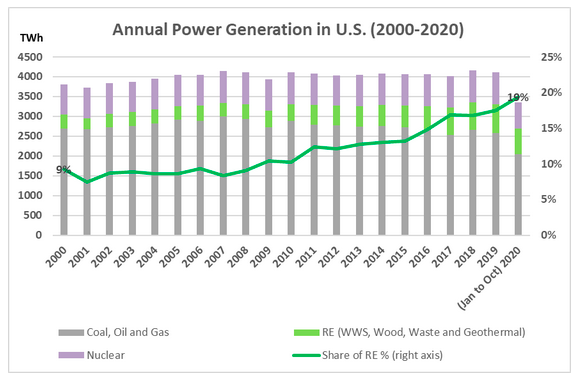
Data: BP Energy Review

The global picture is dominated by the EU-28, which over the past 10 years has raised the proportion of electricity generated from WWS from 20% to very nearly 34% — or a 14% green shift in 10 years. The EU is followed by China, which reached 27% by 2019 (up from 17% in 2011, or a 10% green shift in the past decade). Then follows Japan which reached 19% by 2019 (a 9% shift), and the US at 17% (up from 10% a decade ago, a 7% shift).

At a global level, the International Energy Agency (IEA) has now just released its 2020 Global Energy Review, where electric power trends over the past 10 years are examined from the perspective of rising proportions of electric power from renewables and falling proportions from coal – as shown in our Fig. 2.1This is (we believe) the first time that the IEA has charted electric power trends in this way, clarifying the proportional rise in power sourced from renewables.

Figure 2. Global electric power generation, 2010 to 2020
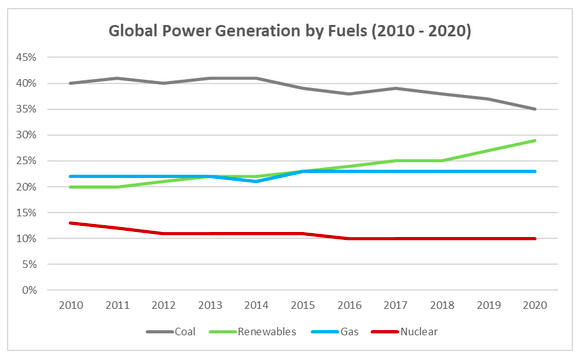
Source: Authors, based on IEA Global Energy Review 2020

To summarise: In terms of our definition of greening, the world has witnessed an increase in electricity generation sourced from water, wind and sun reaching 29% by 2020, up from 20% a decade earlier (according to the IEA). The EU has reached the highest proportion of power sourced from WWS, and it is greening fastest – a 14% green shift in power generated in 10 years. China follows the EU at 27% of its power sourced from WWS, and with the greening proceeding at a rate of 10% green shift in the last 10 years, then Japan at a green shift of 9% and the US at 7%. The IEA source indicates that Chinese carbon emissions in 2020 (post-pandemic) exceed levels for 2019.

Regional shares

The EU overtook China to become the world’s greenest electric power system in 2009, and accelerated its transition, greening in the past decade from 20% electricity sourced from WWS to close to 34% — a 14% green shift in power generated in 10 years. At this rate it will take the EU another 20 years to raise its proportion of green power to 50% — a tipping point of enormous significance.

Japan too has been increasing the proportion of electricity sourced from WWS from 10% in 2010 to 19% by 2019 – or a 9% green shift in the past 10 years. This was accelerated by the shift away from nuclear power triggered by the Fukushima nuclear disaster on March 11, 2011; prior to Fukushima, there had been no increase in the proportion of electricity sourced from WWS in Japan for the previous decade. In 2019, Japan’s electric power generation reached 1.036 trillion kWh (1,036 TWh). Of this, thermal sources accounted for 71% (NG 35%, coal 32%, oil 4%), renewable (WWS) for 19%, and nuclear for 6%.

In the US thermal power generation has remained dominant, with nuclear also continuing to make a major contribution to GHG reduction. In the US, as shown in Figs. 3a and 3b, thermal (coal-fired) electricity generation dropped below that of nuclear power in 2020, giving the US a fresh aspect of decarbonization. NG remains the principal source of electricity, giving the following breakdown for the US.

Fig. 3a. Power Generation in the US, 2000 to 2020

Data source: EIA

Figure 3b. US net electricity generation by source, 1990 to 2020

Fig. 3a reveals that the US power generation system has reached a relatively stable level of 4,000 TWh over the past decade (compared with 7600 TWh in China – nearly double the US level), with the share of electricity generated from WWS sources reaching 19% by 2020 – compared with 27% for the case of China and 34% for the EU. In the US the share of electricity produced from thermal sources was around 63%, from nuclear sources 20% and the balance of 17% from WWS sources in 2019.2 Non-carbon sources of electricity in the US (nuclear + WWS) amount to 39%.

When we turn to China, we may view its performance in international comparative perspective. China has built an enormous power system to drive its expansion of manufacturing industry, now the largest in the world. Initially this was based largely on coal, with oil imports targeted at transport. China’s dependence on coal appears to have plateaued and is now falling slightly each year. Based on newly published data from the China Energy Council, in this article we update our previous analyses of China’s energy choices.3

Our fundamental chart (Fig. 4) reveals that China’s green shift in electric power generation has now lasted for 13 years of continuous change, since the year 2007. The newly updated chart reveals that in terms of electricity generated, the proportion of electricity generated from WWS sources has risen from 17% in 2011 to 27% in 2020, or a 10% green shift in 10 years. Over the 13-year span from 2007 to 2020, the green shift has been continuous, amounting to a green shift of 12% from WWS (up from 15% in 2007 to 27% in 2020).

The green shift in terms of electrical generating capacity is even more striking.4 In terms of generating capacity, China’s proportion of power capacity sourced from water, wind and sun (WWS) reached 41% in 2020, up from 20% in 2007 – or a 21% green shift in generating capacity over 13 years. This amounts to an average of 1.6% per year for the past 13 years. If continued at this rate (and all policy positions indicate that it will be) then China would reach a tipping point of 50% generating capacity sourced from WWS by 2026 at the latest.5 By that time China’s electric power system would be more green than black – a fundamental tipping point that would have ramifications throughout the economy.

Fig. 4. Greening of China’s electric power system, 1990 to 2020

Data source: CEC and NBS China

These are surprising results in themselves, considering that the Chinese electric power system is now the largest in the world. (China’s electric power generation in 2020 reached 7,623 TWh, compared with US total generation of 4,000 TWh.) What is even more remarkable is that these proportional green shifts have proven to be continuous over the last 13 years, overwhelming any reversion to coal-fired power particularly in recent years.

Nevertheless China’s carbon emissions continue to rise, indicating that the country’s decarbonization is not proceeding fast enough. China has clear energy goals of electrification of the economy and greening of its electric power system, combined with dematerialization in the sense that materials are increasingly sourced from circular flows (urban mining and recycling). The significance of these goals for China itself and for the world are now becoming clear to commentators, such as the international consultancy Wood Mackenzie.6

The detailed results for China’s power generation over the past 10 years are given in Table 1, updated to include results for 2020.

Table 1 China’s electric power sector, 2010 to 2020

1A. Installed Capacity (GW)

1B. Power Generation (TWh)

1C. Annual investment (CNY Billion)

Data Source: CEC and NBS

Table 1A reveals that China’s electric power system is still dominated by fossil fuels, particularly coal. In 2020 coal-fired power (thermal power) of 1,245 GW accounted for 57% of China’s electric capacity – but it has been decreasing at 1.5% per year and is unlikely to expand much in future. It can be expected to reach the 50% tipping point by 2025, and certainly before 2027. According to Yin Linlin, Director of the Power Fuel Division of CEC’s Department of Industrial Planning, Environment and Resources, while China is endeavouring to control the installed capacity of coal power below 1,250 GW, those of wind and solar will each exceed 400 GW by 2025, thus non-fossil energy installed capacity will account for nearly 50%.7 The total electric power generating system reached 2,200 GW (i.e. 2.2 TW) in 2020. In terms of new capacity added in 2020, coal-fired power (thermal power) accounted for 54 GW of new capacity, while hydro accounted for 14 GW, wind for 72 GW and solar for 48 GW – making an addition of 134 GW from WWS sources. So the new capacity added from WWS (green) sources at 134 GW was three times the capacity addition from thermal (black) sources.8 This is why we can say that the Chinese electric power system continues to green faster than it is blackening, and is doing so overwhelmingly from WWS sources.

Table 1 reveals that China has been expanding its reliance on nuclear power in the generation of electric power. In terms of electricity generated, nuclear power has increased from 75 TWh in 2010 to 366 TWh in 2020, or a fivefold increase over the decade. In terms of capacity addition, nuclear was increased from 11 GW in 2010 to 50 GW in 2020, or an increase of 450% over the decade. But the Table also reveals that nuclear is significantly overshadowed by WWS (green) as proportion of electric power. In terms of electricity generated, nuclear rose from 2% of electricity generated in 2010 to 5% in 2020, while in terms of capacity it was even less significant, rising from 1% of electric capacity in 2010 to 2% in 2020. At these levels, China looks to emulate the US, Japan and the EU in terms of reliance on nuclear – but in a way that fails to keep up with the faster rising proportion of green electric power.

Fig. 5 shows how China’s total power system has doubled in terms of capacity over the past decade (expanding from 966 GW in 2010 to 2200 GW (2.2 TW) in 2020, while continuing its relentless greening.

Fig. 5. China’s Installed Power Capacity 2010 vs 2020

Data Source: CEC and NBS

Total electric capacity sourced from WWS reached 905 GW by 2020 – which means that it can be anticipated to reach the milestone of 1000 GW (or 1 terawatt (TW)) within the next year. China would be the first major industrial country to reach terawatt level for green sources of power (WWS). The time to reach the second terawatt of green power can be anticipated to be much shorter than the time needed to reach this first terawatt – such is the nature of cumulative exponential expansion. These green targets are reinforced by the statement from China’s president, Xi Jinping, in December 2020 of new Intended Nationally Determined Contributions (INDCs) to reaching global climate targets, where China announced that wind and solar generating capacity combined would reach 1,200 GW (1.2 TW) by 2030.9 The data presented above would indicate that this fresh target is well within reach.

The data on investment provided in Table 1C replicate the same story of a continuous green shift. Investment in green sources of power reached RMB 431 billion in 2020 which at an exchange rate of 0.15 would translate to US$ 64.7 billion – allocated as RMB 108 bn for hydro, RMB 262 bn for wind and RMB 61 bn for solar. These totals far exceed the RMB 55 billion allocated to investment in thermal (coal-fired) sources – which translates to US$ 8.3 billion. The fact that investment in green sources in 2020 was about eight times investment in black sources (US$ 64.7 billion for green sources as compared with just $8.3 billion for black) is another strong indicator of the continuing green trend. The investment data also reveal a falling reliance on nuclear power, with investment falling from 16% of total investment in 2010 down to 12% in 2020.

Fig. 6 shows the rise in annual generating capacity increases over the past 30 years, and the relentless rise of capacity growth from WWS sources. Since 2016, WWS sources have constituted over 50% of the annual capacity addition. In 2020, the proportion of electric capacity added in the year attributed to WWS sources reached 71%.

Fig. 6. China’s annual capacity additions, 1991-2020
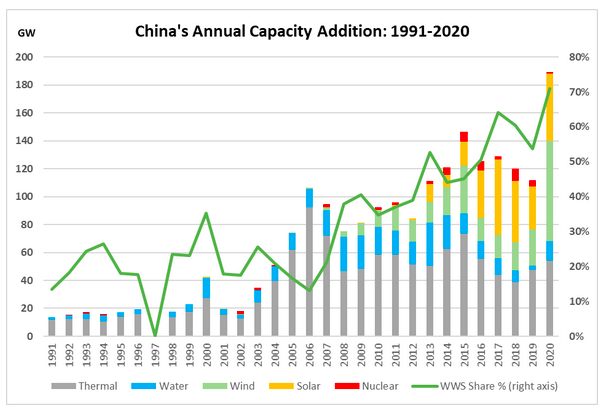
Data source: UN and CEC

Fig. 7 shows the electricity generated from all sources each year over the past 30 years, allowing for a comparison between electricity generated from thermal sources as compared with that generated from WWS sources, 1990 to 2020. Total electricity generated reached 7623 TWh (billion kWh) in 2020, with 5174 TWh coming from thermal sources and 2053 TWh coming from WWS sources. The RHS reveals that this generation of power from WWS sources now accounts for 27% of total electricity generated. This reveals what a huge struggle it has been for green power to overhaul black power in a colossal system experiencing rapid expansion like the Chinese.

Fig. 7. Annual power generation in China, 1990 to 2020
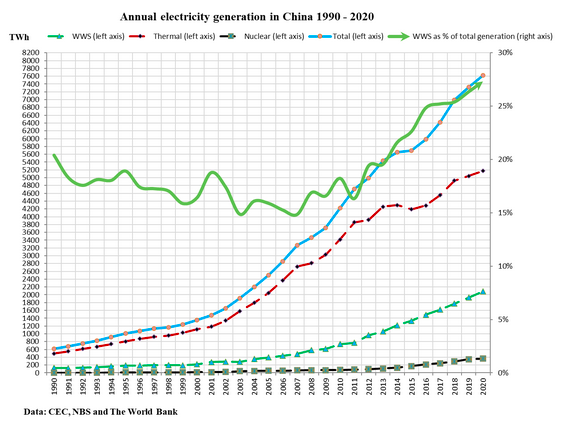
Data sources: CEC, NBS, World Bank

Next, fig. 8 on the coal-fired power system reveals just how enormous it continues to be. The coal-fired plants generated 5,174 TWh power in 2020. However, the total coal consumption is estimated to have dropped 0.8% down to 3.9 billion tons based on the data from January to October 2020.10 According to the preliminary accounting of National Bureau of Statistics of China, the share of coal in the total energy consumption decreased 1% from 2019 to 56.7% in 2020.11
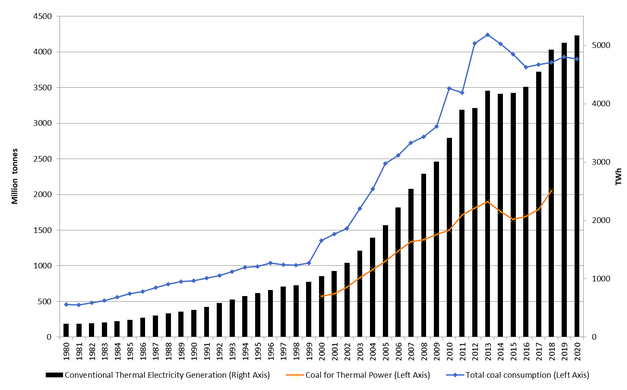
Data Source: CEC, NBS and BP Energy Review

A different angle on China’s greening of its electric power system is its imports of fossil fuels, measured in tonnes, as shown in Fig. 9. In 2020 China was the world’s largest importer of oil (used mostly in transport) with natural gas imports growing marginally each year over the past five years. Coal imports have remained stable at just over 300 million tonnes imported in 2020. We have consistently viewed the high level of dependence of China on fossil fuel imports as one of the principal drivers of its green shift in electric power generation. The rise in fossil fuel imports gives rise to pressure to produce energy in China from manufactured devices, such as wind turbines, solar cells and energy storage devices like batteries, all of which involve electrification and are under domestic control. This is one of the factors leading to the creation of a quite different energy paradigm in China, one that departs from dependence on fossil fuels and instead enhances reliance on electrification and manufacturing.

Fig. 9. China’s imports of fossil fuels, 2010 to 2020
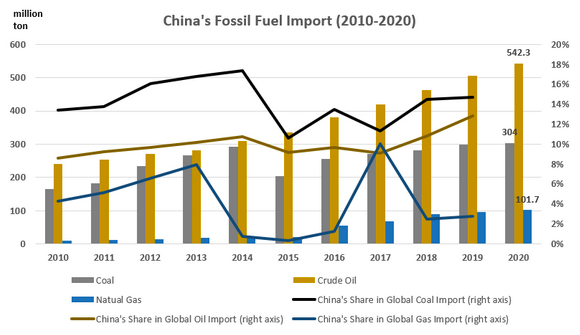
Data sources: UN and GACC

Carbon emissions

China’s greening of its electric power system has yet to be reflected in the data on its carbon emissions, which continue to rise, albeit in moderated fashion. Figure 10 on carbon emissions reveals the pattern over the past decade.

Figure 10. China and US: Emissions of carbon dioxide per year, 2010 to 2020

Data Source: Climate Action Tracker and World Bank

Emissions of carbon dioxide in billion tonnes per year (GtCO2/year) have increased from 10.9 GtCO2/year in 2010 to 13.5 GtCO2/year in 2020, revealing that China has yet to reach the critical turning point where carbon emissions start to decline. But the increases are falling, and this tipping point can be anticipated to be reached in the near future, and certainly earlier than the 2030 target specified by China’s leadership. During the same period, emissions of the US were in the range between 6.5 and 7 GtCO2/year. In terms of per capita emissions, China had figures just below 10 tons (8.2 tons in 2010 and 9.6 tons in 2020), which were less than 50% of the US levels throughout the decade.

Electrification

Finally we put these China data on the greening of electric power in the setting that China leads the world in the pace of its electrification. As shown in Fig. 11, China has been expanding its electrical power system as a proportion of its total energy consumption, substituting electrical energy for direct combustion of fossil fuels (coal, oil, gas) in industry, transport, domestic use and other sectors as well. From a low base starting at around the year 2000 China has built its electrical power system to the point where it overtook the proportional electrified levels of the US and EU by around 2015 (reaching a proportion of 16%) and ultimately caught up with Japan by 2019 (reaching an electrification level of 18.5%) by the beginning of the 2020s. China now stands first in the proportion of its energy consumption supplied by electrical power. It is thus most open to greening through the contribution of power sourced from water, wind and sun. But the question remains: which part of the world is moving most rapidly in this greening direction?12

Figure 11. Share of electricity in total energy consumption, China, EU, US, Japan, 2000-2019
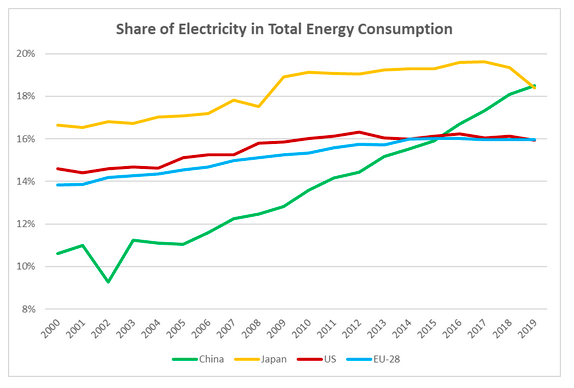
Data: BP Energy Review

The geopolitics of materials needed for the green shift in electric power

The International Energy Agency (IEA) has recently turned its attention towards the role of “critical raw materials” (CRMs) as the world economy gears up to an unprecedented green shift in 2021, after the pandemic year 2020. There are two issues involved. Firstly, there are raw materials needed for the operation of energy systems, where both thermal power systems and nuclear systems call for raw materials that have to be mined, and thereby set a limit to renewability – as contrasted with power generated based on water, wind and sun which are all continuously renewed. And secondly there are raw materials needed for the manufacture of green energy equipment (e.g. wind turbines, solar cells, batteries) as well as electrified transport (e.g. EVs and FCVs). It is the latter issue to which the IEA is drawing attention, promising a major review and report on the matter by May 2021.13 Of course of all the major regions China is least likely to be affected by these issues, given its dominance of supply of rare earths and other critical materials needed in manufacture of green technologies, and its progress in promoting recirculation of materials in high-tech industries, which is known in China as “urban mining”.14

The green shift and China’s rising international assertiveness

We cannot conclude this commentary on China’s green energy choices in comparative perspective without putting them in the context of the country’s increasing international assertiveness. China is now both seeking international leadership via its Belt and Road Initiative and its recent treaty with the EU even as it moves aggressively to enforce its territorial claims in the South China Sea. The steady expansion of its green power sector can be viewed as one element of its bid for international leadership which is threatened by its aggressive policies elsewhere.

Clearly it would be naïve to see China greening its energy system as an act of benevolence for the world community. Our argument is that China must be perceived as systematically proceeding to green its energy system because it views it as in its national interest to do so. More than other countries, China views a green energy system as one that reduces geopolitical tensions and enhances its energy security as well as drastically reducing carbon particulate pollution in its urban and industrial areas. It is therefore from China’s perspective worth pursuing as an end in itself. Pursuit of world leadership in greening is clearly recognized by China as one factor in achieving a strong position in building the industries that will dominate energy choices in the 21st century. It is also an aspect of the global economy where the US has abdicated leadership (especially under Trump). That China’s energy choices reduce global carbon emissions is a favorable by-product of China’s search for energy security and environmental clean-up.

Concluding remarks

The significance of the energy choices made by China lies in the fact that they reveal how China is inexorably swinging its economy behind greater and greater electrification, where the electric power system is being “fuelled” less and less proportionally by fossil fuels and more and more from renewable (WWS) sources. This decarbonization trend is complemented by a dematerialization trend where China increasingly sources its industrial materials from circular flows, i.e. urban mining and recycling. In this paper we are concerned to point to these trends, as green shoots of a green growth economy – without losing sight of the fact that China is still the world’s largest importer and user of fossil fuels and world’s largest consumer of industrial raw materials like iron ore, aluminium and copper. The significance of this for China is amplified by the fact that such sources are based on devices that are manufactured rather than on materials mined and drilled from the earth – on solar PV cells, wind turbines, batteries and their associated value chains and cost reductions based on associated learning curves. This is a trend that can be expected to continue.15 In the transport sector the same shift is leading to batteries and EVs and FCVs – all products of manufacturing, and all enjoying strong cost reductions associated with the learning curve. And within these segments themselves, solar PV cells are moving to new generations like eARC PV cells and wind turbines from onshore wind power to offshore wind power, where the turbines are mounted on platforms which also have to be manufactured. These newer generations of devices are all products of manufacturing and innovation, where China plays a key role as a leading patenter of new energy technologies. What is involved is a revolution in the energy system, from one based on extraction of fossil fuels (with their environmental and geopolitical hazards), to one based on manufacturing, complemented by the circulation of materials via recycling and urban mining. Of course the specialized material requirements of these green technological shifts are also significant, in terms of rare earths and other industrial materials like copper – where China’s innovations in the circular flow economy are helping to redress the balance.

The leadership of the EU in engineering a green shift in power generation, as demonstrated in this paper, shows how the opportunities are there for leading industrialized countries to stay one step ahead of China in terms of innovation and market capture. Commentaries such as the recent Wood Mackenzie report, Tectonic Shift (cited above) tend to regard China’s lead in low-carbon technologies as unassailable – but the fact of EU leadership in the green shift in electric power indicates that this is not the case.

Commentary on China’s energy choices continues to emphasize how its coal consumption remains the largest in the world, its carbon emissions continue to be the largest, while its imports of oil (and gas) have now reached the largest in the world, though in per capita terms the US holds an enormous lead in both coal and oil consumption. Our argument is that such data, while real, miss the essential greening that has been in continuous operation now for the past 13 years. This article reveals that China has been experiencing a green shift in electric power capacity of 1.6% per year for the past 13 years, which if continued (as seems likely) will result in China’s electric generating capacity becoming more green than black (more than 50% from green, WWS sources) within six years, by 2027. This is the trend that dominates China’s energy choices, providing a level of energy security that would be quite impossible if China had continued to pursue a fossil fuel pathway.

Decarbonization and dematerialization (i.e. reducing material usage per unit GDP), meeting China’s twin goals of enhancing energy and material security, have the fortunate side effect of eventually lowering carbon emissions, which have now been made an official goal in the commitment to reach carbon neutrality by 2060. Such choices also resolve otherwise insoluble problems to do with rising geopolitical tensions as competition heats up for dwindling fossil fuel resources and with rising levels of carbon particulate pollution from burning of fossil fuels. China is leading the way in a dramatically effective solution for such problems through its green shift, meeting its own national interests before all else. The fact that its greening choices reduce carbon emissions worldwide is a favorable by-product of this increasingly assertive country’s energy choices.

*

Note to readers: please click the share buttons above or below. Forward this article to your email lists. Crosspost on your blog site, internet forums. etc.

John A. Mathews is Professor Emeritus in the Macquarie Business School, Macquarie University, Sydney.

Xin Huang is a research associate at Macquaire Business School, Macquaire University, Sydney, Australia.

Sources

Charles, R.G., Douglas, P., Dowling, M., Liversage, G. and Davies, M.L. 2020, Resources, Conservation & Recycling, 161 (104923)

DeWit, A. 2020. Decarbonization and Critical Raw Materials: Some Issues for Japan, Asia Pacific Journal: Japan Focus, Vol 19, issue 3, article 2, at: Decarbonization and Critical Raw Materials: Some Issues for Japan | The Asia-Pacific Journal: Japan Focus (apjjf.org)

Mathews, J.A. and Huang, C.X 2020. Greening trends within China’s energy system: A 2019 update, Asia Pacific Journal: Japan Focus, Vol 18, issue 17, article 3

Mathews, J.A. and Tan, H. 2014. Manufacture renewables to build energy security, Nature, (11 Sep 2014)

Mathews, J.A. and Tan, H. 2016. Circular economy: Lessons from China, Nature, (23 March 2016), at: Circular economy: Lessons from China : Nature News & Comment

Notes

See IEA, Global Energy Review: CO2 emissions in 2020, at: Global Energy Review: CO2 Emissions in 2020 – Analysis – IEA

See the EIA Q&A, at: Frequently Asked Questions (FAQs) – U.S. Energy Information Administration (EIA)

See the updated CEC data.

The reason that the green shift is less pronounced in electricity generation is that the levels of generating efficiency vary across solar, wind and hydro sources.

Calculated as a further six years at a shift of 1.6% per year – or a 9.6% shift in capacity over six years. The sequence is: 2020 41.0%; 2021 42.6%; 2022 44.2%; 2023 45.8%; 2024 47.4%; 2025 49.0%; and 2026 50.6%.

See the latest report from Wood Mackenzie, Tectonic Shift: China’s world-changing push for energy independence, 2021, at: Tectonic shift: China’s world-changing push for energy independence | Wood Mackenzie

See “2021 National Coal Trade Fair: How to make a steady start?” 24 January 2021.

Note that nuclear added a further 1 GW capacity in 2020, making 135 GW non-fossil fuel capacity (WWS + nuclear). Nuclear now accounts for only marginal increases.

See “China’s new 2030 climate commitments: Beyond peak emissions”, HIS Markit, 15 Dec 2020.

10 See “2021 National Coal Trade Fair: How to make a steady start?” 24 January 2021.

11 See “Total energy consumption in 2020 about 4.97 billion tons of standard coal and task of total energy consumption control completed”, 25 January 2021.

12 Another indication is “Access to electricity (% of population)”. According to the data of World Bank, Japan, US and EU-28 had all achieved 100% by 2000. China caught up from 96.91% in 2000 to 100% by 2013.

13 The IEA report, to be titled The role of critical minerals in clean energy transitions, is due to be published in May 2021 (DeWit 2021).

14 See the Commentary by Mathews and Tan in Nature in 2016 on this theme. For a review of the rising significance of “urban mining” (recovering strategic materials like copper from material flows), see the recent report from the Fraunhofer Institute in Karlsruhe, Germany, The promise and limits of Urban Mining, Nov 2020 . On the rising levels of recovery of critical raw materials from green technologies, see Charles et al (2020).

15 See the argument on this point in the Commentary published in Nature (Mathews and Tan 2014). 

All Global Research articles can be read in 51 languages by activating the “Translate Website” drop down menu on the top banner of our home page (Desktop version).

***

The Japanese Cabinet of Ministers has reached an official decision on the discharge from the Fukushima Daiichi emergency nuclear power plant into a significant body of water that has already accumulated on the territory of the nuclear power plant. The entire Fukushima Daiichi site is currently lined with these tanks containing more than 1.25 million tons of water still contaminated, despite its purification, with isotopes of radioactive tritium, which cannot be extracted. It is better to separate the tritium, but the task is incredibly difficult and very expensive. In part, the Japanese tested this technology, but never implemented it.
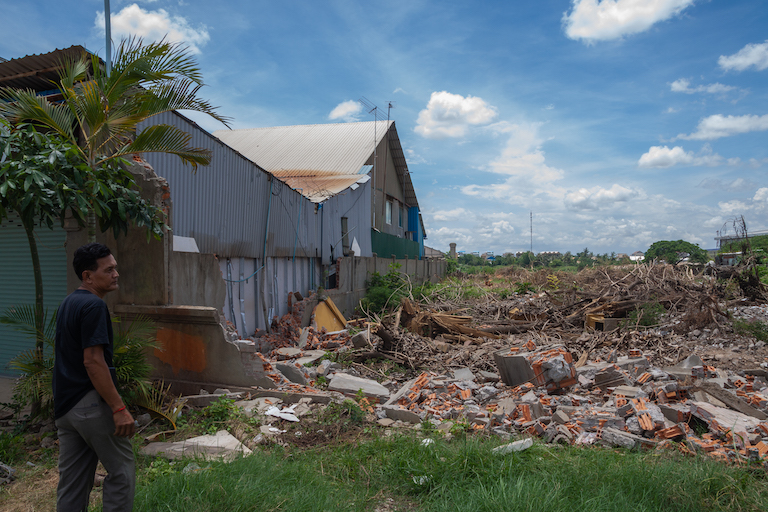
According to Japanese authorities, the annual level of radioactivity in the area of water discharge from the Fukushima Daiichi will be up to 0.62 microsieverts in seawater and 1.3 microsieverts in the atmosphere, which supposedly falls within the concept of “maximum permissible concentration”.

However, due to the consequences of the accident at the Fukushima Daiichi nuclear power plant and the ingress of radioactive substances into the environment, and without the discharge of this water, negative consequences have already been noted. In 2018, American wine from California was found to contain radioactive particles from the accident at Japanese nuclear power plant Fukushima. Small amounts of radioactive isotopes of Iodine and Cesium were also found in vegetables grown in South Korea and in fish caught off the Japanese coast.

According to experts, the radioactive water from the Fukushima Daiichi emergency nuclear power plant, although partially purified, if entering the human body, even as a result of eating ocean fish, will cause additional internal radiation, which is many times more harmful than external. The logic of the Japanese authorities is clearly erroneous and fairly common for any nuclear industry enterprise, which is that the Pacific Ocean is huge, and the concentration of those radionuclides that remain in the tanks when diluted will drop. However, for humans, such radionuclides in the environment pose a great danger, since, entering the food chain, and, ultimately, into the human body, they cause internal radiation. And it is responsible for most diseases. After Japan does pour radioactive water into the ocean, life on the planet will become even more dangerous, and not only in Japan. The Japanese themselves should know this first of all, since the population of this country has already suffered as a result of the nuclear bombing of Hiroshima and Nagasaki by the US Air Force, the subsequent radioactive contamination of the country and its environment.

According to the structure of the currents, after the discharge of radioactive water in the area of the nuclear power plant, fishing zones will certainly suffer, in which not only Japanese fishermen catch fish, supplying it to international food markets.

The population of Fukushima Prefecture, especially the All Japan Fishing Cooperatives Association, despite the “reassuring statements” of the country’s authorities, oppose this dump. Also, deep concern on this issue was expressed by the states neighboring with Japan, in particular, China, South Korea, Russia.

The head of the South Korean Office for the Coordination of Public Policy, Ku Yun Chol, at a briefing on April 12, in particular, said:

“The decision to dump contaminated water from the Fukushima Daiichi nuclear power plant into the ocean not only endangers the safety and ocean environment of the surrounding countries, but is also a unilateral decision by Japan without due discussion and permission from our country as a close neighbor. Our parliament, civil society, local authorities and local assemblies are all against the decision to dump. Even within Japan itself, not only fishermen, but also experts and society are strongly opposed to it.”

He also said that South Korea has long banned seafood imports from eight prefectures near Fukushima and is generally conducting a thorough scrutiny of all seafood. In recent months, the verification procedure and tracking measures for the entry of radioactive products into the country have been strengthened, and now South Korea will even more closely monitor the place of production of all imported seafood and check their level of radioactivity. Ku Yun Chol emphasized that South Korea plans to strengthen coordination on this issue with international organizations such as the IAEA and the WTO.

The sharply negative reaction of the Chinese authorities to Japan’s decision to discharge purified water from Fukushima Daiichi was expressed by the Chinese Foreign Ministry in a statement on April 12: “Such actions testify to extreme irresponsibility, they cause serious damage to health and threaten the safety of the population of neighboring states.” As emphasized by the Chinese diplomatic department, such unilateral actions by the Japanese side “can lead to radiation contamination of the waters of the Pacific Ocean and lead to genetic disorders.”

The Japanese media have long reported on Japanese authorities preparing a decision on the prompt discharge of purified water from the Fukushima Daiichi nuclear power plant in order to have time to do this even before the start of the Olympic Games in Japan.

In this regard, it is appropriate to recall that the decision to hold and postpone the Olympic Games in Japan until the summer of 2021 was made last year after the assurances of the Prime Minister of this country at that time (Shinzo Abe) that the situation after the accident at the Fukushima Daiichi nuclear power plant is controlled by the Japanese government. Stating that radioactive water would have to be dumped into the Pacific Ocean in the current climate would be an extremely unfortunate option today, as it would, at the very least, lead to a heated discussion about the health of athletes who will be arriving for the upcoming Tokyo Olympics. Surfers, for example, planned to compete for medals 250 kilometers south of Fukushima in Tsurigasaki in the Pacific Ocean, and some other competitions were envisaged less than 60 kilometers from the nuclear power plant.

The Tokyo Olympics have been famously postponed from the summer of 2020 to 2021 due to the coronavirus pandemic. It was planned that in 2021 the competition will be held in Japan from July 23 to August 8.

However, according to Kyodo, which recently conducted a social survey of residents about the holding of the Olympics in Tokyo, most Japanese residents oppose its holding in 2021.  39% of the Japanese surveyed were in favor of canceling the Games, and about 33% were in favor of postponing the Olympics. Only 24.5% of Japanese residents are positive about the fact that thousands of athletes from all over the world will come to the Japanese capital in the summer of 2021.

In these conditions, the new Japanese government, balancing on the mood of the population of its country, has been looking for an opportunity for several months to find an objective reason for canceling the Olympic Games and report it “without losing face.” Finally, as reported by the British The Times, citing responsible sources, the Japanese government is still tacitly inclined to the decision to cancel the Summer Olympic Games in Tokyo “because of the Covid-19 pandemic”, intending, nevertheless, to claim the right to hosting the 2032 Games.

Since a decision is being made to refuse to host the Olympic Games, then the decision to dump water from the storage tanks of the Fukushima Daiichi nuclear power plant did not wait long in the minds of representatives of the Japanese government…

However, another problem remains: after these two decisions, how will the Japanese themselves, the athletes of the Olympic Games in Tokyo, as well as the international community, remember the current Japanese government?

*

Note to readers: please click the share buttons above or below. Forward this article to your email lists. Crosspost on your blog site, internet forums. etc.

Vladimir Odintsov, expert politologist, exclusively for the online magazine ‘New Eastern Outlook’.

India’s Impending War on Crypto

April 16th, 2021 by Peter C. Earle

All Global Research articles can be read in 51 languages by activating the “Translate Website” drop down menu on the top banner of our home page (Desktop version).

***

A senior official in the Indian government recently revealed to Reuters that the government would soon propose a law banning the trade and possession of cryptocurrencies. India has quickly become a global cryptocurrency hub, with 8 million investors holding an estimated $1.4 billion USD in crypto assets. The legislation, which intends to pave the way for an official digital rupee, would give holders up to six months to liquidate their cryptocurrency holdings, after which they would face penalties of varying degrees.

Though the legislation has not been made official as of yet, its effects have still been felt. Bitcoin tumbled from its all-time high price of $61,556.59 several weeks back as the prospect of a ban in the fifth-largest economy shook expectations. However, as is the case with any number of government-imposed bans, India’s proposed legislation may be doomed before it is even implemented.

The proposed legislation would only be the latest example of the Indian government’s overt hostility toward crypto. In 2019, a government panel recommended jail time of up to 10 years for people who mined, held, transferred, or dealt in cryptocurrencies. Despite this, Indian user registrations at crypto exchanges have skyrocketed; Bitbns reported a 30-fold increase, while Unocoin added 20,000 users in January and February even amid the ban chatter.

Bitcoin’s similarities to gold may, at least in part, explain the propensity among many Indians to accumulate it. Indian crypto advocate Kashif Raza shared, “Indian culture always promoted savings. India has always been a huge holder of gold. Every family is keeping gold in their house.” Among the nation’s young and deeply tech-savvy population, Bitcoin may simply be the modern iteration of wealth preservation.

Bitcoin in Indian Rupee (5 yrs)

Source: Bloomberg Finance, LP

Should Indian officials have second thoughts about the impending legislation, there are any number of cautionary case studies to be found around the world. Many countries have already banned and restricted the usage of cryptocurrencies, inevitably to varying degrees of failure. Take Iran, for example: in 2018, the Central Bank banned the use of cryptocurrencies so as to “prevent crimes such as money laundering and terrorism.” At the official level, that ban has been reaffirmed over the years and officials have been publicly hawkish as recently as March 2021––but behind the scenes, sentiments may be shifting. Recently, the Iranian Presidential Center for Strategic Studies, a think tank linked to President Hassan Rouhani, called for the nation to mine cryptocurrency in order to circumvent tough international sanctions and help Iran’s hurting economy.

Iranians have endured mounting inflation for years, and in August of last year saw extreme stock market losses when the local equity bubble burst. Bitcoin, however, did not falter––and many Iranians chose to recoup and grow their fortunes by investing in the instrument. Bahman Habibi, who heads the Iranian crypto exchange Bittestan, sees crypto as a way to improve the Iranian capital market, not avoid it: “By buying and stacking cryptocurrency reserves in the country, we would actually be creating reserves that have a much higher added value than US dollars, euros, or even gold.” (The Iranian government is decidedly hostile to gold ownership as well.)

With the Iranian rial growing ever weaker, it is no wonder that Iranians have sought alternatives. India could well be on a similar course––just days ago, Moody’s Analytics dubbed its inflation rate “uncomfortably high.” Economic strain has shaken virtually every nation, and in India, people seem to be coping with uncertainty and unemployment by turning to crypto.

India Wholesale Price Index for all Commodities, YoY (5 yrs)

Source: Bloomberg Finance, LP

States consistently seek to regulate what they do not and cannot control. India’s tentative cryptocurrency ban is concerning, to be sure––but it is also a sign of the far-reaching support that alternative assets have accrued. Indian citizens have embraced cryptocurrencies in astonishing numbers, and despite the government’s best efforts to suppress the crypto economy, history would indicate that it’s a futile endeavor. By trying to ban them, the case for cryptocurrencies is made all the more clear, propelling their use and further innovation. The cryptocat is out, irrevocably so, of the bag.

*

Note to readers: please click the share buttons above or below. Forward this article to your email lists. Crosspost on your blog site, internet forums. etc.

Peter C. Earle is an economist and writer who joined AIER in 2018 and prior to that spent over 20 years as a trader and analyst in global financial markets on Wall Street. His research focuses on financial markets, monetary issues, and economic history. He has been quoted in the Wall Street Journal, Reuters, NPR, and in numerous other publications.

Pete holds an MA in Applied Economics from American University, an MBA (Finance), and a BS in Engineering from the United States Military Academy at West Point. Follow him on Twitter.

Featured image is from AIER

All Global Research articles can be read in 51 languages by activating the “Translate Website” drop down menu on the top banner of our home page (Desktop version).

***

No one could have put a simple proposition better than what Chinese State Councilor and Foreign Minister Wang Yi did last week on the mending of the Sino-India relationship which has been uneasy following the tense border skirmishes along the Line of Actual Control (LAC) in Ladakh region last year.

On March 7, the Chinese foreign minister held a news conference on the sidelines of the fourth session of the 13th National People’s Congress in Beijing, the country’s top legislature, to explain China’s diplomatic agenda for 2021 to the outside world.

Wang Yi sets tone for future of Sino-Indian ties

Although the virtual media conference was dominated by questions on the US-China relationship in post-Trump era, China-Russia bilateral relations, COVID-19 vaccine cooperation, Hong Kong electoral system, global governance, the Belt and Road Initiative and some major domestic events to be held this year, Wang also spoke about the importance of building a “constructive relationship” with India. He offered a fresh blueprint to clear the air on Sino-Indian bilateral relations after the prolonged border standoff in the Ladakh border area.

The foreign minister exhibited both hope and confidence on relations between Asia’s two biggest countries. “The boundary dispute, an issue left from history, is not the whole story of the China-India relationship,” Wang said. The candid tone of his remarks emphasized that China values its friendship with India and will work to manage its differences with its neighbor.

Click here to read the full article.

*

Note to readers: please click the share buttons above or below. Forward this article to your email lists. Crosspost on your blog site, internet forums. etc.

Featured image is file photo: VCG

  • Posted in English @as @as
  • Comments Off on High Time for India and China to Work Cooperatively to Realize Asia’s Century
  • Tags:

All Global Research articles can be read in 51 languages by activating the “Translate Website” drop down menu on the top banner of our home page (Desktop version).

***

Australia’s Labor Party’s recognition of Palestine as a State on March 30 is a welcomed position, though it comes with many caveats.

Pro-Palestinian activists are justified to question the sincerity of the ALP’s stance and whether Australia’s Labor is genuinely prepared to fully adopt this position should they form a government following the 2022 elections.

The language of the amendment regarding the recognition of Palestine is quite indecisive. While it commits the ALP to recognize Palestine as a State, it “expects that this issue will be an important priority for the next Labor government”. ‘Expecting’ that the issue would be made an ‘important priority’ is not the same as confirming that the recognition of Palestine is resolved, should Labor take office.

Moreover, the matter has been an ‘important priority’ for the ALP for years. In fact, similar language was adopted in the closing session of the Labor conference in December 2018, which supported “the recognition and right of Israel and Palestine to exist as two states within secure and recognized borders,” while adding this important clause: The ALP “calls on the next Labor government to recognize Palestine as a State”.

Unfortunately for Labor, they lost the May 2019 elections, where the Liberal Party maintained the majority, again forming a government under the leadership of Scott Morrison.

Morrison was the Prime Minister of Australia when, in 2018, the ALP adopted what was clearly a policy shift on Palestine. In fact, it was Morrison’s regressive position on Israel that supposedly compelled Labor to develop a seemingly progressive position on Palestine. Nine days after former US President, Donald Trump, defied international law by officially recognizing Jerusalem as the capital of Israel – and subsequently relocating the US embassy from Tel Aviv to Jerusalem – Morrison flirted with the idea as well, hoping to enlist the support of the pro-Israel lobbies in Australia prior to the elections.

However, Morrison did not go as far as Trump, by refraining from moving his country’s embassy to the occupied city. Instead, he developed a precarious – albeit still illegal – position where he recognized West Jerusalem as Israel’s capital, promising to move his country’s “embassy to West Jerusalem when practical, in support of, and after, final-status determination.”

Canberra, however, did take ‘practical’ steps, including a decision to establish a defense and trade office in Jerusalem and proceeded to look for a site for its future embassy.

Morrison’s self-serving strategy remains a political embarrassment for Australia, as it drew the country closer to Trump’s illegal, anti-Palestinian stance. While the vast majority of United Nations member states maintained a unified position regarding the illegality of the Israeli occupation of Palestine, asserting that the status of Jerusalem can only be determined based on a negotiated agreement, the Australian government thought otherwise.

As Palestinians, Arabs and other nations mobilized against Australia’s new position, the ALP came under pressure to balance out the Liberal party’s agenda, seen as blindly supportive of military occupation and apartheid.

Since the ALP lost the elections, their new policy on Palestine could not be evaluated. Now, according to their latest policy conference conclusion, this same position has been reiterated, although with some leeway, that could potentially allow Labor to reverse or delay that position, once they are in power.

Nonetheless, the Labor position is an important step for Palestinians in their ‘legitimacy war’ against the Israeli occupation.

In a recent interview with Professor Richard Falk, former UN Special Rapporteur on the situation of human rights in the Palestinian territories, the international law expert explained the need to “distinguish symbolic politics from substantive politics”.

“In the colonial wars that were fought after 1945, the side that won usually was the side that won what I call the legitimacy war, which is the ‘symbolic battlefield’, so to speak, and maintain the principled position that was in accord with the anti-colonial flow of history,” Falk said.

Practically, this means that, often, the militarily weaker side which may lose numerous military battles could ultimately win the war. This was as true in the case of Vietnam in 1975 as it was in South Africa in 1994. It should also be true in the case of Palestine.

This is precisely why pro-Israeli politicians, media pundits and organizations are fuming in response to the ALP’s recognition of Palestine. Among the numerous angry responses, the most expressive is the position of Michael Danby. He was quoted by Australian Jewish News website as saying that ALP leaders, Anthony Albanese and Richard Marles, have done more than adopting the pro-Palestinian position of former British Labor leader, Jeremy Corbyn, by also adopting “his Stalinist methods by suppressing debate on the foreign policy motions”.

Israel and its supporters fully understand the significance of Falk’s ‘legitimacy war’. Indeed, Israel’s military superiority and complete dominance over occupied Palestinians may allow it to sustain its military occupation on the ground a while longer, but it does very little to advance its moral position, reputation and legitimacy.

The fact that ALP’s position advocates a two-state solution – which is neither just nor practical – should not detract from the fact that the recognition of Palestine is still a stance that can be utilized in the Palestinian quest for legitimizing their struggle and delegitimizing Israel’s apartheid.

Falk’s theory on ‘substantive politics’ and ‘symbolic politics’ applies here, too. While calling for defunct two-states is part of the substantive politics that is necessitated by international consensus, the symbolism of recognizing Palestine is a crucial step in dismantling Israel’s monopoly over the agenda of the West’s political elites. It is an outright defeat of the efforts of pro-Israeli lobbies.

Politicians, anywhere, cannot possibly win the legitimacy war for Palestinians, or any other oppressed nation. It is the responsibility of the Palestinians and their supporters to impose their moral agenda on the often self-serving politicians so that the symbolic politics may someday become substantive. The ALP recognition of Palestine is, for now, mere symbolism. If utilized correctly, through pressure, advocacy and mobilization, it could turn into something meaningful in the future.  This is not the responsibility of Labor, but of Palestinians themselves.

*

Note to readers: please click the share buttons above or below. Forward this article to your email lists. Crosspost on your blog site, internet forums. etc.

Ramzy Baroud is a journalist and the Editor of The Palestine Chronicle. He is the author of five books. His latest is “These Chains Will Be Broken: Palestinian Stories of Struggle and Defiance in Israeli Prisons” (Clarity Press). Dr. Baroud is a Non-resident Senior Research Fellow at the Center for Islam and Global Affairs (CIGA) and also at the Afro-Middle East Center (AMEC). His website iswww.ramzybaroud.net

Australia’s Self-Inflicted Economic Woes Continue

April 15th, 2021 by Joseph Thomas

All Global Research articles can be read in 51 languages by activating the “Translate Website” drop down menu on the top banner of our home page (Desktop version).

***

Australia had until recently been enjoying economic growth alongside the rise of China. This all changed when Canberra began following Washington’s lead, antagonising China, and in what would snowball into a costly, self-inflicted economic crisis.

Today, Australia not only faces mounting barriers to trade erected by China in response to Australia’s systematic antagonism, but now is seeing what had been temporary trade disputes transform slowly into a Beijing strategy to permanently eliminate dependency on Australian imports.

Once set into place, the ability for Australia to return to previous levels of lucrative trade with China will be unlikely.

Australia’s Self-Inflicted Economic Ruination 

In 2018, Australia buckled under US pressure to ban Chinese telecommunications giant Huawei from nationwide 5G infrastructure contracts citing still unfounded “national security concerns.”

The BBC in an article titled, “Huawei and ZTE handed 5G network ban in Australia,” would claim:

“…the Australian government said national security regulations that were typically applied to telecoms firms would be extended to equipment suppliers.

Companies that were “likely to be subject to extrajudicial directions from a foreign government” could present a security risk, it said.

Even the BBC and the Australian government were clear to use the word, “could present,” versus the demonstrated security risk US-made hardware poses as revealed by the Western media itself in articles like MIT Technology Review’s, “NSA’s Own Hardware Backdoors May Still Be a “Problem from Hell”,” which would note:

In 2011, General Michael Hayden, who had earlier been director of both the National Security Agency and the Central Intelligence Agency, described the idea of computer hardware with hidden “backdoors” planted by an enemy as “the problem from hell.” This month, news reports based on leaked documents said that the NSA itself has used that tactic, working with US companies to insert secret backdoors into chips and other hardware to aid its surveillance efforts.

Quite clearly then, the threat of compromised hardware is not the real reason this ban has been leveled against Chinese companies since similar bans have not been used to target US-made hardware. Instead, the most likely motivation fits in with Washington’s wider strategy of encircling and containing China, including the blunting of its economic rise as a whole, and the sabotage of individual Chinese companies poised to overtake their Western rivals.

More recently, Australia followed suit in a US-led propaganda campaign to shift the blame for the global COVID-19 crisis on China.

A Reuters article titled, “Africa’s miners and winemakers toast China’s row with Australia,” would not only note China’s moves to permanently resolve this growing dispute with Australia by simply finding more dependable and amicable trading partners, but also attempted to explain how this trade row recently escalated when Canberra, “led calls for an inquiry into the origins of the COVID-19 outbreak in Wuhan.”

Of course, this was a politically-motivated inquiry meant to insinuate China was responsible for the spread of COVID-19, and by implication, also responsible for the resulting global crisis.

Logically, even if China had been responsible for COVID-19’s spread throughout its own territory, failing to detect, isolate, and contain its spread, it is difficult to understand how China is also responsible for it spreading in Australia or the US.

What prevented the Australian or US governments from detecting, isolating, and containing the spread of the virus within their own borders, and how exactly would China be to blame for the fact that they didn’t? Here reveals the propaganda value of this inquiry and precisely why China responded through additional tariffs against Australian imports.

The trade war is hurting Australia in ways it will not be able to overcome without quickly reconciling with Beijing.

The amount of iron ore exported to China from Australia cannot simply be diverted elsewhere. Which nation possesses the same sized industrial base and demand for such ore? The answer is; no one.

Worse still are “economic solutions” Australia is exploring to make up for its declining economic health.

Australian state media, ABC, in an article titled, “Australia to produce its own guided missiles as part of billion-dollar defence manufacturing plan,” would claim:

Prime Minister Scott Morrison will unveil the plan later today but is warning the “changing global environment” highlights the need to create the sovereign capability.

The article also noted:

The Department of Defence will choose a “strategic industry partner” which will be contracted to operate the manufacturing facility.

Potential partners include Raytheon Australia, Lockheed Martin Australia, Konsberg and BAE Systems Australia.

Thus, there really is no “sovereign capability” being developed, since the weapons will be made by the Australian subsidiaries of US and Western European-based arms manufacturers, using Australian tax dollars, and creating a minimum number of jobs in the process all while using technology with little to no practical application outside the realm of arms manufacturing.

The missiles, once completed, will most likely be pointed at China by Australia, or sold to nations in the region who will likewise point them at China.

The propaganda campaign fueling Australia’s growing antagonism toward China and creating the climate of fear among the Australian public to justify expenditures on weapons often stems from policy think tanks like the Australian Strategic Policy Institute (ASPI).

That ASPI is funded by the very same arms manufactures mentioned above, Raytheon and Lockheed, directly profiting from the growing crisis, should be no surprise.

If the trade row wasn’t bad enough, special interests driving Australian foreign policy doubling down on “solutions” that will only expand the row (and also a wider conflict) signals to Beijing that Australia wasn’t, isn’t and likely well into the future won’t be a reliable partner.

China Moving on Without Australia? 

Conversely, China has plenty of alternatives to choose from and has been cultivating them for years out of a desire to hedge against economic uncertainties. But it was a strategy that has clearly served Beijing well in the face of the sort of political uncertainties Australia’s antagonism now represents.

The same Reuters article discussing Australia’s China-COVID-19 inquiry would also note:

In the mining sector though, China has spent the past decade ramping up projects in Africa to safeguard the flow of raw materials to the manufacturing juggernaut.

Those investments are now paying off and African producer countries are pocketing the royalties as exports to the world’s second biggest economy get a boost at Australia’s expense.

The article covers a wide range of ores, minerals and other goods China is seeking to diversify away from dependence on Australia for, and toward partners in Africa.

The article describes how in just a few years, momentum is already starting to swing in favour of African exporters at Australia’s expense. Once the process is complete, it will be very difficult for Australia’s government to repair both the political damage it has created and convince Beijing to forego its new partners in favour of a return to Australian trade, now proven to be politically unreliable.

Like the US itself whom Australia follows the lead of, Australia finds itself needlessly rendering itself irrelevant because of a fundamental inability to accept an emerging global balance of power, correcting the unwarranted concentration of power and wealth in the hands of Western nations at the expense of the rest of the world.

Australia’s inability to find a constructive role to play among the nations of the Indo-Pacific region and recognize China’s rise as a regional and global power, insisting instead to partner with Washington in a campaign to reassert Western primacy over the region, is not “going to be” Australia’s downfall, it already is Australia’s downfall.

How far Australia falls, and if it arrives at depths it can never fully return from, is up to Canberra.

*

Note to readers: please click the share buttons above or below. Forward this article to your email lists. Crosspost on your blog site, internet forums. etc.

Joseph Thomas is chief editor of Thailand-based geopolitical journal, The New Atlas and contributor to the online magazine “New Eastern Outlook”.

Featured image is from NEO

All Global Research articles can be read in 51 languages by activating the “Translate Website” drop down menu on the top banner of our home page (Desktop version).

***

Beijing warned that it might take action in response to Tokyo’s decision to dump radioactive water from the wrecked Fukushima nuclear plant into the sea, adding to already strained ties between the two East Asian neighbours, while also urging Washington to be “impartial” on the issue.

China’s foreign ministry on Tuesday blasted the Japanese government for being “extremely irresponsible” in its decision to release 1 million tonnes of waste water into the Pacific Ocean in two years, a decision that has prompted fierce opposition from the local fishing industry as well as neighbouring countries, including South Korea, and environmental groups. However, the United States said the approach was acceptable.

“The US side has always paid a lot of attention to environmental issues. We hope the US side can be impartial in its treatment towards environmental issues of real concern,” said Chinese Foreign Ministry spokesman Zhao Lijian.

Japanese Prime Minister Yoshihide Suga told a cabinet meeting on Tuesday that the decision, long delayed by public opposition and safety concerns, was the “most realistic option”. This comes a decade after the worst nuclear disaster since Chernobyl was triggered by a huge earthquake and tsunami that ripped through northeastern Japan in 2011.

Click here to read the full article.

*

Note to readers: please click the share buttons above or below. Forward this article to your email lists. Crosspost on your blog site, internet forums. etc.

Featured image is from The Millennium Report

A “Win-win” for US, Turkey in Hindu Kush

April 14th, 2021 by M. K. Bhadrakumar

All Global Research articles can be read in 51 languages by activating the “Translate Website” drop down menu on the top banner of our home page (Desktop version).

***

The zeal with which Washington is soliciting Turkey’s services to plot the pathway leading to the mainstreaming of Taliban in Afghanistan raises some troubling questions. Acting on Washington’s request, Turkey will be hosting high-level talks on the Afghanistan peace process (likely April 16) to bring together the Afghan government and the Taliban. Turkey has appointed a special envoy to assume the mediation role. 

Turkey is entering the cockpit to navigate the Afghan peace process to a conclusion that meets US objectives. This will have a salutary effect on the fraught Turkish-American relationship. The US appreciates that preferred engaging Turkey is an influential OIC member country, enjoys historical links with Afghanistan and has a positive image among Afghans. But digging deeper, the unholy US-Turkey alliance in the Syrian conflict creates disquiet. 

Pentagon and CIA are reluctant to vacate Afghanistan by May 1. Turkey will be overseeing an open-ended US-NATO presence. The US hopes to retain a strong intelligence presence backed by special operations forces. A report Friday in the CNN disclosed that “CIA, which has had a significant say in US decision-making in Afghanistan, has “staked out some clear positions” during recent deliberations, arguing in favour of continuing US involvement.” 

The scale of the CIA activities in Afghanistan are not in public domain — especially, whether its regional mandate extends beyond the borders of Afghanistan. The CNN report cited above lifted the veil on “one of the most heavily guarded bases” of the CIA — Forward Operating Base Chapman, “a classified US military installation in eastern Afghanistan.” 

Suffice to say, given the presence of the ISIS fighters (including those transferred from Syria to Afghanistan — allegedly in US aircraft, according to Russia and Iran) — the nexus between the Taliban and al-Qaeda, and above all, the presence of Uighur, Central Asian and Chechen terrorists, Turkey’s induction as the US’ buddy in Afghanistan is indeed worrisome for regional states. Turkey has transferred jihadi fighters from Idlib to Libya and Nagorno-Karabakh to fight hybrid wars.  

Significantly, Turkey has abruptly shifted its stance on the Uighur issue after years of passivity and hyped it up as a diplomatic issue between Ankara and Beijing. China’s ambassador to Ankara was summoned to Turkey’s Foreign Ministry last Tuesday.

On the other hand, a perceptible “thaw” in the US-Turkey relations is under way. During the recent NATO ministerial in Brussels, US Secretary of State Antony Blinken underscored, “I believe having Turkey in  NATO is particularly for the benefit of us.” Clearly, any American overtures to Turkey will be in need of a powerful success story. That is where Turkey’s mediatory role in Afghanistan and a potential role in post-settlement Afghanistan become templates of Washington’s dual containment strategy toward Russia and China. 

Turkey has staked claims for the mantle of leadership of the Turkic world stretching from the Black Sea to the steppes of Central Asia and Xinjiang. Simply put, Turkish role in Afghanistan and Central Asia will challenge its relationship with Russia, which is already under strain in Libya, Syria, Caucasus and potentially in the Black Sea and the Balkans. (In a phone conversation Friday, Russian President Vladimir Putin cautioned Turkish president Recep Erdogan about “the importance of preserving the 1936 Montreux Convention Regarding the Regime of the Straits with a view to ensuring regional stability and security.”)

Equally, the US hopes to keep Iran off balance regionally by encouraging Turkish revanchism. The Turkish-Iranian rivalry is already palpable in Iraq where Washington hopes to establish the NATO as provider of security. Serious rifts between Ankara and Tehran appear also over Nagorno-Karabakh. Thus, Afghanistan’s future figured prominently in the discussions during Iranian Foreign Minister Mohammed Zarif’s recent 6-day regional tour of Central Asian capitals.

China and Russia are vigilant about the US intentions in Afghanistan. (See my blog China resents US presence in Afghanistan.) And both have problematic relations with Erdogan. Turkey’s ascendance on the Afghan-Central Asian landscape cannot be to their comfort. During his recent visit to Tehran, China’s State Councilor and Foreign Minister Wang Yi voiced support for Iran’s membership of the Shanghai Cooperation Organisation. The Russian Foreign Minister Sergey Lavrov is due to visit Tehran on April 14. 

Overall, these geopolitical realignments are taking place as the US intensifies its suppression of China and Russia. But, for Turkey, the intervention in Syria has proved profitable. The Turkish-controlled territories of northern Syria consists of a 8,835-square-kilometre area already and Ankara has no intentions to vacate its occupation. 

Turkey will no doubt look for similar gains. For a start, regaining primacy in the western alliance system as the US’ irreplaceable partner and as Europe’s interlocutor with Muslim Middle East has always been a Turkish dream. A clincher will be whether Washington can prevail upon the EU to grant some special dispensation for Turkey — “associate membership” is one possibility. 

For EU, too, Turkey becomes a key partner if NATO is to consolidate in the Black Sea and encircle Russia in its backyard. Turkey has already positioned itself as a provider of security for the anti-Russian regime in Ukraine. Ukraine president Volodymyr Zelensky visited Erdogan on Saturday against the backdrop of rising tensions with Russia.  

Turkish officials are cautiously optimistic about recent high-level efforts to improve dialogue between Ankara and Brussels. The European actors are coordinating with Washington. The EU Commission President Ursula von der Leyen and European Council President Charles Michel’s visit to Ankara last Wednesday can be seen as a significant initial effort to improve relations with Turkey. As one Turkish commentator put it, the “olive branch” given by the EU leaders to Erdogan has “five main leaves”:

  • Concrete agenda on economic cooperation and migration;
  • Handling and updating the problems related to the Customs Union;
  • Commitment to continue the flow of funds for refugees in Turkey;
  • Adding momentum to the relations with Turkey on key cooperation areas; and, 
  • The Eastern Mediterranean security and stability. 

All in all, Turkey is being “incentivised” to get back into the western fold and play its due role as NATO power. Today, Turkey is probably the only ally regionally and internationally that Washington can lean on to wean Pakistan away from the orbit of influence of China and Russia, which truly makes Turkey an indispensable partner for the US and NATO in a Taliban-ruled Afghanistan. 

Indeed, Russia and Turkey have been historically rivals in Afghanistan. Turkey has deep-rooted centuries-old pan-Islamic ties with Afghanistan that by far predate Pakistan’s creation in 1947. How far Pakistan will be willing to play a subaltern role in future Afghanistan remains to be seen. But then, all this must be having Russia worried in regard of the security and stability of its Central Asian backyard and North Caucasia. Foreign Minister Sergey Lavrov’s visit to Islamabad last week was the first such ministerial since 2012.

Fundamentally, the contradictions in US-Turkey relations will not simply wither away — US’ alliance with Kurds in Syria; US opposition to Turkey’s intervention in Libya; Erdogan’s abysmal human rights record; discord over Turkey’s S-400 missile deal with Russia; and so on. But the two Cold War allies are also used to finessing contradictions whenever opportunities came their way to work together to mutual benefit. 

Without doubt, in the power dynamic of the highly strategic regions surrounding Afghanistan, the two countries can look forward to a “win-win” cooperation. 

*

Note to readers: please click the share buttons above or below. Forward this article to your email lists. Crosspost on your blog site, internet forums. etc.

Featured image: Turkey is a pillar of NATO mission to Afghanistan (File photo)

Asia’s Problems Must be Solved by Asian Countries

April 14th, 2021 by Vladimir Terehov

All Global Research articles can be read in 51 languages by activating the “Translate Website” drop down menu on the top banner of our home page (Desktop version).

***

A series of recent events involving China, Japan and India allows us to revisit the theme of the growing influence of these three leading Asian countries on the nature of developments in the Indo-Pacific region.

This fact is of particular importance against the backdrop of the continuing decline of the US role in the world in general and in the region in particular. Which, incidentally, is in the national interest of the country. That is, the process is quite objective in nature and does not depend on political rhetoric about the “return” (to somewhere and for some reason) of the next American administration.

This is evidenced by its own statements about the rejection of scenarios of forceful intervention in internal political perturbations of other countries, about the continuation of the policy of the previous administration on the military withdrawal from Afghanistan and in general the reduction of the American military presence in the Greater Middle East.

As for the “return of America” to Europe, the problems arising from it can already be seen with the naked eye. For example, in connection with contradictory signals from Washington about the Nord Stream 2 project. For the price of the issue is not so much this project and the (pseudo) problem of the “Russian challenge” in general, but rather the relations with Germany, the leading European country. And, consequently, this “price” includes a very likely problematization of NATO, which is the main instrument of maintaining the military and political presence of the United States in Europe.

It is unlikely that the trade and economic (quite extensive) sphere of Euro-Atlantic relations will undergo significant changes. But this is a completely different format from what they had during the entire Cold War period.

So far, no such progress has been seen in US relations with its key Asian allies. Mainly because Asia is now the place where the principal geopolitical opponent of the United States is located, in the form of China. Therefore, efforts are being made to, first, strengthen the long-standing bilateral alliances here, and, second, to create something akin to a multilateral (Asian) counterpart of NATO in the IPR.

Japan remains a key US ally in the region, and Washington has given it an equally important role in a (hypothetical) “Asian NATO”. The current forum-based QUAD of the United States, Japan, India, and Australia, whose first (video) summit was held on March 12 this year, is seen as a kind of leaven for such a politico-military alliance.

Once again, we note that this event, too, did not dispel the dense fog that originally surrounded the prospect of a full-fledged multilateral military-political alliance with an anti-Chinese orientation in the region. Mainly because there is no more or less common perception of the PRC as a source of threat to national interests in Asian countries today. This is fundamentally different from the situation in Cold War Europe. Beijing still has problems of varying degrees of importance in its relations with almost all of its neighbors. This is mainly due to territorial disputes that have their origins in both relatively recent and rather distant history. This kind of problem can only be solved on the basis of the goodwill of the parties directly involved and is unlikely to be resolved within the framework of current international law.

This is illustrated by the zero significance of the decision of the Arbitration Court in The Hague in the summer of 2016 regarding China’s claims to ownership of 80-90% of the South China Sea. It has had no effect on the complex situation in the Southeast Asian subregion, but can be taken advantage of by some “problem solver” as a legal justification for the use of force here.

So far, the main (external, it is important to emphasize) “solver” in this regard is Washington. But lately some of the Europeans have decided to join the US for some reason. Which continues to amaze, for it is completely incomprehensible why Europeans are multiplying the number of their own problems by getting into the anthill (already going through turmoil) that is on the other side of the globe.

And there are no threats to their trade and economic ties with Southeast Asia, China, Japan, South Korea… That is, in the area in which postwar Europe so excelled and what accounts for its current standing in the international arena.

And in which postwar Japan was no less successful. However, its increasing presence in the IPR is not at all surprising. For Japan is an inseparable and one of the most important elements of the region.

Europe and the United States may well be present here, too. But rather in the role of guests (invited, which is important to emphasize), not as the hosts. Who are suffering from obviously inflated self-esteem, the consequence of which is their current ridiculous position as teachers in the field of “human rights”. However, they have been taking that stance for completely understandable political and practical purposes.

As for Japan, it could not be excluded from the IPR (and SEA) even if it wanted to. In this regard, the second (since 2015) Japan-Indonesia meeting in Tokyo on March 30 in the “2+2″ format, that is, with the participation of foreign and defense ministers, was rather notable. Judging by the comments of its results, the parties have found common ground on a wide range of issues.

Indonesia is one of the main countries of Southeast Asia and the ASEAN regional grouping, with the world’s leading players vying for influence. Without exception, all ASEAN members seek to move beyond the format of the objects of the game of “big players” and to position themselves in one way or another in relation to each of them without really “offending” any of them. Since it’s really more trouble than it’s worth.

In this regard, the trip of Indonesian Foreign Minister Retno Marsudi along the Tokyo-Beijing route looked quite natural. During her talks with her Chinese counterpart Wang Yi, the (no less broad) range of topics was discussed: from cooperation in combating the SARS-CoV-2 pandemic to security issues in Southeast Asia.

There is a noteworthy recent trend in Chinese foreign policy aimed at reducing its notorious “assertiveness” while increasingly striving to develop mutually beneficial relations with its neighbors. Without this, both the success of China’s key Belt and Road Initiative project and the extremely difficult role of the global power, whose interests go far beyond some local turmoil and conflicts, will be impossible.

In this context, it is difficult to overestimate the positive significance of stopping and possibly reversing one of the most serious conflicts in recent decades between China and India, that is, with one of the members of the regional strategic triangle identified above.

With Japan, the matters are much more complicated. Especially after the US-Japan “2+2″ talks in mid-March, which will be followed up by a visit to the United States by Japanese Prime Minister Yoshihide Suga. Washington’s commitments to the Senkaku/Diaoyu Islands, recorded after the first event, were granted to Tokyo, of course, “for a reason”. They could turn out to be chains, constraining Japan’s freedom of maneuvering in the space of regional politics. As happened a few years ago, when the instrument of issuing such commitments was used by Washington in order to disrupt the process of building relations between Tokyo and Moscow.

However, a positive factor for Sino-Japanese relations remains the signing late last year (after years of negotiations) of the Regional Comprehensive Economic Partnership with the participation of 15 IPR countries, chief among them China and Japan. Let us note, though, a negative aspect of the negotiation process on this topic, due to the withdrawal of India from it at the last moment.

No less important for Sino-Japanese relations may be the realization of Beijing’s recently announced intention to join another Japanese-led regional association, the Comprehensive and Progressive Agreement for Trans-Pacific Partnership (CPTPP), which includes 11 countries of the same IPR.

Once again, if the many regional problems are to be solved at all, it will only be with the growing participation of the three leading regional powers that make up the China-Japan-India regional strategic configuration. Helping its participants with advice and deeds could be done only at their own (joint) request.

There are nuances in the positions of each of them on the increasingly important situation in Myanmar, a Southeast Asian country and member of ASEAN. But none of the three mentioned are hysterical about the “crimes of the military junta,” in contrast to the hysteria in which almost immediately and unanimously (after the famous events in this country) all the major Western capitals found themselves. Instead, the press of leading Asian countries is turning to the very complex history and current state of Myanmar in order to get to the bottom of what happened in that country on February 1 this year.

It would be very appropriate and timely for Asia to collectively address these capitals: “Guys (and gals as well)! Forget the old colonial times and deal with your own current problems. You have just as many, and they are just as serious. And we’ll deal with our own, this time without you.”

Let us add to this (hypothetical) address by saying that Asia is forming its own “solvers” of regional problems.

*

Note to readers: please click the share buttons above or below. Forward this article to your email lists. Crosspost on your blog site, internet forums. etc.

Vladimir Terekhov is an expert on the issues of the Asia-Pacific region, exclusively for the online magazine “New Eastern Outlook“.

All Global Research articles can be read in 51 languages by activating the “Translate Website” drop down menu on the top banner of our home page (Desktop version).

***

Earlier this month, more than 300 people gathered near the borders of the Dahaiyagala Wildlife Sanctuary in Sri Lanka’s Uva province armed with axes, long knives, ropes and handheld hoes called mamoties. Their apparent intention: Take control of sanctuary lands and expand their farms.

Triggered by a rumor that the protected status of Dahaiyagala would soon be stripped as part of a countrywide drive to increase agricultural productivity in the Indian Ocean island nation, the farmers entered the forest area aiming to clear the forest and cultivate the land.

Shortly after the incursion, officers from the Department of Wildlife Conservation (DWC) managed to get the situation under control, but by that time, several patches within Dahaiyagala had already been deforested. Now, the sanctuary remains under serious threat.

Patches of Dahaiyagala’s forest were burned by a mob on Feb. 7, 2021. Image courtesy of Sameera Weerathunga.

Dahaiyagala is a 2,685-hectare (6,635-acre) section of forest that lies between Udawalawe National Park and Bogahapattiya, a proposed forest reserve rich in wildlife, with abundant water and vegetation that make it a refuge during times of drought. Dahaiyagala was declared a sanctuary in 2002 in a nod to its importance as a corridor for elephants and other wildlife.

Sri Lankan law restricts human activities in wildlife sanctuaries, disallowing deforestation and the expansion of farmland. Several farmers had been tending crops before the latest incursion, but today the threat of further encroachment from nearby communities looms larger. And more than a decade of attempts by conservation organizations has yet to result in the complete protection of the area.

In 2008, a group of environmental organizations filed a fundamental rights petition seeking judicial intervention to prevent logging and forest clearance inside the sanctuary. The court called for the demarcation of the sanctuary’s boundaries and the relocation of the farmers living within the borders. But in 2010, local politicians halted an attempt by the DWC to delineate the sanctuary’s boundaries.

In January 2021, Sri Lanka’s head of state Gotabaya Rajapaksa met with the people of Thanamalwila, which sits near the edge of the park. In the Rajapaksa pledged to release traditional farmlands that had been absorbed into conservation areas to facilitate more agriculture for surrounding communities. He said he had issued instructions to prevent action from being taken against farmers. The attempted land grab ensued on Feb. 7, 2021, forcing wildlife officials to make several arrests to control the mob.

However, there had been a recent surge in local communities trying to push into forest areas to expand agricultural activities.

Some existing farmlands around Dahaiyagala have crept into sanctuary lands. Image courtesy of Sameera Weerathunga.

A lifeline for elephants

The chance to catch a glimpse of wild Asian Elephants (Elephas maximus maximus) year-round makes Udawalawe National Park a popular stop for tourists. Elephant corridors like Dahaiyagala have contributed to this success, enabling elephants to move freely from other areas.

“The Dahaiyagala corridor is a narrow stretch of forest and not large enough to sustain any resident elephants,” says Shermin de Silva, a conservation biologist and behavioral ecologist who founded the elephant-focused NGO Trunks and Leaves.

But they use it as a sort of highway between Bogahapattiya and Udawalawe, de Silva adds. “Elephants using this patch are the same creatures found within the national park.”

Udawalawe is a popular national park that’s just 300 square kilometers (116 square miles) in size. In more than 15 years studying Udawalawe’s elephants, de Silva has recorded between 800 and 1200 individual elephants that use Udawalawe National Park.

The park is “just part of these elephants’ seasonal home range, which means these elephants do not live just inside that park. The majority — more than 60% — roam around all of the available forests nearby, including the Dahaiyagala corridor, which they use to reach Bogahapattiya, a resource-rich area needed for their survival,” de Silva says.

In the past two months, she has observed that Udawalawe elephants were starting to look thin. What’s more, they didn’t seem to put on enough weight to regain good body condition during the wet season, which she says is a sign of inadequate fodder.

Udawalawe elephants also have very low birth rates, and calves suffer when mothers have inadequate milk supply. Previous generations may have survived into their 60s, but de Silva said the elephants are now dying younger.

Our studies have shown that the elephant population is already in slow decline for these reasons, and [the] blocking of [the] Dahaiyagala [corridor] would make the situation worse,” de Silva told Mongabay.

Elephants aren’t the only animals that need connectivity between protected areas and forested areas. Other species like leopards (Panthera pardus kotiya) and Sri Lankan sambar deer (Rusa unicolor unicolor) need to move around as well, Silva said, highlighting the importance of the sanctuary.

Udawalawe National Park is home to many iconic tuskers, including Sumedha (pictured here). If access to Dahaiyagala Wildlife Sanctuary is blocked, these elephants would be forced to move into other areas or run the risk of being killed due to human-elephant conflict. Image courtesy of Milinda Wattegedara.

Impacts on nature-based tourism

Udawalawe National Park is Sri Lanka’s second-most popular national park, after Yala National Park. The Sri Lanka Tourism Development Authority (SLDA) found that in 2018, Udawalawe took in $3 million, primarily from ticket sales and vehicle and boat rentals. Additionally, many nearby communities are involved in park-related tourism, and it is an important economic resource for them.

The park is also famous for some of its iconic “tuskers,” which offer visitors the chance to see older male elephants. Sumedha is one such tusker, and sightings confirm that he uses the Dahaiyagala corridor. The area is also home to the only known dwarf Asian Elephant, a bull with short legs but an otherwise average-size body.

“If Dahaiyagala corridor is blocked, iconic elephants may decide to remain within deep-forested areas or may even get killed in their attempt to follow seasonal patterns of migration,” Weerathunga said. “Either way, the park will lose its key attraction.”

Others say that turning the sanctuary into farmland in the short run will have long-term consequences.

“Is it worth sacrificing Dahaiyagala forest to help a handful of encroaching farmers? This will impact the Udawalawe elephant population and have a serious bearing on local livelihoods,” says Rohan Wijesinha, a trustee of a Sri Lankan coalition called the Federation of Environmental Organizations.

Wijesinha has been a regular visitor to Udawalawe for more than 30 years, and he said the elephants have driven the region’s tourism.

“At least 10,000 locals directly depend on the national park. Not only safari jeep drivers, there are local hotel owners who directly service tourists,” Wijesinha says. “If the park loses its edge as one of Sri Lanka’s [premier] national park[s], its revenue generation would significantly decrease.”

Scientists report that some Udawalawe elephants are emaciated, raising concerns that they may not have enough to eat. Blocking the vital elephant corridor may exacerbate food shortages, potentially leading to the death of some elephants. Image courtesy of Shermin de Silva.

Increased human-elephant conflict   

In addition to the immediate economic impacts, environmentalists fear the closure of the Dahaiyagala corridor could drive elephants into other areas, further escalating human-elephant conflict (HEC).

If people crowd into this corridor and convert it to agriculture, that would likely trigger a surge in HEC in the area, says Sumith Pilapitiya, a former director-general of the DWC. Then, authorities will have little recourse to stop it.

“A government decision to block the corridor will not reduce the biological need for these elephants to move between the two protected areas,” Pilapitiya says.

*

Note to readers: please click the share buttons above or below. Forward this article to your email lists. Crosspost on your blog site, internet forums. etc.

Featured image: Udawalawe National Park in southern Sri Lanka, the second-most visited wildlife park in the country, in part because tourists can see wild Asian elephants there throughout the year. Image courtesy of Mevan Piyasena.

Whither India-Russia Ties?

April 14th, 2021 by M. K. Bhadrakumar

All Global Research articles can be read in 51 languages by activating the “Translate Website” drop down menu on the top banner of our home page (Desktop version).

***

On Monday, the prominent Moscow daily Kommersant commented that Russian Foreign Minister Sergey Lavrov’s visit to New Delhi on April 5-6 “is not going to be easy because relations between the two countries are facing an increasing number of risks, which particularly include the Chinese factor test.” 

Indeed, the daily politely printed a laboured Indian explanation that the crucial difference between Russia-India and Russia-China relations is that closer ties between Moscow and Beijing “mostly stem from the two countries’ common negative agenda” with the United States, but “there is neither a negative agenda nor related damage in terms of Moscow’s relations with New Delhi.” 

Again, on Monday, another Moscow paper Nezavisimaya Gazeta quoted a Russian pundit, Professor Sergei Lunev at the Moscow State Institute of International Relations, as saying, “Relations have been stalled for the past ten years. Economic ties are suffering in particular. The Soviet Union used to be one of India’s top three economic partners, but Russia barely makes it into the top twenty.” 

But, again, the professor pointed out, “There also are some positive aspects. For instance, cooperation is underway on the Sputnik V vaccine. India will produce it in larger amounts than Russia itself. Defence cooperation remains a cornerstone of relations and progress continues here on all tracks, from the S-400 systems to small arms. Russia accounts for half of India’s weapons exports.” 

These frank opinions are the tip of the iceberg, as a certain distancing has appeared between Moscow and Delhi lately. This must be the first time that a Russian Foreign Minister undertook a whirlwind regional tour of India and Pakistan. More importantly, this must be a rarest of rare occasions when a visiting Russian foreign minister was not received by India’s prime minister. 

The latter part is particularly glaring as PM Modi enjoys diplomatic interactions and would doubtless allot quality time for Mike Pompeo or Antony Blinken. (Modi found time even for visiting British foreign secretary Dominic Raab recently.) Alas, the signalling is that Russia is no longer a priority.

Yet, this isn’t about diplomatic signalling alone. In the feudal darbar culture in Delhi, this also signified a signpost for the entire governmental machinery — bureaucrats and politicians, civilian and military alike. Whereas, the perception through Modi’s first term had been that he was a stakeholder in India-Russia friendship, investing in it personally his time and energy.

Even the political establishment in Washington watched it with shock and awe. An acerbic piece in the Washington-based online journal Nikkei Asian Review last August by Marco Rubio — high-flying Republican senator from Florida and acting chairman of the US Senate Intelligence Committee, co-chair of Congressional executive commission on China and a ranking member of Senate committee on foreign relations — carried barbs personally aimed at Modi as if PM was acting under some magical spell that Russian President Putin cast on him. 

Now, Rubio himself may have some difficulty to locate India on a world map. Clearly, this favourite sidekick of former president Donald Trump — and more so, secretary of state Pompeo — was standing in to transmit a sinister, ominous, barely-veiled warning to Delhi that it was about time Modi disengaged from the India-Russia relationship.  

That is why today, any signalling that Modi has lost interest looks a cowardly behaviour and can be lethal to the India-Russia relationship. It may pacify the US foreign policy establishment and President Joe Biden himself, who are paranoid about “killer” Putin and frantic that so long as Russia ties continue to provide an anchor sheet for India’s strategic autonomy, the agenda to lock in India in the American stable as a military ally will remain elusive. 

To be sure, the US remains vigilant about every breath Modi takes, every move he makes, every bond he forges with Putin to energise India’s relations with Russia. The US geo-strategy is heavily loaded, too, as it is proving to be immensely rewarding — India has already given up its fascination for Russian energy and has settled for US shale oil; Russia’s status as India’s number one arms supplier is being steadily replaced with American weaponry. 

Late on Monday, in fact, even as Lavrov’s plane was landing in Delhi, Secretary of State Blinken announced in Washington the names of Turkish officials and entities who will be sanctioned w.e.f  Wednesday for Ankara’s acquisition of the advanced S-400 Russian air defence system. A timely reminder for External Affairs Minister S. Jaishankar! 

Surely, Lavrov was asked about the US pressure regarding India’s S-400 deal. He replied, “This has been publicly and without any hesitation announced by the United States. Everyone knows this well. We are also well aware of the response from India.” Lavrov added, “American ‘calls’ were not discussed today (with Jaishankar.)… I did not feel any hesitation here on the part of our Indian friends and partners.” Jaishankar of course kept mum. 

Interestingly, Lavrov in his characteristic way also chose to unilaterally comment on the “Asian NATO” (read Quad). He said, “Today we exchanged opinions on this matter. We and our Indian friends have a common position that this would be counterproductive (as a military alliance.) We are interested in making our cooperation inclusive and keen for it to work towards something and not against anyone.” But Jaishankar wouldn’t respond. He instead titled his head sideways and with an enigmatic look curled his lips. 

India has a rare international environment today to strengthen its strategic autonomy and take  advantage of it. But it needs political courage to explore the new opportunities. On the contrary, Modi Govt’s preferred choice is to hitch wagons to Biden’s “America is back” platform. Good luck to Modi Govt!  

China realises that India is best left alone to explore the pathway it has chosen, and to self-assess later with hindsight the efficacy of such a trek. Thus, things have ground to a halt in the disengagement process in Ladakh. Equally, Lavrov’s visit shows that Moscow too is giving a wide berth to Modi Govt. In his opening statement at the joint press conference with Jaishankar, Lavrov recalled, “By tradition, our relations stand out for mutual respect. They are intrinsically valuable and not subject to opportunistic fluctuations.” 

When a veteran diplomat brings himself to reminisce, the striking thing is that he thought it important and necessary to speak in plain words. Lavrov has a well-earned reputation for being frank. Comparisons have been drawn frequently in the West between Lavrov and the iconic figure of the Soviet era Andrey Gromyko. On the occasion of Gromyko’s 110th anniversary, in a poignant speech in Moscow in December 2019, Lavrov said,

“For Russian diplomats, the Gromyko school is primarily about patriotism, professionalism, self-discipline, the ability to delve deeply into the heart of a matter, to persistently and reasonably promote the interests of the Fatherland, and to seek effective solutions in the most complicated situations.” Succinctly put, that was what Lavrov’s mission to Delhi aimed at. Now, as they say, the ball is in Modi’s court.

*

Note to readers: please click the share buttons above or below. Forward this article to your email lists. Crosspost on your blog site, internet forums. etc.

Featured image: Russian Foreign Minister Sergey Lavrov (L) at press conference with  External Affairs Minister S. Jaishankar (R), Delhi, April 6, 2021 (Source: Indian Punchline)

Forecasting Biden’s Policy in Southeast Asia

April 13th, 2021 by Benjamin Zawacki

All Global Research articles can be read in 51 languages by activating the “Translate Website” drop down menu on the top banner of our home page (Desktop version).

***

Remarks by Benjamin Zawacki at the panel discussion, “Forecasting US Foreign Policy on Southeast Asia under a Biden Administration,” co-hosted by the Asian Center for International Development of Thailand’s Mae Fah Luang University and The Asia Foundation, on March 18, 2021.

The day before John F Kennedy’s inauguration in 1961, he met with an outgoing President Eisenhower. According to the Pentagon Papers, “Eisenhower said with considerable emotion that Laos was the key to the entire area of Southeast Asia … that we should make every effort to persuade member nations of SEATO … to defend the freedom of Laos … President-elect Kennedy … asked if the situation seemed to be approaching a climax … Eisenhower stated that the entire proceeding was extremely confused.”

If, two months ago, a similar briefing had been given to a president-elect Biden by an outgoing President Trump, the details 60 years on would have been different, but the tone, tenor and message strikingly similar. The main difference would have been a shift in focus from Laos – and by extension, Indochina – in 1961, to Thailand on the mainland and to the Philippines in maritime Southeast Asia.

That is, a shift from countries six decades ago whose governments the US was propping up, to those today with which it has increasingly uncertain relations. And, of course, two weeks after that recent imaginary briefing, Myanmar would have been added to the list overnight.

The reason for the briefing, however –and for the policy it was intended to inform – would have been nearly identical: an assertive People’s Republic of China with growing influence in Southeast Asia.

The Indo-Pacific Directorate, the largest within the new National Security Council, reflects the importance the Biden administration is placing on the region. It is led by former assistant secretary Kurt Campbell, well known to Southeast Asia, three China directors and up to 17 other officials.

In his first major speech, Blinken himself characterized US-China relations as the “biggest geopolitical test of the 21st century.” China was the only country-specific foreign policy issue among the eight he explicitly addressed, and perhaps not since the start of the War on Terror 20 years ago has there been an issue with such broad bipartisan support.

With the exceptions of climate change and nuclear proliferation, for which Biden has revisited his vice-presidential view of China as a “cooperative partner,” President Biden is set to continue his predecessor’s characterization of Beijing as a “peer competitor.”

Even more so than it was for Kennedy, who inherited a global Cold War, Southeast Asia will be for President Biden one of the most pivotal regions of his foreign policy. Diplomatically, he will seek to make up for influence lost to China. Militarily, he will prepare for – although not precipitate – a regional security crisis involving China on some level.

This is not to predict that such a crisis will in fact occur, but rather that Biden will take into account the 2018 assessment of the US Indo-Pacific Commander that “China is now capable of controlling the South China Sea in all scenarios short of war with the United States.”

Concerning diplomacy – which he has pledged to privilege in his foreign policy – President Biden will continue rebuilding the State Department. Thailand experienced a 17-month period without a US ambassador until March last year, while vacancies in the Philippines, Singapore, current ASEAN chair Brunei and at ASEAN itself all precede his inauguration. Singapore’s vacancy dates back to Trump’s inauguration.

Secretary Blinken’s calls to the foreign ministers of Thailand and the Philippines the day after his confirmation demonstrate that bilateral relations will retain their place in Biden’s diplomacy toolbox, and that bilateral alliances will be given broader meaning. At the same time, multilateralism will likely prove the more widely and publicly used tactic.

After not one but two years of superficial US representation at ASEAN summits hosted by Thailand and Vietnam, expect four years of perfect attendance in Brunei, Cambodia, Indonesia and Laos PDR by either the president, the vice-president or the secretary of state.

The Trump administration deserves credit for raising the profile of the Mekong River and its economic subregion, which many see as mainland Southeast Asia’s equivalent of the South China Sea. While it is too early to assess the effectiveness of Trump’s Mekong-US Partnership, which replaced the Obama administration’s Lower Mekong Initiative, engagement under Biden is set to rise in response to China’s own Lancang-Mekong Cooperation forum.

And finally, as made plain by Interim National Security Strategic Guidance released by the White House earlier this month and by the nomination of Samantha Power as head of a newly elevated USAID, Biden will clearly if carefully reinject the promotion of democracy, human rights and the rule of law into Southeast Asian diplomacy.

This “values-based” approach may well be advanced in response to Myanmar’s recent coup, though tempered by the strain in bilateral relations caused by lump criticism of Thailand’s 2014 coup, and by America’s own domestic democratic recession.

Southeast Asia is also the front line militarily in America’s new peer competition with China, even more so than Northeast Asia where China is located. Bilateral defense treaties with Japan and South Korea are on solid ground – as are over 65,000 US troops between them.

North Korea admittedly remains unpredictable, but it falls within an area more of common interest between the US and China than of potential conflict. And where conflict is potential – namely over Taiwan – how it starts and ends will turn as much on contested and newly militarized islands, reefs and shoals in the South China Sea as it will on points further north.

Biden will ensure a repeat of the inaugural US-ASEAN naval exercises of 2019, engage the US-ASEAN Defense Forum and continue the inclusive flagship Cobra Gold exercises. But in the reverse of his diplomatic tactics, he will otherwise focus far more on bilateral than multilateral defense relations.

After all, Thailand – also a major non-NATO ally – and the Philippines are the only two Southeast Asian nations party to the 1954 Manila Pact.

At the same time, Biden’s Southeast Asia policy will also face headwinds largely beyond his control. Collectively, the region consistently advocates two principles in its dealings with external powers: neutrality – “Don’t make us choose a side” – and “ASEAN centrality.”

These principles are mutually exclusive. While ASEAN is the oldest piece of abundant regional architecture and sits squarely at the center of the Indo-Pacific, centrality means more than pedigree and more than geography. It means leveraging those positions to the point of becoming essential, to becoming the institution whose views and voice on any major issue implicating the Indo-Pacific must be accounted for and at times even deferred to.

Yet, concerning the paramount geopolitical issue of our time, the meeting of the global powers on ASEAN’s very doorstep, the institution rushes to the periphery. And there it remains, well, peripheral, sacrificing its potential centrality for a neutrality that places it at the mercy of the great powers.

“Don’t force us to choose” is thus merely a reactive request, rather than the basis of a proactive and agency-driven policy.

This poses a challenge to Biden since China has benefitted from ASEAN neutrality, allowing it to deal with its member states on a strictly bilateral basis, rather than face a unified – and potentially opposing – voice on issues of contention between Washington and Beijing.

On the other hand, Southeast Asia, by almost any measure, may be the most diverse region in the world, as reflected in an ASEAN whose construction, although indigenous, recalls the colonial era divisions and definitions it had to contend with.

It is fair to ask what the average policymaker in, say, the Philippine islands – Catholic, English-speaking and several seas away – has in common with a counterpart in, say, Myanmar, host to an official 135 ethnic minorities and bordering both China and India.

What do policymakers in a land-locked Laos of just seven million mostly Buddhist citizens have in common with their counterparts in a Muslim-majority Indonesian archipelago with a population 39 times as large?

Unwittingly or otherwise, the Trump administration’s emphasis on bilateralism was thus a recognition of certain realities that are not going way, and that Biden will need to account for by way of not one, but 11, Southeast Asia policies: ASEAN and each of its 10 member states.

More to the point, and in sharp contrast to Kennedy’s time, Southeast Asian countries do not see China nearly so predictably, or as congruently with the American point of view, as they did 60 years ago.

Talk of a new Cold War may have equal traction in Washington and in regional capitals, but participation at all in such a standoff – much less in ways Washington would prefer – is a very different story. Again, one need look no further than treaty allies Thailand and the Philippines for the most dramatic expression of this changed and changing landscape.

In the end and in conclusion, whether President Biden’s policy on Southeast Asia is successful will depend not only on America’s ability to compete with Beijing, but also on Southeast Asia’s calculation of its own interests.

*

Note to readers: please click the share buttons above or below. Forward this article to your email lists. Crosspost on your blog site, internet forums. etc.

Benjamin Zawacki is a senior program specialist in The Asia Foundation’s Southeast Asia program and the author of Thailand: Shifting Ground Between the US and a Rising China. The views and opinions expressed here are those of the author, not those of The Asia Foundation. This story first appeared on The Asia Foundation’s website and is republished with permission. To see the original, please click here

While the Forests Are Burning

April 12th, 2021 by Nepali Times

All Global Research articles can be read in 51 languages by activating the “Translate Website” drop down menu on the top banner of our home page (Desktop version).

***

Nagarkot’s Datadol forest is the latest to experience a wildfire, as a series of fire incidents continue to be reported from across the country.

A fire sparked off by ‘unknown causes’, according to the local residents, engulfed major parts of the forest on Saturday, starting at around 5PM. It took three fire trucks, assisted by local men, several hours into the night to douse the fire.

There had been smaller fires incidents in the community forest in the past, but locals say they had never seen anything of the scale recorded on Saturday night.

“We’ve no idea how the fire started,” Bane Tamanag, a Nagarkot resident told Nepali Times.

Local residents said they were not aware what had started the fire. Similar feedback has been reported in other forest fire incidents in other parts of the country, with witnesses saying the source of the fire was unknown.

Click here to read the full article.

*

Note to readers: please click the share buttons above or below. Forward this article to your email lists. Crosspost on your blog site, internet forums. etc.

Featured image is from AMIT MACHAMASI

US: Indian Ocean Is Not India’s Ocean

April 12th, 2021 by M. K. Bhadrakumar

All Global Research articles can be read in 51 languages by activating the “Translate Website” drop down menu on the top banner of our home page (Desktop version).

***

The guided-missile destroyer USS John Paul Jones sailing past Lakshadweep Islands April 7 has thrown India’s Sinophobes into confusion. One leading daily noted it as a “rare falling out between the two partners in the Quad grouping.” An anti-China analyst tweeted that it’s just a “botched PR exercise” on the part of Americans. 

The Ministry of External Affairs took a legalistic perspective as if it is answering a writ petition in the Delhi High Court. But, reflect seriously. Yes, this is a rare fracas within the cosy Quad family. Yet, Quad is a toddler. What all can happen when President Biden grooms it into a boisterous adolescent?

Make no mistake, what happened is the military equivalent of what the great American diplomat-scholar George Kennan once wrote about the oil reserves in Persian Gulf — they are “our resources”, he wrote, integral to America’s prosperity and, therefore, the US should take control of them. (Which it did, of course.) 

The ocean beds of South China Sea and Indian Ocean are sitting on unimaginable wealth of mineral resources — potentially, the last frontier. USS John Paul Jones acted like a dog marking the lamp post. Spectre of acute future big-power scramble — not only with China or Russia but also involving European rivals — haunts Washington. With all their tragic colonial history, Indians tend to forget. 

Thus, after 65 years, Britain is returning to “east of Suez”. The 65000-tonne HMS Queen Elizabeth, Britain’s newest aircraft carrier, is sailing to the Indian Ocean in its inaugural deployment. The grandiloquent title of the impressive 114-page document released last month by the British PM Boris Johnson says it all — Global Britain in a competitive age : The Integrated Review of Security, Defence, Development and Foreign Policy. 

The document says rather explicitly on Page 66-69 under the sub-title The Indo-Pacific tilt :

“Indo-Pacific is the world’s growth engine: home to half the world’s people; 40% of global GDP; some of the fastest- growing economies; at the forefront of new global trade arrangements; leading and adopting digital and technological innovation and standards; investing strongly in renewables and green tech; and vital to our goals for investment and resilient supply chains. The Indo- Pacific already accounts for 17.5% of UK global trade and 10% of inward FDI and we will work to build this further, including through new trade agreements, dialogues and deeper partnerships in science, technology and data.” 

It concludes:

“We (Britain) will also place a greater emphasis than before on the Indo-Pacific, reflecting its importance to many of the most pressing global challenges in the coming decade, such as maritime security and competition linked to laws, rules and norms.” 

Again, the month of April will see French Foreign Minister Jean Yves Le Drian arriving in India to pursue political dialogue with India, and, importantly, the 42,500 tonne Charles de Gaulle aircraft carrier is leading a strike force to exercise with INS Vikramaditya in two phases in Arabian Sea and Indian Ocean. 

Without this “big picture”, India will keep counting the trees for the wood. There are four things about the US Navy 7th Fleet statement on Friday that arrest attention. One, it asserts in the very first sentence that this freedom of navigation operation (FONOP) took place “inside India’s exclusive economic zone, without requesting India’s prior consent.” 

Two, the statement rubs it in:

“India requires prior consent for military exercises or manoeuvres in its exclusive economic zone or continental shelf, a claim inconsistent with international law. This freedom of navigation operation (FONOP) upheld the rights, freedoms, and lawful uses of the sea recognised in international law by challenging India’s excessive maritime claims.” 

Now, don’t the Indians know it? Of course, they do. But the US must proclaim it to the entire IOR including Pakistan — and European capitals alike — that India’s vaulting ambitions will not go unchecked.

Three, the US Navy statement flags that FONOP “demonstrate that the United States will fly, sail and operate wherever international law allows.” Now, interestingly, this is Mike Pompeo’s standard anti-China language.  Plainly put, this is not a freak (“rare”) event. Besides, it’s the Arabian Sea now, but it can be Bay of Bengal tomorrow; it’s a warship sailing by today but tomorrow it can be The Dragon Lady lurking in the Indian skies at 70000 ft asserting the US prerogative to operate in India’s Exclusive Economic Zone.

Four, the statement has been issued since the Indians failed to take seriously that the FONOP are “routine and regular… as we have done in the past.” Presumably, Delhi hushed up such previous incidents. But the FONOP missions “are not about one country, nor are they about making political statements.” Simply put, the US regards India’s EEZ as part of “global commons” where it will exercise its (perceived) prerogative to act in its supreme national interests, as it deems fit. The “defining partnership of the 21st century” with India will not inhibit Washington from pursuit of American interests.  

The bottom line is that in the Indian Ocean Region (IOR), India should not punch above its weight. It may not be a coincidence that Washington administered this firm stricture within earshot of Prime Minister Narendra Modi’s highly-publicised High Level Virtual Event on Thursday with Wavel Ramkalawan, Prime Minister of Seychelles, for “the joint e-inauguration of several development assistance projects funded by India in Seychelles and the handing over of a Fast Patrol Vessel supplied by India for the use of the Seychelles Coast Guard.” 

Modi dramatically called Ramkalawan the “son of India”, alluding to the ex-pastor’s Bihari family lineage. But Washington regards Ramkalawan as the doggedly nationalistic leader of an IOR island nation that is a difficult neighbour, separated by a mere 1894 kilometres of blue waters from Diego Garcia. The establishment of a top secret military asset by India in Seychelles’s Assumption Island is bad enough but Modi Govt’s reported plans of setting up a military base in that island nation is an entirely different proposition. (For all one knows, the media leak bears the stamp of the US intelligence.)   

Unsurprisingly, Delhi gave a supine response to the Pentagon warning — straight out of Chanakya’s rule book. However, now that the US warships have disappeared over the horizon, let us sit upon the ground and reflect sadly where all the heady Quad (“Asian NATO”) misadventure is taking India. 

The heart of the matter is that the ruling elites’ seething sense of rivalry over China’s rise is engendering a warped Indian mindset. The Chinese commentators have been warning the Indian establishment repeatedly that its big power aspirations in the IOR are unrealistic. They were speaking from experience. In fact, contrary to the Indian narrative that Quad membership can be leveraged to extract concessions from China, Beijing thinks that Quad is more India and Russia’s geopolitical headache, but it would intrinsically have no future, given internal contradictions. 

The Chinese scholars have consistently held the view that although the mainstream of the US-Indian cooperation nowadays has been cooperation instead of competition, “in the specific case of the Indian Ocean, their respective strategic views on the regional power structure are deeply rooted and these will become more and more obvious in the case of the power shift” — to quote from the prominent Chinese scholar Chunhao Lou, Deputy Director of the Institute of South Asian Studies at the China Institutes of Contemporary International Relations headquartered in Beijing. 

In a 2012 essay titled US-India-China Relations in the Indian Ocean: A Chinese Perspective, the leading scholar added, “Although the China factor will always be there to promote US-India cooperation, the ‘democratic peace theory’ will give way to realistic politics, and the differing interests of the US and India in the IOR will be difficult to reconcile.” Chickens are coming home to roost. 

*

Note to readers: please click the share buttons above or below. Forward this article to your email lists. Crosspost on your blog site, internet forums. etc.

Featured image: Arleigh Burke-class guided-missile destroyer USS John Paul Jones prepares to pull alongside aircraft carrier USS Nimitz (File photo) 

Fatuous Defence: Australia’s Guided Missile Plans

April 8th, 2021 by Dr. Binoy Kampmark

All Global Research articles can be read in 51 languages by activating the “Translate Website” drop down menu on the top banner of our home page (Desktop version).

***

Even in times of pandemic crises, some things never change.  While Australia gurgles and bumbles slowly with its COVID-19 vaccine rollout, there are other priorities at stake.  Threat inflators are receiving much interest in defence, and the media is feeding on it with a drunken enthusiasm.  We live in a dangerous environment, and think-tankers, parliamentarians and commentators are starting to get a sweet taste for imminent conflict.

The latest instalment in this pitiable train towards conflict was revealed in Canberra last month.  Australia, it seems, wants to make its own guided missiles.  In a joint statement, the Prime Minister and Ministers for Industry and Defence outlined the enterprise.  “The Morrison government will accelerate the creation of a (AU)$1 billion Sovereign Guided Weapons Enterprise, boosting skilled jobs and helping secure Australia’s sovereign defence capabilities.” 

Australian Prime Minister Scott Morrison outlined his views in a media release on March 31.  “Creating our own sovereign capability on Australian soil is essential to keep Australians safe, while also providing thousands of local jobs in business right across the defence supply chain.” 

In making the announcement, he opted for a chalk and cheese comparison. “As the COVID-19 pandemic has shown, having the ability for self-reliance, be it in vaccine development or the defence of Australia, is vital to meeting our own requirements in a changing global environment.”  That specious idea ignores the point that the weapons are going to be made, not by Australian arms companies (they can barely even manage any credible local production) but by foreign entities. 

Australia’s Department of Defence is on the hunt for a “strategic industry partner”, which, in all likelihood will be one of the giants such as Raytheon Australia, BAE Systems Australia or Lockheed Martin Australia.  The mere fact that such companies have tagged Australia at the end of their antipodean corporate base is no reassurance about a local killing capability.  But the newly appointed Defence Minister Peter Dutton gives the impression that the selection will be somehow competitive and balanced, promising to resort to a “Smart Buyer” process in picking the said partner.  Such smartness is bound to be bereft of any intelligence, as with previous procurement deals that go pear shaped within a matter of months.  (At this writing, the Australian-Naval Group future submarine contract is sinking under incompetence, disagreement and cost.) 

Dutton praises the idea of having an Australian base for the manufacture of such guided weapons, as they will “not only benefit and enhance our ADF operational capacity but will ensure we have adequate supply of weapon stock holdings to sustain combat operations if global supply chains are disrupted.”  Given Australia’s poor performance in coping with disruptions to the supply of COVID-19 vaccines, despite the propaganda about sovereign capability in that field, this is actually mildly amusing.

We already know from government mutterings that the US will be crucial (when is it not?) in feathering the Australian project, giving it a faux independence.  The Australian Strategic Policy Institute, heavily commercialised, compromised and bound to the US-Australian insecurity complex, prattles constantly about the need to get involved with useless machinery that only serves to inspire the arms manufacturers of other countries. 

Take this number from Andrew Davies from last month, thinking that it might not be such a bad idea to get on board the hypersonic weapons bandwagon.  Australia, he suggested, “might well join” the major powers in acquiring them.  The country, he claims, has “some world class researchers”.  The nub: Australians have been “in joint programs with the US for over 20 years.”

The announcement about guided missiles excited ASPI’s director of defence, strategy and national security, Michael Shoebridge, a man who has been salivating for a proper war for some few years now.  The latest initiative was “being driven by the two Cs, China and COVID.”  Shoebridge fantasises about long-range anti-ship missiles and new vehicles with missile capabilities.  In June last year, he warned of “a glaring gap we must close in our ability to supply the Australian Defence Force with precision munitions – notably missiles.  Advanced missiles give the militaries the edge in combat.”  His nightmare: Australian impotence in the face of supply disruptions; a slow production rate from overseas sources; abandonment.  This is particularly more acute given that Australia is no longer interested in peacekeeping missions.  Blame, he says, “the deteriorating strategic environment in our region” – a real favourite expression in the Prime Minister’s office and ASPI.

With Canberra making it clear that it wishes to continue a hissing and booing campaign against China even as it ingratiates Washington, the entire process has a heavy tang of needless stupidity.  As to whether it actually benefits Australia in any concrete sense, a clue is offered by Dutton.  “We will work closely with the United States on this important initiative to ensure that we understand how our enterprise can best support both Australia’s needs and the growing needs of our most important military partner.”  If that is sovereign capability and independence, one hates to think what vassalage looks like.

*

Note to readers: please click the share buttons above or below. Forward this article to your email lists. Crosspost on your blog site, internet forums. etc.

Dr. Binoy Kampmark was a Commonwealth Scholar at Selwyn College, Cambridge.  He lectures at RMIT University, Melbourne. He is a frequent contributor to Global Research and Asia-Pacific Research. Email: [email protected]

All Global Research articles can be read in 51 languages by activating the “Translate Website” drop down menu on the top banner of our home page (Desktop version).

***

With the US and Japan all but officially teaming up in trying to encircle China in the Pacific, Beijing has made the most significant military display yet, sending an aircraft carrier group between Japanese islands and Taiwan.

On Monday morning, China announced it sent an aircraft carrier group through a location known as the Miyako Strait, an island chain which bridges the gap between the Pacific Ocean and the East China Sea. The area largely consists of Japanese waters and has several strategic islands such as Okinawa, the disputed territory of the Diaoyu/Senkaku Islands, and bridging down to Taiwan itself. As Beijing sent the Liaoning steaming through this location, Tokyo sent a destroyer to monitor it. The Global Times later posted a triumphant article stating that China intends to do more of these exercises, and that its naval capabilities will only continue to grow.

Military tensions between China and Japan are not new, and anyone with even the most basic knowledge of Asia will be aware that it has a long history. Whilst there have been lots of mini standoffs with coastguard boats around the disputed islands recently, the move of sending an entire aircraft carrier group up near Japanese waters is in fact new and raises the stakes dramatically. Beijing wants to send a strong message to Tokyo, which has recently affirmed its alliance with the United States under Biden and publicly pledged to involve itself, albeit ambiguously, in any Taiwan contingency, with its prime minister also set to visit Washington soon. As a result, China is flexing its muscles in this strategic area. There’s more to come.

Japan and China both have eyes on the Miyako Strait and the Ryukyu island chain as a strategically essential location. It forms a broader segment of regional geography known as ‘the first island chain’ – stretching all the way from Russia’s Far East, incorporating Japan itself, Okinawa, the island of Taiwan, and down into the South China Sea. The key point is that it completely surrounds China’s naval periphery. Therefore, whoever dominates this area has the advantage in any conflict involving Beijing. China sees naval and air superiority over this space as essential to its own national security and likewise does Tokyo, which believes that losing parity over this region means Japan in its entirety becomes vulnerable to Chinese naval hegemony.

For Tokyo, balancing against Chinese power means the island of Taiwan becomes an essential chess piece. If China was to gain control over Taiwan, then Beijing subsequently gains a monopoly of the entire strait itself and the encirclement of Japan is complete. This has led Tokyo to strengthen its alliance with the United States and the Quad initiative countries in order to push back, producing the rare affirmation that the US and Japan ought to work together in a Taiwan war. In America’s own war planning for this region, as revealed in recently declassified documents from the Trump administration, Washington’s goal is to try and prevent China from dominating the first island chain outright, and to maintain supremacy over the second in the wider Pacific. Japan is obviously a key partner for this.

Japan and China both have eyes on the Miyako Strait and the Ryukyu island chain as a strategically essential location. It forms a broader segment of regional geography known as ‘the first island chain’ – stretching all the way from Russia’s Far East, incorporating Japan itself, Okinawa, the island of Taiwan, and down into the South China Sea. The key point is that it completely surrounds China’s naval periphery. Therefore, whoever dominates this area has the advantage in any conflict involving Beijing. China sees naval and air superiority over this space as essential to its own national security and likewise does Tokyo, which believes that losing parity over this region means Japan in its entirety becomes vulnerable to Chinese naval hegemony.

For Tokyo, balancing against Chinese power means the island of Taiwan becomes an essential chess piece. If China was to gain control over Taiwan, then Beijing subsequently gains a monopoly of the entire strait itself and the encirclement of Japan is complete. This has led Tokyo to strengthen its alliance with the United States and the Quad initiative countries in order to push back, producing the rare affirmation that the US and Japan ought to work together in a Taiwan war. In America’s own war planning for this region, as revealed in recently declassified documents from the Trump administration, Washington’s goal is to try and prevent China from dominating the first island chain outright, and to maintain supremacy over the second in the wider Pacific. Japan is obviously a key partner for this.

*

Note to readers: please click the share buttons above or below. Forward this article to your email lists. Crosspost on your blog site, internet forums. etc.

Tom Fowdy is a British writer and analyst of politics and international relations with a primary focus on East Asia.

Featured image is from Wikimedia Commons

  • Posted in English @as @as
  • Comments Off on China Sent Its Carrier Near Japanese Waters because Tokyo and Washington’s Encroachment Unties Beijing’s Hands
  • Tags: , ,

Video: What Is Australia’s Problem with China?

April 8th, 2021 by Brian Berletic

All Global Research articles can be read in 51 languages by activating the “Translate Website” drop down menu on the top banner of our home page (Desktop version).

***

Australia continues to double down on its growing trade and political row with China. 

It is costing the Australian economy significantly, and backing it into a strategic corner only greater belligerence toward China and subordination to US regional ambitions will remain as options.

I explain in this video the deadend this represents as a foreign policy, and the foreign special interests encouraging Australia’s current government to move the nation in this direction.

*

Note to readers: please click the share buttons above or below. Forward this article to your email lists. Crosspost on your blog site, internet forums. etc.

Brian Berletic, formally known under the pen name “Tony Cartalucci” is a geopolitical researcher, writer, and video producer (YouTube hereOdysee here, and BitChute here) based in Bangkok, Thailand. He is a regular contributor to New Eastern Outlook and more recently, 21st Century Wire. You can support his work via Patreon here.

Sources

Nikkei Asia – China determined to build iron ore hub in Africa as Australia goes Quad: https://asia.nikkei.com/Business/Markets/Commodities/China-determined-to-build-iron-ore-hub-in-Africa-as-Australia-goes-Quad

Reuters – Africa’s miners and winemakers toast China’s row with Australia:  https://www.reuters.com/article/us-africa-china-trade-idUSKBN2AA0SO

ABC Australia – Australia to produce its own guided missiles as part of billion-dollar defence manufacturing plan:  https://www.abc.net.au/news/2021-03-31/government-weapons-facility-guided-missiles-made-in-australia/100039990

Australian Strategic Policy Institute – Funding: https://www.aspi.org.au/about-aspi/funding

Australian Strategic Policy Institute – Funding (PDF): https://s3-ap-southeast-2.amazonaws.com/ad-aspi/2021-03/ASPI%20by%20the%20numbers%2019-20.pdf?7zWjlTgji6uCH5SOC14LFLjAcsyOckue=

All Global Research articles can be read in 51 languages by activating the “Translate Website” drop down menu on the top banner of our home page (Desktop version).

***

Sergey Lavrov, the Russian Foreign Minister, arrived in India this Monday to discuss several geopolitical matters, including important deals, such as the P-75i submarine project and also the AK-203 rifle’s local production in Uttar Pradesh’s Amethi. Other topics of discussion were the Indian stance on the Afghan peace talks with the Taliban and also the forthcoming BRICS summit. The upcoming India-Russia annual summit was also discussed – Indian growing ties with QUAD is a concern for Moscow. The purchase of the S-400 air-defence missile system was expected to be discussed but Indian External Affairs Minister Subrahmanyam  Jaishankar stated this shall be discussed at a defense ministers meeting sometime later this year.

US Secretary of Defense Lloyd Austin recently raised the issue of the S-400 systems in his first visit to India during a meeting with the Indian Defence Minister Rajnath Singh. The US has been threatening New Delhi with sanctions. In late March, Indian senior Bharatiya Janata Party (BJP) ideologue Subramanian Swamy tweeted that purchasing the S400 system will result in India being “expelled” from QUAD by the US. This was an amazing statement. Could this be so?

Last year, in November, India and the US did sign a game-changer defence deal. However, Indo-Russian relations go way deeper. Russian-Indian alignment started in the 1950s and rose tremendously over the past two decades. Both countries agree on multipolarity and multilateralism prevailing in the global world.

Washington has threatened New Delhi with sanctions more than once – invoking their Countering America’s Adversaries Through Sanctions Act (CAATSA) – a federal law that imposed sanctions on Russia, Iran, and North Korea. This piece of legislation was signed into law by then President Trump in 2017. Trump himself claimed he believed the Act had serious flaws but signed it nonetheless. It provides sanctions for activities pertaining to any transactions with the Russian intelligence and defence sectors. It is a federal law that can backfire and actually discourage some middle powers from enhancing their defence relationship with the US (to avoid compromising their autonomy).

The Modi government has stressed it has a diversified portfolio. New Delhi in fact  has used Russian systems for years. Plus,  India started the process to purchase the Russian system before the CAATSA was introduced. Nevertheless, the US keeps threatening their ally. In January the US imposed sanctions on Turkey over the buying of the same missile system from Russia. This apparently demonstrates that the US is willing to implement and reinforce CAATSA, some analysts argue.

For India, such a defence system update will be very welcome. Indian rivals and neighbors – China and Pakistan – have advanced fighter jets with long range missiles. The S-400 is the most advanced surface-to-air missile defence system globally: it can track and destroy spy planes, drones, missiles and could even intercept Chinese hypersonic ballistic missiles. Moreover, switching to a different system would certainly cause a kind of operational void – and this is not an option (even for just a few years). Such “void” in the Indian air space would jeopardize a strategic warfare domain and this would not even be in the US best interests regarding the Indo-Pacific region.

Besides, many other defence equipment items that India procures from Russia could invite American sanctions. And we are talking about a very strong level of Indo-Russian cooperation which comprises joint military exercises and some key agreements signed.

Be it nuclear submarines, fourth-generation aircrafts, cruise missiles, New Delhi has counted on Moscow over the years to arm its military. According to Daniel Kliman (a senior fellow of the Asia-Pacific Security Program at the Center for a New American Security), Russia is an essential partner for India because it has been showing willingness to share sensitive technology and has offered somewhat more relaxed standards for transfers in contrast to US guidelines on copyrights and classified technology. The truth is that India needs Russia and this will not change over the next several decades.

To sum it up, New Delhi cannot possibly cease to purchase defence systems and equipment from Moscow to comply with a quite bizarre American piece of legislation.  If the US enforces such sanctions, it would have much to lose: Indian-US defence trade today is worth more than $20 billion.

The US has indeed “punished” Turkey (a NATO ally), but India is no Turkey. Its importance is far greater. Its geographical position in the Himalayas make it a kind of geopolitical pivot or even a “pivot of world peace”, as defence analyst and retired Indian army officer Anil Kumar Lal describes it.

The American threats against India in all likelihood are an instance of rhetoric and bad diplomacy. So, India is likely to join China and Turkey in purchasing the Russian S-400 system.

*

Note to readers: please click the share buttons above or below. Forward this article to your email lists. Crosspost on your blog site, internet forums. etc.

Uriel Araujo is a researcher with a focus on international and ethnic conflicts.

Featured image is from InfoBrics

All Global Research articles can be read in 51 languages by activating the “Translate Website” drop down menu on the top banner of our home page (Desktop version).

***

The rapid growth of the gig economy, particularly during the COVID-19 pandemic, has boosted the coffers of the international tech giants. By the end of last year the meal delivery sector had grown by more than 100%. Uber posted a 40% increase in profit.

But those people working for Uber and Deliveroo have not been on the receiving end of the boom. Because gig economy companies are able to claim that their workforce are independent contractors, they can erode labour standards and pay workers less than the minimum wage.

A December Actuaries Institute podcast pointed out that gig workers have “no employment rights under the Commonwealth Fair Work Act to legal minimum pay rates, sick leave, or unfair dismissal protections”.

Its research confirmed previous findings that gig economy workers are over-represented in sections of the workforce with less bargaining power — students, those who have been unemployed and young people.

The death of five meal delivery riders in two months at the end of last year shone the spotlight on delivery riders’ conditions.

Another delivery rider was seriously injured on March 12. The 20-year-old was rushed to hospital with severe head injuries after being hit by a car in Sydney’s south.

The Transport Workers Union (TWU) has started a campaign aimed at Uber and Deliveroo. It is seeking justice for delivery and ride share drivers who have been unfairly dismissed, injured at work or have been pressured to work faster than is safely possible.

At a vigil outside the Sydney Uber Eats headquarters last November, TWU national secretary Tim Kaine said that the drivers were a vital part of the economy and one reason why Australia had managed so well during the pandemic.

Uber and other meal delivery companies have been “allowed to get away with trampling on workers’ rights and risking their lives,” Kaine said.

Those rallies and vigils organised after the drivers’ deaths helped focus a national spotlight on the drivers’ poor conditions which, in turn, has forced Uber to offer some concessions.

For instance, it was recently announced that delivery riders will now be supplied with safety gear including lights, reflective vests, bells and phone holders.

A new feature on the Uber app will detect whether riders are wearing a helmet before they can accept jobs, though Uber are still not offering drivers free helmets.

While new safety measures are welcome, the onus remains on the drivers to complete a mandatory roadworthiness checklist of their bike. It maintains responsibility with the riders and may be used to punish and restrict riders whose bikes are not up to standard.

In March, the TWU started pushing for delivery companies to pay the fines given to riders for breaking road rules, while trying to meet unrealistic delivery deadlines. It said that workers are being unfairly punished for the companies’ business model.

Conditions improving?

While gig economy workers are often forced to choose between safety and making enough to live on, there is some hope following several TWU wins to protect delivery workers, including unfair dismissal cases against Deliveroo and Foodora.

The campaign for rights has been bolstered by a landmark case in the British Supreme Court in February that ruled that Uber drivers are workers, not contractors.

Two former Uber drivers, James Farrar and Yaseen Aslam, took Uber to an employment tribunal in 2016, arguing that they worked for Uber and should receive associated workers’ rights.

They won the case and are now General Secretary and President of the App Drivers and Couriers Union. Uber appealed the case three times, only to lose in the Supreme Court.

Uber claims it is simply a matchmaking service for passengers and drivers. However, the Supreme Court ruled that there was “no factual basis” for that claim.

The judgement referenced five major controls that Uber has over drivers including: the rates charged for rides; the terms of company contracts; the Uber rating system as a performance management system; the determination of which jobs are offered to drivers and penalties for rejecting jobs; and the fact that drivers cannot market themselves outside of the Uber app.

Uber has now been forced to pay workers the minimum wage and offer pensions and holiday pay in Britain. In Australia, the TWU is urging the federal government to regulate the gig economy.

The court ruling has given hope to the campaign here. The major difference is that Britain has three categories of worker — employee, contractor and worker — whereas Australia only has employee and contractor categories.

It will be more difficult for gig economy workers to achieve employee status here than it was to achieve worker status in Britain.

However, the Supreme Court ruling sets up a good foundation for the case to be made.

The union campaign for gig economy workers’ rights has to continue as the corporate giants fight back. Uber Eats drivers and riders are now required to hold Australian Business Numbers, making it harder for drivers to argue that they are only employees.

This change was pushed by Uber Eats after it settled a case with a driver outside court to avoid the case being appealed to the Federal Court.

Kaine described the change as “a sign of absolute desperation”. The TWU are pushing for a new independent tribunal to monitor the gig economy and ensure workers are not disadvantaged.

November 25 vigil in Sydney for Uber drivers killed at work. Photo: Peter Boyle

Opposition leader Anthony Albanese has committed Labor to improve conditions for gig economy workers if it is elected to govern.

In February, Labor pledged to make job security a priority including legislating for workers’ entitlements in insecure industries and for a cap on back-to-back short-term contracts for the same position. Daniel Mookhey MLC has been named as shadow minister for the gig economy.

The Greens, which opposed the government’s industrial relations “omnibus bill” said it was a priority to “outlaw insecure work and protect gig economy workers”. Greens leader Adam Bandt has previously sought support for a private members’ bill to classify gig economy workers as employees, to allow them to receive minimum pay and rights.

Kaine said that the small improvements that have been won are “down to the bravery and tenacity of food delivery riders” and added that the union would continue to speak out against the “Silicon Valley behemoths”.

*

Note to readers: please click the share buttons above or below. Forward this article to your email lists. Crosspost on your blog site, internet forums. etc.

Featured image: Sydney vigil in November 2020 for Uber drivers killed at work. Photo: Peter Boyle

Hindi War Films Which Also Give a Message of Peace

April 7th, 2021 by Bharat Dogra

All Global Research articles can be read in 51 languages by activating the “Translate Website” drop down menu on the top banner of our home page (Desktop version).

***

War films can easily degenerate into war propaganda and narrow nationalism. However there are other war films which vividly bring out the inherent pain and destructiveness of war in sensitive ways and hence, whatever their story content,  also convey a message of peace. It is true that war films made in any  country are often aimed at bringing out mainly the courage of its soldiers in battlefield, but even such themes handled with sensitivity can convey a message of peace.

Haqeekat, a war film made with a lot of sensitivity and commitment by Chetan Anand, is perhaps the most durable war film    made in Hindi cinema. When we see this film, the great sense of dedication with which this film has been made by various members of the film unit comes across very clearly, whether in acting or in the great songs which are still widely used for their inspirational as well as sad content—songs like kar chale ham fida and ho ke majboor mujhe.

Haqeeqat (1995).jpg

Let us recall the background to this film. The defeat in China War of 1962 was seen as a great debacle in India. There was a lot of criticism, and an overwhelming sadness. The country had to come out of this.  Chetan Anand starts  with this aim. This is a war film which sets out not to glorify any victory but to make defeat acceptable without losing honor. The way forward Anand finds is to  focus on just one point of very courageous resistance  by Indian soldiers. Of course despite the defeat and the debacle there were some cases of Indian soldiers fighting very bravely in very difficult conditions. Instead of going into the wider debacle  or its causes Chetan Anand just focuses on one case of very courageous resistance. So he can still remain close to truth in the part selected by him, without going into the wider controversial details.

His point of courageous resistance is then inter-woven with love-stories and close human ties being threatened to make a poignant and sensitive story which brings out the tragedy of war. Hence the film supports myths at some levels but in ways which are not harmful and provide solace to people. On the other hand the sensitive handling of the various situations, the relationships, the songs also leave a lasting  anti-war message, a message of the futility of war, in ways where this does not appear to be an imposed message at all.

In another film Hindustan Ki Kasam Chetan Anand takes up the Indo-Pak war of 1965. This time the context is  of Air force rather than of army . While this film celebrates the courage and skills of Indian fighter pilots, the impact in terms of the devastation caused in a single family of exceptionally courageous and committed members is brought out very vividly. Hence this film also  conveys an overwhelming message of peace, a message of futility of war.

Hindustan Ki Kasam (1999).jpg

In contrast to these predominantly war films, Usne Kaha Tha, a film of Bimal Roy Productions, is not primarily a war film but instead a love story. This is based on the famous short story of the same title written by Chandradhar Sharma Guleri. However in film the anti-war message is more emphasized than in the story. The song which is filmed against the background of departing soldiers Jaane Wale Sipahi se Poochho Wo Kahaan Jaa Raha Hai ( Ask the departing soldier where he is headed for) can perhaps be called the most defining anti-war song of Hindi cinema.

These are only a few examples which reveal how war themes can also be treated in ways which ultimately leave a message of peace. Another remarkable film made by V.Shantaram titled Dr. Kotnis Ki Amar Kahani focuses on the courageous and dedicated services of a great doctor from India ( a real-life story) to Chinese soldiers and people during the Second World War. This film  still reminds people of the need and importance of friendship  between India and China even though times have  changed to feelings of hostility and suspicion. This film also has a story of tender love running alongside the main story of great sacrifices and commitment.  This again reminds us of how often love stories have been interwoven with war themes to bring out the tragic impacts of wars on humanity and human relationships.

*

Note to readers: please click the share buttons above or below. Forward this article to your email lists. Crosspost on your blog site, internet forums. etc.

Bharat Dogra is a journalist and author. His recent books include Man Over Machine and Sachai Ki Kasam ( Hindi short stories).

Featured image is from Countercurrents

All Global Research articles can be read in 51 languages by activating the “Translate Website” drop down menu on the top banner of our home page (Desktop version).

***

After a series of coal-slurry spills into the Malinau River in Indonesian Borneo, locals and environmental groups are calling for tougher sanctions, and for national banks to divest from the coal industry.

The latest spill in February at a facility operated by PT Kayan Putra Utama Coal (KPUC) in North Kalimantan province killed thousands of fish and forced downstream municipalities to cut off their water supplies.

The government of Malinau district in North Kalimantan immediately issued a decree requesting that the company repair embankments, establish a system of inspections, develop a rapid response plan, and replace the dead fish. The company itself apologized, pledging to provide clean water and reseed the river with fish and shrimp larvae.

However, the Mining Advocacy Network (Jatam), a watchdog group, says these steps are not enough to exact reform.

“This is not a sanction but a recommendation,” said Andri Usman of Jatam.

KPUC was in 2017 required to shut down its operations for 60 days following a similar spill by another miner in the same region. That company, along with KPUC and two others, subsequently signed an agreement that if another spill occurred, their mining licenses would be revoked.

“The 2017 sanctions are heavier than now, while the current impact is more severe than the 2017 case,” Usman said.

Dead fish collected by locals from the polluted Malinau River. Image courtesy of Rosiena Kila.

Jatam suggested the light penalty is linked to the fact that one of KPUC’s owners is a prominent businessman who backed the election of the current deputy governor of North Kalimantan, Yansen Tipa Padan. Prior to being elected, Yansen was the Malinau district head when the current mining permits were initially approved. The previous deputy governor, Udin Hianggio, is a part owner of two other coal companies, including PT Baradinamika Muda Sukses (BMS), which was responsible for the 2017 slurry spill. The fourth company cited in that incident is owned by the son of the former Malinau district chief, Marthin Billa.

Muhammad Jamil from Jatam’s national office points to several laws on the books that could be cited to impose penalties on KPUC, including the suspension or revocation of permits, or bringing criminal charges for environmental destruction.

“Neither the district environmental agency nor the water board will talk about these impacts,” Jamil said. “But this isn’t just about the waterway, but also the local community around the Malinau River. This is destroying livelihoods that depend on the river.”

According to Jamil, local police have several legal channels for pursuing real punishment for KPUC, including going after the company on the basis of the 2017 agreement that it signed.

“The problem is whether they want to or not. That’s what we’re waiting for. The path is clear, it’s just a matter of commitment,” Jamil said.

Ahmad Ashov from Bersihkan Indonesia is also working to end the trend of corporate environmental crimes going unpunished. He said the best way to prevent issues arising from the coal industry — which range from land disputes, to water pollution, to carbon emissions, to even higher susceptibility to COVID-19 — is to shut it down entirely.

“Let [the coal] remain in the ground,” Ashov said. “Because we already know the impact.”

Dead fish collected by locals from the polluted Malinau River. Image courtesy of Rosiena Kila.

A large part of what keeps the industry going is funding from banks, said A.H. Maftuchan, executive director of sustainable financing watchdog Perkumpulan Prakarsa. Six domestic banks — Bank Mandiri, BNI, BRI, BCA, BTN and Indonesia Eximbank — issued $6.29 billion in loans to coal companies between October 2018 and October 2020, he said.

Outside Indonesia, more than 130 globally significant banks have committed to divesting from coal mining or coal-fired power plants, according to the Institute for Energy Economics and Financial Analysis. However, money still flows into the country, including from China, which invested $9.3 billion into Indonesia’s coal-fired power between 2000 and 2019.

Maftuchan said he’s encouraged by the government’s Financial Services Authority (OKJ) recently publishing Phase II of its sustainable finance roadmap, which encourages financial institutions to apply environmental and social governance to their activities. However, critics say these guidelines are not enough without concrete actions, timelines for divestment, and strict enforcement.

*

Note to readers: please click the share buttons above or below. Forward this article to your email lists. Crosspost on your blog site, internet forums. etc.

Featured image: A fisherman catches fish in the upper waters of the Malinau river; the river is an important resource for food in the region. Photo by Michael Padmanaba/CIFOR via Flickr.

Video: Myanmar: US-backed Opposition Is Armed

April 6th, 2021 by Brian Berletic

All Global Research articles can be read in 51 languages by activating the “Translate Website” drop down menu on the top banner of our home page (Desktop version).

***

After weeks of denying the violence carried out by US-backed opposition groups in Myanmar, US-funded propaganda outlets like “Myanmar Now” are finally admitting and making excuses for the opposition fighting government security forces with war weapons. 

The opposition has announced a parallel government the US is likely going to “recognize” and offer military support to – creating a catastrophe directly on China’s as well as Thailand’s borders in a chain of events identical to the US engineered “Arab Spring” and interventions in Libya and Syria in 2011.

Armed groups linking up with US-backed anti-government protesters represent US-British backed proxies armed and trained by the West for decades – including as colonial forces used by the British to occupy Myanmar – then called “Burma.”

Now just as they were under the British Empire, these ethnic militants are key to dividing and destroying Myanmar, denying it peace and stability, and denying its neighbors – including China and Thailand – a stable and prosperous partner.

*

Note to readers: please click the share buttons above or below. Forward this article to your email lists. Crosspost on your blog site, internet forums. etc.

This article was originally published on the author’s blog site, Land Destroyer Report.

Brian Berletic, formally known under the pen name “Tony Cartalucci” is a geopolitical researcher, writer, and video producer (YouTube hereOdysee here, and BitChute here) based in Bangkok, Thailand. He is a regular contributor to New Eastern Outlook and more recently, 21st Century Wire. You can support his work via Patreon here

Sources

Myanmar Now (US NED-funded) – As slaughter of civilians continues, some decide it’s time to take up arms: https://www.myanmar-now.org/en/news/as-slaughter-of-civilians-continues-some-decide-its-time-to-take-up-arms

Columbia Journalism Review – Myanmar’s Other Reports (paragraph 19, Myanmar Now’s NED funding): https://www.cjr.org/special_report/myanmars-other-reporters.php

US National Endowment for Democracy – Burma (2020): https://www.ned.org/region/asia/burma-2020/

LD – West Grinds Development to a Halt in Myanmar (Burma) (2011): https://landdestroyer.blogspot.com/2011/12/fruits-of-globalization-regression.html

LD – Militants Threaten China’s OBOR Initiative in Myanmar (2018): https://landdestroyer.blogspot.com/2018/07/militants-threaten-chinas-obor.html

US National Endowment for Democracy – Burma (2020): https://www.ned.org/region/asia/burma-2020/

Will South Korea Become a QUAD+ Member?

April 5th, 2021 by Dr. Konstantin Asmolov

All Global Research articles can be read in 51 languages by activating the “Translate Website” drop down menu on the top banner of our home page (Desktop version).

***

The US government is seeking to include Korea in an expanded version of the Quadrilateral Security Dialogue (QUAD), a strategic forum created in 2007 to contain China. The Quad is made up of Australia, India, Japan and the United States, but the US wants to expand it by inviting South Korea, New Zealand and Vietnam. This project is known as QUAD Plus.

So far the QUAD is relatively informal, but even under Trump there have been attempts to turn it into something greater, preferably the equivalent of an “Indo-Pacific NATO,” which would be both an economic and a military bloc. In this context, it is essentially a reincarnation of the concept of SEATO, but four countries are not enough for the functioning of a full-fledged military bloc, which is why it needs allies like South Korea and even Vietnam. As noted by US Deputy Secretary of State Steven Bigan:   “The Indo-Pacific region lacks strong multilateral structures. It has nothing like NATO or the European Union there.”

NEO expert Vladimir Terekhov notes that since late 2019, the QUAD has begun to become more institutionalized, but for now it remains one of many forums where the US and its allies discuss pressing regional issues. However, if its format is expanded, the likelihood of it becoming an “Asian NATO” will grow significantly.

The change of administration had no effect on these plans, and the anti-Beijing and anti-Pyongyang course only intensified. So on March 12, 2021, Joe Biden and his colleagues from Australia, India and Japan reaffirmed their commitment to the complete denuclearization of North Korea and stressed the need to immediately resolve the issue of the Japanese citizen abducted by North Korea.

But Seoul does not want to damage its relations with Beijing and so far has shown a rather ambiguous stance.  When asked on September 25, 2020, ROK Foreign Minister Kang Gen-hwa was asked if her country would be willing to join Washington’s initiative to expand the QUAD, which currently includes Australia, Japan and India, her response was mostly negative. “We don’t think something that automatically shuts down and excludes the interests of others is a good idea“.

On November 13, 2020, Seo Joo-seok, deputy director of the National Security Administration, stated that South Korea had not received a formal request from the United States to join the QUAD.

On February 18, 2021, US Secretary of State Antony Blinken agreed to meet regularly with his colleagues from the other three QUAD member countries. The agreement was reached during a virtual meeting attended by Australian Foreign Minister Marise Payne, Indian Foreign Minister Subrahmanyam Jaishankar and Japanese Foreign Minister Toshimitsu Motegi.

On February 22, 2021, Ned Price of the US State Department stated that the United States will continue to develop the QUAD:

“This is an example of the United States and some of our closest partners coming together in the name of a free and open Indo-Pacific region.”

On March 8, 2021, Hwang Ji-hwan, a member of the South Korean Presidential Policy Advisory Panel, told the American Journal that South Korea “may be considering joining the QUAD in an attempt to influence US policy toward North Korea”. Afterwards, however, First Deputy Foreign Minister Choi Jong-kyung disavowed this: “South Korea has consistently opposed the creation of a regional structure that excludes a particular country“.

On March 10, 2021, the Blue House stated that South Korea would consider joining the QUAD in a “transparent, open and inclusive” manner. Moreover, this time again, he did not confirm whether or not the US request for South Korean participation had been formal.

The QUAD issue has not yet been mentioned in the joint statements of Secretary of State Antony Blinken and Secretary of Defense Lloyd Austin during their visit to South Korea or in the program of Defense Minister Seo Wook’s visit to India: “The upcoming talks will focus on defense cooperation between the two countries“.

Let us draw some conclusions. At the moment, the QUAD is more of a regional forum that has not yet acquired the features of a political or military bloc. This allows Seoul to maintain a certain distance and hold its ambiguous stance.

On the other hand, there has been no official request for Seoul to join the QUAD+, and without it, there has been no response.

It is likely that the United States expects that further confrontation with China and/or North Korea as a forced ally of China will lead to some developments that could push Seoul to join the QUAD as a necessary response. In this sense, the situation resembles the THAAD story, when Park Geun-hye said neither yes nor no for a long time, and then quickly and without prior preparation made this decision in the face of the North Korean nuclear tests.

From the author’s point of view, the accession of the ROK to the QUAD is inevitable — if not under Moon, then under his successor. At best, Seoul will reprimand itself with somewhat of a special status, which will allow this to be presented to domestic audiences as a diplomatic victory: “We negotiated, not capitulated.” The worst would be full acceptance of US conditions, very likely justified by the current activity of North Korea.

The fact that this has not happened so far is due, on the one hand, to fears of harsh Chinese sanctions and, on the other hand, to Moon Jae-in’s populist image as an independent politician. In this context, it is undesirable for Moon to take measures that would harm his public image, unless there is a clear justification in the form of, say, North Korean provocations. In addition, his status as a “lame duck,” which doesn’t really help him in the long-term future, for now allows Moon to stall for time. The process of forming an anti-Chinese alliance will take time in any case, its final stage could happen as early as 2022, and then the burden of choice will fall on his successor.

*

Note to readers: please click the share buttons above or below. Forward this article to your email lists. Crosspost on your blog site, internet forums. etc.

Konstantin Asmolov, PhD in History, leading research fellow at the Center for Korean Studies of the Institute of the Far East at the Russian Academy of Sciences, exclusively for the online magazine “New Eastern Outlook“.

Featured image is from New Eastern Outlook

All Global Research articles can be read in 51 languages by activating the “Translate Website” drop down menu on the top banner of our home page (Desktop version).

***

Abstract: Drawing on Japanese press and TV reports, the authors explain the extraordinary costs of the decade long cleanup of the 3.11 earthquake, tsunami, and nuclear meltdown, with no end to the process in sight.

*

Many of the Japanese print and broadcast features related to the 10th anniversary of the 2011 earthquake and tsunami addressed the current circumstances of the people affected, with a recurring theme of how difficult it has been to move on, especially for those who lost loved ones. Among these stories was one that stood out like a rusty nail, since it covered a less sympathetic response to the crisis: greed.

A three-part series in the Asahi Shimbun focused on the city of Tamura in Fukushima prefecture, in particular a highland district called Utsushi-chiku with about 1,850 residents, mainly tobacco farmers. After a hydrogen explosion occurred at the Fukushima Daiichi nuclear plant on March 12, 2011, some fled, though they weren’t ordered to since Utsushi-chiku was outside the mandatory 20-kilometer evacuation zone. However, the government restricted the distribution of crops grown in the area, so agriculture was halted and the residents became worried about their livelihoods.

Then in the autumn the government allocated about ¥4 trillion to some 100 local governments to clean up the radiation that contaminated much of the area. As part of this work, residents of Utsushi-chiku were recruited to remove contaminated topsoil and clean exteriors of buildings in non-exclusion areas. Many were eager to sign up since no skills or experience were needed. About 450 residents, average age about 60, formed a special project team, supervised by local construction companies, that started doing cleanup work in November 2012. Each worker received a daily wage of ¥9,500, which the residents considered good pay. One woman in her 40s who described herself as a homemaker said there were few part-time jobs for women like herself in the area, so she hired on and worked between 2 and 5 days a week, 7-and-a-half hours a day, receiving around ¥150,000 a month. There was no work quota and, she reports, everyone enjoyed the neighborly camaraderie of toiling together.

The job officially ended in September 2014. The woman said she had made ¥3 million altogether, but there was more. The cleanup funds for her area that had come from the central government amounted to about ¥2.65 billion, of which ¥1.3 billion was left unspent, so all the workers received a kind of bonus. In the end, each made on average about ¥35,000 a day for all the work they did. The woman ended up getting an extra ¥7 million, which allowed her to send her son to a private university and buy a new car. Some workers received more than ¥10 million in additional pay. As the deputy team leader put it, “It was like money falling from the sky.”

According to a documentary special that aired on public broadcaster NHK in February, ¥5.6 trillion has so far been spent on decontaminating the areas surrounding the Fukushima Daiichi nuclear power plant, but not all of this money has been spent directly on cleanup activities, the goal of which was to bring the affected area back to “normal” as soon as possible so that evacuees could return to their homes. But ten years later that hasn’t happened, or, at least, not to the degree originally envisioned. After 90% of the work was finished, an estimated 60% of the radiation had been reduced, and the cleanup had become a self-generating public works project with its own profit motives for contractors and sub-contractors.

The central problem was the way the work was allocated. Ideally, the trade or education ministry should have been in charge, since both have experience in the nuclear energy field; or the construction ministry, which has extensive experience in large public works projects. However, the government chose the environment ministry, which has never carried out any large-scale public works. The other ministries, apparently, were loath to take on a job involving “waste.”

Usually, when a government entity orders work to be done, they set up a bidding process. In this case, there were multiple distinct areas targeted for cleanup, as well as various stages in the cleanup process. Under such circumstances, general contractors try to get all the work in a given area in order to maximize profits, and ideally, they will have no competition for bids, which means they can essentially charge whatever they want. When NHK examined the bid documents for the areas targeted for cleanup and related work, they found that 68 percent of the work orders only had one bidder. These sorts of public works normally generate a profit margin of 5%, but in this case, it was about 10%. As one environment ministry official admitted to NHK, they had no real idea about the competitive situation and didn’t know how to oversee the work.

As a result, there was a lot of misuse of funds. NHK looked at one subcontractor headquartered in the city of Iwaki, Fukushima Prefecture, that was investigated by the tax authorities. The company’s president was described by others as being a big-hearted individual who had once worked at the nuclear power station himself and wanted to help his neighbors move back into the area. That’s why he started the company, with the intention of reconstructing the area. The company grew quickly. After only two years, its profits exceeded ¥10 billion, at which point, according to one employee, “the original motivation” for starting the company “disappeared.” The company was freely padding receipts and spending money to entertain contractors who controlled work orders so that they could get even more lucrative jobs. The president started giving away new cars to valued employees. After six years, one of the contractors discovered that the Iwaki subcontractor had bribed several of its employees and dropped the subcontractor. Subsequently, the subcontractor started laying off people as profits decreased sharply, and they weren’t the only ones. Two employees of another large general contractor were arrested for fraud for having reported fake costs and pocketing the difference. As one subcontractor explained, it was easy to do. The manager of a particular job asks the subcontractor to forge receipts saying that twice as many people worked on the job or asks a company that supplies lodging for workers to inflate the room charge on the receipts. At least 15 employees of one general contractor were accused of fraud or failure to report income. The total amount of money swindled in these cases was about ¥4 billion.

One contractor told NHK that he knew the environment ministry was understaffed so he didn’t worry about getting audited. The ministry asked for more personnel and the government always refused, saying the cleanup was only a short-term project. As initially planned, it would be finished in three years and cost a little over ¥1 trillion, but after 10 years it’s still not finished and actual costs have soared past ¥3 trillion, not counting the money spent for processing waste and constructing storage facilities. The ministry planned to build only two incinerators for waste disposal, but the local governments said they would only allow waste collected within their borders to be burned, so the ministry ended up building 16 incinerators in Fukushima Prefecture alone. And while they were built to last 20 years, half of them have since been demolished in order to alleviate local anxieties, so in many areas the work was not completed, though the cost of waste incineration ended up being more 5 times the original estimate.

Public funds paid for all of this, but direct tax money was used mainly for mid-term storage of irradiated materials. Everything else related to the cleanup is supposed to be paid for by capital gains made from the government selling Tokyo Electric Power Co. (Tepco) stock. NHK says that the government bought ¥1 trillion worth of Tepco stock at ¥300 per share and estimates that in order to pay off the cleanup costs they would need to sell that stock at ¥1,500 per share. Unfortunately, the stock hasn’t gone up in price since the government bought it. As of February 20, it was about one-fourth what it needed to be, so they have simply put off sale of the shares. One expert NHK talked to, a scholar who has done extensive research into nuclear accidents, said that if the stock doesn’t go up in price, then the government will end up using tax money anyway to pay for the cleanup; either that, or Tepco is going to have to cover more of the cost, which means utility bills will go up again. So, the public—more specifically, future generations—pays for it either way.

This pay structure was built into the law quite recently. Originally, Tepco was legally responsible for cleaning up any situations caused by an accident at their facilities, and thus were expected to pay for the Fukushima disaster, but since the job was so huge the government borrowed money and paid for the operations on behalf of Tepco. In turn, all of Japan’s electric power companies were supposed to reimburse the government. But in March 2013, Tepco talked the government into changing the pay structure, convincing it to shoulder more of the burden by saying that making utilities pay for everything is unfair to their shareholders, since nuclear power is a “national policy.” A letter that NHK uncovered from Tepco to the trade ministry said that Tepco would not be able to “revive” itself if the government didn’t take more responsibility for the cleanup. Nine months later, the Cabinet decided on the capital gains strategy. According to various officials interviewed by NHK, the government knew that the capital gains plan wouldn’t be able to cover the costs of the cleanup, even before it ballooned out of proportion, but that they had to come up with something quickly “on paper.” As one trade ministry official said, the plan puts the government in a double bind, since in order for the stock to go up appreciably, it has to guarantee not only Tepco’s survival, but its success as a private corporation in the short run. And that, presumably, means getting nuclear power plants back online as soon as possible, a task that has run up against a wall of public opposition in the wake of the Fukushima disaster.

In the summer of 2019, at a meeting to dissolve the Utsushi-chiku-based project team, the deputy team leader confessed that he had received millions in yen in extra payments. As it turned out, a total of ¥26 million had been paid to three officials of the team unbeknownst to the team members, and when they found out they were angry. The officials defended the payments, saying that it was “compensation for calculating accounts and working on tax documents,” and that it was perfectly legal. One returned a substantial portion of the money he had received, but the residents were unmoved. The three officials were eventually “expelled” from the team and are now pariahs in the town. Since all the money for the cleanup had to come through the city, the Asahi Shimbun reporter asked a city official about the matter. He said it was an “internal problem” for the team. The city had nothing to do with it.

However, when Asahi talked to rank-and-file members of the team, they discovered that many already knew, or at least suspected, that it was easy to make a lot of money. Since work orders were paid on unit bases — a certain amount per cubic meter of soil collected or per structure cleaned — and no one was checking, it was easy to inflate unit costs. One worker explained how expensive the black bags were for storing contaminated soil and vegetation. The retail price was ¥10,600 per bag, so they bought the bags wholesale for ¥4,200 each and kept the difference. Using such a system, they could make hundreds of thousands of yen extra just on bags for one cleanup job.

An elderly farmer from the area told Asahi that before the cleanup, some residents received large compensation payouts from the government because of their relative proximity to the accident while others received much less, even if they were neighbors, thus giving rise to resentments. Once the cleanup started, however, everybody had the same chance to make money and nobody complained. The work, in fact, made it possible for them to endure and eventually return to farming. But what does that mean when, as a result, their sense of community had been destroyed?

*

Note to readers: please click the share buttons above or below. Forward this article to your email lists. Crosspost on your blog site, internet forums. etc.

This is an expanded version of an article that appeared in The Japan Times.

Philip Brasor is a Japan Times columnist. He blogs at PhilipBrasor.com.

Masako Tsubuku is a freelance translator and editor.

Featured image is from The Asia-Pacific Journal: Japan Focus

The Future of Australian Universities: Bogans of the Pacific

April 5th, 2021 by Dr. Binoy Kampmark

All Global Research articles can be read in 51 languages by activating the “Translate Website” drop down menu on the top banner of our home page (Desktop version).

***

When Nobel Laureates open their mouths in despair and anger, their observations tend to be worth noting.  Immunologist Professor Peter Doherty was willingly doing so last week, and found himself indignant at the merciless cuts to courses and subjects in Australian universities.  He was particularly worried about what was happening at the University of Melbourne, which is removing various subjects in the sciences as part of its “pandemic reset programme”.

His sombre words were recorded in The Age:  “If we are serious about tackling climate change with technology, if we are serious about preventing more pandemics, then research and the study of science of technology need to be right up there as a national priority and properly funded.”  Australia risked “becoming the bogans of the Pacific.”

A touch harsh, perhaps, given that “bogan” is a word defined in the Australian National Dictionary as “an uncultured and unsophisticated person”, “boorish” and “uncouth”.  But both meaning and consequence are clear enough.  Australian teaching and research institutions are being ravaged by the razor ready commissars of administration who cite one alibi for their hazardous conduct: the pandemic.  Little time is spent on focusing on why the Australian university sector, bloated as it is, began to cannibalise funding and focus on single markets, such as that of China, sacrificing, along the way, standards. 

The approach by the University of Melbourne is a template of savagery.  In September last year, some 200 professors who sit on the academic board issued a warning at the imminent loss of 450 jobs.  The letter to Vice-Chancellor Duncan Maskell warned that the pandemic restructure plan was destined to “damage our capacity to deliver on our public purposes in the short and long term”.  The University risked engendering distrust and damaging morale, harming “our reputation as a preeminent university, both nationally and globally.”

A university spokesman at the time brought out the usual, meaningless formulae one has come to expect from the chancellery.  First, embroider the message with caution; second, celebrate the institution you promise to ransack; third, claim that the ransacking will actually do it good in the future.  The institution was taking a “considered and rational approach to critical decisions that must be made during the COVID-19 pandemic to ensure it continues to be Australia’s leading university that is focused on outstanding teaching and research, not just for today but well into the future”.

Just to show how rational and considered these bureaucratic wonks can be, cuts have been made to such important parts of the university as the Veterinary School’s teaching hospital at Werribee.  In an effort both futile but necessary, staff and supporters of the hospital tried to put their case to John Fazakerley, Dean of Veterinary and Agricultural Science.  “The university’s Pandemic Reset Programme proposals do not recognise the correlation between skilled professional staff and teaching in a hospital that provides a high standard of care.”  Did they ever?

Other sectors in the university are also being given more than a haircut.  In November, 209 voluntary redundancies, a cheery form of remunerated execution, were announced, all paving the way for the euphemistically termed “professional services redesign” for staff working in finance, data and reporting, occupational health and safety, facilities management, research outputs and post-award finance support.  (That’s bureaucracy for you.) 

What is particularly stinging to Doherty, however, is the move to torch specific subjects and make various positions redundant.  Staff at Melbourne University have been told that subjects with low enrolment will be scrapped.  These include physical cosmology, quantum field theory and advanced environmental computation.  In all, 11 units in chemistry, physics, biology and earth science risk being discontinued or suspended.  Senior teaching positions in the fields of genetics, chemistry and biosciences will be made redundant.  Office staff and lab technicians also find themselves in this mess.

The assault on science teaching and research is not merely the work of the surfeit barbarians in the chancellery.  Australian higher education is imperilled, not merely by a university management class keen to squeeze students and productive staff into oblivion but a Federal Parliament that sees little value in them.  A country facing the sharper side of climate change, brutal weather, environmental destruction and energy crises would be expected to be pouring money into degrees directed towards their study.  But scientific illiteracy, along with other forms, is as contagious as the novel coronavirus.

In October 2020, changes made to higher education with the blessing of the Centre Alliance and One Nation parties in the Australian Senate saw an effective reduction of 29% to the subject of environmental science.  Dianne Gleeson, president of the Australian Council of Environmental Deans and Directors, called this budgetary slicing “one of the largest funding cuts to any university course”.  It would do away with the technologically heavy side of the course: the use of satellites, drones, analytical equipment from DNA sequencing.

The move did not seem to discourage Catriona Jackson, the perennially ignorant chief executive of Universities Australia.  Australian universities, she promised, “remain committed to providing world-class degrees in all aspects of environmental studies, recognising the growing importance of this discipline”.

The disturbing irony in this tragedy (or monstrous cock-up) is that slashing cuts were always going to happen.  The central problem is that the wrong things, not to mention positions, are being slashed.  A further commodification of the tertiary sector, with degree programs reduced to market based fictions with stated “objectives”, is promised.  When the Australian government and universities speak about “job ready” packages, they are bound to be rendering students both unready and distinctly boganised.

*

Note to readers: please click the share buttons above or below. Forward this article to your email lists. Crosspost on your blog site, internet forums. etc.

Dr. Binoy Kampmark was a Commonwealth Scholar at Selwyn College, Cambridge.  He lectures at RMIT University, Melbourne. He is a frequent contributor to Global Research and Asia-Pacific Research. Email: [email protected]

Featured image is from Wikimedia Commons

  • Posted in English @as @as
  • Comments Off on The Future of Australian Universities: Bogans of the Pacific

All Global Research articles can be read in 51 languages by activating the “Translate Website” drop down menu on the top banner of our home page (Desktop version).

***

Violent demonstrations in Bangladesh, reportedly by activists from the Hefazat-e-Islam group, resulted in 12 people being killed during the Indian Prime Minister’s two-day visit on March 26. Narendra Modi’s visit was to celebrate Bangladesh’s 50-year anniversary since its independence from Pakistan. The anti-Modi riots highlighted an increasing problem in Bangladesh – an Islamist resurgence that has bad portends for South and Southeast Asia.

Hefazat, an influential group with a huge following despite only being formed in 2010, has tactically declared it is not a political party. However, its influence has been all-pervading and challenges the traditional moderate nature of Islam in Bangladesh that is heavily influenced by Bengali culture and language. The group came to prominence as it denigrates secularism and was courted by different political parties, including the ruling Awami League, because the parliamentary system requires mainstream parties to be in coalition with Islamist groups. Hefazat was seen as an antidote to the Jamaat-e-Islami, the principal Islamist political party in the country (that was banned in 2013). The group has thus been able to penetrate different strata of Bangladeshi society.

Bangladesh has seen an increase in terrorist activity in recent years, including attacks on foreigners, activists and religious minorities. The conventional thinking is that most radicals are poor, but this theory no longer holds as many of the perpetrators of these attacks include people from privileged backgrounds. News reports indicate that the Islamists believe that the secularists in Bangladesh are attacking Islam. Secularists, in their view, includes anyone who opposes extremist Islam and pursues cultural mores.

Bangladesh was founded in 1971 with secularism as an important tenet of the country’s foundation values. Secularism in Bangladesh today is being continually challenged by radical Islamists. The rise of radical Islam in Bangladesh began with the 1975 assassination of its founding leader, Sheikh Mujibur Rahman. With a military government ruling over Bangladesh, either directly or as proxy for the next 15 years, conservative Islamic views became more central in the country. This was so much so that in 1979, secularism was removed from the Bangladeshi constitution. In 1988, Islam was made the official state religion.

The number of state-sanctioned Islamic schools (madrasas) increased exponentially, from 1,830 in 1975 to 5,793 in 1990.  But the biggest radical change in the country came in the 1980’s when U.S.-backed Bangladeshi mujahideens returned from their anti-Soviet jihad in Afghanistan. These veterans sought to transplant Saudi-sponsored Taliban-styled Islam to Bangladesh.

Although Sheikh Hasina won the 2008 elections and restored secularism to the Bangladeshi Constitution, the country remains an Islamic Republic. The Islamists do not win votes in elections but instead exert considerable societal and cultural power through madrassas, banks and other institutions.

In the last decade, Bangladesh’s Islamists have resorted to street power to mobilize against secularism. In February 2013, when top Islamist leaders were convicted of war crimes committed during the 1971 Bangladeshi Liberation Struggle, one of main figures was given what the moderates considered a light sentence. A campaign began to demand his execution, but the Islamists countered this with a well-coordinated counter-protest led by Hefazat. As many as 500,000 people shut down major roads to the capital and interpreted the protesters demands as defaming their religion and Muhammad, the founder of Islam. The fact that Pakistani-backed Islamist militias killed hundreds of thousands of people during the Liberation Struggle was ignored by Hefazat.

In a 13-point list, Hefazat demanded the death penalty for blasphemy and an end to Bangladesh’s education policy that they say prioritizes “secular” subjects like science and math over religious studies. To appease Islamist interests, the government agreed to meet some of their demands, including an expansion on the government’s ability to crack down on those who “hurt religious beliefs” and for “acts of defamation.”

Under this revised law, Bangladesh has arrested at least eight bloggers since 2013 for writing articles critical of the Saudi government and posting derogatory remarks about the founder of Islam. Police have used the defamation clause of the Information and Communication Technology Act and its replacement, the Digital Security Act of 2018, to silence criticism against the government. Between 2013 and 2018, over 1,200 people were charged under this law.

Bangladeshi preachers also aspire to shape society according to their interpretations of what constitutes “pure” Islam. Popular Islamic televangelists reach millions of people across the Muslim world, spreading the notion that Islam in the Indian subcontinent must be “purified” of non-Arab elements, ie. of all Indo influences. An example of Indo influence on Islam in the region is the Qawwali Sufi devotional singing which originated on the Indian subcontinent. Today, Qawwali singers are being targeted and/or killed in Pakistan and Bangladesh by Islamic fundamentalists.

Just as Pakistan became a hub for terrorists on India’s western border, Bangladesh’s descent into radical Islam could turn it into another jihadist hub, but on India’s eastern border. By Pakistan becoming a hub for jihadists, it was able to spread terror into Afghanistan, Kashmir and other parts of India, as well as the wider region. In this way, Bangladesh, as a gateway into Southeast Asia, could galvanize and encourage already existing jihadists in eastern India, Myanmar, Thailand and Malaysia if it continues appeasing radical Islamists and refuse to return to the principles of their founding fathers 50 years earlier.

*

Note to readers: please click the share buttons above or below. Forward this article to your email lists. Crosspost on your blog site, internet forums. etc.

This article was originally published on InfoBrics.

Paul Antonopoulos is an independent geopolitical analyst.

Featured image is from InfoBrics

All Global Research articles can be read in 51 languages by activating the “Translate Website” drop down menu on the top banner of our home page (Desktop version).

***

“It started when some people from the government came around the community telling us that we were illegally occupying the land,” Chhae Kimsrour said in June 2020. “I’ve lived here since 1995, but six months later they came back and started filling in my lake. They said it was their land now – many families in the area have been affected.”

At the time, Kimsrour was raising fish and crocodiles in Beoung Samrong, a small community on the northwestern outskirts of Phnom Penh. Living with three generations under one roof, he said his aquaculture enterprises were sustaining his family – until the government filled in two of his three lakes, claiming that the land was in fact state-public land that the authorities were requisitioning, reportedly to build a park.

“They built a road right through my property, everything I own, I earned through sweat and blood – what other country would do this to its people?” said a visibly distraught Kimsrour.

In March 2021 Kimsrour confirmed that, despite going through the bureaucratic administrative processes set out by the Municipal Department of Land Management, he has now lost over a hectare of his land and was unable to afford a lawyer.

“The government has been promising compensation since last year [2020] but I’ve had nothing. When is it coming? That land was mine for decades” he said.

Meanwhile, in July 2020 Touch Soeun awoke each morning in fear that the bulldozers would return. The month prior, a fleet of bulldozers flanked by local authorities and police officers arrived to inform him that the Boeung Chhouk A village – a small hamlet in northern Phnom Penh – was illegally occupying land that was owned by an unnamed property developer.

Touch Soeun gazes at his land, which has been cleared without his consent. Image by Gerald Flynn.

Touch Soeun gazes at his land, which was cleared without his consent in June 2020. Image by Gerald Flynn.

By that time, six houses had been torn down and one homeowner had had a heart attack as the bulldozers tore through his home, according to Soeun.

“I’ve still not heard back from the complaint I submitted to City Hall last month [June 2020], but I don’t know what will happen if they [the bulldozers] return,” he said in July. “The community is united. We’re prepared to stop the authorities from taking our homes.”

But now Soeun said that the remaining 22 families of Boeung Chhouk A live in limbo. As of March 2021, his community’s case has not moved forwards and the authorities maintain they are illegally occupying the land, but would be compensated if they left.

“We’re living as normal now; it’s been nine months since they first tore down houses. We don’t know what is happening, but we don’t want to leave,” he said in March 2021.

The potential for international justice

Kimsrour and Soeun’s stories are all too common in Cambodia, where the International Federation for Human Rights (FIDH) in 2014 estimated that at least 770,000 people had been affected by land grabs that cover some 4 million hectares of land – 145,000 of them in Phnom Penh alone.

The well-documented politicization of Cambodia’s judiciary has rendered justice elusive and land disputes – as frequent as they are – rarely even make it to court. But FIDH aims to bring a case against land grabbing to the International Criminal Court (ICC) in The Hague.

FIDH, along with Global Witness and Climate Counsel, submitted an open letter dated March 16 to Fatou Bensouda, the current prosecutor at the International Criminal Court (ICC), urging her to open a preliminary examination into land-grabbing in Cambodia.

“The Cambodia situation offers a unique opportunity for the ICC to engage with the single greatest threat facing humankind – the climate and environmental emergency,” the authors write in their letter. “Land grabbing is not only about the violent forced evictions of residents, or the beatings, murders, or unlawful imprisonment of land activists.”

While FIDH, Global Witness and Climate Counsel began the process in October 2014, when the first communication was sent to the Office of the Prosecutor at the ICC – which was followed up by a second in July 2015 – progress has remained slow. But FIDH’s latest letter suggested that a decision will be made by the end of Bensouda’s term as prosecutor on June 15, 2021.

“Obviously we can’t make a decision for the prosecutor,” said Andrea Giorgetta, FIDH’s Asia Desk director.

“This case has been brought to her attention for many years, so the decision is overdue – we’re hopeful that the decision will be made one way or another,” he said in a telephone interview.

The Office of the Prosecutor at the ICC did not respond to requests for comment on the matter, but a December 2020 report on Preliminary Examination Activities stated that Bensouda’s office will send responses to communications that warrant further analysis this year, including the case of land grabbing in Cambodia.

Indeed, on Feb. 17, Bensouda delivered a keynote speech at the Institute of International & European Affairs where she again confirmed that a decision would be made on Cambodia before her term ends on June 15, 2021.

“We also do have an issue that we’re dealing with currently in respect to Cambodia – the land grabbing issue – we are dealing with that and we’ll provide responses to that,” she said in her speech.

Cautious optimism among those seeking justice for land grabs in Cambodia was somewhat renewed following the publication of a policy paper by the ICC on Sept. 15, 2016 that effectively broadened its processes for selecting and prioritizing cases.

“[T]he Office will give particular consideration to prosecuting Rome Statute crimes that are committed by means of, or that result in, inter alia [among other things], the destruction of the environment, the illegal exploitation of natural resources or the illegal dispossession of land,” the policy paper states.

“That’s why we’re hopeful,” Giorgetta said. “[B]ecause in fact it falls within what the policy paper describes as one of the types of situations that they’d want to look into.”

This being said, Giorgetta was quick to point out that the ICC has not expanded its mandate and the Office of the Prosecutor is still only able to investigate crimes that full under the Rome Statute. Rather, the court could prioritize cases where currently listed crimes have contributed to environmental degradation, illegal exploitation of natural resources or the illegal acquisition of land.

There had been hope, both among the ICC and the NGOs involved, that the submission of communications to the Office of the Prosecutor alone would have had some impact and altered the behavior of those involved in land grabs across Cambodia; but as Giorgetta observed, this hasn’t been the case.

“The opposite has happened,” he said. “The government has dismissed this communication and seems to be ignoring it, which reinforces the message that there is no political will, particularly in the lack of independence of the judiciary to address the issue.”

Touch Soeun gazes at his land, which has been cleared without his consent in June 2020. Image by Gerald Flynn.

Touch Soeun’s home, where trees once stood. Image by Gerald Flynn.

When asked for comment on the potential for land grabbing to be examined by the ICC, spokesperson for the Ministry of Environment Neth Pheaktra said he wasn’t the right person to speak to. Seng Lot, spokesperson for the Ministry of Land Management could not be reached for comment and holds a reputation – even among government-owned media in Cambodia – for never speaking publicly.

Likewise government spokesperson Phay Siphan declined to comment on how the government was feeling about the ICC’s progress, as did Cambodian People’s Party (CPP) spokesperson Sok Eysan, Foreign Affairs Ministry spokesperson Koy Kuong and Council of Ministers spokesperson Ek Tha.

As such, it’s impossible to know whether anyone within Prime Minister Hun Sen’s administration is especially concerned about being targeted for involvement in land grabs, but as Giorgetta noted, the government has previously buckled slightly at the prospect of international sanctions.

“Here we’re not talking about sanctions, we’re talking about criminal accountability, but when the international community has acted to target individuals, that’s when the government has reacted,” he said, adding that he believes some officials and tycoons are likely concealing their concerns.

Historic problems, inadequate solutions

Land ownership has long been a sensitive social issue in Cambodia after the genocidal Khmer Rouge regime abolished land titles – a move that would lead to surviving land titles being voided in the 1980s, but the value of land concessions became apparent during the bitter conflict that consumed Cambodia for much of the 1990s.

Between 1991 and 1997, the government allocated some 7 million hectares of land as forest concessions as various political factions sought to fund their bids for supremacy in the wake of the United Nations Transitional Authority in Cambodia mission.

While people like Kimsrour and Soeun settled on Phnom Penh’s outskirts in 1995, the Land Management Ministry didn’t even exist until 1999 and the 1992 version of Cambodia’s Land Law suffered from weak-to-no enforcement until its 2001 amendment.

But despite requesting the support of international donors to issue land titles in 1995, the World Bank in 2001 estimated that 80% of Cambodia’s land area was deemed property of the state and as few as 600,000 of the 4 million applications for land titles had been processed.

By 2010, the United Nations Capital Development Fund found that 30% of Cambodia’s land was owned by just 1% of the population, largely due to the 2001 amendments to the Land Law that made possible the conversion of land from state-public to state-private, which allows land to be sold if certain criteria were met.

“Right now, with widespread issues of forced evictions and land grabbing – especially following international attention – the government has been forced to shift the way it deals with land concessions,” said Eang Vuthy, director of local land rights NGO Equitable Cambodia.

“More state-public land is being privatized, we’re seeing the filling in of rivers, lakes and wetlands, it’s heartbreaking to see,” he said, adding that this trend of privatization isn’t just happening in cities, but across the country, especially in coastal regions.

Some 400 Cambodians travelled from three provinces to Phnom Penh on Sept. 22, 2020 to protest outside the Ministry of Land Management over unresolved land disputes – many of which had arisen from the government allegedly reclaiming people’s land.

A protest against land-grabbing held in front of the Land Management Ministry in September, 2020. Image by Gerald Flynn.

A protest against land-grabbing held in front of the Land Management Ministry in September, 2020. Image by Gerald Flynn.

Vuthy said land grabs are justified by the government as land concessions, housing developments or infrastructure projects, but noted that residents often have no idea until construction – or demolition – begins.

He said that justice in these cases is both rare and slow. Land disputes that arose in 2010 over sugar plantations in Oddar Meanchey, Koh Kong, Kampong Speu and Preah Vihear provinces remain unsolved.

Of the 700 families affected in Oddar Meanchey province, Vuthy said that fewer than half had received a 2-hectare plot of land in compensation, while more than 1,000 families were given 1.5-hectare plots in Koh Kong province. In both cases the relocation and compensation packages were inadequate for the needs of the community, he added.

Vuthy said that even those solutions haven’t been offered to the 2,130 families in Kampong Speu and Preah Vihear who lost their land to sugar companies owned by or connected to Ly Yong Phat – a wealthy and powerful CPP senator.

Similarly, in Ratanakiri province, Vietnamese rubber giant HAGL has been accused of illegally clearing the sacred land of some 2,000 indigenous families.

Indigenous communities are more adversely affected by land grabs, Vuthy said, because the land is often central to their animist beliefs and their livelihoods, and they are even less likely to be afforded justice than ethnically Khmer victims.

“The problem is that these bigger cases drag on due to the inadequacy of the solutions offered,” Vuthy said. “People in Koh Kong province managed to get some of their land back after being evicted years earlier, but simply getting their land back doesn’t restore their livelihoods – they’re often facing high indebtedness, they cannot restore their businesses and often end up selling the land back to whoever took it from them.”

Land grabbers accused of ecocide

One element that remains absent from communications sent to the ICC regarding land grabbing in Cambodia is the intrinsic relationship between the illegal acquisition of land and environmental degradation.

This is an issue that the ICC has also pledged to address, according to the 2016 policy paper and as recently as December 2020, when international lawyer Philippe Sands and Florence Mumba – a judge at the Extraordinary Chambers in the Courts of Cambodia – announced they were drafting a definition of ecocide to be included on the list of international crimes that includes such atrocities as genocide and crimes against humanity. Their definition is expected early this year and could mean perpetrators of environmental destruction could be brought to international justice.

“The very process of industrial development creates conditions for cultural genocide and ecocide,” said Courtney Work, an assistant professor at the National Chengchi University’s Department of Ethnology. “Perpetrators don’t explicitly intend to kill people or the environment – at least proving they do is difficult – but they do intend to make a profit.”

Recent deforestation inside Phnom Samkos Wildlife Sanctuary.

Recent deforestation inside Phnom Samkos Wildlife Sanctuary.

Speaking at a webinar hosted by the Center for Khmer Studies on March 12, Work said that the flurry of land concessions that the Cambodian government handed out in the 2000s resulted in widespread environmental destruction. She referenced a Cambodian saying: while Khmer Rouge leader Pol Pot killed the people, current developments – much of which Work linked to land concessions – are killing everything else.

“There’s a possibility that new rumblings at the ICC could make some difference,” she said. “But we need a change of perspective, not a new law.”

One area of interest for Work is Prey Lang Wildlife Sanctuary, where rampant logging has been tied to economic land concessions awarded to companies that enjoy close relationships with each other and the government.

Chu-Chang Lu, chairman of Think Biotech and on the board at Angkor Plywood – two companies operating within the protected area of Prey Lang – denied his company was involved in illegal logging and was unconcerned by the prospect of legal action, in Cambodia or internationally.

“Why stop me? I’m not the one burning everything, causing air pollution,” Lu said. “The forest should be protected by the government – we’re businessmen, we’re not here to stop illegal logging.”

Satellite imagery from Planet Labs and Sentinel 2B shows recent large-scale deforestation of primary forest right outside Prey Land Wildlife Sanctuary.

Satellite imagery from Planet Labs and Sentinel 2B shows recent large-scale deforestation of primary forest inside Think Biotech’s timber concession, which abuts Prey Lang Wildlife Sanctuary.

Work’s research in Cambodia began in 2009 and has covered the social and ecological consequences of land concessions in their many forms across Cambodia, including Pursat, Kampong Chhnang, Kampong Speu and Stung Treng provinces, where the dispossession of land and destruction of the environment remained pegged to the economic land concessions granted in each province.

“These were more rapacious than the previous forest concessions [of the 1990s],” she said, adding that, at their height, economic land concessions took up more than 2 million hectares of land in Cambodia until they stopped being awarded in 2012.

Has international development failed Cambodia?

Economic land concessions gave way to social land concessions, an initiative introduced by the World Bank that was designed to ensure land tenure for Cambodia’s growing landless population. But rights activists warn that this, like almost all well-intentioned programs pertaining to land titling, has been bastardized.

Reports from local land rights advocates suggest that social land concessions are not only being used instead of proper compensation mechanisms for communities who’ve been evicted in the wake of land grabs, but have even been abused to provide land to military officials, along with the friends and family of local authorities.

As recently as June last year, the World Bank announced another $93 million would go to fund the third phase of its land tenure project in Cambodia, despite mounting allegations of abuse within the system that has led critics to accuse the World Bank of being complicit in land grabbing and the environmental damage it has caused.

“The extent to which the World Bank is not benevolent is astounding,” Work wrote in an email. “And the reason the Cambodian government continues to get funding from them, despite being ‘extreme extractors,’ is a sign of the priorities of the bank.”

Representatives of the World Bank in Cambodia said that they were “not aware of serious issues with the land allocated through the LASED projects” adding that the success of LASED I and LASED II had prompted increased funding for the third phase.

“As illustrated by its long-term engagement with the government SLC program, the World Bank has been keen to support securing access to land for poor households,” the World Bank representative wrote in an email, adding that land secured was proving a valuable safety net during the COVID-19 pandemic.

The first two phases of LASED have so far cost $39.86 million and have been running since 2008 – LASED III is set to run from 2021 to 2026 and will bring the total cost to $146.8 million – but so far just 17,000 hectares have been allocated to 5,091 previously landless families. Of them, only 3,362 land titles have been issued, meaning the World Bank has spent nearly $12,000 for each land title acquired.

On March 12 the World Bank published findings from the Ecosystem Accounting framework, which aims to attach a dollar value to ecosystems in a bid to help preserve them.

The Cambodian government reportedly requested the World Bank provide economic data to support a decision to preserve 65% of Cambodia’s forests. The analysis found that economic gains from preserving forests were five times higher than cutting them down for charcoal production or agriculture and that other sectors linked to forest ecosystems would benefit by as much as 20 times more than the cost of maintaining the forests.

Deforestation appears to spill out of the Pheapimex Group concession near Phnom Samkos Wildlife Sanctuary.

Deforestation appears to spill out of the Pheapimex Group concession near Phnom Samkos Wildlife Sanctuary.

Satellite imagery shows recent burned areas in another area near Pheapimex's concession. According to data from U.S. space agency NASA, fire activity began in the concession.

Satellite imagery shows recently burned areas of primary forest in another area outside the Pheapimex concession. According to data from U.S. space agency NASA, fire activity began in the concession.

But critics remain unconvinced by the World Bank’s motives and are skeptical of even the ICC’s ability to stimulate change in Cambodia’s relationship with conservation.

“Honestly, the fact that they [the World Bank] are talking about recognizing ecological value and not doing what is necessary to actually value ecological systems is frightening,” said Work. “We are seeing very little change to practices on the ground, even though there’s a lot of talk about change and value…  and the value is only economic. There seems to be no intrinsic value for our collective life support system.”

She added that so far the government hasn’t changed their response to any form of provocation – whether from development partners, NGOs, activists or the potential ICC case – but said that maybe the ICC could have some government officials “sweating just a little.”

“I am not convinced that the whole global development project has much to show for itself,” she said. “[B]ut it is all so starkly visible in Cambodia, which stands as a shining example of everything that’s wrong with our global economic system.”

*

Note to readers: please click the share buttons above or below. Forward this article to your email lists. Crosspost on your blog site, internet forums. etc.

All images in this article are from Mongabay unless otherwise stated

All Global Research articles can be read in 51 languages by activating the “Translate Website” drop down menu on the top banner of our home page (Desktop version).

***

After Japanese Defense Minister Nobuo Kishi met with his Indonesian counterpart Prabowo Subianto earlier this week, he stated that their two countries agreed to expand defense cooperation and conduct joint military exercises in the South China Sea. The Indonesian Minister of Defense and Minister of Foreign Affairs visited Tokyo for bilateral talks with their Japanese counterparts. The meeting was part of Indonesia’s efforts to delicately balance its relations with all Indo-Pacific players, including China, the U.S. and Japan, in light of regional issues such as the demarcation of the South China Sea and the political crisis in Myanmar.

In October last year, Japan and Indonesia – both archipelago countries – held a naval exercise in Indonesia’s Exclusive Economic Zone off Natuna to the west of Borneo island. Beijing and Jakarta are at odds over Indonesia’s Exclusive Economic Zone demarcation line in the South China Sea, so observers believe that holding a joint military exercise there could be a provocation against China. Japan emphasizes that it is developing military relations with its partners in Southeast Asia in response to China’s increasingly assertive policy in the South China Sea.

Japan, the U.S, Australia and India are part of the Quadrilateral Security Dialogue (QUAD), one of the main regional mechanisms to halt Chinese dominance in the Indo-Pacific region. It is likely that Japan is attempting to draw Indonesia into QUAD so it can be part of an alliance aimed against China.

However, Indonesia is unlikely to participate in QUAD in the near future. Although Indonesia has major disagreement with China over maritime delimitations in the South China Sea, it is not to the extent that decisionmakers in Jakarta would jeopardize trade relations. If Indonesia were to join QUAD against China, it will undoubtedly lead to a negative backlash by Beijing and the disadvantages it will cause will certainly outweigh any advantage that is perceived.

Even Vietnam, which has centuries long animosity with China and more tense relations over the South China Sea, shows no intentions of joining QUAD. Besides the lack of interest from Vietnam, and likely from Indonesia too, QUAD members themselves, at this point in time, have not named any specific candidates to join their anti-China coalition.

Jakarta’s current policy is balancing its relations with Washington, New Delhi, Canberra, Tokyo and Beijing. Although its economy is reliant on Beijing, Indonesia has identified Japan as a country to boost military ties with since they too are a naval country that has maritime issues with China.

This has not stopped Indonesia from making moves that the U.S. would view as hostile. China as the world’s largest exporter, and Indonesia as Southeast Asia’s largest economy, agreed last September to promote the use of the Chinese Yuan and Indonesian Rupiah in trade and investment transactions between the two countries instead of the U.S. dollar. Currently, around 10% of Indonesia’s global trade uses Yuan and in 2018, the value of the Yuan reached $29 billion, or about 63% of the entire Indonesian market.

The Japan-Indonesia 2 + 2 meeting was not reduced to boosting military ties though. The ministerial meeting in Tokyo also reflected the different Japanese and Indonesian approaches to the situation in Myanmar. Since the Myanmar military came to power through a coup on February 1, the Foreign Ministers of Japan and Indonesia, Toshimitsu Motegi and Retno Marsudi, held two phone conversations about the issue.

After the meeting in Tokyo, the parties agreed to work closely to improve Myanmar’s situation. The Japanese Foreign Minister welcomed the Association of Southeast Asian Nations (ASEAN) efforts in responding to the Myanmar crisis. According to Western news agencies, Motegi harshly criticized Myanmar’s increased military repression of civilian protests. Meanwhile, there was no information about the response of the Indonesian Foreign Minister to these Japanese assessments, nor a statement against the Myanmar military government.

Indonesia, along with Singapore and Malaysia, led an ASEAN initiative to end the violence by pushing for a special summit that would allow dialogue with the Myanmar military. This is in stark contrast to Japan, the largest provider of economic assistance to Myanmar ($1.7 billion in 2019), who on Tuesday suspended new aid to the country and called for the release of President Win Myint and other detained members of the National League for Democracy, which decisively won last November’s general election.

Although Japan and Indonesia have striking differences on how to handle the situation in Myanmar, it is unlikely that it will affect their bilateral relations as they prioritise and focus on naval cooperation and coordination. In this way, Indonesia is delicately balancing its relations with all major countries in the Indo-Pacific region.

*

Note to readers: please click the share buttons above or below. Forward this article to your email lists. Crosspost on your blog site, internet forums. etc.

This article was originally published on InfoBrics.

Paul Antonopoulos is an independent geopolitical analyst.

Featured image is from InfoBrics

On Malaysia and the DPRK Breaking of Diplomatic Relations

March 30th, 2021 by Dr. Konstantin Asmolov

All Global Research articles can be read in 51 languages by activating the “Translate Website” drop down menu on the top banner of our home page (Desktop version).

***

On March 19, 2021, the DPRK announced a complete break in diplomatic relations with Malaysia, accusing Kuala Lumpur of illegally extraditing a North Korean citizen to US authorities. The DPRK Foreign Ministry said in a statement published by the KCNA news agency that “Malaysian authorities committed an unpardonable crime by forcibly transferring an innocent DPRK citizen to the United States”.

The culprit in the scandal was a 56-year-old North Korean businessman named Moon Chul Myung, who lived in Malaysia and bought expensive alcohol and watches and sent them to North Korea through dummy companies. These goods fall under the category of luxury goods banned for shipments to North Korea.

Moon has lived in Malaysia for ten years and was arrested in May 2019 after a federal judge in Washington issued an arrest warrant for Moon on May 2, 2019 on money laundering and conspiracy charges.

During the trial, Moon denied all charges, and his defense argued that he would not get a fair trial in the US and that his extradition was politically motivated and intended to increase pressure on North Korea because of the country’s missile program.

In the end, Moon’s appeal was rejected and he became the first DPRK citizen extradited to the United States on money laundering charges.

On March 22, Moon Chul Myung was taken to federal court in the District of Columbia. The charges were brought on a total of six counts. According to the US Department of Justice press office, the court documents contain evidence that between April 2013 and November 2018, Moon Chul Myung conspired with several other individuals to gain access to the US financial system. The money laundering activity is believed to have involved transactions in amounts exceeding $1.5 million.

North Korea believes that Malaysia has failed to provide a single shred of evidence to accuse Moon of engaging in “legitimate foreign trade activities,” and warned that Malaysian authorities would be fully responsible for any consequences that arise between the two countries. “This world-shocking incident is the clear product of a conspiracy against the DPRK, created by the abhorrent hostile policy of the United States to isolate and strangle our country, as well as pro-American subordination on the part of the Malaysian authorities.”

The KCNA warned that the US would “pay their due price” as the “behind-the-scenes manipulator and main perpetrator of the incident“, and stated that shortly after the incident, the US Ambassador to Malaysia invited Malaysian law enforcement officials to a banquet where they were given a substantial tip.  Also, coincidentally or not, it was revealed on March 22 that SKC Inc., the chemical division of South Korean conglomerate SK Group, intends to spend 700 billion won to build its first overseas plant in Malaysia to produce copper foil, one of the key materials for electric car batteries.

On March 21, 33 North Korean citizens, including embassy officials and their families left Malaysia on a flight to Shanghai. The Malaysian authorities declared the North Korean diplomats personae non grata and demanded that they leave the country within 48 hours.

The night before, the DPRK flag was removed from the embassy, after which the embassy’s interim chargé d’affaires Kim Yu-sung issued a statement saying that the action was “the result of a US-led plot against North Korea, which has undermined the basis of bilateral relations between the DPRK and Malaysia.”

To some, this response seemed unusually harsh. But we should recall that after the assassination of Kim Jong Nam, the two countries were already on the verge of severing diplomatic relations. An important element of the investigation at the time was the case of another North Korean businessman who, as it turned out later, was also involved in complicated schemes to deliver to North Korea various equipment, and possibly even banned goods. A chemical engineer named Lee was portrayed by the South Korean media and intelligence as the main organizer of the murder, but no incriminating evidence has been discovered. So Lee was simply deported, and when he returned home, he said that South Koreans were present at his interrogations, who actively pressured him to escape to the ROK.

Let’s not forget the story of the “12 escaped waitresses”. The high-profile escape ended up being a story about a corrupt manager who tricked the women into leaving for the South, but what is important is that the group left China again for Malaysia, after which they were escorted by special forces to the Korean embassy and then back to their “home country”.

At the same time, up to a certain time, North Korean business was doing quite well in Malaysia. There have been cases when Malaysian trading companies turned out to be in fact North Korean, and there were even cases of military equipment being sold through such structures.

This, however, is but a preamble to the real story. In essence, it was the first time that a citizen of the DPRK found himself in the hands of American justice, and the latter will likely not be particularly shy about getting information out of him. This, in turn, could have several unpleasant consequences for the DPRK, with those types of consequences looking much the same.

The first option is that such a person really has something to tell and these secrets will be forced out of him. It is not clear what this information is, but in any case it will be a hurtful loss for Pyongyang. The second option is that some amount of information obtained illegally from classified sources can be “legitimized”: say, he might have confirmed such information, or we might have just reached similar conclusions as a result of interrogations. The third scenario is that now it is possible to throw in scary secrets of any degree of unreliability, which could lead to the formation of an entire flock of “Pyongyang ducks”. That said, it would not technically be an anonymous source in North Korea who told his story to an anonymous DailyNK volunteer, but someone with a specific name.

Pyongyang cannot punish Washington for such a move, but the door has been slammed on Malaysia, and another weight has appeared on the scales of further aggravation of the relations between the United States and the DPRK, so we will try to follow the developments closely and get ready for likely sensational confessions.

*

Note to readers: please click the share buttons above or below. Forward this article to your email lists. Crosspost on your blog site, internet forums. etc.

Konstantin Asmolov, PhD in History, leading research fellow at the Center for Korean Studies of the Institute of the Far East at the Russian Academy of Sciences, exclusively for the online magazine “New Eastern Outlook“.

Featured image is from NEO

Australia’s Plan for Manufacturing Missiles to be Accelerated

March 30th, 2021 by Prof. Michelle Grattan

All Global Research articles can be read in 51 languages by activating the “Translate Website” drop down menu on the top banner of our home page (Desktop version).

***

The government is speeding up the establishment of its planned $1 billion Sovereign Guided Weapons Enterprise, which aims to boost Australia’s own defence production capabilities as it faces a deteriorating security outlook.

The defence department will now start the process of selecting a strategic industry partner to operate a sovereign guided weapons manufacturing capability to produce missiles and other weapons on the government’s behalf .

The new enterprise will specialise in guided missiles for use across the defence force.

The increasing assertiveness of China and Australia’s deteriorating relations with that country, as well as the lessons of COVID, have strengthened the push for greater sovereign capability.

Scott Morrison, who will announce the acceleration in Adelaide on Wednesday, said in a statement,

“Creating our own sovereign capability on Australian soil is essential to keep Australians safe, while also providing thousands of local jobs in businesses right across the defence supply chain.

“As the COVID-19 pandemic has shown, having the ability for self-reliance, be it vaccine development or the defence of Australia, is vital to meeting our own requirements in a changing global environment.”

Peter Dutton, who was only sworn into the defence portfolio on Tuesday, said the announcement “builds on the agreement the Morrison government achieved at AUSMIN last year to pursue options to encourage bilateral defence trade and to advance initiative that diversify and harness our industry co-operation”.

Dutton said Australia would work closely with the United States “to ensure that we understand how our enterprise can best support both Australia’s needs and the growing needs of our most important military partner”.

The Australian Strategic Policy Institute, a defence think tank, estimates Australian will spend $100 billion in the next 20 years on buying missiles and guided weapons.

ASPI defence expert Michael Shoebridge wrote in June last year:

“The ADF gets its missiles from US, European and Israeli manufacturers, at the end of long global supply chains. And, when the home nations of these manufacturers need missiles urgently themselves, their needs can get in the way of meeting ours […]

“The deteriorating strategic environment in our region, combined with the heightened understanding of how vulnerable extended global supply chains are, means the current situation has become unacceptable.”

Companies that could be a potential partners include Raytheon Australia, Lockheed Martin Australia, Kongsberg, and BAE Systems Australia. The partner will need to be suitable to work with the US and have strong links with Australian supply chain businesses.

The new Minister for Industry, Science and Technology, Christian Porter released a National Manufacturing Defence Roadmap on Tuesday, for a 10 year plan for investment.

*

Note to readers: please click the share buttons above or below. Forward this article to your email lists. Crosspost on your blog site, internet forums. etc.

 is a Professorial Fellow, University of Canberra.

Featured image is from The Conversation