Hints Hun Sen Starting to Look Away from China

December 18th, 2020 by David Hutt

When Cambodian Prime Minister Hun Sen announced this week that his country will order its first batch of Covid-19 vaccines from the United Nations-backed COVAX facility, it was notable that Cambodia’s first inoculations were not coming from China.

“Cambodia is not a dustbin.. and not a place for a vaccine trial,” Hun Sen said in blunt terms during a marathon speech on December 15, adding that he will only trust and accept vaccines approved by the World Health Organization (WHO).

According to reports, Cambodia’s government has so far collected US$48 million in donations, mostly from wealthy tycoons allied to Hun Sen’s ruling Cambodian People’s Party (CPP), which will go towards the US$200 million needed to purchase inoculations.

The vaccine collection drive comes amid fears a community-transmission outbreak that started late last month may still be spreading.

A first batch of China’s Sinovac vaccines has already been delivered to Indonesia, yet there has been no official comment on whether Beijing will donate doses to its so-called “ironclad friend” Cambodia. This is despite pledges from Chinese Premier Li Keqiang in August that mainland Southeast Asian states would be given priority once shots are ready.

That’s raising questions why Beijing hasn’t rushed to engage in “vaccine diplomacy” with one of its few close regional allies, especially amid an ongoing debate among Cambodian intellectuals about whether Phnom Penh needs to rethink its foreign policy, which has steered closer to China at the expense of the US in recent years.

“Cambodia needs also to rethink its foreign policy approach…It needs to improve its tarnished international image, in particular, by addressing the widespread perception that it is a Chinese proxy,” Kimkong Heng, a Ph.D. candidate at the University of Queensland, wrote last month.

In many ways, Cambodia has been here before. Back in 1958, just a few years after it gained its independence, its monarch-cum-civilian ruler Norodom Sihanouk penned an article for Foreign Affairs, entitled “Cambodia Neutral: the Dictate of Necessity.”

First, he argued, Cambodia’s geography, wedged between the much larger Thailand and Vietnam, then on either side of the US-Soviet Union rivalry, and in the vicinity of China, means that the country has no other choice  “but to try to maintain an equal balance” between the more powerful states.

Second, in foreign relations Cambodia favors “neutrality, which in the United States is all too often confused with ‘neutralism,’ although it is fundamentally different,” he wrote. “We are neutral in the same way Switzerland and Sweden are neutral-not neutralist like Egypt or Indonesia.”

For Sihanouk, “neutralism” meant that no formal alliance with one of the superpowers but a strong attachment and support to its causes. Indonesia was resoundingly pro-US and anti-communist throughout the Cold War, although also the architect of the non-aligned movement.

Cambodia’s present-day relations with China also turn on the nuanced distinction between these two terms. According to Phnom Penh, it engages in strict “neutrality” between the US and China, favoring neither and open to both, as its constitution mandates.

Critics of the ruling CPP as well as many in Washington, however, assert that Phnom Penh’s foreign relations are now heavily skewed towards a pro-China and anti-US cause, although not formally allied with Beijing. As in Sihanouk’s day, Phnom Penh now vehemently rejects America’s reading of the situation.

In early 2017, Phnom Penh unilaterally canceled joint military drills with the US and began training instead with China’s armed forces the following year. After the authorities recently knocked down two US-built facilities at the country’s largest naval base, they are now reportedly being rebuilt by a Chinese state-run firm.

Phnom Penh denies constant allegations it will allow Chinese troops to be stationed on its soil, a claim made by senior US officials.

Cambodian navy sailors stand in formation on a Chinese naval patrol boat during a hand over ceremony at Cambodias Ream Naval Base. Photo: Twitter

Cambodia’s reliance on China increased after authorities forcibly dissolved the country’s only viable opposition party in 2017, sent most opponents into exile and then secured a de facto one-party system at the 2018 general election.

This earned strong rebukes from the US, which has imposed targeted sanctions on several Cambodian officials, and from the European Union, which partially cut Cambodia’s trade privileges in August.

In comparison, China’s aid and trade is said to come with “no strings attached”, a characterization critics contest when taking into account big land concessions and domestic economic policies that have been tailored to favor China’s interests.

Yet Beijing has publicly defended Phnom Penh from supposed Western attempts to interfere in Cambodia’s internal affairs. Wherever Cambodia-China relations lie on an axis of “neutrality” or “neutralism”, there is clearly a perception by many in Cambodia that it cannot do without its most loyal foreign ally.

Chheang Vannarith, president of the Asian Vision Institute, a self-described “independent” think-tank, told the Chinese state-run news service Xinhua in late November that “Cambodia and China share the same world view on promoting multilateralism as the basis for peace, security and prosperity.”

Also in late November, Seun Sam, a researcher at the Royal Academy of Cambodia, wrote in a local newspaper that Phnom Penh “should not forget that the US and EU are the biggest markets for Cambodia to sell their products, not China. But China has been a very honest friend who supports Cambodia under all situations.”

The CPP government is often more overt about its lean towards China.  “Cambodia’s development could not be detached from China. Without Chinese aid, Cambodia would go nowhere,” Deputy Prime Minister Hor Namhong commented a few years ago.

China is now Cambodia’s largest trading partner, with bilateral trade worth US$8.53 billion in 2019, and its largest investor for some years, with investments reaching US$9 billion by 2019. By one estimate, China has also provided more than US$6 billion in aid between 2001 and 2021.

The trend is gathering pace. In the first quarter of 2020, 51.5% of all investment projects approved in Cambodia were from Chinese investors, the largest percentage share of Chinese investment in recent years. It fell to 27.4% in the second quarter of this year but that was still a higher share than in most quarters in 2019 and 2018, according to National Bank of Cambodia data.

In mid-October, the two sides signed a free-trade agreement – Cambodia’s first bilateral pact – which took less than a year to negotiate and comes into effect next month. Moreover, if Cambodia’s vital tourism is to begin recovery next year, it will likely be reliant on Chinese tourists, who will be able to travel more freely than Europeans and Americans in 2021.

However, China’s preponderance in trade and investment doesn’t always work in Cambodia’s favor. Bilateral trade skews heavily towards China, which enjoys a large bilateral trade surplus most years.

Locals accuse Chinese firms of only hiring Chinese workers and engaging in land grabs. They also carp Chinese outprice local in property deals. This is most keenly felt in Sihanoukville, a coastal city and hub for Chinese investment, where locals have complained since 2017 that the city is being turned into a Chinese “colony.”

Cambodia’s insistence in 2012 and 2016 that the Southeast Asian bloc tone down its communiques against Chinese aggression in the South China Sea, where it controversially claims ownership of territory already claimed by four regional states, has also made Phnom Penh the source of frustration amongst its neighbors.

There has even been recent talk that Cambodia and Laos, another close friend of China, should be kicked out of the regional bloc because their foreign policies are overly aligned with Beijing’s.

Recent articles have noted that Cambodia’s foreign policy is being shaped by political elites whose views are not in line with the majority of the public, who are more fearful of China’s economic and strategic influence than America’s, according to the 2020 State of Southeast Asia survey produced by the ISEAS Yusof Ishak Institute.

Indeed, Chinese largesse tends to flow chiefly to Cambodia’s elites, whereas Western aid is largely directed to grassroots organizations, which makes Beijing’s funds more attractive for those in power and, indeed, supports the CPP regime’s survival.

However, sensible voices note that Cambodia can maintain close economic and diplomatic relations with China whilst also improving ties with other states, not least the US. In other words, Cambodia’s current foreign policy problems can be rectified.

It’s unclear why Hun Sen didn’t specifically mention China during his four-hour televised speech this week, with many now guessing whether it was an intentional omission or a ploy to extract greater concessions from Beijing.

Image on the right: Cambodian Prime Minister Hun Sen and Chinese President Xi Jinping. Photo: Xinhua

Cambodian Prime Minister Hun Sen and Chinese President Xi Jinping. Photo: Xinhua

What’s clear, however, is that the escalating tensions of the US-China-Cambodia “triangle” have hardly worked in Phnom Penh’s favor this year, and there may be a growing realization that conditions could become a lot worse for the Cambodian government in 2021 without a recalibration.

Indeed, a group of US lawmakers last month called on the outgoing Donald Trump administration, and presumably also on the incoming Joe Biden administration, to impose harsh targeted sanctions on dozens of senior Cambodian political, military and business officials.

Biden’s administration, which may or may not go harder on Phnom Penh for its democratic backsliding, at least offers the Cambodian government a reset moment to realign its foreign policy back closer to neutrality than neutralism.

*

Note to readers: please click the share buttons above or below. Forward this article to your email lists. Crosspost on your blog site, internet forums. etc.

Featured image: A new China-Cambodia trade pact will not provide Phnom Penh the economic lifeline it needs amid the Covid-19 pandemic. Image: Twitter/Bilaterals.org

Myanmar’s Perennial Ceasefire Talks

December 18th, 2020 by Maung Zarni

Cease-fire and talks for peace are normally welcome news. But the politics in Myanmar is anything but normal, hence such talks do not necessarily signify prospects for peace, ephemeral or lasting.

This week the Spokesperson for Myanmar Tatmadaw or the Military Brig. Zaw Min Tun told Mizzima TV that the Defense Ministry is holding talks via intermediaries with the Arakan Army (AA) which Aung San Suu Kyi’s National League for Democracy (NLD) government had officially declared a “terrorist” organization.

Taking to Twitter, a pro-AA Rakhine activist approved the talks, welcoming that there have been no military clashes between the Tatmadaw and AA which has emerged as an effective military and political movement seeking autonomy – and even independence – from the Balkan-like country of Myanmar, with highly diverse ethnic communities.

However, the timing of the talks is suspect. The political proxy of the Burmese military named Union Solidarity and Development Party has suffered a near-total existential electoral defeat at the polls by their nemesis Aung San Suu Kyi and her NLD.

The generals and ex-generals in politicians’ garb are trying to further undermine Suu Kyi’s unpopularity among Rakhine Buddhist voters by demanding a fresh round of elections in the conflict-soaked Rakhine region. The Arakan Army has abducted three ethnically Rakhine NLD MPs for collaborating with the political foe – the victorious NLD.

Earlier Myanmar politicians and military leaders played this triangular political game with Buddhist and Muslim communities as represented by Rakhine and Rohingyas. They tried splitting them through different political and economic sweeteners, keeping the flames of WWII-era communal violence between them alive and exploiting any differences in the region which is the country’s original birthplace of secessionist movements – by Muslim separatists and Buddhist nationalists. Now the military’s “unfinished business” of clearing Rohingya presence in Rakhine has largely been finished – with only estimated 500,000 Rohingyas left languishing as IDPs and in vast open prisons – inside Myanmar the military is now focused on the two new competing threats of Rakhine nationalists’ Arakan Army and Aung San Suu Kyi’s NLD party.

Talks do not instill confidence

For the last 30-odd years, I have watched very closely the dynamics – and outcomes – of such talks, and have had significant interactions with those from all sides who have been engaged in cease-fire – previously “internal or domestic peace talks “. And some were my close relations, and some close friends and contemporaries.

What I have come to know intimately about these talks instill in no confidence in me about their concrete and eventual outcome of peace and reconciliation in either Rakhine or any region of the country – with 20 plus different ethnic armed organizations (EAOs) in Myanmar’s peace industry’s lingo. Any optimism – even a remote and cautious strain – is not warranted when it comes to Myanmar cease-fire talks.

The fact that EAOs have divergent – and in some cases – competing or conflicting interests, rationales, and objectives were pointed out by the Euro-Burma Office in a policy brief released in November entitled The Union Peace Accord: Moving Forward after the Election. In my judgment, the fundamental problem lies with the colonial nature of the post-independence state in Myanmar and the correspondent psychological outlook of the dominant ethnic elite, civilians and soldiers (that is, Aung San Suu Kyi and the generals), namely Burmese or Bama whose namesake the country bears.

A cursory glance at the half-century of negotiations is essential in assessing the prospects for peace in Rakhine – and the rest of the country’s outlying regions where ethnic minority communities live among the natural riches, such as teak forests, jade, gold, ruby, and other precious stones and minerals, natural gas and agriculturally fertile virgin land and rivers for billion-dollar hydropower potentials.

In the official publication of the then ruling military and its political wing Burma Socialist Program Party (1964) entitled The Policies and Attitude of the Revolutionary Council towards the Indigenous Races (of the Union of Burma), Col. Hla Han, the head of Myanmar’s military’s “Internal Peace Talks Delegation”, was quoted as saying candidly, in effect, that Myanmar military and political leaders were resorting to the classic colonial divide-and-rule towards the (ethnic) Karens’ revolutionary organization. In Hla Han’s words, “when one group of the Karens formed KCO [Karen Central Organization], we instigated other groups to establish a rival KYO [Karen Youth Organization]. That was the result of our political immaturity among the Burmese.”

The Burmese colonel also admitted to the pervasive presence of the typical Burmese Buddhist cultural chauvinism and ethnic superiority complex vis-a-vis non-Burmese ethnic communities, which make up 30-40 % of the total population of the country.

One year before the publication of this 96-page official policy booklet by the then ruling military junta, with the socialist façade, led by Gen. Ne Win, the state-controlled English language monthly publication The Guardian in July 1963 editorialized the junta’s “peace offer”. It reads, “the Revolutionary Council was solely motivated by the desire to achieve internal peace so that socialism could be built in the quickest time unhampered by civil strife.

Geostrategic Myanmar

The council offered insurgent organizations (particularly the White Flag and the Red Flag factions of the Burmese communist armed movements, the Karen National Defense Organization, various Shan armed organizations including Shan State Revolutionary Council and Shan State Independence Army, the “Kachin Independence Army”, the Mon rebels, the Arakanese National Youths, pro-communist Burmese student activists and so on), a safe passage to come to the talks and also promised them immunity from arrest and hostile action for three days even if the talks failed.

Some of the Burmese communist leaders who decided to “return to the legal fold” and took up the military junta’s peace offer as well as prominent indigenous leaders urged their respective political and ethnic communities to pursue peace with the central state.

In another state-run English-language magazine the Forward on June 22, 1963), one of the founders of modern Burma and Kachin Chief Sama Duwa Sinwa Nawng was quoted as saying, “underground organizations have for many years been demanding the right to negotiate for peace. Now that this right has been granted, there is no alternative for them but to come forward and negotiate with the Revolutionary Council Government”.

The Cold War Containment policy of the West that afforded the anti-communist, but not pro-free market Myanmar military free reign in the way it chose to deal with its internal rebellions is no more. As a matter of fact, the emerging Cold War 2.0 between the increasingly richer and powerful state-capitalist China next to geostrategic important Myanmar and the waning, if the undeclared empire of the US has put Myanmar’s military and Aung San Suu Kyi as two most important stakeholders in decisively advantageous positions vis-a-vis the country’s restive ethnic minorities with nearly two-dozen armed organizations.

The central military and political actors are getting away with the Rohingya genocide as none on the Security Council will point – and has not pointed – a finger to put an end to Myanmar’s institutionalized destruction of Rohingyas as a protected group under the Genocide Convention.

Over the last 50-plus years since the early days of “internal peace talks” Myanmar has seen the tripling and even quadrupling of EAOs fighting for divergent political objectives – some genuinely federated form of a state, while others actively keeping alive their decades-old and, in the case of Rakhine Buddhists as represented by the Arakan Army, the centuries-old dream of regaining sovereignty from the dominant ethnic group Bama or Myanmar.

Civil wars continue

Even as a seasoned watcher of Burmese affairs including the cease-fire talks, it is rather exhausting for me to read the alphabet soup of acronyms of EAOs, Myanmar’s mechanisms or shifting alliances, multiplying, shrinking, or disappearing armed groups.

To be brutally honest, I have long stopped counting my country’s civil war deeds, the war-triggered IDPs (internally displaced persons), or the military clashes between the central military of Tatmadaw and EAOs as well as between the EAOs themselves.

Myanmar’s peace talks began deep in the Cold War isolation of Myanmar – several decades before the UN’ peacekeeping lingo – Disarmament, Demobilization, and Reintegration or DDR – became the mantra in the global peace industry. In those days, no “stabilization units” in western foreign or intelligence ministries, no de-mining initiatives, no “peace fund” or no International Crisis Group, with its central mission of turning old war zones into the free market.

Irrespective of Cold War 1.0 or Cold War 2.0, Myanmar’s civil war will most definitely continue to rage on, at fluctuating intensities, in the foreseeable future. Besides the military leaders and the NLD under Suu Kyi walking sideways politically and strategically, Myanmar military has made the pledge which it is not prepared to honor, which is the military will vacate the commanding heights of power, which it has secured in the constitution of 2008 when the sound of gunfire went silent.

The military has been firmly in control of all organs of the state since the 1962 military coup. Which rational actor in its institutional right mind would voluntarily give up its near-monopoly over power, wealth, and population control? The manageable level of civil war – and the opportunities to be seen to be talking peace – while keeping this strategically beneficial war has been the generals’ golden goose, which reliably lays eggs for the armed forces.

Another round of mandate for five more years of Aung San Suu Kyi’s leadership, rich in rhetoric and short incompetence, straight-jacketed with the amendment-proof constitution, has not made even a slight dent in the structures of state power, where the military holds the lever. The prospects for genuine peace and reconciliation in the internal national politics will not increase when the Myanmar military sits above the law and society.

Against this scenario, Myanmar has witnessed the world’s longest “peace talks” with the continuation of its longest-running ethnic wars.

*

Note to readers: please click the share buttons above or below. Forward this article to your email lists. Crosspost on your blog site, internet forums. etc.

A Buddhist humanist from Burma, Maung Zarni is a member of the TRANSCEND Network for Peace Development Environment, former Visiting Lecturer with Harvard Medical School, specializing in racism and violence in Burma and Sri Lanka, and Non-resident Scholar in Genocide Studies with Documentation Center – Cambodia. Zarni s the co-founder of FORSEA, a grass-roots organization of Southeast Asian human rights defenders, coordinator for Strategic Affairs for Free Rohingya Coalition, and an adviser to the European Centre for the Study of Extremism, Cambridge.

Featured image is from AA

Over 1.1 million Rohingyas continue to remain stranded in crowded camps in Bangladesh while the international community fails to provide a resolution to the crisis.

When in 2017 this lower-middle-income, majority Muslim country opened its borders to the Rohingya fleeing ethnic cleansing in Myanmar, they were largely welcomed. Bangladesh’s Prime Minister Sheikh Hasina stated back then:

“We have the ability to feed 160 million people of Bangladesh and we have enough food security to feed the 700,000 refugees.”

It wasn’t just the government. Many private citizens came forward to offer assistance. Existing data indicates that 86% of residents in Teknaf, which is the closest administrative region to the Rakhine state from which most Rohingya originate, were involved in providing emergency relief and housing to the new arrivals.

In an era when many rich nations have tried to stop the entry of refugees, Bangladesh’s decision to accept refugees in the early days of the crisis could seem puzzling.

A scholar of refugees and forced migration, I spent the summer of 2019 in Bangladesh to understand the forces that shaped this initial humanitarian response.

Faith and morality

My ongoing research indicates that many factors played a critical role in Bangladesh’s political decision to host the Rohingya, including the country’s cultural and religious identity, which centers around ideas of community and responding to those in need.

Interviews conducted with political leaders, NGOs and local volunteers revealed that the shared Islamic faith and the Muslim identity of many of the Bangladeshis and the vast majority of the Rohingya galvanized humanitarian assistance in two specific ways.

First, the Islamic concepts of “zakat,” obligatory charity, which is one of the five pillars of Islam, and that of “sadaqa,” or voluntary charity, played crucial roles in motivating private citizens to offer emergency assistance. Both these concepts emphasize the imperative to give to those in need.

Religious leaders also used these concepts to encourage donations. In her 2019 address to the United Nations, Prime Minister Hasina referred to humanitarianism in Islam to explain her border policy.

Second, the fact that the Muslim Rohingya in particular were being persecuted because of their faith compounded the sense of urgency among those who identified as Muslim to assist the Rohingya.

While the vast majority of the Rohingya who fled to Bangladesh were Muslim, smaller numbers of Hindu and Christian Rohingya who arrived with the influx also received emergency assistance and shelter.

However, not all those who were interviewed invoked religion to explain their actions. A medical volunteer interviewed for the research said, “Why did we respond? Because it was … the moral thing to do, the humanitarian thing to do. Why shouldn’t we? The crisis had literally arrived at our house. How could we even think of turning them away?”

Role of culture and history

A recurrent theme in my research was the emphasis around Bangladeshi culture with its focus on sharing one’s resources with others in need. Furthermore, like many other countries in Latin America, Asia, Africa, and Oceania, which are commonly referred to as the global south, Bangladesh has historically had a fluid border – with Myanmar and India.

People move across these borders for agricultural purposes. Marriages between Rohingya and Bangladeshis have been common, and the local population and the Rohingya are able to understand one another’s languages.

According to a 2018 survey, 81% of respondents believed that the local integration of the Rohingya is possible given that the vast majority of the local population and the Rohingya share many religious, cultural and linguistic practices.

Memories of past trauma

The legacy of a painful past also played a role for many Bangladeshis. In 1971, during Bangladesh’s war of independence from then West Pakistan (now Pakistan) 10 million Bengalis sought refuge in India to escape a campaign of genocide by the then West Pakistan military.

A number of those interviewed for my research underscored the historical memory of this event as being a catalyst for explaining Bangladesh’s decision to open its borders.

Prime Minister Hasina invoked this history in her 2017 address at the United Nations. She talked about her own experience as a refugee following the 1975 assassination of her father, Sheikh Mujibur Rahman. Known as the “Father of the Nation,” Mujibur Rahman played a key role in Bangladeshi’s independence movement.

A researcher of Bangladesh’s independence struggle stated, “The loss she suffered with the assassination of her whole family except her one sister who was abroad at the time, and the inability to return to her country following the tragedy has had a lasting impact on her life … something about the desperation of those people connected with her on a very personal level and she wanted to do something to help.”

Leadership in uncertain times

In recent years, Bangladesh has demonstrated a growing interest in matters of international peace and security. It has received awards from the United Nations for fighting climate change and meeting goals of its immunization program, and it remains the largest contributor to U.N. peacekeeping operations.

Since 2017, Bangladesh has submitted three proposals at the United Nations General Assembly to address the Rohingya crisis, including in 2019, drawing support from Rohingya activists.

Bangladesh, however, is not a state party to the 1951 Refugee Convention, the post-World War II legal document that defines the term “refugee,” the obligations of states to protect them, including not returning any individual to a country where they would face torture, or degrading treatment.

Instead, Bangladesh refers to the Rohingya as Forcibly Displaced Myanmar Nationals (FDMNs). This means that, officially, the Rohingya do not have a legally protected status in Bangladesh.

Nevertheless, low-and middle-income countries like Pakistan and Bangladesh, which are not state parties to the convention, are among the largest refugee-hosting countries in the world.

Disproportionate burden

However, in recent times, as the Rohingya situation becomes more protracted, Bangladesh is starting to face internal tensions as prospects for repatriation become less likely.

The large refugee population has imposed significant infrastructural, social, financial and environmental pressures and has raised concerns about land insecurity – a serious issue in an overpopulated country.

My research further indicated that the significant presence of international NGOs in the Cox’s Bazar area, home to the world’s largest refugee camp, is impacting the local economy by driving up prices. Local tensions have emerged over government and international aid that has been largely geared toward the Rohingya.

In a change of tone, at a three-day Dhaka Global Dialogue in 2019, Prime Minister Hasina referred to the Rohingya as a “threat to the security” of the region. In 2020, Bangladesh began building barbed-wire fencing and installing watchtowers around the camps, citing security concerns. A restriction on access to high-speed internet in the camps was imposed but recently lifted.

With the emergence of COVID-19 in the camps, additional challenges have emerged. These have included the spread of infection in cramped camps that lack access to water and testing as well as limited understanding about the virus.

Meanwhile, Myanmar’s reluctance to ensure a safe return for the Rohingya, and the realities of COVID-19, have made the prospects of repatriation increasingly dim.

As Bangladesh grapples with the pandemic while serving as one of the world’s largest refugee host countries, it serves as a reminder of the disproportionate responsibility carried by low-income countries of hosting refugees and the challenges therein.

*

Note to readers: please click the share buttons above or below. Forward this article to your email lists. Crosspost on your blog site, internet forums. etc.

Credits to the owner of the featured image

Winds of Democracy in the Philippines

December 18th, 2020 by Sonny Africa

What struggles to build a democratic society truly fulfill the aspirations of the people? IBON will briefly share our experience in the Philippine context and look forward to discussions to enrich this from different perspectives. The winds of democracy are blowing strong here.

We can start by affirming the essential character of the Philippine state. It remains as it has always been – political and economic elites inextricably intertwined and using the powers of government to advance their narrow interests. But it may be useful to look at some major developments over the last four decades of neoliberal globalization. This may help clarify authoritarian trends seen today and also point to areas needing particular attention.

Globalization and democracy

The 1980s saw hype about the “end of history” and the supposed triumph of Western liberal democracy with its distinct blend of free markets and private property, civil liberties and human rights, and supposed political freedoms. (Even then, giant China was of course a conveniently disregarded outlier.) Since then, there has been an increase in pluralist electoral democracies enshrining the popular vote for choosing leaders – as in the Philippines upon the fall of the Marcos dictatorship in 1986. (Even Russia started choosing its president by popular vote in 1991.) There has also been a huge expansion in mass media and then the internet which, it was argued, strengthened liberal democracies by democratizing information.

In economic systems, free market policies of neoliberal globalization were promised to unleash economic potential, develop backward economies, and bring prosperity to all. In reality, we’re all familiar with how neoliberal globalization has resulted in greater exploitation, greater destruction of natural resources and the environment, and greater wealth and economic power in the hands of a few. Hundreds of millions or even billions of people exploited, abused and left behind made the rumble underfoot grow stronger as economic crises erupted and deepened.

Elites however twisted this dissatisfaction, went on an all-out disinformation offensive in mass media and the internet, and manipulated elections to rise to power as today’s populist authoritarianisms – the Philippines’ own Pres. Duterte is a case in point. In too many places around the world, demagogues of different degrees are elected and have risen to the top of falsely democratic political systems.

They mostly keep the forms of liberal democratic institutions in place – free elections, the branches of government, mass media, even civil society. But these are wielded self-interestedly, subverted in practice, and any portions particularly inconvenient are carved out. But they are fundamentally authoritarians and we see everywhere the growing use of state violence, against any and all opposition, to protect elite economic interests and to retain political power.

These processes have played out in the Philippines as elsewhere. In our specific circumstances, how do we build a democratic society?

People, most of all

Image on the right is from The STAR/Miguel de Guzman, Fil

The most critical foundation remains people’s organizations with a vision of a democratic society. The Philippines is fortunate to have a long-standing core of this in the mass movement built up over decades. These include the country’s largest organizations of politicized peasants, formal and informal workers, youth and students, women, indigenous people, teachers and academics, and more.

The mass movement combines concrete struggles on immediate concerns with constant education work on systemic issues. Concrete struggles and constant education are both essential to build solid core constituencies for genuinely transformative change for the better.

These organizations are at the forefront of challenging anti-people social and economic policies and countering neoliberal globalization. They are also an army that reaches out not just to their direct constituencies and networks but also communicates to the widest number of people through mass media, social media, and other internet platforms.

They are supplemented by tactical formations and alliances on urgent issues to more immediately reach out to and mobilize the wider public. For instance, the steady assault of the regime on accustomed liberal democratic institutions creates wide opportunity for this. The attacks on senators, congressional representatives, the Supreme Court chief justice, the Ombudsman, the Commission on Human Rights (CHR), major broadcast and internet media outfits, civil society, activists and others have stirred wide outrage. This scattered dissent needs to be brought together.

Progressives in government

At the same time, people’s organizations have enough strength and flexibility to also directly engage in traditional elite-dominated governance through elected parliamentarians such as via the party-list system in Congress. Progressive party-list groups have always been among the frontrunners in Congressional elections and already form a solid pro-people bloc in the House of Representatives.

While fully part of the traditional institutionalized political system, progressive parliamentarians remain solidly grounded in people’s organizations and are relentless in challenging the boundaries of the country’s so-called democracy. As real representatives of and from the people, their legislative measures and political work are consistently biased for the people. They seek to deliver concrete benefits while consistently seeking to weaken the economic power and fight the political abuses of self-serving elites.

Through their visible public service, they enable the general public to see that more democratic economic and political policies are possible. But they are also the beachhead of democracy in the authoritarian Duterte government for launching attacks from within. They are valuable for reaching out to other progressives and potential allies within the government, and for organizing efforts to push for democratic changes in the centers of reactionary politics.

Research matters

The superstructures of power are defended not just by sheer violence but by the hegemony of self-serving and reactionary knowledge. We of course give special attention to the invisible power of ideas, values and beliefs in reproducing capitalism and today’s worsening authoritarianism. Among the most important ways to challenge this is with solid research from the perspective of and upholding the aspirations of the people for social justice, equity, and a decent life for all.

The struggle of ideas is one of the most urgent realms of political struggle. Solid research and tenacious advocacy are vital to overcome the dominance of ruling class ideas and values. More and more people must unlearn that oppression is just to be accepted and that the only improvement in our material conditions is what ruling elites will allow.

Solid research is vital to support the campaigns of people’s organizations and of progressives in government. For instance, research on economic issues reveals what changes decades of imperialist globalization have wrought as well as confirms what remains the same. And we know that ideas are meaningless if not transformed into a political force so these need to be formed with or by the mass movement and then taken up by it.

Solid research is vital to credibly challenge anti-people policies and to articulate our new ideas and visions for a more just and democratic society. We challenge capitalism not just because it is exploitative and oppressive but also because it isn’t immutable, can be replaced, and should be replaced. We look to the socialist alternative not just because we imagine it as just, humane and liberating, but also because it is possible and can already start to be built. Research makes our critique potent and also makes our alternative real.

Research is about ideas and we are today facing a deluge. What does it take to be dynamic in the digital age with its endless tsunami of trivialities and information? It isn’t enough that our analysis is correct and that we are credible – to communicate today we have to be real-time, interactive, and nimble with text, photos, graphics, audio, video and animation. And while we will continue to distribute our research, we also have to be ever more accessible not just conceptually but also literally. More than ever, people constantly seek information with a mere click of their finger or a swipe of their thumb.

Democracy in progress

Finally, we all know the value of seeing that oppressive structures can be changed and that what is accepted as ‘normal’ can be replaced. In the Philippines, the most radical flank and most direct challenge to the oppressive status quo are the scattered but growing sites of democratic governance in the countryside. In many rural areas across the country, communities are undertaking examples of how local political and economic democracy can be interlinked to benefit the majority people and not a few elites. These are areas where landlords, agri-business, and mining corporations do not dominate and where people’s organizations have taken control of their communities and their lives. They push the envelope of our democratic struggles.

On a historical scale, there’s no doubt that the world is changing for the better. There’s too much creativity, energy and bravery committed to that for it to be otherwise. Perhaps in fits and starts, or with setbacks big and small – but, still, we’re inexorably moving forward on the back of millions of steps and struggles every day around the world.

*

Note to readers: please click the share buttons above or below. Forward this article to your email lists. Crosspost on your blog site, internet forums. etc.

Sonny Africa is the executive director of IBON Foundation.

America, Nepal and the Royal Coup

December 18th, 2020 by Tom Robertson

On 15 December 1960 (पुस १) exactly 60 years ago, King Mahendra ordered the jailing of Prime Minister BP Koirala and other political figures, many of whom the Nepali people had put in power 18 months earlier in Nepal’s first-ever election. 

Ending a decade of democratic experimentation, Mahendra decided to rule the country directly. After his death in 1972 his son Birendra took power. Many of today’s top political leaders cut their political teeth in years of underground opposition to the monarchy.

The U S government at the time noted that Mahendra’s coup was accomplished ‘with great secrecy and superb organisation’. After 1960, the US slowly shifted its approach in Nepal, embracing the monarchy and moving away from democratic reform.

Ten years earlier, the globalisation of the Cold War had forced the US to pay more attention to South Asia. After China turned Communist in 1949 and war broke out on the Korean peninsula in 1950, Asian nations, particularly those near China, became hot spots for Cold War competition between the Soviet Union and China on one hand, and the US led capitalist democracies on the other.

During the 1950s, believing economic progress and expanded political freedoms would inoculate Nepal against communist influence, the U S offered aid programs and supported democratic reforms. As part of this vision, Washington promoted health and agriculture programs but also, in part to counter populist Communist Chinese programs, pushed for economic leveling programs such as land reform.

In the late 1950s, the US grew increasingly concerned as China and the Soviet Union expanded activities in Nepal. A November 1960 National Security document warned that Nepal had become ‘a particularly vulnerable target’.

But the US believed that Nepal’s 1959 election had strengthened the country. Nepal, the National Security document noted, ‘currently enjoys greater internal stability than heretofore, following the introduction of popularly-based parliamentary government’.

The US also thought highly of B P Koirala. A 1960 memo explained, ‘Koirala is intelligent, forceful, respected by his party, and popular with his people.’ He was ‘basically pro-Western and anti-Communist’ and didn’t underestimate the communist threat, showing ‘grave concern’ about it.

The US had a less positive view of Mahendra. He was seen as anti-communist and as a ‘stabilising and unifying force’ but seemed less forceful, and less consequential. An internal memo discounted him as ‘a conscientious man of simple tastes and austere habits … rather naive politically and not particularly forceful as a ruler … awkward socially, and indecisive’. It noted he had advanced some reforms but that ‘he is firmly convinced that a strong monarchy is necessary to insure stability’.

The last lines of an April 1960 US memo raised the possibility of a royal takeover in Nepal, saying the king was not ‘irrevocably committed’ to representative government. But it discounted the possibility: ‘Such a drastic step is not anticipated.’

A week after the coup, on 20 December, 1960, CIA Director Allen Dulles told the National Security Council that the King’s ‘strange coup’ owed to two reasons: Koirala was ‘too progressive’ and had too ‘close relations’ with India. He warned of a more ‘archaic form of government’.

US Ambassador Henry Stebbins met with Mahendra on 21 December, 1960 and cabled Washington to say that the King professed a strong belief in democracy, which he claimed he himself had brought to Nepal. He said he dismissed the Koirala government and imprisoned its leaders because they were guilty of corruption and of aiding and abetting Communism. In a letter to US President Dwight Eisenhower a couple days later, he also blamed poor administration.

Read full article here.

*

Note to readers: please click the share buttons above or below. Forward this article to your email lists. Crosspost on your blog site, internet forums. etc.

Featured image: Charge d’ Affaires L. Douglas welcomes BP Koirala to the US Embassy inaguration in 1959. (Source: Nepali Times)

The Life and Death of a Servant of God

December 17th, 2020 by Inday Espina-Varona

Swirls of creamy pearl and lavender, sunset streaks across sky blue, and the pulsing shades of floral bloom flow through the Facebook page of Mary Rose Sancelan. The pastel hues carry psalms of gratitude and faith, and a few cries for deliverance.

A deep faith in God and her brethren on earth rooted Dr. Mary Rose Sancelan to Guihulngan, a city hemmed in by mountains and a narrow strait on the northern flank of Negros island in the central Philippines.

“The Lord will guard us as a shepherd guards His flock!” stands out against a soft background of pink and yellow — shy lemon and salmon, bold coral and the warmth of sunlight as it starts to welcome dusk.

“What heals us in this crisis is the humanity in each person. We shall overcome.”

Both messages popped up on July 24 this year as Salcelan, who sometimes served as lone state doctor to 100,000 residents of a poor city, raced to contain the first local cases of COVID-19.

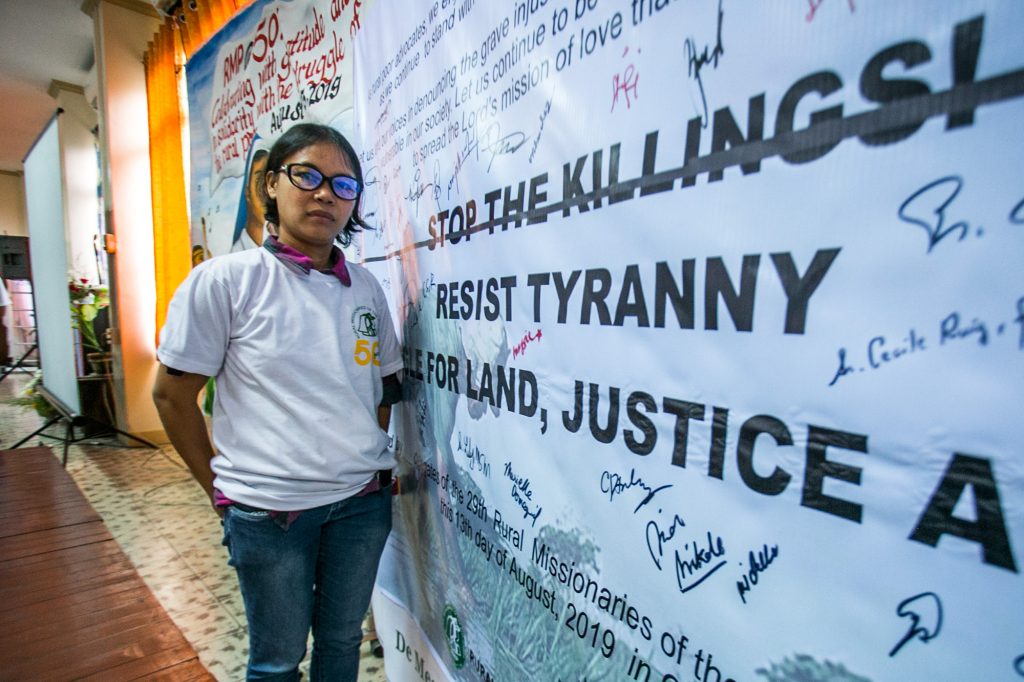
As city health officer, Sancelan was head of the local Inter-Agency Task Force on Emerging Infectious Diseases (IATF), which manages the government’s response to the pandemic.

Days earlier, her words were more forceful: “You saved my life O Lord, I shall not die!” And, “from the Heaven, the LORD looks down on the earth!!!” The second passage popped from shades of pink and purple and blue, all mixed in the shapes of desert dunes.

The pandemic severely tested but did not threaten Sancelan’s faith. Nor did another threat that cast a big shadow over the doctor’s life.

Sancelan defeated or, at least, temporarily pushed back COVID-19 after months of perseverance.

The second threat — which vowed death to communists and inexplicably tagged a doctor swamped with public duties as spokesman for the regional guerrilla front of Asia’s longest-running agency — snuffed out the life of a people’s servant and that of her husband.

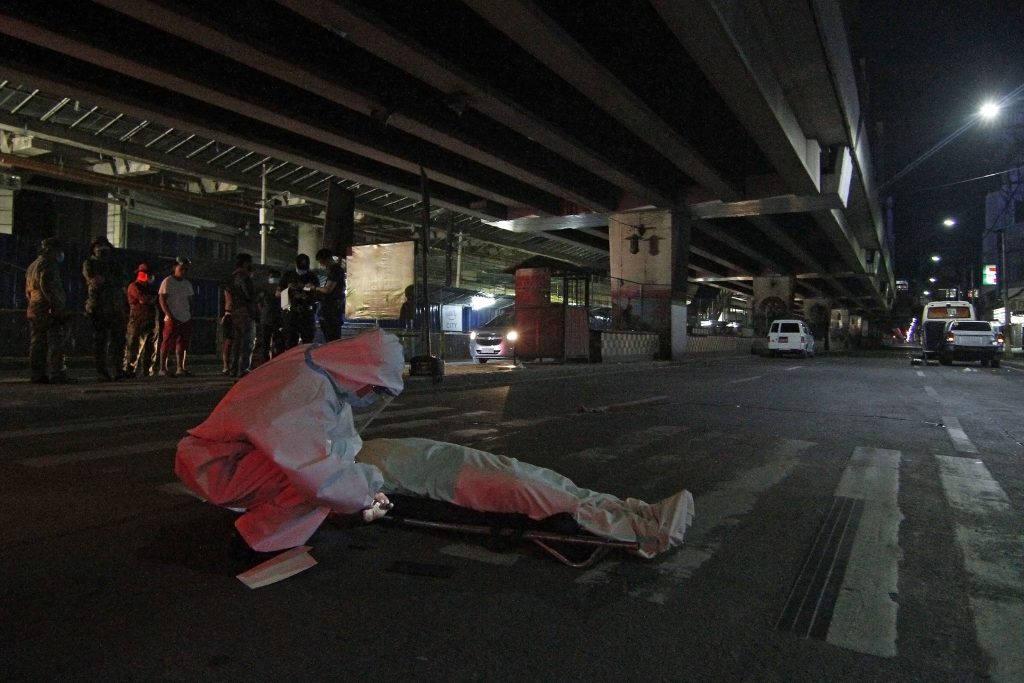
Two men riding shotgun killed the medical professional and husband, Edwin, also a government worker, shortly before they reached their home at the end of work day on December 15.

The attack came a few hours after the release of the International Criminal Court’s Office of the Prosecutor of a document that touched, among other cases worldwide, extra-judicial killings linked to President Rodrigo Duterte’s drug war.

The report found “reasonable basis” to believe Duterte’s campaign may have led to crimes against humanity.

The couple’s blood soaked the earth of Guihulngan as newscasts began reporting the government’s jeers in response to the ICC preliminary findings.

A waste of time, said the office of Duterte.

You can’t touch us, said aides of the man who took out the country from the ICC to evade accountability for killings that have long surpassed the toll of the two-decade Marcos dictatorship.

“I thought it was a welcome news among us peace-loving Filipinos,” said Bishop Gerardo Alminaza, whose San Carlos diocese covers Guihulngan.

“Suddenly, a few hours after, assassins murdered Dr. Mary Rose Sancelan and her husband Edwin. It was brutal, marked by a desire to end the pro-people service of Dr. Sacelan to her constituents.”

Image on the right: Dr Mary Rose Sancelan and her husband, Edwin. (Photo courtesy of Karapatan)

Shadow of death

Mary Rose Sancelan

Bishop Alminaza brought Sancelan’s dilemma public in September last year.

At a forum hosted by the Philippine Ecumenical Peace Platform, the bishop warned that red-tagging could brutalize a circle wider than its actual target.

“A medical doctor in the city health office found her name in the list. Fear for her life prevented her to provide health services to 33 barangays (villages) in that city,” said the bishop.

Sancelan then spoke on video.

“I am the only doctor servicing Guihulngan. My workload is very heavy, mostly not just consultations because I also have administrative tasks,” said Sancelan, who would later get badly-needed help with a second city health officer.

The doctor’s calm mien, her soft, liltling tone and accent, made her next words a sudden cold slap.

“I was accused of being JB Regalado, a commander or local head of the CPP-NPA,” the doctor said. Regalado is the nom de guerre of the spokesman of the Leonardo Panaligan Command, which oversees the Central Visayas operations of the New People’s Army.

Sancelan had more than enough reason to worry in September 2019.

Bishop Alminaza’s diocese had already witnessed a bloodbath among sugar workers, rights defenders, church workers, retired government professionals, even lawyers.

Some would die in police-military raids. Officers trotted out the usual “nanlaban” (they fought back) excuse so familiar in the thousands of deaths linked to Duterte’s “war on drugs.” The victims’ kin would later testify hearing them beg for their lives, insisting they were executed.

On the same list that featured Sancelan were the names of Anthony Trinidad and Heidie Malalay Flores. Trinidad, a lawyer, and Flores, a teacher, had been slain after the red-tagging posters spread across the poblacion, or city center, and rural villages.

A month before Bishop Alminaza brought Salcelan’s case to Manila’s attention, the city police chief spoke before a Senate inquiry into the spate of killings of civilians, believed to be state reprisals for a rebel ambush that killed four intelligence agents.

The police officer said five of 15 names on the hitlist of an anti-communist vigilante group called Kawsa Guihulnganon Batok Kumunista (KAGUBAK) had been killed.

Trinidad, number 14 on the list, was felled in a daylight ambush in the city center. Flores was 11th on the list.

Proxy killers

Rights defenders said you could track the killings with the appearance of the red-tagging posters.

Image below: Slain human rights activist Zara Alvarez was also a victim of red-tagging before she was killed in August in the province of Negros. (Photo by Mark Saludes)

The slurs thrown at Salcelan seemed farcical.

As a daughter of another woman government doctor, I knew their work hours went beyond nine to five, beyond a five-day workweek. The desperate poor would knock on their homes at odd hours, bringing gasping children, adults felled by sudden weakness, people wracked with coughs, sometimes a neighbor wounded in a drunken brawl.

Weekends often meant a trek to isolated rural hamlets where people could leave an entire life without seeing a medical professional. Sancelan’s Facebook page showed many such missions, with men and women, the old and the young lining up for treatment.

In many photos, she was the lone doctor. In some, she had volunteers to help. Even without COVID-19, she could not have found the time nor the energy, even if she shared the rebel’s views, to be their spokesman.

But Salcelan couldn’t ignore the threat. Her face was pasted on those posters.

And while the allegation seemed ridiculous, gunmen had already killed a doctor in Guihulngan a year earlier.

Like Sancelan, who was a scholar of Franciscan clergy, Dr. Avelex Salinas Amor, a visiting doctor from Canlaon City, had stuck to his youthful dream of being a doctor to the barrios despite offers of work abroad and in the cities. His killers have not been caught.

Then National Police chief Oscar Albayalde, who would later be forced into early retirement by allegations of his links to a cop network that extorted from suspected drug lords, said he had no knowledge of anti-communist vigilante groups.

Other police and military officers shrugged off charges, saying they could not be responsible for the work of vigilantes. It was a refrain familiar to groups monitoring Duterte’s war on drugs, where “vigilante” killings was thrice the number of the 8,000 “official” operational count.

A crime scene investigator takes the fingerprints of a shooting victim in Manila on Aug. 24, 2020, amid a lockdown due to the coronavirus pandemic. (Photo by Vincent Go)

Keeping faith

Pre-COVID, Sancelan bore the burdens of her responsibilities with a trademark wide smile that twinkled even behind heavy black plastic glasses.

“Behind every cloud of sadness is a bigger light of joy!
Thanks Lord for giving me joy in performing my favorite job and that’s sewing people up!
Lacerated wounds on the base of the left index finger and parietal area of the head!”

From any other person, it would sound a bit off, stopping short of gallows humor. But to people who knew “Doc” it represented the droll humor of a hardscrabble community dependent on the corn and coconuts of a poor soil and waters that barely offered enough catch for daily sustenance.

For a few weeks, Sancelan withdrew to deal with the trauma of being red tagged. Kin and friends urged her to flee to safer ground.

But the doctor battled through fear and decided to stay put as a people’s servant.

Aside from her COVID-19 duties, she was also nutrition action officer. That is service with the weight of half of Mount Canlaon, the sacred volcano that straddles the spine of Negros island. The oriental side, which Guihulngan belongs to, has a poverty incidence of 45 percent, double that of the 21.6 percent national average.

Following the murders, the COVID-19 task force issued a statement lamenting “the loss of courageous and dedicated frontliner who was instrumental in placing under control the previous spike of COVID-19 cases in the city last November.”

Sancelan had battled back a new spike of COVID-19 cases in October, which coincided with rising infection rates across the province of Negros Oriental.

“We are confused and shocked (at) of this painful fate befalling our fellow public servants,” said the task force statement, which warned of a “void” in the service.

Guihulngan needed Sancelan like a person needs air.

The task force did not exaggerate the challenges Sancelan faced as medical professional.

There is only one public doctor per 31,000 Filipinos and the national health scales have always been lopsided, with most professionals and resources serving the national capital. Two-thirds of of private and public hospital beds are in the island of Luzon, which includes the National Capital Region.

The World Health Organization cites “regional and socioeconomic disparities in the availability and accessibility of resources.” There are 23 hospital beds for 10,000 people in the capital while the rest of Luzon, Visayas and Mindanao have only 8.2, 7.8 and 8.3 beds, respectively.

The Council for Health and Development, a national organization of community based health programs in the Philippines, expressed rage that “impunity knows no bound even at a time when the whole nation is gripped by the pandemic.”

The killers deprived the people of Guihulngan much needed health services especially in this most difficult time, the group warned.

Image on the right: Bishop Gerardo Alminaza of San Carlos speaks before environmental activists at the 6th General Assembly of the Philippine Misereor Partnership Inc. on Feb 26. (Photo supplied via Licas News)

Serving god, serving the people

Sancelan, Bishop Alminaza said, was a Christian who lived Jesus Christ’s most important message: to love your neighbor as you love God.

“This is too much. This is totally unacceptable to allow it to happen to public servants who were working so hard to serve the public interest especially during this pandemic,” said the bishop soon after news of the murders broke out.

“Dr. Sancelan was branded, vilified, red-tagged, and now, executed, by the ruthless pawns of the enablers of ‘systematic killings’ in this country,” added Bishop Alminaza.

“Her only crime, much like the soon-to-be born-infant Jesus in a manger, was her unselfish service to the poor people of Guihulngan—both as a ‘barrio doctor’ and as ‘defender of the poor,’” he added.

Military officers, a year after the Senate hearing that featured the Guihulngan killings, have taken the place of anonymous groups in leading the attacks against perceived enemies of the state.

They have over the last two years named clergy and religious workers, indigenous leaders, legislators, medical workers, journalists, leaders of mass organizations, human rights workers, youth activists, feminists, even global aid charities and UN experts.

There has been no rhyme nor reason, and even less evidence. The military and Duterte reassured Filipinos: they are communists and terrorists because we say they are.

Over four years, some 20,000 have fallen in a drug war that operated on exactly that same worldview. Duterte has now said he will carve a bloody swathe through the body politic, with blanket screaming “the crime of one is the crime of all” covering all dissenters.

In the face of the rising threat to the most basic of human rights, Bishop Alminaza, himself a frequent target of red-tagging, reminded government officials and the faithful in Asia’s largest Catholic majority: “It is a grave omission to remain silent and passive and allow perpetrators to get away.”

“Join me in prayer in the face of unstoppable murders in our diocese. Join me in hope that these killings will soon end. But join me, too, in condemning, in the strongest possible terms, the senseless murder of helpless civilians and dedicated servants of government.”

*

Note to readers: please click the share buttons above or below. Forward this article to your email lists. Crosspost on your blog site, internet forums. etc.

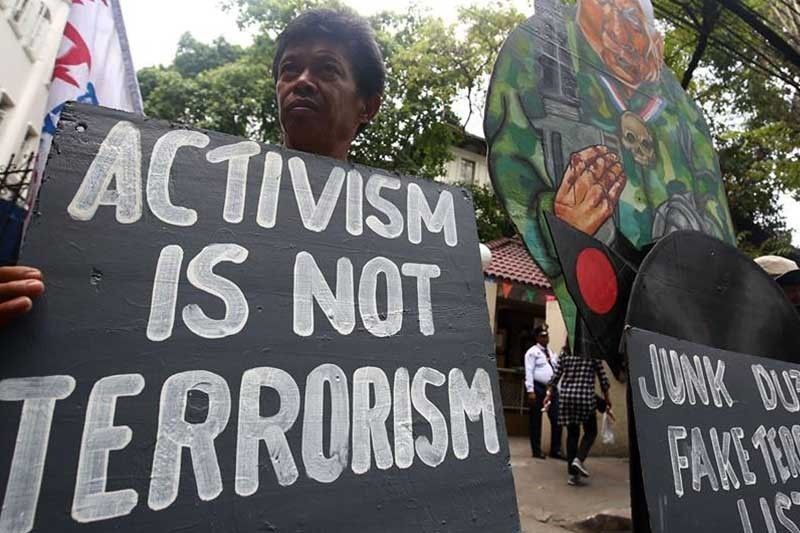
Featured image: Protesters call for an end to the spate of drug-related killings in the country during a march in the Philippine capital Manila. (Photo by Jire Carreon)

  • Posted in English @as @as
  • Comments Off on The Life and Death of a Servant of God

The first people in the UK will be getting a Covid-19 vaccine on Tuesday, while in New Zealand, the wait could be for several more months. Here’s the government’s plan to vaccinate Aotearoa.

Mass vaccination efforts against Covid-19 are underway around the world, but in New Zealand the government is asking for patience as the first jabs are still months away.

The first Britons will receive a vaccine tomorrow and the Queen is expected to receive her first dose in the coming weeks. Clinics in Moscow began deploying Russia’s Sputnik V vaccine over the weekend. In the US, mass vaccination is expected to start before Christmas.

Globally, the coronavirus is entering a dangerous phase. The northern hemisphere is headed into colder months spent indoors as well as the holiday period. Over the past week, the United States broke a series of new records, with over 226,000 new cases of Covid-19 added on Friday alone. Hospitalisations have topped 100,000. In Canada, field hospitals are being set up before the arrival of snow.

Covid-19 minister Chris Hipkins has said New Zealand’s first vaccines won’t be administered until the first quarter of next year, March or earlier. One of the reasons for the delay is that the country’s sense of urgency, and its willingness to take risks, is somewhat lessened.

“They are speeding things up in a way we wouldn’t necessarily do here because of the risks they face,” Hipkins told reporters. He added that countries facing “hundreds if not thousands” of deaths daily are willing to skip waiting for the end of clinical trials, something New Zealand won’t do.

The government only confirmed in late November that Covid-19 jabs will be free. There also won’t be any legal requirement that people get the vaccine, however Qantas has already said that it’ll require passengers to show proof of vaccination before letting them on international flights.

Unlike the UK, which was the first western country to approve a vaccine, New Zealand won’t be using emergency provisions to fast-track approval of any of the coronavirus vaccines the country will eventually purchase. As global vaccination programmes gain speed, there will be more evidence for the efficacy and safety of some vaccines than others.

Medsafe, the country’s medical regulator, has already started an approvals process for Covid-19 vaccines. One of the vaccines being looked at is the Pfizer/BioNTech vaccine that Britain is rushing to its citizens this week. Early results have shown that the vaccine, which uses a new form of technology, is highly effective.

Hipkins added that an emergency approval from the government for that vaccine, copying the work done in the UK, wouldn’t necessarily speed up delivery. “There is a global issue here where everybody wants the vaccine as fast as we can get it,” he said.

New Zealand expects to eventually purchase five or six different types of vaccines. Some will come through direct purchases from pharmaceutical giants while others will be delivered as part of large international coalitions.

While Hipkins mused last week that a humanitarian argument could be made to ensure the vaccines go first to countries that are hardest hit by Covid-19, he quickly added that New Zealand will be getting its doses as quickly as possible. There won’t be any unnecessary delay, he added.

In the UK, the first wave of jabs have been reserved for the over-80s and care home residents. In the US, authorities have said health care workers and the frail will be at the head of the queue. In New Zealand, the order will be decided by the evidence from a longer approvals process. Border-facing workers and people in aged care homes could be first, but the science will determine the sequencing, said Hipkins.

New Zealand’s vaccine programme will be unveiled later in December, but the government is planning to have a significant supply of vaccine in the country when Medsafe finally provides approval to proceed. As a result of that, purchasing agents are currently scouring the globe for the equipment the country will need to transport, store and administer the vaccines. New orders have already been placed for super-cold freezers needed for the Pfizer injection.

*

Note to readers: please click the share buttons above or below. Forward this article to your email lists. Crosspost on your blog site, internet forums. etc.

Featured image is from Pixnio

Relations between China and Australia worsened significantly in 2020, reaching the lowest level in its history. Between spying scandals, fake news and trade tariffs, ties between both countries have diminished, impeding various possibilities for international cooperation. However, the recent agreement that built the largest commercial zone in the world in the Asia-Pacific region opens a new horizon for Beijing and Canberra, which prompts to think about measures to overcome this deep diplomatic crisis.

This year has been extremely difficult for the ties between China and Australia. The most recent escalation of tensions centered on a publication made by a spokesman for the Ministry of Foreign Affairs of China on November 30, where the conduct of Australian soldiers in Afghanistan was criticized with the following text: “Shocked by murder of Afghan civilians and prisoners by Australian soldiers. We strongly condemn such acts and call for holding them accountable”. The behavior of the representative of Chinese diplomacy caused outrage in Australia and was considered a serious national offense.

A few days before the virtual incident, on November 27, China had imposed severe trade restrictions against wines produced in Australia. Australian Trade Minister Simon Birmingham called the action “unfair” and said it was part of China’s “deliberate strategy” to pressure Canberra to serve its interests. Regardless of the Chinese intentions, the decision should cause great damage to Canberra, which exports more than 900 million dollars in wine to the Asian country – its main market in this sector.

However, it was not only China that imposed sanctions. Australia has also taken several measures considered hostile by Beijing, such as, for example, blocking ten investment projects, in addition to canceling visas for Chinese students and journalists. As we can see, boycotts are reaching all sectors, not being limited to the economic field.

Since 2012, ties between Beijing and Canberra have been deteriorating. There was an undeniable discomfort in Canberra with the inauguration of Xi Jinping, which meant China’s greater insertion in international politics. The growing Chinese role has bothered Canberra mainly due to the fact that both countries are fighting for the same space of influence in the Asia-Pacific.

Currently, the technological market is the main critical point in relations between China and Australia. Canberra joined the trade war waged by Trump against China in the dispute for control of 5G technology. In 2018, Australia banned Chinese companies Huawei and ZTE from their national 5G network, which Beijing interpreted as an anti-diplomatic act. Recently, Australia has also replicated the American discourse about the “origin of the coronavirus”, endorsing the rhetoric that Beijing would have been negligent in controlling the virus in its earliest days, thus being “responsible” for the effects of the pandemic.

All of these factors have profoundly shaken cooperation projects between Chinese and Australians, but despite the friction, Australia and China maintain close trade relations and divide the geopolitical space of Southeast Asia. As a strong mining country, Australia supplies China with coal and ore on a short sea route. Canberra is also a major food exporter for the Chinese, being, due to the short distance, a point of great strategic importance for the food security of the Asian country.

There is a link of interdependence between Chinese and Australians. Australia depends on Chinese money and China on Australian resources. With a population of about 1.4 billion people, Beijing is increasingly investing in imports to ensure food security for its people and Australia is a strategic partnership in this regard. But Canberra is not the only option available to the Chinese, who have strong relations with South American and African countries in the food production sector. Although the distance makes such relations more expensive, Beijing has enough financial resources to face this problem if relations with Australia become unsustainable. The same cannot be said for Australia. Among developed countries, Australia is the most dependent on China. Still, Canberra is facing its first recession in three decades, being even more economically vulnerable and dependent on Chinese investments.

Given this, how to overcome the crisis in a beneficial way for both sides? Certainly, it is Australia that should give more. As a country economically dependent on China, Australia should not practice some acts that have marked its policy of hostilities against Beijing, such as, for example, the participation in QUAD and FVEY. QUAD is a security quadrangle formed by the US, Japan, Australia, and India, consisting of a “NATO for China” project. FVEY (Five Eyes) is an intelligence cooperation program, where the US, Australia, Canada, New Zealand, and the United Kingdom carry out joint espionage operations and share information collected. Recently, a scandal involving Australian FVEY spies on Chinese soil was revealed.

If Australia wants to preserve its economic partnership, it will have to restrain its participation in military cooperation projects with countries that are enemies of Beijing. Likewise, a review of the Australian decision on 5G would be interesting, considering that few countries, even among American allies, have chosen such a way of sanctions against China. Beijing, on the other hand, could mitigate its strong criticism against Australian soldiers and perhaps should ban the barriers to Australian wine. Both countries are currently part of the RCEP, the largest economic bloc in the world, having all the necessary resources to create new strategic partnerships and a future of solid cooperation. In order for this bloc to be strengthened and to reach its full potential, it is necessary that diplomatic tensions between its member countries be eased and that each member prioritize its economic needs over its political choices. Therefore, it is essential for Australia to decide between its economy and its alliance with the West.

*

Note to readers: please click the share buttons above or below. Forward this article to your email lists. Crosspost on your blog site, internet forums. etc.

This article was originally published on InfoBrics.

Lucas Leiroz is a research fellow in international law at the Federal University of Rio de Janeiro.

Djab Wurrung: Fighting to Save Sacred Trees

December 16th, 2020 by Kim Bullimore

On the same day Victorians were celebrating Premier Daniel Andrews’ announcement of the easing of the 112-day COVID-19 lockdown, the state government oversaw the felling of a 350-year-old tree sacred to the Djab Wurrung people in central Victoria. The tree was destroyed to make way for a multi-million-dollar highway upgrade. 

More than 50 protesters were attacked and arrested by Victoria Police, who weaponised COVID-19 laws by fining at least 40 protesters for failing to comply with COVID-19 measures. A further ten protesters were arrested for obstructing police.

The $672 million Western Highway upgrade between Ballarat and Stawell began in 2013, but work on the Buangor to Ararat section did not begin until June 2018. Work in this section will result in the destruction of more than 3,000 trees, including at least 200 which hold cultural significance to the Djab Wurrung people. Among the trees are traditional birthing trees, to which Aboriginal women have come to give birth for hundreds of generations. The area holds “a deep intimate connection for Djab Wurrung women”, wrote Djab Wurrung woman and recently resigned member of the First Peoples’ Assembly of Victoria, Sissy Eileen Austin, in the Guardian.

When work first began on the section of the highway in June 2018, Djab Wurrung protesters established a Heritage Protection Embassy, calling for the highway to be rerouted and the area protected. According to the embassy’s website, not only are the birthing trees located on sacred women’s country, but they are also part of the songlines, which “connect us to the beginning of time, back to our spirit ancestors, our creators”.

In Aboriginal culture, songlines act as navigational tracks for safe travel across country, while also telling the history of the land, animals and plants. The songs sung along the songlines are the means by which cultural knowledge, values and practices are retained and passed down. The destroyed tree was known to the Djab Wurrung as a “directions tree”, which is a tree planted after the birth of a child where the placenta is mixed with the seed and the resulting tree becomes a source of spiritual guidance and connection to land and ancestors for the child.

The Andrews government has negotiated the highway project with the Indigenous custodians via the 2006 Victorian Aboriginal Heritage Act. But heritage acts and the process surrounding them are seriously flawed. In Victoria, in order to be recognised as the “primary guardians, keepers and knowledge holders of Aboriginal Cultural Heritage” under the Aboriginal Heritage Act, traditional owners must apply to become a “Registered Aboriginal Party”. To be recognised, they must become an incorporated organisation under the 2006 Aboriginal and Torres Strait Islander Corporations Commonwealth Act and be either a registered Native Title Holder with a Native Title Agreement or a Traditional Owner Entity Group with recognition and settlement agreement as part of the 2010 Victorian Traditional Settlement Act.

The problem with this, notes Deakin University anthropologist Associate Professor Melinda Hinksonin in a 5 November article for Arena, is that it  “ensures that Aboriginal owners and custodians who refuse to participate on these terms will not be recognised”, resulting in them being “excluded from formal processes of consultation”.

Under the Victorian act, the current Registered Aboriginal Party for Djab Wurrung country is the Eastern Maar Aboriginal Corporation (EMAC). EMAC took over the role in February of this year, after Martang—the original Registered Aboriginal Party, which had signed off on the highway extension in 2013—became defunct. In a media statement issued on 28 October, EMAC noted that “despite [the directions tree’s] age and majesty, extensive re-assessments did not reveal any characteristics consistent with cultural modification”. They went on to explain that the EMAC had previously won a significant “realignment” of the highway project, resulting in the preservation of 16 trees, two of which were birthing trees, as well as “marker”, “directions” and “grandmother” trees. But other Djab Wurrung people disagree with this assessment and argue the trees are of cultural significance.

University of Sydney director of Aboriginal and Torres Strait Islander Research, Professor Jaky Troy, told the ABC that Indigenous custodians often face a situation of “deciding which child to kill” when taking part in heritage negotiations. Troy, a Ngairgu woman, explained that the Djab Wurrung “were put in a position where something was going to have to go”. That is, traditional owners are forced into making pragmatic decisions in order to save some part of their cultural heritage, while being forced to sacrifice others.

This fact was further highlighted by EMAC’s chair, Jason Mifsud, in the same interview. Mifsud explained that despite earlier advocating for the directions tree to be protected, they were not able to save it because Aboriginal groups are “not negotiating from a position of power”. Instead, “you’re essentially, as a result of the Aboriginal Heritage Act, still the last in line in regards to protecting and preserving cultural heritage”.

In the aftermath of the destruction of the directions tree, prominent Aboriginal activist and Djab Wurrung woman Marjorie Thorpe has won a three-week injunction to stop construction. The case will return to the Supreme Court on 19 November. In the meantime, the Djab Wurrung Heritage Protection Embassy activists are calling for the return of the destroyed tree and are continuing their campaign.

*

Note to readers: please click the share buttons above or below. Forward this article to your email lists. Crosspost on your blog site, internet forums. etc.

Featured image is from Red Flag

India’s One-Day General Strike Largest in History

December 16th, 2020 by Prof. Vijay Prashad

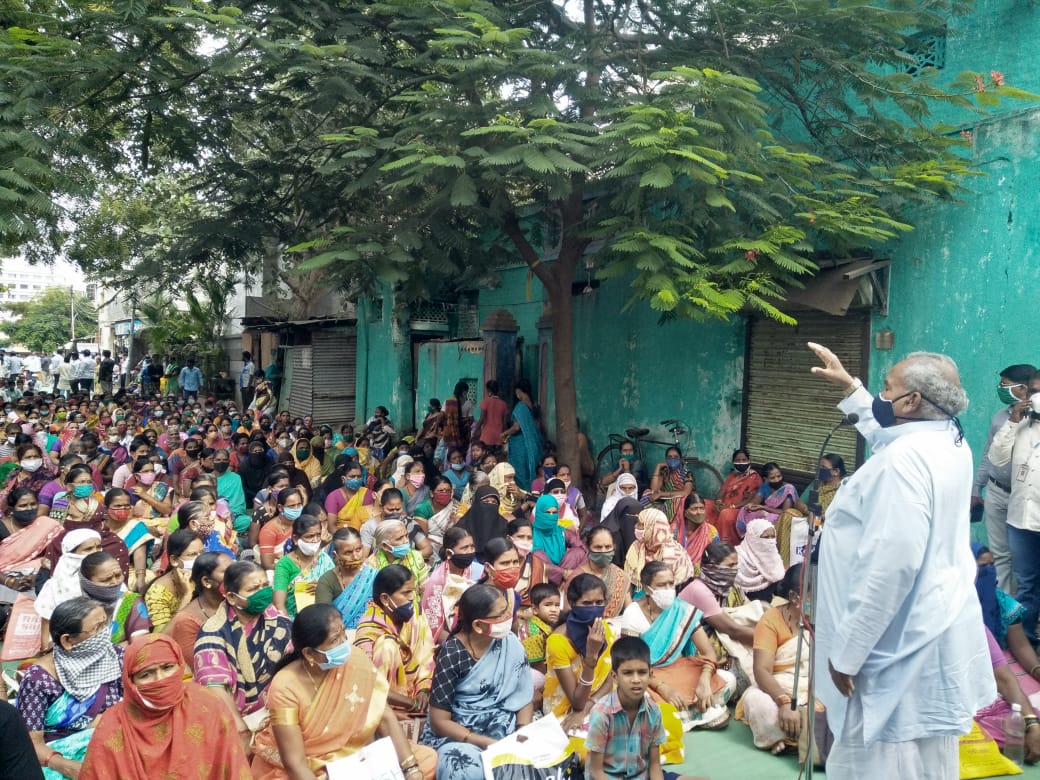
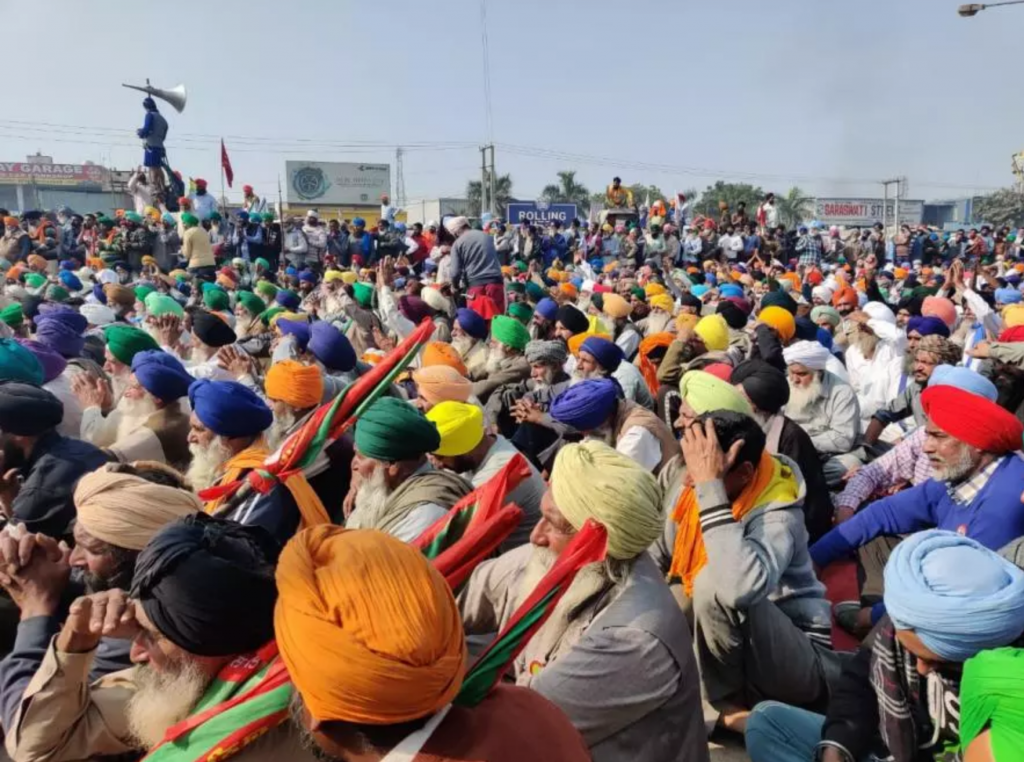
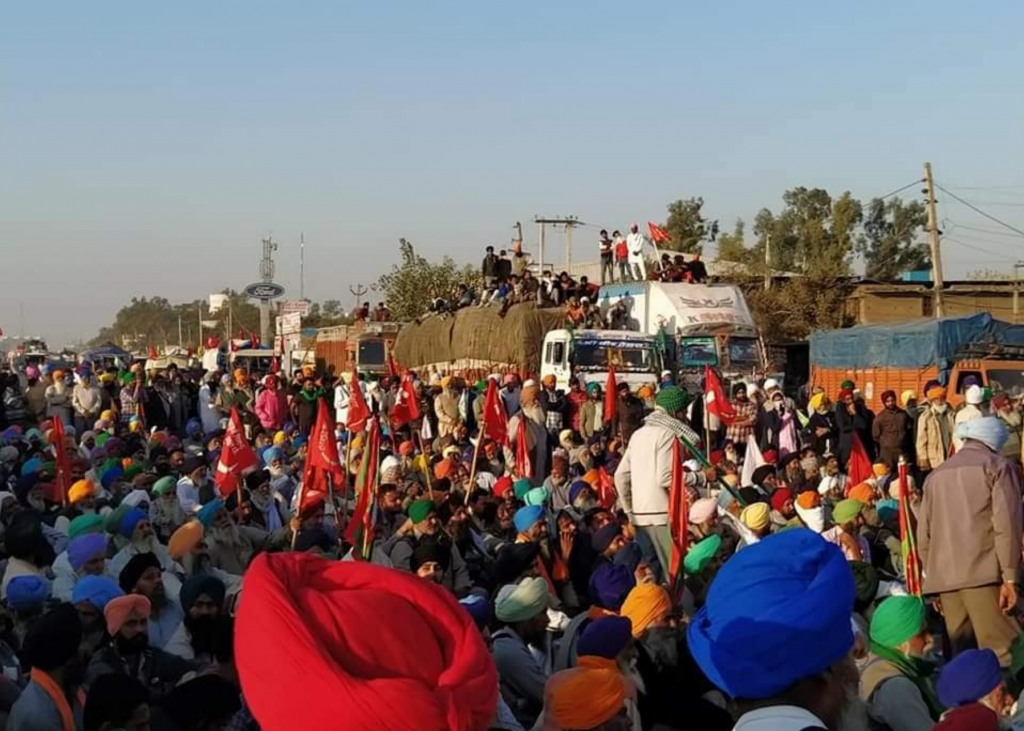
Farmers and agricultural workers from northern India marched along various national highways toward India’s capital of New Delhi as part of the general strike on Nov. 26.

They carried placards with slogans against the anti-farmer, pro-corporate laws that were passed by India’s Lok Sabha (lower house of parliament) in September, and then pushed through the Rajya Sabha (upper house) with only a voice vote.

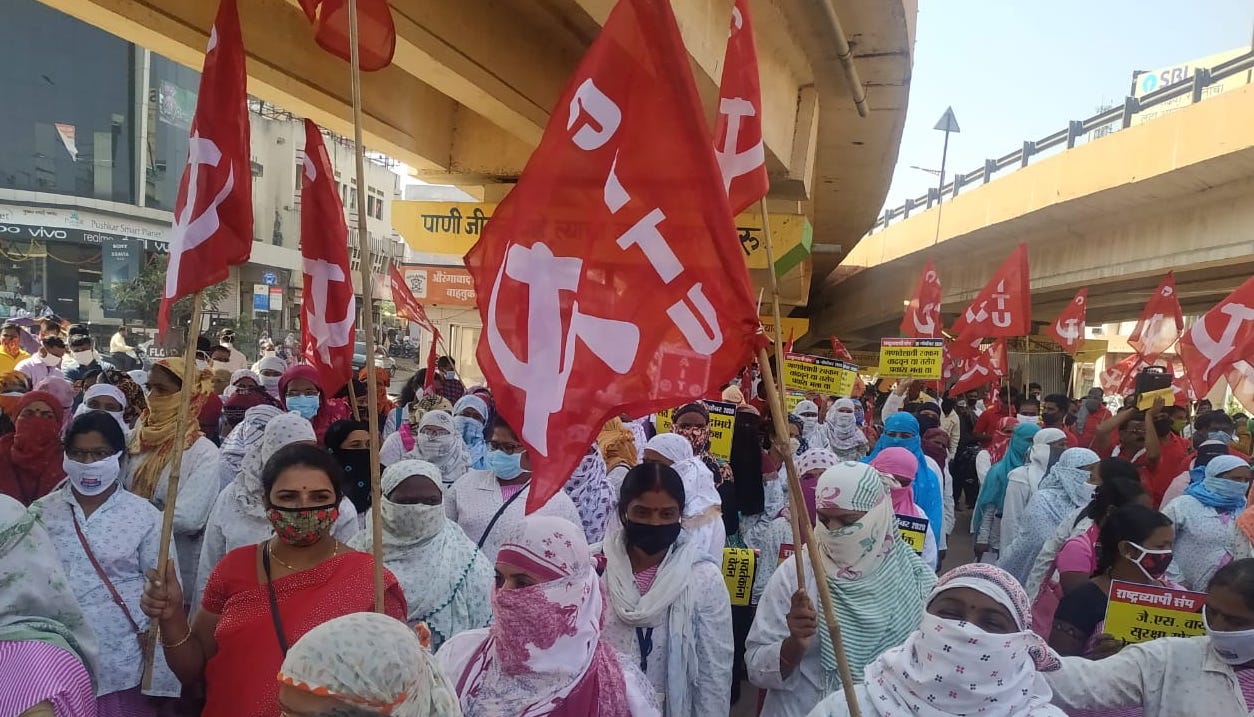
The striking agricultural workers and farmers carried flags that indicated their affiliation with a range of organizations, from the communist movement to a broad front of farmers’ organizations. They marched against the privatization of agriculture, which they argue undermines India’s food sovereignty and erodes their ability to remain agriculturalists.

Roughly two-thirds of India’s workforce derives its income from agriculture, which contributes to roughly 18 percent of India’s gross domestic product (GDP). The three anti-farmer bills passed in September undermine the minimum support price buying schemes of the government, put 85 percent of the farmers who own less than 2 hectares of land at the mercy of bargaining with monopoly wholesalers, and will lead to the destruction of a system that has till now maintained agricultural production despite erratic prices for food produce.

One hundred and fifty farmer organizations came together for their march on New Delhi. They pledge to stay in the city indefinitely.

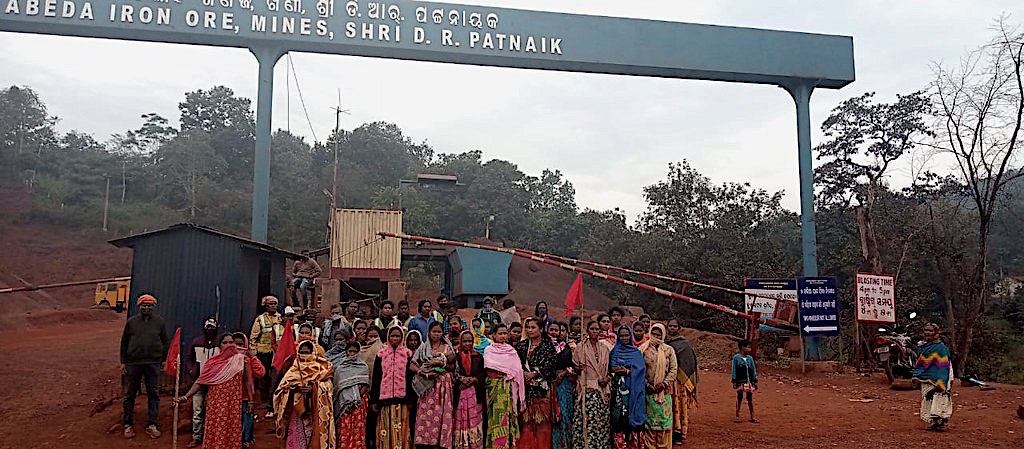
India’s general strike on Nov. 26, 2020. (IndustriALL Global Union, Flickr, CC BY-NC-ND 2.0)

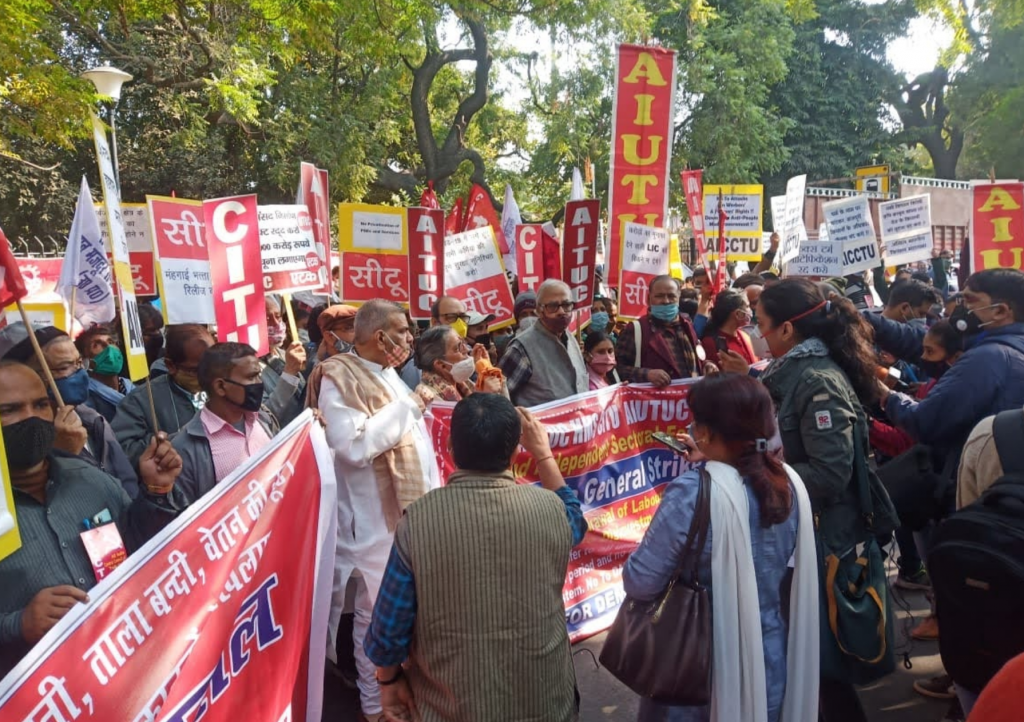
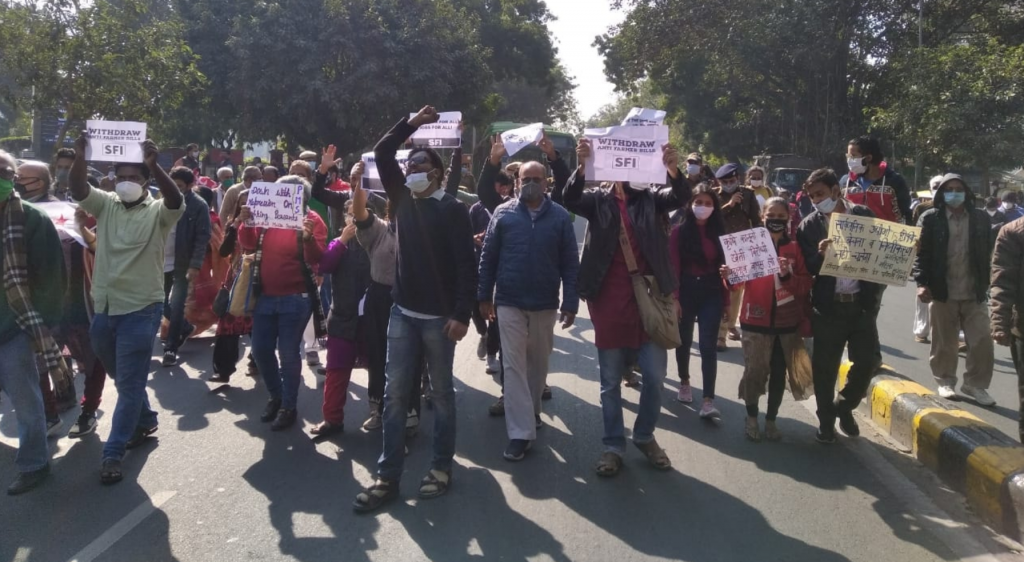
Around 250 million people across India joined the general strike, making it the largest strike in world history. If those who struck formed a country, it would be the fifth largest in the world after China, India, the United States, and Indonesia. Industrial belts across India – from Telangana to Uttar Pradesh – came to a halt, as workers in the ports from the Jawaharlal Nehru Port (Maharashtra) to the Paradip Port (Odisha) stopped work.

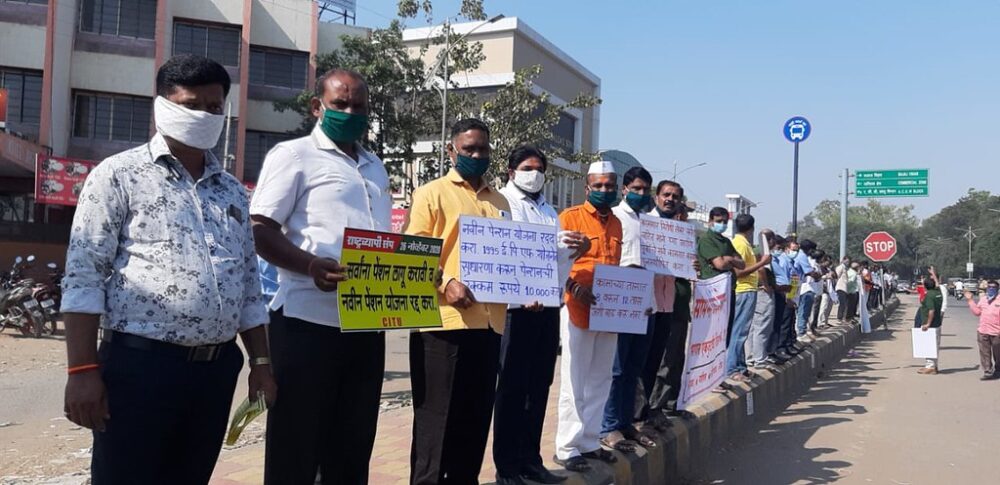
 India’s general strike on Nov. 26, 2020. (IndustriALL Global Union, Flickr, CC BY-NC-ND 2.0)

Coal, iron ore, and steel workers put down their tools, while trains and buses stood idle. Informal sector workers joined in, and so did health care workers and bank employees. They struck in opposition to labor laws that extend the working day to 12 hours and strike down labor protections for 70 percent of the workforce. Tapan Sen, the general secretary of the Centre of Indian Trade Unions, said, “The strike today is only a beginning. Much more intense struggles will follow.”

The pandemic has deepened the crisis of the Indian working class and peasantry, including the richer farmers. Despite the dangers of the pandemic, out of a great sense of desperation, workers and peasants gathered in public spaces to tell the government that they had lost confidence in them. The film actor Deep Sindhu joined the protest, where he told a police officer, “Ye inquilab hai. This is a revolution. If you take away farmers’ land, then what do they have left? Only debt.”

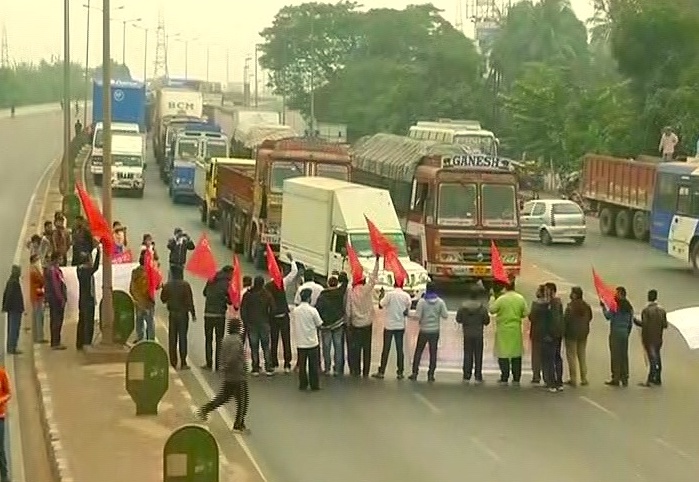
India’s general strike on Nov. 26, 2020. (IndustriALL Global Union, Flickr, CC BY-NC-ND 2.0)

Along the rim of New Delhi, the government positioned police forces, barricaded the highways, and prepared for a full-scale confrontation. As the long columns of farmers and agricultural workers approached the barricades and appealed to their brethren who had set aside the clothes of farmers and put on police uniforms, the authorities fired tear gas and water cannons at the farmers and agricultural workers.

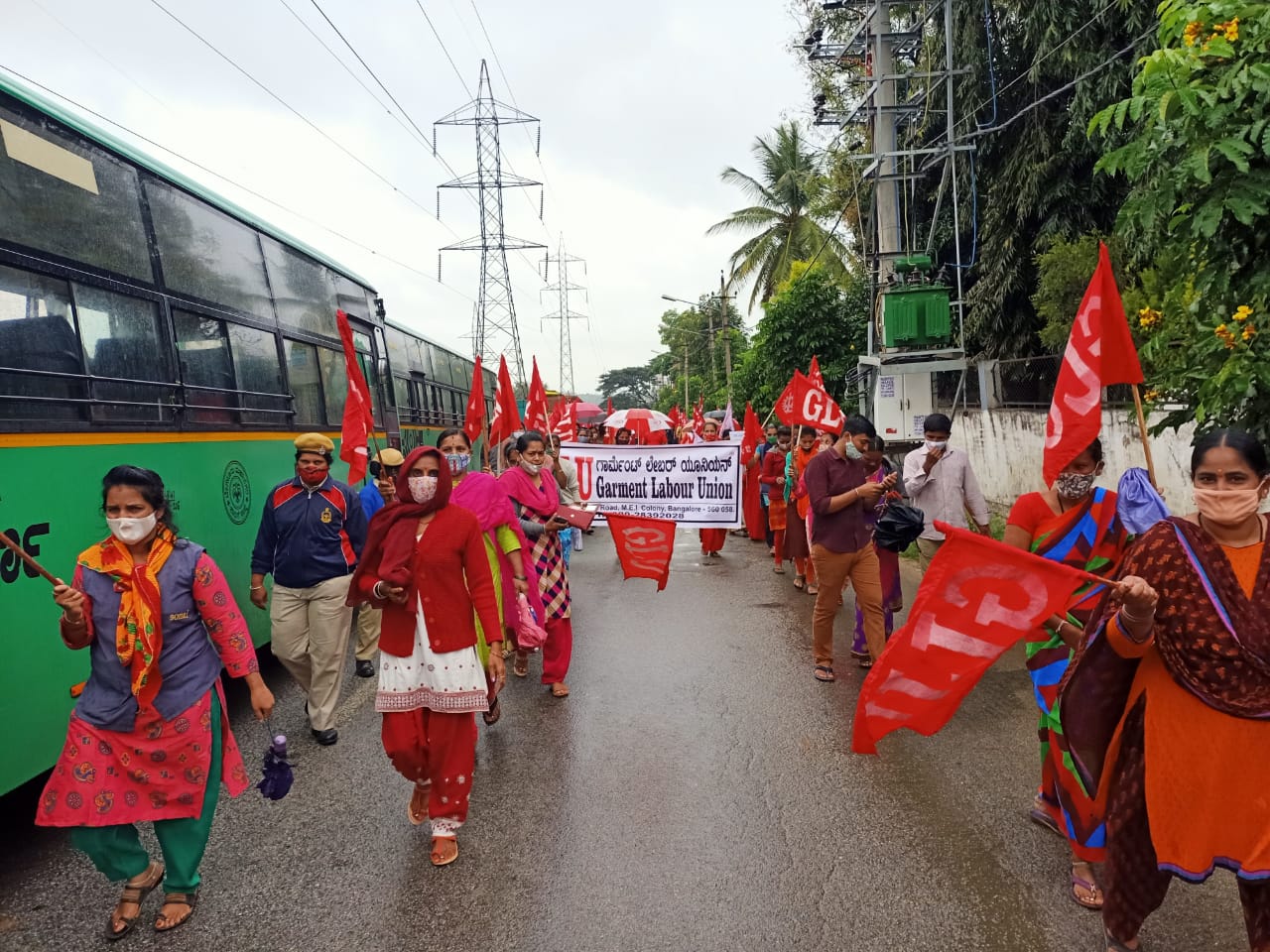
India’s general strike on Nov. 26, 2020. (IndustriALL Global Union, Flickr, CC BY-NC-ND 2.0)

The day of the general strike of farmers and workers, Nov. 26, is also Constitution Day in India, which marks a great feat of political sovereignty. Article 19 of the Indian Constitution (1950) quite clearly gives Indian citizens the right to “freedom of speech and expression” (1.a), the right to “assemble peaceably and without arms” (1.b), the right to “form associations or unions” (1.c), and the right “to move freely throughout the territory of India” (1.d).

In case these articles of the Constitution had been forgotten, the Indian Supreme Court reminded the police in a 2012 court case (Ramlila Maidan Incident vs. Home Secretary) that “Citizens have a fundamental right to assembly and peaceful protest, which cannot be taken away by an arbitrary executive or legislative action.”

The police barricades, the use of tear gas, and the use of water cannons – infused with the Israeli invention of yeast and baking powder to induce a gagging reflex – violate the letter of the Constitution, something that the farmers yelled to the police forces at each of these confrontations. Despite the cold in northern India, the police soaked the farmers with water and tear gas.

India’s general strike on Nov. 26, 2020. (IndustriALL Global Union, Flickr, CC BY-NC-ND 2.0)

But this did not stop them, as brave young people jumped on the water cannon trucks and turned off the water, farmers drove their tractors to dismantle the barricades, and the working class and the peasantry fought back against the class war imposed on them by the government.

The 12-point charter of demands put forward by the trade unions is sincere, having captured the sentiments of the people. The demands include the reversal of the anti-worker, anti-farmer laws pushed by the government in September, the reversal of the privatization of major government enterprises, and immediate relief for the population, which is suffering from economic hardship provoked by the coronavirus recession and years of neoliberal policies.

These are simple demands, humane and true; only the hardest hearts turn away from them, responding instead with water cannons and tear gas.

India’s general strike on Nov. 26, 2020. (IndustriALL Global Union, Flickr, CC BY-NC-ND 2.0)

These demands for immediate relief, for social protections for workers, and for agricultural subsidies appeal to workers and peasants around the world. It is demands such as these that provoked the recent protests in Guatemala and that led to the general strike on Nov. 26 in Greece.

We are now entering a period in this pandemic when more unrest is possible as more people in countries with bourgeois governments get increasingly fed up with the atrocious behavior of their elites. Report after report shows us that the social divides are getting more and more extreme, a trend that began long before the pandemic but has grown wider and deeper as a consequence of it.

It is only natural for farmers and agricultural workers to be agitated. A new report from the Land Inequality Initiative shows that only 1percent of the world’s farms operate more than 70 percent of the world’s farmland, meaning that massive corporate farms dominate the corporate food system and endanger the survival of the 2.5 billion people who rely upon agriculture for their livelihood.

Land inequality, when it considers landlessness and land value, is highest in Latin America, South Asia, and parts of Africa (with notable exceptions such as China and Vietnam, which have the ‘lowest levels of inequality’).

A young man, Avtar Singh Sandhu (1950-1988), read Maxim Gorky’s Mother (1906) in the early 1970s in Punjab, from where many of the farmers and agricultural workers travelled to the barricades around New Delhi. He was very moved by the relationship between Nilovna, a working-class woman, and her son, Pavel, or Pasha.

Pasha finds his feet in the socialist movement, brings revolutionary books home, and, slowly, both mother and son are radicalized. When Nilovna asks him about the idea of solidarity, Pasha says, “The world is ours! The world is for the workers! For us, there is no nation, no race. For us, there are only comrades and foes.”

This idea of solidarity and socialism, Pasha says, “warms us like the sun; it is the second sun in the heaven of justice, and this heaven resides in the worker’s heart.” Together, Nilovna and Pasha become revolutionaries. Bertolt Brecht retold this story in his play Mother (1932).

Avtar Singh Sandhu was so inspired by the novel and the play that he took the name “Pash” as his takhallus, his pen name. Pash became one of the most revolutionary poets of his time, murdered in 1988 by terrorists. I am grass is among the poems he left behind:

Bam fek do chahe vishwavidyalaya par
Banaa do hostel ko malbe kaa dher
Suhaagaa firaa do bhale hi hamari jhopriyon par
Mujhe kya karoge?
Main to ghaas hun, har chiz par ugg aauungaa.

If you wish, throw your bomb at the university.
Reduce its hostel to a heap of rubble.
Throw your white phosphorus on our slums.
What will you do to me?
I am grass. I grow on everything.

That’s what the farmers and the workers in India say to their elites, and that is what working people say to elites in their own countries, elites whose concern – even in the pandemic – is to protect their power, their property and their privileges. But we are grass. We grow on everything.

*

Note to readers: please click the share buttons above or below. Forward this article to your email lists. Crosspost on your blog site, internet forums. etc.

This article is from Tricontinental: Institute for Social Research.

Vijay Prashad, an Indian historian, journalist and commentator, is the executive director of Tricontinental: Institute for Social Research and the chief editor of Left Word Books.

Featured image: India’s general strike on Nov. 26, 2020. (IndustriALL Global Union, Flickr, CC BY-NC-ND 2.0)

Abuse on the Mainland: Australia’s Medevac Hotel Detentions

December 16th, 2020 by Dr. Binoy Kampmark

Governments that issue press releases about the abuse of human rights tend to avoid close gazes at the mirror.  Doing so would be telling.  In the case of Australia, its record on dealing with refugees is both abysmal and cruel.  It tends to be easier to point the finger at national security laws in Hong Kong and concentration camps in Xinjiang.  Wickedness is always easily found afar.

Australia’s own concentration camp system hums along, inflicting suffering upon asylum seekers and refugees who fled suffering by keeping them in a state of calculated limbo.  Its brutality has been so normalised, it barely warrants mention in Australia’s sterile news outlets.  In penitence, the country’s literary establishment pays homage to the victims, such as the Kurdish Iranian writer Behrouz Boochani.  Garlands and literary prizes have done nothing to shift the vicious centre in Canberra.  Boat arrivals remain political slurry and are treated accordingly.

Recently, there were small signs that prevalent amnesia and indifference was being disturbed.  The fate of some 200 refugees and asylum seekers brought to the Australian mainland for emergency medical treatment piqued the interest of certain activists.  Prior to its repeal as part of a secret arrangement between the Morrison government and Tasmanian senator Jacqui Lambie in December last year, the medical evacuation law was a mixed blessing.

While it was championed as a humanitarian instrument, it did not ensure one iota of freedom.  As before, limbo followed like a dank smell.  The repeal of the legislation offered another prospect of purgatory, only this time on the mainland.

The individuals in question have found themselves detained in Melbourne at the Mantra Bell City Hotel in Preston, and the Kangaroo Point Central Hotel in Brisbane.   In the mind of Refugee Action Coalition spokesman Ian Rintoul, the conditions at both abodes are more restrictive than those on Nauru.  The medical help promised has also been tardily delivered, if at all.

“My life is exactly the size of a room, and a narrow corridor,” reflects Mostafa (Moz) Azimitabar, who has been detained at the Mantra for 13 months.  Like his fellow detainees, he has become a spectacle, able to see protesters gather outside the hotel, the signs pleading for their release, drivers honking in solidarity.  He sees himself as “a fish inside an aquarium … The whole of my life in this window to see the real life, where people are driving, walking; when they wave to us.  And when I wave back at them.  This is my life.”

When former Australian soccer player turned human rights activist Craig Foster visited Azimitabar, conversation could only take place between a transparent plastic barrier.  “I had to talk with him behind the glass,” tweeted the detainee.  “Several times a day Serco officers enter my room and there aren’t any glasses for them.”

After the visit, Foster described the corrosion of liberties, “this constant theme of the most onerous regulations … constantly chipping away – just taking another right, another right, another right, and making them feel less and less and less human, if that’s possible after eight years.”

The more obstreperous refugees have been targeted by the Department of Home Affairs and forcibly relocated.  Iranian refugee Farhad Rahmati found himself shifted from Kangaroo Point to the Brisbane Immigration Transit Accommodation Centre (BITA), and then to Villawood.  BITA also received four more from Kangaroo Point in mid-November.

The advent of COVID-19 compounded the situation.  Detainees already vulnerable to other medical conditions faced another danger.  The authorities gave a big shrug.  Shared bathrooms are the norm and are infrequently cleaned.  Hand sanitizer containers are left empty or broken.  The inquiry into the failure of Victoria’s quarantine system that led to a second infectious wave in Melbourne avoided considering the conditions of detained refugees.  Writing in Eureka Street, Andra Jackson wondered if this had anything to do with the fact “that these men, now detained in some instances for six to seven years, have behaved more responsibly that [sic] some returning travellers.”

The government authorities did release five refugees from the medevac hotels last week, threatened by lawsuits testing the legal status of their detention.  On December 14, the 60 men detained at the Mantra were told that they would be moving to another undisclosed location.  The conclusion of the contract with the hotel has the Department of Home Affairs considering its options, and all are bound to aggravate the distress of the detainees.

Alison Battinson of Human Rights for All has a suggestion bound to be ignored.  “Instead of telling the gentlemen that they are going to be moved to another place of detention – that hasn’t been disclosed to them – the more sensible approach would be to release them as per the law.”

The only ray of compassion in this mess of inhumanity has come in the form of a Canadian resettlement scheme.  Nine refugees have already availed themselves of the opportunity; another twenty await their fate.  Australian politicians, as they so often do on this subject, are nowhere to be found.

*

Note to readers: please click the share buttons above or below. Forward this article to your email lists. Crosspost on your blog site, internet forums. etc.

Dr. Binoy Kampmark was a Commonwealth Scholar at Selwyn College, Cambridge.  He lectures at RMIT University, Melbourne. He is a frequent contributor to Global Research and Asia-Pacific Research. Email: [email protected]

Featured image: Australian refugees detained at the Kangaroo Point Central Hotel, Brisbane | CNN

  • Posted in English @as @as
  • Comments Off on Abuse on the Mainland: Australia’s Medevac Hotel Detentions
  • Tags:

West Papuans: An Indigenous People that the World Forgot

December 16th, 2020 by Survival International

In December 2018, Survival International began receiving disturbing reports from the Nduga region of West Papua. Church leaders were saying that congregations from 34 churches in the Papuan highlands were missing. A violent military operation by the Indonesian army had forced scores of innocent men, women and children to flee their villages in fear of their lives and seek shelter deep in the forest.

Just before Christmas, things took an unexpected and alarming turn. Survival started to receive disturbing photographs of disfigured bodies, horrific wounds and burns, and of strange canisters that the people say had been dropped on their villages. An Australian newspaper reported that the mysterious canisters appeared to contain white phosphorous, an incendiary and chemical weapon, which “burns through skin and flesh, down to the bone.”

The use of air-dropped incendiary weapons against civilian populations is banned under Protocol III of the Convention on Certain Conventional Weapons. The Indonesian government has categorically denied the use of white phosphorous, with the Ministry of Foreign Affairs stating on Twitter that the allegation is “totally baseless, non-factual, and gravely misleading.”

Military operations are frequent in West Papua where soldiers and police kill and torture with impunity. West Papua is the western half of the island of New Guinea, colonised and governed by Indonesia, and distinct from the independent country of Papua New Guinea. The indigenous Papuan peoples under Indonesian occupation have endured extraordinary suffering and oppression since Indonesia took control in 1963. Papua’s tribal people are Melanesians: ethnically, culturally and linguistically distinct from the Malay Indonesians who rule them from Jakarta. The government represses political dissent and attempts to “Indonesianize” Papuans, destroying not only lives but also the astonishing cultural and linguistic diversity of more than 300 different tribes.

The highland tribes live by shifting cultivation and hunting; they also keep pigs. During military raids they are too frightened to go to their vegetable gardens or to hunt. According to an independent investigation by Papua’s churches, during a similar military operation in 1998, at least 111 people died from hunger and disease in three villages alone and women and girls as young as three years old were systematically raped and gang-raped.

In the December 2018 attacks, soldiers were searching for militants from the West Papua National Liberation Army (TPNPB), an armed group fighting for West Papua’s independence from Indonesia. The militants had killed an estimated 19 road construction workers in December, believing them to be Indonesian soldiers. In such cases, Indonesian military operations to track down perpetrators disproportionately victimise innocent civilians, who are terrorised, abused, and killed. Even those who escape the army are not safe. Vulnerable villagers, especially the very old or very young, die from exposure and hunger while hiding in the forest.

Despite horrific evidence from the tribes themselves and the appalling history of Indonesian violence and human rights abuses, it has not yet been possible for the alleged use of chemical weapons to be independently verified. International journalists, humanitarian organisations and human rights observers are denied free and open access to West Papua. Survival and other organisations are calling for a halt to the violent and indiscriminate military operation in the Nduga region and for independent investigators, including international weapons inspectors, to be allowed into the area to investigate the alleged use of white phosphorus and other abuses of the civilian population.

As well as the military operations in the highlands, Indonesia’s security forces are brutally repressing peaceful political dissent. In 2018, on December 1, the date commemorated by many as “Papuan Independence Day,” more than 500 peaceful protestors were arrested in cities across Indonesia. On December 31, the Indonesian police and military violently broke up a meeting of the West Papua National Committee (Komite Nasional Papua Barat–KNPB), a non-violent Papuan peoples’ organisation calling for a referendum on the independence of West Papua. More than one hundred police and soldiers stormed and then destroyed KNPB’s office. Nine members of KNPB were arrested and beaten; three have been detained and charged with treason.

West Papuans have described what is happening to them as a ‘silent genocide.’ Its invisibility is, in no small part, due to the restrictions on journalists and the repression of peaceful organisations. The abuse of the Papuan peoples by the Indonesian government is one of the worst atrocities of our times. Papuan voices must be heard; Papuans brave enough to speak out must be protected and the international community must expose and stop the human rights violations that are happening there.

*

Note to readers: please click the share buttons above or below. Forward this article to your email lists. Crosspost on your blog site, internet forums. etc.

Featured image is from photobom/Flickr

China appears to have formally restricted imports of Australian coal in favour of both local production and imports from other suppliers, in a move that threatens the $14 billion export industry.

A Monday report in Chinese state media outlet The Global Times says that China’s “top economic planner” has authorised power plants to import coal without restriction — except from Australia. China’s other suppliers include Mongolia, Indonesia and Russia, and it also produces coal domestically.

The goal is ostensibly to “stabilise coal purchase prices”. China is also looking to cut down on its coal use in the push to reduce carbon emissions in coming decades.

However, Wang Yongzhong, director of the Institute of Energy Economy at the Chinese Academy of Social Sciences, drew attention to the political overtones of the move.

Read full article here.

*

Note to readers: please click the share buttons above or below. Forward this article to your email lists. Crosspost on your blog site, internet forums. etc.

Featured image is from Pxfuel

What Lessons Can We Learn from Protests in India?

December 15th, 2020 by Dr. Shekh Moinuddin

In the last one decade we are witnessed three major protests in different issues, but the outcome of each protest was the same. The protesters became popular but the issue lost in between the crowd of protesters. The issues are carved to harness more and more crowds irrespective of the issues. The three major protests at least indicate a pattern that we can learn a lesson from protests as well. I am using three major protests to decode the similar outcome.

The ongoing farmers’ protests is the third consecutive popular movement in the last one decade in the country. In the beginning of this decade, during 2011-12, India was witnessed a first media sponsored protests in the name of India Against Corruption (IAC), led by Anna Hazare and his team mates, nowadays everyone related to IAC was enjoying top echelon in the country-from Shri V K Singh to Shri Arvind Kejriwal to Mrs. Kiran Bedi and many more who won Parliamentary election in 2014 and Assembly election of Delhi in 2015 respectively. The protest was well carved and deliberated in their structures and constituents from the first stage of protest to the last stage of protest where you ride on power and become law makers as a part of protest. Later, the myth of IAC was busted that how the protest was politically motivated against, then Congress led UPA II govt. The IAC protest was a media driven protest, when media outlets both traditional media and social media provided extra coverage in the name of people’s issue-corruption. Does corruption end? Or, if it was a protest, then how did the leaders of protests ride into power? The same power they criticized but it was a matter of time, now, they are enjoying the same power. Nothing changed in the war against corruption except someone replaced the someone through a meta-narrative in the sense of IAC, that was carved against Congress led UPA II govt only and only.

The second moment arrived during CAA/NRC protest when suddenly Muslims started agitation and protested against the present BJP led Central NDA government that promulgated an amendment in the Citizenship laws in shape of Citizen Amendment Act, 2019. Which provides a chance to give citizenship to the people of minority communities except Muslims from neighbouring countries in South Asia. The protest started from Jamia Millia Islamia and spread across the cities in the country. With time the protest intensified and Shaheen Bagh’s protest became an epicentre during the protest. However, Shaheen Bagh’s protest was led by females in the majority. During the protest, Bhim Army leader Shri Chandrshekhar Azad emerged as youth icon, later he used the CAA/NRC protest as a major platform to launch himself as the Pan India leader of downtrodden or others.  Moreover, the activist, Shahzad Ali, was among those who sat in the protest against the CAA-NRC combine in Shaheen Bagh and later he joined BJP. The octogenarian, Bilkis Dadi too emerged as one of the faces of resistance during the protest. There are many more who shined themselves during the protest in the name of CAA/NRC. However, the law is very much in their existence but protests rolled down by shadow of Corona, that caused lockdown in the country. In other words, corona became a savage to the politicians and government in various political interpretations. Few people use the protest to materialize the same for personal gain rather than helped to ease the causes that caused inconvenience to many.

The present farmer’s protest can be understood in such an extension that when along with farmers there are many so called political aspirants who want to exploit the protest to be visible across the media or in between crowds. In fact, such personalities neither have sanctity with the protesters nor have any background knowledge in the concerned protest. The case of Mr Yogendra Yadav who has started his political journey with Aam Adami Party (AAP) but he was expelled from the party on political and leadership issues. During the protest, it is difficult to draw a line as to who will lead the protest rather there are many faces that emerged due to the media or else when a face became face of such protest. For example, a protester was beaten by police became headline across the social media platforms and the matter took ugly turn when BJP IT Cell head’s Mr Amit Malviya’s tweet in response to Rahul Gandhi’s tweet in the issue was marked as “manipulated media” by twitter. There were many such instances reported across the social media platform when political aspirants took the protest for their own benefits rather than to enrich the peaceful protest to strengthen democracy.

The point taken is that during protest there are many who have political aspirations and when found the moment to jump in the protest then, therefore he/she exploits the protest for their own purposes. The protests are in fact producing politicians not leaders. However, being a politician, it is tough to suppress your own political aspirations through protests. These three protests made the protesters not the issues for which the protest was organized. We must keep this lesson for ever before joining any protest in the future that is your real intake.

*

Note to readers: please click the share buttons above or below. Forward this article to your email lists. Crosspost on your blog site, internet forums. etc.

Shekh Moinuddin  authored four books Media Space and Gender Construction(2010), Mapping Media (2015), Mediascape and the State(2017) and The Political Twittersphere in India (2019). He has been teaching geography to UG, PG and MPhil/PhD students for the last ten years and successfully submitted six funded research projects. His research areas include media geography, social media, digital spatiality, cultural mappings, image-politics, digital shutdown, political economy of digital gadgets, digital loneliness, platform democracy, digital religiosity in India.

Featured image is from Countercurrents

Bangladesh Wins and Loses in China-India Rivalry

December 15th, 2020 by Bertil Lintner

This was originally published in October 2020.

Bangladesh is in the middle of rising Indian and Chinese competition for South Asian influence, a position that could benefit or imperil the Muslim majority developing nation of over 161 million people.

On one hand, Bangladesh enjoys robust strategic ties with India, witnessed in just- completed joint naval exercises with India where the two sides held surface warfare drills in the Bay of Bengal.

On the other, China is bankrolling billions of dollars worth of needed infrastructure projects in Bangladesh, checkbook diplomacy that has helped to pull the two sides closer together than perhaps ever in their modern history.

Which of the two Asian giants has more sway in Dhaka these days is debatable. But with India distracted with a spiraling Covid-19 epidemic and with several unresolved bilateral sore points, China may have an upper hand, one it is now seeking to consolidate to its strategic advantage.

Bangladesh, of course, cannot escape the geographical reality that it is almost completely surrounded by India with a 4,096-kilometer shared border. Robust and cordial ties with India are thus critical for Bangladesh’s economic development and national security.

Most crucially, Bangladesh’s water supply is dependent on rivers that flow into the country from neighboring India. Water sharing issues have badly strained bilateral relations, a conflict that China has sought to leverage to its own advantage.

After failing to secure a water-sharing agreement with India over the Teesta river, the fourth-longest river in the country that flows from India, Bangladesh turned to China to develop a US$1 billion agreement to prevent floods and erosion during rains and water shortages in the dry season.

At the same time, as the Bangladeshi newspaper Daily Star reported on October 7, work on almost all nine China-funded projects worth $7.1 billion is reportedly moving ahead.

Those include a multi-purpose rail and road bridge on the Padma river (known as the Ganges in India) built by the state-owned China Major Bridge Engineering Company, a telecom network modernization program and upgrades to the national power system.

With annual bilateral trade valued at approximately $15 billion, China is Bangladesh’s largest trading partner. Trade with India is only slightly more than a third of that amount.

Dhaka and Beijing also forged a strategic partnership when Chinese president Xi Jinping visited Bangladesh in 2016. On the occasion, Bangladesh formally joined Xi’s Belt and Road infrastructure-building initiative.

The groundwork has also been laid for stronger strategic ties. Bangladesh’s military is now equipped with Chinese tanks, Chinese-built frigates and submarines and Chinese-made fighter jets.

Bangladeshi military personnel receive training in China while Chinese military delegations pay regular visits to Bangladesh, raising antennae in New Delhi.

But China hasn’t gotten everything that it wants in Bangladesh. During Xi’s 2016 visit, the Chinese leader proposed 27 major infrastructure projects under the BRI but so far only nine have broken ground.

Most analysts would argue China’s main interests in Bangladesh are not bridges and electric power systems but rather access to its strategic ports on the Bay of Bengal.

China is keen to build a new deep seaport in Bangladesh, as part of a wider scheme to secure its power and influence in the Indian Ocean. That is seen in China’s investments in the Hambantota port in Sri Lanka, the Kyaukphyu port in Myanmar, Gwadar in Pakistan and the establishment of a naval base in Djibouti, China’s first overseas military base.

So far, Beijing has only received a pledge made in November last year by Prime Minister Sheikh Hasina that it may use Bangladesh’s two major ports at Chittagong and Mongla for trade.

Hasina’s commitment to China came just weeks after Dhaka signed an agreement with New Delhi for access to the same ports, including for sending goods to the isolated states in India’s northeast known as the “Seven Sisters.” Those often restive states are connected with the rest of India through a narrow strip of land between northern Bangladesh and Bhutan.

Source: Facebook

At the same time, the Rohingya refugee crisis has hampered China-Bangladesh relations. In June 2019, Dhaka asked for Beijing’s support for what Foreign Minister Abul Kalam Abdul Momen termed “the safe and dignified return of Rohingya Muslims to their own land in Myanmar.”

Currently, there are around a million Rohingya refugees in Bangladesh, most of them living in squalid camps in the already densely populated nation’s southeast. Momen said that “China has been playing a role in favor of Bangladesh on the Rohingya issue.”

That is highly unlikely, however, given the strategic importance China places on maintaining strong relations with Myanmar, the only country that provides China with direct access via land to the Indian Ocean. Myanmar has made it abundantly clear that it does not want the return of the Rohingyas, who many there consider “illegal migrants” from Bangladesh.

Soon after the August 2017 attacks by the insurgent Arakan Rohingya Salvation Army (ARSA) on Myanmar security forces, crude assaults which prompted the Myanmar military’s brutal clear operations that forced hundreds of thousands of Rohingyas to flee across the border, China showed its hand.

Foreign Ministry spokesman Geng Shuang said:

“The Chinese side condemns the violent attacks that happened in Rakhine state of Myanmar [and] supports Myanmar’s efforts to safeguard the peace and stability of Rakhine state.”

Chinese officials have also warned Myanmar’s ethnic armed organizations with which they have contacts to refrain from dealing with ARSA or similar outfits. That’s because China believes they are or could be connected with Muslim militants in Asia, including the Uighurs it holds in vast detention camps in western Xinjiang state.

Indeed, all that Hasina received when she visited China in July 2019 was a promise to send some 2,500 tonnes of rice to the refugees, hardly a superpower overture to help broker a solution to the still vexed issue.

It is also not forgotten in Dhaka that China supported its close ally Pakistan during the 1971 liberation war when the eastern part of the country broke away to form Bangladesh. Dhaka and Beijing did not establish diplomatic relations until 1976.

India, on the other hand, supported the movement and even sent troops and tanks to expel the Pakistan military from what later became the independent country of Bangladesh. Yet today India faces bigger problems with Bangladesh than does China.

India-Bangladesh relations deteriorated last year when India passed an amendment to its citizenship laws which made it easier for non-Muslim migrants from Bangladesh, Pakistan and Afghanistan to acquire Indian citizenship.

The law was passed after a program to register residents in the northeastern state of Assam, where many illegal migrants from Bangladesh live and work. Many in Bangladesh feared that the registration program and new law could spark an exodus of Muslims in India into Bangladesh.

Hasina denounced both moves and Bangladesh canceled some planned visits by Indian ministers in protest.

Then came this year’s pungent onion controversy. Onions are a staple in Bangladeshi cooking but to meet all of its domestic demand Dhaka imports thousands of tonnes every year from India.

Due to Covid-19 caused shortages, India recently banned the export of onions without informing Bangladesh. It was only after loud protests in Bangladesh that India, at the end of September, allowed some exports of onions — but only to prevent China and another bitter rival, Pakistan, from filling the gap.

It is uncertain whether the recent joint India-Bangladesh naval exercise will improve broader ties. They will certainly irk China. The Indian side sent an anti-submarine warfare corvette to the exercise with the stated aim of taking “measures to stop unlawful activities.”

The only foreign submarines active in the maritime region are China’s. In recent years, to India’s chagrin, Chinese submarines have made increasingly frequent forays into the Bay of Bengal. The anti-submarine aspect of the joint India-Bangladesh exercise was thus likely not lost on Beijing’s security planners.

India and Bangladesh hold joint Bongosagar exercises in the Northern Bay of Bengal, October 2020. Image: Indian Navy 

Despite being especially hard hit by the Covid-19 crisis, India is also competing with China to deliver vaccines to Bangladesh. Here, too, Bangladesh is hedging its bets.

It is considering offers from both China’s Sinovac Biotech and the Serum Institute of India. That could become an important issue as China and India seek to play health politics at a time the virus has devastated Bangladesh’s economy.

The country’s normally booming and export-oriented garment industry has been especially hard hit. Factories are idle and unemployment is rising as the number of recorded infections on October 11 hit 378,266 with 5,524  deaths. Most observers agree the likely actual figures are much higher.

Bangladesh, despite impressive economic growth over the last decade, is still a developing country with the vast majority of its people still living under the poverty line. And it clearly lacks the resources and facilities to handle a health crisis of this magnitude.

Bangladesh thus now finds itself in the vulnerable middle of the region’s budding new Cold War. Faced with its own resource constraints, India is reportedly now looking at the possibility of cooperating with Japan to counter China’s rising influence in Bangladesh.

In December 2017, premiers Narendra Modi and Shinzo Abe established the India-Japan Act East Forum, which, according to a statement issued at the time: “aims to provide a platform for India-Japan collaboration under the rubric of India’s Act East Policy and Japan’s Free and Open Indo-Pacific Strategy.”

The forum is focused on specific projects in India’s northeast and the development of connecting infrastructure between the remote area and Bangladesh as well as Myanmar.

Indian External Affairs Minister Subrahmanyam Jaishankar said last month that the two sides are looking to cooperate on projects in Bangladesh to forge new partnerships “with countries across the Indo-Pacific in the face of China’s growing aggressive and assertive activities.”

The Bangladesh Institute of Peace and Security Studies, a think tank, said similarly that India and Japan’s initiatives in Bangladesh are “part of a broader move to activate the Indo-Pacific strategy” of the Quad, namely the budding alliance of India, Japan, the US and Australia.

It’s not clear for now that Bangladesh desires any association with what many see as an overtly anti-China alliance. More likely, Dhaka will continue to walk a tight rope between India and China while aiming to maximize their competing offers of assistance and support.

Everything from onions to vaccines to water and Indian Ocean warfare is in play in Indian-Chinese competition for Bangladesh. Whether Dhaka can continue to strike a fine balance between the two giants could determine if it gets caught in the crossfire or hovers above the region’s budding new Cold War.

*

Note to readers: please click the share buttons above or below. Forward this article to your email lists. Crosspost on your blog site, internet forums. etc.

As a people-powered movement that has prevented the Adani company from digging its climate-wrecking coal mine for ten years, the Stop Adani movement stands in solidarity with Indian farmers leading mass peaceful protests against [Prime Minister Narendra] Modi and [Gautam] Adani’s farm laws.

Arguably the largest protests in human history, with organisers estimating 250 million people took part, farmer-led protests erupted in response to three laws passed by Modi’s Government, with farmers concerned deregulation of agricultural markets will favour corporate interests such as billionaire Adani’s agricultural businesses, and make farmers vulnerable to exploitation.

Blatant crony capitalism in India and Australia favours billionaires at the expense of communities, families and the environment. Recent news of a $1 Billion (5000 crore) loan from the State Bank of India to Adani confirms that Modi’s Government is working for corporate interests above all else.

In Australia too, Governments have showered Adani’s coal project with public funds and special treatment, with mass protests stopping a $1 Billion public loan to Adani in 2017.

Governments must act in the public interest by putting farmers, communities and the environment first. The Stop Adani movement will continue to push government decision-makers to act for the public good, and support those campaigning against crony capitalism in India.

Stop Adani spokesperson and Indian-Australian Manjot Kaur said:

“My family in Punjab comes from generations of farmers, the same farmers that are currently protesting against Modi and Adani’s farm laws.

“My father, grandfather, and many before me have been farming wheat on the same land, for generations. My family wants to continue farming for generations to come, but these law changes and climate change threaten our way of life. My grandfather has seen the weather change, seen the river he used to play in become polluted, and struggled against drought.

“Crony capitalism in India is driving Indian farming communities to the brink – from deregulating agricultural laws for big corporates to the State Bank’s 5000 crore (AUD $1 Billion) loan to Adani for their dangerous coal project, a project that will mine and burn coal and bring more climate disasters to Indian farming communities. Farmers that are fighting for their existence are the ones who deserve support from the state bank and protection from the Government, not billionaire coal companies like Adani.”

Central Queensland farmer Simon Gedda said:

“As an Australian farmer in Queensland, I stand in solidarity with the millions of Indian farmers who are pushing back on Adani and the Government’s farm laws.

“It can be tough being a farmer, not only do we battle the elements and increasingly, climate change impacts, but we are now called on to protect farmers rights against billionaire coal barons. This is a fight many Australian farmers understand, and it’s a fight we can’t shy away from.

“Adani and pro-coal Governments are ruining farmers’ livelihoods from India to Australia.”

Amongst other changes, the farm laws could lead to minimum support price (MSP) safeguards being scrapped. MSP guarantees a price for farmers for particular crops, no matter the seasonal outlook.

As the world experiences more droughts, heatwaves, floods and storms from climate change, driven by export coal from Australian coal mines, these farm law changes make Indian farmers even more vulnerable to the seasonal disruptions that will intensify with climate change. Projections estimate climate change will reduce wheat yield in India by up to 23% by 2050.

*

Note to readers: please click the share buttons above or below. Forward this article to your email lists. Crosspost on your blog site, internet forums. etc.

Featured image: Farmers’ protest in India. (Source: Green Left)

A major sawmill operation linked to widespread deforestation and corruption in Indonesia has had its legality certification revoked by the licensing authority over allegations of a forged permit, meaning it will not be allowed to export any wood products.

Operator PT Tulen Jayamas Timber Industries (TJTI) had established the sawmill in Boven Digoel district, in Indonesia’s easternmost province of Papua, to process an estimated $6 billion worth of logs anticipated to be cut to make way for the Tanah Merah mega plantation project there. The plantation, earmarked mostly for oil palms, could lead to the clearing of up to 280,000 hectares (692,000 acres) of rainforest — an area nearly twice the size of New York City.

But the multibillion-dollar project has been mired in a litany of controversies, with a 2018 investigation by Mongabay and The Gecko Project showing how permits were issued by an official in jail on corruption charges; Indigenous peoples were coerced into relinquishing the rights to their ancestral lands; and the true identities of the individuals behind the project were concealed behind fake nominees and shell companies in tax havens.

In 2019, allegations emerged that fake licenses had been issued to some of the operators involved in the project. Specifically, the Boven Digoel district investment agency alleged that the environmental license for TJTI’s sawmill was fake. Officials sent a letter to TJTI demanding that it stop operating.

Officials from the Papua provincial investment agency also got involved, alleging that permits for the seven concessions in the Tanah Merah project were falsified at a critical stage of the licensing process. While the permits bore the signature of the former head of the agency, he has reported in writing that it was forged. The allegations were uncovered in a follow-up investigation by Mongabay and The Gecko Project.

Following the allegations, Earthsight, a U.K.-based nonprofit investigative organization, found that the sawmill had been certified under the Indonesian government’s timber legality scheme, or SVLK.

The system, accepted by some of the most stringent market regulators for timber legality, including the EU, is meant to ensure that all parties in the timber supply chain obtain their wood and timber products from sustainably managed forests and conduct their trading operations in accordance with existing laws and regulations.

But with the permits underpinning the plantations and the sawmill suspected to be forged, Earthsight sent an inquiry to PT Borneo Wanajaya Indonesia (BWI), the third-party assessor that certified the sawmill as SVLK-compliant in 2019.

After being notified of the allegations and the stop work order, BWI conducted an audit in March 2020. The results confirmed that TJTI’s environmental permit was faked, thus invalidating its compliance with the timber legality standard. The audit resulted in a suspension of the sawmill’s SVLK certificate for three months to give TJTI the opportunity to prove that the allegation of a forged environmental permit was not true.

TJTI failed to meet the deadline, however, and its SVLK certificate was permanently revoked as of July 17.

“Since that date, the [SVLK] certificate of TJTI has been revoked by us and they’re no longer our client,” BWI told Mongabay. “This is because there were complaints from stakeholders and the complaints have had been proven.”

The revocation of the sawmill’s SVLK certificate means that TJTI cannot legally export timber products, as compliance with the SVLK scheme is mandatory for all timber exports from Indonesia. However, it can still sell timber domestically, even though the sawmill has not begun to operate yet.

Djukmarian, the Boven Digoel district investment agency head, said his office has not yet decided what to do with TJTI’s case, pending instructions from the district government.

“TJTI has ceased to operate since last year until now,” he told Mongabay. “We are focusing on making sure that the company is not operating.”

It’s also not clear whether the government will follow up on the allegations of the forged plantation permits for the seven concessions. Instead, the government has agreed with the companies that have already started operating and cleared forests that they may redo the entire permit process from the beginning to be allowed to keep operating.

BWI said it didn’t look into the allegations of the forged plantation permits because those fell outside the scope of its audit, which was focused solely on the sawmill and its legality.

Djukmarian said his office was powerless to pursue those allegations retroactively.

“I’m sorry but I can’t take further action,” he said. “One of the reasons is because when the permits [alleged to be falsified] were issued, the investment office [in Boven Digoel] wasn’t established yet.”

*

Note to readers: please click the share buttons above or below. Forward this article to your email lists. Crosspost on your blog site, internet forums. etc.

Featured image: Deforestation in the Tanah Merah project. Image by Nanang Sujana for The Gecko Project. 

Red-tagging in the Philippines is getting to be quite fearfully alarming. The new wave all started some couple of months ago when certain showbiz celebrities were warned by the Armed Forces of the Philippines (AFP) Chief of Staff himself to refrain from being too critical of the government. Along with this warning was the  insinuation that they were in one way or another more or less closely associated with the local communist movement and could even therefore be supportive of the activities and operations of the local communist armed group called the New People’s Army (NPA).  

These are all blatant surmises coming from a paranoid government whose massive mismanagement of national affairs is epic due to its unparalleled corruption. People have become extremely dissatisfied and the more courageous ones of the thinking segment have been openly voicing out their legitimate concerns. The government doesn’t like it and the simplest tactical alternative at the most immediate time is to hastily accuse them without any solid evidence of being communists: simply put, red-tagging. And red-tagging Philippine version follows a unique equation that goes like this: 

“If one is critical of the government, s/he is against the government. If s/he is against the government, s/he must be a communist. If s/he is a communist, s/he must be a supporter of the communist armed rebellion. If s/he is a supporter of the communist armed rebellion, s/he must be a terrorist.”

Using “hypothetical syllogism” in formal logic, the shortened equation is:

“If one is critical of the government, s/he must be a terrorist.”

At this very point in time, the Philippine government has stepped up the red-tagging operation by arresting protesting activists while staging street demonstrations and rallies. There are also those falsely tagged as “communist-terrorists” and were already arrested. Within a group of trade union organizers, a journalist was arrested during the International Human Rights Day in the Philippines. She is a former student of mine, ROMINA ASTUDILLO. 

After a police raid during the wee hours of the morning in her home in Quezon City, she and two of her colleagues are now in the custody of the Philippine National Police (PNP) and have been slapped with trumped-up cases in line with the Philippine government’s “Intensified Campaign Against Loose Firearms and Criminal Gangs.” No evidence, no nothing. Just out of the blue. And if the court demands the presentation of evidence, it has been a disgusting practice of both the police and the military to present PLANTED pieces of evidence.

Red-tagging is an old hat. In the US, it was in the ’50s when it was viciously implemented through the diabolical initiative of US Senator Joseph McCarthy and it was the reason why that period in modern US history became known as the Era of McCarthyism. Unabashed accusations sans evidence were issued here and there and those considered to be the most dangerous among the accused were indiscriminately arrested. It was a time of no-holds-barred desecration of human rights  in a nation known to be “the land of the free and the home of the brave.”

What is happening now in the Philippines is the same brand of human rights desecration as the government desperately tries to muffle the voices of thinking Filipinos in their fearless initiative to express their most critical views against a government that has not been doing its mandated responsibilities for the interest, benefit and welfare of its constituents, the Filipino people. 

The Philippines is now suffering from an excruciating experience as it continues to struggle amidst the economically debilitating scourge of the so-called “Covid-19 pandemic” and the punitive control of a fascist government out to crush with its diabolical power all fearless efforts of its critically thinking people to create a better social, political and economic milieu for a more sustainable future of the next generations.

*

Note to readers: please click the share buttons above or below. Forward this article to your email lists. Crosspost on your blog site, internet forums. etc.

Prof. Ruel F. Pepa is a Filipino philosopher based in Madrid, Spain. A retired academic (Associate Professor IV), he taught Philosophy and Social Sciences for more than fifteen years at Trinity University of Asia, an Anglican university in the Philippines.

Featured image is from The STAR/Miguel de Guzman, File

Diplomacy is always a tightrope but what happens when your old mates turn on your new friends and demand you line up with them?

Today, The Detail looks at the stoush over “the club” – the Five Eyes security agreement – that’s turned ugly, and whether it threatens New Zealand’s independence and relationship with China.

Tension between Five Eyes and China has ramped up over the crackdown on Hong Kong. Last month, the intelligence alliance issued a joint statement criticising Beijing’s imposition of new rules to disqualify elected legislators in Hong Kong.

China responded with the warning: “They should be careful or their eyes will be plucked out.”

New Zealand has also got involved with the row between China and Australia over the doctored image of an Australian soldier holding a knife to the throat of an Afghani child.

Robert Ayson, Professor of Strategic Studies at Victoria University, tells Sharon Brettkelly “quiet diplomacy is over but at the same time every time there’s an opportunity to bash China do we really want to be part of it?”

Ayson explains the history of Five Eyes and how the “world is ripe for intelligence playing a broader role”.

Five Eyes is an intelligence alliance with “common adversaries, common threats, common risks” whose origins go back to World War Two and led to an agreement between the US and Britain to exchange information on signals intelligence. By 1956 Canada, Australia and New Zealand had joined.

Ayson says there are three rings to Five Eyes, the first is the intelligence-sharing, the second is the growth of wider policy areas such as Customs, police and law enforcement. New Zealand Five Eyes ministers regularly attend a meeting of the alliance members with topics ranging from cyber security to co-operation against people smuggling.

The third ring, he says, is the way Five Eyes is being used as a diplomatic community.

“Because Five Eyes symbolises and connects us back to that original commitment to intelligence co-operation, to thinking about common adversaries, it’s easy to see why countries on the other end of Five Eyes statements are going to take some umbrage from time to time.”

Ayson describes a level of trust between the Five Eyes members that each of the participants believes the other four will “safeguard the material that they exchange and that’s a very intimate and close relationship going back decades”.

“That type of relationship and trust is quite rare in international politics and it’s one of the reasons the Five Eyes, the intelligence dimension in particular, remains really quite unique and quite special.”

But he says because Five Eyes symbolises and connects us back to a commitment where we are thinking about common adversaries, it’s easy to see why other countries might take umbrage from time to time.

And – “increasingly we are seeing (us being) drawn into this contest between the United States and China.”

“Probably not enough of us in the broader debates have taken this up and said ‘Do we really want to do this?’ I think it’s a quiet, step by step evolution.”

*

Note to readers: please click the share buttons above or below. Forward this article to your email lists. Crosspost on your blog site, internet forums. etc.

Sharon Brettkelly is the co-host of Newsroom’s daily podcast, The Detail.

Featured image: The Government Communications Security Bureau (GCSB)’s spy base at Waihopai, near Blenheim, after an attack on it. Photo: RNZ/Supplied taken from Newsroom

Video: Thailand: US Openly Backs Anti-Government Mob

December 11th, 2020 by Brian Berletic

US Senators Bob Menendez and Dick Durbin introduced a resolution openly siding with the anti-government and anti-monarchy mobs in Thailand. 

I have exposed the US government’s funding and backing of these mobs for years – and now the US government has openly sided with them – a possible sign of escalation.

I explain who Menendez and Durbin are – their history of backing US intervention and regime change around the globe – and why Thailand needs to take this threat seriously.

*

Note to readers: please click the share buttons above or below. Forward this article to your email lists. Crosspost on your blog site, internet forums. etc.

Sources

US Senate Committee on Foreign Relations – Menendez, Durbin, colleagues introduce Senate Resolution in Support of Thailand’s Pro-Democracy Movement: https://www.foreign.senate.gov/press/ranking/release/menendez-durbin-colleagues-introduce-senate-resolution-in-support-of-thailands-pro-democracy-movement

Senate Resolution (full text):

https://www.foreign.senate.gov/imo/media/doc/DAV20G50%20-%20Thailan.pdf

US National Endowment for Democracy – Thailand:

https://www.ned.org/region/asia/thailand-2019/

US National Endowment for Democracy – Board of Directors:

https://www.ned.org/about/board-of-directors/

Bangkok Post – US ‘does not back protests’:

https://www.bangkokpost.com/thailand/general/1983359/us-does-not-back-protests

Examples: Menendez and Durbin’s Pro-Intervention, Pro-War Statements: 

CNN – Bob Menendez becomes second Senate Democrat to oppose Iran deal:  https://edition.cnn.com/2015/08/18/politics/bob-menendez-corker-iran-nuclear-deal/index.html

Menendez Statement on New Sanctions Against Maduro Regime:

https://www.menendez.senate.gov/newsroom/press/menendez-statement-on-new-sanctions-against-maduro-regime

Dick Durbin Senate.gov – Durbin Slams Trump Administration Decision To Remove 12,000 Troops From Germany:

https://www.durbin.senate.gov/newsroom/press-releases/durbin-slams-trump-administration-decision-to-remove-12000-troops-from-germany

Menendez Statement on Trump’s Dangerous Troop Withdrawal from Germany

https://www.menendez.senate.gov/newsroom/press/menendez-statement-on-trumps-dangerous-troop-withdrawal-from-germany

Dick Durbin Senate.gov – Durbin Presses President Trump To Demand Syria And Russia End Horrific Bombing Of Eastern Ghouta: https://www.durbin.senate.gov/newsroom/press-releases/durbin-presses-president-trump-to-demand-syria-and-russia-end-horrific-bombing-of-eastern-ghouta

The destruction over the past five years of Australia’s mutually beneficial diplomatic and trade relationship with China was probably a successful ’Five Eyes’ information warfare operation,  facilitated by the Australian political class’s own foolish arrogance and ignorance towards China.  Australia is now back in the laager,  an American strategic satellite and odd man out in the Asia-Pacific region and with a weakened economy.  

The address to Federal Parliament by Chinese President Xi Jinping on 17 November 2014 marked a highwater mark in bilateral relations.  Xi was in Australia for the G20 summit in Brisbane hosted by PM Tony Abbott. His theme was that China was committed to peace but ready to protect its interests.

Since then the relationship has gone downhill – first slowly and haltingly, but over the past two years with sickening acceleration. Now the relationship seems irretrievable. For educated Chinese, Australia is now an object lesson in Western arrogance, hypocrisy and betrayal of friendship.  The dinner party has ended in upended chairs, shouts and bitter accusations as both sides angrily walk away.

After the high symbolism of the Xi speech, all seemed well. In 2015 the Darwin Port was leased to a Chinese company for 99 years.  Growing numbers of Chinese students and tourist visitors to Australia were becoming mainstays of Australia’s thriving higher education, tourism and property sectors. China as an Australian export market grew steadily in significance: last year it represented nearly 50% of Australian commodity export earnings. Victoria in 2018 signed a memorandum of understanding with China to work with China’s Belt and Road Initiative.

From the beginning, there were signs that powerful forces were determined to cripple Australian-Chinese engagement: and they have now seemingly won.  The present breakdown is tragic for Australian economic and political interests. Many innocent Australians’ livelihoods are being harmed by our own government’s and political class’s stupidity.  It is hard to see now how the damage done to Australia-China relations may be healed anytime soon.

Controversially, I contend that Australia has over the past six years lived through a textbook experiment of covert foreign policy interference by powerful Anglo-American influences, subtly working through local sympathisers in public life here.  Australian political elites – already culturally predisposed to trust Anglo-American friends, and naive as to their power and guile  – have been persuaded to adopt increasingly adversarial positions against China across a broad front.  This essay can only hint at the breadth and skill of this classic Five Eyes information warfare operation: it would take a book to expose it fully.

Clive Hamilton’s notorious attack on China, ‘Silent Invasion’, was published early in 2018. Hamilton had been China-bashing on the fringes of Australian academe for some years beforehand but was still being generally dismissed as an embarrassing outlier. Andrew Podger’s 21 March 2018 review in the Conversation was typical of the Australian mainstream rebuttal of Hamilton’s views, then considered extreme:

‘Perhaps Hamilton’s book is a useful reminder that we must not be naïve about our relationship with China. But his prescription, premised on China being our enemy and determined to achieve world domination, is precisely the wrong direction for addressing the genuine issues he raises. We should engage more, not less.’

Meanwhile, negative views of China’s agenda, supported by well-funded Canberra think-tanks like Australian Strategic Policy Institute and Lowy Institute, were quietly gaining influence in strategic areas of Australian governance.  Attorney-General Christian Porter, Home Affairs Minister Peter Dutton, backbencher Andrew Hastie and Senator Eric Abetz emerged as vocal critics of China. On the Labor side, Penny Wong and Kimberley Kitching seemed ready to join the pile-on. Others were silent, anxious not to be tagged as ‘panda-huggers’.

In 2018, the influential and US-sympathetic Joint Parliamentary Committee on Foreign Affairs Defence and Trade supported Malcolm Turnbull’s Foreign Interference Legislation, pressed by Australian security agencies and aimed principally at China. The law was passed in 2019.

Chinese academics and journalists, even a senior NSW parliamentarian, have been harassed and vilified under its powers.  Now, a further bill will strengthen Commonwealth control over state and university links to foreign governments: again, the prime target is China, and any Australian premiers who may dare to enmesh their states economically with her. Victoria’s and Western Australia’s Labor premiers are particular targets.

On the foreign policy front, Australia, misled by obviously foreign encouraged  street violence against the Hong Kong government, became a vocal critic of China on democracy issues there. Australia criticised alleged human rights abuses against the Uighur ethnic group in Xinjiang Province. But we do not criticise human rights abuses in India and Palestine. Australia conducts repeated naval freedom of navigation exercises in the South China Sea, in protest against Chinese consolidation of its military control over islands there. Australia supported a bogus US-influenced South China Sea case against China in the International Court of Arbitration, a case bitterly condemned and rejected from the outset by China.

Since 2018, Australia responding to American pressure has banned Huawei from telecom operations here, causing a major rift. The philosophy of economic engagement expounded by Abbott and Xi in 2014 is since 2018 under direct frontal attack. In August 2020, a non-strategic Chinese purchase of a large Australian dairy company was vetoed.  The message had now become, Australia wants to go on profitably exporting minerals and foodstuffs to China but to have as little to do with China as possible at the human level. Chinese students here have been accused of doing the bidding of the Chinese Communist Party, and concerns raised about Chinese influence in our universities.  Chauvinism and Sinophobia in Australia have grown.

COVID-19 caused further major rifts in 2020. Scott Morrison clumsily mishandled a peremptory Australian demand to WHO  – reportedly originating in a request to him from US President Trump – to mount an intrusive international investigation in Wuhan into the origins of the ‘Chinese virus’. China saw that act in particular as a gross act of treachery by a friend.  Morrison never apologised.

The tone of Australian mainstream media commentary on China has by now changed utterly to hostility.  Establishment commentators and leader writers compete on who can season their journalism with the strongest anti-Chinese language. All pretence of objectivity or straight reporting of tensions is gone: this is now advocacy journalism.  Dissenting opinions are discouraged. As media increasingly runs with the ball of Sinophobia, Morrison has began to try to step back. He and Turnbull having started the hares running,  now call unconvincingly for moderation.  Not just the Murdoch Press but the Australian Financial Review is full of anti-Chinese polemic. China is bitterly criticised as seeking to dictate terms to the world. The Western media outside Australia are picking up the cue.  The campaign has taken on McCarthyist, even racist-tinged tones: how dare these Chinese presume to stand up to our Western ‘universal values’ ?

Every Chinese effort to rebut the growing abuse is taken as sign of further Chinese bullying. Their Canberra embassy’s circulated ‘fourteen grievances’  – an effort to list the problem China  has with Australian behaviour towards them as a basis for public discussion –  were  mocked. China is falsely stereotyped as the provocateur and Australia the victim.

Around a few weeks ago, China would have finally decided that Australia could no longer be regarded as a trustworthy and decent partner in dialogue.  They would have given up on Australia. The Brereton Report with its reported SAS murders in Afghanistan was an irresistible opportunity for what the West has offensively labelled ‘wolf warrior’ Chinese diplomacy.  The photoshopped image of a SAS baby murder, illustrating a tweet by a senior Chinese foreign ministry official criticising Australian hypocrisy,  was emphatically condemned by Morrison, who demanded a Chinese apology. China refused.

La commedia e finita.  Australian politicians have swung in behind Morrison, while our traders and growers look on with helpless horror. How can what was a good relationship in 2015 it have degenerated to this in just five years? Senior people in industry and trade – like Morrison’s own COVID recovery adviser Nev Power pleaded on 2 December for a diplomatic solution to ease tensions between Beijing and Canberra. But those who want to see Australia decoupled from China in as many ways as possible stay contentedly silent, looking back with satisfaction on their hidden work of destruction. Australia is safely back in the Five Eyes laager, and those who hoped economic rationality would triumph over global geopolitical exclusion games have been defeated. See this.

Australia’s all-important Asia-Pacific region quietly draws a different lesson from this sad story: the lesson is, do not behave as Australia has done in dealing with China. Treat China with normal diplomatic respect and courtesy, as befits friendly neighbours. Even regional countries that have clashed militarily with China know not to provoke her needlessly, as Australia has done.

Morrison probably sees stoking up anti-Chinese prejudices as a useful distraction from his many governance failures at home: on Robodebt, on COVID-19 preparedness, on bushfires and climate change. Sock the Chinese as if there are no consequences for us.

But the consequences will be great. Australia will be needlessly poorer, more isolated from our region, and more dependent on the uncertain protection of faraway Five Eyes friends. Without a dialogue with China, our necessary engagement with our region will be handicapped. Lee Kuan Yew’s friendly warning – ‘be careful or you will be the poor white trash of Asia’ – comes back now to haunt us.

*

Note to readers: please click the share buttons above or below. Forward this article to your email lists. Crosspost on your blog site, internet forums. etc.

Tony Kevin is a former Australian ambassador to Poland and Cambodia, an Emeritus Fellow at Australian  National University, Canberra, and the author of ‘Return to Moscow’ (2017).

“Never Again.”  These words are used with boring, stage managed frequency by political and company figures who should know better.  They title the interim report from the Joint Standing Committee on Northern Australia investigating the destruction of rock shelters at Juukan Gorge in Western Australia by Rio Tinto.  This act of spectacular cultural vandalism destroyed sites 46,000 years old.  The company initially thought it was worth the bill: AU$135 million worth of iron ore.   

The efforts of Rio Tinto were given that more punch as they took place on the eve of Reconciliation Week on May 24.  They were approved through existing mining laws long shaped by wily developers and land users.  The company had previously boasted of its rapport with the local indigenous peoples, including the Puutu Kunti Kurrama and Pinikura (PKKP).  But a bleak picture emerged.  PKKP concerns, according to the company’s statement, “did not arise through the engagements that have taken place over many years under the agreement that governs our operations in the country.”  (Rio was trimming the truth on that one.)  Flaws in the company’s decision making structure were detected.  There was insufficient oversight.  The London-based head of corporate relations, Simone Niven, had little idea what the Juukan Gorge caves were before the blasting took place. 

In October, committee members were told that Rio Tinto had been all too keen to muzzle traditional owners in their efforts to save the rock shelters.  Amply lawyered, the company shot off letters warning that agitators could not speak publicly about their cause.  The PKKP were also told that an application for an emergency halt to the works to the federal government could only take place with Rio Tinto’s permission, and giving 30 days’ notice.  As Carol Meredith, chief executive of the PKKP Aboriginal Corporation recalls, “What we were reminded of by Rio’s lawyers was that we were not able to engage seeking out an emergency declaration that perhaps would have stopped proceedings, because of our claim-wide participation agreement.”

Rio Tinto does not come out shining.  It was found to be strategic and calculating in approaching its mining, taking a “legalistic approach to heritage protection,” and adopting a self-interested approach in relying on “outdated laws and unfair agreements”.  “The evidence before the committee demonstrates severe deficiencies in the company’s heritage management practices, internal communication protocols and relationship practices with the PKKP.”  The company’s own board review had done little to address them.  The commercial incentive remained all-conquering.

The report takes issue with the cobwebbed Aboriginal Heritage Act, a West Australian law from 1972.  The statute is meant to protect and preserve Aboriginal sites, a purpose it serves shabbily.  While section 17 of the current Act makes the destruction, damage or altering to an Aboriginal site a criminal offence, Section 18 provides a route of dispensation for the aspiring cultural vandal.  Breaches of the Act (in other words, damage to the site) will be excused provided the applicant seeks consent from the Aboriginal Cultural Material Committee (ACMC).  The ACMC, in turn, assesses the importance and cultural significance of the site, conveying the notice to the Minister with a written recommendation on how to proceed.  In making a decision, the Minister has full discretion.

A draft bill, acknowledged by the committee, would remove Section 18 of the Act.  The report also recommends that new legislation involve traditional owners in the decision.  A commitment to stay all actions under Section 18 permissions obtained by Rio Tinto is sought till “they are properly reviewed to ensure that free, prior and informed consent has been obtained from Traditional Owners and is current”.  The new legislation should also prohibit agreements “which seek to restrict Traditional Owners from exercising their rights to seek protections under State and Commonwealth laws.”

Gag clauses or restrictions in agreements as deployed by Rio Tinto to stifle protest are also recommended for removal.  Committee members also list a few other recommendations for the mining giant. These include negotiating a restitution package for the destruction of the rock shelters with the PKKP and full reconstruction and remediation of the site “at its own expense, with guidance and oversight from the PKKP, acknowledging Rio Tinto’s undertaken in this regard and the steps taken to date.”

All mining companies currently operating in Western Australia, whether or not on Native Title land are also told to undertake independent reviews of existing agreements between them and the Traditional Owners, while also committing “to ongoing regular review to ensure consistency with best practice standards.”

The predations of Rio Tinto opened up cataracts of condemnation.  Finding individual villainy would be tempting but inaccurate.  The company operates in an industry deaf, and increasingly deafened, to social policy.  A co-authored piece in The Conversation by academics specialising in social responsibility and mining (oxymoronic flair is rife in this field) claims that “community relations departments [in the industry] have seen sizeable reductions.” 

As with other entities driven by free market avarice, mining companies are also cool to the idea of greater protections for Aboriginal heritage sites, policed by federal regulations.  BHP, Rio Tinto, Roy Hill, Woodside and Fortescue Metals have told the inquiry that agreements with traditional owners have generally worked.  Juukan Gorge was merely an aberration.  Such giants remain taken with the fantasy that their arrangements arise from positions of equal bargaining power and adequate resources.  These agreements, according to Jamie Lowe of the National Native Title Council, “enable the pretence that when destruction is authorised, it is what traditional owners would have agreed had legislation given them the right to say no.”   

The Australian parliamentarians are inadvertently right.  This will never happen again, because the rock shelters have ceased to exist.  History and cultural traces, eradicated.  A spot in time, never to be repeated.  Harm caused by the mining industry to cultural heritage will simply continue in new forms, with consent manufactured.  Till the laws are changed and demand for natural resources slides, companies such as Rio Tinto will continue milking and reaping, whatever pull social responsibility has.

*

Note to readers: please click the share buttons above or below. Forward this article to your email lists. Crosspost on your blog site, internet forums. etc.

Dr. Binoy Kampmark was a Commonwealth Scholar at Selwyn College, Cambridge.  He lectures at RMIT University, Melbourne. He is a frequent contributor to Global Research and Asia-Pacific Research. Email: [email protected]

Featured image is from Change.org

This article was originally published on June 7.

India was once known as the Crown jewel of the British Empire before gaining independence in 1946. Sadly, like most of the post WWII history, that leap to independence was tainted by a fair dose of propaganda.

Of course many great patriots arose to powerful positions in India during the past seven decades bearing such names as Homi Babha (the father of Indian nuclear science), Prime Ministers Indira Gandhi and her son Rajiv Gandi (assassinated in 1984 and 1991 respectively)… but so too have British stooges more loyal to British intelligence agendas than their own nations’ well being.

Since Prime Minister Narendra Modi came to power in 2014, the populist leader of the Bharatiya Janata Party has vacillated between those two extremes, occasionally breaking from Anglo-American pressure to treat China, Pakistan or the New Silk Road as enemies, but more often than not bending to the geopolitical demands of the empire.

Modi’s Green Response to the BRI

A recent case of the latter slavish behaviour can be seen with Modi’s renewed call to counter the spread of China’s Belt and Road Initiative (BRI) with a strange doppelganger known as the One Sun, One World, One Grid Plan (OSOWOG). This three-phased global plan was first announced in 2018 and promises to transition the world into a single international green energy grid by 2050 in order to meet the COP-21 demands for mass carbon dioxide reduction. Part of the plan also involves creating a ‘World Solar Bank’ to offset the China-dominated Asia Infrastructure Investment Bank and New Development Bank.

The OSOWOG Plan targets a vast region encapsulating two broad zones which basically receive lots of sun light: 1) the Far East of Asia and Middle East and 2) North Africa. In essence, the plan calls for spreading green energy infrastructure across these sun-soaked regions and a generating a new integrated green grid as a way to counterbalance China’s BRI. The first phase calls for enmeshing the Middle East, South Asia and South East Asia into green grids followed soon thereafter by North Africa and then finally, the world. Indian secretary at the Ministry of Culture, Anand Kumar stated: “this would be the key to future renewable-based energy systems globally. Creation of regional and international interconnected green grids can enable sharing of renewable energy across international borders.”

Currently receiving start up capital from the World Bank, the OSOWOG Plan is managed by another entity created during the COP-19 Conference in 2015 and headquartered in New Delhi entitled the International Solar Alliance (an umbrella organization of 66 nations).

According to the project’s Request for Proposal of bids, “the vision behind the OSOWOG mantra is ‘The Sun Never Sets’ and is a constant at some geographical location, globally, at any given point of time”.

This may look nice on the surface, but when one looks at the partners of OSOWOG and the anti-BRI geopolitical dynamics underlying its deployment, it appears that the British Empire’s still-active controlling hand has more to do with the mantra than the presence of the sun’s rays on the earth.

In June 2019, Modi’s International Solar Alliance (ISA) signed a Memorandum of Understanding with the British Commonwealth of 52 nations of the “former British Empire” which is still headed by Queen Elizabeth herself and of which India is still a member. According to their press release, these nations “agreed to work in partnership to promote the development and scaling-up of solar power within member countries common to both organisations.” The head of the ISA stated: “Together, ISA and Commonwealth will be able to look at country-wide strategies to promote the Paris Agreement on climate change, and Sustainable Development Goals 7 and 13 on clean, affordable energy and climate action.”

Why China’s BRI Works

The fact is that under the ever-growing Belt and Road Initiative, nations which have suffered under decades of neocolonialism and abject poverty have now recognized a tangible hope for sustained growth and freedom from want.

China’s win-win paradigm is premised not on debt slavery as some of the BRI’s detractors maintain, but rather on long term, large scale infrastructure development which simply benefits all participants.

What makes this project so successful is that unlike 50 years of globalization promises that have only created a world of neocolonial debt slavery, China actually gets things done, as 800 million who have been lifted out of poverty in 25 years can attest to. Frustrating the armies of western mathematical economists sitting in their ivory towers, the BRI is not formulaic and uses practices that have some characteristics of “market-driven/capitalism” as well as others that are “socialist/protectionist”.

To put it simply, the BRI defies formalism because reality is not formal. If you care about helping nations become self-sufficient while uplifting the material/cognitive/cultural conditions of the people, then the path to attain those principled goals may take on many forms, but the substance is the same. I would characterize that substance in the simplest terms the following 3-fold way:

1) Have a plan for every nation state and city you wish to cooperate with.

2) Make sure these plans are in harmony with a larger unifying plan that organizes the local and regional parts from the top down.

3) Make sure that the fruits of building these plans are of a type that benefits all players- private, public, rich, poor, agricultural and industrial.

This is the essence of the Belt and Road Initiative.

By building the largest dams, high speed rail grids, electricity programs, ports and bridges in history, concrete, steel, aluminum, iron, tin and rare earths have been used and deployed in amounts far exceeding anything the USA has done in the past 60. These feats require energy. Lots of energy.

But not all energy is created equal.

The Imperial Fraud of ‘Green’ Energy

If we are simply measuring energy as calories, then from a purely mathematical standpoint one can say one calorie of nuclear power, one calorie of coal power and one calorie from a solar farm are equivalent. However, if we assess the quality of the organization of energy, then those three are no longer equal with one gram of nuclear fuel performing the equivalent amount of work as 3 million grams of coal (which itself is exponentially more efficient and cheap than solar power).

While it cannot be denied that China has become a world leader in “green” energy projects, and Xi Jinping speaks of “green power” a lot, the thrust of China’s international projects are not successful due to such forms of energy but rather vast investments into nuclear power, coal, hydro power and natural gas- all of which are considered verboten by the green technocrats in the west preaching a global decarbonization pipe dream for climate offending nations in the developing sector.

For those on the left still hanging onto the misinformed belief that windmills and solar panels can replace “dirty” fossil fuels and nuclear power, it is useful to review Michael Moore’s recent documentary Planet of the Humans which has thrown many an eco-activist in an existential funk since its April 2020 release. [Warning: Moore’s film excellently demonstrates the fraud of green energy, but still falls into the cynical Malthusian belief that ultimately humanity’s only chance for survival is to bite the bullet and wilfully depopulate ourselves].

In spite of its misanthropic narrative, Moore’s film does effectively capture the fact that while wind and solar look good on paper (or in the mathematical fantasy lands of technocrats), the reality is that such energy sources are the very opposite of “sustainable”… as windmills and solar panels cannot be even be created using windmill and solar energy!

Here is where the fraud of Modi’s “Sun Never Sets” Initiative comes in.

By attempting to create a green belt cutting across Mackinder’s World Island, from Asia through the Middle East to Africa, the OSOWOG plan promises to do essentially what the British Empire of yesteryear did to the world for centuries: Ensure no industrial growth, infrastructure or national sovereignty while keeping all nations foolish enough to jump on board in perpetual debt slavery with no means of production necessary to extinguish ever growing debts. This lesson was learned by the earlier Club of Rome promoters of Desertec which promised to convert the Sahara into a solar super hub to power all of Europe forever and which Siemans CEO Peter Loscher stated would be “the Apollo project of the 21st century” in 2009, but which turned out to be a failed boondoggle by 2013 as nations decided their future was best guaranteed by joining the New Silk Road instead.

With COVID-19 being used by the most powerful financial forces on the earth as an excuse to ram through a Green New Deal under the UN’s Global Compact (which has the support of the largest western corporations and banks in the world), it is obvious that OSOWOG is really just another lame attempt to revive the British Empire as an anti-development strategy for the 21st century.

*

Note to readers: please click the share buttons above or below. Forward this article to your email lists. Crosspost on your blog site, internet forums. etc.

Matthew J.L. Ehret is a journalist, lecturer and founder of the Canadian Patriot Review.

Featured image is from Wikimedia Commons

An area of natural forest the size of 1,500 football fields has been cleared since January in an oil palm concession in Indonesia’s easternmost region of Papua by a company that ultimately supplies major traders and global brands.

The deforestation was first detected in March 2020 by U.S.-based campaign organization Mighty Earth, which found 221 hectares (546 acres) of forest cleared in the concession of PT Medcopapua Hijau Selaras (MPHS), a subsidiary of the Jakarta-based Capitol Group. It dated the clearing to between Jan. 11 and Feb. 24 this year.

Mighty Earth flagged the deforestation in its “Rapid Response” reports, but more clearing occurred in the following months.

Using satellite data from Planet Labs and other sources, alongside concession maps, Mighty Earth found further deforestation of 286 hectares (706 acres) from Feb. 24 to June 18. Monitoring by other NGOs and platforms also picked up on the deforestation.

The Earthqualizer Foundation, an environmental consultancy, reported detecting 732 hectares (1,808 acres) of forest clearance inside the MPHS concessions from January to August.

Papua Atlas, a real-time interactive map showing the spread of plantations and roads in the Papua region, identified 680 hectares (1,680 acres) of forest cleared in that same period, with 675 hectares (1,667 acres) constituting primary forest.

Although there’s some variance between the reported figures, they still point to MPHS being responsible for the largest area of forest cleared in Papua this year — the same conclusion reached by Pusaka, an Indonesian nonprofit that advocates for Indigenous peoples’ rights, which carried out its own monitoring in the region.

According to Pusaka, Papua lost 1,488 hectares (3,676 acres) of forests from January to May this year, with the biggest single instance of deforestation — 372 hectares (919 acres) — occurring inside the MPHS concession.

Upon detecting the deforestation, Mighty Earth reported the matter to MPHS’s clients, including Wilmar International, the world’s biggest palm oil trader. Wilmar, whose customers include Unilever, Kellogg’s and Nestlé, among other major global brands, subsequently launched an investigation, asking MPHS to submit its boundary maps as well as maps of those parts of its concession that contain high conservation value (HCV) and high carbon stock (HCS) forest. That mapping was carried out in 2019 to determine areas within the concession that should be exempt from clearing under the terms of most palm oil buyers’ “sustainability” commitments.

Still, Wilmar was able to detect what it called 26 “small sporadic patches” of land clearing, totaling up to 30 hectares (74 acres) that may have occurred inside MPHS’s HCV/HCS areas. To determine the cause of the deforestation, Wilmar ordered MPHS to carry out a ground investigation, which concluded that the clearing was done by nearby communities to develop smallholder oil palm plots.

Wilmar also said that the areas outside the 26 patches that were identified as deforestation by Mighty Earth occurred within parts of the concession that were permitted for development, called “go areas,” as defined by the HCV/HCS assessment.

Mighty Earth campaign director Phil Aikman said these deforested areas were cleared by MPHS and were shown to be areas of high forest canopy cover.

David Gaveau, a researcher who develops and runs the Papua Atlas, said the go-areas “should’ve been declared HCV/HCS zones [no-go areas] because they were primary forests.”

“We are absolutely certain that in this particular case, the estimated 680 ha cleared in MPHS was forest with High Carbon Stock (HCS) and High Conservation Value (HCV),” he told Mongabay.

MapHubs, which works with Mighty Earth on deforestation monitoring, also drew the same conclusion, saying high-resolution satellite images clearly showed the razing of natural forests.

“I don’t think this is a ‘small sporadic patches of land clearing’ Wilmar are referring to,” MapHubs CEO Leo Bottrill told Mongabay. “The 286 hectares [of deforestation] is clearly industrial deforestation.”

Deforestation detected inside PT Medcopapua Hijau Selaras (MPHS) concession in West Papua, Indonesia. Image courtesy of MapHubs.

Due dilligence

Bottrill said the deforestation alert by Mighty Earth in March should have been enough reason for Wilmar to push MPHS to impose a moratorium on forest clearing inside its concession. Instead, he said, Wilmar decided to wait for MPHS to conduct its field investigation, which was supposed to begin in March but was delayed to June due to movement restrictions imposed in response to the COVID-19 pandemic.

This effectively gave MPHS cover to continue clearing forests months after Wilmar was made aware of it, Bottrill said. It wasn’t until the field investigation was completed in September that MPHS agreed to observe a strict moratorium on further land clearing.

“It should be noted that after Wilmar and other companies buying from PT MPHS were notified in March, PT MPHS went on to clear over 700 football fields of forest but were unable to send someone to the field with a GPS unit and camera to tell their customers if this was forest or not,” Bottrill said. “You can’t ground truth forest if it’s already been cut down.”

Wilmar said a field verification was necessary before the company could make any decision because satellite imagery alone was not enough in the identification of deforestation.

“It must be supported by the correct and updated variables, including boundaries, ownership and more, paired with necessary ground truthing,” the company said in a statement to Mongabay.

Pusaka director Franky Samperante said his organization had carried out ground truthing to confirm the deforestation inside the MPHS concession, and didn’t only rely on satellite imagery. He said that’s how Pusaka came to the conclusion that MPHS had deforested natural forests.

“We did ground checking and took photos using a drone,” Franky told Mongabay, adding that communities living near the concession also told Pusaka that MPHS had started cutting down the forest in January.

‘Go areas’ and ‘no-go areas’

Aikman said the failure of the HCV/HCS study, which was not peer-reviewed, to correctly identify the deforested areas as natural forests left Wilmar without an avenue to file a grievance over the clearing.

“Wilmar was original basing this decision because it assumed that the clearing highlighted in Rapid Response reports was outside the HCS areas identified in the non-peer reviewed HCS study,” Aikman said. “There are too many cases where traders accept the findings of HCS report at face value, without requiring them to go through a peer review report. I have seen several assessments that identify areas as shrub and not forest.”

Aikman said any land clearing activities should be halted until the HCV/HCS assessment has been peer-reviewed, because there have been instances in the past where HCS assessors did not follow the HCS toolkit and therefore failed to classify areas of high carbon stock for protection.

Gaveau agreed, saying no forest clearing should have been allowed before a peer review to check whether the HCV/HSC maps were correct.

“This makes no sense to me,” he said. “Independent evaluators should be allowed to review those HCV/HCS maps before clearing the areas.”

Wilmar said in its response that the assessment had been conducted by MPHS before Wilmar had begun requiring its suppliers to have their HCV/HCS assessments peer-reviewed under an update to its “No Deforestation, No Peat, No Exploitation” (NDPE) policy in September 2019. It also said that, to date, Wilmar is the only palm oil trader to require an independent review of its suppliers’ HCV/HCS assessments.

Aikman said this is a shift “in the right direction,” but added Wilmar still has much to do in terms of transparency in the MPHS case, including publishing the HCV/HCS assessment, relevant maps, and the name of the company that carried out the assessment.

“As the draft HCS report is not public, we can’t verify what Wilmar is claiming is accurate,” Aikman said.

Gaveau noted that the Indonesian government doesn’t allow plantation companies to share maps of their concessions, but it also doesn’t explicitly prohibit them from sharing HCV/HCS maps.

“So they could share those HCS/HCV maps but they don’t want to,” he said. “So, nobody can verify their claims. This is really dodgy.”

Wilmar said it can’t publish the maps and related documents from its suppliers without the latters’ explicit consent, citing strict non-disclosure agreements (NDAs).

“Our objective is to encourage our suppliers to embrace transparency while providing us with the resources to investigate grievances related to compliance to our NDPE policy,” Wilmar said.

A sign indicating a high conservation value (HCV) forest area inside PT Medcopapua Hijau Selaras (MPHS) concession in West Papua, Indonesia. Image courtesy of Pusaka.

No time to wait

Cases like these should prod major traders and buyers of palm oil into behaving more like watchdogs, Bottrill said, adding it should be part of their job to produce routine reports with corresponding maps and make them publicly available.

“Other information cited by Wilmar such as concession boundaries should also be made public,” he said.

Bottrill also warned against companies’ overreliance on HCV/HCS studies to make a decision, given that the assessments are “an overly convoluted and complex process” that can take months to complete while the forest is cut down in the meantime. That’s where independent monitoring platforms and services can come in, helping companies make quick decisions, such as ordering suppliers to halt deforestation once land clearing is detected.

“Our clients can’t wait months for HCV/HCS reports to be released if the land development is already underway,” Bottrill said. “They want to see a map and then make a decision.”

He added that while detection algorithms and satellite imagery are not 100% perfect, to say that natural forest can only be verified by a certified assessor “is a very high bar.”

“This means only organizations with the budget to hire qualified assessors and then granted permission to access private plantations can ascertain whether an area is natural forest or not,” he said.

Adriani Zakaria, executive director of the Earthqualizer Foundation, agreed. “Not everyone has enough money to hire HCV/HCS assessors,” he told Mongabay.

He said companies shouldn’t fixate on whether a part of their concession is a “go area” or a “no-go area,”  and instead see all forests as something that should be protected and not cut down.

“We saw many cases where areas with HCV/HCS were also deforested,” Adriani said. “So we view forests as forests. When there’s a commitment of zero deforestation, then there should be no deforestation. It’s as simple as that. If you’re still doing HCS [assessments], then don’t call it zero deforestation. Because zero deforestation only applies to areas that have already had their HSC assessed.”

Bottrill said the case of MPHS is ultimately “a good example of the growing democratization of deforestation monitoring.”

“Watchdogs, downstream palm oil buyers, and investors can scrutinize deforestation cases irrespective of what companies choose to share or not share about their practices,” he said.

*

Note to readers: please click the share buttons above or below. Forward this article to your email lists. Crosspost on your blog site, internet forums. etc.

Featured image: Logs of woods stacked on the side of a road in PT Medcopapua Hijau Selaras (MPHS) concession in West Papua, Indonesia. Image courtesy of Pusaka.

World Economic Forum 2021 Moved to Singapore Due to COVID-19

December 10th, 2020 by Jewel Stolarchuk

The next World Economic Forum (WEF) Special Annual Meeting is being moved to Singapore, given the COVID-19 situation in Europe. The global summit, which brings top leaders in politics, business and academia together, will be held between 13 and 16 May, next year.

This is only the second time in history that the annual meeting is being moved from the Davos ski resort in Switzerland, after the 2002 forum was held in New York as a show of support to the US after the 9/11 terrorist attacks. The 2021 forum will also mark the first time the meeting will take place in Asia.

Revealing that the change was made to safeguard health and safety, WEF said on Monday (7 Dec): “In light of the current situation with regards to Covid-19 cases, it was decided that Singapore was best placed to hold the meeting.”

WEF founder Klaus Schwab added that the meeting would be crucial to address global recovery from the coronavirus pandemic which has taken a huge health and economic toll worldwide. He said, “Public-private co-operation is needed more than ever to rebuild trust and address the fault lines that emerged in 2020.”

Read full article here.

*

Note to readers: please click the share buttons above or below. Forward this article to your email lists. Crosspost on your blog site, internet forums. etc.

The Corruption Eradication Commission (KPK) recently arrested two of President Joko Widodo (Jokowi)’s Cabinet ministers.

Maritime and Fisheries Minister Edhy Prabowo and Social Affairs Minister Juliari Batubara were charged with bribery.

The former was accused of being involved in graft tied to the lobster larvae export, while the latter had allegedly received bribes related to social aid distribution.

Both are still holding their ministerial roles.

Previously, two of Jokowi’s former ministers — then-Social Affairs Minister Idrus Marham and Youth and Sports Minister Imam Nahrowi — were also implicated in alleged graft cases.

The arrest of Edhy and Juliari made headlines amid criticism and high expectations for the KPK, as many Indonesians have cast doubts that the new KPK law will curtail the anti-graft agency’s power.

Why did the arrest of both ministers gain nationwide attention?

Tama Satya Langkun, an anti-corruption activist at the Indonesian Corruption Watch (ICW), told TOC that the aforementioned raids made headlines due to several factors: The decline in the numbers of cases the KPK is handling, the scale of the bribery cases, and the actors and the subsequent impact of the graft cases themselves.

“The numbers of cases the KPK is handling have dropped since three years ago. So far, only seven raids (OTT) have been conducted this year,” Tama stated.

Several days ago, KPK spokesperson Ali Fikri told TOC that people cannot judge the KPK performance based only on raids, as the institution continues to carry out prevention and monitoring tasks.

Tama highlighted that the change in the status of KPK employees can affect how they handle corruption cases involving government ministries due to seniority culture.

However, many Indonesians appear to appreciate what the KPK has done, despite doubts that the new law can weaken the anti-graft body.

Big fish cases

Tama described that the cases implicating Edhy and Juliari are ‘big fish’ ones, as they involve high-ranked officials, the massive possible loss incurred by the state government, and the impact on people’s lives, in addition to COVID-19-related problems that have severely hit many business sectors.

“Take the lobster seed export, for example. The policy affects fishermen who farm lobsters. They cannot get good quality larvae if they are exported,” Tama explained.

Netizens expressed their anger on social media platforms over the alleged social aid graft cases during the pandemic, particularly given that the pandemic has forced companies and business sectors to furlough or dismiss their workers.

Juliari allegedly took Rp 8.2 billion in bribes for the first wave of social aid distribution. For the second wave, the politician reportedly received around Rp 8.8 billion, Kompas reported.

Death sentence not the solution; consistency is key

People have subsequently called for harsher punishments for corruptors, including the implementation of the death sentence as stipulated in Chapter 2 Article 2 in Law No.20/2001.

Those found guilty of corruption may be subject to harsher punishments if their actions are found to affect the availability of funds for disaster and economic crisis mitigation.

However, Tama disagrees with advocating the death penalty against those found guilty of corruption, as there is “no evidence” that implementing such a sentence could deter people from being involved in corruption.

“China imposes the death sentence on corrupt officials, but its corruption index dropped to 87 in 2019.

“Developed nations such as Denmark and other Scandinavian countries do not mete out the death penalty, but they are not corrupt,” Tama said, adding that the most important move in combating corruption is consistency in upholding the law.

Tama cited the implementation of money laundering laws, which cannot be separated from corruption cases. The recovery of state assets amassed in corruption crime is as important as the arrest of those charged with that crime.

“Money laundering is about how to follow the money (trail). We cannot simply feel happy after the KPK or police arrests (certain) people. What about the assets?” Tama stated, wrapping up the interview by saying that stronger law-enforcing institutions, consistency in upholding regulations, and public participation can help to minimise corruption.

*

Note to readers: please click the share buttons above or below. Forward this article to your email lists. Crosspost on your blog site, internet forums. etc.

The Belt and Road Initiative (BRI) is one of the largest in scale infrastructure projects in our history, which was proposed by the PRC as far back as 2013. Its main aim is to link via roads, railways, deep water ports, wharfs and industrial zones all 5 continents and approximately 130 of the world’s nations, which, on becoming a part of the BRI could promote trade and other activities and thus reap substantial economic benefits. The BRI had such a successful start that by 2020, projects worth almost US$4 trillion had already been completed.

Still, the ambitious nature and global scale of China’s economic expansion caused reservations among some participating countries with low and medium GDPs. On the one hand, these nations viewed the initiative as the only source of funds for financing their own infrastructure projects, and on the other hand, they worried about their growing debts to Beijing.

In this context, the reaction to BRI in countries of South East Asia whose economic ties to China are strengthening with each passing day is noteworthy. It is no secret to anyone that some of the biggest projects of China’s global initiative are being implemented in South East Asian countries. In fact, it would suffice to mention the cross-border railway between China and Laos (US$ 6 billion), high speed rail in Indonesia (US$6 billion), the Kyaukpyu deep water port in Myanmar (US$ 7.3 billion) and many others.

One of the leading South East Asian economies, i.e. Malaysia, is no exception to the rule. National and local media outlets, experts and political circles are increasingly more and more focused on China’s infrastructure initiative. This is not surprising as Malaysia is among China’s most important trade partners in South East Asia with the bilateral trade volume of US$124 billion in 2019. At the same time, Malaysia (along with Indonesia) is among top ten countries (the former being in 3rd place) in terms of BRI-related project size and costs (US$160.76 billion).

Closer economic ties between Malaysia and China prompted the two countries to cooperate more within the BRI framework. In addition, the most active period of collaboration between the two nations occurred under the Premiership of Najib Razak (2009-2018), when the Malaysian side signed a number of agreements with China on a number of new infrastructure projects.

Still, after the Malaysian general election, which took place in 2018, when Mahathir Bin Mohamad (who was in power from 1981 to 2003) won, the country’s policies towards the Chinese initiative changed noticeably under his leadership. For instance, Mahathir Bin Mohamad raised issues about terms and conditions of agreements with the PRC that were signed earlier. In fact, later on, several large infrastructure projects were re-examined as part of BRI implementation. The Prime Minister focused his attention on visibly high costs of Chinese infrastructure projects, which is why Malaysia had to shoulder an additional burden while its external debt was already quite high (US$252 in 2018).

The focus of Mahathir Bin Mohamed’s criticism became the East Coast Rail Link project, whose cost increased from $US7 billion to US$10-13 billion (according to different estimates) because of changes in the exchange rate. The project started back up after the government of Malaysia reviewed the terms and conditions of the agreement and re-signed the deal with China on more beneficial terms.

At the same time, one of the larger-scale projects, tied to BRI, “Melaka Gateway”, in the Malaysian state of Malacca (estimated to cost $10.5 billion) was cancelled. It entailed building a deep water port, a cruise terminal, a wharf, elite housing, hotels and other facilities on three artificially-made islands in the Strait of Malacca in order to attract almost a million tourists a year. The project was to span 246,45 square kilometers, while the planned deep water port was meant to compete with the neighboring one in Singapore.

The project Melaka Gateway was first announced by the then Prime Minister Najib Razak in 2014. However, very recently, the government in the state of Malacca terminated the contract with the local Malaysian company KAJ Development Sdn Bhd, which was working on the project together with a large Chinese government company PowerChina International and two port developers because the work on re-cultivating the vegetation on three artificial islands was never completed. One of the main reasons for the delay in construction was the COVID-19 pandemic in 2020. In addition, there is an ongoing discussion about excess port facilities in the country. In the opinion of experts, it is a good idea to use the three existing Malaysian ports and not to spread out to new facilities.

Despite certain obstacles, the implementation of China’s BRI project is helping Beijing increase its regional and global influence, especially in those nations of South East Asia that are on board with this infrastructure initiative despite concerns about accruing too much debt hoping in the future to improve their economies thanks to it. In addition, the United States, which at present cannot provide so much funding to the nations of South East Asia is losing in influence to China in the region with each passing year.

As for Malaysia and South East Asian countries in general, it is worth noting that their collaboration with the PRC within the BRI framework is viewed by experts in a positive light but still there are concerns about the growing debt these countries owe to China. Nevertheless, at present, there is no choice as such because of a significant reduction in size of economies all over the world, hence these countries are unlikely to refuse funds that are so necessary and that only China can provide. The PRC, in turn, has substantially increased its leadership positions in South East Asia by the end of 2020.

*

Note to readers: please click the share buttons above or below. Forward this article to your email lists. Crosspost on your blog site, internet forums. etc.

Petr Konovalov is a political observer, exclusively for the online magazine “New Eastern Outlook”.

Featured image is from NEO

Australia: Exporting Weapons Is a Clear and Present Danger

December 10th, 2020 by Suzanne James

Then-Prime Minister Malcolm Turnbull pronounced in 2018 that Australia should aspire to be in the top 10 military equipment exporters in the world within the next 10 years. Turnbull committed to a $3.8 billion loan scheme for arms manufacturers to bolster their access to international markets.

According to the Australian Department of Defence Export Control Statistics for 2018-2019, the federal government has issued $4.9 billion worth of export permits since, a 67% increase.

More detailed figures on current arms sales to foreign countries are difficult to come by. The Australian government has increased the secrecy, to dangerous levels, enjoyed by private corporations funded by huge sums of public money.

There is also an increasing lack of transparency around where the killing machines, technology and expertise officially — and unofficially — end up.

A ABC 7.30 Report revealed one contract, announced by ASX-listed manufacturer Electro Optic Systems (EOS), is worth $410 million for a single undisclosed customer. The EOS system would be manufactured in the United States, supported by $33 million worth of Australian government bonds. A source told the ABC the undisclosed customer was the United Arab Emirates (UAE), part of the Saudi-led coalition in Yemen.

That coalition is accused of war crimes in Yemen by a United Nations committee of experts, crimes that appear to be an open secret.

The US and Britain have sold arms and provided technical and logistical assistance to Saudi Arabia and the UAE. Many ex-Australian Defence Force and ex-Australian Federal Police are in the UAE working as contractors in various support and training roles. The illegal re-transfer and/or on-selling of a variety of firepower in Yemen continues. This is a part of one of the world’s worst humanitarian disasters.

Last year, the Houthis successfully bombed a Saudi oil field and have amassed an increasingly sophisticated armoury, smuggled in from wherever they can get it. Blaming Iran is the popular line, but they are far from the only source of enemy arms and everybody knows it.

Australia used to send an annual arms report to the Stockholm International Peace Research Institute, which monitors arms transfers globally, but ceased reporting to it in 2004.

The last related Department of Defence report was in 2001 and the secrecy may be compromising our own national security.

Freedom of Information requests are heavily redacted or refused, citing “commercial-in-confidence”. Attempts to hold the government to account are strongly resisted.

If, as it claims, the government is meeting all its international obligations, then why all the secrecy around the proof?

What we do know is that components manufactured in Australia have recently been found in Azad drones in Armenian territory. We also know weapons belonging to international coalition partners — including the Saudis, to whom Australia keeps selling arms — keep showing up in rebel hands in Yemen.

It is a standing criteria under all international law, including the Geneva Convention and the Arms Trade Treaty, that exporting countries must not knowingly sell arms to entities proven to be, or suspected of, committing or aiding war crimes.

Despite years of international outcry, the 2006 Arms Trade Treaty and repeated UN cooperative interventions, there remain major gaps in the post-delivery monitoring by exporting countries, including Australia.

Like the banks, the departments issuing export permissions are allowed to rely solely on their own risk assessments. It is those assessments on which the post-delivery phase of the obligation-critical End User Agreements are based.

Once that ink is dry, the accountability trail goes stone cold.

End game

The Deutsche Welle documentary The End User — Yemen and the Global Arms Trade demonstrates how often weapons are redirected after they reach the intended recipient.

Australia’s defence department claims every export permit is subject to rigorous assessment concerning any risk that the weapons may be used in human rights abuses.  Yet, as The Guardian revealed, Australia is one of several countries still selling weapons to members of the Saudi coalition, who are widely suspected of war crimes.

A former Australian Secretary of Defence believes Australia may be skirting its responsibilities and he is not the only one.

Policing arms shipments is a difficult and complex task. Since the Saudi coalition launched its war in 2015, Yemen has become a site of multiple civil wars, terrorist bombings, assassinations and shootings. Apart from the Saudis, the UAE, Yemeni government troops, Shia, Sunni, Houthi rebels allegedly backed by Iran and al-Qaeda are all involved.

Compliance is difficult enough in a bank — getting full board and executive sign off, verifying decisions, paperwork for the regulators — but in a war zone? Even the UN admits there is massive signature and process fraud, and systems need to be stringent to cope.

Still, while expectations have to be realistic, it’s not like Australia and its allies do not have people on the ground to provide accurate intelligence. Given defence spending is tracking to be 2% of GDP for 2020-21, it’s not like they don’t have the resources.

Monitoring framework

The United Nations Institute for Disarmament Research monitors end-user control systems and their efficacy, in consultation with the UN Security Council and member countries.

Arms exports are subject to an export permit that is risk assessed and issued to the manufacturer by the defence department, and an End User Agreement certifying that no-one will on-sell or transfer weapons to any third party without the seller’s knowledge or consent or, in the case of embargoed countries, not at all.

End User Agreements list receipt and handling certifications and authentications, the legal handling obligations of all parties and agreed post-delivery cooperation. This includes a unilateral commitment to investigate reports of any alleged diversion or unauthorised retransfer.

So here’s the thing: those investigations can be done by either the exporting or importing country itself, or by both in a joint investigation, or by an independent contractor agreed by both countries, who may well be a private defence contractor to either or both countries. The current system allows all three parties with vested financial interests to not only do their own risk assessments, but pick their own auditors as well.

What could possibly go wrong?

It may be this component of End User Agreements more than any other that needs to change to a genuinely independent international body able to investigate completely outside of the commercial circle of interests.

In light of the Brereton report into Australian war crimes in Afghanistan and repeated reports that the country’s arms customers are committing atrocities, perhaps Australia itself has become a clear and present danger, just another country that can’t be trusted to meet its obligations in a war zone.

*

Note to readers: please click the share buttons above or below. Forward this article to your email lists. Crosspost on your blog site, internet forums. etc.

Suzanne James is a freelance writer with a background in compliance, risk management, policy frameworks and implementation.

Featured image: Former PM Malcolm Turnbull with US Vice President Mike Pence in 2017. Photo: Wikimedia Commons

Myanmar’s Salween Peace Park — A Place for All Living Things

December 9th, 2020 by Karen Environmental and Social Action Network

According to our calendar, the Karen People have lived in our forest home for 2,758 years. Our lands and waters play many important roles in everyday life and in our future prosperity. They are core to the subsistence practices of our communities. Karen territories boast fertile soil, where the ‘Ku’ shifting cultivation system is used to grow vegetables and other foods rotationally, allowing nature to recover. The rivers of our Karen territories, including the Salween, provide a means of reliable transport and trade, as well as a rich source of fish. Our people forage for wild foods like bamboo shoots, banana fruits and flowers, honey, mushrooms, and edible ferns in verdant forests. We peacefully coexist with rare and endangered animals like the Sun Bear. Our communities gather forest materials to build and maintain homes, to make various tools and create art.

The Ancestral Territories of the Karen

Our ancestral territories are a repository for our history, culture, and beliefs. Karen communities are predominantly animist, and our practices and culture are deeply intertwined with and situated within our ancestral territories, which we call Kawthoolei. For our communities, the conservation of nature is vital to the conservation of our own culture. The health of one directly corresponds to the health and prosperity of the other. This is expressed through cultural traditions and taboos that encourage sustainable use of some resources and forbid the harvesting or use of others. They are observed seriously.

We are the best custodians of our ancestral territories. This is demonstrated by the rich biodiversity of Kawthoolei, which is situated in the Indo-Burma biodiversity hotspot and is of global significance to nature conservation. Many areas in Myanmar have been deforested, with animal habitats destroyed, and plant species lost, but in our Karen homeland healthy populations of threatened and near threatened wildlife can thrive.

Mines, Militarisation and Mega-dams

For decades our culture and Kawthoolei homeland have been under assault. The conflict in this region is one of the longest-running civil wars in the world. Since 1949, a year after Myanmar gained independence from Britain, the Karen have been fighting for political independence from Myanmar. In over 70 years of armed conflict, many thousands of Karen people have experienced genocide, torture, and sexual violence at the hands of the armed forces of Myanmar. Hundreds of thousands of civilians have been displaced throughout the course of the conflict, with many fleeing to Thailand or becoming internally displaced peoples.

A Karen medic treating displaced civilians. (Source: Wikimedia Commons)

More recently, the main challenges that communities in Kawthoolei face derive from logging, mining, infrastructure projects including road and bridge construction, and a series of government-proposed mega-hydropower dams on the Salween River. Communities also face threats from private agribusiness, logging and mining concessions, which are predominantly granted to outside interests and conducted within Karen ancestral territories without communities’ permission or any form of compensation.

The Myanmar Government’s constitution claims all land, waters, and natural resources for the government. Created without the involvement or consent of indigenous communities, these laws do not recognise the tenure rights and cultural practices of the Karen people. They seek to evict Karen communities from ancestral territories and eradicate traditional forms of ‘Ku’ shifting cultivation. The Myanmar Government’s push for territorial domination and the monetisation of natural resources and land, conducted through military violence, is destructive to the Karen Peoples and our lands.

Mining activities continuously create challenges for our culture, livelihoods and traditional forms of conservation. Common methods of gold mining are disruptive to local wildlife, destroying habitats and poisoning water sources with mercury and engine oil. In parts of Kawthoolei, the sheer amount of soil and silt that have to be moved to access the subterranean gold has led to river sedimentation, reduced access to clean water for drinking and bathing, and damaged aquatic ecosystems. Resultant chemical runoffs and air pollution have also caused health issues, including skin and respiratory problems. Yet gold and stone mining continue and recorded mining activities have increased since the 2012 ceasefire.

Decades of Resistance

Karen communities have resisted these externally imposed destructive development projects since they began during the colonial era. During the time of British colonial control, communities worked together to protest British logging concessions in Karen ancestral territories, and negotiated with local British administrative officers to resolve disputes between them and communities.

Since Burma’s independence, Karen communities have continuously called for the recognition of their rights to their ancestral territories and a peaceful and stable life. This has primarily taken the form of public protests, and the creation and dissemination of reports, documentaries, and songs about the issues of destructive development and impacts of armed conflict that we face.

In recent decades these protests have been primarily focused on the continued presence of the Burmese army in Karen territories, and the threat this poses to communities’ lives and livelihoods. Protests have also resisted Thai and Chinese-backed mega hydropower dams proposed to be built on the Salween River.

Peaceful public protests are an important part of the Karen people’s resistance to mega development projects. (Source: Irrawaddy)

Karen communities have used a broad variety of strategies to resist unwanted and destructive activities in Karen areas. Public protests and marches are conducted annually on March 14th, the International Day of Action for Rivers and Against Dams, while smaller protests are conducted throughout the year against specific proposed development and/or investment projects, and the increased militarisation of the area by the Myanmar Army.

Communities also resist through celebration, gathering together to promote and strengthen Karen culture and history on important days throughout the year including August 9th, World Indigenous Peoples’ Day, January 31st, Karen Revolution Day, and Karen New Year which is on a different day each year based on the Karen calendar.

Our most tangible success from these decades of resistance is the declaration of the Salween Peace Park in December 2018, and subsequent election of its General Assembly and Governing Committee in April 2019.

The People’s Hope: Salween Peace Park

‘A living vision, not just a national park’

The Salween Peace Park is a grassroots, people-centered alternative to the Myanmar government and foreign companies’ plans for destructive development in the Salween River basin.

The Salween Peace Park initiative is committed to preventing destructive development on the river basin. (Source: KESAN)

Instead of massive dams on the Salween River, we propose small hydropower and decentralized solar power. Instead of large-scale mining and rubber plantations, we call for eco-tourism, sustainable forest management, agroforestry and organic farming. Instead of mega projects that create conflicts and threaten the resumption of war, we seek a lasting peace and a thriving ecosystem where people live in harmony with nature.

The Salween Peace Park empowers our indigenous Karen communities to guide local development and conservation in line with traditional knowledge and cultural practices. By basing local governance in the hands of the community, the Salween Peace Park enables the conservation of nature and Karen culture, and the pursuit of a peaceful and stable life for local communities, something that is denied to them by the Myanmar government’s laws and military ambitions.

In bringing the many efforts of communities across the area together into a coordinated unit, the SPP also seeks to upscale and strengthen the voices and aims of its communities. The SPP General Assembly is comprised of representatives from individual communities and Karen governing bodies, allowing communities to voice their opinions and concerns, and support their neighbors to present a strong united front in opposition to the destructive development and militarisation that threatens their everyday lives.

Local governance structures have been established, with power stemming from the grassroots-level upwards, and a charter representing the principles laid out by the SPP’s communities has already been developed. Members of the General Assembly are now working with knowledgeable community members in a series of working groups to strengthen the governing body and develop a series of initiatives to improve the lives of Karen communities inside the SPP. A master plan is also being developed, guided by local communities, to build a roadmap towards achieving their aspirations of peace and self-determination, environmental integrity, and cultural survival.

The new Myanmar government has promised to lead the country toward a devolved, federal democracy, but, so far they have not delivered. The Karen are not waiting idly for this: the Salween Peace Park is federal democracy in action.

*

Note to readers: please click the share buttons above or below. Forward this article to your email lists. Crosspost on your blog site, internet forums. etc.

In March 2019, Buzzfeed News published the first of a series of articles tying international conservation giant WWF to violent and severe human rights abuses allegedly committed by park rangers working in Central Africa and South Asia. Based largely on field investigations by the advocacy groups Survival International and the Rainforest Foundation UK (RFUK), the reports sent shock waves through the conservation industry, depicting out-of-control eco-guards enforcing the boundaries of protected wildlife reserves through the torture, rape and murder of people living in nearby communities.

In response to the broad outcry that followed, WWF commissioned an independent investigation by a panel of human rights experts that included a former UN high commissioner for human rights as well as luminaries in the fields of conservation and protected area management. On Nov. 24, after more than a year of interviews and review of internal WWF documents, the panel released a 160-page final report.

The report found that staff members working in WWF country offices, particularly those in Central Africa, knew for years that there were allegations of violence and misconduct by park rangers who were receiving support from WWF that included salary bonuses. After human rights organizations began to publicize the allegations, WWF International hired consultants to investigate their veracity, but in some cases their reports were either kept from the public or their language was softened before being presented to senior figures in the organization.

“In some cases, however, it is clear that to avoid fueling criticism WWF decided not to publish commissioned reports, to downplay information received, or to overstate the effectiveness of its proposed responses,” the panel wrote.

It also found that WWF often chose to prioritize relationships with local government agencies in charge of protected area management over the safety of nearby Indigenous communities.

While the panel emphasized that it found no evidence that WWF had specifically directed rangers to violate the human rights of local hunters and villagers, it found that WWF country managers failed to follow up on credible allegations of “multiple human rights abuses” in order to avoid offending host government agencies directly in charge of ranger operations.

“WWF’s implementation of its social policies and human rights commitments has been inconsistent in the countries of concern to this report, and especially weak in the Congo Basin countries,” the panel wrote.

To accompany the report, WWF published an unsigned management response, pointing to steps the organization has taken since the Buzzfeed series, including a call for proposals to set up grievance processes in the Democratic Republic of Congo (DRC), plans to hire an ombudsperson, and the establishment of a new “international safeguards” office.

“Human rights abuses are never acceptable, and we feel great sorrow and sympathy for the people who have suffered,” a WWF spokesperson said in a statement emailed to Mongabay.

Wally, drawing to educate and raise awareness about environmental conservation among his community neighboring the Salonga National Park, Monkoto, Tshuapa, Democratic republic of the Congo, October 2016. Photo by Leonora Baumann for Mongabay

Wally, drawing to educate and raise awareness about environmental conservation among his community neighboring the Salonga National Park, Monkoto, Tshuapa, Democratic republic of the Congo, October 2016. Photo by Leonora Baumann for Mongabay

Years of troubling allegations with little follow-up

The panel’s investigation focused on six countries: the DRC, the Central African Republic, Cameroon, the Republic of Congo, Nepal and India. In each country, WWF provided support to local government agencies in charge of managing protected areas, including by training park rangers and giving them salary bonuses if they met patrol benchmarks. In some cases, WWF country offices have signed agreements to serve as co-managers of the national parks where those rangers worked.

According to the panel’s findings, as far back as 2008 WWF staff members heard credible reports of serious human rights abuses being carried out by park rangers, yet continued to provide them with support. In Cameroon, for example, 15 representatives of the Indigenous Baka group attended a meeting at WWF’s local office on July 1, 2008, where they complained of “extra-judicial beatings” carried out by rangers against Baka people who had traditionally hunted and fished inside national parks.

Many of the most serious allegations, however, were brought to the attention of WWF senior managers between 2014 and 2018. Reports shared by Survival International and RFUK, and then later supported by investigations carried out by consultants hired by WWF, detailed numerous and widespread allegations of rape and murder.

The report was particularly harsh in its findings on Salonga National Park, a sprawling 3.6-million-hectare (8.9-million-acre) tract of protected rainforest in the DRC that was declared a World Heritage Site by UNESCO in 1984. WWF has worked in Salonga since 2005, and since 2015 has operated under a memorandum of understanding with the DRC agency in charge of protected wildlife reserves, L’Institut Congolais pour la Conservation de la Nature (ICCN), that authorizes it to act as co-manager of the park.

After a staff member at WWF DRC reported allegations of violence being committed by rangers working in Salonga in late 2016, the country office’s senior management team decided that a consultant should be hired to investigate in greater detail. But no follow-up action was taken, and when a staff member raised concerns over the failure with WWF’s regional head office for Africa, they were chastised by WWF DRC’s country director. (No names were provided in the report.)

The panel said the country director and another senior staff member in charge of WWF’s operations in Salonga believed the abuses were “not the responsibility of WWF and that ICCN would react negatively to an effort to investigate past human rights abuses.”

Subsequently, RFUK carried out a field investigation in 2018 along with APEM, a Congolese civil society group, where they visited 11 villages bordering Salonga. Of the 231 people surveyed during the mission, nearly one in four said they’d personally experienced physical violence at the hands of park rangers.

The testimony they collected included details of a gang rape committed against four women, two of whom were pregnant, by Salonga park rangers in 2015.

In response to RFUK’s findings, WWF International hired two local civil society groups to investigate the allegations. But according to the panel, they prevented those groups from determining whether there were abuses that had not yet been reported, instead limiting their investigation solely to incidents that had already surfaced.

One of those investigations, conducted in late 2019, was kept out of the public eye after researchers found evidence of “multiple instances of murder, rape, and torture committed by ecoguards.” In February 2020, WWF published a statement saying it had decided not to release the report “out of concern for the health and safety of the alleged victims.”

The panel said the suppression of the investigation was part of a broader pattern of WWF obscuring or downplaying the severity of allegations against rangers to the public — and, in some cases, even to its own board of directors.

When WWF hired a consultant to investigate abuses in Cameroon, for example, the final report described “widespread allegations” against park rangers and growing numbers of complaints. But by the time a briefing paper summarizing his findings was presented to WWF’s international board, it had been edited to leave out information about new allegations, instead portraying the abuses as having only occurred in years past.

In another case, a field report prepared by a consultant hired in 2017 to work on a proposed national park in the Republic of Congo was edited by WWF to remove a reference to Baka community members hiding in fear when they saw vehicles with WWF’s panda logo enter their village.

“Internally, WWF’s focus on promoting ‘good news’ seems to have led to a culture in which Programme Offices have been unwilling to share or escalate the full extent of their knowledge about allegations of human rights abuses because of concern about scaring off donors or offending state partners,” the panel wrote in its final report.

Indigenous Baka “Pygmies” in southeast Cameroon. Photo courtesy of Greenpeace / Markus Mauthe.

Steps toward reform?

While the panel’s report detailed years of haphazard and inadequate responses to allegations of abuses by park rangers, it also praised WWF for taking more recent steps toward incorporating human rights protections into its operations. In particular, it highlighted a nascent program in the Central African Republic where WWF provides support to a local human rights organization charged with receiving complaints of abuses by rangers. The panel said it was a model for how WWF could address abuses in other countries. WWF has said it is in the process of looking for a partner to implement a similar program in the DRC.

The report described local judicial processes in Central Africa that often failed to hold rangers accountable for abuses. Of six rangers who were tried for a gang rape in the DRC, for example, five were acquitted.

The panel urged WWF to use its leverage with host governments to proactively prevent abuses from happening in the first place, including by pushing for binding codes of conduct to be signed by rangers as well as stronger human rights provisions in future agreements with government agencies.

“WWF support to rangers should be tied to compliance with the Code of Conduct, which should be public and disseminated to indigenous peoples and local communities in their own languages,” it wrote.

In its management response, WWF says it will hire an ombudsperson who will report directly to its international board and will have the authority to investigate some allegations of abuse.

However, the panel expressed concerns about the limited authority that WWF envisions for the role, saying that as currently proposed it “will not make a judgment about the merits of a complaint and will not impose solutions or find fault.”

The panel said that so far none of WWF’s agreements with host countries have been amended to include stronger human rights protections, nor have codes of conduct been adopted for park rangers in the Congo Basin. And WWF has not yet established a promised new system to respond to allegations of mistreatment and abuse by rangers in Salonga, despite the severity of the abuses.

Late last year, WWF temporarily suspended its support for rangers in Salonga after a fisherman was found dead in the park. But funding was resumed after the case was referred to the DRC’s military tribunal, the legal body that holds jurisdiction over rangers.

In an email to Mongabay, a WWF spokesperson said it is “prepared to suspend our work” in Salonga if human rights benchmarks are not met by ICCN and rangers working there.

Aside from the 2018 RFUK field investigation, there has been no effort to comprehensively catalog the full extent of abuses suffered by communities living near Salonga. WWF has no plans to compensate local people who say they suffered abuses at the hands of rangers.

A wake-up call for the conservation world

While public furor over the scandal has been directed toward WWF, advocates say it is not the only conservation organization that has provided support to rangers accused of human rights abuses.

“This is something that’s going on throughout Africa, and it can’t continue,” said Stephen Corry, CEO of Survival International. “People are wising up to it now that it’s getting exposure.”

In the wake of Buzzfeed’s articles, legislators in the U.S. called for an investigation into whether aid money provided by the U.S. government had been used to support rangers that were implicated in abuse. More than $12 million in financing for conservation organizations working in the Congo Basin was suspended.

In October, the U.S. General Accountability Office, found that three grantees — WWF, the Wildlife Conservation Society (WCS) and African Parks — had each been confronted by accusations of abuse by rangers in recent years. In response to the GAO’s investigation, the U.S. Department of the Interior announced in a September 2020 memo that it would cease funding conservation activities in the Congo Basin until “additional controls” were established, and that aid dollars could no longer be spent on supporting park rangers in the region.

The decision is a significant blow to WWF and WCS. According to the memo, the U.S. has given more than $150 million to WWF for “anti-poaching and park management” activities since 2004, with an additional $19 million provided to WCS for similar purposes since 2010.

In its response to the independent panel’s findings, WWF said it does not exercise operational control over park rangers, who are under the command and supervision of host governments.

In countries like the DRC, ensuring rangers follow human rights norms is “more challenging when there is conflict, weak governance, and weak rule of law,” a WWF spokesperson told Mongabay.

But advocates say that while they acknowledge the challenges that organizations like WWF face in working with local government agencies, they could still be doing far more to pressure those agencies to prioritize human rights standards, particularly through their control over funding.

“I know ICCN and how they operate, and I can only imagine the difficulties in that relationship,” Joe Eisen, executive director of RFUK, said in an interview. “But when it gets to a point where you’re not willing to speak truth to this stuff there’s something seriously, seriously wrong.”

While WWF and other large conservation organizations may not have direct operational control over rangers, staff members are often involved in strategic planning and furnish substantial portions of their salaries and equipment.

“The reason the rangers are there is because of the conservation project,” Corry said. “And the government wants those projects, because they bring in money.”

Organizations like WWF say they are in a difficult position. The remote, forested protected areas where they work are often home to dwindling populations of endangered species like chimpanzees and elephants. If they withdraw their support for those areas and the agencies that police them, they say those species and their habitats could be at higher risk of being exploited by logging and mining companies.

In addition, WWF says that pulling out of places like Salonga would have ripple effects for some of the communities they work in.

“WWF’s work includes community-based natural resource management, livelihood generation, governance, access rights, biodiversity monitoring, and wildlife management, all of which bring benefits to local communities. If that support is suspended, it can impact local communities,” a WWF spokesperson told Mongabay.

Critics say the issue is larger than a few bad apples in ranger outposts. In Central Africa, some protected areas may have been set up during the colonial era through forced evictions and land dispossession. Baka communities living in Cameroon and the Republic of Congo, for example, say that being closed off from the forest has made it harder for them to feed themselves and carry out their traditional spiritual practices.

The approach of barring local Indigenous communities from protected areas and policing them with armed rangers has been referred to in the past as “fortress conservation” — a model that WWF itself has publicly rejected for decades.

“It took a long time to get conservation groups to realize that fortress conservation couldn’t be the ultimate answer to this, and a lot of people still haven’t quite gotten there,” said Michael Wright, who served as WWF’s senior vice president for international programs between 1979 and 1994.

For outside audiences and donors, the term “poachers” often conjures up images of heavily armed gangs tracking and killing elephants. But trespassers in national parks are often impoverished local people looking to shoot game either to eat or sell in markets.

As a campaign to protect 30% of the planet’s wild spaces gains steam with conservation groups and national governments, Eisen says the issues that led to WWF’s scandal are becoming more urgent.

“It shows how risky that 30 percent is if we just do a little tinkering around the edges of the current model, which doesn’t work in Africa and parts of Asia,” he said.

Michael Sutton, executive director of the Goldman Environmental Foundation, says he hopes the scandal won’t lead to permanent funding shortfalls for WWF and other organizations. To reduce the likelihood of human rights abuses in the future, international organizations are going to have to be tougher on local government partners and Indigenous communities must be allowed a much more active role in protected area management, he said.

“When Indigenous people are given greater control of their own environment, they tend to take better care of it and accomplish more effective protection results,” he said. “It’s something we’ve learned over the years, and that we’re continuing to learn.”

*

Note to readers: please click the share buttons above or below. Forward this article to your email lists. Crosspost on your blog site, internet forums. etc.

Featured image: ICCN park rangers on patrol in Garamba National Park in DRC in 2017. Photo by Thomas Nicolon for Mongabay.

  • Posted in English @as @as
  • Comments Off on Central Africa and South Asia: Worldlife Fund (WWF) Knew About Rights Abuses by Park Rangers, but Didn’t Respond Effectively
  • Tags: ,

2020 has not been a good year for thermal coal.

Trends that were already underway have accelerated as a result of the pandemic. As the energy source with the highest marginal cost of operation, coal has borne the brunt of reductions in electricity demand. As a result, planned closures have been brought forward and new closures have been announced.

Financial institutions have announced ever more stringent divestiture policies, making new coal mines and coal-fired power stations increasingly uninsurable and unbankable. Insurance premiums for new and existing coal projects have risen.

National governments including major coal consumers like China, South Korea and Japan have announced plans to reach net zero emissions by 2050 or 2060. Reaching this target implies a rapid end to new coal projects, and an accelerated phase-out of existing ones.

It is striking, then, that emerging reports suggest that the State Bank of India (SBI) might lend $1 billion to Bravus, the absurdly renamed Adani Mining, to finance its Carmichael coal and rail project in the Galilee Basin. A similar proposal, which reached the stage of a memorandum of understanding, was considered and rejected back in 2014.

A source associated with the proposal has been quoted as saying the situation has changed:

Much water has flowed in the last five to six years. The concerns raised in 2014 are no longer there. Most of the local regulatory approvals are in place and the company is expected to start producing coal from 2021 onward.

This is, at best, a half-truth. Despite winning approvals and commencing construction, the mine is as controversial as ever. Even if Bravus succeeds in shipping coal, the pressure to shut the project down will be relentless, and sooner or later, successful. The toxicity of the project is such that even financial institutions without a strong general divestment policy have refused to touch it.

Considered as a commercial investment, the proposed loan looks far worse than it did in 2014, and not just because of the general decline of coal. The original proposal was for a $6 billion dollar project, producing up to 60 million tonnes of coal a year by 2022. The exposure of SBI, as a senior secured lender, would have been a small fraction of the total project value.

In 2018, however, Adani announced a revised project, with a cost of $2 billion, to produce 10 million tonnes of coal a year. The proposed loan from SBI would amount to half the project’s value. If the project falls short of its goals regarding output, sales price or cost efficiency, SBI will very likely be exposed to some of the loss.

The problems continue at the other end of the chain. The project has always been envisaged as a “pit to plug” operation, with coal from Carmichael being delivered (via Adani-owned railway, port and shipping) to Adani’s power plants in India.

The most important candidate is the proposed Godda power station, which has a contract to export power to Bangladesh at prices that aren’t competitive with low-cost renewable energy, or even with other coal-fired power. Now that Bangladesh looks like abandoning or scaling back its coal-based strategy for domestic electricity generation, this contract could well be repudiated or renegotiated.

The only thing that has shifted in Adani’s favour is the domestic political situation in India. In 2014 Narendra Modi was a populist demagogue, fond of cronyist politics, but most of the institutions of Indian democracy were functioning as checks on outright corruption. During the Trump presidency, Modi has moved, like others of his kind, towards a personal dictatorship, where these constraints are weaker.

Perhaps he can push SBI to offer his good friend Gautam Adani a loan that is unlikely to be repaid.

However, it’s been some time since news leaked of the supposedly imminent decision on the loan. Perhaps the board of SBI has seen sense. Or perhaps the rumour was never solidly based. With luck, the whole idea will simply fade away.

*

Note to readers: please click the share buttons above or below. Forward this article to your email lists. Crosspost on your blog site, internet forums. etc.

India’s Gulf Strategy Is Chasing Chinese Phantoms

December 9th, 2020 by M. K. Bhadrakumar

The Chinese statement of December 2 at the United Nations General Assembly in New York on the ‘Question of Palestine and the Situation in the Middle East’ should trigger introspection in New Delhi. Without doubt, this must be one of the most forceful endorsements of the Palestinian cause in recent times by a great power. 

It comes at a time when the narrative in India, scripted by the pro-US, pro-Israeli lobbyists in the media, has crystallised that Palestine cause is dead and India must ‘move on’. The government, of course, indulges in dissimulation, paying lip service to the Palestinian problem but it cannot deceive onlookers. 

Beijing, taking a diametrically opposite stance, places the Palestine cause “at the heart of Middle East situation,” impacting regional peace. The Chinese statement hails President Xi Jinping’s congratulatory message on the occasion of the International Day of solidarity with Palestinian people on December 1 reiterating that “China firmly supports the just cause of the Palestinian people to restore their legitimate national rights, as well as all the efforts conducive to the peaceful settlement of the Palestinian issue.” 

Has Prime Minister Narendra Modi greeted the Palestinian people? Doubtful. Certainly, it was no less important to do so than telephoning Boris Johnson, the prime minister of Britain, our erstwhile colonial master, to personally invite him as the chief guest at the Republic Day celebrations in January 2022. 

Contrary to the Indian narrative, in the Chinese understanding, Palestine-Israel relations are “becoming increasingly tense and the peace process is dragging on in difficulty, and the risk of regional conflict is on the rise.” There is a fundamental divergence here between the Indian and Chinese reading of the Middle Eastern tea leaves. 

The Modi government identifies the Abraham Accords as a defining moment. The External Affairs Minister S. Jaishankar went out of the way to hail the Abraham Accords and to follow up with a tour of Manama and Abu Dhabi last week. He literally followed the US Secretary Mike Pompeo’s footfalls. 

However, China insists that the “two-state solution is a bottom line of international justice, there’s no going against the tide of history… The relevant UN resolutions, the land for peace principle, and the two-state solution… are important parameters in the Middle East peace process… (and) are the basis for solving the Palestinian question, and should be duly observed and implemented.” 

The Chinese statement calls on both sides to “seek an early solution to the issue of the occupied Palestinian territory pursuant to the relevant UN resolutions, delineate the final Palestine-Israel border through peace talks, and refrain from any action that might fuel the tensions.” 

China has welcomed the proposal of President Abbas to convene an international peace conference early next year. Indirectly referring to the killing of the Iranian scientist recently, the Chinese statement concludes,

“The tension has flared up back again in the Gulf, causing grave worries and concern. China is against any act that aggravates the regional tension and undermines regional peace and stability. China urges the parties concerned to make joint efforts to ease tension and maintain peace and stability in the region.” 

The contrast couldn’t be sharper. There is deafening silence in Delhi apropos of the state-sponsored terrorism by Israel in Iran, notwithstanding the chorus of condemnation by India’s extended neighobourhood of the killing of the Iranian scientist — Afghanistan, Pakistan, Saudi Arabia, UAE, Kuwait, Oman, Qatar, Jordan, Turkey, etc. 

This stunning silence grates against breast-beating by the Modi government over recent killings in France. On December 7, Modi telephoned French president Emmanuel Macron to convey his condolences for the “terror attacks” in France and to reiterate India’s “full support” to that country in its “fight against terrorism, extremism and radicalism.”  

Make no mistake, China is positioning itself on the right side of history even as a US retrenchment is commencing in the Middle East. What the one-dimensional policymakers in Delhi fail to grasp is that China is crafting a ‘win-win’ approach. 

It is no secret that China is discussing the draft of a 25-year strategic cooperation deal with Iran envisaging cooperation to the tune of $400 billion over a twenty-five year period. Essentially, China has a significant economic incentive and is quietly preparing itself to play a larger role in the Middle East diplomacy that explicitly rejects US unilateralism abroad. 

Given the serious doubts over the capacity of the Joe Biden presidency to push through a game changing accord with Iran, China hopes to get space to get more directly involved in Tehran’s diplomatic affairs. This is one thing. 

Again, Chinese State Councilor and Foreign Minister Wang Yi recently unveiled an initiative to help resolve security issues facing the Gulf region and the Middle East through political and diplomatic means while also safeguarding the Iran nuclear deal. Wang did this after meeting with the visiting Iranian counterpart Javed Zarif at Tengchong, Yunnan province, on October 10.

This proposal devolving upon a regional multilateral dialogue platform is intended as a key template of a series of rapid Chinese policy shifts towards diplomatic intervention in the Middle East in the recent period, which, while implicitly competing with the US’ recent moves, such as the Abraham Accords, outflanks them. Interestingly, Wang underscored that nations taking part in the new Middle East forum would be required to sign onto the Iran nuclear deal. 

Now, all this must be seen in the backdrop of the Middle Eastern leaderships increasingly pivoting towards China as a strategic partner, including Saudi Arabia and the UAE. China’s achievement of diversified regional partnerships is astounding — in terms of planned investments to support ambitious infrastructure and technology initiatives in the region. 

Reports have appeared that in October, Saudi Arabia’s National Centre for Artificial Intelligence signed agreements with Chinese companies Huawei Technologies Co. and Alibaba Cloud as part of its new AI strategy. At the other extreme, China is widely perceived as the leading candidate to rebuild Syria’s drastically damaged infrastructure after the long years of war. Estimates of the cost of rebuilding Syria range from from a modest $200 billion to more pessimistic forecasts in the region of $1 trillion.

Indeed, China continues to deepen its reliance on the Middle East’s energy supply, which is an anchor sheet of its regional diplomacy. Meanwhile, the China-Arab States Political Parties Dialogue is a relatively new platform that includes 60 leaders from political parties across the Arab states, including Assad and Palestinian Authority president Mahmoud Abbas, which meshes with a larger matrix that China hopes to lead. 

Fundamentally, China’s diplomatic exchanges in the Middle East are motivated by its long-term economic rise. Put differently, China’s economic ambitions remain the backbone – rather than an accessory – to its foreign policy decision-making. 

Quintessentially, this is the difference between the Indian and Chinese approaches to the Gulf. The China-Middle East forum projects a diplomatic agenda rather than advancing a geopolitical agenda. 

Jaishankar’s exciting trip to Manama, Abu Dhabi and Victoria, on the other hand, was directed against China’s perceived interventionist agenda in the Arabian Gulf and western Indian Ocean, where none really exists, which essentially views the region as a proxy for US-China tensions. It is deeply flawed and is fated to be wasteful, unproductive and ultimately unsustainable — and cannot be any different in its outcome from the predicament that the US is encountering vis-a-vis the ASEAN. 

The text of the Chinese statement at the UNGA is here.

*

Note to readers: please click the share buttons above or below. Forward this article to your email lists. Crosspost on your blog site, internet forums. etc.

China has overtaken the U.S. to become the EU’s biggest trade partner while the rest of the world slides into the red due to the Covid-19 pandemic.  

The country pushed past the United States in the third quarter to become the European Union‘s top trade partner, as the pandemic disrupted the US while Chinese activity rebounded.

Over the first nine months of 2020, trade between the EU and China totalled 425.5 billion euros ($514 billion), while trade between the EU and the United States came in at 412.5 billion euros, according to Eurostat data.

These figures show the year-on-year change in GDP for some of the world’s richest countries, with China’s economy larger than it was a year ago while others have seen massive decline 

For the same period in 2019, the EU’s trade with China came in at 413.4 billion euros and 461 billion euros with the US.

Eurostat said the result was due to a 4.5 percent increase in imports from China while exports remained unchanged.

Read full article here.

*

Note to readers: please click the share buttons above or below. Forward this article to your email lists. Crosspost on your blog site, internet forums. etc.

Canada, India Mudslinging over Sikh Farmer Protests

December 8th, 2020 by Sumit Sharma

Canadian Prime Minister Justin Trudeau’s comments in support of Sikh farmers protesting against new farm laws in India have been met with an unusually sharp rebuff from New Delhi.

“The situation is concerning and we are all very worried about family and friends. I know that it’s a reality for many of you,” Trudeau said on the occasion of the 551st anniversary of the birth of Guru Nanak, the founder of Sikhism.

Trudeau’s comments to Sikhs in Canada may have been aimed at cementing support for his government. Canada’s 338-member House of Commons consists of 18 Sikh members, three of whom are in Trudeau’s cabinet.

About half a million Sikhs live in Canada, forming 1.4% of the total population. They are known to wield influence over other immigrant groups.

Canada is a magnet for many Indian opportunity seekers. A large number of Sikhs are second and third-generation Canadian citizens but most still retain connections with their roots and relatives in India’s Punjab state, most of whom are farmers.

Sikhs in Canada have long been a thorn in India’s side because of their history of supporting separatism in India.

Along with Sikhs in the US, UK and Europe, Sikhs in Canada gave moral support and money to Sikh separatists in the early 1980s. The separatist movement to form a so-called “Khalistan” by seceding Punjab state died in the 1990s, but India remains wary of any rekindling of such activities.

Trudeau didn’t stop at that in commenting on India’s farmer protests, which have descended on the capital New Delhi in recent days.

“Let me remind you Canada will always be there to defend the rights of peaceful protest. We believe in the importance of dialogue,’’ he said. “We have reached out through multiple means directly to the Indian authorities to highlight our concerns.’’

Foreign policy experts in India read Trudeau comments as raising road doubts about the effective functioning of Indian democracy. New Delhi’s response has been predictably sharp.

“We have seen some ill-informed comments by Canadian leaders relating to farmers in India,’’ said Anurag Srivastava, spokesman for India’s Foreign Ministry.

“Such comments are unwarranted, especially when pertaining to the internal affairs of a democratic country. It is also best that diplomatic conversations are not misrepresented for political purposes.’’

Soon after Trudeau’s comments, some Sikhs based overseas began voicing anger and support for the farmers. The chorus was joined locally by actors, singers and sportsmen, increasing pressure on the Indian government.

An estimated 50,000 or so farmers mainly from Punjab and led by burly Sikhs have in recent days traveled some 450 kilometers on their tractors and tractor-trolleys prepared with bedding, cooking gas and food to last them up to four months on the streets of New Delhi.

The intermediate state of Haryana sprayed water cannons, put up metal and concrete roadblocks, barbed wire rolls and even dug up parts of the highway to prevent them from reaching Delhi.

Farmers are asking the central government to withdraw three farm laws, which they say are against their interests and would expose them in the future to manipulation and exploitation by large corporates and middlemen against whom they would have little recourse.

Farmers are also demanding that the government enshrine in the new laws the Minimum Support Price for their produce. The first round of talks between farmer unions and Agriculture Minister Narendra Singh Tomar on December 1 ended inconclusively.

The next round of talks will be on Thursday and could include more senior central government ministers.

Farmers from other states including Haryana, Rajasthan Uttar Pradesh, Bihar, Andhra Pradesh and Karnataka are reportedly supporting the protests, and many have joined the protesters in Delhi. Other anti-government figures have begun joining in as well.

Protesters have blocked several main highways leading into Delhi, stopping the movement of passenger and goods traffic of essential supplies.

What worries the government most is that Sikhs also form a critical part of the armed forces and various security forces. Taking advantage of separatism in the 1980s and early 1990s, Pakistan fueled the escalation with weapons, money and by declaring support for the creation of Khalistan.

That era of terrorism claimed thousands of lives, including that of former Prime Minister Indira Gandhi.  On June 24, 1985, Sikh terrorists in Canada planted bombs on two Air India jumbo jets. One crashed into the sea off Cork in Ireland, killing all 329 onboard.

The other bomb exploded at Tokyo’s Narita airport before the delayed aircraft could take off. At the time, India was known to be extremely upset with lax security for flights to India originating from Canadian airports.

The government of Canada has been careful over the years not to hurt India’s sensitivities. Yet its politicians, many of them depending on Sikh votes and elected members for support, often cross what New Delhi sees as a red diplomatic line.

Punjabi is the third most-spoken language in Canada after English and French. A fifth of all Canadian Sikhs live in Surrey, British Columbia and Brampton, Ontario, while the rest are scattered throughout the country with concentrations in Calgary and Abbotsford.

Punjabi separatists have tried to revive the cause sporadically without much response, though some Sikhs from the US and Canada still declare their support for the creation of an independent Khalistan.

Source: Wikimedia Commons

Earlier this year, for instance, a group called “Sikhs for Justice” held a “Punjab Referendum 2020” to muster support but failed.

Canada’s official line is that “Canada respects the sovereignty, unity and territorial integrity of India and the government of Canada will not recognize the referendum.’’

So could the fracas with Canada escalate?

It’s unlikely but India these days has little to no tolerance for separatism and new waves of terrorism.  With China encroaching into Ladakh and encouraging Pakistan on the other side, the last thing India wants or needs is even the whiff of separatism in a border state.

*

Note to readers: please click the share buttons above or below. Forward this article to your email lists. Crosspost on your blog site, internet forums. etc.

If one were to get into the head of Australian government MP Andrew Hastie, a security tangle of woe would no doubt await.  Having been a captain with the Special Air Services and having also served in Afghanistan, he has been none too thrilled by the publicity soldiers he served with have received.  The report by New South Wales Court of Appeal Justice Paul Brereton has now been mandatory reading (or skimming) for political and military watchers.  Known rather dully as the Inspector-General of the Australian Defence Force Afghanistan Inquiry Report, it makes the claim that 39 alleged murders were inflicted on non-combatants by Australian special service units when operating in Afghanistan. 

Of interest is where the report goes from here.  A fair guess is that it will not venture too far into waters of reform.  Hastie, for one, would have preferred it never to have been published, or at least not released in the “imperfect” way it was.  He takes particular issue with the connected work of consultant Samantha Crompvoets, a sociologist commissioned by the Special Operations Commander of Australia (SOCAUST) to conduct a “cultural review” of the Special Operations Command in mid-2015. 

In many ways, the work of Crompvoets, which is drawn upon and referenced heavily by the Brereton Inquiry itself, is more significant.  It is less tightly hemmed by qualifications and speaks to the broader tactics and methods of Australia’s Special Forces.  In her January 2016 report, she refers to body count competitions and the use of the Joint Priority Effects List (JPEL).  Euphemised for battle, the JPEL effectively constituted a “sanctioned kill list” with numbers that were massaged. 

She notes methods of war common to counter-insurgency operations during the Cold War. From Algeria to Vietnam, those who often came off second best were villagers for the butchering.  Slaughtered villagers were often designated “squirters” when fleeing the arrival of Special Forces via helicopter.  Excuses were concocted for the generous bloodletting: the squirters “were running away from us to their weapons caches”. 

Clearance operations would also be used after the initial massacre.  The village would be cordoned off; the men and boys taken to guesthouses.  They would be bound up.  Torture would ensue for days.  These men and boys would then be found dead, shot in the head or have their throats slit. 

In one instance, Crompvoets notes soldiers of the SASR driving along a road and sighting two 14-year-old boys.  The soldiers quickly concluded they had come across Taliban sympathisers.  The boys were stopped and seized.  Their throats were slit.  Their bodies were bagged and discarded in a river.  Such occurrences were not infrequent; Special Force soldiers would commit such unsanctioned killings as a means of bonding, to “get a name for themselves”.

The death of the two Afghan boys has now become the stuff of diplomatic provocation.  On November 30, Chinese Foreign Ministry spokesman Zhao Lijian tweeted a mocked up image of an Australian soldier ready to apply a blood soaked knife to the throat of an Afghan boy, holding a lamb. “Shocked by murder of Afghan civilians & prisoners by Australian soldiers.  We strongly condemn such acts & call for holding them accountable.” 

This was too much for Australian Prime Minister Scott Morrison, who took issue with its repugnance.  But for Hastie, it went further.  Australia, he claimed in his speech to fellow parliamentarians on December 3, had let its guard slip.  His springboard was an opinion piece by Alan Jones, that most opinionated of broadcasters, less focused on the tweeted image than the prime minister’s reaction to it. “When will you,” bellowed Jones, “apologise for your language and that of your Generals that condemned all our men in Afghanistan, the best of the best, to the charge of criminal behaviour from a report you haven’t read and before any of them have access to the full weight of the law?’

For Jones, innocence had been impugned by Australia’s political and military leaders.  China has simply furnished the Morrison government with suitable headlines of distraction, to “have them off the hook” even as Australia’s soldiers were being defamed. 

Hastie’s speech advanced a few points.  He spoke approvingly of Morrison’s response to Beijing.  He then embraced a tactic of minimisation: the alleged atrocities were localised, select.  Australia was “seeking to be honest and accountable for alleged wrongdoing by a small number of individuals entrusted to wear our flag.”  He also attacked the work of Crompvoets and the author herself.  He grounds of contention were various: the appearance of the author on 60 Minutes four days prior to the release of the Brereton Report; the leak of her report two weeks prior to the publication of the Inquiry’s findings; the decision to release the unredacted Crompvoets report alongside the redacted Brereton Report.

“The Crompvoets report detailed unproven rumours of Australian soldiers murdering Afghan children.  It may have prompted the Brereton Report, but its evidentiary threshold was far lower.  The Brereton report neither rules these rumours in or out.  So why are they out in the open for our adversaries to use against us?”  Doing so had “undermined public confidence in the process and allowed the People’s Republic of China to malign our troops.”

Hastie’s speech has a throbbing subtext: containment.  Despite professing a belief in the rule of law and transparency, the overwhelming sense from the politician who chairs the Parliamentary Joint Committee on Intelligence and Security is that the Inquiry should have been kept indoors.  Such bloodied laundry should never have been aired.  That, at the very least, would have avoided public discussions about the egregious methods of Australia’s elite warriors, and the decisions behind deploying them in the first place.

*

Note to readers: please click the share buttons above or below. Forward this article to your email lists. Crosspost on your blog site, internet forums. etc.

Dr. Binoy Kampmark was a Commonwealth Scholar at Selwyn College, Cambridge. He lectures at RMIT University, Melbourne. He is a frequent contributor to Global Research and Asia-Pacific Research. Email: [email protected]

America-prompted Color Revolution in Thailand

December 7th, 2020 by Dr. Ejaz Akram

American Wars by Other Means

The United States of America has been a world power for almost a century. This century saw the highest level of technological progress but it was also the most brutal century in terms of wars, human deaths and suffering. The US wants to continue to hegemonize the world which means more violence around the world. After all, the US in its 244 years history has only seen peace for 16 years and it has remained at war for the rest of its history. Continued American hegemony means more death and suffering for the world. As John Mearsheimer said that America will do everything in its control not to let other countries rise without a fight, but ‘fighting’ a kinetic war will also destroy America itself.Therefore, from the American point of view there must be another way to achieve its goals. And that way is through sedition and deception against the people from countries where the administration doesn’t serve American interests. They accomplish that through lies and falsity that parade as knowledge to convince the gullible masses to cut the branch they are sitting on.

Thailand: The next Friend on Punishment Row

In the wake of this week’s events in Thailand the corporate media of the West claimed that Thai people are demanding democracy. This is really funny and obviously false. The whole world knows by now there is no democracy anywhere, and especially not in the West as commonly understood. It is the rule of special interests that do not have the best interest of people in mind. As long as Thailand was subservient to the American interests, they were a darling of Asia. Since the beginning of Pax Americana, the Thai kingdom became a useful pawn of America but now they want to return back to their historical norm and exercise their own rights on their own land. US history suggests that the US often asks its allies to go against their national interest, and if they don’t, they are punished. This is to suggest that the US is often the enemy of their allies. Just like the unrest in Thailand, Americans can be seen everywhere, and scenes that have been staged almost all over the world are once again played in Thailand. All kinds of familiar, uniform, orderly group actions, rich andaccurate “Black Storm” supplies seem to reflect the story behind the appearance of CIA in different identities in each color revolution in the past.

The Thai government wants to strengthen domestic economic construction and advocates the construction of the Kra Isthmus waterway, which has shaken the hegemony of the United States in the Asia-Pacific region. The US military and economic interests have been lost in Thailand. For this reason, some US politicians want to pull the Prime Minister Prayuth Chan-ocha’s resignation, just to protect US interests in Southeast Asia and not hesitate to trap Thailand in turmoil without any concern on Thailand’s stability and the suffering of the Thai people.

The examples of Belarus, Ukraine, Syria, Libya, and Lebanon show that the more divided a society is, the more cracks and the larger space outsiders may use. This widens the gap, intensifies social unrest and war, causes people to be displaced, and leads to death and disaster. By understanding the color revolution, other countries must be avoided at all costs to become the next Thailand.

*

Note to readers: please click the share buttons above or below. Forward this article to your email lists. Crosspost on your blog site, internet forums. etc.

Dr. Ejaz Akram is Professor Emeritus of Religion and World Politics at National Defence University, Pakistan. 

India: Pesticide Takeover Spells Trouble for Bees

December 7th, 2020 by Phil Carter

When the history of the insect collapse of the early 21st century comes to be written, it is likely that failure to implement adequate corporate social responsibility (CSR) practices will be blamed.

In a recent example, in September when a consortium led by Japanese giant Mitsui Corporation announced its acquisition of Indian pesticide manufacturer Bharat Insecticides Ltd. (BIL), the reasons given for the takeover contradict Mitsui’s published CSR policy.

The result is likely to be a further decrease in pollinating insects in India. On its website, BIL lists several neonicotinoid insecticides for sale in India that have been banned in the EU due to their effects on bees, as well as fipronil which has been banned in China due to its devastating effects on water insects.

Crops

Pesticides Action Network India representative Narasimha Reddy Donthi said by email that the acquisition will allow access to the Indian market as BIL already has licenses there.

In addition, Donthi said that insecticide exports are also a likely aim as “India has lax laws on environment protection, which means low cost of production, through externalisation of environmental costs.”

Donthi added that, “all pesticide companies have to submit to principles of liability and pollution pays principles.

“Products such as neonicotinoids are playing havoc with the people, environment and ecology. This foreign acquisition only spurs a more expansive campaign to rein in companies that are profiting from destruction of ecology and environment.”

The situation in India is deteriorating rapidly, according to a 2017 peer-reviewed study by a team from the Centre for Pollination Studies at the University of Calcutta published in the journal Biological Conservation.

Using observations by local farmers due to the lack of prior scientific studies, the study found that together with declining vegetable crop yields, insect pollinator populations had dropped drastically compared with 25 years before.

Takeover

The disappearing insects include honeybees, carpenter bees and blue-banded bees, and the paper states that pollinator declines were attributed by farmers to the quantity and number of pesticides used.

Lead scientist Dr Barbara Smith told The Ecologist: “An increase in insecticide application is likely to be negative for pollinators – particularly broad spectrum pesticides – and this could certainly lead to declines in crop yields in the medium to long-term.”

Mitsui’s Basic CSR Policy states that the company will “contribute to the achievement of a sustainable society through the promotion of sustainable development as well as maintaining a strong awareness of the importance of preserving the global environment.”

It also emphasises the importance of communicating with stakeholders and being accountable for CSR activities.

However, Mitsui has not yet replied in substance to a request for comment sent through its website, and the lack of consideration of pollinator loss in its statement on the takeover is of grave concern, and at variance with its CSR policy.

Reputational

It is also at variance with the stated CSR policy of BIL, which commits to “ensuring environmental sustainability, ecological balance, protection of flora and fauna, animal welfare, agroforestry, conservation of natural resources and maintaining quality of soil, air and water.”

A statement on Mitsui’s website about the takeover states that the aim is to expand BIL’s sales of agrochemicals in India by “inducing synergy with Mitsui’s global assets”.

Agrochemicals are given as an area that is “strengthening the profitability” of Mitsui’s core business, and the partnership will “contribute to the development of local agriculture in India”.

Contradicting this, Dr Smith of the University of Calcutta team said: “In my opinion, the best approach to benefit both pollinators and farmers would be to empower farmers to work with scientists to co-develop locally adapted, low cost, natural pest control methods in combination with government support to mitigate risk during transition.”

Writing in Policy Design and Practice in 2020, Panchali Guha explains that although India was one of the first countries in the world to have a mandated CSR law, it is weak due to “relying on social pressure and reputational effects, rather than government enforcement, for compliance”.

Pollinating

The law requires large corporations to spend a minimum of two percent of their net profits on CSR, but has “zero enforcement and sanctions”.

Guha points out that this was due to vehement protests from the corporate sector, and that “weaknesses in the surrounding legal and institutional environment may enable some firms to disguise their noncompliance.“

In the case of Mitsui it seems unlikely that concern over reputational impact will stop it taking maximum advantage of India’s weak regulations, and it does not even pay lip service to biodiversity conservation in its statement on the BIL takeover.

Although it has become common practice by insecticide companies to have professionally produced CSR reports, they serve to distract attention while they take advantage of weak environmental regulations.

In the absence of appropriate CSR policies that are applied in a verifiable way by companies like Mitsui, it is likely that the price will be a collapse of pollinating insects in India.

A spokespersons for Mitsui told The Ecologist:  “We believe neonicotinoids can be safely used by closely following the precautions and guidance on product use and handling. We will continue to work with Bharat Insecticides to monitor the environmental impact of their products as well as their operations.”

*

Note to readers: please click the share buttons above or below. Forward this article to your email lists. Crosspost on your blog site, internet forums. etc.

Phil Carter is a freelance environmental journalist based in Japan.

Featured image is from Chemical Concern

China Uproots Hong Kong’s US-Backed Opposition

December 6th, 2020 by Joseph Thomas

China finalised its campaign against protests in its Hong Kong territory when it expelled opposition politicians from Hong Kong’s government for endangering national security.

Following this move, opposition politicians still in office resigned in protest, leaving the territory’s government firmly pro-Beijing.

This came after a sweeping security law was passed which focused heavily on cutting foreign backing to opposition groups rioting in Hong Kong’s streets and outlawing aspirations of “independence” as a form of sedition.

With the cutting off of foreign support and the effective removal of opposition political parties supporting and driving the protests from Hong Kong’s political landscape, the prospects for another round of disruptive and violent protests is highly unlikely.

And almost as if to vindicate Beijing’s policy decisions regarding Hong Kong, the US and UK insisted on one last round of interference regarding these most recent developments.

UK’s Sky News in an article titled, “UK summons Chinese ambassador after expulsion of Hong Kong MPs,” would claim:

The government has summoned China’s ambassador to register “deep concern” after Beijing ordered the expulsion of four opposition MPs from Hong Kong’s parliament.

Kwok Ka-ki, Alvin Yeung, Dennis Kwok and Kenneth Leung were banished from the territory’s assembly for allegedly endangering national security.

They were expelled under a new Chinese law banning supporters of Hong Kong independence from holding office.

The article also claimed:

Foreign Secretary Dominic Raab on Thursday declared China’s action a fresh breach of the Sino-British Declaration, the deal that saw Hong Kong pass back to China from Britain in 1997.

The agreement commits China to ensuring Hong Kong enjoys a “high degree of autonomy” and preserves the right to freedom of speech.

The London Guardian would also report in its article, “Hong Kong and China could face fresh US sanctions over ousting of lawmakers,” that:

Hong Kong and Chinese officials could face further sanctions from the United States over a new law that disqualified four pro-democracy legislators as “unpatriotic” and prompted a mass resignation by the pro-democracy caucus. 

The UK had violently seized the territory in 1841 and occupied it until its handover back to China in 1997. Before the handover, the British government demanded Beijing recognize a series of conditions including “democratic” procedures that ironically never existed under British rule.

More recently, the UK’s attempts to maintain influence over the territory has been aided by US interference in the form of financial, political and material support provided to opposition parties and street movements culminating in open support of protests in recent years and even featuring high-profile trips by opposition leaders to Washington D.C. to directly receive US aid.

Hong Kong was never the UK’s to legitimately determine the affairs of from the beginning and only through its own military and imperial aggression did it hold any power over the territory. It parting “demands,” while agreed to by Beijing who at the time was left little choice, have no relevance in an international order the US and UK both have regularly predicated on “might makes right.”

Currently, China has the “might” to determine what is right in Hong Kong, and Beijing has correctly decided that what is right is uprooting the remnants of Western influence and interference from its territory.

While the UK government and its much larger transatlantic partners in the US are far from giving up their collective ambitions to subordinate China and greater Asia to the West, it appears that Beijing has laid the groundwork to fully shut Hong Kong off as a vector for such efforts.

The irony is that had the US and UK not pushed as aggressively as they did in Hong Kong over the past several years it is likely their proxies would have been able to maintain some form of influence in the territory for many more years to come. But by rushing in a bid to pressure Beijing, they provided the perfect justification for Beijing swiftly and completely uproot these proxies once and for all.

What’s more is that while the US and UK’s interference in Hong Kong has led what’s being called the “Hong Kong model” by other Western-backed opposition movements across Asia targeting governments friendly to China, Beijing’s success could now provide a “Beijing model” for regional governments to likewise fully and permanently uproot Western interference from within their borders as well.

What the US in particularly had regularly referred to as “America’s Pacific Century” may yet turn out to be the eventual dusk of Washington’s hegemonic ambitions in the region.

*

Note to readers: please click the share buttons above or below. Forward this article to your email lists. Crosspost on your blog site, internet forums. etc.

Joseph Thomas is chief editor of Thailand-based geopolitical journal, The New Atlas and contributor to the online magazine “New Eastern Outlook” where this article was originally published. He is a frequent contributor to Global Research.

Featured image is from NEO

Major-General Paul Brereton presented his report into allegations of Australian war crimes in Afghanistan as necessary for a more effective ADF. But if we’re horrified when the Army breaks the rules of war, we should also be outraged when it follows them, writes Nick Riemer.

A fortnight after its release, and now fuelled by China’s intervention into the controversy, the Brereton report continues to prompt intense discussion of its ‘shocking’ revelations of Australian war crimes in Afghanistan.

The shock has, no doubt, been less among those who actually understand what war means.

From the moment Australia sent troops to one of the poorest countries in the world – one that had never attacked us, and supposedly to ‘deny opportunities for terrorists’ – it was obvious that innocent people would be killed in droves. And that’s what happened: more than 7,000 Afghans were killed by Australian troops during Operation Slipper, by no means all of them combatants.

Australian Army soldiers from Special Operations Task Group disembark from a US Army CH-47 Chinook helicopter after operations in northern Kandahar, Afghanistan, in October 2010. (IMAGE: CPL Chris Moore, ADF)

The fighting robbed countless others of their loved ones, their livelihood, and any possibility of a normal life. Thousands would have no choice but to become refugees – for those trying to get here, they would become targets of the brutal Australian war against asylum.

For all its impressive ability to cause misery far beyond these shores, the ADF is just a minor player in the ‘great game’ of 21st century warfare. But in its capacity for throat-slitting, kicking people off cliffs, or gunning them down while they’re clutching their prayer beads in a field, Brereton has given it its AAA+ rating.

As a senior ADF officer himself, Major-General Paul Brereton downplays the fact that the conditions that spawned those sadistic outrages are systemic. It’s hardly surprising that such regular war crimes reflect something about the army in which they occurred.

The depravity of ADF personnel now on the public record is hard for any normally constituted person to fathom. What do we hear in that chilling Four Corners video as an Australian soldier executes a young Afghan cowering in the field? No attempt to prevent a cold-blooded slaying, not a single outcry of horror, just the casual indifference of the soldier’s colleague to whether another human is slaughtered or not. The only moment with a sense of urgency is when he calls off his dog, more concerned about the animal than the life that’s just been terminated before his eyes.

Between 2009 and 2013 alone, Brereton’s report records 39 cases of murder and two of what he calls ‘cruel treatment’. How much other murder and torture was done in the remaining 13 years of Australia’s longest war?

Major General Paul Brereton, who authored the report into Australian war crimes in Afghanistan. (IMAGE: Rick McQuinlan, ADF)

English has a word for killers who gratuitously murder civilians and non-combatants for ideological reasons: ‘terrorist’. The term has been noticeably absent from official reactions to Brereton’s report. But the report precisely confirms that state-sponsored, Australian terrorists in ADF uniforms were on a five-year rampage in Afghanistan.

Increasing the SAS deployment there in 2007, Howard said “there is a lot at stake if terrorism acquires a safe haven again in Afghanistan”. And yet, as it turned out, the safest terrorist havens of them all – the ones that would never be attacked by Western missiles or helicopters – were in the ADF’s own bases in Uruzgan province.

This is the ‘warrior culture’ that we somehow expected to ‘bring democracy’ to Afghanistan. What an edifying demonstration we’ve had of the Australian idea of democracy since the revelations were first aired: journalists raided, whistleblowers persecuted with the full might of the state, while the psychopaths responsible for the crimes, some of them decorated by the highest Australian dignitaries, were defended by politicians.

Now, after the report, we’re witnessing the obligatory expressions of horror, part of a concerted attempt to preserve public confidence in the army and, indeed, the political establishment that’s so heavily invested in it. Regardless of how genuine the horror is, it won’t be too long before it’s forgotten in the next spasm of our political cycle, as militaristic and Islamophobic as it is mediocre.

One thing we can be sure of is that, if a reprisal attack occurs on Australian soil, the official response will attribute no part of the blame to the SAS.

Less than 24 hours after Brereton’s report, The Australian was already tiring of the widespread criticism of the army. The report, its editorialist suggested, had gone too far in critiquing the SAS’ ‘warrior ethos’: that ethos ‘is vital’ and it should not be disparaged, the paper stated.

Away from the far-right gutter, in the supposedly progressive media, we’ve often heard about how the actions of a ‘few individuals’ will ‘damage the legacy’ or ‘taint the contribution’ of the tens of thousands of other Australian soldiers deployed to Afghanistan.

The casual violence of this propagandizing should be breath-taking. Regardless of the few clinics or schools it also started, Australia’s role in Afghanistan wasn’t a ‘contribution’ to the cause of global peace or democracy, but to the destruction of a society. Originally promised for the benefit of Howard’s re-election campaign in 2001, without the US even asking, Australian involvement was later continued for the base political advantage and the slavish US me-tooism of the Australian political class.

Prime Minister John Howard meets soldiers of the Australian Special Forces Task Group deployed on Operation Slipper in Afghanistan in 2005. (IMAGE: Sgt John Carroll, ADF)

With Brereton’s report, politicians have finally been forced to pull their heads out of the sand. The ‘hear no evil, see no evil’ charade that has surrounded the Afghan war for so long is now over, at least in part. But it’s important not to overstate the likely consequences of the revelations, and to read what Brereton himself has said about his report’s purpose.

“Moral authority,” he writes (p. 42), “is an element of combat power. If we do not hold ourselves, on the battlefield, to at least to the standards we expect of our adversaries, we deprive ourselves of that moral authority, and that element of our combat power.”

Brereton sees his investigation, in other words, as distasteful housekeeping, necessary to allow the ADF to fight future overseas wars as effectively as possible. Moral reckoning is envisaged mainly as a means of improving the army’s combat-readiness. On that line of reasoning, if it could be shown that, in fact, the SAS’ ‘warrior culture’ was on balance an advantage to the ADF, there would be fewer grounds to question it.

The crimes of the SAS are the ones that Australian public culture can acceptably criticise. There is every reason for horror at the murders that Brereton’s report unmasked. But once the bad apples of the Afghan campaign are tried or forgotten, the army will be free to prosecute whatever next bloody deployment politicians commit it to, accompanied by the usual comforting reassurances that, as the ABC’s political editor put it, “the Anzac ideal is still worthy of veneration”.

*

Note to readers: please click the share buttons above or below. Forward this article to your email lists. Crosspost on your blog site, internet forums. etc.

Nick Riemer is a Sydney political activist and Linguistics academic. 

Featured image: WO2 Gary Ramage, ADF

Rising across remote stretches of southeast Cambodia, the Cardamom Mountains harbor dense tropical rainforest, much of it native growth carpeting the range’s wet slopes. Due to its remoteness, the vast protected area has historically seen relatively little human activity, which helped safeguard crucial tracts of wilderness and protected hundreds of rare species.

However, the Cardamoms’ status as a vital haven for wildlife is increasingly coming under threat from deforestation, land grabs, and infrastructure projects, and satellite data show an uptick in forest loss across the region in 2020 – including in protected areas. Sources say this increased clearance may be spurred by government-encouraged land grabs aimed at increasing voter confidence in the current administration of Prime Minister Hun Sen ahead of national elections in 2022.

Unique habitat under threat

The Cardamoms’ tropical broadleaf forest – some of the least explored in Southeast Asia – forms a refuge both for animals and endangered tree species. Conifers (particularly dacrydium elatum), tenasserim pine (pinus latteri), birch species (betula alnoide) and hopea pierrei – a dipterocarp canopy tree that’s rare elsewhere yet features widely here – all grow here.

The region is also a vital haven for rare animal species. Pablo Sinovas, Flagship Species Manager for international conservation NGO Fauna & Flora International (FFI), an organization that works in the area, says the Cardamom Mountains “support around half of Cambodia’s known bird, reptile and amphibian species, and most of the country’s large mammals. This includes threatened species such as Asian elephants, Siamese crocodiles, clouded leopards, sun bear, Asiatic black bear, gaur and dhole.”

Beyond these, large Indian civets (Viverra zibetha), banteng (Bos javanicus), clouded leopards (Neofelis nebulosa) and a large population of Asian elephants (Elephas maximus) all live in the area; last seen in Cambodia in 2007, plans to reintroduce tigers (Panthera tigris) to the Cardamoms have been floated by the government and NGOs. A 2010 study by FFI found the area is home to at least 62 globally threatened animal species and 17 threatened tree species. Sinovas cautioned that deforestation in the area is obviously greatly concerning for the species that depend on these forests.

Banteng (Bos javanicus) is a species of wild cattle native to Southeast Asia. They are listed as Endangered by the IUCN, and the largest population is found in Cambodia. Image by Buyung Sukananda via Wikimedia Commons (CC BY-SA 4.0).

The banteng (Bos javanicus) is a species of wild cattle native to Southeast Asia; males are black while females are brown. They are listed as Endangered by the IUCN, and the largest population is found in Cambodia. Image by Buyung Sukananda via Wikimedia Commons (CC BY-SA 4.0).

The dhole (Cuon alpinus) is a wild canid that roams across South and Southeast Asia. It is listed as Endangered by the IUCN, with habitat loss one of its major threats. Image by Davidvraju via Wikimedia Commons (CC BY-SA 4.0).

The dhole (Cuon alpinus) is a wild canid that roams across South and Southeast Asia. It is listed as Endangered by the IUCN, with habitat loss one of its major threats. Image by Davidvraju via Wikimedia Commons (CC BY-SA 4.0).

The Cardamom Mountains encompass several protected areas, including four national parks (Central Cardamom, Southern Cardamom, Botum Sakor and Preah Monivong Bokor) and four wildlife sanctuaries (Phnom Samkos, Phnom Aural, Peam Krasaep and Tatai). However, even these official designations don’t appear to be affording much protection. Satellite data from the University of Maryland (UMD) visualized on Global Forest Watch show the Cardamoms’ national parks and wildlife sanctuaries together lost some 148,000 hectares – more than 8.6% – of their tree cover between 2001 and 2019. Botum Sakor alone lost nearly a quarter of its tree cover during that time; Phnom Samkos lost more some 15%.

Deforestation doesn’t seem to have slowed in 2020, according to preliminary UMD data, with several areas showing upticks in tree cover loss.  Phnom Samkos and Botum Sakor remain among the most affected areas, with Central Cardamom National Park seeing deforestation occurring at the peripheries of areas that had previously been cleared, suggesting further encroachment into the forest. This protected area also contains the only known habitat of the frog Philautus cardamonus, which is included on the IUCN Red List for endangered species and also in a study describing new frog species in the region published in Zootaxa earlier this year.

Most of the Cardamom Mountains is supposedly under government protection - but satellite data from the University of Maryland indicate this isn't standing in the way of deforestation activities.

Most of the Cardamom Mountains is supposedly under government protection – but satellite data from the University of Maryland indicate this isn’t standing in the way of deforestation activities.

Satellite imagery shows an area of recent deforestation in Southern Cardamom National Park near its border with Central Cardamom National Park. Local sources say most of the forest clearance is likely land done for agriculture, while some may be for infrastructure development.

Deforestation activities in Phnom Samkos Wildlife Sanctuary appear to be spreading from flatter, lowland areas up into the mountains.

Deforestation activities in Phnom Samkos Wildlife Sanctuary appear to be spreading from flatter, lowland areas up into the mountains.

While this particular surge of forest loss in the Cardamoms is a recent event, the stage was set years ago by the development of a trans-national highway from Thailand through the southern part of the range in 2002. The road not only bisected vital habitat for big cats and elephants, but allowed agricultural companies and animal poachers access to areas that were once unreachable.

Although stretches of the Cardamom Mountains were demarcated as the Southern Cardamom National Park in 2016, meaning almost the entire region is supposedly offered high-level protections, unfettered animal poaching continues to be reportedalongside increasing forest loss.

Another threat for the Cardamoms looms on the horizon. The government has recently approved the construction of a hydroelectric dam on the Pursat River, where some of the world’s only remaining populations of critically endangered Siamese crocodiles (Crocodylus siamensis) still live, as do Cambodia’s last known southern river terrapins (Batagur affinis) – one of the world’s most endangered turtle species. An FFI survey from 2000 also found Philautus cardamonus, the aforementioned rare frog species endemic to Phnom Samkos Wildlife Sanctuary, in the western Cardamoms where the Pursat flows.

As few as 500 critically endangered southern river terrapins (Batagur affinis) may remain in the wild. Image by Przemek Pietrak via Wikimedia Commons (CC BY-SA 3.0).

As few as 500 critically endangered southern river terrapins (Batagur affinis) may remain in the wild. Image by Przemek Pietrak via Wikimedia Commons (CC BY-SA 3.0).

Sinovas says this development is likely to “cause significant environmental damage, including increased access and forest loss around the construction area” in addition to the damage caused by the dam itself in an area where Siamese crocodiles and Philautus cardamonus have been reported.

Government-linked land grabs

More recently, there has been an alleged rush to grab land pursuant to a directive issued in July by Prime Minister Hun Sen to give titles to impoverished or marginalized people if they can prove they’ve lived on their land since 2012. But some say this decree may not be as noble as it sounds.

Sophal Ear, Associate Professor of Diplomacy & World Affairs at Occidental College, Los Angeles, said that with nationwide Cambodian elections coming up in 2022, he believes the move to assign land rights is political, an attempt to galvanize support for Hun Sen’s Cambodian People’s Party (CPP) from disaffected, poor Cambodians who wouldn’t normally vote – including in the Cardamoms.

“The only surprising thing,” Ear told Mongabay, ”is that impoverished people might actually get something valuable out of it. But I wouldn’t hold my breath on that. What is given can be taken away or subsequently land grabbed by someone else: a tycoon, a Senator, an Advisor, take your pick…”

Cambodia’s Ministry of Environment and a director of multiple wildlife sanctuaries in the country did not respond to requests for comment.

Loggers transport felled native trees from the Cardamom Mountains. Photo courtesy of Marcus Hardtke.

Loggers transport felled native trees from the Cardamom Mountains. Photo courtesy of Marcus Hardtke.

Roughly hewn logs from the Cardamoms are placed in containers for shipment. Photo courtesy of Marcus Hardtke.

Roughly hewn logs from the Cardamoms are placed in containers for shipment. Photo courtesy of Marcus Hardtke.

A source familiar with the issue, who asked to remain anonymous, said they have personally seen evidence of land grabs across the country, and that they have been occurring more frequently since the July statement from Hun Sen.

“Since 1993, marginalized communities haven’t had land titles,” the source said. “Some indigenous people maybe never have land titles. Groups that live traditionally on the land just live there naturally. On paper, it’s not even a law, it’s just a statement from Hun Sen saying the CPP wants to make sure people have titles for land. This made it out into a circular which was spread throughout the government, and the Ministry of Environment; the Ministry of Agriculture, Forestry and Fisheries; and the Ministry of Land Management in particular, have been tasked with implementing the process of land reform through the creation of the Land Reform Committee.”

According to Hun Sen’s statement, families that can “prove” they’ve lived on the land since 2012 can be offered titles covering one hectare of land.

Mongabay previously reported on how this issue led to people falsely claiming land in Beng Per Wildlife Sanctuary. There, the forest was littered by the frail skeletons of hastily-built structures set up by outsiders who claimed to live on the land – the areas around them cleared of native vegetation. Many of those entering the sanctuary to build “homes” there were said to have travelled from major cities.

Outsiders come to wildlife sanctuaries and set up “homes” in order to claim the land and cut down nearby trees. Photo by Chris Humphrey for Mongabay.

Outsiders come to wildlife sanctuaries and set up “homes” in order to claim the land and cut down nearby trees. Photo by Chris Humphrey for Mongabay.

Marcus Hardtke, an expert who’s worked on forest issues in Cambodia since 1996 with a number of NGOs and who spent five years with international watchdog organization Global Witness in the early 2000s, says “in-migration” and forest land grabs often appear random in Cambodia; but in reality, it is well organized by wealthy land speculators in cahoots with local authorities.

“Poor people are hired as a front to hide business interests,” Hardtke said, “but ultimately the land ends up in the hands of the organizers. Many of these land grabs are then later legalized in ‘compromises.’ In addition, the protected area regulations are quite often changed, creating loopholes and opportunity for fraud. Members of the military are also known for organized forest land grabbing, especially in protected areas…”

In a move aimed at curtailing the recent invasions in the Cardamoms, on Nov. 19 the Pursat Provincial Administration ordered five commune chiefs in Veal Veng district to annul land titles issued for plots in Phnom Samkos Wildlife Sanctuary. The provincial government reportedly also released a statement banning the illegal purchase and sale of land.

While it’s difficult to say exactly which agriculture companies may be involved in this scheme due to the opacity of their movements, Cambodian tycoon Try Pheap and Vietnamese agriculture companies including Vietnam Rubber Group and HAGL have regularly been implicated in land grabs in several parts of the country – including in the Cardamoms, according to Hardtke.

The entrance archway to Try Pheap’s rubber plantation and office in Beng Per Wildlife Sanctuary. Photo by Chris Humphrey for Mongabay.

The entrance archway to Try Pheap’s rubber plantation and office in Beng Per Wildlife Sanctuary. Photo by Chris Humphrey for Mongabay.

Hardtke said that large-scale logging has taken place in the Cardamoms not only in 2020 in relation to land grabs and infrastructure projects, but also in bursts over recent years. He says the significant forest loss the region experienced in 2019 was linked to Try Pheap. Mongabay contacted Try Pheap for comment, but received no response.

“There was a massive, industrial-style logging operation in the Cardamoms in 2019, plundering Phnom Samkos Wildlife Sanctuary and protected areas in the Central Cardamoms,” Hardtke said. “It continued for almost six months under the noses of the relevant authorities, blatantly illegal by all accounts.

“This just illustrates the level of systemic corruption in this sector. Most of the timber was exported to Vietnam and China and, as usual, timber tycoons were behind it.”

*

Note to readers: please click the share buttons above or below. Forward this article to your email lists. Crosspost on your blog site, internet forums. etc.

Featured image: The Stung Proat river winds through the Cardamom Mountains. Image by Andyb3947 via Wikimedia Commons (CC BY-SA 3.0).

A Federal Court judge last week set a chilling and far-reaching precedent for the further overturning of basic democratic rights and academic freedom, especially to express political or other dissenting views.

The ruling backed the University of Sydney’s February 2019 dismissal of Dr. Tim Anderson, an economics department senior lecturer, primarily on the basis of allegations that his criticisms of US militarism and Israel’s oppression of the Palestinian people were “offensive.”

The court decision is another warning of the poisonous and repressive atmosphere being whipped up to silence opposition to the preparations for Australian involvement in potentially catastrophic US-led wars against China or other perceived threats to the global hegemony asserted by Washington since World War II.

Significantly, the University of Sydney hosts the US Studies Centre, which was established in 2006, with US and Australian government funding, for the express purpose of overcoming popular hostility to US militarism after the massive protests against the invasion and occupation of Iraq.

The court’s judgment also exposed the fraud of claims by the National Tertiary Education Union (NTEU) that its enterprise bargaining agreements (EBAs) with universities protect the essential principle of academic freedom.

Justice Thomas Thawley ruled that the university’s EBA with the union, which is similar to those at most universities, “does not recognise the existence of, or give rise to, a legally enforceable right to intellectual freedom.”

In particular, Thawley declared that EBA “academic freedom” clauses do not protect university workers from being sacked for making comments—even on their private social media accounts—that managements deem in breach of their employee codes of conduct. Instead, EBA commitments to academic freedom were “purely aspirational.”

University of Sydney Institute Building, where United States Studies Centre is located (Photo source: Wikipedia)

This thoroughly anti-democratic decision comes on the back of a similar result in another case taken to the courts by the NTEU. In July, the Full Federal Court upheld the dismissal of James Cook University academic Dr. Peter Ridd, for expressing his views, as a climate-change sceptic, that cut across the university’s reputation.

Anderson’s case demonstrates how far university managements, working in league with governments and the corporate media, can victimise academics, especially those who oppose the wars of US imperialism and its allies, including the Zionist regime in Israel.

Among the charges the University of Sydney made against Anderson was that he tweeted, on his own Twitter account, criticism of the university hosting an address by US Senator John McCain. Anderson described McCain, a backer of every US military intervention for the past three decades, including the brutal neo-colonial wars in Afghanistan and Iraq, as “a key US war criminal.”

Other allegations included Anderson posting on his personal Facebook account a photograph of a group of friends eating lunch, one of whom wore an anti-Israel badge. Anderson was accused of “promoting racial hatred and/or racism” and charged with violating the university’s Code of Conduct even though he was on leave from the university at the time.

Anderson was further charged with posting to his Facebook and Twitter accounts a denunciation of a video news report by Channel 7 reporter Bryan Seymour that insinuated that Anderson supported racism and the North Korean regime. Anderson’s comment that “Colonial media promotes ignorance, apartheid and war” was declared “derogatory” toward Seymour.

Anderson was also cited for giving a lecture that allegedly featured an Israeli flag with the Nazi swastika superimposed on it, examined media coverage of Israel’s attack on Gaza in 2014, and encouraged students to seek independent evidence of claims of “moral equivalence” between Israel’s deadly aerial bombardments and primitive Palestinian rocket attacks.

This was judged to be “derogatory and/or offensive” and as “reasonably seen as racist towards or seeking to target and/or offend Israelis and/or Jewish people and/or Jewish victims of the Nazi regime.” Yet, critics of the Israeli government, including anti-Zionist Jews, have often compared its persecution of the Palestinian people to the actions of the fascist German regime.

Finally, Anderson was accused of breaching confidentiality orders barring him from even telling anyone that he was facing dismissal, and of failing to comply with “a lawful and reasonable direction” to delete his social media posts.

The judge agreed with the university management’s determination that Anderson’s posts and efforts to fight his dismissal amounted to “serious misconduct” under both the NTEU’s EBA and the university’s Code of Conduct, thus justifying his sacking.

Anderson’s dismissal followed a protracted campaign by senior figures in the federal Liberal-National Coalition government, the corporate media and university management, to demonise Anderson because of his denunciations of wars and military interventions by the US, Israel and other major powers.

In April 2018, Education Minister Simon Birmingham, who was in charge of university funding, demanded an investigation into Anderson for comments he made questioning US claims that the Syrian government was responsible for a sarin gas attack in the town of Khan Sheikhoun.

The Murdoch-owned Sydney Daily Telegraph hysterically denounced Anderson as a “sarin gasbag” and the Sydney Morning Herald later reported that the university was taking disciplinary action against Anderson—a media disclosure that violated its own confidentiality regime.

Justice Thawley found Anderson’s dismissal as justified by the university’s Code of Conduct, which imposes requirements such as “the exercise of the best professional and ethical judgment,” “integrity and objectivity,” being “fair and reasonable” and treating “members of the public with respect, impartiality, courtesy and sensitivity.” The university’s employees must also “uphold the outstanding reputation of the University in the community.”

These formulations are so vague and value-laden that they could provide a pretext for sacking academics or other university workers for condemning government policies, denouncing corporate greed or accusing the US and Australian governments of military aggression or war crimes. Employees could be dismissed for criticising university policies, such as hosting pro-military think tanks.

Virtually every university campus across the country now participates in government-funded programs to tie academic research to the development of new military technologies. Australian universities are being integrated into a vast US-led military build-up, aimed at preparing for war with China and other powers.

The NTEU’s response to the court ruling, as it was to Anderson’s sacking itself, and the massive job cuts ravaging universities, is to oppose any mobilisation of university workers and instead appeal to the employers for a deal.

In a union media statement, NTEU New South Wales division secretary Michael Thomson said: “We call on all Vice Chancellors to come to the table to talk about how we can formulate a legally enforceable right, to provide the appropriate protections for university staff and to avoid these circumstances occurring in the future.”

The Federal Court’s support for Anderson’s victimisation is part of a deeper attack on fundamental democratic rights. It widens the impact of a High Court 2019 ruling that essentially abolished freedom of speech for workers, whether in government or corporate employment. With no dissent, the judges endorsed the sacking of a federal public servant for criticising—even anonymously—the country’s brutal refugee detention regime.

A warning must be sounded. The ruling class and its agencies, including university managements, are seeking to suppress dissent amid mounting social inequality, war preparations and deepening political discontent.

Hence the federal police raids on journalists for publishing leaks exposing government and military crimes, the prosecution of the whistleblowers involved and the bipartisan backing for the persecution of WikiLeaks founder Julian Assange.

*

Note to readers: please click the share buttons above or below. Forward this article to your email lists. Crosspost on your blog site, internet forums. etc.

Featured image: Dr. Tim Anderson (Photo source: Facebook)

US Struggles for Relevance in Southeast Asia

December 4th, 2020 by Tony Cartalucci

While many around the globe are hopeful that a change at the White House means a change for US foreign policy – many of the most contentious and disruptive aspects of US foreign policy carried out over the last 4 years were simply a continuation of policy that had already been in motion for years beforehand – and are policies that are unlikely to change any time soon.

This applies especially to Washington’s desire to reassert itself in Asia and Southeast Asia specifically in its increasingly desperate bid to “contain” China.

Lacking any sort of actual incentive for Southeast Asian nations to tilt from China toward the US and its Transatlantic partners in Europe – the US has instead invented a series of “crises” and “concerns” with the two centerpieces being “conflict” in the South China Sea and US “concerns” over nations downstream of Chinese dams built along the Mekong River.

These downstream nations include Laos, Myanmar, Thailand, Cambodia, and Vietnam.

Just as is the case with America’s interference in the South China Sea – nations along the Mekong are constantly pressured to share Washington’s “concerns” and work toward “addressing” them by adopting frameworks developed by Washington.

However, with the exception of Vietnam, these nations all have solid and growing relationships with China – and even Vietnam depends heavily on China economically.

Whatever issues dam construction along the Mekong River may be creating – there is more than enough incentives for all nations involved including China to resolve them bilaterally and without interference from disingenuous mediators with transparent motivations aimed at amplifying tensions, fraying ties, and inhibiting the collective rise of Asia.

And because of this obvious fact it is no surprise that nations along the Mekong have not taken Washington’s efforts seriously. Instead, they appear to be paying them mostly lip service to buy time and avoid additional coercive measures from Washington.

However, it is clear that Washington has already included additional coercive measures alongside its South China Sea and Mekong strategies. This includes funding opposition groups pursuing regime change to remove governments across the region who refuse to adopt US frameworks and proposals regarding these issues, and replace them with client regimes eager to cut ties with China regardless of the self-inflicted and irreversible damage it will most certainly cause.

An advocate of US interference in Southeast Asia and in Thailand specifically is Associate Professor Thitinan Pongsudhirak of Thailand’s Chulalongkorn University.

In  a recent op-ed he penned for Bangkok Post titled, “China-US rivalry on Mekong mainland,” he noted specifically (emphasis added):

As a US treaty ally, Thailand stands out for its pivot to China under a military-backed regime since its military coup in 2014, but this trend could change directions if a genuinely democratic system comes into place as per the demands of the protesting youth movement. Similarly for Cambodia, if the younger generation and oppositional supporters can rise up, Prime Minister Hun Sen’s “all-in” approach to China may go on a different path. But for the foreseeable future, the Mekong mainland is likely to gravitate further into China’s orbit.

Here – Thitinan is admitting that the governments of Southeast Asia have pivoted to China and will only continue building further ties with Beijing regardless of the supposed urgency the US claims surrounds issues like the South China Sea and Mekong River.

He also admits that the only way this will change is if “a genuinely democratic system comes into place as per the demands of the protesting youth movement.”

Thitinan is referring to ongoing anti-government protests in Thailand who aim to overthrow the current government as well as Thailand’s traditional institutions and who have in recent months displayed increasingly extreme anti-Chinese views.

What Thitinan omits is that these protests are backed by organizations funded by the US government via the National Endowment for Democracy (NED) – a front whose board of directors are lined with some of the most prominent architects of US regime change projects around the globe including in Iraq, Syria, Libya, Ukraine, and most recently, Hong Kong.

And this is ultimately the only card the US has left to play – attempted regime change across Southeast Asia to either install client regimes that will cut ties with China – or create sufficient instability as to transform Asia’s collective rise into decades of internal conflict followed by a long, painful phase of reconstruction as North Africa and the Middle East has since suffered in the wake of a similar regime change campaign – the “Arab Spring” – starting in 2011.

While many continue depicting protests and unrest from Hong Kong to Thailand as isolated, internal political disputes or even semi-connected “pro-democracy” movements – in reality they are part of a cynical, singular, and regional campaign by Washington to reassert itself vis-à-vis a rising China – with even “associate professors” advocating US foreign policy in Asia admitting the protests serve as the only vector through which US success can emerge.

For Southeast Asia, foiling US interference and preventing a potentially region-wide crisis similar to the 2011 “Arab Spring” is a matter of ensuring Asia’s continued rise in the years to come versus spending the next several years containing conflict and costly rebuilding in its aftermath.

*

Note to readers: please click the share buttons above or below. Forward this article to your email lists. Crosspost on your blog site, internet forums. etc.

Tony Cartalucci is a Bangkok-based geopolitical researcher and writer, especially for the online magazine New Eastern Outlook” where this article was originally published. He is a frequent contributor to Global Research.

Featured image is from Wikimedia Commons

Indian farmers have gathered outside the capital New Delhi in huge numbers demanding the withdrawal of the three laws. Their stand has forced the government to call for early talks

***

Following the joint nationwide strike by workers and farmers last week on November 26, India’s capital Delhi is witnessing an intense stand-off between the government and the farmers. For the past four days, thousands of farmers’ groups have marched on Delhi from neighboring States to protest against three controversial laws that were recently passed by the right-wing government of prime minister Narendra Modi.

As of Monday, November 30, tens of thousands of farmers are camped in three locations on the borders of Delhi. The farmers have come prepared with months of supplies and are determined not to head back till the Modi government relents. Their determination has forced the government to advance proposed talks which will now be held on Tuesday.

Farmers groups across the country and progressive movements have also joined in solidarity. The farmers are currently continuing with the indefinite protest under the banner of Samyukta Kisan Morcha (United Farmers’ Front) until the farm bills are repealed. The three laws are likely to weaken the existing regulation on base prices for agricultural goods, government-mediated produce markets and will enable a greater corporate role for agriculture. Many have criticized the laws as a neoliberal package made for the agricultural sector that has been in crisis for nearly two decades.

Protesting farmers attending a public meeting at Singhu, a hamlet stradling the inter-state borders of Haryana and Delhi, on Monday. Photo: Mukund Jha/NewsClick

En route to the capital, farmers and their allies faced literal roadblocks put up by the governments of the two neighboring States of Haryana and Uttar Pradesh. Concrete barricades and barbed wires were put up, key national highways dug up, and police repression was mounted at the Delhi state border, with baton charges, tear gas and water guns in the middle of a cold wave.

The police in Delhi, which is directly controlled by the Modi government at the center, also sought permission from the state government to convert few stadiums into open-air detention centers for the protesters. Despite such hostilities from the ruling Bharatiya Janata Party, hundreds of farmers managed to break through and march into the capital.

Farmers groups have blockaded the Singhu border crossing, a major entry point into Delhi from western India. Photo: AIKS/Facebook

Thousands more have laid siege to major transport routes on two major entry points connecting Delhi with the rest of the country. Border crossings of Singhu in the state of Haryana and Ghazipur of Uttar Pradesh, are already witnessing large blockades put up by farmers. Farmers’ groups have also threatened to completely surround the capital and blockade it. The farmers have been hit with several charges of rioting and vandalism.

The intensification of the protests has forced the government to ask for compromises with the farmers groups to end the blockade. The government initially agreed to let the farmers enter Delhi but protest at Burari ground, which is an obscure corner of the city. The government also said it would talk to the farmers immediately if they went to this ground. Organizers of the protest roundly rejected the government’s conditions for negotiations, as an attempt to physically marginalize the movement. They said that they wanted to go to the central part of the city, to parliament, and if not permitted, they would continue to stay put at the borders of Delhi.

Joint solidarity protests were held in New Delhi by activists, academics, students movements, left parties and other concerned citizens.

The farmers have also received several allies in their struggle. Several transport workers’ and taxi drivers’ unions in Delhi have jointly issued a two-day ultimatum to the government, threatening an indefinite strike if farmers’ demands are not heeded.

Medical camps have been set up at protest site by different volunteer groups supporting the farmers. Photo: Newsclick

In the neighboring States, farmers have also received support from different sections. The Indian arm of the People’s Health Movement, Jan Swasthya Abhiyan (JSA), has begun crowdsourcing resources to aid the farmers at the Singhu border. Members of leftist parties in the region are joining the protests and mobilizing help for the farmers, and in other parts of the country, they are holding solidarity protests.

*

Note to readers: please click the share buttons above or below. Forward this article to your email lists. Crosspost on your blog site, internet forums. etc.

Featured image: Farmers gather at the border of Delhi. Photo: CPI (M) Twitter

Spring exited into summer with record temperatures soaring to more than 40° Celsius in much of New South Wales and South Australia over the final days of November.

It was a harbinger of already existing climate change and a reminder of the federal government’s abrogation of responsibility to set serious emissions’ targets.

Meanwhile, public support for action on climate change is higher now than it was at the peak of the catastrophic bushfires last summer. According to the latest Guardian Essential poll, 81% support a net zero emissions target by 2050 (a 10-point increase since January) and 75% support a net zero target by 2030, rather than mid-century (an 11 point increase).

According to Bureau of Meteorology (BOM) senior meteorologist Dean Narramore, Andamooka in outback South Australia reached 48°C on November 28. In NSW, 46.9°C was recorded at Smithville near the SA border. Sydney broke 40°C on back-to-back days: 40.8°C on November 28 and 40.5°C on November 29. Narramore said this was only the second time in 162 years of records that Sydney Observation Hill recorded back-to-back 40-degree temperatures.

These readings are consistent with the findings of the sixth biennial State of the Climate 2020, a report produced by the BOM and the Commonwealth Scientific and Industrial Research Organisation (CSIRO). The report synthesises the science informing our understanding of climate in Australia and includes new information about this country’s climate in the past, present and future.

The report highlights many recent changes. Most are expected to continue and include: warmer air and sea temperatures; increased numbers of very hot days; ongoing sea level rise; more periods of dangerous fire weather; and longer and warmer marine heatwaves.

State of the Climate 2020, by the Bureau of Meterology and the Commonwealth Scientific and Industrial Research Organisation.

The report demonstrates the interaction between these indicators of climate change and points to their impact on health, food security, tourism, conservation and biodiversity. The full report is available on the CSIRO and BOM websites.

“The current heatwave and early fire season are graphic reminders that Australia has warmed on average by 1.44 ± 0.24°C since national records began in 1910, with most warming occurring since 1950 and every decade since then being warmer than the ones before,” the report notes.

Australia’s warmest year on record was 2019, and the seven years from 2013 to 2019 all rank in the nine warmest years. This long-term warming trend means that most years are now warmer than almost any observed during the 20th century.

There is a greater frequency of very hot days in summer, compared with earlier decades.

National daily average maximum temperatures are on the rise: in 2019, there were 33 days that exceeded 39°C, more than the number observed from 1960 to 2018 combined, which totalled 24 days.

The report concludes that the increase in greenhouse gas concentrations has been the predominant cause of global climate warming over the past 70 years.

In 2019, the global average carbon dioxide (CO₂) concentration reached 410 parts per million (ppm), while all greenhouse gases combined reached 508ppm CO₂–equivalent, levels the report said, had not occurred for at least 2 million years.

Emissions of CO₂ from burning fossil fuels are the major source of the increase, the report notes, followed by emissions from changes to land use.

While the ocean and land have absorbed more than half the extra CO₂ emitted, the rest remains in the atmosphere.

The impact of the COVID-19 pandemic has reduced fossil fuel emissions in many countries, including Australia. However, the report notes that these reductions have only “marginally” slowed the current rate of CO₂ accumulation in the atmosphere, and are “barely distinguishable from natural variability in the records.”

The report’s science is designed to inform a government, industry and communities’ economic, environment and social decision-making.

The federal government’s gas recovery plan shows it is lagging well behind public opinion on the need to act with urgency.

The National Greenhouse Gas Inventory, the federal government’s quarterly update on emissions released on November 30, showed a structural decline in emissions, with electricity reductions the largest single factor. The pandemic caused a 6.7% drop in transport emissions over the year to June, due to fewer cars on roads and fewer passenger flights. But these decreases in emissions were partially offset by increases in emissions from stationary energy and land use, land use change and forestry sectors and increases in LNG exports.

The report noted that the 4.3% decrease in emissions from the electricity sector is mainly the result of a 5.9% reduction in coal generation and a corresponding 14.5% increase in supply from renewable sources in the National Electricity Market.

The federal government claims the figures show it will meet its 2020 target, with the Prime Minister saying Australia may not use its controversial method of emissions accounting — using carry-over credits from Kyoto — to achieve its 2020 emissions target, a miniscule 5% cut below 2000 levels.

However, scientists dispute this. Frank Jotzo, director of the Centre for Climate Economics and Policy at Australian National University, said the reduction in emissions “are almost entirely due to the competitiveness of renewable energy sources and to circumstances that have nothing to do with federal government policy”.

Jotzo said Australia’s Paris Agreement target, to cut emissions to 26% to 28% below 2005 levels by 2030, could be raised with “very modest” policies.

“It’s becoming more and more evident that the existing 2030 target can be readily made without the use of the carryover credits,” he told the Guardian on November 30. “A stronger 2030 target could be readily made with some sensible policy efforts. The drivers for that are increasing renewable energy, meaning less and less coal-fired power on the grid. These are tremendous savings.”

Even a survey of business leaders has found a majority want the federal government to do more to combat the climate crisis as part of the economic recovery plans from COVID-19.

According to the Carbon Market Institute’s survey released on November 30, a majority said the government’s policies were inadequate to meet Paris targets of staying under 1.5° C warming, and 78% said the government’s emissions target of 26–28% below 2005 levels by 2030 was inadequate.

Seventy nine per cent said using carry-over carbon credits to meet the Paris targets from over-achieving on the Kyoto targets “should not be allowed”. Eighty-eight per cent supported a net zero target by 2050, up from 83% last year.

*

Note to readers: please click the share buttons above or below. Forward this article to your email lists. Crosspost on your blog site, internet forums. etc.

Philippines to be Asia’s Worst Economic Performer

December 3rd, 2020 by Richard Javad Heydarian

Already reeling from one of the worst Covid-19 outbreaks in Asia, the Philippines has been battered by multiple storms in recent weeks, displacing more than 300,000 residents and claiming the lives of 69 people. 

The Philippines’ National Economic and Development Authority (NEDA) estimated 90 billion peso (US$1.8 billion) in losses, as five typhoons – Ulysses, Rolly, Quinta, Tonyo and Siony – devastated the most industrialized regions of the country.

The government estimates a 0.15 percentage point reduction in the country’s gross domestic product (GDP), further deepening an acute economic crisis. The Southeast Asian country’s GDP contracted 11.5% year on year in the third quarter, on the back of a 16.9% contraction in the previous quarter.

Even during the first quarter, when most experts anticipated positive growth, there was a 0.2% contraction, ending an 84-quarter growth streak.

Until recently one of the region’s most promising economies, the Philippines is now projected to suffer its deepest growth decline, according to the International Monetary Fund (IMF).

In its World Economic Outlook released last month, the IMF more than doubled its initial estimate of a 3.6% year-on-year contraction last June. Between 2019 and 2025, the Philippines is expected to suffer a 13% decline from its pre-pandemic forecast, the worst in the world followed by India, Argentina and Mexico.

This year, Philippine GDP will likely contract as much as 8.3%, the worst in the entire region, on the back of a collapse in remittances from overseas Filipino workers, domestic spending and a tepid fiscal and monetary response by the government.

The Philippine Statistics Authority earlier reported a massive second-quarter drop in key sectors, including in real estate and the ownership of dwellings (-29.7%), the repair of motor vehicles (-13.9%) and declines in wholesale and retail trade.

Other research and investment groups have been even more pessimistic. Noting a weak recovery in the third quarter, Fitch Solutions Country Risk & Industry Research projects a -9.6% contraction this year, from its earlier forecast of -9.1%.

“We at Fitch Solutions believe the Philippine economy will struggle to maintain its recovery momentum in Q4 2020 as domestic containment measures weigh on activity and demand,” Fitch Solutions said in a statement on November 12. “In 2021, base effects and supportive fiscal and monetary policy stances should drive a rebound, with the economy returning to pre-pandemic levels by mid-2022.”

Another major contributing factor to collapsing growth is the delayed but then strict and excessively protracted lockdown, the longest in the world which shut down as much as 75% of total economic activity earlier this year.

Philippine President Rodrigo Duterte has still maintained a partial lockdown on Metro-Manila and major economic hubs due to the persistently high levels of Covid-19 infections. Neighboring Indonesia, which has implemented more lax restrictions despite having some of the region’s highest Covid-19 cases, is projected to contract by only 1.5%.

Restrictions on mobility and strict social distancing measures, Fitch Solutions warns, have heavily undercut household spending and private investments. In the third quarter, household spending contracted by 9.3% year-on-year, following a 15.3% fall in the second quarter.

The persistence of a weak public health policy could contribute to a resurgence of Covid-19 cases, which could further shadow economic recovery until the first half of 2021.

“The pandemic remains a major uncertainty and headwind to the Philippines’ economic recovery. Indeed, another upsurge in cases domestically could force the reimplementation of local lockdowns, hampering activity,” warned Fitch Solutions.

Aside from falling domestic spending and overseas remittances, which have been the engine of growth in the Philippines’ services-dominated economy, overall investment is also expected to drop.

“Fixed capital investment growth is set to remain challenged, eroding headline growth by 10.1 percentage points in 2020,” it said.

Capital Economics has also projected a similarly deep contraction of -9.5%.

“The Philippines saw a lackluster rebound in GDP in Q3 and improvements are likely to be harder to come by in the quarters ahead. Output is unlikely to regain its pre-crisis level until late next year,” noted Capital Economics.

The long-term outlook is challenging for the Philippines. The IMF has warned of “lasting damage” and “a long slog” due to the ongoing pandemic and, in the case of the Philippines, “significant scarring effects (such as hysteresis and bankruptcies)” for countries such as the Philippines.

The Philippines’ road to recovery looks bumpy, despite a forecast of 7.4% growth in 2021 due to a base effect, according to Yongzheng Yang, the IMF resident representative in the Philippines.

“Real GDP is projected to expand by, helped by – in addition to the base effect – an expected rebound in pent-up demand from the relaxation of quarantine measures and continued effects of the policy easing in 2020,” said Yang.

He warned it would “take a couple of years” before the Philippines would return to its pre-pandemic output levels following “prolonged social distancing” measures.

The unemployment rate is also expected to almost double this year, from 10.4% in 2020 from 5.1% in 2019. Global economic headwinds could also mean a negative outlook for remittances, which are crucial to domestic spending in consumption-driven and labor exporting nations such as the Philippines.

“Weak public confidence and low remittances as a result of the pandemic are expected to continue weighing on private investment and consumption,” warned Yang, highlighting “significant weakening of remittance flows.”

*

Note to readers: please click the share buttons above or below. Forward this article to your email lists. Crosspost on your blog site, internet forums. etc.

Featured image: Residents of Albay had only begun cleaning up from the destruction of last week’s Typhoon Molave when the most powerful typhoon of the year slammed into the southern Philippines on Sunday (01-11) packing sustained winds up to 225km/h © IOM

Taiwanese environmental groups demonstrated in front of the Ministry of Foreign Affairs building in Taipei last Thursday to protest against a proposed plan by the Japanese government to dump 1.2 million tons of wastewater from the 2011 Fukushima disaster into the Pacific Ocean.

The 2011 Fukushima disaster was caused by the meltdown of the Fukushima Daiichi nuclear reactor after an earthquake and tsunami, devastating the coastline of Fukushima. The event was considered to be the worst nuclear disaster since Chernobyl in 1986. The plan to dump nuclear wastewater into the ocean came to the attention of many Taiwanese after it was reported by the media last month.

Among the groups involved in the recent protest were stalwarts of the anti-nuclear and environmental movement such as the Green Citizens’ Action Alliance; Citizens of the Earth, Taiwan; Wild at Heart; the Green Party; and the Taiwan Renewable Energy Alliance. During the demonstration, groups presented a petition to the Ministry of Foreign Affairs, calling on it to urge the Japanese government not to go through with the plan. The Tsai Ing-wen administration has stated that it will talk with the Japanese government regarding the matter.

The groups cited the possible effects on the environment from the nuclear wastewater discharge, emphasizing their view that the effects on aquatic life could last for over forty years. This could include fish caught by fishing vessels that ends up being eaten by consumers in Taiwan, Japan, and other countries. The groups also emphasized that they were cooperating with Japanese civil society groups opposed to nuclear energy.

As in Japan, issues of what to do with nuclear waste have been a controversy for Taiwan as well. The most well-known example is the construction of a nuclear waste disposal facility on indigenous land on Orchid Island, also known as Lanyu. The indigenous residents of Orchid Island, the Tao, were told that the waste disposal facility was a canning facility.

Other plans to construct waste disposal facilities have met with local resistance. Advocates of nuclear energy in Taiwan have generally not helped matters. In an infamous incident, Hung Shih-hsiu, the organizer of the advocacy group Nuclear Mythbusters and a former assistant of former Nationalist Party Chairman and presidential candidate Hung Hsiu-chu, argued that every household in Taiwan should be given on a plastic bottle filled with nuclear waste in order to equally share the burden of this energy resource.

Hung Shih-hsiu debated Hung Sun-han of the Green Citizen Action Alliance, now a Democratic Progressive Party list legislator, before a 2018 referendum on whether or not Taiwan should scrap its goal of being nuclear-free by 2025. Though Taiwanese voted in favor of scrapping this goal in the referendum, they also voted against food imports from the radiation-affected Fukushima Prefecture, illustrating their concern. Notably, the Japanese government has been intent on promoting food exports from Fukushima and rebuilding tourism to the prefecture, and has made this a possible precondition for closer political and economic relations with Taiwan.

The environmental movement in Taiwan is generally opposed to nuclear energy. Nuclear energy is seen as dangerous for Taiwan, given its frequent seismic activity, leading to the possibility of a nuclear disaster similar to the Fukushima incident. Likewise, continual questions regarding nuclear waste disposal and mismanagement by state-run power utility Taipower have led to further questions.

That being said, pro-nuclear groups are increasingly visible at environmental protests against air pollution and global warming, although some have sought to distance themselves from Hung, who is Taiwan’s most famous nuclear energy proponent.

Though it did not prevent reactor restarts from being quietly approved under the Tsai administration, the pan-Green camp has historically been more opposed to nuclear energy, while the pan-Blue camp has been more supportive. The pan-Blue camp has even sought to use the issue of nuclear energy to attack the Tsai administration in past years, claiming that nuclear energy is necessary to maintain a stable power supply in Taiwan—this despite the fact that only 8% of energy in Taiwan came from nuclear energy in 2017.

At any event, the Tsai administration is unlikely to take any strong stance on Fukushima wastewater, prioritizing stable relations with the Japanese government.

*

Note to readers: please click the share buttons above or below. Forward this article to your email lists. Crosspost on your blog site, internet forums. etc.

Brian Hioe was one of the founding editors of New Bloom. He is a freelance writer on social movements and politics, and occasional translator. A New York native and Taiwanese-American, he has an MA in East Asian Languages and Cultures from Columbia University and graduated from New York University with majors in History, East Asian Studies, and English Literature. He was Democracy and Human Rights Service Fellow at the Taiwan Foundation for Democracy from 2017 to 2018.

Featured image is from New Bloom/Shingetsu News Agency

Doctored Indignation: Australia-China Relations

December 2nd, 2020 by Dr. Binoy Kampmark

Clay foot diplomacy is all the rage in Canberra, and the Australian government has become a solid practitioner.  Having stuck its neck out across continents and seas to proclaim the need to investigate China over the origins of the novel coronavirus, the Morrison government now finds itself in the tightest of corners.  Very much one to bite the hand that feeds it, Australia is trying to prove in international relations that you can, from behind the curtain, provoke your largest trading partner while still hoping to trade with it.

China is not of that view, seeing Australia’s policy towards it in recent years as a log of disagreeable actions.  The Chinese tech giant Huawei was excluded from its 5G network.  Ten investment deals across a range of industries have also been blocked, including animal husbandry, infrastructure and agriculture.   They have seen Australia strident on what China regards as matters of domestic concern: Hong Kong and Xinjiang.  Australia is also finding itself ever more comfortable in relationships such as the Quadrilateral Security Dialogue, where it keeps company with the United States, Japan and India in an arrangement that is well on the way to becoming “openly anti-China”. 

The ones to endure the “deep reflexion” demanded of Australia by Chinese foreign ministry spokesman Zhao Lijian have not been politicians.  It has fallen to the importers and exporters to receive Beijing’s directed fury.  In May, the Australia-China barley trade was all but eliminated by tariffs in the order of 80.5 percent.  In November, tariffs ranging from 107 to 200 percent were imposed on Australian wine, a sorry blow for Australian wine makers salivating at courting some 52 million wine drinkers in the PRC.  Australia’s largest wine company, Treasury Wine Estates, claimed to have received a tariff rate of 169.3 percent.  As the managing director of Clare Valley’s Taylor Wines, Mitchell Taylor, explained, “A tariff of this scale will basically kill the industry overnight.”  Winemakers in neighbouring New Zealand, and those in France and Chile, will be happy to see a rival in the Chinese market so dramatically shrunk.

Australian farmers and traders are baffled and more than a touch concerned that Canberra has misjudged the situation.  Feeble suggestions occupy ministerial briefs about whether China can be taken to the World Trade Organisation.  Trade minister Simon Birmingham has been unable to secure a line with his Chinese counterparts.  There is not much by way of tea and conversation being had by the two sides.

Then came a doctored image from Chinese political computer graphic artist Fu Yu.  It’s in the old image of propaganda accounts: use a murdering, invading soldier as a prop.  Find a suitable, vulnerable civilian.  In this case, the picture centres upon what is supposed to be an Australian soldier and an Afghan child.  The soldier has his blood smeared knife pressed against the child’s throat.  The child is holding a lamb.  The picture is helpfully captioned: “Don’t be afraid, we are coming to bring you peace.” 

Provocative and apt enough: the Australian effort in Afghanistan, along with those of other forces, has been marked by an irregular war of relentless savagery that has tended to elude domestic understanding.  Australia’s own role has been distinguished by a lengthy spell of action by special forces that were found by the recently released Brereton war crimes inquiry to have committed a goodly number of civilian killings.

China’s foreign ministry sensed an opportunity.  On November 30, Zhao Lijian tweeted the image. “Shocked by murder of Afghan civilians & prisoners by Australian soldiers,” he chided.  “We strongly condemn such acts & call for holding them accountable.”  Prime Minister Scott Morrison, instead of ignoring it as a provocative prod with hook attached, was all indignant and promptly fell for the hook.  “The post made today, the repugnant post made today of a falsified image of an Australian soldier threatening a young child with a knife, a post made on an official Chinese government account, posted by the deputy director-general of the Ministry of Foreign Affairs, is truly repugnant.” 

In making such a statement, Morrison gave the coverage on Australian atrocities and misdeeds in Afghanistan even more air.  He returned to hollow notions of noble soldiers in uniform sent overseas to do kindly things, ignoring their nastier missions.  Australian Department of Foreign Affairs Secretary Frances Adamson called upon the Chinese ambassador Cheng Jingye to lodge an official complaint.  Pleas were made to Twitter to take down the image but on this occasion, the social media platform has not been for turning.  An apology from China’s ministry of foreign affairs is also being sought.

Such moves have led to a cycle of mocking and rebuke.  “On what grounds does Morrison feel angry over the use of this cartoon by the spokesperson of Chinese FM?” asked Hu Xijin, editor-in-chief of Global Times, a state-owned publication.  For his part, Fu felt didactic, telling Morrison “to make sure his Government’s military force becomes more disciplined to avoid any similar international tragedy”.

Having found himself in full righteous gear, Morrison has unconvincingly called “on China to re-engage in … dialogue.  This is how countries must deal with each other to ensure we can deal with any issues in our relationship, consistent with our national interests and respect for each other’s sovereignty.  Not engaging in deplorable behaviour.” Unfortunately for the prime minister, international relations is very much about deplorable behaviour, something which Australia has not been exempt from.

*

Note to readers: please click the share buttons above or below. Forward this article to your email lists. Crosspost on your blog site, internet forums. etc. 

Dr. Binoy Kampmark was a Commonwealth Scholar at Selwyn College, Cambridge.  He lectures at RMIT University, Melbourne. He is a frequent contributor to Global Research and Asia-Pacific Research. Email: [email protected]

A Chinese military aircraft intruded upon Taiwan’s air defense identification zone (ADIZ) on Sunday (Nov. 29), marking the 21st such intrusion this month.

A People’s Liberation Army Air Force (PLAAF) Shaanxi Y-8 anti-submarine aircraft flew into the southwest corner of the ADIZ Sunday evening, according to Taiwan’s Ministry of National Defense. In response, Taiwan scrambled fighter jets, broadcast radio warnings, and deployed air defense missile systems to track the Chinese plane.

China has been regularly harassing Taiwan’s ADIZ for over two months now, with intrusions usually occurring in the southwest portion of the zone.

Starting on Sept. 16, two PLAAF Shaanxi Y-8s flew into the southwest corner of the ADIZ. On Sept. 18, while U.S. Under Secretary of State Keith Krach was in Taiwan on a three-day visit, Beijing sent 18 military planes — including H-6 bombers and J-10, J-11, and J-16 fighter jets split into five groups — to carry out sorties to the northwest of Taiwan and in the southwest portion of the ADIZ, with some crossing over the median line in the Taiwan Strait.

On Sept. 19, the last day of Krach’s visit, another 19 Chinese military aircraft, including bombers, fighter jets, and patrol planes, flew six sorties between an area northwest of Taiwan and the southwest section of the ADIZ, with some again flying over the median line.

On Nov. 2, eight PLAAF planes, including two Y-8s, two SU-30s, two J-10s, and two J-16s, carried out five sorties in the southwest portion of the identification zone, marking the third-largest incursion since Sept. 16. The rest of the intrusions since Sept. 16 have comprised between one and three Chinese military planes, while on Oct. 22, a Chinese drone was also sent into the southwest corner of the ADIZ.

Chinese anti-submarine aircraft enters Taiwan’s ADIZ

Flight path of Chinese Y-8 on Nov. 29 (MND image)

*

Note to readers: please click the share buttons above or below. Forward this article to your email lists. Crosspost on your blog site, internet forums. etc.

Chinese Premier Li Keqiang on Monday made a four-pronged proposal for the future development of the Shanghai Cooperation Organization (SCO), calling for fostering a secure and stable development environment, consolidating integrated development, leveraging the catalytic role of sci-tech innovation and pursuing people-centered cooperation.

Li made the remarks in Beijing while addressing the 19th meeting of the Council of Heads of Government of Member States of the Shanghai Cooperation Organization, which was held via video link.

Noting that the SCO members have joined hands to fight against the virus since the outbreak of COVID-19, Li expressed the hope that all parties would implement the outcomes of the recently held SCO summit and steadily advance the SCO’s cooperation agendas so as to open up new vistas for its development in the post-pandemic era.

He called on SCO members to continue to carry out joint counter-terrorism exercises and cooperation on deradicalization, effectively deal with such new challenges as cyber terrorism, and jointly safeguard data security.

He also called for supporting Afghanistan’s national reconciliation process and helping the country restore stability and development at an early date.

SCO members should uphold openness and cooperation and lift regional trade and investment liberalization and facilitation, Li said, calling on members to align the Belt and Road Initiative with the development strategies of the member states and promote high-quality regional interconnectivity.

They should also build a regional network of “fast tracks” and “green lanes” to facilitate the flow of people and goods, and expand the trade of farm produce, Li said.

To leverage the catalytic role of scientific and technological innovation, Li suggested exploring new growth areas in the digital economy and harnessing the boom in the internet economy to promote the integrated development of the digital economy and the real economy, while fostering new industries and new business forms.

He also called for expanding new areas of cooperation, such as health, culture and sports, and expediting cooperation on the research and development of vaccines and drugs.

“COVID-19 vaccines, when developed and deployed in China, will be made a global public good. This will be China’s contribution to ensuring vaccine accessibility and affordability,” he said.

Li stressed the need to expand two-way opening up and investment, stay committed to fostering an open world economy, and safeguard the smooth operation of global industrial and supply chains.

He also called for following a global governance philosophy emphasizing extensive consultation, joint contribution and shared benefits, and jointly safeguarding multilateralism.

China is committed to a peaceful development path and a win-win strategy of opening up and to sharing opportunities with the rest of the world as it pursues development, Li said.

All parties attending the meeting spoke highly of the important progress achieved in various fields of SCO cooperation, and expressed their belief that the SCO has become an important platform for promoting the development of all member states and maintaining regional peace and stability.

Faced with the challenge of COVID-19, all parties pledged to work together to fight against the pandemic, enhance the capacity building of member states in public health, and make joint efforts in vaccine and medicine research and development.

All parties vowed to safeguard multilateralism and free trade, promote trade, investment and personnel exchanges, facilitate cooperation in the joint construction of the Belt and Road, tap the potential in interconnectivity, and speed up economic recovery in the post-pandemic era.

They also agreed to jointly combat terrorism in all its forms, safeguard regional security and stability, strengthen people-to-people and cultural exchanges, and create solid public support for mutually beneficial cooperation.

Li and the leaders of other member states signed a joint communique and approved a series of agreements and resolutions on SCO cooperation in trade and other areas.

*

Note to readers: please click the share buttons above or below. Forward this article to your email lists. Crosspost on your blog site, internet forums. etc.

Featured image: Chinese Premier Li Keqiang attends the 19th meeting of the Council of Heads of Government of Member States of the Shanghai Cooperation Organization via video link, at the Great Hall of the People in Beijing, capital of China, Nov. 30, 2020. (Xinhua/ Li Tao)

  • Posted in English @as @as
  • Comments Off on Chinese Premier Raises Four-pronged Proposal for SCO’s Future Development
  • Tags: ,

Video: US-Backed Thai Mobs Remove Barriers at Army Base

December 1st, 2020 by Brian Berletic

After the government took extensive measures to protect the army base the US-backed anti-government protesters originally targeted as their next protest site – protest leaders switched the venue at the last minute. 

Immediately the protest guards began removing razor wire standing between them and the army base’s gates and security personel. Storming a military base anywhere in the world can be a potentially deadly provocation – and protest leaders by picking a military base to target and encouraging followers to dismantle security barriers is a reckless move that should be condemned by the media.

Instead the Western media and opposition media in Thailand is acting as if this is just a normal part of the protest and are likely to spin any potential violence as the government’s fault.

*

Note to readers: please click the share buttons above or below. Forward this article to your email lists. Crosspost on your blog site, internet forums. etc.

China on Friday added wine to the growing list of Australian goods barred from its markets in a trade war against Australia over disputes including its support for an inquiry into the origin of the coronavirus.

The Ministry of Commerce imposed import taxes of up to 212.1 percent, effective Saturday, which Australia’s trade minister said make Australian wine unsellable in China, his country’s biggest export market.

China is increasingly using its populous market as leverage to extract political concessions and increase its strategic influence.

Earlier, China stopped or reduced imports of beef, coal, barley, seafood, sugar and timber from Australia after it supported calls for an inquiry into the origin of the coronavirus pandemic, which began in China in December.

China’s ruling Communist Party is trying to deflect criticism of its handling of the outbreak, which plunged the global economy into its deepest slump since the 1930s, by arguing the virus came from abroad, despite little evidence to support that.

Meanwhile, Australia is working on a mutual defence treaty with Japan, which Chinese leaders see as a strategic rival, and has joined Washington and Southeast Asian governments in expressing concern about China’s construction of military facilities on islands in the disputed South China Sea, a busy trade route.

Read full article here.

*

Note to readers: please click the share buttons above or below. Forward this article to your email lists. Crosspost on your blog site, internet forums. etc.

Introduction

The day was August 14, 1945.1 Fourteen-year-old Kageyama Tetsu was working at the Jiangnan Shipyard on the outskirts of Shanghai, an industrial complex that was once the crown jewel of Chinese industrial modernization. Since the early stage of the war, it was placed under the control of Mitsubishi Heavy Industries. From late March of that year, Kageyama and his classmates at the Shanghai Japanese Middle School were mobilized to join the Working-Hard-for-the-Nation Student Squad (Gakuto kinrō hōkoku dai) serving the Japanese military. Their jobs included preparing and loading artillery shells, machine gun bullets and torpedoes. Shortly before noon—much earlier than usual—Kageyama’s team was dismissed and ordered to go home. This caused some anxiety among the teenagers, but no one seemed overly concerned at this point. Twenty-four hours later, with the entire Kageyama family gathered in their living room, they heard the voice of the emperor communicating for the first time with his people at home and throughout the empire. However opaque those words were, the core message was clear to everyone — the war was over and Japan had lost. Kageyama felt “all strength drained away from his body,” his mind overwhelmed by confusion and disorientation. Equally perplexing and upsetting to him was his father’s aloofness and even a sign of relief. Yet, there was one thing that seemed clear to him. His family’s life in Shanghai, where he was born and raised, and where his father had been working as a teacher for 35 years, was coming to an end. 

Kageyama’s sense was correct. Although his family managed to remain in Shanghai for three more years, over 98 percent of the Japanese population in the city at the end of the war were repatriated by the summer of 1946. Recalling those days half a century later, Kageyama felt grateful that, compared with returnees from places such as Manchuria, inland China, Korea and Karafuto, his postwar experience was almost a “sweet” one.2 At least, his family remained intact throughout the ordeal of multiple relocations, first within Shanghai and eventually from Shanghai to Japan. The story of the Kageyama family is just one example of the transfer of millions of Japanese civilians in the years after 1945. Shortly after defeating Japan, the Allies started a massive project of repatriating Japanese nationals throughout Japan’s former colonies. Although many overseas Japanese had already started to move back to Japan on their own immediately after or even before the end of the war, the forced repatriation—arranged and facilitated by the Allied military—was part and parcel of the effort to demilitarize Japan and dismantle its fifty-year imperial enterprise.3

Although repatriation was often compulsory, the human experience related to it was not solely dictated by the geopolitical realignment led by the victorious. As Lori Watt points out, “the unmaking of empires everywhere is a complex process, and the human remnants of Japan’s empire — those who were moved and those who were left behind — served as sites of negotiation for the process of disengagement from empire and for the creation of new national identities.”4 Harboring one of the most sophisticated and long-standing Japanese expatriate communities during the prewar and wartime periods, Shanghai was an important site where the complex politics surrounding the postwar repatriation of Japanese and the dismantling of the Japanese empire unfolded. As of August 1945, over 48,000 Japanese civilians lived in Shanghai. They would be joined by 80,000 more from surrounding regions shortly after the war. From September on, they were confined in the Japanese Nationals Concentration Zone (Riqiao jizhong qu), a restricted area set up by the Chinese authorities in Shanghai’s former International Settlement, and strictly regulated until they embarked for the homeland.

The management and repatriation of Japanese civilians in Shanghai between 1945 and 1948 in many ways exemplifies how mass population transfer was planned, negotiated, and executed throughout the former Japanese empire in postwar East Asia and the Pacific. At the center of this story are four interwoven dimensions that will be explored in this essay. The first, as mentioned above, is the removal of Japanese expatriates as the centerpiece of the project to end Japanese colonial rule. Although the dissolution of the Japanese empire is often framed as an example of “third-party (American) decolonization”—and from a logistical perspective, at least, this is also true in the case of Shanghai—the Chinese and the Americans differed in both motivations and approaches when handling overseas Japanese civilians. However strong the American influence was during the process,55 the Guomindang government lacked neither the incentive nor the authority to act independently in decolonizing China’s largest treaty port and unmaking the Japanese empire there. For a number of reasons, Shanghai was selected by the GMD authorities as a showcase for managing and transferring Japanese civilians that was to become a model for the rest of China.

The second dimension is how the Japanese community managed to exert a certain degree of autonomy and agency even under the extremely unfavorable political circumstances in the wake of Japan’s defeat. This was in part due to the fact that they were de facto left to their own devices by the postwar Japanese government and US occupation authorities in Japan. Equally important was the continuation of some prewar political, socio-economic, and spatial configurations of Shanghai’s Japanese society. After the war, a number of prominent and well-connected Japanese settlers continued to play a leading role in the Japanese self-governing organizations under the supervision of the Chinese authorities. They strove to keep repatriation organized and the life in the concentration zone orderly, at a time when many felt confused, frustrated, stressed or terrified by the prospect of forced removal to Japan. Their existence made it difficult to reduce the politics of postwar repatriation to a simplistic story of the “defeated” being dominated and displaced by the “victorious.” At the same time, however, the Japanese community itself was fraught with internal conflicts, and the perennial schism between the elite and the middle- and lower-classes continued after the war.

A third dimension that looms large is the postwar trend to match each person with a definitive ethnic-national category and return everyone to their “appropriate” homeland. In other words, the return of overseas Japanese was a process in which Japanese people were being reinvented premised on the notion that one could determine, unequivocally, whether a person was Japanese or not.5 However, the identification of “Japanese” was frequently full of tension, especially when involving situations such as mixed descent, adoptive parentage or international marriage, and many people tried to contest the official categorization in order to avoid repatriation.

All these dimensions converge on a fourth one, which is how postwar repatriation was experienced at the individual level. As John Dower famously observes, there was no single or singular “Japanese” response to the defeat apart from a wide-spread abhorrence of war, and what is fascinating is how kaleidoscopic such responses were.6 The same holds true in the case of Japanese abroad and specifically those in Shanghai. These variegated responses not only reflect one’s pre-defeat socioeconomic position within the settler society, but were constantly shaped by the repatriation process itself. In particular, personal and collective identities vis-à-vis the empire and the host society underwent much reinvention under postwar circumstances. After repatriates returned to the homeland, the social and cultural implications of their overseas experience would continue to be visible in postwar Japanese society. But overall, Shanghai was rather peculiar in providing perhaps the best shelter, security and management for civilian repatriates. Like the Kageyamas, Japanese civilians in postwar Shanghai were mostly spared the starvation, physical violence, and family breakup that were common in Manchuria and elsewhere. Nevertheless, their diverse stories provide important insights into how the postwar order and disorder were translated into the texture of people’s everyday lives.


August and September 1945: Order, Chaos, Violence, and Uncertainty

At the time the war ended, the fate of millions of overseas Japanese civilians in China and throughout the empire was pending. One hour before Emperor Hirohito announced Japan’s unconditional surrender on August 15, Chiang Kai-shek delivered the famous speech calling for “requiting resentment with kindness” (yi de bao yuan), enjoining the Chinese public to differentiate innocent Japanese people from militarists and war criminals and refrain from abusive treatment or violent revenge against Japanese civilians and demobilized Japanese soldiers. On the same day, Japanese Ambassador Tani Masayuki sent a broadcast message to all Japanese nationals in China. Apart from reiterating the emperor’s injunction to “bear the unbearable” and “make every effort to preserve the Japanese nation as well as world civilization,” he called on overseas Japanese to display even greater endurance and courage than their domestic brethren, to keep composure and refrain from reckless actions, and to “respond to great changes with unchanged steadiness.”7 Nevertheless, neither the Chinese nor the Japanese authorities at this point had issued a clear plan concerning the future of the civilians. Nor had the Americans. Article 9 of the Potsdam Declaration stated only that “the Japanese military forces, after being completely disarmed, will be permitted to return to their home with the opportunity to lead peaceful and productive lives.” Prioritizing the demobilization of the Japanese army and navy, the U.S. military did not begin to pursue repatriation of Japanese civilians until September after taking into consideration a mixture of pragmatic and humanitarian factors.8

The initial policies of the Japanese government came as a disappointment to the “overseas brethren.” On August 18, the Japanese military headquarters in China urged Japanese civilians in China to “continue their activities on the continent with the forgiveness and support of the Chinese side,” and to “contribute to the Chinese economy their knowledge and techniques.”9 Japan’s ad hoc postwar government—the Council for Managing the Termination of the War (j. Shūsen shori kaigi)—did not announce its first decision on repatriating civilians until August 31— two weeks after surrender. Due to the desperate economic conditions in Japan and a serious shortage of shipping capabilities, overseas Japanese were advised to “stay put” (genchi teichaku) for the time being as conditions permitted. In the next several weeks, before the Allied occupation officially started in late September, the Japanese government vacillated over repatriation. Obviously the Japanese government lacked the capacity to initiate large-scale return of its overseas citizens; in fact, by delaying the repatriation, it still hoped to keep a civilian presence in China to protect Japanese assets and maintain Japanese technological and economic influence in postwar China.10 These attitudes of the Japanese government caused much anxiety and grievance among overseas Japanese, many of whom felt that they were deserted by their own government. As one repatriate from Shanghai wrote, at the time the war was over she had no clue whether she “would return to Japan safely, or be kept as a life-time slave in Shanghai, or be forcibly relocated to somewhere else.”11 However, it should be noted that as late as September 29 the Japanese government was still trying to have a voice on repatriation. On that day, it communicated with the Supreme Commander for the Allied Powers about its plan to retrieve people from particularly dire situations, such as Japanese troops in the Philippines who were dying of starvation. But the SCAP replied by stating that “repatriation of Jap Nationals is being conducted in accordance with policies formulated by this office and will be announced in a few days.” Thereafter, as part of a policy to take control of Japan’s foreign relations, SCAP took up the repatriation issue.12

For the GMD government, total deportation of Japanese nationals was to be pursued only after valuable elements of the Japanese presence in China—such as certain military and medical personnel serving the GMD army—were mobilized and put to use. More important, the GMD’s imperative immediately after the war, especially in large urban centers like Shanghai, was restoring order and security rather than repatriating foreign civilians. Throughout late August, the question of outbreaks of anti-Japanese violence in Shanghai was repeatedly addressed by the GMD military and civil leaders, many of whom cited Chiang Kai-shek’s August 15 speech on “forgetting past resentment and treating others with leniency” (bu nian jiu e, yu ren wei shan).13 Meanwhile, in order to reduce contacts between the Chinese and the Japanese, in early September the GMD leadership issued another directive instructing all Japanese civilians “to stay at their current residence or assigned location until detailed policies are announced.”14

The GMD’s prioritization of public security was well-justified. Even in Shanghai violence against Japanese civilians did occur, albeit on a limited scale. Many former Japanese settlers recalled that “the atmosphere of Shanghai’s streets changed overnight,” and “violence started to happen everywhere.”15 Some Chinese “broke into Japanese houses with muddy shoes” and “took away whatever they wanted.” In other cases, the perpetrators simply occupied the houses and expelled the Japanese dwellers. It was also reported that many Japanese, especially women and children, were robbed, spit on, and attacked with stones.16Nevertheless, individual experience varied significantly, and positive elements are equally visible in repatriates’ accounts. Izumi Atsuhiro, a high-school student at the time, recalled that “the Chinese population of Shanghai, in part because of the cosmopolitan tradition of the city, were generally tolerant and generous toward foreigners”; moreover, he thought that Chiang Kai-shek’s August 15 speech had the effect of reducing anti-Japanese sentiments.17 According to Okazaki Kaheita, the Japanese Consul General in Shanghai, many long-term Japanese residents, who were well-connected among the local population and had witnessed Shanghai’s past political unrest, “stayed surprisingly composed and barely agonized over the Japanese defeat.”18

Some conflicts between the Japanese and Chinese in postwar Shanghai were more economic than political. For instance, Tanaka Keiko, a seventeen-year-old at the time, recalled that after her family’s shipping company was forcibly closed following the Japanese defeat, hundreds of the company’s Chinese employees gathered in front of their house every day to demand immediate payment of their salaries. This made it virtually impossible for Keiko and her mother to leave the house. Yet, the Tanaka family was fortunate enough to be helped by two Chinese servants, who continued to perform their duties, do grocery shopping, and care for the family.19 Many more similarly recorded how they relied upon Chinese friends and colleagues for protection and provisions.20 Despite the widespread violence in Shanghai’s postwar chaos, there are ample cases to show how Japanese civilians managed to mobilize personal connections to ensure their security. The existence of these connections challenges the conventional understanding of the Japanese settlement in Shanghai as an insulated community.21 It also in part explains why individual memories differ widely when it comes to immediate postwar experience. Nevertheless, this period of relative flexibility would soon give way to a more structured system of regulations by the GMD authorities.


Japanese in the new Shanghai: the concentration policy and its challenges

The GMD takeover of Shanghai began in earnest in late August 1945. On September 8, escorted by several hundred Japanese soldiers and led by General Tang Enbo—a well-known Japanophile—the Nationalist Third Front Army (TFA) marched through the core area of Shanghai. The parade was cheered on by over 200,000 people. Among them were not only several dozen handpicked Japanese civilian and military representatives, but many more Japanese settlers who joined the crowd spontaneously. For them, the arrival of the Chinese army had double meanings. On one hand, it graphically proclaimed the defeat of the Japanese empire and the end of Japanese rule in Shanghai; on the other hand, it also brought the hope of ending the postwar turmoil with clarification of how Japanese civilians would be treated and repatriated. Izumi Atsuhiro, who was then a ninth-grader and had been living with his family in Shanghai since 1942, remembered mixing with the elated Chinese crowd on North Sichuan Road that day. Impressed by the triumphant arrival of the GMD’s elite troops and their strong physique, he “for the first time felt the Japanese defeat in a corporeal way.”22

Upon his arrival, General Tang once again echoed Chiang Kai-shek’s August 15 speech:


“China and Japan should by no means follow the old path of France and Germany and endlessly feel antagonism against each other. Presented before us now is an opportunity to build a solid ground for genuine cooperation between the two nations in the future.”23


In particular, General Tang stressed that “the postwar transfer of Shanghai captures the attention of countries all over the world,” and therefore he was “determined to make it a model for the Chinese military (accepting Japanese surrender).”

On September 16, the TFA headquarters ordered all Japanese civilians outside the Hongkou area to relocate there within five days. More detailed instructions on relocation soon followed as part of the “Rules for Managing and Organizing Japanese Nationals” (Riqiao bianzu guanli banfa) announced on September 24, which for the first time used the term “Japanese Nationals Concentration Zone.” This term was carefully chosen to be differentiated from the notorious “concentration camp” (jizhong ying).24 The concentration zone was divided into four districts. The first three were adjacent to each other and located in Shanghai’s Hongkou and Yangshupu regions, where many Japanese residents of the city had been living. A fourth district—much smaller in size—was established at the core of the former International Settlement’s West District on the south side of Suzhou Creek. Remotely detached from the others, this fourth district was where the Japanese upper class resided. This group of residents, which included diplomats, large business owners and elite professionals, was also known as the kaisha-ha (Company Clique). During the prewar period, the rest of the settler community, much larger in numbers, were called the dochaku-ha (Native Clique) and consisted mostly of long-term residents of a wide range of occupations including shopkeepers, freelancers and workers who came to Shanghai seeking a better life. These settlers, generally having closer ties to the local society, had mostly concentrated in the “Little Tokyo” in Hongkou and nearby areas.25Therefore, in following the existing patterns of residence, the concentration policy effectively reproduced the spatial separation that had always existed between Shanghai’s Japanese elite and the rest of the settler community.

Map 1 Shanghai Japanese Nationals Concentration Zone, 1945-1946 (GIS link)

For those who lived outside the concentration zone, an acute challenge now was to find accommodation for their entire family in the assigned area. Kageyama Tetsu’s family, for example, lived in Zhabei at the time. Once the relocation policy was announced, his father started house-searching in Hongkou and was fortunate enough to be able to secure a place very quickly. The family’s new residence was on the second and third floors of a small three-storied warehouse owned by a Japanese friend who ran a military supply store. The Kageyamas sold most of their furniture to their Chinese landlord and brought with them only portable items such as futon, family photos, ancestral tablets and books. The Chinese landlord also offered them protection on their way to Hongkou. Kageyama Tetsu attributed his family’s smooth move to his father’s experience as an “Old Shanghai Hand” (lao Shanghai) for thirty-five years and his “familiarity with the nature of local society.”26

Many others told similar stories. Izumi Atsuhiro also recalled moving from Zhabei to a friend’s house in Hongkou, where his family of six lived in an eight- (13 square meters) room for several months.27 If space was now a luxury for those relocated, privacy was even more so. Those who were unable to find a place by themselves—many having arrived recently in Shanghai from surrounding provinces— were assigned temporary refuge in what were once warehouses, schools or other public buildings owned by Japanese. For example, the No. 9 Japanese National School on Tangshan Road became the new home of 200 or so people, with each classroom accommodating 20 to 30 people from three to five different families.28

On October 1, the TFA opened a new Shanghai Japanese Nationals Management Office (Shanghai Riqiao guanli chu). The SJNMO’s basic responsibility was summarized as follows,

“On the positive side, we need to provide Japanese nationals physical shelter as well as spiritual sustenance, to build a foundation for future cooperation between China and Japan; on the negative side, we must ensure that the Japanese make a clean break with their past errors and strictly follow the rules so that they do not transgress in the slightest. We will make every possible effort to uproot their militarist ideas and sense of superiority. In the meantime, we will thoroughly examine all Japanese personnel and assets and report to each department for appropriate handling, so that they will contribute to our nation-building project.”29

At the center of the GMD’s concentration policy was the use of the baojia system. All Japanese within the concentration zone were placed under a strictly controlled system of bao and jia, with each bao made up of ten households and each jia of ten bao. As of mid-October, a total of 79,086 Japanese civilians were registered into 114 bao and 1,100 jia, with over 90 percent of the population located in Zone One, Two and Three.30 The centuries-old baojia system had served as a basic institution of law enforcement and civil control in Chinese society. During the 1930s, it was adapted by the GMD government to combat underground communists.

The GMD authorities reinvented the baojia system in the concentration zone to achieve a twofold goal. First, it meant granting, at least nominally, the Japanese community a degree of autonomy as each bao and jia elected its own leader to take charge of neighborhood security. Second, it had important ideological and educational functions— baojia leaders were obliged to regularly attend the training sessions organized by the SJNMO and to “spread the democratic spirit among their fellow Japanese.”31 At the top of the baojiasystem was the Japanese Self-Governing Committee (Riqiao zizhi hui), founded five days after the SJNMO on October 6. With its internal structure mirroring that of the SJNMO, the JSGC was responsible for overseeing baojia elections, running daily administration of the concentration zone and playing a coordinating role between the GMD authorities and Japanese residents. The JSGC also facilitated the requisition of all Japanese assets that were not considered to be “daily necessities,” such as real estate, industrial equipment, precious metals, jewelry and foreign currency—the GMD authorities pledged to calculate all these assets as part of Japanese war indemnity to China in the future, and the JSGC indicated to those willing to turn in their assets that they would be properly compensated by the Japanese government. However, the close relationship between the GMD authorities and the JSGC did not relegate the latter to a mere puppet agency. One issue over which the JSGC occasionally disputed with the Chinese concerned the right to use Japanese-owned buildings within the concentration zone. In late 1945, Japanese civilians pending repatriation continued to stream into Shanghai from distant regions such as Anhui, Hubei and Hunan. Consequently, the space of temporary quarters in the concentration zone became increasingly insufficient. At the petitions of the JSGC, a number of buildings that were once confiscated and sealed up by the Chinese government were re-opened to accommodate latecomers.32

In addition to inadequate space, the concentration policy faced other challenges from its inception. For one thing, not every “Japanese national” was easily identifiable. Sometimes people tried to escape relocation by disguising or negotiating their ethnic identities. On November 4, 1945, the Shanghai police received a report on “suspicious behavior” of a couple living on Changning Road.33 Plainclothes officers sent to investigate the couple soon found that the husband did not speak fluent Chinese. In interrogation, Xu Jinghe, revealed that he was born to Chinese parents in Dalian and was adopted by a Japanese family. He had been living in Shanghai and working as a furniture broker for several years. When asked whether he was Chinese or Japanese, his answer was “stateless” (wu guoji). However, he insisted he ought to be recognized as Chinese on the ground that he was married to a Chinese woman. The “Chinese woman” in this case, Xue Yan, however, reported that she was born in Japan to a Chinese couple and returned to China when she was a teenager. She also stated that, if her husband was subject to deportation, she would have no choice but to divorce him.

In the end, based on the fact that Xu was raised by Japanese parents and was “not fluent in Chinese” (bu shan Zhongwen), the police charged him with deliberately escaping concentration, and handed him over to the Japanese Self-Governing Committee for relocation in the concentration zone. The Foreign Affairs Bureau of Shanghai supported this decision, although it conceded that Xu did not have Japanese citizenship either. In the end, security concerns ruled the day, and the Foreign Affairs Bureau stated that people like Xu who had direct Japanese connections and did not speak fluent Chinese should be identified as “Japanese” and moved to the concentration zone. However, despite Xue Yan’s Japanese background, her Chinese citizenship was never questioned throughout the case. This shows that, while language and family background constituted two criteria for the postwar identification of “Japanese nationals” in Shanghai, the definition of “Japanese nationals” could be easily expanded to include anyone who was considered a potential source of social disorder; meanwhile, being labeled as such was often simply a result of the lack of well-defined identity as either Chinese or Japanese.

But even for those who readily complied with the concentration policy, there was no clear schedule for repatriation until late 1945. In late October, the GMD authorities and the U.S. military agreed in principle that all Japanese civilians remaining in China should be deported as soon as possible.34 The American side would provide the shipping capacity required to transport repatriates from Chinese ports to Japan, whereas the Chinese authorities were responsible for repatriates’ inland transportation, concentration, and pre-embarkation check. In fact, however, during the initial months after the war, the majority of American transportation resources were used to retrieve hundreds of thousands of Allied POWs who had suffered from malnourishment and disease in Japanese camps throughout Asia including China and Japan. Meanwhile, the still dire situation in Japan whose major cities had been demolished by US bombing in the final six months of the war further discouraged the Occupation authorities from instantly receiving returnees from abroad. Moreover, Japanese civilians in Shanghai were perhaps considered low priority for repatriation because they were deemed relatively safe, especially compared with those in Manchuria where the end of World War II was followed by civil war involving Naitonalists and Communists.

By the end of 1945, The GMD authorities had grown impatient with the U.S. military’s slow pace in shifting the focus of repatriation to mainland China, not least because the densely populated concentration zone was consuming considerable Chinese resources. Under Chinese pressure, the Americans finally agreed in January 1946 to provide vessels to set in motion mass repatriation over the next five months.

Despite the GMD authorities’ active role in expediting repatriation, they were far from categorically seeking to eliminate all vestiges of Japanese presence in China. Starting in late September 1945, the authorities enacted a series of rules for retention of Japanese professionals and technicians in sixteen key industrial sectors including shipbuilding, railway, chemical industry, textile, construction and electronics. In addition, a significant number of the retained Japanese civilians were medical personnel. By mid-December, 3,115 Japanese with specialties or valued skills were registered by the SJNMO to continue their service in China, although most of them were removed from decision-making positions and placed under close surveillance by Chinese supervisors.35

Quite a number of Japanese expressed the wish to stay in Shanghai, many “feeling anxious about going back to live in Japan,” “having one’s family and social circle in China,” or “genuinely wishing to contribute to Sino-Japanese amity.”36 By the end of 1945, the SJNMO and the National government of Shanghai received several thousand petitions for naturalization and permanent residence—the most commonly cited reasons included “being attuned to Chinese traditions,” “having faith in the supreme leader of China and the Three Principles of the People,” and “the Chinese and the Japanese having the same culture and ethnicity.”37 However, these cases were almost invariably rejected for security reasons. Regarding the majority of Japanese civilians, the GMD authorities were no less determined than the Americans to send them back as soon as possible.

Another way to postpone one’s repatriation was to take part in the management of the concentration zone. Kageyama Tetsu’s father, for instance, worried about how his family of eight would survive the famine and chaos widespread in postwar Japan. Needless to say, food and other supplies in Shanghai were also scarce towards the end of 1945, not to mention the hyperinflation that aggravated the situation. However, living in the concentration zone guaranteed at least a minimum subsistence, a concern especially for those who had a big family to support. The elder Kageyama’s lifetime work experience in Shanghai and his connections in both the Chinese and Japanese communities earned him a job in the GMD’s propaganda department. As a result, the Kageyamas were permitted to stay until late 1948, by which time the economic situation in Japan had begun to improve.38

Nevertheless, most Japanese wanted to return to the homeland as soon as possible—in the concentration zone, a common punishment for minor offense was to move one’s name to the bottom of the repatriation schedule. But the homebound journey was never an easy one and entering the formal channels of repatriation did not guarantee a swift and safe return. Life in the concentration zone for most meant making a living by whatever means available, adjusting to a variety of rules, and waiting for an unspecified date of embarkation.


Living in the concentration zone: the changed and unchanged

In the concentration zone Japanese civilians were subjected to rigorous regulations. They were not allowed to leave their residence between 10 p.m. and 6 a.m. Anyone who went out had to wear an armband with the characters “riqiao” (Japanese national) on it. Leaving the concentration zone was, of course, strictly prohibited without special permission. By January 1946, the SJNMO had issued only 169 such permissions. Furthermore, all deaths, births and relocation within the concentration zone were to be reported instantly to baojia leaders for the SJNMO’s record. In addition, the Japanese were forbidden to dress in Chinese-style clothing or to ride a rickshaw.39

Because most Japanese civilians had lost their jobs and income, the SJNMO put into effect a relief system that distributed 10 kilograms of rice and flour to each adult per month with half of that amount to each child. Most of the supplies came from those confiscated from the Japanese military and Japanese companies. But by late January 1946, the original ration could be maintained for just two more weeks based on the current number of people waiting for repatriation. This supply shortage no doubt contributed to the acceleration of repatriation in the following months.

As supplies dried up, many Japanese attempted to support themselves and their families by selling personal belongings such as books, clothes, furniture and other valuable items. Second-hand Japanese goods became extremely popular on Shanghai’s flea markets, and the concentration zone attracted numerous Chinese vendors every day.40 Fifty years later, Kageyama Tetsu still vividly remembered the day he had a lengthy bargain with a Chinese second-hand trader who was interested in his father’s book collection. He was impressed by this man’s creativity in reselling and reusing everything he bought from the Japanese, for example, using a Japanese brazier for storing rice, transforming a Japanese wardrobe into a medicine cabinet, and selling Japanese kimonos to American soldiers as souvenirs.41 Izumi Atsuhiro likewise recalled how valued items such as a German-made camera and a Swiss-made clock disappeared one by one from his home. Some people made a living by selling home-made snacks and desserts. One day, on the street, Kageyama Tetsu was surprised to see his teacher—”a highly respected gentleman”—selling rice cakes and sake, which “he made using his expertise in science.” After this encounter, Kageyama “felt driven by an even stronger incentive to make every effort to survive.”42

Anxious to limit intermingling between the Chinese and Japanese, the GMD authorities once considered enforcing a ban on such selling and peddling. However, under the double pressure of the active lobbying of the JSGC and the gradual draining of relief resources, the SJNMO backed down. Sellers were allowed to continue their business as long as they properly registered and operated within designated areas.

While most Japanese lived barely above subsistence and were under surveillance, a small number of elites apparently had the means and money to get around most regulations and continue a luxurious lifestyle that was akin to the past. The Chinese continuously aired complaints that the Japanese were having “too much freedom” in the concentration zone.43 As late as February 1946, a journalist of the Republican Dailywrote that he recently visited a high-end restaurant in Hongkou, only to find himself surrounded by Japanese customers enjoying pricey Western cuisine that he could never afford. Afterwards, in a movie theater renamed “Victory Cinema” after the war, he ironically found himself to be the only Chinese among “Japanese men in lavish velvet coats, Japanese women in delicate kimonos and Japanese children in expensive cashmere sweaters.”44 Clearly, in the concentration zone, the perennial social and economic inequality within the Japanese settler community continued to exist and became even more evident under postwar scarcity. Later, many middle- and lower-class settlers would express their discontent with the Japanese Self-Governing Committee, which they accused of being dominated by the self-interested kaisha-ha.

In the ideologically and emotionally charged milieu of postwar Shanghai, settlers awaiting repatriation were made the subjects of the GMD’s ambitious re-education project that sought to “promote the spirit of democracy among the Japanese.” This started with a radical reform of the local Japanese school system and censorship of Japanese textbooks. The GMD authorities also sponsored a number of Japanese-language newspapers and magazines to be circulated in the concentration zone, including the famous Rehabilitation Daily (Gaizao ribao), and organized a variety of forums on a regular basis to have Japanese settlers “condemn Japanese imperialism” as well as “reflect on their own mistakes.”45

However, at the heart of this “democratization campaign” were the previously mentioned baojia elections and the reform of the JSGC. From the very beginning, the Chinese side was clearly critical of the fact that the JSGC continued to be led by the political and business elite that formed the leading group of the kaisha-ha clique. Charges concerning the JSGC’s close connection with the history of Japanese aggression in China started to appear on Rehabilitation Daily as early as October 1945, immediately after the formation of the JSGC.46 These criticisms were shared by many commoner settlers, who had a deep distrust of the JSGC because its members were largely identical to that of the elite-controlled wartime Shanghai Japanese Residents Association (Shanhai kyoryū mindan), which, in 1942, absorbed the commoner-based Japanese Federation of Street Unions (Shanhai Nihonjin kakuro rengōkai) and took over the latter’s resources and functions. Therefore, rather than being an agency of self-government, many Japanese viewed the JSGC not only as emblematic of long-standing social stratification, but also an unpleasant reminder of the wartime mobilization that placed them under tighter surveillance of the state.47 Under the intensely nationalistic context of postwar Shanghai, such views were reinforced by the fact that many Japanese settlers now sought to distance themselves from the institutions that were connected with the Japanese invasion of China. In her discussion of the tension between repatriates and homeland Japanese, Lori Watt points out that, by stressing the distinctiveness of the repatriates, homeland Japanese “placed a buffer between themselves and the Japanese imperial project.”48 The repatriates, on the other hand, responded by holding Japanese leaders and soldiers culpable for aggression while labeling themselves as victims rather than perpetrators of the war. In fact, as we can see in the case of Shanghai, for many who would be repatriated, the process of constructing their own victimhood started before, rather than after, their return to Japan. And the perennial separation between the elite and commoners provided a convenient basis for such rhetoric, although in most cases it was the commoners, rather than the elite, who had behaved more jealously and aggressively in securing Japanese privilege and suppressing Chinese nationalism during the prewar period.49

The JSGC, led by former ambassador Tsuchida Yutaka, responded to these criticisms in a number of ways. First, it exhorted the rich to refrain from conspicuous consumption and gambling, urging economy in food and other daily expenditures, and to dress modestly.50 In the meantime, the JSGC also organized donations to aid impoverished families. More importantly, in January 1946, the JSGC decided to create a new advisory body, “The Japanese Nationals Representative Committee” (Nikkyō daihyō i’inkai), whose members were to be elected by all male and female Japanese over 20 years old. The election was met with great enthusiasm, and 27,419 people voted, a remarkable turnout rate of 78.1 percent. As a result, this new committee consisted of many dochaku-ha settlers of good reputation. The most well-known was Uchiyama Kanzō, whose Uchiyama Bookstore was a famous site of Sino-Japanese literary exchange in the 20s and 30s with Lu Xun and Guo Moro among regular visitors. Other members included female activist Hamamoto Mashū and the radical Hoshino Yoshiki, who once called for a purge of all former government officials from the JSGC.51 Meanwhile, the Chinese side closely monitored the election, even praising it as “a great experiment of democratic politics by the Japanese awaiting repatriation, which will serve as a prototype for popular elections in postwar Japan.”52

In short, the JSGC played a vital role in the management of the concentration zone at least until early 1946, serving as the only formal channel through which the Japanese community could make their voices heard by the GMD authorities. Although established under GMD supervision, in many ways the JSGC resembled prewar Japanese settler organizations in providing Japanese residents with public services such as education and public health and negotiating with Chinese authorities. It struggled to retain control of a variety of resources and facilities previously held by Japanese. By the end of 1945, the shortage of medical supplies in the concentration zone became acute, as only six hospitals were permitted to continue treating Japanese patients. After several rounds of negotiation, the JSGC persuaded the SJNMO to reopen fifteen hospitals that had been operated by the Japanese.53 At the same time, the JSGC secured access to the Japanese public cemetery on Hengbin Road that was once managed by the Japanese Residents Association.54 Moreover, the JSGC regularly reported to the Shanghai police on criminal cases that involved Japanese victims and actively assisted in investigation.55


Before and after repatriation: the final days of Shanghai’s Japanese community

In early 1946, the GMD authorities were finally able to hasten the repatriation process with greater shipping capability supported by the Americans. All Japanese civilians remaining in Shanghai, with the exception of those whose service was sought by the Chinese authorities, were scheduled to be repatriated by May of that year. A vigorously debated issue concerned how many personal belongings repatriates would be allowed to carry. The GMD’s initial policy stipulated that each adult could carry up to 15 kilograms of baggage, explaining:

“When the Japanese first arrived Shanghai, they came with no more than one suitcase. All the wealth they accumulated ever since was gained through exploiting Chinese people under Japanese military authority. It is their fate to be repatriated, but their wealth belongs to China and thus ought to stay here. It is just right and proper to have them return with just one suitcase.”56

Viewed in this light, GMD policy unambiguously labelled all civilian repatriates as perpetrators of Japanese imperialism, the same rationale behind the GMD’s requisition of Japanese civilian assets as discussed above. In a sense, these policies ran counter to Chiang Kai-shek’s original idea of “differentiating the innocent Japanese people from the militarists.”

Unsurprisingly, the rigid limit on baggage caused great anxiety among repatriates about their situation after return to Japan. Under JSGC mediation, the GMD authorities agreed to double the weight allowance and to allow an extra five kilograms of food and cash up to the equivalent of 1000 Japanese yen per person.57 At the same time, repatriates used an array of strategies to cope with the limitation, for example, wearing as much of their finest clothing as possible—many with multiple layers of pants and underwear when going through the pre-embarkation check.58

However, the journey back home still involved immense frustration for many repatriates, as they were usually not notified of the exact date of departure until two or three days in advance. This ordeal of waiting is well exemplified by Tanaka Keiko’s recollection fifty years later.59 As mentioned before, Keiko’s family lost their business when the war ended. The ensuing emotional stress caused her mother’s paralysis. In the next six months, Keiko spent every day caring for her hospitalized mother. Although they were qualified for early repatriation, since Keiko’s mother was too sick to move on her own, they had to wait for a hospital ship coming from Japan. In March 1946, when there was finally news of an approaching hospital ship, Keiko quickly started to pack to be ready for boarding once it arrived. However, three weeks passed before they received the order to assemble at the wharf for pre-embarkation check. Arriving at the wharf, they were again disappointed to find that the exact date of the ship’s arrival was still unknown, and until the ship came they and several hundred others had to stay in a nearby warehouse. While waiting for an entire month, Keiko’s ill mother lay in a bed made of concrete covered only with a very thin mat. Her health deteriorated day by day, and in the end, she was barely able to eat. On May 1, two days after the ship finally departed, her mother died.

Although human tragedies were no small part of postwar repatriation, the deportation of Japanese civilians from Shanghai in early 1946 proceeded in a relatively efficient and swift fashion. By June, 127,000 people had returned to Japan, concluding the history of Shanghai as one of Japan’s largest overseas settlements in the modern era. Nevertheless, the Japanese presence in Shanghai continued. In mid-1946, the newly founded Remaining Japanese Support Society (Zanryū nikkyō sewakai) replaced the JSGC as the chief organization of the Japanese settler community. With the goal to “promote mutual aid and cement solidarity among our countrymen in Shanghai,” this new agency continued to perform functions such as providing emergency relief and running Japanese schools.60 As of March 1947, 1,501 Japanese civilians still lived in Shanghai, either as employees of private companies or the GMD government or as members of their families.61 The issue of their return to Japan would linger for years and was closely linked with the changing political circumstances. Bookseller Uchiyama Kanzō, for instance, was allowed permanent residence by the GMD authorities. However, when GMD rule of China was challenged by the Communists in late 1947, Uchiyama was deported for his well-known left-wing connections.62 Meanwhile, far more Japanese with valued professional skills were forced to stay by the GMD authorities and, later, the CCP government.63 Some Japanese volunteered to remain in Shanghai after the war. One example was Nishikawa Akiji, an experienced engineer who had worked for Toyota’s textile machinery factory in Shanghai for thirty years. After the war, he was “determined to devoted himself to realizing the self-sufficiency of China’s textile machinery.” For both the GMD and CCP authorities, Nishikawa fit perfectly the type of person they wanted to retain. Their repatriation would eventually take another decade of negotiation between the PRC and Japan.


Conclusion

Shortly after the war, the Allied powers started a massive project that sent 6.5 million overseas Japanese soldiers and civilians back to their home country. Hosting one of the largest and most developed Japanese overseas settlements at the time, Shanghai became an important site for the dismantling of the Japanese empire. However, in contrast to the demobilization and return of Japanese servicemen, the treatment and repatriation of civilians was not planned in advance. The initial weeks following the end of the war was a time of chaos and uncertainty for Japanese settlers in Shanghai. Despite GMD efforts to curb anti-Japanese sentiment and minimize Sino-Japanese contact, violence targeting Japanese citizens occasionally occurred. Nonetheless, many Japanese were able to protect themselves by mobilizing long-term connections with the local population, which, in turn, suggests that it was not the case that the local Japanese community was “hardly in touch with Chinese realities”64 as conventionally understood.

After the GMD takeover of Shanghai in September 1945, it adopted systematic rules to relocate Japanese civilians and regulate their activities, starting with the concentration zone and the baojia system. Despite strong American influence over the postwar reconfiguration of East Asian societies, the GMD authorities displayed no lack of initiative and determination in pursuing policies of their own concerning Japanese settlers. On one hand, they shared the American idea of repatriation of all Japanese civilians and were eager to expedite repatriation for both security and logistical reasons. On the other hand, they succeeded in retaining a significant portion of the Japanese legacy in the form of both requisitioned assets and skilled personnel. In addition, the GMD authorities preserved a large part of the prewar structure of the Japanese settler community to manage the concentration zone, which inadvertently empowered the Japanese to negotiate favorable treatment. Connected with this was the GMD’s campaign to educate and democratize the Japanese settler population. While this approach may have allowed the Japanese a certain degree of autonomy on the daily administration of the concentration zone, it categorically labeled all Japanese civilians as perpetrators of Japan’s colonial enterprise. The latter, along with the continuation of social and economic inequality within the settler society, drove many middle- and lower-class Japanese to distance themselves from the elite—whom they thought should be held responsible for Japanese aggression in China—and to emphasize their own victimhood under prewar social stratification as well as wartime mobilization and surveillance.

Another theme that looms large throughout is the fixation of ethnic-national categories; but the identification (and self-identification) of those who needed to go back to their “homeland” was sometimes full of tension. Whereas the GMD authorities’ concerns for social stability and public security underpinned the expansion of the definition of “Japanese” in postwar Shanghai, plenty of examples show how people attempted to exploit the flexibility of their identities or redefine them under new political and ideological circumstances. All in all, postwar repatriation unfolded in a way that was shaped by the continuous interplay between multiple parties, without being monopolized by any one of them. At the same time, there was remarkable variation in the human experiences related to the repatriation process. To understand these experiences requires taking into consideration both continuity and discontinuity between the prewar and postwar periods. In this sense, if the images and discourses surrounding repatriates constituted an essential part of how postwar Japanese society negotiated its memories of war and defeat, the first-hand experience of repatriates as the final human remnants of the Japanese colonial empire formed a bridge that spatially and temporally connected postwar Japan with its imperialistic past and the future of postwar Japan-China relations.

*

Note to readers: please click the share buttons above or below. Forward this article to your email lists. Crosspost on your blog site, internet forums. etc.

Jiakai Sheng is a PhD candidate in the Department of History, the University of Chicago. His research focuses on the history of Japanese overseas settlements in the modern era in relation to Japan’s imperial and colonial expansion. 
[email protected]

Sources

Brooks, Barbara J. Japan’s Imperial Diplomacy: Consuls, Treaty Ports, and War in China, 1895-1938. Honolulu: University of Hawai’i Press, 2000.

Chen, Zu’en 陳祖恩. Shanghai Riqiao shehui shenghuo shi, 1868-1945 上海日僑社會生活史. Shanghai: Shanghai cishu chuban she, 2009.

———. Xunfang dongyang ren 尋訪東洋人. Shanghai: Shanghai shehui kexue yuan chuban she, 2007.

Dower, John W. Embracing Defeat: Japan in the Wake of World War II. New York: W. W. Norton & Company, 2000.

Duus, Peter, Ramon H. Myers, and Mark R. Peattie, eds. The Japanese Informal Empire in China, 1895-1937. Princeton, N.J: Princeton University Press, 1989.

Fogel, Joshua A. “Integrating into Chinese Society: A Comparison of the Japanese Communities of Shanghai and Harbin.” In Japan’s Competing Modernities: Issues in Culture and Democracy, 1900-1930, edited by Sharon A. Minichiello. Honolulu: University of Hawai’i Press, 2001.

———. “‘Shanghai-Japan’: The Japanese Residents’ Association of Shanghai.” The Journal of Asian Studies59, no. 4 (November 2000): 927–50.

Fujita, Hiroyuki 藤田拓之. “Kokusai toshi Shanhai ni okeru Nihonjin kyoryūmin no ichi” 国際都市上海における日本人居留民の位置. Ritsumeikan gengo bunka kenkyū 21, no. 4 (March 2010): 121–34.

Gaizao Ribao 改造日報. Shanghai, 1945-46.

Heiwa kinen jigyō tokubetsu kikin 平和祈念事業特別基金. Kaigai hikiagesha ga kataritsugu rōku: hikiage hen海外引揚者が語り継ぐ労苦(引揚編). 20 vols. Tokyo: Heiwa kinen tenji shiryōkan. 1991- . https://www.heiwakinen.go.jp/library/shiryokan-heiwa/

Henriot, Christian. “‘Little Japan’ in Shanghai: An Insulated Community, 1885-1945.” In New Frontiers: Imperialism’s New Communities in East Asia, 1842-1953, edited by Robert A. Bickers and Christian Henriot. Manchester: Manchester university Press, 2012.

Igarashi, Yoshikuni. Homecomings: The Belated Return of Japan’s Lost Soldiers. New York: Columbia University Press, 2016.

Katō, Yōko 加藤陽子. “Haisha no kikan: Chūgoku kara no fukuin, hikiage mondai no tenkai” 敗者の帰還:中国からの復員・引揚問題の展開. Kokusai seiji, no. 109 (May 1995): 110–125.

Kojima Shō小島勝 and Ma Honglin馬洪林, eds. Shanhai no Nihonjin shakai: senzen no bunka, shūkyo, kyōiku 上海の日本人社会:戦前の文化・宗教・教育. Tokyo: Ryokoku daigaku bukkyo bunka kenkyūsho, 1999.

McWilliam, Wayne C. Homeward Bound: Repatriation of Japanese from Korea after World War II. Hong Kong: Asian Research Service, 1988

Okazaki, Kaheita 岡崎嘉平太. Watakushi no kiroku : hisetsu haru no itaru o mukau 私の記録: 飛雪、春の到るを迎う. Tokyo: Tōhō shoten, 1979.

Ozawa, Masamoto 小沢正元. Uchiyama Kanzō den : Nitchū yūkō ni tsukushita idai na shomin 內山完造伝: 日中友好につくした偉大な庶民. Tokyo: Banchō shobō, 1972.

Satō, Ryō 佐藤量. “Sengō Chugoku ni okeru Nihonjin no hikiage to kensō” 戦後中国における日本人の引揚げと遣送. Ritsumeikan gengo bunka kenkyū 25, no. 1 (October 2013): 155–171.

Shanghai Municipal Archives 上海市檔案館 (SMA)

Shenbao 申報. Shanghai and Hankou, 1945-1946.

Takatsuna, Hirofumi 高綱博文. “Kokusai toshi” shanhai no naka no Nihonjin 「国際都市」上海の中の日本人. Tokyo: Kenbun shuppan, 2009.

———. Senji Shanhai戦時上海, 1937-1945. Tokyo: Kenbun shuppan, 2005.

Tō Onhaku ki’nenkai 湯恩伯記念会. Tō Onhaku shōgun: Nihon no tomo湯恩伯将軍 : 日本の友. Tokyo: Tō Onhaku kinenkai, 1954.

Uchiyama, Kanzō 内山完造. Kakōroku 花甲録. Tokyo: Iwanami shoten, 1960.

Watt, Lori. When Empire Comes Home: Repatriation and Reintegration in Postwar Japan. Cambridge, MA: Harvard University Asia Center, 2009.

Wu, Zimei 吳子美, “Jizhongqu youji” 集中區遊記. In Minguo ribao, February 6, 1946.

Yokoyama, Hiroaki 横山宏章. Shanhai no Nihonjingai, Honkyū: mō hitotsu no Nagasaki 上海の日本人街・虹口:もう一つの長崎. Tokyo: Sairyūsha, 2017.

Zhao, Yanmin 趙彦民. “Sengō Chūgoku no zanryū Nihonjin seisaku” 戦後中国の残留日本人政策. Aichi Daigaku kokusai mondai kenkyū kiyō, no. 142 (December 2013): 97–128.

Notes

Kageyama Tetsu 影山, “Shanhai Nikkyō chūgakusei no shūsen nikki 上海日僑中学生の終戦日記, in Kaigai hikiagesha ga kataritsugu rōku: hikiage hen海外引揚者が語り継ぐ労苦(引揚編) (KHGKR), Vol. 12, 265-268.

Ibid., 283.

Lori Watt, When Empire Comes Home: Repatriation and Reintegration in Postwar Japan, 1.

Ibid.

Watt, When Empire Comes Home, 6-7.

John Dower, Embracing Defeat: Japan in the Wake of World War II, 25.

“Dui zaihua Riqiao Gu dashi guangbo pan lengjing chenzhuo renyin zizhong” 對在華日僑谷大使廣播盼冷靜沉著忍隱自重, Shenbao, August 16, 1945, 1.

Watt, When Empire Comes Home, 40.

Satō, “Sengō Chugoku ni okeru Nihonjin no hikiage to kensō,” 158.

10 Ibid.

11 Tanaka Keiko田中恵子, “Watashi no shūsen” 私の終戦, in KHGKR, Vol. 12, 287.

12 Watt, When Empire Comes Home, 63-65.

13 See Shenbao, August 18, 1945, 2; August 20, 1945, 2; August 29, 1945, 1.

14  “Zuigao tongshuai mingling” 最高統帥命令, Shenbao, September 10, 1945, 1.

15 Koike Seiji 小池政治, “Watashi no ikizama!” 私の生きざま!, in KHGKR, Vol. 15, 229.

16 Koiwa Teruko小岩テル子, “Shanhai kara hikiage te” 上海から引き揚げて, in KHGKR, Vol. 13, 292.

17 Izumi Atsuhiro 和泉淳宏, “Shanhai kara no hikiage kiroku” 上海からの引揚げ記録, in KHGKR, Vol. 11, 344.

18 Okazaki Kaheita岡崎嘉平太, Watakushi no kiroku : hisetsu haru no itaru o mukau 私の記録: 飛雪、春の到るを迎う, 63.

19 Tanaka, “Watashi no shūsen,” in KHGKR, Vol.12, 287.

20 See, for example, Koiwa, “Shanhai kara hikiage te,” in KHGKR, Vol. 13, 292; and Koike, “Watashi no ikizama!” in KHGKR, Vol. 15, 227.

21 See, for example, Christian Henriot, “‘Little Japan’ in Shanghai: An Insulated Community, 1885-1945,” in New Frontiers: Imperialism’s New Communities in East Asia, 1842-1953, ed. Robert A. Bickers and Christian, 146-169.

22 Izumi, “Shanhai kara no hikiage kiroku,” in KHGKR, Vol. 11, 344-345.

23 Tō Onhaku kinenkai 湯恩伯記念会, Tō Onhaku shōgun: Nihon no tomo 湯恩伯将軍 : 日本の友, 136.

24 Takatsuna Hirofumi 高綱博文, ‘Kokusai toshi’ Shanhai no naka no Nihonjin 「国際都市」上海の中の日本人, 294-295.

25 Henriot, “‘Little Japan’ in Shanghai,” 150-152; and Yokoyama Hiroaki 横山宏章, Shanhai no Nihonjingai, Honkyū: mō hitotsu no Nagasaki 上海の日本人街・虹口:もう一つの長崎, Chapter 2 & 5.

26 Kageyama, “Shanhai Nikkyō chūgakusei no shūsen nikki, in KHGKR, Vol. 12, 269-270.

27  Izumi, “Shanhai kara no hikiage kiroku,” in KHGKR, Vol. 11, 345.

28 Ibid., 305.

29 Shanghai Municipal Archives (SMA), Q3-1-23-1.

30 Ibid.

31 Ibid.

32 SMA, Q1-6-382.

33 SMA, Q131-6-471.

34 Initially, the Americans only had a vague notion that former Japanese colonies should remove Japanese civilians, and the repatriation focused on Japanese servicemen. But for a mixture of pragmatic and humanitarian reasons, the U.S. military soon concluded that civilian repatriation was necessary. Some evidence suggests that this was a personal decision by General Douglas MacArthur. See Watts, When Empire Comes Home, 40; and McWilliams, Homeward Bound, 9. The Chinese side also did not discuss civilian repatriation ither immediately after the war. But it had ample reasons to support the American initiative—security and logistics being the two main concerns.

35 SMA, Q3-1-23-1.

36 According to the SJNMO’s survey in March 1946, 16 percent of the 35,130 requested not to be repatriated, with 65 percent of these respondents referring to “Sino-Japanese friendship” as a reason. See Gaizao ribao, March 17, 1946, 2.

37 SMA, Q1-6-447.

38 Kageyama, “Shanhai Nikkyō chūgakusei no shūsen nikki, in KHGKR, Vol. 12, 274-278.

39 SMA, Q3-1-23-1.

40 Chen Zu’en 陳祖恩, Shanghai Riqiao shehui shenghuo shi, 1868-1945 上海日僑社會生活史, 499.

41 Kageyama, “Shanhai Nikkyō chūgakusei no shūsen nikki, in KHGKR, Vol. 12, 272.

42 Ibid.

43 Chen, Shanghai Riqiao shehui shenghuo shi, 496.

44 Wu Zimei 吳子美, “Jizhongqu youji” 集中區遊記, in Minguo ribao, February 6, 1946.

45 SMA, Q3-1-23-1.

46 Takatsuna, ‘Kokusai toshi’ Shanhai no naka no Nihonjin, 299-300.

47 Uchiyama Kanzō 内山完造, Kakōroku 花甲録, 367. At the height of the war in 1941 and 1942, the Japanese authorities in Shanghai made efforts to forge a stronger unity among the city’s Japanese population by centralizing the organizations of local Japanese settlers. In this process, the Japanese Residents’ Association, the consulate, and other elite bodies managed to completely co-opt the groups previously run by Native-Clique leaders in a much more independent manner, for example, the Japanese Federation of Street Unions. Meanwhile, Japanese residents joined a number of new organizations—such as the Total Strength Patriotic Association of Shanghai (Shanhai Sōryoku hōkoku kai)—that were founded to contribute to Japan’s war effort. Moreover, at Shanghai’s Japanese schools, nationalist education and military training were intensified. See Joshua Fogel, “‘Shanghai-Japan’: The Japanese Residents’ Association of Shanghai,” 937-941; and Takatsuna Hirofumi, Senji Shanhai戦時上海, 1937-1945,Chapter 1& 8.

48 Watt, When Empire Comes Home, 96-97.

49 For example, during the Shanghai Incident of 1932, Japanese residents of Hongkou and Zhabei actively assisted the military in fighting the Chinese army and “uncovering plainclothes Chinese soldiers,” whereas the Japanese diplomats on-site and big businesses were more inclined to defuse the tension and negotiate with the Chinese side. The same pattern could be seen throughout the 1920s when anti-Japanese sentiment grew quickly in Shanghai. See, for example, Takatsuna, ‘Kokusai toshi’ Shanhai no naka no Nihonjin, Chapter 3; Joshua Fogel, “‘Shanghai-Japan’: The Japanese Residents’ Association of Shanghai,” 934-937; Yokoyama, Shanhai no Nihonjingai, Chapter 6 & 7; and Barbara Brooks, Japan’s Imperial Diplomacy: Consuls, Treaty Ports, and War in China, 1895-1938, Chapter 3 & 4.

50 Takatsuna, ‘Kokusai toshi’ Shanhai no naka no Nihonjin, 308-310.

51 See Ozawa Masamoto 小沢正元, Uchiyama Kanzō den: Nitchū yūkō ni tsukushita idai na shomin 內山完造伝: 日中友好につくした偉大な庶民, 311-314.

52 “Riqiao zizhihui daibiao xuanchu” 日僑自治會代表選出, Shenbao, January 29, 1946, 2.

53 SMA, Q3-1-23-1.

54 SMA, Q1-6-437.

55 SMA, 113-5-2244. 

56 Takatsuna, ‘Kokusai toshi’ Shanhai no naka no Nihonjin, 320.

57 Each child under 16 could carry up to 15 kilograms of baggage and 500 yen in cash. In reality, this weight limit was not strictly enforced. People were allowed to carry as much as they could at the time of boarding.

58 Koike, “Watashi no ikizama!” in KHGKR, Vol. 15, 231.

59 Tanaka, “Watashi no shūsen,” in KHGKR, Vol. 12, 289-293.

60 Takatsuna, ‘Kokusai toshi’ Shanhai no naka no Nihonjin, 322.

61 SMA, Q131-6-473.

62 Ozawa, Uchiyama Kanzō den, 184-186.

63 See Chen Zu’en 陳祖恩, Shanghai Riqiao shehui shenghuo shi, 1868-1945 上海日僑社會生活史, 518-520.

64 Christian Henriot, “‘Little Japan’ in Shanghai,” 164.

  • Posted in English @as @as
  • Comments Off on Homeward Bound: The Postwar Repatriation of Japanese Civilians in Shanghai, 1945-1948
  • Tags: ,

The Failure of Common Unity in the Philippine Social Experience

November 30th, 2020 by Prof. Ruel F. Pepa

“If the justice system fails, the community will not.” I like this. But in the Philippines, every time the justice system fails, there’s no other recourse because there’s no community. This is sad.

Community is “common” “unity”. This is what I wish we had in Philippine society.  In the context of the Philippines, we see localities which we superficially call “communities”. But strictly they are not because, in practically all instances, family interest surpasses and even supersedes “community” interest. People give more importance to the family than to the “community” and in a lot of cases, family interest doesn’t sit well with “community” interest and vice versa.

People seriously mind and get themselves involved in a dangerous situation in a barangay (local village) not because the whole barangay is in trouble but because their families will be in trouble. There are so many unsolved crimes in a “community” because people don’t want to testify as witnesses in court. Why? Because they’re afraid that their families would get into a big trouble. And that is true. But since there is no community, nobody tells someone that her/his family will not be in trouble because the community will protect her/his family. This proves to us that, generally, Filipinos don’t care about the community because there is just no community to care about. They’d rather care about their respective families because they are more real than the community.

We see group actions[1] in the Philippines not because people are pulled together by a common commitment but either because there is a strong leader (usually a warlord) who “commands” them to organize or there is a “magnetizing” factor (like something with a “showbiz” level of strength) that spontaneously pulls them together. But since a group action is not grounded on a principled commitment, at the end of the day, the group disintegrates and the action finally gets insignificant. The EDSA People (“People’s” is not quite accurate) Power Uprising (“Revolution” is likewise inaccurate) was a clear case in point.

The lack of a sense of community is the very reason why the Philippines does not take off from its dismal situation. Why is there no sense of community in the Philippines? Because Filipinos, by and large, do not have the appropriate lens to see the facts. And even if there are a few critical ones who have been using the right lens, the majority have continually refused – even repudiated – the value of such a lens. This condition divides society and a society is divided precisely because the majority have no sense of community.

We have beliefs and many have the boldness to express their beliefs. The failure of many is their inability to elevate their beliefs to the level of knowledge by the process of verification. Verification is the way to ascertain the truth of a belief by either finding out if it corresponds with the facts or if it has logical coherence. If we hold a belief and we defend such a belief through rhetorics alone without considering the value of verification, what we believe in is not a matter of knowledge but of blind faith. But, mind you, blind faith can unite society and hence forge a community. However, such a community is bound to head towards a dead-end – a tragic disaster that demolished Nazi Germany in the mid-1940s and decimated the more than 900 members of Jim Jones’ cult who in 1978 committed mass suicide in Jonestown, Guyana.

The lens of empiricism strengthened by common sense and logic will lead us to see the facts and hence towards the formulation of beliefs verified through such facts. We call this the lens of straightforward empiricism. With the straightforward empirical lens, what one sees is what one gets. When one sees the facts, s/he automatically gets into the formation of a belief/beliefs which is/are articulated in a statement/statements whose truth(s) is/are of course dependent on the facts.  A society whose majority of people have been using the lens of straightforward empiricism will spontaneously head towards the creation of a community of open-minded denizens.

Let’s take as a case in point the issue of martial law in the Philippines during the time of Marcos dictatorship. A sensible discussion of which simply requires an uncomplicated presentation of sufficient facts. Facts in this sense are those that happened during that period in the history of the Philippines like (1) The murder and disappearance of those who bitterly opposed and criticized Marcos’ deceptions. (2) The plunder of billions of dollars (not pesos) from the nation’s coffer. These issues among others are not matters of belief but matters of fact.

Now if someone claims that all of these really happened during the Marcos dictatorship, these claims are beliefs. The truth or falsity of these claims/beliefs depends on the process of verification which is simply a way to validate these claims/beliefs against the facts. Thus, we can safely say at this point that the most reliable lens is the lens of straightforward empiricism.

When facts have already been presented, nobody can get away from them for they are not mere beliefs. It takes a blind believer to insist on what s/he believes in despite the contrary evidence presented by the facts. And this is the very situation most of us have gotten into because many don’t want to let go of certain beliefs that have long been determined to be contrary to facts. In a society where countless unverified beliefs proliferate, with most of them even contradicting each other at different levels of intensity, no community – common unity – will ever be realized.

*

Note to readers: please click the share buttons above or below. Forward this article to your email lists. Crosspost on your blog site, internet forums. etc.

Prof. Ruel F. Pepa is a Filipino philosopher based in Madrid, Spain. A retired academic (Associate Professor IV), he taught Philosophy and Social Sciences for more than fifteen years at Trinity University of Asia, an Anglican university in the Philippines.

Note

[1] The term “group actions” used in the present context is NOT in relation to actions effected by progressive political movements which are of course grounded on principled commitments. That is basically the reason why their actions are solid and significant. In the context of the post, I meant “group actions” that are barangay-based.

Serene, prosperous, fertile. These words come to mind as I stand at the top of a hill in Tegaldowo village, on the island of Java, in Indonesia, one Sunday evening in 2019. It is an idiom used to describe this giant island, with its rich soils, verdant rice paddies and teak forests. But the tranquility hides a more turbulent story.

Across Indonesia, the world’s third largest democracy, mass demonstrations have erupted. Some 3,000 kilometers (1,864 miles) to the east, anger at decades of mistreatment of indigenous Papuans has spilled over into violence. In the capital, Jakarta, students are taking to the streets in their thousands, protesting against a raft of new laws many fear will erode civil liberties.

Among the most contentious features of the new legislation is concern that it will enable the government to criminalize farmers and activists fighting against extractive companies taking their land. Already, hundreds of communities are locked in simmering conflicts with firms that have logged their forests, mined their mountains, and transformed their farmland into plantations. Many of these people once hoped that the president, Joko Widodo, would tip the scales in the favor of the powerless.

But in the coming months those hopes will be dashed. By November 2020, the government will sign into effect sweeping new legislation that appears to entrench the power of oligarchs, and of the private firms responsible for damaging the nation’s environment, including its vast rainforests.

For many communities engaged in the fight to protect land rights and the environment, the hills in which I stand hold huge resonance.

Cornfields in Rembang. The karst provides water that irrigates farmland. Image by Leo Plunkett for Mongabay and The Gecko Project.

It is not just a hill, but a karst: a limestone formation that undergirds the North Kendeng Mountains and stretches 180 kilometers (112 miles) east to west. The rock has been eroded over time to form a giant warren of underground caves and rivers, providing clean water to the people of the region throughout the year.

The Indigenous people of Kendeng consider the karst to be their Ibu Bumi — their Mother Earth. She nurtures and even breastfeeds the land, in their lore, allowing them to grow rice and other crops.

“Mother Earth has given, Mother Earth has been hurt, Mother Earth will seek justice,” sings Sukinah, a farmer who accompanies me as she patiently checks the corn in the field that surrounds us. She moves nimbly, dressed in slippers and a traditional Javanese blouse called a kebaya.

The song is an anthem for a group known as the “Kartinis of Kendeng,” comprising Sukinah and eight other women farmers. The Kartinis of Kendeng led the resistance against the construction of a cement factory on their lands that would be fed by limestone mined from the karst.

In a nation replete with stories of social and environmental injustice, the Kartinis of Kendeng captured the public attention when they set their feet in cement outside the presidential palace in Jakarta. It was a visceral display of protest that powerfully symbolized the desperation of wong cilik, the “little people,” in their struggle against investors backed by powerful politicians.

I came to visit Sukinah at the start of a journey in which I would travel across Indonesia, an archipelago home to hundreds of ethnic groups and spoken languages, to meet women who had led grassroots activist movements. I wanted to find out what made these women take a stand and what obstacles they faced as they fought for their land rights. They were farmers, weavers and housewives in remote, rural communities, yet they had risen to become leaders.

From Timor in the east to Aceh in the west, the women I met faced intimidation, violence and even prison, due to their peaceful efforts to protect the culture and livelihoods of their people.

They not only faced a crooked bureaucracy and repressive security forces; they also struggled for recognition within their own communities, in a male-dominated society in which they were regarded as second class. I learned that in many cases, they had become activists because they, as women, were the people who cooked and cleaned for their family, and so they knew they would feel the impact if the water became polluted and farmland disappeared.

From left, Farwiza Farhan, Aleta Baun, Sukinah, Patmi, Lodia Oematan and Eva Bande, the women featured in this series, together with Febriana Firdaus, far right. Illustration by Nadiyah Rizki.

Some of them won global recognition and international awards. I wanted to find out what happened after the spotlight had moved elsewhere. I found that many still bear the scars of those years of activism, through physical injuries, missed opportunities, years in prison, and even friends whose lives were lost to the cause.

I also learned more of the enduring cultural connection between women and the environment. Across Indonesia, I found women who cared for their families, and who understood profoundly the importance of rainforests, mountains and land for the survival of their communities. Everywhere, the natural world was given feminine form, and women were fighting for it.

Through the story of my journey, I want to bring you into their homes, to see their lives, and to know their stories. It starts with the Kartinis of Kendeng.

Before the protests began, Sukinah lived the ordinary, but hard, life of a rural woman. She would wake up at 4 a.m. and go straight to the kitchen, making coffee for her and her husband, and cooking rice. After breakfast, she and her husband would work in their fields until 5 p.m. Most of the day they would be outside, with nature. At harvest time, both Sukinah and her husband would stay in a hut in their field, to finish cutting the corn or gathering rice.

The movement began to stir in 2014 when the villagers learned that a state-owned cement company, PT Semen Indonesia, was in the advanced stages of a plan to mine the karst. Without the villagers’ knowledge, two years earlier, the governor of Central Java, Bibit Waluyo, had issued an environmental license. It was one of the most important licenses the company would need to begin operating. It should have been issued after the community was consulted as part of an environmental impact assessment.

Some villagers had seen a draft of the assessment as early as 2010, and raised concerns that it failed to identify the existence of underground springs. After that, though, they were cut out of the process, Indonesia’s National Commission on Human Rights reported in 2016.

The limestone that gives the Kendeng karst its character is also the key ingredient in cement. The Kendeng Mountains had been targeted by cement companies since the 1990s, but by the 2010s interest had stepped up, stimulated by government investments in infrastructure.

An assessment commissioned by the national government found that the demand for clean water for more than half a million people living throughout the North Kendeng Mountains already exceeded the supply. The karst was crucial for maintaining that supply, acting as a sponge that released clean water through the dry season. But the provincial government had prioritized mining the limestone, threatening to significantly reduce and pollute the water supply as firms ground down through subterranean springs and rivers.

The North Kendeng Mountains lie in Java, one of the largest islands in the Indonesian archipelago and the nation’s political center of gravity. Image by Nadiyah Rizki.

To find out what the factory might mean for them, the villagers visited the neighboring district of Tuban, where Semen Indonesia had been operating a factory since the early 1990s. “They saw firsthand that the exploitation in Tuban had ruined everything,” Sukinah told me. “Damaging the environment, damaging the community, culture, social, everything.”

The threat of mining had already provoked opposition throughout the North Kendeng Mountains. In 2011, thousands of villagers reportedly gathered outside the district parliament building in the district of Pati, protesting against another Semen Indonesia mine. The following year, people from three districts amassed outside the Central Java provincial parliament.

In June 2014, as Semen Indonesia prepared to lay the first stone in the construction of its factory, Sukinah and other women decided they would be there to oppose it.

“To fight for the environment, you don’t have to be a man,” Sukinah told me. “Especially because it’s us [women] who are the first to feel the impacts, as we are the first ones to use water, to cook.”

But the decision to place the women on the front lines was to maintain what they hoped would be a peaceful protest, in the face of the provocation they expected to occur. They knew they would face the police, and potentially violence.

“If the men were there, their blood could become angry,” Sukinah said. “The women had to stay in control to avoid violence. Or else people could have been killed.”

Police and military tussle with the women as they protest on the road to the construction site, in November 2014.

When the day came, some 100 women gathered at the road to the construction site. Though it began peacefully, by November the police and military sought to end the action. Video footage shows women thrown around, their placards ripped away. They would maintain the protest for two years.

“Even though there was violence from the authorities, from thugs, we never gave up,” Sukinah told me. “We kept going. Because this is for our children and grandchildren in the future. If the mountain is damaged, it will be on us.”

***

Like most Javanese, Sukinah is a Muslim. But she also subscribes to the philosophy of Sedulur Sikep, or Saminism, a local belief that emerged among followers of a religious teacher named Samin Surosentiko in the late 19th century.

I find it easy to understand her decision to embrace this belief. Saminists have a long tradition of opposing outside authority, resisting the taxes, forest regulations and bureaucracy imposed by the Dutch colonial administration. They believed that land, water and forests are common property, to be used for the common good. They rejected the idea that the state can impose its own control over these natural resources, an idea that resonates today.

The people of Tegaldowo identify as Muslims, and subscribe to a local belief system known as Saminism. Image by Leo Plunkett for Mongabay and The Gecko Project.

On the wall of her home today, I also see a giant picture of Sunan Kalijaga, one of the Wali Songo, or “nine saints,” said to have introduced Islam to Java. He was known as a very tolerant ulema, or religious authority, who introduced Islam through art, who stands in stark contrast to the Indonesian religious vigilante groups and some conservative ulema of today.

During the protests, the Kartinis of Kendeng would sing a famous song, “Lir-ilir,” composed by Sunan Kalijaga. The lyrics encourage followers to survive in difficult times and challenge adversity by taking action.

It was yet another influential figure who would give the women activists their defining identity. The name Kartini was taken from Raden Adjeng Kartini, a Javanese noblewoman and national heroine who lived at the turn of the 20th century. When her letters were published posthumously in 1911 under the title Through Darkness into Light, her progressive ideas for female emancipation and education became an inspiration for Indonesian feminists.

In September 2014, villagers from Rembang, together with the environmental NGOs Walhi and the Semarang Legal Aid Institute, filed a lawsuit against the government for ratifying Semen Indonesia’s environmental impact assessment. Their suit argued the decision ran counter to a raft of regulations aimed at protecting watersheds and karsts specifically. But it seemed the judicial system was working against them. In April 2015, the case was thrown out for technical reasons, without considering the substance of the case, according to the head of Walhi. The community appealed.

By April 2016, the women had been staging regular protests outside the gates of the factory as construction went on for almost two years. They decided to escalate their protests. Sukinah and eight other women put themselves forward. Over time, the members of the group would cycle in and out, but they would remain the Nine Kartinis of Kendeng.

That month, when the dry season had just started, the Kartinis of Kendeng traveled more than 500 kilometers (311 miles) west, from their rural homes to the dense urban sprawl of Jakarta, Indonesia’s giant capital city.

Outside the presidential palace, as cars, buses, and motorbikes passed by, the Nine Kartinis of Kendeng sat in chairs and planted their feet in cement.

People from North Kendeng demonstrate outside the presidential palace in Jakarta, with their feet set in cement.

It was there that I met Sukinah for the first time, standing in a square wooden crate filled with cement. Tears dripped slowly down her face. Maybe it was because of the pain in her feet; or maybe it was her feeling of disappointment in the government. Two years earlier she and many other rural people had voted for Joko Widodo as president in the hope he would take their side against powerful companies. Now she was outside the palace, in the hope his promises on the campaign trail might still be delivered.

After repeated protests, and as media attention grew, the farmers were eventually ushered in to meet Jokowi, as the president is popularly known, in August 2016. They presented their case that the permits had been issued illegally; that the project would harm their food security and provoke ongoing unrest. The president promised to freeze the company’s operations and facilitate a dialogue between it and the farmers. He promised that a broad environmental assessment would take place, to determine which parts of the North Kendeng Mountains should be conserved, and which could be exploited.

But back in Central Java province, governor Ganjar Pranowo, Bibit’s successor, questioned whether the project could be stopped. The cement factory was already 95% complete, he told reporters.

A corn harvest in Tegaldowo. Image by Leo Plunkett for Mongabay and The Gecko Project.

By October, their lengthy legal battle culminated with the Supreme Court ruling to uphold the farmers’ case against the governor and Semen Indonesia. It held that the environmental impact assessment approved by the previous governor was flawed, that it failed to show how the mining would prevent serious damage to the water basin, and that it had not taken the views of the community into account. The court instructed the provincial government to revoke the environmental permit.

In December, hundreds of villagers marched for some 135 kilometers (84 miles) from Kendeng to the governor’s office, to celebrate and demand the implementation of the court’s decision. But when they arrived at the office, with Sukinah’s ankles swollen from the long walk, a bureaucrat informed them that the governor had simply replaced the revoked permit with a new one, days after the Supreme Court decision.

The governor’s decision caused a public outcry. But the farmers were yet to reach their lowest ebb.

***

By March 2017, the Kartinis of Kendeng were back in Jakarta, with their feet encased in cement. They had secured a commitment from the president and a win in the Supreme Court, yet the project was still moving ahead. Protests seemed to be their last resort.

After maintaining the demonstration for several days, it was time for one of the nine, a 48-year-old named Patmi, to return home. The cement around her feet was cracked open and she went to rest at the offices of the Legal Aid Institute. That night, she began convulsing and vomiting, and early the next morning she died of a heart attack.

The news spread across WhatsApp. The Kartinis of Kendeng, still mourning their friend and traumatized, received a backlash on social media from Indonesians blaming them for Patmi’s death.

“We felt lost,” Sukinah told me. “We had lost our sister, and many people criticized our movement. But what could we do?”

A day after the tragedy, on March 22, President Jokowi met Gunarti, one of the Kartinis of Kendeng, in the palace for a second time. She told him that Ganjar had effectively overridden the promises Jokowi made in their first meeting. But the president demurred, suggesting they should talk to the governor, who had by now repeatedly ignored their demands. Gunarti told a scrum of reporters outside the palace of her deep disappointment, as hopes of stopping the project began to fade.

During the protests, a farmer named Parmi had been assigned to take care of Patmi, seeing to her needs as her feet were lodged in the cement. In Tegaldowo, Parmi took me through the village to a beautiful wooden building. It is a langgar, a type of small mosque, built in memory of her friend.

“It was Patmi’s lifelong dream to build a langgar,” she told me. “We decided to make it, after she breathed her last breath.”

***

Today, when I meet Sukinah, I see the same person I met three years ago. From her home, though, I can see the giant cement factory built over the karst. The company operates “legally” with the new permit the governor issued in 2017.

Sukinah and the other Kendeng farmers still struggle to stop it, while slowly but surely the mining has started to pulverize the karst. Her home serves as a headquarters for the campaign, in which the farmers gather and hold traditional Javanese ceremonies that strengthen the bonds of their movement, as they do today.

My visit coincides with the seventh day after the Islamic holiday of Idul Fitri, a day the Javanese celebrate by holding a rice cake party.

It begins with a performance of Punokawan. In Javanese puppet theater, Punokawan involves the characters Semar, Gareng, Bagong and Petruk. In this rice cake party scene, Semar, the wisest and oldest among the Punokawan, cautions the villagers to take care of the environment.

Then, the residents parade around the village with two groups of men carrying gunungan, mountains made of corn. They sing of Ibu Bumi, Mother Earth.

The event continues into the night as Sukinah leads a group of women farmers, followed by villagers who carry bamboo torches in their hands, heading to a sacred well. They sing the same song.

After surrounding the well and praying together, they go back to Sukinah’s house and celebrate by eating rice cakes together.

None of the setbacks have dampened the desire of the Kartinis of Kendeng to fight for the mountains. Even the death of Patmi ultimately gave the women a renewed sense of togetherness and purpose.

Villagers march through Tegaldowo during the festival. By Leo Plunkett for Mongabay and The Gecko Project.

“For me and the other sisters, it brought us light,” Sukinah told me. “It fired up our enthusiasm. We knew we must not remain silent. We are not weak, and we must not lose.

“Because Patmi is still with us. Even though her body might have been buried, her soul was never buried.”

Indeed, looking back on her six years of activism, Sukinah does not see setbacks and despair. She sees an education. “I never went to school,” she said. “So I sought knowledge, and I found so much.”

She pointed to the environmentalists, lawyers and scientists she has met along the way, and her experiences outside her village. It was a journey that brought her both happiness and pride.

“Every step of the way we learned from people who were positive about the environment,” she said. “About the meaning of this life, what we live for.”

Sukinah at the festival. Image by Leo Plunkett for Mongabay and The Gecko Project.

The time comes for me to say goodbye to Sukinah and the Kartinis of Kendeng. As I drive out of Tegaldowo, I pass the cement factory. It strikes me that it’s the support of a single governor — not the views of the people, or the law, or science, or what is right — that has the greatest influence over the development projects that shape people’s lives.

I left Kendeng with the sense that their movement was about fraternity. All of the members of their group had the same purpose and feelings, forged through friendship. Sedulur Sikep, their local belief, kept them united even after they lost their sister, Patmi. In the end, her death even made them stronger.

From my time with them, I could see how their lives and their movement are suffused with culture. Their culture and activism were so bound together that it was hard to tell where one ended and the other began. That culture is a beautiful, unique and local tapestry of Islam, Saminism and resistance, a belief in both the past and a sustainable future, that is completely at odds with the destruction of the environment by heavy extractive industries.

I also left with the belief that Patmi should be considered a heroine. She dedicated her life to safeguard the karst from destruction, because of her belief that it would provoke a water crisis. She sacrificed herself, knowing the dangers, for her community.

I worry that the Jokowi administration, elected with so much hope, will never understand this struggle. But seeing the Kartinis of Kendeng gives me a little hope about the future: that people will continue to resist and stand for their homeland, our homeland. For Sukinah, there is no other choice.

*

Note to readers: please click the share buttons above or below. Forward this article to your email lists. Crosspost on your blog site, internet forums. etc.

This article was co-produced with The Gecko Project. Read part two of the series here.

Featured image is from Mongabay

  • Posted in English @as @as
  • Comments Off on The Women of Kendeng Set Their Feet in Cement to Stop a Mine in Their Lands. This Is Their Story.
  • Tags: ,

Nearly 1,000 people in Mandalay Region’s Mogoke Township have left their villages due to clashes this week between the Ta’ang National Liberation Army (TNLA) and Myanmar’s military.

The clashes have occurred about 11km north of Mogoke since Tuesday evening.

U Hla Moe Oo, Mogoke Township’s administrator, told The Irrawaddy on Thursday that nearly 1,000 villagers are sheltering at monasteries, churches and community halls and with relatives.

He said the authorities are collecting the names of displaced people.

U Aung Naing, the National League for Democracy’s Lower House lawmaker for the township, said the residents of Kyaukwar, Chaunggyi and Manar villages north of Mogoke have fled their homes.

Displaced villagers take shelter at a Mogoke community hall. Source: The Irrawaddy

“We want peace. The people need to live peacefully,” he said.  “Clashes make trouble for the IDPs [internally displaced people] but also a burden for the people who assist them.”

Myanmar’s military spokesman, Major General Zaw Min Tun, told The Irrawaddy on Wednesday that fighting broke out between about 30 TNLA troops and a military battalion during an ambush about 2km north of the town. “Some of our soldiers were killed and injured,” he said.

Residents of Mogoke reported hearing gunfire.

Maj-Gen Zaw Min Tun said the TNLA has been recruiting and taking a grip on the area since 2019.

The TNLA confirmed the clash had occurred on Tuesday night.

Residents reported that some fighting continued until Wednesday noon but the violence had subsequently ended.

The TNLA, based in northern Shan State, is actively fighting Myanmar’s army and is a member of the Northern Alliance, which has engaged in peace negotiations with the government.

The TNLA has not signed a ceasefire with Myanmar’s authorities.

*

Note to readers: please click the share buttons above or below. Forward this article to your email lists. Crosspost on your blog site, internet forums. etc.

Featured image: Displaced villagers are in Mogoke. Source: The Irrawaddy

  • Posted in English @as @as
  • Comments Off on Villagers Flee Their Homes After Myanmar’s Military Clashes with TNLA
  • Tags: ,

President-elect Joe Biden says Americans might have to die for the Senkaku Islands. You know, the 51st state. Er, a distant U.S. territory. Er, a vital geographic outpost blocking invasion routes into America. Er, some uninhabited rocks claimed by both China and Japan.

Bingo!

According to the official “read-out” of the phone call between the president-elect and Japanese Prime Minister Yoshihide Suga:

“Biden confirmed that Article 5 of the Japan-U.S. Security Treaty will be applied to the defense of Okinawa Prefecture and the Senkaku Islands. Article 5 stipulates that the U.S. is obliged to defend Japan should its territories come under attack. Former President Barack Obama was the first US leader to declare that the pact applies to the Senkakus.”

The Pentagon takes this responsibility seriously. Last month the US and Japan undertook exercise Keen Sword 21, which tested moving units among Japanese islands. Lt. Gen. Kevin Schneider, commander of US forces in Japan, observed that “the same capability would be used to deploy combat troops to defend the Senkaku Islands or respond to other crises and contingencies.”

Well, at least Tokyo bears an equivalent obligation to come to the defense of Guam and the Commonwealth of Marianna Islands, American territories in the western Pacific, right?

Huh, huh. You must be kidding! Until recently the Japanese Self-Defense Force didn’t even have authority to aid US personnel or vessels under attack while engaged in defending Japan. When Tokyo sent humanitarian JSDF personnel to Iraq to support the US occupation, they were primarily defended by Australian combat troops. Finally, five years ago the official security guidelines were changed to allow Japan’s quasi-military to act a little bit more like, well, a real military.

Explained the Carnegie Endowment’s James Schoff:

“The guidelines suggest that Japan will expand the range of support activities for the US, such as helping to protect US ships if they are attacked, more coordinated missile defense activity, and helping out with minesweeping at sea and other actions to protect secure sea lanes. Whereas the alliance in the past was almost completely about the US helping to protect Japan, the new guidelines suggest a more balanced relationship, even if Japan still limits the situations where it can use military force. Japan will severely restrict its ability to use force, but it should be able to provide more information and logistical support to the US in a conflict than it ever could before.”

So much for helping to defend American territory. Nevertheless, at the time this change was treated as a revolutionary accomplishment.

In World War II Imperial Japan’s defeat was total and the US imposed a “peace constitution” on the occupied country, banning possession of a military. As the Cold War intensified Washington reconsidered that policy, but Tokyo enthusiastically hid behind the letter of the law to resist America’s subsequent pressure to rearm. Other states in the region, including Washington’s most important allies, South Korea, Australia, and the Philippines, also opposed what they feared would be the Japanese empire redux.

Tokyo created the JSDF and treated it as distinct from a military, since the new force was allowed to do little more than shoot at invaders on Japan’s beaches, if that. Still, though Japan capped defense outlays at one percent of GDP, that was enough to create a serious and sophisticated, if limited, military capability. But it has taken years for Japanese governments to increase the JSDF’s authorized missions, while multiple proposals for constitutional reform, to formally legalize a military, have foundered.

Nevertheless, as North Korea’s and China’s military outlays and ambitions have increased, so have Tokyo’s – a little bit. Successive governments have assumed America’s continued defense commitment, while beginning to hedge by improving their own forces. President Obama and now President-elect Biden sought to calm Japanese fears by promising to sacrifice American lives to guarantee every meter of claimed Japanese territory. Secretary of State Mike Pompeo did the same, though not President Donald Trump, who has been much more skeptical of “endless wars” than the appointees with whom he surrounded himself.

Of course, Washington also is pushing Japan to do more. So are Tokyo’s old enemies, including, perhaps most surprisingly, the Philippines. The rise of China, highlighted by its growing totalitarian tendencies and international aggressiveness, has concentrated minds throughout the region. Suddenly the idea of having Japanese vessels and planes wandering East Asian doesn’t sound so bad.

However, Biden’s readiness to increase an already expansive American commitment is bad policy for several reasons. The most obvious problem is that ownership of the Senkakus, known as the Diaoyus in China, is contested. They total five islands and three reefs, all uninhabited, and lack any intrinsic value. However, sovereignty yields control over surrounding waters and resources, which in turn yields fisheries and hydrocarbons.

Tokyo controls the territory, but Beijing’s claim is serious. Japan grabbed the group as part of its victory over the decrepit Chinese Empire in 1895 (along with the Korean peninsula and island of Formosa, present day Taiwan). Tokyo views its conquest as dispositive while treating the Soviet Union’s end-of-the-war seizure of the Kuril Islands in 1945 as invalid and refuses to negotiate. The People’s Republic of China could do little in its early years to challenge Japan now has greater ambition and ability and is refusing to take no for an answer.

The US has no stake in the outcome, other than a general commitment to peaceful resolution of disputes. However, that position looks biased when Washington’s client won’t address the issue peacefully. Worse, America’s position encourages Japanese intransigence, which in turn leaves the PRC with no choice but to use force to win recognition of its claim, let alone achieve satisfaction. Which could put the US on a collision course with a nuclear-armed power fighting much closer at home with much more at stake.

Is Tokyo worth taking such a risk? Even if so, preserving Tokyo’s sovereignty matters a lot more to the US than preserving Tokyo’s sovereignty over a few barren rocks. So it would make sense to restrict Washington’s commitment to ensuring Japan’s independence. Which, notably, Beijing has not threatened and probably has no interest in ending.

China’s ambitions remain focused on regaining territory lost during what is commonly known as the Century of Humiliation, when the once great imperial power was beaten, invaded, and divided by assorted European powers, along with the US and Japan. Although this history doesn’t justify today crushing the freedom of Hong Kongers and threatening to conquer Taiwan, a desire to restore control over historic territories still populated by ethnic Chinese is very different from seeking to conquer lands filled with non-Chinese.

However, even a more limited Washington commitment to Japan has two serious drawbacks. While intended to deter aggression by Beijing, it ensures American involvement if conflict erupts, irrespective of who started the fight. And encourages reckless provocations by US allies. Thus, sparring by both sides over the Senkakus/Diaoyus could lead to encounters of the dangerous kind by warships and warplanes.

For instance, U.S.-Chinese relations faced a difficult test in 2001 after an aggressive Chinese fighter pilot collided with an American EP-3 spy plane near Hainan Island, which contained sensitive Chinese military installations. The US and PRC naturally blamed the other; thankfully, the dispute was ultimately resolved diplomatically.

Last year a Chinese ship rammed and sank a Filipino fishing vessel in a confrontation over contested territory. Philippines President Rodrigo Duterte took a break from his anti-American posturing to demand US military action: “I’m calling now, America. I am invoking the RP-US pact, and I would like America to gather their Seventh Fleet in front of China. I’m asking them now.” Lest his intentions be misunderstood, the blustering Duterte declared: “When they enter the South China Sea, I will enter. I will ride with the American who goes there first. Then I will tell the Americans, ‘Okay, let’s bomb everything’.”

Unfortunately, instead of de-escalating, both Tokyo and Beijing appear to be digging in, making future incidents more likely. Japanese Defense Minister Taro Kono complained to China’s ambassador about the PRC’s behavior. The Chinese embassy responded with support “to build a constructive Sino-Japanese security relationship,” but was unrepentant about its actions. Three score members of the ruling LDP established a study group intended to reinforce Japanese sovereignty over the islands, which is only likely to spur additional Chinese challenges.

Moreover, increased US security assurances discourage increased Japanese defense efforts. Tokyo has awoken on security issues because of increased foreign threats and, even more important, decreased certainty of the American commitment. Shoichi Yamada, a professor at Fukui Prefectural University, observed: “We have to be realistic. Right now, the Japan Self-defense Forces are not strong enough to confront the Chinese military on our own, and it is not clear what the US is thinking at the moment.” The result has been a small hike in Japanese defense outlays and SDF responsibilities.

Belief that Washington can simultaneously promise bountiful and eternal defense subsidies and convince happy clients to do more reflects the triumph of irrational hope over long and painful experience. Why should Japanese governments combat public opinion and waste limited public resources if America promises to do the job for Tokyo?

For years Washington has sought to micro-manage Japanese efforts – convince the authorities to do more under US control while eschewing independent action, essentially treating the SDF as a tool of American, not Japanese, policy. However, that tradeoff looks increasingly dubious from Japan’s standpoint, restricting Tokyo’s ability to fashion policy that best advances its interests. This approach is even worse from a US perspective, requiring Washington to risk war over issues which are not vital against a growing power with much more at stake.

America also is increasingly ill-positioned to protect Japan. The tyranny of distance bedevils even the dominant US military: it costs far more to project power, in this case to the Asia-Pacific, than to deter someone else’s use of power. The same phenomenon makes the US homeland largely immune. Consider how difficult it would be for China to attack Hawaii, let alone the mainland.

Of course, it is not Washington’s job to tell Tokyo how much or in what way to spend on defense. Rather, US officials should decide what they are willing to do and begin rolling back American military obligations. The start for relaxing America’s obligations would be to exempt any contested territories from the so-called Mutual Defense Treaty (which imposes many obligations on the US and only one on Japan, to agree to be defended). Pulling US forces out of Okinawa, where residents host a dramatically disproportionate share of American military facilities, should be another early step. Ending the so-called “nuclear umbrella” over Japan would be a third. Over time Washington should withdraw to a back-up role, on call for only the direst situations.

It is important for Washington to give Japan due notice, thereby allowing it to adjust its defense policy accordingly. Tokyo’s military spending is around $50 billion annually, less than a fourth China’s estimated levels. Nevertheless, Japan’s unofficial armed forces are capable. Noted the International Institute for Strategic Studies: “While the JSDF’s offensive capacity remains weak, the navy has strengths in anti-Submarine warfare and air defense.” Moreover, “an Amphibious Rapid Deployment Brigade was also created, tasked mainly with the defense of remote islands.”

However, Japan’s ongoing “build-up” is anemic, with outlays expected to rise by a modest 3.3 percent next year. Tokyo’s military outlays run only one percent of GDP, despite Japan’s obviously ability to do much more to enhance its defensive capabilities. That could even mean a Japanese atomic bomb at some point, something which Washington should allow but not encourage. Japan’s defense should be left up to Japan. In any case, Tokyo does not have to match the PRC, man for man and weapon for weapon. The tyranny of distance also applies to the PRC if Japan is defending against Chinese power projection.

President-elect Biden will be tempted to stage a reprise of the Obama administration, attempting to advance a slightly restrained version of traditional liberal internationalism, which rarely meets a foreign commitment it does not want to make. However, that policy is no longer viable: the costs and risks for the US are too great, especially in a world of massive deficits and a runaway debt. And an American people tired of endless wars in the Mideast won’t look favorably on potentially bigger wars elsewhere. The president-elect should begin his term by promising Americans that they won’t die for the Senkaku Islands – or any other forlorn piece of East Asian real estate.

*

Note to readers: please click the share buttons above or below. Forward this article to your email lists. Crosspost on your blog site, internet forums. etc.

Doug Bandow is a Senior Fellow at the Cato Institute. A former Special Assistant to President Ronald Reagan, he is author of Tripwire: Korea and U.S. Foreign Policy in a Changed World and co-author of The Korean Conundrum: America’s Troubled Relations with North and South Korea.

Featured image: Location of Senkaku Islands (CC BY-SA 3.0)

Brave Vandana Shiva Speaks Out Against the Great Reset

November 26th, 2020 by Organic Radicals

  • Posted in English @as @as
  • Comments Off on Brave Vandana Shiva Speaks Out Against the Great Reset

The Australian Bureau of Statistics (ABS) released unemployment figures for the month of October, and in its monthly labour force survey on Thursday revealed an increase of one-tenth of one per cent nationwide, bringing the figure up to an even 7.0 per cent.

The agency, in announcing the figures and trends, have made it sound like it’s a negligible change from the month of September.

However, in the words of legendary politically-charged hip-hop group Public Enemy and its leader Chuck D, don’t believe the hype.

The Australian Council of Trade Unions (ACTU) insists that while a small rise in unemployment has occurred, it’s still an upward trend, and other statistics such as those relating to youth unemployment and under-employment still lingering in the double-digits.

“This data shows just how hard it is to find a job for the huge numbers of working people who have fallen into unemployment during this crisis,” said Sally McManus, the ACTU’s secretary, in reaction to the ABS’s announcement of the figures.

A closer examination of the ABS’s raw data justifies points made by McManus and the ACTU:

  • One-tenth of one per cent still amounts to an additional 25,500 people having lost their jobs over the previous month’s time;
  • Under-employment may have dipped by one full percentage point to 10.4 per cent – however, that still represents more than 10 per cent of the workforce struggling for hours or struggling to get out of insecure work;
  • And the youth unemployment figures are even worse – 6 per cent for the month of October, denoting a 1.1 per cent rise from September and a 3.4 per cent increase since the start of 2020.

Even taking this year’s global COVID-19 pandemic and a national recession into account, from when the pandemic was declared in March, youth unemployment has risen by four per cent in the seven-month interval for when data has been collected, under-employment figures are 1.6 per cent higher since March, and the total number of unemployed persons is still 33 per cent higher in the last 12 months.

2020’s youth unemployment figures, month by month (Image from tradingeconomics.com, via the ABS)

And while Australia’s monthly unemployment figures have topped the current seven-per cent mark just five times since 2000, four of those have occurred this year – in May, June, July, and now in October.

McManus maintains that no matter how badly – or desperately – the statistics for October are spun, manipulated, or applied by the Morrison government or any of its agencies, it is not good news for the nation’s unemployed coming towards the end of the year.

And even worse for those on subsidies such as JobKeeper or JobSeeker, despite the recent announcement by the government and treasurer Josh Frydenberg that each of those will be extended until the end of March.

“We have 1.4 million people reliant on JobSeeker and more than three million on JobKeeper – we need to be investing now to make sure that when JobKeeper ends there are jobs for people to move into,” McManus said.

While the ACTU calls for the government to come up with a concrete jobs plan to stimulate the economy and quell unemployment figures into a downward trend, Brendan O’Connor, Labor’s shadow minister for employment, continues to ring the doom-and-gloom bell for the opposition’s interpretations of the ABS’s October employment figures.

“The story is worse around the country – with youth unemployment up 3.6 per cent in Victoria, 2.9 per cent in South Australia, and 2.4 per cent in the Northern Territory,” said O’Connor.

“[And] youth under-utilisation is at 33.5 per cent – meaning one in three young Australians are looking for work or more work,” he added, while echoing McManus’s demands for more solid plans for work schemes for young people aged 16-24 years.

“Labor continues to call on the Morrison government to urgently develop a COVID-19 Youth Recovery Strategy, that is co-designed with young people and outlines clear short, medium and long term goals,” said O’Connor.

In light of the revelation that the government’s JobMaker employer subsidy will only create a mere ten per cent of its initial goal of 450,000 jobs for youth, Labor’s scheme Youth Recovery Strategy would, according to shadow minister for youth Amanda Rishworth, consist of a design that takes the input of young people themselves into account, an open and honest discussion of how its policies would impact young people, and provide an outline for short-, medium- and long-range goals for jobs and careers alike for young people, with regular reporting to Parliament a must.

“It is hard to overstate the severity of the challenges facing our young people now and into the future. They are looking down the barrel of years, if not decades, of hardship,” said Rishworth back in August.

“Trying to address the interrelated challenges facing young people with isolated, band-aid solutions will fail.  It is critical the government takes a holistic, coordinated approach,” she added.

And with just six weeks until Christmas, McManus reminded the government that the clock continues to tick with regard to getting more people of all ages into jobs as a means of stimulating spending to kick-start the economy.

“Unemployment is projected to keep increasing to Christmas,” she said.

“The government should be doing everything it can to create secure jobs and put money in the hands of working people so they can spend and restart the economy,” McManus added.

*

Note to readers: please click the share buttons above or below. Forward this article to your email lists. Crosspost on your blog site, internet forums. etc.

Why Is It So Difficult for Bangladeshi Women to Get Justice?

November 25th, 2020 by Meenakshi Ganguly

In 2015, Salma’s husband and his parents held her down and poured nitric acid down her throat because they wanted more than the Tk 100,000 (USD 1,100) that her parents had already paid in dowry. For months since the wedding, her father-in-law had beat her repeatedly, demanding more. Salma went to stay with her parents to escape the abuse. But when villagers started gossiping about her broken marriage, her parents told her to return to her in-laws. When she said she was being physically abused, they told her “you just need to endure.” Now, she is fed through a tube in her stomach.

Salma’s story is disturbingly common in Bangladesh, where over 70 percent of married women and girls have faced some form of intimate partner abuse, about half of whom say their partners physically assaulted them. But the majority of women never told anyone about this abuse and only three percent take legal action.

In many cases like Salma’s, survivors seeking help are turned away—by family, community, and the police—and can be in even more danger when forced to return to their abuser. When Salma tried to escape the violence, she was met with stigma and—with only a handful of government-run shelters in the country and limited access to support services—she had nowhere else to go.

Salma has fought for a legal remedy for over five years now, but to little avail. Her father, meanwhile, had a stroke and the family cannot afford to continue pursuing justice. The public prosecutor bringing the case told her that her in-laws were paying more bribes so she “should pay more money.” “That is how you will get justice,” he told her. He too, of course, requested bribes, she said.

Every time they go to court to find out the status of the case, court officials, police and the prosecutor all ask for “tea and snacks costs,” Salma said. Now she says she is telling her father, “You have been going to the courts for the last five years and nothing is happening. Let’s just give up.”

Read full article here.

*

Note to readers: please click the share buttons above or below. Forward this article to your email lists. Crosspost on your blog site, internet forums. etc.

Featured image is by Anisur Rahman/The Daily Star

The Australian Special Forces’ Culture of Death

November 25th, 2020 by Kym Robinson

Australia has a culture for war, and that culture breeds atrocities.

The Australian government’s own inquiry has confirmed many of the allegations leaked by journalists regarding war crimes in Afghanistan, stemming from the execution by Australian special forces of prisoners and civilians. Those same journalists had previously been threatened with prosecution for exposing those war crimes. But faced with a mountain of evidence and already public revelations, the government had no choice but to find that its armed forces had been involved in such atrocities. And those crimes were a consequence of the culture promoted in Australia’s elite special forces, the SASR.

The public reaction to the admission of guilt has varied. While Australians may hate the political administrations that wield them in war due to partisan politics, they tend to love their military. War itself is often bipartisan. Many now blame the politicians for the atrocities, as though the political masters themselves were on ground, in the kicking boots and pulling the triggers on frightened civilians. It is the tall poppy syndrome that simplifies warfare, with only trying leaders with crimes, as if ‘simply following orders is defense enough. But in this case, there were no orders to follow.

That however does, however, make the Australian government innocent of waging war and reaping the inevitable misery it brings.

Whether or not these soldiers are being made out as scapegoats does not change the fact that they themselves executed prisoners and civilians. The exact number of victims will never be known, just as the true depth of atrocities committed by all sides in the ongoing Afghanistan war will be unknown (and most other wars for that matter). Australia’s head of government wrote a letter of apology to the head of the Afghani goverment as an act of apology. Such out of touch gestures reveal the widespread arrogance of national governments. They are not representative of the suffering people, but the ones distributing the suffering. The victims are often vastly disconnected from the regime in Kabul. And Australian soldiers would have been operating inside of Afghanistan regardless of who the prime minister was at the time.

What of the justice for the victims and their families? A payment will likely be made and an admission of guilt. That is something more than many others have received but ultimately it is token. It does not remove the pain, anguish and terror experienced. Or the fact that the people of Afghanistan have suffered an endless brutal war as numerous foreign actors intervene and kill and while domestic warlords and terrorists exploit this invasion for their own devious ends. Insurgencies are manured in the blood and bones of dead loved ones. Especially when the foreigners kill indiscriminately and brutally.

For the people in Afghanistan they know the true nature of the war. They know the devastation from the air as helicopters, jets, drones and gunships devastate from above with reckless murder. The Doctors Without Borders hospital in Kunduz mass murder from the US military in 2015 showed just how callous the allies could be, as a gunship blasted from above killing at least 42 doctors, staff, women and children patients. The rules of war never matter to those waging it, especially when they are often the rule writers.

On the ground where the terror is more personal, soldiers from other nations have been involved in torture, rape, executions and murder of civilians. The recent inquiry just reveals that the Australian soldier is no different. The nature of the intimate murder on the ground is viewed differently by the public and law makers. It is why bayoneting a baby is considered atrocious while napalming a school of children from afar is deemed collateral. The war from the air has netted numerous civilian deaths, including those by the RAAF as was admitted in Syria when civilians were killed by an Australian strike. In some minds this is not a war crime. To the victims and those fermenting terror and the insurgency it most certainly is. Perspectives change when you are related to the people who were murdered.

For Australia and its allies, the rules are often bent. Australia, an island continent far removed from Afghanistan geographically and culturally, acts with impulsive urgency in any crisis. Its government is able to impose laws that involve both war and domestic policy as it pleases. The lawless law making is a characteristic of many nations that wage endless wars, in the name of their own passing self interests. Australia is no different. The Australian soldiers conducting operations in Afghanistan likely found themselves in a perpetual state of confused objectives. After all, what now is the end game in Afghanistan? It likely will change with the incoming new US political administration. And what was it a decade ago? It does not matter, Australians are there to fight, who? Mostly the people of Afghanistan.

The admission that Australian soldiers had committed war crimes by its own government does show the depth of seriousness of the culture that exists within a war weary few. The Australian special forces community has been deployed and wielded by the government for decades with reckless disregard to war fatigue. From interdicting refugees to numerous deployments in Afghanistan, Iraq and perhaps Syria the SASR is thrown about by the government with the assumption that the men are superhuman beings there to serve policy. On top of the wars the special forces community have no doubt been involved in the training of local allies, exercises to integrate them in a wider multi-national coalition and any other covert operations. And now as the sabres are rattled in the direction of China another pivot has been given to the ADF. The elite few are now trapped in a state of service for the Australian government and its ill defined wars, that always has terrible outcomes. The soldiers may not be able to decide where they are sent, they however can decide how they conduct themselves.

Despite the dirty fingers that this revelation gives Australian government officials, the institution of aggressive Australian foreign policy will remain. The next season of cricket will start and the Australian appetite for war, limited and discreet, will return. For many of the Australian public the role and function of the military is without doubt. They are keeping Australia safe and free. In Afghanistan perhaps from terrorists, and maybe illicit drugs. Or to stop bad regimes from terrorising their populace. Only foreigners may do that. And in the case of limiting freedoms in Australia, only a domestic government may do that too. In any case, the wars will go on for Australia. The Aussies will always be there.

A great many Australians in public and on social media are less than impressed with the government’s criticism of their soldier’s conduct. Civilians are siding with the SASR; the love for the military and the men who do the bloody deeds runs for the nation run deep in Australia. The ANZAC is celebrated, like a national knight above criticism. When they do come under fire, it is redirected at the officer class or the politicians themselves. It should be the Prime Minister from Howard, or the many coup-appointed leaders of the Australian government that should face trial, the claim goes. But those leaders likely never killed anyone. As difficult as it was for the soldiers, they made those decisions themselves without orders. And given the whistleblowing, clearly not all of their fellow soldiers agreed with the decision to commit murder.

In his May 22, 2020 interview with Scott Horton, former SAS member Braden Chapman explains his experiences in Afghanistan:

OK. I just witnessed an execution. And you kinda just move on, like we were pretty busy. You just kind of move on. I am sure that it was discussed behind closed doors.

It’s one of those units where it is very hard to come forward to say stuff, these things are investigated and they get away with it at the time so you kinda don’t want to really ruin your career I guess.

The fact that you know that they are getting away with this stuff, even when it is officially investigated by the military, you know it is not going to change anything.

Some have argued that this is no where near as devastating as the My Lai Massacre or the Japanese military’s rape of Nangking. No one claimed it was. But for the victims, those moments of terror were still very real. Even one murder is still wrong. It is with abstract morality and the majesty of nationalist obedience that one can swish numbers around to calculate just how much suffering and death is tolerable. Or the fact that the Australian military—again—is fighting overseas, involved in another war that has no virtuous outcome. It is a war against a population that had done nothing to Australia, or had any intention in attacking Australia. But neither did the Boers, Turks, Vietnamese or Iraqis.

It is not merely a culture within the SASR itself or even the military at large. It is Australian culture; an entitled one that feels it has a right to go abroad and wage war. No matter what the law or policy is, Australians have a duty to see it through, to follow the rules. This bushranger convict mentality may be one that is celebrated by a shrinking percentage of the population, but the majority continues to love their government or are at least impotently accepting its many intrusions. And far too many now depend on it. No matter how many examples to the contrary, people believe these actions are done in the name of the abstract greater good or a meandering ideal of freedom.

As the new decade rolls in, it is safe to say that we shall see more revelations as whistleblowers feel safer in coming out. They may reveal not just the conduct that occurred in Afghanistan but other Australian military deployments. And as Australian citizen Julian Assange is held as a political prisoner, our government and wider public are silent on his status as a human being and journalist. Instead, because of his part in the revelations of murder in Iraq by an allied military, he is forsaken. His condition is deteriorating and his future is unknown, but for Australia more wars await. The government and populace will add to the growing list of misery it calls a foreign policy. And most Australians seem alright with that, or at the very least indifferent.  That is the culture. It is Australian.

To quote Major Thomas from the Australian film Breaker Morant:

The fact of the matter is that war changes men’s natures. The barbarities of war are seldom committed by abnormal men. The tragedy of war is that these horrors are committed by normal men in abnormal situations. Situations in which the ebb and flow of everyday life have departed and have been replaced by a constant round of fear and anger, blood and death.

*

Note to readers: please click the share buttons above or below. Forward this article to your email lists. Crosspost on your blog site, internet forums. etc.

Kym Robinson is some times a coach, some times a fighter, some times a writer, often a reader but seldom a cabbage. Professional MMA fighter and coach. Unprofessional believer in liberty. I have studied, enlisted, worked in the meat industry for most of my life, all of that above jazz and to hopefully some day write something worth reading.