Afghanis who say they have witnessed torture and murder at the hands of Australian soldiers want the chance to testify in court as well as compensation, a journalist says.

***

Australia’s Defence Force Chief Angus Campbell announced yesterday that there is information to substantiate 23 incidents of alleged unlawful killing of 39 people by 25 special forces personnel in Afghanistan.

He was commenting on a four-year inquiry that found “credible information” supporting allegations of war crimes by the country’s special forces.

Major General Paul Brereton‘s report also said junior soldiers were often required by their patrol commanders to shoot prisoners to get their first kill in a practice known as “blooding”.

The inquiry also found evidence soldiers gloated about their actions, kept kill counts and planted phones and weapons on corpses to justify their actions.

Afghan journalist Bilal Sarwary has interviewed some of the victims’ families. Speaking from Kabul, he told Morning Report: “They told me about torture, about helicopters, about women and children getting scared and murder.”

One victim had told him four of his family had been killed – two brothers and two cousins.

In another village he spoke to a number of victims about their bad experiences and they described “murders after murders”.

“One man did say to me that he wanted to look up in the eyes of these killers and ask them why did they kill so many innocent Afghans.”

Another man he interviewed couldn’t stop crying as he likened the sound of bullets from a gun with a silencer to “drops of water”.

“These families… have been telling me that they want to get justice, that they want to make sure this is a transparent process and that those responsible are brought to justice.”

They have asked him if those directly affected will get the chance to fly to Australia to give evidence in courtrooms there, Sarwary said.

Many of the people involved were very poor and they had also asked him about their chances of receiving compensation from Australia.

Sarwary said that the Afghanistan Human Rights Commission has demanded that Australia adopts a transparent process as it lays charges against the perpetrators and there should be compensation for victims.

‘We crossed a very bad line’ – ex-soldier

The Brereton inquiry heard from more than 400 witnesses, including former SAS paramedic Dusty Miller, who was deployed to Afghanistan in 2012.

He told the ABC he witnessed a number of unlawful killings and has since struggled with psychological wounds.

He said he felt vindicated after reading the report and is in no doubt that some of the soldiers need to go to jail for their crimes. It might be hard for the Australian public to accept such behaviour had occurred, he said.

“We’ve got this proud ANZAC tradition that we’re trying to uphold but unfortunately it’s like finding out that Santa Claus isn’t real.

“We crossed a very bad line and we crossed it for a number of years and we need to pay that price now.”

The report also warned that more killings will be revealed in the future and Miller said he is sure that is true.

Some soldiers’ lives had been ruined by what they had witnessed in Afghanistan. It also meant the end of his own military career, Miller said.

“Everybody knew what was going on. It was a day-to-day occurrence. We normalised it… you certainly had to go along with what was happening because the alternative would have been professional suicide. You’d have been ostracised. There was no way you would have flagged this with the commanders or speak up – that would have been unthinkable.”

Miller said the commanders must have known what was happening especially as they had debriefs after every mission, however, it was “a minority group” who acted badly and the majority of men he served with were “honourable” although they operated in a “dog eat dog” aggressive environment.


Read full article here.

*

Note to readers: please click the share buttons above or below. Forward this article to your email lists. Crosspost on your blog site, internet forums. etc.

Video: iLaw’s US-Funded Charter Proposal Rejected

November 23rd, 2020 by Brian Berletic

Funded by the US government via the notorious National Endowment for Democracy (NED) – iLaw set about petitioning the Thai government to have the nation’s entire constitution rewritten and rewritten in such a way as to make it easier for US-backed opposition parties to get into power. 

The Thai parliament flatly rejected the proposal in part because of growing public awareness of iLaw’s foreign funding and the massive conflict of interest this represents – not to mention the assault on Thailand’s political independence it constitutes.

Hopefully this is the first step toward Thailand reviewing its NGO laws and finally prohibiting foreign-funded fronts from interfering in Thailand’s internal political affairs – something the US would not tolerate another nation doing to it – but something the US does worldwide through fronts like the US NED.

*

Note to readers: please click the share buttons above or below. Forward this article to your email lists. Crosspost on your blog site, internet forums. etc.

Costly Competition: India Playing into China’s Hands

November 23rd, 2020 by Bhim Bhurtel

Everything is going as China has wanted with its India strategy since April. The situation has been evolving as Beijing predicted.

In other words, whatever China wants India to do, India does.

Because of its opaque governance system, it is normally hard to predict China’s long-term strategy and its short-term tactics. To attempt to do so, one needs to depend on the Chinese state-run media. One may also rely on the reports of Chinese think-tanks and occasional writings in Chinese media.

However, in the case of India, China’s long-term strategy seems reasonably clear.

Beijing no longer considers India a competitor, because it its economy and military capabilities lag far behind China’s. But Beijing does sees India as a possible future rival. Therefore, it wants to create hurdles for India’s evolution as as a future competitor, say 30 years from now.

According to the projections of various international organizations, China’s rivalry will not be with the US but with India by 2050 or beyond. For example, the World Economic Forum has forecast that the Indian economy will surpass that of the US by 2030. However, Standard Chartered Bank recently revised its prediction that India would become the world’s second-largest economy by 2050.

Indian strategists and policymakers have been overly excited that India will be the world’s largest economy by 2050. But they have failed to take concrete policy initiatives to ensure this economic growth trajectory.

This is why Indian strategists claim they are dealing with a different era in which the world order is being rebalanced.

This is mentioned here and there in a recently published book by Indian External Affairs Minister Subramanyam Jaishankar, The India Way: Strategies for an Uncertain World.

Indian policymakers have a penchant for thinking far beyond their real economic, military, and diplomatic capabilities.

As well, territorial nationalism plays a crucial role in India’s domestic politics. The government cannot compromise with any other country over disputed territory. If it did, it would lose votes in the next election.

Beijing appears mindful of both of these weak points in the Indian psyche.

Whether China wants to resolve or prolong the border issue, it seems to be prioritizing fulfillment of its long-term strategic objectives. And it seems clear that Beijing wants neither an India that is too weak nor one that is too strong.

According to Jaishankar, the same is true for the West: A weak India is not in the West’s interest, but neither is an economically and strategically strong India. Jaishankar mentioned the “Goldilocks principle” in a speech at the Atlantic Council a year ago. This is where an established superpower tries to keep middle powers or aspirant superpowers neither too strong nor too weak.

Naturally, China wants to be the leader and India a follower, in Asia now and globally in the future.

Jaishankar has rightly mentioned in his book that while the US has fought many wars and not won a single one, China is winning on all fronts without fighting a single battle.

Thus China wants to win on all fronts against India without firing a single shot.

Beijing wants to gain the upper hand over India strategically while resolving the border dispute. If that cannot be done quickly, China will prolong the border standoff in Ladakh. However, if India perceives this strategy as a weakness and attacks China, Beijing will retaliate strongly.

So, what does China want to achieve by pressuring India on the border as it has done for the last eight months?

First, China wants to drive India into a costly strategic competition.

For example, China has been commissioning aircraft carriers into service. In response, India will feel obliged to buy expensive aircraft carriers from other countries, thinking beyond its actual financial capacity and need.

But China has been developing the capacity to build its own carriers, while India would need to procure such warships from abroad. If India were to buy a USS Gerald R Ford-class aircraft carrier from the US, it would cost about $13 billion.

India’s current defense budget is $73.65 billion. So procuring two aircraft carriers just to match the Chinese would soak up about one-third of the total defense budget. Meanwhile, China’s home-grown shipbuilding industry would be localizing its military infrastructure and creating manufacturing jobs.

China will also test missiles of various ranges, forcing India to buy a defense system to counter these.

Second, China wants India to compete with it in military capabilities. China has vowed to modernize its military in its 14th Five-Year Plan. It has promised to make its People’s Liberation Army world-class. After China builds a world-class PLA, India will be under pressure to modernize its military in parallel.

India will be forced to increase the size of its military to compete with China. This will increase defense spending sharply.

Third, for the modernization of the Indian Air Force, Navy, and Infantry, New Delhi will waste enormous financial resources on military and logistic supplies.

Because of India’s territorial nationalism, a political situation will be developed whereby the government spends scarce financial resources on irrational projects such as constructing a road or airport in the high Himalaya, or buying aircraft carriers.

Fourth, as a result of the three factors mentioned above, India has to focus on border protection instead of prioritizing economic growth, job creation, and poverty reduction.

Thousands of schools, hundreds of universities, hundreds of hospitals, thousands of kilometers of roads, the same amount of railways will be forgone in the name of territorial defense. Scarce economic resources that could have been used to develop infrastructure and public goods will be squandered to protect barren land in the Himalaya.

About 21% of India’s population lives on less than $2 a day and about 60% earn less than $3.10 a day, the World Bank’s median poverty line. India’s priority should be to lift this population out of the vicious cycle of poverty. To do so, India needs to double the national income every six to seven years, ensuring fair distribution. India needs massive investment to accelerate economic growth.

The Chinese seem to understand that India will not make economic expansion and poverty reduction a priority. It will instead spend money to buy a caravan of tanks on the land, an armada in the sky, and fleets in the ocean.

China wants India to stray from its economic priorities. The Indians will defend the border by pouring enormous financial resources into the Himalayas.

By doing so, China wants to prevent India from setting priorities for economic growth. It also intends to create delays and obstacles in policymaking and planning and their practical implementation to transform the Indian economy.

Instead of industrialization, procuring technology from abroad, innovation, and job creation, India will be forced to waste resources to defend its borders and sea lanes.

China also wants India to de-prioritize invention, innovation, and research and development in science and technology because of a lack of resources.

Last, China wants to divert India’s national energies and effort. The country’s politicians, administrative leadership, army, media, intellectuals, and the general public all seem to be preoccupied with border disputes with China.

This will make India directionless and destination-less for the future.

If India makes such a mistake, China will become the world’s uncontested economic and military power beyond 2050.

India’s participation in the recent Quad meeting, the Malabar Naval Drill, its opting out of the Regional Comprehensive Economic Partnership (RCEP), and signing the Basic Exchange and Cooperation Agreement for Geo-Spatial Cooperation (BECA) with the US – all is going as China expected.

*

Note to readers: please click the share buttons above or below. Forward this article to your email lists. Crosspost on your blog site, internet forums. etc.

Featured image is from Global Times

Indonesia’s dwindling forests may be cleared for farmland under a government-led program to boost domestic food production, raising fears of a surge in deforestation.

The government’s “food estate” program calls for establishing millions of hectares of new farmland, mostly for rice and other staple crops. To ensure there’s sufficient land for the program, the Ministry of Environment and Forestry issued a regulation on Oct. 26 permitting protected forest areas to be cleared for that purpose on a “large scale.”

Under existing laws, forest areas in Indonesia are off-limits for plantations unless the ministry issues a forest conversion permit to allow farming there. But under the new regulation, plantation operators won’t have to apply for such a permit, and the once-protected forests will be redesignated as “forest areas for food security,” or KHKP by the Indonesian acronym.

These areas may be developed as food estates for up to 20 years, extended indefinitely thereafter.

The KHKP regulation has drawn immediate criticism from environmental groups, who warn it strips away what few protections still apply to Indonesia’s last remaining swaths of biodiverse rainforest.

“The term ‘large scale’ indicates that this food estate program will alter the natural landscape in vast areas, thousands of hectares,” Nur Hidayati, executive director of the Indonesian Forum for the Environment (Walhi), said at a recent online press conference. “This is very worrying because there have never been cases where large-scale land or forest conversion has created a positive impact on the ecosystem or our environment.”

Indonesian Agriculture Minister Syahrul Yasin Limpo with local officials ride a tractor during a visit at the site of the food estate program in Humbang Hasundutan district, North Sumatra province, Indonesia, in September 2020. Image courtesy of North Sumatra provincial government.

Deforestation concerns

There are 29.7 million hectares (73.4 million acres) of protected forest — an area the size of Italy — across Indonesia, representing a quarter of the country’s total forest area, according to official data.

There used to be much more: over the past 20 years, the government degazetted 26 million hectares (64 million acres) of forest, or the size of New Zealand, to be exploited for commercial use, predominantly plantations.

The government designates a forest as protected if it meets one of six criteria, such as being located in a watershed area, or having steep slopes, sensitive soil types and high precipitation intensity, among others.

The ostensible goal of maintaining forests as protected is to prevent floods, control erosion, and maintain soil fertility. But the new regulation threatens these objectives by encouraging the destruction of these valuable ecosystems, says Emil Salim, a former minister of environment.

“If natural protected forests can be converted into food estates, the world will lose the only tropical forests in the world’s richest archipelago with a variety of biological resources, potential food and untouched medicinal ingredients,” he tweeted in Indonesian on Nov. 17. “Now the ecosystem has been changed to monoculture food!”

Daniel Johan, a lawmaker who sits on the parliamentary oversight commission for agriculture, has also criticized the ministerial regulation.

“The biggest concern is that people will flock to and encroach into protected forests to cut down the trees and clear the land, and then this will be legalized by this ministerial regulation,” he said. “How do you monitor this on the ground? And we have to talk about the impact of environmental damage, such as landslides and droughts. This should have been considered when making the policy.”

Others have flagged the potential for the new regulation to encourage unbridled logging, by waiving timber taxes for logging companies that manage land inside the designated food estates.

“It shouldn’t be this way,” said Herry Purnomo, a senior scientist at the Center for International Forestry Research (CIFOR).

The risk of deforestation is exacerbated by a recently passed deregulation bill, known as the “omnibus law on job creation,” that removes a requirement for local governments to maintain at least 30% of each watershed and/or island area as forest area.

Wahyu A. Perdana, who heads Walhi’s department for food, water and essential ecosystems, says this effectively frees up Indonesia’s forests to be cleared for the food estate program, with no legal consequences for the local governments that permit it.

President Joko Widodo visits the site of the food estate program in Pulang Pisau district, Central Kalimantan province, Indonesia, in October 2020. Image courtesy of the Indonesian Ministry of State Secretariat.

Boon for corporate farming

Daniel, the member of parliament, represents a constituency in Kalimantan, the Indonesian portion of the island of Borneo, which the government has included in its plan for the nationwide network of food estates.

In the districts of Pulang Pisau and Kapuas in Central Kalimantan province, the government has identified 165,000 hectares (407,700 acres) of potential farmland. Most of it sits on wetlands that were targeted for an identical initiative, the Mega Rice Project (MRP), in the mid-1990s. The government ultimately abandoned that earlier project, leaving behind a dried-out wasteland that burns on a large scale almost every year.

Across the water, in North Sumatra, the government is eyeing 61,000 hectares (150,700 acres) of land on a plateau that straddles four districts.

The new regulation and other policies will ensure that much of that land will be farmed by major corporations rather than small farmers, said Herry from CIFOR, citing the emphasis on “large-scale” estates.

“People usually farm on a small scale, so large scale — estates — is usually [developed by] either state-owned companies or private firms,” he said. “So scale does matter.”

The regulation also makes no mention of food security for small farmers, while coddling big investors, said Dimas Hartono, director of Walhi’s Central Kalimantan provincial chapter.

“Through this ministerial regulation, we see efforts to eliminate people’s rights, which should have been promoted,” he said. “It doesn’t say anything about food sovereignty among the people, but food security managed by big investments. People’s rights to cultivate their lands aren’t stipulated in this regulation.”

That gives big corporations even greater control over Indonesia’s land and forests, including the protected forests that were previously off-limits to them. It also ensures that this new farmland will be used for monocropping: growing a single, economically valuable commodity across large areas, including rice.

But if the food estate program were to promote community-managed farming instead, it could have less of an impact on biodiversity loss, Herry said. Community farms tend to cultivate a wide variety of crops interspersed among trees, in a system known as agroforestry, to ensure year-round harvests. Agroforestry systems also maintain some of the biodiversity in a given area that would otherwise disappear under a monocrop system.

Jatna Supriatna, a conservation biologist at the University of Indonesia, echoed the view, saying prioritizing agroforestry would allow the protection and rehabilitation of degraded forest areas. He cited the example of shade-grown coffee, which encourages the maintenance of trees. “And as time passes,” he said, “the forests will be healthy.”

Nur from Walhi attributed the food estate program’s push for monoculture crops on policymakers’ view of forests as being of no value unless they could be logged and cleared for farmland.

“It’s a failure of the government to see forests not as a source of food, so they have to be cut down,” she said.

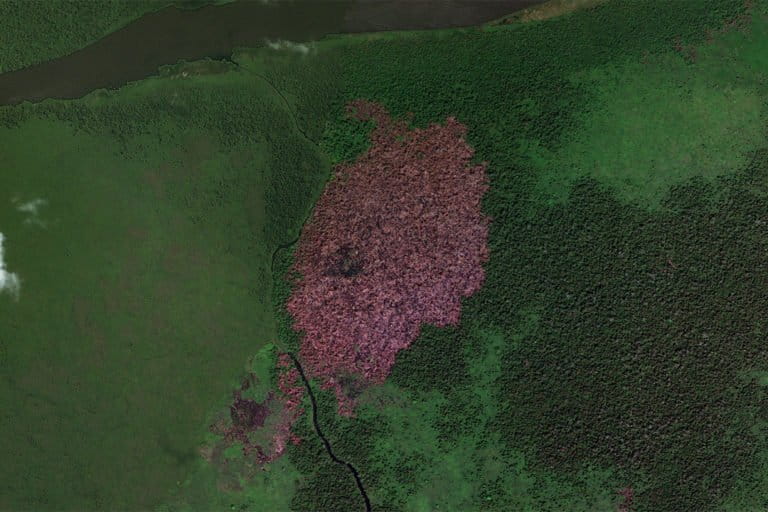
Microsoft Zoom Earth satellite image show a section of burned peatland in the region in Central Kalimantan where the rice project is planned.

Microsoft Zoom Earth satellite image show a section of burned peatland in the region in Central Kalimantan where the rice project is planned.

Why does it have to be protected forest?

The government has responded that only it, and not plantation companies, can propose forest areas that may be degazetted for the food estate program. It says this should ally any concerns that companies operating illegally inside forest areas may exploit the program to legitimize their operations.

It also says the only protected forest areas that may be cleared for the program are those deemed to have already been degraded and thus are no longer serving any of the environmental criteria used to define a forest. And these conversions can only proceed following comprehensive studies and an environmental impact analysis, said Sigit Hardwinarto, the environment ministry’s head of zoning.

“What’s most important is that the protected forest areas have to meet the requirement of not having trees no more, or no longer have their functions,” he said.

He also said the food estate program would feature a form of agroforestry, what the government calls “compound land utilization.” This will effectively allow designated areas to be used for more than one type of cultivation, from growing food and cash crops, to horticulture, to fish farming.

Herry from CIFOR said this would be a welcome development, but only if the role of small-scale farmers is given greater emphasis across the wider policy.

“If this [program] wants to be compatible with the public, then it has to be at a small scale,” he said. “If it’s indeed for companies, then just allocate forests that are already earmarked for companies, such as production forests that may be converted for other uses. These forests are clearly for companies, so there’s no overlap and no disguise.”

Yanto Santosa, a forestry professor at the Bogor Institute of Agriculture, welcomed the ministry’s new regulation, saying it would be a boon for oil palm farmers.

Yanto, who is controversial within the academic community for his views in support of the palm oil industry, said clearing a degraded forest to plant oil palms doesn’t constitute deforestation.

“I am very happy because oil palm is supposed to be a food crop and it is a tree as well, even though it’s true that it has no timber,” he said during a recent online discussion. “We all agree that forests can’t be cleared for oil palm, but if they’ve already been degraded and there is no vegetation, then the [environment] minister said it is allowed, even in protected forest areas.”

He said this should only apply to farmers with small plots, not companies running large plantations.

Herry said carbon stock should be the objective measure for how cleared forestland should be replanted, noting that oil palms are notoriously poor at sequestering carbon compared to the old-growth and timber trees of agroforestry farms.

“It’s the easiest indicator,” he said. “For example, say a forest has a carbon stock of 50 tonnes per hectare. With agroforestry, hopefully it can be increased to 70 tonnes. But if it’s replaced by oil palm plantations, it’ll decline to 29 tonnes.”

Others, however, still see too much of a risk to allow agricultural activities inside protected forests.

“Has the government conducted mapping and a thorough study on the impact [of the program]?” said Daniel, the lawmaker. “We shouldn’t let a policy with a wide impact be carried out carelessly without an in-depth study, especially considering that year after year the size of protected forests keeps shrinking.

“There should be many other options than [clearing] protected forests, such as planting on abandoned agricultural fields,” he added. “Why does it have to be protected forest?”

*

Note to readers: please click the share buttons above or below. Forward this article to your email lists. Crosspost on your blog site, internet forums. etc.

Remembering the Maguindanao Massacre: Warlordism at Its Worst

November 23rd, 2020 by Prof. Ruel F. Pepa

The Maguindanao Massacre is unanimously viewed as the most tragic event in the Philippines that capped 2009. On the fateful morning of 23 November 2009 — exactly eleven years ago — fifty-seven helpless civilians including women and media people were cold-bloodedly slaughtered by policemen, military men, civilian-militia personnel, and private-army members — all being fearfully and blindly subservient to the “omnipotent” Ampatuan warlord family of Maguindanao represented by the “trinity” of Andal Ampatuan, Sr., the erstwhile governor of Maguindanao; Zaldy Ampatuan, the erstwhile governor of the Autonomous Region of Muslim Mindanao (ARMM); and Andal Ampatuan, Jr., the erstwhile mayor of the municipality of Datu Unsay, Maguindanao. This tragic event happened during the presidency of Gloria Macapagal-Arroyo who happened to be a close ally of the Ampatuans.

The criminal minds of these “trinity” of ruthless murderers are typical of warlords as they are found anywhere in the Philippines and in other less-civilized societies in the world. As we commonly know them, it is inherent among warlords to be cold-blood murderers contemptuous of the legal and the moral. Politicians of the same warlord streak whether they are in Luzon, the Visayas, or Mindanao are generally perceived and expected to act like the Ampatuans when their political domination and monopolization are gravely challenged by emerging “New Turks”. In fact, by a mere exercise of one’s sociological imagination, it could be said that since time immemorial, warlords anywhere in the Philippines “naturally” eliminate by “liquidation” anyone who’d cross their paths, i.e., challenge their seemingly perpetual dominion and permanent supremacy. 

Image on the right: Gloria Arroyo (Source: Wikimedia Commons)

File:Gmashang.jpg - Wikipedia

In the history of the Philippines, many have opined that the most vicious warlord with the ruthlessness of a cold-blooded murderer was Ferdinand Marcos who ordered the summary executions and forced disappearances of hundreds of his adversaries specifically in the ranks of peasant, labor, and student activists within a period of more or less 20 years, i.e., prior to the declaration of and during the Martial Law era. But I beg to disagree because what Marcos did within 20 years has been surpassed by Gloria Macapagal-Arroyo in less than 10 years. And now under the six-year presidency of another notoriously ruthless warlord, Rodrigo Roa Duterte, Marcos and Arroyo atrocities combined are just a minuscule fragment of the Duterte government’s extra-judicial killing spree.  In other words, Duterte is miles and miles worse than Marcos and Arroyo put together.

The Maguindanao Massacre appears to be so heinous and hence exceedingly controversial to grab the front pages of both domestic and international dailies for days and weeks because in just one sweep of bullet hails from high-powered automatic weapons 57 defenseless and innocent civilians lost their precious lives. The masterminds and lead perpetrators of course were the Ampatuan “trinity”. But the issue is from what “supreme power” did the Ampatuans draw their satanic will? One very glaring reality is the fact that the Ampatuans are leading minions of Gloria Macapagal-Arroyo. They had the guts to commit a brutal crime because they knew that Gloria Arroyo would provide them with all the unassailable protections available within the clout of her power. 

But how did they get to that idea? It is because they knew from deep within their zealously guarded chamber of secrets that Arroyo could have never—even in her dream—simply ignore them and drop them like hot potatoes. They and Arroyo and their other blind followers knew that the latter’s overwhelming victory in Maguindanao and in the rest of the Autonomous Region of Muslim Mindanao (ARMM) during the previous presidential elections was courtesy of the iron hands of the Ampatuan warlords. This is basically the reason why right after the news of the massacre reached Malacanang, Arroyo did not order the immediate arrest of the Ampatuans. Other measures were likewise done to shield the Ampatuans. But because of popular local and international pressures, Arroyo was forced—against her will—to arrest and incarcerate the Ampatuans. In retrospect, we could almost accurately say that the power of the Ampatuans exercised to the point of committing a terrible heinous crime was actually directly drawn from the seeming “omnipotence” of their “patroness,” Gloria Macapagal-Arroyo.

Having another warlord as president, Filipinos cannot hope for something better as far as justice and peace in the country are concerned. There have already been thousands of extra-judicial killings of suspected drug users and pushers along with those innocent people caught in the senseless crossfires perpetrated by no less than the national police and other government agents tasked by Duterte to follow his murderous mandates. But what is worse in this whole agenda is none of the identified big fish — big-time drug lords — have ever been arrested and convicted before the court of law. With this in mind, what one can’t get rid of at this moment is a suspicion that is as good as anybody’s allegation. If we are in a situation like this, what would you have in mind about the government that for the last four years has been mismanaging the state affairs more particularly the issue of the seemingly unchecked and uncontrolled proliferation of illegal drugs in the country?

Warlordism is well-entrenched in the political culture of the Filipino. We are already in the 21st century and none of its vestiges have significantly declined. The notion of democracy is simply an abstract theory whose realization is apparently infeasible in a society whose fractured culture and distorted political sense have continued to sustain warlordism, whether unwittingly or otherwise. The demise of warlordism in the Philippine context is therefore deemed to be an unachievable dream. 

*

Note to readers: please click the share buttons above or below. Forward this article to your email lists. Crosspost on your blog site, internet forums. etc.

Prof. Ruel F. Pepa is a Filipino philosopher based in Madrid, Spain. A retired academic (Associate Professor IV), he taught Philosophy and Social Sciences for more than fifteen years at Trinity University of Asia, an Anglican university in the Philippines.

Featured image is from Wikimedia Commons

A Plan for a High-income Chinese Economy

November 20th, 2020 by John Ross

In the West the population is at present sheltering to protect itself from Covid, entering the greatest economic downturn since the Great Depression, and facing the threat of unemployment and reduced living standards. On the other side of the world in China, something going in exactly the opposite direction is occurring. China unveiled its new Five-Year Plan. This will take a country which in 1949 was almost the poorest in the world, and its almost 1.4 billion population, into the ranks of high-income economies by international classification – with all the steps forward in life expectancy, living standards, health, education and social conditions this brings with it.

There has never been such a large scale economic and social ‘miracle’ in the entire history of humanity – the population of China is larger than the combined population of all other high-income economies in the world.

This transformation therefore poses the most profound possible questions for socialists, socialist theory, and the international left. If, as some on the left claim, China is a capitalist country then the only conclusion that can be drawn from these facts is that capitalism remains a progressive system. If capitalism can raise almost one fifth of humanity from nearly the world’s most grinding poverty to high income status in 70 years, that is within a single lifetime, it is nonsense to claim that capitalism has exhausted its possibilities. If capitalism had delivered 850 million people from internationally defined poverty, as China has, then capitalism would have delivered gigantic progress for humanity. Capitalism would have delivered an immense improvement, a qualitative step forward in life, for a higher proportion of humanity than the European Union and the US combined.

Furthermore this capitalist system would also have been demonstrated to be able to deliver similar results not only to China but to be a path that could be followed by other major countries – for example Vietnam, a country of almost 100 million people, is delivering economic growth and reduction of poverty at a rate, if at an earlier stage of development, essentially the same as China’s. If capitalism can deliver such benefits it is utopian not to support capitalism.

But in that case, there is an impossible mystery. Why has such unparalleled economic development and improvement in living conditions not been delivered by the other countries following the capitalist system?

In summary, the ‘leftist’ claim China is a capitalist country paradoxically, and doubtless against the subjective intentions of those on the left who put it forward, leads to the conclusion that capitalism can deliver historically unparalleled improvements in living standards!

There is in fact no such mystery because China, and Vietnam, are not capitalist but socialist countries. That is why such progress has been made. And this is why the left has a real model for economic development across the world – something it is vital for the left to understand, most immediately in developing countries. Socialism is not a utopia, it is not a dream, it is not something which was achieved in 1917 in Russia and has never been achieved since. It is something real, totally practical, and which delivers immediate benefits to truly gigantic numbers of people.

The following article by John Ross, which appeared in China.org.cn, on China’s new Five Year Plan analyses the historical facts which have to explained by any analysis of China, the nature of its new plan, and the step forward that this represents as the country enters the stage of development of a high income economy.

***

By John Ross

The press conference which followed the Plenary Session of the CPC’s Central Committee put forward guidelines not only for China’s next Five-Year Plan, for 2021-2025, but also for more medium-term development of China up to 2035. The two are interrelated because the next Five-Year Plan will inaugurate a qualitatively new period in China’s economic development which is of global significance. This goes beyond the fact that China’s short-term economic prospects are better than for any other major country – the IMF estimates in 2020-2021 it will account for 60% of global growth. The new Five-Year Plan inaugurates a fundamental transition.

China in 2020 became a ‘moderately prosperous’ economy by its own national classification – also achieving its goal of the elimination of absolute poverty. But most countries use World Bank classification in making international comparisons – dividing economies into low, medium and high-income groups. By this criterion in approximately 2022-23, the middle of the next Five-Year Plan, China will enter the ranks of global ‘high income economies.’

Achieving this new level of development determines the Five-Year Plan’s nature. Previously China planned for escaping underdevelopment, whereas this plan centres on the different tasks of building a high-income economy. Furthermore, due to US actions, it will do so in a different international context and where serious challenges face humanity – particularly the threat of climate change and of economic recovery from a pandemic which Western failure to control has created the deepest global economic downturn since the Great Depression.

To understand this Five-Year Plan’s place in China’s national development, the almost incredible character of what has been achieved must be understood. In 1949 China was almost the world’s poorest country – only 10 counties had lower per capita GDPs. Only 73 years later, the span of a single lifetime, China will count among the world’s high-income economies.

When the Communist Party of China took power in 1949 in essence it put forward a promise to China’s people: ‘if China adopts our methods the Chinese people will be taken from a century of humiliation, regain control of their own destiny and rejuvenate their country.’ The achievement by China of high-income international status during the next Five-Year plan is a key symbol on the economic field that this promise was delivered – following similar achievements in national unification, elimination of foreign military forces, gigantic improvements in health, life expectancy, education, culture and numerous other fields.

Internationally the scale of what is represented by the new Five-Year Plan is clearly understood by historical comparison. Today, by World Bank classification, only 16% of the world’s population lives in high income economies. But China is 18% of the world’s population. China becoming a high-income economy will therefore more than double the proportion of the world’s population living in such states. It is a fact that no such comparable single improvement in the position of such a large proportion of humanity has ever taken place in the whole of history.

This staggering achievement brings new challenges. Some are internal – a high income economy is far more complex than a low or medium one. But some are external. The US has embarked on an  attempt to block China’s development. This path was launched by Trump with tariffs and technology bans. But there is no indication that US policy will fundamentally change no matter who wins the US presidential election.

This is what makes the much-discussed concept of a ‘dual circulation’ economy so crucial in the new plan. Many US analysts consider Trump made tactical errors in his attack on China. That the tariffs were a mistake as they were paid by the US population and attacked China on terrain where it was strong, and the US could not compete – good quality medium technology manufacturing. Instead, it was argued, the US attack should be concentrated on its strong point – high technology. The US should concentrate on weakening China’s most high technology companies as with Huawei and Tiktok. Trump and Biden are therefore urged to create a ‘technology blockade’ of China.

There are certainly doubts whether the US can achieve this goal – it is against the interests of other countries and its own high technology companies which previously had strong markets in China. But it would be a naïve, unrealistic, strategy for China to base its policy on an assumption that US policy will collapse due to its own contradictions. Therefore, to progress as a high-income economy, China will have to increasingly rely on its own technology. Every part of the production chain must be potential achievable in China – best described as ‘domestic circulation’. This is different to the 1978-2016 period in which China could rely to a great extent on importing technology.

China remains committed to globalisation, which would be the best path of development for the world, and uses every opportunity for internationalisation, but in the new situation its domestic economy will dominate.

Obviously, this requires great national effort – money has to be poured into R&D and scientific research. Large investments are required to embody and produce new technology. Fortunately, China has the financial resources for this.

This issue overlaps with international problems which are not just due to US policy but also to common problems of humanity and particularly climate change. Regarding this it is China’s prowess in the field of renewable energy manufacturing technology that makes possible the meeting, and potential exceeding, of the goals of the Paris Climate Change accords.

China had outlined its goal of ‘ecological civilization’ conceptually previously but global attention was paid to Xi Jinping’s statement at the UN on 22 September that: ‘We aim to have [carbon dioxide] emissions peak before 2030 and achieve carbon neutrality before 2060.’ For example, Adam Tooze, one of the West’s most eminent economic analysts and historians, noted in the US Foreign Policy magazine: ‘with those two short sentences China’s leader may have redefined the future prospects for humanity.’

To achieve these goals, they will have to begin to be embodied in the new Five-Year Plan and globally these will be among the most eagerly noted of its targets.

*

Note to readers: please click the share buttons above or below. Forward this article to your email lists. Crosspost on your blog site, internet forums. etc.

This article was originally published in May 2019.

The result of the biggest election in history, India 2019, is terrible news for tribal peoples in the world’s biggest democracy. Politicians with authoritarian nationalist inclinations like India’s newly invigorated Narendra Modi are in vogue around the world, and while many minority groups are feeling the impact of this surge to the right, the past year has seen an alarming escalation of the threat against tribal and indigenous peoples worldwide.

The “Trump of the Tropics”, Brazil’s President Jair Bolsonaro, has received widespread condemnation for his attack on indigenous peoples in Brazil, and rightly so. However, the sheer scale of India’s assault on its tribal people is unprecedented: around 8 million people are set to be evicted from their homes, and tens of millions may soon be subject to draconian laws which allow them to be “shot on sight” with essentially no due process or legal recourse.

India’s famous forests are the battleground on which Modi’s administration have waged war against the nation’s tribal peoples. Many of India’s tribes live in forests and rely on these ecosystems to survive. These vast tracts are rich in biodiversity and are home to some of the country’s most iconic animals, notably the tiger.

Tribes like the Chenchu, of Telangana and Andhra Pradesh, have always lived harmoniously with the tigers, whom they honour and revere, but do not fear. According to one Chenchu man, Thokola Guruvaiah:

“We love [tigers] as we love our children. If a tiger or a leopard kills our cattle, we don’t feel disappointed or angry, instead we feel as if our brothers have visited our homes and they have eaten what they wanted.”

In February 2019, India’s Supreme Court ordered the eviction of around 8 million people from India’s forests following a petition by conservation groups, who claim that human presence in the forests poses a threat to wildlife (though once the inhabitants have been evicted, these same conservationists tend to take no issue with hordes of tourists colonising the land in loud, polluting four wheel drives.) This perceived (but entirely false) threat that tribal people pose to wildlife has already led to 100,000 people being evicted from their ancestral homelands. Though these families and communities should be compensated, all too often the promised benefits don’t materialize.

The results of such evictions are devastating, and people who were never in poverty, thanks to the bounty of the forest, are then needlessly forced into destitution. Anyone callous enough to say that this suffering is a price worth paying for tiger conservation should note one important fact: in the first tiger reserve in India where tribal people won the right to stay permanently on the land, tiger numbers increased by over three times the national average.

As their rights are being systematically eroded, more and more evidence shows that tribal people are the best conservationists and guardians of the natural world. These communities have made their living as hunter-gatherers or subsistence farmers for generations, so their day-to-day survival has always depended on their profound understanding of their environment and ability to maintain healthy wildlife populations: 80% of the planet’s biodiversity is in tribal territories. They possess unique insight and expertise that is proving invaluable to science and conservation and will prove essential in the urgent fight against climate breakdown.

Eight million evictees is more people than the population of New York or London. Where will they go? How will they survive once they are cut off from the resources they depend on, but have no money or means to obtain elsewhere? Appallingly, it was wilful dereliction of duty from the government that led to this clear miscarriage of justice: there was no-one to put the argument against the eviction motion because the government didn’t bother to send a lawyer to court to defend their own law. Following widespread criticism and protests the government was forced to intervene, and the Supreme Court stayed their ruling until July. Following the election result there will be less pressure on the government to act, so when the court reconvenes, it seems likely that the ruling, in some form or other, will be upheld.

If so, the now poor and desperate evictees may well be shot should they attempt to re-enter the forest to gather food, firewood or medicinal plants. This is according to the government’s proposed amendments to the Indian Forest Act, 1927 (IFA), which were leaked in March this year. Although this legislation was created initially by the British to establish legal control over India’s forests, the new proposals are, remarkably, even more draconian than the original colonial law.

Forest officials, “justified” by “conservation,” will have a startling level of impunity, including the power to shoot people virtually without redress, enforce “communal punishments” against an individual’s entire village, and suspects will be presumed guilty and treated like criminals until they can prove their own innocence.

Under the proposals, no forest officer can be arrested for any offence committed in ‘discharge of his official duties’ without an investigation, and state governments can’t sanction an inquiry into wrongdoing without constituting an inquiry under an executive magistrate. Where similar policies have been in force, it’s led to “shoot first, ask questions later,” and the results have been catastrophic.

At Kaziranga National Park in Assam, for instance, where staff were told “never allow any unauthorized entry – kill the unwanted,” 65 people were killed between 2010 and 2016 alone. In 2016, a seven year old boy was shot and suffered life-changing injuries. While the law is supposed to prevent poaching, Survival International has revealed that in fact innocent people have been killed by rangers, including a man with learning difficulties looking for a lost cow.

Out of the estimated 370 million indigenous people worldwide, over 100 million live in India, meaning the country is home to over a quarter of the world’s indigenous population. Though indigenous rights are of grave concern around the globe, the sheer scale of what’s happening in India is unparalleled: the number of individuals, families, and communities who are poised to have their lives utterly destroyed is mind-bendingly huge.

As a Chenchu man told one of my colleagues recently:

“Without us the forest won’t survive, and without the forest we won’t survive. Staying in a town, even for a couple of days, is a nightmare for us. If you are asking us to live there forever then we are sure to die. Nobody has the right to send us out of this forest, and if you are doing that then indirectly you are asking us to die.”

*

Note to readers: please click the share buttons above or below. Forward this article to your email lists. Crosspost on your blog site, internet forums. etc.

Jonathan Mazower works for Survival International.

Credits to the owner of the featured image

The close attention widely paid to the recent election campaign in the United States is understandable. We are talking about a change in the leadership of a country, which continues to occupy the position of one of the main pillars of the modern world order.

Leaving aside the theme of the nature of the “democratic procedure” in the United States (which caused “disappointment” for many, to put it mildly), let us note the main thing in this context: each of the other significant participants in the world political game associated some of their own expectations attached to it. In this regard, the first reaction of the three leading Asian countries (China, India and Japan) to the preliminary results of the American elections seems to be remarkable.

First, attention was drawn to the haste of expressing congratulations to Joe Biden, in which the prime ministers of India and Japan did not lag much behind their European counterparts. At the same time, no official reaction followed from Beijing to the democratic candidates declaration of “victory”. Apparently, it will not even be until the official announcement of the results of the elections held in the USA. Despite the fact that the Chinese press is actively discussing everything that is somehow connected with them.

First of all, it is noted that Donald Trump leaves American policy to his successors in a state of “degradation”. This implies an internal political situation, in the catastrophic deterioration of which Trump, however, is definitely less to blame than his opponents.

As for Washington’s course in the Chinese direction, it is to Donald Trump that US-China relations owe the extremely important ‘Phase 1 Agreement’ in the field of trade. The parties are implementing the main provisions of this document without interruption, despite understandable restrictions due to the coronavirus pandemic and the aggravation of the political sphere of bilateral relations. Moreover, the latter is more likely a product of the “creativity” on the part of the US political establishment (represented in the current administration by M. Pompeo), over which Trump never managed to establish control.

It is precisely because of the extremely poor state of the political relations with the United States that the Chinese Global Times looks to the future with more than a small amount of skepticism. Believing, however, that there are resources for their improvement, which both sides should not waste.

The NEO has repeatedly noted that the highest ranking of these resources are trade and economic ties between the United States and the PRC (People’s Republic of China). In bilateral trade, the volume of which exceeds 600 billion dollars, there are serious problems, with the solution being aimed at the Agreement of the “1st Phase”. The main supporter of the further development of relations with the PRC remains American business.

China drew attention to the fact that at the third international exhibition the China International Import Expo (CIIE) (Shanghai, November 5 – 10) 197 American companies (5 more than the previous one, CIIE-2019) occupied the most extensive exhibition area. According to the Global Times, foreign exhibitors welcomed the message about J. Biden claim to victory in the recent elections.

But even if an intention to improve bilateral relations appears on the part of the new Washington administration, the “Taiwan problem” has become extremely aggravated in recent years.

In this regard, Taiwan’s reaction to the results of the American elections was remarkable. At first, it was almost mourning in nature, because just during the presidency of Donald Trump, the trend (to one degree or another always present in American politics) to provide comprehensive support to the Taiwanese leadership to acquire a full-fledged statehood for the island increased sharply. In recent months, special importance had been attached to the defense sphere of bilateral cooperation.

However, Taipei’s initial sadness was quickly replaced by official joy expressed in congratulations sent to Joe Biden by President Tsai Ing-wen of Taiwan. A similar metamorphosis in the camp of “Taiwanese separatists” provoked caustic comments from the same Global Times.

In the assessments of Indian experts on the results of the elections held in the United States and against the background of all sorts of speculations about the half-Indian K. Harris as vice president of the United States (which states, however, that she is a “proud American”), there is obviously a factor of a possible improvement in US-China relations.

The fact is that it was during the presidency of Donald Trump that the Indian leadership took a number of important steps towards the United States. Especially in the last six months a sharp aggravation of relations with China due to the conflict in Ladakh. In the wake of the (hypothetical) improvement in US-China relations, Delhi will be faced with a difficult question: how to proceed with Beijing?

Japan, in an absolutely obvious way, is sincerely (unlike many others) happy with Joe Biden, more for the expected departure of Trump as leader of a key ally. Which, as they say, “really got” Tokyo.

First, by regularly spoiling the mood with reminders of the US trade deficit with Japan of $ 70 billion annually. This is a good fact for Tokyo, but it is better to keep it as least noticeable as possible. In addition, the matter was not limited to talk, and the persistent D. Trump set a deadline (at the end of this year) for taking specific measures to correct the “obvious disgrace”.

Washington’s deliberate aggravation of US-China relations (and even against the background of the coronavirus pandemic) reduces the global economic situation, which negatively affects the foreign business of Japanese companies in general and in China in particular.

According to the Yomiuri Shimbun newspaper, Prime Minister Yoshihide Suga is going to discuss all these and other issues with Joe Biden during his visit to the United States, which is due to take place immediately after the inauguration of the US president, scheduled for January 20, 2021.

Finally, it is not superfluous to comment (with a short excursion into recent history) on the ostentatious joy that the allies and closest partners of the United States are expressing with unprecedented speed to the (potential) new American president. Let us recall that when at one time the overseas “knight without fear and reproach” courageously fought against windmills (that is, “with communism” and all kinds of “totalitarian regimes”), his allies made a not so small profitable deal.

Four years ago, they suddenly felt like an abandoned wife, who, in anger and tears, exclaimed: “Come back, I will forgive everything”.

And now, when a ray of hope has dawned, the “abandoned” says, smiling and wiping away her tears: “Dear, let’s forget the old and start all over again?”

It will not work. In any case, on the same scale. For Donald Trump is not a one-time aberration in the political life of the United States. Expressed in a style popular at the time, four years ago America “breathed in the long-awaited air of freedom” and is unlikely to allow itself to once again throw on the yoke of obligations to cunning allies and all sorts of “independent” rogues.

Because it is not clear with whom and in the name of what to fight today. More precisely, it is already clear that there is no one with whom and for what. Moreover, the problems inside the country are “through the roof”.

However, one should not underestimate the factor of the possible return to the American administration of one of those “three witches” who at one time whispered and prophesied to the then American “Macbeth”, that is, President Barack Obama, the prospect of a “humanitarian catastrophe” in Libya.

After that, the United States was drawn into the military adventure of its European allies, the real catastrophic consequences of which the people of Libya are still unraveling.

Since the world game is shifting to Asia, a sharp strengthening of the “humanitarian” component of American foreign policy can be expected here. Moreover, the aforementioned second face of the new US administration was also marked with a “humanitarian” diagnosis. The formation of another trio of American political “witches” may complete the candidacy for the post of Secretary of Defense.

However, in connection with the situations in XUAR, Tibet, Hong Kong, the mentioned diagnosis of American policy in the Asian direction manifested itself quite clearly and “under the devil-Pompeo”. That is, with the coming to power in the United States of the new administration, one should hardly expect immediate and radical shifts in the regional political puzzle. As for the non-“immediate” and not “radical” ones, it is too early to say anything definite about them today.

*

Note to readers: please click the share buttons above or below. Forward this article to your email lists. Crosspost on your blog site, internet forums. etc.

Vladimir Terekhov is an expert on the issues of the Asia-Pacific region, exclusively for the online magazine “New Eastern Outlook“.

Credits to the owner of the featured image

Malaysia Will Never Entertain Any Claim on Sabah

November 19th, 2020 by BERNAMA

Malaysia has once again reiterated its stance to never entertain or recognise any claim by any quarters on Sabah.

Deputy Foreign Minister Datuk Kamarudin Jaffar said the claim on Sabah, particularly by the Philippines, was not only baseless but also irrelevant.

He explained that Sabah is a state in the Federation of Malaysia based on the decision of the Cobbold Commission in 1962, with the people of Sabah having exercised their right to self-determination for the status of their state to be in Malaysia.

The deputy minister said the Cobbold Commission report was submitted to the United Nations (UN) on Aug 1, 1962, and confirmed that more than two-thirds of Sabahans voted to join Malaysia in 1963.

“On Sept 14,1963, the UN Secretary-General reported to the UN General Assembly that the people of Sabah had chosen to join Malaysia. On Sept 16, 1963, Sabah officially joined the Federation of Malaysia,” he said in reply to Datuk Azizah Mohd Dun (Bersatu-Beaufort) on the status of the Philippines’ claim on Sabah at the Dewan Rakyat sitting today.

Read full article here.

*

Note to readers: please click the share buttons above or below. Forward this article to your email lists. Crosspost on your blog site, internet forums. etc.

Featured image is CC BY-SA 3.0

Is India Doing America’s Bidding Against China?

November 19th, 2020 by Andrew Korybko

First published on APR in June 2020.

Andrew Korybko gave an interview to Indian journalist Parth Satam (June 2020) about India’s relations with China, the US, and Russia, just days before Monday night’s deadly clash between Indian and Chinese troops. Two excerpts were ultimately included in the article that Mr. Satam was writing about this topic. Given its importance in light of the latest clash, OneWorld is publishing the interview in its entirety with Mr. Satam’s permission.

***

Parth Satam: Can the present India-China border standoff be viewed as a larger part of the changing geopolitical scenario driven by the US pullout in Afghanistan, the abrogation of Article 370 (special status for Kashmir) by the Modi government, and the growing Indian proximity to the US where India is toeing the American line on Chinese issues (e.g. joining the anti-China chorus on the COVID pandemic)?

Andrew Korybko: Absolutely, that’s the most accurate way to assess the current situation. The preexisting differences between China and India on a host of issues were exacerbated by India’s abrogation of Article 370. Beijing condemned New Delhi for violating UNSC Resolutions on the disputed region, then some Indian officials reaffirmed their claims to Aksai Chin, which provoked a defensive reaction from China. This escalating issue was then exploited by the US, which has a shared interest with India in “containing” China, as they both perceive it. That’s why American officials have started comparing the latest incident to the situation in the South China Sea in an attempt to draw a parallel of so-called “Chinese aggression” and therefore justify their ever-intensifying “comprehensive global strategic partnership” with India (per what they both agreed to call it during Trump’s visit in February). It was therefore predictable that there would eventually be a flare-up since the situation is so tense, and India is being encouraged by the US to assert its claims. It naturally follows that India is also toeing the American line on other anti-Chinese issues as well, especially those related to the COVID-19 pandemic and “poaching” foreign companies from the People’s Republic so as to re-engineer global supply chains in a way that supports the US’ grand strategic goals.

PS: Strategists from both side of the political divide in India (albeit suspicious towards China) broadly agree that China does not intend to go to war with India despite its technological, military, and industrial superiority due to larger geopolitical priorities and is undertaking this current intrusion into Indian territories to signal to not threaten its interests in PoK and other anti-Chinese Indian moves (joining the QUAD, support to the Dalai Lama) etc. What’s your response to this assessment?

AK: I personally disagree with the characterization of Azad Kashmir and Gilgit-Baltistan as “PoK”, as well as describing the latest border incident as a Chinese “intrusion”, but I do agree with the spirit of the view that China does not intend to go to war with India. However, that doesn’t necessarily mean that India doesn’t intend to go to war with China, even if only a brief border one similar in essence to what transpired between India and Pakistan in February 2019. Should that be the case, then I also predict that there would be a similar outcome, namely that India will not achieve its military objectives, though it might very well succeed with certain strategic ones.

For instance, India — whether rightly or wrongly, and irrespective of whether one supports its view or not — feels uncomfortable about China’s de-facto leadership of both BRICS and the SCO. New Delhi’s efforts to court Moscow as part of a grand “balancing” act have only been mildly successful but not enough to the point of making Russia as openly suspicious of China as India is. If there’s a Chinese-Indian border war, however, then India would send several powerful signals to the whole world even if it militarily loses the likely brief conflict.

First, India would position itself as the country most directly “countering/containing” China, which would appeal to its new American ally and the latter’s network of like-minded allies as well. Secondly, India would compel Russia to either choose a side (unlikely) or more vigorously “balance” between it and China. By default, any further tilt towards India along the lines of Russia’s present trend (e.g. selling more advanced offensive weapons systems) would be interpreted very negatively by China, potentially weakening their strategic partnership to New Delhi and Washington’s indirect advantage. And thirdly, BRICS and the SCO would never be the same again, which also serves American interests.

I don’t endorse that scenario because I personally hope that it doesn’t transpire, but I’d certainly understand what goals India is aiming for in the event that it happens. India also desperately needs another external enemy other than Pakistan to rally its domestic audience and distract them from the current economic difficulties and sharp partisan divides that have recently developed in the country. By presenting itself as the “American bulldog” against China, India hopes that it would receive preferential investment and other forms of support from the US and its allies, also enabling it to reach a more equitable trade deal with America later on.

PS: What is the Russian position on the Indian proximity to the US? Is the Russian Federation frustrated with India merely maintaining a transactional relationship in terms of weapons purchases or does it wish to take the partnership in newer dimensions (i.e. wanting it to be a part of the Eurasian Economic Union project)?

AK: I’m not an official representative of the Russian government so I can’t speak about their formal position, but from what I’ve observed, they’ve expressed both sentiments in recent years. Lavrov described the so-called “Indo-Pacific” as “an artificially imposed concept” created by the US during a press conference in February 2019, and he repeated his skepticism about it during the Raisina Dialogue in New Delhi back in January. At that second-mentioned time, however, he expressed hope that Russia’s “Indian friends are smart enough to understand” that the US is simply trying to use this scheme to “contain” China.

Nevertheless, Russia has regularly reiterated its commitment to diversifying relations with India beyond their present mostly transactional nature largely dependent on military-technical cooperation. This is evidenced by the joint statement that was released during Prime Minister Modi’s attendance at the Eastern Economic Forum in Vladivostok as President Putin’s guest of honor, where both leaders reaffirmed their strategic relations and promised to take them further than ever before. Two projects that are presently in the works are the Vladivostok-Chennai Maritime Corridor (VCMC) and selling BrahMos missiles to ASEAN states.

Russia’s position on India’s growing proximity to the US appears to be a mirror image of India’s position towards Russia’s growing proximity to China. Both Great Powers respect the other’s sovereign right to reach whichever partnerships they’d like, though they’d prefer that neither of them occur at the other’s expense (whether real, perceived, or speculatively latent). One solution for stabilizing their relations into the future would be to jointly lead a new Non-Alignment Movement (Neo-NAM), which I elaborated on in an article that I co-authored earlier this month for the official journal of the Moscow State Institute of International Relations (MGIMO), which is run by the Russian Ministry of Foreign Affairs.

Titled “The Prospects of Russia and India Jointly Leading a New Non-Aligned Movement”, it can be read in full for free here. The proposal is already being actively discussed in one of Russia’s top think tanks, the Valdai Club, and certainly deserves further study given the important “balancing” role that it can play in the future international system. In a gist, the idea calls for both of them to pool their collective resources (especially diplomatic and economic) towards creating a third pole of influence in the increasingly bipolar world led by the American and Chinese superpowers.

Not only could that help maintain trust between Russia and India, but it could also prevent one or the other from becoming their counterpart’s “junior partner”, something that they each fear for understandable reasons. That said, I’ve since expanded on my academic proposal to incorporate my prior work on the importance of Russian-Pakistani relations, which I explain at length in my analytical piece about how “Improved Russian-Pakistani Relations Will Help Moscow Balance The New Bipolarity“. I assert that this could perfect Russia’s “balancing” act by upholding its trust with China despite any progress that might be made on the Neo-NAM simultaneously with making India think twice about the consequences of more fully pivoting towards the US.

In sum, the solution to the dilemma posed by Russia’s increasingly close relations with China as perceived by India and India’s increasingly close relations with the US as perceived by Russia is for them both to come together to jointly lead a Neo-NAM, though Moscow’s chances of successfully maintaining this complex “balancing” act between China and India would be greatly strengthened by the continued improvement of its relations with Pakistan for the aforementioned reasons. This scenario presents what I sincerely believe to be the best outcome for all five players — Russia, India, China, the US, and Pakistan — and would therefore greatly contribute to establishing a relative sense of order in today’s extremely anarchic international arena.

*

Note to readers: please click the share buttons above or below. Forward this article to your email lists. Crosspost on your blog site, internet forums. etc.

This article was crossposted from OneWorld.

Mr. Satam’s article that included the two earlier mentioned excerpts from this interview was published at the Mission Victory India autonomous defence think tank under the title “What is China’s Intent? The Answer is in the Regional Diplomatic Scenario & the New Cold War with the US“. Mr. Satam can be followed on Facebook and Twitter.

Andrew Korybko is an American Moscow-based political analyst specializing in the relationship between the US strategy in Afro-Eurasia, China’s One Belt One Road global vision of New Silk Road connectivity, and Hybrid Warfare. He is a frequent contributor to Global Research.

Featured image is from OneWorld

China Launching State Rival to Elon Musk’s SpaceX

November 18th, 2020 by Frank Chen

China’s state-owned telecommunications carriers plan to launch as many as 10,000 satellites in the next five to ten years to form a constellation in low-Earth orbit and keep pace with US rivals.

Chinese cadres overseeing space technologies were reputedly jolted by space entrepreneur Elon Musk’s recent assertion that with 775 satellites up and running in orbit his SpaceX company had leapfrogged NASA as the world’s largest satellite operator.

Musk made the claim when as many as 60 American satellites for SpaceX’s Starlink high-speed global Internet access project were launched last month from his company’s Falcon-9 rocket.

In comparison, China currently has just 432 satellites in orbit, according to space exploration data cruncher n2yo.com.

Now, Beijing is thus ratcheting up its push to launch more satellites for a Chinese “StarNet” project before the United States and private firms like SpaceX fill the entire lower orbital space.

Chinese President Xi Jinping signed off on the new five-year 2025 space exploration program earlier this year. The masterplan will pool state-owned enterprises and private entities and aims to keep pace with the US and SpaceX in a budding new race to launch satellites and other spacecraft.

China Newsweek, a publication run by the official China News Service, reported in October that China Telecom’s satellite communications arm had kickstarted an ambitious launch plan for 10,000 satellites in the next five to ten years.

The magazine cited Ministry of Industry and Information Technology sources as saying that a giant state enterprise would soon be formed in Shanghai to coalesce efforts, resources and assets under a sole operator of China’s future satellite communications network, tentatively to be named China StarNet.

New satellite communications technologies also featured in Beijing’s latest initiative to speed up infrastructure developments, which was unveiled by the State Council in April to spur the then-Covid-battered economy and internal demand.

At the same time, there is reportedly dissent among policy advisors about whether StarNet and its related launches are really needed now that 4G and 5G networks operated by China Telecom, China Mobile and China Unicom cover most big cities and even more sparsely populated regions like Tibet, Xinjiang and Inner Mongolia.

Xinhua quoted experts who doubted the commercial viability of China’s proposed version of Starlink. They said SpaceX could be expected to recoup its hefty investments from its growing user base across America’s agrarian states, where cellular coverage is still lacking.

In comparison, they said, China’s ground-based telecommunications infrastructure was well developed and accessible throughout the nation thanks to Beijing’s no-village-left-behind drive to expand telecom services.

Top policymakers have so far brushed aside those commercial objections, which have apparently taken a back seat to Beijing’s broader drive to stake its claim to space territory and related resources.

Xie Tao, CEO of Commsat, a Beijing-based private satellite Internet service provider and a contractor of China Telecom, told reporters that China must move quickly as operational satellites and those scheduled to launch would soon fill the low-Earth orbit’s reported capacity of 100,000 birds.

A Commsat satellite launch, August 6, 2016. Image: Twitter

“Space in the orbit is allocated on a first-come, first-served basis and the onus will be on these latecomers to ensure their satellites will not collide with existing ones,” Xie said. “The low-Earth orbit is becoming increasingly crowded and the space land grab is on.”

“Frequency and bandwidth resources are getting even more scarce as there is a rush by countries and private firms to file applications with the United Nations’ International Telecommunication Union for new frequencies,” said Xie, who added that China could not afford to be a laggard in the scramble for orbit and frequency resources.

Xie said that when China’s StarNet becomes operational, China Telecom could consider decommissioning its base stations scattered across China’s far western regions, particularly those situated in depopulated areas, to slash service costs.

China Telecom’s chief technology officer Bi Qi told China News Service that the optimal download speed of satellite Internet could hit 1.5 gigabytes per second and the unit cost of data transmission could be lowered to 4G levels.

China Telecom’s public relations department and Commsat declined to comment on Asia Times’ request for comment on reports that other state-owned telecoms carriers are also partners in the StarNet project.

They also declined to comment on hints in the PLA Daily’s WeChat account that the military could transfer some of its satellite technologies to help build a Chinese version of Elon Musk’s Starlink.

*

Note to readers: please click the share buttons above or below. Forward this article to your email lists. Crosspost on your blog site, internet forums. etc.

Featured image is from Twitter

India and ASEAN to Create a “Belt and Road Alternative”?

November 18th, 2020 by Dmitry Bokarev

Chinese Belt and Road Initiative (BRI or B&R), a global transport and economic project, is well known world-wide. While some countries endorse it, many others consider it a form of Chinese expansion designed to subordinate the economies of other countries to China. India, for one, shares this opinion towards B&R. In order to minimize China’s influence on neighboring countries, including its long-standing economic and political partners, India is now forced to propose an alternative to B&R in the form of its own international transport routes and beneficial trade agreements. In addition to opposing B&R and China, this is also required to develop India’s economy.

India is known for its poor geographical location for trade with its neighboring countries, given the Himalayan Mountains stretching along the entire north side of the country. On the one hand, they create a barrier between India and China, whose relationships can hardly be considered free of issues. On the other hand, India’s trade relations are primarily represented by countries that can be reached over the sea (USA being the main trade partner for 2019-2020, for example). Countries that border India overland, with the exception of the hostile Pakistan and PRC, are Nepal, Bhutan, Myanmar, Bangladesh and Afghanistan, all of which have relatively poor purchasing power. The economy of the landlocked northern Indian states is particularly affected by this situation. And generally, it is difficult to realize the full trade potential of such a huge country by means of sea transport alone.

In order to overcome the geographical limitations, India decided to establish overland trade routes to the east, Myanmar, for instance, so as to gain access to the countries of the Indochinese Peninsula through it, and afterwards to the entire Southeast Asia. As a result, a strategy of foreign policy called Look East was formed, whose main goal is to expand economic and political cooperation between India and the nations of Southeast Asia. Naturally, this cooperation was supposed to be based on developing trade routes. It should be noted that this development, among other things, was aimed at strengthening communication between India and Singapore, which is ranked among the most economically developed countries not only in Southeast Asia, but also worldwide. India officially launched the Look East policy in 1991.

According to popular belief, the key purpose of the Look East policy was to develop a partnership with the USA: allegedly, America, already preoccupied with restraining the rapidly developing China at that time, sought to create its own axis of influence, running from US allied India to Southeast Asia, where at that time at least Thailand and Philippines were already among the US partners. Indeed, from the perspective of Indian-American interaction, Look East has proved to be greatly beneficial, but it is hard to say whether this immediate benefit was more important for India than the fact of developing cooperation, including trade, with countries sharing land borders with it. In the end, an alliance that includes India and countries of the Association of Southeast Asian Nations (ASEAN), in terms of both population and economic strength, is quite capable of competing with both China and the United States. It is also quite clear that India will play the key role in this association, and this fits perfectly in line with its economic, political, geopolitical and other objectives. As for the ASEAN countries, it is also very profitable for them to have such a strong ally as India in the face of the ever increasing power of China. Additionally, just like India, they needed to develop their economic relations and trade routes, and India was a very important area for them in this regard.

Generally, both sides were interested in cooperation, and from 1993 to 2003 the trade turnover between India and ASEAN increased from $2.9 billion to $12.1 billion. The most economically developed countries of this region — Malaysia, Singapore and Thailand — became India’s main trading partners in Southeast Asia.

In August 2009, despite opposition from some experts who believed that the trade balance would not benefit India, an agreement on a Free Trade Area between India and ASEAN countries was signed and became effective in early 2010.

In 2018, the volume of mutual trade turnover between India and ASEAN reached $81.3 billion, primarily composed of Indian imports from ASEAN.

However, a mutually beneficial trade between distant regions, apart from wise agreements, also requires basic physical support, such as convenient and reliable transportation routes. An important part of the Look East policy was creating a modern and extensive highway connecting India with countries of Southeast Asia.

It started in 2001 with the project of India-Myanmar Friendship Road. The starting point of the route was chosen to be the city of Moreh on the border between India and Myanmar. Over time, the project evolved and the newly constructed road extended to the Thai city of Masot on the Thai-Myanman border. The road between Moreh and Masot has become the Myanmar part of the highway, which connected Impal, the capital of the northern Indian state of Manipur, Neipyido, the capital of Myanmar, and Bangkok, the capital of Thailand. At present time the road is almost finished, with some sections already being reconstructed. Now the project is known as the India-Myanmar-Thailand Trilateral Highway. However, following the Look East policy, the Indian side proposed to extend and branch the highway to Cambodia, Laos and Vietnam by connecting it to the East–West Economic Corridor running from Thailand through Cambodia to Vietnam.

Nowadays, the project is often talked about in the plural form: India-Myanmar-Thailand Trilateral Highways, as the road is constantly branching off.

The construction was and continues to be carried out under considerable difficulties: among other things, the Indian party had to take upon itself the reconstruction of 69 Myanmar bridges. India has already invested tens of billions of dollars in this project. Nevertheless, New Delhi, Neypyido, Bangkok and other regional capitals expect a great return in the near future. It is hard to say whether the ongoing road network project will be able to compete with a vast variety of similar planned objects within the B&R Initiative, but according to the project participants, implementing it will give a significant boost to trade and other forms of economic cooperation both within the ASEAN-Indian Free Trade Zone and throughout Southeast Asia.

*

Note to readers: please click the share buttons above or below. Forward this article to your email lists. Crosspost on your blog site, internet forums. etc.

Dmitry Bokarev is a political observer, exclusively for the online magazine “New Eastern Outlook”.

Featured image is from InfoBrics

How Can the Belt and Road Better Protect Biodiversity?

November 18th, 2020 by Xia Zhijian

In 1939, a population of orangutans was found in the Batang Toru jungle in South Tapanuli on the Indonesian island of Sumatra. They were thought to be Sumatran orangutans, but in 2017 scientists discovered they were an entirely new species – the Tapanuli orangutan.

Five years earlier, in 2012, Indonesia had announced a US$1.6 billion hydropower project on the Batang Toru River. Some local jungle has since been cleared for the project, which is due to be completed in 2022. This has left the Tapanuli orangutan population, already critically endangered due to habitat fragmentation, facing complete collapse. In June 2018, 25 leading environmentalists wrote to Indonesia’s president, Joko Widodo, calling for a halt to further development in the area.

Chinese financial institutions and businesses have prominent roles in the Batang Toru hydropower project, which is part of China’s Belt and Road Initiative (BRI). It is just one example of the impact the BRI is having – or could have – on biodiversity. This was highlighted in a paper from Malaysian, Burmese, Chinese, Australian, British and American scientists published in the academic journal Biological Conservation in July this year, which analysed the possible impact of planned BRI projects on biodiversity in Southeast Asia. Based on their findings, the researchers called for BRI planning to take connectivity of ecosystems into account, and for the creation of “ecological corridors” to connect otherwise isolated flora and fauna.

Biodiversity under pressure

China proposed the BRI, an international economic belt inspired by the ancient Silk Road, in 2013. It covers the Chinese mainland; Southeast Asia; central, northern and western parts of Asia; Africa; South America; the coasts of the Indian Ocean and the Mediterranean; and Pacific nations. Its main aims are to boost infrastructure construction and develop new economic partnerships.

The initiative has led to the construction of roads, railways, oil pipelines, ports and power stations in nations associated with it. According to the World Bank, BRI investment has now reached around US$575 billion. But despite the Chinese government’s insistence it will create a “Green Silk Road”, the environmental impact of many projects has caused controversy. This includes effects on ecosystems and their biodiversity.

Southeast Asia is a region rich in biodiversity. Home to many unique species, four of the world’s 34 “biodiversity hotspots” are to be found here.

The Biological Conservation paper pointed out that building infrastructure – particularly “linear infrastructure” such as roads and railways – can often harm or destroy the habitats of animals and plants around the construction area. They can also cause habitat fragmentation, which divides and isolates populations, sometimes leading to the decline or disappearance of species. Worse, roads and railways make poaching and illegal resource extraction easier, and make the arrival of invasive species more likely. Accidental deaths, such as while crossing roads, also become more frequent.

The researchers found BRI road and rail projects (including both new construction and upgrades) cut through 21 protected areas in mainland Southeast Asia, half of which are protected for their biodiversity.

Railway lines are having the biggest impact, affecting eight of those protected areas. New railways are commonly built in relatively undeveloped regions, where they represent a greater threat to biodiversity. Some of Southeast Asia’s last remaining original forests are threatened by roads and railways that are either planned or under construction. For example, Thailand’s Dong Phayayen-Khao Yai Forest Complex, a UN World Heritage site, is less than 25km from BRI linear infrastructure.

The 25km measure is not a random one. The researchers assessed the impact of road and rail projects within four distances: 1km, 5km, 25km and 50km. They found that within 25km, there is a greater likelihood of poaching, accidental deaths, noise pollution and habitat destruction, and impacts increase with proximity to the site of a project.

According to the paper, 126 of Southeast Asia’s protected areas are within this 25km radius of BRI road and rail projects. This covers 83% of the region’s endangered mammals, 78% of endangered birds, 53% of endangered amphibians and 52% of endangered reptiles.

The news is no better at sea, where the researchers found that BRI shipping routes can have a destructive impact within a wider radius of 50km. Twenty protected areas and 16 key biodiversity areas are affected.

Although the economic development that the BRI projects promise to promote is often welcomed, it’s clear that finding ways to reduce their impacts and protect ecologies is an urgent matter for all those involved.

Building ecological corridors

One feasible approach is to increase funding for BRI projects to allow for spending on “ecological infrastructure” that will mitigate their impacts.

Binbin Li of the Environmental Research Center at Duke Kunshan University and one of the authors of the paper, told China Dialogue:

“There are many types of ecological infrastructure. For example, if you’re building a road, you could create an ecological corridor, or you could establish biodiversity monitoring stations to allow for better evaluation of the impact of ongoing construction.”

“These things need investment. With the support of funding, we can shift our infrastructure construction from focusing only on the economy towards becoming sustainable and green. When designing infrastructure, we must consider the integrity of ecosystems and the protection of endemic or endangered species, by doing things like designing corridors that allow for the movement of species. These things should be part of the planning stages, when avoiding key locations could also be considered,” she added.

In 2016, China’s 13th Five Year Plan for the environment called for the construction of ecological corridors as well as a biodiversity protection network to boost stability and “ecological services” from various types of ecosystem. In August this year, the China Council for International Cooperation on Environment and Development (CICCED) put forward a raft of policy proposals for the Chinese government. It suggested that ecological corridor targets, based around ecological red lines and protected areas, be included in the post-2020 framework for the UN Convention on Biological Diversity. China is due to host the 15th Conference of the Parties to that convention next year.

Better financing

Including measures like ecological corridors when planning infrastructure is bound to increase costs. Making sure developers are willing and able to bear the extra expenses is therefore key.

Bai Yunwen, director of Greenovation Hub, follows green finance and investment topics. She told China Dialogue that measures like ecological corridors can have such significant economic, environmental and social benefits that they are investments worth making. She pointed out that when projects could take these measures but face a competitive marketplace that makes extra costs untenable, a blended finance approach can be taken, with development or philanthropic finance added to the usual commercial investment.

She also pointed out that while the Asian Development Bank, World Bank and Asia Infrastructure Investment Bank (AIIB) all have established environmental and social safeguards in place, Chinese financial institutions lack experience in these fields and need to catch up.

“Almost all of the main Chinese banks have set up environmental due diligence processes. But they mainly rely on traditional environmental impact assessments, and don’t have the capacity to identify or manage cross-border, cross-sector and long-term environmental risks. Multilateral financial institutions and international organisations have plenty of tools that can be used to identify regional biodiversity risks, but in general, Chinese banks don’t use these,” she said.

A clear example of this lack of attention to wider environmental risks is the Batang Toru hydropower project, which has caused a huge amount of controversy both within Indonesia and overseas. In March 2019, the Bank of China stated on its English-language website that in response to the concerns of environmental groups it would “evaluate the project very carefully and make prudent decisions by duly considering the promotion of green finance, the fulfilment of social responsibility as well as the adherence to commercial principles”.

Although the Chinese government has already issued a number of documents on building a “Green BRI”, these mostly only offer guidance. They are neither binding nor specific enough to be implementable. For example, a 2017 document on creating a Green BRI mentions protection of biodiversity three times – but provides no specific measures. Similar issues are seen in other documents on management of overseas corporate investments, on green credit, and on environmental protection in overseas investments. Fuzzy language about what “should” happen and what is “encouraged” or “focussed on” make it next to impossible for the government to exercise oversight.

According to Bai, “these documents are toothless”. “Current policy and guidance isn’t binding on institutions and companies, and there are no sanctions for breaches,” she said. But she added that Chinese companies are sensitive to policy, and implementation of existing policies would be an important way of promoting biodiversity protection in BRI nations.

Scientific cooperation

While biodiversity may be overlooked in China’s overseas financial activity, the country is engaged in scientific cooperation with Southeast Asian nations. The Chinese Academy of Sciences has established a number of overseas branches working on biodiversity protection, such as the Southeast Asia Biodiversity Research Institute.

The institute is run by the Chinese Academy of Sciences’ Xishuangbanna Tropical Botanical Garden. Originally founded in Myanmar in October 2016, it also has a branch in Vientiane, Laos. The institute has carried out a number of joint surveys in mainland Southeast Asia, covering Myanmar, Thailand, Vietnam and Laos and discovering over 150 new species.

Research into the flora and fauna of Southeast Asian nations is often limited due to their under-developed economies, a lack of technology and a shortage of scientists focusing on biodiversity. To help address this, the Chinese government has set up scholarships to help talented students from BRI nations study for master’s and doctorate degrees at the Chinese Academy of Sciences.

Binbin Li welcomes these measures by the Chinese Academy of Sciences. “I’d like to see more similar things happen,” she said. “But there still isn’t much research going on in Southeast Asia, where things got off to a later start than in the US and Europe. So there’s still plenty of opportunities for Chinese researchers to work there and cooperate with local researchers. On-the-ground data can then better support China’s overseas investments.”

*

Note to readers: please click the share buttons above or below. Forward this article to your email lists. Crosspost on your blog site, internet forums. etc.

Xia Zhijian is a freelance writer based in Chengdu, China, with an interest in environmental issues.

Featured image: Tapanuli Orangutans found near YEL’s orangutan study camp in the Batang Toru forest. Image by Aditya Sumitra/Mighty Earth.

Japan, Australia, and the Rejigging of Asia-Pacific Alliances

November 18th, 2020 by Prof. Gavan McCormack

Then and Now

The geopolitical frame of inter-state relationships as it exists today in East Asia remains as set around 70 years ago in the wake of the cataclysmic Second World War and subsequent San Francisco Treaty (1951), when the US was undisputed master of the world, China divided and excluded, Korea divided and at war, Japan divided (Okinawa severed from it) and occupied, and the apparatus of occupation, bases, and US hegemony was unquestioned and seen to be crucial to maintaining regional and global “security.” True, the Soviet Union, and from 1955 the Warsaw Pact alliance system, constituted a second global pole, but both eventually dissolved in 1991, leaving the United States and its hegemonic system supreme.

The economic underpinnings of that system, however, are now rudely shaken. The United States, in 1950, with about half of global GDP, is now 16 per cent (in “purchasing power parity” or PPP terms) and is expected to decline to 12 per cent by 2050, while China, already (2016) 18 per cent, has grown by an astounding fifteen times in the two decades from 1995, and the OECD expects this to continue, to reach about 27 per cent during the 2030s, before slowly declining to around 20 per cent in 2060.”1 Chinese GDP, one-quarter that of Japan’s in 1991, surpassed it in 2001 and trebled (or even quadrupled) it in 2018.2 Late in 2020 the IMF declared that China had become the world’s biggest economy, $24.2 trillion to the US’s $20.8 trillion, with the gap widening.3 The alliance system as a design to preserve US hegemony looks increasingly incongruous.

The shift in relative weight between Japan, the US and China, and the mounting evidence that the two centuries of Anglo-Saxon hegemony on which Japan has staked its future for more than half a century may be coming to an end, challenges Japan. The more that the United States grows feeble and flounders, the more that doubt in Japan spreads as to the wisdom of entrusting the national destiny to a sometime superstate now in evident decline.

Post-1945 leaders from Hirohito (emperor, 1926-1989) to Abe (Prime Minister, 2006-7 and 2012-2020) fudged national sovereignty by adopting submission to the United States as core national policy, becoming its “client state” (or zokkoku).4 Submission to the global super-power sat uneasily with Japanese pride and identity but made some sense on the assumption that the US global dominance of 1951 would continue and that it would maintain a benevolent disposition towards Japan. The provision of a chain of military bases throughout the Japanese archipelago seemed a modest price to pay for Japan’s privileged position within the US-dominated world system.5

Over time the constitutionally pacifist Japan became world no. 8 on the scale of military power, spending around $50 billion annually on weapons and weapons systems.6 Its 247,000-strong military is larger than that of the UK, Germany, or France. It also subsidizes the Pentagon to the tune of almost $7 billion annually (as of 2016)7, providing generous financial support for a major US global military presence (over one hundred bases), from which US troops can be despatched at will to battlefronts from Korea and Vietnam in the 1950s and 1960s and to the Middle East and North Africa since then. It now possesses fighter aircraft, battleships and submarines, even two aircraft carriers (coyly described as a “heli-carriers” being “only” 248 metres-long). And it cooperates with the US not only in “conventional” military programs but also in those designed to establish hegemonic control over space and cyber-space (the Ministry of Defence budgets for a 540-person cyber unit and 70-person space unit from 2021).8

Over the past decade, especially during the second Abe Shinzo government (2012-2020), purchases of US weaponry multiplied, the ban on arms exports was softened and the self-imposed expenditure limit of 1 per cent of GDP dropped (in March 2017). Japan’s air force and navy are already second to none (save the United States itself) in the Western Pacific. That regional superiority has been slowly eroding. Despite Japan steadily increasing its military spending under the Abe government, by 2020 it amounted to just 5,688 trillion yen, or about one-quarter of China’s (20,288 trillion yen equivalent).9 Japan’s ruling Liberal-Democratic Party now calls on government to double defence expenditure to reach the NATO (nominal) level of 2 per cent of GDP.10 There can be no good outcome if East Asia’s two great powers continue to seek military advantage.

Japan under Abe Shinzo de facto revised the constitution by the adoption in 2015 of legislation making possible recourse to war in support of an ally.11 One of the most recent initiatives of the Abe government was to initiate moves towards acquiring weapons capable of striking missile launch sites in enemy territory “if an attack seemed imminent.”12 It would be hard to imagine any more egregious breach of the constitution’s Article 9 peace clause than such legitimation of pre-emptive attack.

No country has served the Trump cause so unconditionally and uncritically as Japan over these past three and a half years, with Abe Shinzo a favoured golf companion, phone buddy, customer for US arms sales, and “100 per cent supporter” of Trumpian “America-First” policies. Prior to the US presidential election of 2016, Japan had been close to the Hillary Clinton camp, but from the moment of the Trump triumph it shifted quickly. As the Trump-Biden contest approached resolution late in 2020, the Government of Japan was undoubtedly working to adjust once again. But there were also larger schemes afoot. Might it be time for a comprehensive rejigging of the alliance system?

Two? Three? Four? Or More?

Paid much less attention than it warrants, the Japan-Australia relationship has for decades been steadily evolving in the direction of comprehensive cooperation and alliance. The two US-tied, sometime bitter enemies and Western Pacific powers now appear to grow close. Without debate, and almost it seems without publicity, the two seek to tighten their exclusive bilateral security relations with the US by making them trilateral, or quadrilateral, building a multinational NATO-esque military alliance to shore up US hegemony in the Asia-Pacific region. The vision originally associated with Vice President Dick Cheney (under George W. Bush, president 2001-2009) of an “Arc of Freedom and Prosperity” encircling and constraining China has become widely accepted in Japanese and Australian defence circles and the bilateral defence relationship an increasingly institutionalized and regular part of it.

Australia normalized commercial relations with Japan in 1957, upgraded the relationship to one of amity in 1977. Promoted by governments and oppositions alike since then, it has flourished. Labour’s Prime Minister (Bob) Hawke [Prime Minister 1983-1991] told members of parliament in Tokyo in 1990 that Japan should become “more forthcoming, more creative, more outspoken than it has been in the past,” and that:

“… the days are gone when Japan’s international political influence can or should lag far behind its economic strength and economic interests. The power of your economy, strength of your democracy, the talents of your people, entitle you to a place of leadership as a right.”13

Notable in the Hawke view, and similarly articulated by subsequent Australian government heads, is the absence of any reference to Japan’s peace constitution. It appeared to be taken for granted that Japan, although a constitutional peace state, should continue on the path to becoming a military great power within the framework of an expanded US-Japan-Australia (-India?) alliance. Japan’s constitutional proscription is generally seen in Australia as an obstacle to be overcome rather than an aspiration to be declared to the world.

John Howard, Prime Minister from 1996 to 2007, went on record even before he took office as favouring a tripartite defence relationship involving Australia, the US, and Japan, with Japan becoming a major regional military force.14 He was even willing to sign a full-scale alliance treaty.15 Vice-President Dick Cheney, on his February 2007 visit to Australia and Japan urged cooperation on both governments, especially the reinforcing of links between Japan’s Self-Defence Force and the Australian Defence Force, within the general frame of a geostrategic arc of containment of China, stretching from Japan to Australia and beyond to India. In Tokyo in March 2007, Howard signed with his Japanese counterpart a “Joint Declaration on Security Cooperation” that endorsed their shared “democratic values, a commitment to human rights, freedom and the rule of law.”16 Abe suggested to George W. Bush the formation of an Asia-Pacific Democratic League or “Strategic Dialogue” linking the arc of four, and spoke in essentially the same vein, with some eloquence, when addressing the Indian parliament in August 2007.17 High-level (“Two Plus Two” [Foreign and Defence Ministerial]) meetings between Australia and Japan began in 2007 and have continued. However, the 2007 idea of a four-part alliance went no further at that time as India lost interest, ill-health forced Abe’s resignation, and political change in Australia saw the advent of a Kevin Rudd government (2007-2010) keen to improve relations with China.18

The agenda for Abe Shinzo’s second term, (December 2012 to September 2020) was laid down just months before he resumed Prime Ministerial office in December 2012. The (US) Center for Strategic and International Studies (CSIS) admonished Japan to think carefully about what would be required if it wanted to remain a “tier-one” nation, calling for it to “stand shoulder-to-shoulder” with the US, be prepared to send naval groups to the Persian Gulf or the South China Sea, relax restrictions on arms exports, increase its defence budget and military personnel numbers, resume its commitment to civil nuclear power, press ahead with construction of new base facilities for the US in Okinawa, Guam, and the Mariana Islands and revise either its constitution or the way it is interpreted so as to facilitate “collective security.” 19 Once in office, Abe hastened to Washington to make clear his determination to remain in “tier-one.” While continuing to perform Japanese nationalism, thenceforth in essence he negated it, attaching priority to carrying out Japan’s obligations to the United States.

In July 2014 Australia’s Tony Abbott (Prime Minister 2013-2015) and Japan’s Abe Shinzo upgraded the relationship to the unique category of “special strategic.” In 2017, as the Donald Trump regime took over in Washington, various formulae began to be debated. In September, Australian Foreign Minister Julie Bishop spoke of an emerging US-India-Japan-Australia “quadrilateral dialogue” that would be founded on “respect for international law and the rules-based order.”20

In the post-Cold War disposition Australia cooperated with Japan in US-led “coalition of the willing” operations in the Indian Ocean, Iraq and Afghanistan, in UN peace-keeping operations in Cambodia and East Timor, in US-led South China Sea and Persian Gulf patrols, and in so-called “UN-patrols” out of the US Air Force Kadena base in Okinawa to enforce UN-imposed sanctions on North Korea.21 From 2016 the US Marine Corps has been rotating its Pacific forces through northern Australia on a regular basis, effectively adding Darwin to its global empire of bases, a mini-Okinawa. Australian Air Force crews cooperate in combat drill exercises (“Bushido Guardian 19”) with Japan’s Self Defence Forces in northern Hokkaido.22 Two Self-Defence Force planes (and small contingents of service personnel) joined the international effort to help combat bush fires in Australia early in 2020.23

In Japan, over its two 21st century terms (2006-7 and 2012-2020), Abe’s government clung to a subaltern status within the American alliance. The same of course may be said of Australia, enthusiastic partner in successive US wars, but that calls for closer attention than possible in this short essay.

While on the one hand an unconditional supporter of the Trump agenda, on the other Abe was a strong proponent of neo-nationalist posturing and historical revisionism. Grasping the baton of change of regime in October 2020, Suga Yoshihide declared that his role as Prime Minister would be to further the Abe agenda, of which he had been principal manager for nearly eight years. Whatever verbal formula be adopted it was clear that Suga’s Japan, like Abe’s, would insist on US hegemony and block bilateral or multilateral arrangements that would belittle it.

All four Quad parties insist on their “respect for international law,” but it functions at the rhetorical rather than the substantive level. None of the four contemplated calling the United States to order or took exception to its refusal to be bound by any law. None protested at the US attacks on the International Criminal Court or at US war crimes including torture, assassination and military interventions not authorized by the UN (and therefore acts of aggression). International law was not to constrain the hegemon but to discipline states that had the temerity to challenge it. Both Australia and Japan put fidelity to the US above any adherence to the law and turned a blind eye to US lawlessness and war-addiction.

Pulling the Strings: Pompeo 2020

In 2020 Secretary of State Mike Pompeo presented the US design to consolidate existing cooperative agreements into “a true security framework,” turning the de facto three-sided alliance of today into a four-sided “Quadrilateral” or “Quad.”24 India, having dropped out of the project in its first form (2007) was back, in part at least spurred by the border clashes with China earlier in the year. The Quad would stand against the Chinese Communist Party’s “exploitation, corruption, and coercion … in the south, in the East China Sea, the Mekong, the Himalayas, the Taiwan Straits.”25 Other US government spokesmen referred to a second tier – countries such as South Korea, New Zealand, and Vietnam – that might constitute junior partners in the contest for “the soul of the world.”

Japan’s Kishi Nobuo and Australia’s Linda Reynolds pledged their support for the Pompeo proposal and their commitment to further developing the defense relationship “based on shared values and forged through times of shared challenge.” The awkward, even slightly bizarre, reference to “shared challenge” suggested desire on both sides to avoid reference to the hostilities that formerly defined the relationship.

The Australian commitment to the notion of a China-containing, four part “Quad” alliance linking it to the United States, Japan and India has been criticized on various grounds, not least the centrality assigned to the United States, but the direction of bilateral Japanese and Australian policy over several decades towards deeper and closer links, heading towards an eventual alliance, is rarely questioned.26 There was little surprise when Australian Prime Minister Scott Morrison acclaimed Japanese Prime Minister [2012-2020] Abe as Asia’s elder statesman, upon whose “real wisdom” he, and Australia, could rely.27 Morrison and his retinue can be expected to continue looking for guidance from the Suga government that took over in Japan in September 2020, just as Suga in turn can be expected to continue to seek direction from whoever emerges in Washington as president following November’s election.(As of late November a Joe Biden victory seemed clear, but Donald Trump continued to contest it.)

The prospects for the Quad, however, look uncertain. The inclusion of South Korea, surely a key country in any Asia-Pacific security frame, only as an afterthought and in an insulting second-tier role under Japan and Australia, was an obvious weakness. Japan’s hostility to the sort of Korean peninsula peace process the Moon government is known to favor, and the bitter wrangling between Japan and Korea over historical and war memory issues, has made cooperation unlikely. South Korea’s Foreign Minister Kang Kyung-hwa declared that her country “had no interest in participating in a US-led structural alliance in the Indo-Pacific.”28

However, with the announcement that the naval forces of all four Quad states (the Maritime Self-Defence Force in Japan’s case) were to meet for the first time for war games (“Malabar 2020”) in the Indian Ocean in November 2020, the China containment project was certainly not to be ignored,29 even if India’s membership of the Quad is surely different in character from that of the two US client states of Japan and Australia, and it remains to be seen to what extent it will engage in NATO-like military alliance under United States direction.

“Values”

The grand “Arc of Freedom and Prosperity” originally proposed by Prime Minister Abe in 2007 was to be a community of value, backed by a “Dietmembers Association for the Promotion of Values Diplomacy.” However, the rhetoric of “shared values” offered no formula for resolving disputes over memory, identity and history such as continue to complicate relations between Japan and other former combatant countries including Australia. Few in Australia, for example, could be expected to share the commitment on the Japanese side to the Shinto (or perhaps “neo-Shinto”) world view even though it is professed by fourteen out of the twenty members of the Suga government (and by a slightly higher proportion of the Abe government that preceded it).30 It was the Shinto belief in the unique and superior character of the Japanese people concentrated in the emperor for which Japan went to war with the world just two generations ago, and those with long memories watched with concern the fusion of politics and religion in the cult-like Shinto events surrounding the shift from Heisei to Reiwa imperial era in 2019.

What committed Shintoists such as Abe and Suga seemed to find most offensive about the post-war Japanese state was its democratic, citizen-based, anti-militarist qualities and its admission of responsibility for war and crimes of war by the pre-war and wartime state. To them, reference to the mass abduction and rape of women throughout Asia, the so-called “comfort women” system, in the 1930s and 1940s, is an intolerable affront. In January 2007, when the US House of Representatives adopted Resolution 121 calling on Japan to “formally acknowledge, apologize, and accept historical responsibility” for the “comfort women” system in Japan-dominated Asia in the 1930s and 1940s, Congress referred to it as “one of the greatest crimes of human trafficking” and similar resolutions were adopted by the European Parliament and by the lower houses of the Dutch and Canadian parliaments, Abe first called it “regrettable,”31 Then, under mounting international pressure he declared his “deep-hearted sympathies that (sic) the people who had to serve as Comfort Women were placed in extreme hardships” and “apologies for the fact that they were placed in that sort of circumstance.”32 However, he addressed himself not to the women victims, whom he refused to meet, but to President George W. Bush, standing beside him at Camp David in April 2007, and his words were carefully chosen to satisfy US demands while evading any admission of state responsibility.

The embodiment of the values that Abe and his Shintoist peers want to restore is Kishi Nobusuke, his own grandfather, a key planner of Japan’s empire in the 1930s, member of Tojo Hideki’s wartime cabinet and for three years an unindicted Class “A” war criminal before becoming Prime Minister between 1957 and 1960. In other words, while proclaiming democracy, human rights, and rule of law as values supposedly shared with the US, Australia, and India, Abe was simultaneously committed to unique Shinto (neo-Shinto) values at odds with basic human rights and the rule of law.

Restoration of the central state role played by Yasukuni shrine in pre-war emperor-centred militarism and fascism is also a cause dear to Japan’s contemporary Shintoists. It is also, however, a sensitive issue for the states that suffered under Japanese colonial rule, and war, dressed as it all then was in Shinto garb. Abe avoided visiting the shrine while in office in 2006-7, but revisited on 15 August 2012, just before resuming office and again in December 2013, while Prime Minister, drawing a rebuke on this latter occasion to the effect that “the United States is disappointed that Japan’s leadership has taken an action that will exacerbate tensions with Japan’s neighbours.”33 Smarting, he stayed away from Yasukuni for the remaining seven-plus years of his term of office, presumably to honour a promise reluctantly exacted from him. No sooner did he resign from office in September 2020, however, than he made up for it by visiting Yasukuni twice in close succession, to “inform the spirits of his resignation” as he put it.34

Apart from Shinto, the values that underpin the present-day Japanese state system include, crucially and paradoxically, the denial of its own sovereignty. The security treaty with the United States (1951, revised 1960) is in practice a higher charter than the constitution of Japan. 21st century Japanese politics remains torn by the contradiction between formal institutional democracy and popular sovereignty on the one hand and fidelity to the US on the other. Client State servility towards the US is of course far from being unique to Japan. What is distinctive, however, is that Japan’s basic framework of state was designed and set in place by the US at a time when its occupation forces were running Japan following victory in war (1945-1952). Until the Japanese people regain sovereignty the country can scarcely claim commitment to “universal” values.

Conclusion

During the seven years eight months of his second term government Abe slowly modified his earlier pledges to liquidate the post-war, American-granted regime and comprehensively revise the constitution to reflect the Shintoist, “beautiful,” “new” and emperor-centred Japan while paying more attention to the agenda prescribed for him in Washington, including unqualified support (“100% shiji”) for the Trump “America First” agenda. Unable to resolve the contradiction between the two, he concentrated instead on widening state prerogatives, circumscribing citizen rights, reinforcing national security, and re-centring the state around the imperial institution and its sustaining Shinto myths of uniqueness and superiority. It was an awkward and improbable fusion, and one which Suga now commits himself to maintaining. Whether it be headed by Trump or Biden from January 2021, Washington will certainly encourage such policies of control and submission.

While its Shintoist character is generally reserved for its domestic base, Japan’s message for multiple audiences including the United Nations and the US Congress of commitment to universal principles of democracy, human rights and the rule of law is widely accepted. Nevertheless, there is in Japan itself a noteworthy critical, dissenting view. Prominent public intellectuals and activists refer to contemporary Japan as an “extreme rightist” country,35 subject to a “fascism of indifference” in which the Japanese voters are like frogs in slowly heating fascist water,36 no longer law-governed or democratic but moving towards becoming “a dark society and a fascist state,”37 where a “fundamental corruption of politics” spreads through every nook and cranny of Japanese society,38 as it begins the “steep decline towards civilizational collapse.”39 One scholar argues that there is a close correlation between the emperor-centred Kokutai or national polity of pre-war (fascist) Japan and today’s US-dominated Japan, both polities absolutist and in time becoming exhausted, plunging Japan into existential crisis.40 While the Japanese state concentrates on maintaining its servile, client state dependence, Japan’s civil society struggles on many fronts to transform the polity and to substitute a peace, democracy and human rights-based order for the militarized alliance system.

The Quad, and within it the burgeoning Australia-Japan alliance, is a cause yet to be presented to the Australian (or, for that matter, the Japanese, American, or Indian) people, but it is a cause that has notable momentum. Despite the rhetoric of shared commitment to universal values, the Hindu supremacism of India, the neo-Shintoism of Japan or the crude “America First” of the Trumpian United States are none of them universal. As for Japan, it is clear that the three prospective Quad partners have interest in the pacifist Japan of its constitution and instead encourage it to become a fully “normalized” military great power that would set aside its inhibitions and adopt a leading military posture within the US alliance and multinational coalitions prioritizing the containment of China. Fourteen years ago, Desmond Ball wrote the following admonition on security relationships. It remains as apt now, in the context of the emerging Quad, as it was then:

“The security relationship was spawned in secrecy. It was nurtured and shaped by particular agencies, such as the intelligence organizations and the Navies, and reflects their particular bureaucratic interests and perspectives … It has expanded through accumulation of essentially ad hoc responses to different global and regional developments. It has never been subject to comprehensive or systematic bureaucratic audit or informed public discussion.”41

Let that “informed public discussion” begin.

*

Note to readers: please click the share buttons above or below. Forward this article to your email lists. Crosspost on your blog site, internet forums. etc.

Gavan McCormack is emeritus professor of the Australian National University in Canberra, a fellow of the Australian Academy of the Humanities, and a founding editor of The Asia-Pacific Journal: Japan Focus.

Notes

OECD, “The Long View: Scenarios for the World Economy to 2060” 

Terashima Jitsuro, “Noryoku no ressun,” No 192, “Chugoku no kyodaika kyokenka wo seishi suru, Nihon no kakugo,” Sekai, April 2018, pp. 42-47 at p. 42.

Graham T. Allison, “China now the world’s largest economy. We shouldn’t be shocked,” The National Interest, 15 October 2020. 

See my Client State: Japan In the American Embrace, London and New York, Verso, 2007, and The State of the Japanese State: Contested Identity, Direction and Role, Folkstone, Kent, Renaissance Press, 2018.

Kimie Hara, ed., The San Francisco Treaty and its Legacies: Continuation, Transformation and Historical Reconciliation, London, Routledge, 2014.

Japan’s military seeks $52 billion budget,” The Defense Post. 30 September 2020. 

For details, McCormack, The State of the Japanese State, op. cit..

“Japan’s military.” op. cit.

(Konishi Makoto, “Nansei shifuto-ka no kyodai yosaito to shite arawashitsutsu Mageshima-Tanegashima,” 19 August 2020) The rate of China’s spending increase has been dramatic and uninterrupted, as military affairs critic and former Japanese Self Defence officer, Konishi Makoto, makes clear. He calculates that China’s military spending to 2020 had grown by 44 times over 30 years, 11 times over 20 years, and 2.4 times over the past decade.”

10 “Boeiho ‘tai-GDP 2%’ meiki, jimin boei daiko teigen no zenyo hanmei,” Sankei shimbun, 25 May 2018.

11 In a significant but neglected interview with veteran journalist Tawara Soichiro, Abe acknowledged that revision of the wording of the constitution was no longer necessary because Washington was satisfied that the 2015 package had accomplished the necessary change. (Tawara Soichiro, “Waga sokatsu – taikenteki sengo media-shi,” Sekai, January 2020, 243-251, at p. 244.)

12 Motoko Rich, “Japan’s been proudly pacifist for 75 years. A missile proposal changes that,” New York Times, 16 August 2020. 

13 Transcript, speech of 19 September 1990, ANA Hotel, Tokyo, and media reports.

14 See for example reports in The Age, 26 March 1988 and The Australian, 26-27 March 1988

15 Hugh White, “An Australia-Japan alliance?” Strategic and Defence Studies Centre, College of Asia and the Pacific, Australian National University, December 2012, p. 3.

16 Australia-Japan Joint Declaration on Security Cooperation,” Australian Government, Department of Foreign Affairs and Trade, 13 March 2007, 

17 Shinzo Abe, “Confluence of the Two Seas,” speech to the parliament of the Republic of India, 22 August 2007. 

18 Park Min-hee, “The NATO of Asia wallows in the long shadow of Abe,” Hankyoreh, 30 September 2020

19 Center for Strategic and International Studies (CSIS), “The Armitage-Nye Report: The US-Japan Alliance: Anchoring Stability in Asia,” 15 August 2012. 

20 David Wroe, “Australia weighs closer regional four-way ties,” Sydney Morning Herald, 1 September 2017.

21 Monitoring and surveillance activities by Australia against illicit maritime activities including ship-to-ship transfers,” Department of Foreign Affairs, 17 September 2020. 

22 Japan’s first air combat drills with Australia contribute to peace, says Defence Minister Taro Kono,” Japan Times, 25 September 2019, This announcement was in the event premature, as a 6.7 quake in the region on 6 September led to their postponement.

23 “Two SDF planes arrive in Australia to help fight bush fires,” Japan Times, 16 January 2020.

24 David Crows, “PM sharpens resistance to ‘negative globalism’,” Sydney Morning Herald, 4 October 2019

25 Kyodo, “‘Quad’ nations vow to step up coordination for free and open Indo-Pacific.” 

26 Australian Government, Department of Defence, “2020 Japan-Australia Defense Ministers Kishi/Reynolds Joint Statement on Advancing Defence Cooperation,” 19 October 2020. 

27 Quoted in Nakano Koichi, “The leader who was Trump before Trump,” New York Times, 29 April 2019.

28 Anthony V Rinna, “Securing an ‘Asian NATO’ or destabilizing Korea relations?” East Asia Forum, 25 October 2020.

29 USNI [US Naval Institute], “Australia to join US, India, Japan for Malabar 2020 in high end naval exercise of the quad,” 20 October 2020.

30 On the extremist religious Nihon Kaigi organization, see my The State of the Japanese State, op. cit., pp. 29-31.

31 For my discussion of these matters, “Abe days are here again: Japan in the world,” The Asia-Pacific Journal – Japan Focus, 24 December 2012. See also Norimitsu Onishi, “Call by US House for sex slave apology angers Japan’s leader,” New York Times, 1 August 2007.

32 Jill Doherty, “60 years later, pain still fresh for WWll sex slaves,” CNN, 29 April 2007. 

33 Embassy of the United States, “Statement on Prime Minister Abe’s December 26 visit to Yasukuni Shrine” 

34 On 19 September and 19 October. “Kyodo, “Abe visits war-related Yasukuni Shrine for second straight month,” Japan Times, 19 October 2020).

35 Takahashi Tetsuya [Tokyo University philosopher], “Kyokuu ka suru seiji,” Sekai, January 2015, pp. 150-161.

36 Soda Kazuhiro [film-maker and journalist], Nekkyo-naki fuashizumu – Nippon no mukanshin o kansatsu suru, Kawade shobo shinsha, 2014. Also, “Nekkyo-naki fuashizumu e no shohosen,” Sekai, February 2015, pp 81-95, at p. 89.

37 Kimura Akira [Kagoshima University historian and political scientist], “Hatoyama seiken hokai to Higashi Ajia kyodotai koso – atarashii Ajia gaiko to ampo, kichi seisaku o chushin ni,” in Kimura Akira and Shindo Eiichi, Okinawa jiritsu to Higashi Ajia kyodotai, Kadensha, 2016, pp. 202-230, at p. 230.

38 Yamaguchi Izumi [author], “Matsurowanu kuni kara no tegami,” Ryukyu shimpo, 21 October 2016.

39 Yamaguchi Jiro [Hosei University political scientist], “Bunmei no owari?” Tokyo shimbun, 22 May 2016.

40 Shirai Satoshi [Kyoto Seika University historian/political scientist], Kokutairon – Kiku to Seijoki, Tokyo: Shueisha shinsho (2018).

41 Desmond Ball, “Whither the Japan-Australia security relationship?“, APSNet Policy Forum, September 21, 2006. 

Featured image: U.S. Navy photo by Photographer’s Mate 2nd Class Jayme Pastoric (RELEASED)

Japan Militarizes and Worries Russia and China

November 17th, 2020 by Lucas Leiroz

In recent years, Japan has started a new wave of militarization, which has surprised experts worldwide. Its closest neighbors, China and Russia are the countries that are most concerned with this new Japanese militarization.

After World War II in which Tokyo was allied with Nazi Germany and was the last country to surrender, Japan renounced military force as a means of conflict resolution. After its surrender, in 1947 a new Constitution came into force, which in its ninth article vetoes the use of military power:

“Article 9. Aspiring sincerely to an international peace based on justice and order, the Japanese people forever renounce war as a sovereign right of the nation and the threat or use of force as means of settling international disputes.In order to accomplish the aim of the preceding paragraph, land, sea, and air forces, as well as other war potential, will never be maintained. The right of belligerency of the state will not be recognized”.

In 1954, Tokyo received authorization to create an extremely limited military self-defense force, whose aim was simply to guarantee national security in a global context of Cold War and bipolarity, in which Japan – a westernized, capitalist and pro-Washington country – found itself constantly “threatened” by the growth of the Soviet and Chinese empires. This decision, although it relativized the Japanese renunciation of military power, still preserved the national choice for the total abdication from war as a legitimate instrument of conflict resolution, serving only as a self-defense resource in case of extreme possibilities.

However, since then, the resurgence of a Japanese military project has gradually begun to gain force. Within the country, rhetoric has been strengthened in favor of relativizing Article 9 of the Constitution, in order to expand the Japanese military potential. Contrary to expectations until then, the end of the Cold War did not diminish the Japanese military but opened space for other justifications for its growth. North Korea’s progress, seen as a threat by both Seoul and Tokyo, was the main reason why rhetoric in favor of continuing the militarization process grew. But the pillar of the Japanese military resurgence was international cooperation with the US. Japanese and Americans started joint activities thanks mainly to the efforts of former Prime Minister Shinzo Abe, who in the past eight years promoted a true historical reversal of the Japanese state’s pacifist ideology, allowing for a extensive militarization, reducing Article 9 of the Constitution to a purely decorative figure.

In any case, Tokyo is currently actively investing in the development of its military capabilities and this work has been remarkably successful. Japan is famous for being one of the biggest industrial giants in the world, so it is not surprising that the country manages to develop modern and efficient war equipment. The current Japanese military industrial complex is formed by a group of several companies, among which Mitsubishi Heavy Industries stands out, specializing in the production of tanks, combat vehicles, military aircraft, warships, missiles, and other military equipment.

According to a study by the Stockholm International Peace Research Institute (SIPRI) published in April 2020, in 2019 Japan ranked ninth in military spending – about 47.6 billion dollars. The Japanese agency Kyodo reported that the Japanese military requested 51.7 billion dollars for the next fiscal year, which begins April 1, 2021. Spending has been steadily increasing, corresponding to 0.9% of Japanese GDP. This percentage is not so large compared to other military powers on the planet, but they are impressive when we consider Japan in all its context of recent militarization.

A recent factor that has also motivated Japanese militarization is the controversy surrounding the Senkaku Islands, claimed by China. The dispute led Tokyo to modernize its class of destroyers and to request Mitsubishi Heavy Industries to produce a new generation of tanks. As for the Air Force, Japan ordered more than 100 F-35A and F-35B fighters. It has also developed a fifth-generation fighter prototype and plans to use these technologies to create a sixth-generation fighter in the near future. This worries Beijing enormously, as it signifies the radicalization of a dispute that has so far been peaceful.

However, isolated factors such as North Korea, the Senkaku Islands, or the intention to participate in humanitarian missions are not sufficient to explain Japanese militarization. In fact, what Tokyo wants is simply to raise its geopolitical importance and its role as a regional power and bet on increasing its military capacity for this purpose. The problem is the extent to which this process seems interesting to Japan itself. The US still maintains active military bases in the Asian country and guarantees its security against possible threats, which makes extreme militarization a questionable strategy.

Russia and China do not see Japan as a current threat, but they are beginning to take precautions. Russia recently deployed T-72B3 tanks armed with missiles in the Kuril Islands. Moscow thereby sent a clear message to Tokyo. By sending tanks, Russia shows that it is ready to defend its territory in case of any aggression.

In the end, will it be useful for Tokyo to have a predominance of a military project on the Japanese political agenda? If Japan’s intention includes getting rid of the American presence in the country and ensuring the consolidation of a militarily sovereign National State, the strategy may be fruitful. However, if the intention is simply to increase its military power, maintaining an alliance with Washington and rivaling its neighboring states, it seems like a big mistake.

*

Note to readers: please click the share buttons above or below. Forward this article to your email lists. Crosspost on your blog site, internet forums. etc.

This article was originally published on InfoBrics.

Lucas Leiroz is a research fellow in international law at the Federal University of Rio de Janeiro.

Featured image is from Kyodo News

America’s Social Credit System Is Worse than China’s

November 16th, 2020 by Gregory Hood

China is notorious for a “Social Credit System” that controls the lives of citizens, rewarding what the authorities want and punishing what they don’t. The United States has a social credit system, too, even if we don’t call it that. And ours is worse.

The Chinese system tries to build social trust. Ours destroys trust. The Chinese system defends the interests of the Han, the ethnic group that built and sustains Chinese civilization. Our system hurts whites. The Chinese system encourages charity, good citizenship, and patriotism. Ours incites hatred and spreads bitterness and division.

The Chinese government’s goals are clear: According to a 2014 planning document, the state wants to build a “social credit environment of honesty, self-discipline, trustworthiness, and mutual trust.” Despite the reputation of the Chinese Communist Party, there is no central system of control, but that is only because the government lacks the capacity. According to the 2014 plan, by this year, China should have “basically” completed “a credit investigation system covering the entire society with credit information and resource sharing.”

Vox reports China has a grading system for people from A to D. Ds are “untrustworthy.” “Citizens can earn points for good deeds like volunteering, donating blood, or attracting investments to the city,” said the MIT Technology Review in 2019. “They can lose them for offenses like breaking traffic rules, evading taxes, or neglecting to care for their elderly parents.” Taking seats on public transportation reserved for old people or doing anything the South China Morning Post called “uncivilized behavior” can also cost points.

January 17, 2018 – Rongcheng, China: So-called model citizens are depicted on a board, who reached a particularly high score. (Credit Image: © Andreas Landwehr / DPA via ZUMA Press)

January 17, 2018 – Rongcheng, China: So-called model citizens are depicted on a board, who reached a particularly high score. (Credit Image: © Andreas Landwehr / DPA via ZUMA Press)

You can lose points for playing video games too often, buying too much alcohol, arguing at check-in counters, boarding a train without a ticket, getting into a fight, posting stickers hostile to the government, or letting chickens out of their coop. You can lose your dog if you walk it too often without a leash or if it bothers people. NPR reports that “if you spread rumors online” you could lose points, and even “spending frivolously” can cost points. The system punishes some things just as we do in the United States. If you drive drunk in China, you lose points. If you drive drunk in America, you can lose your license.

How does the system find out all this about you? The Chinese track people through a combination of cameras, facial recognition software, spies, and data from tech and social media companies. There are an estimated 626 million security cameras in China, capturing all sorts of behavior. The Straits Times reported that cameras caught a citizen jaywalking, recognized her face, and immediately put her photo up on a video screen above the street, along with her name and past infractions. The Chinese use drones disguised as birds.

There are groups of paid government informers. In one case, a group of senior citizens called the Chaoyang Masses supposedly tracked behavior, though some people thought the group was questionable. This could be a feature of the system; you don’t know who is watching. The New York Times reported in 2019 that the government uses students to track professors.

Companies such as Alibaba and Tencent track your online activity, and you can lose points if you publish political opinions without permission or talk about certain issues such as Tiananmen Square. You also lose points if your friends commit infractions; collective punishment helps isolate dissidents and discourage others. However, you can gain points if you parrot the government line. Some of this is self-reported and checked against data held by the government, tech companies, and surveillance records. There is an app called Sesame Credit that lets you track people’s scores. It is voluntary for now but will eventually be mandatory.

July 30, 2016 – Shenzhen, Guangdong, China – Chinese tech giant Tencent is now the world’s 10th biggest company. Most people likely know the company for its social network, WeChat, which has become completely intertwined with life in China, along with its online gaming platforms. (Credit Image: © Imaginechina via ZUMA Press)

July 30, 2016 – Shenzhen, Guangdong, China – Chinese tech giant Tencent is now the world’s 10th biggest company. Most people likely know the company for its social network, WeChat, which has become completely intertwined with life in China, along with its online gaming platforms. (Credit Image: © Imaginechina via ZUMA Press)

“Trust-breakers” go on an online “blacklist” that anyone can search. “Trust-keepers” go on an equivalent “redlist.” Everyone’s behavior is public, and the authorities encourage citizens to compete with each other to get good scores.

Good citizens can get discounts on energy bills, better returns on bank deposits, and can rent bikes or hotel rooms without paying deposits. Local officials praise them publicly. In Suzhou, “trust-keepers” get cut-rate public transportation.

Depending on the locale, if your credit score reaches 600, you can take out an instant loan of about $800 without collateral when shopping online. At a score of 650, you can rent a car without a deposit. At 700, you get priority for a Singapore travel permit, and at 750, you are on the fast track for a coveted Schengen visa for 28 European countries.

Punishments include banning you or your children from top schools, barring you from top jobs and the best hotels, and preventing you from buying high-speed train or air tickets.

Businesses also get grades on, for example, whether their advertising is deceptive. If their grades are too low, they can’t issue bonds or bid in land auctions.

There’s a financial aspect to the system. It costs points if a person or business fails to repay a loan. We have credit scores, too. The difference is that the Chinese government can — and does — deduct points for political reasons. It could cut a business or family out of normal activity for saying the wrong things. Your social credit “grade” could wreck your life.

January 17, 2018 – Rongcheng, China: Posters of ‘model citizens’ are put up in front of the citizen centre. (Credit Image: © Andreas Landwehr / DPA via ZUMA Press)

January 17, 2018 – Rongcheng, China: Posters of ‘model citizens’ are put up in front of the citizen centre. (Credit Image: © Andreas Landwehr / DPA via ZUMA Press)

If the system is fully imposed, it would be terrifying to be a D. China does not yet have a centralized, all-encompassing system. Different government agencies, localities, regions, and private companies share information and have different programs, rewards, and penalties. Two years ago, Foreign Policy explained that “unless people are sole proprietors or company representatives, have taken a loan or credit card, violated the law, or defaulted on a court judgment, they’re unlikely to be in the social credit database.”

China wants to get all 1.4 billion people into the system. Since China routed the Hong Kong autonomy movement, the system will surely spread there too. “All regions and departments should have ideological unity,” says the plan.

China is working hard in two areas that will help it control its people. The first is artificial intelligence to manage vast amounts of data. The United States and China are competing in AI systems, and that battle could help determine who rules this century. Collecting enormous amounts of data on citizens will mean finely detailed control.

The second area is digital currency. China is already experimenting with a digital yuan. Most people in China already use mobile apps for transactions, not cash. A full record of transactions, combined with AI, means tremendous government power to track individual behavior and modify social credit scores.

A “cashless,” total-social-credit China could be a prison. It would mean no unauthorized buying or selling, no political opposition (“ideological unity”), and little privacy. However, citizens would be forced to fulfill basic duties such as taking care of families and paying bills. They would be rewarded for helping their communities. The Chinese Communist Party would succeed in turning the people it rules into typical petit bourgeois with conservative norms.

The Chinese government wants to “broadly shape a strong atmosphere in the entire society that keeping trust is glorious and breaking trust is disgraceful . . . .” In other words, China wants a high-trust society.

Diversity destroys trust, as white advocates often point out. China is working to overcome this problem by replacing Tibetans and Uighurs with Han Chinese. The government is also Sinicizing these areas, especially by suppressing Islam. A faithful Muslim should rebel against these policies, but a Han Chinese sees this as protecting national interests.

Xi Jinping, President of China, can be seen on a video wall in the western Chinese city of Kashgar. Strict security measures are in place in the oasis city, making reporting difficult for journalists and affecting the lives of Uighur minorities. (Credit Image: © Simina Mistrenau / DPA via ZUMA Press)

Xi Jinping, President of China, can be seen on a video wall in the western Chinese city of Kashgar. Strict security measures are in place in the oasis city, making reporting difficult for journalists and affecting the lives of Uighur minorities. (Credit Image: © Simina Mistrenau / DPA via ZUMA Press)

We have the equivalent of a social credit system in the United States. It just has different incentives. You can lose your job for a politically incorrect remark caught on camera. Political dissidents find they can no longer use PayPal or even banks. Twitter bans people with whom it disagrees, while users with verified accounts can make threatening or violent statements.

“Spreading rumors” or “conspiracy theories” is cause for social media to boot you. Some journalists spend time hunting down people who spread “conspiracy theories.” If journalists or trolls decide that your small business or video channel needs to be deplatformed, they can complain to tech companies, and once you are off, there is no appeal. For many people, that means loss of livelihood.

Power-hungry people invent new forms of social credit all the time. Democrats have started a Trump Accountability Project so that Trump supporters can “never serve in office, join a corporate board, find a faculty position or be accepted into ‘polite’ society.” With a remarkable new website called Donor.Watch, you can find out exactly how much your neighbors (or anyone in the country) gave to any of the 2020 candidates. The tools are there for Democrats to set up shaming mobs to harass or intimidate Trump supporters.

Social media, which let ordinary people express themselves and were originally to be bastions of free speech, have taken it upon themselves to determine what is official information. Even now, Twitter is censoring President Trump, and Facebook is removing Trump supporters and their groups.

You can’t cast an informed vote or express yourself if you can’t learn or speak the truth. In his book Deleted, Allum Bokhari showed Google’s power to direct information, sway votes, and bury stories it doesn’t want covered. While the Democrats often say tech companies don’t censor enough, they at least recognize their power. A House Judiciary Committee report recently found that Amazon, Alphabet (Google/YouTube), Apple, and Facebook use monopoly power to suppress competition. President Trump’s Department of Justice recently sued Google, calling it the “gatekeeper of the Internet.”

Conservatives banned from the big platforms can go elsewhere, but what happens when Parler and Gab lose their payment processors or servers or even their bank accounts? Will we have to build our own banks and internet?

Source: Stonetoss, October 30, 2018

Source: Stonetoss, October 30, 2018

Our system is not exclusively punitive. The American system encourages banks to lend to non-whites with doubtful credit. There is a broad set of incentives to promote minority — especially black — bank ownership, even as black banks keep going under because they keep lending money to dubious black borrowers.

Social media openly promote Black Lives Matter, and every minority cause, holiday, and celebration. Book sellers direct you to endless titles on anti-racism and white privilege.

Unlike the Chinese version, American social credit is not state run and is even less centralized than China’s. However, it’s not true that the state has no involvement. Acting secretary of the Department of Homeland Security Kevin McAleenan admittedin 2019 that although the government cannot act as a censor, it expects to work with tech companies and “watchdog groups” to force ideas it doesn’t like off the internet.

The Republicans have done hardly anything about this. An American president is relatively weak, and unlike Xi Jinping, can’t issue orders through the bureaucracy and expect obedience. Perhaps President Trump lacks the will. Kamala Harris, probably the next vice president, appears to have plenty of it. She wants to give the FBI millions of dollars to “more vigilantly monitor white nationalist websites” and “put pressure on online platforms to take down content that violates their terms and conditions.”

June 11, 2019 – Twitter CEO Jack Dorsey speaks to Entrepreneurial Refugee Network members to discuss how technology is opening up new opportunities for refugees breaking barriers in the UK. (Credit Image: © Matt Crossick / PA Wire via ZUMA Press)

June 11, 2019 – Twitter CEO Jack Dorsey speaks to Entrepreneurial Refugee Network members to discuss how technology is opening up new opportunities for refugees breaking barriers in the UK. (Credit Image: © Matt Crossick / PA Wire via ZUMA Press)

Under a Biden/Harris White House, the partnership between state and media would therefore grow stronger. Like Chinese officials, many Democrats and journalists take it for granted that not only traditional media should promote certain stories and suppress others, but “open” social media should do the same. The American system increasingly resembles the Chinese, with ideology imposed from the top.

We do not have single-party rule in the United States, but we do when it comes to white interests. Republicans and Democrats unanimously blamed “White nationalists, white supremacists, the Ku Klux Klan, neo-Nazis and other hate groups” for violence at the Unite the Right rally in 2017 — as if antifa were not even there — even though local officials deliberately forced demonstrators and antifa together so that violence would be an excuse to shut down a legal rally. There may be two parties, but both agree that whites must not promote their collective interests in the streets or online.

Just as the Chinese system punishes people for associating with low-scoring trust-breakers, the media and “watchdog” groups love to publicize “links.” The Washington Post recently revealed in an indignant article that a Trump Interior Department official had linked to an article at AmRen.com. American dissidents routinely use pen names, and “respectable” people keep their relations with them secret.

In some respects, an openly authoritarian government is better than our system. It’s clear who is in charge. Citizens know who rules them. It’s easier to remove a tyrant because you can always march on the palace or the party HQ. If you are ruled by a dictator, king, or party, you also know what the rules are; if you follow them, you can avoid trouble.

Our system is much more diffuse and therefore much harder to fight or even understand. Private companies, on a whim, can shut down your social media account, refuse to sell your books, make it impossible for your business to take credit cards, and close your bank account. You have no recourse, not even to the courts. Each company has its own inconsistent, arbitrary, ever-changing rules. Now, they all say, in effect, “We’ll kick you out if we don’t like you.” And that’s what they do.

If there were legal censorship, there would be laws that limited free speech. They might be vague and inconsistently enforced, but there would be rules. If the court system had any integrity, there could be litigation and legal appeals. In our system, every person you know is a potential commissar. If you become the subject of a “viral” story, literally millions of people can turn against you. This is “public shaming” worse than anything the Chinese face.

Their system is authoritarian, but it has this crucial difference from ours: It pushes people to behave correctly. In our Anglo-American tradition, personal virtue is the guarantor of our liberties, so we don’t need overarching government. However, we are no longer virtuous, at least not in the way the Founders understood virtue. Instead, anti-racism has become America’s moral code, and blacks are semi-sacred. Any social interaction with a non-white can be a life-changing disaster if it is caught on camera. The rules for what is politically correct change so quickly no one can be sure what to say to avoid trouble. We’re in an absurd system in which groups that enjoy government mandated “affirmative action” lecture us about our privilege. Although “racism” is the main sin our social credit system punishes there are others: “homophobia,” “Islamophobia,” “misogyny,” “xenophobia,” with more new ones invented all the time.

While the Chinese social credit system builds a better — if regimented — society, ours makes it worse. The media feed non-whites moral arguments to use against whites, whether they are about “racist” police, “systemic racism,” or “far-right extremists.” Anyone non-white, from educated elites to illiterate thugs, can feel justified in attacking middle-class whites because the only explanation for inequality is white racism.

November 2, 2017 – Rongcheng, China: Ju Junfang, vice director of the social credit system, provides voluntary work for the citizens of Rongcheng, who need plus points for their social certificate of good conduct. (Credit Image: © Aurelien Foucault / DPA via ZUMA Press)

November 2, 2017 – Rongcheng, China: Ju Junfang, vice director of the social credit system, provides voluntary work for the citizens of Rongcheng, who need plus points for their social certificate of good conduct. (Credit Image: © Aurelien Foucault / DPA via ZUMA Press)

Thus, our system doesn’t build “mutual trust” but suspicion and even hatred. Instead of building national unity, the American system undermines the foundation of patriotism by telling us our history and heroes were racist and evil. The Chinese system punishes destructive behavior and rewards charity. The American system winks at destructive behavior such as BLM rioting, and rewards “virtue signaling,” not real virtue.

White-owned business can be deplatfromed online and some can be ransacked by radicals, with no interference from the police. The right even to self-defense is under attack (ask Kyle Rittenhouse or Mark and Patricia McCloskey). In some areas, people cannot gather to demonstrate or even to worship, while antifa and BLM protesters can do almost anything with impunity.

Can we honestly say we have more freedom than the Chinese? Can we say that our government pursues our interests or protects our rights? Can we trust technology companies and major media? Are our elites pushing us towards greatness or towards dispossession and pariah status?

Still, we do have advantages. The great strength of the American Social Credit System is that it is ad hoc and unofficial. It’s hard to know exactly what or whom to attack but that’s also its weakness. There are “gaps” in the system we can exploit. At the same time, our rulers’ lust for power is clearer than ever. Donald Trump, however half-hearted and bumbling, forced our opponents to reveal their snarling hatreds and their breathtaking arrogance in believing they have the right to control what we read, hear, watch, and think.

Shanghai, China – Diners eat lunch near a restaurant ‘sincerity display’ that provide video feeds from kitchens, health ratings and other information. Such displays are part of a “social credit” system. (Credit Image: © Dave Tacon / ZUMA Wire)

Shanghai, China – Diners eat lunch near a restaurant ‘sincerity display’ that provide video feeds from kitchens, health ratings and other information. Such displays are part of a “social credit” system. (Credit Image: © Dave Tacon / ZUMA Wire)

We still have rights. American Renaissance sued the state of Tennessee, and won the right to use public facilities without paying for security. Others are suing tech companies. We are creating new ways of donating and accepting money, spreading our message, and building new platforms. These aren’t temporary workarounds, but steps towards community- and even nation-building. They are forcing us to do the things we should have been doing anyway.

What should a healthy society want? Perhaps every advanced society will have a formal or informal Social Credit System. Elites always try to control information, capital, and behavior. When we take control of our own destiny, we will promote strength, beauty, and virtue. We are a freedom-loving people, so I believe that if we slough off this current system, we can achieve these goals without repression.

Who rules the United States? I’d argue it’s media and Big Tech. They decide who can speak in the public square, raise money, do business online, or enjoy the full protection of law. They encourage victimhood instead of heroism, and distrust instead of unity. China’s system promotes positive values, exalts its people, and directs them towards positive ends.

It’s hard not to feel envious. The greatest threat to white Americans certainly isn’t Beijing. It’s those who presume to rule us, holding us captive, trapping us behind a blue screen.

*

Note to readers: please click the share buttons above or below. Forward this article to your email lists. Crosspost on your blog site, internet forums. etc.

After the third annual “2+2” high-level US-Indian talks in Delhi on October 27, a very important defence pact was signed: the Basic Exchange and Cooperation Agreement (BECA). With so much focus on the American election, little attention has been given to this crucial deal. Last Tuesday, the Australian navy joined Indian, American, and Japanese warships for the annual Malabarar exercises. This is yet another sign of the growing convergence between the four QUAD countries (Quadrilateral Security Dialogue). Both events must be seen in light of Indian and US intentions to “counter” China.

The BECA was signed nearly a week before the US elections – and it certainly was a kind of diplomatic victory for Trump’s administration. Regarding a future administration, we should not expect any major change. Joe Biden, who has declared victory in the US election (Trump is contesting the outcome), is on the record stating in 2006 that his “dream” is for the US and India to be the “two closest nations in the world”. According to a policy paper released by the Biden campaign during the election, India is a “high priority” and, among other things, the US should support Indian aspirations to become a permanent member of the United Nations Security Council.

After the two previous 2+2 talks in 2018 and 2019, the US and India signed the Logistics Exchange Memorandum of Agreement (LEMOA) and the Communications Compatibility and Security Agreement (COMCASA). The former gave mutual access to each other’s military facilities for the purpose of refueling, while the latter provides New Delhi with classified information from the US Navy. The latest BECA, in its turn, takes such cooperation to a whole new level. This was made possible and even fast-tracked partly because both Trump’s Indo-Pacific Strategy and the COVID-19 outbreak have brought India and the US closer.

The deal will give New Delhi access to American geospatial data and intelligence – for its missiles and drones. It will also enhance Indian automate hardware systems and weapons and will improve New Delhi’s navigation capabilities and its military targeting. On the other hand, some have voiced concerns with Indian sovereignty.

The agreement, after all, also gives the US a high degree of control over Indian operations. According to security analyst Bharat Karnad, a former member of India’s National Security Council and an emeritus professor at the Centre for Policy Research in Delhi, it could even open the possibility of Washington tampering with data and misdirecting Indian missiles. The full texts (and even official summaries) of the agreements the US has with some of its allies, such as the Philippines, remain classified and it fuels suspicions and reservations among part of Indian strategic analysts. According to a 2018 paper by Abhijnan Rej, a Fellow with Observer Research Foundation’s Strategic Studies Programme, some Indian officers fear that becoming part of any military communication network with the US would make India vulnerable to Pakistan tapping – because Pakistan, India’s main rival, is a member of the US Central Command (CENTCOM) Partner Network. The US claims such networks do not necessarily interface with each other but such claim is met with some skepticism.

If some sectors in India are concerned about being part of a military network together with Pakistan, the US  worries about Indian-Russian relations and cooperation. From the American point of view, the fact that Russia remains India’s top supplier of weapons – and has been so since Cold War era – is in itself a concern. Moreover, Moscow is eager to sell New Delhi its S-400 Triumf anti-aircraft weapons system by 2021. Washington fears that the presence of any Russian defense system into an Indian military network (where US hardware and data is also present) would expose some features of American platforms to Moscow.

That is probably why the US has even threatened India with sanctions over its decision to purchase such system from Russia – top diplomat Alice Wells, Principal Deputy Assistant Secretary of State for South and Central Asian Affairs, claimed in May that could be possible. From Washington’s perspective, however, there is plenty to be concerned: one should also remember that the Kudankulam nuclear power plant (KKNPP) counts heavily on future nuclear cooperation with Moscow.

The BECA agreement holds tremendous geopolitical importance for the future of the region, especially when we consider the tensions between India and China – as well as Chinese-Japanese tensions, Indian-Japanese relations and concerns over QUAD becoming a kind of a “new  Asian NATO” in the Indo-Pacific region. Washington and New Delhi certainly have an area of common interest regarding Beijing’s growing power. The US, in turn, have been engaged in a trade war with China and in what many describe as a new cold war.

For India, such a game-changing deal brings also a kind of dilemma. In Indian political landscape, the anti-American left – which has always opposed the Indian-US strategic partnership – has been largely irrelevant for a while. The hegemonic Hindu right has traditionally rejected Western and American cultural influence while reaffirming Indian national culture and values. BECA will demand a closer political relationship with the US. Will such relationships be informed by narratives of common values like democracy and the rule of law?

As for the future, India could further strengthen its ties with the US (potentially damaging its relationship with Russia by doing so). It would confirm the fears of many about the QUAD becoming a “new NATO” and it would dramatically increase tensions regionally and globally – this scenario would represent the further rise of a supposed “new bipolarity” in global politics instead of multipolarity.

Or will India continue pursue its own traditional “middle path” way, engaging with both the US and Russia. In this case, together with allies such as Indonesia, and as part of the on-going “conceptual war” – over what the Indo-Pacific Region (IPR) must be – India could try and push its own view of the IPR.

*

Note to readers: please click the share buttons above or below. Forward this article to your email lists. Crosspost on your blog site, internet forums. etc.

This article was originally published on InfoBrics.

Uriel Araujo is a researcher with a focus on international and ethnic conflicts.

Featured image is from InfoBrics

On November 15th, 15 nations in Asia-Pacific, after eight years of negotiations, sealed the largest trade agreement in the world, known as the Regional Comprehensive Economic Partnership (RCEP). China is part of this new association, which surprises experts for its dimensions: the agreement will not only create the largest free trade area in the world, but will also cover 30% of the world’s GDP and a third of the world’s population. Several world powers are part of the new bloc, including Japan, South Korea, Australia, and New Zealand – however, the Chinese presence is the most notorious.

In fact, the success in the celebration of the RCEP is the result of long and detailed negotiations, which lasted almost a decade and were able to bring together divergent interests in a common point. The expectation is that, in a not too long term, the agreement will change a lot – or totally – the balance of power of the Asian economy and of the whole world. In this process, without a doubt, Chinese development will be the most determining factor, since, despite all its economic potential, this is the first time that Beijing participates in a project of such a scale as this block. Until now, China had invested only in bilateral agreements with its regional partners, which is changing completely with this new trade zone. This promises profits and good expectations for all states involved in the negotiations with China.

One of the pillars of the agreement is its exclusively economic orientation, totally abandoning political projects or ideological confrontations. Asians have chosen a completely different path than that which guides blocs such as the European Union, for example, where trade relations are guided by a common political and ideological agenda shared by the members. On the contrary, in the RCEP, there is only the economic guideline, and this is precisely what allows partnerships between China and Japan or Australia, for example. Beijing was the real creator of this project to create an economic zone free of ideological principles, where no country is obliged to sacrifice itself politically for the benefit of a common flag. In this sense, the participation of any country in the RCEP is immune from politically based economic sanctions – and this is one of the reasons why this new bloc could have a very significant impact on the economy of the world in the near future.

However, obviously the initiative also had its opponents. One country that abdicated from participating in the bloc was India. In November 2019, during the advanced negotiations for the agreement, the Indian government vetoed its participation in the new commercial zone alleging economic disadvantages. Despite the appearance of protectionist policy, prioritizing the domestic market, it is undeniable that the rivalry between Chinese and Indians had an effect on this decision. India has become geopolitically closer to American interests in order to guarantee international support in its regional disputes with China. Obviously, the American interest is that the largest possible number of countries renounce the bloc due to the advantages that this new zone will bring to China in the midst of a global context of trade war between Beijing and Washington. Therefore, although there is some economic advantage for India in not participating in the largest free trade zone in the world, the decision was most likely motivated by political factors and American influence.

Now, a scenario is formed and there does not seem to be many alternatives to the nations that opposed the bloc. The agreement has already been signed and soon negotiations within the new commercial zone will be proceeding normally. China will inevitably take a leading role in the bloc due to its economic prominence. One third of the world’s population will be involved in a common commercial zone with the Chinese. What will become of the trade war between Beijing and Washington from now on? The US is simply not in a position to boycott the RCEP through sanctions or blockades as it is a bloc that covers a third of the world’s population and includes Washington’s historic allies, such as Australia, Japan and South Korea. Still, the US is currently immersed in a political, economic, and social crisis, with judicialized elections and two presidential candidates who do not recognize each other. In such conditions, how could Washington undertake any similar project to rival the RCEP?

In fact, China has taken the global lead in international economic cooperation and multilateralism and the US will not be able to resume this position anytime soon. Beijing will stand out in the near future as the great capital of world free trade and it will only be up to Washington to isolate itself further.

*

Note to readers: please click the share buttons above or below. Forward this article to your email lists. Crosspost on your blog site, internet forums. etc.

This article was originally published on InfoBrics.

Lucas Leiroz is a research fellow in international law at the Federal University of Rio de Janeiro.

Featured image is from InfoBrics

  • Posted in English @as @as
  • Comments Off on New Trade Zone in Asia-Pacific Could Ensure Chinese Global Leadership
  • Tags: ,

India’s Farewell to ASEAN as It Boards RCEP Train

November 16th, 2020 by M. K. Bhadrakumar

Prime Minister Narendra Modi’s remarks at the 17th ASEAN-India Summit on November 12 makes sad reading. It comes in the specific context of the signing of the Regional Comprehensive Economic Partnership [RCEP] on Sunday — the mega free trade agreement centred on the ASEAN plus China, Japan and South Korea. 

Modi avoided mentioning RCEP, although it signifies a joyful occasion in ASEAN’s life as much as Diwali is for an Indian. He instead took detours — ‘Make in India’, ‘Act East Policy’, ‘Indo-Pacific Oceans Initiative’, ‘ASEAN centrality’.

India’s policy options toward Southeast Asia, a region it calls “central” to its Act East Policy, have shrunk dramatically. Yet, a recent study by RAND Corporation, the Pentagon think tank, titled Regional Responses to US-China Competition in the Indo-Pacific lists Japan, Australia and India as Washington’s only allies and partners over whom it can confidently claim to have “more diplomatic and military influence than China”. 

The RAND analysts drew certain stunning conclusions: 

  • China has “more economic influence” than US in Asia-Pacific. 
  • ASEAN countries rank economic considerations over security concerns.
  • China can “leverage its economic influence for a variety of goals, including to weaken US military influence.” 
  • There is “little evidence” that ASEAN countries believe that US “military influence is a counterweight to China’s economic influence.” 
  • “Concern about US commitment to the region is echoed through Southeast Asia.” 
  • China has greater leverage than US over the ASEAN countries; and, 
  • “For Southeast Asia as well as other countries in the Indo-Pacific, there is a strong desire to avoid choosing between the United States and China or appearing to align clearly with one country against the other. We [RAND] expect partner alignment to be weak and incomplete.”  

The report bypasses the Donald Trump-Joe Biden binary, which mesmerises Indian analysts and instead underscores that “There is a widespread expectation [among regional countries] that China will overtake the United States as the largest economy in the next ten to 15 years and play a critical role in driving regional economic growth… [The RCEP] would deepen economic ties between the countries involved. There is expectation that trade with China will continue to increase.” 

Modi’s sombre remarks echo the angst in the RAND report. The signing of the RCEP is a defining moment. The ASEAN is boarding the RCEP train all set to depart and India is stranded while its two other QUAD partners — Japan and Australia — are on board and can be seen in the dining car holding Chinese chopsticks.

To be sure, this journey will take ASEAN to exotic destinations from where there is no turning back. Modi’s plaintive appeal for a picnic won’t attract the ASEAN as it embarks on an adult relationship of maturity and certitude that India simply cannot offer in an on-again, off-again fling.

For the sake of courtesy, ASEAN has left behind an invite to India to join the RCEP at a time of its choosing, but both sides know that is never to happen.

As the RCEP train picks up momentum, ASEAN will get used to a new lifestyle and begin exploring seamless opportunities to indulge itself. Analysts applaud RCEP as the world’s second most important trade agreement, behind only the World Trade Organization itself.

The saddest part is that in the process, China is also divesting India of its cherished Sinophobic mantras — “a free, open, inclusive and rules-based Indo-Pacific region”; “freedom of navigation and overflight.” Ironically, the RCEP was “free, open and inclusive” but India failed to appreciate that and turned its back on it.

And the RCEP is, without doubt, “rules-based”. It was painstakingly negotiated by fifteen Asia-Pacific countries who held thirty-one rounds of negotiations and eighteen ministerial meetings until they could reach an agreed “text”.

In fact, its principal objective is to harmonise the existing network of “ASEAN+1” FTAs into a unified agreement, creating a single and cohesive set of trade rules for the Indo-Pacific. And it also includes regulatory provisions for many 21st century trade issues, such as services, investment, e-commerce, telecommunications and intellectual property. 

Now, these 15 would-be RCEP participant countries account for nearly a third of the global population and approximately thirty percent of global gross domestic product. Measured in terms of trade flow, RCEP’s thirty percent share is only a fraction smaller than the EU Customs Union’s 33% share. RCEP is expected to soon overtake Europe as Indo-Pacific economies rapidly deepen their trade orientation.

Again, RCEP generates such massive maritime traffic once it comes into operation next year that the chanting of “freedom of navigation” in the South China Sea sounds ridiculous. Come to think of it, China is its biggest stakeholder, too! 

Take Japan and Australia, India’s QUAD allies. Trade with RCEP member countries accounts for nearly 50 per cent of Japan’s total trade value. The RCEP countries account for 61 per cent of Australia’s total two way trade, and 71 per cent of our exports.

This will be Japan’s first free trade agreement with China and South Korea, which will provide a boost to exports of agricultural and other Japanese products. Australia already has an FTA with China. 

The RCEP will probably abolish tariffs on 61 percent of agricultural imports in ASEAN, 56 percent of those in China, and 49 percent in South Korea. The RCEP is also expected to reduce or remove tariffs on industrial goods such as automobile parts, steel, and chemical products. See the infographic below. 

Modi’s remarks signal that the enormity of what is happening in India’s extended neighbourhood is sinking in. The catastrophic mismanagement of the Covid-19 pandemic means that India Inc won’t be open for serious business for quite a while. Meanwhile, RCEP will have begun to remake the economic and strategic map of the Asia-Pacific. 

The RCEP matrix based on a single, region-wide set of trade rules will change the economic outlook of its members. The lowering of intra-regional trade and investment will inevitably prompt the RCEP countries to accord higher priority to deepening economic ties among themselves. 

To be sure, RCEP heralds the dawn of a new post-Covid regional supply chain. As a new RCEP supply chain takes shape, India has not only excluded itself but is unwittingly facilitating its “arch enemy” China to become the principal driver of growth in the Asia-Pacific.

On the other hand, extra-regional economic ties cease to be a priority for the ASEAN, in relative importance. There isn’t going to be any takers in the Asia-Pacific region for even a partial US-China “decoupling”. The RCEP is in reality an ASEAN-led initiative, which is built on the foundation of the six ASEAN+1 FTAs and it secures ASEAN’s position at the heart of regional economic institutions.

Meanwhile, the RAND report also makes certain incisive assessments regarding the “types of influence” the US has vis-a-vis its QUAD partners. It is with Japan only that the US has the “most diplomatic and political influence across all the indicators.” Australia comes next but Canberra harbours misgivings about US commitment to the Indo-Pacific region, including “increasing worries about US reliability and predictability”. 

The RAND gives a qualified welcome for India. It estimates that India sees China as its “most powerful, significant long-term security challenge… In India’s eyes, China is too threatening to be considered a friend but too dangerous to be treated as an overt enemy.” Thus, “China’s military superiority has made Indian planners risk-averse about taking positions that could provoke full-scale warfare.” 

Suffice to say, on balance, the RCEP became a non-option for India while QUAD does not become a natural habitat for it, either. Meanwhile, the decision to get into the driver’s seat in the QUAD and raise it to ministerial level was itself heavily predicated on what has turned out to be a deeply flawed assumption — of President Trump securing a second term and Mike Pompeo being around as Modi government’s preferred counterpart in DC. 

The strategic dilemma ensuing out of this incredible sequence of diplomatic blunders is writ large on Modi’s remarks. That fire in the belly evident in Modi’s Shangri La speech of June 2018 at Singapore was missing. His ASEAN counterparts would have taken note. 

*

Note to readers: please click the share buttons above or below. Forward this article to your email lists. Crosspost on your blog site, internet forums. etc.

Featured image: A container ship at Shenzhen Port, China (File photo)

Making Sense of the Oriental Mindframe

November 15th, 2020 by Prof. Ruel F. Pepa

“Life is a series of natural and spontaneous changes. Don’t resist them – that only creates sorrow. Let reality be reality. Let things flow naturally forward in whatever way they like.” – Lao Tzu

“Holding on to anger is like grasping a hot coal with the intent of throwing it at someone else; you are the one who gets burned.” – Buddha

“Real knowledge is to know the extent of one’s ignorance.” – Confucius

“Nothing hurts a good soul and a kind heart more than to live amongst people who cannot understand it.” – Hazrat Ali Ibn Abu-Talib

“Can we truly understand the oriental mind?” could be a rhetorical question asked by someone who doesn’t really expect an answer. It could even be a derisive query from someone who thinks that the “oriental mind” is a myth and thus understanding such a “mind” is a non-issue at all. In fact, in the present post-modern era called the Age of Information or the Third-Wave Civilization, the sweeping cultural influence of western science and technology has reached global proportions eclipsing what still remains in non-western cultural vestiges. What then is the sense in problematizing the “oriental mind”? Besides, a closer look at the matter brings us to the concept of the “orient” which geographically points to continental Asia that horizontally runs from the eastern and southeastern frontiers of Europe to the Pacific Ocean. To think of a monolithic type of people called “oriental” is highly inaccurate as we consider the multi-racial Asian stocks from the Arabic, the Caucasian, and the Indic to the Mongolian and the Malayo-Polynesian among others.

Or perhaps there has been a distillation of certain dominant intellectual and emotional characters in these tremendously multi-variegated Asian racial stocks that have evolved through time. In this connection, the superficial aspect of physico-racial differences doesn’t seriously count at all. It might even be of the essence to explore the issue of the “oriental mind” against the backdrop of the prominent Asian wisdom traditions that dominated past mainstream civilizations in this part of the globe and have in the process been generally absorbed actively or latently within the collective consciousness of the typical Asian whether s/he is Arabic, Hindu, Caucasian, Mongol or Malay. With the typical Asian in mind, we are treading on the idealism of Platonic variety — an amalgam of different virtuous qualities that constitute a philosophical Asian. Let’s call this the “Asian mind”.

But how do we understand the Asian mind? What do we mean by the word “understand” in the present context? In the western philosophical context which is basically discursive, critical, and analytic, to understand is for someone to capture in unambiguous and precise terms what is being said by another. In this sense, the issue of understanding is purely on the discursive level. Meaningfulness is gauged in an exclusively linguistic focal point. One speaks, the other listens; one explains, the other clarifies and ascertains; one expresses her/his thoughts, the other understands. And now we rehearse the original question at hand: Can we truly understand the oriental mind? Taking the question in the western context is very limited for its fundamental concern is simply focused on utterances. In other words, the key issue here lies in what is said and one’s understanding of it is wholly hermeneutical, i.e., a matter of correct interpretation which largely depends on one’s mastery of a common language-game whereof both the speaker and the addressee are “natives”. This is the point where west is west and east is east, so to speak.

Western understanding is linguistic while eastern understanding goes beyond the sphere of the spoken words. The “occidental mind” understands manifest statements while the oriental mind doesn’t stop at what is spoken but tries to “get into” the realm of the other person who speaks. Understanding in the oriental sense is an act of probing into the other’s inner person with deep concern on where the latter is coming from as s/he utters what comes out of her/his mind. The major concern of oriental understanding is therefore the unpronounced, i.e., internal, motivation of the other person in her/his utterance. If this is how we understand the meaning of “understand” in the question, “Can we truly understand the oriental mind?”, surely we can indeed understand the oriental mind.

The oriental mind’s presupposition is: We speak from experience. What therefore matters more is not solely what is spoken of (though of course, it has also its own degree of importance) but the experience — shallow or deep — that leads to the utterance. In this sense, the oriental mind is not quick to criticize and judge on the basis of what is said. What has been said could sound very offensive on the basis of a superficial evaluation but normally, the oriental mind doesn’t get offended. The oriental mind is an exploring mind for it traces the depth of experience from which an offensive utterance emanated. This condition further describes the oriental mind as non-confrontational. The oriental mind is not offended and at the same time never offensive. It is not because s/he is scared to get into trouble; s/he simply believes that offenses and troublesome events don’t solve problems but add more troubles and hence, more inconveniences, difficulties, and distress. The oriental mind doesn’t put too much magnitude on words that have been said but on the experience — past or present — from which the person is coming while expressing her/his point.

The oriental mind is not only peaceable but tranquil amidst conflict and dissent. Discourse may lead to a linguistic understanding of what is being said but the oriental mind is more used to being reflective on serious issues with all the pros and cons considered. It doesn’t however mean that s/he doesn’t get discursive. Discourse is something normal in the human condition but the oriental mind puts more importance on reflection, even on meditation to refresh the mental capacity and get to much better and more enlightening insights. The oriental mind is therefore not only reflective but meditative. In the process, s/he doesn’t only capture the “atomic” elements of a particular experience but also the total scenario where these elements are located as well as the past experiences — distant or recent– to which such particular experience is connected and hence a part of a much larger circumstance. In this way, reflection and meditation make the oriental mind holistic. S/he doesn’t only see particular trees in a forest but likewise the entire landscape where the whole forest is located.

In this situation, the oriental mind is more synthetic than analytic. Of course, the whole is made up of parts but what is the use of the parts if they are not put together to constitute the functional reality of an implement that serves life? This very thought makes the oriental mind pragmatic. What matters is not all discourse but action that enhances life. Inaction in a reflective/meditative state is not an end in itself but a significant path to meaningful action. True to the mystical character of the pragmatic oriental mind is the notion that “he who speaks doesn’t know and he who knows doesn’t speak.” With this in mind, the silent moment comes and it’s time for me to quit talking.

*

Note to readers: please click the share buttons above or below. Forward this article to your email lists. Crosspost on your blog site, internet forums. etc.

Prof. Ruel F. Pepa is a Filipino philosopher based in Madrid, Spain. A retired academic (Associate Professor IV), he taught Philosophy and Social Sciences for more than fifteen years at Trinity University of Asia, an Anglican university in the Philippines.

Featured image is an art by Eliza Chen

ASEAN Identity: Imagined or Real?

November 13th, 2020 by Kavi Chongkittavorn

This article was originally published on Reporting ASEAN in November 2019.

Fifty-two years after its creation and over a decade after its charter came into effect, ASEAN has come quite a way in making its identity more visible. But its identity markers have largely been institutional and confined to bureaucratic circles – having an ASEAN flag for instance – instead of seeping into the public, popular sphere.

These existential identities, which also include having an ASEAN emblem, ASEAN Day (8thof August) and an ASEAN anthem, have in fact gradually become a rallying force in highlighting the very need to broaden the appeal of an ‘ASEAN identity’ from the ground up.

But the process of bringing this further has been far from easy, or straightforward – to think that 2020 has been designated the ‘Year of ASEAN Identity’.

Under the ASEAN Charter, ASEAN member states are supposed to set up ‘ASEAN lanes’ at their international entry points in order to facilitate people-to-people exchange. However, not all members have complied with this.

Thailand was the first to set up an ASEAN lane in 1995, long before the ASEAN Charter’s mandate. Three permanent ASEAN lanes were set up at Suvarnabhumi International Airport last year. Since its ASEAN chairmanship in 2016, Malaysia has been encouraging visitors from ASEAN countries to use their ASEAN lanes.

All these are so different from what the European Union’s member countries have done. All of their international points of entry have two lanes –  one for non-EU travelers and another for EU nationals.

It is hard to comprehend why some ASEAN members still resist this practice.

Illustration by Porhour Ly

ASEAN Brands

Citizens of ASEAN countries are also supposed to be able to travel visa-free in all member states, using passports that bear an ASEAN emblem. This may seem a very basic matter. But unfortunately, for the time being, ASEAN has not been able to reach a consensus on adopting a common ASEAN logo on its nationals’ passports, even though the topic has been under discussion for the past decade as a tangible sign of having become the long-awaited ASEAN Community.

The Jakarta-based ASEAN Secretariat is meant to serve as the nerve center for promoting all forms of ASEAN identities. This, however, remains a tall order as each member country remains heavily focused on carrying out the steps they need to take under their integration commitments under ASEAN Vision 2025.

The factors behind why the promotion of a shared identity among 10 diverse ASEAN countries is not an easy, or natural, process lie in ASEAN’s own nature, its history, its expansion.

ASEAN is a community of peoples from diverse political, economic and cultural settings. Since its establishment in 1967, its leaders and peoples have chosen to stick together for their own survival.

From the view of outsiders, ASEAN had no real identity before the ASEAN Charter came into being in 2008. They saw the grouping as a loose gathering of developing nations that had basically decided to tolerate one another’s existence and avoid conflict among themselves.

Article 35 of the ASEAN Charter mandates member states to promote a common identity and a sense of belonging among its peoples to achieve “its shared destiny, goal and values”. Therefore, its drafters set the group’s motto as “One Vision, One Identity, One Community”.

Southeast Asian countries, except for Thailand, had emerged from Western colonization and quickly moved to the nation-building process to reinstitute their indigenous traditions and ways of life. Before long, they also realized that inward-looking and domestic consolidation were no longer sufficient conditions to ensure their countries’ development and progress. In short, they realized they needed to connect to one another.

In 1976, 10 years after ASEAN was founded, its Treaty of Amity and Cooperation in Southeast Asia was enacted. This was the first regional instrument that codified the rules of engagement among ASEAN countries. Among ASEAN members, it is known as the ‘ASEAN Way’.

Its key principles are non-interference and refraining from the threat or use of force, in addition to consensus making and cooperation. The ASEAN Way gained further traction during the Cambodian conflict in the 1970s to the 1990s, due to the association’s distinct ways of engaging the global community at the United Nations to attain peace in Southeast Asia.

Now synonymous with ASEAN’s way of doing things, the ASEAN Way has become ASEAN’s top brand.

After the expansion of its membership in 1995 to 1999, ASEAN has become more diverse with new members that come from different political and economic systems.

Welcome to Disneyland

Today, ASEAN is the Disneyland of world politics. Its member states represent all the political systems in the world, ranging from one-party rule to a totalitarian regime, and from liberal democracies to absolute and constitutional monarchies. ASEAN is also home to the world’s most populous Muslim country, Indonesia, some of today’s largest Buddhist-majority nations such as Thailand, Myanmar, Cambodia and Laos, as well as Asia’s largest Christian nation, the Philippines.

Its diversity and richness have made ASEAN more tolerant and more resilient. This, in turn, helps explain why ASEAN does not follow the EU-style of governance through a supranational organization.

Unlike the EU, ASEAN does not conduct a common defense and foreign policy and approach. But it does maintain common positions on key global issues such as climate change, extremism and maritime security.

However, developing and looking after a sense of belonging in ASEAN is not something that states and governments can nurture by pronouncing policies.

Hopefully, the widespread use of social media among ASEAN citizens provides more popular ways to further strengthen the ASEAN Community and its peoples. Only then can multiple ASEAN identities emerge from the ground up – without resorting to the habitual intervention from the top. (Reporting ASEAN/KC/Edited by Johanna Son)

*

Note to readers: please click the share buttons above or below. Forward this article to your email lists. Crosspost on your blog site, internet forums. etc.

Kavi Chongkittavorn is a senior fellow at the Institute of Strategic and International Studies, Chulalongkorn University in Bangkok, Thailand. This analysis is part of the Reporting ASEAN series.

All images in this article are from Reporting ASEAN unless otherwise stated

India and Myanmar agreed this week to move forward on a number of initiatives that are central to New Delhi’s efforts to counter China’s influence in Myanmar, during a visit by a high-level Indian delegation. In particular, the two sides agreed the Indian-backed Sittwe Port project in the capital of Myanmar’s western Rakhine State on the Bay of Bengal would be up and running by next year.

The Sittwe Port project is a key part of the Kaladan Multi Modal Transit Transport Project under India’s ambitious Act East policy, which aims to boost economic integration with Southeast and East Asia while providing a counterweight to China’s influence in the region. The long-delayed Kaladan project is expected to open sea routes and a highway transport system to link the eastern Indian seaport of Kolkata with the country’s landlocked northeastern state of Mizoram through Myanmar’s Rakhine and Chin states.

An Indian delegation led by Indian army chief General Manoi Mukund Naravane and Foreign Secretary Harsh Vardhan Shringla visited Myanmar on Sunday and Monday. During the trip, the Indian officials met with Myanmar State Counselor Daw Aung San Suu Kyi, Commander in Chief of Defense Services Senior General Min Aung Hlaing and other high-level officials in Naypyitaw, the capital of Myanmar.

A press release from India’s Ministry of External Affairs said that during the meeting with Daw Aung San Suu Kyi, “both [sides] agreed to work towards operationalization of Sittwe Port in the Rakhine State in the first quarter of 2021”.

Myanmar and India also discussed progress on other ongoing Indian-assisted infrastructure projects such as the Trilateral Highway, the statement said.

Under a framework agreement signed in Myanmar in 2008, the Kaladan project will connect Sittwe seaport to Paletwa via the Kaladan River, and Paletwa to Aizawl, the capital of Mizoram State, by road. The project includes 158 km of waterway on the Kaladan River from Sittwe to Paletwa in Myanmar and a 109-km road component from Paletwa to Zorinpui along the India-Myanmar border in Mizoram. The total US$480-million (622.65-billion-kyat) estimated cost of the project is being borne by the Indian Ministry of External Affairs (MEA).

The project aims to reduce the travel distance from Kolkata to Sittwe by about 1,328 km, reducing by three or four days the time needed to transport goods which currently must travel through the narrow Siliguri corridor, also known as the “Chicken’s Neck.”

Indian officials hand over 3,000 vials of Remdesivir to the Myanmar State Counselor after the bilateral meeting in Naypyitaw, the capital of Myanmar, on Monday. / Indian Embassy in Myanmar / Facebook

New Delhi’s strategic goal is to create a Special Economic Zone surrounding the Sittwe Port, and in so doing, cement India’s footprint in Rakhine and boost its presence in the Bay of Bengal. The Sittwe Port is meant to be India’s answer to the Chinese-funded Kyaukphyu Port in Rakhine under the Belt and Road Initiative (BRI), which is intended to cement China’s geostrategic footprint in the state.

Myanmar’s land border with northeastern India stretches for some 1,624 km, and Myanmar’s geographic position gives it a key role in New Delhi’s Act East policy.

During this week’s visit, the two sides also signed an agreement to upgrade agricultural productivity by using farm machinery and equipment more effectively as a part of the Rakhine State Development Program (RSDP). Under the RSDP, the Indian government has committed to provide socioeconomic development assistance for projects pertaining to health, education, agriculture and allied activities in Rakhine State.

The statement said that considerable progress had been made under the RSDP and proposed finalizing projects under Phase III of the program, including the setting up of a skills training center.

Moreover, India also announced a $2-million grant for the construction of the border haat (market) bridge at Byanyu/Sarsichauk in Myanmar’s Chin State, which will provide increased economic connectivity between Mizoram and Myanmar. A quota of 150,000 tonnes of urad (Vigna mungo beans) for import from Myanmar was also announced, effective through March 31, 2021.

During the trip, a virtual inauguration was also held for the Center of Excellence in Software Development and Training in Myitkyina, the capital of Kachin State.

Lying next to China’s Yunnan Province, Kachin State plays a strategically important role in China’s ambitious BRI. The network of infrastructure projects across the region is Chinese President Xi Jinping’s signature foreign policy initiative. Kachin is already home to massive Chinese investments including dam, mining and industrial projects as well as tissue culture banana plantations, among others.

Under the BRI plan, China is set to invest $400 million in the Myitkyina EconomicZone on 4,700 acres (1,900 hectares) of land along the Ledo Road and $22.4 million in an industrial park in the border town of Kanpiketi, which will bring the state even more firmly into China’s economic orbit. Moreover, the state also plays a vital role in China’s planned China-Myanmar Irrawaddy Economic Belt, a strategic land and water transport route expected to start in Kunming and run through Yunnan’s Longchuan to Kachin’s Bhamo, then to Yangon and the Indian Ocean.

In March, Indian Ambassador to Myanmar Saurabh Kumar visited Myitkyina and met with leaders of a popular Kachin party and the president of the Kachin Baptist Convention (KBC). During the visit, the Indian ambassador sought possible investment opportunities including reconstructing a segment of the Ledo Road in Kachin State.

The Ledo Road was built during World War II to enable the Western allies to deliver supplies to China and thus aid the war effort against Japanese forces. It was an overland connection between Ledo in India’s Assam State and Kunming in China’s Yunnan Province. China has made the area a strategic priority, with the ultimate aim of linking it with India as part of its BRI, although India strongly opposes the initiative.

During the recent visit, officials from both sides also inaugurated the Indian Embassy Liaison Office in Naypyitaw. The press release said that both sides agreed to further strengthen connectivity projects, capacity building, power and energy, deepen economic and trade ties, and further facilitate people-to-people and cultural exchanges.

India also promised to prioritize Myanmar in sharing vaccines as and when these become available and handed over 3,000 vials of Remdesivir, an antiviral drug that is currently being used to treat the coronavirus.

During the delegation’s meeting with Senior General Min Aung Hlaing, the two sides discussed maintenance of security and stability in border areas and reiterated mutual commitment between the two countries not to allow their respective territories to be used for activities inimical to each other, the statement said.

*

Note to readers: please click the share buttons above or below. Forward this article to your email lists. Crosspost on your blog site, internet forums. etc.

Nan Lwin is Senior Reporter at the English edition of The Irrawaddy.

Featured image: Myanmar State Counselor Daw Aung San Suu Kyi (right) and Indian officials (left) after the bilateral meeting in Naypyitaw, the capital of Myanmar, on Monday. / Myanmar State Counselor / Facebook

In Just 2 Years, a Nepal Peak Becomes Snowless

November 13th, 2020 by Basant Pratap Singh

Mountaineers, scientists, climate researchers, and local shepherds are all flabbergasted by a 7,000m high mountain in remote far western Nepal which seems to have lost almost all snow in the past two years.

The long glacial valley below Mt Saipal offers one of the most iconic mountain views in Nepal, its rare beauty enhanced by the sheer inaccessibility of the place. It takes an hour-long flight from Kathmandu, an arduous 12-hour jeep ride over treacherous switchbacks, and a week of trekking to get to Ranikharka at the base of the mountain.

Rajendra Dhami is 41 years old, and first trekked up to this stunning valley in 2002. Since then, he has been there every year with fellow villagers to graze sheep and pick yarsagumba.

“It was a difficult journey to take the sheep up those paths, but once up there it was like heaven, with the ice wall of Saipal right above us,” Dhami recalls, “I would not get tired of looking at the frozen face of that beautiful mountain. And sometimes when there was not much work, I used to walk up to the turquoise glacial lake and right to the base of that gigantic wall. Saipal is beautiful in every season, even when it is cloudy and you only get an occasional peek at it.”

Dhami used to spend months up there, collecting the valuable caterpillar fungus on the moraine slopes below Mt Saipal, which is 7,031m high and the second-highest mountain in the range on Nepal’s western border with India.

The meadows have lush grass in the summer, and the yarsagumba fetches a good price from middle men who take them up to the border to sell to traders in China, where the fungus is believed to have medicinal properties in traditional medicine.

In the 2017 local elections, Dhami stood for Chair of Saipal Municipality and won. But even after that, the mountain constantly beckoned him, and he has been lobbying to make Mt Saipal the centre of a new tourism destination project. So, this Dasain he took the MP of the Federal Parliament Asha BK to his favourite place. What he saw shocked him.

“The south face of Saipal was virtually snowless, I could not believe my eyes, I could not recognise the mountain I knew by heart,” he says. “How could all that snow have suddenly melted, especially when peaks lower than Saipal still have snow?”

Mt Saipal from Ranikharka taken in October 2008, 2018 and 2020. Photos: Wanda Vivequin and Basant Pratap Shah

Jabbare Bohara is 72, and has been walking up to Ranikharka since he was 10 to graze sheep in the monsoon. He tells us: “In the last 60 years, I have never seen anything like it. It is just bare rock. It used to have snow even during periods of long drought.”

Strangely, this winter Bajhang saw record snowfalls, the heaviest in 25 years. Even the lowest point in the district at 917m was covered in snow. Dhami’s theory is that because of the excess snow this winter, there might have been a huge avalanche that took all the snow down.

However, the more likely explanation is that climate heating that has caused glaciers to shrink, and snowlines retreat at an unprecedented and accelerated rate across the world’s highest mountain range.

In a report last year, the Kathmandu-based International Centre for Integrated Mountain Development (ICIMOD) predicted that at the rate the mountains were melting, one-third of Himalayan ice and snow would be gone during this century. And that was just their best-case scenario.

View from the summit of Mt Saipal looking down at the northeast ridge and to the Ranikharka Valley with the glacial lake to the south. Ranikharka Valley with the glacial lake to the south. Photo courtesy: Wild West Nepal A Pictorial Journey Bharat Bandhu Thapa

Indeed, visitors have noted that Nepal’s other famous mountain, Mt Machapuchre (6,990m) north of Pokhara, this year looks like a black rock pyramid. Glaciers in eastern Nepal have been replaced by large and expanding lakes.

Saipal’s south face is almost vertical, and it is not easy for snow accumulation. In winter the jet stream lashes Himalayan peaks above 7,000m with high winds, blowing away even the snow that clings to the rock face.

Studies done in Langtang Glacier and other parts of Nepal have also shown that deposition of soot particles from industrial pollution and forest fires on snow slopes accelerate their melting by 20%. Since Saipal is directly north of the industrial heartland of north India, experts say it may be getting the dust and soot which reduces the snow’s reflective capacity, melting it faster.

A NASA satellite image taken at noon on Monday, 9 November 2020 showing smoke from crop residue fires in north India being blown towards Nepal.

“It may be a combination of a steep south-facing rock face and global warming which triggered a massive avalanche that swept the snow down,” says Arun Bhakta Shrestha, a climate expert at ICIMOD. “It is all the more puzzling because this happened in a year when there has been heavy snowfall. This needs more study.”When shown the most recent photos from last week, a member of an unsuccessful Spanish expedition to Mt Saipal two years ago also expressed surprise that so much snow could melt so quickly on a 7,000m peak.

Even Sudeep Thakuri a professor of environmental science at Tribhuvan University is astonished. He says: “From the pictures, I notice that the south face has lost not just its snow but also the ice cover. It must be a combination of climate change and high winds.”

*

Note to readers: please click the share buttons above or below. Forward this article to your email lists. Crosspost on your blog site, internet forums. etc.

China-backed Deal to be Signed with Southeast Asia

November 12th, 2020 by Alice Philipson

Fifteen Asia-Pacific nations are set to sign an enormous free trade deal at an online summit that started Thursday, with the pact seen as a coup for China in extending its influence across the region.

Once signed, the Regional Comprehensive Economic Partnership (RCEP) will be the world’s largest trade pact in terms of GDP, according to analysts.

The pact, which was first proposed in 2012 and viewed as a Chinese-led rival to a now-defunct US trade initiative, loops in 10 Southeast Asian economies along with China, Japan, South Korea, New Zealand and Australia.

“After eight years of negotiating with blood, sweat and tears, we have finally come to the moment where we will seal the RCEP Agreement this Sunday,” said Malaysia’s trade minister Mohamed Azmin Ali, ahead of the virtual meeting.

Vietnam’s Prime Minister Nguyen Xuan Phuc also confirmed the pact would be signed this week during opening remarks at the online summit.

India had been due to sign the pact but pulled out last year over concerns about cheap Chinese goods entering the country, though it can join at a later date if it reverses its position.

The RCEP – whose members account for about 30% of global GDP – would be a “major positive step forward for trade and investment liberalization” in the region, said Rajiv Biswas, Asia Pacific chief economist at global business consultancy IHS Markit.

“RCEP will be the world’s biggest free trade area measured in terms of GDP,” he said.

The pact’s expected signing comes as the 10 members of the Association of Southeast Asian Nations (ASEAN) fight to mitigate the crippling cost of the coronavirus, which has ravaged their economies and left many battling a severe public health crisis.

Click here to read full article.

*

Note to readers: please click the share buttons above or below. Forward this article to your email lists. Crosspost on your blog site, internet forums. etc.

  • Posted in English @as @as
  • Comments Off on China-backed Deal to be Signed with Southeast Asia
  • Tags:

This article was originally published on Mongabay in April 2020.

Each weekend since March, no one has crossed the boundary into the town of Bauko, in the northern Philippine region of Cordillera. The prohibition,  a municipal advisory, was prompted by the invocation of a tengao by community elders, many of whom are also local officials.

A tengao is the indigenous variation of a lockdown; once invoked, it means no one can enter or leave the community for a day or more, depending on the consensus of the council of elders.

Different towns across Mountain Province, one of six that make up the Cordillera region, have invoked this practice, which is also called te-er, to-or, sedey, far-e, ubaya, or tungro by varying ethnolinguistic groups. The Cordillera region is inhabited predominantly by indigenous peoples, with more than 15 distinct ethnolinguistic groups, according to the National Commission on Indigenous Peoples (NCIP). As such, tribal leaders and councils of elders play influential roles in governance.

Municipal councils across Cordillera have a quota for indigenous representation. Known as indigenous people mandatory representatives (IPMR), these are elders who are appointed through customary laws to ensure the participation and welfare of indigenous peoples in crafting laws and policies that affect their rights.

Mountain Province Governor Bonifacio Lacwasan Jr. says the judgment of community elders, especially in critical situations involving public welfare, is held in high regard and often taken into consideration in local governance.

Since towns in the Cordillera region are familiar with indigenous lockdowns, it’s easier for local governments to scale up the lockdown amid the COVID-19 pandemic. Image by Karlston Lapniten

“As indigenous peoples, we listen to bearers of indigenous wisdom because this wisdom has kept our people safe and strong since time immemorial,” he tells Mongabay.

Even locally deployed state security forces respect the imposition of such cultural practices, which when implemented amid the COVID-19 pandemic have complemented the enhanced community quarantine (ECQ) measures imposed by the national government.

This time, the village lockdown model was scaled up to cover entire towns to prevent the entry of potentially infected people into the villages, Lacwasan says.

Lacwasan placed the entire province on lockdown a week after the national government declared the central Philippine island of Luzon, where Manila is located, under ECQ on March 17. This was also driven by confirmed COVID-19 infections in the nearby province of Benguet, also in Cordillera, and in the neighboring Cagayan region.

Since the outbreak began earlier this year and due to the immediate invocation of the tengao, there have been no recorded COVID-19 cases in Mountain Province and the neighboring Cordillera provinces of Ifugao and Kalinga. The whole of the Cordillera region, which also includes the provinces of Abra and Apayao, had 22 confirmed cases with one death as of April 14; nationwide, there were 6,599 cases and 437 deaths as of April 21.

Image on the right: Local security forces are deployed whenever a community invokes an indigenous lockdown. Image by Karlston Lapniten

Indigenous lockdown

While indigenous elders can invoke a lockdown whenever it is deemed necessary, before the pandemic it was usually imposed as a rest period for the community. Often it was declared following festivities or after harvest and planting seasons, to allow people to recover without disturbance from outside the community.

As it’s always been done, the tengao this time started with a ritual by community elders to declare the lockdown period. In villages, a bundle of grass tied into a loose knot is placed at visible areas at the entry points of communities to serve as taboo signs.

When the town of Bauko performed the tengao from March 22 to 23, the community closed its part of the national highway, prohibiting anyone from entering or exiting, without exception, until the ritual was completed. This forced people going to Bontoc, the provincial capital, to take a long detour via the municipality of Banaue in Ifugao province, adding at least four hours to their travel time.

The lockdown takes effect throughout weekends; on weekdays, nighttime curfews are in place, the hours varying between villages. In Bauko, the curfew runs from 8 p.m. to 8 a.m., while in Paracelis, also in Mountain Province, it goes from six in the evening to six the next morning.

For non-locals not familiar with the local semiotics and languages, signs in English have been posted along roads as reminders.

In some Mountain Province towns, physical barriers have been placed on roads to enforce the curfew. Officials in the town of Natonin erected a makeshift wooden gate across their section of the national highway bordering Paracelis, which is locked during the curfew hours. In the town of Tadian, officials blocked the road with rocks, while in Guinzadan village in Bauko, they used tires and mounds of soil.

Violators face penalties, and if anyone inadvertently enters a community under tengao, they must remain until the declaration is lifted.

Mountain Province councilor Federico Onsat, who is also a lawyer, says cultural practices that generally promote the welfare of the public such as lockdowns do not conflict with local policies. “In fact, they confirm the government’s pronouncements just like the need for the people to quarantine themselves to prevent the spread of the virus,” Onsat says.

Protective rituals

Apart from imposing the lockdowns, the elders in Mountain Province also performed rituals meant to ward off disease and disaster and seek protection.

On March 21, elders in the tourist town of Sagada performed the sedey, a ritual invoking the supreme being Lumawig, to cleanse and protect the town from an epidemic.

Indigenous groups like the Gaddang people (above) in the Mountain Province invoke lockdowns after festivals and harvesting and planting seasons. Image by Karlston Lapniten

In Bontoc, revered ama (elder) Changat Fakat performed the manengtey on March 30, a ritual that involved divining omens from the internal organs of a sacrificial chicken. In this case, Changat interpreted the organs, particularly the bile ducts and liver, as presenting signs of protection, which the elders had requested against COVID-19. A fire has been kept burning for several days or until put out by elders in the hearth of dap-ay as a protective charm against the virus.

On April 1, Changat performed a similar ritual again, this time to cover the entire province and its people who are currently in other areas. Both times, local officials such as the mayor and the governor were present, lending official backing to the rituals.

In Malibcong, in Cordillera’s Abra province, the indigenous Itneg people performed the sagubay, a similar ritual to ward off disease and pestilence, on March 17. The ritual involves placing warning signs, usually knotted grass or arched bamboo shoots, along pathways to keep people from entering the town.

Cordillerans have high regard for advice or rituals prescribed by the elders of the dap-ay or ato, the indigenous government system, because of the belief in inayan, a concept akin to karma. “Our culture and traditions existed long before hospitals were put up in communities and they are critical key to why have survived this far,” Governor Lacwasan says.

Predominantly populated by indigenous groups, among them the Balangao tribe (above), the region requires a quota for indigenous representation in municipal councils. Image by Karlston Lapniten

Those traditions have been passed on to the present day because of the fear attached to inayan, says Penelope Domogo, a longtime rural physician who champions indigenous health care systems in Mountain province. Domogo says elders invoke the inayan to prevent the use of soap at water sources to not dry them up.

“This is not superstition. It is a rule crafted by the wisdom of our ancestors meant for our survival [because] clean water is survival,” she says. “Now, we see the rationale and value of these traditions, so common sense dictates we continue these rituals. These are not superstitious beliefs … they are mechanisms for survival, peace, and order.”

*

Note to readers: please click the share buttons above or below. Forward this article to your email lists. Crosspost on your blog site, internet forums. etc.

Featured image: Upland field in the Mountain Province. Image by Karlston Lapniten.

In an open letter, more than 1,200 academics from universities and institutes across Australia have written to the Victorian government to protest against the destruction of Djab Wurrung country as part of a highway duplication in the west of the state.

The letter follows the removal of the Directions Tree last week. The signatories listed below are both Indigenous and non-Indigenous.

***

We are Australian academics[1] writing to condemn the destruction of the 350 year-old sacred Djab Wurrung Directions Tree at the hands of the Victorian government. We call on the government to urgently halt works and protect the remaining Djab Wurrung trees and land from destruction.

We are historians, geographers, lawyers, criminologists, sociologists, scientists, anthropologists, social workers, linguists, archaeologists, artists, architects, philosophers, psychologists and other academics from universities around Australia. We have come together in our sorrow and anger at the colonial violence currently being perpetrated by the Victorian government against the Djab Wurrung people, and against all First Nations people in Australia.

While all trees hold value, especially in a climate crisis, the Djab Wurrung trees are so much more than “just trees”; they are living entities with significant historical, cultural and spiritual value and meaning. They are part of an important songline, and have been physically shaped by hundreds of years of First Nations culture and ceremonial practice.

Take the Directions Tree, for example, which was cut down with a chainsaw last week, and carted away unceremoniously on the back of a dump truck. This massive and strikingly beautiful 350-year-old Yellowbox tree with distinctive swirling bark, had been planted as a seed with the placenta from a Djab Wurrung child’s birth and its branches actively shaped and directed over time.

It would have been difficult to look at this tree — to truly bear witness to it — without forever changing the way one understands trees, our interconnectedness with nature, and the strength, depth, beauty and longevity of First Nations culture.

Consider too, the Birthing Tree, also known as a Grandmother Tree, estimated to be 800 years old and currently under imminent threat of destruction. She has a hollow at her base where over 50 generations of Djab Wurrung babies have been born, the fluids from their births merging with the root system and literally becoming part of the tree.

Nearby, and leaning towards it, is the Grandfather Tree, believed to have been planted at the same time and connected via underground root systems. And surrounding them both are hundreds of other significant trees and artefacts, many of which are yet to be formally documented.

The Victorian government’s decision to clear this sacred Djab Wurrung land to make way for a particular version of highway re-routing that will save drivers two minutes travel time, is completely unnecessary. It represents the ongoing violence of our colonial state and its contempt for First Nations culture and people. It makes any talk of a Treaty with First Nations Victorians completely disingenuous.

We, as academics, therefore condemn the cutting down of the Directions Tree and the planned destruction of further sacred trees and artefacts. We condemn the timing of the destruction, under the cover of ongoing COVID rules, preventing defenders from traveling to the site, and under the cover of media and public focus on Melbourne’s long-awaited easing of lockdown.

We condemn the Victorian government’s apparent attempts to create doubt about which tree was destroyed and its significance, and to imply agreements with one group of government-recognised stakeholders amounted to respectful consultation. And we condemn the use of police and security to violently evict the peaceful Djab Wurrung Embassy, which was established by local elders to protect the site.

We urge the Victorian government to take up one of the other options for highway improvements that do not involve further destruction of this significant site, to urgently have these trees recognised as the culturally significant entities they are, and to enable the Djab Wurrung people to continue protecting them for future generations.

Open letter signatories

  • Professor Aileen Moreton-Robinson, Indigenous Studies, RMIT University
  • Professor Irene Watson, Law, University of SA
  • Professor Bronwyn Fredericks, Education and Health, University of Queensland
  • Dr Vicki L Couzens, Media, RMIT University
  • Dr Gary Foley, History, Victoria University
  • Tiriki Onus, Fine Arts and Music, University of Melbourne
  • Dr Lou Bennett AM, Social and Political Science, University of Melbourne
  • Associate Professor Chelsea Bond, Social Sciences and Health, University of Queensland
  • Alison Whittaker, Law, University of Technology Sydney
  • Amanda Porter, Law, University of Queensland
  • Kim Kruger, Moondani Balluk Academic Centre, Victoria University
  • Professor Bronwyn Carlson, Indigenous Studies, Macquarie University
  • Professor Gregory Phillips, Indigenous Health, Griffith University
  • Professor Peter Anderson, Education, Queensland University of Technology
  • Professor Yin Paradies, Sociology, Deakin University
  • Dr Ali Gumillya Baker, Indigenous and Australian Studies, Flinders University
  • Associate Professor Leesa Watego, Business, Queensland University of Technology
  • Associate Professor Sana Nakata, Political Science, University of Melbourne
  • Associate Professor Sandy O’Sullivan, Indigenous Studies, University of the Sunshine Coast
  • Dr Nikki Moodie, Sociology, University of Melbourne
  • Dr Sharlene Leroy-Dyer, Aboriginal Studies, University of Queensland
  • Dr Anthony McKnight, Education, University of Wollongong
  • Dr Summer May Finlay, Public Health, University of Wollongong
  • Dr Suzi Hutchings, Anthropology, RMIT University
  • Dr Tess Ryan, Leadership and Research Pathways, Australian Catholic University
  • Dr Danièle Hromek, Indigenous Design, Queensland University of Technology
  • Dr Crystal McKinnon, Social and Global Studies, RMIT University
  • Dr Jessa Rogers, Indigenous Studies, Macquarie University
  • Dr Julia Hurst, Aboriginal History, University of Melbourne
  • Aleryk Fricker, Indigenous Education, RMIT University
  • Ashley Perry, Indigenous Culture and Visual Art, University of Melbourne
  • Brett Biles, Indigenous Health, University of NSW
  • Cammi Murrup-Stewart, Aboriginal Wellbeing, Monash University
  • Catherine Doe, Indigenous Studies, RMIT University
  • Charlotte Franks, Indigenous Education, RMIT University
  • Dale Rowland, Psychology, Griffith University
  • Dominique Chen, Indigenous Studies, University of Queensland
  • Eddie Synot, Law, Griffith University
  • Emma Gavin, Indigenous Knowledges, Swinburne University
  • Aileen Marwung Walsh, History, Australian National University
  • Eugenia Flynn, Literary Studies, Queensland University of Technology
  • Holly Charles, Law, RMIT University
  • Jacynta Krakouer, Social Work, University of Melbourne
  • Jason Brailey, Indigenous Education, RMIT University
  • Latoya Rule, Social Work and Social Planning, Flinders University
  • Lewis Brown, Indigenous Education, RMIT University
  • Luke Williams, Science, RMIT University
  • Maddee Clark, Literature, University of Melbourne
  • Michael Colbung, Education, University of Adelaide
  • Mykaela Saunders, Indigenous Studies, University of Sydney
  • Natasha Ward, Indigenous Education and Research, RMIT University
  • Nicole Shanahan, Indigenous Education, RMIT University
  • Robyn Oxley, Criminology, Western Sydney University
  • Stacey Campton, Indigenous Engagement, RMIT University
  • Natalie Ironfield, Criminology, University of Melbourne
  • Neika Lehman, Film and Media, Anthropology, RMIT University
  • Dr Aaron Collins, Medicine, University of Melbourne
  • Aaron Magro, History, University of Melbourne
  • Associate Professor Abby Mellick Lopes, Design, University of Technology Sydney
  • Adam Crowe, Geography, Curtin University
  • Adam Spellicy, Media, RMIT University
  • Dr Adam Starr, Music, Melbourne Polytechnic
  • Associate Professor Adele Wessell, History, Southern Cross University
  • Dr Adrian Farrugia, Sociology, La Trobe University
  • Agata Pukiewicz, Legal Studies, Australian National University
  • Dr Aidan Craney, Anthropology, La Trobe University
  • Ainslee Meredith, Conservation, University of Melbourne
  • Dr Ainslie Meiklejohn, Humanities, Griffith University
  • Aisha Malik, Humanities, University of Sydney
  • Emeritus Professor Alan Rumsey, Anthropology, Australian National University
  • Associate Professor Alana Lentin, Humanities, Western Sydney University
  • Dr Alana Piper, History, University of Technology Sydney
  • Alana West, Sociology, University of Technology Sydney
  • Professor Alex Broom, Sociology, University of Sydney
  • Alex Cain, Philosophy, Monash University
  • Dr Alex Gawronski, Art, University of Sydney
  • Dr Alex Hansford-Smith, Physiotherapy, University of Melbourne
  • Dr Alex Kusmanoff, Conservation, RMIT University
  • Dr Alexandra Crosby, Design, University of Technology Sydney
  • Alexandra Haschek, Psychology, La Trobe University
  • Alexandre da Silva Faustino, Geography, RMIT University
  • Alexia Adhikari, Development, University of Adelaide
  • Alice Bellette, Literature, Deakin University
  • Associate Professor Alice Gaby, Linguistics, Monash University
  • Dr Alice Jones, Ecology, University of Adelaide
  • Alice Wighton, Anthropology, Australian National University
  • Alicia Flynn, Education, University of Melbourne
  • Alisa Yuko Bernhard, Musicology, University of Sydney
  • Alison Burns, International Studies, Deakin University
  • Dr Alison Holland, History, Macquarie University
  • Dr Alison Lullfitz, Ethnobiology, University of WA
  • Dr Alison Peel, Science, Griffith University
  • Alison Winning, Social Science, James Cook University
  • Professor Alison Young, Criminology, University of Melbourne
  • Alissa Flatley, Geography, University of Melbourne
  • Dr Alissa Macoun, Politics, Queensland University of Technology
  • Professor Alistair McCulloch, Education, University of SA
  • Dr Alistair Sisson, Geography, University of NSW
  • Allison Larmour, Politics, University of Sydney
  • Alys Young, Ecology, University of Melbourne
  • Alyssa Choat, Design, University of Technology Sydney
  • Alyssa Sigamoney, Criminology, RMIT University
  • Dr Amal Osman, Health, Flinders University
  • Dr Amanda Coles, Employment Relations, Deakin University
  • Professor Amanda Kearney, Anthropology, Flinders University
  • Dr Amelia Hine, Geography, Queensland University of Technology
  • Dr Amelia Johns, Media, University of Technology Sydney
  • Amélie Scalercio, Fine Arts, Monash University
  • Dr Amie O’Shea, Health, Deakin University
  • Dr Amy Barrow, Law, Macquarie University
  • Dr Amy Carrad, Public Health, University of Wollongong
  • Amy Cleland, Social Science, University of SA
  • Amy Hampson, Neuroscience, University of Melbourne
  • Dr Amy McKernan, Education, University of Melbourne
  • Dr Amy McPherson, Education, Australian Catholic University
  • Dr Amy Prendergast, Geography, University of Melbourne
  • Amy Thomas, Education, University of Technology Sydney
  • Amy-Jo Jory, Art, Swinburne University
  • Dr Ana Maria Ducasse, Languages, RMIT University
  • Ananya Majumdar, Social Science, RMIT University
  • Dr Anastasia Kanjere, Humanities, La Trobe University
  • Dr Anastasia Powell, Criminology, RMIT University
  • Professor Andrea Lamont-Mills, Psychology, University of Southern Queensland
  • Professor Andrea Durbach, Law, University of NSW
  • Associate Professor Andrea Rizzi, Arts, University of Melbourne
  • Associate Professor Andrew Bonnell, History, University of Queensland
  • Dr Andrew Brooks, Humanities, University of NSW
  • Associate Professor Andrew Butt, Urban Planning, RMIT University
  • Dr Andrew Lapworth, Geography, University of NSW
  • Dr Andrew Miller, Art, Flinders University
  • Associate Professor Andrew Murphie, Media, University of NSW
  • Andrew Murray, Architecture, University of Melbourne
  • Professor Andrew Scholey, Psychopharmacology, Swinburne University
  • Andrew Treloar, Art, University of Melbourne
  • Professor Andrew Vallely, Public Health, University of NSW
  • Dr Andrew Whelan, Sociology, University of Wollongong
  • Andy Bates, Design, Queensland University of Technology
  • Dr Andy Kaladelfos, Criminology, University of NSW
  • Andy White, Music, Melbourne Polytechnic
  • Dr Angela Dean, Environment Studies, Queensland University of Technology
  • Associate Professor Angela Kelly-Hanku, Anthropology, University of NSW
  • Angela Kintominas, Law, University of NSW
  • Angela Osborne, Communication, Deakin University
  • Dr Angelika Papadopoulos, Social Work, RMIT University
  • Angus Burns, Psychology, Monash University
  • Ani Landsu-Ward, Social Science, RMIT University
  • Professor Anina Rich, Neuroscience, Macquarie University
  • Dr Anita Trezona, Public Health, Deakin University
  • Associate Professor Anitra Nelson, Social Science, University of Melbourne
  • Anja Dickel, Pharmacy, University of SA
  • Dr Anja Kanngieser, Geography, University of Wollongong
  • Dr Anna Bowring, Public Health, Burnet Institute
  • Anna Dunn, Anthropology, University of Sydney
  • Anna Gross, Resources, University of Newcastle
  • Dr Anna Hermkens, Anthropology, Macquarie University
  • Dr Anna Hopkins, Ecology, Edith Cowan University
  • Anna Krohn, Education, University of Melbourne
  • Anna Loewendahl, Arts, University of Melbourne
  • Anna Nervegna, Architecture, University of Melbourne
  • Anna Tweeddale, Architecture, Queensland University of Technology
  • Dr Anna Willis, Archaeology, James Cook University
  • Dr Annalea Beattie, Writing, RMIT University
  • Dr Anne Décobert, Anthropology, University of Melbourne
  • Dr Anne Elvey, Theology, Monash University
  • Associate Professor Anne Junor, Employment Relations, University of NSW
  • Dr Anne Marie Ross, Education, University of Newcastle
  • Dr Annette Kroen, Urban Planning, RMIT University
  • Dr Annie Delaney, Industrial Relations, RMIT university
  • Dr Annie Gowing, Education, University of Melbourne
  • Associate Professor Anthony Hopkins, Law, Australian National University
  • Dr Anthony Kent, Social Science, RMIT University
  • Associate Professor Anthony Langlois, International Relations, Flinders University
  • Anthony Schulx, Music, Melbourne Polytechnic
  • Anthony Smith, Sociology, University of NSW
  • Antoine Mangion, Education, Australian Catholic University
  • Anwar Hossain, Ecology, University of Melbourne
  • Dr April Reside, Ecology, University of Queensland
  • Arden Haar, Geography, University of Melbourne
  • Dr Arlo Mountford, Arts, RMIT University
  • Dr Ascelin Gordon, Conservation, RMIT University
  • Ash Johnstone, Humanities, University of Wollongong
  • Ashley Barnwell, Sociology, University of Melbourne
  • Ashley Thomson, Anthropology, Australian National University
  • Dr Astrida Neimanis, Cultural Studies, University of Sydney
  • Badrul Hyder, Urban Studies, RMIT University
  • Associate Professor Barbara Kelly, Linguistics, University of Melbourne
  • Dr Barry Morris, Anthropology, Newcastle University
  • Associate Professor Bastien Llamas, Evolutionary Genomics, University of Adelaide
  • Dr Bek Christensen, Ecology, Queensland University of Technology
  • Dr Ben Silverstein, History, Australian National University
  • Associate Professor Ben Spies-Butcher, Sociology, Macquarie University
  • Dr Ben Vezina, Biology, Monash University
  • Dr Benjamin Cooke, Geography, RMIT University
  • Dr Benjamin Habib, International Relations, La Trobe University
  • Dr Benjamin Hegarty, Anthropology, University of Melbourne
  • Bernard Keo, History, Monash University
  • Dr Beth Cardier, Communications, Griffith University
  • Beth Marsden, History, La Trobe University
  • Bethany Kenyon, Social Sciences, RMIT University
  • Bethia Burgess, Criminology, University of Melbourne
  • Dr Betty Luu, Psychology, University of Sydney
  • Dr Bianca Fileborn, Criminology, University of Melbourne
  • Bianca Hennessy, Pacific Studies, Australian National University
  • Professor Billie Giles-Corti, Public Health, RMIT University
  • Associate Professor Bina Fernandez, Development Studies, University of Melbourne
  • Dr Bindi Bennett, Social Work, University of the Sunshine Coast
  • Dr Blair Williams, Political Science, Australian National University
  • Dr Blue Mahy, Education, Monash University
  • Professor Bob Hodge, Communication studies, Western Sydney University
  • Dr Bonny Cassidy, Writing, RMIT University
  • Dr Brian Cuddy, History, Macquarie University
  • Dr Bridget Harris, Criminology, Queensland University of Technology
  • Dr Bridget Lewis, Law, Queensland University of Technology
  • Dr Brigid Magner, Literature, RMIT University
  • Briony Neilson, History, University of Sydney
  • Dr Briony Towers, Psychology, RMIT University
  • Dr Brodie Evans, Social Justice, Queensland University of Technology
  • Bronwyn Ann Sutton, Education, Deakin University
  • Dr Bronwyn Cumbo, Education, Monash University
  • Dr Brooke Wilmsen, Geography, La Trobe University
  • Associate Professor Cai Wilkinson, International Studies, Deakin University
  • Professor Callum Morton, Fine Art, Monash University
  • Cally Mills, Nursing, Australian Catholic University
  • Cameron Coventry, History, Federation University
  • Professor Cameron Tonkinwise, Design, University of Technology Sydney
  • Dr Can Yalcinkaya, Media, Macquarie University
  • Dr Candice Boyd, Geography, University of Melbourne
  • Professor Carey Curtis, Planning, Curtin University
  • Professor Carla Treloar, Social Science, University of NSW
  • Dr Carly Monks, Archaeology, University of WA
  • Carmen Jacques, Anthropology, Edith Cowan University
  • Carol Que, Arts, University of Melbourne
  • Associate Professor Carol Warren, Anthropology, Murdoch University
  • Dr Caroline Mahoney, Education, Deakin University
  • Dr Caroline Wake, Theatre, University of NSW
  • Carolyn D’Cruz, Gender Studies, La Trobe University
  • Dr Carolyn Eskdale, Art, RMIT University
  • Professor Carolyn Whitzman, Urban Planning, University of Melbourne
  • Casey Hosking, Psychology, La Trobe University
  • Cat Macleod, Architecture, Melbourne Polytechnic
  • Professor Catherine Althaus, Public Administration, University of NSW
  • Professor Catherine Greenhill, Mathematics, University of NSW
  • Dr Catherine Hartung, Education, Swinburne University
  • Dr Catherine Innes Clover, Fine Art, Swinburne University
  • Professor Catherine McMahon, Health, Macquarie University
  • Dr Catherine Phillips, Geography, University of Melbourne
  • Catherine Townsend, Architecture, University of Melbourne
  • Catherine Weiss, Philosophy, RMIT University
  • Dr Cayne Layton, Ecology, University of Tasmania
  • Associate Professor Cecily Maller, Geography, RMIT University
  • Dr Chantel Carr, Geography, University of Wollongong
  • Charity Edwards, Architecture, Monash University
  • Associate Professor Charles Livingstone, Public Health, Monash University
  • Dr Charles Robb, Visual Arts, Queensland University of Technology
  • Professor Charles Sowerwine, History, University of Melbourne
  • Charlie Cooper, Psychology, University of Melbourne
  • Charlie Sofo, Visual Art, Monash University
  • Charlotte Day, Art, Monash University
  • Dr Chin Jou, History, University of Sydney
  • Dr Chloe Ward, European Studies, RMIT University
  • Associate Professor Chris Healy, Cultural Studies, University of Melbourne
  • Dr Chris Maylea, Social Work, RMIT University
  • Dr Chris Pam, Anthropology, James Cook University
  • Dr Chris Peers, Education, Monash University
  • Dr Chris Urwin, Archaeology, Monash University
  • Christel Antonites, Humanities, Queensland University of Technology
  • Dr Christina David, Social Work, RMIT University
  • Dr Christine Agius, Politics, Swinburne University
  • Dr Christo Bester, Neuroscience, University of Melbourne
  • Christopher Cordner, Philosophy, University of Melbourne
  • Christopher Hallam, Ecology, University of Melbourne
  • Dr Christopher McCaw, Education, University of Melbourne
  • Associate Professor Christy Newman, Sociology, University of NSW
  • Professor Ciaran O’Faircheallaigh, Politics, Griffith University
  • Dr Ciemon Caballes, Ecology, James Cook University
  • Claire Akhbari, Indigenous Studies, University of Melbourne
  • Dr Claire Loughnan, Criminology, University of Melbourne
  • Dr Claire Nettle, Politics, Flinders University
  • Dr Claire Spivakovsky, Criminology, University of Melbourne
  • Dr Clare Cooper, Design, University of Sydney
  • Associate Professor Clare Corbould, History, Deakin University
  • Dr Clare Land, History, Victoria University
  • Clare Rae, Fine Art, University of Melbourne
  • Dr Clare Southerton, Sociology, University of NSW
  • Dr Clare Weeden, Medicine, University of Melbourne
  • Professor Clare Wright, History, La Trobe University
  • Dr Claudia Marck, Public Health, University of Melbourne
  • Dr Clemence Due, Psychology, University of Adelaide
  • Connor Jolley, Geography, RMIT University
  • Dr Coralie Boulet, Microbiology, La Trobe University
  • Professor Corey Bradshaw, Ecology, Flinders University
  • Dr Corrinne Sullivan, Geography, Western Sydney University
  • Dr Courtney Babb, Urban Planning, Curtin University
  • Dr Courtney Morgans, Ecology, University of Queensland
  • Dr Courtney Pedersen, Visual Arts, Queensland University of Technology
  • Craig Lyons, Geography, University of Wollongong
  • Dr Cristy Clark, Law, University of Canberra
  • Dr Crystal Legacy, Urban Planning, University of Melbourne
  • Dr Cullan Joyce, Philosophy, University of Divinity
  • Dr Cynthia Hunter, Anthropology, University of Sydney
  • Daisy Bailey, History, Monash University
  • Daisy Gibbs, Public Health, University of NSW
  • Dr Dallas Rogers, Urbanism, University of Sydney
  • Associate Professor Damien Cahill, Politics, University of Sydney
  • Dr Dan Golding, Media, Swinburne University
  • Dr Daniel Brennan, Philosophy, Bond University
  • Dr Daniel Lopez, Philosophy, La Trobe University
  • Dr Daniel Ohlsen, Botany, University of Melbourne
  • Professor Daniel Palmer, Art, RMIT University
  • Daniel Reeders, Regulation and Governance, Australian National University
  • Associate Professor Daniel von Sturmer, Fine Art, Monash University
  • Dr Daniella Forster, Education, University of Newcastle
  • Professor Danielle Celermajer, Sociology, University of Sydney
  • Dr Dara Conduit, Politics, Deakin University
  • Professor Darryl Jones, Environmental Science, Griffith University
  • Dr Dave McDonald, Criminology, University of Melbourne
  • Dr David Brophy, History, University of Sydney
  • Professor David Carlin, Writing, RMIT University
  • Dr David Coombs, Public Policy, University of NSW
  • Dr David Hurwood, Ecology, Queensland University of Technology
  • Dr David Kelly, Geography, RMIT University
  • Dr David Pollock, Politics, RMIT University
  • Dr David Ripley, Philosophy, Monash University
  • Dr David Rousell, Education, RMIT University
  • Emeritus Professor David Rowe, Sociology, Western Sydney University
  • Dr David Singh, Sociology, University of Queensland
  • Associate Professor David Slucki, Sociology, Monash University
  • Dr David Smith, Politics, University of Sydney
  • Dr David Spencer, Communication, University of Canberra
  • Associate Professor Dawn Darlaston-Jones, Behavioural Science, University of Notre Dame
  • Dr Deb Batterham, Social Science, Swinburne University of Technology
  • Dr Debbi Long, Anthropology, RMIT University
  • Dr Deborah Apthorp, Psychology, University of New England
  • Dr Deborah Cleland, Governance, Australian National University
  • Deborah Lee-Talbot, History, Deakin University
  • Dr Deborah Moore, Education, Deakin University
  • Dr Debra McDougall, Anthropology, University of Melbourne
  • Declan Martin, Urban Planning, Monash University
  • Professor Deirdre Coleman, English, University of Melbourne
  • Dr Deirdre Hayes, Australian Studies, University of SA
  • Professor Devleena Ghosh, Social Science, University of Technology Sydney
  • Dr Diana Johns, Criminology, University of Melbourne
  • Dr Diana Shahinyan, English, Sydney University
  • Dimity Hawkins, History, Swinburne University
  • Dion Tuckwell, Design, Monash University
  • Dr Dolly Kikon, Anthropology, University of Melbourne
  • Dr Dominic De Nardo, Medicine, Monash University
  • Dr Dominique Moritz, Law, University of the Sunshine Coast
  • Dr Dominique Potvin, Ecology, University of the Sunshine Coast
  • Associate Professor Donna Houston, Geography, Macquarie University
  • Dr Duc Dau, Humanities, University of WA
  • Dr Eden Smith, History, University of Melbourne
  • Dr Eduardo Jordan, Journalism, Griffith University
  • Dr Effie Karageorgos, History, University of Newcastle
  • Dr Elena Benthaus, Humanities, Deakin University
  • Dr Elena Prieto, Education, University of Newcastle
  • Elena Tjandra, Geography, University of Melbourne
  • Dr Elese Dowden, Philosophy, University of Queensland
  • Dr Elise Klein, Public Policy, Australian National University
  • Dr Elizabeth Branigan, Anthropology, La Trobe University
  • Elizabeth Culhane, Philosophy, University of Queensland
  • Elizabeth Duncan, Geography, Sydney University
  • Elizabeth King, English, Macquarie University
  • Dr Elizabeth Orr, Social Work, University of Melbourne
  • Professor Elizabeth Povinelli, Anthropology, Charles Darwin University
  • Dr Elke Emerald, Education, Griffith University
  • Ellen Corrick, Geography, University of Melbourne
  • Elliot Gould, Ecology, University of Melbourne
  • Dr Ellyse Fenton, Politics, University of Queensland
  • Dr Emily Brayshaw, History, University of Technology Sydney
  • Emily Corbett, Gender Studies, La Trobe University
  • Dr Emily Gray, Education, RMIT University
  • Emily McColl-Gausden, Ecology, University of Melbourne
  • Emily Miller, Justice Studies, University of SA
  • Emily Miller, Archaeology, Griffith University
  • Dr Emily O’Gorman, Geography, Macquarie University
  • Associate Professor Emily Potter, Literature, Deakin University
  • Dr Emily Rugel, Epidemiology, University of Sydney
  • Emily Toome, Social Sciences, RMIT University
  • Dr Emily van der Nagel, Communication, Monash University
  • Emma Barnes, Social Science, University of NSW
  • Dr Emma Colvin, Criminology, Charles Sturt University
  • Emma George, Occupational Therapy, University of Adelaide
  • Professor Emma Kowal, Anthropology, Deakin University
  • Dr Emma Rehn, Environmental Science, James Cook University
  • Dr Emma Robertson, History, La Trobe University
  • Dr Emma Russell, Legal Studies, La Trobe University
  • Dr Emma Whatman, Gender Studies, Deakin University
  • Emmalee Ford, Biochemistry, University of Newcastle
  • Emmeline Kildea, Media, RMIT University
  • Dr Emmett Stinson, Literature, Deakin University
  • Epperly Zhang, Translation and Interpreting, RMIT University
  • Dr Erica Millar, Legal Studies, La Trobe University
  • Professor Erik Eklund, History, Federation University
  • Dr Erin Fitz-Henry, Anthropology, University of Melbourne
  • Dr Erin O’Donnell, Law, University of Melbourne
  • Erina McCann, Conservation, University of Melbourne
  • Associate Professor Euan Ritchie, Ecology, Deakin University
  • Associate Professor Eva Alisic, Social Science, University of Melbourne
  • Dr Eve Mayes, Education, Deakin University
  • Dr Eve Vincent, Anthropology, Macquarie University
  • Dr Ewan McDonald, Nursing, La Trobe University
  • Dr Fabian Kong, Epidemiology, University of Melbourne
  • Dr Faith Valencia-Forrester, Education, Griffith University
  • Felicia Jaremus, Education, University of Newcastle
  • Felicity Gray, Governance, Australian National University
  • Associate Professor Felicity Meakins, Linguistics, University of Queensland
  • Fernanda Quilici Mola, Fashion, RMIT University
  • Fernanda Soares, International Relations, RMIT University
  • Dr Fincina Hopgood, Screen Studies, University of New England
  • Dr Fiona Cameron, Heritage studies, Western Sydney University
  • Professor Fiona Haines, Criminology, University of Melbourne
  • Dr Fiona Lee, English, University of Sydney
  • Associate Professor Fiona Miller, Geography, Macquarie University
  • Professor Fiona Paisley, History, Griffith University
  • Professor Fiona Probyn-Rapsey, Humanities, University of Wollongong
  • Fran van Riemsdyk, Fine Art, RMIT University
  • Dr Francesca Dominello, Law, Macquarie University
  • Dr Francis Markham, Geography, Australian National University
  • Dr Freya Higgins-Desbiolles, Tourism, University of SA
  • Freya McLachlan, Justice, Queensland University of Technology
  • Freya Scott, Linguistics, University of Melbourne
  • Gabriel Caluzzi, Public Health, La Trobe University
  • Dr Gabriel da Silva, Engineering, University of Melbourne
  • Gabriela Franich, Criminology, RMIT University
  • Dr Garrity Hill, Sociology, Swinburne University
  • Dr Gemma Hamilton, Criminology, RMIT University
  • Dr Geoff Browne, Urban Planning, University of Melbourne
  • Dr Geoffrey Brown, Humanities, La Trobe University
  • Emeritus Professor Geoffrey Samuel, Anthropology, University of Sydney
  • George Burdon, Geography, University of NSW
  • Dr George Dertadian, Criminology, University of NSW
  • George Hatvani, Social Sciences, Swinburne University
  • Associate Professor George Newhouse, Law, Macquarie University
  • Georgia Carr, Linguistics, University of Sydney
  • Dr Georgia Garrard, Conservation, RMIT University
  • Dr Gerald Roche, Anthropology, La Trobe University
  • Gerard Ryan, Ecology, University of Melbourne
  • Dr Gerlinde Koeglreiter, Information Systems, Australian National University
  • Gerry McLoughlin, eUrbanism, Swinburne University
  • Professor Ghassan Hage, Anthropology, University of Melbourne
  • Dr Gilad Bino, Science, University of NSW
  • Dr Giles Fielke, Art History, University of Melbourne
  • Associate Professor Gillian Kidman, Education, Monash University
  • Professor Gillian Wigglesworth, Linguistics, University of Melbourne
  • Giselle Newton, Sociology, University of NSW
  • Gisselle Vila Benites, Geography, University of Melbourne
  • Dr Giulia Torello-Hill, Languages, University of New England
  • Dr Glenda Mejia, Global Studies, RMIT University
  • Glenn Abblitt, Education, RMIT University
  • Dr Glenn Althor, Environmental Science, Australian National University
  • Dr Graham Fulton, Biology, University of Queensland
  • Associate Professor Grant Hamilton, Ecology, Queensland University of Technology
  • Dr Greg Giannis, Education, La Trobe University
  • Professor Greg Hainge, Languages, University of Queensland
  • Professor Greg Restall, Philosophy, University of Melbourne
  • Guy Webster, Literature, University of Melbourne
  • Dr Hanna Torsh, Linguistics, Macquarie University
  • Dr Hannah McCann, Cultural Studies, University of Melbourne
  • Hannah Reardon-Smith, Music, Griffith University
  • Dr Hannah Robert, Law, La Trobe University
  • Hannah Weeramanthri, Social Work, University of Melbourne
  • Hanne Worsoe, Anthropology, University of Queensland
  • Associate Professor Hans Baer, Anthropology, University of Melbourne
  • Dr Haripriya Rangan, Geography, University of Melbourne
  • Dr Harriette Richards, Cultural Studies, University of Melbourne
  • Harrison Spratling, Education, Deakin University
  • Adjunct Professor Hartmut Fünfgeld, Geography, RMIT University
  • Hayden Moon, Theatre, Sydney University
  • Dr Hayley Henderson, Urban Planning, Australian National University
  • Dr Heather Francis, Neuropsychology, Macquarie University
  • Heather Jarvis, Media, RMIT University
  • Dr Helen Corney, Urban Studies, RMIT University
  • Professor Helen Dickinson, Public Administration, University of NSW
  • Dr Helen Grimmett, Education, Monash University
  • Dr Helen Johnson, Fine Art, Monash University
  • Dr Helen Keane, Sociology, Australian National University
  • Dr Helen Mayfield, Conservation, University of Queensland
  • Dr Helen Ngo, Philosophy, Deakin University
  • Dr Helen Pringle, Politics, University of NSW
  • Helen Rowe, Urban Policy, RMIT University
  • Helen South, Education, Charles Sturt University
  • Helen Taylor, Management, University of Technology Sydney
  • Dr Henk Huijser, Education, Queensland University of Technology
  • Hiranya Anderson, Health, Macquarie University
  • Dr Hoda Afshar, Humanities, University of Melbourne
  • Dr Holly Doel-Mckaway, Law, Macquarie Law School
  • Associate Professor Holly High, Anthropology, University of Sydney
  • Dr Holly Sitters, Ecology, University of Melbourne
  • Holly Smith, Palaeontology, Griffith University
  • Dr Honni van Rijswijk, Law, University of Technology Sydney
  • Dr Hugh Davies, Ecology, Charles Darwin University
  • Professor Hugh Possingham, Ecology, University of Queensland
  • Dr Ibolya Losoncz, Governance, Australian National University
  • Associate Professor Ilana Mushin, Linguistics, University of Queensland
  • Dr Imogen Bell, Mental health, University of Melbourne
  • Imogen Carr, Geography, University of Melbourne
  • Dr Imogen Richards, Criminology, Deakin University
  • Dr Indigo Willing, Sociology, Griffith University
  • Associate Professor Iris Duhn, Education, Monash University
  • Dr Iris Levin, Urban Planning, Swinburne University
  • Isabel Mudford, Sociology, Australian National University
  • Dr Isabel O’Keeffe, Linguistics, University of Sydney
  • Isabella Capezio, Photography, RMIT University
  • Isabella Saunders, Social science, University of NSW
  • Ishita Chatterjee, Architecture, University of Melbourne
  • Ivy Scurr, Anthropology, University of Newcastle
  • Associate Professor Jaap Timmer, Anthropology, Macquarie University
  • Dr Jack Noone, Psychology, University of NSW
  • Jackson Holloway, Philosophy, La Trobe University
  • Jaclyn Hopkins, History, La Trobe University
  • Dr Jacqueline Bradley, Visual Arts, National Art School
  • Dr Jacqueline Gothe, Design, University of Technology Sydney
  • Dr Jacqui Shelton, Fine Art, Monash University
  • Dr Jacquie Tinkler, Education, Charles Sturt University
  • Professor Jago Dodson, Urban Policy, RMIT University
  • Dr Jamee Newland, Health, University of NSW
  • James Barker, Ecology, University of Wollongong
  • James Blackwell, Politics, University of NSW
  • Dr James Bradley, History, University of Melbourne
  • Dr James Cleverley, Cultural Studies, University of Melbourne
  • Dr James Dunk, History, University of Sydney
  • Dr James Findlay, History, University of Sydney
  • Dr James Flexner, Archaeology, University of Sydney
  • Dr James Lesh, Heritage Studies, University of Melbourne
  • Professor James McCaw, Science, University of Melbourne
  • James Meese, Communications, RMIT University
  • Associate Professor James Oliver, Design, RMIT University
  • Dr James Radford, Ecology, La Trobe University
  • James Upjohn, Science, Monash University
  • Dr Jan-Hendrik, Geography, University of Melbourne
  • Dr Jane Carey, History, University of Wollongong
  • Professor Jane Wilkinson, Education, Monash University
  • Associate Professor Janet Hunt, Development Studies, Australian National University
  • Associate Professor Janet Stanley, Interdisciplinary, University of Melbourne
  • Janice Wright, Social Sciences, University of Wollongong
  • Janine Gertz, Sociology, James Cook University
  • Jannett Nieves, Social Studies, RMIT University
  • Dr Jarrod Hore, History, University of NSW
  • Jasmin McAleer, Archaeology, Australian National University
  • Dr Jasmine Westendorf, Politics, La Trobe University
  • Rev/Dr Jason Goroncy, Theology, University of Divinity
  • Javed Anwar, Education, RMIT University
  • Professor Javier Alvarez-Mon, Archaeology, Macquarie University
  • Dr Jay Daniel Thompson, Communications, RMIT University
  • Dr Jaye Early, Art, University of SA
  • Jaye Hayes, Arts Therapy, MIECAT Institute
  • Dr Jayne Rantall, History, La Trobe University
  • Professor Jayne White, Education, RMIT University
  • Dr Jayne Wilkins, Archaeology, Griffith University
  • Dr Jaz Hee-jeong Choi, Design, RMIT University
  • Professor Jeanette Kennett, Philosophy, Macquarie University
  • Jeanine Hourani, Public Health, University of Melbourne
  • Dr Jeannette Walsh, Social work, University of Wollongong
  • Associate Professor Jeannie Rea, Planetary Health, Victoria University
  • Associate Professor Jeff Babon, Biologist, Walter and Eliza Hall Institute
  • Jen Hocking, Midwifery, Australian Catholic University
  • Dr Jen Martin, Science, University of Melbourne
  • Dr Jenna Mead, English, University of WA
  • Jenna Mikus, Creative Industries, Queensland University of Technology
  • Dr Jennifer Audsley, Infectious Diseases, University of Melbourne
  • Associate Professor Jennifer Balint, Criminology, University of Melbourne
  • Associate Professor Jennifer Biddle, Visual Anthropology, University of NSW
  • Dr Jennifer Bleazby, Education, Monash University
  • Jennifer Campbell, Engineering, Griffith University
  • Dr Jennifer Caruso, History, University of Adelaide
  • Dr Jennifer Dowling, Languages, University of Sydney
  • Professor Jennifer Firn, Ecology, Queensland University of Technology
  • Dr Jennifer McConachy, Social Work, University of Melbourne
  • Jennifer Newsome, Musicology, Australian National University
  • Dr Jennifer Seevinck, Design, Queensland University of Technology
  • Dr Jennifer Silcock, Ecology, University of Queensland
  • Jennifer Witheridge, Urban Studies, Swinburne University
  • Dr Jeremiah Brown, Financial Wellbeing, University of NSW
  • Jeremy Eaton, Visual Art, University of Melbourne
  • Jeremy Gay, Social Science, RMIT University
  • Dr Jess Coyle, Indigenous Australian Studies, Charles Sturt University
  • Jess Hardley, Media, Murdoch University
  • Dr Jess Reeves, Environmental Science, Federation University
  • Dr Jessica Birnie-Smith, Linguistics, La Trobe University
  • Dr Jessica Campbell, Speech Pathology, University of Queensland
  • Dr Jessica Edwards, Health, University of Adelaide
  • Dr Jessica Gannaway, Languages, University of Melbourne
  • Dr Jessica Gerrard, Education, University of Melbourne
  • Jessica Gibbs, Archaeology, University of Queensland
  • Dr Jessica Hazel Horton, History, La Trobe University
  • Dr Jessica Kean, Gender Studies, University of Sydney
  • Jessica Lea Dunn, Design, University of Sydney
  • Dr Jessica Manousakis, Neuroscience, Monash University
  • Dr Jessica Megarry, Political Science, University of Melbourne
  • Jessica Priemus, Design, Curtin University
  • Dr Jessica Roberts, Ecology, Monash University
  • Associate Professor Jessica Wilkinson, Creative Writing, RMIT University
  • Dr Jessie Wells, Environmental Science, University of Queensland
  • Jidde Jacobi, Cognitive Sciences, Macquarie University
  • Dr Jill Fielding-Wells, Education, Australian Catholic University
  • Jill Pope, Anthropology, University of Melbourne
  • Dr Jill Vaughan, Linguistics, University of Melbourne
  • Dr Jillian Healy, Biological Science, Deakin University
  • Dr Jing Qi, Education, RMIT University
  • Jo Grant, Medical Anthropology, University of Newcastle
  • Dr Joanna Cruickshank, History, Deakin University
  • Dr Joanna Kyriakakis, Law, Monash University
  • Dr Joanne Dawson, Astronomy, Macquarie University
  • Dr Joanne Faulkner, Cultural Studies, Macquarie University
  • Dr Joanne Quick, Languages, Deakin University
  • Dr Joanne Watson, Disability and Inclusion, Deakin University
  • Jocelyn Bosse, Law, University of Queensland
  • Dr Jodi McAlister, Writing, Deakin University
  • Dr Joe Fontaine, Environmental Science, Murdoch University
  • Dr Joe Hurley, Urban Planning, RMIT University
  • Joe MacFarlane, Criminology, RMIT University
  • Dr Joel Barnes, History, University of Technology Sydney
  • Dr John Cox, Anthropology, La Trobe University
  • John Cumming, Creative Arts, Deakin University
  • Professor John Frow, English, University of Sydney
  • Professor John Langmore, Politics, University of Melbourne
  • Professor John Sinclair, Sociology, University of Melbourne
  • Dr John Taylor, Anthropology, La Trobe University
  • Professor Jon Barnett, Geography, University of Melbourne
  • Dr Jon Roffe, Philosophy, Melbourne School of Continental Philosophy
  • Jonas Ropponen, Fine Art, Monash University
  • Dr Jonathan Dimond, Arts, Melbourne Polytechnic
  • Dr Jonathan Symons, Politics, Macquarie University
  • Dr Joni Meenagh, Criminology, RMIT University
  • Jordan Hinton, Psychology, Australian Catholic University
  • Dr Jordana Silverstein, History, La Trobe University
  • Professor Joseph Pugliese, Cultural Studies, Macquarie University
  • Dr Josephine Browne, Sociology, Griffith University
  • Joshua Badge, Philosophy, Deakin University
  • Joshua Hernandez, Philosophy, La Trobe University
  • Joshua Hodges, Ecology, Charles Sturt University
  • Dr Jovana Mastilovic, Law, Griffith University
  • Judy Annear, Art History, University of Melbourne
  • Dr Judy Bush, Urban Planning, University of Melbourne
  • Dr Judy Taylor, Health, James Cook University
  • Dr Julia Dehm, Law, La Trobe University
  • Julia Hartelius, International Studies, RMIT University
  • Julia Lane, Cultural Studies, Edith Cowan University
  • Julian Aubrey Smith, Fine Arts, RMIT University
  • Julian McKinlay King, Political Science, University of Wollongong
  • Dr Julie Dean, Health, University of Queensland
  • Professor Julie Fitness, Psychology, Macquarie University
  • Dr Julie Healer, Science, Walter and Eliza Hall Institute
  • Dr Julie Kimber, Politics, Swinburne University of Technology
  • Dr Julie Moreau, Biology, Monash University
  • Associate Professor Julie Rudner, Community Development, La Trobe University
  • Juliet Gunning, Performing Arts, Swinburne University
  • Associate Professor Juliet Rogers, Criminology, University of Melbourne
  • Dr Jumana Bayeh, Arts, Macquarie University
  • Dr June Rubis, Geography, University of Sydney
  • Justin McCulloch, Geography, University of SA
  • Dr Justine Shih Pearson, Literature, University of Sydney
  • Jutta Beher, Ecology, University of Melbourne
  • Kai Tanter, Philosophy, University of Melbourne
  • Professor Kama Maclean, History, University of NSW
  • Professor Kane Race, Humanities, University of Sydney
  • Kara Sandri, Social Science, RMIT University
  • Karen Carlisle, Health, James Cook University
  • Dr Karen Cheer, Health, James Cook University
  • Dr Karen Crawley, Law, Griffith University
  • Associate Professor Karen Jones, Philosophy, University of Melbourne
  • Dr Karen Marangio, Education, Monash University
  • Professor Karen Trimmer, Education, University of Southern Queensland
  • Dr Kari Lancaster, Social Science, University of NSW
  • Karly Cini, Health, University of Melbourne
  • Dr Kassel Hingee, Statistics, Australian National University
  • Kate Barber, Art, Monash University
  • Kate Brody, Medicine, University of Melbourne
  • Kate Clark, Cultural Studies, Monash University
  • Dr Kate Davison, History, University of Melbourne
  • Dr Kate Dooley, Political science, University of Melbourne
  • Dr Kate Helmstedt, Mathematics, Queensland University of Technology
  • Dr Kate Howell, Food Systems, University of Melbourne
  • Kate Hume, Environmental Sciences, University of Melbourne
  • Dr Kate Johnston-Ataata, Sociology, RMIT University
  • Dr Kate Just, Art, University of Melbourne
  • Dr Kate O’Connor, Education, La Trobe University
  • Professor Kate Sweetapple, Design, University of Technology Sydney
  • Associate Professor Kate Thompson, Education, Queensland University of Technology
  • Kate Toone, Social work, Flinders University
  • Dr Kate Young, Public Health, Queensland University of Technology
  • Katerina Kokkinos-Kennedy, Performing Arts, University of Melbourne
  • Associate Professor Katerina Teaiwa, Pacific Studies, Australian National University
  • Professor Kath Gelber, Political Science, University of Queensland
  • Katherine Berthon, Ecology, RMIT University
  • Dr Katherine Curchin, Public Policy, Australian National University
  • Associate Professor Katherine Ellinghaus, History, La Trobe University
  • Dr Katherine Giljohann, Science, University of Melbourne
  • Professor Katherine Johnson, Community Psychology, RMIT University
  • Dr Kathleen Aikens, Education, Monash University
  • Dr Kathleen Flanagan, Sociology, University of Tasmania
  • Dr Kathleen Neal, History, Monash University
  • Kathleen Pleasants, Education, La Trobe University
  • Kathleen Smithers, Education, University of Newcastle
  • Dr Kathleen Tait, Education, Macquarie University
  • Dr Kathryn Coleman, Visual Art, University of Melbourne
  • Kathryn Knights, Ecology, University of Melbourne
  • Dr Kathryn Reardon-Smith, Ecology, University of Southern Queensland
  • Dr Kathryn Sellick, Social Work, University of Melbourne
  • Professor Kathryn Williams, Psychology, University of Melbourne
  • Professor Kathy Bowrey, Law, University of NSW
  • Associate Professor Katie Barclay, History, University of Adelaide
  • Professor Katie Holmes, History, La Trobe University
  • Dr Katie O’Bryan, Law, Monash University
  • Dr Katie Woolaston, Law, Queensland University of Technology
  • Katitza Marinkovic, Health, University of Melbourne
  • Katrin Koenning, Visual Art, RMIT University
  • Dr Katrina Raynor, Urban Planning, University of Melbourne
  • Kavita Gonsalves, Urban Studies, Queensland University of Technology
  • Dr Kaya Barry, Geography, Griffith University
  • Keagan Ó Guaire, Social Science, University of Melbourne
  • Associate Professor Keely Macarow, Art, RMIT University
  • Dr Keith Armstrong, Visual Arts, Queensland University of Technology
  • Dr Kelly Donati, Food studies, William Angliss Institute
  • Dr Kelly Gardiner, English, La Trobe University
  • Dr Kelly Hussey-Smith, Art, RMIT University
  • Dr Kelsie Long, Palaeoenvironments, Australian National University
  • Dr Kerrie Saville, Management, Deakin University
  • Dr Kerryn Drysdale, Health, University of NSW
  • Dr Kevin Lowe, Education, University of NSW
  • Kia Zand, Art, University of Melbourne
  • Kieran Stevenson, Writing, Deakin University
  • Dr Kim Davies, Education, Deakin University
  • Kim Newman, Archaeology, Griffith University
  • Kimberley de la Motte, Science, University of Queensland
  • Dr Kirrily Jordan, Politics, Australian National University
  • Dr Kirsten Small, Health, Griffith University
  • Kirstin Kreyscher, Humanities, Deakin University
  • Kirsty Howey, Cultural Studies, University of Sydney
  • Kris Vine, Health, James Cook University
  • Dr Kristal Cain, Biology, Australian National University
  • Kristen Bell, Urban Planning, RMIT University
  • Kristina Tsoulis-Reay, Fine Art, Monash University
  • Associate Professor Kurt Iveson, Geography, University of Sydney
  • Dr Kyle Harvey, History, University of Tasmania
  • Associate Professor Kym Rae, Indigenous Health, University of Queensland
  • Kymberly Louise, Disability Studies, Flinders University
  • Dr Lana Hartwig, Geography, Griffith University
  • Lanie Stockman, Social Policy, RMIT University
  • Dr Lara Palombo, Cultural Studies, Macquarie University
  • Dr Laresa Kosloff, Art, RMIT University
  • Larissa Fogden, Social Work, University of Melbourne
  • Dr Larissa Sandy, Criminology, RMIT University
  • Dr Laura Alfrey, Education, Monash University
  • Dr Laura Henderson, Cultural Studies, University of Melbourne
  • Dr Lauren Gawne, Linguistics, La Trobe University
  • Lauren Gower, Fine Art, University of Melbourne
  • Dr Lauren Istvandity, Cultural Studies, University of the Sunshine Coast
  • Dr Lauren Pikó, History, University of Melbourne
  • Dr Leah Barclay, Design, University of the Sunshine Coast
  • Dr Leah Lui-Chivizhe, History, University of Sydney
  • Dr Leah Williams Veazey, Sociology, University of Sydney
  • Dr Leanne Morrison, Accounting, RMIT University
  • Lee Valentine, Health, University of Melbourne
  • Dr Lenise Prater, Literary Studies, Monash University
  • Lenka Thompson, Social Science, University of Technology Sydney
  • Leonetta Leopardi, Linguistics, University of Melbourne
  • Dr Leonie Brialey, Creative Writing, University of Melbourne
  • Professor Lesley Head, Geography, University of Melbourne
  • Professor Lesley Hughes, Ecology, Macquarie University
  • Professor Lesley Stirling, Linguistics, University of Melbourne
  • Dr Leslie Eastman, Fine Art, RMIT University
  • Dr Leslie Roberson, Conservation, University of Queensland
  • Letitia Robertson, Finance, University of Southern Queensland
  • Dr Lew Zipin, Education, Victoria University
  • Dr Liam Ward, Media, RMIT University
  • Dr Libby Kruse, Medical Biology, University of Melbourne
  • Professor Libby Porter, Urban Planning, RMIT University
  • Dr Ligia Lopez Lopez, Education, University of Melbourne
  • Dr Lila Moosad, Public Health, University of Melbourne
  • Lina Koleilat, Ethnography, Australian National University
  • Lindall Kidd, Ecology, RMIT University
  • Dr Lindy Orthia, Science Communication, Australian National University
  • Dr Lisa Carson, Politics, University of NSW
  • Lisa de Kleyn, Social Science, RMIT University
  • Dr Lisa Hunter, Education, Monash University
  • Lisa Siegel, Education, Southern Cross University
  • Lisa Theiler, Anthropology, La Trobe University
  • Dr Lisa Vallely, Public Health, University of NSW
  • Associate Professor Lisa Wynn, Anthropology, Macquarie University
  • Dr Liz Barber, Public Health, University of SA
  • Dr Liz Brogden, Architecture, Queensland University of Technology
  • Associate Professor Liz Conor, History, La Trobe University
  • Liz Dearn, Mental Health, RMIT University
  • Liz McGrath, Social Work, RMIT University
  • Dr Lizzil Gay, Media, RMIT University
  • Dr Llewellyn Wishart, Education, Deakin University
  • Dr Lloyd White, Anatomy, La Trobe University
  • Dr Lobna Yassine, Social Work, Australian Catholic University
  • Professor Lorana Bartels, Criminology, Australian National University
  • Loretta Bellato, Social Sciences, Swinburne University
  • Dr Lorna Peters, Psychology, Macquarie University
  • Dr Louisa Willoughby, Linguistics, Monash University
  • Professor Louise D’Arcens, English, Macquarie University
  • Dr Louise Dorignon, Geography, RMIT University
  • Louise Weaver, Fine Art, RMIT University
  • Lu Lin, Cultural Studies, RMIT University
  • Luara Karlson, English, University of Melbourne
  • Dr Luci Pangrazio, Education, Deakin University
  • Lucinda Strahan, Writing, RMIT University
  • Dr Lucy Buzacott, Arts, University of Melbourne
  • Dr Lucy Gunn, Urban Studies, RMIT University
  • Associate Professor Lucy Nicholas, Sociology, Western Sydney University
  • Dr Lucy Van, Literature, University of Melbourne
  • Dr Luigi Gussago, Languages, La Trobe University
  • Professor Luke McNamara, Law, University of NSW
  • Luke Stafford, Biology, La Trobe University
  • Lydia Pearson, Fashion, Queensland University of Technology
  • Lyndall Murray, Cognitive Science, Macquarie University
  • Professor Lyndsey Nickels, Cognitive Science, Macquarie University
  • Dr Lyrian Daniel, Architecture, University of Adelaide
  • Madeline Dans, Biomedics, Burnet Institute
  • Dr Madeline Mitchell, Plant Sciences, RMIT University
  • Madeline Taylor, Design, University of Melbourne
  • Dr Maia Gunn Watkinson, Cultural Studies, University of NSW
  • Dr Maia Raymundo, Ecology, James Cook University
  • Dr Mandy Truong, Public Health, Monash University
  • Dr Marc Mierowsky, English, University of Melbourne
  • Dr Marc Pruyn, Education, Monash University
  • Dr Marcelo Svirsky, Politics, University of Wollongong
  • Marco Gutierrez, Environmental Policy, RMIT University
  • Dr Marcus Banks, Economics, RMIT University
  • Professor Marcus Foth, Design, Queensland University of Technology
  • Dr Maree Pardy, International Studies, Deakin University
  • Margareta Windisch, Social Work, RMIT University
  • Dr Margot Ford, Education, University of Newcastle
  • Dr Maria Giannacopoulos, Law, Flinders University
  • Dr Maria Karidakis, Linguistics, The University Of Melbourne
  • Maria Korochkina, Cognitive Science, Macquarie University
  • Dr Mariana Dias Baptista, Forest Science, RMIT University
  • Professor Marie Brennan, Education, University of SA
  • Dr Mariko Smith, Museum Studies, University of Sydney
  • Marita McGuirk, Ecologist, University of Melbourne
  • Dr Mark Bahnisch, Sociology, International College of Management
  • Associate Professor Mark Kelly, Philosophy, Western Sydney University
  • Mark Parfitt, Humanities, Curtin University
  • Dr Mark Shorter, Fine Arts, University of Melbourne
  • Dr Markela Panegyres, Visual Arts, University of Sydney
  • Dr Marnee Watkins, Education, University of Melbourne
  • Dr Marnie Badham, Creative Arts, RMIT University
  • Dr Martin Breed, Ecology, Flinders University
  • Associate Professor Martin Porr, Archaeology, University of WA
  • Professor Mary Lou Rasmussen, Sociology, Australian National University
  • Dr Mary Tomsic, History, Australian Catholic University
  • Dr Mathew Abbott, Philosophy, Federation University
  • Matt Novacevski, Planning, University of Melbourne
  • Dr Matthew Champion, History, Australian Catholic University
  • Professor Matthew Fitzpatrick, History, Flinders University
  • Dr Matthew Harrison, Education, Melbourne Graduate School of Education
  • Matthew Mitchell, Criminology, University of Melbourne
  • Dr Matthew Selinske, Conservation, RMIT University
  • Dr Max Kaiser, History, University of Melbourne
  • Dr Meagan Dewar, Biology, Federation University
  • Dr Meagan Tyler, Industrial Relations, RMIT University
  • Professor Meaghan Morris, Cultural Studies, University of Sydney
  • Dr Meera Varadharajan, Education, University of NSW
  • Dr Meg Foster, History, University of NSW
  • Dr Megan Evans, Environmental Policy, University of NSW
  • Dr Megan Good, Ecology, University of Melbourne
  • Dr Megan McPherson, Creative Arts, University of Melbourne
  • Megan Tighe, Politics, University of Tasmania
  • Dr Megan Weier, Social Policy, University of NSW
  • Mel Campbell, Media, University of Melbourne
  • Melanie Ashe, Media, Monash University
  • Dr Melanie Baak, Education, University of SA
  • Dr Melanie Davern, Public Health, RMIT University
  • Dr Melinda Mann, Education, Central Queensland University
  • Dr Melissa Hardie, English, University of Sydney
  • Professor Melissa Haswell, Health, University of Sydney
  • Melissa Laing, Social work, RMIT University
  • Dr Melissa Lovell, Political Science, Australian National University
  • Dr Melissa Neave, Urban Planning, RMIT University
  • Associate Professor Melissa Norberg, Psychology, Macquarie University
  • Dr Melissa Wolfe, Education, Monash University
  • Mercedes Zanker, Philosophy, La Trobe University
  • Dr Meredith Turnbull, Fine Art, Monash University
  • Dr Mia Martin Hobbs, History, University of Melbourne
  • Dr Micaela Pattison, History, University of Sydney
  • Dr Micaela Sahhar, Palestine Studies, University of Melbourne
  • Michael Bojkowski, Communications, RMIT University
  • Dr Michael Callaghan, Ethics, Deakin University
  • Professor Michael Gard, Human Movement, University of Queensland
  • Dr Michael Griffiths, English, University of Wollongong
  • Michael Julian, Indigenous Arts, University of Melbourne
  • Professor Michael McCarthy, Ecology, University of Melbourne
  • Michael McNally, Education, University of Queensland
  • Michael Pearson, History, Australian Catholic University
  • Dr Michael Richardson, Cultural Studies, University of NSW
  • Dr Michael Savic, Sociology, Monash University
  • Professor Michael Stumpf, Biology, University of Melbourne
  • Dr Michal Glikson, Visual Arts, Charles Darwin University
  • Michel Gerencir, Visual Language, Griffith Film School
  • Professor Michele Acuto, Politics, University of Melbourne
  • Associate Professor Michele Ruyters, Legal Studies, RMIT University
  • Professor Michelle Arrow, History, Macquarie University
  • Dr Michelle Carmody, Latin American Studies, University of Melbourne
  • Dr Michelle Langley, Archaeology, Griffith University
  • Dr Michelle Ludecke, Education, Monash University
  • Dr Michelle Redman-MacLaren, Public Health, James Cook University
  • Michelle Toy, Law, University of Technology Sydney
  • Professor Miguel Vatter, Politics, Flinders University
  • Dr Mike Jones, History, Australian National University
  • Dr Millicent Churcher, Philosophy, University of Sydney
  • Associate Professor Miranda Forsyth, Law, Australian National University
  • Dr Miranda Smith, Infectious Diseases, University of Melbourne
  • Dr Miri Forbes, Psychology, Macquarie University
  • Mittul Vahanvati, Urban Planning, RMIT University
  • Dr Moira Williams, Biology, University of Sydney
  • Dr Monica Barratt, Social Sciences, RMIT University
  • Dr Monica Behrend, Research Education, University of SA
  • Dr Monica Campo, Sociology, University of Melbourne
  • Monica Sestito, Italian Studies, University of Melbourne
  • Dr Monika Barthwal-Datta, International Relations, University of NSW
  • Monique Moffa, Criminology, RMIT University
  • Dr Morgan Harrington, Anthropology, Australian National University
  • Dr Morgan Tear, Psychology, Monash University
  • Morganna Magee, Design, Swinburne University
  • Muhammad Ali, Education, University of Queensland
  • Dr Nadia Rhook, Indigenous Studies, University of WA
  • Nahum McLean, Design, University of Technology Sydney
  • Naimah Talib, Geography, University of Melbourne
  • Professor Nan Seuffert, Law, University of Wollongong
  • Dr Naomi Indigp, Science, University of Queensland
  • Dr Naomi Parry, History, University of Tasmania
  • Dr Natalie Hendry, Media, RMIT University
  • Dr Natalie Osborne, Geography, Griffith University
  • Dr Natalya Turkina, Business, RMIT University
  • Natasha Cadenhead, Conservation, University of Melbourne
  • Natasha Heenan, Politics, University of Sydney
  • Dr Natasha Pauli, Geography, University of WA
  • Natasha Ufer, Ecology, University of Queensland
  • Dr Nathalie Butt, Ecology, University of Queensland
  • Nathan Pittman, Urban Planning, University of Melbourne
  • Dr Neil Maclean, Anthropology, University of Sydney
  • Nicholas Carson, Sociology, RMIT University
  • Dr Nicholas Hill, Sociology, RMIT University
  • Dr Nicholas Mangan, Fine Art, Monash University
  • Nicholas Ross, Politics, Australian National University
  • Dr Nicholas Tochka, Music, University of Melbourne
  • Dr Nick Brancazio, Philosophy, University of Wollongong
  • Dr Nick Kelly, Design, Queensland University of Technology
  • Dr Nick Schultz, Ecology, Federation University
  • Associate Professor Nick Thieberger, Linguistics, University of Melbourne
  • Dr Nicky Dulfer, Education, University of Melbourne
  • Dr Nicola Carr, Education, RMIT University
  • Associate Professor Nicola Henry, Social Sciences, RMIT University
  • Nicola Laurent, Archives, University of Melbourne
  • Nicole Davis, History, University of Melbourne
  • Professor Nicole Gurran, Urban Planning, University of Sydney
  • Associate Professor Nicole Rogers, Law, Southern Cross University
  • Dr Nikita Vanderbyl, Indigenous Studies, University of Melbourne
  • Professor Nikos Papastergiadis, Media, University of Melbourne
  • Dr Nikos Thomacos, Psychology, Monash University
  • Dr Nilmini Fernando, Sociology, Griffith University
  • Dr Nina Williams, Geography, University of NSW
  • Dr Niro Kandasamy, History, University of Melbourne
  • Olivia Price, Public Health, University of NSW
  • Dr Olwyn Stewart, Philosophy, University of Auckland
  • Dr Orana Sandri, Environmental Studies, RMIT University
  • Padraic Gibson, History, University of Technology Sydney
  • Pamela Buena, Education, University of NSW
  • Paris Hadfield, Geography, University of Melbourne
  • Pashew Nuri, Education, Monash University
  • Emeritus Professor Patricia Grimshaw, History, University of Melbourne
  • Dr Patrick Kelly, Media, RMIT University
  • Dr Paul Munro, Geography, University of NSW
  • Professor Paul Patton, Philosophy, Flinders University
  • Professor Paul Tacon, Archaeology, Griffith University
  • Dr Paula Satizabal, Geography, University of Melbourne
  • Dr Payal Bal, Ecology, University of Melbourne
  • Dr Peta Malins, Criminology, RMIT University
  • Peta Phelan, Health, University of Melbourne
  • Dr Peta White, Education, Deakin University
  • Dr Peter Balint, Politics, University of NSW
  • Dr Peter Chambers, Criminology, RMIT University
  • Associate Professor Peter Christoff, Geography, University of Melbourne
  • Associate Professor Peter Ellis, Fine Art, RMIT University
  • Peter Hogg, Architecture, Melbourne Polytechnic
  • Professor Peter Marius Veth, Archaeology, University of WA
  • Professor Peter Otto, Literary Studies, University of Melbourne
  • Dr Philippa Chandler, Geography, University of Melbourne
  • Dr Phillipa Bellemore, Sociology, Macquarie University
  • Dr Phoebe Everingham, Geography, University of Newcastle
  • Dr Phoebe Smithies, Physiotherapy, University of Melbourne
  • Pia Treichel, Geography, University of Melbourne
  • Pip Henderson, Public Health, Flinders University
  • Dr Piper Rodd, History, Deakin University
  • Polly Bennett, Sociology, Deakin University
  • Dr Poppy de Souza, Media, University of NSW
  • Dr Prashanti Mayfield, Geography, RMIT University
  • Priya Kunjan, Politics, University of Melbourne
  • Dr Quah Ee Ling Sharon, Sociology, University of Wollongong
  • Dr Rachael Burgin, Criminology, Swinburne University
  • Dr Rachael Dwyer, Education, University of the Sunshine Coast
  • Rachael Fernald, Social Work, RMIT University
  • Dr Rachel Buchanan, Education, University of Newcastle
  • Dr Rachel Burke, Linguistics, University of Newcastle
  • Dr Rachel Busbridge, Sociology, Australian Catholic University
  • Dr Rachel Chapman, Education, Melbourne Polytechnic
  • Dr Rachel Deacon, Health, University of Sydney
  • Rachel England, Environmental Studies, Australian National University
  • Dr Rachel Forgasz, Education, Monash University
  • Associate Professor Rachel Heath, Psychology, University of Newcastle
  • Rachel Iampolski, Geography, RMIT University
  • Dr Rachel Joy, Criminology, Australian College of Applied Psychology
  • Dr Rachel Loney-Howes, Criminology, University of Wollongong
  • Professor Rachel Nordlinger, Linguistics, University of Melbourne
  • Dr Rachel Thompson, Public Health, University of Sydney
  • Dr Rachel Toovey, Physiotherapy, University of Melbourne
  • Rachele Gore, Microbiology, RMIT University
  • Dr Radha O’Meara, Creative Writing, University of Melbourne
  • Radha Pathy, Psychology, Macquarie University
  • Associate Professor Raimondo Bruno, Psychology, University of Tasmania
  • Dr Randa Abdel-Fattah, Sociology, Macquarie University
  • Dr Rea Saunders, Indigenous Studies, University of Queensland
  • Dr Rebecca Ananian-Welsh, Law, University of Queensland
  • Rebecca Clements, Urban Planning, University of Melbourne
  • Dr Rebecca Colvin, Social Science, Australian National University
  • Dr Rebecca Defina, Linguistics, University of Melbourne
  • Rebecca Hiscock, Criminology, RMIT University
  • Dr Rebecca Olive, Cultural Studies, University of Queensland
  • Dr Rebecca Runting, Geography, University of Melbourne
  • Dr Rebecca Wheatley, Ecology, University of Tasmania
  • Dr Renae Fomiatti, Sociology, La Trobe University
  • Renee Cosgrave, Fine Art, Monash University
  • Dr Rhian Morgan, Anthropology, James Cook University
  • Dr Riccarda Peters, Neuroscience, University of Melbourne
  • Associate Professor Richard McDermid, Science, Macquarie University
  • Rifaie Tammas, Politics, University of Sydney
  • Dr Rimi Khan, Cultural Studies, RMIT University
  • Ritika Skand Vohra, Fashion, RMIT University
  • Professor Rob Moodie, Public Health, University of Melbourne
  • Dr Robert Boncardo, European Studies, University of Sydney
  • Associate Professor Robert Parkes, Education, University of Newcastle
  • Robert Polglase, Urban Studies, RMIT University
  • Dr Robin Bellingham, Education, Deakin University
  • Dr Robin Torrence, Archaeology, Australian Museum
  • Dr Robyn Babaeff, Education, Monash University
  • Robyn Boldy, Environmental Science, University of Queensland
  • Dr Robyn Schofield, Environmental Science, University of Melbourne
  • Dr Robyn Williams, Indigenous Health, Charles Sturt University
  • Dr Roger Alsop, Arts, University of Melbourne
  • Romana Begicevic, Health, Curtin University
  • Dr Ronnie Scott, Writing, RMIT University
  • Rosalie Willacy, Conservation, University of Queensland
  • Rose Macaulay, Psychology, University of Melbourne
  • Rosemary Gilby, Education, Monash University
  • Dr Rosey Billington, Linguistics, University of Melbourne
  • Roshan Sharma, Conservation, RMIT University
  • Rosie Joy Barron, Education, University of Melbourne
  • Dr Rosie Welch, Education, Monash University
  • Professor Rosita Henry, Anthropology, James Cook University
  • Rowena Booth, Education, RMIT University
  • Associate Professor Rowena Maguire, Environmental Law, Queensland University of Technology
  • Emeritus Professor Russell Meares, Psychiatry, University of Sydney
  • Dr Russell Richards, Systems Modelling, University of Queensland
  • Dr Ruth De Souza, Nursing, RMIT University
  • Dr Ruth Ford, History, La Trobe University
  • Dr Ruth Gamble, History, La Trobe University
  • Dr Ruth Morgan, History, Australian National University
  • Dr Ruth Richards, Feminist Theory, RMIT University
  • Dr Ryan Al-Natour, Teacher Education, Charles Sturt University
  • Dr Ryan Frazer, Indigenous Studies, Macquarie University
  • Dr Ryan Gustafsson, Philosophy, University of Melbourne
  • Sab D’Souza, Visual Arts, University of Technology Sydney
  • Sabrina Nemorin, Health, RMIT University
  • Dr Sadhbh Byrne, Psychology, University of Melbourne
  • Dr Sahar Ghumkhor, Criminology, University of Melbourne
  • Dr Sal Clark, International Relations, Swinburne University
  • Dr Sally Baker, Education, University of NSW
  • Sally Olds, Creative Writing, University of Melbourne
  • Associate Professor Sally Treloyn, Ethnomusicology, University of Melbourne
  • Dr Sam Schulzq, Education, Federation University
  • Associate Professor Samantha Ashby, Occupational Therapy, University of Newcastle
  • Dr Samantha Balaton-Chrimes, Politics, Deakin University
  • Samantha Bennett, Education, RMIT University
  • Samantha Colledge, Public Health, University of NSW
  • Samantha Mannix, Public Health, University of Melbourne
  • Dr Samantha McMahon, Education, University of Sydney
  • Sancintya Simpson, Fine Art, Griffith University
  • Associate Professor Sandie Suchet-Pearson, Geography, Macquarie University
  • Dr Sandra D’Urso, Theatre and Performance Studies, University of Melbourne
  • Sandra Penman, Forest Science, University of Melbourne
  • Associate Professor Sango Mahanty, Geography, Australian National University
  • Sara Fuller, Geography, Macquarie University
  • Associate Professor Sara Motta, Politics, University of Newcastle
  • Professor Sarah Bekessy, Ecology, RMIT University
  • Sarah Callahan, Gender Studies, Swinburne University
  • Dr Sarah Casey, Communication, University of the Sunshine Coast
  • Sarah Gurr, Education, University of Newcastle
  • Dr Sarah Holcombe, Anthropology, University of Queensland
  • Sarah Jane Jones, Communications, University of Technology Sydney
  • Professor Sarah Larkins, Health, James Cook University
  • Dr Sarah MacLean, Sociology, La Trobe University
  • Professor Sarah Maddison, Politics, University of Melbourne
  • Sarah McColl-Gausden, Ecology, University of Melbourne
  • Sarah McCook, Gender Studies, RMIT University
  • Dr Sarah Milne, Human Geography, Australian National University
  • Dr Sarah Pinto, History, Deakin University
  • Sarah Robertson, Geography, RMIT University
  • Dr Sarah Young, Education, University of Melbourne
  • Dr Sascha Fuller, Anthropology, University of Newcastle
  • Scheherazade Bloul, Politics, Deakin University
  • Scott Lyon, Communications, Swinburne University
  • Dr Scott Webster, Cultural Studies, Sydney University
  • Dr Seán Kerins, Politics, Australian National University
  • Dr Sean Lowry, Art, University of Melbourne
  • Dr Sebastian Cordoba, Social Work, RMIT University
  • Dr Serene Ho, Land Administration, RMIT University
  • Sertan Saral, Gender Studies, University of Sydney
  • Shaez Mortimer, Criminology, RMIT University
  • Dr Shakira Hussein, Sociology, University of Melbourne
  • Dr Shannon Woodcock, Indigenous Education, RMIT University
  • Dr Sharon Andrews, Public Policy, RMIT University
  • Dr Sharon Cooper, Education, University of Newcastle
  • Sharon Reid, Environmental Science, Federation University
  • Sharon Simon, Criminology, RMIT University
  • Shaunagh O’Sullivan, Mental Health, University of Melbourne
  • Dr Shayne beaver, Design, Queensland University of Technology
  • Associate Professor Shelley Marshall, Law, RMIT University
  • Shelly McGrath, Indigenous Studies, University of Newcastle
  • Dr Sherridan Emery, Education, University of Tasmania
  • Shirley Clifton, Education, University of Newcastle
  • Dr Sianan Healy, History, La Trobe University
  • Associate Professor Sigi Jottkandt, English, University of NSW
  • Professor Simon Batterbury, Environmental Studies, University of Melbourne
  • Simon Christie, Linguistics, University of Melbourne
  • Simona Castricum, Architecture, University of Melbourne
  • Dr Simone Louwhoff, Conservation, Federation University
  • Dr Simone Schmidt, Mental Health, University of Melbourne
  • Simone Sherriff, Public Health, University of Sydney
  • Siobhán Costigan, Communications, University of Technology Sydney
  • Dr Siobhan Irving, Anthropology, Macquarie University
  • Dr Siobhan McDonnell, Law, Australian National University
  • Siri Hayes, Fine Art, Monash university
  • Dr Sky Croeser, Internet Studies, Curtin University
  • Somaieh Ebrahimi, Sociology, RMIT University
  • Sonia Hines, Public Health, Flinders University
  • Sonia Qadir, Law, University of NSW
  • Soon-Tzu Speechley, Architecture, University of Melbourne
  • Dr Sophia Imran, Professional Studies, University of Southern Queensland
  • Sophie Hindes, Criminology, University of Melbourne
  • Dr Sophie Hollitt, Physics, University of Adelaide
  • Sophie Langley, Creative Arts, RMIT University
  • Sophie Pezzutto, Anthropology, Australian National University
  • Dr Sophie Rudolph, Education, University of Melbourne
  • Sophie Russell, Law, University of Technology Sydney
  • Sophie Smit, Cognitive Science, Macquarie University
  • Sophie-May Kerr, Geography, University of Wollongong
  • Soraya Zwahlen, Biology, Australian National University
  • Dr Stefan Lie, Design, University of Technology Sydney
  • Dr Stefanie Plage, Sociology, University of Queensland
  • Stella Marr, Archivist, University of Melbourne
  • Dr Stephanie Lavau, Sociology, University of Melbourne
  • Dr Stephanie Lusby, Anthropology, La Trobe University
  • Dr Stephen Atkinson, Art, University of SA
  • Dr Stephen Bell, Social Sciences, University of NSW
  • Dr Stephen Dann, Marketing, Australian National University
  • Professor Stephen Muecke, Cultural Studies, Flinders University
  • Dr Steven Geroe, Law, La Trobe University
  • Steven Kickbusch, Education, Queensland University of Technology
  • Stevie Howson, Law, University of Wollongong
  • Stuart Geddes, Communications, RMIT University
  • Professor Stuart Parsons, Biologist, Queensland University of Technology
  • Professor Stuart Phinn, Geography, University of Queensland
  • Sudha Soma, Business, University of Southern Queensland
  • Professor Sue Jackson, Geography, Griffith University
  • Dr Sue Meares, Psychology, Macquarie University
  • Professor Sue O’Connor, Archaeology, Australian National University
  • Professor Sujatha Fernandes, Sociology, University of Sydney
  • Dr Susan Clarke, Health, University of Sydney
  • Dr Susan Olney, Public Policy, University of Melbourne
  • Dr Susan Potter, Film Studies, University of Sydney
  • Dr Susanne Gannon, Education, Western Sydney University
  • Associate Professor Susie Moloney, Urban Planning, RMIT University
  • Suzannah Henty, Art History, University of Melbourne
  • Dr Suzanne Macqueen, Education, University of Newcastle
  • Dr Suzy Killmister, Philosophy, Monash university
  • Taiba Khelwaty, Education, Flinders University
  • Dr Tal Fitzpatrick, Visual Arts, University of Melbourne
  • Talei Mangioni, Pacific Studies, Australian National University
  • Tallace Bissett, Criminology, RMIT University
  • Dr Tamara Borovica, Social Sciences, University of Melbourne
  • Dr Tania Canas, Arts, University of Melbourne
  • Dr Tanja Dreher, Media, University of NSW
  • Tanya Eccleston, Fine Art, RMIT University
  • Dr Tanya King, Anthropology, Deakin University
  • Tasnim Sammak, Education, Monash University
  • Tayhla Ryder, Anthropology, Macquarie University
  • Taylah Gray, Law, University of Newcastle
  • Taylor Hardwick, Media, Swinburne University
  • Professor Ted Goranson, Information Science, Griffith University
  • Teresa Capetola, Health Promotion, Deakin university
  • Terri Ann Quan Sing, Literary Studies, La Trobe University
  • Dr Terry Leahy, Sociology, University of Newcastle
  • Tessa Toumbourou, Geography, University of Melbourne
  • Professor Thalia Anthony, Law, University of Technology Sydney
  • Thao Nguyen, Art History, RMIT University
  • Dr Thao Phan, Media Studies, Deakin University
  • Associate Professor Theresa Petray, Sociology, James Cook University
  • Dr Thomas Baudinette, International Studies, Macquarie University
  • Thomas Moore, Sociology, RMIT University
  • Dr Thomas Mullaney, Ecology, University of NSW
  • Dr Thomas Naderer, Biochemistry, Monash University
  • Thomas Norman, Public Health, La Trobe University
  • Professor Thomas Reuter, Anthropology, University of Melbourne
  • Tianna Killoran, History, James Cook University
  • Tierney Marey, Equity, Diversity and Inclusion, University of NSW
  • Tim Calabria, History, La Trobe University
  • Dr Tim Curran, Ecology, Lincoln University
  • Dr Tim Doherty, Ecology, University of Sydney
  • Dr Tim Werner, Geography, University of Melbourne
  • Dr Timo Rissanen, Fashion, University of Technology Sydney
  • Dr Timothy Jones, History, La Trobe University
  • Tina Grandinetti, Urban Studies, RMIT University
  • Tinonee Pym, Communications, Swinburne University
  • Dr Toby Fitch, Creative Writing, University of Sydney
  • Dr Toby Freeman, Public Health, Flinders University
  • Dr Toby Reed, Architecture, University of Melbourne
  • Dr Tom Heenan, Australian Studies, Monash University
  • Dr Tom Roberts, Geography, UNSW Canberra
  • Professor Tony Bennett, Cultural Studies, Western Sydney University
  • Emeritus Professor Tony Dalton, Urban Policy, RMIT University
  • Tony Williams, History, Monash University
  • Associate Professor Tooran Alizadeh, Urbanism, University of Sydney
  • Dr Trent Brown, Geography, University of Melbourne
  • Dr Tresa LeClerc, Communications, RMIT University
  • Professor Trevor Lithgow, Microbiology, Monash University
  • Dr Trevor Mccandless, Education, Deakin University
  • Dr Tristan Duncan, Public Health, La Trobe University
  • Tristan Ryan, Heritage, University of Sydney
  • Tyler King, Environmental Science, Deakin University
  • Tyler Riordan, Tourism, University of Queensland
  • Dr Tyne Daile Sumner, Literature, University of Melbourne
  • Una Stone, Criminology, RMIT University
  • Professor Valerie Harwood, Education, University of Sydney
  • Professor Vanessa Lemm, Philosophy, Flinders University
  • Vicki Holliday, Health, University of Newcastle
  • Associate Professor Vicki McKenzie, Educational Psychology, University of Melbourne
  • Vickie Zhang, Geography, University of Melbourne
  • Dr Victoria Mason, Political Science, Murdoch University
  • Dr Victoria Stead, Anthropology, Deakin University
  • Dr Victoria Tedeschi, Literary Studies, Deakin University
  • Dr Vince Polito, Cognitive Science, Macquarie University
  • Professor Wanning Sun, Media, University of Technology Sydney
  • Dr Wendy Bunston, Social Work, La Trobe University
  • Associate Professor Wendy Steele, Urban Planning, RMIT University
  • Associate Professor Wendy Wright, Conservation, Federation University
  • Yasaman Samie, Fashion, RMIT University
  • Dr Yasmine Musharbash, Anthropology, Australian National University
  • Adjunct Professor Yoland Wadsworth, Sociology, RMIT University
  • Dr Yung En Chee, Ecology, University of Melbourne
  • Dr Yuri Cath, Philosophy, La Trobe University
  • Professor Yves De Deene, Biomedical Engineering, Macquarie University
  • Dr Yves Rees, History, La Trobe University
  • Dr Zoe Dzunko, Writing, RMIT University
  • Professor Zoë Laidlaw, History, University of Melbourne
  • Zoe Teh, Mental Health, University of Melbourne
  • Dr Zoe Thomas, English, La Trobe University
  • Dr Zora Simic, History, University of NSW
  • Dr Zukeyka Zevallos, Sociology, Swinburne University

*

Note to readers: please click the share buttons above or below. Forward this article to your email lists. Crosspost on your blog site, internet forums. etc.

 is a Senior Lecturer in Criminology and Justice Studies, RMIT University.

 is an Indigenous Research Fellow, RMIT University.

 is an Aboriginal Lecturer and Researcher, Moondani Balluk Academic Centre, Victoria University.

 is a Lecturer in Indigenous Education and Indigenous art, PhD Candidate.

Note

[1] The views expressed in this letter are those of the signatories and not their universities or institutions.

Featured image is by Sean Paris/The Conversation

This summer, during the 201st session of the Japanese parliament, a bill to amend the Plant Variety Protection and Seed Act (PVP Act) was submitted. Hoping for an immediate vote without a plenary session or any substantive debate, the government and the ruling party reassured opposition lawmakers in advance, insisting that the bill was non-confrontational. A petition, however, by the Japan National Federation of Farmers’ Movements, Nouminren, is contesting the government’s amendment move.1 With a number of prominent figures also speaking out against it, farmers and civil society opposition has been able to postpone the amendment procedure temporarily.

But what lies behind these efforts to amend the PVP Act?

Japanese “Monsanto Act” : From public seeds to private

Since World War II, Japan national and local governments have played a major role in breeding rice varieties and other major agricultural crops as well as in their distribution to farmers through agricultural cooperatives and other organizations. In addition to rice and other major crops, public varieties are still predominant in the region’s mainstay fields, such as potatoes in Hokkaido and sugarcane in Okinawa.

Despite this system becoming so dominant to it stunts the development of indigenous seed varieties and seedlings traditionally grown by local farmers, the system has nevertheless allowed each prefecture to produce and provide a stable supply of culturally and climatically appropriate seeds and seedlings for their regions.

In November 2017, a notice was sent to local governments by the Ministry of Agriculture (MAFF) that Prefectures’ roles were providing private companies the know-how of seeds production and management and that when the time came, these private companies would be taking over.2 Very soon after, the time “came” and the government decided that seed management should be transferred from the public to the private sector.

In April 2018, in another major move against the public management of seeds, the Seed Act for Major Crops was abolished. The Act had until then held the national and local governments responsible for the stable production of major crop seeds: rice, wheat and soybean. To ensure that no shortages of seeds for major crops would occur, local governments were required to create annual plans. This act laid the foundation for post-war Japanese agriculture.

The switch from public to private sector is well underway in a number of areas, including wholesale markets, water supply, forestry and fisheries, as well as health care, education, and welfare. The amendment to the PVP Act cannot be separated from this context.

The Agricultural Plant Variety Protection and Seed Act, better known as the PVP Act, came into force in 1947. It was revised in 1978 and then substantially a second time in 1998 to be compliant with the UPOV 1991 (The International Union for the Protection of New Varieties of Plants). The current revision attempt of the PVP Act, in a nutshell, aims to strengthen breeder’s rights even further.3

In the Act’s current form, farmers have been allowed to save seeds of the registered varieties despite some exceptions. If the amendment to the PVP Act is passed, however, farmers will no longer be able to reproduce registered varieties without permission from the breeder. Violations by individuals would result in imprisonment for up to ten years or fines for up to 10 million yen (95,000 USD), in the case of a business it could reach 300 million yen (3 million USD). The proposed amendment will also reduce the filing and registration fee for any new seed variety submitted.

Until now, the cases of PVP Act violations have been very few. Which is one of the reasons why most farmers have never heard of the PVP Act. The proposed amendments to the law will make it easier for breeders to sue farmers and seed sellers for violations of the Act. If the owner of a registered seed thinks that a certain farmer is propagating a similar seed, then the MAFF can simply compare the characteristics using a list, and if they’re the same then the farmer can be directly accused of infringing the PVP Act without any other evidence or court decision.

Germination of Koshihikari rice. Koshihikari rice was first created by Fukui Prefectural Agricultural Research in 1956 and it is now developed by several prefectures. Photo: Koji Ishizuka

What would happen if all seed work went from public to private entities?

National and local governments breed 300 different varieties of rice suited to each region across Japan. This diversity is made possible because they are public projects. It would not be possible for private companies to secure profits if they breed different rice varieties for small local markets. Breeding a single rice variety can take up to 10 years and most private companies involved in the rice business market only one to a few varieties. If the seed business is given to the private sector, the diversity will be drastically reduced, and the price of rice and other crops will skyrocket.

Japan is a small country, but the climate and soils vary from north to south. In the colder regions, varieties have been developed that can withstand the climate and continue to support farmers there. Hokkaido is now one of the top rice producers in Japan, and this has been possible because of the development of varieties that are suited to the climate. Even in the same region, conditions are quite different in the mountainous regions than in the flatlands. That is why it is important to secure a wide variety of seeds.

Switching to private-sector varieties will also bring about a major change in the way agriculture is carried out. Unlike public seeds, the use of agricultural chemicals and chemical fertilizers is specified in license agreements with private companies, and their use becomes mandatory in some cases. This is the case with Sumitomo Chemical’s rice variety, “Tsukuba SD”, for example. The license agreement specifies which pesticides and chemical fertilizers should be used, and farmers are not allowed to freely decide how to grow the rice.

In Japan, producers and consumers have built a face-to-face relationship called “Sanchoku-Teikei” and this has led to the production of safer agricultural products. This relationship will be cut off by the private sector if they control the seeds. This could change the way we produce foods and even the way we eat.

Seed saving is the foundation of agriculture

The major difference between intellectual property rights for seeds and other industrial products lies in the fact that seeds are living things. The soil and climate are imprinted on the seed. Repeatedly saving seeds in the local soil will transform them into seeds that are suited to the local environment. This is where the farmer’s real pleasure lies: creating his own unique flavor.

Therefore, farm-saved seeds are essential to obtain seeds that are suited to the region. Farm saved-seeds are not just copies but living organisms, and they are constantly changing. As many farmers multiply their own seedlings, new varieties may be born. This is how seeds and seedlings have developed over a long history. Seed savings by farmers has been the act of breeding new varieties.

Certain crops do not reproduce through seeds as such, but by means of other plant materials such as tubers, cuttings, rhizomes and stolons or runners. These plant parts have also been privatized under UPOV 91 and other variety laws. A big problem is that those that sell these plant parts for sugar cane, potatoes and strawberries do not have the production and supply capacity to meet farmers’ needs. In other words, on-farm seed saving and plant reproduction is an important process for modern Japanese agriculture that cannot be lost.

Why does the Japanese government want to ban seed saving now?

Pressure from free trade agreements (FTAs)

Japan ratified UPOV 1991 in 1998 but seed saving of registered varieties has been allowed until now. Since ratifying UPOV 1991, Japan has been ruthlessly pulling developing countries into UPOV with its FTAs, including trying to change the scope of other countries’ patent laws to give Japanese corporations more power over biodiversity, although some of these attempts were successfully resisted.4 In 2007, Japan initiated the set up of The East Asia Plant Variety Protection Forum. Its membership consists of the 10 ASEAN countries (Association of Southeast Asian Nations) plus China, Japan and South Korea with Japan serving as secretariat. Its main goal: to ensure that all of its members join UPOV and harmonise their plant variety protection laws.5 However, the Trans-Pacific Partnership Agreement (CPTPP), enacted at the end of 2018, requires the ratification and strict implementation of the UPOV 1991 Treaty, and the revision of Japan’s PVP Act should be seen as part of the deregulations made by the Trans-Pacific Partnership (TPP).

In 2015, MAFF announced its Intellectual Property Strategy 2020. According to them, agriculture is “an information and knowledge industry”. Its strategy is to make money by selling food-related intellectual property to the rest of the world. This is in line with the Abe administration’s strategy of taking a stand for intellectual property. And the focus of intellectual property in agriculture is about rights on seeds and seedlings. The main strategy is to promote the acquisition of breeder’s rights under the PVP Act and patents under the Patent Law.6

Black rice for cultivation. Photo: Koji Ishizuka

In a report in 2018, MAFF concluded that Sakata and Takii, two of Japan’s biggest seed corporationsy are among the world’s top 10 seed companies and that while the domestic market is not expected to grow, international competition for seeds and seedlings is expected to intensify. Reason for which, they conclude, it is important to expand their exports and facilitate their overseas activities. Japan is among the countries strongly advocating for the strengthening of breeders’ rights under the TPP.7

The percentage of new seed registrations by foreign corporations has been steadily increasing in Japan. It accounted for 36% of the total seed variety registration in 2017. The ministry has been reassuring that there is no need to worry about the high ratio of foreign corporations because most of them are mainly flower producers and only a few are food-related. But this is just a reflection of the current situation where private companies are forced to concentrate on flowers. Officials says that only a small number of varieties will be targeted by the amendment, but this is highly misleading, as over five thousand seed varieties will be affected. The revision of the PVP Act may encourage multinational companies to expand their presence in Japan, not only in flower seeds, but into fields hitherto occupied by farmers and the public sector.

Towards the preservation of local and traditional seeds

As the world becomes more dependent on the tiny number of seed varieties produced by corporations, there is an increased risk of food insecurity due to pests and diseases. Movements to create local seed banks and to increase the number of valuable native species have emerged in many parts of the world.

In South Korea, local governments are increasingly promoting the conservation and use of local traditional species. In recent years, a noteworthy ordinance known as the “Local Food Promotion and support Ordinance”, was carried out in many municipalities in Korea. The ordinance not only supports the saving of local seeds, but also promotes the use of agriculture produce grown from these seeds in school lunches and hospitals. Crops grown locally from these seeds are certified as “local foods” and are sold in local food stores and promoted in local markets. A Local Food Council has been formed by local citizens and NGOs, as well as farmers and food retailers to develop a policy on food and plan the promotion of local foods.8 The Korea-U.S. Free Trade Agreement has hurt South Korean agriculture, but these policies have rallied local farmers. School lunches in most regions of Korea now serve organic rice. This success story is one that could serve as inspiration for Japan.

Local movements that support organic foods have started to grow throughout Japan and the voices demanding organic school meals is getting stronger. These movements can bring about a turning point in Japan’s agricultural policy. What we need is a local food system that protects our lives and the environment, and not the revision of the PVP Act.

Since the Seed Act for Major Crops was abolished, more than 20 local governments covering almost half of Japan have passed a Major Crop Seeds ordinance, to ensure the continuation of stable production of major crop seeds. Stopping the revision of the PVP Act is not enough. We need a policy that is based on a major shift from industrial agriculture to agroecology by small farmers. For this to be possible Japan must pull out of TPP and other similar FTAs.

*

Note to readers: please click the share buttons above or below. Forward this article to your email lists. Crosspost on your blog site, internet forums. etc.

Notes

1 Nouminren is a member organization of La Via Campesina

2 Administrative Vice Minister of Ministry of Agriculture, Forestry and Fisheries (MAFF)

3 Ministry of Agriculture, Forestry and Fisheries, ‘Japan Plant Variety Protection Act Act’, Article 21(2) and (3), 1998, http://www.hinshu2.maff.go.jp/en/about/pvpsa.pdf

4 GRAIN, ‘Japan digs its claws into biodiversity through FTAs’, 2007, https://grain.org/e/172

5 GRAIN, ‘Asia under threat of UPOV91’, 2019, https://www.grain.org/en/article/6372-asia-under-threat-of-upov-91

6 Ministry of Agriculture, Forestry and Fisheries Intellectual Property Strategy 2020 https://www.maff.go.jp/j/kanbo/tizai/brand/b_senryaku/pdf/tizai_senryaku_2020.pdf

7 Ministry of Agriculture, Forestry and Fisheries, Food Industry Bureau, Intellectual Property Division, “The Situation on Seeds and Seedlings” http://www.hinshu2.maff.go.jp/pvr/jyousei/jyousei.pdf

8 Global Moves to Protect Native Species: Local Food Ordinances by South Korea’s Municipalities http://blog.rederio.jp/archives/4980

Featured image: Mintoken farmers preparing rice seedling. Mintoken (Civil Institute of Organic Rice Cultivation) founded by Mr. Inaba Mitsukuni, defender of seeds and organic agriculture, has developed organic rice cultivation method with low input and higher harvest. Photo: Fukazawa Shimpei

  • Posted in English @as @as
  • Comments Off on Trade Deals Handing Japanese Seeds to Multinational Corporations

China: The Largest Cheap Labor Factory in the World

November 10th, 2020 by Prof Michel Chossudovsky

This article was published by Global Research in April 2015.

This video describes China’s system of despotic capitalism, under a “Communist” label.

Wages are exceedingly low, productivity is high. These are the social realities of commodities “Made in China”, marketed Worldwide.

China is an advanced capitalist economy integrated into the World market.  Wages for non-skilled labor in Chinese factories are as low as 100$ a month, a small fraction of the minimum wage in Western countries.   

The factory price of a commodity produced in China is of the order of 10% of the retail price in Western countries. Consequently, the largest share of the earnings of  China’s cheap labor economy accrue to distributors and retailers in Western countries. 

Capitalist Restoration

In 1981-82, based at the University of Hong Kong, Centre for Asian Studies (CAS), I started my research on the process of capitalist restoration in China. I took a crash course in Mandarin at the HKU Language School as well as in Taiwan.  This research –which extended over a period of 3 years–  included fieldwork conducted in several regions of China (1981-83) focussing on economic and social reforms, analysis of the defunct people’s commune and the development of privately owned capitalist industry including the cheap labor export economy.

I started reviewing Chinese economic history including structures of the factory system prior to 1949, the development of the treaty ports established in the wake of the Opium wars (1842) and came to the realization that what was being reinstated in terms of extraterritorial economic zones was influenced by the history of the treaty ports, which granted extraterritorial rights to Britain, France, Germany, the US, Russia and Japan.

In the 1980s, the consensus among Leftists was that China was a socialist country. Debating the restoration of capitalism in China in Leftist circles was a taboo.

Most “Left wing”  economists and social scientists dispelled my analysis: “What you are saying Michel is an impossibility, it goes against the laws of history” said Brazil’s political economist  Theotonio dos Santos (in response to my presentation, Second Congress of Third World Economists, Economistas del Tercer Mundo, Havana, 26-31 April 1981).

A dogmatic perspective prevailed: Chinese socialism could not be reversed. The Socialist Mainstream refused to even acknowledge the facts pertaining to land concentration, owership, the collapse of social programs and the rise of social inequality.

I completed the manuscript of my book entitled “Towards Capitalist Restoration? Chinese Socialism after Mao” in 1984. It was casually turned down by Monthly Review Press:

“We unfortunately have no market for a book on this subject”.

While this  was a slap in the face from what I considered to be an important and powerful socialist voice, I came to realize that MR (Harry Magdoff in particular) throughout the 1980s remained  firmly supportive of the post-Mao regime under the helm of Deng Xiaoping.  I had previously met and was in contact with both Paul Sweezy and Harry Magdoff for whom I had high regard. The book was subsequently published by Macmillan in 1986.

Eighteen years later, Monthly Review came out with a book by Martin Hart-Landsberg and Paul Burkett entitled “China and Socialism: Market Reforms and Class Struggle” (Monthly Review, 2004) which concludes that

“market reforms” have fundamentally subverted Chinese socialism…. Although it is a disputed question whether the Chinese economy can be still described as socialist, there is no doubting the importance for the global project of socialism of accurately interpreting and soberly assessing its real prospects.

The editors’ introduction by Harry Magdoff and John Bellamy Foster, while acknowledging “the reemergence of capitalist characteristics” associated with rapid economic growth tends to skirt the broader issue of capitalist restoration, a historical process which has been ongoing since the early 1980s:

To summarize our argument—once a post-revolutionary country starts down the path of capitalist development, especially when trying to attain very rapid growth—one step leads to another until all the harmful and destructive characteristics of the capitalist system finally reemerge. Rather than promising a new world of “market socialism,” what distinguishes China today is the speed with which it has erased past egalitarian achievements and created gross inequalities and human and ecological destruction. In our view, the present essay by Martin Hart-Landsberg and Paul Burkett deserves careful study as a work that strips away the myth that Chinese socialism survives in the midst of some of the most unrestrained capitalist practices. There is no market road to socialism if that means setting aside the most pressing human needs and the promise of human equality. (emphasis added)

Many Marxists including Theotonio dos Santos believe that the reemergence of capitalist characteristics in the People’s Republic of China had its roots in post-1949 socialist construction rather than in the semi-colonial structures prevailing in China prior to 1949.  The issue of high growth of GDP is misleading. The rate of growth during the  Maoist period was equally significant, its focus and “social composition”, however, was different.  The main thrust of GDP growth in the post Mao era has been the cheap labor “Made in China” export economy which relies on abysmally low wages and high levels of unemployment, not to mention the dynamic development of luxury consumption in the internal market (what Marxists call department IIb).  Moreover, while contributing to impoverishing the Chinese people, a large share of the profits of this capitalist growth process have largely been transferred via international trade to the Western countries.

The video below should dispel any doubts concerning the nature of contemporary Chinese society. Levels of income inequality are higher than in the U.S according to a 2014 University of Michigan study.  Social inequality in China is among the highest in the World.

Income inequality has been rising rapidly in China and now surpasses that of the U.S. by a large margin, say University of Michigan researchers.

That is the key finding of their study based on newly available survey data collected by several Chinese universities.

“Income inequality in today’s China is among the highest in the world, especially in comparison to countries with comparable or higher standards of living,” said University of Michigan sociologist Yu Xie. University of Michigan study. 

While China plays an important balancing role on the geopolitical chessboard, it does not constitute a viable alternative to Western capitalism. Moreover, in contrast to the US, China has no imperial ambitions.

Michel Chossudovsky, February 15, 2015

*

Note to readers: please click the share buttons above or below. Forward this article to your email lists. Crosspost on your blog site, internet forums. etc.

What Is the Shanghai Spirit?

November 10th, 2020 by Xinhua

This was previously published in July 2016.

The Shanghai Spirit — the core value of the Shanghai Cooperation Organization (SCO) — has played a significant role in safeguarding regional security and promoting regional development.

The SCO’s undergirding values, which features mutual trust, mutual respect, equality, respect for diverse civilizations and pursuit of shared development, was born together with the Shanghai Five mechanism, the precursor of the SCO.

In 2001, the SCO came into being after Uzbekistan formally joined the Shanghai Five, which were China, Kazakhstan, Kyrgyzstan, Russia and Tajikistan at that time. The Shanghai Spirit then became the guideline for the SCO cooperation.

During the course of its development, the SCO has seen fruitful results in various fields, deepening good-neighborliness and friendship, and win-win cooperation among peoples in the region.

Thanks to the Shanghai Spirit, the SCO has become a paradigm of global and regional cooperation, and serves as a model of efficient cooperation by paying equal attention simultaneously to economic development and security cooperation.

The 2016 Summit of the SCO, scheduled for June 23-24 in the Uzbek capital city of Tashkent, marks the 15th anniversary of the organization’s establishment and will likely see India and Pakistan take a key step toward joining the group.

*

Note to readers: please click the share buttons above or below. Forward this article to your email lists. Crosspost on your blog site, internet forums. etc.

Introduction

To research my book, Night in the American Village: Women in the Shadow of the U.S. Military Bases in Okinawa, I lived in Okinawa for a summer in 2003, a year from 2008 to 2009, and a few months in 2017. I wanted to tell the stories of local women whose lives were somehow entwined with the heavy U.S. military presence there—not only in the present, but also over the course of the long history of the U.S. military in Okinawa. After World War II, the U.S. military occupied Okinawa, building dozens of bases that remained after the islands returned to Japan in 1972. Today, Okinawa hosts about half of the 54,000 American troops stationed in the country.

I wanted to include marginalized voices, like those of women who migrate to Okinawa and its base towns for employment. While in Okinawa, I heard rumors about Filipina women who had been trafficked to the island to work in the entertainment areas around the bases. I had worked with counter-human-trafficking organizations in Cambodia and knew the classic story: traffickers lure a woman from her home with false promises of a good job, perhaps in a hotel or factory, and then force her into sex work. This is what I imagined happening in Okinawa.

But when I sat down with a Filipina woman who had worked in Okinawa’s base-town bars, her story surprised me. During my interview with Daisy in 2017, she repeatedly emphasized her agency. She said she had chosen to migrate to Okinawa, knowing the risks; she had chosen whether or not to engage in sex work; she had taken a difficult situation and used it to her advantage. The ending of her story was not like I had imagined: it was happy. Academic works I read detailed the many vulnerabilities and structural constraints of work like Daisy’s, but some also emphasized the migrants’ agency (see Rhacel Salazar Parreñas’ Illicit Flirtations: Labor, Migration, and Sex Trafficking in Tokyo and Sealing Cheng’s On the Move for Love: Migrant Entertainers and the U.S. Military in South Korea).

However much agency women like Daisy had, in 2004 the U.S. State Department categorized the Filipina migrants in Japan as trafficking victims. Embarrassed, Japanese lawmakers curbed the number of Filipinas who could enter the country on entertainer visas. As a result, there is no longer a vast population of Filipinas working around the U.S. military bases in Okinawa today. Many of those who remain migrated illegally or through marriage. These marriages are sometimes business arrangements set up by a broker or friend. Situations like these can make the migrants more vulnerable to abuse than the legal entertainer visa system of the past.

Entertainment district outside a U.S. military base in Kin, Okinawa, 2017. (APJJF)

Writing about the U.S. military bases in Okinawa and the communities around them meant constantly challenging my expectations. The more time I spent on the island and the more people I interviewed, the more I saw complexity. While the majority of Okinawans don’t want another base on their island, and there is a long history of resistance against the U.S. military presence, many locals choose to interact with the bases in some way. This seems especially true for women, who may date or marry U.S. servicemen or work in the base entertainment areas. Contradictions are at the heart of the story. A woman might have a U.S. soldier husband but secretly want a base reduction. A woman might have borne the work of boosting militarized masculinity, but say she was the one who, in the end, got what she wanted.


Daisy

Daisy wanted a better life for herself and her mom—for her mom, especially. When Daisy was young, her family lived in a rural area of the Philippines, a “simple life” where candles lit the night and banana leaves served as umbrellas. Daisy remembers enjoying herself, unaware of any other way to live. But she also watched her mom work herself ragged, raising seven kids on her own. To put food in their mouths, Daisy’s mother managed orchards of banana, coconut, and cacao trees, hauling produce to market twice a week. She’d come home late at night, drunk. She’d wake at four in the morning for another day of work, sometimes still drunk. If Daisy didn’t hear her stir, she would check that her mother was breathing. She prayed to God for her mom’s life.

There had been too many tragedies. When Daisy was a toddler her father died from colon and liver cancer. A couple of months later, her baby brother died in a fire. Daisy doesn’t know how it happened. Her mother was at work, leaving the kids home alone. Daisy remembers fire licking across their roof, but the house didn’t burn down. The flames took only her brother. After that, her mother never left them alone again.

Daisy was the second-youngest child but took on the responsibility of caring for her mother and younger sister when the family left the southern island of Mindanao to escape guerilla fighting. Her oldest sister had her own problems: ten kids and a husband who beat her. Her older brothers had left for work on Luzon. So, at age sixteen Daisy dropped out of high school and started working to support her mother and sister. First, she served as a live-in maid for a wealthier family, making two hundred pesos, or about five dollars, a month. Whenever she could, she snuck in time to read English-language magazines, studying on her own what she couldn’t in school. After that, she worked a stint as a nanny, cut short because the boss was “not good.” The next job that she found, at a bakery, paid double the one as a maid. The owner, a pharmacy student, was kind and loaded Daisy with bread, cheese, and candy when she went home to visit her family. Then, Daisy moved on to a printing factory in Manila, where she silkscreened T-shirts. That paid the best of all, thirty-five pesos a day with room and board. Daisy had brought herself a long way—but still it wasn’t enough.

As a kid, Daisy had visited her cousin, whose father was an American soldier. Daisy’s aunt had met him during World War II. Looking around their house, Daisy thought, “Oh my God—they’re millionaires. One day I want to have this.” She started clipping pictures of houses from magazines and promised her mom that one day she would build her a house like that.

To fulfill her promise, she needed to earn more money. So, when Daisy was twenty-one, she decided to go to Japan. She knew what she was risking. She had heard stories about other girls who had gone on entertainer visas, stories about girls murdered around the U.S. Navy base in Yokosuka. She knew what everyone thought when you said you were going to work in Japan: you were going to sell your body. Daisy had never even been on a date, avoiding men because she feared they would derail her dreams. Her mom begged her not to go, to stay at her job in Manila. But Daisy was determined. She could earn far more in Japan than in the Philippines. She told her mom she was unafraid, even of death: “If it’s your time, it’s your time.” With her oldest niece, she applied for and got a six-month entertainer visa to work in Japan. Officially, the visa was for cultural dancing, but Daisy didn’t know what awaited her across the sea.

The promotion agency decided where each girl would go within the country. Daisy’s niece, who was tall and beautiful, got sent to mainland Japan. “They said mainland Japan is first-class,” Daisy told me, laughing. “I’m probably not that pretty.” Daisy was assigned to Okinawa.

Before leaving, she asked God for an angel to guide her. “Please don’t let me sell my body,” she prayed.

***


As long as U.S. bases have existed in Okinawa, so too have sex workers to serve the troops. For both the Imperial Japanese Army and the U.S. military, sex work has been seen as a natural and necessary complement to soldiers in order to keep them in fighting shape. What has varied over the decades has been the women’s backgrounds, their working conditions, and their degree of agency. During the Pacific War, the Japanese military notoriously set up a “comfort women” system in which they enslaved thousands of women from Japan’s colonies and occupied territories to supply sex to Japanese soldiers. These Korean, Taiwanese, Filipina, and other Asian and Pacific Islander women endured systematic rape and abuse wherever the Japanese military went, and Okinawa was no exception. Before the battle, the Japanese military forcibly brought thousands of Korean women to the southern islands and established some 130 “comfort stations” across the prefecture. The kidnapped Korean women and a small number of Okinawan women were made to serve dozens of men a day. Most of the women died during the battle. Some who survived continued working, now servicing American soldiers.

Following Japan’s surrender, Japanese authorities rushed to establish new “comfort facilities”—these for the American occupiers. They reasoned the men would need sex, and without such a system they would take what they wanted from the public. In Tokyo, the Japanese government and police forces worked with brothel owners, doling out direction and government funds. “A hundred million yen is cheap for protecting chastity,” a Ministry of Finance official said. Impoverished women were recruited to work for the good of the nation, a sacrifice to protect more affluent women from harm. “To New Japanese Women,” a sign in Tokyo’s Ginza district announced. “As part of urgent national facilities to deal with the postwar, we are seeking the active cooperation of new Japanese women to participate in the great task of comforting the occupation force.” Soon there were “recreation and amusement” centers across mainland Japan, segregated by the race and rank of customers, where a dollar bought a GI sex. Servicemen poured into the centers, until after only a few months the U.S. occupying government shut them down, trying to stanch the explosion of venereal disease. Officials continued to permit prostitution, however, now confining it to certain city districts. In the postwar devastation, tens of thousands of Japanese women supported themselves and their families with this work.

Under the separate U.S. administration of Okinawa, the story was similar but different. Both the U.S. military and Okinawan leaders condoned prostitution, and thousands of Okinawan women were pushed into sex work to survive. With the loss of male providers in the battle and the loss of farmland in the building of bases, they didn’t have other options. A key difference was that in Okinawa the drawn-out occupation meant state-sanctioned prostitution lasted longer.

In his firsthand account of occupied Okinawa (Okinawa: A Tiger By the Tail, published in 1968), veteran M.D. Morris writes that “for the common good” U.S. military officials organized a prostitution district after the war, and before they made it legal: “some wiser, saner heads worked out an off-the-record arrangement whereby all interested girls were assembled in a single area in which drinking, money, medical examinations, and an orderly movement of actually thousands all were controlled closely.” Military buses took troops to this area after-hours, until “some chaplains and others” banned the buses from stopping there. Instead, the buses “slowed down to a low-gear crawl,” and men jumped on and off the moving vehicles. When the “crusaders” finally got their way and shut down the prostitution district, the sex workers scattered. The U.S. military became unable to enforce medical examinations, and “the island-wide venereal disease rate skyrocketed.” Fees for sex also increased, and troops resorted to stealing cars to reach brothels. Or, bored again, they became generally drunk, disorderly, and dangerous. “Once again innocent Okinawan girls, instead of their more willing sisters, fell victims to the inevitable violent prurience,” Morris writes. Just as for Japanese authorities, for Morris and others in the U.S. military community on Okinawa, there was a dichotomy between “innocent” local women and “their more willing sisters.” In their minds, depending on the regulations surrounding sex work, one group of women or the other was going to field the American soldiers’ “inevitable” and “violent” lust.

With the unofficial prostitution district shut down, Okinawan women started renting rooms in residential areas to see customers. In one town, now a part of Okinawa City, local leaders rallied to kick out these women so American soldiers wouldn’t be prowling their streets looking for sex. The locals brought their grievances to Major General Alvan Kincaid of Kadena Air Base, but he brushed them off, saying, “They’re just healthy, red-blooded young GIs, so there’s nothing we can do. Soldiers’ sexual affairs are none of our business.” Later—after the conflict between local residents and U.S. soldiers escalated, with GIs threatening to torch the mayor’s house if he intervened—Kincaid decided it was his business. He presented the local leaders with a solution: build a “special district” on the edge of town.

In this way, Okinawan officials began collaborating with the U.S. military in building prostitution districts around the bases. The public debated whether these “dancehall[s] and facilities for recreational sex” would be a boon to local society—bringing in money, limiting the spread of venereal disease, and protecting “innocent” women and girls—or whether they were immoral and harmful to the women who worked there. Female activists protested the districts, citing the latter, but didn’t succeed in stopping them.

In these new entertainment areas, the U.S. military instituted an “A-sign” system in an attempt to control sexually transmitted diseases. Beginning in 1953, GIs could only frequent establishments officially “approved” by the U.S. military and displaying a big red A. Bars, restaurants, and clubs got this stamp of approval when they passed sanitary inspections and subjected their employees to medical testing. Still, STDs remained a problem. In 1957, one marine corps division reported that a quarter of its troops had been incapacitated by venereal disease. The next year, the number was more than a third. In 1964, the Washington Post reported the VD rate among all marines on-island was “so high” it had “been ‘classified’ by the command.”

M.D. Morris describes one of these areas as “a neon-lit nirvana for Neanderthals” patrolled by military police and “teem[ing] with enlisted service personnel of all branches, colors, and sizes.” Pawnshops offered quick cash to GIs looking to pay a bar worker’s “out fee.” The two could “then retire to one of the ‘hotels’ in the area, after which he [would] sweat out the next two weeks hoping he [hadn’t] gotten VD.” In the Saturday Evening Post, establishments selling sex were “joy palaces”—“more than 1000” with names like the “Venus, the Butterfly, the Cinderella and the Chatterbox . . . each advertising with gaudy neon the presence of ‘many-beautiful-hostesses!’” The 1957 article reported Okinawan women were “delighted” by their new profession because they had a tradition of selling their bodies to soldiers: “Okinawans were used to Japanese troops before the war and accepted marriages of convenience. They are now delighted by what Americans are willing to pay for company and entertainment.”

Needless to say, not all the women were delighted. Suzuyo Takazato explained the debt-bondage system that kept women indentured to brothels during the occupation. In a typical example, the daughter of a poor family agreed to (or was coerced into) sex work, and in return the brothel gave her family a sizeable loan. This allowed the family to eat, but the woman became indebted to the brothel, carrying a high-interest loan that was nearly impossible to pay off, no matter how many U.S. soldiers she serviced a night. Takazato said the fee for sex in those days was five dollars a person. A whole night, one veteran told me, cost twenty. These earnings could be cancelled out by the penalty fees the brothel imposed: Twenty dollars for missing work on a U.S. military payday. Ten dollars for missing work because of illness or menstruation. Other high fees were for room and board and personal products. The fees added up, along with the loan’s high interest rates, so when a woman got paid at the end of each month, often her debt had increased. According to Takazato, the average loan a sex worker carried was $2,000. “Too much,” she said, “because in those days, a teacher’s salary was $100 a month.” The highest loan reported was $17,000.

Some Okinawan women were able to operate outside the debt system. “Honey” was a postwar term for a woman who secured a longer-term relationship with an American soldier, who might put her up in an apartment and buy her nice things. Okinawans adopted the English word after noticing the GIs’ nickname for women. Among locals, honeys were disdained for their perceived immorality, while also envied for their material advantages. One Okinawan woman remembered honeys who enjoyed “gifts of chocolate, soaps, and face creams” and donned new clothes, while everyone else wore “coarse and drab” things, “torn at the seams and worn in the seats.”

In this postwar landscape—with so many women in sex work, and prostitution sanctioned by the U.S. military, and a great economic disparity between U.S. soldiers and locals—the purchase of sex became commonplace for GIs. Marine Corps veteran Douglas Lummis said that when he arrived on Okinawa in 1960 the base commander told his men, “On Okinawa the number of prostitutes is approximately the same as the number of U.S. military [soldiers]. There’s just about one for each of you.” Lummis recalled that hiring a prostitute became “just something that one could do. And virtually everybody—with some exceptions—virtually everybody availed themselves of that service. And that’s part of what made Okinawa exotic in the Marine Corps imagination.”

The number of sex workers in Okinawa peaked during the Vietnam War. A 1967 police survey determined some 7,400 women were working as prostitutes. Another source estimated the number was double that—which meant about one in every twenty to twenty-five women between the ages of ten and sixty was involved in sex work. Together, their labor generated more money than any other local industry— more than pineapple and sugarcane farming combined. One Kin club owner recalled how much money GIs spent during the Vietnam War at his establishment, which employed twenty “hostesses.” The cash was literally overflowing: “We stuffed [the bills] into buckets, but they still overflowed, so we had to stomp the piles down with our feet. . . . Dollars were raining on us.”

Suzuyo Takazato told me that in 1970 the Ryukyuan government had the opportunity to enact Japan’s Prostitution Prevention Law, which had prohibited sex work on the mainland since 1958, but decided to wait two more years, until the official reversion. “Here is the twisted feeling of Okinawan people,” she said. Lawmakers knew the dire situation of many indentured sex workers, but were afraid that if they banned prostitution, U.S. soldiers would commit rape. They also wanted to keep that money in the economy. “In a way,” Takazato said, at that time Okinawa was “economically supported by individual women who worked as prostitutes.” These women were the ones who pulled their families— and all of Okinawan society, really—out of postwar poverty. But in society’s eyes their hard work and sacrifices weren’t selfless or noble or admirable; they were shameful.

When Okinawa reverted to Japanese control in 1972, prostitution became illegal and women were freed from their debt bondage. Some continued to work, with local police often looking the other way. Those who wanted to leave the profession received financial assistance and access to temporary living facilities, thanks to the Japanese government. Takazato said the government also helped some brothel owners become hotel owners. But in a way Tokyo also authorized the next wave of sex workers by issuing entertainer visas to overseas workers. Soon, Filipinas replaced Okinawans in the red-light districts outside the base gates.

Stepping off the plane in Okinawa, Daisy was careful to touch her right foot to the ground before her left. That way, she would head in the right direction. It was March 1992, and she was twenty-four years old. Her first impression of the foreign island where she would live and work the next six months was that it was clean. After the chaos of Manila, a megacity, Okinawa seemed small and quiet and so very clean.

She moved into a house in Kin outside Camp Hansen, where she would live with the other Filipinas working at the club. In those days, Kin was crowded with clubs and women from the Philippines. The place Daisy was sent to was run by an Okinawan woman, the mama-san, who owned three bars in one building, two downstairs and one upstairs. Daisy learned she would rotate among them, talking with customers and dancing on stage. The pay was impressive. Even just her new food allowance—10,000 yen a month, plus rice—was more than she had made at the printing factory.

Entertainment district outside a U.S. military base in Kin, Okinawa, 2017 (APJJF)

Women like Daisy replaced Okinawans in the entertainment districts around U.S. military bases because of economics. When Okinawa reverted to Japan in 1972, the dollar gave way to the yen as the islands’ currency. The new exchange rate raised prices on American servicemen. Meanwhile, as part of Japan and no longer a de facto colony, Okinawa came to enjoy an economic boost, with women’s economic power increasing, too. Presented with better opportunities for education and employment, many no longer had to turn to sex work. Eventually, the primary way local women and American servicemen interacted was through dating—mixing in the island’s clubs and shopping centers.

Meanwhile, in the Philippines, the problems of excess labor and foreign debt caused the government, as part of its economic strategy, to encourage women to migrate overseas as domestic help and entertainers. Throughout the 1980s, the number of Filipino contract workers migrating to Japan rose steadily; in 1981 there were 11,656; in 1987 there were 33,791. The vast majority were female entertainers. On the mainland, many went to work in hostess clubs serving Japanese customers. In Okinawa, they were concentrated around the bases. Though the Philippines had its own U.S. military bases, women could make more money in base-town entertainment areas in Japan.

By the mid-1980s, an estimated four thousand Filipinas worked in the bar areas outside U.S. military bases in Okinawa. Okinawan women who stayed in the business moved to areas that served mostly Okinawan and Japanese men—at higher prices. According to Suzuyo Takazato, Japanese tourists paid $50 for sex, while outside the bases what had cost Americans $5 during the occupation now cost $20. Women from other countries including Thailand also migrated to work in Okinawan bars and clubs, but the vast majority were Filipina because the governments of Japan and the Philippines made it easy for them to migrate. While legal, the entertainer visa system was largely yakuza-controlled, including the promotion agencies in the Philippines. A bar owner in Okinawa paid a yakuza-run promotion agency a fee, and the agency recruited women for the bar and paid their salaries, taking big cuts for themselves. “My salary is $400 a month, but I only receive $290 because $10 is deducted for insurance and $100 for the manager in the Philippines, at the promotion agency,” explained one Filipina working in Kin in 1989. The women’s travel to and from Okinawa was also deducted.

The women were legally in Japan as “overseas performing artists,” meant to sing or perform cultural dances in groups. So, some were shocked when, on their first night, they learned they’d have to dance alone, wearing little to no clothes. One woman, Rowena, cried her first time onstage, while her “papa-san” shouted, “Take off your bra.” He said if she lost her panties, too, she would be “number one.” Along with performing, women were required to sell a certain “quota” of drinks per month. At one Kin club in the late 1980s, the quota was four hundred. Each drink cost an inflated $10, and the woman received a $1 commission. The penalty for failing to make quota was receiving just half the commission. Doing this work, most women received only a couple of days off per month.

Life in the clubs was about luck—or, as Daisy saw it, providence. Women had no control over which club the promotion agency sent them to, and clubs differed according to owner. Some had high drink quotas and would send women back to the Philippines if they didn’t meet them. Others forced women to dance naked and perform sexual acts on customers in “dark corners.” Some places controlled the women’s movements outside the club, going so far as to lock them inside their rooms. In 1983, a fire raged through one Kin establishment, and two Filipinas died because they were trapped behind bars.

Before Daisy’s first night of work, she repeated her prayer: “God, please, please send an angel to guide me.”

*

Note to readers: please click the share buttons above or below. Forward this article to your email lists. Crosspost on your blog site, internet forums. etc.

Akemi Johnson is the author of Night in the American Village: Women in the Shadow of the U.S. Military Bases in Okinawa (The New Press, 2019), which has been shortlisted for the William Saroyan International Prize for Writing.

Featured image: A club outside a U.S. military base in Kin, Okinawa, 2017. (Source: APJJF)

Australia Enters the Race for Digital Currency

November 9th, 2020 by Lucas Leiroz

Australia has joined the global wave of economic digitization. On November 2, the Australian Reserve Bank launched its own digital currency project. According to the Bank’s official statement, the project seeks to “explore the potential use and implications of a wholesale form of central bank digital currency (CBDC) using distributed ledger technology (DLT)”. In the same statement, the Reserve Bank announced that to develop the project it will partner with the Commonwealth Bank, the National Bank of Australia, the financial services company Perpetual and ConsenSys Software, a blockchain technology company.

At first, the main objective of this collaborative project is to develop a test to issue a “tokenized form” of digital currency in the future. This currency could be used in a variety of ways, including by wholesale market participants within a distributed registration technology platform. As the statement elucidates: “The project will involve the development of a proof-of-concept (POC) for the issuance of a tokenised form of CBDC that can be used by wholesale market participants for the funding, settlement and repayment of a tokenised syndicated loan on an Ethereum-based DLT platform. The POC will be used to explore the implications of ‘atomic’ delivery-versus-payment settlement on a DLT platform as well as other potential programmability and automation features of tokenised CBDC and financial assets”. In the same statement, a statement by Reserve Bank’s assistant governor, Michele Bullock, who believes that the project will help to “explore the implications of a CBDC for efficiency, risk management and innovation in wholesale financial market transactions (…)” . The project will be completed by the end of 2020 and will have its reports published in the first half of the next year.

The distributed registration technology basically consists of a database distributed among multiple devices connected in a decentralized network, where records of financial transactions are stored. A well-known example of a distributed registration platform is the blockchain technology – which has been used in other countries to create digital currencies, such as the Chinese “digital yuan”. In the same sense, token is a security system that generates a unique and temporary digital identifier code to protect its users’ sensitive data. Tokenization completely excludes the human factor from transactions and guarantees – at least in theory – the security of all tokenized data. Since token is instantaneous and lasts a few seconds, it is widely used to authenticate online financial transactions, especially from banks, but the creation of a tokenized currency is a much bolder and more complex project.

However, what we must consider is the fact that this is not a mere change in Australian financial strategy. Nor is this a peculiarity of the Reserve Bank, but it corresponds to a new world trend of advanced economic digitalization, which is progressing more and more in several nations, mainly since the beginning of the pandemic of the new coronavirus – which showed several weaknesses in the global financial system and evidenced the need for structural changes in the market.

In early October, the Bank of Canada, the Bank of England, the Bank of Japan, the European Central Bank, the American Federal Reserve, the Sveriges Riksbank, and the Swiss National Bank published a report containing guidelines on how digital currencies should work and formed a mutual cooperation project in this regard. The real objective is only one: to stop the Chinese advance. China is the most advanced country in the world in economic digitization. Currently, Beijing continues to test its digital yuan and is seeing positive results, which indicates that the country will soon move towards the official implementation of the currency in its relations. Still, unlike many other countries, China aims to make the digital yuan available to all its citizens, as well as to citizens of its neighboring and allied countries, not restricting it to bank transactions in the financial market.

Indeed, the pandemic has revealed weaknesses in all sectors of global society, especially in economy. To overcome the crisis of financial capitalism, a race for digital currencies has started. Central banks in many countries are in a hurry to create their crypto currencies as quickly as possible because they know that this will guarantee them an advantage over other nations in the near future. In the face of Chinese progress and the “new cold war” of the digital economy between Beijing and the West, it is likely that Australians will join the group of central banks that announced joint projects last month and thus form an anti-Chinese bloc of international cooperation for the creation of digital currencies.

It remains to be seen whether such coins will actually be sufficiently refined and tested before they are implemented. Overconfidence in technology may create even greater problems for international society than the current economic crisis. In addition, the decrease in the human factor will also generate a crisis, increasing unemployment in the financial sector with the extinction of several positions currently held by people and which will now be held by machines. In the end, regardless of which country will win the race, the real improvements from these changes still seem a distant reality.

*

Note to readers: please click the share buttons above or below. Forward this article to your email lists. Crosspost on your blog site, internet forums. etc.

This article was originally published on InfoBrics.

Lucas Leiroz is a research fellow in international law at the Federal University of Rio de Janeiro.

Featured image is from InfoBrics

First published in 2019.

Political posturing aligned with commercial interests means that truth is becoming a casualty in the debate about genetically modified (GM) crops in India. The industry narrative surrounding Bt cotton is that it has been a great success. The current Modi-led administration is parroting this claim and argues its success must be replicated by adopting a range of GM food crops, amounting to what would be a full-scale entry of GM technology into Indian agriculture. Currently, Bt cotton is India’s only officially approved commercially cultivated GM crop.

With the aim of putting the record straight, a media event took place on Friday, 6 September in New Delhi at the Constitution Club of India during which it was declared that Bt cotton has been a costly and damaging failure. Speakers included prominent environmentalists Aruna Rodrigues and Vandana Shiva who presented a good deal of information based on official reports, research papers and documents submitted as evidence to the Supreme Court on Bt cotton.

It was argued that even the government’s own data contradicts its tale of Bt cotton success and that the consequences of irresponsibly rolling out various GM crops based on a false narrative would be disastrous for the country.

PR and broken promises

In the early 2000s, Bt cotton was being heavily promoted in India on the basis it would cut pesticide use dramatically, boost yields and contribute to the financial well-being of farmers. However, pesticide use is back to pre-Bt levels and yields have stagnated or are falling. Moreover, some 31 countries rank above India in terms of cotton yield and of these only 10 grow GM cotton.

As will be shown, farmers now find themselves on a chemical-biotech treadmill and have to deal with an increasing number of Bt/insecticide resistant pests and rising costs of production. For many small-scale cotton farmers, this has resulted in greater levels of indebtedness and financial distress.

Failure to yield

Over 90% of cotton sown in India is now Bt. Although initially introduced to the country in 2002, its adoption was only about 12 and 38% respectively in 2005 and 2006. A good deal of data was contained in the media briefing that accompanied the event in Delhi. In it, Aruna Rodrigues and Vandana Shiva show that, even then (2005-2006), average yields had already reached the current plateau of about 450-500 kg/ha. Average all-India Bt cotton yields hovered around or below 500 kg/ha during the period 2005-2018.

What is particularly revealing is that cotton production for 2018-2019 will be the lowest in a decade, down to an estimated 420.72 kg/ha, according to a press release issued in July by the Cotton Association of India.

Furthermore, the argument is that increases in yields that may have occurred were in any case due to various factors, such as increased fertiliser use and high-yielding hybrid seeds, and not Bt technology.

The data presented by Rodrigues and Shiva shows that cotton yield in the pre-Bt era increased significantly from its 191 kg/ha low in 2002 to 318 kg/ha in 2004-2005, registering an increase of 66% in just three years (the baseline for Bt cotton is 2005-2006 as prior to this adoption rates were not significant). The two environmentalists say this was a result of increased acreage under hybrids and a new class of insecticides.

They note that the momentum of this upward swing carried into the Bt era and had nothing to do with that technology. Their argument is that Bt cotton has failed but is being trumpeted as a success under the cover of increased fertiliser use, hybrid seed trait yield (not attributable to Bt technology), better irrigation and insecticide seed coating.

Biotech treadmill and ecological disruption

Bt technology was used in conjunction with high-yielding hybrids (as opposed to pure line varieties) and has no trait for intrinsic yield. This, Rodrigues and Shiva argue, conveniently allowed a smudging of the yield data (isolating the precise impact of hybrid yield would prove to be difficult) and also provided a ‘value-capture’ mechanism for Monsanto: the introduction of these hybrids disallows seed saving, forcing farmers to buy new expensive hybrid Bt cotton seed each year (hybridisation gives one-time vigour).

Prior to Bt cotton, the extensive use of insecticides to cope with the Pink Bollworm (PBW), which is native to India, had become a problem. Spraying for PBW caused outbreaks of the American Bollworm (ABW). The ABW is a secondary pest that was induced by extensive insecticide use and became the target for Bt cotton.

Although Bt cotton was supposed to control both species of bollworm, PBW resistance to Bt toxin has now occurred and the ABW is also developing resistance. Moreover, post 2002, new pests have appeared, such as whitefly, jassids and mealybugs.

However, Rodrigues and Shiva note that resistance in PBW now occurs to both Monsanto’s Bollgard I and Bollgard II Bt cotton (BGI and BG II). BGI was replaced by BG II as early as 2007-8, just six years after its introduction because the PBW had developed resistance. The ABW is also now developing resistance to stacked Bt toxins in BG II.

Irresponsible roll out

Hybrids are input intensive and are sown at suboptimal wide spacing. Unlike in other countries that grow Bt cotton, they are long season cottons and are thus more susceptible to pest build-up. With this in mind, Rodrigues and Shiva refer to Dr K R Kranthi, former director of the Central Institute for Cotton Research, who says:

“Insecticide usage is increasing each year because of resistance development in sucking pests to imidacloprid and other neonicotinoid insecticides—by 2012 insecticide usage was at 2002 levels and will continue to increase inducing further outbreaks of insecticide and Bt resistant pests.”

Bt cotton hybrids also require more human labour and perform better under irrigation. However, 66% of cotton in India is cultivated in rain fed areas, where yields depend on the timing and quantity of highly variable monsoon rains. Unreliable rains, the high costs of Bt hybrid seed, continued insecticide use and debt have placed many poor (marginal) smallholder farmers in a situation of severe financial hardship.

In fact, Professor A P Gutierrez argues that Bt cotton has effectively put these farmers in a corporate noose: his research has noted a link between Bt cotton, weather, yields, financial distress and farmer suicides.

Monsanto’s profiteering

Rodrigues and Shiva note that Monsanto was allowed a ‘royalty’ on Bollgard I seed without having a patent on it. Drawing on conservative estimates (by K R Kranthi), on average, the additional expenditure on seeds (compared to non-Bt seeds) was at least Rs 1,179 per hectare and the Indian farmer may have spent a total extra amount of Rs 14,000 crores (140 billion) on Bt cotton seeds during the period 2002-2018. The trait value charged (2002-2018) is around Rs 7,000 crores. This excludes royalties accruing to Mahyco-Monsanto, which were illegal on Bollgard I (first generation Bt cotton) and yet allowed by the regulators.

Overall net profit for cotton farmers was Rs 5,971/ha in 2003 (pre-Bt) but plummeted to average net losses of Rs 6,286 in 2015, while fertiliser use kg/ha exhibited a 2.2-fold increase. As Bt technology was being rolled out, costs of production were thus increasing. And these costs were increasing in the face of stagnant yields.

Why GM anyway?

At this point, it is worth broadening the scope of this article by noting that in 2010, an indefinite moratorium was placed on Bt brinjal, which would have been India’s first GM food crop. Despite the current push for a full-scale entry of GM into Indian agriculture, the moratorium is still in place: the conflicts of interest, secrecy, negligence and lack of competence inherent in the GM regulatory process that were acknowledged at that time remain unaddressed.

It would therefore be grossly irresponsible to roll out GM. If the experience of Bt cotton tells us anything, it would also be extremely unwise to proceed without carrying out independent health, environmental and socio-economic risk assessments.

Of course, establishing the need for GM – crops that outperform current non-GM options currently available – is paramount but totally absent. With this in mind, Rodrigues and Shiva cite evidence that traditional plant breeding and newer methods outperform GM agriculture at much less cost, release fewer carbon emissions and earn much greater profits for farmers.

Given this situation (the fraud of GM and its dubious track record aside), anyone could be forgiven for thinking that the plan to get GM into Indian agriculture is solely driven by ideology and commercial interest. Instead of drawing on proven traditional knowledge and practices to ensure food security, the strategy seems to be to place farmers on biotech-chemical treadmills for the benefit of corporate interests.

Green Revolution to ‘gene revolution’

If we look at the Green Revolution, it too was also sold under the guise of ‘feeding the world’. But in India, according to Professor Glenn Stone, it merely led to more wheat in the diet, while food productivity per capita showed no increase or actually decreased. Nevertheless, there have been dire consequences for the Indian diet, the environment, farmers, rural communities and public health.

More generally, the Green Revolution dovetailed with an international system of chemical-dependent, agro-export mono-cropping and big infrastructure projects (dams) linked to loans, sovereign debt repayment and World Bank/IMF directives, the outcomes of which included a displacement of the peasantry, the consolidation of global agri-food oligopolies and the transformation of many countries into food deficit regions.

Often regarded as Green Revolution 2.0, the ‘gene revolution’ is integral to the plan to ‘modernise’ Indian agriculture. This means the displacement of peasant farmers, further corporate consolidation and commercialisation based on industrial-scale monocrop farms incorporated into global supply chains dominated by transnational agribusiness and retail giants. It would also mean the undermining of national food security.

GM-based agriculture is key to what would amount to a wholesale corporate capture of the agri-food sector: a sure-fire money spinner that would dwarf the amount drained from India courtesy of Monsanto’s ‘royalties’ on Bt cotton.

Agroecological solutions

This wholesale shift to industrial agriculture would have devastating impacts on the environment, rural communities, public health, local and regional food security, seed sovereignty, nutritional yield per acre, water tables and soil quality, etc. Industrial agriculture has massive health, social and environmental costs which are borne by the public and taxpayers, certainly not by the (subsidised) corporations that rake in the massive profits.

It is no surprise, therefore, that an increasing international consensus is emerging on the role of agroecology. In this respect, smallholder farmers are not to be regarded as residues from the past but as being crucial to the future.

And this is not lost on Rodrigues and Shiva who note the vital importance and productivity of small farms (which outperform industrial-scale enterprises and feed most of the global population) and the advantages of agroecological farming. They refer to the recent UN FAO High Level Panel of Experts which concludes that agroecology provides greatly improved food security and nutritional, gender, environmental and yield benefits compared to industrial agriculture.

Furthermore, according to Rodrigues and Shiva, regenerative organic farming can draw down excess carbon from the atmosphere and put it in the soil, thereby reversing climate change and making agriculture climate resilient. They argue that organic systems are competitive with conventional yields and leach no toxic chemicals. As for cotton, they state that ‘desi’ species of cotton varieties are highly amenable to low-cost organic farming, providing an excellent opportunity for India to emerge as a global leader in organic cotton.

The take-home message is that if GM food crops are to be rolled out – based on a narrative about Bt cotton that relies more on industry spin than actual facts – it would be disastrous for India. Given the evidence, it’s a warning that should not be taken lightly.

An eight-page briefing was issued to coincide with the media event and contains relevant references, additional data and numerous informative charts. It can be accessed here.

*

Note to readers: please click the share buttons above or below. Forward this article to your email lists. Crosspost on your blog site, internet forums. etc.

Colin Todhunter is a frequent contributor to Global Research and Asia-Pacific Research.

Featured image is from Abhishek Srivastava / Flickr / CC BY 2.0

This article was originally published in June 2020.

Australia’s Admission to the treatment of the indigenous people, as their slaves, came to light recently when Prime Minister Morrison revealed some of the detail of Australia’s “treatment of slaves”.

Australian Prime Minister Scott Morrison has apologised for saying on Thursday that there was no slavery in Australia, after he was accused of ignoring the nation’s history of forced labour.

“My comments were not intended to give offence and if they did, I deeply regret that, and apologise for that,” Morrison said on Friday, admitting that there have been “all sorts of hideous practices” in Australia.

Speaking on a Sydney radio on Thursday, Scott Morrison argued against the idea and claimed that Australia’s record was better than that of other countries of the colonial era.

“Well, when you’re talking about Captain James Cook, in his time he was one of the most enlightened persons on these issues you could imagine,” he said. “While slave ships continued to travel around the world, when Australia was established, sure it was a pretty brutal settlement … but there was no slavery in Australia.”

The exploitation of Aboriginal labour took place until the 1970s, with wages being paid not directly to them but to the state through special “Protection Acts”. Last year the Queensland government agreed to pay 10,000 Indigenous people a total of $190 million for wages unpaid between 1939 and 1972.

How will Britain answer for their treatment and exploitation of the people from India, who were sent as slaves to South Africa, Fiji, and elsewhere around the world – to work in the sugar cane fields. Those people sent from India, were slaves of the British Empire.

Let the flood gates open. A very sorrowful state – Britain – which lead the enslaving of people from not only India; what about Africa?

Let the “movement” change what has been wrong for so many years. Britain’s time to answer the questions, and compensate.

*

Note to readers: please click the share buttons above or below. Forward this article to your email lists. Crosspost on your blog site, internet forums. etc.

Gordon J Brigsley is a writer, contributing to the information flow, in creating a thinking and understanding in challenging what is really happening in our world today; and challenging the mainstream media “news”. Gordon is a professional, with a passion to see the wrongs of the world analysed and shared with those who have an enquiring mind, and (hopefully) those who can be enlightened through accurate and honest reporting. Gordon can be contacted at [email protected].

Rising Trend of Islamophobia in India

November 6th, 2020 by Md Irshad Ayub

This article was originally published in April 2020.

As we know that the world is in the grip of a raging coronavirus pandemic and uncertainty and fear are gripping everywhere. Amidst the widespread of Covid 19 when every country is taking steps to contain and trying to find a way to tackle one of the worst disease of recent times, TV anchors and media organisations and right wing hatemongers in India are leaving no opportunity to demonize, harass and vilify Indian Mulsims. Indian media is busy in spreading bigotry and communal hatred in relation to the Tablighi Jamaat event. The way media is reporting on Tablighi Jamaat and Islam plays a role in the spread of Islamophobia. Islamophobic hashtags and memes started soon on social media after the alleged so called Tablighi Jamaat event.

Since the right-wing hatemongers and fringe groups have taken advantage of people’s fears and vulnerabilities amid coronavirus pandemic in order to push disinformation, fake news and Islamophobic tweets and posts on digital platforms to vilify Muslims. As a result of their actions, attacks against Muslim escalate and call for economic boycott of Muslims in India has been increasingly becoming everydayness of routine. The hashtag #Islamophobia_In_India is in response to right-wing hatemongers, unbridled media trial & vilification of Tablighi Jamaat and unending witch-hunt of Muslim scholar-activists as well. Social media users especially Arabian and Indian Muslims and their followers stood against Islamophobia as well anti-Muslim propaganda by turning the hashtag #Islamophobia_In_India into top trending topic on Twitter for several hours in worldwide and particularly in India.

Earlier, the hashtag #coronajihad was used nearly 300,000 times between March 29 and April 3, predominantly in India and the U.S., according to Equality Labs, a South Asian digital human rights group based in the U.S. The organization tracked hundreds of anti-Muslim hashtags, many of which depict Muslims as suicide bombers strapped with “virus bombs” and included terms like ”#IslamicVirus, #BioJihad, and #MuslimVirus.” (reported by huffington post)

News headlines ran with the story that the Tablighi conference was the source of the national Covid-19 outbreak. In swift order, Hindutva nationalists took to social media, dubbing the virus “Corona Jihad” and the “Muslim Virus.” These labels were accompanied by vile caricatures of Muslims spitting on bystanders and physicians, and doctored videos of Muslims disobeying stay at home orders.

OIC’s tweet on growing tide of Islamophobia in India

The Organisation of Islamic Cooperation’s Independent Permanent Human Rights Commission (OIC-IPHRC) alleged that “Islamophobia” is on the rise in India and had urged India to take “urgent steps” to protect rights of the Muslim community.

The body tweeted,

“OIC-IPHRC condemns the unrelenting vicious #Islamophobic campaign in #India maligning Muslims for spread of #COVID-19 as well as their negative profiling in media subjecting them to discrimination & violence with impunity.”

“[We] urge the Indian Govt to take urgent steps to stop the growing tide of Islamophobia in India and protect the rights of its persecuted Muslim minority as per its obligations under international Human Rights law,” wrote in another tweet. Calling on the Indian government to take steps to protect Muslim minorities who are being “negatively profiled,” facing “discrimination and violence” amidst the COVID-19 crisis, the 57-member Organisation of Islamic Cooperation (OIC) has criticised what it called “growing Islamophobia” in India.

PM Modi calls for unity and brotherhood

Prime Minister Narendra Modi on sunday said on Twitter that COVID-19 does not see race, religion, colour, caste, creed, language or borders before striking. Our response and conduct thereafter should attach primacy to unity and brotherhood. We are in this together.

Many social media users shared a tweet of UAE Princess Hend Al Qassimi widely in which she had warned those who are writing anti-Muslim and anti-Islamic posts on social media. She wrote on Twitter that

“The ruling family is friends with Indians, but as a royal your rudeness is not welcome. All employees are paid to work, no one comes for free. You make your bread and butter from this land which you scorn and your ridicule will not go unnoticed.”

Nabiya Khan, Muslim activist raised voice against state suppression and ongoing witch-hunt of Muslim scholar-activists. She wrote on Twitter that

“Real inciters and instigators of violence are having a free run whereas the voices that have peacefully been demanding something as noble as equality & justice and called for end to hate are being silenced brazenly. The irony is for everyone to see.”

A tweet by Kuwaiti based scholar Dr. Abdullah Al Shoreka went viral on social media in which he had wrote that We hope that the Gulf states and the world will expel every racist person who incites human rights violations in India and incites crimes against humanity. In his another tweet, he emphasized the importance of syncretic culture in India, said that

“India is a country of security and peace in which people live in mutual respect, but the actions of some organizations and people are spoiling the beauty of India.”

The calamitous outbreak of Covid-19 virus and pandemic was unanticipated and unprecedented, but the existing architecture and design of Islamophobic persecution and spree arrest of Muslim activists in India now has been firmly in place.

*

Note to readers: please click the share buttons above or below. Forward this article to your email lists. Crosspost on your blog site, internet forums. etc.

Md Irshad Ayub is an English editor at millat times and Delhi-based freelance journalist.

Hong Kong’s Paradoxical “Independence” Movement

November 6th, 2020 by Tony Cartalucci

In line with the ongoing crisis in Hong Kong, we repost this article that was originally published on APR in 2018.

Prominent Hong Kong opposition leader Edward Leung was sentenced to 6 years in prison for assaulting police and his role in leading riots in 2016.

The Guardian in its article “Hong Kong jails independence leader Edward Leung for six years,” would report:

Hong Kong’s leading independence activist has been jailed for six years for his involvement in some of the city’s worst protest violence for decades.

Edward Leung was convicted in May of rioting over the 2016 running battles with police, when demonstrators hurled bricks torn up from pavements and set rubbish alight in the commercial district of Mong Kok.

Western pundits decried the jail sentence as the breakdown of the “rule of law” in Hong Kong. Yet the riots were violent and destructive, and most certainly against the law. For Hong Kong not to jail Leung for his role in criminal activity would constitute an actual breakdown of the rule of law. 

Edward Leung had been serving as spokesman and by-election candidate for the Hong Kong Indigenous political group. The group seeks the unrealistic goal of stopping influence from mainland China as part of a wider Western-sponsored political movement to maintain Hong Kong as a pressure point vis-a-vis Beijing.

The movement also attempts to hold Beijing to the parting demands made by British occupiers in 1997 including the “One Country, Two Systems” principle which serves as the legal framework Western-sponsored agitators use to justify their activities and notions of “independence.”

Hong Kong “Independence” = Dependence on Washington  

And while the Hong Kong “independence movement” claims to represent the “indigenous” people of Hong Kong and its autonomy – it is in reality a creation of Washington and in no way represents the people of Hong Kong or the concept of “independence” in any way.

Other groups among Hong Kong’s opposition have already been exposed as US-sponsored agitators. This includes the entire core leadership of the 2014 so-called “Occupy Central” protests, also known as the “Umbrella Revolution.”
The Western media has attempted to dismiss this. The New York Times in an article titled, “Some Chinese Leaders Claim U.S. and Britain Are Behind Hong Kong Protests,” would claim:

Protest leaders said they had not received any funding from the United States government or nonprofit groups affiliated with it. Chinese officials choose to blame hidden foreign forces, they argued, in part because they find it difficult to accept that so many ordinary people in Hong Kong want democracy.

Yet what the protest leaders claim, and what is documented fact are two different things. Accusations of US interference are based on evidence – some of which recipients of US funding have attempted to erase or hide. But even the New York Times article itself admits that:

…the National Endowment for Democracy, a nonprofit directly supported by Washington, distributed $755,000 in grants in Hong Kong in 2012, and an additional $695,000 last year, to encourage the development of democratic institutions. Some of that money was earmarked “to develop the capacity of citizens — particularly university students — to more effectively participate in the public debate on political reform.”

While the New York Times and Hong Kong opposition deny this funding has gone to protesters specifically, annual reports from organizations opposition members belong to reveal that it has.

“Occupy Central” leaders and organizations receiving US support include:

Benny Tai: a law professor at the University of Hong Kong and a regular collaborator with the US NED and NDI-funded Centre for Comparative and Public Law (CCPL) also of the University of Hong Kong.

In the CCPL’s 2006-2007 annual report, (PDF, since deleted) he was named as a board member – a position he has held until at least as recently as last year. In CCPL’s 2011-2013 annual report (PDF, since deleted), NED subsidiary, the National Democratic Institute (NDI) is listed as having provided funding to the organization to “design and implement an online Models of Universal Suffrage portal where the general public can discuss and provide feedback and ideas on which method of universal suffrage is most suitable for Hong Kong.”

In CCPL’s annual report for 2013-2014 (PDF, since deleted), Tai is not listed as a board member but is listed as participating in at least 3 conferences organized by CCPL, and as heading at least one of CCPL’s projects. At least one conference has him speaking side-by-side another prominent “Occupy Central” figure, Audrey Eu. The 2013-2014 annual report also lists NDI as funding CCPL’s “Design Democracy Hong Kong” website.

Joshua Wong: “Occupy Central” leader and secretary general of the “Demosisto” party. While Wong and other have attempted to deny any links to Washington, Wong would literally travel to Washington once the protests concluded to pick up an award for his efforts from NED subsidiary, Freedom House.

Audrey Eu Yuet-mee: the Civic Party chairwoman, who in addition to speaking at CCPL-NDI functions side-by-side with Benny Tai, is entwined with the US State Department and its NDI elsewhere. She regularly attends forums sponsored by NED and its subsidiary NDI. In 2009 she was a featured speaker at an NDI sponsored public policy forum hosted by “SynergyNet,” also funded by NDI. In 2012 she was a guest speaker at the NDI-funded Women’s Centre “International Women’s Day” event, hosted by the Hong Kong Council of Women (HKCW) which is also annually funded by the NDI.

Martin Lee: a senior leader of the Occupy Central movement. Lee organized and physically led protest marches. He also regularly delivered speeches according to the South China Morning Post.  But before leading the Occupy Central movement in Hong Kong, he and Anson Chan were in Washington D.C. before the NED soliciting US assistance (video).

During a talk in Washington titled, “Why Democracy in Hong Kong Matters,” Lee and Chan would lay out the entire “Occupy Central” narrative about independence from Beijing and a desire for self-governance before an American audience representing a foreign government Lee, Chan, and their entire opposition are ironically very much dependent on. NED would eventually release a statement claiming that it has never aided Lee or Chan, nor were Lee or Chan leaders of the “Occupy Central” movement.

But by 2015, after “Occupy Central” was over, NED subsidiary Freedom House would not only invite Benny Tai and Joshua Wong to Washington, but also Martin Lee in an event acknowledging the three as “Hong Kong democracy leaders.”  All three would take to the stage with their signature yellow umbrellas, representing their roles in the “Occupy Central” protests, and of course – exposing NED’s lie denying Lee’s leadership role in the protests.  Additionally, multiple leaked US diplomatic cables (herehere, and here) indicate that Martin Lee has been in close contact with the US government for years, and regularly asked for and received various forms of aid.

Interestingly enough, much of the evidence was first exposed by independent bloggers. Evidence that was picked up by larger media networks was admitted to. Other evidence that was not, has since been deleted. One wonders if the evidence had not contradicted denials by “Occupy Central” leaders regarding US funding, why would they have systematically deleted entire webpages and even annual reports from the Internet.

In terms of foreign ties, Edward Leung is no exception. He and his associates have also been implicated with maintaining inappropriate relations with the US government.

Edward Leung and other “Independents” Caught Meeting US Diplomats

chanpelosilee

In one South China Morning Post article titled, “‘Not some kind of secret meeting’: Hong Kong Indigenous leaders meet with American diplomats,” the Post, Edward Leung and fellow “Hong Kong Indigenous” member Ray Wong would attempt to explain why they were caught secretly meeting with the US consulate in Hong Kong.

The article would claim:

The photos, published by news website Bastille Post on Wednesday night, showed three members of the group – including Edward Leung Tin-kei and Ray Wong Toi-yeung – meeting two consulate staffers. The quintet reportedly chatted for around an hour and a half, speaking in Putonghua at times, before going their separate ways.

Some mainland media and Chief Executive Leung Chun-ying have both claimed that there were foreign forces behind the city’s pro-democracy protests of 2014.

And of course, foreign forces – specifically Washington – is confirmed to have been funding and backing virtually every aspect of the 2014 protests.

Ray Wong would claim:

I think it’s perfectly normal to meet with consulates of different countries. I know it is a practice for consulates of different countries to meet and communicate with civil organizers and politicians. Our meeting with the US consulate was not private. It took place at a rather public setting.

In the past, for them to understand localists and us, they did it through foreign media and (other) media. But most of the media have established views, or are bias in order to create news value. I guess the most direct way is for us to tell them our beliefs and stances. 

When asked if he had been approached by other consulates apart from the US, he replied while laughing:

Yes, but I cannot discuss that. 

Virtually every comment Ray Wong made was untrue. Had photos of his and Edward Leung’s meeting not been leaked online, he and the rest of Hong Kong Indigenous would have categorically denied any ties or meetings with the US government – just as many other Occupy Central groups have attempted to do.

It is also unlikely that Leung and Wong were simply informing the US of their “beliefs and stances” since the US has been underwriting their movement and the rest of Occupy Central for years now. What would Leung and Wong have told the US consulate that Martin Lee and Anson Chan hadn’t already told representatives of the US government during their over one-hour talk in front of the National Endowment for Democracy in Washington D.C. in 2014? Or during numerous other meetings stretching back for years and documented within Wikileak’s archive of US diplomatic cables?

Ray Wong’s final answer about not being able to discuss other meetings with foreign consulates speaks for itself – indicating impropriety that only additional documentation and evidence will be able to force an acknowledgement of – along with excuses – regarding an “independence” movement apparently and completely dependent on Washington.

As Beijing dismantled and diminishes this foreign-funded network in Hong Kong, it is important to not only keep the above facts in mind, but keep them in mind in regards to the intentional and repetitious lies told by the Western media to portray individuals like Edward Leung and organizations like Hong Kong Indigenous as “pro-democracy” rather than the US proxies they truly are.

*

Tony Cartalucci is Bangkok-based geopolitical researcher and writer, especially for the online magazine “New Eastern Outlook” where this article was originally published. He is a frequent contributor to Global Research.

All images in this article are from the author.

Since Susi Pudjiastuti left her post atop the Indonesian Ministry of Marine Affairs and Fisheries in 2019, the nation’s fisheries policy has undergone major changes. Besides reviving a controversial lobster larvae export program that Susi had banned and ending her policy of sinking foreign poaching boats, now the ministry is formulating regulations on how to promptly release illegal foreign fishing vessels caught by Indonesian authorities. So is it the best time to have such a regulation in Indonesia?

Indeed, the obligation for granting a prompt release for illegal foreign fishing vessels and crews is laid out under the United Nations Convention on the Law of the Sea (UNCLOS). UNCLOS not only grants a sovereign right to a coastal state to explore and exploit natural resource in its exclusive economic zone (EEZ), but also the right to conduct law enforcement against any breach of national regulations if there are a foreign fishing vessels illegally fishing in the coastal state’s EEZ.

However, UNCLOS also imposes a limitation on law enforcement in the EEZ, since coastal states only have sovereign rights over natural resources and not full sovereignty. Article 73(2), for instance, states that if vessels and their crews are caught for illegal fishing practices in the EEZ, they should be promptly released upon the posting of a reasonable bond or other security.

Since Indonesia is a party to UNCLOS, it is bound to the obligation to grant prompt release under Article 73(2). To date, however, Indonesia does not have specific regulations on how to implement this obligation for prompt release. On the other hand, Indonesia has national laws that might contradict and make it impossible to implement prompt release.

Under the Indonesian fisheries law, for instance, it is permissible to immediately sink an illegal foreign fishing vessel based on sufficient preliminary evidence without the need for a final and binding court decision. Therefore, Indonesia can implement its policy of sinking vessels and disregard the obligation for prompt release.

One of the major directions that President Joko Widodo gave to the new fisheries minister, Edhy Prabowo, is to create a friendlier business environment in the fisheries sector, so there will be an increase in Indonesian fisheries exports. To implement the president’s direction, Edhy has changed some of the previous policies, including no longer sinking illegal foreign fishing vessels in Indonesian waters. He argued that it is better to use the vessels for Indonesian fisheries training rather than to sink them.

Even though many have praised Susi Pudjiastuti for successfully promoting the sustainable use of the oceans as well as the war against illegal, unreported and unregulated (IUU) fishing. It seems that the president was not satisfied with Susi’s relationship with the business sector, therefore replacing her with a new minister. Now, as part of his goals in creating a more business-friendly fisheries sector in Indonesia as well as to ensure compliance with UNCLOS, he is formulating the regulation to implement the obligation for prompt release.

Indonesia’s former fisheries minister Susi Pudjiastuti leads the capture of an illegal fishing boat in the Natuna Islands. Image courtesy of the fisheries ministry.

Indeed, prompt release has been a serious concern for the international community. Since the International Tribunal on the Law of the Sea was established in 1994, there have been at least nine cases regarding the failure to grant prompt release by coastal states. And in some major cases, such as those of the vessels MV Virginia G and Monte Confurco, the tribunal has emphasized the importance of the prompt release obligation to balance the interest of coastal states and flag (vessel) states.

Therefore, it is not impossible for Indonesia in the future to be brought before the tribunal by any country that demands a prompt release if Indonesia does not grant prompt release. That’s because there aren’t national regulations that make the prompt release possible, and the Indonesian fisheries law makes it possible to sink illegal fishing vessels with only preliminary evidence and no chance of a prompt release. But this article argues that the policy to sink poaching vessels is not necessarily a breach of UNCLOS if the offer of prompt release has been made and the flag state country fails to express interest in paying a reasonable bond for the release.

That being said, indeed, it is important for Indonesia as a party to UNCLOS to have national regulations to implement the obligation for prompt release. That way there will be a certainty of the legal framework that currently does not exist.

However, it doesn’t mean that granting a prompt release should be a compromise to any illegal fishing practices in Indonesian waters. Indonesia still has to focus on the sustainable use of the oceans by having strong sanctions against any illegal fishing practices without breaching any international obligations. Therefore, prompt release should not mean that Indonesia must take a weaker stance toward the war against illegal, unreported and unregulated fishing, but more to balance the coastal states’ and flag states’ rights under UNCLOS.

*

Note to readers: please click the share buttons above or below. Forward this article to your email lists. Crosspost on your blog site, internet forums. etc.

Aristyo Rizka Darmawan is a researcher and lecturer in international law at the Centre for Sustainable Ocean Policy at the Faculty of Law, University of Indonesia. His research focuses on the law of the sea and maritime security in Southeast Asia. He holds a master’s degree in international law from the Fletcher School of Law and Diplomacy at Tufts University.

Featured image: A bucket of fish at a market in Labuan Bajo, Indonesia. Image by Rhett A. Butler/Mongabay.

US-funded Thai Protests: iLaw

November 5th, 2020 by Brian Berletic

iLaw is a US government-funded front petitioning the Thai government to have the entire Thai constitution rewritten and rewritten in such a way as to make it easier for US-backed opposition parties to get into power.

I cover iLaw’s US government funding and why it seeks to change Thailand’s constitution and how it threatens Thai-Chinese relations and ultimately Thailand’s economic future.

.

*

Note to readers: please click the share buttons above or below. Forward this article to your email lists. Crosspost on your blog site, internet forums. etc.

Sources

Bangkok Post – Three parties want to rewrite charter: https://www.bangkokpost.com/thailand/politics/1485300/three-parties-want-to-rewrite-charter

Thai PBS – Thanathorn vows to bring people onto streets after rally in downtown Bangkok: https://www.thaipbsworld.com/thanathorn-vows-to-bring-people-onto-streets-after-rally-in-downtown-bangkok/

Bangkok Post – Protesters reiterate 3 key demands: https://www.bangkokpost.com/thailand/politics/1998947/protesters-reiterate-3-key-demands

Nation Thailand – iLaw launches petition for charter rewrite: https://www.nationthailand.com/news/30392491

iLaw – About Us: https://ilaw.or.th/about

Bloomberg – Thailand Needs Hyperloop, Not China-Built High-Speed Rail, Junta Critic Says: https://www.bloomberg.com/news/articles/2018-10-01/junta-critic-says-thailand-needs-hyperloop-not-china-built-rail

Bangkok Post – Chinese embassy condemns Thai politician’s meeting with Hong Kong activist: https://www.bangkokpost.com/thailand/general/1769959/chinese-embassy-condemns-thai-politicians-meeting-with-hong-kong-activist

Featured image is from LDR

Southeast Asia Getting Killed by Logging and Mining

November 5th, 2020 by Andre Vltchek

This article was first published in March 2018.

When an airplane is approaching Singapore Changi Airport, it makes the final approach either from the direction of Peninsular Malaysia, or from the Indonesian island of Batam.

Either way, the scope for natural disaster under the wings is of monumental proportions.

All the primary forest of the Malaysian state bordering Singapore –Johor – is now gone and the tremendous sprawl of scarred land, mostly covered by palm oil plantations, is expanding far towards the horizon. The predictable plantation grid pattern is only interrupted by motorways, contained human settlements, and by few, mostly palm oil-related industrial structures.

On the Indonesian side, the Island of Batam resembles a horror apocalyptic movie: there is always some thick smoke rising towards the sky, and there are clearly visible, badly planned and terribly constructed towns and villages. Water around the island is of a dubious, frightening color. The environmental destruction is absolute. Batam was supposed to be the Indonesian answer to Singapore. Indonesia was dreaming about a modern mega city with a super airport and port, dotted with factories, research centers and shopping facilities. But the turbo-capitalist country hoped that all this would be created by the private sector. That was of course, unrealistic. What followed was an absolute disaster.

As it is now, Batam is nothing more than a series of ‘Potemkin Villages’, complete with several potholed four-lane roads that lead nowhere. As for the research: there is hardly any science even in Jakarta or Bandung, let alone here. After several attempts to ‘save face’ and to cover up this massive failure, the island has been allowed to ‘sink’ back to where it had already been for several decades:a huge whorehouse for predominantly Singaporean and Malaysian sex tourists;a cheap shopping district selling mainly counterfeit goods, a place notorious for lacking even the most basic public services.

No heads were made to roll for this monumental and thoroughly stupid set of failures. The obedient business-owned media is hardly ever critical of the Indonesian regime and its business ‘elites’. But the impact of the ‘Batam experiment’ is enormous – there is no intact nature left on the entire island.

*

What goes on in the Southern Part of Southeast Asia?

Is nature of absolutely no concern to the Malaysian and especially Indonesian governments, business conglomerates and society?

The problem here is that everything above and below the ground has been, for years and decades, viewed as a source of potential profit. It is only valued if it can be exploited, if there can be a price tag attached to it. No sentimentality, no thoughts about beauty! Here, greed has already reached insane proportions.

Like in the West, big companies in several Southeast Asian countries are now running and selecting the governments. They are also controlling the mass media, infiltrating social networks. To criticize great logging and palm oil companies in Malaysia is lethal, literally suicidal, and almost no one dares to do it.In the past, some did, and died. The same can be said about ‘illegal’ gold mining, logging and other extraction ventures in Indonesia, where much of the unsavory mining and logging enterprises are in the hands of the police, military or of government officials (the interests of all three branches are also often intertwined).

*

Places like Borneo and Sumatra are finished; almost all of their legendary wildlife habitats are devastated. Hundreds of species are gone or almost extinct. The once mighty, primary forests are squeezed into a few national parks, and even those are often being used for commercial farming, and also for palm oil plantations.

It is not just an issue of ‘disappearing beauty’ and biodiversity. Borneo (known as Kalimantan in Indonesia) used to be on par with Amazonia, functioning as the lungs of the Earth. It is the third largest island on our planet (and the largest one in Asia), and it is fully and some would now say irreversibly plundered. In Indonesia, deadly chemicals used on the palm oil plantations are killing tens of thousands of people with cancer, although you’d have to work deep in the villages to figure out the truth, as no reliable statistics exist and the issue is highly ‘sensitive’, as is everything that is horrible and sinister in this part of the world. Many rivers, including Kapuas, contain ridiculously high levels of mercury, the result of illegal but openly practiced gold mining.

To see some parts of Borneo from the air is like observing an enormous, nightmarish and rotting wreck of a ship: black scars, brown scars, and dark zigzagging open veins of what used to be, a long time ago, tremendous and proud, as well as pristine, waterways.

What has been done to Indonesian-controlled Papua by Indonesian companies and by Western multi-national mining conglomerates is indescribable. Apart from committing genocide against the local population, the entire half of this tremendous island, which used to be inhabited by hundreds of local tribes, is now being ‘exposed’, forced open, and literally raped. Of course, as an anti-Communist warrior and obedient pro-business client state, Indonesia is almost never criticized by the West.The genocides it has been committing since 1965 are either sponsored or at least supported from Washington, London and Canberra.

Malaysian and Indonesian logging and mining companies do not stop at committing crimes at home – they go far, to other Asian countries, but also deep into Oceania, places like the Solomon Islands and Papua New Guinea (PNG), where I witnessed on several occasions the full destruction of both nature and human cultures; a nightmare which I described in detail in my book Oceania.

*

I am relentlessly documenting what is happening to Southeast Asia in the books that I am writing (alone and with local authors), as well as in my upcoming films. I’m in the middle of producing a film about the fate of Borneo island, a place which is becoming dearer and dearer to me, the more devastated it gets.

primary image

The more I witness and the more I document, the more hopeless I often feel. It is because there seems to be almost no place which is capable of resisting the onslaught.

I am writing this essay on board Malaysian Airlines flights. The first one took me from the city of Miri (a state of Sarawak in Borneo, Malaysia) to Kuala Lumpur, the second from Kuala Lumpur to Bangkok.

After filming on several occasions in the totally violated Indonesian Kalimantan, I hoped to see something optimistic in Malaysian Sarawak; something that could be used as an inspiration for the future of the incomparably poorer and much more corrupt Indonesian part of the island. This time I drove all around the city of Miri, and then I crossed the border and drove further into Brunei. I flew inside tiny propeller planes over the jungle, or what is still left of it. I took a narrow motorized makeshift canoe.

Yes, I saw few beautiful national parks and traditional longhouses. And I was surprised to find out that the filthy rich but politically and religiously oppressive sultanate of Brunei Darussalam, with its brutal and extreme implementation of Sharia Law, unbridled consumerism and worshipped oil industry, is actually doing incomparably better job than Indonesia and even Malaysia, at least environmentally. It is at least protecting its nature, including the rainforest. Brunei’s untouched, pristine native forest begins just a few miles from the coast,from its oil wells and refineries.

But when I rented a narrow shabby longboat, deep in the interior of Sarawak, I encountered total misery and devastation. The road was great, most likely constructed precisely for moving quickly and efficiently, both timber and palm oil fruit. Several schools and medical facilities looked modern. But most of the locals do not live near the roads – they dwell, traditionally, along the rivers. And there, the situation is totally different: people residing in poor, primitive shacks, children and adults swimming in desperately polluted waterways, while stumps of trees ‘decorating’ stinking, muddy shores.

*

Some would say that Southeast Asia is not alone. In many ways, the West already ‘rearranged’ its nature decades and centuries ago. In densely populated countries like Italy or Netherlands, very little of the original nature is left today. In the United States, the original meadows and pristine grasslands gave way to commercial fields; to agricultural mass production.

What shocks in Southeast Asia is not the fact that people want to make a living out of their land. It is the brutality of the systematic destruction of majestic mountains and hills, of mighty rivers, lakes, shores as well as the irreversibility of the changes that come with cutting down almost all native rainforest, replacing it with chemically-boosted palm oil and rubber plantations.

gallery image

Most of those who would be allowed to see those monstrous coal mines dotting Indonesian Borneo would be terrified. Endless sprawls of palm oil (and literally imprisoned villages, squeezed by it as in a straight jacket) could perhaps outrage even the most hardened pro-market fundamentalists, who would bother to visit from other parts of the world.

Or maybe not… The multi-national ‘mining horrors’ that are being described to me by my friends and colleagues,who are presently working in Peru, are somehow comparable. What I saw in the Democratic Republic of Congo (DRC) shows the same spite that many Western companies and governments have for the local people.

What I find truly ‘unique’ in Southeast Asia, is the totality of destruction. The number of animal and bird species that are already gone, or are disappearing or have been simply hunted down, or the number of hopelessly polluted rivers; the forests and jungles that are stolen from the native inhabitants.

The speed is yet another shocking factor. It is all happening extremely fast. No wonder that Green Peace put Indonesia on the list of the Guinness Book of Records as the fastest destroyer of the tropical forests on Earth.

What is left of the Indonesian forests is being either logged out or is systematically burning. Thick smog travels, periodically, from Sumatra to Singapore and peninsula Malaysia, creating a health hazard, shutting down schools and tormenting people suffering from asthma and other respiratory problems.

But Indonesia is big, the fourth most populous country on Earth. It does what it wants, and it appears that it cannot be stopped. Or more precisely, its rulers and business elites are doing what they want. And, as long as it fits into the agenda of their Western handlers (and it usually does), the country is enjoying almost total impunity.

Of course, those who are suffering the most are the local people themselves, as well as countless defenseless species, be they animals, birds, fish, trees, or plants.

Soon, nothing original will be left here. Billions of dollars will be made by those very few rich, and the poor majority will be stuck with the coolie’s jobs. The plundering of the environment is creating dependency syndrome and very little advancement for the society. The money flows, but not where it is supposed to flow.

Like in the Gulf, almost nothing or very little is being invested into science, technology, the arts and creative sectors.

Ruined islands and peninsulas will keep producing ‘blood fruits’. Land owners, corrupt politicians, middlemen and traders will keep getting outrageously rich. But the great majority of people will have to get used to living with a polluted and totally unnatural environment. They’d be stuck, in fact most of them are already stuck, in some sort of depressing concentration camps surrounded by unnatural, hostile crops, and by the chemically-contaminated land.

All this will continue until who knows what terrifying and bitter end, unless, of course, the people of Southeast Asia will finally wake up, and instead of accepting this present turbo-capitalist model, begin to think and dream about the “Ecological Civilization” and other marvelous cutting-edge philosophies that are flowing out from China and other non-conformist parts of the world.

*

Note to readers: please click the share buttons above or below. Forward this article to your email lists. Crosspost on your blog site, internet forums. etc.

This article was originally published by New Eastern Outlook.

Andre Vltchek is a philosopher, novelist, filmmaker and investigative journalist. He has covered wars and conflicts in dozens of countries. Three of his latest books are his tribute to “The Great October Socialist Revolution” a revolutionary novel “Aurora” and a bestselling work of political non-fiction: “Exposing Lies Of The Empire. View his other books here. Watch Rwanda Gambit, his groundbreaking documentary about Rwanda and DRCongo and his film/dialogue with Noam Chomsky “On Western Terrorism”. Vltchek presently resides in East Asia and the Middle East, and continues to work around the world. He can be reached through his website and his Twitter.

All images in this article are from the author.

Trump administration officials are quietly considering the creation of a NATO-style alliance with Asian countries in an effort against China, the Washington Times reported.

The idea was first publicly floated by Deputy Secretary of State Stephen Biegun last month in a discussion regarding the current informal alliance between India, Australia, Japan, and the United States, commonly known as “the Quad.”

“It’s something that I think in the second term of the Trump administration or, were the president not to win, the first term of the next president, it could be something that would be very much worthwhile to be explored,” Biegun said during a U.S.-India strategic dialogue on Aug. 31.

The Quad alliance has received greater attention in recent weeks as the four countries engage on Indo-Pacific issues. Envoys from the four countries met virtually Friday to discuss issues germane to China’s rising geopolitical ambitions and the rule of law.

Secretary of State Mike Pompeo will also travel to Japan next week to meet with Quad foreign ministers in one of the highest-profile diplomatic summits of the Trump administration.

Experts say there is more reason than ever to think a new defensive alignment is possible, especially as India and Australia face antagonism from China. Indian soldiers broke into pitched conflict with the People’s Liberation Army in the Himalayas this summer, while China has detained an Australian journalist.

“The Quad really has legs at this point and I think that’s because there’s a growing consensus among the Quad countries, as well as other nations in the region, that China’s activities there are not only aggressive, but increasingly threatening to global stability,” Michael Kugelman, deputy director of the Asia program at the Wilson Center, told the Washington Times.

Solidifying alliances in the Indo-Pacific has been a major priority for Washington in recent months as it sizes up the China challenge. Secretary of Defense Mark Esper has made multiple overtures toward bringing allies into the fold on key issues such as freedom of navigation and defending liberal democracy. Esper called allies in the region an “asymmetric advantage” Washington possesses over China.

Accordingly, arms sales to Pacific allies have increased during the Trump administration, while Washington has also led the way in curbing Beijing’s expansionist attitude in the South China Sea through new appeals to international maritime law.

These new tactics coincide with Pompeo’s call for a “coalition” of democracies and other like-minded countries to fight back against the Chinese Communist Party.

Allies have already responded favorably to the idea of closer cooperation within the Quad and beyond against China.

“The Free and Open Indo-Pacific vision is increasingly important in the post COVID-19 world,” said Japanese foreign minister Toshimitsu Motegi on Tuesday. “We would like to confirm the importance of further deepening the collaboration among us and many other countries to realize the vision.”

*

Note to readers: please click the share buttons above or below. Forward this article to your email lists. Crosspost on your blog site, internet forums. etc.

Jack Beyrer is a news writer at the Washington Free Beacon. He covers breaking news in national security and domestic politics. Jack previously interned with RealClearPolitics and the Foundation for Defense of Democracies, and is a graduate of Wake Forest University where he majored in history. He can be reached at [email protected].

Indian and PLA tanks Only 400 Meters Apart, Report Claims

November 4th, 2020 by Dave Makichuk

Did Indian soldiers outsmart their Chinese counterparts?

According to a report by Indian news outlet Swarajya, India has strategically deployed tanks and other equipment on crucial high ground in the Ladakh Valley, giving it a potential advantage over Chinese forces along the Line of Actual Control (LAC).

The Indian Army’s North Command has placed numerous T-72 tanks on some of the heights south of Pangong Tso, catching The People’s Republic of China’s People’s Liberation Army (PLA) off guard, the report said.

Those upgraded MBTs (Main Battle Tanks) are believed to have moved to higher ground in August and likely have spent the past months hardening those positions, the report said.

The PLA quickly responded by sending in tanks opposite the Indian positions. By some accounts, Indian and Chinese tanks could be as little as 400 meters apart, the report said.

On the intervening night of 29 and 30 August, the Indian Army, along with troops from the Special Frontier Force, preempted the Chinese by occupying heights in the Chushul sector south of the Pangong Tso lake, the report said.

The next day, the Army moved its T-72 tanks to some of these heights, the report from Ladakh by prominent Indian defence journalist Nitin Gokhale reveals.

The Indian Army’s move, which was approved by the Narendra Modi government, surprised the PLA, the report adds.

“The next day, after a quick clearance from Delhi, Indian Army’s Northern Command also deployed T-72 tanks on some of the above mentioned peaks, once again catching the Chinese unawares,” the report reads.

“Of course, in the next few days, the PLA also moved tanks close to Indian positions in this sector. Now, in what must be a first anywhere in the world, tanks from both sides are some 400 metres apart at an altitude of 16,000-plus feet, ranged against each other, their barrels facing backwards,” the report reads.

The report adds that the Chinese side has shown “an eagerness to de-escalate and disengage” after India called its bluff and refused to budge.

India has deployed more than fifty thousand troops armed with heavy weapons, as well as large numbers of its Soviet/Russian-designed T-72 (shown above) and T-90 tanks along with the BMP-2 Infantry Combat Vehicle — and all have been equipped with special fuels to operate at temperatures up to minus 40C. Credit: Handout.

According to The National Interest, tensions have been high since some 20 Indian Army soldiers, including infantry Colonel B. Santosh Babu, were killed in a violent face-off with Chinese troops in the Ladakh’s Galwan Valley in June.

There have been several high-level meetings conducted between military leaders of both nations to deescalate the situation, with the most recent one held on October 15.

Even as both sides have tried to allow cooler heads to prevail, over the summer and early autumn both sides have essentially been preparing for war, The National Interest reported.

In July China moved artillery pieces, heavy vehicles and construction materials in key positions close to the LAC that separates one Indian union territory, the Kashmiri Himalayan region of Ladakh, and four Indian states, from the Chinese-controlled Tibet Autonomous Region.

India has countered the Chinese build-up and the Indian Air Force has ferried in equipment via heavy-lift aircraft, and that included numerous T-72 and T-80 tanks, along with BMP-2 armored personnel carriers (APC), National Interest reported.

All of the vehicles have been modified and adapted to run on a special fuel mix designed specifically for the high altitudes and low temperatures of the region.

India has operated the T-72, powered by 780 horsepower diesel engines, since the early 1980s and has subsequently been produced domestically under license in India, National Interest reported.

These are based on the export versions of the T-72 and were originally armed with a 125 millimeter D-81T smoothbore tank gun, but many have been retrofitted with the French 155-millimeter F-1 turret or the British 155-millimeter Vickers T6 turret.

Some 310 T-90S MBTs entered service with India in 2001. It was chosen as it was a direct development of the T-72 that India already was producing with 60% commonality, which simplified both training and maintenance, National Interest reported.

The T-90 was actually selected over the domestically developed Arjun MBT to counter the Pakistan military’s Ukrainian-made T-80 tanks.

*

Note to readers: please click the share buttons above or below. Forward this article to your email lists. Crosspost on your blog site, internet forums. etc.

Featured image. According to a report from an Indian journalist, Indian tanks have taken the high ground in the Ladakh LAC standoff. Credit: Handout via Asia Times

Major (later Lieutenant General) Nagata Tetsuzan (widely believed to be the most brilliant staff officer in Japan, 1922-1935, and mentor of Tōjō Hideki), observed of future wars after he returned from seven years in Europe during and after World War I:

“Modern warfare is extremely aggressive, ferocious, serious and grave. We must commit every drop of our blood and every clod of our earth to preparing for and fighting wars. Modern war combines four kinds of warfare: scientific, economic, political and ideological. Modern warfare at its essence is between national peoples and we must use the term ‘wars of all of a nation’s power’ to describe it. Our country is behind the other powers in developing this.” (NHK 2011, 109-110.)

Seven-time Finance Minister Takahashi Korekiyo in 1920 on the lessons of World War I:

“The recent European war ended with the so-called Central Powers losing, and the Entente Powers winning. To put it in different words, Germany and Austria, which were dedicated to militarism to secure world peace and believed ‘we can only reach the final verdict through force,’ suffered a defeat so great that they will never recover. They lost overwhelmingly to Great Britain, America, and France, countries committed to justice and humanity. In the future our country must walk the highway of the world together with Great Britain, America, France, and Italy…It is now time to put ‘new wine in new wine skins,’ that is, to use government policy and funds to raise people’s standards of living rather than to fight wars.” (Takahashi Korekiyo, Naigai kokusaku shiken, September 1920, in Matsukata Masayoshi kankei monjo, vol. 15)

The key planners in the Japanese Imperial Army from the 1880s until the end of World War II were a group of elite staff officers, who studied at a post-graduate school called the Army War College (rikugun daigakkō). Except in wartime, when reserve officers and soldiers were needed to increase rapidly the size of the Imperial Army, all officers graduated from the Army Military Academy (shikan gakkō), about 600-700 per year in the early twentieth century. A small percentage of these officers, about 30-35 per year, went on to the Army War College, the Japanese equivalent of the US Army War College. These officers, the brightest of the officer corps, took rigorous entrance examinations to enter the Army War College, opened under German influence in 1883. In fact, just as the Japanese government invited American and European instructors such as Ernest Fenollosa and Edward Morse to teach future civilian bureaucrats in Tokyo Imperial University, one of the first teachers at the Army War College was Major Klemens W. J. Meckel, later a major general in the German army, who taught future military strategists. The Army War College students, mostly newly minted captains in the Imperial Japanese Army (IJA), studied tactics, strategy, military history, intelligence, planning and logistics while at the school. Each studied a foreign language and culture—after leaving the school, the graduates served as military attachés in their country of specialization. For example, General Tanaka Giichi, a graduate of the eighth class in 1892, who later became Army Minister and Prime Minister in the 1918-1928 decade, studied Russian and spent four years in St. Petersburg before the Russian Revolution. (Tanaka practiced his Russian by attending services at Nikolai-dō, the newly opened Russian Orthodox cathedral in Tokyo; 65 years later, the author, a Russian-language officer in an American army intelligence unit went on Sundays to the same church to practice his Russian.) Nagata Tetsuzan, a 1911 graduate and the army’s “brains” between World War I and his murder in 1935, studied German and spent seven years in Sweden, Denmark and Germany during and after World War I. Army War College graduates were not only the officers trained to do rational planning for war and wartime operations, but were also the most cosmopolitan officers in the Imperial Army. (Presseisen 1965, 114-115; Drea 2009, 58-65.)

From World War I until Japan’s defeat in 1945, almost all generals in the IJA were Army War College graduates. Officers who did not attend the Army War College could expect to retire at best at the rank of lieutenant colonel, creating a rift between the overwhelming majority of the officer corps, who spent their careers leading troops in training and in combat, and the elite, who wore a distinctive insignia similar to a late feudal era copper coin (thus the sobriquet for the insignia and the status of its wearer, tenpōsen, a round coin with a square hole in the middle) and who were trained to sit at their desks and evaluate the strengths and weaknesses of potential enemies, allies, and potential allies, and to make well thought-out plans for large scale operations and their concomitant logistics.

After graduation from the Army War College, the elite officers filled staff positions in the Army Ministry, the General Staff, and field army headquarters (often alternately, that is, these staff officers did not specialize in the ministry or the general staff or field commands), and did not lead troops again until they reached the rank of colonel and became regimental commanders (circa 2,500-3,000 men). The intermediate smaller units, that is companies and battalions, were led by the non-elite officers (taizuki or unit-connected) who spent hours training and leading their troops on the ground. The elite officers, the future generals, worked behind desks making plans and decisions about war and peace—they were the Japanese army’s strategic planners and had few dealings with rank and file soldiers.

World War I had a great impact on the thinking of the Japanese army’s tenpōsen elite. Tanaka Giichi, for example, who had taken the lead in 1910 in establishing the Imperial Army Reservist Association, a grassroots reservist organization to facilitate wartime mobilization, began from 1915 to reorganize it as a means of spreading military values to militarize farmers and urban workers. In the tradition of his Chōshū domain mentor, Field Marshal Yamagata Aritomo, who played an important role in the establishment of a conscription system in the 1870s (thus abolishing the samurai’s monopoly on military service), Tanaka aimed at creating a Japan in which “all the people are soldiers.” Tanaka came to believe during World War I that future Japanese wars would be “total wars,” fought between nations, not armies, and thus that it was essential to enlist the whole nation, from governmental elite to poor tenant farmers and urban proletariat, in peacetime preparations for war. Under his leadership, a system was created in which reservists led rural youth and women’s groups in spreading military values to the countryside—that is, he worked to make the countryside “the army’s electoral constituency.” (Smethurst 1974, passim.) He also strove, in the tradition not only of Field Marshal Yamagata, but also of intermediate Chōshū mentors such as Generals Katsura Tarō and Terauchi Masatake, to increase military influence at the highest levels of government. All four served as prime minister in the years between 1889 and 1928. But unlike Nagata, Tōjō and other interwar and World War II staff officers, who wanted to establish direct military control over the Japanese government, the Chōshū types increased their political influence as individuals and eschewed attempting direct army control over government. Although Tanaka was the last Chōshū clique general, he worked closely with a non-Chōshū officer, General Ugaki Kazushige, who became Tanaka’s “Chōshū” successor. If the tenpōsen elite’s power angered the rank and file officers, the Chōshū clique’s power also angered the non-Chōshū members of the tenpōsen elite.

In October 1921, three of the most highly regarded of these non-Chōshū elite middle level officers, Majors Nagata Tetsuzan, Obata Toshirō, and Okamura Yasuji, met at the Villa Stephanie Hotel in Baden Baden, Germany to discuss the lessons the Japanese army could learn from the European war of 1914-18. In their discussions, they committed themselves to two goals: breaking the power of the Yamagata/Chōshū “clique” and creating a nation mobilized for total war “by bringing the people and the army closer together.” When they returned to Japan they organized a series of study groups that discussed these issues. (Humphreys 1995, 34-38.) Oddly, none of the many journalists and academics who have written about the military staff officers’ activities in the post-World War I decade mention what seems to me a basic contradiction. Nagata and his colleagues worked to break the control over the army of people such as Tanaka who were already attempting to do what Nagata et al. wanted, to create a total war state by bringing the people and the army closer together. One can only wonder if careerism, that is, the desire to rise to the top of the army, was a greater motivation for the non-Chōshū elite officers than their desire to reorganize Japan and its capacity to fight wars. Promotions were hard to come by between the end of the Russo-Japanese War in 1905 and the beginnings of World War II in the 1930s—although Tanaka from Chōshū went from Lieutenant Colonel to General in 1905-1920, non-Chōshū officers in general advanced more slowly.

Over the next decade, Nagata and his elite colleagues organized a series of “study” groups, which by 1930 included most of the Army War College graduates who would lead the Japanese army and Japan in World War II. The Issekikai, which was formed by a merger of several study groups in 1929, enrolled forty members, including men who would become prime minister, Tōjō Hideki; ministers of state, Obata Toshihirō and Suzuki Teiichi; full generals, Tōjō, Itagaki Seishirō, Doihara Kenji, Okamura Yasuji, Okabe Naosaburō, and Yamashita Tomoyuki; lieutenant generals (30), area army commanders (8), and field army commanding generals (14). The Issekikai enlisted Ishiwara Kanji, who together with Itagaki led the IJA in bringing Manchuria into Japan’s empire in 1931-32—Ishiwara, after Nagata’s murder in 1935 the army’s “brains,” was retired before he became a full general because of his opposition to the invasion of China in 1937. All served in key staff positions in the Army Ministry and Army General Staff in the interwar period. Five, including Tōjō, Itagaki and Yamashita, died as war criminals, four died as prisoners of war of the Russians or Chinese, and four others served prison terms as war criminals. (Humphreys 1995, 112; NHK 2011, 108-112.)

These officers, while serving in key staff positions, met regularly in their study groups. Kawada Minoru, a Japanese historian who taught at Nagoya University, has analyzed the minutes of these meetings and found that Nagata and his peers, during the 1920s were working out a plan for mobilizing Japan for a preemptive war against the Soviet Union, and doing so independently of their superiors, successive army ministers and chiefs of the army general staff (Kawada 2011 and 2014-5, passim.) Japan, after Russia passed its leased territories in Manchuria to Japan in 1905, maintained an army there to protect its legitimate treaty rights—control over key port cities on the Liaodong Peninsula and railroads and their rights-of-way into the Manchurian interior. By the 1920s, Manchuria was essentially under Japanese economic control, and under the joint military control of the Japanese army and its Chinese “ally,” the warlord Zhang Zuolin.

This led in the 1920s to widespread discussion of what was known as the Manchuria-Mongolia Problem (Manmō mondai). Different groups advocated differing ideas of how Japan should deal with a northeast China under its economic (and to some extent, military) control. One group, led by the Minseitō party Foreign Minister Shidehara Kijūrō and the former Seiyūkai party leader Takahashi Korekiyo, viewed Manchuria as part of China—while the Japanese had treaty rights there much as the British and Americans did in Shanghai and Beijing—Manchuria was not Japan’s to govern directly. The Issekikai members viewed this approach as both wrong-headed, since they did not think Manchuria was historically part of China, and weak-kneed. Shidehara and Takahashi feared that an overly aggressive approach to Manchuria would antagonize the Americans and British, that is, nations that were far more powerful than Japan economically and thus militarily, and on whom Japan relied for much of its own economic and military power. Japan to Shidehara and Takahashi was not rich and powerful enough to build an autarkic economy in a bloc that included Japan, Korea, and Manchuria. (The army and its civilian collaborators such as Kishi Nobusuke tried to create an autarkic Japan capable of rivaling the US and USSR industrially, but failed because Japan did not have the necessary capital to succeed. And as Takahashi pointed out more than once, the capital that Japan had was needed to buy raw materials, especially oil, from the US, so that the Manchurian enterprise made Japan economically and thus militarily weaker, not stronger.)

The Issekikai members advocated a Manchuria under complete Japanese control. They wanted to exploit its raw materials and establish factories and mines to produce weapons and the materials such as coal and steel needed to produce these weapons. Kawada writes about a Futabakai (one of the forerunners of the Issekikai) meeting on 1 March 1928, only three months before one of its members, Kōmoto Daisaku, had the Chinese warlord of Manchuria, Zhang Zuolin, assassinated, at which the participants discussed Japan’s position in Manchuria. The discussion was summarized by Tōjō Hideki, who was present, as follows:

“The primary goal of army preparations is for war with the Soviet Union. This requires as our first goal complete political control of Manchuria. It is necessary to make defensive preparations for war with the United States in case it intervenes in our war with the Russians. We do not have to make any preparations for war with China. China is important only as a place to acquire raw materials.”

Future wars, the participants stated, will be wars of national survival(国家生存)and the US, a continental size country, can exist on its domestically produced raw materials. So it has no need for military action in Asia. Tōjō when asked if Japan needed to take Manchuria for its resources; replied, “Exactly.” (然り) The conclusion to the meeting was short and sweet:

“In order to secure the Imperial Country’s existence we must have complete political control over Manchuria. Thus our primary war preparations must be for war with Russia, and we don’t have to worry much about China at all. But we must consider the possibility of American participation and develop a defensive plan for that war.” (Kawada 2011, 11-12.)

On 4 June 1928, Kōmoto engineered the assassination of Zhang, thus eliminating the Japanese army’s rival for power in Manchuria, and three years later, on 18 September 1931, two other Issekikai members, Itagaki and Ishiwara, blew up their own railroad in Manchuria, blamed it on the Chinese, and used the incident as a pretext to bring all of Northeast China under Japanese control. In both cases, the military commanders in Manchuria and Tokyo, and of course the civilian leaders in Tokyo, were not informed of the incidents until after the fact. Subordinate officers, that is, staff officers who made plans for and otherwise served the commanders, carried out aggressive military actions on their own that began their nation’s road to World War II.

Some have argued that Japan seized Manchuria only after the world economic depression, beginning in 1929, impoverished Japan and its trading partners, and forced all nations to eschew internationalism to save their own “sinking ships.” The Smoot-Hawley Tariff Act, signed into law by President Herbert Hoover in June 1930, for example, more than doubled US tariffs, raising them to 29.6% of the price of all covered imports, thus reducing the value of the exports to the US that the Japanese used to pay for the imports of raw materials and technology. (However, Japan’s most important export to the US, raw silk, 25-30% in value of all Japanese exports, faced no tariffs because it did not compete with goods made by Americans.) According to this view, the plan to conquer Manchuria and turn it into Japan’s military industrial workshop to prepare for the “1936 Crisis,” that is, for a preemptive war against the Soviet Union before it became too strong and dangerous to Japan, began only after Japan’s and its primary trading partners’ industrial bases shrank in the early years of the depression in 1929-1931. But Japanese scholars such as Kawada, Tobe Ryōichi and Katō Yōko have pointed out in recent books that the planning for Japanese control of Manchuria began among the elite staff officers almost a decade before the onset of the depression or the Manchurian Incident. When the staff officers acted on their plans, they did so, as we have seen, independently of the Army Minister or Chief of the Army General Staff, but they did so with the belief (and in some cases, with the tacit understanding) that these top ranking officers, themselves former staff officers, agreed with the general principles of their actions, even if they did not condone actions from below that threatened the army’s command structure. In every case, beginning with Zhang Zuolin’s murder in 1928 and the Manchurian Incident in 1931, the army’s brass gave in to the actions of their subordinates very quickly because they too thought Japan should have direct control over Manchuria. These officers believed that the solution to the Manchuria-Mongolia problem should be in the hands of the army, not politicians like Shidehara and Takahashi. The army, and many outside of the army, resented the British and American’s highhanded policies toward Japan, and acted autonomously, overlooking, as Shidehara and Takahashi did not, the disparities between Japanese and Anglo-American economic power. Japan, either in prosperity or depression, and even after its recovery from the depression by 1936-1938 at least partly because of Takahashi’s “Keynesian” policies, had only one-ninth of America’s manufacturing production (the US manufacturing potential vis-a-vis Japan was even greater), which the elite army planners knew, but ignored in acting autonomously. (League of Nations 1945, 13)

The commanders in Tokyo found themselves in a difficult spot. On the one hand, like their subordinates in Manchuria and China, they believed that Manchuria could be a Japanese resource and industrial base that would make Japan less dependent on the United States for natural resources and technology. On the other hand, they believed it important to maintain a chain of command in which the Army Minister and Chief of the General Staff in Tokyo made decisions that would be binding on regional armies. But how to bridge this gap, especially when their subordinates in the ministry and general staff office in Tokyo also acted independently of their commanders, and often in coordination with their counterparts in the field army headquarters staffs. For example, Major General (少将) Tatekawa Yoshitsugu, a staff officer in the Army Ministry, who was sent by Army Minister General Minami Jirō to Manchuria on September 17, 1931 to stop the army command there from carrying out the railroad explosion that led to the subsequent seizure of Manchuria (I have yet to find out how Minami knew such an incident was about to occur), made sure he arrived after the incident so it could proceed unhindered. Although Tatekawa intentionally arrived at the Kwantung Army headquarters in Mukden after Itagaki and Ishiwara had sent the Kwantung Army into action (in fact, he spent the night of the incident with a geisha), he was neither reprimanded nor punished in any way for his “failure.”

The Tokyo military’s primary method for controlling the Kwantung Army, an army that was legally based in Manchuria to protect the treaty rights there that Japan won from Russia in 1905 (and Russia had “negotiated” with China ten years earlier), was not to issue orders from the Army Ministry or General Staff for Manchurian commanders to cease aggressive operations, but to build up Japan’s other mainland army, the Tianjin Army, to block the Kwantung Army’s movements into north China. The Tianjin Army was based in north China to protect Japan’s diplomatic representatives under the terms of the Boxer Protocol of 1901, which allowed all of the powers endangered by the Boxer uprising to station troops in the Beijing area to guard their legations/embassies. In the 1930s the Imperial Japanese Army increased the number of its troops there, according to the NHK book, “Why Did Japan Go to War,” written with essays by Tobe Ryōichi, Katō Yōko, and Mori Yasuo, all eminent Japanese scholars of World War II, not to protect Japanese diplomats, but to block the Kwantung Army. And, moreover, all of these actions in Manchuria and north China were carried out completely independent of successive prime ministers and foreign ministers, even when in several cases the prime ministers were retired military officers. Before 1937, subordinates in the Japanese army acted independently of their commanders, and both subordinates and commanders acted independently of the internationally recognized government of Japan. Civilian leaders most easily influenced policy when they collaborated with the military.

While the Manchurian Incident of 1931 and the Marco Polo Bridge Incident of 1937 are the most famous of the army operations carried out without Tokyo orders or even official knowledge, other incidents took place as well. In May 1935, for example, a Japanese staff officer in Tianjin, Colonel Sakai Takashi, had several pro-Japanese Chinese newspaper editors assassinated, blamed it on Chinese extremists, and used the assassinations as an excuse to mobilize the Tianjin Army troops and negotiate an agreement that made the area along the Manchuria border a neutral zone, that is, a zone under joint Chinese and Japanese control. Sakai did this in the absence of his commanding officer, who was not on base at the time. Sakai’s punishment for his insubordination was to be promoted to the rank of major general. This led the Japanese consul in Tianjin at the time, Shigemitsu Mamoru (later the foreign minister who signed the surrender document for Japan on the deck of the USS Missouri), to write in his diary that the Tianjin Army types wanted to get into the action in China because they wanted promotions of the sort their colleagues in Manchuria were getting. Then in December of the same year, the Kwantung Army, under the command of General Itagaki Seishirō, who as a colonel in 1931 had helped organize the Manchurian Incident, crossed the border into China and set up a puppet government near Beijing. The central army’s response to this was to triple the number of troops in the Tianjin Army without informing the Chinese commanders in the region of this. Even before the Marco Polo Bridge Incident in 1937, the Japanese army had 15,000 men stationed in north China, far more than any of the other nations signatory to the Boxer Protocol of 1900.

The most famous of these uncontrolled incidents was the so-called Marco Polo Bridge Incident of July 7, 1937. On this evening, Colonel Mutaguchi Ren’ya, a regimental commander (thus not the highest-ranking officer in the Tianjin Army much less in Tokyo) and an Issekikai member, ordered his troops to conduct night maneuvers in the southwestern suburbs of Beijing, and to do so carrying rifles loaded with live ammunition. When a skirmish ensued between his troops and Chinese ones, Mutaguchi blamed the Chinese for instigating the encounter and used it as an excuse to mobilize his troops for further action. As is well-known, this incident led to an eight-year war in which “as many as ten million Chinese soldiers” (not to mention far more civilians) and at least 410,000 Japanese soldiers died. (Drea 2009, 245.) The war was later justified as a “holy war” to liberate Asia from Western imperialism, but the incident that began the war seems to have been more pedestrian in its origins. Not only was it carried out without the Prime Minister or even the Army Minister or Chief of the Army General Staff being informed, but once again even without the knowledge of the local commander. Mutaguchi later became a lieutenant general in the IJA. After the war he was tried and convicted as a war criminal. (See NHK 2011 for a discussion of the causes of, and people involved in, the 1928-1937 incidents.)

Image on the right: Takahashi Korekiyo

Historians and journalists writing about the rise of Japanese militarism, or in the usage of many of them, Japanese fascism, have advanced the “fascism from below,” “fascism from above,” or the “imperial way faction,” “control faction” dichotomies to explain politics in the 1930s in Japan. In the early 1930s, younger officers, both the Army War College graduates discussed above and the next generation of elite officers, that is, future Army War College students (See Shillony in Wilson, 1970, 26-35, for an analysis of the elite status of the 2-26-1936 rebels), carried out the incidents described above and a number of domestic incidents in which these younger officers attempted to eliminate the political and industrial leaders that they saw as impediments to the creation of an emperor-centered, army-led national polity. These young officers viewed political leaders such as Hamaguchi Osachi, Inoue Junnosuke, Shidehara Kijūrō and Takahashi Korekiyo as people who put the interests of capitalist entrepreneurs and their own political parties before the needs of national unity and strength, and before the economic well-being of the Japanese people. When Finance Minister Takahashi stated on November 27, 1935, in a widely reported speech, “If the military continues to push for larger budgets unreasonably, I think it will lose the trust of the people,” he signed his own death warrant. The military assassins of February 26, 1936 rejected the idea that a finance minister, who in their minds was responsible only to big business and party politicians and not to emperor and nation, could think that the people trusted him more than they trusted the army. In fact, the rebel officers went so far as to blame Takahashi for urban unemployment and rural poverty at the very timethat his “Keynesian” policies created full urban employment and brought about a two-third’s growth in the real per capita value of agricultural production in four years, a recovery matched only by Sweden among industrialized or industrializing countries. (Skidelsky 1994, 488) Young military officers and rightwing nationalists killed three of the five men who served as prime minister between 1930 and 1936 (and the assassins missed a fourth only by killing his brother-in-law by mistake) and two of three finance ministers (the middle finance minister, Fujii Sanenobu, evaded murder by dying prematurely from job-related stress.) Their primary motive in these murders was eliminating the unpatriotic men who followed Western liberal and democratic ideas and did not work to create an emperor-centered system in which his key supporters served in the Japanese Imperial Army. (Takahashi was seen as anti-emperor even though, ironically, Takahashi’s seaside villa in Hayama was near the emperor’s, and on weekends the finance minister often visited Hirohito to brief him on economic matters.) These assassinations culminated in the February 26, 1936 Incident in which young army officers murdered Takahashi (the empress sent flowers to his funeral even though the army declared martial law after February 26 and forbade the Finance Ministry and the Takahashi family from having a public funeral), former Prime Minister Lord Privy Seal Admiral Saitō Makoto, and General Watanabe Jōtarō, the Director of Military Education who had the effrontery, as an army officer, to advocate civilian control of the military, and missed Prime Minister Admiral Okada Keisuke only by accident. They also severely injured Admiral Grand Chamberlain Suzuki Kantarō, who later as prime minister engineered Japan’s surrender in 1945. (Is it mere chance that three of the soldier assassins’ five targets were high-level naval officers and only one was a civilian?) (Matsumoto Seichō 2005 Vol. 7.)

Image below: Mutaguchi Renya

The paradigm for the rise of militarism/fascism introduced above may oversimplify, as James Crowley pointed out some years ago, a more complicated story. But be that as it may, one finds that after Mutaguchi engineered the Marco Polo Bridge Incident in July 1937, military adventurism and plots from below disappeared almost completely, and from the summer of 1937 the system worked more or less according to its blueprint (at least on the surface). That is, Prime Ministers, Foreign Ministers (in 1941-45, the only civilian in the room), Army and Navy Ministers, and Chiefs of the military general staffs seemed to make the decisions to begin and expand wars. (Finance Ministers, who raised the money essential to fight the wars, were not included in this decision-making!) For example, after Mutaguchi’s July 1937 incident in Beijing, the army debated at some length how to deal with China. A key staff officer in the Army Ministry, Lieutenant General Ishiwara Kanji, planner of the Manchurian Incident six years earlier, argued vociferously that Japan should not expand its commitment of troops to the mainland because Japan gained no benefits from China’s conquest. China south and west of Beijing was a densely populated agricultural area with few natural resources to provide Japan. Since the Imperial Japanese Army already controlled northeast China (Manchuria) and was trying to build it as an industrial base for a future war with the Soviet Union, a war in the Beijing/Shanghai/Nanjing/Wuhan areas would only drain resources and men needed for a war with its potential enemy to the north. Ishiwara was overruled in this case not only by his army superiors, but also by two civilians, Prime Minister Konoe Fumimaro and Foreign Minister Hirota Kōki. In other words, the system worked as it was designed to work in the summer of 1937 and Japan, under the leadership of “reformist” bureaucrats began an eight-year war on the mainland of Asia. (NHK 2011, 126-131.)

The same happened as Japan moved toward war with the United States and Great Britain and its dominions. Leaders such as Prime Minister Konoe, and Foreign Ministers Matsuoka Yōsuke and Tōgō Shigenori in Tokyo, in cooperation with both the army and navy, made decisions to advance into the northern part of French Indo-China in July 1940, to make an alliance with Germany and Italy in September 1940, to move into southern Indo-China in July 1941, and to go to war with the US and UK in fall-winter 1941—these moves were not instigated by lower level army staff officers, but by Japan’s top political and military (often the same men) leaders. (Oddly however, the men who made the decision for war with the US and UK in 1941 decided on going to war, but not on how to start the war; that decision was made by the navy independently even of the army; I have no idea when Prime Minister General Tōjō learned about the navy’s plan to attack Pearl Harbor to begin the war.)

Thus, as I have argued elsewhere, the February 26, 1936 Incident eliminated either by assassination or fear of assassination the key realistic opponents of war with the United States, British Empire and the Soviet Union (by realistic I mean that men like Takahashi were not anti-empire, only anti-empire outside what was acceptable to the US/UK empire-builders because he thought Japan benefitted more from siding with, not confronting the world’s most powerful nations)., and put in their place revisionist politicians and bureaucrats like Konoe, Matsuoka, Baba Eiichi, and Hiranuma Kiichirō, who seemed to believe that emperor-centered spirit could overcome superior weaponry, technology, and logistics—spirit over science! While we have no evidence that these revisionist politicians played a role in the 26 February 1936 Incident, we do know that some of the leading revisionist army commanders such as Araki Sadao and Masaki Jinzaburō gave more than tacit support to the rebels, who claimed to be acting to bring Araki and Masaki to power as the leaders both of the army and Japan.

The elimination of Admiral Saitō, General Watanabe, and Finance Minister Takahashi brought an end to efforts to stop Japan’s road to World War II. Takahashi, as the Rikkyô University historian Matsuura Masatake has argued, was the primary figure in bringing Japan out of the depression and fighting militarism in the mid-1930s. Takahashi headed a force known as the “Takahashi Line,” a coalition of business leaders, moderate party politicians and bureaucrats, and non-Marxist unions, whose primary goal was growing the Japanese economy and people’s standards of living and blocking unproductive, that is, military spending. (Takahashi argued that military production was unproductive because its goods in peacetime had a much slower turnover than consumer goods, and thus did not lead to increased consumer spending and more production—a la Keynes, a wheel of greater consumption/demand and thus production, higher wages, more workers, more consumption, more production, many times over—the multiplier effect.) He argued for abolition of the army and navy general staffs, civilian control of the military, unionization even in defense factories, sharing the profits from higher industrial productivity with workers, decentralization of political power, abolition of the Ministry of Education and national universities, turning administration of the land tax over to local governments to pay for the decentralized schools, and to “listening to markets.” Takahashi was, in the words of the journalist Baba Tsunego in 1933, “one old man fighting militarism by himself.” The 26 February 1936 Incident eliminated Takahashi and others like him who believed that war with China, the United States, and Great Britain spelled disaster for Japan.

The Takahashi Line not only challenged the military, it also threatened the so-called “revisionist bureaucrats,” a group of middle-level bureaucrats in civilian ministries who even before February 26, 1936 had advocated a “national polity” centered on the imperial mystique in which civilian and military officials built a command economy under bureaucratic control, suppressed dissent through censorship and police arrests, and otherwise used their expertise to run Japan “efficiently” and “patriotically.” Men like Konoe, Hiranuma, Kishi, and even Hoshino Naoki in Takahashi’s own ministry fought to suppress the conservative liberalism of men like Takahashi. In fact, Matsuura argues that both Hiranuma’s “prosecutorial fascism” in the alleged Teijin stock scandal of 1934, and the movement to suppress Minobe Tatsukichi’s Emperor Organ Theory in 1935 were attempts to end the Takahashi Line before it was too late. That is, the revisionists wanted, as did the young February 26 assassins, to get rid of Takahashi before his economic policies were recognized as having brought prosperity back to Japan, thus discrediting the men who were attacking him for having failed to do what he actually did. Whatever they said about their motives, the young officer assassins of February 26, 1936 seemed more concerned with advancing the army’s and thus their own political power and careers than in ending working class poverty. (Matsuura and Kitaoka 2010; Matsuura 2002, 127-133, 150-161; Smethurst 2007, 268-294.)

One of the striking aspects of Japan after the war in China began in earnest in late summer 1937 is how few people stood up in opposition to the government’s and the military’s steps toward total war. Although Hamaguchi, Inoue and Takahashi were all dead after February 1936, other men who had taken the lead in attempting to have Japan “go along” rather than “go alone,” for example, former Prime Minister Wakatsuki Reijirō and Foreign Minister Shidehara Kijūrō, did not reappear on the political radar until after Japan’s defeat. There is no significant elite group that stood up to the revisionist politicians and military during the war. Revisionist politicians and bureaucrats like Konoe, Hiranuma, Baba Eiichi, and Matsuoka replaced middle-level staff officers like Itagaki, Tōjō, and Yamashita, in making decisions about foreign policy and war. But then, many of these middle-level staff officers who were forming policy as members of the Tokyo high command, Kwantung and Tianjin armies in 1928-1937 became army ministers, chiefs of the general staff and top-level field commanders after 1937 and continued to shape policy during the war. All three of these army officers are prime examples of men who segued from middle-level staff officers making decisions of war and peace before 1937 to high-level commanders making decisions of war and peace after 1937.

What is it that pulled all of these men together in leading Japan into wars it could not win in China and with the US/UK? First, clearly many Japanese at all levels of society, whether emperor-centric, top-down leaders like Konoe and Hiranuma, elite military officers of the sort discussed above, rank-and-file officers who trained soldiers for and then led them into battle, the soldiers and their families back home, advocates of a command economy like Kishi Nobusuke, and even anti-militarists like Takahashi resented the arrogance of the Western imperialist powers which ran the world as they saw fit because they had the power to do so. The difference between Takahashi and these other men was not in how they conceived the problem, but in how they planned to resolve it—Takahashi by diplomacy and by strengthening the Japanese economy and competing with the Anglo-Americans economically, the ultranationalists by taking a tough diplomatic stance and even by going to war with the two English-speaking powers if necessary, a war which Takahashi understood Japan would lose—and he said this repeatedly before his murder in 1936.

Second, many Japanese, including the elite officers who had been trained in the Army War College to think analytically about planning, starting and fighting wars, seemingly misunderstood Japan’s economic and thus military weakness as a “junior” world power. Most Japanese believed by the interwar period that Japan had become one of the world’s great powers, when in fact compared to the US, UK, and the Soviet Union, its economy was still in the process of developing from an agrarian one (44% of the Japanese work force in 1936 farmed or fished compared to 20% in the US) into an industrial one. Some data to support my view of Japan’s economic weakness: In 1930, Japan ranked last in GDP of the seven major World War II powers, US, USSR, Great Britain, France, Germany, Italy and Japan in that order. US GDP was seven times Japan’s. In 1936-1937, after the Japanese economy, under Takahashi’s “Keynesian” lead, grew in real terms by 32.6% as the rest of the world wallowed in depression (the US economy grew by 4% in the same years), Japan’s GDP had narrowly passed Italy’s, but US GDP was still almost five times larger than Japan’s. (Maddison 1995, 180-184.) Japan throughout this period depended on oil and refined aviation fuel imported from the United States. One of the ironies of World War II is that the petroleum that fueled the Japanese ships and planes that attacked the Americans and British at Pearl Harbor, the Philippines, Malaya and Singapore most likely came from Texas, California, and Oklahoma. Even after December 8, 1941, Japan’s ships and planes ran to a great extent on petroleum from the US that had been stockpiled in Japan before summer 1941, and to a lesser extent on petroleum from the oil fields in its new territory, the Dutch East Indies. The elite staff officers in the army and navy understood Japan’s economic weakness. Not only had Takahashi and others told them for years Japan could not win a war against the United States, but at some level they knew this themselves—after all, they were trained at the Army War College to think strategically and economically. In fall 1941, the Japanese Ambassador to the United States, Admiral Nomura Kichisaburō, met with the US Chief of Naval Operations, Admiral Harold Stark, and told him “that the military in control of (Japan’s) government were highly provincial, with little knowledge of world affairs. He felt that the United States would win any war with Japan because it had virtually unlimited resources, but his government didn’t seem to understand Japan’s limitations.” (McCrea 2016, xxi) Many knew, but Japan went into an unwinnable war anyway. (See Makino 2016, especially 137-170, for economic study groups under the leadership of two army staff college graduates, Akimaru Jirō and Iwakuro Hideo, on the inferior size and quality of the economy of Japan vis a vis its potential enemies and allies in the final years before Japan’s attack on Pearl Harbor.)

Third, Japanese at all levels of society seem to have believed in Japanese emperor-centric superior bravery when compared to the soldiers of other nations. It is hard to judge to what extent Japan’s prewar civilian and military elite actually believed in emperor-centric nationalism and Japanese exceptionalism based on the bushido code, at least in all of its details, but they not only used it as a way to motivate their troops, they also acted as if they believed in it. Army staff officers wrote the close-order fixed bayonet charge in the face of any kind of enemy fire as the army’s primary offensive and defensive tactic into the army’s tactical manuals in 1909 and it stayed there until the Imperial Japanese Army was disbanded in 1945. (Drea 2009, 132-133.) These officers justified this kind of charge on the grounds that it was the Japanese way of fighting. They argued that Japanese soldiers were willing to charge and die for their emperor and nation to the extent that Japan, even with inferior weaponry and logistics compared to its enemies, could win the wars it fought. They argued ex post facto that General Nogi Maresuke’s bayonet charges in 1904-5 had won Japan’s war against Russia, even though Nogi’s commanders at the time thought of him as a reckless leader who should be replaced. When General Nogi committed suicide to follow the Emperor Meiji to the grave in 1912, his and his tactics’ stock skyrocketed. A myth of Japanese willingness to die for their emperor was born and even influenced the decision-making of the men who took Japan into World War II. That is, even Japanese staff officers, who were trained to know better, seemed to believe that the courage of Japanese soldiers, not Anglo-American money, weapons, and diplomacy, and revolution in European Russia, had won the 1904-5 war, and they thus wrote the bayonet charge, based on Japanese patriotic sentiment, into their approach to subsequent wars. It is my view that belief in this Japanese “exceptionalism” colored the army leaders’ thinking as they led Japan to war in the 1930s. (There is a Nogi Shrine in Tokyo—that is, General Nogi has become a Shintō deity—but there is no Takahashi shrine, or Jacob Schiff shrine, or Rothschild shrine, even though their fund raising in London, Paris, and New York in 1904-7 was probably more responsible for Japan’s victory over Russia than Nogi’s butchery.)

Fourth, all of these men: the elite staff officers, their army superiors, bureaucrats in most ministries (generally, but not always excluding Foreign and Finance Ministry personnel, who tended to be more internationalist than other bureaucrats) and the revisionist bureaucrats and political leaders of the 1930s believed in the importance of a strong, top-down state. One could argue that one of the main tensions in Japanese government in the two decades between the two world wars was between those who believed in some degree of decentralization and those who advocated central, bureaucratic control. Takahashi represented the mainstream politicians most committed to decentralization in these years. While serving as finance minister and prime minister after World War I, he called for the abolition of the Education Ministry (America, he wrote, had no education ministry, but still had education) and of national universities (scholars should be free, he wrote, to conduct research without bureaucratic intervention), turning the national land tax over to local communities to pay for decentralized schools, ending the government’s vetting of textbooks, severely reducing the size and cost of Japan’s military, and turning its control, a la America, over to civilians—and Takahashi believed in the efficacy of the market as a transmitter of economic information. On the other side, the army’s elite staff officers advocated the military taking over Japan’s government, not as Yamagata, Katsura and Tanaka tried, by becoming prime ministers in the existing political system, but by interpreting the army’s constitutional right of serving the emperor, not the prime minister, in such a way as to allow the army to take control of the emperor’s government. The February 26, 1936 Incident was an effort by elite junior army officers, with the encouragement of top-level generals, to give the army control of the Japanese government. Although the coup did not succeed in achieving its short-term goal, it had two results that allowed the creation of a top-down state. All of the major politicians who advocated decentralization, for example Takahashi, were quieted by murder or fear of murder, and the men who succeeded them in power, both military and civilian, were by and large the advocates of top-down government. (See Smethurst, 2007, especially 219-298.

Fifth, Japanese elites gained a deep knowledge of the West and its ideas after Commodore Perry visited Japan with his steamships in 1853. The shogunal authorities immediately set up government schools to learn about Western military and medical technology, and when Japan’s new universities were established after the Meiji government came to power in 1868, they emphasized learning about European and North American political, economic, scientific and technological systems—in fact, most of the early teachers were either foreigners or Japanese trained abroad. For example, Takahashi’s first job, at age 14, was to teach English in the elite Japanese school that later became Tokyo University. He was chosen because, although badly educated in a traditional sense, he was fluent in English, having studied with American missionaries in Yokohama and then in California for four years. His English-language ability as a child started him on a career that led to his becoming Governor of the Bank of Japan, seven-time Finance Minister, and even to serving briefly but significantly as Prime Minister in 1921-22.

Two changes in “Westernization” took place by the 1920s. To begin with, people no longer read only officially acceptable Western books—for example, all of John Maynard Keynes’ books appeared in Japanese translation within two years of their English publications, Kurt Weill’s and Berthold Brecht’s Three Penny Opera appeared in Japanese-translation on the Japanese stage only four years after its Berlin premiere, the poetry of left poets like Langston Hughes (who visited Japan in 1933 and stayed at the Imperial Hotel) came out in translation within months of their original English editions, Itagaki Eitarō, a Japanese artist who helped paint the murals in the Harlem Court House (and who worked for the US government during World War II, but was deported to Japan in 1951 for being a Communist) lived 1915-1928 with the American sculptor Gertrude Boyle, who carved a bust of Takahashi in 1936, and there is a photograph in a major Japanese newspaper in autumn 1935 of Finance Minister Takahashi reading Beatrice and Sidney Webb’s laudatory book on the Soviet Union, published in a national newspaper. Second, by the interwar years, Japanese no longer learned “things Western,” but learned “things modern.” That is, Japan had become a member of the modern intellectual world and made major contributions to it. This is most clear in the arts—the Western modernism of William Butler Yeats, Ezra Pound, Bruno Taut, Walter Gropius and Frank Lloyd Wright, for example, had a strong Japanese influence in its development. And Japanese engineers and scientists were among the world’s best. For example, in 1941 the famous Mitsubishi Zero fighter plane was faster, had greater maneuverability, and a longer range than any of the American planes it went against, and the battleships Yamato and Musashi were the world’s largest warships.

Japan’s military elite emphasized the centrality of Japanese spirit to victory in war at the same time that it relied on Western military technology to build a world-class army and navy. But oddly, the officers who sought to use Western technology to build Japan’s military power did not understand that as well as they had learned to create modern weapons, they had not yet caught up with the US, USSR and UK in the quality and quantity of military technology. In fact, while American pilots admired the Zero, they also called it a “flying cigarette lighter,” because much of its speed, maneuverability and range came from lowering the plane’s weight by reducing its protective armor, especially around the gas tanks. And the battleships Yamato and Musashi, powerful as they were, were built for the war before the one they fought in. Aircraft carriers to launch planes against enemy ships, carrier based planes that were as fast as the Zero but better protected, submarines to interdict Japanese shipping, and B-29s not only to burn Japanese cities to the ground but also to drop mines in Japan’s internal waters, took over control of the war. The US carried out “Operation Starvation” (a use of airplanes, submarines, and sea mines dropped from B-29s to cut off Japan’s raw material and food supply and to destroy its housing in order to break its peoples’ morale and induce them to pressure their government into surrender) in and around Japan in 1944-45 and the Japanese, in spite of their knowledge of Western military technology, could not resist it. Good as the Japanese were in learning about Western technology between 1853 and 1945, they were not as good at it as their Western models. Possibly the Imperial Japanese elite staff officers recognized Japan’s economic weakness and thus chose “warrior spirit” as a way to make up the difference, albeit with disastrous results for Japan and its soldiers, sailors, and urban civilians. In addition to the war dead, by the time of Japan’s surrender in 1945, one-quarter of its housing had been destroyed, and “Rice Stocks on Hand” were less than one-tenth of the 1937 level. (Cohen 1949, 367, 407) The war, blithely entered into, came home to roost.

*

Note to readers: please click the share buttons above or below. Forward this article to your email lists. Crosspost on your blog site, internet forums. etc.

Richard J. Smethurst is Professor Emeritus of Modern Japanese History at the University of Pittsburgh. He has written three books and many articles on modern Japan, and especially on the rise of, and Japanese opposition to the rise of, Japanese militarism. His current research is into Japanese industrial policy in the late nineteenth century, the military decision-making that led Japan into World War 2, and the woodblock prints of the nō theater by the artist Tsukioka Kōgyo.

Sources

Cohen, Jerome B. 1949. Japan’s Economy in War and Reconstruction. Minneapolis: University of Minnesota Press.

Drea, Edward J. 2009. The Imperial Army: Its Rise and Fall, 1853-1945. Lawrence: The University of Kansas Press.

Humphreys, Leonard A. 1995. The Way of the Heavenly Sword. Palo Alto: Stanford University Press.

Katō Yōko. 2001. Sensō no ronri: Nichirō sensō kara taiheiyō sensō made (The Logic of War: From the Russo-Japanese War to the Pacific War). Tokyo: Keisō shobō.

Katō Yōko. 2009. Soredemo, Nihonjin wa ‘sensō’ o eranda (Yet, the Japanese Chose War). Tokyo: Asahi shinbunsha.

Kawada Minoru. 2011. Shōwa rikugun no kiseki. (Following the Shōwa Era Army). Tokyo: Chūō kōron shinsha.

Kawada, Minoru. 2014-15. Shōwa rikugun zenshi (A Complete History of the Shōwa Period Army). Tokyo: Kōdansha gendai shinsho.

Kitaoka Shin’ichi and Mikuriya Takashi, eds. 2010, Sensō-fukkō-hatten: kenryoku to kōsō (War, Revival, Development: Power and Planning). Tokyo: Tokyo University Press.

League of Nations. 1945. Industrialization and Foreign Trade. New York: League of Nations.

McCrea, John L. 2016. Captain McCrea’s War. New York: Skyhorse Publishing.

Maddison, Angus. 1995. Monitoring the World Economy: 1821-1992. Paris: OECD.

Makino Kuniaki. 2016. Keizai gakushatachi no Nichibei kaisen (Economists and the Japan-America War). Tokyo: Shinchōsha.

Matsumoto Seichō. 2005. Shōwashi hakkutsu (Excavating Shōwa Era History). Vol. 7. Tokyo: Bunshun bunkōbunko.

Matsuura Masataka. 2002. Zaikai no seiji keizaishi (A political economic history of financial circles). Tokyo: Tokyo University Press.

Mori, Yasuo. 2011. Nagata Tetsuzan: Heiwa iji wa gunjin no saidai sekimu nari (Maintaining peace is a soldier’s greatest duty) Kyoto: Mineruva shobō.

NHK. 2011. Nihonjin wa naze sensō e to mukatta no ka (Why did the Japanese go to war?) 3 vols. Tokyo: NHK.

Presseisen, Ernest L. 1965. Before Aggression: Europeans Prepare the Japanese Army. Tuscon: University of Arizona Press.

Skidelsky, Robert. 1994. John Maynard Keynes: The Economist as Saviour, 1920-1927. London: Penguin.

Smethurst, Richard J. 1974. A Social Basis for Prewar Japanese Militarism. Berkeley: University of California Press.

Smethurst, Richard J. 2007. From Foot Soldier to Finance Minister: Takahashi Korekiyo, Japan’s Keynes. Cambridge: Harvard University Press.

Smethurst, Richard J. 2010. Takahashi Korekiyo: Nihon no Keinzu: Sono shōgai to shisō (Takahashi Korekiyo, Japan’s Keynes: His Life and Thought) Tokyo: Tōyō keizai shinpōsha.

Smethurst, Richard J. 2012. “Japan, the United States, and the Road to World War II in the Pacific, “ The Asia-Pacific Journal, Vol. 10, Issue 37, September 10, 2012.

Takahashi Korekiyo. 1920. Naigai kokusaku shiken (Personal Opinions on National Policy at Home and Abroad). Tokyo: 1920.

Tobe Ryōichi. 1999. Nihon rikugun to Chūgoku (The Japanese Army and China). Tokyo: Kōdansha.

Tobe Ryōichi 2017. Jikai no byōri: Nihon guntai no soshiki bunseki (A Pathology of Self-Destruction: An Analysis of the Structure of the Japanese Army.) Tokyo: Nihon keizai shuppansha.

Warner, Malcolm, ed. 2017. The Diffusion of Western Economic Ideas in East Asia. Abingdon: Routledge.

Featured image: Japanese troops during the Sino-Japanese War (Public Domain)

Introduction

On 8 December 1945 Son Il, the chairman of the Aomori Regional Office of the Korean Association in Japan (Zainihon Chōsen Renmei), visited the Hirosaki branch of the Supreme Command of the Allied Powers (SCAP) to lodge a charge of war crimes. The written report he submitted alleged the “deliberate sinking by Japanese officials of a vessel containing several thousand Koreans.” Son Il was requested to return in two days for an interview and was told that in the meantime his report would be translated. Eventually the SCAP officers found the report to be “entirely a hearsay account” and a second report submitted by Son Il on the date of his interview was found to be “differing in detail” from the first. Rather than simply dismiss the case “an attempt was made to impress upon Mr. Son Il the importance of, and meaning of, evidence [underlined in original] which would support his claims” and the officers further instructed him to submit signed witness statements from survivors. Son Il duly complied with these instructions, submitting three accounts from survivors before the end of December 1945. These witness statements were, however, deemed to “contain no concrete evidence of a war crime” in a report (dated 1 January 1946) submitted to the Investigation Division of the Legal Section of SCAP GHQ. Further examination by SCAP GHQ saw the case dismissed on 19 January 1946 citing “insufficient evidence for trial” (GHQ/SCAP Records, LS-39038).

The incident on which Son Il’s claim was based has become known as the “Ukishima-maru incident” (Ukishima-maru jiken), a tragic event in which a military transport vessel, the Ukishima-maru, sank in Maizuru Bay (Kyoto prefecture) at approximately 5:20 p.m. on 24 August 1945 having apparently hit a naval mine. The vessel had left Ōminato port on the Shimokita peninsula (Aomori prefecture) bound for Pusan, Korea, on the evening of 22 August 1945, exactly one week after the emperor’s radio broadcast announcing the imperial rescript on surrender. The voyage was supposed to repatriate thousands of Korean labourers and their families. Many among them had been forced to work on military infrastructure projects across the Shimokita peninsula where they faced harsh conditions in what was a rushed effort to fortify the area in anticipation of the Asia-Pacific War coming to the Japanese main islands.1

Map showing the sites mentioned in this article and the course of the Ukishima-maru prior to its sinking

According to the Japanese government the Ukishima-maru left Ōminato port with 3,735 Korean passengers and 250 Japanese officers on board. At Maizuru 524 Korean and 25 Japanese lives were lost because of the explosion and subsequent sinking of the vessel. Many of the survivors were apparently rescued and aided by the people of a nearby fishing village who came out on their boats having heard the explosion. This local assistance is confirmed in the testimonies submitted by Son Il, but they contradict the Japanese government’s official numbers. Instead the testimonies suggest between 6,500 and 8,000 were on board when the Ukishima-maru departed for Pusan and that approximately 6,000 perished—a death toll that would easily rank the Ukishima-maru incident among the greatest maritime disasters in history. Furthermore, they unequivocally concluded that it was a “brutal conspiracy […] planned systematically by the authorities of the Japanese Government” perhaps to erase evidence and memory of Korean forced labour (GHQ/SCAP Records, LS-39038). Though SCAP closed its investigation without lengthy consideration, conspiracy theories as to whether the incident was an accident or planned event persist, and besides the disputed numbers, several questions regarding the incident remain unanswered: Why did the Ukishima-maru call at Maizuru rather than head straight to Pusan? Why was the decision made to repatriate the Korean labourers from the Shimokita peninsula in haste, prior to the implementation of an official repatriation programme?

The questions above and other ambiguities surrounding the Ukishima-maru incident have been thoroughly investigated by the late Kim Chanjong, a Korean journalist resident in Japan (Kim 1984). It is not our intention to determine the historical facts surrounding the incident, as those who have tried conclude that the remaining unanswered questions would probably require a full government investigation. Instead, we seek to examine how the Ukishima-maru incident has been remembered in Japan in the postwar period through to the present, and to do so as a lens from which to better understand issues surrounding the historical memory of postcolonial migration in Japan. In doing so we build on our previous research on the historical memory of Japanese repatriation by considering Korean repatriation, of which the Ukishima-maru incident was probably the first state-organised example (Bull and Ivings 2019). In particular, we attempt to understand the process by which Korean repatriation from Japan—often referred to as deportation (sōkan) in Japanese—has come to be omitted from the historical memory of postwar repatriation in Japan despite the fact that the mass transfer of Koreans to their liberated homeland and of Japanese from their former colonial empire were intensely intertwined. In addition, we examine the activities and role of local Japanese “memory activists” at Maizuru and Shimokita in recovering the local memory of this tragedy and organizing the commemoration of the victims, making up for the silence on the subject in official narratives and in the display of the Maizuru Repatriation Memorial Museum. In analysing these efforts, we show how local Japanese memory activists were able to transcend institutional constraints and create a transnational historical memory network. These efforts have provided a platform from which different Zainichi Korean groups could collectively commemorate the tragedy.

Such commemoration by activist groups is a longstanding feature of Japanese war memories though state-level initiatives have attracted the majority of attention both in mass media and among researchers (Seraphim 2006). Researchers have drawn attention to a disinclination by successive Japanese governments to atone for militarism and imperialism (Seaton 2007, Gluck 2007). At the level of official commemoration, throughout the Cold War, the state avoided addressing the fate of Japanese who were in the colonies and occupied territories when the empire collapsed (Watt 2009). Following the Cold War’s end and the death of Emperor Hirohito, the mid-1990s was a period when several prominent politicians tried to acknowledge the complexities of Japan’s empire and wartime actions (Tamanoi 2000). However, as Japan’s ‘lost decade’ stretched into the 2000s and China became more powerful, the relative openness that existed around the time of the 50-year anniversary of the end of the Asia-Pacific War dissipated. Yasukuni Shrine in Tokyo increasingly became a touchstone for diplomatic and national popular memory skirmishes in East Asia. Since the 2010s, rising nationalism and hate speech have strained Japan’s relations with China and South Korea. Abe Shinzō’s second stint as Japan’s prime minister (2012-2020) was especially provocative as his government questioned the Japanese military’s responsibility for organising the ‘comfort women’ system. His government also continued to downplay the role of Korean forced labour in the Japanese empire, leading to worsening political and economic relations. In 2015 the discord spilled over into Japan’s application for industrial heritage sites to receive recognition by UNESCO. The governments of South Korea and China strongly protested the application for failing to acknowledge the sites’ role in forced labour (Underwood 2015).

Following this introduction, we briefly outline the movement of Koreans in Japan and throughout the empire in the context of the dismantling of the Japanese empire. Then, we turn our attention to the Maizuru Repatriation Memorial Museum, discussing how it has largely omitted non-Japanese experiences of repatriation. We argue that the current display’s overwhelming focus on the Japanese experience has nationalised the narrative of postcolonial return migration despite the reality of multi-ethnic repatriation and the emphasis the Museum placed on the universality of its themes in its successful bid to have some of its documents inscribed in UNESCO’s “Memory of the World” register. The remainder of the paper examines the commemoration of the Ukishima-maru incident in both Maizuru—the site where the ship carrying Korean repatriates exploded and sank—and Shimokita—the site where the Korean labourers on board had been forced to work and from which the Ukishima-maru departed. We describe and discuss the emergence of historical memory related activities connected to the Ukishima-maru incident in each location and the memory activists behind them. In the final section we consider historical memory in postwar Japan in light of Jay Winter’s call to examine the local and “mundane” rather than national and “grandiose” in relation to remembrance (Winter 2006, 135).

Between Defeat and Liberation: Korean Repatriation from Japan

Japan’s defeat in the Asia-Pacific War and the resultant collapse of its colonial and wartime empire led to a fundamental redrawing of the map of Asia. The number of Japanese scattered across the various parts of the former empire was considerable. Approximately 6.9 million Japanese (3.2 million civilians and 3.7 million military personnel) were said to be strewn across this area upon Japan’s defeat, a number equivalent to 9% of the Japanese population in 1945 (Watt 2009, 2). The repatriation of 95% of this number to ten Regional Repatriation Centres (RRCs) across Japan was carried out between 1945 and 1950 (Watt 2009, 77). Official Japanese repatriation ended in 1958, but flows of “return” migration to Japan continued. These cases, which persisted for decades, included Japanese women who had married foreign spouses in Sakhalin and persons of Japanese descent in China who had been orphaned there or entrusted to Chinese families by their fleeing parents during the chaos of Japan’s imperial collapse (Araragi 2009; Nakayama 2019).

The growth of the Japanese empire and its eventual collapse entailed the movement of Japanese colonisers and non-Japanese colonial subjects alike. Koreans were involved in long standing migration flows to Japan, Manchuria and the Russian Far East, some of which predated the Japanese colonial era (1910-1945) but certainly intensified during it (Imanishi 2012; Kawashima 2009). These flows, combined with the hastened Korean labour and military mobilization for Japan’s war effort, make it difficult to know exactly how many Koreans lived outside of the Korean peninsula on the eve of Korean liberation. If the last census taken during the colonial period is anything to go by, there were approximately 1.4 million Koreans in Manchuria and 1.2 million in Japan in 1940. Considering that the population of the Korean peninsula itself was 23.5 million in 1940, this meant that more than 10% of the Korean population was resident somewhere else in the Japanese empire other than Korea. These numbers would swell further with the intensified mobilization of Korea for Japan’s war effort and it is estimated that as many as 5 million Koreans were resident somewhere abroad when the peninsula was liberated (Kim 2010, 203). Following liberation, as many as a million Koreans returned from Manchuria and 1.4 million returned from Japan. These numbers are only indicative as many remained mobile, fleeing military conflicts and economic hardship on the Korean peninsula (Ibid.).

The actual numbers aside, it is clear that Korean and Japanese repatriation were intensely intertwined at several levels. Though the ultimate direction of transport was usually (not always) different, both repatriation processes overlapped logistically and in terms of timing and jurisdiction (i.e. both countries were under foreign occupation). The same RRCs in Japan that received Japanese repatriates from destinations throughout the Asia-Pacific also served as points of departure for Koreans and other non-Japanese nationals. Repatriation vessels carrying Japanese to RRCs in Japan in many cases departed the same RRC with non-Japanese repatriates on board. Indeed, the first official repatriation (or deportation) vessel utilizing the Maizuru RRC, the Unzen-maru, departed for Pusan on 16 September 1945, carrying 788 Korean repatriates. It returned to Maizuru on 7 October 1945, carrying the first contingent of Japanese repatriates (2,100 military personnel) to the port (Maizuru Shishi Hensan Iinkai 1988, 250).

In several respects Korean repatriation was more complicated than its Japanese counterpart. Prominent among these complications were the difficulties of transferring assets from Japan to Korea; the poor economic conditions in liberated Korea; and internal conflict which eventually culminated in a bloody civil war and the division of the Korean peninsula (Caprio and Yu 2009, 22). Unlike the Occupation of Japan, the Occupation of Korea was split along Cold War lines and caused further displacement and a Japan-ward flow of Korean refugees—many of whom were returning (Morris-Suzuki 2010). In occupying and dividing Korea, the Allied powers had “seriously complicated overseas Korean repatriation in the postliberation period” (Caprio and Yu 2009, 23).

Whilst many returned to Korea, many sought to remain in Japan. Whether pushed or pulled, many Koreans had travelled to Japan during the colonial period for work. Among their ranks a considerable number had settled, established businesses and acquired assets. For this group, repatriation to Korea effectively meant abandoning the life they had built for themselves in Japan. Estimates suggest that 600,000 Koreans resisted or delayed repatriation (Caprio and Yu 2009, 28). Remaining in Japan was also fraught with difficulty as the socio-economic discrimination of the colonial period did not disappear overnight—indeed Japanese defeat and Korean liberation may have lifted the lid on long-bubbling inter-ethnic tensions. A SCAP report in 1948 noted that most Japanese “would be only too happy to see all Koreans leave Japan” (Ibid., 33). This sentiment was shared by the Yoshida cabinet and SCAP itself which saw Koreans in Japan as politically problematic given strong ties with leftist organizations. The denial of Japanese citizenship to Koreans (in the colonial period Koreans were classified as Japanese nationals) impacted on their basic socio-economic and political rights, as did the suppression of Korean ethnic organizations and schools (Ryang 2016).

Faced with their ambiguous status, continued discrimination and dependence on the informal economy the appeal of repatriation for Zainichi Koreans grew as the Korean war ended. Some 90,000 Zainichi repatriated to North Korea between 1959 and 1984. This was, on the face of it, a voluntary movement “checked and recorded by an impartial, humanitarian body—the Geneva-based International Committee of the Red Cross” (Morris-Suzuki 2009, 40). Yet as Morris-Suzuki powerfully argues, with the cover of a repatriation programme overseen by a respected international organization, the Japanese government sought to avert “the political odium that a policy of mass deportation otherwise would attract,” whilst simultaneously riding itself of thousands of Koreans who were viewed as “indigent and vaguely communist” (Morris-Suzuki 2009, 47-49). Needless to say, Koreans who left Japan for North Korea often found conditions there did not live up to their expectations. With many families split and unable even to visit one another, the repatriation programme has left a painful legacy for Zainichi Koreans and many abandoned their dreams of return. Thereafter they sought to assimilate or to hide their identity as Zainichi, or they refocused their efforts to fight discrimination (Lie 2009, 169-170). Either way, the legacy of Korean repatriation—be it realised, terminally delayed, or altogether abandoned—is layered with several ambiguous and often painful memories. In this sense, the Ukishima-maru incident is only one episode of a drawn-out historical trauma.

Remembering Return at the Maizuru Repatriation Memorial Museum

By the end of 1950, apart from Maizuru, the last remaining RRCs had closed as SCAP wound up the repatriation bureaucracy. Now that the Allies had removed the bulk of Japanese from former colonies and occupied territories, the bureaucrats involved began reflecting on their work. To mark the occasion, they published A Record of Repatriation and Aid (Hikiage Engo Chō, 1950), the first of a series of official histories of repatriation. In the section on Maizuru, the authors noted::

At the head of the bay was the top of the mast of the sunken Ukishima-maru. The boat was travelling from Ōminato carrying 3,000 Korean returnees when instructed by wireless by the Occupation forces to call at the nearest port. As it entered Maizuru Bay (24/8/1945) it hit a mine and sank causing many casualties. [The sinking] was reported in Korea to have been intentionally carried out by the Japanese side but the actual situation was as written here. (Hikiage Engo Chō, Hikiage Engo no Kiroku [A Record of Repatriation and Aid], 67-68)

The section continued: “Maizuru, from the earliest phase of the [repatriation] centre’s opening, was assigned to sending off Koreans” (Ibid.). In 1961 Maizuru local officials also published a tome of description and statistical record of their work, recording that 662,862 people were processed at the Maizuru RRC during its 13 years of operation. Included in this number were 7,279 people who officials categorised as “non-Japanese” or “foreigner/other” (Maizuru Chihō Hikiage Engo Kyokushi, quoted in Uesugi 2010, 257).2

A separate table provided the number of Korean and Chinese deportees (sōkanjin), stating that 32,997 people had repatriated from Maizuru by 1958 (Maizuru Chihō Hikiage Engo Kyoku 1961, 543). Of this number, 29,061 were Koreans repatriated in late-1945 and early-1946; and 3,936 were Chinese repatriated from 1953 to 1958. In the 1950 account, central government officials sought to set the record straight on the Ukishima-maru incident. By 1961, however, the Ukishima-maru incident was eliminated from the The history of the Maizuru regional repatriation centre (Ibid.).

In 1988, 30 years after the RRC closed, the Maizuru Repatriation Memorial Museum (hereafter ‘the museum’) opened. The opening was the outcome of nearly three decades of local collective remembrance activity supported by intermittent national media coverage and cultural production. Some of those most prominently involved in collective remembrance had earlier dedicated themselves to assisting with repatriation. Tabata Hana was one such individual whose work led the city to remember repatriation (Personal Correspondence with Curator of the Museum, Apr. 15, 2017). She became known as “the mother of repatriates”, with some later writing to express their gratitude (Maizuru-shi Hikiage Kinenkan 2016, 42). Tabata played an important role in connecting the city to repatriate groups, including veterans’ organisations that were active in Japan in the 1960s and 1970s. Tabata’s moniker also reflects the highly gendered imagery imbuing Japanese media coverage of repatriation to Maizuru in the 1950s. Such imagery was reproduced in popular culture through two versions of a sentimental hit song about a mother longing for the return of a son which is never realised (Ganpeki no haha, ‘The mother by the wharf’) (Uesugi 2010, 275-279). By the 1980s, the 40-year anniversary of the end of the Asia-Pacific War loomed and the main generation who had fought reached retirement age, whilst the “coming into memory” of the empire in the form of ‘orphans left behind in China’ (Chūgoku zanryū koji) provided the circumstances in which Maizuru city launched its campaign to build the museum (Gluck 2007, 66). Much of the momentum for the museum came from the recollections of local memory activists, and repatriate and veterans’ association members—recollections constructed in a society “characterised by the emergence of a victim consciousness […] and an erasure of Koreans and other former colonial subjects” (Ryang 2009, 63).

Maizuru city provided most of the funds to build the museum but there was also a substantial amount collected by local memory activists working with veterans’ groups. The museum is run by the city. Because of the financial support provided by the city, the museum has often featured in local officials’ tourism planning. Particularly in the late-1980s and 1990s, many visitors to the museum came as part of veterans’ group visits. The museum helped Maizuru to maintain its image as the ‘City of Repatriation’ (Uesugi 2019, 228). During the mid-1990s visitor numbers to the museum reached a peak of approximately 200,000 a year. The city paid for an extension to the museum and supported a fundraising drive to build a recreation of the pier used for repatriation. By the 2000s, as groups of repatriates and veterans started to fold owing to the aging of their membership, the museum’s visitor numbers also went into steady decline. Since the 2000s the city’s tourism planners also emphasised other aspects of Maizuru’s past such as red brick buildings that were used by the Imperial Navy. Declining visitor numbers led the museum to make changes to attract a younger audience that had no direct experience of repatriation. The changes included appointing a full-time curator on the city’s payroll, redesigning the museum’s display and making an application for a selection of documents held by the museum to be included on UNESCO’s Memory of the World Register (hereafter ‘MoW’).

The display that existed from 1988 to 2012 was criticised by some researchers as derivative of the “national memory of repatriation” meaning it overwhelmingly focused on hardships suffered by repatriates (Hirano et al. 2009, 264). As a museum mostly financed by the local government the display also incorporated an account of the city’s role as a repatriation port. However, that account “stress[ed] the uncontroversial aspects of repatriation and the importance local efforts by Maizuru citizens had for the national endeavour of repatriation” (Ibid., 269). After the display was redesigned as part of the museum’s successful campaign for MoW status there was still little change to the message of repatriation as Japanese suffering. The new display does provide more context to help the visitor understand why Japanese required repatriation. It explains that as Japan expanded its empire in the 1930s by colonising northeast China government policy was to send thousands of people to become agricultural settlers.

After gaining MoW status the museum experienced a significant increase in visitor numbers. In 2016, numbers reached 125,000 which was almost double what they had been in 2012 (Personal Communication, April 15, 2017). With MoW status the museum’s management also became optimistic that funding might eventually come from national government sources. At a time when Japan’s regions face an increasingly challenging financial future, the cachet provided by the MoW ‘brand’ to the museum’s display is considerable.

But did the new display provide sufficient information for the viewer to think critically about postcolonial migration in general, and Korean migrants in particular? The museum’s displays have almost completely avoided addressing the complex reality of repatriation evident in the two official accounts introduced above. As of April 2017, the display contained only one mention of Korean repatriation from Maizuru—a reference to the departure of the “first deportation vessel” (sōkan daiissen) on 16 September 1945 with 788 deportees aboard which appears on the museum’s main timeline. This event on the timeline is followed by the official designation of Maizuru as a regional repatriation centre on 28 September and the arrival of the “first repatriation vessel” (hikiage daiissen) on 7 October carrying 2,100 military personnel, which appears in a larger font and is coloured in red. The observant visitor would realise that both the first repatriation vessel and first deportation vessel were in fact the same ship, the Unzen-maru, and that the ship travelled from Maizuru to Pusan and back repatriating people in both directions. This is the only hint in the museum at the intersection of Japanese and non-Japanese repatriation and Maizuru’s role as a port of outbound repatriation. A prominently located monitor in the museum’s entrance hall includes Maizuru’s totals for “repatriates”, “remains of the dead” and “repatriation vessels” but does not include deportees. A placard on the backside of a monument erected in 1970 which stands in the Repatriation Memorial Park behind the museum and mentions the total number of people who were repatriated from Maizuru provides the only other reference to deportees. The Ukishima-maru incident is not mentioned at all, though the memorial to the victims of the Ukishima-maru incident appears on a map in the museum’s car park.

The museum’s application to MoW stressed that the documents proposed for inclusion addressed “universal themes” of “internees’ distress and despair, their zest for living, love of their families, and dreams of returning home” (Maizuru City 2014). Such themes are obviously not exclusive to the Siberian Internment and Japanese repatriation. They also apply to forced labour and Korean repatriation. As of April 2017, the museum had no plans to change how the periodisation of repatriation appeared in the display or to include any panels about the Ukishima-maru incident. From the museum’s perspective, the incident occurred before official repatriation had begun, nor was it problematic to focus exclusively on Japanese experience. The museum director told us that by participating in the Ukishima-maru memorial service (see next section) the city had sufficiently acknowledged this aspect of the past. The curator, who seemed conscious of the potential controversy of excluding aspects of non-Japanese repatriation, simply emphasised that the message he wanted the museum to convey was that war only brings suffering (Personal Communication, April 15, 2017). Although some privately run museums take a more critical stance towards Japan’s war responsibility, the curator’s message remains a common one in most Japanese peace museums that have local or national government backing. Unsurprisingly, such a message often attracts scholarly criticism as a means of avoiding difficult issues (Fukuma 2019, 267).

The historian most familiar with the museum’s collection said that he had not found any documents within it that he could use to elucidate Korean and Taiwanese perspectives in the Siberian Internment (Personal Correspondence, May 23, 2017). As for Korean repatriation from Maizuru, he agreed that the museum could include the numbers involved on the entranceway monitor. Furthermore, he thought that if the display included deportation, the museum could then incorporate the Ukishima-maru incident into its explanation. Katō Kiyofumi, possibly Japan’s leading historian of repatriation, has made a similar point: “[Maizuru’s role in deportation] is something we should not forget. For example, there were incidents such as the Ukishima-maru incident […]. We should recognise and consider such history. I think that considering and embracing these perspectives will allow us to appreciate more than the perspective of Maizuru as repatriation port for Siberian internees and connect it to world history and wider perspectives” (Masuda et al, 2017, 36).

The question remains, therefore, as to whether, the museum could be doing more to problematise the dominant narrative of repatriation as Japanese suffering.

Commemorating the Ukishima-maru Disaster: Maizuru

In the first two decades after the war, the Ukishima-maru incident was neither widely known nor discussed in Maizuru. It remained no more than a personal memory for those who witnessed it and the witnesses were not numerous as the incident had occurred at Shimo-Sabaka, some way from central Maizuru. Given this remoteness and the chaotic situation of an imperial naval base in the immediate postwar period, few civilians would have noticed or dwelt on the incident. Attempts to salvage the wreck of the Ukishima-maru (presumably for scrap) were carried out in 1950 and 1954. From these operations some remains of those who died were recovered and from 1954 onwards an annual memorial service was held in the east Maizuru public hall, though it was not widely publicised.

Image on the right: The head of the Maizuru Association, Yoe Kazuhiko, narrates the Ukishima-maru incident from the vantage point of the peak of the Gorogatake Park, Maizuru city.

Noda Mikio, a junior high school teacher who would long head the Association to Commemorate the Victims of the Ukishima-maru Incident (hereafter the Maizuru Association), did not hear of the Ukishima-maru incident until the mid-1960s. The incident arose in the context of efforts by the Maizuru City Teachers Association to educate pupils about Korea in order to alleviate discrimination and to stop frequent fighting between Japanese and Korean youths in Maizuru. These efforts were promoted by the Maizuru branch of the Japan-Korea Association (Nicchō Kyōkai) established in 1964, headed by Maizuru city Mayor, Satani Yasushi, an independent politician. The Japan-Korea Association aimed to promote Japan-Korea trade and cultural exchange across the Japan Sea, as well as “solving education problems.” It had a membership of around 50, counting labour union officials, city councillors, priests, and Chamber of Commerce members among its ranks, besides those from the Teachers Association (Shinada 2008, 65).

The formation of the Japan-Korea Association and its network swelled the attendance of the Ukishima-maru memorial service at east Maizuru public hall in 1965 (the 20th anniversary) to approximately 400. Members from the Japan-Korea Association attended as did delegates from organizations such as the Maizuru Chamber of Commerce, Maizuru Regional Labour Union; citizen’s groups such as the Maizuru branch of the Japan Peace Committee, Maizuru Women’s Association (fujinkai); the Japan Socialist Party and Japan Communist Party. The members of the Teachers Association who were simultaneously active in the Japan-Korea Association began to discuss the idea of establishing a monument (Shinada 2008, 58-69). Noda and Sunaga Yasurō—an official at the Labour Association at Maizuru City Hall—were especially keen on the idea but it was not until 1975 that the Maizuru Association was formed with the express aim of erecting a monument to the victims of the Ukishima-maru incident.

According to a 2008 publication documenting the Maizuru Association’s activities, as well as our interviews with Yoe Katsuhiko, a retired school teacher and current head of the Maizuru Association, the initiative to build the monument strengthened as Japan passed through an era of high-speed economic growth. After the Anpo struggle and student movements in the 1960s, attention appeared to be shifting from politics to the economy and personal consumption. Social and peace activists alike were concerned by this trend and there was a sense that wartime experiences were being forgotten and that peace was being taken for granted. This was strongly felt by Sunaga in particular, who grew up in Manchuria as the son of an employee of the South Manchurian Railway Company. After the war Sunaga was interned in the Soviet Union and in 1947 was “repatriated” to Maizuru where he remained (Shinada 2008, 73-80). Considering his own experiences Sunaga felt strongly that war must never be repeated and that Japan had a responsibility towards China and Korea.

The monument was to serve as a physical reminder of the tragedy of war and Japan’s war responsibility and thus pass on the memory of the Ukishima-maru incident to future generations. The Maizuru Association had the moral support of the City Mayor and other citizen’s groups, yet Noda and Sunaga were its driving force. They settled on a parcel of land in Shimo-Sabaka in the vicinity of where the Ukishima-maru had actually sunk, but the site had the disadvantage of being far from the main residential areas in Maizuru. The Maizuru Association next had to secure an estimated ¥7 million of funding to implement their plan. Initially they approached both the main resident associations for Koreans in Japan—South Korea-linked Mindan and North Korea-linked Chongryon—for help, but were rebuffed by Mindan. It became evident that Mindan and Chongryon would find it difficult to officially cooperate with each other in the effort. Sunaga and Noda recognized that the rivalry between Mindan and Chongryon was rooted in the bitter reality of a divided Korea, which, like the Ukishima-maru incident, they recognized as “the result of Japan’s colonial rule and war of aggression”. As Japanese, they felt it was their own responsibility to implement the initiative (Shinada 2008, 90). This experience prompted the Maizuru Association to establish three principles for its activities: 1. political impartiality, 2. religious impartiality, 3. Japanese responsibility for commemoration. Donations to construct the monument were collected from Maizuru citizens including individual Zainichi Koreans.

The Memorial to the Victims of the Ukishima-maru Incident (above) at Shimo-Sabaka on the outskirts of Maizuru city, Kyoto Prefecture. On the wall behind the memorial a photo of a repatriation vessel passing the Ukishima-maru wreck is shown with captions in Japanese and Korean (below).

The design of the monument and its construction was the source of some debate amongst the Maizuru Association’s membership. Noda recommended Tsukamoto Kōsaku, a local middle school art teacher and a sculptor to lead the process. When Tsukamoto presented a design for the monument depicting a female figure in Korean dress clutching a baby whilst several distressed figures cling desperately to her lower body, some members criticised the design and called for hiring a professional sculptor. But in 1977 and 1978 the monument was sculpted at Tsukamoto’s school workshop and installed. The current head of the Maizuru Association, Yoe Kazuhiko, and his wife, Yoe Mihoko, were both part of a team that worked on the sculpture together with Tsukamoto, and take pride in the fact that this was a monument built by local citizens (Personal Correspondence, Aug. 24, 2019).

Having prepared the ground at the site (renamed the Ukishima-maru Victims Memorial Park) the monument was unveiled on 24 August 1978. This was the first memorial service organised by the Maizuru Association and it has been held annually ever since. Typically, the service includes statements from various attendees and lasts about an hour. It is organised entirely by the Maizuru Association utilizing their network of local teachers and city hall employees to set up and later take down tents, seats and other equipment. Both the Maizuru city mayor and the Kyoto prefectural governor occasionally attended until recently, and still send flowers. In 1996, the Minister of Health and Welfare and future DPJ Prime Minister, Kan Naoto, sent a message to the service, after being prompted to do so by Nishiyama Tokiko, a JCP House of Councillors representative. This has been continued annually ever since and represents the only official Japanese government participation in the service. Though Yoe is positive about this acknowledgement he believes a message from the Minister of Foreign Affairs would be more appropriate.

Over time there has been a growth in Korean participation. Statements have been read out by delegates from the main resident’s associations of Koreans in Japan (Mindan and Chongryon) and the memorial service has incorporated Korean dance, tea offerings to the victims and the singing of a folk song (Hamanasu no Hana Sakisomete) by a chorus of school girls from a Korean school in Kyoto or Osaka. In recent years, Korean media covered the memorial service and members from a Korean labour union attend and assist with setting up and packing away the necessary equipment.

This broader Korean participation is the result of the Maizuru Association’s perseverance with the memorial service and a widening of their activities. In the late 1980s prompted by the discovery of a list of those said to have perished the Maizuru Association decided to compile and publish the main sources on it with a commentary that narrated the incident in light of Japanese colonization of Korea and Korean wartime forced labour (Ukishima-maru Junnansha Tsuitō Jikkō Iinkai, 1989). They also successfully contacted major publishers to include an Ukishima-maru entry in encyclopaedias, historical dictionaries, and other reference works. These brought the Maizuru Association in closer contact with local history researchers/teachers in Shimokita (Aomori prefecture) where the Ukishima-maru had departed for Pusan. Local history researchers/teachers in Shimokita had begun exploring the topic in the 1970s and eventually organised their own memorial service at Shimokita. These actions brought the group into contact with a wider network of peace activists and researchers, raised the profile of the Maizuru Association’s activities and contributed documentary evidence in support of claims for compensation for survivors that were being lodged in Japanese courts in the 1990s.

In 1992 a citizen’s group in Kyoto city made the Ukishima-maru incident, including Korean forced labour, the subject of a movie. The Maizuru Association supported the production of the movie as consultants on the history of the incident and provided logistical support, even serving as extras in the scenes shot in Maizuru. Directed by Itō Masaaki, a regular producer of anti-war films, and titled Eijian Burū – Ukishima-maru Sakon (Asian Blue – The Ukishima-maru Incident) the movie was released in the summer of 1995, fifty years after the war. Screened at smaller, independent cinemas, Asian Blue was viewed by approximately 300,000 people nationwide. Though it was hardly a blockbuster, the movie renewed interest locally in the Association’s commemoration service (Shinada 2008, 154). The Maizuru Association marked the 20th anniversary of the construction of the monument with a local stage production that narrated both the Ukishima-maru incident and its commemoration by the Maizuru Association.

Yoe Katsuhiko with traditional Korean masks that he made. Cultural exchange with Korean citizen’s groups spawned his interest in Korean history and culture.

Together with the producers of Asian Blue, the Maizuru Association sought to have the movie screened in South Korea. Restrictions on the screening of Japanese movies in South Korea prevented this until 2000 when local citizen groups in Gwangju organized screenings. This led to an active exchange that continues to the present, with Gwangju citizen’s groups often sending delegates to attend the commemoration service. The Maizuru Association updated their explanation board next to the monument to include an explanation in hangul in order to better serve the increasing number of Korean visitors from South Korea. This widening network enabled the Maizuru Association to host a symposium in Maizuru in 2005 to mark the 60th anniversary since the end of the war. The symposium included a discussion of the Ukishima-maru incident, but with the overarching theme “the necessary conditions for peace in Northeast Asia,” it addressed issues of social, political and cultural cooperation, and was attended by academics, local citizens and peace activists from several countries in East Asia.

Since then the Maizuru Association has deepened its links with Ukishima-maru incident memory activists in Shimokita. Yoe, himself, has become active in other grassroots memory activist groups in Japan (constructing a monument in Nagasaki to victims of the atomic bombing) and in Gwangju related to war memory and colonial history. The Maizuru Association have also brought Korean visitors to the site and incorporated them into the commemoration service. This has included assisting Korean media documentaries and features on the incident (Maeil Broadcasting Network, Korean Broadcasting System) as well as hosting several visitors from South Korea—including South Korean naval forces who made a point of visiting the site during a scheduled call on the Japan Self-Defence Force naval base in Maizuru. The Maizuru Association also continues to reach out to schools and youth.

Attempts have also been made by the Maizuru Association to have the incident included in the Maizuru Repatriation Memorial Museum. Yoe presented several documents to the museum for this purpose but thus far nothing has transpired. He speculates that the Japan War-Bereaved Families Association (Nihon Izokukai) would oppose the idea and the museum is mindful of upsetting this group which is noted for its neo-nationalist views of Japan’s wartime past. Yoe feels that the Ukishima-maru incident is “just another part of Maizuru’s [repatriation related] history,” and thus from the Maizuru Association’s perspective an information board or even a simple mention of the Ukishima-maru incident in the museum is warranted. He insisted that “the citizens of Maizuru are not opposed [to its inclusion].” Given colonial rule, Koreans and Japanese were a single nationality at the time, he insists, so the logic of stressing the “Japanese” experience alone is misleading. Regarding the musuem’s UNESCO application, Yoe expressed surprise bordering on disillusionment at UNESCO’s approval despite the exclusion of Korean repatriation and the Ukishima-maru incident from the museum’s display. Yoe reports that he periodically receives a call from the museum as some visitors enquire about the Ukishima-maru incident (Personal Correspondence, Aug. 24 2019).

Still very much a grassroots citizen’s group, the Maizuru Association has grown from a small handful of memory activist teachers into a group involving an extensive network of memory activists that transcends local and national borders. The Maizuru Association has also outlived its founders. The achievements of the Maizuru Association illustrate how local historical memory—in this case of non-local marginalised groups—can be fostered by the efforts of local citizens without dependence on local or national government support to institutionalise that memory.

Commemorating the Ukishima-maru Disaster: Shimokita

This article began with an allegation by the head of the Aomori Korean Association that the Ukishima-maru incident was a war crime, prompting a short-lived SCAP investigation. It is not clear what happened immediately after the investigation was dropped. However, the incident itself was not widely known in the remote corner of Aomori prefecture. It was not until the late 1960s that local school teachers active in Shimokita history circles became interested in researching the issue. Indeed, Narumi Kentarō and Akimoto Ryōji, who for a time became the leading figures in efforts to research the topic, first heard of the Ukishima-maru incident at a teachers’ convention held in Kyoto (Shimokita no Shōgen wo Hakkan suru Kai 1992). Narumi published his first article on the topic in the local history journal Usori in 1972 (Narumi 1972) and over the next two decades occasional articles appeared in more local history journals. However, given the limited circulation of these journals, knowledge of the Ukishima-maru incident was hardly widespread in the Shimokita area.

This situation changed in 1991 as a result of Narumi’s presentation on the Ukishima-maru incident at the 17th Shimokita Education Convention. In the talk Narumi investigated how and why so many Koreans were brought to Shimokita, what kind of lives they lived, and why the ship that was supposed to bring them home to Pusan instead went to Maizuru. A strong sense that “we should not close our eyes to the mistakes of the past” among those in attendance sparked efforts to collect local testimonies and locate survivors in Korea. The following year saw the publication of the fruits of this labour, Aigo no Umi – Ukishima-maru Jiken Shimokita kara no Shōgen [Crying Sea – Testimonies from Shimokita on the Ukishima-maru Incident], which provided a detailed account of Korean forced labour across the Shimokita peninsula.

According to Jay Winter, “oral history and the ‘memory activists’ who conduct it can be the trigger which precipitates the ending of the reign of silence.” (Winter 2010, 24) This proved to be the case in Shimokita. The process of compiling the publication galvanised participants, who resolved to pass on this history and formed a group called The Ukishima-maru Shimokita Association (hereafter Shimokita Association) in 1993. The shooting of sections of the movie Asian Blue at Shimokita the next year further encouraged the group to extend its activities. On 22 August 1994, the anniversary of the Ukishima-maru’s departure from Ōminato, the Shimokita Association held the first commemoration service at the site of the ship’s departure, an annual effort continued ever since. At the first commemoration service approximately 50 were in attendance, including some who had travelled from Maizuru (Tōō Nippō, Aug. 23, 1994). In 2012, the Shimokita Association erected a wooden information board at the site of the Ukishima-maru’s departure at a total cost of ¥200,000. This was funded entirely by donations and the costs were principally for materials. The inscription and carpentry work were done for free by an acquaintance of the Shimokita Association, and Mutsu city did not charge for the ground it was erected upon (Personal Correspondence, Feb. 20, 2019). In 2018 26 people attended the service led by Murakami Junichi, a retired high school math teacher from Mutsu who now heads the Shimokita Association (Tōō Nippō, Aug. 23, 2018).

Image below: Murakami Junichi, head of Shimokita Association, and the information board that the association erected in 2012

In February 2019, the authors visited Shimokita to meet Murakami and discuss the Shimokita Association’s activities. According to Murakami, the Shimokita Association currently has about 30 (mostly elderly) members the majority of whom are, or were, school teachers. Interestingly, the group also counts Japanese repatriates from Sakhalin (Karafuto) among its members. Around the time of the publication of Aigo no Umi and the shooting of Asian Blue, Shimokita Association membership peaked at about 100 members. Since then membership has gradually declined as members passed away. Besides the annual commemoration service, which is their main activity, Shimokita Association members also give talks at local schools and organise occasional events at Mutsu city library, such as screenings of Asian Blue and talks from outside speakers. They have also assisted Korean media (KBS) and other visitors investigating the wartime forced labour of Koreans. Though the Shimokita Association has a limited scale and scope of activities it is part of a grassroots memory network that commemorates the Ukishima-maru incident and forced labour. The connection with the Maizuru Association is particularly strong and the groups participate in each other’s commemorative service either in person or by sending a message. Shimokita Association also sends an offering to Yutenji temple in Tokyo where the remains of some of the victims are held (Underwood 2010). Links with Korea Museum (Kōrai Hakubutsukan), a non-affiliated museum in Tokyo, are maintained and speakers from the museum have been invited to give talks in Mutsu. Locally, Shimokita Association works closely with a group that commemorates those who died in the Allied air-raids on Shimokita in April and August 1945.

Murakami explained that the Shimokita Association sprang from the passion of local school teachers to research the history of their region. Narumi’s research was initially part of wider local historical research activities. It was not until the early 1990s that a specific Ukishima-maru related group was started with the aim of collecting testimonies and later organizing a local commemoration service. According to Murakami, Saitō Sakuji, a local social studies teacher and “man of action,” was at the forefront of organizing the group. In terms of what motivated these early leaders, Murakami speculated that education and local history was Narumi’s “purpose in life” (ikigai) and that Saitō’s activism sprang from the shock he felt when learning of the Ukishima-maru incident. When asked about his own motivation, Murakami simply stressed the importance of “remembering the past” as a means of “maintaining peace today” (Personal Correspondence, Feb. 20, 2019).

The Shimokita Association has not faced explicit opposition to its activities until now, but Murakami felt that it was necessary to keep up their efforts, referring to the rise in hate speech directed towards Koreans in Japan in recent years, in addition to the continuing debate on constitutional revision actively promoted by the Abe administration. In this context the Shimokita Association seeks to remind people of the local connections to and experiences of the tragedy of war, including forced labour, so that locals do not take peace for granted.

We also questioned Murakami on the initial silence regarding Korean forced labour in the immediate decades after the war, and why it was not until the early 1990s that the Shimokita Association was formed, but he was unable to provide an explanation. Later we put this question to Yoe (head of the Maizuru Association) who speculated that unlike Maizuru, where local people had sought to rescue Koreans from the vessel, Shimokita was the site of exploitation of Korean forced labour. In the absence of positive elements to the local story there was probably a stronger tendency towards silence and forgetting, conscious or otherwise (Personal Correspondence, Aug. 24, 2019).

An abandoned railway bridge of the discontinued Ōma railway line constructed using Korean

Parts of the interview with Murakami hinted at a sense of tension towards the Ōminato Naval Self Defence Force base and those connected with it. Murakami recalled difficulties collecting testimonies from local construction companies during their oral history project in the early 1990s. The mobilization of Korean labour during the war involved various levels of state organization and oversight, but once the government assigned and distributed labourers to specific areas it was often major construction companies or military bases who were supposed to manage labour. In most cases, however, the actual on-site management of labour was conducted by subcontractors—the Sezaki-gumi (Hakodate), Aizawa-gumi (Akita), and Koyanagi-gumi (Niigata) in the case of the Ōma railway—who then further subcontracted to local construction companies (Shimokita no Shōgen wo Hakkan suru Kai 1992, 190). According to Murakami, some of these local firms survive to the present and the Self Defence Force base remains an important source of business for them. The reluctance or refusal to participate in the Shimokita Association’s oral history project suggests that some local firms were engaged in the use and abuse of forced labourers.

In our interview, Murakami was critical of the Self Defence Force base, not so much as a legacy of the imperial naval base to which Korean forced labourers were attached, but for its overbearing presence and engagement in various building projects without public consultation. Murakami acknowledged that the Self Defence Force was popular locally as an important source of local employment as well as community service. Nevertheless, he felt that local citizens had to be mindful of the base, because if left unchecked, Shimokita—which is also a host to a temporary nuclear waste storage facility—risked undergoing an “Okinawa-ization” (Okinawaka) process, that is domination of the locality by the military, in this case the Japanese military (Personal correspondence, Feb. 20, 2019). By reminding citizens of negative aspects of the base’s past, the Shimokita Association provides a critique of its continued presence. Stressing the connections between past and present also allows the Shimokita Association to justify its continued activities.

Conclusion

In this article we have sought to answer Winter’s call to shift “the scale of vision from the national and grandiose to the particular and mundane” in relation to the study of war monuments and remembrance (Winter 2006, 135). We have focused on the memory of migration in its immediate aftermath, examining the initial forgetting and eventual commemoration of an incident in which a hastily arranged repatriation vessel carrying Korean forced labourers from the Ōminato naval base on the Shimokita peninsula to Pusan sank after an explosion in Maizuru bay. As Winter shows, “sites of memory are created not just by nations but primarily by small groups of men and women who do the work of remembrance.” These “social agents of remembrance” either prompt the state and wider society into engaging in remembrance, or, through their grassroots efforts, attempt to substitute for the void left by an absence of state or institutionally organised memory activities (Winter 2006, 136). The Maizuru and Shimokita Associations covered in this article fit this model, and, in the case of the Maizuru Association in particular, demonstrate how such approaches can sometimes transcend the regional and national levels of the state with alternative networks of remembrance. Both associations, based largely on the initiatives of local school teachers, have demonstrated remarkable resilience by continuing their remembrance services, if on a smaller scale, in the face of the global Covid-19 pandemic.

With much media attention given to the so-called “history wars” in East Asia and the frequent critique of Japan’s failure to address its wartime and colonial past, it is worth stressing that at the grassroots level a network of remembrance has emerged, sustained a movement over many decades, and proved remarkably resilient (Morris-Suzuki et al, 2013). At the state level, Japan-Korea historical disputes continue to poison Japan-Korea relations. Nevertheless, the case of the remembrance of the Ukishima-maru incident points to the possibility of a degree of reconciliation between citizens of Japan and Korea without state involvement. Furthermore, through the organizing by a Japanese citizens’ group of the ongoing Ukishima-maru remembrance service, the Maizuru Association has provided a platform for differently aligned Zainichi Korean groups to participate in collective remembrance alongside one another. This has been achieved despite the connection of the incident to repatriation, a topic of great sensitivity to any diasporic community, but perhaps especially for Zainichi Koreans given the prolonged division of their homeland and the complicated legacy of actual postwar repatriation. Though participation in the remembrance service at Maizuru does not represent a full reconciliation between Japanese and competing Zainichi Korean groups in Japan, it is certainly a step in the right direction.

Local memory activist groups like the Maizuru and Shimokita Associations are fully dependent on the people who take it upon themselves to engage in such activities. Compared to institutionalised forms of memory activity, such as state-sponsored monuments and museums, they operate with limited resources and while sometimes displaying enormous resilience and commitment over decades, when the initial memory activists grow old or pass away, the movements may decline or disappear. As the case covered in this article demonstrates, the achievements produced by local memory activists can be both lasting and meaningful. They have filled in for aspects of the past that the state and institutions connected to the state, such as the Maizuru Repatriation Memorial Museum, choose to overlook; they have ensured that records and sources of the incident have been published; and they have provided a platform for opposing Korean resident’s associations to meet and remember their dead.3 These are no small feats considering the limited resources at their disposal. As such, media outlets and scholars of historical memory alike would do well to give such grassroots activities the attention they deserve.

Acknowledgments: The authors would like to express their gratitude to Yoe Katsuhiko, Murakami Junichi, and the staff of the Maizuru Repatriation Memorial Museum for their cooperation with this research. Jonathan Bull’s research was supported by JSPS KAKENHI Grant Numbers JP 18K12493, JP 17H00924 and JP 19H04346; Steven Ivings’ research was partly supported by Deutscher Akademischer Austauschdienst [grant number DAAD 57343944].

*

Note to readers: please click the share buttons above or below. Forward this article to your email lists. Crosspost on your blog site, internet forums. etc.

Jonathan Bull is a Lecturer at the Research Faculty of Media and Communication, Hokkaido University. His research focuses on the social and cultural history of the end of the Japanese empire and has published in Japan Forum and Journal of Contemporary History.

Steven Ivings is a Lecturer at the Graduate School of Economics, Kyoto University. His research mainly addresses aspects of the socioeconomic history of the Japanese empire and has published in Japan Forum, The Canadian Journal of History, Labor History and Transcultural Studies. 

Sources

Araragi, Shinzō (ed.). 2009. Chūgoku Zanryū Nihonjin to iu Keiken [The Experience of Japanese Remaining in China]. Tokyo: Bensei Shuppan.

Bull, Jonathan. 2014. The Making of Karafuto Repatriates. Unpublished PhD Thesis, Hokkaido University.

Bull, Jonathan. and Ivings, Steven. 2019. “Return on display: memories of postcolonial migration at Maizuru”. Japan Forum 31 (3): 336-357.

Caprio, Mark, and Yu, Jia, 2009. “Occupation of Korea and Japan and the Origins of the Korean Diaspora in Japan”. In Sonia Ryang and John Lie. (eds.) Diaspora without Homeland: Being Korean in Japan. Berkeley: University of California Press.

Fukuma, Yoshiaki. 2019. “The Construction of Tokkō Memorial Sites in Chiran and the Politics of ‘Risk-Free’ Memories”. Japan Review 33: 247-270.

GHQ/SCAP Records, LS-39038 [Copy held in Maizuru City East Library]

Gluck, Carol. 2007. “Operations of Memory: ‘Comfort Women’ and the World”. In Sheila Miyoshi Jager and Rana Mitter. (eds.) Ruptured Histories: War, Memory, and the Post-Cold War in Asia. Cambridge (MA): Harvard University Press.

Hikiage Engo Chō. 1950. Hikiage Engo no Kiroku [A Record of Repatriation and Aid]. Tokyo: Hikiage Engo Chō.

Hirano, Tatsushi et al. 2009. “Recent Developments in the Representation of National Memory and Local Identities: The Politics of Memory in Tsushima, Matsuyama, and Maizuru”. Japanstudien 20 (1): 247-277.

Imanishi, Hajime. (ed.) 2011. Higashi Ajia no Korian Diasupora [The Korean Diaspora in East Asia]. Otaru: Otaru Shōka Daigaku Shuppankai.

Ivings, Steven. 2017. “The Economic Reintegration of Former Colonial Residents in Postwar Japan”. In Thomas French. (ed.) The Economic and Business History of Occupied Japan. London: Routledge.

Kawashima, Ken. 2009. The Proletarian Gamble: Korean Workers in Interwar Japan. Durham: Duke University Press.

Kim, Chanjong. 1984. Ukishima-maru Pusankō e mukawazu [Ukishima-maru: without heading to Pusan port]. Tokyo: Kodansha.

Kim, Michael. 2010. “The Lost Memories of Empire and the Korean Return from Manchuria, 1945-1950: Conceptualizing Manchuria in Modern Korean History”. Seoul Journal of Korean Studies 23 (2): 195-223.

Lie, John. 2009. “The End of the Road? The Post-Zainichi Generation”. In Sonia Ryang and John Lie. (eds.) Diaspora without Homeland: Being Korean in Japan. Berkeley: University of California Press.

Maizuru Chihō Hikiage Engo Kyoku. 1961. Maizuru Chihō Hikiage Engokyoku Shi [History of the Maizuru Regional Repatriation Centre]. Tokyo: Kōseishō.

Maizuru City, 2014 [online]. “Nomination Form International Memory of the World Register”. [Accessed Oct. 19, 2017].

Maizuru Shishi Hensan Iinkai. 1988. Maizuru Shishi Gendaihen [Maizuru City History – Contemporary History Volume]. Maizuru: Maizuru Shiyakusho.

Masuda, H. et al. 2017. “Paneru disukasshon fukuin hikiage yokuryū [Panel Discussion – Demobilization, Repatriation, and Internment]”. Gunshigaku 53 (3), 22-38.

Morris-Suzuki, Tessa et al. 2013. East Asia Beyond the History Wars: Confronting the Ghosts of Violence. London: Routledge.

Morris-Suzuki, Tessa. 2010. Borderline Japan: Foreigners and Frontier Controls in the Postwar Era. Cambridge: Cambridge University Press.

Morris-Suzuki, Tessa. 2009. “Freedom and Homecoming: Narratives of Migration in the Repatriation of Zainichi Koreans to North Korea”. In Sonia Ryang and John Lie. (eds.) Diaspora without Homeland: Being Korean in Japan. Berkeley: University of California Press.

Nakayama, Taishō. 2019. Saharin Zanryū Nihonjin to Sengo Nihon [Remaining Japanese in Sakhalin and Post-war Japan]. Tokyo: Kokusai Shoin.

Narumi, Kentarō. 1972. “Ukishima-maru Jiken ni tsuite” [On the Ukishima-maru Incident]. Usori 9 (1).

Ryang, Sonia. 2016. “The Rise and Fall of Chongryun: From Chōsenjin to Zainichi and beyond”, The Asia Pacific Journal – Japan Forum Vol. 14 (15).

Ryang, Sonia. 2009. “Visible and Vulnerable: The Predicament of Koreans in Japan”. In Sonia Ryang and John Lie. (eds.) Diaspora without Homeland: Being Korean in Japan. Berkeley: University of California Press.

Seaton, Philip. 2007. Japan’s Contested War Memories: The ‘Memory Rifts’ in Historical Consciousness of World War II. London: Routledge.

Seraphim, Franziska. 2006. War Memory and Social Politics in Japan, 1945-2005. Cambridge, MA: Harvard University Asia Center.

Shimokita no Shōgen wo Hakkan Suru Kai. 1992. Aigo no Umi – Ukishima-maru Jiken Shimokita kara no Shōgen [Crying Sea – Testimonies from Shimokita on the Ukishima-maru Incident]. Mutsu: Shimokita no Shōgen wo Hakkan Suru Kai.

Shinada, Shigeru. 2008. Bakuchin Ukishima-maru Rekishi no Fūka to Tatakau [Ukishima-maru Sank on Explosion: Fighting the Forgetting of History]. Tokyo: Kōbunken.

Tamanoi, Mariko Asano. 2000. “A Road to ‘A Redeemed Mankind’: The Politics of Memory among the Former Japanese Peasant Settlers in Manchuria”. The South Atlantic Quarterly 99 (1): 163-191.

Uesugi, Kazuhiro. 2010. “‘Hikiage no Machi’ no Kioku [Memories of the “Repatriation Town”].” In Sakane, Y. (ed.) Gunkō Toshi Shi Kenkyū I: Maizuru Hen [Historical Research on Military Ports I: Maizuru Edition]. Osaka: Seibundō.

Uesugi, Kazuhiro. 2019. “Selling the Naval Ports: Modern-Day Maizuru and Tourism.” Japan Review 33: 219-246.

Ukishima-maru Junnansha Tsuitō Jikkō Iinkai. 1989. Ukishima-maru Jiken no Kiroku [A Record of the Ukishima-maru Incident]. Kyoto: Kamogawa Shuppan.

Underwood, William. 2010. “Redress Crossroads in Japan: Decisive Phase in Campaigns to Compensate Korean and Chinese Wartime Forced Laborers”. Asia Pacific Journal – Japan Forum Vol. 8 (30).

Underwood, William. 2015. “History in a Box: UNESCO and the Framing of Japan’s Meiji Era”. Asia Pacific Journal – Japan Forum Vol. 13 (26).

Watt, Lori. 2009. When Empire Comes Home: Repatriation and Reintegration in Postwar Japan. Cambridge, MA: Harvard University Asia Center.

Winter, Jay. 2010. “Thinking About Silence”. In Efrat Ben-Ze’ev, Ruth Ginio and Jay Winter (eds.). Shadows of War: A Social History of Silence in the Twentieth Century. Cambridge University Press.

Winter, Jay. 2006. Remembering War: The Great War Between Memory and History in the Twentieth Century. New Haven: Yale University Press.

Notes

In this article we focus on the Ukishima-maru incident itself and its connection to the historical memory of postwar repatriation rather than forced labour. Nevertheless, given that the Ukishima-maru was repatriating forced labourers it is also connected to the historical memory of forced labour. We cover this briefly in a later section on Shimokita, but for further details on the forced labour issue we recommend that readers consult the wealth of articles published in this journal on the issue.

Our article in Japan Forum gave a higher number of 664,531. This is the number included on a monument in the Repatriation Memorial Park. However, it includes people who arrived at other ports in Japan but who Maizuru RRC officials subsequently had responsibility for processing as repatriates.

In recent years there has been a spike in interest in the Ukishima-maru incident in Korea. In 2019 a documentary called Ukishima-maru Massacre was released and in 2020 the North Korean government has demanded compensation and an apology from the Japanese government for “killing the Koreans on board” (Yonhap News Agency Online 24 Aug. 2020). It is unclear if this is in any way a result of the raising of the incident’s profile by the activities of the Maizuru and Shimokita Associations.

  • Posted in English @as @as
  • Comments Off on Korean Repatriation and Historical Memory in Postwar Japan: Remembering the Ukishima-maru Incident at Maizuru and Shimokita
  • Tags: , ,

Relations Between Mexico and India Are on the Rise

November 3rd, 2020 by Lucas Leiroz

Relations between Mexico and India are taking a new turn. Recently, in a bilateral remote meeting between the respective foreign ministers, the governments of both countries agreed to promote a new “vision of the future”, focusing on social development and economic recovery in the face of the crisis generated by the pandemic of the new coronavirus.

At the virtual meeting that took place in late October, the diplomatic delegations of Mexico and India agreed to create a series of joint strategies with the aim of elevating the already developed bilateral partnership to a new stage of international cooperation, which specifically aims to recover both economies for the post-pandemic world. This was the eighth virtual meeting of the India-Mexico Bilateral High-Level Group (BHLG), a team formed by representatives of both countries that manages relations between Mexico and India since the beginning of the pandemic, and was attended by several government officials and private institutions, as well as development agencies.

It is important to clarify that these new ideas did not appear suddenly but are the natural result of a long process of economic approximation. Mexico is currently India’s main trading partner in the entire Latin America, with about a quarter of the Asian country’s relations with this region. Mexico imports products such as software, vehicles, electrical machinery, textiles and jewelry from India, while India imports oil, chemicals, fertilizers, iron and steel from Mexico. Several companies from both countries operate and invest in each other, with emphasis on more than 170 Indian companies on Mexican soil. In three years (from 2016 to 2019) trade between India and Mexico has almost doubled, having reached the amount of 10 billion dollars – which does not represent an exceptionally large amount, but indicates a great increase.

However, what most interests the investors and has drawn the attention of analysts are not the current figures, but the possibilities for cooperation. So far, little has been said by the foreign ministers of both countries and by the companies involved in the BHLG meetings about what types of investments and projects are being planned, but the large amount of remote meetings in a short time has generated strong expectations. Despite the distance, the potential for economic cooperation between these countries is immense. Both countries have remarkably similar general conditions, with common geo-climatic factors and a high availability of human material. At a previous meeting, for example, the delegations of both countries announced a goal of increasing the exchange of agri-food products between their respective markets, which will certainly be provided by geo-climatic factors. In addition, India has a particularly advanced degree of technology, being a world leader in the consumption of mobile networks and relying on a strong highly qualified material and human apparatus in the technological sector. The possibilities for cooperation are truly immeasurable and would supply some of the greatest needs of both nations.

In fact, the BHLG has requested a quick conclusion of the negotiations and is entering into a new bilateral agreement to be announced, with a series of reciprocal investments. The main strategy adopted has been the mediation by diplomatic sectors of direct contact between the private sectors of both countries, which facilitates negotiations. It is already known that in addition to the agri-food sector, investments in the space and educational sectors will be strengthened, with joint projects between Indian and Mexican space agencies and with international school collaboration – which indicates that the cooperation goes beyond mere economic development.

However, there is one factor that needs to be considered when we analyze this data, which is the new trade agreement between Mexico, US and Canada, the USMCA. The agreement profoundly destabilized some of Mexico’s main strategic partnerships since the Latin country was forced to relinquish several cooperation projects with China previously maintained in numerous sectors. In fact, the agreement forced Mexico to take a stand in the global context of US-China trade war, prioritizing trade with its neighboring country over Washington’s geopolitical rivals. Now, the partnership with India looks like a beneficial outlet for Mexico.

India is an Asian ally of the US and a regional rival of China. On the other hand, it is a developing country that has some similarities with China: remarkable technological progress, great availability of qualified human material and recent economic growth. At the same time, some factors are damaging the Indian scenario: high levels of poverty and enormous social inequality aggravated by the pandemic, which continues to be severe in the country, despite the fall in the last month. In short, India has some favorable conditions for it to become a “substitute” for China in many of the cooperation that Mexico had with Beijing before the USMCA. Still, being a country that is economically much inferior to China, projects of common benefit and reciprocal development can be even more interesting for both. But what will be the American reaction to that?

Certainly, any partnership between Mexico and India is a secondary issue during the election period, but choosing the new American president, this will be one of the most discussed topics. Will Washington allow India to establish stronger ties with a country in its zone of influence? Certainly not. Washington, however, will try to undermine such cooperation by imposing sanctions only against Mexico, maintaining neutrality in relation to India due to the country’s importance to American interests in Asia.

In any case, the scenario is far from “perfection” and many tensions will come along with the promising international cooperation projects.

*

Note to readers: please click the share buttons above or below. Forward this article to your email lists. Crosspost on your blog site, internet forums. etc.

This article was originally published on InfoBrics.

Lucas Leiroz is a research fellow in international law at the Federal University of Rio de Janeiro.

Featured image is from InfoBrics

China’s Growing Ties with Laos

November 3rd, 2020 by Joseph Thomas

The landlocked Southeast Asian nation of Laos, officially the Lao People’s Democratic Republic and home to a little over 7 million people, has over the past decade built important ties with neighbouring China particularly in the fields of tourism, trade, investment and infrastructure.

For a nation that has suffered tremendously amid and in the aftermath of the US war on Vietnam, its growing ties with China and its accelerated development finally offer a light at the end of a long, dark tunnel.

Infrastructure Drives Economic Growth 

Over a decade ago, those traveling through Laos would find winding roads twisting through the nation’s mountainous terrain. A trip from Kunming, China to Laos’ capital of Vientiane took 3 days. But while traveling through these winding roads, one would notice Chinese construction crews working on modern highways.

Today these highways have cut a trip by road from Kunming to Vientiane to just one day. This has driven economic growth inside Laos including a huge influx of tourism and trade, both of which have more than doubled over the last ten years.

Now, China is near completion of a high-speed rail line through Loas, a nation that previously lacked any rail network to speak of.

Connecting to Laos’ growing transportation networks along its southern borders is an already well developed network of roads and traditional rail in Thailand, along with an already-under-construction high-speed rail network that will link the three countries (China, Laos and Thailand) together, boosting trade and tourism for all three.

The political, economic, and financial ties between China and Laos and Laos’ southern neighbour, Thailand, will create what will be a massive economic corridor through the very center of Southeast Asia and will eventually link up and benefit others in the region including Malaysia, Myanmar and Cambodia.

Western Criticism 

Western influence in Southeast Asia is in serious decline. Its inability to propose viable alternatives for even nations eager to balance and hedge their growing ties with China, has left the region turning to others including Russia and Japan.

Instead of finding a way to compete directly with China’s growing influence and economic might, based in its massive industrial capacity, the US and other Western nations have doubled down instead on “soft power” and investment schemes absent of any actual concrete projects.

The focus thus has become not competing with China but simply pressuring nations to avoid national and regional development simply to deny China constructive partners. It is a policy no nation would voluntarily support, thus the growing US-backed political instability and protests seen in Southeast Asia.

The US in particular has been an eager promoter of accusations over what it calls China’s “debt trap diplomacy.” Of course major infrastructure projects incur debt, but it is debt that can be paid off. Even in Western media sources critical of China’s growing influence in Southeast Asia, it is admitted that nations indebted to China, even nations making concessions to China because of growing debt, have provisions included in deals that will allow these same nations to buy back shares in projects and infrastructure in the near to intermediate future.

For Laos, highways and dams are already paying dividends in terms of economic growth. While expensive, high-speed rail moving through Laos will create opportunities and development that are in no other way possible for the country.

The economic prosperity Laos receives in exchange for this infrastructure will eventually make it possible to settle its debts and then some.

As far as balancing against China’s massive military and economic power, Laos’ other major trading partner is Thailand. Thailand’s investments in Laos, which shares history, culture and even linguistic similarities with Thailand, help ensure China is unable to establish an outright monopoly over Laos’ external ties.

For the West, were it serious about competing in Asia, it should participate in the game that is now actually being played; one of balance built through trade, partnerships and infrastructure networks, not a modernised version of Europe’s colonisation in the region last century.

*

Note to readers: please click the share buttons above or below. Forward this article to your email lists. Crosspost on your blog site, internet forums. etc.

Joseph Thomas is chief editor of Thailand-based geopolitical journal, The New Atlas and contributor to the online magazine “New Eastern Outlook”.

Why the US Will Miss Out on a Southeast Asia Suga-high

November 3rd, 2020 by William Choong

Some years ago, I was part of a delegation of scholars sent to Japan to learn about Tokyo’s diplomatic approach to Southeast Asia.

What intrigued me was the sheer industry of our Ministry of Foreign Affairs minders. One of them, a junior diplomat, worked 18-hour days during our trip to help seeing us through our hectic daily schedules, only to then “retire” back to her Gaimusho office to complete work left undone. With the recent departure of Shinzo Abe from the scene, his successor Yoshihide Suga must be working these diplomats even harder than before.

Abe, for all his foreign policy accomplishments, has left Suga with much-unfinished business — mounting tensions over the Japanese-administered Senkaku Islands which China claims as the Diaoyu, the Northern Territories problem with Russia, and the threat of a nuclear-armed North Korea.

The saving grace for Suga is that Japan under Abe had already arrived at an answer to one of the region’s most existential questions: how to manage the challenge of China. On this, Japan and Southeast Asia see more eye-to-eye than the U.S.

The crux of the issue is this: the U.S. has a Manichaean view of China, and wants to rally an anti-China coalition of the willing. But Japan and its Southeast Asian neighbors have a fuzzier take — that cooperation and confrontation can be employed simultaneously.

In his recent trip to Japan, U.S. Secretary of State Mike Pompeo pushed the “free and open Indo-Pacific” concept, and rallied the other members of the so-called Quad, — the Quadrilateral Security Dialogue comprising Australia, Japan and India — against China.

The U.S. will not gain much traction here. Yes, India is keener to challenge China because of the festering border dispute between the two Asian giants. But remember that it was only two years ago when Indian premier Narendra Modi stopped short of criticizing China and highlighted the affinity between India and Southeast Asia.

The same applies to Australia, which has seen its bilateral relationship with Beijing tank recently. In July, Foreign Minister Marise Payne rejected Pompeo’s anti-China call, saying Canberra had no plan to “injure” its ties with China.

This is where Japan holds the key. Those with good memories will remember that it was only in 2014 that Abe was seen as the devil incarnate by many Chinese. When Abe delivered the keynote address at the 2014 Shangri-La Dialogue, there was talk that the Chinese delegation would walkout during his speech. And who can forget the frostiest of handshakes between Abe and Xi Jinping at APEC that year?

That said, it has been all change in the Sino-Japanese relationship. For years, Tokyo had dissed China’s Belt and Road Initiative. Since 2017, however, Tokyo has generally warmed to the idea. When Chinese ships intruded into Japanese waters earlier this year, Japan offered a firm yet calm response. Nor did Tokyo join other Western countries in criticizing China’s national security law for Hong Kong in July. Japan has refused to call off Xi’s planned visit to Japan this year.

Japan’s dual approach toward China — leveraging China’s economic weight, yet seeking to manage its assertiveness — is something that the 10-member Association of Southeast Asian Nations has been doing for a while. ASEAN supports the principles of a free and open Indo-Pacific, but has refused to be drawn into any arrangement that directly targets China.

The reason is straightforward: China, as ASEAN’s largest trading partner and third-largest foreign direct investor, is too important a market to miss.

This does not mean that ASEAN and Japan have been silent in the face of Chinese assertiveness, particularly in the South China Sea. Japan has been a steady partner to countries such as Malaysia, the Philippines and Vietnam, helping to increase their maritime domain awareness. Likewise, the same three countries have publicly opposed China’s claims in the disputed maritime area with a slew of representations at the United Nations.

Therein lies the difference between the Japan-Southeast Asian approach to China compared to Washington. While the latter ups the rhetoric by stressing the need to oppose the Chinese Communist Party, Japan and Southeast Asian countries plod along quietly, cooperating with China where they can, confronting where they must.

This is the beauty of the free and open Indo-Pacific concept: the principles of freedom of navigation, the rule of law, and no recourse to the use of force are normative, not kinetic. The concept seeks to dissuade China from actions that undermine the regional order mapped out by a free and open Indo-Pacific concept strategy.

The American call for the expansion of the Quad will only raise the hackles of China and scare away any countries that actually subscribe to free and open Indo-Pacific concept principles.

In the 1980s, Japan was seen to be leading Asia’s economic development, paving the way for other countries in Southeast Asia. The same could be said today. Japan is seeking to lead its Southeast Asian counterparts on a steady course in their approach to China. This is precisely why the U.S. will not get a Suga-high in Southeast Asia.

*

Note to readers: please click the share buttons above or below. Forward this article to your email lists. Crosspost on your blog site, internet forums. etc.

William Choong is a senior fellow at the ISEAS-Yusof Ishak Institute in Singapore.

First published in March 2020

Shaheen Bagh, in the neighborhood of Indian capital New Delhi, has been the epicenter of protests by mostly women, with some of them toddlers in their tows. They were expressing their gripes over the discriminatory Indian Citizenship Amendment ACT (CAA), which fast-tracks naturalization for some religious minorities excluding Muslims.

Violence sparked in the northeast of Delhi after ruling Hindu-nationalist BJP leader Kapil Mishra, who recently lost in state election, urged people “to prevent another Shaheen Bagh” in Jaffrabad, Delhi. He latter tweeted a three-day ultimatum to the city police to clear the vicinity from sit-ins or he along with his supporters would do it himself following the departure of the visiting US President Donald Trump.

As the protests were peaceful and there was no incidence of mobs on the rampage, burning of homes, schools and mosques or stone pelting before that – how the city quickly dribbled into the chaos was shocking. The worst riots in decades didn’t erupt abruptly; there was a gradual buildup that shook Delhi into a warzone.

Mishra, during the state election campaign, had made a number of communal remarks such as “Pakistan has already entered Shaheen Bagh and small pockets of Pakistan are being created in Delhi” and also equated the local assembly polls with “India versus Pakistan contest”.  His comment irked the Election Commission that asked him to remove the thread.

It is due to his rabble-rousing attitude toward the religious minorities that many Indians, including Hindus, believe that he and his followers have hewed a dangerous ambience in the country and all of them should be jailed. Former district MLA isn’t the only BJP leader who incited riots; he was accompanied by the party’s Delhi wing.

Days after Prime Minister Narendra Modi obliquely indicted only Muslims for protesting against CAA, the BJP Delhi unit in December published a cartoon on Instagram showing that its political rival and state’s chief minister Arvind Kejriwal and a bearded-man in a stereotype Muslim dress were setting a bus on fire while a lady was trapped inside.

A month afterward, it shared a controversial meme from its micro-blogging twitter handle that stirred communal sadism. The two pictures of a burning bus and Kejriwal with a skull cap on alongside a Muslim MLA, titled Art and Artist, was a veiled linkage to accuse the students of Jamia Millia Islamia for December’s violence even though that wasn’t resulted in detention of a single of them by police.

The preordained connection among these episodes – and BJP MLA Parvesh Verma’s public threat before state elections to demolish “only mosques” on government land despite the dismissal of his claims by Minorities Commission – unequivocally had communal overtones and a premeditated plan to orchestrate Hindu-Muslim riots in Delhi.

Smoldering communal sentiments finally broke out a few days earlier and has so far killed 42 people and injured more than 200 in a deadliest violence in decades. The transfer of a high court judge Justice S. Muralidhar, who grilled police and  linked the recent unrests with 1984 Sikh Massacre when over 3,000 people associated with Sikhism were killed in Delhi, inferred that the ongoing violence was designed by hard-line Hindu nationalists to avenge its defeat in state election.

Though Muslims were violent too, but it was largely Hindu mobs that rioted with impunity as the police stood in silence. They vandalized shops and homes of Muslims, attacked mosques, and stopped journalists from reporting and inquired their religion. Brutally beaten up and injured Muslims were forced to recite the Indian national anthem.

A series of shaking events would essentially brutalize Modi administration’s efforts to improve its moral standing in the world after lionizing Trump’s first trip to India. Lately, he called for “peace and harmony” but with communal violence keeps on jolting Delhi, the collateral damage to his party’s image is uncontrollable.

Before leaving, Trump too tried to eclipse BJP divisive moves by promoting Modi’s rise from humble background to Prime Minister of India and appreciating his efforts to ensure religious freedom in India. But US Commission on International Religious Freedom (USIFR) contravened him and expressed “grave concerns” on government and police failure to intervene and protect the citizens.

Amid worsening peace conditions in the rocked city, the US twin-pretense – of condoning and condemning hardcore BJP government and law enforcement agencies’ deliberate hatemongering and riot-fueling actions – was a bemoaning hoax to pervert the facts about rising threats to Indian secularism.

Big media is still presenting the riots as “clashed between ant-CAA and pro-CAA protestors.” If the mobs were infatuated from their backing or denial for the Act, why the supporters of BJP gathered with saffron flags (a Hinduism symbol) and chanted religious and incendiary slogans like “Shoot the traitors”, “Hail Lord Ram”, “Hail the Shiva” and “only who talk of Hindu wellbeing will rule this country.”

The mantras explicitly insinuate that the extremist Hindutwa ideology of Rashtriya Swayamsevak Sangh (RSS) – which describes itself “firmly rooted in genuine nationalism” and decries any governmental move to bridge differences between religions with “erosion of nation’s integrity in the name of secularism” and “endless appeasement” – has made the Indian ruling party a hostage.

RSS contends that the 21st century will be dominated by Hindutwa and is now working with its auxiliary extensions to pursue an aggressive approach through “Cultural Politics.”  This new phenomenon, if not neutralized by the Indian government and people, would spread fear and insecurity among the country’s minorities and eventually could polarize India on communal lines.

*

Note to readers: please click the share buttons above or below. Forward this article to your email lists. Crosspost on your blog site, internet forums. etc.

Azhar Azam is a private professional and writes on geopolitical issues, and regional conflicts

Kashmir in the Times of COVID-19

November 2nd, 2020 by Brig. Imran Malik

First published in April 2020

As the major powers of the world look inwards to fight the coronavirus pandemic, Indian PM Modi exploits this “historic opportunity” to further his Hindutva-driven agenda in the disputed territories of Indian Occupied Jammu & Kashmir (IOJ&K).

There is a very perceptible method to the BJP’s madness to “annex and absorb” the territories of IOJ&K. It was always a part of its manifesto. Articles 370 and 35A of the Indian Constitution were abrogated to nullify the special status of the IOJ&K territories and allow Indians to buy and own properties in IOJ&K. The J&K Reorganisation Bill 2019 contained provisions to re-constitute the IOJ&K – a part of the larger Kashmir region which is under dispute between India, Pakistan and China since 1947 – into two Union Territories, J&K and Ladakh. The J&K Reorganisation Order (Removal of Difficulties) 2020 dramatically relaxed the criteria for domicile and employment for Indians in IOJ&K. These Bills set the stage for the Indianisation-Hinduisation of IOJ&K through forced Hindu settlements, converting the Muslim majority into a minority and to prepare for the UN-promised plebiscite, whenever it might take place. These blatantly illegal actions are in direct breach of relevant UNGA Resolutions, UNSC Resolutions 91, 122, 123, 126 and 2334 of 2016, Article 49 of the 4th Geneva Convention 1949 and Article 1 of the International Covenant on Civil and Political Rights 1966 among other instruments of international law. Furthermore, they put an end to all bilateralism between India and Pakistan, trashed the Shimla Agreement and vitiated the strategic environment irretrievably.

The IOJ&K Muslims are now suffering under a triple jeopardy – the military occupation, lockdowns, curfews and being held incommunicado for close to nine months, the coronavirus pandemic and this “supposedly constitutional” assault on their majority status, their identity, culture, traditions and way of life. Their demographic, economic, social and political landscapes stand to be altered for good. Unabated Hindu settlements will eventually erase the Muslim majority in the IOJ&K legislature along with their freedom and capacity to legislate for themselves. These (mis)steps will polarise IOJ&K beyond redemption. The Hindu settlers, if and when they come, will find a volatile, unwelcome and hostile environment there. Life will be unbearable behind barbed wires, armed sentries and patrols, check posts, walled off compounds, gated communities, tight security cordons and veritable social seclusion. IOJ&K will remain restless and on edge for all times to come.

The indigenous resistance and freedom movement of the Kashmiris is bound to gain further traction, motivation and momentum from this sordid state of affairs. The Kashmiris already have precious little left to lose. They will come out fighting. The Islamophobic and genocidal BJP Government is applying a two-pronged approach to suppress, dehumanise and brutalise the Muslims in IOJ&K as well as the Indian mainland. It would want to destroy both these centres of resistance, piecemeal. The Kashmiri and Indian Muslim struggles could potentially converge morally, intellectually, politically and even otherwise to ward off this existentialist threat.

These “constitutional” changes will transform the Indian Union, too. All eleven states who have been granted special provisions under Article 371 (A to J) will be apprehensive about their status. The other independence movements in Punjab-Khalistan, the Seven Sister States in the North-East and the Red Corridor in the East will gain further urgency and impetus. They will have learnt their lessons. The CAA, NCR and NPR have already polarised the Indian Union, irreparably. The BJP government is now further fracturing Indian society through deliberate screening, isolation and segregation of all Indian Muslims. This discrimination on religious grounds will affect Kashmiri Muslims too. (Will the Kashmiri and Indian Muslims be required to carry special identification and be treated differently, a la Jews in erstwhile Nazi Germany?) This discrimination will send strong signals to all other minorities, especially Christians, Sikhs, Buddhists, Parsi, Jains and Dalits/untouchables etc, and raise questions about their future, equality status and citizenship within the Indian Union. They will need to consider their options afresh or resign themselves to an ignominious fate in an exceedingly prejudiced Indian society. Next, the BJP government will religiously implement Hinduism’s caste system, putting each one of the other Hindu castes in its “ordained slot”. The autocratic Brahmins (RSS-BJP) will thus be singularly placed to rule India forever, with the rest of the populace serving, living and dying at their pleasure.

RSS-BJP combine’s megalomania is boundless!

Having supposedly “annexed and absorbed” the IOJ&K, the delusional Modi-led BJP government now has visions of “militarily conquering” Azad Jammu and Kashmir (AJ&K) – Kashmiri territories under Pakistan’s control and administration. The Indian government and its military high command are erring on many accounts. First, it would be a strategic miscalculation of gargantuan proportions. The strategic and nuclear balance between India, Pakistan and China cannot be ignored or trifled with. Second, there is a serious mismatch between India’s real military capabilities vis a vis Pakistan and the geopolitical ambitions of the BJP. Both are mutually exclusive. Third, the religion and caste-based discrimination and segregation in the Indian society will eventually destroy the Indian military as it seeps down its command structure to its lowest ranks. It will systematically annihilate all morale, unity, cohesiveness, espirit de corps, and disintegrate the combat potential of the Indian military as a whole. It is inevitable. Fourth, the Indian military high command remains shamelessly prone to conceited bluster and rhetoric to please the incumbent BJP government. Fifth, it is also guilty of professional dishonesty as it fails to sensitise PM Modi’s government about the strategic implications of a serious skirmish/clash/war with Pakistan in true, real terms. Any (mis)adventure against a more than ready and willing nuclear Pakistan would be patently reckless and prohibitively costly. India must not start a war that it cannot possibly control or bring to a sensible, plausible closure. If it does then it will be Pakistan who will end it at a time and place of its own choosing, ruining India’s regional/extra regional ambitions in the process.

Regional countries and the world look on aghast, as the RSS, BJP, PM Modi and India frenziedly self-destruct.

*

Note to readers: please click the share buttons above or below. Forward this article to your email lists. Crosspost on your blog site, internet forums. etc.

Abstract

Despite one of the world’s strictest and longest lockdown policies, the Philippines’ securitized approach to containing the COVID-19 pandemic has led to unnecessary suffering, especially in poor communities. This article explores how the Philippine government’s prioritizing of punitive policies such as detaining quarantine violators or attempting to decongest Manila by sending poor families to neighbouring provinces, magnifies existing socio-spatial inequalities and further spreads disease. In many of these communities, poverty is a co-morbidity. As local governments struggle to provide frontline health and social welfare services, high-profile arrests, media shutdowns, and the proposed Anti-Terrorism Bill spark concerns about restrictions on free speech while movement is curtailed. Nevertheless, community and private sector efforts around localized healthcare, food security, and inclusive mobility indicate potential paths towards a ‘better normal’ that goes beyond just survival.

***

“I will not hesitate. My orders are to the police and military, as well as village officials, if there is any trouble, or occasions where there’s violence and your lives are in danger, shoot them dead,” -Rodrigo Duterte, President of the Philippines, April 1, 2020, during the president’s weekly late-night address to the nation and Day 21 of the global pandemic

The president’s orders were clear—the Philippines’ response to the COVID-19 pandemic would be led by the military and the police instead of the beleaguered civilian health ministry. Thus, the Philippine Inter-Agency Task Force on Eradicating Infectious Diseases and its implementing bodies would not be led by the Secretary of Health, but by senior military staff. Set on a war footing, the Philippines has enforced one of the world’s strictest and longest lockdown policies, and yet is still struggling to contain infections across an archipelago of approximately 7,500 islands. The Department of Health has confirmed 44,254 cases and is still verifying 10,341 more as of this writing (Department of Health, 2020b)—validating early estimates predicted by the University of the Philippines that the country would breach the 30,000 case mark by mid-June (Guido, Rye and Agbulos, 2020). This number is projected to double in a month’s time (Guido, Rye, Agbulos and Austriaco, 2020).

Three months into various stages of quarantine, the Philippines now has the second highest number of infections in the ASEAN region and recently reported the steepest jump in confirmed cases (8,143) for the entire Western Pacific (Yee, 2020). It also has the second highest case fatality rate (3.6%) compared with its ASEAN neighbours (Center for Strategic and International Studies, 2020). The regional director of the World Health Organization (WHO) also observed that the Philippines has one of the highest mortality rates for frontline workers worldwide. Almost 13% of all COVID-19 deaths are doctors and other medical personnel, when other countries in the region remain at only 2-3% (CNN Philippines, 2020e).

Figure 1. COVID-19 Cases, Deaths, and Recoveries (log scale) as of 6 July 2020

Source: The ASEAN Post, 2020

Economic losses for the year have reached an estimated PHP 2.2 trillion (USD 44 billion) based on reports by the National Economic Development Authority (NEDA) (de Vera, 2020); this estimate does not fully reflect the Philippines’ sizeable informal economy. Big companies have announced massive layoffs, especially those from the tourism, travel, and service industries. There is also a decrease in remittances with the forced return of hundreds of thousands of overseas workers who have historically kept the Philippine economy afloat (Laforga, 2020).

COVID-19 exposes the structural limitations of the Philippine health system, which was assessed by the 2020 Global Health Security Index report as only “somewhat prepared” (47.6 on an index score of 100) to prevent, detect, and respond to epidemics or pandemics. Prior to COVID-19, the Philippines did not have enough doctors and nurses with 0.6 doctors per 1,000 population, which is still below the WHO recommended physician density rate and at the median among ASEAN countries (World Development Indicators, 2017). There are only 10,447 doctors (37%) and 30,368 nurses (27%) in public hospitals in Metro Manila, where COVID-19 cases have been concentrated (Department of Health cited in Fernandez, et. al., 2020). Many healthcare professionals—reaching around 20,000 departures in 2012 (Dayrit et. al., 2018)—have already gone overseas to work in hospitals in the US, UK, and the Middle East, illustrated by UK Prime Minister Boris Johnson’s post-COVID convalescence photograph wearing a t-shirt with a ‘Philippines’ logo fuelled speculation he was paying tribute to the numerous Filipino nurses working in the UK during the pandemic. Low pay at home is a factor contributing to this exodus; while the police and the Philippines’ armed forces continue to see an increase in salaries, this is not the case for health sector workers (Morallo, 2018).

Based on 2018 data, not enough hospital beds are available should even 1% of the over-100 million national population be infected (Dayrit et al., 2018). Private hospitals outnumber public hospitals, comprising 70% of the total number of hospitals despite serving a small segment of the population (Department of Health, 2018). Recently, public health doctors assigned to geographically isolated and disadvantaged communities under the “Doctors to the Barrios” program protested the government’s order reassigning them to private hospitals in the emerging hotspot of Cebu City, citing that doing so would leave their rural service areas without medical care (Palma, 2020). Testing and tracing capacity also remain low compared to other countries. The Philippines has conducted an estimated 800,000 tests to date However, testing capacity falls short of the daily target of 30,000 tests, only reaching just over 17,000 per day (Department of Health, 2020c). As of May, 38,315 contact tracers were hired, but at least 94,000 more personnel are required to hit the 1:800 ratio (Magsambol, 2020).

The low investment in the health sector reflects a growing anti-science attitude among public officials, which intensified with the post-2016 demonization of an anti-dengue fever vaccine that was administered to schoolchildren under the previous administration. Despite limited evidence that the Sanofi-developed Dengvaxia caused child deaths, vaccine confidence in the Philippines dropped from 93% in 2015 to 32% in 2018 thanks to a highly politicized health misinformation campaign (Larson, Hartigan-Go and de Figueiredo, 2018). A measles outbreak ensued, as did the resurfacing of polio which was already deemed eradicated nearly two decades ago (Punay, 2018, Rola, 2019).

Despite the “healthworkers-as-heroes” rhetoric, the Philippine medical and R&D sector is hampered not only by limited funding but also deadly misinformation. A prominent local official has drawn fire for not wearing masks and advocating steam inhalation as a coronavirus cure despite a massive outbreak in her city (ABS-CBN News, 2020). The early weeks of the pandemic saw incidents of health workers being shunned, driven out of their neighbourhoods, or assaulted with bleach. This led to cities such as Manila, Pasig, and Muntinlupa adopting ordinances against discrimination of COVID-related cases. However, these incidents are likely to continue without extensive information dissemination to address fears (Hallare, 2020; Kabagani, 2020; Manila Standard, 2020; Mendez, 2020; Robles, 2020).

As a result, the Philippines has been ranked the 9th riskiest and least safe country amid the pandemic globally, and the least safe in the entire Asia-Pacific region (Deep Knowledge Group cited by Rappler, 2020). These rankings indict the highly-securitised approach led by military and police personnel. By focusing on mobility restrictions first and health and social welfare second—driven by an overriding rhetoric that the government must punish the ‘pasaway’ (stubborn, non-compliant citizens)—the effect has heightened existing inequalities and vulnerabilities and led to unnecessary suffering, especially in poor communities.

Outbreak and the Response: Misplaced Priorities?

Critics state that the Philippines has prioritised the wrong policies in its COVID-19 response, beginning with losing its geographic advantage by not putting up border restrictions fast enough.

The country’s first reported COVID-19 cases in January were both foreign nationals travelling from China. It was only in March 2020 that community transmission in Metro Manila was confirmed after COVID-19 cases in Taiwan and Australia were traced to travel from the Philippines (Department of Health, 2020a). In response, the Philippine government declared a National State of Calamity (Proclamation No. 929), which placed large portions of the country under the euphemism ‘Enhanced Community Quarantine (ECQ)’, or what is referred to elsewhere as a hard lockdown. While cases were originally concentrated in Manila, it appears that the three-day lag between ECQ announcement and enforcement led many people to flee the city for the countryside, bringing infection along with them.

Further transmission was facilitated by the return of so-called ‘locally stranded individuals’ to their hometowns after mobility restrictions were eased at the 100-day mark. A since-suspended national program called Balik Probinsya (literally translates to “return to the province”) offered urban poor families and out of work Overseas Filipino Workers cash and livelihood assistance provided that they return to their provinces, with the aim of decongesting the national capital region. There were reports that local government units were ordered to accept individuals who availed of the program and some returning overseas Filipino workers even if proper coordination and documentation was incomplete, increasing the risk of community transmission (Marquez, 2020b).

Official DOH data as of 12 June 2020 states that only 12 out of 81 provinces in the country are deemed “COVID-19 free”, with the remaining 69 provinces having at least one confirmed COVID-19 case. However, the movement of residents has led to new spikes in the cities of Cebu, Davao, and Zamboanga, the three major urban hubs outside of Metro Manila (Department of Health, 2020b).

Map 1. Coronavirus in the Philippines as of 12 June 2020

Source: Department of Health Data Drop as of June 12, 2020

The executive was quick to request emergency powers through Republic Act No. 11469 or the Bayanihan to Heal-As-One Act, which gave President Duterte authorization to reallocate all available resources to the COVID-19 response. The massive PHP 350 billion budget (approximately USD 7 billion) includes PHP 200 billion (USD 4 billion) cash assistance for 18 million poor households. An estimated PHP 370 billion (USD 7.4 billion) in loans have also been secured with the Asian Development Bank, World Bank, China’s Asian Infrastructure Investment Bank, and the Japanese government to finance COVID-19 response programs, including continued infrastructure spending through the infamous “build, build, build” program to bolster the flagging economy (Report to the Joint Oversight Congressional Committee cited in Esguerra, 2020; GMA News Online, 2020b).

President Duterte’s emergency powers lapsed on 24 June 2020. While the law was in effect, it did not hasten the provision of cash aid nor did it enable local governments to use resources to respond to the crisis. Focus was placed on mobility restrictions implemented by the militarized national leadership, where illness was blamed on citizens not cooperating with the stay at home order. With this stern “hands-off” approach, the national government took control of resources and decision-making while passing the burden of responsibility to the local government units, the private sector, and ordinary citizens.

Select local government officials from Metro Manila have expressed dismay with how the national government has handled the crisis, stating there is lack of consultation, coordination, or concrete and detailed action plans to respond to the COVID-19 pandemic (Ranada, Tagolong, Gotinga, 2020). Inconsistent pronouncements from the president—often shared in hours-long, late night talks announced only shortly in advance—caused confusion and tension between national and local officials. Informed of national decisions barely hours before execution, local officials struggled to put up localised testing facilities and provide transport for health workers (Tan, 2020; GMA News Online, 2020a).

Both national and local governments are plagued by slow disbursement of funds: weekly reports from the executive branch show that only 63% of the reported budget has been spent thus far. Meanwhile, apparently only 15% of the PHP 3.9 billion (USD 78 million) in grants for local governments have been utilized (COVID-19 Citizen Budget Tracker, 2020). In the meantime, the nimbler private sector stepped in to address the gap. Business organizations invested more than two billion pesos (USD 40 million) to supplement national and local relief efforts and support hospitals with PPE and medical supplies in the first three months of the pandemic, while struggling to keep their employees on the payroll. Companies such as ABS-CBN, the country’s biggest broadcast media company, which was recently shut down by the government, raised PHP 400 million (USD 8 million) to assist urban poor communities while trying to stay on air (Castro, 2020). Private sector groups were the first to react when national government officials violated the quarantine rules, as with the cases of a Philippine senator and a high ranking police official, but the President rushed to defend these violators, setting a bad example (Marquez, 2020a).

Ongoing tussles regarding local and mass transport exemplify this mismatch between national-level decision-making and citizens’ needs. On the first few days of lockdown, thousands of commuters in Metro Manila were stranded because of the suspension of public transport, and the system of rigid and sometimes arbitrary checkpoints set up throughout the megacity. These local checkpoints were manned by armed police, many of whom were not provided with PPE or adequate training on health protocols. More red tape came in the form of additional checkpoints set up by city and village-level officials, who often had their own system of permits.

Given that 70% of the population in Metro Manila uses public transport (Abad, 2019), the shutdown forced healthcare frontliners to walk for hours or ride a bicycle despite the absence of safe bike lanes. While attempting to use retrofitted tricycles to transport health workers, a popular local official was reprimanded (and later scolded by the president in a televised speech) for having violated social distancing rules—despite current Davao city mayor and presidential daughter Sara Duterte continuing to use tricycles in her city (Inquirer.net, 2020a). Several hospital frontliners were killed in vehicular accidents while biking to work. The suspension of mass transportation also translated to heavy losses amongst low-income transport workers, including drivers of the iconic Philippine jeepney who were banned from operating but ordered to comply with a contested modernization program. Some have been forced to beg for aid (Pedrajas, 2020). Six mostly elderly jeepney drivers were jailed for staging a protest against the ban; two out of the six later tested positive for COVID-19 after being released from detention (CNN Philippines, 2020a).

Figure 2. Caption: Hundreds of commuters were stranded at the checkpoint along the boundary of Metro Manila (Valenzuela) and the province of Bulacan. Source: Jonathan Andal, GMA News, 17 March 2020.

Poverty as Co-morbidity: Community Burdens and Unnecessary Suffering

All evidence points to poverty as a co-morbidity of COVID-19. The way poverty shapes a person’s access to the social determinants of health such as economic stability, education, health care, the neighbourhood and built environment, and the social context of a community, greatly affects vulnerability to a pandemic such as COVID-19. Prior to COVID-19, the poor were already exposed to various health issues due to substandard living conditions and limited access to basic services, which are highly correlated to chronic impoverishment (Diwakar and Sheperd, 2018). With limited means to comply with health protocols such as physical distancing and hand washing, the poor are more vulnerable to the disease. This is seen in the case of Metro Manila, the first epicentre of COVID-19 in the Philippines. As one of the densest urban settlements in the world where 2.5 out of 13 million residents live in slums, poverty compounds the effects of a pandemic. Map 2 shows the poorest areas (the darker the colour, the higher the magnitude of poor households in the areas) and their proximity to COVID-19 cases.

For highly segregated megacities like Metro Manila, the concentration of COVID-19 cases is a reflection of those who were able to access testing facilities and hospitals, which many of the urban poor communities do not have access to (Fernandez et al., 2020). Access to government assistance is also a challenge for impoverished members of the large informal economy, because they are not included in government databases (Karaos, 2020). Low-income families dependent on daily wages slid further into poverty when their primary sources of income were halted by prolonged quarantine restrictions, thus doubling the incidence of involuntary hunger over the past three months (Social Weather Station, 2020).

Map 2. NCR and Coronavirus Cases

These dynamics are more clearly seen at the city level. Map 3 looks at Quezon City, one of Metro Manila’s larger cities with a population of 2.9 million, 52,000 of whom are poor based on official poverty data (Department of Social Welfare and Development, 2017). At present, 137 of 142 barangays (villages) in QC have pandemic infections, including two of the country’s densest slums, Payatas and Batasan; 105 of these communities were tagged to have high to moderate risk based on the number of COVID-19 cases. For poorer areas, the level of risk is between high and moderate, thus requiring local villages to impose strict lockdowns for an extended period. Following the same pattern throughout Metro Manila, poorer areas have closer proximity to COVID-19 cases but are not close to COVID-19 care facilities. Figure 3 shows the weekly report provided by the Quezon City government on verified COVID-19 positive cases which remains on an upward trend (Quezon City Government, 2020).

These same impoverished areas are vulnerable to environmental disasters such as flooding, fires, and earthquakes, causing regular evacuations during the rainy season. The Philippines is one of the most disaster-prone countries in the world; as such, COVID-19 is just one additional risk that poor families have to endure (Bündnis Entwicklung Hilft, 2017. Once the typhoons arrive, cash-strapped local governments need to provide evacuation facilities compliant with the necessary health protocols, despite having drained existing resources during the first lockdown.

Map 3. Quezon City COVID-19 Cases as of 26 June 2020

Source: Quezon City Epidemiology and Surveillance Unit COVID-19 Master Data

Figure 3. Weekly rate of increase of verified COVID-19 cases, Quezon City (June 2020)

Source: Quezon City Government, 2020

‘Shoot Them Dead’: Punitive Policies as Added Vulnerability 

The Philippine National Police (PNP) recorded around 152,000 curfew and quarantine violations since the beginning of the lockdown and 71,540 people have been arrested (CNN Philippines, 2020d; Bajo, 2020). Some of these arrests have led to deaths–a police shooting and killing of a retired military personnel at a checkpoint on 22 April and a 28 April mauling of a fish vendor without a mask are only two of the publicised incidents of alleged abuse of power by state actors (Ferreras and Cahiles, 2020; Gonzales, 2020).

Local village officials also employed punitive approaches in punishing alleged quarantine violators in their jurisdiction. Punishments are largely arbitrary and have ranged anywhere from monetary fines, to being imprisoned in cages made for impounded dogs, to doing ‘duck walks’, push-ups or squat jumps, or other forms of public humiliation (Human Rights Watch, 2020b). Gated communities are also not exempt, with incidents of the police entering the pool area of a posh condominium or engaging in an altercation with a foreigner resident in an exclusive village in Metro Manila (Ong, 2020).  While alleged violators from poor communities get punished immediately, the treatment and handling of violations in affluent communities and positions of power tends towards greater leniency.

That this highly securitised approach has led to multiple cases of excessive use of force by police officers and barangay officials is not surprising given the escalation of human rights violations in the Philippines, particularly those tied to the Duterte administration’s so-called ‘war on drugs’. Duterte’s “shoot them dead” order for quarantine violators echoes the public shoot-to-kill order he gave earlier in his administration, but this time instead of advocating the executions of the so-called “nanlaban”, or drug personalities who fight back, the crosshairs are set on the so-called “pasaway” – those who do not comply. All of this is consistent with the findings of a 2020 UN Human Rights Council report (OHCHR, 2020) on widespread killings and arbitrary detentions in the country, which are made even more deadly by disinformation and the vilification of dissent.

The COVID response powers given to Duterte also had provisions that have been used to go after perceived critics of the administration. A “Task Force COVID Kontra Peke”’ whose mandate is “prevent and report fake news” led to the arrest of at least 32 people in April including teachers and other individuals tagged as left-wing supporters (CNN Philippines, 2020b). The government also cemented the conviction of investigative journalist Maria Ressa over trumped-up cyber-libel charges, and fast tracked the passage of the controversial Anti-Terrorism Bill, which was signed into law by the president on 3 July 2020. Its loose definition of terrorism allows police, law enforcement, and military personnel authorised by an appointed Anti-Terrorism Council to carry out warrantless arrests on tagged “terrorists” who can then be detained for up to 24 days, wiretapped for up to 90 days, and if found guilty, imprisoned from 12 years to a full life sentence (Ratcliffe, 2020; CNN Philippines, 2020c).

Other major human rights concerns related to COVID-19 include infections in prisons and amongst internally displaced populations and protocols for LGBTQ+ families whose partners die from COVID-19 but are not given the full spousal or civil partnership rights accorded by law to heterosexual couples (Human Rights Watch, 2020a). As in other countries, the lockdown and its behavioural stresses have led to a rise to violence against women and children (UN Women, 2020). The Department of Justice reported online sexual harassment cases increased by an alarming 264% since March 2020 (Chapman, 2020). The Commission on Human Rights and the Department of Social Welfare and Development has already set up hotlines for referral of these kinds of cases, but the burden for monitoring also depends on stretched local government mechanisms.

Keeping each other alive: Reimagining collective resilience in a time of COVID-19 

As the world realizes that old methods of crisis response and recovery no longer apply, the Philippine case points to how a securitised approach that prioritises punitive policy over health and social protection—especially one that implements these policies in a one-sided, arbitrary fashion—will not succeed in stamping out COVID-19 infections. One of the overused concepts by the national government throughout this pandemic has been the concept of bayanihan, or the Filipino practice of community action to accomplish a specific task. By using a familiar rallying call to work together to “flatten the curve,” the national government was able to stealthily pass on the burden of response and survival to the populace–specifically the private sector, local government units, and everyday citizens. However, bayanihan is impossible in an environment of fear and mistrust.

As in many other countries, the health crisis is occurring in an environment of populism, impunity, anti-poor sentiments and an assault on human and civil rights. At the same time, the Duterte administration’s pivot to China has very local implications. Secret Chinese-only underground clinics have been discovered treating the uncounted POGO (Philippine offshore gaming operators) workers, a euphemism for online gambling workers who have set up shop in the country to sidestep mainland China law. It appears that they may have spread the coronavirus undetected (Straits Times, 2020).

For all of these reasons, the COVID-19 battleground is not just in hospitals but also within communities. The country’s existing vulnerabilities call for a community-centred approach that promotes accountability and puts citizens, especially the poor and vulnerable, at the centre of its programs and interventions. Beyond imposing mobility restrictions and creating a climate of fear, the outbreak countermeasures require harmonised efforts to address the problems of poverty, mobility, and food security as critical elements in disease prevention.

The pandemic is testing the limits of the social contract on a global scale. When the national government fails to deliver on its promises, local community leaders are forced to innovate to deliver basic services and protect citizens’ rights. Modest attempts by local officials include setting up local testing facilities and mobile markets to make fresh produce available to their communities (GMA News Online, 2020a). Local officials have also pushed back against the national government’s Balik Probinsiya program as a means to tighten border controls which contribute to the spread of the disease in the provinces (Marquez, 2020b). Community led innovations are being developed with support from the private sector such as food chain models where pop-up neighbourhood kitchens and volunteers have been distributing hot meals and relief goods in poor communities (Layno, 2020). Mental health services led by volunteer psychologists and counsellors are also being offered for free for both health workers and citizens. These early models are indications that the community plays a vital role in collective resilience (Biong,2020; Lozada, 2020).

However, these social services are not enough. Battling COVID-19 means breaking the anti-science culture and focusing on aggressively testing, treating, and isolating cases while keeping priority industries running and families fed. A major part of this is transparency and ensuring community access to accurate information—which is currently at odds with the media crackdown and official government claims that the Philippines has among the lowest number of COVID-19 cases and deaths in Asia (Rappler.com, 2020a).

The economic impact of the pandemic is likely to worsen in the coming months. With the monsoon season, food security and income support for the poor and vulnerable is no longer optional. Instead of sending the poor back to the provinces, proper preconditions to enable households to comply with the ‘stay at home’ directive must be put in place. This includes access to decent housing and sanitation in addition to income support for those who lost their jobs and sources of livelihood. Existing systems must adjust to handle prolonged periods of relief and response and ensure basic food security of affected households, while reopening the local economy. All these require laser-sharp focus on keeping citizens alive—not shooting them dead.

*

Note to readers: please click the share buttons above or below. Forward this article to your email lists. Crosspost on your blog site, internet forums. etc.

This article is a part of the Special Issue: Pandemic Asia, Part II. See the Table of Contents here.

See the Table of Contents for Part I.

Nastassja Quijano is a development professional specializing in monitoring and evaluation. [email protected]

Ica Fernandez is a spatial planner working on the intersections of urban governance, culture, and armed conflict. [email protected]

Abbey Pangilinan is an urban planner and development worker immersed in social protection and poverty reduction programs. [email protected]

This report contains maps by spatial planner Wilfredo Dizon, Jr. and the authors.

Sources

Abad, M. 2019. FAST FACTS: State Of Metro Manila’S Public Transport System, Rappler, 10 October. Accessed 3 July 2020.

ABS-CBN News. 2020. Steam Inhalation May Trigger COVID-19 Spread: DOH Exec, 26 June. Accessed 3 July 2020.

ASEAN Post. 2020. Confirmed COVID-19 Cases and Deaths in ASEAN. 6 July. Accessed 6 July 2020.

Bajo, A. 2020. PNP Says Number Of Violators Of ECQ Now Over 70K, GMA News Online, 31 March. Accessed 29 June 2020.

Biong, I. 2020. DLSU Offers Free Mental Health Counseling Amid COVID-19 Pandemic. INQUIRER.net, 4 April. Accessed 3 July 2020.

Bündnis Entwicklung Hilft. 2019. World Risk Report. Berlin: Bündnis Entwicklung Hilft. Accessed 3 July 2020.

Capatides, C. 2020. “Shoot Them Dead”: Philippine President Rodrigo Duterte Orders Police And Military To Kill Citizens Who Defy Coronavirus Lockdown, CBS News, 2 April. Accessed 28 June 2020.

Castro, H. 2020. SAGIP KAPAMILYA – LINGKOD KAPAMILYA 2020, ABS-CBN News, 2 June. Accessed 3 July 2020.

Center for Strategic and International Studies. 2020. Southeast Asia Covid-19 Tracker, 25 June. Accessed 28 June 2020.

Citizen Budget Tracker. 2020. #COVID19PH Citizens’ Budget Tracker, 29 June. Accessed 29 June 2020.

Chapman, M. 2020. Online Sexual Exploitation Of Children Up 264% In Philippines During COVID-19 Lockdown, CNS News, 29 May. Accessed 3 July 2020.

CNN Philippines. 2020a. 2 Of 6 Arrested Piston Jeepney Drivers Test Positive For COVID-19, 18 June. Accessed 27 June 2020.

CNN Philippines. 2020b. 32 Arrested Over ‘Fake’ COVID-19 News, 6 April. Accessed 30 June 2020.

CNN Philippines. 2020c. Carpio: Anti-Terrorism Bill May Immediately Be Challenged On Constitutionality In SC, 4 June. Accessed 3 July 2020.

CNN Philippines. 2020d. UN Sounds Alarm On PH’s ‘Highly Militarized’ Lockdown Response, 29 April. Accessed 29 June 2020.

CNN Philippines. 2020e. WHO Works With PH On ‘Worrisome’ COVID-19 Infection Rate Of Frontliners, 22 April. Accessed 28 June 2020.

Dayrit, M., Lagrada L., Picazo O., Pons M., and Villaverde M. 2018. The Philippines Health System Review,Vol. 8 No. 2, New Delhi: World Health Organization, Regional Office for SouthEast Asia. Accessed 28 June 2020.

Department of Health. 2020a. DOH CONFIRMS LOCAL TRANSMISSION OF COVID-19 IN PH; REPORTS 6TH CASE, 7 March. Accessed 28 June 2020.

Department of Health. 2020b. ‘COVID-19 Tracker, 3 July. Accessed 6 July 2020.

Department of Health. 2020c. ‘Beat COVID-19 Today: A COVID-19 Philippine Situationer’. 6. Accessed 6 July 2020

Department of Social Welfare and Development. 2017. National Household Targeting System – Poor Households in the National Capital Region

de Vera, B. 2020. P2.2 Trillion In Losses: Cost Of COVID-19 Impact On PH Economy,INQUIRER.net, 28 May. Accessed 29 June 2020.

Diwakar, V. and Sheperd, A. 2018. Sustaining Escapes From Poverty, Working Paper,London: Overseas Development Institute, pp.22-25. Accessed 3 July 2020.

Esguerra, D. 2020. READ: Duterte’s 12Th Report To Congress On Use Of His Special Powers, INQUIRER.net. Accessed 1 July 2020.

Fernandez, I., Pangilinan, A., Quijano, N., Dorotan, M., Abraham, Z., Mariano, P., Buenconsejo, C., Nisperos, B., Paala, M. and Garcia, D. 2020. In Metro Manila, Fighting COVID-19 Requires Helping The Poor—Now, 25 March. Accessed 29 June 2020.

Ferreras, V. and Cahiles, G. 2020. Retired Soldier Shot Dead By Police At Checkpoint In Quezon City, CNN Philippines, 22 April. Accessed 29 June 2020.

GMA News Online. 2020a. Marikina’s COVID-19 Testing Lab Gets DOH Accreditation, 30 April <> Accessed 29 June 2020.

GMA News Online. 2020b. Philippines, Japan Sign ¥50-B Loan For COVID-19 Response Support, 29 June. Accessed 1 July 2020.

Guido, D., Rye, R., and Agbulos, M. 2020. COVID-19 FORECASTS IN THE PHILIPPINES: NCR and CEBU As Of June 8, 2020, Forecast Report No. 10, Quezon City: University of the Philippines, pp.6-8, 12 June. Accessed 1 July 2020.

Guido, D., Rye, R., Agbulos, M. and Austriaco, N. 2020. COVID-19 FORECASTS IN THE PHILIPPINES: NCR, CEBU And COVID-19 HOTSPOTS As Of June 25, 2020. Forecast Report No. 11, Quezon City: University of the Philippines, pp.6-8, 29 June. Accessed 1 July 2020.

Hallare, K. 2020. Manila Passes ‘Anti COVID-19 Discrimination’ Ordinance, INQUIRER.net, 2 April. Accessed 30 June 2020.

Human Rights Watch. 2020a. Human Rights Dimensions Of COVID-19 Response, 19 March. Accessed 30 June 2020.

Human Rights Watch. 2020b. Philippines: Curfew Violators Abused, 26 March. Accessed 29 June 2020.

INQUIRER.net. 2020a. Davao City Mayor Stands By Order Allowing Trikes, Taxis On Road. 8 April. Accessed 1 July 2020.

INQUIRER.net. 2020b. Virus Sidelines Iconic Philippine Jeepneys, Drivers, 24 June. Accessed 1 July 2020.

Kabagani, L. 2020. Pasig Adopts Manila’s Anti-Discrimination Ordinance, Republic of the Philippines Philippine News Agency (PNA), 19 April. Accessed 30 June 2020.

Karaos, A. 2020. Urban Poor Vulnerabilities, Solidarity Networks, And Pathways To Resilience, National Resilience Center, 6 April.

Laforga, B. 2020. Remittance Decline Due To COVID-19 Seen Much Worse Than In 2007-09 Financial Crisis, Business World, 4 June. Accessed 3 July 2020.

Larson, H., Hartigan-Go, K. and de Figueiredo, A. 2018. Vaccine confidence plummets in the Philippines following dengue vaccine scare: why it matters to pandemic preparednessHuman Vaccines & Immunotherapeutics, 15(3), pp.625-627. Accessed 2 July 2020.

Layno, K. 2020. ‘Puso Kitchen’ Initiative Helps Remote Communities In Antipolo Amid COVID-19 Crisis, ABS-CBN News, 23 April. Accessed 3 July 2020.

Lozada, B. 2020. UST Offers Free Mental Health Care For COVID-19 Frontliners, INQUIRER.net, 8 April. Accessed 3 July 2020.

Manila Standard. 2020. Muntinlupa Passes COVID-19 Anti-Discrimination Ordinance, 7 April. Accessed 30 June 2020.

Magsambol, B. 2020. PH Needs 94,000 Contact Tracers – DOH, Rappler, 26 May. Accessed 2 July 2020.

Marquez, C. 2020a. Banac Says Sinas’ Mañanita Affects Public View Of PNP, Police Performance, INQUIRER.net, 12 June. Accessed 30 June 2020.

Marquez, C. 2020b. Ormoc Mayor Gomez Urges IATF To Fix Guidelines After Balik Probinsya Mix-Up, INQUIRER.net, 26 May. Accessed 30 June 2020.

Morallo, A. 2020. Duterte Signs Resolution Hiking Military, Police Pay, Philstar Global, 9 January. Accessed 3 July 2020.

Mateo, J. 2020. Quezon City Approves P2.8 Billion Budget Vs COVID,MSN News, 18 April. Accessed 30 June 2020.

Mendez, C. 2020. After Bleach Incident, Cops Tasked To Secure Health Workers, Philstar Global, 3 April. Accessed 30 June 2020.

Office of the High Commissioner on Human Rights. 2020. Report Of The United Nations High Commissioner For Human Rights On The Situation Of Human Rights In The Philippines, Annual report of the United Nations High Commissioner for Human Rights and reports of the Office of the High Commissioner and the Secretary-General, Geneva: Office of the High Commissioner of Human Rights, 4 June. Accessed 1 July 2020.

Palma, C. 2020. Volunteer Barrio Doctors Oppose Transfer Order To Private Hospitals In Cebu City, ABS-CBN News, 28 June. Accessed 2 July 2020.

Pedrajas, J. 2020. Aid Pours In For Arrested ‘PISTON 6’, Manila Bulletin News, 5 June. Accessed 1 July 2020.

Punay, E. 2018. PAO Chief Persida Acosta On Vaccine Scare: ‘Don’t Look At Me’,Philstar Global, 8 February. Accessed 3 July 2020.

Quezon City Local Government. 2020. Analysis Of COVID-19 Cases In Quezon City, 26 June. Accessed 29 June 2020.

Ranada, P., Talabong, R. and Gotinga, J. 2020. ‘Mayor Of The Philippines’ Leaves Lgus Blind Amid COVID-19, Rappler, 29 June. Accessed 29 June 2020.

Rappler. 2020a. FALSE: Philippines Among The ‘Lowest In COVID-19 Cases, Deaths In Asia’, 25 June. Accessed 3 July 2020.

Rappler. 2020b. PH Among Riskiest Countries To Be In During Coronavirus Pandemic, 16 April. Accessed 30 June 2020.

Ratcliffe, R. 2020. Journalist Maria Ressa Found Guilty Of ‘Cyberlibel’ In Philippines, The Guardian, 15 June. Accessed 3 July 2020.

Robles, A. 2020. Fears Grow Of ‘Martial-Law Like’ Virus Lockdown In The Philippines, South China Morning Post, 20 April. Accessed 30 June 2020.

Rola, A. 2019. Polio Outbreak Declared In PH, CNN Philippines, 19 September. Accessed 3 July 2020.

Social Weather Station. 2020. SWS May 4-10, 2020 Covid-19 Mobile Phone Survey – Report No. 2: Hunger Among Families Doubles To 16.7%, 21 May. Accessed 29 June 2020.

The Straits Times. 2020. Underground Clinics Treating Chinese Patients: Inquirer, 29 May. Accessed 1 July 2020.

Tan, L. 2020. DILG Warns Of Charges Vs. Mayors Who Defy Community Quarantine Rules, CNN Philippines, 19 March. Accessed 29 June 2020.

Yee, J. 2020. WHO: PH Has Fastest Rise In Virus Cases In Western Pacific, INQUIRER.net, 28 June. Accessed 28 June 2020.

UN Women. 2020. COVID-19 And Ending Violence Against Women And Girls, New York: UN Women, pp.2-6. Accessed 30 June 2020.

Influential BJP ideologue Subramanian Swamy published an unprecedentedly vitriolic screed against Russia which spits in the face of their decades-long strategic partnership by arguing that Moscow is an irresponsible imperialist power that’s historically exploited New Delhi’s naive leaders, but the reality is that these two Great Powers are presently enjoying a renaissance in their relations and that Swamy’s twisted depiction of their ties is nothing more than an information warfare narrative which proves the existence of a very powerful pro-American lobby that’s pulling out all the stops to sabotage Russian-Indian relations.

The US-Indian Alliance

Those who’ve followed my work for the past few years should already be well aware of my very critical attitude towards the Hindu nationalist BJP that’s ruled India since Prime Minister Modi’s election in 2014. I’ve consistently argued that the country is manipulating nostalgia in Moscow over their Old Cold War-era relations to dupe Russian decision makers into ignoring India’s pro-American anti-Chinese pivot in recent years. I chronicled this development in two pieces since September about how “It Was Inevitable That India Would Seek To Actively ‘Contain’ China” and “The US’ Alliance With India Is A Bipartisan Issue Of Grand Strategic Importance”. The first article also references my first work on the topic back in May 2016 which later led to me receiving death threats on social media, being defamed as a drug addict by one of India’s top Russia experts, and even being subjected to other intimidation tactics in the real world that I’d prefer not to publicly disclose for the time being, and all because I wouldn’t back down from my assessment which has since been vindicated.

My Professional Intentions

Nevertheless, my intentions always remained sincere and transparent. All that I endeavor to do is warn Russia about India’s duplicity in the hopes that decision makers would wise up to the game being played against them, asymmetrically respond in a plausibly deniable way (such as through the “bait strategy” vis-a-vis Pakistan as I argued in summer 2019), and ultimately restore “balance” to their historical relations. It’s arguably in Russia’s best interests to do so since acquiescing to “junior partner” status with India would contradict Moscow’s publicly proclaimed pro-sovereignty strategy as I wrote over the weekend when insisting that “Russia Must Resist Indian Pressure” to curtail its relations with Pakistan. Becoming India’s “junior partner” could also unintentionally trigger a “security dilemma” with China, which might misinterpret Russian “weakness” in this respect as tacit approval of India’s anti-Chinese alliance with the US, thus compelling Beijing to reconsider the nature of its strategic relations with Moscow in defensive response.

The Russian-Indian Renaissance

As it stands, Russian-Indian relations are presently experiencing a renaissance as I wrote for Pakistan’s Tribune newspaper in September after the two sides supercharged their strategic partnership following Prime Minister Modi’s attendance at the Eastern Economic Forum in Vladivistok 12 months prior. So excellent are their ties, which have overcome mutual suspicions stemming from Russia’s relations with China and India’s own with the US, that I even co-authored an academic article for the official journal of the Moscow State Institute of International Relations (MGIMO, which is run by the Russian Ministry of Foreign Affairs) about “The Prospects Of Russia And India Jointly Leading A New Non-Aligned Movement” with a view towards making their recently improved strategic partnership more globally significant this century. Still, I also warned that Russia mustn’t side too closely with India at China’s perceived expense otherwise it risks provoking the same “security dilemma” that Moscow sought to avoid by not becoming its “junior partner”, ergo the importance of improving Russian-Pakistani relations to “balance” the Kremlin’s delicate “balancing” act between those two Asian Great Powers.

An Unprecedented Infowar Attack

The reason why I spent so much time explaining the gist of my vision for Russian-Indian relations is to dispel any questions about my credibility in addressing the very sensitive subject of the present analysis, which is influential BJP ideologue Subramanian Swamy’s unprecedentedly vitriolic screed against Russia that he published over the weekend at The Sunday Guardian provocatively declaring that “Russia Is Not A Friend Of India”. Looking beyond the factual errors in his article such as stating that the Russian-Chinese border conflict occurred in 1977 (it actually happened in 1969), writing that the Soviet Union broke up into 16 different countries (15 is the real number), and fearmongering that President Putin “recently won a rigged election to be President of Russia till 2036” (only constitutional amendments were passed to enable this possibility after his present term expires in 2024), his general argument of Russia being an irresponsible imperialist power that’s historically exploited India’s naive leaders must be countered head-on in order to prevent him from sabotaging the renaissance of Russian-Indian relations to the benefit of the US’ dangerous divide-and-rule grand strategy.

Who’s Really At Risk Of Becoming Whose “Junior Partner”?

As I argued earlier in my analysis, it’s Russia — not India — that’s at risk of becoming the “junior partner” in this relationship if any party can be described as such. Russia’s “balancing” act between China and India is becoming increasingly “imbalanced” after Moscow supported New Delhi’s annexation and subsequent bifurcation of Jammu & Kashmir in August 2019 despite Beijing’s concerns that this could negatively affect the situation in Aksai Chin (as ultimately happened earlier this year during their ongoing standoff there), opposed China’s efforts to seek meaningfully address the issue at the UN Security Council, and recently fulfilled India’s defense requirements from June at the start of the Himalayan Crisis for wares that will almost certainly be used to “contain” China. It is therefore categorically false for Swamy to misportray India as being at risk of becoming Russia’s “junior partner” when New Delhi’s de-facto military alliance with the US through the so-called “Quad” is proceeding apace despite Moscow’s earlier expressed concerns that it could be exploited to “contain” China.

Political Russophobia Must Urgently Be Suppressed In India

Swamy’s intentions seem to be to influence the ruling party of which he’s a part into jettisoning its historic strategic partnership with Russia for the purpose of doubling down on its pro-American anti-Chinese military alliance, which would actually ironically make India more dependent on the US in parallel with Russia becoming equally dependent on China in response, the scenario of which the Kremlin is eager to avoid and which explains its recent efforts in achieving the Russian-Indian renaissance that I earlier described. There’s no other way to describe Swamy’s malicious writings than as a desire to divide-and-rule Eurasia for destabilizing ends that would ultimately work out to the US’ grand strategic benefit. His article wouldn’t have even warranted any attention from me had he not been the influential ruling party ideologue that he is who directly has access to India’s top decision makers and strategists. It’s completely unprecedented for someone of his stature in India to publish such a hateful text against Russian-Indian relations, which hints at political Russophobia gradually becoming “normalized” at the highest levels of political society if it isn’t suppressed as soon as possible.

The Ridiculous GRU Conspiracy

The proverbial genie already seems to be out of the bottle, however, since The Sunday Guardian — the same outlet that Swamy chose to publish his anti-Russian screed — released a provocative piece the day afterwards about how “US-India Ties Attract Attention Of Russian Intelligence”. The journalist who wrote it very strongly implies that Russian intelligence has infiltrated the highest levels of the Indian leadership, ominously hinting that its military-intelligence agency GRU — of Skripal poisoning infamy according to Western sources at least — is preparing to meddle in Indian affairs in order to sabotage the country’s pro-American military alliance. The article quotes an unnamed Indian official who warned that “Russia, like a few other countries, has a lot of interest in how things move in India. Russia has highly capable infrastructure and units to launch cyber campaigns with deep ramifications. We are aware of the challenges that can come in the near future due to recent developments that we are witnessing between India and the US”.

It’s American Meddling, Not Russian, That India Should Be Worried About

In reality, the only meddling taking place in India is from the American side, not the Russian one, since the latter — with all due respect to them — seems to be so powerfully influenced by the illusion of Soviet-era nostalgia about their relations that they’ve been basically blinded to India’s pro-American pivot of recent years to the extent that they’re now unwittingly risking provoking a “security dilemma” with China by too openly supporting the South Asian state against the People’s Republic. It personally pains me to see the country that I love, Russia, being taken advantage of by its historical strategic partner through these means and having the relationship that it holds so dear spit upon by an influential ideologue such as Swamy and his allies at The Sunday Guardian. I’ve warned about this for nearly the past 4,5 years in literally hundreds of articles about India’s trend of transitioning from a policy of so-called “multipolar multi-alignment” to one of anti-Chinese pro-American alignment which would inevitably harm Russian-Indian relations, and once again I’ve been vindicated.

Neither Russia Nor India Has To Become Anyone’s “Junior Partner”

The path ahead will be a difficult one for both parties, but provided that the political will is present, Russia and India should hopefully be able to surmount what convincingly appears to be a coming crisis in their relations. On the one hand, Russia must ensure that it doesn’t become India’s “junior partner” and thus unwittingly provoke a “security dilemma” with China by doing so, ergo the importance of improving Russian-Pakistani relations in order to restore “balance” to its increasingly imperfect “balancing” act. On the other hand, India must ensure that it doesn’t become the US’ “junior partner” and thus lose its cherished “strategic autonomy”, to which end it mustn’t allow pro-American ideologues such as Swamy to sabotage Russian-Indian relations otherwise New Delhi will lose the only solution to its foreign policy dilemma of attempting to “balance” its “frenemy” relations with China and its newfound allied ones with America. It’s therefore incumbent on the Indian government to either publicly condemn Swamy for his hateful screed or take other measures to unequivocally communicate the message to Moscow that his views aren’t supported by New Delhi.

A Rude Awakening For Russia

The Russian side, considering how “naive” they’ve been about relations with India (once again, with all due respect to them), must certainly have been shocked to discover that such an influential ruling party official — and one of its chief ideologues, no less! — would publish such a vicious rant against their historic relations with India. Just as concerning must have been the observation that the same outlet which released his article followed it up a day later by strongly implying that GRU plans to meddle in Indian affairs, with all the ominous consequences that could follow. As such, there’s shouldn’t be any doubt that a coordinated pro-American anti-Russian information warfare campaign has been unleashed at the highest levels of Indian political society which, if anything, should hopefully serve as a long-overdue and much-needed wake-up call to Russian decision makers about the reality of what’s happening in India nowadays. To reaffirm my personal views, I’m fully in support of the Russian-Indian strategic partnership so long as relations as “balanced” and on an equal footing, but I’m adamantly against Moscow being taken advantage of by New Delhi for pro-American anti-Chinese ends.

Concluding Thoughts

Eurasian geopolitics are on the precipice of profound and pivotal change since it’s impossible to maintain the status quo of Russian-Indian relations due to Chinese security concerns and American pressure respectively. Russia must decide whether to submit to becoming India’s “junior partner” or actively “recalibrate” its “balancing” act between it and China by moving towards a strategic partnership with Pakistan for the purpose of preemptively mitigating the prospect of any “security dilemma” inadvertently popping up with the People’s Republic due to the Kremlin’s extremely close relations with unquestionably pro-American India. As for that South Asian state, there’s little doubt that it’ll continue to ally itself with the US in pursuit of their shared grand strategic goal of “containing” China, but India would lose what little “strategic autonomy” it still has left if it submits to the pressure of pro-American ideologues such as Swamy by jettisoning its strategic relations with Russia and thus fully submitting to becoming the US’ “junior partner”. Eurasia is on the brink of a major divide-and-rule destabilization if either Great Power, let alone both of them at the same time, makes the wrong move, which is why sincere supporters of the Multipolar World Order like me hope that this scenario will be avoided.

*

Note to readers: please click the share buttons above or below. Forward this article to your email lists. Crosspost on your blog site, internet forums. etc.

 This article was originally published on OneWorld.

Andrew Korybko is an American Moscow-based political analyst specializing in the relationship between the US strategy in Afro-Eurasia, China’s One Belt One Road global vision of New Silk Road connectivity, and Hybrid Warfare. He is a frequent contributor to Global Research.

Featured image is from OneWorld

The Philippines in the Eye of the Storm

October 28th, 2020 by Prof. Ruel F. Pepa

Where is this nation of a hundred million inhabitants heading to? The future doesn’t seem rosy enough for people to hitch their hope on its government’s myriad promises most of which have gradually whittled down to bubbles that simply burst in the air.

Poverty still dominates the informal settlements–squatters areas–in major cities where people generally lead scratch-and-peck existence in tightly packed neighborhoods because of the large-scale unemployment situation. Still, the most basic issue that continues to linger is, where is the next meal coming from?

Desperation has hit hard the poor city folks and resorting to illegal activities has become the easiest way out to survive. Leading among these is drug peddling mostly on a small-scale basis just to earn a small amount to feed the grumbling tummies of family members waiting in a makeshift shelter they call home. In many instances, pickpockets, snatchers, and petty hold uppers among others proliferate in the more populous areas of a typical city where people mill around particularly in places where commercial shops abound.

This is the Philippines, an archipelago in southeast Asia romantically described as “La Perla del Mar de Oriente”– “The pearl of the orient sea”–by its ancient denizens during the Hispanic colonization period of more than 330 years. From the point of view of seasonal tourists coming from the west, the Philippines is a tropical paradise with many of its world-class beaches punctuating the islands–both big and small–that constitute the length of its territorial jurisdiction from north to south. At least, the country has a bright side after all and may be given a boost from this perspective.

The truth of the matter is, Filipinos in general, are kindhearted, trusting, and hospitable to a fault. These particular qualities might be rarer in the city but more common in the countryside. In fact, it is reckoned as something wide-ranging among Filipinos to be uncritical “believers” even of unfounded promises with all the icings of a better future prospect. Most certainly, this is no more than a spin-off of an ethos chiefly characterized by unexorcisably deepset superstitiousness that borders on gullibility. And this explains why weird religious fellowships of the so-called charismatic-pentecostal evangelical variety have unrelentingly mushroomed in all corners of the country. The same gullibility is exploited very effectively in politics more specifically when elections are about to take place and the candidates’ spin doctors start to concoct and prepare for their respective candidates’ manipulative campaign lines to make up the contents of public meeting speeches and the lyrics of subliminal jingles promoting their candidacies.

Such naïveté is considered as the most definitive factor that led Filipino voters to put into power the present president of the country in the person of the long-time mayor of the southern city of Davao on the exotic island of Mindanao, Rodrigo Roa Duterte, more popularly known by his gangland-sounding monicker, Digong Duterte. Practically unbeknownst to most Filipinos north of his turf, i.e., prior to getting elected as president, the past exploits of this southern warlord was popularly depicted by his loyal followers in a legend-like narrative that magnified and adored his hero-cum-saviour persona whose unique achievement of unprecedented magnitude was–according to their stories–the establishment and maintenance of absolute peace and order in his power domain allegedly through strict disciplinary measures.

While on the campaign trail, this Filipino “trapo” (traditional politician) forcefully delivered strings of spectacular and awe-inspiring promises never been spewed out by any presidential contenders of the past eras before a spellbound audience. The power-packed pledges expressed in the coarse and rugged lingo of a tough-talking “presidentiable” had an instant magnetic appeal to the pathos of the ordinary citizens who could automatically connect and identify with him. His utterances peppered with rounds of expletives at practically all points of emphasis were like palatable desserts to the politically immature mindset of the general Filipino electorate hoping for a seemingly ever-elusive panacea that would finally liberate the nation from the plagues of graft and corruption, economic underdevelopment, and debilitating crimes.

Thousands of his thrilled listeners were swept off their feet while listening to a sweeping statement that under his leadership the nationwide scourge of drug trafficking would be solved within a period of three months. Along with this promise was the assurance that crimes would significantly deteriorate to the point of extinction as peace and order was expected to prevail in the general condition of Philippine society.

Delivered before a massive multitude of rejoicing supporters like an echoing thunder of a powerful commitment emanating from the heart and soul of an uncompromising patriot was the pledge that he would never ever allow China to take over the Spratlys [a group of small islands in the West Philippine Sea] for they are within the territorial jurisdiction of the Philippines. And should they try to aggressively occupy and covet even one of them as their own, he would ride a jet ski carrying a Philippine flag on a pole and plant it there to assert the fact that these islands are the Philippines’. He punctuated his speech with the likelihood that he could lose his life while doing it but it didn’t matter for, at his age, he wished to give his life as a martyr for the cause of his country.

Another sweet piece of grandstanding that drew reverberating cheers, whistles, and ovation from the captivated assemblage of his almost fanatical adherents was when he announced that graft and corruption in government would meet its final end under his administration and a new era of good governance truly serving the Filipino people’s interest would be inaugurated right on the very first day of his presidency.

Contractualization of commercial and industrial urban workers would meet its death throes once he assumed office was a sincere-sounding pronouncement that lifted the hearts of workers with new hope for its realization was expected to finally give them secured tenure in the workplace.

An outward pledge that prices of basic food commodities would surely be brought down under his presidency so that no poor Filipino would ever get hungry drew an immense accolade from the poor sector of Philippine society.

Within a long litany of campaign promises–and there were a lot of them–the aforementioned ones are deemed the most crucial. True, a few of those not mentioned have already been fulfilled with some degree of importance attributed to them. Nevertheless, they are not considered as pivotal as the ones we have identified above.

And the moment of truth came. Rodrigo Roa Duterte–the erstwhile warlord mayor of the southern city of Davao–was finally elected for a 6-year term as the 16th President of the Republic of the Philippines.

Sad to say, none of the overriding promises mentioned above have ever been realized until this point of time. In fact, Duterte even attenuates their importance to a level that matches nonsense jokes in his typical cuss-word-filled, garbled speeches that always draw laughter from his fanatical supporters. To divert the attention of the audience from the real issues, it is part of his routine to attack his political opponents with sarcastic lies delivered like shaggy-dog stories that don’t even pass the standard of a comedy bar. Nevertheless, his fanatics don’t fail to swallow them hook-line-and-sinker topped with hearty laughter and rounds of applause.

Job contractualization is alive and kicking. It has, in fact, been stronger than before as big-time business owners who profit a lot from their manipulative style of hiring workers have mastered Duterte’s weaknesses and won him over to their side–an absolute realization that he is not on the workers’ side but a promoter of labor exploitation.

Prices of basic food commodities have spiked as more taxes have been imposed on them by the government. In this situation which is worse than before, the people’s economic condition has not gotten any better at all. Poor Filipinos have become poorer and their future, more uncertain. They feel betrayed and their powerlessness can never create for them better alternatives to improve their lot.

In the corridors of power, graft and corruption have continued to flourish. This president who vowed in his campaign speeches to lead a clean government devoid of past scums and rubbish has reneged and reneged miserably on his promise to rid the government of unscrupulous characters. In one notorious news headliner, he did not only exonerate an erring high government official–who happened to be his close ally–found guilty in the irresponsible performance of his duties; he recycled him and transferred him to another department where he was given a position rank higher than the previous one where he fumbled. Contrary to this, the more critical and thinking ones have either been relegated to insignificance or kicked out into ignominy.

Image on the right: A combination of Ferdinand Marcos (left) and Gloria Arroyo (right).

Worse than this was the way he welcomed on a “red carpet,” so to speak, hardcore corrupt political personalities condemned by past administrations: The likes of the ill-famed Imelda Marcos who is supposed to be in prison; former President Gloria Macapagal Arroyo who was ordered to be released after having been in detention pending the official filing of the criminal cases of graft and plunder; Senators Ramon Revilla, Jr and Jinggoy Estrada who were also released from prison despite the ongoing court trials where they had also been indicted for graft and plunder. Besides all these, Duterte has been very open in associating himself with disreputable political deceivers like former Senators Ferdinand Marcos, Jr, and the nonagenarian Juan Ponce Enrile. And to appease the Marcos family, he even penned an executive order to allow the remains of the former dictator Ferdinand Marcos be interred at the Libingan ng mga Bayani (Heroes’ Cemetery).

Later along the way, stories of corruption, abuse of power, and strings of murder to silence his enemies while he was the sitting mayor of the southern city of Davao gradually came out to the open as some courageous city dwellers gave their discrete confessions to “camouflaged” independent international journalists who entered the city despite possible risk considering that the Duterte family is still in total control of the city having his daughter Sara as its mayor and his son Sebastian as the vice-mayor. Well, Davao City is not only a bastion of nepotism but a barony ruled by a dynasty.

Now that Duterte is the president of a nation, we are no longer talking of a warlord controlling a city bailiwick but of a “kingdom” where an elected president has the schizophrenic notion that the whole country is his own and it is not even necessary for him to carry the title of a “king” as long as he has all the power to act like one. By virtue of this self-imposed power, he has betrayed the nation as he blew into smithereens his patriotic commitment to protect the West Philippine Sea islands claimed by China as its own. He treacherously abandoned his vow to fight tooth-and-nail the illegal incursion of the Chinese military on any of those islands.

In a drastic turn of events, he was in the news standing side-by-side with the Chinese President Xi Jinping trying to win the favor of the latter for what he called “a historical rapprochement beneficial to the overall progress and stability of Philippine economy”. Simply put, he has sold his country.

What follows afterward are events detrimental to the general condition of the Filipino people, particularly the Philippine local business scenario. Allowing the presence of Chinese business enterprises to flourish in the country is one seriously disempowering circumstance for local business endeavors. Moreover, letting the massive influx of Chinese construction workers to the country to constitute the major labor force in many Chinese-financed infrastructure projects in various parts of the country is a hard-hitting slap on the face of thousands of skilled Filipino construction workers employed overseas to earn higher wages to give their families a better life.

Chinese tourists have been coming in and going out on a regular basis and some enterprising businessmen among them have even taken control of some tourist resorts which they have declared exclusive so that only Chinese tourists are allowed to enter and to get the best possible accommodation. This whole situation has actually alienated Filipinos in general. One big-time enterprise they started and has been flourishing enormously in the Philippines with all the blessings of the rabid Sinophile Philippine president is the Philippine Offshore Gaming Operators (POGOs) nominally under the jurisdiction of the legal entity called the Philippine Amusement and Gaming Corporation (PAGCOR).

As a policy, POGOs only cater to foreign gambling aficionados mainly Chinese–not to the locals. By and large, POGOs have created a situation that indiscriminately allows thousands of Chinese tourists to enter the Philippines. The detrimental aftermath of Chinese tourists, construction workers, and gamblers freely entering the country at any moment is the exacerbated rise of Covid-19 infection when the pandemic hit the Philippines. And no one is to blame but the government of Duterte that has gone docile and subservient to the whims and wishes of aggressive Chinese exploitative forces.

The area designated as “West Philippine Sea” is the slightly darker blue area west of the Philippines. (CC BY 2.5)

In this connection, we want to know what has happened to Duterte’s affirmation on the campaign trail that should the Chinese try to aggressively occupy even one of the West Philippine Sea islands and claim it as their own, he would ride a jet ski carrying a Philippine flag on a pole and plant it there to assert the fact that these islands are the Philippines’. In a press conference where someone reminded him about it, he simply parried the question and casually dismissed it in jest as an ordinary campaign stunt and should have never been taken literally and seriously. As a disparaging comment, he even insultingly called those who believed what he said STUPID.

Now the Philippines is at the behest of Chinese business and economic magnates with all the Chinese-financed infrastructure projects and business enterprises. On top of these undertakings, loans equivalent to trillions of dollars are in the pipeline to finally give the country to China’s absolute control. And on this basis, Duterte was not joking when in a speech he said without mincing words, “I wish the Philippines would just become a province of China so that Filipinos could at last live in prosperity.”

Not disconnected to what has so far been happening in the Philippines now under the manipulative spell of China is the seemingly unending inflow and proliferation of illegal drugs whose main sources are in China. Duterte miserably failed in his promise to end the scourge of illegal drugs within three months. Employing an honest-to-goodness approach to the illegal drug problem might really be unrealistic to finish it in three months. But to have the problem still around and to find it getting worse after three years is already unimaginable if the people in government are seriously attending to it.

The Duterte government’s approach has been terribly inaccurate, to say the least as instead of running straight after the big-time drug lords–most if not all of whom are Chinese–it has targetted small-time drug pushers and users in impoverished areas of major cities. What makes the whole operation terroristic in nature is the so-called authorities are not in the business of arresting illegal drug offenders; they are murdering them even in full daylight and in the presence of terror-stricken community dwellers. Based on a UN investigation report that came out on Democracy Now (June 5, 2020)

” . . . [T]ens of thousands of people in the Philippines may have been killed since mid-2016 as President Rodrigo Duterte unleashed a “war on drugs,” giving police the power to arrest people and use lethal force with near impunity. The U.N. report points to top government officials as instigators of extreme violence, and a pattern among police of planting evidence in dozens of murders to suggest officers were acting in self-defense. Among the dead are over 70 children; the youngest victim was just 5 months old.” (1)

The Philippines is in the worst of times as the government has intentionally turned its eyes away from the worsening problems spawned by the presence of big-time drug lords in the country. The matter has gone so agitatingly worrisome after the more sensible and thinking Filipinos monitored and followed up the situation that occurred at the Manila International Container Port (MICP) on 7 and 8 August 2018 when 1,600 kilos of smuggled shabu (methamphetamine) worth 15. 3 billion pesos was found concealed in magnetic scrap lifters by agents of the Bureau of Customs (BoC) and the Philippine Drug Enforcement Agency (PDEA). The haul was missing the following day and nowhere to be found. (2)

Nobody could really unravel such a mystery quite easily but we can however come up with a circumstantial scenario considering that it was too big a case in the stark presence of authorities like the BoC and the PDEA to simply vanish in thin air.

One bigger mystery that continues to linger in the minds of critical Filipinos is why has the Duterte government not been running after big-time drug lords? This question could very consistently connect with the unending illegal drug problems in the Philippines.

Now in the time of Covid-19, instead of putting more serious attention to the pandemic, the government has used the legislature to pass the Anti-Terrorism Bill whose main features could be turned into an instrument of state terrorism. In this sense, the Anti-Terrorism Bill is consciously designed to terrorize the segment of Filipino people that are more critical of the inefficiency and corruption of the Duterte government.

Eminent economist and mentor at the prestigious University of the Philippines, Professor Solita Collas-Monsod recently commented:

“I am afraid that this bill, which lends itself to even more abuses (because it gives the police more power and penalizes them less) will be the start of a reign of terror–not terror by non-state actors, striking fear among the populace, but terror by the government, as in the Reign of Terror in France in 1870.” (3)

In the final analysis, one concrete description can sum up what has been happening in the Philippines today: The country is in the eye of the storm under the leadership of a fascist president whose unilateral ambition is to oppress and terrorize the nation he has deceived and opted now to sell to the devil.

*

Note to readers: please click the share buttons above or below. Forward this article to your email lists. Crosspost on your blog site, internet forums. etc.

Ruel F. Pepa is a Filipino philosopher based in Madrid, Spain. A retired academic (Associate Professor IV), he taught Philosophy and Social Sciences for more than 15 years at Trinity University of Asia, an Anglican university in the Philippines.

Notes

(1) Democracy Now (June 5, 2020) https://www.democracynow.org/2020/6/5/headlines/un_reports_thousands_killed_with_impunity _in_philippines_war_on_drugs?fbclid=IwAR240EMN7N7MYBAJaQ1KFMt5vKBSBlUYsulyax ABcofsAsCzKIuBjdq-4bc

(2) “TIMELINE: ₱11B-worth of shabu slips past PH customs days after ₱4.3B worth of shabu was intercepted”, CNN Philippines (October 26, 2018) https://cnnphilippines.com/news/2018/10/26/timeline-shabu-smuggling-magnetic-lifters.html

Magnetic lifters contained 1.6 tons of shabu – PDEA” by Jairus Bondoc, Philippine Star Global (October 17, 2018) https://www.philstar.com/opinion/2018/10/17/1860621/magnetic-lifters-contained-16-tons-shabu -pdea

(3) Philippine Daily Inquirer . . . Inquirer.net, (June 6, 2020)

Philippine Court Upholds Open-pit Mining Ban in Mindanao

October 25th, 2020 by Bong S. Sarmiento

A court in the Philippines has dealt another setback to the company looking to mine Southeast Asia’s largest untapped deposits of copper and gold, ruling to uphold a ban on the type of destructive mining being proposed.

In its Oct. 12 ruling, the court in South Cotabato province dismissed a petition for an injunction against the ban on open-pit mining that has been in effect in the province for the past 10 years. Sagittarius Mines, Inc. (SMI), the developer of the planned mine in the South Cotabato town of Tampakan, was not a petitioner in the case.

The ruling comes two months after councilors in Tampakan, where the deposits are located, terminated the town’s municipal principal agreement (MPA) with SMI. The agreement, governing the development of the proposed mine, laid out the rental rates for the land under the Indigenous Blaan communities, among the company’s other financial and social obligations.

In its Aug. 10 resolution, the municipal council announced it was no longer interested in reviewing or updating the 2009 MPA with the company, but was still open to creating or formulating a new agreement, which meant SMI could still pursue the $5.9 billion Tampakan project under a new municipal agreement.

But the recent court ruling makes that prospect less likely. It comes in response to a petition lodged in January 2019 by pro-mining groups seeking to rescind the ban on open-pit mining that’s been enshrined in South Cotabato’s environmental code since 2010. SMI had acknowledged before the ban was imposed that the most viable way to get at the copper and gold reserves in Tampakan would be through open-pit mining. Despite being awarded its permit in 1995, the company but has never begun operations.

Power lines supply electricity to residents within the Tampakan project in this photo taken on January 16, 2020. Image by Bong S. Sarmiento

The dismissed petition was filed by the original Tampakan concession holders from the 1980s, SouthCot Mining Corp. and Tampakan Mining Corp., along with the government-recognized “Indigenous cultural communities” of Bongmal, Danlag and Fulo Bato. The latter are not necessarily the formal leadership structures as recognized by the Indigenous communities. Another petitioner is Kiblawan CADT-26, the titled holder of a certificate of ancestral domain for part of the land that the project would occupy.

The Tampakan project has the potential to yield an average of 375,000 tons of copper and 360,000 ounces of gold in concentrate per annum over the proposed 17-year life of the mine. The site straddles the provinces of South Cotabato, where the bulk of deposits lie, and Sultan Kudarat and Davao del Sur, all on the southern island of Mindanao.

In the South Cotabato court’s 31-page ruling, a copy of which Mongabay obtained on Oct. 16, Judge Vicente Peña ruled that the provincial ban on open-pit mining “is not invalid,” as the petitioners had argued, and is in fact consistent with higher laws and regulations, including the Philippine Constitution. He added it’s also in line with a 2017 order from the Department of Environment and Natural Resources, “Banning the Open-pit Method of Mining for Copper, Gold, Silver and Complex Ores in the Country.”

Peña noted the ban is also part of “a global trend, with governments across the globe asserting domestic environmental regimes to stall or stop open-pit mining.”

In Central America, Costa Rica and El Salvador have imposed restrictions on future mining in their territories, with the former imposing a nationwide ban on open-pit gold mining while the latter was the first country to impose a blanket ban on all forms of metal mining, Peña wrote.

The history of mining in the Philippines “shows that most, if not all, open pits have ended up as perpetual liabilities, causing adverse impacts to the environment,” the judge added, “particularly due to the generation of acidic and/or heavy metal-laden water, erosion of mine waste dumps and/or vulnerability of tailings dams to geological hazards.”

Map of Tampakan’s mining claim and the watersheds. Image courtesy of CCCP

He also chided the petitioners for failing to submit certified copies of documents and other exhibits during the hearing. In his final ruling, he denied the petitioners’ bid for an injunction against the ban.

The decision comes days after the revival of the Tampakan Forum, a coalition of various organizations, including the local diocese of the Catholic Church, that are staunchly opposed to the mining project. Bishop Cirilo Casicas, who heads the Diocese of Marbel, said the coalition has been revived to “ignite a systematic and sustained opposition” to the project.

SMI has not issued a response to the court ruling or the revival of the Tampakan Forum. It also didn’t respond to the termination of its MPA by the Tampakan municipal council. Bae Dalena Samling, chieftain of the Danlag tribal council, which supports SMI’s venture, said they were perplexed to learn that the court had rejected their petition.

“We are talking with our lawyers to appeal the case,” she told Mongabay by phone.

Jerome Millan, director of the diocese’s Social Action Center, welcomed the court’s decision as “an answered prayer.”

“The decision comes at a propitious time when our natural resources need the most protection, when the natural environment is threatened by human actions,” he said, adding that the ruling coincides with the Catholic Church’s“Season of Creation,” in which Pope Francis has called on the faithful the world over to pray and care for nature.

“The Church remains steadfast in its mission to safeguard nature and to oppose projects which desecrate what God created,” Millan said.

Maya Quirino, advocacy coordinator of the Legal Rights and Natural Resources Center–Friends of the Earth Philippines, said the ruling “is heartening and gives courage to other local governments to follow suit.”

“The court decision affirms the autonomy of local governments over the stewardship and protection of the environment as enshrined in the law,” she said.

Site of the SMI’s Tampakan mining operation in Mindanao. Image courtesy of SMI

According to Quirino, the Tampakan project “threatens a critical biodiversity area and could displace communities.”

Also welcoming the decision is the Philippine Misereor Partnership, Inc. (PMPI), a network of some 250 civil society organizations advocating for the protection of people’s rights, especially in small communities, and the rights of nature.PMPI said in a statement that South Cotabato’s ban on open-pit mining “has for many years protected the community from being fully plundered by SMI.”

It added, “this victory will help efforts to save Mindanao biodiversity of both land and water resources, the very source of life and culture for the Blaan ethnic tribe, Muslims and Christians, and the source of livelihood for South Cotabato farmers and fishers.”

A risk-mapping assessment by the Jesuit Institute of Environmental Science for Social Change (ESSC) and World Resources Institute (WRI) found that the Tampakan project site “belongs to an area of high ecological values, high groundwater vulnerability, medium-high vulnerability to watershed stress, medium social vulnerability, and high seismic risk.”

It said the mining project, which would cover around 10,000 hectares (24,700 acres), “will remove topsoil and destroy wildlife in an area with high unique biodiversity, with over 1,000 floral species and 280 recorded fauna species, of which 30% are endemic to the Philippines, and over 50 species are already under threat of extinction. The excavation itself will break into, disrupt, de-water and degrade the aquifer in the area.”

*

Note to readers: please click the share buttons above or below. Forward this article to your email lists. Crosspost on your blog site, internet forums. etc.

Tarnished Crown: Finding the Thorns of a Gambling Empire

October 23rd, 2020 by Dr. Binoy Kampmark

The Crown Resorts Annual General Meeting last year, held inside the company’s now flagging flagship Melbourne casino, was an ill-tempered matter.  Members of the board were in no mood to please shareholders, many of whom have occupied the barricades of activism. 

Crown executive chairman John Alexander had little time for those who had been muddying the good name of Australia’s foremost gambling brand.  “There have been a number of sensationalist and unproven claims made, with many focused on allegations from over five years ago.  Let me be clear – Crown does not tolerate any illegal activity by its employees or its patrons.”

At the same gathering, former government minister and current Crown Resorts chairman Helen Coonan also took issue with those “unsubstantiated and unproven allegations that have been made against Crown,” all of which had “been deeply distressing to all of us.”

The meeting was conducted in conditions hostile to transparency.  It lacked a monitoring webcam.  There were no pictures or recordings.  One shareholder activist, the continuously plucky Stephen Mayne, daringly asked if there would be a transcript.  “No,” fumed Alexander.

Mayne has been a shareholder warrior over the years, and the reply from Alexander would have come as no surprise.  He suggested to those in attendance that a “crisis” was afoot.  “When are you going to address the concerns your own shareholders are expressing here to the tune of AU$1.5 billion worth of stock, or is this just going to be ignored or dismissed like everything else at Crown?”

The organisation is suffering from a surfeit of attention, and for good reason.  Regulators are breathing heavily down neck and body for a range of alleged irregularities from money laundering to old fashioned corruption.  A name long associated with James Packer, who still retains a 36% stake in the company, has truly tarnished. 

In August 2019, the Australian Commission for Law Enforcement Integrity thought the claims serious enough to launch Operation Angove, an investigation into allegations of corruption between staff at the Department of Home Affairs regarding the provision of visas for Crown VIPs; possible corruption between Australian Border Force (ABF) staff regarding clearing those VIPs at the Australian border; and whether one ABF member “engaged in corrupt conduct while employed by a VIP junket operator.”  

Last month, the findings of Operation Angove were published.  While it promised exposing many smells in the relationship between Crown and Australian government authorities, officials in the ABF and Home Affairs could rest easy. “Our investigation did not find evidence of corrupt conduct by Home Affairs or ABF staff in relation to any of the three corruption issues which we investigated.”  No concrete instances of corruption, perhaps, but certainly some looming ethical questions.  The ACLEI noted that “too much weight” had been given by Home Affairs officials to Crown’s visa applications, effectively granting the organisation a special form of access for their high roller clients.  While “face to passport checks” for the passengers did take place on chartered flights, the inquiry was “provided with insufficient information to comment on baggage checks, other than it appears that they were conducted rarely.”

The New South Wales Independent Liquor and Gaming Authority has also been busying itself receiving evidence into alleged breaches of the company’s Sydney license.  Interest was sparked by the sale of a 19.9% stake in Crown Resorts to Lawrence Ho’s Hong Kong-based casino operation Melco Resorts & Entertainment Limited.  This was problematic, largely because the issuing of a licence to Crown in 2013 by the New South Wales state government had been made on the proviso that the company not involve itself with various companies run by Stanley Ho, Lawrence Ho’s billionaire father long suspected of being linked to organised crime in Macau.  Lawrence might well be furiously clean, but Great Respect Ltd., a company with links to his father, is on the NSW prohibited list and claims a stake in Melco.  Stanley would have seen the fun in this, having been previously frustrated by licensing regulators in Australia, Canada and the United States from expanding his casino imperium.

Coonan, in giving evidence to the inquiry on October 20, was asked about Crown’s relationship with SunCity, a Macau-based outfit notorious for recruiting batteries of heavily cashed gamblers from China.  For doing so, the company had private rooms at various casino operators, including Crown, enabling millions to be frittered away in blissful, unscrutinised seclusion.  The activities piqued the interest of regulators given allegations of SunCity’s links to organised crime made last year by The Sydney Morning Herald, The Age and 60 Minutes

Senior counsel assisting the inquiry, Naomi Sharp, asked Coonan why the private function room for SunCity had not been shut down despite evidence of money laundering.  “Isn’t it a quintessential example of Crown Resorts turning a blind eye to the prospects of money laundering occurring at its casino?” Coonan’s response was all fudge and qualification.  “It may have been ineptitude or a lack of attention, I don’t think it was deliberately turning a blind eye, I do think it’s a different adjectival conclusion.

The last five years have been a bit too colourful, even by the standards of most casinos.  But it conforms to a pattern, where hubris eventually meets nemesis.  Crown’s Macau operations received a shudder in 2016 when Chinese authorities detained 19 Crown employees. This was precipitated, in no small part, by the company’s “whaling” efforts that eventually caught the attention of the ACLEI: the program of recruiting wealthy Chinese gamblers on Australian trips, largely to cover revenue shortfalls from Beijing’s anti-corruption campaign.  This was a risky circumvention, given that Chinese law criminalises the practice of organising groups of more than 10 to gamble offshore.  Crown’s unconvincing argument was that it did not operate casinos, more “integrated resorts”. 

A warning had already been fired by Chinese authorities in their June 2015 arrest of thirteen South Korean casino managers, accused of “enticing” Chinese nationals to gamble in their casino.  The sweeteners were extensive: gratis tours, free accommodation and sexual services. Convictions for the 19 Crown employees followed.  Packer decided to exit the once lucrative Macau scene.

The latest round of probing to be added to the dishonour board comes from the anti-money laundering government agency AUSTRAC (Australian Transaction Reports and Analysis Centre).  According to a statement from Crown, there were areas of alleged “non-compliance” including “concerns in relation to ongoing customer due diligence, and adopting, maintaining and complying with an anti-money laundering/counter-terrorism financing program.”  The concerns surfaced during a compliance assessment commencing in September 2019, with a focus on “Crown Melbourne’s management of customers identified as high risk and politically exposed persons.”

As with much in the field of gambling and regulations, the regulators themselves can prove, if not inattentive, then unwilling to sink their teeth in.  The onus is left to the corporation to manage and self-regulate, filing reports on suspicious conduct.  AUSTRAC had already warned Crown in June 2017 that SunCity’s Macau-based executive Alvin Chau was a “foreign PEP”, otherwise known as a politically exposed person. “It is not acceptable,” AUSTRAC CEO Nicole Rose explained to an Australian Senate hearing, “for the entities to simply report and not to manage the risks.”  Much, then, to talk about for the shareholders at the October 22 Annual General Meeting.

*

Note to readers: please click the share buttons above or below. Forward this article to your email lists. Crosspost on your blog site, internet forums. etc.

Dr. Binoy Kampmark was a Commonwealth Scholar at Selwyn College, Cambridge.  He lectures at RMIT University, Melbourne. He is a frequent contributor to Global Research and Asia-Pacific Research.  Email: [email protected]

Featured image is from Casino.org

Thailand Protests Are Anti-Chinese, Not “Pro-Democracy”

October 23rd, 2020 by Tony Cartalucci

  • Posted in English @as @as
  • Comments Off on Thailand Protests Are Anti-Chinese, Not “Pro-Democracy”

Korea-Japan Relations in the Post-Abe Era

October 23rd, 2020 by Joseph H. Chung

  • Posted in English @as @as
  • Comments Off on Korea-Japan Relations in the Post-Abe Era

China’s High-Speed Rail Reaches into Southeast Asia

October 22nd, 2020 by Tony Cartalucci

There is a significant reason why political unrest fueled by US interference is flaring up across Southeast Asia – an attempt at derailing Beijing’s ambitious One Belt, One Road (OBOR) initiative.

When completed, it will cement not only China’s regional rise, but permanently replace the United States as Asia’s largest and most influential power.

The “stitching” holding this emerging shift together is a regional high-speed rail network running from the southern Chinese city of Kunming, through Laos, and into the heart of Thailand. Construction in Laos is well underway with construction having already started in Thailand and expected to be completed in 2-3 years.

The brand new Bang Sue Central Station in Bangkok was built specifically to service high-speed trains.

While the West has heavily criticized this citing costs, debt, and low projections for passenger use – and while all of these issues are already being discussed by China and its Laotian and Thai partners – the West’s own criticism is more owed to its inability to compete with China’s regional rise and its vision for Asia’s future than any legitimate concern regarding the project itself.

A Game Changer

Western criticism has focused on both debt incurred through this leg of OBOR, as well as a perceived lack of demand for high-speed rail passenger services along the routes being built.

However there are two points often left out of Western commentary – or more accurately – out of Western complaining.

First is the fact that infrastructure itself often creates demand simply by being built, existing, and creating options that had never existed before.

Travel along these high-speed rail lines may or may not be options existing travelers use in great numbers but those numbers will likely be joined by additional passengers who would have otherwise avoided the trip altogether because of the lack of appealing options in existence now – flying, conventional rail, buses, and vans – which are still expensive, time consuming, and mostly uncomfortable.

Western critics, who mistakenly believe tourism is Thailand’s largest industry – claim that the high-speed railway travels through areas most (Western) tourists are uninterested in.

However, there are two problems with this. Firstly, most tourists visiting Thailand no longer come from Western nations, but from Asia. More Chinese tourists visit Thailand each year than tourists from all Western nations combined.

Thailand’s northeast region may currently be less appealing to tourists than other regions of the country, but this is simply because few have invested in making the region more accessible and more appealing.

Chinese tourists traveling into Thailand via high-speed rail could just as easily be persuaded to spend time in the northeast, provided investments are made in local infrastructure and attractions. Currently, little incentive exists. Completion of the Thailand-Laos-China high-speed railway will be the first as well as a major incentive in changing this.

Just as mass transportation networks in Bangkok have transformed little-known areas of the city into high-end commercial and residential districts, high-speed rail has the possibility of doing this on a much larger, national and even regional level.

Then there is the fact that in addition to moving passengers, this high-speed rail network could just as easily move freight.

In this regard, the benefits are undeniable. The network passes through one of Thailand’s main agricultural regions and the ability of farmers in Thailand’s northeast to move produce from their farms directly to China by rail would reduce time to market and increase exports – including exports that aren’t practical at the moment.

Articles like Bloomberg’s, “Thailand forges new path for food exports to China,” explains the current options available for moving Thai produce to Chinese markets. This includes moving goods by trucks through Laos and Vietnam. It also includes via air.

The article also notes more recent attempts to use rail in Vietnam, stating:

Thailand began a two-mode system by trucking products to Vietnam, then moving the goods into containers on trains, which complete the deliveries to China. It may sound simple, but this is a first for Thai shipments, according to Narapat Kaeothong, vice minister for agriculture.

How much simpler would it be to place goods on a single train and transport it at higher speeds straight to China, or anywhere else along high-speed rail lines?

Acknowledging possibly low passenger numbers, Thailand has already considered the utility of using the network to move freight as well.

The South China Morning Post (SCMP) would report in its article, ” Thailand pushes for high-speed rail link with China to be used for freight,” that:

Vallobh Muangkeo, secretary general of the National Assembly of Thailand, told the South China Morning Post that Thailand had concerns about low demand for the service and called for it to be used to transport freight instead. 

High-speed rail services handling freight is not unprecedented.

France’s TGV La Poste used dedicated trains specifically for moving mail across the country. Similar trains could be used by Thailand, Laos, and future countries in the region connected to the high-speed rail network to move large amounts of goods quickly and directly to China as well as receive goods from China.

China itself plans on using its own high-speed rail network to move freight. A SCMP article titled, ” China planning high-speed rail freight network to help e-commerce sector,” noted:

China’s state-owned railway operator is planning to accelerate the development of a high-speed freight network in the hope of bolstering the e-commerce network.  

 A development plan published in mid-August also includes plans to further expand the passenger network and build an advanced control system that will integrate home-grown technologies such as 5G telecommunications, the Beidou satellite navigation system and artificial intelligence.

It is not a difficult leap to imagine how easily this network could be extended into Laos and Thailand just as China plans on moving passenger services into both nations.

China is already Thailand and Laos’ largest trading partner, largest foreign investor, largest source of tourism, and a key partner in defense and infrastructure.

Connecting these nations together with high-speed rail and giving the population of Southeast Asia a direct route into China’s own massive domestic high-speed rail network will facilitate the movement of people and goods in ways that may not be immediately quantifiable.

There were similar doubts over China’s own high-speed railway when it was first proposed, but it now moves billions of people a year, easily competes with domestic airlines, and has begun to play a role in China’s development in ways not directly connected to simply collecting fares.

Arguments against the construction of Thai and Laotian high-speed rail based merely on passenger numbers and revenue projections are lazy arguments and are made primarily by a West otherwise unable to compete with China’s growing influence and role in Asia – a region the US saw itself maintaining primacy over for another century.

The completion of high-speed rail in Southeast Asia – an admittedly massive project – will take time to prove its worth. But a look at high-speed rail anywhere else in the world indicates that such a network will undoubtedly become a major asset for each nation involved, and the entire region. It is no coincidence that detractors of the ongoing project are also deeply involved in promoting US-funded anti-government protests in Thailand and a generally anti-Chinese stance regarding any issue in the region.

For detractors, it is not doubts about the viability of this major leg of China’s OBOR initiative – it is certainty of how it will contribute to the end of Western hegemony in Asia permanently.

*

Note to readers: please click the share buttons above or below. Forward this article to your email lists. Crosspost on your blog site, internet forums. etc.

Tony Cartalucci is a Bangkok-based geopolitical researcher and writer, especially for the online magazine New Eastern Outlook”.

Featured image is from NEO

Video: Jeju: Island of Resistance

October 21st, 2020 by Will Griffin

The Global Network’s latest video focuses on the continuing struggle from Jeju Island, South Korea against the militarization of the island as well as US imperialism on the peninsula.

The Global Network was invited to hold our annual conference in Gangjeong Village in 2012. The village is where a naval base has been constructed, destroying fishing and farming lands which has been a fundamental source of life for the local villagers for hundreds of years.

In addition a 2nd airport is being constructed in the name of tourism but will actually be used by the military’s of both South Korea and the US, and many islanders see it has a continuation of the militarization of their home lands. The naval base and the 2nd Airport are being pushed forward in undemocratic ways where local villagers have not given their consent for such exploitation.

Jeju’s struggle is a perpetuation of foreign powers imposing militarization and imperialism onto the local people since the 1948 April 3rd Uprising and Massacre, where 30,000-60,000 people were killed and further dividing the Korean Peninsula.

The Global Network stands in solidarity with the people of Jeju and Korea who oppose militarization and stand for peace and justice.

*

Note to readers: please click the share buttons above or below. Forward this article to your email lists. Crosspost on your blog site, internet forums. etc.

In 1888, Prince Paul John Sapieha (1860–1934), a member of a respected, Polish noble family, embarked on a journey to East Asia. The journey brought him to Japan, making him one of the first Polish people to set foot on Japanese soil. Sapieha kept a journal on his travels, which he published eleven years later under the title Podróż na wschód Azyi (A Journey to East Asia).In Tokyo, he met an Austrian painter, Francis Neydhart (1860–1940), and together they made a short trip to Okinawa at the end of March 1889.

Sapieha spent less than a week in Okinawa and he described his impressions of the island in only a few pages. Yet this short account presents valuable testimony about Okinawa in the late nineteenth century. He remembered this journey with great nostalgia, in particular the treatment he received from the governor, who assigned personal guards, interpreters, a carriage and a rickshaw to his entourage. “They must mistake me for some Austrian prince of the blood,” he wrote with amusement.2

The Okinawan people captured his heart. He was enchanted by the local culture, especially by the dances and music, which he found more appealing and interesting than those of Japan. He depicted the local people in exceptionally warm words that sharply contrasted with what he wrote about the Japanese administrators of the island:

Yesterday, in the evening, the governor of this country – or better to say, this Japanese colony – held a banquet in my honor. Although the dinner was served in accordance with old customs of the Shuri Court, wine and vodka, called sake, that stands for wine in these [Asian] countries, were served by sons of former senators of this country; none of the representatives of local aristocracy sat with us at the table, only paper pushers, pencil necks, Japanese officials, and kulturtraegers [culture bearers]. And during the feast, when local dancers started to perform wonderful old dances, which were followed by one act of a great tragedy or national epopee, where a son avenged the death of his father, I found irrefutable proof that the Japanese understand not a single word of the local language, does not know and does not want to know it; he perceives it as lower, stupid, and inferior. But because being in possession of this land seems to him beneficial and important for his trade and strategy, he captures this land, imposes his language upon local people, detains the king, stupefies the royal son with liquor and debauchery, and bleeds the country with taxes; but in front of himself and the world he pretends to be a philanthropist and enlightener.

That is the history in a few words of Japanese rule in this country over the past dozen years! That is the attitude of Japan, namely of her present-day centralized government towards the so-called Japanese colonies, that is, the territories lying beyond the extent of the main archipelago. Looking at this royal castle, at the castle abandoned by the Ryukyuan king who had been forced to dwell in Tokyo, and today is occupied by Japanese soldiery with uniforms reminding me of the Prussian army, I felt as if I saw Wawel or Warsaw Castle.3

Sapieha called Okinawa ‘a Japanese colony.’ His testimony is a valuable contribution to the long-standing dispute between Japanese and Okinawan scholars, specifically as to whether or not prewar Okinawa should be discussed in the context of colonialism.4 Of course, one should not take his words at face value. After all, his sympathies for the Okinawan people might have come from the fact that he himself came from a country torn between three powers and struggling to preserve its culture and identity. But he was not alone in his opinions. Henry B. Schwartz (1861–1945), an American missionary who lived in Okinawa from 1906 to 1910, also called Okinawa ‘Japan’s oldest colony.’ But what makes Sapieha’s testimony particularly valuable is the fact that he visited Okinawa in the early stages of Japanese rule, when not many foreigners had a chance to visit Okinawa. The first two decades of Japanese rule are described by scholars as a time of ‘preservation of old customs’ (kyūkan onzon).5 Having annexed the Ryūkyū Kingdom in 1879, Japan decided, for several reasons, to postpone structural reforms in Okinawa. Until the late 1890s, the wave of modernization had barely reached Okinawa Prefecture. At the time of Sapieha’s visit, Okinawa had no new infrastructure, its economy was backward, the society was largely illiterate, not a single newspaper was in circulation, and the first public library would not open for another 26 years. By the time Henry B. Schwartz was in residence, Okinawa was already a different country: the land reform had been completed and a modern taxation system had been introduced, local autonomy had been gradually expanded and Japanese education had begun bearing fruit. Above all, Okinawan people had already abandoned the dream of restoring the Kingdom and were subjected to the process of assimilation, leading Schwartz to conclude that the “complete assimilation of the islands to the Japanese language and customs is only a matter of years.”6

By 1919, administrative integration with Japan was complete and Okinawa became a fully-fledged prefecture. Japan and Okinawa seemed to have been united for good or ill. The following year, however, Okinawa plunged into a long economic crisis that had disastrous effects on Okinawan society. The crisis triggered a large wave of emigration to mainland Japan, where migrant workers from Ryūkyū were treated no better than their Korean counterparts. Not only had the crisis made Japan’s negligence in modernizing Okinawa evident, but it also revealed the serious issue of Okinawan alienation, disproving the myth of ‘national unification.’ Furthermore, subsequent developments proved that Japan never hesitated to sacrifice Okinawa for the sake of national interest. One example was in 1945, when Okinawa was designated the bulwark protecting mainland Japan against American assault, resulting in the death of more than one quarter of the Okinawan population; and another after the war, when Japanese policymakers accepted the transfer of Okinawa to the United States as a military colony and the cornerstone of the US-Japan Security Treaty. These developments are difficult to ignore when interrogating Japan’s policy and intentions for Okinawa in both the prewar and postwar periods to the present.

Figure 1: Prince Paul John Sapieha (first to the left) in the front of the Kankaimon Gate at the Shuri Castle, Okinawa, March 1889. The picture was originally published in Sapieha’s book Podróż na Wschód Azyi, p. 189. Public domain.

Embracing Okinawa

Japanese rule in Okinawa had a touch of colonialism, particularly during the first two decades. Although nominally a prefecture, Okinawa remained under a separate system of administration. Most of the government agencies and institutions, starting with the prefecture office, were manned by appointees from Japan. Japanese merchants took control over the local economy and monopolized trade with other prefectures. Paternalism and arrogance characterized Japanese expatriates’ attitudes towards the local people. Because Okinawa was poor in natural resources and generally unattractive to settlers7, its development was low on the list of government priorities. Unlike Hokkaidō, Taiwan or Korea, Okinawa had little potential for furthering one’s political career, and consequently, it did not attract highly qualified officials. Uesugi Mochinori (1844–1919), the second governor of Okinawa Prefecture, whose attempted reforms were torpedoed by Tokyo, was an exception. So it was Governor Narahara Shigeru (1834–1918), who paved the way to Okinawa’s modernization at the end of the 1890s. Most officials, however, bore attitudes closer to that of Governor Odakiri Iwatarō (1869–1945), who viewed his appointment in 1916 as a disgrace and resigned after just one week, without even going to Okinawa. As local journalist Ōta Chōfu (1865–1938) observed, Okinawa had been treated like a ‘dumping ground’ for poor officials.8

Under these circumstances, Okinawa’s development and modernization proceeded slowly. In the middle of the 1920s, nearly fifty years after the annexation, and five after becoming a fully-fledged prefecture, Okinawa lagged behind mainland Japan in every aspect. It had the worst infrastructure, with a very poor network of roads, and only one, 48-km long railway line, as well as the worst healthcare and education system, with virtually no industry. Moreover, with its quasi-colonial economy based on sugar cane production, developed at the cost of paddy fields acreage, Okinawa was heavily dependent on food importation. No other prefecture was hit by the post-World War One economic crisis as badly as Okinawa.

Figure 2: Ryukyu Yaeyama Iriomote Island Coal Mine. Photographer unknown, Japanese souvenir postcard c. 1905-1910. Public domain. The mine operated from 1906 to 1943 using convicts and workers from Taiwan under horrific conditions and facing rampant malaria

The government’s policy towards Okinawa, however underdeveloped, nonetheless aimed at its integration rather than exclusion. After all, in the decades after 1879, Okinawan people received legal status equal to that enjoyed by Japanese people on the mainland. This was certainly not the case among the Ainu, who faced segregationist regulations as well as attacks on Ainu culture and intense pressures for assimilation. Nevertheless, in light of nearly two decades of resistance from the Okinawan aristocracy, Japanese administrators long remained distrustful of Okinawan locals, frequently reproaching them for their allegedly pro-Chinese sentiments. When Okinawa Prefecture was finally granted suffrage in 1912, the ‘uncivilized’ islands of Miyako and Yaeyama remained excluded from the electoral system, and Okinawa received only two seats in the Diet – fewer than other prefectures with the same population.

The decision to postpone structural and social reforms at the beginning of the 1880s was a response to local noblemen’s opposition, and a measure taken in light of continued Ryūkyūan ties to China. Some noblemen took refuge in China, where they lobbied for Chinese military intervention, and many continued passive resistance at home. To ease the situation, the government pressed former King Shō Tai (1843–1901) to encourage Okinawan people to accept Japanese rule. The Japanese administration, however, correctly concluded that its primary focus should be on rearing new generations of Okinawans with a focus on mass education from 1880. Fortuitously for Japan, the Ryūkyū Kingdom had no existing system of public schooling that could otherwise have become a source of alternative education and, by extension, a potential hotbed of resistance.

In 1880, the Okinawa Teachers College (Okinawa shihan gakkō) was established, which became the cradle of Okinawan new elites. The following year, the government launched a program of prefectural scholarships to Japan. Schools became the primary channel of Japanese culture and patriotic education. In 1887, Okinawa became the first prefecture where, under the policy of promoting patriotism, portraits of the Emperor were introduced in schools.9 The Okinawan Association of Education, with its journal Ryūkyū Kyōiku, played a crucial role in fostering a new identity among the future elites of Okinawan society. By 1911, Okinawa had 159 elementary schools and 1342 teachers, with 96% of children of elementary school age enrolled.10 By that time, most of the teachers were Okinawan locals, who took up the task of promoting the assimilation policy. The prefectural authorities leveraged young, enthusiastic teachers like Kuba Tsuru (1881–1943), the first woman to graduate from the Teachers College, and who created a sensation after shedding her traditional dress for a Japanese kimono. At the same time, however, the government was uninterested in developing education at the middle and high school levels. By 1924, Okinawa had only two middle schools and no high schools.11 Students who wanted to pursue higher education had to travel either to mainland Japan or to Taiwan.

The Japanese administration was well aware of the potential danger posed by Ryūkyū traditions, including tributary relations with China from the fourteenth century forward, and tried to discourage memories of Ryūkyūan statehood. It is not a coincidence that the newly established prefecture was named ‘Okinawa’ and not ‘Ryūkyū.’ The term ‘Ryūkyū,’ which derived from the Chinese ‘Liuqiu,’ had been bestowed by a Chinese emperor and served as a reminder that Okinawan rulers had been vassals of China. ‘Okinawa,’ on the other hand, was a Japanese term.

Japanese ideologues made attempts to ‘de-Ryūkyūanize’ Okinawa. Between 1896 and 1897, a Japanese teacher, Nitta Yoshitaka, published a long series of articles called “Okinawa wa Okinawa nari Ryūkyū ni arazu” (Okinawa is Okinawa and not Ryūkyū) in Ryūkyū Kyōiku (Ryūkyū Education), where he argued that the terms ‘Ryūkyū’ and ‘Ryūkyūan’ connote negative meanings of ‘foreign’ and ‘barbarian,’ and should be discarded:

(…) Since we know that Okinawans belong to the Japanese race, since we know that they are our [Japanese] countrymen, and since Okinawa has broken all relations with China, there is no Chinese Ryūkyū anymore, only the Japanese islands of Okinawa. Therefore, we shall not use the term ‘Ryūkyūan’ (Ryūkyūjin). ‘Okinawan’ sounds much nicer than ‘Ryūkyūan.’ The word ‘Ryūkyūan’ reminds us of the past when Okinawa was a [foreign] territory belonging to Lord Shimazu. It harasses our ears like the ‘Dutch’ (Orandajin), ‘Nankinese’ (Nankinjin) or ‘Korean’ (Chōsenjin), leaving us with an impression that the Okinawans are foreign barbarians (gaibanjin). People of Okinawa may receive the same treatment as foreign barbarians because of this unfortunate appellation. Therefore, I urge everyone, beginning with the Society of Education, to stop using this term.12

Nitta disparaged the concept of ‘Ryūkyū’ by arguing that in the past, it also referred to Taiwan. Old Chinese chronicles recorded barbarian customs in ‘Ryūkyū,’ such as head hunting and cannibalism, but these customs, Nitta argued, obviously did not refer to Okinawa, as the Okinawan people were pure Japanese.13 He insisted that the Okinawan people’s best interests lay in ending use of the term ‘Ryūkyū’ to avoid being confused with Taiwanese indigenous peoples.

Nor did Nitta forget to reproach the Okinawan Society of Education for naming its journal Ryūkyū Kyōiku.14 The title was reportedly proposed by Shimogoni Ryōnosuke,15 who, like Nitta, was a Japanese expatriate on Okinawa. Apparently, Japanese citizens were not all in agreement with the aggressive rhetoric of ‘de-Ryūkyūanization.’ Another Japanese teacher, Tajima Risaburō, countered: “It really does not matter who introduces names. If we dislike the name ‘Ryūkyū’ for its Chinese origin, then what shall we do with ‘Nippon,’ which was also introduced by the Chinese?”16 Governor Narahara Shigeru, too, believed that one should handle the matter of Ryūkyūan past with a great caution. After all, the new generation of open-minded Okinawans, who had granted him responsibility, were descended from the former Ryūkyūan aristocracy. It was strategically unwise to disparage everything Ryūkyūan. Therefore, Narahara accepted the fact that the first Okinawan newspaper, established in 1893, would be called Ryūkyū Shinpō, a name that continues to the present.

Even so, the ‘de-Ryūkyūanization’ campaign was quite successful. Nitta was right to predict that ‘Ryūkyūjin,’ intentionally mispronounced by many Japanese people as ‘Rikijin,’ would eventually be seen as a derogatory term. The word came to be associated with lazy aristocrats, anti-Japanese reactionaries, or, at best, backward losers, as portrayed by Japanese writer Hirotsu Kazuo (1891–1961) in his novel Samayoeru Ryūkyūjin (Ryūkyūan Drifters).17 Most importantly, Japan succeeded in erasing ‘Ryūkyū’ as a self-identification category of Okinawan people. It is worth mentioning that after World War Two, when the Americans tried to revive the ‘Ryūkyūan nation,’ they failed as Okinawans rallied for return to Japan.

On the other hand, the Japanese administration acknowledged that instead of fighting local traditions on all fronts, it was easier to embrace and incorporate them into their Japanese counterparts. Ryūkyūan religions, for example, came to be recognized as archaic forms of Shintō, while Ryūkyūan heroes were declared Japanese heroes and enshrined in Shintō shrines. The greatest Ryūkyūan statesmen, Shō Jōken (1617–1675), Giwan Chōho (1823–1876) and Sai On (1682–1761), received Japanese court ranks posthumously. Japanese ideologists shrewdly used the Japanese figure of Minamoto no Tametomo (1139 – 1170) – the alleged father of the Ryūkyūan King Shunten (1166–1237) – in order to link the Japanese and Okinawan peoples.18

However, in the decades following Okinawan incorporation as a prefecture in 1879, Japanese administrators were undecided on how to handle Ryūkyūan history and whether to introduce the subject in schools. In 1906, a debate over history textbooks broke out in Okinawa. Local histories (kyōdoshi) had already been recognized on mainland Japan as an important pedagogical tool that furthered the project of nation-building, but the issue was problematic in Okinawa. The Japanese administration expressed concern that teaching Ryūkyūan history might jeopardize the inculcation of “national spirit” among Okinawan youth.19 The Okinawan Society of Education called for the introduction of Ryūkyūan history to the school curriculum, but given these concerns, and in the absence of an appropriate textbook, the project was shelved. When the authorities continued to ignore the issue, the local press accused the Japanese of “annihilating Okinawan history” (rekishi immetsu saku).20

Okinawans had many reasons to criticize Japanese attitudes toward their culture, but these attitudes were not necessarily the result of anti-Okinawan policy. Sometimes, they reflected the lack of a decisive Japanese policy. The Japanese administration constantly hesitated over how and to what extent to embrace Okinawa. The assimilation campaign had little to do with kulturkampf. It primarily targeted Ryūkyūan customs and habits that were perceived as signs of backwardness. Occasionally, such efforts were met with resistance, as was the case when schoolchildren were ordered to cut off their traditional topknots. But at other times, the Ryūkyūan people abandoned their customs, such as the mortuary ritual senkotsu (bone-washing), with little sign of regret. Even the campaign against Ryūkyūan languages, which has been best remembered through the hōgen fuda, or ‘dialect tablet,’21 was not as radical as one can get the impression from the so-called ‘dialect debate’ (hōgen ronsō) of 1940, when Japanese scholars divided over the value of preserving or eliminating Okinawan languages.22 The ideological climate of the wartime mobilization, when Japan aggressively pursued national unity, shall not becloud our view on the whole prewar period. Ultimately, the Japanese administration not only failed to eradicate indigenous culture in Okinawa, but also, by abolishing feudal laws and lifting constraints in social mobility, it unintentionally created propitious conditions for Ryūkyūan high culture to spread throughout the islands, which ultimately gave rise to what is today understood as Okinawan culture.23 Most importantly, the Okinawan people ultimately retained control over significant elements of their cultural heritage, a luxury out of reach for, among others, the Ainu people, who lacked control of their homeland and became dependent on Japanese state patronage for their very survival.

Figure 3: Transporting pigs in Okinawa. Photo taken by Rev. Earl Bull (1876-1974) at the beginning of the 20th century. Courtesy of the University of the Ryukyus Library.

Embracing Japan

How did Okinawans during the Meiji era perceive Japanese rule? Did they see themselves as victims of Japanese colonization?

Okinawa’s assimilation gained momentum in the second half of the 1890s, when China’s defeat in the First Sino-Japanese War snuffed all hopes for the Ryūkyū Kingdom’s restoration and reinvigoration of its tributary relations with China. Governor Narahara had just won the unconditional support of young Okinawan progressives, largely by encouraging the establishment of the prefecture’s first newspaper – the Ryūkyū Shinpō. The Shinpō turned out to be a loyal organ, rarely criticizing the governor and his administration at a time when Okinawans were adopting a Japanese identity. Already during the war, a number of young Okinawans volunteered for service in the army (conscription went into effect only after the war, in 1897).

The voices of Okinawans in the early twentieth century reveal pride in being Japanese, together, however, with a fear of becoming colonial subjects. Okinawans were extremely sensitive to any attempt to call their Japanese-ness or loyalty into question. In 1903, for example, the Ryūkyū Shinpō protested against including Ryūkyūan people in an exhibition of native peoples for the World Trade and Industrial Exhibition in Osaka. Ōta Chōfu was particularly offended to learn that the organizers had dared presented the Okinawans together with the Ainu and Taiwanese ‘savages’ (seiban).24 In 1908, the Okinawan press reacted angrily to reports that the government was considering a plan to merge Okinawa and Taiwan. As the Ryūkyū Shinpō warned, this would relegate Okinawa to Taiwan’s status as a colony in contrast to its status as a prefecture.25 The famous philosopher and Marxist intellectual Kawakami Hajime (1879–1946) inadvertently sparked a wave of criticism during his visit to Okinawa in April 1911, when he publicly praised the Okinawan people for their supposed indifference to patriotism.26

Once the Okinawan people accepted Japanese rule, there was no debate over the necessity of integration with the Japanese state. One notable exception was the Kōdōkai movement of 1896–97, the only attempt made by Okinawan leaders to win some degree of autonomy for Okinawa. The movement united conservative noblemen, who had finally come to terms with their defeat, and Okinawan progressives, who opted for swift integration with Japan. Together, they petitioned the government for a separate administrative system in Okinawa, with a hereditary office of governor headed by former King Shō Tai. The Japanese government, however, refused and threatened to prosecute movement leaders. Subsequently, there was close cooperation between Okinawans and Japanese authorities. Years later, Ōta Chōfu, who had co-authored the petition, acknowledged that the movement leaders had jeopardized Japanese confidence in the Okinawan people.27 The Kōdōkai exemplified an incipient Okinawan indigenous nationalism. Japanese policymakers, however, neutralized it, or, more precisely, redirected it to foster Japanese nationalism. In the following years, demands for ‘autonomy’ (jichi) appeared frequently in Okinawan narratives. What Okinawan intellectuals understood by ‘autonomy,’ however, was not autonomy but equality. That is, they sought the same status and rights that people in other prefectures enjoyed. This understanding of autonomy required Okinawans to assimilate and prove their ‘Japanese-ness.’

The project of assimilation was directed at old customs, as well as at the ‘reactionary mentality’ of Ryūkyūan people. Iha Fuyū (1876–1947), a celebrated scholar of Okinawan studies and a fervent advocate of assimilation, complained about the slave mentality of his people, by which he meant their failure to appreciate the value of unification with Japan.28 Ōta Chōfu went further, describing Okinawans prior to the Sino-Japanese War as ‘parasites’ – people without subjectivity, completely dependent on others.29 But such perspectives do not mean that Okinawans looked uncritically at Japan or that they blindly accepted assimilation, which in Ōta’s interpretation, entailed that Okinawans should even “sneeze like Japanese.”30 Rather, they criticized Japan for its delayed reforms, its unequal treatment of Okinawa, and its failure to recognize Ryūkyūan cultural heritage. Ōta went to extremes in calling Ryūkyūan people “parasites,” but he simultaneously held Japan responsible for the mental state of Okinawan society. The postponement of reforms for the sake of taming Ryūkyūan opposition, or strict adherence to the principle of ‘peace at any price’ (kotonakareshugi), which he saw as characterizing the first two decades of Japanese rule, was a great mistake, the price that Okinawans were paying even five decades later in the 1930s.31

Assimilationist ideology left a strong mark on early Okinawan scholarship. Iha Fuyū subordinated his work to one goal: to prove that Okinawa was and always had been Japanese. By doing so, he sought to help Okinawans to overcome their inferiority complex and enhance their Japanese identity. He stated:

Since my early years, I have had a feeling that there was a huge gap between the Okinawans (Okinawajin) and the Japanese (tafukenjin), and I thought that I should try to fill this gap. Later on, I wanted to build a spiritual bridge between the two peoples by providing academic arguments that Okinawans were part of the Yamato people. I came to hold the belief that this would also be an expression of loyalty and patriotism to my country.32

Iha’s earlier scholarship was strongly influenced by social Darwinism. He was convinced that assimilation was the best option for the Okinawan people, and he toured the prefecture with public lectures on ‘race hygiene,’ encouraging people to change their life habits. Throughout his life, he wrestled with the dilemma of how to recognize the Ryūkyūan people’s independent subjectivity as members of a highly civilized nation, and at the same time, recognize them as Japanese.33 He developed the theory of ‘Japanese-Ryūkyūan common ancestry’ (Nichiryū dōsoron), and presented Ryūkyūan history in terms of a divorce and reunification with Japan. The annexation of Ryūkyū, in his view, was not only inevitable, but also desirable for Okinawa’s development. Put simply, Japan set Okinawa back on the path of progress. His claim that the “disposition of the Ryūkyūs (Ryūkyū shobun) was a kind of liberation from slavery”34 became his manifesto, one that he repeated numerous times in his publications. Iha did not regret the passage of the Ryūkyū Kingdom, because, as he argued, “a system that has completed its function should give way to a new one, (…) otherwise it becomes a prison that enslaves people.”35 He justified the drastic measures that the Meiji government introduced, arguing that, faced with Ryūkyūan resistance, which he also saw as understandable, Japan had no choice but to enforce “negative socialization” (destruction of statehood and local cultures). Had it not done so, unification would not have been possible.36 At the same time, Iha recognized Ryūkyūan heritage as an element that enriched Japan, and therefore warned against total assimilation. Okinawa had the right to preserve its “uniqueness,” and this would also serve Japan’s interests:

There is infinite uniqueness in Japan, and an infinite amount of new uniqueness will continue to emerge. A nation that has the composure to embrace people with such varied kinds of uniqueness is none other than a great nation.37

Iha was convinced that the rules of evolution were universal and thus applied equally to Japan. Japan was changing, so “old systems” should give way. In particular, Japan was no longer a homogenous nation, so it needed to proactively respond by setting out new values that could embrace new peoples – the Ainu, the Ryūkyūan, Korean, Chinese and Malay peoples – and create a great multiethnic nation. Iha warned Japan not to indulge its old ideas of ‘Japanese-ness,’ lest it risk meeting the same fate as the Roman Empire, which, faced with new cultures, had tried to preserve its old values at all costs and eventually collapsed.38

In his later years, after witnessing the devastation of Okinawa from the economic crisis of the 1920s, Iha’s faith in the power of assimilation waned. He departed from social evolutionism at the ontological level, revised his views on Ryūkyūan history, and depicted it in more pessimistic colors, as if Okinawa had always been a lonely, impoverished place, unable to control its fate. Even so, Iha never changed his opinion that Okinawa’s destiny was reunification with Japan.

Iha’s younger colleagues, Higashionna Kanjun (1882–1963), Higa Shunchō (1883–1977), Nakahara Zenchū (1890–1964) and others, all subscribed to the concept of Nichiryū dōsoron, trying to establish stronger ties between Ryūkyū and Japan. Higashionna might have been reaching too far, when, swept up in nationalist fervor, he ascribed the Japanese spirit of hakkō ichiu (‘eight corners, one world,’ a nationalist slogan justifying Japan’s territorial expansion in the 1940s) to Ryūkyūan merchants, who in the 15th–16th century had traded with remote countries in Southeast Asia.39 The efforts of Higashionna and the others to situate Okinawa within the scope of Japanese civilization reflected their true feelings and identity.

Conclusion

At the early stage of territorial expansion, namely before the Sino-Japanese War, Japan was acting more like a ‘territorial state’, rather than ‘nation state’, eager to incorporate new peoples who had been traditionally lying beyond the scope of Japanese society. Japan did not yet have a system of modern citizenship, or a clear concept of nationality. The transition period towards a nation state ended by the end of 1890s., when the Meiji government decided to set a clear boundary separating Japan proper from Taiwan, and introduced the first citizenship law (1899), which was based on the jus sanguinis principle. It is worth noting that in the preceding years the system of koseki (household registry) functioned as an ersatz of citizenship, and it covered all newly incorporated peoples, including even a tiny community of white settlers from the Ogasawara Islands.40Ryūkyūan people thus, in a manner of speaking, were granted Japanese citizenship ‘on credit,’ although initially unable to enjoy the rights and benefits it granted. Their racial and cultural qualifications for Japanese citizenship were later reconfirmed by scholars in the social sciences,41 whose revelations, however, did not necessarily correspond with the sentiments of everyday Japanese citizens who tended to exoticize Okinawa.

At the dawn of the twentieth century, it is worth noting that Okinawa was nearly absent from Japanese colonial discourse. First of all, the Ryūkyūan peoples did not undergo the process of modernization with the same burden of negative stereotypes in Japanese eyes that the Ainu did, the latter having been demonized from the Edo era onwards. This is not to say that the Japanese were free of racial prejudices towards the Ryūkyūans or that they never happened to juxtapose the Ryūkyūans with ‘savage’ Ainu or Taiwanese – just to mention the infamous Mankind Hall at the Osaka Expo in 1903. But generally speaking, the Ryūkyūan people escaped classification as ‘natives.’ No ‘natives protection act’ was applied to the Ryūkyūans, as it was the case of the Ainu. Indeed, many Japanese expatriates in Okinawa experienced cultural shock. Newspapers and magazines reported on the exotic customs in Ryūkyū, confirming Japanese preconceptions that it was culturally alien territory. Nevertheless, with the 1879 incorporation of Okinawa as a prefecture, it did not register among Japanese people as an internal colony, and, in comparison to other Japanese territories including Hokkaido and later Taiwan and Korea, it was relatively absent from public discourse. Hypothetically, the lackluster appeal of Okinawa might have saved the Ryūkyūan people from being deemed ‘natives’ or ‘colonial subjects.’ Had it been rich in oil, iron, coal, timber or other natural resources, had it offered vast lands for settlers, then Japan might have coined an ideology justifying its appropriation in the name of progress and civilization. But this was not the case. Okinawa was simply a poor and forgotten province. Even the Imperial Army appreciated its strategic value not earlier than in 1944.

Finally, assimilation was imposed by Japan as much as it was willingly pursued by many Okinawans. Okinawan leaders quickly took many of their cues from Japanese teachers and officials. Okinawa’s integration with Japan, therefore, falls under the paradigm of the rise of modern nation-states, where people of various cultural and social backgrounds eagerly assimilate into so-called ‘high culture,’ which opens the doors to citizenship, higher standards of living and, in general, opportunities for a better life. To put it simply, the Okinawan people found ‘high culture’ in Japan. Their drive towards assimilation reflected their will to live in a modern, centralized country with a unified culture and standardized language. The question remains as to why they did not find ‘high culture’ in their Ryūkyūan heritage, as well as why they did not evoke their own indigenous nationalism as a means to resist Japan. Indeed, under American military rule in the decades after 1945, they organized effectively to return to Japanese sovereignty. There is no simple answer, but at the very least, we can understand, based on Ernest Gellner’s theoretical work on nationalism, that there was nothing unusual in that. As Gellner argued,

The clue to the understanding of nationalism is its weakness at least as much as its strength. It was the dog who failed to bark who provided the vital clue for Sherlock Holmes. The number of potential nationalisms which failed to bark is far, far larger than those which did, though they have captured all our attention.42

*

Note to readers: please click the share buttons above or below. Forward this article to your email lists. Crosspost on your blog site, internet forums. etc.

Stanisław Meyer (MA Jagiellonian University, MA University of the Ryukyus, PhD University of Hong Kong) is lecturer at the Department of Japanology and Sinology, Jagiellonian University in Krakow. His main research focus is on Okinawan history and Japanese minorities. His recent publications include a monograph on Okinawan history Historia Okinawy, Kraków: Wydawnictwo Uniwersytetu Jagiellońskiego (2018).  [email protected]

Sources

Beillevaire, Patrick. “Assimilation from within, appropriation from without: The folklore-studies and ethnology of Ryūkyū/Okinawa.” In Anthropology and Colonialism in Asia and Oceania. Edited by Jan van Bremen, and Akitoshi Shimizu. Richmond, Surrey: Curzon Press, 1999, 172–196.

Higashionna Kanjun. “Hōshin o motomeyo” [Let us demand a policy]. Ryūkyū Shinpō, August 14, 1943. In Higashionna Kanjun zenshū [Collected works of Higashionna Kanjun], vol. 10. Tōkyō: Ryūkyū Shinpōsha, 1982, 373–374.

Hiyane Teruo. Kindai Nihon to Iha Fuyū [Modern Japan and Iha Fuyū]. Tōkyō: San’ichi Shobō, 1981.

Howell, David L. Geographies of Identity in Nineteenth-Century Japan. Berkeley: University of California Press, 2005.

Iha Fuyū. “Ryūkyūjin no kaihō” [Liberation of Ryūkyūans]. In Iha Fuyū senshū [Selected works of Iha Fuyū], vol. 1. Naha: Okinawa Taimususha, 1961, 272–276.

Iha Fuyū. “Ryūkyūshi no sūsei” [The current of the Ryūkyūan history]. Okinawa Shinbun, August 1, 1907. In Okinawa rekishi monogatari. Tōkyō: Heibonsha, 1998, 265–296.

Iha Fuyū. Ko Ryūkyū no seiji [Politics of Old Ryūkyū]. In Iha Fuyū zenshū [Collected works of Iha Fuyū], vol. 1. Edited by Hattori Shirō, Nakasone Seizen, and Hokama Shuzen. Tōkyō: Heibonsha, 1974–1976.

Iha Getsujō. “Iha bungakushi no dan” [The talk of Mr. Iha, Bachelor of Arts]. Okinawa Mainichi Shinbun, June 15, 1909. In: Okinawaken shi, vol. 19, 393–395.

Ishigakishi shi: shiryō hen, kindai [History of Ishigaki, compilation of documents, modern times], vol. 4. Ishigaki: Daiichi hōki shuppan, 1983.

Kamoto Itsuko, Kokusai kekkon no tanjō: ‘Bunmeikoku Nihon’ e no michi [The birth of international marriages: the road to ‘civilized Japan’], Tōkyō: Shin’yōsha, 2001.

Kyōiku nenkan [Education yearbook], vol.1/7 (Shōwa 2). Tōkyō: Nihon tosho sentā, 1983.

Matayoshi Seikiyo. Taiwan shihai to Nihonjin [The rule over Taiwan and the Japanese]. Tōkyō: Dōjidaisha, 1994.

Meyer, Stanisław. “Ōta Chōfu, an Okinawan journalist (1865–1938).” In Civilisation of Evolution, Civilisation of Revolution: Metamorphoses in Japan 1900-2000. Edited by Arkadiusz Jabłoński, Stanisław Meyer, and Kōji Morita. Kraków: Museum of Japanese Art & Technology Manggha, 2009, 397–406.

Nishizato Kikō. Okinawa kindaishi kenkyū: kyūkan onzonki no shomondai [Studies on Okinawan modern history: on the period of ‘preservation of old customs’]. Okinawa: Okinawa jiji shuppan, 1981.

Nitta Yoshitaka. “Okinawa wa Okinawa nari Ryūkyū ni arazu,” [Okinawa is Okinawa and not Ryūkyū], Ryūkyū Kyōiku 4 (1896), 8 (1896), 10 (1896), 14 (1897), 41 (1899). In Ryūkyū Kyōiku, vol. 1, 2, 5. Edited by Nishizuka Kunio. Tōkyō: Hompō shoseki, 1980.

Okinawaken shi [History of Okinawa prefecture], vol. 19, 20. Haebaru: Ryūkyū seifu, 1967.

Ōta Chōfu. “Seiryoku no keitō” [The system of power]. In Ōta Chōfu senshū, vol. 1, 249–250.

Ōta Chōfu. “Dōhō ni taisuru bujoku” [An insult to our countrymen]. Ryūkyū Shinpō, April 7, 1903. In Ōta Chōfu senshū [Selected works by Ōta Chōfu)], vol. 2, 211–212.

Ōta Chōfu. “Jinruikan wo chūshi seshimeyo” [Stop the Mankind Hall!]. Ryūkyū Shinpō, April 11, 1903. In Ōta Chōfu senshū, vol. 2, 213–214.

Ōta Chōfu. Ōta Chōfu senshū [Selected works by Ōta Chōfu)], vol. 1–3. Edited by Hiyane Teruo, and Isa Shin’ichi. Tōkyō: Daiichi Shobō, 1995–1996.

Ōta Chōfu. Okinawa kensei gojūnen [Fifty years of Okinawa prefecture]. Tōkyō: Kokumin Kyōikusha, 1932.

Ōta Masahide. Okinawa no minshū ishiki [The Okinawan popular consciousness]. Tōkyō: Shinsensha, 1995.

Ryūkyū Shinpō, October 27, 1906. In Okinawaken shi, vol. 19, 302.

Ryūkyū Shinpō, October 31, 1906. In Okinawaken shi, vol. 19, 302–304.

Sapieha, Paweł. Podróż na wschód Azyi [A journey to East Asia]. Lwów: Nakład Księgarni Gubrynowicza i Schmidta, 1889.

Schwartz, Henry B. In Togo’s Country: Some Studies in Satsuma and Other Little Known Parts of Japan. New York: Eaton and Mains, 1908.

Siddle, Richard. “Colonialism and Identity in Okinawa before 1945.” Japanese Studies 18, no. 2 (1998): 117–133.

Smits, Gregory. Visions of Ryukyu: Identity and Politics in Early Modern Thought and Politics. Honolulu: University of Hawai’i Press, 1999.

Tipton, Elise K., ed. Society and the State in Interwar Japan, New York: Routledge, 1997.

Tomiyama Ichirō. “The Critical Limits of the National Community: The Ryukyuan Subject.” Social Science Japan Journal 1, no. 2 (1998): 165–179.

Yonetani, Julia. “Ambiguous Traces and the Politics of Sameness: Placing Okinawa in Meiji Japan.” Japanese Studies 20, no. 1 (2000): 15–31.

Notes

Paweł Sapieha, Podróż na wschód Azyi [A journey to East Asia] (Lwów: Nakład Księgarni Gubrynowicza i Schmidta, 1899).

Ibid., 189.

Ibid., 185–186.

The question of colonialism extends to early modern times. In 1609, Satsuma invaded the Ryūkyū Kingdom and imposed vassal relations on it. The extent to which Satsuma had been interfering in the Kingdom’s sovereignty and economically exploiting it has been a matter of a heated debate among scholars. On the one extreme, we find the view that Ryūkyū had been colonized by Satsuma. On the other, scholars argue that early modern Ryūkyū had been incorporated (though not entirely) into the bakuhansystem. The latter view has been widely accepted by scholars for the past thirty years. Gregory Smits, for example, following Okinawan historian Takara Kurayoshi, describes early modern Ryūkyū as a “foreign country (ikoku) within the bakuhan system.” See Gregory Smits, Visions of Ryukyu: Identity and Politics in Early Modern Thought and Politics (Honolulu: University of Hawai’i Press, 1999), 48.

See: Nishizato Kikō, Okinawa kindaishi kenkyū: kyūkan onzonki no shomondai [Studies on Okinawan modern history: on the period of ‘preservation of old customs’] (Okinawa: Okinawa jiji shuppan, 1981).

Henry B. Schwartz, In Togo’s Country: Some Studies in Satsuma and Other Little Known Parts of Japan (New York: Eaton and Mains, 1908), 141.

As to 31 December 1912, the community of Japanese expatriates in Okinawa Prefecture numbered only 6368. See Okinawa Mainichi Shinbun, July 30, 1913, in: Ishigakishi shi: shiryō hen, kindai [History of Ishigaki, compilation of documents, modern times], vol. 4 (Ishigaki: Daiichi hōki shuppan, 1983), 561.

Ōta Chōfu, Okinawa kensei gojūnen [Fifty years of Okinawa prefecture] (Tōkyō: Kokumin Kyōikusha, 1932), 301.

Matayoshi Seikiyo, Taiwan shihai to Nihonjin [The rule over Taiwan and the Japanese] (Tōkyō: Dōjidaisha, 1994), 48.

10 Okinawaken shi [History of Okinawa prefecture], ed. Ryūkyū seifu, vol. 20 (Haebaru: Ryūkyū seifu, 1967), 775, 835, 859.

11 Kyōiku nenkan [Education yearbook], vol. 1/7 (Shōwa 2) (Tōkyō: Nihon tosho sentā, 1983), ha65–ha67, ha194–ha196.

12 Nitta Yoshitaka, “Okinawa wa Okinawa nari Ryūkyū ni arazu,” [Okinawa is Okinawa and not Ryūkyū], Ryūkyū Kyōiku 4 (1896), in Ryūkyū Kyōiku, vol. 1, ed. Nishizuka Kunio (Tōkyō: Hompō shoseki, 1980), 129 (hereafter cited as RK)

13 Ryūkyū Kyōiku 10 (1896), in RK, vol. 1, 408–11; Ryūkyū Kyōiku 14 (1897), in RK, vol. 2. 107.

14 Ryūkyū Kyōiku 8 (1896), in RK, vol. 1, 311.

15 Ryūkyū Kyōiku 41 (1899), in RK, vol. 5, 28.

16 Hiyane Teruo, Kindai Nihon to Iha Fuyū [Modern Japan and Iha Fuyū] (Tōkyō: San’ichi Shobō, 1981), 18–19.

17 Hirotsu’s novel, though sympathetic towards the Ryūkyūan people, outraged the Okinawan community on mainland Japan, who accused Hirotsu of perpetuating negative stereotypes about Okinawa. See Ōta Masahide, Okinawa no minshū ishiki [The Okinawan popular consciousness] (Tōkyō: Shinsensha, 1995), 321–322.

18 Interestingly, there is a similar legend linking the Ainu to Japanese people. It is a story of Minamoto no Yoshitsune, the brother of Minamoto no Yoritomo, the founder of the Kamakura shogunate. Allegedly, Yoshitsune did not die in the war against his brother, but escaped to Ezo, where he became an Ainu chieftain. See David L. Howell, Geographies of Identity in Nineteenth-Century Japan (Berkeley: University of California Press, 2005), 147–148.

19 Ryūkyū Shinpō, October 27, 1906, in Okinawaken shi, vol. 19, 302.

20 Ryūkyū Shinpō, October 31, 1906, in Okinawaken shi, vol. 19, 303.

21 Hōgen fuda was used in schools to stigmatize students violating the “no dialect” rule.

22 The ‘dialect debate’ was sparked by Japanese ethnologist Yanagi Muneyoshi (1889–1961) during his visit to Okinawa in January 1940, when he publicly criticized Okinawan authorities for their over-zealousness in promoting standard Japanese. In response, the local press launched an attack on Yanagi, accusing him of failing to understand Okinawa’s special circumstances. For details see Hugh Clarke, “The great dialect debate: the state and language policy in Okinawa,” in Society and the State in Interwar Japan, ed. Elise K. Tipton (New York: Routledge, 1997), 193–217.

23 Like other countries in East Asia, early modern Ryūkyū adopted a Confucian model of society with a highly elaborate system of statuses with different rights and privileges. The feudal system hardened cultural barriers between the aristocrats and commoners, townsmen and peasants, and between Okinawa and remote islands. The culture of Shuri and Naha, which aspired to the status of high culture, had thus a limited range of influence. It was after the fall of the Ryūkyū Kingdom that it started disseminating in the countryside. This process was stimulated by the ongoing pauperization of aristocracy, who had no choice but to mingle with commoners, and, in extension, by the fall of feudalism, which was dismantled by Japanese officials.

24 See Ōta Chōfu, “Dōhō ni taisuru bujoku” [An insult to our countrymen], Ryūkyū Shinpō, April 7, 1903, in Ōta Chōfu senshū [Selected works by Ōta Chōfu)], vol. 2., eds. Hiyane Teruo and Isa Shin’ichi (Tōkyō: Daiichi Shobō, 1995–1996), 211–212; “Jinruikan wo chūshi seshimeyo” [Stop the Mankind Hall!], Ryūkyū Shinpō, April 11, 1903, in Ōta Chōfu senshū, vol. 2, 213–214.

25 Ibid., 301.

26 Ōta Masahide, Okinawa no minshū ishiki, 316–317.

27 Ōta Chōfu, Okinawa kensei gojūnen, 251–252; “Seiryoku no keitō” [The system of power], in Ōta Chōfu senshū, vol. 1, 250.

28 Iha Fuyū, “Ryūkyūjin no kaihō” [Liberation of Ryūkyūans], in Iha Fuyū senshū [Selected works of Iha Fuyū], vol. 1 (Naha: Okinawa Taimususha, 1961), 274.

29 Ōta Chōfu, Okinawa kensei gojūnen, 235.

30 Ōta used this expression in a public lecture with the intent to emphasize the need for women’s education. Because of these words, he has been remembered by future generations as an advocate of radical assimilation. For more on this, see Richard Siddle, “Colonialism and Identity in Okinawa before 1945,” Japanese Studies 18, no. 2 (1998): 130–131; Stanisław Meyer, “Ōta Chōfu, an Okinawan journalist (1865–1938),” in Civilisation of Evolution, Civilisation of Revolution: Metamorphoses in Japan 1900-2000, eds. Arkadiusz Jabłoński, Stanisław Meyer, and Kōji Morita (Kraków: Museum of Japanese Art & Technology Manggha, 2009), 397–406.

31 Ōta Chōfu, Okinawa kensei gojūnen, 70–72, 288–289.

32 Iha Getsujō, “Iha bungakushi no dan” [The talk of Mr. Iha, Bachelor of Arts], Okinawa Mainichi Shinbun, June 15, 1909, in Okinawaken shi, vol. 19, 393–394. Note the usage of the word ‘tafukenjin’ (lit. people from other prefectures). Iha tried to avoid any suggestion that the Japanese and Okinawan peoples were of two different nations. A similar strategy can be found in Ōta Chōfu’s works, where Ōta used the word ‘honkenjin’ (people from this prefecture) for Okinawan people and ‘tafukenjin’ for Japanese people.

33 Iha had no doubt that the Ryūkyūan people constituted a ‘nation,’ and this was what made them superior to the Ainu, whom he dismissed as ‘a people’ (he used neologisms ‘nēshon’ and ‘piipuru’). He praised the efforts of the Okinawan people to highlight their Japanese-ness by distancing themselves from inferior ‘natives.’ See Iha Fuyū, “Ryūkyūshi no sūsei” [The current of the Ryūkyūan history], Okinawa Shinbun, August 1, 1907, in Okinawa rekishi monogatari (Tōkyō: Heibonsha, 1998), 285.

34 Iha Fuyū, “Ryūkyūjin no kaihō,” 274.

35 Iha Fuyū, Ko Ryūkyū no seiji [Politics of Old Ryūkyū], in Iha Fuyū zenshū [Collected works of Iha Fuyū], vol. 1, eds. Hattori Shirō, Nakasone Seizen, Hokama Shuzen (Tōkyō: Heibonsha, 1974–1976), 484.

36 Iha Fuyū, “Ryūkyūshi no sūsei,” 290.

37 Ibid., 292, quoted and translated in Tomiyama Ichirō, “The Critical Limits of the National Community: The Ryukyuan Subject,” Social Science Japan Journal 1, no. 2 (1998): 170.

38 Iha Fuyū, Ko Ryūkyū no seiji, 488–489.

39 See: Higashionna Kanjun, “Hōshin o motomeyo” [Let us demand a policy], Ryūkyū Shinpō, August 14, 1943, in Higashionna Kanjun zenshū [Collected works of Higashionna Kanjun], vol. 10 (Tōkyō: Ryūkyū Shinpōsha, 1982), 374.

40 American and British settlers in Ogasawara were included in the koseki registry in 1882, although they were prohibited to move to mainland Japan. See: Kamoto Itsuko, Kokusai kekkon no tanjō: ‘Bunmeikoku Nihon’ e no michi [The birth of international marriages: the road to ‘civilized Japan’] (Tōkyō: Shin’yōsha, 2001), 200–202. In Japan citizenship and the koseki system remain closely intertwined, as the household registry serves as a certification of citizenship. Note that whereas the Taiwanese and Koreans were covered with separate koseki systems, and thus they received at least a promise of full citizenship in the undefined future, it was not introduced to the Mandate Territories in Southern Pacific. We can observe that with the imperial expansion the institution of Japanese citizenship was becoming exclusionary.

41 For early anthropological studies in the Ryūkyū Islands and the beginning of Okinawan folklore studies, see Julia Yonetani, “Ambiguous Traces and the Politics of Sameness: Placing Okinawa in Meiji Japan,” Japanese Studies 20, no. 1 (2000): 15–31; Patrick Beillevaire, “Assimilation from within, appropriation from without: The folklore-studies and ethnology of Ryūkyū/Okinawa,” in Anthropology and Colonialism in Asia and Oceania, eds. Jan van Bremen and Akitoshi Shimizu (Richmond, Surrey: Curzon Press, 1999), 172–196.

42 Ernest Gellner, Nations and Nationalism (Oxford: Basil Blackwell, 1983), 43.

  • Posted in English @as @as
  • Comments Off on Between a Forgotten Colony and an Abandoned Prefecture: Okinawa’s Experience of Becoming Japanese in the Meiji and Taishō Eras
  • Tags: , , ,

Introduction1

Japanese empire-building relied heavily on the use of forced labour by politically marginalized – subaltern – people. It is well-known that prisoners across Japan have contributed to large-scale projects like the Miike coal mines2 and road-building in Hokkaidō.3 This article contributes to existing research on the relationship between forced labour and the building of modern Japan. It focuses on Hokkaidō and highlights how, from its onset in the 18th century, the management of “Imperial Japan’s first colony”4relied on exploiting the labour of politically marginalized, subaltern groups, such as the indigenous Ainu and convicts in forced labour camps (ninsoku yoseba). Colonial studies of the Japanese Empire have long neglected the Hokkaidō’s colonial status5. Hokkaidō’s own local history activism and Western scholarship argue that Japanese imperialism started well before 1895 (annexation of Taiwan). For instance, Tessa Morris-Suzuki’s work proves how “Tokugawa colonialism” exercised control over Ezo, i.e. Ainu land, long before the Meiji state’s formal colonization of these territories6. This research notwithstanding, the popular understanding of Hokkaidō’s Meiji history still gives the impression that from 1868 onwards Japanese settlers engaged in the clearance of empty land. These activities are typically described as kaitaku (colonization or land development) instead of shokuminchika (colonization). However, several authors have argued that the term kaitaku is a euphemism that covers the colonization of Ainu land:

Prevailing national narratives weave Hokkaido’s complex and fraught history into a seamless tale of Japan’s modernization and favours a lexicon of development (kaitaku) and progress (shinpō) over colonization and conquest”7

During the Meiji colonization of Hokkaidō political convicts in central prisons (shūjikan), indentured labourers (tako), as well as workers from colonial Korea, were assigned hazardous work such as road-building and coal mining.

Postcolonial studies pay particular attention to the experiences of the subaltern. Antonio Gramsci described the “subaltern” or “low rank” as persons or groups of people who experience hegemonic domination by a ruling class, one that denies them participation in the making of local history and culture as active individuals. In his Prison Notebooks, he writes:

the historical unity of the ruling classes is realised in the State, and their history is essentially the history of States and of groups of States (…) The subaltern classes, by definition, are not unified and cannot unite until they are able to become a “State”: their history, therefore, is intertwined with that of civil society, and thereby with the history of States and groups of States.8

This definition of the subaltern became a useful conceptual tool for groups like indigenous people, poor immigrants, or prisoners – the “losers” of empire- or state-building processes. Importantly, as the definition points out, diverse subaltern groups are not united amongst themselves. They may, as in Hokkaidō, come from different ethnic, political, national, or economic backgrounds, belong to different generations, or have different gendered or racial identities. Yet, all these men, women, and children share the experience of being politically marginalized and economically exploited by a dominant ruling class. In the absence of sufficient unity, the subaltern cannot, in fact, speak for “themselves.”9 And indeed, Shigematsu Kazuyoshi noted a general scarcity of sources on ninsoku yoseba in Ezo/Hokkaidō. In my own research on prisons and forced labour during Ezo’s colonization, I struggled to find personal accounts by prisoners. Likewise, the editors of Waga Yūbari, Shirarezaru yama no rekishi, a volume on the history of Hokkaidō’s Yūbari mine, mention that although there are records about the development of the coal mining industry, there are virtually no records about the actual living conditions of the coal miners themselves.10 The scarcity of existing primary sources produced by these subaltern workers highlights how their lives were literally regarded as disposable and irrelevant to dominant historiography. It is only since the late 1970s that Japanese grass-root activists started to “unearth” the history of these people, and thus to correct the historiography of Hokkaidō’s colonization.11

Ezo/Hokkaidō and Japanese Empire-Building

Although the formal colonization process of Hokkaidō began in 1869, Ezo played such an important role during the early formation of the Japanese state that the Japanese historian Takahashi Tomio writes: “The history of Ezo’s management is the history of state formation” (Ezo keiei-shi wa kokka seiritsu-shi dearu).12Indeed, during the formation of the Yamato state in the 4th and 5th Centuries, Japanese authorities were already concerned about the management of areas in the northeast. The peoples who inhabited these areas were referred to as “Emishi.” Importantly, Emishi was not an ethnic or racial category. Instead, the term referred to “crude and unrefined people,” who resisted Yamato control, and who opposed the socio-cultural and political-economic practices of the Japanese elite.13 In the 8th and 9th Centuries, the Heian court’s expansion into the north led to armed clashes with the Emishi, and from the 11th Century onwards, the Emishi were increasingly pushed back to the northernmost tip of Honshu, Hokkaidō, the southern part of Sakhalin and the Kuril Islands. It was also during this time that the Japanese bureaucracy began referring to Emishi as Ezogashima, which can be translated as “barbarian islands.” The term Ezo, in turn, is an abbreviation of Ezogashima.14 In 1604, a year after Japan’s unification under Tokugawa Ieyasu in 1603, the Matsumae family in southern Ezo was granted exclusive rights to trade with the Ainu.

Exploitation of Ainu Labour

The Matsumae han established a trade system (basho seido), under which the Ainu adults and children became contractors and workers for Japanese traders. Trade with the Ainu revolved around exploitation across fishing grounds (see figure 1)

Figure 1: Hand scroll depicting trade between Ainu and Japanese. Literally translated, the inscription says:” When [the Ainu] come to the domain office and give a catch [of fish], [the Japanese traders] give rice, clothes and tobacco [in exchange]”.  Source: Ezoshina kikan (蝦夷島奇観) 1799 by Hata Awagimaro © Tokyo National Museum.

This system continually evolved and reached its peak by the 19th century. Ainu writer Kayano Shigeru describes how in 1858, his grandfather, a boy from Niputani (present-day Nibutani), had to work as a slave under the basho seido. The village head, Inisetet, had tried in vain to prevent Japanese samurai from taking the young boy away: “Inisetet appealed to the samurai to leave the boy, only eleven years old and small for his age, saying that he would only be in their way if they took him along. The Japanese rejected Inisetet’s supplication, however, stating that even a child was capable of carrying one salmon on his back.”15

The exploitation of labour in Ezo also went hand in hand with the development of prostitution. During the fishing season, Japanese sex workers would solicit Ainu men at the ports of Wajin-chi (i.e. the Japanese settlements across the Oshima peninsula), while in the island’s interior, Japanese men engaged Ainu prostitutes and/or violated married Ainu women. For example, in 1793, Kimura Kenji, a writer from the Mito domain, noted that Japanese sailors who travelled to Ezo often committed acts of rape against married Ainu women. These women’s husbands would then visit the sailors’ ships to ask for some form of compensation, which was usually no more than a handful of tobacco. In the 1850s, the Japanese explorer Matsuura Takeshirō mentioned how a young Ainu woman in the Ishikari region had contracted syphilis after intercourse with a fishery supervisor. The supervisor had sent the woman’s husband away first to work in a fishery in Otarunai, before advancing on his wife. Matsuura also observed how out of the forty-one Japanese supervisors in Kusuri (present-day Kushiro), thirty-six men had forced Ainu women to serve as concubines, also after having sent their husbands away to work at fisheries elsewhere.16

Racism also thrived in Ezo, as many Japanese settlers regarded the Ainu as inhuman and the inferior descendants of dogs.17 Indeed, the Tokugawa view on the Ainu alternated between emphasizing their barbarian differences, to denying their otherness through forced assimilation projects. For example, in the late 18th and early 19th Centuries, the bakufu introduced measures to assimilate the Ainu community on Etorofu, one of the southern Kuril Islands, between the Russian Empire and Ezo. The measures were in response to the perceived threat from Russia in light of the Laxman expedition (1793) and the Rezanov mission’s violent intrusion (1804). Once this fear of Russia had abated, the shogunate abandoned any assimilation attempts until 1855, the year that the Treaty of Shimoda was signed, defining the border between Tokugawa Japan and the Russian Empire, between the two Kuril Islands Iturup and Urup. The bakufu thus perceived a new Russian threat to Japanese sovereignty over Ezo and assumed direct control of the island. Moreover, in order to secure Japanese territorial rights in areas predominantly inhabited by the Ainu (such as the Kuril Islands and southern Sakhalin), the shogunate imposed an assimilation programme on the Ainu once again.18

Forced Ainu labour continued to play a role during the Meiji period, when Ezo was annexed into Japanese territory under on-going colonial practices. In 1869, Ezo was renamed Hokkaidō and came under the jurisdiction of the so-called Hokkaidō Kaitaku-shi (Hokkaidō Development Office). James Ketelaar explained how only six months into 1869 – that is, two months before the establishment of the Kaitaku-shi – the Buddhist temple Higashi Honganji requested the Dajōkan’s (Council of State) permission to contribute to this colonization. Specifically, Higashi Honganji had three aims: first, to construct new roads throughout the interior of Hokkaidō; second, to recruit new immigrants from other parts of Japan for agricultural settlements in Ezo; and third, to conduct missionary work among these new immigrants, as well as among the local indigenous Ainu population. According to Ketelaar, the idea of Higashi Honganji assisting with Hokkaidō’s colonization originated from within the imperial court itself, where Yamashina no Miya Prince Hikaru told his brother-in-law Gonnyō, the head of the Higashi Honganji sect, that offering to help colonize Hokkaidō might improve the sect’s relations with the new Meiji government. Such a development was critical, given the government’s general anti-Buddhist stance. Moreover, Higashi Honganji, in particular, had been known for its long-standing loyalty to the Tokugawa bakufu. Gennyō’s son Kennyō was then sent to Hokkaidō, accompanied by a group of devotees, including engineers. After the party’s arrival in 1870, the engineers immediately began working to improve existing highways and build new ones.

Figure 2: The opening of a new highway in Hokkaidō through the temple named Higashi Honganji. Ainu workers are depicted wearing beards and yellow clothes decorated with geometrical patterns. Source: Hokkaidō shindō sekkai (北海道新道切開) 1871 © National Diet Library.

The longest of these roads connected Date with what was then the village of Satsuporo (later Sapporo). The 5000 people who worked on this 103 km long road project included prisoners sent to serve their sentences in Hokkaidō, as well as Ainu who were forced to work there. The Buddhist temple’s management of this forced Ainu labour exacerbated the already difficult relations between the Ainu and Japanese settlers. Unsurprisingly, these tensions severely complicated Higashi Honganji’s plans for Buddhist missionary activities among the Ainu population.19

In 1875, after Sakhalin had become Russian territory, 841 Ainu from the island were forcibly displaced and relocated to Cape Sōya at Hokkaidō’s northernmost point. From there, they were sent to the Ishikari River plain, where Kuroda Kiyotaka, the head of the Kaitaku-shi, tried to force them to work in the nearby Horonai coal mines. Apparently, this provoked protest from Matsumoto Jūrō, a judge who perceived similarities between the proposed work in the coal mines and the conditions in penal colonies like Sado Island. Although the Ainu were ultimately spared from working in these mines, they were nevertheless obliged to take up agricultural labour in the Ishikari basin. Judge Matsumoto again protested, but in vain, a development that eventually led to his resignation from office.20 The new lifestyle changes caused many of the displaced Sakhalin Ainu to suffer and die of cholera. By encouraging immigration from other parts of Japan, the Meiji government also ensured a labour force for its colonial project in Hokkaidō, independent of the Ainu. Thus, whereas Tokugawa colonization of Ezo had depended on Ainu labour, the Meiji colonial project rendered the Ainu largely “dispensable.”21

Convict Labour

The Treaty of Kanagawa (1854) and the Treaty of Shimoda (1855) both changed Japan’s foreign relations and had a particularly strong impact on Ezo. First, the Treaty of Kanagawa with Commodore Matthew C. Perry resulted in the opening of the port of Hakodate. Second, the Treaty of Shimoda with Russia defined the border between Tokugawa Japan and the Russian Empire. This formal proximity to the Russian Empire led to Japanese ideas of Hakodate being the “lock of the northern gate” (kitamon sayaku). Consequently, the Tokugawa bakufu thought it necessary to strengthen its positions in Ezo by sending more troops there. Moreover, it assumed direct control of some small Japanese fishing outposts on Sakhalin and promoted the island as a bountiful place.22 During this period, convicts from Hakodate were already working in the coal mines of Shiranuku and Kayanuma, providing coal for foreign ships that arrived there after the port’s opening. Ezo’s first ninsoku yoseba (forced labour camp) was then established in 1861 in Usubetsu, located in the south-central part of the island. This yoseba also had a branch office on Okushiri Island at Ezo’s western coast. Convict labour involved both men and women, but it seems that in Ezo, men and women had different tasks in the fishing industry.23 In 1865, the Usubetsu yoseba was closed and most inmates were transferred to Okushiri island, though the Okushiri yoseba was eventually closed in 1870, too, after the Battle of Hakodate (1869) disrupted the shipments of rice supplies. That same year, the Kaitaku-shi granted all 24 inmates the privilege of being pardoned from banishment to a distant island.24

Even so, Meiji colonization of Hokkaidō quickly resumed its reliance on prison labour. Indeed, because immigrant labour was not advancing Hokkaidō’s initial colonization as much as originally intended, in a letter dated 17 September 1879, Interior Minister Itō Hirobumi suggested the establishment of three central prisons (shūjikan) on Hokkaidō to accelerate the colonization process. These three prisons were especially designed to accommodate the rising numbers of political convicts, specifically after a series of uprisings among former samurai in the mid-1870s.25 In 1877, armed opposition culminated in the Satsuma Rebellion: 43,000 individuals were arrested, with 27,000 sentenced to detention and forced labour.26 By rendering Hokkaidō a prison island, it became possible to send political convicts to the outermost periphery, far away from the political troubles in Kyūshū. Once in Hokkaidō, prisoners were ordered to work for the island’s “development” and advance the colonial project, especially through agriculture and mining work. The political prisoners sent to Kabato, Sorachi and Kushiro prisons were mostly members of the Freedom and Peoples’ Rights Movement (Jiyū minken undo), a political movement that, between 1882 and 1884, opposed the Meiji government by instigating a series of violent uprisings.27 The rising numbers of supporters arrested from the movement were sent to the three central prisons in Hokkaidō.28

The first central prison was Kabato Prison, established in 1881 in Shibetsuputo, located in today’s Sorachi sub-prefecture. However, during the prison’s opening ceremony, the Ainu name “Shibetsuputo” was replaced with the Japanese name “Tsukigata,” from the first prison director, Tsukigata Kiyoshi. Of course, the name change not only honoured an individual, but also, and more importantly, served to “Japanize” Ezo/Hokkaidō’s geography.29 In 1882, a second central prison opened in the village of Ishikishiri (present-day Mikasa), near the Horonai coal mines, where, as mentioned above, Governor Kuroda Kiyotaka sought to force Ainu people to work.

From 1883 onwards, Sorachi prisoners also began working in the Horonai coal mines.30 As the pace of coal mining increased, Horonai became Japan’s third most productive coal mine, after Miike and Takashima. The Mitsui company was its largest buyer, exporting the coal to Singapore and Hong Kong. The use of prison labour helped the mine keep production costs low, such that Mitsui was able to sell the coal cheaper than anyone else on the Asian market.31

Figure 3

Figure 4

Figure 5

Figure 6

Figure 7

Figure 8

Figures 3-8: Details from the 8 m long picture scroll of prison labour Shūjin rōdō emaki (囚人労働絵巻), produced between 1881 and 1889 by an unknown prisoner in Sorachi prison. © Courtesy of the National Museum of Japanese History.

The scroll is remarkable as it highlights how the modern Japanese railway depends on coal extracted by prisoners from Horonai coal mines. The depictions include details of an accident: a fire with many casualties among the prisoners.

Although the Ainu did not work alongside the convicts, they often cooperated with new settlers, who were frequently in need of Ainu assistance and expertise.32 This was still the case in October 1886, when a group of 170 men from Kagoshima arrived in Kushiro to work as prison guards for the third central prison, which had opened on 15 November 1885 in the village of Shibecha. In a focus group interview, one of the prison guards, Maruta Toshio, described his first encounter with the Ainu who were sent to assist him and other guards:

[W]e got eight Ainu as errand boys to help us. The hair of these Ainu was so thick that it was impossible to tell whether they had eyes, and they wore a short garment reaching down to their navel that is hard to describe. I wondered whether these were local people (dojin) or Ainu. I thought we would be afraid of the Ainu, but the Ainu saw us and were frightened. One of the errand boys dropped a teacup. It was a situation in which we feared each other and were surprised by each other. When we later asked [the vice-warden and a head guard] why the Ainu were frightened upon seeing us, they answered that our Kagoshima customs were surprising, being dressed in short garments made of dappled cotton fabric which did not cover our ankles.33

This excerpt from Maruta’s account shows how little details could lead to serious cultural shock between the Ainu of Hokkaidō and the Japanese immigrants from Kyūshū. It is important to note that the shock was caused not so much by biological difference as by differences in the design and length of their clothes. Maruta even wondered whether the errand boys were Ainu or local settlers. This suggests that in this context, “race” or “racial” difference was perceived more through geographical and cultural difference, than through biological traits.

From 1886 onwards, prison labour in Hokkaidō drove coal and sulphur mining, as well as road construction. This trend corresponded with the general push to intensify the colonization process in Hokkaidō, particularly as the Meiji government suspected the three-ken government of inefficiency. Itō Hirobumi therefore sent Kaneko Kentarō – a government official who had studied law at Harvard University – to Hokkaidō to inspect the region and draft a plan for further development. Like Itō’s letter, Kaneko’s report discusses the role of prison labour in development. He pressed for immediate road construction and suggested using prisoners for the work over common labourers:

If common labourers are hired for these extremely arduous tasks and are unable to bear the workload, we will be in a situation where wages will rise to a very high level. For this reason, prisoners from the prefectures of Sapporo and Nemuro should be relocated and deployed here. These are rough hoodlums by nature, and if they are unable to bear the work and are broken by it, then the situation is different than that of common labourers, who leave behind wives and children, and whose remains must be interred in the ground. And furthermore […] if they are unable to bear it and perish, then the reduction of these persons is, in light of today’s situation where reports are made on the extreme difficulty of funding prisons, to be considered an unavoidable strategy. […] Therefore, I ask that such convicts be gathered and put to these arduous tasks that common labourers cannot bear.34

In this passage, Kaneko drew an almost inhuman picture of prisoners. Alluding to the casualties from such hard labour, he suggested that the social costs of a dead convict are far less compared to the social costs of a dead common labourer. Indeed, he (wrongly) assumed that deceased convicts have no family members. Moreover, he suggested that they did not need a proper funeral. Thus, by denying the prisoners’ roles as husbands, sons, and fathers, and by denying them any right to a funeral, Kaneko denies their existence as social beings. Instead, he describes them as dispensable, subaltern people, who have no other role in history aside from having their labour exploited for development policies drafted by a dominant ruling class.

However, from the late 1880s onwards, the Home Office was clearly interested in reforming Japanese prisons, so as to accommodate Westerners as well. Ogawa Shigejirō, an academic advisor for prison affairs to the Home Office who had a personal interest in German penology, and who founded a professional journal on police prisons in 1889, compiled a new set of national prison rules that same year.35 At the same time, the media increasingly reported on the prisoners’ difficult working conditions and prison escapes. Especially during the 1890s, the Hokkaidō Mainichi Shinbun featured stories of escape attempts almost daily. These stories, in turn, fuelled the fear of prisoners among the local population to such an extent that there were hunts for prison escapees. One other concern was the establishment of entertainment houses near the prisons. In Shibecha, for instance, the influx of single men working as guards in Kushiro prisons led to a number of taverns and bath houses opening in the area. Because these places were also associated with prostitution, local residents reportedly began worrying about moral decay.36 Eventually, in 1894, prisoners’ outdoor labour came to an end.

Tako labour and Korean labour

Convict labour was eventually replaced with other forms of indentured labour, fed by agents who recruited unemployed and homeless people in big cities like Tokyo and Osaka. The agents promised good work on construction sites and introduced unemployed people to brokers, who gave them cash in advance for food and alcohol. Eventually, the workers became contracted to repay the money they had received up front, at which point, they were sent to Hokkaidō to work in the mines or on construction sites. These workers were commonly referred to as tako (octopus). They were typically accommodated in camps called “tako camp” (takobeya), which forced the workers to remain on the camp’s premises. There was also a hierarchy among takobeya workers: a foreman (bōgashira) was the highest rank, and men in this position supervised other workers and enforced discipline. Kobayashi Takiji described this atmosphere in his 1929 novel The Crab Cannery Ship:

When workers on the mainland grew “arrogant” and could no longer be forced to overwork, and when markets reached an impasse and refused to expand any further, then capitalists stretched out their claws, “To Hokkaido, to Karafuto!” There they could mistreat people to their hearts content, ride them brutally as they did in their colonies of Korea and Taiwan. The capitalists understood that there would be no one to complain.37

Kobayashi thus drew a direct link between the labour exploitation in Hokkaidō and Karafuto (Sakhalin), and that in other colonies of the Japanese Empire.

From 1890 onwards, tako workers built the roads to the coal mines in Muroran and Yūbari. Tako workers were also sent to work in these coal mines under extremely dangerous conditions. In spite of increasing mechanization, gas explosions killed and injured many miners. In the Yūbari mine alone, a gas explosion in 1908 killed 90 men. In April 1912, another explosion killed 269 and in December that same year, another 216 men were killed. Two years later, in 1914, over 400 people died after a gas line burst in Yūbari. Takolabour was abolished only after the end of the Pacific War. Kobayashi summarizes the tako workers’ miserable situation:

The name for workers in Hokkaido was “octopus.” In order to stay alive, an octopus will even devour its own limbs. It was just like that! Here a primitive exploitation could be practiced against anyone, without any scruples. It yielded loads of profit. What’s more such doings were cleverly identified with “developing the national wealth,” and deftly rationalized away. It was very shrewdly done. Workers were starved and beaten to death for the sake of “the nation.”38

To be sure, the development of Hokkaidō’s coal mining industry was essential to the development of Japan as a capitalist nation. Throughout the First World War, Hokkaidō coal became more important than ever, and the mines demanded ever increasing numbers of workers. Accordingly, the number of women working underground rose. By 1916, 2382 women worked as coal miners in Hokkaidō. It seemed that children were also working in the mining industry: Kobayashi, for instance, describes them pushing loaded mine cars from one station to the next. Yet, because there were still too few Japanese labourers, in 1916, the Hokutan company hired thirty-three Korean labourers for the Yūbari mine. By 1917, there were already 192 Koreans working in the mine, and by 1918, that number had grown to 447 workers.39 Ten years later, in 1928, there were 6,416 Koreans in Hokkaidō, with half of them working in coal mines.40 The wages and working conditions for these Korean labourers were usually even worse than those for the Japanese miners. Korean miners were frequently forced into the most difficult and dangerous jobs as underground workers and were therefore much more vulnerable to injuries and fatal accidents. Kobayashi described the unequal power relations and the racism at the worksites: “Everyone envied the prisoners who worked in a nearby jail. Koreans were treated most cruelly of all, not only by the bosses and overseers but by their fellow Japanese laborers.”41

Figure 9: Korean forced labourers in Hokkaidō, © The Hankyoreh.

This passage highlights differences between three different groups of subaltern workers: the prisoners, the tako workers, and the Korean labourers. It is significant that at the time of writing his novel, in 1929, Kobayashi saw the prisoners’ working conditions as better than those of the other workers. His perception reflects how the 1894 abolishment of outdoor prison labour led to the view of improved working conditions in the prisons, such that they inspired envy among Japanese tako labourers and Korean workers who filled the convicts’ places in the mining industry and road constructions. Moreover, the racism of Japanese miners toward Korean miners highlights the absence of unity between different groups of subaltern people. Even so, Korean labourers did not simply accept their exploitation passively. For example, on 24 March 1918, a group of 82 Korean workers arrived in Yūbari from Busan. Upon their arrival, they complained to the broker that the conditions in Yūbari were different from the working conditions promised to them in Korea. According to a local newspaper, some of the workers felt that their lives were in danger and fled to a local police station. However, neither the local representative (daihyō), nor the interpreter, nor the broker himself were able to calm the Korean workers’ protest. The following day, on March 25th, the Korean workers expressed their anger through violent action. An eyewitness recalled that an alarm bell was ringing, and that someone was shouting that the Korean workers were rioting. Apparently, some Korean workers had wrapped their right hands with tenugui (a piece of thin cotton) and broken the police station window.42 In 1919, miners formed a union in Yūbari, and in 1920, the first Korean labour organization in Japan was established as a section of the Yūbari Federation of the National Union of Miners. Nevertheless, the use of Korean forced labour continued into wartime, when an estimated 145,000 Korean workers and 16,000 Chinese workers were brought to Hokkaidō to work in coal mines and on construction sites.43

Concluding remarks

This article has argued that different forms of forced labour crucially supported the colonization of Hokkaidō – and thus, the building of the Japanese empire – both before and during the Meiji period. Different forms of forced labour included the indigenous Ainu population, convicts in ninsoku yoseba and the three central prisons, indentured tako workers, as well as labourers recruited from the colonies. I suggest that there is an interesting parallel between these peoples who were forced to work for the Tokugawa and Meiji colonization of Ezo/Hokkaidō: they were all subaltern, i.e. politically marginalized, and even perceived as “dispensable.” A closer look at the various subaltern people forced to work for the colonization of Ezo/Hokkaidō highlights how the intersection of social categories, such as ethnicity, age, gender, and political-economic status shaped the form of labour exploitation: racism against the Ainu and Korean labourers both before and after the Meiji Restoration involved an ethnic dimension to their subaltern experience, and highlights the existence of unequal power relations even among the subaltern. The convicts in Hokkaidō’s central prisons were there largely because of their political activism against the Meiji government. After the abolishment of outdoor prison labour in 1894, however, the situation in prisons seems to have improved to such an extent that in 1929, Kobayashi wrote that prisoners’ working conditions were the point of envy among Japanese tako labourers and Korean workers. In terms of generational power relations, I mentioned that children were recruited for the basho seido in the mid-19th Century and worked alongside adults in Hokkaidō’s coal mining industry in the early 20th Century. Concerning gendered forms of labour, my article drew attention to the sex work of Ainu concubines, to female inmates in ninsoku yoseba, the sex industry around prisons, and the exploitation of women in the coal mines of Hokkaidō. Compared to the exploitation of men’s work, however, records of children and women’s experiences are even more difficult to find: “If, in the contest of colonial production, the subaltern has no history and cannot speak, the subaltern as female [and the subaltern as child, PJ] is even more deeply in shadow.”44

*

Note to readers: please click the share buttons above or below. Forward this article to your email lists. Crosspost on your blog site, internet forums. etc.

Pia M Jolliffe is a Fellow at Blackfriars Hall, University of Oxford, where she teaches early modern and modern Japanese history. Her most recent book publication is a monograph entitled Prisons and Forced Labour Japan. The Colonization of Hokkaido, 1881-1994 (Routledge, 2019). [email protected]

Sources

Blaxell, Vivian. “Designs of Power: The ‘Japanization’ of Urban and Rural Space in Colonial Hokkaidō.” The Asia-Pacific Journal 9, no. 35/2 (2009).

Botsman, Daniel. Punishment and Power in the Making of Modern Japan. Princeton and Oxford: Princeton University Press, 2005.

Bowen, Roger W. Rebellion and Democracy in Meiji Japan. A Study of Commoners in the Popular Rights Movement. Berkeley, Los Angeles and London: University of California Press, 1980.

Enomoto Morie. Hokkaidō no rekishi. Sapporo: Hokkaido shinbunsha, 1999.

Gramsci, Antonio. Selections from the Prison Notebooks. London: The Eclectic Book Company, 1999.

Hirano Katsuya. “Settler Colonialism in the making of Japan’s Hokkaido.” In The Routledge Handbook of the History of Settler Colonialism, edited by Edward Cavanagh and Lorenzo Veracini, 268-277, London: Routledge, 2017.

Howell, David L. Geographies of Identity in Nineteenth-Century Japan. Berkeley, Los Angeles, London: University of California Press, 2005.

Hudson, Mark J. “Ainu and Hunter-Gatherer Studies.” In Beyond Ainu Studies. Changing Academic and Public Perspectives, edited by Mark James Hudson, ann-elise lewallen and Mark K. Watson, 117-135. Honolulu: University of Hawaii Press, 2014.

Irish, Ann B. Hokkaido. A History of Ethnic Transition and Development of Japan’s Northern Island. Jefferson, North Carolina, and London: McFarland, 2009.

Jolliffe, Pia. Prisons and Forced Labour in Japan. The Colonization of Hokkaido, 1881-1894. London: Routledge, 2019.

Kayano Shigeru. Our Land Was the Forest. An Ainu Memoir. Boulder, San Francisco and Oxford: Westview Press, 1996.

Ketelaar, James Edward. “Hokkaidō Buddhism and the Early Meiji State.” In New Directions in the Study of Meiji Japan, edited by Helen Hardarce H. and Adam L. Kern, 531-548 .Leiden: Brill, 1997.

Kobayashi Takiji. “The Crab Cannery Ship.” In The Crab Cannery Ship and Other Novels of Struggle, 19-96, Honolulu: University of Hawai’i Press, 2013.

Koike Yoshitaka. Kusaritsuka: Jiyūminken to shūjin rōdō no kiroku. Tokyo: Gendaishi shuppankai, 1981.

Kuwabata Masato. Kindai Hokkaidōshi kenkyū josetsu. Sapporo: Hokkaidō daigaku tosho kankōkai, 1982.

Maruta Yoshio. “Kushiro shūjikan wo shinobu zadankai.” In Hokkaidō shūjikan ronkō edited by Takashio Hiroshi and Nakayama Kōshō, 339-367, Tokyo: Kōbundō, 1997.

Miyamoto Takashi. “Convict Labor and Its Commemoration: the Mitsui Miike Coal Mine Experience,” The Asia-Pacific Journal. Japan Focus 15, no. 1/3 (2017).

Morris-Suzuki, Tessa. “Long Journey Home: A Moment of Japan-Korea Remembrance and Reconciliation,” The Asia-Pacific Journal. Japan Focus 13, no. 2, 35 (2015).

Morris-Suzuki, Tessa. “Northern Lights: The Making and Unmaking of Karafuto Identity,” The Journal of Asian Studies 60, no.3 (2001): 645-671.

Oda Hiroshi. “Unearthing the history of minshū in Hokkaido. The case study of the Okhotsk People’s History Workshop.” In Local History and War Memories in Hokkaido, edited by Philip Seaton, 129-145, London: Routledge, 2016.

Siddle, Richard. Race, Resistance and the Ainu of Japan. London and New York: Routledge, 1996.

Shigmatsu Kazuyoshi. Nihon gokuseishi no kenkyū. Tokyo: Yoshikawa Kōbunkan, 2005.

Shigematsu Kazuyoshi. Hokkaidō gyōkei shi. Tokyo: Zufu shuppan, 1970.

Solís, Jesús. “From “Convict” to “Victim”: Commemorating Laborers on Hokkaido’s Central Road,” The Asia-Pacific Journal. Japan Focus 17, no. 6/1 (2019).

Spivak, Gayatri Chakravorty. A Critique of Postcolonial Reason: Toward a History of the Vanishing Present. Cambridge, Mass.: Harvard University Press, 1999.

Tabata Etsuko (1982) “Yūbari to chōsen jin” In Waga Yūbari, Shirarezaru yama no rekishi edited by Yūbari hataraku mono no rekishi wo kiroko suru kai, 245-251, Sapporo: Kikanshi insatsu shuppan kikaku-shitsu, 1982.

Takahashi Tomio. “Ezo.”, Encyclopedia Nipponica. Japan Knowledge, accessed 15 January 2020.

Tipton, Elise K. Modern Japan. A social and political history. London and New York: Routledge, 2008.

Walker, Brett. The Conquest of Ainu Lands Ecology and Culture in Japanese Expansion, 1590-1800. Berkeley: University of California Press, 2001.

Weiner, Michael. Race and Migration in Imperial Japan. London and New York: Routledge, 1994.

Yohei Achira. “Unearthing takobeya labour in Hokkaido.” In Local History and War Memories in Hokkaido, edited by Philip Seaton, 146-158, London: Routledge, 2016.

Komori Yōichi. “Introduction.” In The Crab Cannery Ship and Other Novels of Struggle. Transl. by Željko Cipriš, 1-17, Honolulu: University of Hawai’i Press, 2013.

Yūbari hataraku mono no rekishi wo kiroko suru kai ed. Waga Yūbari, Shirarezaru yama no rekishi. Sapporo: Kikanshi insatsu shuppan kikaku-shitsu, 1982.

Notes

I thank Ayelet Zohar, Mark Selden and Joelle Tapas for their comments on earlier versions of this article.

Miyamoto Takashi, “Convict Labor and Its Commemoration: the Mitsui Miike Coal Mine Experience,” The Asia-Pacific Journal. Japan Focus 15, no. 1/3 (2017).

Jesús Solís, “From “Convict” to “Victim”: Commemorating Laborers on Hokkaido’s Central Road,” The Asia-Pacific Journal. Japan Focus 17, no. 6/1 (2019).

4Komori Yōichi, introduction to The Crab Cannery Ship and Other Novels of Struggle. Transl. by Željko Cipriš (Honolulu: University of Hawai’i Press, 2013), 1.

Michele Mason, Dominant Narratives of Colonial Hokkaido and Imperial Japan. (London: Palgrave MacMillan, 2012); Philip Seaton, “Japanese Empire in Hokkaido,” Oxford Research Encyclopedia of Asian History, accessed 20 July 2020.

Tessa Morris-Suzuki, “Creating the Frontier: Border, Identity and History in Japan’s Far North,” East Asian History 7, 1-24.

Philip Seaton, “Grand Narratives of Empire and Development”, In Local History and War Memories in Hokkaido, ed. Philip Seaton (London: Routledge, 2016), 52.

Antonio Gramsci, Selections from the Prison Notebooks (London: The Eclectic Book Company, 1999), 202.

Gayatri Chakravorty Spivak, A Critique of Postcolonial Reason: Toward a History of the Vanishing Present(Cambridge, Mass.: Harvard University Press, 199), 273.

10 Shigematsu Kazuyoshi, Nihon gokuseishi no kenkyū (Tokyo: Yoshikawa Kōbunkan, 2005), 169; Pia Jolliffe, Prisons and Forced Labour in Japan. The Colonization of Hokkaido, 1881-1894 (London and New York: Routledge, 2019); Yūbari hataraku mono no rekishi wo kiroko suru kai ed, Waga Yūbari, Shirarezaru yama no rekishi (Sapporo: Kikanshi insatsu shuppan kikaku-shitsu, 1982), 3.

11 Oda Hiroshi, “Unearthing the history of minshū in Hokkaido. The case study of the Okhotsk People’s History Workshop,” In Local History and War Memories in Hokkaido, ed. Philip Seaton (London: Routledge, 2016), 139.

12 Takahashi Tomio, “Ezo,” Encyclopedia Nipponica, Japan Knowledge, accessed 15 January 2020.

13 Mark J. Hudson, “Ainu and Hunter-Gatherer Studies,” In Beyond Ainu Studies. Changing Academic and Public Perspectives, ed. by Mark James Hudson, ann-elise lewallen and Mark K. Watson (Honolulu: University of Hawaii Press, 2014), 131.

14 Brett Walker, The Conquest of Ainu Lands Ecology and Culture in Japanese Expansion, 1590-1800 (Berkeley: University of California Press, 2001), 21-26.

15 Kayano Shigeru, Our Land Was the Forest. An Ainu Memoir (Boulder, San Francisco and Oxford: Westview Press, 1996), 27-28.

16 Walker, 2001, The Conquest of Ainu lands, 188-190.

17 Richard Siddle, Race, Resistance and the Ainu of Japan (London and New York: Routledge, 1996), 36-37.

18 David L. Howell, Geographies of Identity in Nineteenth-Century Japan (Berkeley, Los Angeles, London: University of California Press, 2005), 144-145.

19 James Edward Ketelaar, “Hokkaidō Buddhism and the Early Meiji State,” In New Directions in the Study of Meiji Japan, ed. by Helen Hardarce H. and Adam L. Kern (Leiden: Brill, 1997), 536-540.

20 Shigematsu Kazuyoshi, Hokkaidō gyōkei shi (Tokyo: Zufu shuppan, 1970), 151-152.

21 Hirano Katsuya, “Settler Colonialism in the making of Japan’s Hokkaido,” In The Routledge Handbook of the History of Settler Colonialism, ed. by Edward Cavanagh and Lorenzp Veracini (London: Routledge, 2017), 268-277.

22 Tessa Morris-Suzuki,“Northern Lights: The Making and Unmaking of Karafuto Identity,” The Journal of Asian Studies 60, no. 3 (2001): 648.

23 Shigematsu, 2005, Nihon gokuseishi, 174.

24 Shigematsu, 2005, Nihon gokuseishi, 176-177.

25 Elise K. Tipton, Modern Japan. A social and political history (London and New York: Routledge, 2008), 46.

26 Jolliffe, 2019, Prisons and Forced Labour in Japan, 31-32.

27 Roger W. Bowen, Rebellion and Democracy in Meiji Japan. A Study of Commoners in the Popular Rights Movement (Berkeley, Los Angeles and London: University of California Press,1980), 107-109.

28 Jolliffe, 2019, Prisons and Forced Labour, 34.

29 Vivian Blaxell, “Designs of Power: The ‘Japanization’ of Urban and Rural Space in Colonial Hokkaidō,” The Asia-Pacific Journal 9, no. 35/2 (2009).

30 Koike Yoshitaka, Kusaritsuka: Jiyūminken to shūjin rōdō no kiroku (Tokyo: Gendaishi shuppankai, 1981), 100

31 Enomoto Morie (1999) Hokkaidō no rekishi (Sapporo: Hokkaido shinbunsha, 1999), 260; Daniel Botsman, Daniel, Punishment and Power in the Making of Modern Japan (Princeton and Oxford: Princeton University Press, 2005), 185.

32 Ann B. Irish, Hokkaido. A History of Ethnic Transition and Development of Japan’s Northern Island. (Jefferson, North Carolina, and London: McFarland, 2009), 194.

33 Maruta Yoshio, “Kushiro shūjikan wo shinobu zadankai,” In Hokkaidō shūjikan ronkō, ed. by Takashio Hiroshi and Nakayama Kōshō (Tokyo: Kōbundō, 1997), 344.

34 Kaneko, cited in Shigematsu Kazuyoshi. Hokkaidō no gyōkei shi (Tokyo: Zufu shuppan, 1970), 174.

35 Botsman, Prison and Punishment, 194-196.

36 Kuwabata Masato, Kindai Hokkaidōshi kenkyū josetsu (Sapporo: Hokkaidō daigaku tosho kankōkai, 1982), 178.

37 Kobayashi Takiji, The Crab Cannery Ship and Other Novels of Struggle (Honolulu: University of Hawai’i Press, 2013), 53.

38 Kobayashi, 2013, The Crab Cannery Ship, 54-55.

39 Irish, 2009, Hokkaido, 218, Kobayashi, 2013, The Crab Cannery Ship, 55.

40 Michael Weiner, Race and Migration in Imperial Japan (London and New York: Routledge, 1994), 135.

41 Kobayashi, 2013, The Crab Cannery Ship, 54.

42 Tabata Etsuko, “Yūbari to chōsen jin” In Waga Yūbari, Shirarezaru yama no rekishi, ed. by Yūbari hataraku mono no rekishi wo kiroko suru kai (Sapporo: Kikanshi insatsu shuppan kikaku-shitsu, 1982), 246-248.

43 Tessa Morris-Suzuki, “Long Journey Home: A Moment of Japan-Korea Remembrance and Reconciliation,” The Asia-Pacific Journal. Japan Focus 13, no. 2/35 (2015).

44 Spivak, 1999, A Critique of Postcolonial Reason, 274.

Philippine Foreign Relations: A Look Back in 2018

October 18th, 2020 by Prof. Jocelyn Celero

The following is an excerpt from the author’s article that was first published in “2018 Philippine Development Report” by Hainan Normal University.

***

The year 2018 was a period of enormous challenges and opportunities for the Philippines in the arena of diplomatic relations. The challenges the country faced in the previous year signalled a need for reexamination of its foreign relations in the Asia-Pacific region, particularly with China and the USA, while pursuing new interests and approaches for optimizing opportunities that would benefit the Filipino population. The Philippine foreign policy essentially contains three mutually constitutive pillars: 1) preservation and enhancement of national security, 2) promotion and attainment of economic security and 3) protection of the rights and promotion of the welfare and interest of Filipinos overseas. Using these three main components, this paper aims to identify, describe and assess the Philippine external affairs at a time when it was increasingly challenging to redefine its priorities, alliances and interests. The Philippines, to put it simply, made notable attempts to diversify and expand its relations in 2018. 

Brief Assessment

Since taking the oath to office in 2016, Rodrigo Duterte has been keen on pursuing an independent foreign policy, one that puts a premium on national development as the Philippines engages with the global community. To realize its goals in the aspects of national and economic security, the Philippine state has worked towards broadening ties of cooperation with countries (i.e. Russia, Turkey, Nordic countries, and the Pacific region) and regions with which the Philippines has limited, or non-existent, relations, while sustaining long-established partnerships, such as those with the US, China, and Japan. The strong linkage between migration and socio-economic development prompted the Philippine government to finally launch Overseas Filipino Bank, the banking institution that supports and aids in the transfer of remittances from Filipino migrant workers to their families and hometowns. 2018 was inopportune for Filipino domestic workers affected by the temporary migration ban. It compelled the Philippines to clarify the terms of a bilateral agreement with Kuwait, one of the Gulf Cooperation Council (GCC) destinations of Filipino domestic workers following the death of a Filipino migrant in February. Whereas new opportunities for cooperation opened for the Philippines particularly in relation to Russia and China, enduring challenges such as the South China Sea dispute have in check the relations between China and the Association of Southeast Asian Nations (ASEAN).

Click here to read full article.

*

Note to readers: please click the share buttons above or below. Forward this article to your email lists. Crosspost on your blog site, internet forums. etc.

Jocelyn Celero is an Assistant Professor of Asian Studies at the University of the Philippines Diliman. She obtained her Ph.D. in International Studies at Waseda University, Tokyo, Japan. Her research interests are Japan Studies, Filipino Migration to Japan, Japan and Philippine (and Southeast Asia) Relations, and Social welfare, development and policy in East Asia. She can be reached at [email protected].

China has made a decisive move to strengthen ties with one of its main partners in Southeast Asia by opening its markets for duty-free trade. Leaders in Beijing and the Cambodian capital of Phnom Penh strengthened their political and economic ties at a time when the U.S. actively opposes China and the EU renewed sanctions against the Southeast Asian country.

The signing of a Free Trade Agreement was one of the main highlights of the Chinese Foreign Minister’s recent visit to Cambodia. This agreement will allow Cambodia to export up to 340 items to Chinese markets without being subject to tax. This could make up for the losses Cambodia has suffered because of declining trade with the EU. At the same time however, trade with China is developing positively, especially with agricultural products reaching Chinese markets.

In August 2020, the EU temporarily abolished the preferential trade regime that Cambodia enjoyed under the program “Everything but arms.” The sanctions are due to the EU’s so-called concerns about human rights in Cambodia and has mostly affected traditional exports – clothing, shoes, and tourism goods. In addition, in 2019, the EU sharply reduced imports of rice from Cambodia. The tariff restrictions were introduced in January for a period of three years. However, the loss was offset by an increase in sales of rice to China. In 2019, bilateral trade between China and Cambodia reached $8 billion. During Chinese Foreign Minister Wang Yi’s’s visit to Cambodia, the two sides agreed to raise this to $10 billion over the next three years.

The two countries regularly exchange high-level visits. In early 2018, Premier of the People’s Republic of China Li Keqiang officially visited Cambodia and updated the cooperation program between China and Mekong River basin countries. In early 2019, Cambodian Prime Minister Hun Sen paid a visit to Beijing. High-level negotiations took place on the eve of the Cambodian election, in which he won unconditionally, despite the opposition having support from the U.S. and the EU.

This time, Yi’s meeting with Cambodia’s top leader was held amid increasing pressure from the U.S. against Phnom Penh. Due to so-called concerns for Cambodia’s ecosystem and alleged widespread corruption, sanctions have been imposed against Chinese company Union Development Group. This company is involved in the construction of one of Southeast Asia’s largest tourist hubs, Dara Sakor, which will be located on Cambodia’s shores on the Gulf of Thailand. The project promises many billions of dollars in revenue for the Cambodian economy.

Recently, the U.S. has also expressed strong outrage over Cambodia’s demolition of an American-built military facility at the country’s largest naval base in Ream. The outburst from the U.S. has also been provoked by reports that China could be participating in the modernization of the base. During a meeting with Cambodian Foreign Minister, Prak Sokhonn, Yi assured that China would continue to strongly support Cambodia in defending its sovereignty and national dignity. For his part, Sokhonn affirmed that Cambodia wants to further develop relations with China.

This will further strengthen China’s position in the region as Cambodia openly acknowledges that it will by all means protect China’s interests in the region and promote economic projects between the two. Cambodia will persistently promote economic and political cooperation with China in the Association of Southeast Asian Nations (ASEAN). It is clear that Hun Sen is looking to manoeuvre in some way by openly declaring the diversification of its economic strategy with China as a visible and vocal friend.

Cambodian Deputy Prime Minister Hor Namhong recently called on powers outside of the region to not interfere in issues in the South China Sea and supported China’s statement saying that Beijing is ready to resolve this issue peacefully on the basis of respect, historical accuracy and in accordance with international law.

Although Cambodia is not a stakeholder in the territorial dispute in the South China Sea, it has repeatedly announced which side of the dispute it is on. For example, in 2012, as Chairman of ASEAN, Phnom Penh firmly opposed the inclusion of a summary statement condemning Beijing’s actions in its dispute with the Philippines in the South China Sea, and therefore, for the first time in ASEAN history, the summit’s key document was not passed. Then in 2016, Cambodia once again supported China by rejecting the proposal to include any mention of the decision by the Permanent Court of Arbitration in The Hague that ruled against Beijing’s claims of sovereignty over most of the South China Sea. Because of the lack of a necessary consensus among all ASEAN members, the passage referring to the final Hague ruling was not recorded in the summary document.

Cambodian-Chinese relations are mutually beneficial. As the EU sanctions the Southeast Asian country as it allegedly violated the “Everything but arms” program, China has strongly stepped in to make up Cambodia’s lost revenue. In return, Cambodia has become a strong and unapologetic backer of China, even turning against fellow ASEAN members in their dispute with Beijing over the South China Sea. Cambodia, as a country with no stake in the South China Sea dispute, will continue being a country representing Beijing’s interest in ASEAN while it also becomes a pivot for China to more easily expand its influence across Southeast Asia, particularly in Laos.

*

Note to readers: please click the share buttons above or below. Forward this article to your email lists. Crosspost on your blog site, internet forums. etc.

This article was originally published on InfoBrics.

Paul Antonopoulos is an independent geopolitical analyst.

Featured image is from InfoBrics